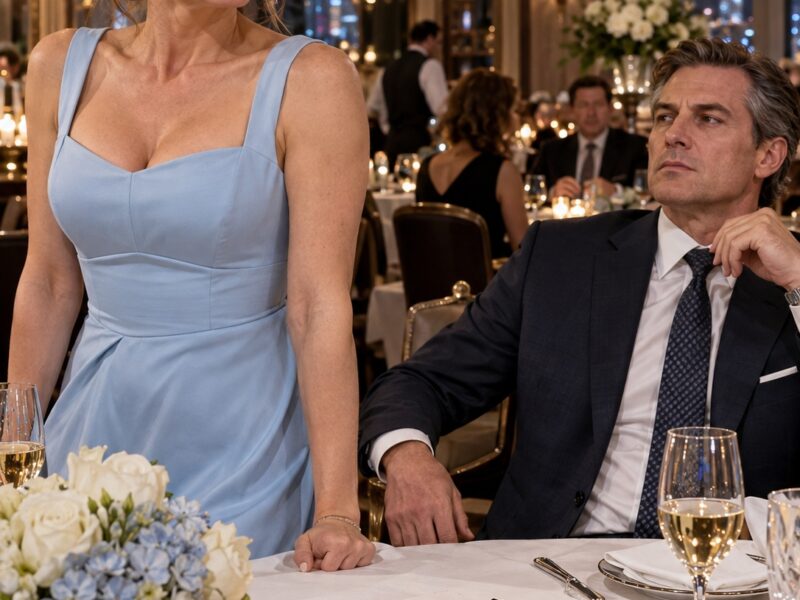
MY HUSBAND CALLED ME “REPLACEABLE” AT OUR ANNIVERSARY DINNER—SIX MONTHS LATER, HE WALKED INTO A BILLIONAIRE SUMMIT… AND SAW ME ON STAGE

The restaurant went silent before Naomi Carter understood that her marriage was over.
Not quiet.
Silent.
There was a difference.
Quiet was the low murmur of expensive conversations beneath crystal chandeliers, the soft scrape of silverware against porcelain, the muted piano drifting from somewhere near the bar.
Silence was forty strangers watching your husband hold another woman’s hand while sliding divorce papers toward you across a white linen tablecloth.
Ethan Brooks did it slowly.
Deliberately.
Almost ceremonially.
His left hand pushed the folder toward Naomi.
His right remained intertwined with Vanessa Cole’s fingers.
Naomi stared at those hands first.
That was what she would remember later.
Not Vanessa’s red dress.
Not the waiter frozen beside their table with a bottle of Bordeaux tilted awkwardly in his hand.
Not the couple two tables away pretending not to stare.
Not even Ethan’s expression.
Just those hands.
Eleven years earlier, Ethan had held Naomi’s hand in a county courthouse outside Columbus, Ohio, while promising he would never let success change the way he looked at her.
Tonight, he was using that same hand to erase her.
“Sign them,” he said.
Naomi lifted her eyes.
Ethan looked almost relieved.
Beside him, Vanessa leaned back in her chair, one manicured finger resting against the stem of her wineglass.
Naomi heard someone at another table whisper, “Oh my God.”
She wished they hadn’t.
Until that moment, she had managed to pretend the humiliation existed only at their table.
Now it had become entertainment.
“Ethan,” Naomi said quietly, “what is this?”
He gave the smallest laugh.
It was not nervous.
That somehow hurt more.
“Don’t do that.”
“Do what?”
“Make this harder than it needs to be.”
Naomi looked from him to Vanessa.
Vanessa did not look away.
That answered several questions Naomi had been too afraid to ask herself during the previous six months.
The late meetings.
The new cologne.
The phone turned facedown at dinner.
The sudden business trips requiring clothes he normally reserved for galas.
The gym membership.
The passwords.
The impatience.
The way he had recently begun looking through Naomi rather than at her.
She had noticed every sign.
She had simply kept choosing explanations that hurt less than the truth.
“This is our anniversary,” Naomi said.
“I know.”
Eleven years.
Naomi had spent the afternoon curling her hair.
She had worn the pale blue dress Ethan once told her made her look like summer.
It was older than half the suits in his closet.
She had nearly donated it twice.
Both times, she had kept it because of the memory attached to it: Ethan at twenty-nine, broke and ambitious, sitting across from her in a tiny Italian restaurant while they split one entrée because they could not afford two.
He had looked at her that night as though the entire future belonged to both of them.
Tonight, he barely glanced at the dress.
“I thought we should do this somewhere neutral,” Ethan said.
Naomi looked around.
“Neutral?”
His jaw tightened.
Vanessa shifted beside him.
Ethan lowered his voice only slightly.
“Somewhere you wouldn’t create a scene.”
For one second Naomi wondered whether she had misheard him.
Then something inside her went very still.
“You brought your mistress to our anniversary dinner because you were worried I might embarrass you?”
Vanessa inhaled sharply.
Ethan’s eyes flashed.
“Don’t call her that.”
“What would you prefer?”
“Naomi.”
“No. I genuinely want to know.”
Vanessa finally spoke.
“This isn’t helping anyone.”
Naomi turned her head.
Vanessa was thirty-two, perhaps thirty-three. Beautiful in the polished, intentional way expensive beauty often was. Her dark hair fell in deliberate waves around bare shoulders. A diamond bracelet shimmered at her wrist.
Naomi recognized it.
She had helped Ethan choose it.
Three months earlier.
He had told her it was a retirement gift for one of the firm’s senior partners.
For the first time that evening, Naomi almost laughed.
Not because anything was funny.
Because betrayal, when finally revealed in full, could be absurd in its laziness.
“That’s a beautiful bracelet,” Naomi said.
Vanessa’s hand instinctively moved toward it.
Ethan exhaled.
“Enough.”
Naomi looked back at him.
“No. I think you’ve planned this evening very carefully. You chose the restaurant. You invited her. You brought legal documents. You apparently made sure we had an audience. So I think I deserve to hear the speech you prepared.”
His expression hardened.
That expression was new.
Or perhaps it wasn’t.
Perhaps Naomi had spent years refusing to recognize it.
Ethan sat straighter.
“I’ve outgrown this marriage.”
There it was.
A sentence polished for repetition.
Naomi said nothing.
Ethan continued.
“We want different things.”
“What do I want?”
He hesitated.
Apparently that part had not been prepared.
Naomi waited.
“What do I want, Ethan?”
“You want…” He gestured vaguely. “This.”
She almost smiled.
“This restaurant?”
“You know what I mean. Comfort. Routine. Stability.”
“I thought most people considered stability a positive thing.”
“That’s not what I’m saying.”
“Then say what you’re saying.”
A muscle worked in his jaw.
Vanessa touched his forearm.
The gesture was so intimate that Naomi felt it physically.
Ethan glanced at Vanessa, and his face softened in a way Naomi had not seen directed at her in years.
Then he looked back at his wife.
“You never understood what it takes to live at the level I’m living now.”
There were moments in life when pain arrived like impact.
And there were moments when it arrived as clarity.
This was the second kind.
Naomi leaned back.
“The level you’re living at.”
“You know what I mean.”
“I don’t.”
“You don’t want the rooms I have to be in. You don’t understand networking. You don’t understand visibility. You don’t care about influence.”
Naomi stared at him.
Eleven years.
She had rewritten his first investor presentation at two in the morning because his numbers contradicted his projections.
She had spent three weekends researching the procurement regulations that saved his first major contract.
She had remembered birthdays, wives, husbands, children’s names and college applications because Ethan said he was “bad at people.”
She had coached him before negotiations.
Edited his speeches.
Called clients when he was too angry to speak without ruining relationships.
Sat in emergency rooms with employees whose names Ethan sometimes forgot.
She had even convinced one of his earliest investors not to pull out after Ethan made a reckless acquisition that nearly destroyed everything.
But she had done those things as a wife.
Quietly.
Without titles.
Without invoices.
Without witnesses.
So Ethan had apparently rewritten history until the person helping him carry the ladder had become the person holding him back.
“Go on,” Naomi said.
He did.
That would haunt him later.
At the time, however, Ethan believed her calmness meant defeat.
“Vanessa understands where I’m going.”
Naomi glanced toward her.
Vanessa lowered her eyes modestly.
Almost beautifully.
“She’s ambitious,” Ethan continued. “She’s polished. She’s comfortable in the world I’m part of now.”
“And I’m not.”
“You’ve never wanted to become more.”
That sentence landed differently.
Naomi felt something old open behind her ribs.
Not rage.
A door.
For years she had turned away from that door every time it appeared.
Tonight, her husband had walked her directly back to it.
“You think I never wanted more?”
Ethan sighed.
“Please don’t turn this into something philosophical.”
Naomi looked at him for several seconds.
Then she looked at the folder.
A pen had been clipped neatly to the top.
He had brought a pen.
Of course he had.
“Have you read these?” she asked.
“My attorney prepared them.”
“That wasn’t my question.”
His eyes narrowed.
“Yes.”
“Every page?”
“Naomi.”
“Every page?”
“I know what’s in them.”
She nodded.
Then she opened the folder.
Vanessa seemed disappointed.
Perhaps she had expected screaming.
Perhaps tears.
Perhaps a wineglass thrown against a wall.
Naomi gave her none of it.
She read.
Not every word.
She did not need to.
She had reviewed enough contracts in her life to understand structure quickly.
The property division was insulting but legal.
The penthouse would remain with Ethan.
She would receive a settlement.
No claim against his company.
No continuing financial support beyond what was already outlined.
The marriage would end cleanly.
Efficiently.
Like terminating a vendor.
Naomi reached for the pen.
For the first time, Ethan looked uncertain.
“You’re signing?”
She lifted her eyes.
“Isn’t that why you brought the pen?”
“Maybe you should have an attorney review—”
“You just said your attorney prepared it fairly.”
“Yes, but—”
“Then we agree.”
Something moved across his face.
Not regret.
Not yet.
Perhaps irritation that the scene was not unfolding according to his imagination.
Naomi signed the first page.
Then the second.
And the third.
Her signature remained steady.
Only her left thumb trembled beneath the table.
No one saw it.
She would remember that too.
The tiny betrayal of her own body.
When she finished, she closed the folder and slid it back.
Then she removed her wedding ring.
Ethan watched.
Eleven years reduced to a thin circle of platinum between her fingers.
She placed it on top of the papers.
The sound was barely audible.
A tiny metallic click.
And yet half the restaurant seemed to hear it.
Naomi stood.
Ethan stood too.
“Naomi.”
She lifted her handbag.
“What?”
His certainty had begun to flicker.
He had wanted release.
He had wanted triumph.
He had wanted Vanessa beside him while Naomi finally understood that she had lost.
Instead, Naomi looked almost frighteningly calm.
“You’re not going to say anything?”
She studied the man she had loved since she was twenty-seven.
For the first time, she saw him without history attached.
Not the young analyst eating grocery-store sandwiches at midnight.
Not the husband who once carried her barefoot across a flooded parking lot because she had broken a heel.
Not the man who held her when her mother died.
Just Ethan.
A fifty-year-old executive sitting beside a woman he had chosen as proof that he had become important.
Naomi felt her heart break.
But heartbreak, she discovered, did not always feel like collapsing.
Sometimes it felt like standing up.
“I hope tonight is everything you wanted,” she said.
Vanessa gave a faint, triumphant smile.
Naomi noticed.
Then she added, “Because one day, Ethan, you’re going to remember this as the happiest night of your life.”
He frowned.
“What’s that supposed to mean?”
Naomi slipped the strap of her handbag over her shoulder.
“It means someday you’ll understand exactly what you threw away.”
She walked toward the door.
No one stopped her.
Outside, Columbus was cool and dark.
The restaurant windows glowed behind her.
Naomi reached the curb before her breath broke.
She pressed one hand against her stomach.
Eleven years.
Gone.
She had known for months something was wrong.
But knowing a storm existed somewhere over the horizon was different from standing inside it.
Her phone began ringing.
Naomi ignored it.
It rang again.
She looked down.
Unknown number.
New York area code.
She nearly declined.
Then something—a strange instinct, an old reflex—made her answer.
“Hello?”
A man’s voice came through the speaker.
Older.
Steady.
Familiar enough to reach across nearly fifteen years.
“Naomi Carter?”
Her knees almost weakened.
She had not heard that voice in nearly a decade.
“Charles?”
A pause.
Then Charles Kingston said, “I heard what happened.”
Naomi turned slowly toward the restaurant.
Through the glass, she could see Ethan leaning toward Vanessa.
Vanessa was laughing.
Charles spoke again.
“I only have one question.”
Naomi swallowed.
“What?”
“Are you finally ready to come home?”
The line went quiet.
So did the world around her.
And somewhere beneath the devastation of her marriage, something Naomi had buried for fifteen years opened its eyes.
Ethan expected Naomi to call the next morning.
She did not.
He expected lawyers.
Emotional messages.
Questions.
Accusations.
Nothing came.
By the third day, her silence irritated him more than anger would have.
“Maybe she’s finally being mature about it,” Vanessa said.
They were standing in the penthouse kitchen while movers carried boxes from Naomi’s old office downstairs.
Ethan poured coffee.
“She was always mature.”
Vanessa looked at him.
He corrected himself.
“Too mature.”
“What does that mean?”
“It means she could make you feel like the unreasonable one without saying anything.”
Vanessa laughed.
“Sounds exhausting.”
Ethan smiled.
But the joke stayed with him.
That afternoon, his assistant told him Naomi had arranged for a service to collect the rest of her personal belongings.
“She isn’t coming herself?”
“No.”
“Did she leave an address?”
“No.”
Ethan frowned.
“Where is she living?”
His assistant looked uncomfortable.
“I assumed you knew.”
He didn’t.
That bothered him too.
For eleven years, Ethan had considered himself the center of Naomi’s private world.
Now he realized he had no idea where she went when she left his.
Naomi spent her first week after the divorce in an apartment on the north side of Columbus.
It was small.
Quiet.
Paid for.
Ethan had never seen it.
Naomi bought it nine years earlier after receiving money from the sale of her mother’s house.
She had told herself it was an investment property.
That was partly true.
But some instinct she never examined too closely had also wanted one thing that remained entirely hers.
A place with no Ethan attached.
No Brooks company mail.
No photographs chosen for appearances.
No rooms designed to impress investors.
Just Naomi.
On the first night, she sat on the floor because most of the furniture had been covered in sheets for years.
She drank tea from a chipped mug that had belonged to her mother.
Then she cried until three in the morning.
Not gracefully.
Not quietly.
She cried for the anniversary dinner.
For the bracelet.
For the divorce papers.
For the eleven years.
But more than anything, Naomi cried for all the small versions of herself she had abandoned along the way.
At twenty-six she had been fearless.
At twenty-eight she had been ambitious.
At thirty-one she had begun saying, “Ethan’s work is demanding.”
At thirty-five she had begun calling his achievements “ours” even when his colleagues called them his.
At thirty-nine she stopped correcting people who assumed she had never really had a career.
By forty-two she sometimes introduced herself simply as Ethan Brooks’s wife because explaining anything else required telling a story she no longer knew how to tell.
At forty-three, sitting on an apartment floor in the dark, Naomi asked herself a question she had avoided for years.
Where had she gone?
The next morning she opened the closet.
Behind a row of winter coats sat a small wall safe.
Naomi entered a code.
Inside were documents she had not touched in years.
An old diplomatic passport from overseas consulting work.
Share certificates.
Letters.
A photograph of Naomi at twenty-six standing beside Charles Kingston outside a glass tower in Manhattan.
She looked young.
Not happier.
Sharper.
The woman in the photograph seemed to be looking directly at her.
Naomi picked up the first letter.
The paper had yellowed slightly.
Charles’s handwriting remained unmistakable.
If the day ever comes when you are ready to build something of your own again, call me.
She sat down.
Then her phone rang.
Charles.
“You disappeared,” he said.
“I needed a few days.”
“Good.”
She almost smiled.
“You don’t sound offended.”
“I’m seventy-three, Naomi. I no longer have enough time left to be offended when intelligent people take time to think.”
She closed her eyes.
“How did you know?”
“About Ethan?”
“Yes.”
“People talk.”
“Charles.”
He sighed.
“One of my directors was at the restaurant.”
Naomi covered her face.
“Wonderful.”
“He wanted to intervene.”
“I’m glad he didn’t.”
“So am I.”
She lowered her hand.
“Why?”
“Because according to him, you didn’t need rescuing.”
The words landed softly.
Naomi looked toward the photograph.
Charles continued.
“I meant what I said.”
“I know.”
“Do you?”
“I remember.”
“Then you also remember why I offered.”
Naomi did.
Fifteen years earlier, Kingston Global had been in the middle of an acquisition when Naomi, then a junior financial analyst working for an advisory firm, found irregularities in a series of overseas accounts.
Her supervisor told her to stop asking questions.
She didn’t.
A senior partner told her mistakes happened during large transactions.
Naomi proved they were not mistakes.
Someone offered her money.
She refused.
Someone suggested her career could become extremely difficult.
She kept digging.
The scheme involved falsified liabilities large enough to cost Kingston Global hundreds of millions.
Naomi assembled the evidence, ignored every person telling her she was too junior to understand what she was looking at, and asked for a private meeting with Charles Kingston.
She expected fifteen minutes.
Charles gave her three hours.
Three months later, several executives were gone.
A criminal investigation had begun.
And Charles Kingston offered Naomi a future almost no twenty-six-year-old analyst would have been foolish enough to refuse.
Senior strategy.
Direct access to him.
Equity.
International leadership.
A path toward succession.
Naomi refused.
Not because she lacked ambition.
Because she had recently met Ethan.
Because she wanted children.
Because her mother had spent Naomi’s entire childhood working three jobs to keep four children fed, and Naomi had promised herself her own family would feel different.
Life, however, rarely honored plans exactly as people made them.
The children never came.
Two miscarriages did.
Then work consumed Ethan.
Then another year passed.
Then another.
By the time Naomi understood that the family she had sacrificed her career to build would never look the way she imagined, she had already become indispensable to her husband’s dreams.
So she stayed.
And stayed.
And stayed.
“Naomi?” Charles said.
“I’m here.”
“I won’t ask you to decide today.”
“I already decided.”
Silence.
“What did you say?”
She looked at the letters.
Then at the apartment around her.
Then at the pale indentation on her ring finger.
“I’m ready.”
Charles inhaled slowly.
“Are you sure?”
For the first time since the restaurant, Naomi smiled.
“You’ve been asking me that question for fifteen years.”
“And?”
“Send me the contract.”
Charles laughed.
It was the same warm, surprised laugh she remembered.
“No.”
“No?”
“Come to New York.”
“When?”
“Monday.”
“That’s six days away.”
“You always worked better under pressure.”
Naomi looked at the open safe.
Something inside her chest tightened.
Not fear.
Recognition.
“Charles?”
“Yes?”
“What exactly are you offering me?”
His answer changed everything.
“I’m not offering you a job.”
Naomi stood very still.
“I’m offering you the company you should have been helping me run fifteen years ago.”
Three months after the divorce, Ethan Brooks was happier than he had been in years.
At least that was what he told everyone.
He bought a silver Aston Martin.
Vanessa moved into the penthouse.
The cream sofa Naomi chose was replaced by a black Italian sectional Vanessa saw online.
The framed photograph from Ethan and Naomi’s tenth anniversary disappeared.
So did Naomi’s books.
Her ceramic bowls.
Her mother’s antique clock.
Vanessa redesigned the primary bedroom before the divorce was officially finalized.
“It’s healthier,” she told Ethan.
“What is?”
“Not living in someone else’s museum.”
He did not mention that almost everything in the penthouse had been chosen by Naomi because he never had time to choose anything himself.
Instead, Ethan kissed Vanessa’s temple.
“Do whatever you want.”
She did.
That eventually became the problem.
Vanessa had spent nine years in corporate communications.
She understood branding.
She understood rooms.
She understood how to make important men feel interesting.
What she did not understand was Ethan’s business.
That didn’t prevent her from becoming increasingly interested in running it.
At first, her involvement seemed harmless.
A suggestion about social media.
A new company photographer.
An expensive redesign of the executive floor.
Then she began attending meetings.
“Why is she here?” Martin Shaw, Ethan’s operations director, asked before a quarterly strategy session.
Ethan looked up from his laptop.
“Vanessa has good instincts.”
Martin glanced through the glass wall toward Vanessa.
“About logistics?”
“About people.”
“We’re negotiating freight capacity.”
Ethan closed the laptop.
“Is there a problem?”
Martin hesitated.
He had worked with Ethan for nine years.
He remembered a version of Ethan who listened when people disagreed with him.
That man appeared less frequently now.
“No.”
“Good.”
Vanessa joined the meeting.
Forty minutes later, she interrupted the chief financial officer to suggest that one of the company’s oldest clients was “not aligned with the image Ethan should project anymore.”
The room went still.
Ethan laughed.
No one else did.
That client represented fourteen percent of annual revenue.
Two weeks later, the client requested a contract review.
A month later, they cut their business by half.
Ethan blamed the market.
Martin did not.
Neither did the CFO.
Neither did the six senior managers who quietly began answering recruiters’ calls.
Naomi, meanwhile, was waking every morning at 5:15 in a hotel overlooking Manhattan.
Her first week at Kingston Global nearly broke her.
Not because she lacked ability.
Because ability had memory.
And hers had been neglected.
On her first morning, Charles handed her a four-hundred-page briefing packet for Kingston Capital’s international expansion.
“Read it.”
“When do you need my thoughts?”
“Nine.”
Naomi looked at the clock.
It was 7:40.
She looked back at Charles.
“You’re still cruel.”
“I’m testing whether marriage made you slow.”
At 8:57 Naomi entered his office.
At 9:03 Charles stopped smiling.
At 9:40 he canceled his next appointment.
By 11:15 three division heads had been called into the conference room.
Naomi had found two structural risks no one else had identified and one opportunity worth potentially hundreds of millions.
At noon, Charles ordered lunch.
Naomi did not touch hers.
At 1:30 he pushed the plate toward her.
“Eat.”
“I’m thinking.”
“You were impossible at twenty-six too.”
“Then why did you bring me back?”
“Because everyone else is predictable.”
Naomi finally took a bite.
Charles watched her.
“What?”
“You’ve changed.”
“Of course I have.”
“No.”
He leaned back.
“You’ve become quieter.”
She laughed once.
“My husband liked quiet.”
Charles’s expression cooled.
“Your husband was an idiot.”
“Ex-husband.”
“Even better.”
Naomi looked down.
Charles saw it.
The pain.
Still alive.
Still fresh.
“Success won’t fix what he did,” he said.
“I know.”
“Good.”
“I’m not here to punish Ethan.”
“Good.”
“I mean it.”
Charles nodded.
“I believe you.”
Naomi met his eyes.
“Do you?”
“Yes. Revenge is inefficient.”
That made her laugh.
Charles pointed at her with his fork.
“There. That woman. I remember her.”
Naomi’s smile faded.
“So do I.”
Within six weeks, other people began remembering her too.
Not Naomi Brooks.
Not Ethan’s wife.
Naomi Carter.
She walked into negotiations prepared better than anyone in the room.
She listened longer than anyone expected.
And when she finally spoke, people stopped interrupting.
Her first major assignment involved a European expansion Kingston had failed to close for nearly three years.
The team expected Naomi to spend months learning the relationship.
She closed the preliminary agreement in seventeen days.
Charles asked how.
“They don’t trust us.”
“We know that.”
“No. You know they don’t trust the terms. They don’t trust our people.”
“What’s the difference?”
“About three hundred million dollars.”
She flew to Zurich.
She met the founder without lawyers.
Without presentations.
Without the twelve-person delegation Kingston normally used.
She asked about his father.
His succession plans.
The reason his oldest daughter had left the company.
Charles read the signed agreement three weeks later and shook his head.
“What did you promise him?”
“Nothing.”
“Then why did he agree?”
“I listened.”
Charles stared at her.
Then he laughed.
“Ethan really was an idiot.”
Naomi did not laugh that time.
Because in an uncomfortable way, Charles was wrong.
Ethan had not discarded a brilliant executive.
He had discarded the person Naomi had allowed herself to stop becoming.
That distinction mattered.
She would not build her new life around proving him wrong.
She would build it around finally refusing to disappear.
The first warning Ethan received arrived on a Tuesday at 8:06 a.m.
His largest logistics partner had been acquired.
Kingston Global.
He skimmed the announcement while walking toward the elevator.
The name meant little to him beyond scale.
Kingston was old money.
Institutional money.
The kind of company that could purchase a midsized firm without changing its quarterly forecast.
“Should we be concerned?” Martin asked.
Ethan pressed the elevator button.
“No.”
“They’ll probably review every major contract.”
“Good. Ours is favorable.”
“Very favorable.”
Ethan turned.
“And?”
Martin chose his words carefully.
“Maybe too favorable.”
Ethan smiled.
“That’s called negotiating.”
The elevator opened.
He stepped inside.
Three weeks later, Kingston terminated the agreement.
Ethan read the letter twice.
Then a third time.
“Strategic realignment?” he snapped.
His CFO remained silent.
“What does that even mean?”
Martin sat across the conference table.
“It means they’re walking.”
“They can’t.”
“They can.”
“We’ve had this relationship for seven years.”
“Kingston owns them now.”
Ethan threw the document onto the table.
“Call whoever approved this.”
“We tried.”
“And?”
“The decision came from the executive level.”
“Who?”
“We don’t know.”
Ethan looked around.
Twelve executives avoided his eyes.
Something cold moved through him.
“Find out.”
Martin nodded.
As the meeting ended, Vanessa entered carrying two coffees.
She wore sunglasses inside.
“Bad morning?”
Ethan stared at her.
“We just lost Franklin Logistics.”
Vanessa removed her glasses.
“The company with the ugly orange trucks?”
Martin stopped walking.
Ethan looked at him.
Martin looked away.
“Yes,” Ethan said tightly. “The company with the ugly orange trucks.”
Vanessa handed him coffee.
“Find another one.”
Martin left before his expression could betray him.
Ethan watched the door close.
He told himself Martin was becoming negative.
He told himself the employees were resistant to change.
He told himself losing Franklin was temporary.
What he did not tell himself was that Naomi once warned him never to allow one logistics relationship to become irreplaceable.
He had laughed.
“That’s what contracts are for.”
She had looked at him over her reading glasses.
“Contracts protect terms, Ethan. They don’t protect dependency.”
He had forgotten that conversation.
Until now.
Over the following month, the damage spread.
Shipping costs increased.
Margins shrank.
A delayed order cost them a major account.
Two banks requested updated financial statements.
A senior vice president resigned.
Then another.
Martin gave notice on a Thursday.
Ethan closed his office door.
“Is Vanessa why you’re leaving?”
Martin looked tired.
“No.”
“Then what?”
“You don’t listen anymore.”
Ethan’s face hardened.
“I listen.”
“You wait for people to stop talking.”
“That’s ridiculous.”
“Is it?”
Ethan stood.
Martin remained seated.
Ten years earlier, he would never have done that.
“Say whatever you came here to say.”
Martin nodded.
“Fine. Naomi used to tell you when you were wrong.”
Ethan froze.
Martin continued.
“She did it carefully. Usually before anyone else saw the mistake. And you listened because she knew how to make you think you came to the conclusion yourself.”
“Don’t bring my ex-wife into my company.”
“That’s exactly the problem.”
“What is?”
“You think she wasn’t part of this company.”
Ethan stared at him.
Martin stood.
“You want to know when things started changing here? It wasn’t when Franklin left. It wasn’t when Vanessa started sitting in meetings. It was when Naomi stopped walking into this building.”
“Get out.”
Martin nodded.
“I already am.”
The door closed.
Ethan stood alone.
For several seconds he could hear nothing but the air conditioner.
Then he looked toward the empty chair beside his desk.
Naomi used to sit there.
Not often.
Just occasionally in the evenings when she brought dinner.
She would read while he worked.
Sometimes she would ask one question.
Only one.
A question that would irritate him.
Then keep him awake.
Then save him money.
Ethan turned away.
He refused to think about it.
That night, Vanessa hosted twelve people at the penthouse.
Champagne.
Music.
A private chef.
Ethan stood at the window looking over the city while people laughed behind him.
Vanessa wrapped her arms around his waist.
“You’re brooding.”
“I’m thinking.”
“Same thing, but less attractive.”
He pulled away.
She noticed.
“Okay.”
“Sorry.”
“What’s going on?”
“Work.”
“Again?”
“Yes, Vanessa. Again.”
Her expression changed.
“Don’t talk to me like I’m one of your employees.”
“Then stop inserting yourself into company decisions.”
The room behind them seemed suddenly too close.
Vanessa lowered her voice.
“Excuse me?”
“You don’t understand the business.”
“Oh.”
“That’s not an insult.”
“It sounded like one.”
“I’m losing senior people.”
“And that’s my fault?”
“I didn’t say that.”
“You implied it.”
Ethan rubbed his forehead.
Vanessa stepped back.
“Maybe Naomi trained you to think a wife is supposed to sit quietly and worship your career.”
The name hit him harder than it should have.
“Don’t.”
“What?”
“Use her to win an argument.”
Vanessa laughed incredulously.
“You humiliated her in public.”
Ethan stared at her.
She realized what she had said.
Something passed between them.
A truth too ugly to examine.
Vanessa picked up her wine.
“I’m going back to our guests.”
She walked away.
Ethan remained at the window.
For the first time, the penthouse did not feel new.
It felt borrowed.
Naomi met Marcus Hill in a conference room in Manhattan on a rainy Wednesday afternoon.
He was thirty-nine, founder and CEO of an infrastructure technology company Kingston was considering investing in.
He arrived six minutes early.
Naomi noticed.
He noticed that she noticed.
“Naomi Carter?”
“Marcus Hill.”
He shook her hand.
“I’ve heard about you.”
“That’s unfortunate.”
He smiled.
“Not the response I expected.”
“Most reputations become less useful the moment people start believing them.”
Marcus looked at Charles, who stood near the window.
“Does she always talk like this?”
Charles said, “It gets worse.”
They negotiated for three hours.
Marcus disagreed with Naomi repeatedly.
Naomi liked him immediately for it.
Not romantically.
Not then.
She liked competent people.
Competence had become almost seductive after years of watching Ethan replace preparation with confidence.
At one point Marcus challenged a valuation model.
Naomi slid a spreadsheet toward him.
“Page six.”
He read it.
Paused.
Then looked up.
“I withdraw my objection.”
Charles nearly fell out of his chair.
Marcus frowned.
“What?”
“I haven’t heard a chief executive say that sentence in twenty years.”
Marcus shrugged.
“Being wrong is expensive. Pretending not to be is more expensive.”
Naomi held his gaze for half a second longer than necessary.
Something in that sentence stayed with her.
They closed the deal four weeks later.
Three months after that, Marcus’s company became one of Kingston Capital’s most successful investments.
Trade publications began asking questions about Naomi.
Who was she?
Where had she come from?
Why had Charles Kingston suddenly placed a previously unknown executive in control of billions?
Naomi declined most interviews.
She accepted no lifestyle profiles.
No glossy photo shoots.
No stories about divorce.
Charles approved.
“Mystery increases market value.”
“I’m a person, Charles.”
“Unfortunately.”
She rolled her eyes.
But financial circles began talking.
A woman had appeared at Kingston.
Brutally prepared.
Quiet.
Strategic.
Impossible to intimidate.
One article called her “Kingston’s hidden architect.”
Ethan scrolled past that headline one night without opening it.
He was too busy reading an email from his bank.
His credit line was being reviewed.
Vanessa sat across from him at the dining table, scrolling through vacation rentals in St. Barts.
“What about this one?”
He did not answer.
“Ethan?”
“No vacation.”
She looked up.
“What?”
“We’re not going.”
“We already invited everyone.”
“Cancel.”
Her face hardened.
“Because of work?”
“Because I don’t have time.”
“Or money?”
Ethan slowly lifted his eyes.
Vanessa set down her phone.
“I’ve seen the accounts.”
“You had no right.”
“I live here.”
“That doesn’t give you access to company financials.”
“It gives me the right to know if our lifestyle is about to collapse.”
“Our lifestyle?”
She leaned back.
“Don’t do that.”
“Do what?”
“Act like I said something terrible.”
“You said our lifestyle.”
“So?”
“Nothing.”
He looked back at the email.
Vanessa stared at him.
For one strange second, Ethan remembered Naomi sitting at this same table during the financial crisis eight years earlier.
They had less money then than he had now.
He had been terrified.
Naomi made spaghetti.
They ate from chipped bowls.
She opened his laptop and said, “Okay. Show me the worst number first.”
He showed her.
She stayed up until sunrise.
By the following week they had a plan.
Vanessa stood.
“I’m going out.”
“Where?”
“I don’t know.”
“With whom?”
She laughed.
“Now you care?”
The door slammed twenty seconds later.
Ethan remained at the table.
On his screen was the banking notice.
Beside it sat an empty chair.
And for reasons he could not explain, that empty chair frightened him more.
The name first reached Ethan during a phone call with an investment banker.
“Kingston’s new restructuring strategy is aggressive,” the banker said. “Carter is moving quickly.”
Ethan leaned back.
“Carter?”
“Naomi Carter.”
His hand stopped.
“What did you say?”
“Naomi Carter. Kingston Capital.”
Ethan’s mouth went dry.
“Who is she?”
The banker laughed.
“That’s the billion-dollar question.”
“How old?”
“Forties, maybe. Why?”
“No reason.”
After the call, Ethan searched the name.
Results appeared.
Most carried no photographs.
One showed a woman from a distance leaving a hotel in Geneva.
Another mentioned negotiations in Singapore.
Another quoted Charles Kingston praising “one of the most disciplined strategic minds I have encountered.”
Ethan enlarged the grainy photograph.
The angle was wrong.
The face partly obscured.
Impossible.
Naomi hated flying.
Didn’t she?
He tried to remember.
Or had she simply stopped traveling because he traveled so much?
He closed the browser.
Ridiculous.
There were millions of Carters.
Thousands of Naomis.
The world was full of coincidences.
Three nights later, Ethan left a private club downtown after another unsuccessful meeting with potential investors.
Rain had darkened the pavement.
A black Rolls-Royce waited across the street.
A woman exited the club’s side entrance with two men.
Ethan barely noticed.
Then she turned.
Not enough for him to see her face.
Enough for him to recognize how she tucked loose hair behind her ear.
His heart stopped.
“Naomi?”
Traffic drowned his voice.
The driver opened the car door.
The woman entered.
The Rolls-Royce disappeared into traffic.
Ethan stood on the sidewalk for nearly a minute.
The next morning he hired a private investigator.
He told himself he needed certainty.
Five days later, certainty arrived in a gray envelope.
Ethan opened it alone.
The first page contained a photograph.
Naomi.
No pale blue dress.
No quiet cardigan.
No wedding ring.
She wore a charcoal suit and stood beside Charles Kingston outside a financial conference in London.
Under the photograph:
NAOMI CARTER
CHIEF EXECUTIVE OFFICER
KINGSTON CAPITAL
Ethan read it twice.
Then laughed.
An involuntary sound.
“No.”
He turned the page.
Corporate filings.
Appointments.
Transactions.
Board membership.
Equity.
An estimated personal stake worth more than everything Ethan had built in two decades.
“No.”
Another page.
Naomi’s professional history before their marriage.
Her work with Kingston.
The accounting investigation.
Charles’s original offer.
The relationship predated Ethan by nearly two years.
Ethan lowered the report.
The office seemed suddenly too small.
He called the investigator.
“Where did you get this?”
“Public records, industry sources and filings.”
“This isn’t right.”
“Which part?”
“She wasn’t an executive.”
“Not during your marriage, no.”
“She never told me any of this.”
The investigator was silent.
Ethan hated the silence.
“What?”
“Nothing.”
“Say it.”
“It’s outside the scope of what you hired me to do.”
“Say it.”
The man hesitated.
“Some of this information wasn’t particularly difficult to find.”
Ethan gripped the phone.
“What are you implying?”
“I’m not implying anything.”
But he was.
Ethan hung up.
He sat alone until after dark.
Then memories began returning.
Not dramatically.
One at a time.
Naomi finding a mathematical error in a financing model when his CFO missed it.
Naomi warning him that a distributor was lying.
Naomi rewriting a presentation after saying, “You haven’t explained why anyone should trust you.”
Naomi predicting that an acquisition would fail.
He ignored her.
It failed.
Naomi quietly repairing the client relationship afterward.
How many times had he called her lucky?
How many times had he taken her insight into the office and presented it as his own?
Not maliciously.
That was the defense his mind offered.
He had not stolen from her intentionally.
He had simply stopped noticing where his ideas ended and hers began.
Which was worse?
His phone rang.
Vanessa.
He ignored it.
He found an old message thread with Naomi.
Seven years earlier.
Ethan: Client is threatening to leave.
Naomi: Call him. Don’t email.
Ethan: What do I say?
Naomi: Ask what you did wrong.
Ethan: I didn’t do anything wrong.
Naomi: Then enjoy losing the client.
Ethan stared.
He scrolled.
More messages.
Warnings.
Ideas.
Edits.
Introductions.
Reminders.
He had built an entire mythology around himself while evidence of Naomi’s invisible labor sat in his phone.
A knock came at his door.
Vanessa entered without waiting.
“Why are you ignoring me?”
Ethan did not look up.
“What?”
She saw the report.
Then the photograph.
Her face changed.
“Is that Naomi?”
He looked at her.
“You knew she was smart.”
Vanessa crossed her arms.
“Of course she was smart.”
“No.”
His voice was strange.
“You knew.”
“Everyone knew.”
The room tilted.
“What does that mean?”
Vanessa laughed uneasily.
“Ethan, come on.”
“No. Explain.”
“Your employees talked about her.”
“What did they say?”
“That she basically helped build the company.”
Ethan stood so quickly his chair struck the wall.
“And you never told me?”
Vanessa stared.
“You were married to her.”
The words landed like a slap.
“You were married to her, Ethan. Why would I know your wife better than you did?”
He had no answer.
Vanessa looked again at the photograph.
“She’s… CEO of Kingston?”
“Yes.”
“How?”
“Apparently by being everything I told her she wasn’t.”
Vanessa’s eyes flickered.
He saw calculation.
Fear.
Something else.
“You knew about the logistics acquisition?” she asked.
Ethan looked at her.
“No.”
“Did she do that?”
“I don’t know.”
Vanessa took a step back.
“Oh my God.”
“She didn’t sabotage us.”
“You don’t know that.”
“I know her.”
Vanessa gave him a look so sharp it almost made him flinch.
“Do you?”
Silence.
Then she left.
Two weeks later, Vanessa left for good.
No dramatic confrontation.
No restaurant.
No audience.
Ethan returned from a meeting with the bank and found half the closet empty.
A note sat on the kitchen counter.
I didn’t sign up to drown because you refuse to admit the ship is sinking.
He read it once.
Then folded it.
He did not call her.
Perhaps because part of him understood the irony too clearly.
Vanessa had loved the version of Ethan standing at the top.
She had never promised to love the man falling down.
Naomi had.
Once.
And he had called her replaceable.
Six months after the anniversary dinner, the National Chief Executive Summit filled one of Manhattan’s largest convention halls.
Ethan almost did not attend.
His company was days away from violating another lending covenant.
He needed money.
Investors.
A miracle.
The summit offered access to all three.
So he went.
His badge no longer carried the same weight.
People who once waved him over now nodded politely and looked elsewhere.
A billionaire retail founder Ethan had played golf with twice excused himself after less than three minutes.
A venture capitalist promised to “circle back.”
Everyone knew what that meant.
Ethan carried a folder containing revised projections.
He had rewritten them himself.
For the first time in years.
They were terrible.
Around noon, energy shifted through the building.
People began moving toward the main auditorium.
“What’s happening?” Ethan asked an acquaintance.
“Kingston announcement.”
“What announcement?”
The man looked surprised.
“You haven’t heard?”
Ethan’s stomach tightened.
“Heard what?”
“Charles Kingston’s naming his successor.”
Ethan already knew.
Or perhaps some part of him did.
Still, he followed the crowd.
The auditorium held thousands.
Ethan found a seat near the back.
Onstage, a massive screen displayed the Kingston Global logo.
Music faded.
Charles Kingston walked out.
The room rose.
Ethan remained seated for half a second before standing with everyone else.
Charles spoke for nearly ten minutes.
About markets.
Legacy.
Leadership.
Then he stopped.
“I’m seventy-three years old,” he said. “Which means I’ve finally reached the age when people assume wisdom has replaced stubbornness.”
Laughter.
Charles smiled.
“They’re wrong.”
More laughter.
Then his tone changed.
“Fifteen years ago, a twenty-six-year-old analyst entered my office carrying evidence that several people more powerful than she was had told her to ignore.”
Ethan stopped breathing.
“She had every reason to protect herself. Instead, she protected a company she did not own, employees she did not know and a reputation that was not hers.”
The room quieted.
“I offered her a future here.”
Charles paused.
“She chose another future.”
Ethan stared at the stage.
“Years passed. I believed the door had closed.”
Charles smiled faintly.
“I was wrong.”
The screen changed.
Naomi’s face appeared thirty feet tall.
Ethan’s folder slipped from his knees.
Around him, people began applauding.
Charles continued.
“In six months, she has overseen the strongest international expansion in our company’s modern history. She has restructured our capital division, secured strategic partnerships across three continents and reminded an old man that patience occasionally produces better returns than pressure.”
The applause grew.
Ethan could not move.
“Please welcome the next chairwoman of Kingston Global.”
Charles turned.
“Naomi Carter.”
The auditorium rose.
Everyone.
Thousands of people.
Chief executives.
Investors.
Founders.
Politicians.
People Ethan had spent twenty years trying to impress.
All standing.
For her.
Naomi walked onto the stage wearing deep emerald.
She did not look shocked by the applause.
She did not look intoxicated by it.
She looked exactly as she had looked while signing divorce papers.
Calm.
Steady.
Entirely in possession of herself.
Marcus Hill walked a few steps behind her.
He shook Charles’s hand and moved aside.
Naomi embraced Charles.
Then she faced the auditorium.
Her eyes moved across the crowd.
For one impossible second, Ethan thought they found him.
Perhaps they did.
Perhaps they didn’t.
Naomi gave no sign.
She approached the podium.
The applause slowly faded.
“Thank you,” she said.
Her voice filled the room.
Ethan had heard that voice every day for eleven years.
He had never truly listened to it.
“There is a particular danger in being underestimated for too long.”
A few people leaned forward.
“You can begin to mistake other people’s limited imagination for evidence about your own limitations.”
Ethan closed his eyes.
Naomi continued.
“Sometimes the hardest thing we build is not a company. It is the courage to stop asking permission to become the person we already know we can be.”
Silence.
“Many of you in this room know what it is to work without recognition. To solve problems no one sees. To hold systems together while someone else stands beneath the spotlight.”
Ethan opened his eyes.
Naomi was looking somewhere above the audience now.
Not at him.
At everyone.
“Do the work anyway.”
Applause began, then stopped when she lifted one hand.
“But do not confuse humility with disappearance.”
The words cut deeper than accusation.
“Humility means you do not need applause to know the value of your work. Disappearance means allowing someone else to convince you that the work has no value unless they approve of it.”
Ethan’s throat tightened.
“I learned the difference late.”
A small smile.
“But not too late.”
The room erupted.
Ethan stood with everyone else.
He clapped.
What else could he do?
No one around him knew he had once been married to her.
No one knew he had called her unambitious.
Unpolished.
Replaceable.
No one knew the chairwoman of Kingston Global had once reminded him to bring an umbrella, packed snacks for his flights and spent Sunday evenings checking the commas in his investor letters.
He slipped out before the speech ended.
In the corridor outside, he leaned against a wall.
For the first time since his company began collapsing, Ethan understood something.
He did not lose Naomi when she became powerful.
He lost her when he decided her power did not count because it was being used for him instead of herself.
And there was no bankruptcy court in the world that could restructure that debt.
It took Ethan eight days to ask for a meeting.
Naomi declined.
He asked again.
Declined.
A former investor finally called Marcus Hill.
Marcus brought it to Naomi reluctantly.
“He says he wants fifteen minutes.”
“No.”
“That’s what I said.”
Naomi signed a document.
Marcus remained standing.
She looked up.
“What?”
“I think you should see him.”
“Why?”
“Not for him.”
Naomi set down her pen.
Marcus leaned against the chair opposite her desk.
“You’ve spent six months proving you don’t need him.”
“I wasn’t proving anything to Ethan.”
“I know.”
“Then why should I waste fifteen minutes?”
Marcus considered.
“Because there are conversations we avoid because they’re finished, and conversations we avoid because some part of us is afraid they aren’t.”
Naomi stared.
“That sounded suspiciously like therapy.”
“My sister’s a therapist.”
“That explains several things.”
He smiled.
Naomi looked toward the Manhattan skyline.
“Fifteen minutes.”
“Want me nearby?”
“No.”
“Security?”
“It’s Ethan, not organized crime.”
Marcus raised an eyebrow.
“Some CEOs are worse.”
Naomi laughed.
Two days later, Ethan arrived.
His suit fit differently.
Not physically.
Psychologically.
Confidence had once worn Ethan better than tailoring.
Now the expensive jacket looked like armor borrowed from someone larger.
Naomi stood behind her desk when he entered.
For several seconds neither spoke.
“Hi,” Ethan said.
“Hello.”
He looked around.
Floor-to-ceiling windows.
Art.
Books.
The city.
Then back at her.
“You look…”
He stopped.
Naomi waited.
“Happy.”
That surprised her.
“Most men would have said successful.”
“I’ve spent too much time making that mistake.”
She gestured toward the chair.
He sat.
Naomi remained standing for another moment before taking her seat.
“You asked for fifteen minutes.”
Ethan nodded.
“I won’t waste them.”
He immediately did.
For nearly two minutes he said nothing.
Then he laughed softly at himself.
“I rehearsed this.”
“I assumed you would.”
“Six versions.”
“That also sounds like you.”
He looked at her.
A trace of their old life passed between them.
Painful because it was familiar.
“I was cruel.”
Naomi said nothing.
“I could explain why.”
“You could.”
“Vanessa. Ego. Success. Fear. Midlife crisis. Whatever label makes it sound complicated enough that I don’t have to call it what it was.”
“And what was it?”
He swallowed.
“Arrogance.”
Naomi leaned back.
Ethan continued.
“I thought loving me meant you were less ambitious.”
Her expression shifted slightly.
“I thought because you helped me instead of competing with me, you didn’t have anything of your own.”
He looked down.
“I thought your quietness meant you needed me.”
Naomi spoke softly.
“You needed it to mean that.”
He nodded.
“Yes.”
“Why?”
“Because if you were choosing me rather than depending on me, then I had to be worthy of the choice.”
He lifted his eyes.
“And somewhere along the way, I stopped being worthy.”
The honesty unsettled her more than excuses would have.
Ethan’s voice broke slightly.
“I found out about Kingston.”
“I assumed you had.”
“I hired someone.”
A faint smile touched her mouth.
“Of course you did.”
“I should’ve just asked you fifteen years ago.”
“Yes.”
“Why didn’t you tell me?”
There it was.
The question.
Naomi had considered it many nights.
At first she blamed Ethan.
Then herself.
Eventually the answer became less convenient.
“I did.”
He frowned.
“No, you didn’t.”
“Not the whole story.”
“Then—”
“But I told you I used to work in finance.”
“I knew that.”
“I told you Charles Kingston once offered me a position.”
Ethan’s face changed.
A memory.
Naomi saw it arrive.
A tiny apartment.
Takeout food.
Two young people sitting cross-legged on the floor.
Naomi saying, I once had this crazy offer in New York.
Ethan laughing.
Something about people exaggerating old opportunities.
He covered his mouth.
“Oh God.”
“You said every twenty-something analyst thinks they’re going to run Wall Street.”
Ethan closed his eyes.
“I said that?”
“You did.”
“I’m sorry.”
“I know.”
“No. You don’t understand.”
“I understand perfectly.”
“I spent eleven years assuming you were ordinary because I never stayed quiet long enough to discover you weren’t.”
Naomi’s expression cooled.
“Ethan.”
He stopped.
“Don’t do that.”
“What?”
“Don’t turn this into another version of the same mistake.”
He looked confused.
“You didn’t fail me because I secretly had the potential to become wealthy or powerful.”
Naomi leaned forward.
“You failed me when you believed I deserved less respect because you thought I didn’t.”
He stared.
“If I had left that restaurant and spent the rest of my life working at a bookstore, what you did would still have been cruel.”
His eyes lowered.
“If I had never met Charles Kingston, I would still have been worthy of being treated with dignity.”
“I know.”
“Do you?”
“Now I do.”
Naomi nodded slowly.
“Good.”
Ethan looked toward the windows.
“The company is nearly gone.”
She said nothing.
“Vanessa left.”
Still nothing.
“The penthouse is being sold.”
Naomi’s eyes moved back to him.
“I’m not telling you that for sympathy.”
“Aren’t you?”
He thought about it.
“Maybe partly.”
The honesty again.
Naomi almost smiled.
“I miss you.”
She looked away.
“I miss the beginning,” he corrected. “Us when we were broke. You making coffee in that terrible apartment. Walking to the grocery store because my car wouldn’t start. Eating cereal for dinner.”
“We weren’t happy because we were poor, Ethan.”
“I know.”
“We were happy because we were kind to each other.”
His face tightened.
“Can I ask you something?”
“You have four minutes.”
“Would there ever be…”
He stopped.
Naomi knew the question before he finished.
“A second chance?”
There it was.
The same man.
But not the same room.
Not the same woman.
Naomi opened the right-hand drawer of her desk.
Inside was a file.
She removed it.
Placed it between them.
Ethan recognized the pages instantly.
The divorce agreement.
His signature.
Her signature.
“What is this?”
“The answer.”
He stared down.
Naomi touched the corner of the document.
“You once handed this to me believing it proved you had won.”
“I know.”
“I signed because at that moment I finally understood something.”
“What?”
“There are humiliations you survive by fighting.”
She paused.
“And there are humiliations you survive by refusing to fight for the person humiliating you.”
Ethan’s eyes filled.
Naomi’s did not.
Not because she felt nothing.
Because she had already cried these tears somewhere he could not see them.
“If you placed these papers in front of me again today,” she said, “knowing everything I know now, I would sign them again.”
Ethan looked at her.
“Every time.”
He lowered his head.
For a moment Naomi saw the young man she once loved.
Not the executive.
Not the adulterer.
Not the man at the restaurant.
Just Ethan.
That was the cruelest part of endings.
People did not become entirely evil simply because they hurt you.
Sometimes they remained human enough to mourn.
Naomi stood.
“So that’s it.”
Ethan’s voice was almost a whisper.
“Yes.”
He stood too.
At the doorway he turned.
“Are you with Marcus?”
Naomi gave him a look.
Ethan smiled sadly.
“Sorry. None of my business.”
“No.”
He nodded.
Then she added, “And no, I’m not.”
Something like relief appeared in his face.
Naomi saw it.
“So there really isn’t anyone?”
She held his gaze.
“Ethan.”
His faint hope disappeared.
“There is.”
He went still.
Naomi touched one hand lightly to her chest.
“Me.”
For the first time that afternoon, Ethan cried.
Only once.
A sharp, involuntary breath.
Then he nodded.
“Goodbye, Naomi.”
“Goodbye, Ethan.”
She closed the door gently.
Not angrily.
Not triumphantly.
Gently.
Some doors did not need to be slammed to remain permanently closed.
A year later, Naomi stood backstage at a leadership conference in Chicago while five thousand people waited beyond a black curtain.
Charles sat nearby pretending he did not need a cane.
“You need the cane,” Naomi said.
“I need less disrespect.”
“You hired me.”
“My first mistake.”
“One of many.”
Marcus laughed from across the room.
Charles pointed at him.
“Don’t encourage her.”
A stage manager approached.
“Ms. Carter, two minutes.”
Naomi nodded.
Her phone vibrated.
A news alert.
Ethan Brooks Holdings had completed restructuring.
The company would survive, smaller than before.
Ethan had stepped down as chief executive.
Naomi read the headline.
Then locked her screen.
Marcus noticed.
“You okay?”
Naomi thought about the question.
“Yes.”
And she was.
Not ecstatic.
Not vindicated.
Not healed in the cinematic way audiences preferred.
Healing was quieter than that.
It was realizing you had gone four days without thinking about the restaurant.
Then ten.
Then a month.
It was hearing Ethan’s name without feeling pressure beneath your ribs.
It was understanding that forgiveness did not require reconciliation.
It was accepting that eleven years could contain love and still end because love had stopped being treated with care.
The stage manager lifted one finger.
“Thirty seconds.”
Naomi walked toward the curtain.
Beyond it came the murmur of thousands of people.
Charles called her name.
She turned.
He studied her for a moment.
“What?”
Charles smiled.
“Nothing.”
“Then why did you call me?”
“I’ve been waiting fifteen years to see you walk through that curtain.”
Naomi looked toward the stage.
“Was it worth the wait?”
“No.”
She laughed.
Charles’s eyes softened.
“It took far too long.”
The introduction began.
Her name echoed through the hall.
Naomi stepped into the light.
The audience rose.
She stood there for a moment while applause rolled toward her.
Years earlier, Naomi might have thought this moment proved Ethan wrong.
It did not.
That was no longer important.
The applause could disappear tomorrow.
The position could disappear.
Money could disappear.
Companies collapsed.
Markets changed.
People left.
What remained was something Ethan had accidentally forced her to recover on the worst night of her life.
Ownership of herself.
The room quieted.
Naomi approached the microphone.
She looked across thousands of faces.
Then she said, “There was a time when I believed being loved meant making myself useful enough that someone would never leave.”
The hall became completely still.
“I was wrong.”
She let the silence remain.
“Love that requires your disappearance is not security.”
Somewhere in the front row, a woman lowered her head.
Naomi continued.
“And losing the person who demanded that disappearance may feel like destruction.”
She smiled gently.
“Sometimes it is actually permission.”
Applause broke across the hall.
Naomi waited.
Not because she needed it.
Because she finally knew the difference.
Across town, in a modest apartment overlooking a far less glamorous part of the city, Ethan sat alone at a kitchen table.
A business magazine lay open in front of him.
Naomi was on the cover.
Not styled extravagantly.
No diamonds.
No theatrical pose.
Just Naomi in a dark suit, looking directly at the camera.
The headline called her one of the most transformative business leaders of her generation.
Ethan reached toward the photograph.
Stopped.
Then opened the drawer beside him.
Inside lay his old wedding ring.
He had kept it.
He did not fully understand why.
Perhaps punishment.
Perhaps memory.
Perhaps because there were objects human beings kept long after they had lost the right to the life those objects represented.
He placed the ring on the table.
For several minutes, he simply looked at it.
Then he remembered the restaurant.
The white tablecloth.
Vanessa’s hand.
Naomi’s pale blue dress.
The folder.
The pen.
And the quiet click of her ring hitting the divorce papers.
At the time, Ethan believed that sound marked the moment he became free.
Only now did he understand.
It had been Naomi’s freedom he heard.
Not his.
His eyes filled.
This time he did not wipe them away.
He finally let himself grieve without demanding anything in return.
No second chance.
No redemption through her forgiveness.
No fantasy that understanding the damage somehow repaired it.
He simply sat with the truth.
He had once been loved by a woman who saw potential in him before the world did.
Then he became so obsessed with being seen that he stopped seeing her.
And by the time he finally looked again, she had become impossible to miss.
Onstage, miles away, Naomi finished her speech.
The audience rose once more.
She stepped back from the microphone as the lights brightened.
Charles stood carefully.
Marcus clapped beside him.
Thousands of strangers applauded.
Naomi looked at them and felt gratitude.
But beneath the sound was another memory.
A restaurant going silent.
A pen touching paper.
A ring placed gently on top of divorce documents.
A woman walking through a door believing something precious had just ended.
Naomi understood now that she had been right.
Something had ended that night.
Just not her life.
Not her value.
Not her future.
Only the long season in which she had mistaken sacrifice for identity.
She smiled.
Then she walked offstage toward a life that no longer required anyone else’s permission.
And somewhere beneath the applause, beneath the headlines, beneath the billions and the boardrooms and every spectacular thing that came afterward, the real victory remained almost invisible.
Naomi Carter had not become powerful after Ethan Brooks called her replaceable.
She had always been powerful.
She had simply spent eleven years using that power to hold up someone who eventually mistook her support for weakness.
The divorce did not create a new woman.
It returned an old one.
The twenty-six-year-old analyst who had once walked into Charles Kingston’s office carrying the truth when everyone more powerful had ordered her to stay silent.
The woman who had never actually been afraid of difficult rooms.
Only of losing the people she loved.
Now she understood something her younger self could not.
Sometimes losing someone is not the price you pay for choosing yourself.
Sometimes losing them is the first evidence that you finally did.
Naomi stepped into the hallway.
Her phone buzzed with messages from colleagues around the world.
Charles called after her.
“Where are you going?”
She turned.
“Home.”
Charles smiled.
“New York?”
Naomi looked back toward the stage, where the audience was still applauding.
Then she thought of Columbus.
Of the small apartment.
Of her mother’s chipped mug.
Of the safe behind the coats.
Of a telephone ringing outside a restaurant on the night she thought her life had been reduced to signed papers and an empty ring finger.
“No,” she said softly.
Charles raised an eyebrow.
Naomi smiled.
“I mean home.”
And for the first time in a very long time, the word referred to no man, no marriage, no company, no city and no address.
It meant herself.









