“SIT DOWN, ELENA. YOU WOULDN’T UNDERSTAND.” THE DUKE HUMILIATED HIS WIFE BEFORE TWO KINGDOMS—UNTIL SHE EXPOSED THE SECRET HIDDEN ON PAGE 31
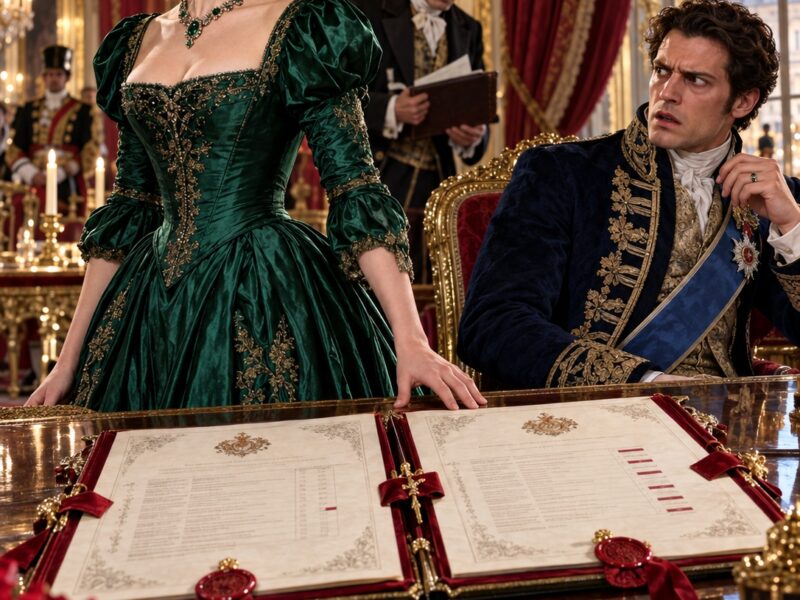
The Duke of Ashwell was three seconds away from signing the most important treaty of his diplomatic career when his wife rose from her chair and quietly spoke his name.
“Lucas, please. Before you sign, there is something wrong with page thirty-one.”
Thirty men turned toward her. A secretary suppressed a laugh. Her husband did not even look up.
“Sit down, Elena,” he said coldly. “You wouldn’t understand.”
What he did not know was that his wife had just discovered a conspiracy worth two million pounds. What he could never have imagined was that the woman he had spent two years teaching to remain silent was the only person in that magnificent room who could save his reputation, his country, and an alliance on which thousands of lives depended.
And the man responsible for the deception was sitting only a few feet from his elbow.
The Hall of Ambassadors in Madrid had been designed to make men feel the weight of history. Golden moldings climbed the high walls, enormous portraits of Spanish monarchs looked down from their elaborate frames, and crystal chandeliers scattered afternoon sunlight over polished marble. Beyond the tall windows, the rooftops and church domes of Madrid shimmered beneath a cloudless June sky.
At the center of the room stood a long diplomatic table. Two copies of the proposed treaty lay upon it, each forty pages long, written in beautiful copperplate and bound with crimson ribbon. One was in English. The other was in Spanish. Both awaited the signatures that would bind Britain and Spain together against the armies of Napoleon.
The British delegation occupied one side of the table. Across from them sat the representatives of the Spanish crown, led by Don Raphael de Montalban, Count of Valde Flores, a sixty-year-old diplomat whose silver hair and measured expression concealed an unusually perceptive mind.
At the head of the British delegation sat Lucas Harrow, Duke of Ashwell, His Britannic Majesty’s special envoy to the Spanish court.
Lucas was thirty-five, handsome in the severe, polished fashion of men accustomed to command. His dark blue velvet coat was immaculate, his decorations carefully arranged, and his silver sash caught the light whenever he moved. He had spent years preparing for an occasion such as this, imagining the dispatches that would announce his triumph and the congratulations awaiting him in London.
His wife sat against the wall, four feet from the treaty table.
Elena Harrow, Duchess of Ashwell, wore a gown of emerald silk and a delicate tiara set with matching stones. Her hair had been arranged with careful elegance, and her gloved hands rested in her lap. To anyone entering the room, she would have appeared exactly as an ambassador’s wife was expected to appear: beautiful, composed, and entirely unnecessary to the proceedings.
That morning, as their carriage crossed Madrid, Lucas had reminded her of her position.
“You are attending because protocol requires it,” he had said without looking at her. “You will sit quietly, smile when appropriate, and leave the conversation to those who understand it.”
Elena had watched the horses through the carriage window.
“Of course, Lucas.”
“You are very good at remaining quiet,” he added.
She had said nothing.
For two years, she had answered him that way. It was easier than explaining herself to a man who had never once demonstrated an interest in listening.
But now, seated beneath the gilded ceiling, she could not stop staring at the Spanish treaty.
Page thirty-one lay open within reach of her chair. The afternoon light illuminated every carefully written line, including the clause specifying the financial support Britain had agreed to provide the Spanish armies.
Elena had read it once.
Then again.
Then a third time, because she could scarcely believe what she was seeing.
Across the table, the English copy lay open to the corresponding page. She leaned forward just enough to compare the passages, keeping her movements small.
The figures were different.
Not slightly different.
Catastrophically different.
The English document committed Britain to paying £200,000 in four installments over the following year. The Spanish document stated £2,000,000.
Ten times the amount.
And beneath that enormous discrepancy lay another clause, present only in the Spanish version, stipulating that the ports of Cádiz and Cartagena would be closed to British warships immediately if any payment was delayed.
Elena felt her heartbeat quicken beneath the stiff silk of her bodice.
She understood precisely what those differences meant.
Britain would believe it had promised £200,000. Spain would believe it had been guaranteed two million. When the first installment arrived, the Spanish crown would regard the payment as a breach of agreement. British ships could lose access to strategically vital ports while the war against France continued.
Each government would accuse the other of dishonesty.
An alliance forged through months of military hardship could collapse over two documents that appeared identical until someone read them carefully.
And someone had made certain that they were not identical.
Elena looked toward Mr. Nash, the embassy’s official translator. He sat beside Lucas, his narrow shoulders unusually stiff, his hands folded before him. Although the room was cool, a faint shine of perspiration marked his upper lip.
A memory returned to her.
A warm Madrid evening. The sound of water falling into a palace fountain. Two Spanish gentlemen speaking quietly beyond a myrtle hedge.
One of them had been the Count of Valde Flores.
I would give a great deal for one honest person in that embassy who could read both languages.
At the time, she had not known whether his suspicions were justified.
Now she knew.
Lucas reached for the inkwell.
Elena stood.
“Lucas,” she said, forcing her voice to remain steady. “Forgive me, but before you sign, there is something you must know about page thirty-one.”
The duke continued dipping his pen.
“Elena.”
“The Spanish copy does not say the same thing as the English.”
A small, incredulous smile appeared on one secretary’s face.
Lucas spoke loudly enough for the entire room to hear.
“Sit down, Elena. You wouldn’t understand.”
The words struck her with familiar precision.
She felt the heat rising along her neck. For a moment, she was no longer a duchess standing before two governments. She was a young bride in her husband’s library, being told that everything she had known before marrying him was something to be ashamed of.
She lowered her eyes.
Slowly, she returned to her chair.
Then, as Lucas positioned his pen above the treaty, a voice rose from the Spanish side of the table.
“Señora, ¿ha leído usted la página treinta y uno?”
Madam, have you read page thirty-one?
The pen stopped moving.
Every English face turned toward Mr. Nash.
But before the translator could answer, Elena lifted her head.
“Sí, Excelencia,” she replied in flawless Spanish. “Tres veces.”
Yes, Your Excellency. Three times.
The Count of Valde Flores smiled.
It was the first time anyone had seen him smile throughout the negotiations.
And the Duke of Ashwell stared at his wife as though he had never met her.
Elena had been born thousands of miles from the cold drawing rooms of London, in a whitewashed house with green shutters overlooking vineyards near Jerez de la Frontera.
Her father, Thomas Wren, was an English merchant from Bristol who had traveled to Andalusia at twenty to learn the sherry trade. Her mother, Isabel Ortega, was the daughter of a respected Spanish cooper whose oak barrels were prized by wine producers throughout the region.
Thomas had met Isabel while negotiating the purchase of several casks.
For the rest of his life, he insisted that his marriage had been the finest bargain he had ever made.
Their daughter grew up between two languages without thinking of them as separate worlds. English belonged to her father’s office, to letters from Bristol and London, to account books and shipping schedules. Spanish belonged to nearly everything else: her mother’s stories, the songs of the harvest workers, the laughter of the kitchen, and the small arguments that rose and disappeared around the family table.
Old Rosario, the household cook, called her niña mía and taught her songs while kneading bread. Her grandfather taught her to distinguish the scent of dry fino from the richer fragrance of amontillado before she was ten.
By fifteen, Elena was helping her father handle correspondence with British merchants and Spanish growers. She translated contracts, corrected invoices, and wrote diplomatic replies when a shipment arrived late or a buyer attempted to alter the terms of an agreement.
Sometimes Thomas watched her working beside the open window, the smell of vines drifting into the office.
“You have two tongues in that clever head, Nell,” he would tell her. “Most men can’t manage one honestly. See that you use both well.”
She laughed whenever he said it.
She did not yet understand how much she would one day need that advice.
Her mother died when Elena was seventeen. Four years later, Thomas followed her, leaving his daughter the family bodega, its inventory of aging sherry, and the complicated responsibilities of a business threatened by war.
French armies had pushed into Spain. By the time they approached Seville, the English residents of Andalusia were preparing to flee.
Her father’s London partners wrote urgently, insisting that Elena return to Britain while she still could.
She left Cádiz with one trunk, the deeds to the bodega, and a letter of credit. From the deck of the departing ship, she watched the Spanish coastline fade into the morning haze, wondering whether she would ever see her mother’s country again.
England was colder than she remembered.
The air felt damp even indoors. Her dresses attracted curious looks, and although she spoke English fluently, the lingering Andalusian rhythm in her voice made strangers ask where she had learned it.
She possessed money, property, and a valuable wine business, yet she had no immediate family nearby and little understanding of the elaborate social rules governing English aristocratic society.
Her father’s partners believed marriage would provide security.
They introduced her to Lucas Harrow in March.
He was the Duke of Ashwell, master of a magnificent ancestral house in Kent and a man whose position in the House of Lords gave him access to the highest circles of government. His manners were polished, his appearance distinguished, and his ambitions unmistakable.
What Elena did not initially understand was how badly his family finances had deteriorated.
His father had gambled recklessly. His grandfather had done worse. The estate remained impressive from the road, but maintaining it required money the family no longer possessed.
Lucas desired something beyond financial stability.
He wanted a diplomatic career.
He wanted to represent his king abroad, negotiate agreements of consequence, and return to England with his name established among the important men of his generation.
A wealthy wife with Spanish connections seemed an excellent beginning.
He proposed in April.
It was not a romantic declaration. Lucas spoke plainly about the suitability of their circumstances, the advantages of the match, and the security his title could provide.
Elena accepted.
At twenty-two, grieving her parents and displaced from the country she loved, she mistook his practical interest in her background for genuine admiration.
She discovered her mistake on their wedding night.
After the wedding breakfast in the London house, Elena had gone downstairs to thank the kitchen staff. There she met Pilar, a young Spanish scullery maid who had fled the war near Seville.
The girl’s expression brightened when she discovered that her new mistress spoke Spanish.
For several minutes, they discussed home.
Pilar described the streets she missed, the relatives she feared she would never see again, and the orange trees whose scent still returned to her in dreams. Elena listened with an aching happiness, grateful to hear her mother’s language spoken without hesitation.
Then Lucas appeared at the foot of the kitchen stairs.
He said nothing while they were with the servants.
Only when he had taken Elena upstairs and closed the library door did his expression change.
“You will not do that again.”
Elena looked at him in confusion.
“Do what?”
“Chatter in Spanish with the servants as though you were one of them.”
“She is from Seville, Lucas. She has lost her home, and I was only—”
“You are the Duchess of Ashwell now. You are English.”
She stared at him.
“My mother was Spanish.”
“I married your Spanish connections, Elena, not your Spanish manners. When they are useful, I shall decide how they are employed.”
The words settled into the silence between them.
Lucas continued, apparently unaware that he was wounding his bride on the first evening of their marriage.
“I would be grateful if you made an effort to improve your accent. There is no need to remind everyone where you came from.”
That night, Elena lay awake listening to the unfamiliar sounds of the London house.
For the first time in her life, she wondered whether loving the country of her childhood was something she ought to hide.
And over the following two years, she learned to hide it remarkably well.
She softened the Spanish rhythm in her English until scarcely anyone could hear it. She stopped speaking Spanish in front of her husband. She kept her mother’s books in her private sitting room and read them late at night.
When the Spanish ambassador’s wife once addressed her warmly in Spanish during a London reception, Elena answered in English.
Across the room, Lucas was watching.
The ambassador’s wife looked disappointed, then politely changed the subject.
Elena never forgot the expression on her face.
What she found most painful was not simply that Lucas disapproved of her Spanish heritage. It was that he never troubled himself to discover what that heritage contained.
He did not know that she had negotiated commercial contracts before leaving her father’s house. He did not know that she still corresponded with growers attempting to protect their vineyards from the war. He did not know how many families depended upon the success of the bodega that had become part of her marriage settlement.
Yet the profits of that business helped pay for his horses, his elegant clothes, and the costly entertainments through which he cultivated influence in London.
He accepted the advantages of her past while rejecting the woman it had made.
When he received his appointment to Madrid, Elena should have been overjoyed.
Instead, she stood quietly in the hall while he removed his gloves and explained the arrangements.
“You will accompany me, of course. The Spanish court expects a man of my rank to travel with his wife.”
“Madrid,” she repeated softly.
“Yes. You will attend dinners and receptions and conduct yourself appropriately.”
He paused.
“And you will speak English. Only English. Mr. Nash is our official translator.”
Elena lifted her eyes.
“Even if someone addresses me in Spanish?”
“Then you will pretend not to understand.”
He gave her a thin smile.
“You are already very accomplished at looking as though you understand nothing.”
She looked down at his discarded gloves.
He had no idea what it cost her to remain silent.
Madrid greeted Elena with sunlight and the scars of war.
Buildings bore scorch marks. Some streets were lined with houses whose windows had been shattered, and beggars gathered outside churches damaged by years of occupation and upheaval.
But the sky was the same brilliant blue she remembered.
As their carriage crossed the Puerta del Sol, voices rose all around her. Street vendors called to customers, children argued, and women exchanged greetings from open doorways.
Spanish surrounded her again.
For a moment, her chest tightened so sharply that she had to turn toward the window.
Lucas was reading dispatches and did not notice.
The British embassy established its temporary residence in a house on Calle de Alcalá. Negotiations began almost immediately at the royal palace, where the two delegations met to establish the terms of a formal agreement against France.
For eleven days, Elena was excluded from the sessions.
She attended formal receptions in the evenings, standing at her husband’s side in emerald silk while British officials discussed military supplies, finances, and naval access.
She smiled when spoken to.
She answered in English.
And she listened.
She heard far more than anyone suspected.
The Spanish officials assumed that the silent English duchess understood nothing of their conversations. They discussed the war around her, complained about British delays, and occasionally mocked the stiffness of her husband.
Two court ladies once observed that Elena was extremely beautiful but evidently not very intelligent, since she rarely spoke.
Elena pretended to admire a vase of flowers.
Their laughter followed her across the room.
On the eighth evening, a reception was held in the palace gardens. Lanterns hung among the trees, and the fountain reflected small fragments of candlelight. Lucas had left her beside the water while he went to confer with several members of the British delegation.
Elena stood alone beneath the orange trees.
Behind a clipped myrtle hedge, two gentlemen were talking.
She recognized the voice of the Count of Valde Flores.
“I do not trust the English translator,” he said.
His companion sounded surprised.
“Mr. Nash?”
“He is fluent. Perhaps too fluent. Have you listened carefully to his pronunciation?”
“He has served the British for years.”
“His Spanish carries traces of French instruction. That alone proves nothing. But twice this week he has translated the duke’s questions concerning subsidies into something subtly different.”
“Different in what way?”
“More favorable to Spain.”
There was a pause, followed by the faint sound of gravel shifting beneath a shoe.
“Why would an English translator do that?”
“That is precisely what troubles me.”
The count’s voice lowered.
“A treaty can be destroyed without a single shot being fired, Don Felipe. All that is required is for two governments to believe they have signed the same agreement when they have not.”
Elena became perfectly still.
“Imagine,” the count continued, “that Britain promises one sum and Spain understands another. Months later, the truth emerges. Britain cries fraud. Spain cries betrayal. The alliance dissolves, and who benefits?”
Neither man answered.
The sound of the fountain seemed suddenly very loud.
“I would give a great deal,” the count said at last, “for one honest person in that embassy who could read both languages.”
Their footsteps receded.
Elena remained beside the hedge, gripping her fan so tightly that the delicate ivory ribs pressed into her palm.
She knew such a person.
She was such a person.
For the rest of the reception, she watched Mr. Nash whenever he came into view. He was an unremarkable man, slightly nervous in manner and quick to defer to those above him. Nothing in his appearance suggested that he might be capable of deliberately undermining a treaty.
Yet the count’s words refused to leave her.
The following morning, Elena made an attempt to speak with Lucas.
He was seated at breakfast, reviewing dispatches while his coffee cooled untouched.
“Lucas, may I ask you something about Mr. Nash?”
He did not look up.
“What about him?”
“Has anyone independently checked his translations?”
His eyes rose from the paper.
“For what reason?”
“I heard something yesterday that concerned me.”
“Nash was recommended by the Foreign Office. He served in Lisbon before coming here.”
“I understand, but—”
“What would you know about his work?”
Elena hesitated.
She could tell him that the Spanish envoy had expressed doubts. She could tell him she had understood every word of a private conversation in the gardens.
But to explain how she knew would require admitting that she had been concealing her fluency from him.
And Lucas’s expression was already hardening.
“I only thought it might be wise to verify—”
“Don’t think, Elena. It doesn’t suit you.”
He returned to his dispatches.
The conversation was finished.
Elena sat motionless, the untouched food cooling on her plate.
She had tried to warn him.
He had dismissed her before she could finish.
Three days later, when the court required both envoys’ wives to attend the signing ceremony, she entered the Hall of Ambassadors determined to obey her husband’s instructions.
Then she saw page thirty-one.
And obedience became impossible.
The count’s question still hung in the silent room.
“Madam, have you read page thirty-one?”
Elena had answered in Spanish.
Now every man at the table was staring at her.
Lucas seemed unable to reconcile the voice he had just heard with the wife he believed he knew.
For two years, she had never spoken Spanish in his presence. He had commanded her silence so completely that he had forgotten it was a command.
He had come to believe that she possessed no knowledge worth hearing.
The Count of Valde Flores rose slowly from his chair.
He crossed the room with the deliberate composure of a man who understood exactly how important the next few minutes might become.
Stopping before Elena, he bowed.
“Señora,” he said in Spanish, “would you do me the kindness of reading the disputed passage aloud?”
Lucas straightened.
“Your Excellency, my wife is not—”
“Your Grace,” the count interrupted, switching to English. “For eleven days I have communicated with your delegation through Mr. Nash. Today, before I place my king’s name upon this document, I should like to hear from someone I can trust.”
He glanced toward Elena.
“I believe your wife may be that person.”
Lucas’s jaw tightened.
For several seconds, the room remained perfectly still.
Then the duke set down his pen.
Elena rose.
She walked to the end of the long table, conscious of every gaze following her. Her emerald skirts whispered against the marble as she approached the two open treaties.
She placed one hand on the Spanish copy and drew the English document beside it.
The crimson ribbons lay almost touching.
“Page thirty-one,” she said.
Her voice was quiet but clear.
“The financial subsidy clause.”
She read the Spanish text first, pronouncing each word with the easy fluency of her childhood. When she reached the amount of money promised, several Spanish officials nodded.
Then she turned to the English copy.
She read that clause aloud as well.
“Two hundred thousand pounds, payable in four installments during the coming year.”
She stopped.
The count’s eyes narrowed.
“Again, if you please, Duchess. The sum in the Spanish document.”
“Two million pounds, Your Excellency.”
A murmur passed down the table.
Lucas leaned forward.
“That cannot be correct.”
Elena looked directly at him.
“It is written here.”
She moved her finger to the next paragraph.
“There is another difference.”
The Spanish clause stipulated that failure to meet any payment on time would result in the immediate closure of Cádiz and Cartagena to British naval vessels.
She translated it into English.
Then she turned the English page toward the count.
“There is no corresponding clause in this copy.”
The silence became oppressive.
Two English secretaries immediately leaned over the papers. One took out his spectacles and examined the passages himself. Another reached for the draft notes from earlier negotiations.
Mr. Nash had not moved.
Elena looked toward him.
“If the treaty is signed as it stands, Britain will believe it has committed itself to a payment of two hundred thousand pounds. Spain will believe it has been promised two million. When the first installment arrives, each nation will believe the other has violated the agreement.”
The count turned slowly toward the translator.
“Mr. Nash,” he said, “can you explain this?”
The thin man swallowed.
“I believe there may have been some misunderstanding in the transcription, Your Excellency.”
“An entire additional sentence?” Elena asked.
Nash’s eyes flickered toward her.
“The documents were prepared under considerable pressure.”
“A numerical error might be blamed on haste,” she replied. “But the removal of a separate provision concerning two naval ports is not the same kind of mistake.”
Lucas opened his mouth, then closed it.
For the first time, he appeared to understand the magnitude of the danger.
Elena continued.
“Both versions were prepared under Mr. Nash’s supervision. I do not believe these differences are accidental.”
Nash pushed back his chair.
It struck the marble floor with a sharp crack.
“Madam, you have no right to accuse—”
He did not finish.
Instead, he turned abruptly toward the great double doors.
For a second, everyone seemed too surprised to move.
Then Nash began to run.
At the entrance, two royal halberdiers stepped forward. Their weapons crossed with a metallic sound, barring the passage.
Nash stopped so suddenly that he nearly stumbled.
“Search him,” the count ordered.
The guards seized him.
Lucas remained seated, his face colorless.
They found three letters concealed in the lining of Nash’s coat.
The envelopes carried no signatures, only plain black wax seals. Their contents were written in French.
Elena took the letters when the count offered them to her.
She read the first silently.
Her stomach tightened.
Then she translated it into Spanish.
The letter promised Nash ten thousand francs, payable in Paris, if the treaty between Britain and Spain were signed with conflicting obligations.
The second promised another ten thousand francs after the resulting dispute destroyed the alliance.
The third contained instructions concerning the preparation of the documents.
Elena translated the passages into English for the British delegation.
When she finished, no one spoke.
Outside the windows, Madrid continued beneath the afternoon sun. Somewhere in the palace, a door closed. The faint sound carried through the hall.
Lucas sat rigidly with his pen lying across the unfinished treaty.
He had been seconds away from signing.
The man he had trusted to translate for his government had been working to destroy the agreement.
And his wife—the woman he had ordered to remain silent—had exposed him.
The Count of Valde Flores walked toward Elena.
Then he bowed deeply, one hand resting over his heart.
“Señora Duquesa,” he said, “in the name of His Majesty King Ferdinand, I thank you. You have spared two kingdoms a terrible mistake.”
Elena lowered her head.
“I am grateful that Your Excellency listened.”
The count straightened and turned toward the delegations.
“The signing is postponed. Both documents will be prepared anew, and every clause will be checked against its equivalent.”
Lucas attempted to recover his composure.
“Certainly, Your Excellency. My secretaries will arrange—”
“No,” the count said.
The duke stopped.
The older diplomat looked toward Elena.
“I shall not sign the revised treaty until the Duchess of Ashwell has read every page in both languages and confirmed that they agree.”
Lucas’s expression tightened.
“With respect, that would be most irregular. My wife holds no appointment in His Majesty’s diplomatic service.”
The count regarded him for a moment.
“It was also irregular,” he replied, “for that service to provide me with a translator who appears to have been working for France.”
No one dared laugh.
“I find,” the count continued, “that I have lost my appetite for regularity.”
His voice remained courteous.
“You may consult your Foreign Secretary, Your Grace. As for me, I shall deal with the duchess, or I shall deal with no one.”
The carriage journey back to the embassy lasted scarcely ten minutes.
Lucas sat in the opposite corner, arms folded, staring through the window at the crowded streets. Elena watched the city passing in fragments: an orange seller arranging fruit beneath a striped awning, two children chasing each other beside a fountain, an old woman crossing herself outside a church.
The silence between husband and wife was familiar.
What surprised Elena was her own response to it.
She was not afraid.
For two years, Lucas’s silences had felt like warnings. She had learned to measure his displeasure by the angle of his shoulders or the length of time he refused to speak.
Now she looked at him and felt only a quiet exhaustion.
He waited until they were alone in the embassy library before speaking.
“You humiliated me.”
Elena stood beside the writing desk.
“No, Lucas.”
His face darkened.
“In front of the Spanish court. In front of my secretaries. You made me look like a fool.”
“I tried to prevent you from looking like a fool.”
“You should have come to me privately.”
“I did.”
He stared at her.
“At breakfast, three days ago. I asked whether Mr. Nash’s translations had been checked.”
Lucas said nothing.
“You told me not to think because it didn’t suit me.”
He looked away.
Elena realized he did not even remember saying it.
To him, those words had been insignificant.
To her, they had been one more small humiliation in a long collection.
“On our wedding night,” she continued, “you told me never to speak Spanish where you could hear me. You said you had married my connections, not my manners.”
“Surely you understand that appearances—”
“You told me to be ashamed of my mother’s language.”
“That is not what I meant.”
“It is what you said.”
He fell silent.
“I obeyed you for two years. I corrected my accent. I stopped speaking Spanish at receptions. I let you believe that I knew nothing about the country where I was born.”
Her voice remained steady, although her hands trembled slightly.
“And today, because I did everything you demanded, you had no idea that I could read the document you were about to sign.”
Lucas moved toward the fireplace, then stopped.
“You might have told me.”
“I tried to tell you many things.”
He looked at her.
For once, she did not lower her eyes.
“You never asked, Lucas.”
That seemed to disturb him more than anger would have.
For several moments, he examined the carpet as if there might be an answer woven into its pattern.
Then he spoke in a different voice.
“The count will not sign without you.”
“No.”
“The Foreign Secretary will hear about Nash.”
“Yes.”
“And the entire Foreign Office will know that my wife saved me from a French agent.”
Elena watched him.
His first concern was still his reputation.
He gave a humorless laugh.
“I shall become the laughingstock of Whitehall.”
“You may also become the man who secured a vital alliance,” she replied. “But only if you allow the work to be completed.”
He looked toward her.
“You intend to assist them?”
“I intend to examine every page. Men are fighting and dying while we stand in this comfortable room arguing about embarrassment. The English need Spanish ports, and the Spanish armies need the money and supplies they have been promised.”
She paused.
“My father’s vineyards are not far from the fighting. I know what this war has done to ordinary families.”
Lucas was silent.
“I am not doing this to restore your pride,” she continued. “I am doing it because the agreement matters.”
She turned toward the door.
“When the treaty has been signed, we shall discuss the rest.”
“The rest?”
Elena looked back.
“Our marriage.”
He studied her with an expression she had never seen before.
For the first time, the Duke of Ashwell appeared to understand that his wife might possess choices of her own.
It took nine days to prepare the new treaty.
Each morning, Elena arrived at the Hall of Ambassadors in a plain gray gown, carrying her notes and the previous day’s corrected drafts.
She sat at the table where the translator had once worked.
English clerks occupied one side.
Spanish clerks occupied the other.
Between them lay the two versions of the treaty.
She checked everything.
When the English wording granted permission and the Spanish imposed an obligation, she stopped the clerks. When one version referred to ports and the other to harbors, she required the locations to be specified. When a provision concerning the transport of muskets could be interpreted in more than one way, she worked with both delegations to establish language that carried a single meaning.
Hours passed beneath the chandeliers.
The clerks learned to wait for her approval before continuing.
The Count of Valde Flores attended nearly every session.
On the third morning, while a secretary sanded a freshly written page, the count studied Elena for a moment.
“Your accent,” he said in Spanish. “You are from Jerez, are you not?”
She smiled.
“Yes, Your Excellency.”
“Near the old quarter?”
“My grandfather was a cooper there. His name was Ortega.”
The count looked up sharply.
“Ortega? The maker of the great sherry casks?”
“My mother’s father.”
He leaned back in his chair.
“I drank your grandfather’s sherry at my wedding forty years ago.”
Elena laughed softly.
“Then I hope it was a happy marriage.”
“A very happy one. And excellent sherry.”
For a moment, he looked at her with something close to grandfatherly affection.
Then his expression became serious.
“Your husband instructed you to pretend you did not speak Spanish?”
Elena lowered her eyes toward the papers.
“Yes.”
The count shook his head.
“He has kept the most useful person in his household sitting against a wall.”
She said nothing.
“You have done more for this negotiation in three days than some diplomats accomplish in an entire career.”
Elena felt herself coloring.
“I was taught to read contracts by my father.”
“Then your father was a wise man.”
The words touched her more deeply than the count could have known.
She returned to her work before the tears gathering in her eyes became visible.
On the fourth morning, Lucas appeared in the hall.
He stood just inside the doors in his dark blue coat, watching as Elena moved between the English and Spanish drafts.
She noticed him but did not interrupt her work.
A Spanish secretary asked about the transportation of military horses. Elena answered in Spanish, then turned to the British clerk and explained the proposed clarification in English.
She wrote the revised wording herself.
Lucas remained by the doors.
He watched her consult with the count, correct a passage, and answer another question without hesitation.
The woman he had assumed was incapable of following political discussion had become the person to whom two delegations directed their most difficult questions.
He stood there for nearly an hour.
Then he left.
The next day, he returned.
And the day after that.
At first, Elena wondered whether he intended to criticize her work. But he said very little, and when the secretaries spoke to him, he answered quietly.
Once, she caught him looking at her with a strange expression.
It was not anger.
It was not quite admiration.
It was the troubled recognition of a man discovering that he had spent years misjudging something important.
On June 22, the treaty was ready.
Both copies now contained forty-one pages. The additional pages reflected the careful revisions and clarifications required to ensure that every promise meant the same thing in both languages.
Elena had read each document twice.
This time, when the delegations assembled, the two treaties agreed.
The count signed for Spain.
Lucas signed for Britain.
Then the count lifted his pen and turned toward Elena.
Below the envoys’ signatures, a new line had been inserted into both copies.
It stated that the documents had been examined and found to agree in both languages.
A space remained for the person who had performed that examination.
The British secretaries had objected when the count first demanded it. They had referred the matter to London, where the Foreign Secretary’s reply had been brief.
Do as he says.
Elena approached the table.
She took the pen.
In the careful handwriting her mother had taught her, she signed:
Elena Wren Harrow, Duchess of Ashwell.
Then she signed the English copy.
For a moment, the room was silent.
The Count of Valde Flores began to applaud.
His hands came together slowly and deliberately.
The Spanish secretaries joined him.
Then the ladies of the court.
One by one, the English clerks rose and applauded the woman who had spent nine days working beside them.
Elena stood with the pen in her hand, unable to speak.
At the far end of the table, Lucas was looking at her.
Then, slowly, he began to clap.
He did not smile.
His face was pale and serious.
But his eyes remained fixed upon his wife.
For the first time in two years, Elena felt that he was looking at her rather than merely at the title she carried.
She had saved his diplomatic mission.
But she understood something more important.
She had begun to recover herself.
Two days after the signing, a royal carriage arrived at the British embassy.
It had not come for the duke.
It had come for Elena.
She was escorted through the magnificent halls of the Spanish palace to a private audience with King Ferdinand, who sat surrounded by several ministers and the Count of Valde Flores.
The king studied her.
“I am told,” he said in Spanish, “that you saved my alliance.”
Elena curtsied.
“Your Majesty is gracious.”
“I am also told that you speak like a daughter of Jerez.”
“I was born there, Your Majesty.”
“Then tell me something of your home.”
For a moment, Elena thought of the white house with green shutters, the cool darkness of the bodega, and her mother standing in the kitchen doorway while Rosario sang.
“My grandfather made the great oak casks used by the wine producers of Jerez,” she replied. “My mother was born beneath the shadow of its cathedral tower.”
Her voice softened.
“Whatever I did in the Hall of Ambassadors, I did because I am her daughter.”
The king remained quiet for a moment.
Then he accepted a small velvet case from a minister.
Inside lay a jeweled insignia suspended from a ribbon of white and violet silk.
It was the Royal Order of Queen Maria Luisa, one of Spain’s most distinguished honors for women.
Elena stared at it.
“For the cooper’s granddaughter,” the king said, “who read page thirty-one.”
She bowed her head, suddenly unable to trust her voice.
That evening, alone in her chamber, she placed the decoration beside a worn little volume of Spanish poems that had belonged to her mother.
For a long time, she sat looking at them.
One was a symbol of honor bestowed by a king.
The other was a reminder of the woman who had taught her that her voice was worth hearing.
She knew which meant more.
News of the treaty reached London within weeks.
Official dispatches described the discovery of the altered documents and the detention of Mr. Nash. Private letters from the British secretaries supplied the details that formal reports omitted.
Soon, every drawing room in Mayfair seemed to know the story.
They knew that the Duke of Ashwell had ordered his wife to sit down.
They knew she had exposed a French-backed conspiracy.
And they knew that the King of Spain had personally honored her.
The words Lucas had spoken became a fashionable joke.
When a gentleman made a foolish error at cards, one of his companions might say, “Sit down, old fellow. You wouldn’t understand.”
The whole table would laugh.
Lucas heard the story often enough.
But the Foreign Secretary was not amused.
Upon returning to England, the duke was summoned to Downing Street. The meeting lasted two hours.
No account of their discussion was made public.
Its consequences, however, were clear.
Lucas was not appointed ambassador to Spain.
The position went to an older, more experienced diplomat.
The duke received formal thanks for his service, but his prospects for future advancement were diminished.
And within the Foreign Office, one conclusion had become difficult to ignore.
If Britain required someone capable of negotiating directly with the Spanish court, the Duchess of Ashwell possessed gifts that her husband had never thought to recognize.
Elena did not accompany Lucas back to England.
She told him of her decision in the embassy library on the evening before his departure.
He was packing documents into a dispatch box when she entered.
“I am going to Jerez,” she said.
He looked up.
“For a visit?”
“No. To reopen the bodega.”
He set down the papers in his hand.
“The war has devastated the region.”
“I know.”
“The vineyards may be ruined.”
“They may be.”
“Then why would you go?”
Elena stepped toward the window.
“Because there are families there who worked for my father. They have had no wages for two years. The French have retreated, and the road south is open. Someone must see what remains.”
Lucas frowned.
“Those affairs can be managed through agents.”
“They have been neglected through agents.”
She turned toward him.
“I intend to see the property myself, repair what I can, and bring the harvest in.”
He hesitated.
“And you expect to finance this?”
“The bodega belongs to me, Lucas.”
His expression changed.
“It is part of our household interests.”
“It is held in trust for my separate use under our marriage settlement. My father’s partners made certain of it.”
He was silent.
“You signed the settlement,” she added, “though I doubt you read it carefully.”
A trace of color rose in his face.
She continued before he could answer.
“I will use my own funds to reopen the business and pay the workers.”
Lucas looked toward the dispatch box.
“How long do you intend to remain?”
“I don’t know. Perhaps a year. Perhaps longer.”
“A year?”
“Until the bodega is standing again.”
He walked slowly toward the mantelpiece.
“You are my wife, Elena.”
“Yes.”
“You cannot simply decide to live in Spain indefinitely.”
“I have not said indefinitely.”
She paused.
“Nor have I said I am ending our marriage.”
He turned toward her.
“Then what are you saying?”
“That I spent two years making myself invisible in your house because you asked it of me.”
Her voice remained gentle.
“I would like to spend some time being visible in my own.”
Lucas studied her for a long moment.
“And if I forbid you to go?”
The question was quiet.
For once, it sounded less like an order than an admission that he was no longer certain of his authority.
Elena met his eyes.
“Then I shall ask the Count of Valde Flores to explain my circumstances to the king. And perhaps the king will mention the matter to your Foreign Secretary.”
She did not threaten him.
She simply stated the practical reality.
Lucas looked away.
After a long silence, he said, “No. I don’t imagine the Foreign Secretary would take my side.”
Elena nodded.
“I shall write to you.”
He looked back at her.
“Will you?”
“Yes.”
Neither spoke for some time.
Then Lucas lowered his head.
“Good night, Elena.”
“Good night, Lucas.”
He sailed for England the following morning.
She traveled south.
The road toward Jerez carried Elena through a country wounded by war.
Villages bore the marks of occupation. Farmhouses stood empty, roads were scarred by military traffic, and entire stretches of land had been abandoned.
When she finally reached her hometown, she scarcely recognized some of the streets.
French soldiers had occupied Jerez for a year. Furniture from grand houses had been burned for fuel, churches had been stripped, and stores of wine had been opened or carried away.
Her father’s white house had lost its doors and windows.
The green shutters were broken.
The vineyard rows were tangled with weeds, the vines unpruned for two seasons. The grapes that remained were small and sour.
Elena stood in the courtyard, watching dust drift through an open doorway.
For a moment, she could not move.
Then she asked to be taken to the bodega.
The great storage building was still standing.
Its entrance had been forced, and many barrels near the front had been emptied. Yet in the deepest part of the cool, shadowed interior, rows of old casks remained untouched.
One hundred and forty barrels.
Some contained sherry her grandfather had laid down decades earlier.
Elena walked slowly between them, breathing in the familiar smell of oak and aging wine.
Her fingertips traced the worn wood of a cask.
She remembered her father explaining the business to her there, the sound of Rosario singing in the distance, and the comforting certainty that everything important in her childhood had belonged to this place.
Then she began to cry.
She cried for her parents, for the years of war, for the home that had been stripped and damaged, and for the frightened young woman who had left Spain believing that survival required her to become someone else.
When she had finished, she wiped her face with a handkerchief.
The barrels were still here.
The land was still hers.
And she had come home.
Her next visit was to Rosario.
The old cook was now seventy and living in two small rooms behind a church. Elena found her seated on the doorstep, shelling beans into a bowl.
“Rosario?”
The old woman looked up.
For a moment, she stared without moving.
Then the bowl slipped from her lap.
“Elena?”
Elena was already crossing the little courtyard.
“Soy yo, Rosario.”
It’s me.
Rosario rose unsteadily and gathered her into her arms.
“Niña mía,” she whispered. “You’ve come back.”
Elena sank to her knees beside her.
“He vuelto.”
I’ve come back.
They held each other while beans lay scattered across the stones.
Neither cared.
Within days, Elena began hiring workers.
She found thirty people who had once depended upon her father’s business and offered them wages from her own funds. Some were older than she remembered. Others had lost family members or returned from military service to find their livelihoods destroyed.
She did not promise them prosperity.
She promised work and payment.
That was enough to begin.
Each morning, she rose before dawn and joined them among the vines. She wore a straw hat and an old brown dress, rolled her sleeves above her elbows, and carried baskets along the rows.
At first, the workers treated her with uncertainty.
She was a duchess now, the recipient of a royal honor. Her emerald gowns and jeweled insignia belonged to a world far removed from their small, damaged farms.
But by the end of the first week, she had worked beside them through the heat, eaten bread and rice beneath the olive trees, and laughed at the same familiar jokes.
They stopped calling her Excelencia.
They called her Elena.
Rosario called her mi niña.
And when the old harvest songs rose among the workers, Elena sang every word.
The harvest was poor.
Everyone had expected it.
The grapes were small, the yield disappointing, and the neglected vines required more care than one season could provide.
But the workers gathered what they could.
The presses began to move again.
Fresh wine flowed into repaired barrels.
For the first time since the French occupation, the courtyard of the Wren-Ortega bodega filled with the ordinary, necessary sounds of a living business.
Elena understood that recovery would take years.
She was prepared to give it years.
By the first week of October, the last baskets of the harvest were being brought into the yard. The workers had gathered for a simple evening meal, and the late afternoon sunlight lay golden across the old stone walls.
Elena stood beside the winepress with her sleeves rolled up, her forearms stained purple with grape juice.
Someone laughed at a joke near the barrels.
Rosario carried plates toward the long supper table.
Then the laughter faded.
A man had appeared in the gateway.
He was tall and dark-haired, wearing a plain brown riding coat covered with the pale dust of the road. He carried his hat in both hands and had arrived without servants.
Elena recognized him immediately.
“Lucas.”
The Duke of Ashwell stood at the entrance to the bodega yard.
He looked thinner than she remembered.
Older, too.
The workers turned toward their mistress, uncertain whether to withdraw or remain.
Lucas did not move farther into the courtyard.
For several seconds, he simply looked at Elena.
He saw her stained sleeves, her untidy hair beneath the straw hat, and the people gathered around her who clearly knew and loved her.
Then he spoke.
In Spanish.
“Buenas tardes, duquesa.”
The pronunciation was dreadful.
Several workers pressed their lips together to keep from laughing.
Lucas continued slowly, visibly concentrating on each word.
“He venido… a aprender.”
I have come to learn.
Elena stared at him.
Then she asked in English, “Learn what?”
He swallowed.
“Everything I should have asked you during the last two years.”
The yard had become completely silent.
Lucas looked down at the hat he was twisting between his fingers.
“I have been taking Spanish lessons since August. A priest in Chelsea has been teaching me.”
He paused.
“He says I am his worst pupil.”
One of the workers coughed to conceal a laugh.
Lucas did not seem offended.
“I believe him,” he added.
Elena studied his face.
The man standing before her no longer wore the expression of someone expecting obedience. There was uncertainty in his eyes, and a humility she had never known him to possess.
“I did not come to ask you to return to England,” he said. “I know I have no right to demand that.”
She waited.
“I hoped you might allow me to stay here for a while.”
“What would you do?”
“Whatever work needs doing.”
“You have never worked in a vineyard.”
“No.”
“You cannot speak to the workers.”
“Not very well.”
“You will find the days long and the accommodations plain.”
“I expect I shall.”
He looked toward the old barrels.
“I should like to learn about this place. About your father. About your mother.”
His voice became quieter.
“About you.”
Elena felt something move painfully in her chest.
For two years, she had wanted those questions.
Once, she might have rushed toward him simply because he had finally thought to ask.
Now she knew that a request for forgiveness was not the same as earning trust.
“The workers begin at dawn,” she said.
Lucas nodded.
“If you stay, you will work beside them.”
“Yes.”
“You will speak Spanish, however badly.”
He gave a faint, embarrassed smile.
“I shall make a fool of myself.”
“Frequently.”
“I suppose so.”
“They will laugh at you.”
He glanced toward the gathered workers.
“I imagine they already have.”
A few smiles appeared.
“You must let them,” Elena said.
“I will.”
She looked toward the long supper table.
“And every evening, you will sit at the far end, with the youngest workers. Not beside me. Not at the head.”
Lucas followed her gaze.
He saw the empty place she indicated.
For a moment, his expression changed.
He remembered another chair.
A gilded chair placed against the wall of the Hall of Ambassadors.
The chair in which he had expected his wife to remain decorative and silent while important men conducted important business.
Now she was offering him a seat at the far end of her own table.
Not as punishment.
As a beginning.
He lowered his head.
“That is fair.”
Elena stepped aside.
Lucas entered the courtyard.
The workers made room for him, still staring curiously at the English duke in his dusty riding coat.
He stopped beside the winepress and examined the purple stains on Elena’s hands, the crushed grapes in the vat, and the rows of ancient barrels visible through the open bodega doors.
Then he shook his head.
In hesitant, painfully accented Spanish, he admitted, “No entiendo nada de esto.”
I don’t understand any of this.
Elena looked at him.
She remembered the room in Madrid, the waiting treaty, the ink on his pen, and the cold certainty with which he had told her that she would not understand.
She remembered the shame she had felt as she lowered herself into that chair.
And now, standing beneath the warm Andalusian evening sky, she heard her husband admit what he did not know without attempting to hide it behind cruelty.
For the first time in two years, Elena smiled at him.
She pointed toward the bench at the far end of the supper table.
“Entonces, siéntate,” she said.
Then sit down.
Lucas looked at the bench.
Elena’s smile deepened.
“I’ll explain it to you.”
And for the first time in their marriage, he sat down because he wanted to listen.
The harvest workers returned to their conversations. Rosario brought another plate to the table. Beyond the courtyard walls, the evening bells of Jerez began to ring.
Nothing had been magically repaired.
There were years of wounded trust between them, and Elena knew that one journey to Spain and a few badly pronounced sentences could not erase them.
Lucas would have to prove, day after day, that he could respect the woman he had once tried to silence.
But as Elena sat among her workers, speaking Spanish without fear while her husband listened carefully from the far end of the table, she understood that their future would no longer be decided by his pride alone.
She had recovered her home, her work, her language, and her voice.
And whatever happened to their marriage, she would never surrender them again.
The Duke of Ashwell had once told his wife to sit down because she would not understand.
In the end, she had understood everything.
And he was finally ready to learn.