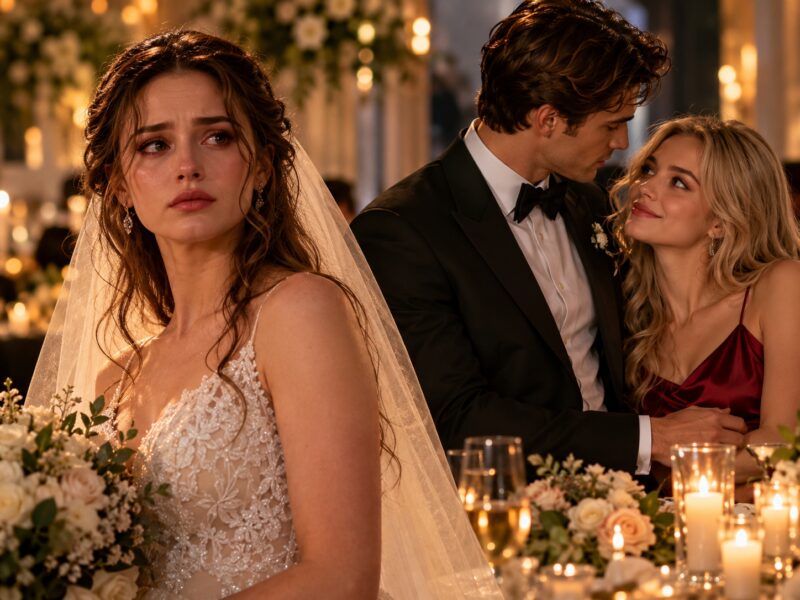
THREE WEEKS BEFORE OUR WEDDING, MY FIANCÉ PUT ANOTHER WOMAN FIRST—SO I MADE ONE DECISION HE NEVER SAW COMING

Three weeks before our wedding, I discovered that my fiancé had secretly changed our wedding arrangements for another woman.
He said she was only his childhood friend.
But when I asked him what I meant to him, his silence told me something his promises never had.
My name is Alina, and for almost five years, I believed Nathan was the man I would grow old with. I had imagined our wedding so many times that I could practically hear the music before the ceremony began. I knew which flowers would sit on the tables, where my parents would stand for photographs, and how Nathan would smile when he saw me walking toward him. What I never imagined was that, just weeks before that day, I would be sitting alone with our wedding notebook, wondering whether the man I loved had ever truly understood what it meant to choose me.
We met on a rainy Saturday afternoon in a small bookstore. I was reaching for a novel on a crowded shelf when another hand touched the same book. I looked up, already preparing to apologize, and found a man with kind eyes and a slightly embarrassed smile. He pulled his hand away immediately and said, “You can have it. I have time to find another.”
I remember laughing because it was such a simple thing to say, and yet he made it sound sincere. We ended up talking between the shelves for nearly half an hour, first about books, then about the weather, and finally about everything else. When we left, the rain had softened to a drizzle, and Nathan offered to walk with me toward the parking lot. Before we parted, he asked for my number.
That was the Nathan I fell in love with. He was patient when I needed time to make decisions, thoughtful about the little things, and dependable in ways that made ordinary days feel safe. He remembered how I liked my coffee, called when he said he would, and never made me feel foolish for being sentimental. For the first few years, I never doubted that I mattered to him.
When he proposed, I said yes without hesitation. It wasn’t because I believed marriage would make our relationship perfect. It was because I trusted that whatever life brought us, we would face it together.
Then Meline came back into town.
Nathan had known Meline since they were teenagers. They had grown up together, stayed close through their younger years, and maintained a friendship even after she moved away following college. I knew about her long before I met her, although until she returned, she had existed mostly in Nathan’s stories. When he told me she was moving back, he seemed genuinely excited.
“She’s practically family,” he said when he noticed my curiosity. “You’re going to like her.”
And at first, I did.
Meline was confident and outgoing, with an easy way of making people laugh. She could walk into a room full of strangers and have everyone talking to her within minutes. She and Nathan shared memories I wasn’t part of, jokes that had begun years before I knew him, and a familiarity that seemed natural for people who had grown up together. I saw no reason to resent any of it.
I had never wanted to be the woman who treated every female friend as a threat. Nathan had a life before me, just as I had a life before him, and I believed a healthy relationship made room for friendships. So when Meline needed help moving into her new apartment, I encouraged Nathan to go. When she needed a ride to the airport, I understood. When she called late at night after a painful breakup, I tried to be patient.
The first few times, nothing seemed unusual. Nathan would come home, tell me what had happened, and thank me for understanding. I felt proud that we could trust each other enough not to turn ordinary friendships into arguments. I thought the way we handled Meline’s return was proof that our relationship was strong.
Looking back, I can see how slowly the balance shifted.
There wasn’t one dramatic incident that made everything fall apart. There wasn’t a lipstick stain on his collar or a message confessing an affair. There were simply a hundred small decisions, each one easy to dismiss by itself, until they formed a pattern I could no longer ignore.
Nathan started canceling plans because Meline needed him. Sometimes it was something practical, like a problem with her car. Other times, she was upset, lonely, or having a difficult day. Every time I expressed disappointment, Nathan had an explanation that sounded reasonable enough to make me question whether I was being unfair.
Our anniversary dinner was one of the first occasions that truly hurt.
I had been looking forward to it for weeks. It wasn’t anything extravagant, just a reservation at a restaurant we both loved and an evening without distractions. I had chosen an outfit, rearranged a few things at work, and spent most of the afternoon looking forward to seeing him. Then Nathan called to say Meline was dealing with an emergency and needed his help.
He apologized, and I told myself that emergencies happened. We could celebrate another evening. But after hanging up, I sat on the edge of our bed for a long time, still dressed for a dinner that wasn’t going to happen. I remember looking at the mirror and feeling embarrassed by how disappointed I was.
A few weeks later, we canceled a weekend trip we had been planning for months because Meline was having trouble with her car.
I tried to explain why it bothered me. Nathan reminded me that she didn’t have many people nearby she could rely on. He made it sound as though I was asking him to abandon someone he cared about. Eventually, I stopped arguing because I didn’t want every conversation about our relationship to become a debate about whether I was being compassionate enough.
The most painful part wasn’t that Nathan helped her. I could understand friendship, loyalty, and the desire to be there for someone in a difficult moment. What hurt was how quickly he rearranged our life around her needs, while treating our plans as though they could always wait.
And I was always the one expected to understand.
By the time our wedding planning was underway, I had begun to dread hearing Meline’s name appear in the middle of a conversation. I hated that feeling. It made me feel small and suspicious, two things I had never wanted to become. I kept telling myself that once the wedding drew closer, Nathan would naturally become more involved with the life we were building.
One Saturday, we had an appointment with the florist. I had spent weeks researching arrangements, collecting pictures, and narrowing down which flowers would look right for our ceremony and reception. Nathan had promised to come because I wanted us to make those choices together. I didn’t expect him to care about every shade of white or every ribbon, but I wanted him beside me.
Twenty minutes before the appointment, my phone rang.
“Alina, I’m sorry,” he said. “Meline’s having a really bad day. She needs me.”
I looked down at the wedding notebook resting in my lap. I had written his name beside the appointment time, and beneath it were several questions I wanted us to discuss with the florist. I had imagined him laughing at how seriously I was taking the flowers before eventually admitting which arrangement he liked best.
“You promised,” I said.
“I know.”
“And you’re choosing her again.”
There was a pause. Then Nathan sighed, the way he had started sighing whenever I mentioned Meline. “Don’t make this into something it isn’t.”
I sat there staring at the phone after the call ended.
For a while, I considered canceling the appointment. Then I gathered my notes, got into my car, and drove there alone. The florist was friendly and professional, and I did my best to act like nothing was wrong. When she asked whether my fiancé would be joining us, I told her something had come up.
The words tasted bitter because I had said them so many times before.
That evening, Nathan came home carrying a coffee for me. He set it on the counter, kissed my forehead, and asked how the appointment had gone. His behavior was so normal that I almost wondered if I had imagined the seriousness of our conversation earlier.
“I love you,” he said.
I wanted those words to fix everything. For a little while, I let them.
But love became harder to believe when the same choices kept repeating.
Two weeks later, we had our wedding rehearsal dinner. My parents had traveled for hours to attend, and Nathan’s family was there too. The room was warm and bright, filled with familiar voices and the kind of cheerful conversation people have when they believe they are celebrating the beginning of something wonderful. Everyone seemed excited about the wedding.
Everyone except me.
I smiled for photographs, answered questions about the ceremony, and thanked relatives who had brought small gifts. I knew I should have been happy. Instead, I kept watching Nathan, noticing how often his attention drifted toward the entrance.
Meline arrived almost an hour late.
The moment Nathan saw her, he pushed back his chair and stood. He crossed the room before she had even finished greeting everyone near the doorway. I watched him lean toward her with an expression of immediate concern.
“Are you okay?” he asked.
Meline smiled. “Fine now.”
He hugged her.
It was such a small exchange that no one else seemed to notice anything unusual. Nathan returned to the table a little later, and the evening continued. But I couldn’t shake the image of how quickly he had moved toward her, or how instinctively he seemed to understand that her arrival required his full attention.
My mother noticed my expression.
“Alina,” she said softly, “are you okay?”
I nodded because we were surrounded by people and I couldn’t bear the thought of explaining what I was feeling at my own rehearsal dinner.
But I wasn’t okay.
Later that night, I stepped outside for some air. The sounds of conversation were muffled behind the door, and the cool evening made my skin prickle. I stood alone, looking at the lights from the building, wondering why I felt so disconnected from a celebration that was supposed to be about my future.
Nathan eventually found me.
“You’ve been quiet,” he said.
“I’ve been thinking.”
“About what?”
I turned toward him. “About whether you actually want to marry me.”
His face changed immediately. “What kind of question is that?”
“A serious one.”
He rubbed his forehead and looked away for a moment. “Alina, I’m marrying you. What more do you want?”
I had been carrying the answer for months, but saying it aloud made my throat tighten.
“I want to feel chosen.”
He stared at me as though he couldn’t understand why I would say something so strange.
“You are chosen.”
“Then why do I always feel like I’m waiting for my turn?”
Nathan didn’t answer.
He stood there for several seconds, looking at me, before turning away and walking back inside. I remained outside after the door closed behind him. The silence was somehow more painful than an argument would have been.
I wasn’t asking him to stop caring about another person. I wasn’t asking him to prove his love with some grand gesture. I was asking him to recognize that the woman he was about to marry needed to matter in the decisions he made every day.
And he had walked away.
For the first time, I began to wonder whether his silence wasn’t confusion at all.
Maybe he understood exactly what I was saying and simply didn’t want to answer.
The next morning, I decided to try again. I still loved him, and I didn’t want to cancel a wedding because we had failed to communicate clearly. There was too much history between us, too much affection, and too many memories for me to walk away without knowing that I had been completely honest.
I asked Nathan to sit down with me.
“No more excuses,” I told him. “I need you to be honest with me.”
He looked exhausted before we had even begun. “I am honest with you.”
“Then tell me where Meline fits into your life.”
“She’s my friend.”
“And where do I fit?”
“You’re my future wife.”
I watched his face. “Then why doesn’t your behavior show it?”
His expression tightened. “You’ve been doing this for months.”
“Because I’ve been hurting for months.”
He stood up, clearly frustrated. “I can’t keep having the same argument.”
“This isn’t just an argument, Nathan. I’m telling you what I need from my future husband.”
He said nothing, so I made my request as clear as I possibly could. I told him that I wasn’t demanding he end his friendship with Meline. I wanted boundaries. I wanted important moments in our relationship to receive the care and attention they deserved, rather than being repeatedly sacrificed whenever she called.
“I need our relationship to come first when something important happens,” I said.
Nathan finally nodded.
“Fine.”
It wasn’t a particularly warm response. He didn’t reach for my hand or apologize for how long I had been struggling. Still, I felt a small rush of relief because I wanted to believe that he had finally heard me.
For the first time in months, I allowed myself to feel hopeful.
Then my phone rang.
It was the wedding venue.
The woman on the other end sounded slightly uncertain when she greeted me. She explained that she wanted to confirm a change to our reservation, something she apparently believed Nathan and I had already discussed.
“What change?” I asked.
“Mr. Nathan contacted us yesterday.”
I sat straighter. “What did he change?”
She explained that he had requested a modification to the reception seating arrangement.
“Why?”
There was a brief pause.
“He said Meline would be sitting at the head table.”
I stopped breathing for a moment.
The head table was supposed to be reserved for Nathan, me, and the immediate wedding party. We had already discussed the seating, and I had spent time making sure everyone would be comfortable. Nathan had never mentioned wanting to change it.
Yet he had contacted the venue without telling me and arranged for Meline to sit there.
I thanked the coordinator and ended the call.
For several minutes, I remained where I was, staring at my wedding notebook. Just hours earlier, I had asked Nathan to respect our relationship. He had nodded and agreed. But the day before that conversation, he had already made a significant wedding decision centered around Meline.
I waited until he came home that evening.
“You changed our wedding seating,” I said.
He looked surprised that I knew.
“She doesn’t know anyone else there,” he explained. “She’ll feel uncomfortable.”
I let out a quiet laugh. There was nothing amusing about it, but the absurdity was beginning to make me feel numb.
“You promised me boundaries.”
“I know.”
“And your first decision after everything we’ve been discussing is to make her part of our wedding table.”
“It’s not a big deal.”
“It is to me.”
He shook his head. “You’re making everything about her.”
I looked at him for a long moment.
“No, Nathan. You are.”
He turned toward the kitchen, clearly wanting the conversation to end. Then his phone buzzed. He glanced down at the screen, and I saw Meline’s name before he turned the phone over.
Something inside me went cold.
“Read it,” I said.
He frowned. “What?”
“Whatever she sent. Read it.”
“Alina, this is ridiculous.”
He picked up his phone and walked into another room.
I stood there listening to his footsteps fade.
That night, I barely slept. I kept replaying the phone call from the venue and Nathan’s reaction when I confronted him. I didn’t know what Meline had written, and I couldn’t prove that there was anything romantic between them. But I was beginning to realize that an affair wasn’t the only way a relationship could be damaged.
The secrecy was real.
The broken promises were real.
And the feeling that I had become an afterthought in my own wedding was painfully real.
The next morning, I went to the wedding venue.
I asked the coordinator if I could review every change that had been made to our arrangements. She brought out the paperwork, and I sat down expecting to find the revised seating plan.
Instead, I discovered that Nathan had changed much more.
He had removed the transportation arranged for the bridal party. He had removed the private room my parents were supposed to use. And he had requested an additional hotel room for Meline.
I studied the documents, trying to absorb what I was seeing.
These weren’t small adjustments made in passing. They involved arrangements we had discussed together, services intended to make the wedding comfortable for our families, and an additional accommodation for the one person whose needs had repeatedly taken precedence over mine.
“Who paid for these changes?” I asked.
The coordinator checked the file.
“Mr. Nathan.”
I thanked her and left.
The drive home felt strangely quiet. I didn’t turn on the radio, and I barely noticed the traffic. I kept thinking about all the times I had wondered whether I was overreacting, whether I was selfish, whether I should simply be more patient.
Now I had documents in front of me showing that Nathan had made deliberate choices about our wedding without telling me.
He knew what he was doing.
He knew I would be hurt.
And he had done it anyway.
When I arrived home, Nathan was waiting.
“You went to the venue?” he asked.
“Yes.”
“You had no right.”
I stared at him, genuinely shocked by the accusation.
“No right? You’re making decisions behind my back.”
He looked irritated, but I continued before he could interrupt.
“You changed our wedding behind mine.”
For a moment, he said nothing.
Then he spoke the sentence that finally ended something inside me.
“Meline needs me right now.”
I looked at him.
“And what do I need?”
He didn’t answer.
I waited, thinking perhaps he hadn’t heard me.
“What do I need, Nathan?”
He looked away.
“I can’t do this tonight.”
Then he walked out.
I heard the door close and stood in the room for several moments, expecting to feel the familiar urge to follow him. Usually, I would have reached for my phone, tried to explain my feelings more carefully, or softened my words so we could find a way back to each other.
That evening, I did none of those things.
I went to the table and opened my wedding notebook.
The pages were filled with months of planning. There were guest lists, flower samples, seating notes, hotel reservations, and reminders about the ceremony. I found the page where I had written down ideas for my vows, the words I had been trying to shape into something worthy of the man I thought I was marrying.
I sat there for almost an hour.
I remembered the bookstore, the rain, and Nathan offering me the last copy of a novel without hesitation. I remembered the early years when he seemed genuinely concerned whenever I was unhappy. I remembered believing that his patience and kindness were permanent parts of who he was.
Then I thought about how differently he had behaved when the person asking for his consideration was me.
The ring on my finger caught the light as I turned a page.
For years, that ring had meant a promise. Now it felt like a question I had spent months avoiding.
I picked up my phone and called the wedding venue.
“I need to cancel the wedding,” I said.
The coordinator was silent for a moment.
“Are you sure?”
I looked down at the engagement ring.
“Yes,” I replied. “Completely sure.”
The words were steady, although my hands were shaking.
After ending the call, I contacted my parents. Telling them was harder than I expected, not because they tried to change my mind, but because saying it aloud made the decision real. I had to explain that the wedding wasn’t being postponed, that I wasn’t simply upset after an argument, and that I had reached a point where I could no longer imagine standing beside Nathan and promising him a lifetime.
Then I called Nathan’s parents.
Finally, I sent Nathan a message telling him the wedding was canceled.
I didn’t write a long explanation. I didn’t list every broken promise or demand that he finally acknowledge what he had done. I had spent months explaining myself, and I was exhausted by the effort.
His call came almost immediately.
I watched the screen light up and let it ring.
Then he called again.
And again.
Messages began appearing.
“Alina, please talk to me.”
“You can’t do this.”
“Where are you?”
“I love you.”
I read the words, feeling the ache of everything they once would have meant. There had been a time when a message from Nathan could turn an ordinary afternoon into something wonderful. Now I was looking at the same name on my phone and realizing that I no longer trusted the promises attached to it.
For once, his words weren’t enough.
By the next morning, everyone knew the wedding had been canceled. News traveled quickly through both families, and I knew there would be questions I wasn’t ready to answer. There were practical decisions to make, arrangements to undo, and a life I had assumed was settled that suddenly seemed uncertain.
My mother came to my apartment and found me sitting on the floor surrounded by boxes.
“Are you moving?” she asked.
I nodded.
“Where?”
I looked around the room. “I don’t know yet.”
She sat down beside me without asking for a detailed explanation.
“You don’t have to figure everything out today.”
I felt my eyes fill with tears. “I should have done this months ago.”
She didn’t say she had warned me. She didn’t tell me I was brave or insist I would soon find someone better. She simply put her arms around me, and I finally allowed myself to cry.
Nathan continued calling over the following days.
Eventually, I answered.
“Alina, please,” he said. His voice was shaking. “We need to talk.”
“We’ve talked, Nathan.”
“No, we haven’t.”
I closed my eyes. “You had months to talk to me.”
“I didn’t realize you were this serious.”
The words hurt more than I expected.
“That’s the problem.”
“What problem?”
“You never believed I’d actually leave.”
He went quiet.
Then he said, “I can fix this.”
I leaned back against the wall and stared at the half-packed boxes.
“You’ve been saying that for months.”
“I’ll distance myself from Meline.”
I shook my head, even though he couldn’t see me.
“That’s not what I wanted.”
“What do you mean?”
“I didn’t want to control who you were friends with. I wanted you to understand that our relationship deserved respect.”
“I understand now.”
“No, Nathan. You understand because I canceled the wedding.”
He didn’t answer immediately. When he spoke again, his voice sounded smaller.
“Is there someone else?”
“No.”
“Then why are you doing this?”
I looked around the apartment.
There was a framed photograph from our first Christmas together. A small plant Nathan had bought me sat near the window. The wedding invitations were stacked neatly on the table, addressed and ready for a future that would never arrive.
I remembered loving him so completely that I had never thought about what my life would look like without him.
“Because I don’t want to spend the rest of my life begging my husband to choose me.”
He whispered my name.
I kept speaking because I knew that if I stopped, I might lose the courage to finish.
“I loved you enough to marry you. But I also need to love myself enough not to.”
Then Nathan began to cry.
I had never heard him cry like that before. His breathing became uneven, and for a moment, I wanted to comfort him out of habit. I wanted to say something kind, something that would make him feel less frightened, because that had been my instinct throughout our relationship.
But I had spent so much time protecting him from discomfort that I had forgotten what it felt like to protect myself.
I let him cry.
And when the conversation ended, I didn’t call him back.
A week later, I met Nathan outside a quiet café to return the engagement ring.
He looked tired. His face was drawn, and the confidence I remembered had disappeared from his expression. I wondered whether he had been sleeping, whether he was eating properly, whether someone had been looking after him.
It was strange how quickly those familiar worries returned.
I placed the ring in his palm.
He stared at it.
“Are you really doing this?”
“Yes.”
“After everything?”
I looked at him. “Because of everything.”
Nathan lowered his eyes.
“I made mistakes,” he said.
“You did.”
“I thought you’d always understand.”
I felt a painful little smile form.
“I understood too much.”
He swallowed and looked up again.
“What about Meline?”
“What about her?”
“She was never more important than you.”
I didn’t argue.
Maybe he believed that. Maybe he had never thought of Meline as someone who could threaten our relationship, because he had never stopped to consider what his constant choices looked like from my side. Maybe he sincerely loved me and simply assumed I would always make room for whatever he decided.
But the outcome was the same.
“You had a thousand chances to show me that, Nathan.”
His fingers closed around the ring.
“I love you.”
The words no longer frightened me with their power.
“I loved you, too.”
He looked at me, almost hopeful.
I nodded gently.
“Yes. I did.”
Then I turned and walked away.
For the first time in almost five years, I didn’t look back.
The months that followed were quieter than I expected. There was no sudden transformation, no dramatic celebration of freedom, and no wonderful new relationship waiting to fill the empty space. I moved into a small apartment across town and began arranging my life around my own routines.
At first, everything reminded me of Nathan.
I would pass a bookstore and remember the day we met. I would reach for my phone when something amusing happened, then remember that he was no longer the person I called first. Some evenings, I cooked too much food because I was still accustomed to preparing dinner for two.
I missed him.
I missed the man who had once made me feel safe, and I missed the future I had imagined with him. There were nights when I wondered whether I had been too harsh, whether our wedding could have happened if I had tried one more conversation, or whether I should have accepted his promise to change.
But whenever those thoughts grew overwhelming, I remembered sitting across from him and asking what I needed.
I remembered him looking away.
And I remembered how many times I had already tried.
Slowly, I began building a life that didn’t depend on waiting for someone else’s attention. I worked longer hours, traveled with my sister, and learned to enjoy the small routines of living alone. I discovered that I could have dinner by myself without feeling abandoned.
I stopped checking Nathan’s social media.
I stopped searching for signs that he regretted losing me.
And eventually, I stopped blaming myself for not having been patient enough to make him understand.
Then, one afternoon, a letter arrived.
I recognized Nathan’s name immediately.
For several minutes, I held the envelope without opening it. Part of me wanted to throw it away because I was afraid of being pulled back into the same questions I had finally learned to live without.
But curiosity won.
I sat down and unfolded the pages.
Nathan wrote that after our wedding was canceled, he had finally begun to understand how his decisions had affected me. He admitted that he had grown so accustomed to my forgiveness that he had stopped appreciating what it cost me to keep offering it.
He also wrote about Meline.
She had eventually moved away again. According to Nathan, their friendship had never been the romantic relationship I had feared. He wanted me to know that there had been no hidden love story waiting behind our broken engagement.
I sat with that part of the letter for a long time.
I had wondered about Meline so often that I thought learning the truth would bring some great sense of relief. Instead, I felt a quiet sadness. Whether or not Nathan had ever loved her romantically no longer seemed to matter as much as it once had.
He had repeatedly placed her needs above the promises he made to me.
He had made decisions about our wedding without my knowledge.
And when I told him how deeply I was hurting, he had treated the conversation as an inconvenience.
The absence of an affair didn’t erase any of that.
Near the end of the letter, Nathan admitted that he had believed I would always forgive him. He said he had mistaken my patience for something permanent, something he didn’t need to protect. He wrote that losing me had finally forced him to see how carelessly he had treated the relationship.
Then he asked for another chance.
I read the letter twice.
I didn’t hate him.
I no longer wanted him to suffer, and I didn’t feel any satisfaction knowing that he regretted what had happened. I could remember the good years without pretending the painful ones hadn’t existed. I could accept that Nathan had loved me in the ways he understood, even if those ways had not been enough.
But I didn’t answer.
I folded the letter and put it away.
There was nothing left I needed him to explain. His regret was real, but it didn’t create an obligation for me to return. I had spent a long time learning that lesson, and I wasn’t willing to forget it simply because he had finally found the words I once desperately wanted to hear.
A year after our canceled wedding, I stood on a balcony in another city and watched the sunset.
The sky had turned a soft orange, and the buildings below were beginning to glow with evening lights. Somewhere behind me, a door opened and closed, and I could hear distant traffic moving through the streets. I held a warm cup in my hands and looked out at a place that would once have felt unfamiliar.
I was alone.
There was no wedding album, no husband waiting inside, and no house filled with the memories I had imagined creating together. My life had not followed the beautiful, carefully organized pages of the notebook I once kept beside my bed.
I had lost a relationship that had shaped nearly five years of my life.
But I had found something I hadn’t realized I was losing.
I trusted myself again.
I could make a decision without immediately wondering whether I was being unreasonable. I could recognize disappointment without convincing myself it was selfish. I could remember my own needs without feeling guilty for having them.
And I finally understood that being chosen should never feel like a competition.
Nathan had once offered me a book because he saw that I wanted it. That tiny act of kindness had begun our entire relationship. For years, I remembered it as evidence of the kind of person he was.
I still believed that moment had been genuine.
But one thoughtful act, no matter how beautiful, couldn’t make up for years of choices that told a different story.
I had loved Nathan. I had wanted our marriage. I had imagined spending my life with him.
Leaving him had hurt more than I could have explained to anyone watching from the outside.
Still, as I stood on that balcony with the evening light settling over the city, I felt a peace I hadn’t known in a long time.
I no longer needed Nathan to tell me that I mattered.
I knew.
And that was enough.