My Husband Gave My Seat, My Bracelet, and My Work to His Mistress—Then His Billionaire Rival Asked Me to Dance

Natalie Arden Wynn knew her marriage was over before her husband said a word.
She knew it when she saw the young waiter standing beneath a chandelier at the Harbor Crown Gala, holding her place card as if it were something embarrassing he had been ordered to dispose of.
“Mrs. Wynn?”
His voice was barely audible beneath the orchestra.
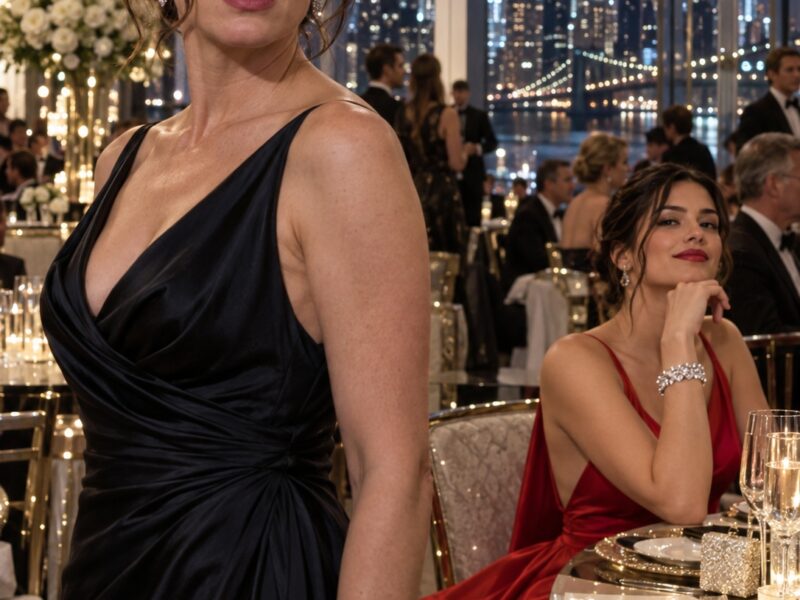
Four hundred investors, city officials, architects, philanthropists, reporters, and development executives filled the glass ballroom above Manhattan’s East River. Through the windows, the city glittered in silver and gold. Champagne moved through the room on polished trays. Camera flashes burst around the stage where, in less than an hour, the Harbor Commission would announce the finalists for a redevelopment project worth nearly two billion dollars.
The biggest night of Charles Wynn’s career.
And supposedly hers.
Natalie looked at the card in the waiter’s hand.
NATALIE WYNN — TABLE 28.
For a second, she thought she had misunderstood.
“Table twenty-eight?”
The waiter swallowed.
“There may have been a seating adjustment.”
Natalie turned slowly toward the center of the ballroom.
Table One sat directly beneath the stage.
Charles was there.
Her husband of nine years wore the midnight tuxedo she had chosen for him three weeks earlier. His silver cuff links caught the light as he leaned toward a city commissioner, smiling with the practiced confidence that magazines described as visionary.
Beside him sat Bianca Frost.
Charles’s executive assistant.
His “strategic partner.”
The woman whose messages had begun arriving after midnight six months ago.
Bianca wore a scarlet evening gown, one hand resting lightly beside Charles’s champagne glass.
On her wrist sparkled Natalie’s grandmother’s diamond bracelet.
Natalie stopped breathing.
The bracelet had been locked in the dressing-room safe that morning.
Her grandmother Evelyn had worn it at Natalie’s parents’ wedding.
Natalie had worn it the day she married Charles.
And now Bianca was turning her wrist beneath the chandelier so the diamonds could catch every camera in the room.
Then Natalie saw the small gold place card in front of Bianca.
MRS. CHARLES WYNN.
Not Bianca Frost.
Not Executive Assistant.
Not Guest.
Mrs. Charles Wynn.
The waiter looked mortified.
“I’m very sorry.”
Natalie gave him a small smile.
“There isn’t a mistake.”
Across the ballroom, Charles finally noticed her.
For half a second, panic crossed his face.
Then it disappeared.
He rose halfway from his chair and gave her the smile Natalie knew too well—the controlled, intimate smile he used whenever he wanted obedience to look like love.
“Natalie.”
He crooked one finger.
“Come here for a second.”
Three years earlier, she would have crossed the room quickly to protect him from awkwardness.
A year earlier, she would have crossed slowly while telling herself marriage required patience.
Six months earlier, she might have waited until they got home.
Tonight, Natalie walked toward him because she wanted to hear what kind of lie a man told when his mistress was wearing his wife’s name and her dead grandmother’s diamonds.
The conversations nearest Table One softened as she approached.
People pretended not to watch.
People always pretended not to watch cruelty when wealth had rented the room.
Charles stepped away from the table.
“You’re late.”
Natalie glanced at the enormous clock above the ballroom entrance.
“By three minutes.”
“I needed you here earlier.”
“For what?”
His jaw tightened.
“Natalie.”
She looked past him.
Bianca had not stood.
That, somehow, was worse than the bracelet.
She remained comfortably seated in Natalie’s place, one shoulder bare, lips painted deep red, looking at Natalie the way a hotel guest might look at housekeeping after requesting fresh towels.
Natalie pointed toward the gold card.
“You gave her my name, too?”
Bianca’s smile flickered.
Charles lowered his voice.
“The seating team made an assumption.”
“An assumption.”
“Yes.”
“That Bianca is your wife?”
“Don’t do this.”
“I’m asking a question.”
“We are surrounded by investors.”
“So?”
“So lower your voice.”
Natalie almost laughed.
Charles had humiliated her in a room of four hundred people and was already concerned she might embarrass him by noticing.
She looked at Bianca.
“Why are you sitting in my chair?”
Bianca finally turned.
“Charles needs someone beside him who understands tonight’s negotiations.”
Natalie felt something cold move through her chest.
“Does he?”
Bianca lifted one shoulder.
“I’m leading the Harbor Crown presentation.”
Natalie looked at Charles.
He did not correct her.
The Harbor Crown presentation.
Natalie had written eighty-seven percent of it.
She had developed the flood-resilience model.
She had spent eighteen months negotiating community protections with housing advocates who distrusted private developers.
She had convinced the Arden Trust to reopen negotiations over twenty-six acres of riverfront property after Charles had insulted two trustees badly enough that they had nearly terminated discussions.
She had revised the engineering package after midnight for six straight weeks.
And that morning, Charles had removed her name from the final deck.
“Table twenty-eight is perfectly respectable,” Bianca added.
Natalie glanced toward the back of the ballroom.
Table 28 sat beside the service doors.
Two junior event coordinators were arranging folders there.
“It’s for support staff.”
Bianca smiled.
“Then you’ll be near people you can manage.”
A tiny silence opened around the table.
Charles’s eyes flashed.
“Bianca.”
But Bianca wasn’t finished.
“You’ve always been better behind the scenes, Natalie.”
For years, Natalie had told herself that disappearing had been her choice.
Charles loved the cameras.
She hated them.
Charles could charm a room.
Natalie preferred plans, numbers, blueprints, negotiations, and details.
It had seemed harmless at first.
He would present.
She would build.
He would sell.
She would design.
He would talk.
She would make sure what he said was actually possible.
Somewhere along the way, the arrangement had changed.
Charles had stopped saying our work.
Then he had stopped saying Natalie’s work.
Eventually, he simply said my company.
And Natalie had let each stolen word pass because confronting one seemed more painful than tolerating ten.
Now Bianca wore the final word.
Wife.
Charles touched Natalie’s elbow.
“We’ll discuss this at home.”
She looked down at his hand.
He tightened his fingers slightly.
“Sit down,” he murmured. “Smile. Let me close this deal.”
For nine years, Natalie had translated that sentence as partnership.
Tonight, for the first time, she heard what it actually meant.
Make yourself smaller so I can stand on what you built.
Natalie raised her eyes.
“No.”
Charles blinked.
“What?”
“Take your hand off me.”
Several nearby conversations stopped completely.
Charles released her.
His face changed.
“Natalie, do not embarrass me in front of Adrian Cross.”
At the name, Bianca’s eyes moved immediately toward the entrance.
So did half the ballroom.
Adrian Cross had arrived.
At forty-one, the founder of Cross Meridian controlled one of the largest privately held development groups in the country. He had spent a decade competing with Charles for waterfront projects, transit districts, luxury towers, and municipal contracts.
Business magazines loved calling them enemies.
Charles loved pretending the rivalry made them equals.
It didn’t.
Charles Wynn was rich.
Adrian Cross could walk into a room where billionaires were talking and make them wonder whether they had misunderstood the definition.
He wore a black tuxedo without a pocket square or visible branding. No entourage surrounded him, though Natalie knew security would be nearby.
The strangest thing about Adrian was that he never seemed to perform his authority.
He simply occupied it.
He greeted the gala chair.
Shook hands with a former governor.
Ignored three people who tried to pull him toward cameras.
Then he saw Natalie.
And stopped.
His gaze moved once to Bianca’s wrist.
The bracelet.
Once to the place card.
Mrs. Charles Wynn.
Then back to Natalie’s face.
He understood something.
Natalie didn’t know how much.
But she knew he understood enough.
Adrian crossed the ballroom.
Charles’s posture stiffened.
“Cross.”
“Charles.”
Adrian gave him a polite nod.
Then he turned to Natalie.
“Mrs. Wynn.”
“Mr. Cross.”
The orchestra began a waltz.
Adrian held out his hand.
“Would you dance with me?”
Charles laughed sharply.
The sound came out too loud.
“My wife doesn’t dance at business events.”
Adrian did not look at him.
“I asked your wife.”
Natalie stared at the offered hand.
Every instinct she had spent nine years developing told her to avoid escalation.
Protect Charles.
Protect the company.
Protect the project.
Protect appearances.
Protect the marriage.
Protect everything except herself.
She looked at Bianca sitting in her chair.
At Charles standing beside a proposal bearing Natalie’s invisible fingerprints.
At her grandmother’s bracelet on another woman’s wrist.
Then at Adrian.
He wasn’t pulling.
He wasn’t rescuing.
He was simply asking.
Natalie placed her hand in his.
“Yes.”
Charles stopped smiling.
“I would.”
Adrian led her toward the dance floor.
The room seemed to tilt around them.
Natalie could feel people watching.
She expected Adrian to say something clever.
Something cruel about Charles.
Something triumphant.
Instead he placed one hand lightly at the middle of her back and kept enough distance between them that she never had to wonder what anyone else might think.
“Do you want to leave?” he asked.
Natalie looked toward the doors.
“Not yet.”
“Do you want me to make Charles uncomfortable?”
Despite herself, she almost smiled.
“You already have.”
“That was effortless.”
His mouth moved slightly.
“I’m asking what you need.”
The question landed harder than any insult Bianca had delivered.
What do you need?
Charles had not asked Natalie that in years.
He asked what the project needed.
What investors needed.
What the board needed.
What he needed.
But somewhere between their fifth anniversary and tonight, Natalie had become infrastructure.
Essential.
Invisible.
Expected to remain functioning without maintenance.
She studied Adrian.
“Why did you ask me to dance?”
His eyes remained on hers.
“Because you were standing alone while someone else occupied a place you earned.”
Natalie swallowed.
“And?”
“And because I’ve wanted to ask you for three years.”
Her step faltered.
Adrian steadied her without pulling her closer.
“That is an extremely dangerous thing to say tonight.”
“Then hear only the first reason tonight.”
Natalie searched his face for manipulation.
Found none.
Across the ballroom, Charles watched them with open fury.
Bianca leaned toward him, whispering.
Charles barely reacted.
His attention remained fixed on Natalie.
The music ended.
Adrian released her immediately.
No lingering hand.
No dramatic gesture.
“Thank you.”
Natalie nodded.
“Thank you.”
He hesitated.
“The gala chair asked me to announce the Harbor Crown finalist.”
“I know.”
“There is something you should hear before I walk onto that stage.”
The noise of the ballroom seemed to fade.
Adrian’s expression had changed.
“Charles submitted your Harbor Crown design under his name.”
Natalie felt no surprise.
Only confirmation.
“I know.”
Adrian studied her.
“Did you authorize it?”
“No.”
Something hardened behind his eyes.
“Then tonight is about to become more complicated than a stolen chair.”
Natalie looked toward the stage.
Charles had returned to Table One.
Bianca was beside him.
Her bracelet glittered beneath the lights.
Her project was about to appear on a forty-foot screen with someone else’s name on it.
For the first time that evening, Natalie smiled.
“Good.”
Adrian raised one eyebrow.
She held his gaze.
“I’m finished making things simple for him.”
Ten minutes later, the gala chair tapped the microphone.
The chandeliers dimmed.
Charles sat upright at the center table.
Bianca slipped her hand through his arm.
He had recovered the public smile Natalie had watched him practice in mirrors before investor dinners.
Only the muscle moving along his jaw betrayed him.
“Ladies and gentlemen,” the chair began, “tonight the Harbor Commission expected to announce the development team selected for final negotiations regarding the Crown Pier restoration.”
Applause rose.
The enormous screen behind the stage displayed two company names.
WYNN URBAN.
CROSS MERIDIAN.
Natalie remained standing beside the dance floor.
She had refused Table 28.
People noticed.
Good.
“Both firms,” the chair continued, “submitted ambitious proposals for the forty-acre riverfront district.”
What most of the ballroom did not know was that twenty-six of those acres belonged to the Arden Trust.
Natalie’s family trust.
After her father died, she had gradually assumed greater responsibility over its civic properties. Six months earlier, the board had elected her voting chair.
Charles knew the Arden Trust owned the land.
He did not know Natalie chaired it.
He had never asked why she disappeared every Thursday morning.
When she once tried to explain the new responsibility, he had glanced at his phone and said, “That’s good, Nat. Whatever keeps the trustees happy.”
Now Adrian stepped onto the stage.
The applause changed.
Natalie watched Charles.
“Following technical review,” Adrian said, “the commission identified an issue that must be resolved before a finalist can be named.”
Charles’s smile vanished.
The screen changed.
Two sets of design files appeared side by side.
One bore Wynn Urban’s logo.
PRINCIPAL AUTHORS:
CHARLES WYNN.
BIANCA FROST.
Beside it appeared an earlier encrypted registration.
ARDEN CIVIC STUDIO.
NATALIE ARDEN WYNN.
A murmur moved through the room.
Adrian continued.
“The structural plan, community covenants, land-use matrix, and flood-mitigation model in Wynn Urban’s submission substantially match a design registered fourteen months earlier by Mrs. Natalie Arden Wynn.”
Now people were no longer pretending not to watch.
Charles stood.
“This is an internal attribution matter.”
The gala chair looked toward him.
Adrian remained calm.
“The commission has received no assignment transferring those design rights to Wynn Urban.”
“My wife developed the plan while working with my company.”
Natalie began walking toward the stage.
Every step felt strangely quiet.
Charles saw her coming.
“Natalie.”
She reached the front.
“I have never been your employee.”
Charles stared at her.
“You worked from our office.”
“I advised Wynn Urban without salary because we were married.”
His face darkened.
“That work was created for this company.”
“No.”
Natalie looked toward the commission representatives.
“The design was developed through Arden Civic Studio before Wynn Urban received a review copy.”
Bianca stood.
“She emailed us the files.”
Natalie turned.
“Authorization to evaluate them.”
Bianca’s chin lifted.
“You never said we couldn’t use them.”
“I didn’t know I needed to explain that emailing someone a file does not transfer authorship.”
A few people laughed nervously.
Charles’s cheeks reddened.
The gala chair looked as if she wanted the floor beneath her to open.
“Mrs. Wynn, are you formally disputing Wynn Urban’s right to submit this proposal?”
Charles locked eyes with Natalie.
There it was again.
The command without words.
Don’t.
Don’t damage me.
Don’t contradict me.
Don’t make me face what I have done.
For years, Natalie had mistaken that look for intimacy.
Now it seemed almost childish.
“Yes,” she said.
One word.
That was all.
But the room changed.
The commission suspended Wynn Urban’s candidacy pending independent review.
Cross Meridian remained technically eligible, but Adrian immediately requested that no winner be announced until Natalie’s ownership claim had been examined by outside counsel.
It was the correct move.
It was also the move Charles had not expected.
He pushed toward Natalie as soon as the microphone went silent.
“What the hell have you done?”
She faced him.
“Corrected the record.”
“We could lose a two-billion-dollar project.”
“You should have considered that before submitting a design you didn’t own.”
Bianca appeared beside them.
“You’re angry about the seating arrangement, so now you’re trying to destroy him.”
Natalie looked at the bracelet.
“Give it back.”
Bianca blinked.
“What?”
“My bracelet.”
“It was a gift.”
“From whom?”
“Charles.”
Natalie looked at her husband.
He rolled his eyes.
“For God’s sake.”
The reaction hurt more than denial.
“My grandmother left that bracelet to me.”
Charles shrugged.
“It was in our home.”
“So was my passport. Would you like to give Bianca that too?”
Bianca glanced between them.
“You told me it was yours.”
Charles snapped, “It’s jewelry. We have larger problems.”
Natalie extended her hand.
“For you, perhaps. For me, theft remains a problem at every price.”
Adrian was speaking to the gala director nearby.
He said something quietly.
A security officer approached.
Bianca’s confidence finally slipped.
She unclasped the bracelet.
For a second, Natalie thought she might hand it over.
Instead Bianca dropped it into Natalie’s palm.
“Enjoy your little victory.”
Natalie closed her fingers around the diamonds.
Bianca leaned closer.
“Charles still comes home with me.”
A strange peace moved through Natalie.
“Then perhaps you should ask where home will be.”
Charles went still.
Bianca frowned.
“What does that mean?”
Natalie looked at her husband.
That morning, while printing updated trust documents from the home office, Natalie had found twelve pages abandoned in the printer tray.
A draft divorce petition.
Charles intended to request exclusive occupancy of their Manhattan penthouse.
Control over selected Arden Trust distributions.
A valuation of Arden Civic Studio low enough to declare it irrelevant, while simultaneously claiming all of Natalie’s design work as marital property.
He planned to file immediately after Harbor Crown was awarded.
Apparently, Charles wanted a clean transfer.
The project.
The home.
The mistress.
The wife’s work.
And then, finally, the wife removed from the picture.
“The penthouse belongs to the Arden Residential Trust,” Natalie said.
Bianca’s smile disappeared.
“Charles has occupancy rights through the marriage.”
She looked directly at Bianca.
“His guests do not.”
Charles took Natalie by the arm again.
This time she pulled away before his fingers closed.
“We need to talk privately.”
“My attorney will contact yours.”
His expression changed.
“Attorney?”
“I found your divorce petition.”
Silence.
Even Bianca looked surprised.
Natalie almost admired that.
Apparently there were still betrayals Charles had not bothered to share with his mistress.
“I was going to tell you,” he said.
“When?”
Charles looked around.
“Not here.”
“After Harbor Crown?”
His silence answered.
“After I convinced my family trust to contribute the land?”
“Natalie—”
“After my design made you a billionaire?”
“You’re being dramatic.”
Bianca looked at him.
“You filed already?”
“No.”
“You told me—”
“Not now, Bianca.”
There it was.
A crack.
Small.
But real.
Natalie removed her wedding ring.
For nine years, it had been on her hand through hospital visits, funerals, project launches, miscarried hopes they had never spoken about properly, business failures, anniversaries, apologies, and all the ordinary mornings she once believed were evidence of permanence.
She placed it in Charles’s palm.
His fingers closed automatically.
“You wanted the divorce after winning Harbor Crown,” she said.
Charles looked down at the ring.
Natalie stepped away.
“You can have it without the project.”
Then she walked out of the ballroom alone.
Adrian followed only as far as the lobby.
“My driver can take you anywhere.”
“No.”
“A hotel suite?”
“No.”
“Security?”
“No.”
He nodded after each answer.
No argument.
No persuasion.
Then he took a card from his pocket.
“My general counsel’s direct number. The commission has preserved every Harbor Crown submission and revision. Your attorney can request the records.”
Natalie took the card.
“You could win the project if Charles is disqualified.”
“Yes.”
“So helping me benefits you.”
“Potentially.”
She appreciated the lack of denial.
“That is why everything goes through the commission. Not me.”
Adrian paused.
“I would prefer you trust the evidence before you decide whether you trust my motives.”
Natalie studied him.
Charles would have turned gratitude into a debt before the elevator doors closed.
Adrian simply stepped back.
“Thank you for the dance,” she said.
Something softened in his face.
“Thank you for saying yes.”
Natalie spent the night in her father’s old townhouse on East Seventy-Third Street.
She slept for forty-three minutes.
At seven the next morning, divorce attorney Naomi Price arrived with coffee, three yellow legal pads, and the expression of a woman who had already decided she disliked Charles professionally.
By eight-thirty, Natalie understood that the betrayal at the gala had been theatrical.
The paperwork was worse.
Charles’s draft petition claimed Natalie had “emotionally abandoned” the marriage.
That she had contributed little to Wynn Urban.
That she had destabilized company operations with unpredictable interference.
That Arden Civic Studio possessed no meaningful independent value.
In the next paragraph, he demanded voting access to Arden Civic Studio because its intellectual property was supposedly essential marital property.
Naomi circled both statements.
“He needs your company to be worthless when discussing your contribution and priceless when discussing what he wants from you.”
Natalie stared at the paper.
“He thought no one would notice.”
Naomi looked up.
“No. He thought you wouldn’t fight.”
That sentence stayed with Natalie.
By ten, they had filed first.
Natalie’s petition cited adultery, attempted misappropriation of separate assets, fraudulent representation of intellectual property, and dissipation of marital funds pending further discovery.
An emergency preservation order froze deletion of Wynn Urban project records.
The Arden Trust suspended Charles’s access to the penthouse after security logs showed Bianca entering with his private code at 3:06 that morning.
At 9:14, Charles called.
Natalie almost ignored it.
Then she answered.
“You locked me out of my home.”
“Good morning, Charles.”
“Do not do that.”
“Do what?”
“Speak to me like I’m a stranger.”
Natalie looked around the townhouse kitchen.
Her father’s old coffee mug sat upside down on the drying rack.
“I’m trying to learn.”
Charles inhaled sharply.
“The trust revoked my access.”
“The trust suspended your access after Bianca entered the penthouse at three this morning.”
“She was helping me pack.”
“Then you were already leaving.”
Silence.
“Call this off.”
“No.”
“We can negotiate privately.”
“Through counsel.”
His voice softened.
The old voice.
The one he used after hurting her.
“Nat.”
She closed her eyes.
“Don’t.”
“Don’t what?”
“Use my name like a key after changing the locks.”
Another silence.
Then anger returned.
“You are destroying nine years over one bad night.”
“The night was a summary, Charles. Not an exception.”
“I gave Bianca the seat because investors respond to her.”
“I know.”
“You hate those events.”
“I hated standing beside you while you accepted praise for work you knew was mine.”
“You never complained.”
Natalie almost smiled from exhaustion.
“I did.”
“No, you didn’t.”
“I told you after Denver. After Seattle. After the Lakeshore proposal. After the transit symposium.”
Charles said nothing.
“You called me insecure.”
“I don’t remember that.”
“I do.”
He exhaled.
“Renew Wynn Urban’s permission to use the Harbor design.”
“No.”
“Hundreds of employees could lose their jobs because you’re angry at me.”
“I arranged temporary payroll financing with three board members last night.”
The silence changed.
“You what?”
“The employees will not pay for what you did.”
“You spoke to my board?”
“Three directors called me after the gala.”
“Natalie.”
“They apparently know who has been fixing your projects.”
She ended the call.
At noon, the Wynn Urban board announced an emergency investigation.
At 2:07 p.m., Bianca made everything worse.
She posted a photograph from a hotel bed.
Charles’s white dress shirt hung loosely over one shoulder.
The bracelet was gone.
Her caption read:
A seat is earned by the woman a man chooses.
Within twenty minutes, the image had spread across business gossip accounts.
Within an hour, someone uploaded footage of Adrian asking Natalie to dance.
The internet created its preferred story immediately.
Discarded wife.
Powerful husband.
Beautiful mistress.
Billionaire rival.
Romantic revenge.
People debated which man Natalie should “choose” as if she had spent nine years becoming invisible only to emerge as a trophy in another man’s competition.
Adrian’s communications director called Naomi offering to issue a statement.
Natalie refused.
Instead, she uploaded three documents.
The original encrypted design registration.
The Harbor Commission authorship notice.
The metadata proving the file existed fourteen months before Wynn Urban’s submission.
Then one sentence:
My marriage is private. The theft of my work is documented.
Nothing else.
That was enough.
Architects Natalie had worked with began posting emails.
Community organizers shared photographs of her at midnight planning meetings.
A retired civil engineer uploaded an old video from a flood-resilience conference.
Natalie stood at the front of the room explaining storm-surge modeling.
Charles sat in the audience looking at his phone.
By evening, the story had changed.
Not completely.
The internet rarely surrendered drama.
But people had begun asking a different question.
Who had actually built Charles Wynn’s empire?
At 9:18 p.m., Adrian sent one message.
You did not need rescuing. The record only needed daylight.
Natalie read it twice.
Then she typed:
Coffee tomorrow? No lawyers.
His answer came almost immediately.
I would like that.
Adrian chose a small café in Tribeca.
No private room.
No security theatrics.
No photographers.
Natalie arrived at eight and found him already seated beside the window with two coffees and a newspaper folded beside his hand.
“You could have bought the café,” she said.
“I considered it.”
She sat.
“But?”
“The paperwork would delay breakfast.”
She laughed.
It surprised her so much she nearly stopped.
Adrian smiled but did not celebrate getting the reaction.
He asked about her father.
About Arden Civic Studio.
About why she had allowed Charles to take public ownership of work that was clearly hers.
“Allowed is an uncomfortable word.”
“I can choose another.”
“No.”
Natalie wrapped both hands around the coffee.
“It’s accurate.”
She looked out the window.
“Charles said two visible leaders confused investors. He was good on camera. I was good at planning. It seemed efficient.”
“At first.”
“At first.”
She swallowed.
“Somewhere along the way, representation became ownership.”
“And the marriage?”
Natalie looked at him.
“Somewhere along the way, compromise became disappearance.”
Adrian did not tell her she should have left sooner.
He did not say she was too intelligent to have tolerated it.
He did not ask why a woman with property, education, and options had stayed.
He simply said, “I’m sorry he made your generosity expensive.”
Natalie looked down.
That sentence hurt more than sympathy would have.
“You said you wanted to dance with me for three years.”
“I did.”
“Why?”
Adrian leaned back slightly.
“Green City Summit.”
Natalie frowned.
“Boston?”
“You presented the flood model.”
“Charles presented it.”
“You started presenting it. Charles interrupted after twelve minutes.”
Natalie remembered.
An audience member had asked about displacement metrics.
Charles answered incorrectly.
Natalie corrected him carefully enough that no one laughed.
Adrian continued.
“Afterward, a graduate student approached you. She clearly didn’t understand one of the equations.”
Natalie smiled faintly.
“Maya.”
“You remember her name?”
“She emailed me for two years.”
“You spent twenty minutes helping her while your husband was across the room networking.”
Adrian’s expression was steady.
“I admired your mind.”
He paused.
“And your kindness.”
Natalie had expected something about beauty.
The gown.
The gala.
Some dramatic confession.
Instead, he remembered twenty minutes she barely remembered herself.
“You notice too much.”
“It’s useful professionally.”
“And personally?”
“Occasionally dangerous.”
She looked at him.
“Adrian.”
“Yes?”
“I’m ending a marriage.”
“I know.”
“I don’t know what I’m doing.”
“I know.”
“You’re Charles’s biggest competitor.”
“I’m aware.”
“And the entire internet thinks I left him for you.”
“I’ve had worse headlines.”
Natalie nearly smiled again.
Adrian became serious.
“Admiration is not permission.”
Something inside her went quiet.
“You are ending a marriage,” he said. “I can be your friend. I can be your business counterpart. I can be the man who shared one dance with you and disappears from your personal life tomorrow.”
His hands remained around his coffee.
“You choose.”
The word mattered.
Choose.
Not owe.
Not should.
Not must.
Natalie breathed.
“A friend.”
“For now?”
She looked at him.
“For now.”
He nodded.
“For now.”
That afternoon, Wynn Urban’s board meeting lasted three hours.
Charles arrived with Bianca.
He introduced her as chief strategy officer.
The board had never approved the promotion.
Natalie arrived with Naomi and an independent intellectual-property examiner.
Charles opened with the confidence of a man who still believed volume could reorganize reality.
“This is a hostile attack coordinated by Cross Meridian and my wife.”
Natalie said nothing.
“Adrian Cross wants Harbor Crown. Natalie wants revenge. They manufactured an authorship dispute to remove Wynn Urban from competition.”
The examiner connected a laptop to the screen.
Metadata appeared.
Creation dates.
Revision histories.
Encrypted registration.
Then a file access record.
BIANCA FROST.
Forty-eight hours before the gala.
The examiner enlarged it.
Bianca’s company laptop had opened Natalie’s registered presentation.
Removed her name.
Changed the ownership field.
Exported a new version under Wynn Urban.
Bianca turned toward Charles.
“You said she assigned it.”
Charles snapped, “You prepared the submission.”
Every board member heard him.
Bianca stared.
“You told me to.”
The first crack opened between them.
Naomi waited.
Then she produced the expense records.
Bianca’s apartment.
Paid by Wynn Urban.
Designer clothes.
Paid by Wynn Urban.
Flights to St. Barts.
Client development.
A cosmetic surgery invoice.
Executive retention.
A jewelry purchase.
Investor relations.
A director removed his glasses.
“Charles, what is this?”
“Compensation.”
“Where is the employment agreement authorizing it?”
Charles looked toward the general counsel.
No one answered.
Another director turned to Bianca.
“Did you approve these categories?”
“Charles did.”
Her voice had changed.
Less lover.
More defendant.
“He said the company was basically his.”
No one moved.
Forty minutes later, the board suspended Charles as chief executive pending forensic audit.
Bianca was terminated for falsifying the Harbor Crown submission.
She was ordered to surrender company devices before leaving the building.
Charles stared at Natalie across the conference table.
“You planned this with Cross.”
Natalie gathered her papers.
“Adrian isn’t in this room.”
She looked at the signatures projected behind Charles.
“Yours are.”
Outside, rain had begun falling.
Natalie stepped through the revolving doors.
Across the street, Adrian stood beneath an awning holding two paper coffee cups.
He had not entered.
He had not sent cameras.
He had not positioned himself beside her victory.
He simply crossed when the light changed.
“How did it go?”
“They suspended him.”
“And the employees?”
“Protected for ninety days while the audit continues.”
Adrian handed her a cup.
“Then you did what you went there to do.”
Natalie looked back at the tower.
WYNN URBAN still shone thirty stories above Manhattan.
For years, Natalie believed love meant standing behind someone.
Charles had liked it there.
Behind him.
Out of frame.
Adrian was teaching her something much more unsettling.
The right person could stand beside you without blocking the light.
The forensic audit began three days later.
By the end of the first week, the stolen design looked almost simple.
Auditors discovered a company called Frostline Advisory.
Bianca owned it through her brother.
Over eighteen months, Wynn Urban had paid Frostline $4.8 million for consulting work no one could verify.
Two million dollars had moved offshore.
Nearly one million funded a deposit on a villa in the Caribbean.
A photograph in the broker’s file showed Charles and Bianca standing on the terrace.
Charles had written across the printed brochure:
Our real beginning.
Natalie stared at the handwriting.
He had written it six weeks earlier.
The same week he asked her to persuade the Arden trustees to contribute more riverfront land.
Naomi turned another page.
“There’s more.”
Of course there was.
A remaining payment had gone through Frostline to a Harbor Commission analyst.
The analyst had access to confidential scoring information.
Messages on Bianca’s surrendered phone discussed Cross Meridian’s score.
One message from Charles read:
Pay him before Adrian sees our number.
Natalie leaned back.
Naomi’s expression was grim.
“We’re no longer discussing only divorce misconduct.”
“What are we discussing?”
“Potential wire fraud. Commercial bribery. Corporate theft. Money laundering.”
Natalie closed the villa brochure.
“Send everything investigators request.”
Charles appeared at the Arden townhouse that evening.
Rain hammered the sidewalk.
Natalie watched him through the security camera for almost ten minutes before answering the intercom.
His hair was soaked.
His expensive overcoat looked heavy with water.
“Natalie.”
“Yes.”
“Let me inside.”
“No.”
“I need to talk to you.”
“We’re talking.”
“Through a gate?”
“It has advantages.”
He wiped water from his face.
“Bianca stole from the company.”
Natalie said nothing.
“I didn’t know Frostline belonged to her.”
“You approved every invoice.”
“She put documents in front of me.”
“You signed them.”
“You know how much I sign.”
“That defense makes you careless, Charles. Not innocent.”
“The commission analyst was her idea.”
Natalie leaned closer to the speaker.
“Did you authorize the payment?”
“I didn’t understand where the money was going.”
“Then explain your message.”
Silence.
“Pay him before Adrian sees our number.”
Another silence.
Then Charles changed direction.
“I was going to end things with Bianca.”
Natalie almost laughed.
“When?”
“After the gala.”
“You put her in my seat.”
“To keep her calm.”
“You gave her my grandmother’s bracelet.”
“She wanted something public.”
“You erased my name from my work.”
“I was protecting the company.”
Natalie closed her eyes.
Every answer was different.
Every answer meant the same thing.
Whatever I wanted was necessary.
Whatever hurt you was acceptable.
Whatever I took became mine because taking it helped me.
“What do you want?” Natalie asked.
His voice softened again.
“Tell investigators Frostline performed legitimate consulting.”
Natalie stared at the screen.
“Excuse me?”
“Renew Wynn Urban’s right to the Harbor design. If the project comes back, I can repay everything.”
“You want me to lie about bribery so you can profit from work you stole.”
“I want you to remember we built a life together.”
Natalie felt something inside her become very still.
“I remember building it.”
She looked at Charles standing alone in the rain.
“You remember standing inside it.”
His mouth tightened.
“Is Adrian there?”
“No.”
“But you wish he were.”
Natalie thought of the afternoon.
Adrian sitting across from her with drainage maps spread across the library table.
Arguing that one affordable-housing covenant needed stronger enforcement.
Listening when she disagreed.
Changing his position after she proved him wrong.
No punishment.
No sulking.
No reminder that he had more money.
When he left, he had asked, “Would you like me to call later?”
Not, “I’ll call.”
Not, “You need me.”
Would you like me to?
“Yes,” Natalie said.
Charles frowned.
“Yes what?”
“Yes. I wish he were.”
Charles struck the gate with his palm.
“He’s using you to destroy me.”
Natalie flinched at the sound.
Then recovered.
“Adrian didn’t create Frostline.”
“He wants Harbor Crown.”
“He didn’t bribe an analyst.”
“He wants my company dead.”
“He didn’t steal my design.”
“You were my wife.”
“He didn’t move Bianca into my chair.”
Charles stepped closer to the intercom camera.
“You don’t know him.”
Natalie’s voice remained quiet.
“You keep calling Adrian responsible because the truth leaves you alone with yourself.”
She ended the connection.
Charles remained outside another three minutes.
Then he walked away.
Twenty-one minutes later, Adrian called.
“How was your evening?”
“Complicated.”
A pause.
“Do you want company?”
Natalie looked at the empty kitchen.
“Yes.”
“Tea or wine?”
She glanced at the Harbor Crown maps covering her father’s old dining table.
“Tea.”
“Responsible.”
“And bring the drainage maps.”
Adrian laughed softly.
“That is a very specific kind of romance.”
“Who said romance?”
“No one.”
His voice warmed.
“I’m bringing both kinds of tea.”
He arrived with tea, maps, and an umbrella dripping onto the entry tile.
They worked until midnight.
Natalie redesigned portions of Harbor Crown so the community land trust, rather than a developer, would own the affordable-housing parcels.
Adrian objected to her financing schedule.
She proved the schedule could work.
He recalculated twice.
Then looked up.
“You’re right.”
Natalie stared at him.
“What?”
“You’re right.”
“That’s it?”
“Would you like a ceremonial surrender?”
She laughed.
“Charles would have argued for an hour.”
“About the financing?”
“About being wrong.”
Adrian set down his pencil.
Natalie wished she had not said it.
But he did not make her regret it.
“Being corrected made him feel unloved?” he asked.
She nodded.
Adrian was quiet for a moment.
“I may dislike being wrong.”
“Most people do.”
“I may become stubborn.”
“You do.”
He raised an eyebrow.
“Already?”
“You tried to move a stormwater reserve without updating the displacement model.”
“That was three weeks ago.”
“I remember most things that matter.”
He recognized his own line and smiled.
Then his expression became serious.
“But I will never ask you to become wrong so I can feel secure.”
Natalie looked down at the plans.
The promise was modest.
That was why she believed it.
At the door, just after midnight, Adrian hesitated.
“The commission can consider a joint proposal.”
Natalie folded her arms.
“Cross Meridian and Arden Civic Studio?”
“Yes.”
“You finance construction.”
“You lead design and community commitments.”
“What economics?”
“Cross takes a minority return on trust-owned land.”
Natalie studied him.
“That would make me Charles’s replacement on your project.”
“No.”
Adrian shook his head.
“It would make Arden Civic Studio Cross Meridian’s partner.”
He paused.
“I’m not interested in inheriting Charles’s position in your work.”
His eyes held hers.
“Or your life.”
Natalie felt heat move into her face.
“Send the terms to Naomi.”
“Tomorrow.”
Adrian opened the door.
“Tonight was tea.”
Their proposal survived independent review.
Adrian recused himself from the relevant scoring process.
Outside counsel verified that Natalie’s design had never belonged to Wynn Urban.
Arden Civic Studio became lead applicant.
Cross Meridian became financing and construction partner.
Charles called it proof Natalie had been sleeping with Adrian before the gala.
Bianca called it theft.
Then Bianca decided prison was more frightening than loyalty.
Her attorney approached federal investigators.
She offered messages.
Invoices.
Voice recordings.
Offshore transfer instructions.
One recording captured Charles promising her the title Mrs. Wynn, the villa, and “half the Harbor upside” once Natalie signed the trust land into the project.
Charles retaliated.
He turned over messages in which Bianca demanded money and threatened to expose their affair.
He called it blackmail.
Bianca responded with photographs of Charles signing transfer papers at the villa broker’s office.
The love they had displayed at Table One became a competition over who could send the other to prison first.
Natalie did not celebrate.
She had spent too much of her life cleaning consequences Charles created.
She would not build her future around watching him suffer them.
Instead, Arden Civic Studio hired forty-seven Wynn Urban employees displaced during restructuring.
Project managers.
Junior architects.
Two engineers.
Administrative staff.
A woman from payroll who cried when Natalie told her the job included full benefits.
When Natalie toured her new offices, Adrian opened the door to an enormous corner suite.
Dark wood.
Private elevator.
Glass walls.
Charles would have loved it.
Natalie stood in the doorway.
“No.”
Adrian looked around.
“No?”
“It’s designed to make one person look important.”
“That is usually what executive offices do.”
“I want project rooms.”
Two months later, the dark walls were gone.
The floor contained collaborative planning tables, quiet rooms for focused work, engineering bays, a community meeting space, and one rule Natalie insisted appear in every proposal.
Every person responsible for substantive work would be credited by name.
One Friday evening, Adrian found her pinning sketches from a twenty-three-year-old junior designer onto the review wall.
“Dinner?”
Natalie turned.
“Is this business?”
“No.”
She studied him.
Adrian tucked his hands into his coat pockets.
“I have wanted to ask for weeks.”
“Why didn’t you?”
“Your divorce hearing was pending.”
He shrugged.
“I didn’t want patience to become pressure.”
Natalie smiled.
“I asked you for coffee first.”
“You did.”
“Then technically I’ve been carrying this relationship.”
“I have replayed your bold initiative privately.”
She laughed.
“Dinner.”
Adrian’s expression changed in the smallest way.
Not triumph.
Relief.
“No Harbor maps?”
“That is my only condition.”
“Unnecessarily harsh.”
They ate at a small Italian restaurant in the West Village where no one cared about construction rankings.
Adrian told her about his older sister.
At twenty, he had lost her in an apartment fire caused by illegal electrical work the landlord had ignored for years.
The building passed inspections because someone had paid someone else not to look closely.
“That’s why you entered redevelopment,” Natalie said.
Adrian nodded.
“Buildings reveal what powerful people believe ordinary lives are worth.”
Natalie thought about Harbor Crown.
The clinics.
The flood walls.
The affordable apartments Charles had once described as “political decorations.”
“That’s why you read my report.”
“I read every report.”
She raised an eyebrow.
Adrian smiled.
“Yours was the first that made me want to meet the author.”
When he walked her home, he stopped outside the gate.
For a moment, neither spoke.
Then Adrian asked, “May I kiss you?”
Natalie forgot how to breathe.
Not because of the kiss.
Because of the question.
She had forgotten how intimate permission could feel when no punishment waited behind the wrong answer.
“Yes.”
He touched her face lightly.
The kiss was slow.
Warm.
Almost cautious.
There was no urgency in it.
No demand that she prove she had moved on.
No attempt to pull her toward a future she had not chosen.
When they separated, Natalie smiled against his mouth.
Then she whispered, “You’re still not getting the Harbor maps back.”
Adrian sighed.
“I knew there would be consequences.”
Four months later, the Harbor Commission scheduled a public ethics hearing.
In the same ballroom where Charles had given away Natalie’s chair.
When Natalie learned the location, she stared at the notice for nearly a minute.
Naomi looked at her.
“You okay?”
Natalie folded the paper.
“Yes.”
She wasn’t sure.
The ballroom had become something larger than a room in her memory.
It was where humiliation had finally become visible enough that she could no longer excuse it.
Where another woman had worn her bracelet.
Where her work appeared without her name.
Where her husband asked her to make herself smaller one final time.
Now she would return.
This time, no one would choose her seat.
Natalie entered alone.
Adrian was already at the Cross Meridian table.
He stood when he saw her.
But he did not cross the room.
Did not turn her arrival into theater.
At the applicant’s table sat a place card.
NATALIE ARDEN.
FOUNDER & DESIGN PRINCIPAL.
Adrian’s card was beside it.
Not above.
Not in front.
Beside.
Charles arrived with two attorneys.
He looked thinner.
Bianca entered separately.
She wore gray.
No diamonds.
No red.
She did not look at Charles.
The hearing began with the design theft.
A forensic examiner reconstructed every step.
Natalie’s original file.
Bianca’s access.
The deletion of Natalie’s name.
Charles’s approval.
The Wynn Urban submission.
Charles’s attorney argued that marriage created “implied authorization.”
The commission chair interrupted.
“Marriage is not an intellectual-property transfer.”
A murmur moved through the room.
Then came Frostline.
The invoices.
Offshore accounts.
The bribed analyst.
Messages appeared on the screen.
Bianca:
Will this fix Adrian’s score?
Charles:
Pay him tonight.
Bianca:
Risky.
Charles:
Price of winning.
Then a thumbs-up emoji.
Charles’s attorney argued context.
Charles himself leaned toward the microphone.
“I was acknowledging receipt. I did not understand her meaning.”
Bianca laughed.
The sound was bitter.
“You chose the amount.”
Charles turned.
“You told me it was research.”
“You called it the price of beating Cross.”
The commission counsel pressed a button.
A recording filled the ballroom.
Charles’s voice.
Clear.
Casual.
Familiar.
Pay him before Adrian sees our score. Once Harbor is ours, Natalie signs the land. Then we move her out. Bianca gets the seat, the house, all of it.
No one moved.
Natalie’s hands went cold.
She had read transcripts.
She knew what was coming.
But hearing his voice changed something.
The gala humiliation had not been impulsive.
Bianca in her chair was not merely cruelty.
It had been rehearsal.
A public test.
How much of Natalie could Charles remove while expecting her to remain quiet?
Her name.
Her bracelet.
Her seat.
Her project.
Her home.
Her marriage.
Eventually, her entire place in the life she had helped construct.
Bianca was crying now.
“He told me Natalie had agreed to a private divorce.”
Natalie looked at her.
Bianca’s mascara had begun smudging beneath one eye.
For one dangerous second, Natalie almost felt sorry for her.
Then she remembered the metadata.
“You knew I hadn’t agreed when you removed my name from the design.”
Bianca looked down.
Charles leaned toward his microphone.
“I said those things to keep her cooperative.”
Bianca looked up sharply.
Charles continued.
“You know how unstable she became.”
Bianca surged to her feet.
“You promised to marry me.”
Charles stared at her.
“You were having an affair with a married executive. Did you honestly believe I would marry a woman who stole from my company?”
The sentence seemed to strike her physically.
Bianca froze.
Then something in her face disappeared.
“We stole together.”
Charles’s lawyer closed his eyes.
Bianca looked toward the commission.
“And I kept proof.”
Her attorney placed a second encrypted drive into evidence.
Recordings.
False invoices.
Offshore discussions.
Conversations in which Charles planned to blame Bianca if the audit began.
Then one document changed the room again.
A draft insurance claim.
For a Wynn Urban warehouse.
A warehouse that had not yet burned.
Federal agents seated near the back exchanged looks.
Two stood and left quietly.
Charles noticed.
For the first time since Natalie had known him, real fear entered his face.
By evening, the commission permanently disqualified Wynn Urban from Harbor Crown while under Charles’s control.
It referred the bribery findings to prosecutors.
The compromised analyst lost certification.
And the commission authorized final negotiations with the Arden–Cross proposal.
The chair invited Natalie to speak.
She stood behind the same microphone Charles had once planned to use for his victory.
She looked out at the ballroom.
Residents sat in the back.
Engineers lined the walls.
Reporters held phones in the air.
Charles stared at her.
Adrian did not.
He watched the audience.
As if reminding her the project was bigger than both of them.
“This project,” Natalie began, “was designed to protect a riverfront community from flooding and displacement.”
The room quieted.
“It was never meant to become a prize in my marriage.”
She glanced once at Charles.
“Or a weapon in someone else’s rivalry.”
Then back at the residents.
“If Arden Civic Studio proceeds, we will publish every community covenant, project fee, amendment, material conflict disclosure, and ownership change.”
She breathed.
“No one person will be larger than the work.”
Applause began among the residents.
Then spread.
Natalie stepped away from the microphone.
Afterward, Charles intercepted her beside the dance floor.
“You got everything.”
She stopped.
“The project.”
He laughed bitterly.
“My employees.”
“You mean the people your fraud nearly left unemployed?”
“Adrian.”
Natalie’s face hardened.
“Adrian isn’t something I won from you.”
Charles stepped closer.
“He asked you to dance because he knew it would humiliate me.”
Adrian approached from several yards away.
Then stopped.
He let Natalie answer.
“He asked because you gave away my seat.”
Charles’s nostrils flared.
Natalie continued.
“The difference is that Adrian saw me standing there.”
Her voice softened.
“You had stopped seeing me years before.”
Charles looked past her toward Adrian.
“You think he’ll marry you?”
Natalie almost laughed.
“Charles.”
“Men like him don’t choose divorced women with scandals attached.”
Adrian finally spoke.
“A scandal is something you created.”
His voice remained quiet.
“Natalie is the person who survived it without sacrificing everyone around her.”
Charles’s jaw tightened.
“Stay out of my marriage.”
Adrian glanced at Natalie before answering.
“Your marriage is ending because of your choices.”
Then he said the only part that mattered.
“I stayed out of it until Natalie invited me into her life.”
Security approached.
Charles looked at Natalie one final time.
For the first time, she saw something close to recognition.
Not remorse.
Not yet.
Just the shock of discovering she had become unreachable.
He was escorted away.
The orchestra began playing for the reception.
Adrian looked toward the musicians.
Then toward Natalie.
“This may be an inappropriate time to repeat myself.”
Natalie felt the corner of her mouth rise.
“Ask.”
He held out his hand.
“Would you dance with me?”
This time, Natalie did not glance toward Charles.
“Yes.”
The divorce trial began four months later.
By then, Charles had been indicted on charges connected to wire fraud, bribery, conspiracy, money laundering, and the warehouse insurance scheme.
Bianca faced overlapping charges.
Both remained free under strict bail conditions.
Both blamed the other.
Charles entered family court looking ten years older and still somehow convinced that if he assembled the right argument, Natalie’s autonomy would become a misunderstanding.
His attorney claimed Natalie had intentionally destroyed Wynn Urban before marital assets could be valued.
Naomi presented the timeline.
Charles’s affair began fourteen months before the gala.
Frostline payments began eleven months before it.
The commission bribe occurred months before Adrian and Natalie ever danced.
Natalie’s first actual date with Adrian happened after the divorce filing.
The judge rejected Charles’s accusations of marital misconduct.
Then came the money.
Charles had spent nearly $1.9 million in company and marital funds on Bianca.
The prenuptial agreement became important.
Ironically, Charles had demanded it.
Years earlier, when they married, he had privately feared Natalie’s family wealth gave her more power.
So he insisted on a clause requiring triple reimbursement if either spouse used marital property to financially support an affair.
He had imagined the clause punishing Natalie.
Now Naomi placed the calculations before the court.
$5.7 million.
Charles stared at the page.
Natalie almost felt the universe had become too obvious.
The Arden townhouse remained hers.
The trust land remained separate property.
Arden Civic Studio remained hers.
Her design rights remained hers.
Charles’s Wynn Urban equity became subject to restitution claims.
Before the decree was signed, he asked the judge for permission to speak.
Natalie wanted to object.
Naomi touched her wrist once.
Let him.
Charles stood.
“Natalie and I built nine years together.”
His voice was weaker than it had been at the gala.
“I made terrible decisions.”
Natalie looked at him.
“But Adrian Cross exploited our separation.”
Of course.
Even now.
“I believe my wife would reconsider if he stepped away.”
Natalie closed her eyes for a moment.
The man still could not imagine a universe in which her decision originated inside her.
She stood.
“Adrian didn’t teach me to leave you.”
Charles looked at her.
“You did that.”
His face tightened.
“You did it when you put Bianca in my seat.”
She continued.
“When you submitted my work under someone else’s name.”
“When you planned to take my home.”
“When you asked me to lie to investigators.”
Charles swallowed.
“Adrian taught me something else.”
Natalie looked toward the judge, then back at him.
“Being understood does not have to cost me my voice.”
Charles’s eyes filled.
“I loved you.”
Natalie believed him.
That was the tragedy.
“I think you did.”
His expression shifted.
Hope.
For one second.
Then she finished.
“But you loved what I made possible.”
The hope vanished.
“When I asked to be visible inside the life we built, you replaced me with someone willing to applaud.”
“I regret it.”
Natalie nodded.
“I believe you.”
“Then—”
“Regret is not restoration.”
The judge signed the decree.
Outside the courthouse, Adrian waited on the steps.
He had refused to sit inside.
Natalie had asked to close her marriage without turning him into evidence of a better future.
“It’s done,” she said.
Adrian studied her face.
“Do you want to celebrate, grieve, work, or disappear for a week?”
Natalie considered it.
“All four.”
“In what order?”
“The order you said.”
“I can arrange the week.”
He held out his hand.
“You choose the work.”
Natalie stepped closer.
“I already did.”
She kissed him beneath a pale winter sun.
The criminal cases ended the following spring.
Bianca pleaded guilty and testified.
Her cooperation reduced her sentence, but the altered files, offshore transfers, false invoices, and evidence destruction still led to four years in federal prison plus restitution.
Charles went to trial.
The recordings buried him.
So did the bribe.
The offshore accounts.
The warehouse insurance plan.
His own messages.
He was convicted.
Ten years.
His remaining Wynn Urban interest was used for restitution, penalties, and unpaid obligations.
The company survived under employee-backed ownership.
Natalie declined an executive position.
Instead, she licensed several non-Harbor designs back at fair rates.
Naomi once asked why.
Natalie looked through the glass wall of Arden Civic Studio at three former Wynn Urban engineers laughing over a model.
“Because accountability isn’t the same as destruction.”
She had spent years being told power meant someone had to disappear.
She was tired of believing it.
Then, just when Harbor Crown seemed safe, another test arrived.
Cross Meridian’s investment committee approved construction financing.
With one condition.
Arden Civic Studio would become a Cross Meridian subsidiary before construction.
Adrian brought Natalie the proposed acquisition before his board could formally deliver it.
She read the document in silence.
The valuation was generous.
Almost absurdly generous.
Enough money that magazines would call any refusal emotional.
But buried beneath the number was the real price.
Cross would gain authority over future design changes.
Natalie’s company would still exist.
Her name would remain on the door.
But the final power would move elsewhere.
Eighteen months earlier, Charles had called erasing her name “efficient.”
Now a room full of powerful people had found a more expensive word.
Acquisition.
Natalie placed the document on the table.
“What happens if I refuse?”
“The committee may withdraw financing.”
“Can you override them?”
“Yes.”
“How?”
“Founder control.”
Natalie looked at him.
“And then your board says you risked billions because you’re sleeping with me.”
Adrian’s mouth tightened.
“They already said it more politely.”
Anger rose in her.
Old anger.
Fear wearing armor.
“Did you know they would try this?”
Adrian’s expression changed.
“No.”
“You told me I would control design.”
“You will.”
“If you override them because you love me, my authority becomes another gift from a man.”
Silence.
Natalie’s heart began beating faster.
She knew what came next.
Or thought she did.
Defensiveness.
Accusation.
You don’t trust me.
After everything I’ve done.
Do you know what I’m risking?
Charles had trained her to prepare for punishment whenever she challenged a promise.
Adrian remained seated.
“What do you propose?”
Natalie stared at him.
“What?”
“You don’t want the acquisition.”
“No.”
“I agree.”
She searched his face.
“So what structure do you want?”
Natalie slowly sat.
“Open financing to competing institutional investors.”
Adrian listened.
“Cross can lead but not control the entire capital stack.”
“Continue.”
“The community trust gets approval rights over material design changes.”
Adrian nodded once.
“Arden remains independent.”
“That reduces Cross Meridian’s return.”
“Yes.”
“How much?”
“Potentially a lot.”
Adrian leaned back.
Natalie waited.
Finally he nodded.
“Draft it.”
She blinked.
“That’s all?”
“I’ll support it on the merits.”
He picked up the term sheet.
“And disclose our relationship before the vote.”
Natalie stared at him.
“You’re not angry?”
“I’m angry at my committee.”
He paused.
“And concerned that you expected my affection to become leverage the moment we disagreed.”
Natalie looked away.
His voice stayed gentle.
“I’m not angry that you protected your company.”
The distinction hurt because it was true.
“I’m sorry.”
Adrian waited.
“I treated you like a danger before you acted like one.”
He nodded slowly.
“You recognized a familiar pattern.”
He reached across the table but stopped before touching her.
“We can examine that without pretending it came from nowhere.”
Natalie placed her hand in his.
“You’re allowed to tell me when I hurt you.”
Adrian gave a small smile.
“I just did.”
She laughed softly.
Then squeezed his hand.
“Thank you for staying in the conversation.”
“Thank you for giving me something better to take to the board.”
The revised financing structure passed after independent review showed that diversified capital actually reduced legal and political risk.
Cross Meridian retained a profitable construction role.
Arden Civic Studio remained independent.
The community gained enforceable approval power.
Natalie and Adrian celebrated with Thai takeout on her office floor.
Adrian looked around.
“This is less elegant than our first gala.”
Natalie opened another carton.
“No one stole my chair.”
“An undeniable improvement.”
That night mattered more to Natalie than either public dance.
Adrian had not proved his love by defeating Charles.
He proved it when a boundary cost him money and he did not punish her for setting it.
He proved it when he admitted hurt without turning hurt into control.
He proved it by helping construct an agreement in which Natalie did not owe him her independence.
A week later, a letter arrived from Charles’s detention center.
Natalie recognized the handwriting immediately.
She almost gave it to Naomi unopened.
Instead, she read it once.
Charles wrote about their first apartment.
The leaking kitchen ceiling.
The folding table they used as a desk.
The night Natalie rebuilt his investor presentation after his laptop crashed.
The morning she talked a furious lender into giving him another ninety days.
He apologized for the gala.
For Bianca.
For the bracelet.
For Harbor Crown.
He wrote:
I finally understand what I lost.
He asked Natalie to visit.
She sat alone in her office for a long time.
Then she placed the letter in the legal file.
No reply.
Charles’s regret might be real.
But regret was not a key.
He missed the woman who protected him from consequences.
Adrian loved the woman who insisted they face difficult truths together.
For the first time, Natalie no longer needed anyone to confirm the difference.
Eighteen months after the first gala, Harbor Crown broke ground.
There were no chandeliers.
The ceremony took place beneath a bright autumn sky beside the East River.
Residents occupied the front rows.
Then construction workers.
Engineers.
Architects.
Community organizers.
Executives sat behind them.
Adrian had insisted on that arrangement.
Natalie stood beside the project model.
The finished district would contain flood barriers hidden beneath public gardens, affordable apartments owned through a community trust, neighborhood retail, and a medical clinic funded partly through development profits.
“This began as a plan people tried to claim,” Natalie told the crowd.
Wind pulled at her hair.
“It succeeds because hundreds of people chose to share responsibility without erasing one another.”
Adrian watched from the second row.
Afterward, they walked along the unfinished pier.
Steel columns rose over the water.
“Do you remember Table 28?” he asked.
Natalie groaned.
“Unfortunately.”
“I tried to buy the place card.”
She stopped.
“You what?”
“The gala manager refused.”
“Why?”
“Evidence in your divorce.”
Natalie laughed.
“Why would you want it?”
Adrian looked toward the river.
“To remind us where this began.”
Natalie’s smile softened.
“It began before that night.”
She thought of Charles interrupting her.
Of lost names.
Ignored warnings.
Apologies she had accepted too quickly.
“I simply noticed the ending there.”
Adrian nodded.
“Then perhaps we shouldn’t frame the insult.”
He reached into his coat.
Natalie stared.
“Adrian.”
He removed a velvet box.
“You chose a construction site?”
“The ballroom belonged to Charles’s mistake.”
Adrian looked around the unfinished pier.
“This belongs to your future.”
He opened the box.
But he did not kneel.
They had already discussed marriage.
Names.
Money.
Children.
Careers.
Separate property.
Joint property.
Prenuptial agreements.
What happened if either wanted to leave.
Nothing about the question was designed to trap her with surprise.
“Natalie Arden.”
His voice shook slightly anyway.
She loved that.
“I love your mind.”
Her eyes filled.
“I love your boundaries.”
She laughed through tears.
“Dangerous start.”
“Your inconvenient corrections.”
“Better.”
“The way you protect people who cannot offer you anything.”
Natalie stopped laughing.
Adrian held the ring between them.
“I don’t want to give you a seat in my life.”
The river moved behind him.
“I want us to build the table together.”
Natalie covered her mouth.
“Will you marry me?”
Tears blurred Manhattan.
“Yes.”
Adrian exhaled.
Natalie wiped her face.
“But that table line was dangerously rehearsed.”
“Three months.”
“Three months?”
“Naomi rejected two earlier drafts.”
Natalie stared at him.
“You involved my divorce attorney?”
“She is terrifying and efficient.”
Natalie laughed as he placed the ring on her finger.
They married six months later in Harbor Crown’s first completed public garden.
Natalie kept Arden.
Adrian never suggested otherwise.
Their prenup protected both companies.
Both had separate lawyers.
No punishment clauses.
No romantic traps.
No provision written to control the person someone might become.
At the reception, there was no head table.
Natalie refused one.
They sat among engineers, friends, residents, and family, changing seats between courses so they could speak to everyone.
When the orchestra began playing a waltz, Adrian approached.
“Mrs. Arden?”
Natalie raised one eyebrow.
“That is not my name.”
He smiled.
“Dr. Arden, founder of Arden Civic Studio, chair of the Arden Trust, and woman currently correcting her husband…”
“Better.”
“Would you dance with me?”
Natalie placed her hand in his.
“Yes.”
Two years later, Harbor Crown opened to the public.
The old glass ballroom remained above the river.
But part of its annual revenue now funded the neighborhood clinic and emergency housing reserve.
Natalie attended the opening gala in a silver gown.
Her grandmother’s restored bracelet circled her wrist.
At Table One, two seats waited side by side.
Natalie Arden.
Adrian Cross.
Before dinner, Natalie asked the events director to add another chair.
“For whom?”
“The lead community organizer.”
The director glanced at the table plan.
“We’ll need to shift everyone slightly.”
Natalie smiled.
“Then shift everyone.”
No one would lose a place so someone powerful could feel larger.
Later, a reporter intercepted Natalie near the dance floor.
“Dr. Arden, one question.”
Natalie stopped.
The reporter smiled.
“People have called marrying Charles Wynn’s billionaire rival the ultimate revenge. Was it?”
Natalie looked across the ballroom.
Adrian stood with a group of engineering students.
One nervous young woman was explaining something with both hands.
Adrian was listening.
Actually listening.
He glanced toward Natalie.
Smiled.
Then returned his attention to the student before she finished speaking.
Natalie turned back to the reporter.
“My marriage is not revenge.”
The reporter waited.
“It is the first love I have known that does not require someone else to lose dignity.”
“Then what was the revenge?”
Natalie considered the word.
Around her, Harbor Crown glowed above the water.
The clinic had opened that morning.
Families were moving into the first affordable units next month.
Her name appeared on the project.
So did hundreds of others.
“Charles believed taking my seat would make me invisible.”
She touched her grandmother’s bracelet.
“Instead, I stopped asking him to see me.”
The reporter lowered her phone slightly.
“I took back my work. I protected the people his choices endangered. And I built the future he tried to claim.”
Natalie looked toward the river.
“His consequences came from his choices.”
Then she smiled.
“My happiness came from mine.”
Later, Adrian found her standing beside the windows.
“You disappeared from Table One.”
“I was reading the clinic report.”
“At your own gala?”
“Scandalous?”
“Deeply.”
Natalie looked around the ballroom.
“It isn’t my gala.”
Adrian sighed theatrically.
“Our gala?”
“The community’s gala.”
“There’s the inconvenient correction I was promised.”
The orchestra changed songs.
Natalie recognized the first notes.
The same waltz.
The same melody that had been playing years earlier when she stood beside a stolen chair with another woman wearing her bracelet.
Adrian held out his hand.
“Would you dance with me?”
Natalie looked at it.
Then at him.
A question.
Still a question.
Even after years.
Even after marriage.
Even after vows.
“Always ask,” she said.
Adrian’s expression softened.
“Always.”
Natalie placed her hand in his.
They stepped onto the dance floor.
Years earlier, she had danced beneath chandeliers while hundreds of people watched to see whether a humiliated wife would break.
Tonight, she danced among people who knew exactly what she had built.
Her chair remained waiting at Table One.
But Natalie no longer measured her value by where another person placed it.
She had her name on her work.
Authority over her company.
A future built through choices she had actually made.
And beside her was a man powerful enough not to need her smaller.
As they turned slowly beneath the lights, Natalie understood something she wished she had understood years earlier.
Humiliation rarely begins with the dramatic thing.
It begins small.
A joke you are expected to tolerate.
A name missing from a document.
A decision made without asking you.
A chair quietly moved.
A boundary dismissed because challenging it would make the evening uncomfortable.
Then another.
Then another.
Until one day you look around and realize you have been edited out of your own life one compromise at a time.
Taking herself back had not begun when Adrian Cross asked her to dance.
It had begun seconds earlier.
When Charles told her to sit down, smile, and let him close the deal.
And Natalie said no.
One word.
Small enough to disappear inside a ballroom.
Powerful enough to change everything.
Adrian drew back slightly as the waltz ended.
“Ready to go back to the table?”
Natalie looked at Table One.
At her name.
At his.
At the extra chair they had added rather than removing someone else’s.
Then she smiled.
“In a minute.”
Outside the glass walls, the East River moved beneath the city lights.
Natalie rested one hand on Adrian’s shoulder.
For years, she had believed being loved meant being needed.
Charles had needed her intelligence.
Her connections.
Her silence.
Her loyalty.
Her ability to repair whatever he broke.
Adrian needed none of those things from her.
And that was exactly why loving him felt free.
He did not need her to disappear so he could become larger.
He simply wanted her there.
Visible.
Difficult.
Brilliant.
Independent.
Whole.
The orchestra began another song.
Adrian glanced toward the floor.
“One more?”
Natalie smiled.
“You already asked.”
“So?”
“So this time…”
She tightened her hand around his.
“…I’m asking you.”
And beneath the same chandeliers that once illuminated the night her old life collapsed, Natalie Arden led him back onto the dance floor.









