A LITTLE GIRL CRASHED HIS WEDDING AND CALLED HIM DAD—THEN SHE SHOWED HIM THE PHOTO
The church doors slammed open three seconds before Noah Hart was supposed to kiss his bride.
Every head turned.
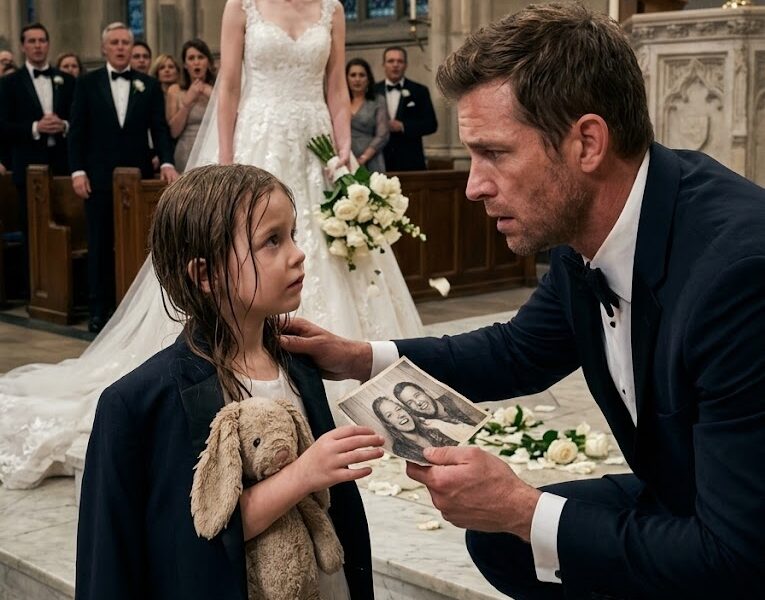
Rain blew through the entrance in a silver sheet, scattering cold droplets across the marble floor of St. Matthew’s Episcopal Church in Manhattan. A little girl stood beneath the vaulted doorway in a soaked yellow raincoat, one hand clutching a stuffed rabbit by its battered ear.
She could not have been older than five.
Her brown hair clung to her cheeks. Her tights were muddy at the knees. She was breathing so hard that her small shoulders shook beneath the wet coat.
Noah still had one hand lifted toward Camille Whitmore’s veil.
The organist stopped playing.
One hundred and eighty guests went silent.
The little girl looked past the flowers, past the bridesmaids, past the men in black suits near the rear doors, until her terrified eyes found Noah standing beneath the white roses at the altar.
Then she ran.
Her shoes squeaked against the polished stone as she hurried down the center aisle.
Camille’s fingers tightened around Noah’s arm.
“What the hell is this?” she whispered.
Noah barely heard her.
The girl stopped directly in front of him.
Up close, he could see that she was trembling.
She stared at his face with the concentration of someone comparing him to a picture she had studied a thousand times.
Then she reached into her coat.
For one strange second, two security men at the back of the church moved forward.
Noah lifted his hand.
“Don’t.”
The girl pulled out a creased photograph.
“Are you Noah?”
Her voice was tiny.
He swallowed.
“Yes.”
Her lower lip trembled.
“Mommy said if something happened to her, I had to find you before the mean people did.”
Camille went completely still.
The little girl held out the photograph.
Noah took it.
And the world he knew ended before he even looked down.
Because he recognized the photograph from its torn corner.
Seven years earlier, outside Penn Station, he and Lily had squeezed themselves into a cheap photo booth after missing the last train home from dinner. Lily had been wearing his coat. Her hair had been wet from snow. In the second frame, she was laughing so hard that she had turned away from the camera.
Noah had once carried a duplicate in his wallet.
He had thrown it away after the divorce.
Or at least he had believed he had.
His eyes rose slowly to the child.
Brown hair.
Gray-green eyes.
A narrow chin.
And just above her left eyebrow, half hidden beneath wet strands of hair, was a tiny crescent-shaped scar.
Noah forgot how to breathe.
Lily had a scar exactly like that.
She had gotten it falling off a bicycle when she was ten.
She used to joke that if they ever had children, their daughter would inherit her stubbornness, her terrible singing voice, and every dramatic scar she had collected before puberty.
Camille’s fingernails dug into Noah’s sleeve.
“Noah,” she said under her breath. “Say something.”
He couldn’t.
The child looked at Camille, then instinctively moved closer to Noah.
“What’s your name?” he finally managed.
“Ava.”
The name went through him like a blade.
Years ago, before the lawyers, before separate bedrooms, before his mother began referring to Lily as “that instability you married,” there had been a rainy Sunday morning when Noah and Lily stayed in bed arguing about baby names.
Lily had wanted Ava.
Noah had insisted it sounded too delicate.
“She won’t be delicate,” Lily had said, resting her chin on his chest. “She’ll have me for a mother.”
He had laughed.
He remembered laughing.
Now a five-year-old girl named Ava was standing in front of him on his wedding day.
Camille recovered first.
She stepped forward wearing the calm smile she used at charity dinners when someone insulted her and she intended to destroy them later.
“Sweetheart,” she said gently, “I think there’s been a misunderstanding.”
Ava flinched.
It was small.
Almost invisible.
But Noah felt it.
Camille extended a hand. “Why don’t we have someone take you somewhere warm while the adults—”
“No.”
The word came from Noah.
Camille looked at him.
“Noah.”
He crouched until he was eye level with Ava.
“Where is your mother?”
The girl hugged the rabbit against her chest.
“At St. Catherine’s.”
The church seemed to disappear around him.
“Why?”
“She got sick.”
“How sick?”
Ava’s eyes filled.
“She fell down.”
Noah’s stomach turned.
“She went to see you this morning,” Ava continued. “But the lady in white wouldn’t let her.”
Camille’s hand slipped from Noah’s arm.
He slowly looked up at her.
For one second, something crossed her face.
Recognition.
Fear.
Then it vanished.
Noah stood.
“What does she mean?”
Camille stared at the child. “I have no idea.”
Ava shook her head urgently.
“You talked to Mommy.”
The room changed.
It was almost physical, the way suspicion moved through a crowd.
Camille’s father shifted in the front pew. Someone near the middle whispered. A phone appeared, then disappeared when one of the ushers glared toward the guests.
Noah’s mother rose.
Eleanor Hart had spent sixty-two years becoming the kind of woman people lowered their voices around.
She wore navy silk instead of anything resembling celebration, a diamond brooch at her throat and an expression so perfectly controlled it looked carved rather than worn.
“This has gone far enough,” she said.
Ava turned toward her.
And recoiled.
Not confusion.
Not shyness.
Fear.
Noah saw it.
So did Eleanor.
That was when something inside him moved.
Slowly.
Dangerously.
He looked at his mother.
“Do you know her?”
Eleanor’s jaw tightened.
“Of course not.”
Ava whispered, “Mommy said not to go with you.”
Silence crashed over the church.
Eleanor’s face changed so slightly no one else might have noticed.
Noah did.
He had spent his life learning the geography of his mother’s expressions because, in the Hart family, survival often depended on understanding what Eleanor felt before she admitted feeling anything at all.
That tiny tightening around her mouth meant she was not shocked.
She was calculating.
Noah looked at Ava again.
Her hands were blue with cold.
She was trying not to cry.
She was surrounded by wealthy strangers in designer clothing who were watching her as if she had spilled something ugly across their perfect morning.
“What happened after your mom got sick?” Noah asked.
Ava sniffed.
“Miss Mae called the ambulance. Mommy woke up a little and told me to remember what she said. Miss Mae brought me here.”
“Who’s Miss Mae?”
“Our neighbor.”
“Where is she?”
“Outside. She said she didn’t think they’d let her in because everybody looked fancy.”
Noah closed his eyes for half a second.
At least the child had not crossed Manhattan alone.
Somehow that small mercy almost made the rest worse.
Ava tugged on his jacket.
“Are you really my daddy?”
There it was.
No accusation.
No dramatic declaration.
Just a child asking a question that should never have needed to be asked in a church full of strangers.
Noah looked down at the photograph again.
He saw Lily’s mouth, his own younger face, the corner of a forgotten life.
“I don’t know,” he said.
Ava’s expression fell.
He immediately crouched again.
“But I’m going to find out.”
Behind him Camille inhaled sharply.
“Noah, we have two hundred people sitting here.”
He turned.
She was pale now.
Humiliated.
Furious.
Still impossibly beautiful in the custom gown that had taken six months to make.
Noah looked past her at the altar, the white flowers, the candles, the priest holding a closed prayer book.
An hour earlier, this room had represented the next thirty years of his life.
Now it looked like a stage someone had built around a lie.
Camille approached him carefully.
“Come with me.”
“No.”
“We need thirty seconds in private.”
“A child just walked into our wedding and told me her mother—my ex-wife—is in a hospital.”
“And we don’t even know whether any of it is true.”
Ava lowered her head.
Noah’s voice hardened.
“Not in front of her.”
Camille laughed once, quietly, unbelievingly.
“You’re protecting her from me now?”
“I’m asking you not to call a five-year-old a liar while she’s standing three feet away.”
“I did not call her a liar.”
“You called this a scam.”
“I said we don’t know what this is.”
Eleanor came down the aisle.
“This ceremony will be postponed for twenty minutes while someone verifies the situation.”
Noah looked at his mother.
“Postponed?”
“Yes.”
The word was delivered as if she were moving a board meeting.
Eleanor gestured toward one of Noah’s assistants.
“Daniel, arrange for the child to be taken to the hospital.”
Ava grabbed Noah’s hand.
He felt every tiny finger close around two of his.
His mother saw it.
Something almost like irritation entered her eyes.
Noah looked at Daniel.
“Get the car.”
“Of course.”
“For me.”
Camille went white.
“Noah.”
He pulled off the white boutonniere pinned to his tuxedo and set it on the altar rail.
“Noah, if you walk out of this church—”
He faced her.
For the first time in three years, Camille did not look like the composed woman who always knew which fork to use, which donor to flatter, which private insult deserved a public smile.
She looked scared.
And suddenly Noah wondered what, exactly, she was afraid of losing.
“You’ll come back?” she asked.
He wanted to say yes.
The answer should have been automatic.
Instead, he looked at the little girl holding his hand.
“I don’t know.”
Camille’s mouth opened.
No sound came out.
Noah removed his tuxedo jacket and wrapped it around Ava’s shoulders.
Then he picked her up.
Her rabbit pressed between them.
As he carried her down the aisle, people moved their knees aside, some staring openly, some pretending not to.
Near the doors, Ava rested her head against Noah’s shoulder.
Then she whispered something only he could hear.
“Mommy said you might not believe me.”
He stopped.
“Why would she say that?”
Ava looked toward the altar.
Toward Camille.
Then toward Eleanor.
“Because she said they already made you believe her once.”
Outside, the rain had turned vicious.
Daniel ran ahead with an umbrella while Noah carried Ava down the stone steps.
A middle-aged woman in grocery-store sneakers and a damp cardigan rushed toward them.
“Ava!”
The girl lifted her head.
“Miss Mae.”
Mae Rodriguez stopped when she saw Noah.
Recognition settled over her face.
Not admiration.
Judgment.
“So,” she said quietly. “You’re him.”
Noah had no idea how to respond.
Mae pulled Ava’s hood up properly.
“I’m sorry she went inside without me. Security wouldn’t let me past the outer doors at first. She slipped away when everybody started arguing.”
“Thank you for bringing her.”
Mae stared at him for another beat.
“Don’t thank me yet.”
Noah felt cold despite the rain.
“What does that mean?”
Mae looked at Ava.
Then back at him.
“Lily spent six years hoping you’d answer one letter.”
Noah heard the church doors open behind him.
He did not turn around.
“What letters?”
Mae’s expression changed.
And Noah knew, before she answered, that whatever waited at the hospital was going to be worse than the child in his arms.
St. Catherine’s smelled like disinfectant, overheated air and coffee that had been sitting on a burner since dawn.
Noah hated hospitals.
Lily used to hate them more.
She hated needles. Hated fluorescent lighting. Hated the way doctors said “discomfort” when they meant pain.
Years earlier, when Noah had needed emergency stitches after slicing his palm on a broken wineglass, Lily had complained so loudly about the blood that the nurse had given her a chair.
Now Ava walked through the same kind of corridors with frightening familiarity.
Room 814.
She stopped outside.
Noah looked through the glass.
And whatever remained of his wedding day vanished.
Lily lay beneath a white blanket.
For several seconds, his mind rejected what his eyes were seeing.
The woman he remembered had occupied space as if life belonged to her.
Lily Mercer had danced barefoot in restaurants after closing time. She talked to cabdrivers like they were old friends. She once made Noah pull over on a highway in Vermont because the sunset was “too rude to drive past.”
The woman in room 814 looked painfully small.
Her dark hair had thinned.
Her cheekbones were sharp.
An oxygen tube curved beneath her nose. There were bruises along the inside of one arm from repeated blood draws.
Noah stepped closer to the glass.
“No.”
A social worker approached.
“Mr. Hart?”
He turned.
She was in her forties, tired-eyed, holding a clipboard against her chest.
“I’m Dana Foster. I’ve been with Ms. Mercer since she arrived.”
“What happened?”
“She has a chronic autoimmune condition. She suffered a severe inflammatory episode and cardiac complications this morning.”
“Will she be okay?”
Dana paused.
Noah understood the pause.
Adults learn to fear pauses in hospitals.
“We’re stabilizing her.”
“That isn’t what I asked.”
“No.”
Ava was watching him.
He forced himself to lower his voice.
Dana glanced at the child.
“Ms. Mercer regained consciousness briefly in the ambulance. She was confused, but she repeated two things very clearly.”
Noah waited.
“She asked us to find Ava.”
“And?”
Dana’s attention stayed on him.
“She said Eleanor Hart was not to have access to her daughter.”
The corridor tilted.
Ava reached for Noah’s hand again.
He closed his fingers around hers.
“Did she say why?”
“No.”
Noah looked through the window at Lily.
Seven years.
Seven years since he had heard her voice.
Seven years since she had stood in the kitchen of their Brooklyn apartment, arms folded, eyes red from crying, telling him that he could not keep leaving every emotional conversation simply because he did not know how to win it.
“You don’t leave rooms, Noah,” she had said. “You disappear while you’re still standing in them.”
He had hated that sentence because it was true.
Their divorce had not happened because one of them had cheated.
Sometimes Noah wished it had.
Infidelity would have given their marriage a clean villain.
Instead they had destroyed each other with quieter weapons.
His family hated Lily.
Lily hated the way Noah allowed his family into every decision.
Noah worked more.
Lily became angrier.
He withdrew.
She pushed.
The more she pushed, the more he shut down.
The more he shut down, the louder she became.
By the end, they had learned exactly where the other person was most vulnerable and sometimes, on their worst nights, aimed there deliberately.
Then came the pregnancy.
Or what Noah had believed was the pregnancy.
Eight weeks after Lily left, Eleanor had entered his office, closed the door and told him Lily had miscarried.
“She doesn’t want you contacting her,” his mother had said.
Noah had sat behind his desk and felt something inside him go permanently quiet.
He had asked whether Lily was okay.
Eleanor had answered, “She will be now that this chapter is over.”
He had accepted that.
That was the part he suddenly could not forgive.
Not his mother.
Himself.
He had accepted it.
Camille arrived forty minutes later.
She had changed nothing except covering the wedding gown with a camel coat.
The dress still trailed beneath it.
Her mascara had smudged under one eye.
Guests had probably photographed her leaving the church. By tomorrow it would be everywhere.
Normally Noah would have cared.
Now he could barely summon the energy to look at her.
Camille stopped several feet away.
“Ava,” she said.
The girl moved closer to Noah.
Camille noticed.
Pain flickered across her face.
Then disappeared.
“Noah, can we speak privately?”
“You can speak here.”
She looked at Mae, Dana and Ava.
“Seriously?”
“Yes.”
Camille lowered her voice.
“I understand that this is emotional.”
“You understand?”
“Don’t do that.”
“Do what?”
“Turn me into the enemy because your ex-wife showed up on our wedding day.”
Noah stared at her.
“Ava said Lily came to the church this morning.”
Camille said nothing.
“She said you spoke to her.”
Mae crossed her arms.
Camille looked toward the hospital room.
“I saw Lily outside.”
The admission fell softly.
It landed hard.
Noah felt his heartbeat change.
“You told me you had no idea what Ava meant.”
“I had no idea she was talking about Lily.”
“That is a lie.”
“I was standing at my wedding altar, Noah. A strange child came screaming down the aisle—”
“She wasn’t screaming.”
Camille stopped.
Ava looked between them.
Noah crouched.
“Ava, would you sit with Miss Mae for a minute?”
The girl hesitated.
His chest tightened.
“I’m not leaving.”
She studied his face.
“You promise?”
“Yes.”
That one word mattered more than every vow he had intended to make inside the church.
Ava allowed Mae to lead her toward the family lounge.
Noah waited until they were out of earshot.
Then he turned back to Camille.
“What happened this morning?”
Camille folded her arms.
“I arrived early. Lily was outside near the side entrance.”
“With Ava?”
“Yes.”
There it was.
Noah closed his eyes briefly.
Lily had brought his daughter to his wedding because she thought it might be her last chance.
“What did she want?”
“What do you think?”
“I’m asking you.”
“She wanted to see you.”
“And you stopped her.”
“I asked her not to destroy our wedding.”
Noah stared.
Camille’s composure cracked.
“She showed up at seven-thirty in the morning with a child and a folder full of God knows what. She looked sick. She looked unstable. She told me you deserved to know the truth before you married me.”
“And that didn’t concern you?”
“Of course it concerned me.”
“Enough to tell me?”
She looked away.
Noah laughed once.
There was nothing amused in it.
“Unbelievable.”
“What was I supposed to do? Drag your ex-wife into the bridal room and ask if she wanted champagne?”
“You were supposed to tell me.”
“And blow up everything because Lily decided the morning of our wedding was the perfect time to resurrect herself?”
Noah’s face hardened.
“She is unconscious ten feet away from you.”
Camille’s eyes shone.
“I know.”
“No. I don’t think you do.”
“She told me she was sick, Noah.”
He froze.
Camille seemed to realize too late what she had admitted.
“How sick?”
“She didn’t say.”
“Did she tell you she might die?”
Silence.
That silence answered him.
Camille shook her head quickly.
“She said the doctors were worried. That’s all.”
“And you still sent her away?”
“I didn’t send her away.”
“Ava said security removed them.”
“I told security there was a private situation near the side entrance. I never told anyone to hurt her.”
Noah stepped back as if proximity itself had become offensive.
Camille’s voice broke.
“She was trying to ruin us.”
“No. She was trying to reach me.”
“Same result.”
Something in Noah’s expression made her stop.
“You think that child is yours already,” Camille whispered.
“I think a five-year-old should not have had to walk into a church and beg me to ask questions I should have asked years ago.”
Camille’s lips parted.
Then Ava’s voice came from behind them.
“Daddy?”
Everyone turned.
Ava stood beside Mae.
Noah had no idea whether she had heard the argument.
He hoped she hadn’t.
Then she held out a folded piece of paper.
“Mommy told me to give you this if she couldn’t.”
Noah slowly took it.
His name was written across the front.
Not printed.
Written.
Lily’s handwriting.
He had forgotten how much one person’s handwriting could feel like a voice.
His thumb moved across the ink.
Camille was staring at the envelope.
Noah noticed.
Not curiosity.
Recognition.
He looked up.
“You’ve seen her handwriting before.”
Camille’s face emptied.
And that was the exact moment Noah realized the wedding morning was not the beginning of what she had hidden.
It was only the first time he had caught her.
That night, Noah remained at St. Catherine’s.
His tuxedo shirt wrinkled. His bow tie disappeared sometime after midnight. His expensive dress shoes still carried mud from the church steps.
He did not open Lily’s letter.
Not immediately.
Ava fell asleep against him in the waiting room with the stuffed rabbit trapped between their bodies.
Noah sat very still.
He was afraid that moving would wake her.
Mostly, he was afraid of what it meant that she trusted him enough to sleep.
At 1:40 a.m., her fingers searched unconsciously for his hand.
He gave it to her.
She curled her small hand around his thumb and settled again.
Noah stared at the hospital floor.
There are moments when a person’s life changes loudly.
A phone call.
A crash.
A diagnosis.
And there are moments when everything changes so quietly no one else would notice.
A sleeping child taking your hand can do it.
At 2:13 a.m., the nurse came running.
“Mr. Hart.”
Noah was awake instantly.
“Lily?”
“She’s conscious.”
He gently shifted Ava into Mae’s arms.
Then he entered room 814.
Lily’s eyes were open.
They found him immediately.
For several seconds, neither spoke.
Noah remembered the last time he had seen her.
She had been wearing jeans and an old Columbia sweatshirt, packing books into a cardboard box.
She had refused to cry until she reached the door.
Then she turned and said, “I hope one day you learn silence isn’t the same thing as peace.”
He had wanted to stop her.
He hadn’t.
Now she looked at him through seven years of absence.
“You came,” she whispered.
Her voice was damaged by oxygen and exhaustion.
Noah pulled a chair to the bedside.
“A little girl interrupted my wedding.”
Lily shut her eyes.
A tear slid toward her temple.
“I’m sorry.”
“For what?”
“Everything.”
He looked at her.
“No.”
Her eyes opened again.
“Don’t forgive me because I look terrible.”
A broken laugh escaped him.
“You do look terrible.”
For half a second, the old Lily appeared.
Her mouth twitched.
“You still have no charm.”
“I was about to get married. Someone must have found me charming.”
That disappeared as quickly as it came.
Lily looked through the glass toward the waiting room.
“Where’s Ava?”
“Sleeping.”
“With Mae.”
“She found you?”
“She found me.”
Lily’s lips trembled.
“I told her only if something happened.”
“Something happened.”
“Yes.”
Noah leaned forward.
“Lily.”
She knew what was coming.
He could see it.
“Is she mine?”
The machines hummed.
Rain struck the dark hospital window.
Lily studied his face for a long time.
Then she said, “You really didn’t know.”
It was not a question.
Noah felt something inside him collapse.
“No.”
“Oh, God.”
She turned her head away.
“Lily.”
“I thought—”
She stopped.
“What?”
“I thought you knew.”
“No.”
“I thought you chose not to come.”
His throat tightened.
“Why?”
She looked at him again.
“Because your mother told me.”
The room went cold.
Noah did not move.
Lily inhaled carefully.
“I found out I was pregnant two days before the divorce papers arrived.”
Noah gripped the side of the chair.
“I was told you miscarried.”
Lily stared at him.
“What?”
“My mother came to my office.”
“No.”
“She said you lost the baby.”
“Noah.”
“She said you didn’t want me contacting you.”
Lily’s face changed.
Shock became understanding.
Understanding became rage.
Even sick, it transformed her.
“She came to my apartment.”
“When?”
“Three days after I found out.”
“What did she say?”
Lily’s eyes filled.
“She said you knew.”
“Knew what?”
“That I was pregnant.”
“No.”
“She said you wanted proof the baby was yours.”
Noah stood so abruptly the chair scraped backward.
“No.”
“I believed her.”
“I never said that.”
“I know that now.”
“Why would you believe her?”
Lily stared at him.
And when she answered, there was no mercy in it.
“Because by then, Noah, you had spent two years teaching me that when things became difficult, you disappeared.”
The words stopped him.
Lily swallowed.
“I knew your mother hated me. I knew she was cruel. But I also knew you had stopped defending me long before we separated.”
“That doesn’t mean I would abandon a child.”
“No. But seven years ago I wasn’t asking what you were capable of. I was asking what I already believed you had chosen.”
Noah looked away.
There was his share of it.
Not the lie.
Not the theft.
But the soil it had grown in.
He had let his mother believe she could speak for him.
He had let Lily believe silence meant consent.
He had let everyone interpret his absence because speaking had always felt too dangerous.
“What happened next?” he asked.
Lily’s fingers trembled over the blanket.
“I wrote to you.”
Noah looked back.
“How many times?”
“Seven letters before Ava was born.”
He said nothing.
“Three her first year.”
Nothing.
“A birthday card every year after that.”
Noah’s mouth went dry.
“I never received one.”
Lily’s eyes closed.
“I know.”
“How?”
“Because eventually I stopped writing to get an answer.”
“What does that mean?”
“It means I wrote because I needed to know I had tried.”
Noah’s voice cracked.
“Where did you send them?”
“Your office. Your mother’s house. The apartment you moved into after the divorce. Later, the Hart Foundation.”
Every address would have passed through people loyal to Eleanor.
Noah pressed his hand over his mouth.
“I never got them.”
“I believe you.”
Those three words hurt more than if she had accused him.
He looked through the window at Ava.
“Why now?”
Lily was quiet.
Then she glanced toward the machines beside her.
“The doctors told me last month the disease had started affecting my heart.”
Noah sat down again.
“I’ve been pretending it was manageable for years.”
“Why didn’t you tell anyone?”
“I told people.”
“You know what I mean.”
She smiled faintly.
“You always did hate not being included in disasters.”
“Lily.”
Her smile faded.
“I was tired.”
He heard the fear beneath it.
“I thought I had more time.”
Noah swallowed.
“And the wedding?”
“I saw the announcement.”
“Where?”
“Magazine at the clinic. Your mother looked radiant.”
Despite everything, he nearly laughed.
Lily’s mouth twitched.
“I decided I wouldn’t go.”
“But you did.”
“I kept looking at Ava.”
Her eyes moved toward the door.
“She has your temper.”
“I don’t have a temper.”
“You once threw a toaster off a balcony.”
“It caught fire.”
“You threw it before it caught fire.”
“It was a complicated morning.”
Lily actually smiled.
Then the smile collapsed under grief.
“I kept thinking if I died, she would believe you knew about her and didn’t want her.”
Noah looked down.
“I couldn’t leave her with that.”
“So you came to the church.”
“Yes.”
“What happened?”
Lily’s face hardened.
“Camille met me outside.”
He felt it again.
That coldness.
“What did she say?”
“She knew my name before I introduced myself.”
Noah stopped breathing.
Lily continued.
“She looked at Ava. Then she looked at the envelope in my hand and said, ‘You cannot be serious.’”
“What envelope?”
“The one Ava gave you.”
Noah had forgotten it was still in his jacket pocket.
Lily looked exhausted now, but anger kept her awake.
“I told Camille I needed five minutes with you. She said she knew about the letters.”
Noah’s head lifted.
“Those exact words?”
“She said, ‘The letters didn’t work, Lily. This won’t either.’”
Everything became silent inside him.
Camille had not simply seen Lily’s handwriting before.
She knew the letters existed.
“How long?”
“I don’t know.”
“What else did she say?”
Lily hesitated.
“Tell me.”
“She said you were finally happy.”
Noah stared at her.
“She said your mother had spent years putting your life back together and I had no right to come back because I was sick and lonely.”
Lily looked embarrassed even repeating it.
“She told me you had moved on.”
“And then?”
“I told her Ava was your daughter.”
Noah’s hand closed into a fist.
Camille had known.
Not suspected.
Known.
“At least she was likely your daughter,” Lily added. “I said I would do a DNA test. Anything.”
“What did Camille do?”
“She looked at Ava.”
Lily’s voice softened.
“And then she told security I was a disturbed former spouse trying to disrupt the ceremony.”
Noah stood.
Lily reached for him.
Her weak fingers caught his wrist.
“Don’t.”
He looked down.
“Don’t what?”
“Do what you always do.”
His expression hardened.
“What does that mean?”
“Run toward a new problem because the old one hurts too much.”
“I’m not running.”
“You look like you want to burn down Manhattan.”
“I might.”
Despite herself, Lily exhaled a faint laugh.
Then pain crossed her face.
The monitor changed.
“Lily?”
Her fingers tightened around his wrist.
“Noah.”
A nurse entered.
Then another.
Lily’s breathing became shallow.
“Noah, listen to me.”
“I’m right here.”
“Don’t let them take her.”
“Who?”
“All of them.”
Her eyes searched his.
“Your mother. Camille. Anyone who thinks love is something they can manage.”
The monitor screamed.
Doctors rushed inside.
Someone shoved Noah backward.
He heard the words arrhythmia, pressure, oxygen.
Then Ava appeared in the doorway.
She had awakened to the alarms.
“Mommy?”
Noah turned.
She saw the doctors around Lily.
Her face changed.
“Mommy!”
Noah caught her before she reached the bed.
She fought him with shocking strength.
“No! Mommy! Mommy!”
He lifted her against his chest.
“I’ve got you.”
“I want Mommy!”
“I know.”
“Put me down!”
“I can’t.”
She beat both fists against him.
Noah held on.
Behind the glass, Lily’s body disappeared beneath a rush of blue scrubs and moving hands.
Ava screamed for her mother.
Noah pressed his face against the child’s wet hair and understood, with brutal clarity, that fatherhood had not arrived as joy.
It had arrived as responsibility in the exact moment there was no one else left to carry it.
By six in the morning, Lily was stable.
Barely.
At seven-fifteen, Eleanor arrived with two attorneys.
Noah saw them step out of the elevator together.
Something inside him went quiet.
Not the old quiet.
Not avoidance.
This quiet had teeth.
Eleanor approached the family consultation room.
“You look exhausted.”
Noah laughed.
It startled her.
“You came with lawyers.”
“There is a child involved.”
“My child.”
“That remains to be established.”
“DNA is being processed.”
“Until then, we need to be practical.”
The word practical had governed Noah’s entire childhood.
His father’s funeral had been practical.
His first breakup had been practical.
His marriage to Lily had been impractical.
His divorce had been necessary.
Camille had been suitable.
Everything in Eleanor Hart’s world could be arranged into columns except love, so she treated love as a defect in other people’s accounting.
Noah closed the consultation room door.
“Did you tell Lily I demanded proof her baby was mine?”
Eleanor’s expression barely shifted.
“Noah, this is not the time.”
“That means yes.”
“One conversation from seven years ago is hardly relevant to—”
“Did you tell me she miscarried?”
Silence.
One of the attorneys glanced toward the door.
Noah smiled without warmth.
“There you are.”
Eleanor exhaled.
“Your marriage was collapsing.”
“So?”
“You were both miserable.”
“So you erased my child?”
“I protected you.”
Noah stared at her.
“From what?”
“From a lifetime tied to a woman who was emotionally volatile, financially irresponsible and openly hostile to your family.”
“She hated you.”
“She had reason to.”
One attorney shifted uncomfortably.
Eleanor’s eyes flashed.
“You have no idea what I prevented.”
“No. I know exactly what you caused.”
“A failed marriage was already over.”
“My daughter was not a marriage.”
Eleanor’s jaw tightened.
“You don’t know she’s yours.”
Noah stepped closer.
“You do.”
For the first time, fear appeared.
Tiny.
But real.
He saw it.
“You knew there was a child.”
“Noah—”
“You knew.”
“I knew Lily claimed—”
“How old was Ava when you found out?”
Eleanor looked toward the attorneys.
Noah slammed his palm against the table.
“How old?”
“Three months.”
The answer broke something.
Noah actually stepped backward.
Three months.
Ava had been three months old.
He imagined a baby he had never held.
A first smile he never saw.
A fever he never worried over.
A first step happening in a room where his name had become something Lily tried not to say.
“You stole seven years.”
“I saved you from making another mistake.”
“No.”
His voice was barely above a whisper.
“You stole seven years because you were offended that I loved someone you couldn’t control.”
“That is childish.”
“My daughter learned to ask strangers whether her father wanted her.”
Eleanor’s expression hardened.
“Lower your voice.”
Noah stared at her.
Then he began laughing.
His mother looked almost frightened.
“You still think this is about manners.”
She picked up her handbag.
“When you’ve slept, you will see this differently.”
“No.”
“Yes, you will.”
“No, Mother.”
He opened the door.
“You’re leaving.”
Her eyebrows rose.
“This hospital?”
“My life.”
She went very still.
“Noah.”
“Do not come near Ava.”
“You cannot possibly be serious.”
“If Lily survives, she can decide whether she ever wants to see you. If Lily doesn’t survive, I will make that decision.”
“Noah, think very carefully.”
“I have spent my entire life thinking carefully enough for both of us.”
He moved closer.
“I should have thought for myself.”
Her face changed.
Not because he was angry.
Eleanor had seen his anger before.
Because for the first time, he was not seeking permission to feel it.
He was already done.
Later that morning, Noah went to the penthouse.
It had been prepared for a marriage that no longer existed.
White orchids from the reception had arrived anyway.
Dozens of them stood in silver bowls like expensive funeral flowers.
On the kitchen counter sat two crystal champagne glasses beside a bottle engraved with NOAH & CAMILLE—FOREVER.
Noah walked past them.
He went directly to the antique mahogany secretary Eleanor had given him when he moved in after his divorce.
She had insisted it belonged in the family.
For years, Noah had stored tax documents, property records and old foundation paperwork inside it.
Now he ripped open drawers.
Nothing.
He pulled out files.
Nothing.
He searched behind false backing panels he had never noticed.
And then, at the very bottom, beneath old financial statements from the Hart Foundation, his fingers struck paper.
A bundle of envelopes.
Tied with blue ribbon.
Noah stopped breathing.
Different stamps.
Different dates.
Same handwriting.
NOAH HART.
His name.
Again.
Again.
Again.
Some envelopes were unopened.
Others had been slit carefully along the top and resealed.
His mother had read them.
Noah sank onto the floor.
The first letter was dated six years and eleven months earlier.
Noah,
I don’t know whether you’ll read this. I don’t even know if I want you to. But I’m thirty-two weeks pregnant, and she kicks when I eat oranges. You would hate how much that makes me laugh because you always said oranges smelled like cleaning products.
It’s a girl.
I’m naming her Ava.
If you really don’t want us, I won’t beg.
But I need to know that decision came from you.
Not your mother.
Not mine.
You.
Noah covered his mouth.
He opened another.
Ava was six months old.
There was a photograph inside.
A baby asleep on Lily’s chest.
He opened another.
A toddler with two messy pigtails.
Another.
A pressed daisy.
Another.
A drawing.
Three stick figures beneath an enormous purple moon.
One was labeled MOMMY.
One AVA.
The third had no body, only a question mark.
On the back, in Lily’s writing:
She asked me what color your hair is today.
I told her brown.
She said that sounded boring.
I agreed.
Noah’s vision blurred.
He opened the most recent card.
Ava’s handwriting was uneven.
Mommy says maybe next year you will write me back.
Do you like pancakes?
I do not like the blueberries inside because they get mushy.
I think I got your eyes.
Mommy says I did.
Noah pressed the card against his forehead.
For seven years he had told himself Lily wanted complete separation.
For seven years, every birthday, every Christmas, every moment he remembered their marriage and wondered what might have happened if they had been less proud, there had been letters somewhere in his life asking him to look closer.
A sound came from the doorway.
“Noah.”
He raised his head.
Camille stood there.
No wedding gown now.
Jeans.
A cream sweater.
No makeup.
She looked younger without the architecture of perfection around her.
Also more tired.
More human.
Noah stood slowly.
He held up the letters.
Camille closed her eyes.
“You knew.”
“Not at first.”
“How long?”
She said nothing.
“How long, Camille?”
“Two years.”
The answer almost made him smile.
Not because it was funny.
Because there were only so many shocks a person could absorb before disbelief began turning into something stranger.
“Two years.”
“Your mother showed me one.”
“One?”
“She said Lily had started contacting you again.”
“Again?”
“She told me Lily had never accepted the divorce.”
“And you believed her?”
“Yes.”
Noah opened his hand.
Letters fell across the floor.
“Did this look like a woman trying to restart a marriage?”
Camille stared down.
“I didn’t read them all.”
“But you knew about Ava.”
Her throat moved.
“Yes.”
There it was.
Noah had imagined the confession hurting.
Instead he felt almost nothing.
Maybe betrayal had limits.
Maybe once your heart had been struck hard enough, the next blow landed on numb ground.
“You knew I might have a daughter.”
“I knew Lily claimed you did.”
“And you never asked me.”
“I asked your mother.”
“That is not the same thing.”
“I was afraid.”
Noah stared at her.
Camille’s eyes filled.
“There. Is that what you want? I was afraid.”
“Of a five-year-old?”
“Of Lily.”
“Why?”
“Because you loved her.”
The apartment went silent.
Camille laughed brokenly.
“You think I didn’t know?”
Noah said nothing.
“Three years, Noah. Three years I loved you while pretending not to notice that there was an entire part of you I could never reach.”
“That gave you the right to hide my child?”
“No.”
“But you did.”
“Yes.”
“Why?”
Camille finally cried.
Not elegantly.
Not the single cinematic tear she might have permitted herself at a gala.
Her face actually broke.
“Because I wanted one thing in my life that was mine.”
Noah’s anger sharpened.
“I was not yours.”
“I know that now.”
“No. You knew it then.”
Her voice rose.
“Do you know what it is like to build a life with someone and realize he still keeps a dead marriage inside him like a locked room?”
“She wasn’t dead.”
“I KNOW.”
The shout echoed through the penthouse.
Camille pressed a hand over her mouth.
When she spoke again, her voice was smaller.
“That was the problem.”
Noah looked down at Ava’s drawing.
Camille continued.
“Your mother said Lily was unstable. She said the child probably wasn’t yours. She said if there were any real proof, Lily would have sued for support.”
“She didn’t want money.”
“I know that now.”
“She wanted me.”
“I know.”
“My daughter wanted me.”
Camille flinched.
“I know.”
“And you looked at her this morning.”
Camille cried harder.
“You looked at her face and still sent her mother away.”
“I panicked.”
“You protected a wedding.”
“I protected the life I thought we had.”
“No.”
Noah shook his head.
“You protected your position in it.”
She stared at him.
He removed the wedding ring he had put on during the vows before the ceremony was interrupted.
The ceremony had not technically been completed, but the band was already there.
He placed it on the desk beside Lily’s letters.
Camille went white.
“Noah.”
“It’s over.”
“You’re making decisions after twenty-four hours without sleep.”
“It was over the second you looked at my daughter and decided your wedding mattered more than her right to know me.”
“I love you.”
He looked at her.
“I believe you.”
That hurt her more than disbelief would have.
She shook her head.
“No, you don’t.”
“I believe you loved me.”
He paused.
“I also believe love made you afraid, and instead of being honest about that fear, you helped people lie to me.”
Camille’s shoulders trembled.
“So Lily comes back, and suddenly everything we had means nothing?”
“No.”
He looked around the apartment.
“It means exactly what it means.”
“What is that supposed to mean?”
“It means we had dinners. Trips. Sunday mornings. Arguments about paint colors. Three years of real memories.”
Camille took one hopeful step closer.
Then Noah finished.
“And it means you lied during all of them.”
She stopped.
“You’ll regret this.”
“Maybe.”
He looked down at the letters.
“I have enough regrets already.”
When Noah returned to St. Catherine’s, the DNA results were waiting.
99.9998 percent probability of paternity.
There are facts you know before science confirms them.
Noah already knew.
But the paper made it real in a way instinct had not.
Ava Hart.
His daughter.
He found her sitting on the floor outside Lily’s room, drawing stars on the back of a hospital menu.
She looked up.
“Hi.”
“Hi.”
“Did you leave?”
The question hit him immediately.
“No.”
“You weren’t here.”
“I went to get something.”
“What?”
He sat beside her.
“Answers.”
She considered that.
“Did you get them?”
“Yes.”
Ava put the crayon down.
Noah showed her the paper.
She stared at the numbers.
“I can’t read that.”
“I know.”
“Is it bad?”
“No.”
He folded the page once.
Then he looked directly at her.
“You were right.”
Her eyes widened.
“I’m your dad.”
Ava did not move.
For several seconds she only watched him.
Then she asked, “For real?”
“For real.”
Her lower lip shook.
Noah opened his arms slightly.
He did not assume.
He waited.
Ava climbed into his lap.
She wrapped both arms around his neck.
Noah held her.
There were apologies too large for words.
So he didn’t try.
He simply held on.
After a while Ava whispered against his collar.
“Why didn’t you come before?”
Noah closed his eyes.
Because there was no answer a child deserved.
Because his mother lied.
Because Lily believed the lie.
Because Camille helped preserve it.
Because Noah had once been the kind of man who accepted silence when he should have demanded truth.
He could blame everyone.
And some of them deserved it.
But Ava needed something more useful than blame.
“I didn’t know you existed.”
She leaned back.
“Mommy said maybe you didn’t.”
“She was right.”
Ava studied his face.
“If you knew, would you come?”
Noah felt his throat tighten.
“Yes.”
“Even if Grandma Eleanor said no?”
A chill moved through him.
“Yes.”
“Even if the lady in the white dress got mad?”
“Yes.”
“Even if Mommy was mad?”
He almost smiled.
“Especially then.”
Ava thought about this.
Then nodded.
“Okay.”
That single word nearly destroyed him.
Adults imagine forgiveness requires speeches.
Children sometimes offer it in one syllable because they have not yet learned to make pain pay interest.
Noah brushed hair from her forehead.
“Ava?”
“Yeah?”
“I need you to know something.”
“What?”
“You never have to wonder whether I wanted you.”
She looked down.
“But you didn’t know me.”
“No.”
“So how can you want me?”
Noah searched for an answer.
Then he understood.
“I want every day I missed.”
She looked back up.
“Even when I’m bad?”
“Especially then.”
“I throw cereal sometimes.”
“We’ll work on it.”
“I hate peas.”
“That’s reasonable.”
“I cried at school because Olivia said rabbits are for babies.”
“That sounds like Olivia’s problem.”
Ava smiled.
It was the first real smile he had seen.
And Noah recognized Lily inside it so completely that for one painful second, he nearly looked toward the door expecting her to walk through.
Instead, a nurse came out.
“Mr. Hart?”
The smile left his face.
“Ms. Mercer is awake.”
Lily survived another twelve hours.
By evening the rain returned.
Noah sat beside her while Ava slept curled in the recliner, one hand twisted into the fabric of his shirt.
Lily noticed.
“She does that.”
Noah looked down.
“When she’s scared?”
“When she thinks someone might leave.”
His chest tightened.
“I’m not leaving.”
Lily studied him.
“You mean that.”
“Yes.”
“I used to hate when you said things like that.”
“What things?”
“Absolute things.”
He gave her a tired look.
“You complained I never committed to anything emotionally.”
“I contain multitudes.”
“You contain contradictions.”
“That too.”
For a moment they simply listened to Ava breathe.
There was too much history between them for reconciliation fantasies.
They had hurt each other.
The lies did not erase that.
Eleanor’s manipulation did not transform their marriage into something perfect that had been stolen.
They had been young, defensive and cruel in all the quiet ways people can be cruel when they know exactly how to injure the person closest to them.
Noah looked at Lily.
“I’m sorry.”
“For which part?”
“All the parts that were mine.”
Her eyes filled.
“That’s annoyingly mature.”
“I’ve had a difficult day.”
Lily smiled.
Then tears slipped down her face.
“I should have tried harder.”
“You wrote ten letters.”
“I should have called.”
“My mother would have blocked you.”
“I should have shown up.”
“You did.”
“Seven years late.”
Noah looked away.
“So did I.”
Lily watched him.
“I hated you.”
“I know.”
“Some days I hated you so much I couldn’t breathe.”
“I know.”
“And then Ava would laugh exactly like you.”
He looked over.
“How?”
“Like you’re surprised anything is funny.”
Despite everything, Noah laughed.
Lily did too.
It became a cough.
He reached for water.
She waved it away.
“Noah.”
“I’m here.”
“I need you to promise me something.”
“Anything.”
“Don’t raise her around people who make affection feel embarrassing.”
He swallowed.
“She loves loudly.”
Lily’s eyes moved toward Ava.
“She hugs everybody. She tells people she misses them. She cries when she sees dead birds. She once apologized to a chair after running into it.”
Noah smiled.
“She sounds strange.”
“She is.”
“Good.”
“Your family will teach her to hide it if you let them.”
“I won’t.”
“Don’t teach her pride is dignity.”
The words landed between them.
Lily looked at him.
“I confused those things for years.”
“So did I.”
“I thought refusing to call you made me strong.”
“I thought refusing to call you made me respectful.”
“We were idiots.”
“Remarkably consistent idiots.”
Lily smiled faintly.
Then she reached for him.
Noah took her hand.
“I don’t want her remembering me like this.”
“She won’t.”
“How do you know?”
“Because she doesn’t see what I see.”
“What do you see?”
He wanted to lie.
Instead he said, “Someone who’s tired.”
Lily nodded.
“What does she see?”
“Her mother.”
Lily closed her eyes.
A tear escaped.
“Sing the moon song.”
Noah stared at her.
“You remember that?”
“I’m dying, not senile.”
“Lily.”
“I know.”
“No.”
Her fingers tightened weakly around his.
“Noah.”
He looked down.
For seven years, he had imagined what he would say if he ever saw her again.
Sometimes he imagined anger.
Sometimes indifference.
Once, after too much bourbon, he imagined telling her he forgave her for leaving.
Now none of those speeches mattered.
Life had brought them to the final room without giving them enough time to become better people first.
Maybe that was why the truth mattered now.
Not to fix the past.
Only to stop lying about it.
Noah cleared his throat.
Then he sang.
The song was ridiculous.
He had invented it during a summer blackout when they were newly married and Lily, who claimed not to be afraid of thunderstorms, had screamed when lightning struck a transformer outside their apartment.
It was about a moon that got lost and followed two people home.
There were barely lyrics.
Mostly nonsense.
Halfway through, Ava stirred.
Her eyes opened.
“Mommy?”
Lily turned toward her.
The change in her face was immediate.
Pain disappeared beneath love.
“Hey, baby.”
Ava climbed carefully onto the bed.
Noah helped with the wires.
“Are you better?”
Lily looked at Noah.
Then at her daughter.
“I’m not hurting right now.”
Children can hear the lies adults hide inside gentle sentences.
Ava’s face crumpled.
“No.”
Lily touched her cheek.
“Come here.”
Ava curled against her.
“I found him.”
“I know.”
“He says he’s my daddy for real.”
“I know.”
“He promised he won’t go where I can’t find him.”
Lily looked at Noah.
The entire history of their marriage passed between them without either speaking.
Then Lily said, “Make him keep that one.”
Ava nodded fiercely.
“I will.”
Noah tried to breathe.
Lily reached toward him.
He moved closer.
She touched his face once.
The same way she used to when she wanted him to stop pretending he was fine.
“Be better than what hurt us,” she whispered.
Noah covered her hand with his.
“I will.”
The monitor changed.
At first it was subtle.
A new rhythm.
A nurse looked through the glass.
Then the sound sharpened.
Noah stood.
“Lily?”
Her eyes remained on Ava.
“Mommy?”
Doctors entered.
A nurse gently lifted Ava away.
The girl screamed.
“No!”
Noah caught her.
“Mommy!”
“I’ve got you.”
“No! Put me back!”
The medical team surrounded Lily.
Someone called a code.
Someone began compressions.
Ava fought Noah with every ounce of strength in her small body.
“Mommy! Mommy, answer me!”
Noah turned her face into his chest.
He did not want her to see.
She twisted around.
“Why isn’t she answering?”
Noah had no words.
There is no music when a person dies.
No beautiful silence.
No merciful fade into darkness.
There are machines.
Shoes on linoleum.
Short instructions spoken by people who have learned how to function next to other people’s worst moments.
Then eventually there is a sound that stops.
A doctor looked at the clock.
Noah knew before anyone spoke.
Ava did not.
She kept calling her mother.
And that was the moment Noah Hart would remember for the rest of his life.
Not the church.
Not the wedding.
Not his mother’s confession.
Not the letters.
A five-year-old girl trying to understand why the person who had always answered her suddenly wouldn’t.
Three months later, Eleanor Hart resigned from two nonprofit boards after the letters became part of a legal filing.
Noah did not release every detail publicly.
There were things Ava deserved to own later.
But he filed for a protective order.
He removed himself from the Hart family trust’s management structure.
He resigned from Hart Development.
His mother called his choices emotional.
He decided she was right.
He was finally allowing emotions to tell him when something mattered.
Camille moved to London for several months.
They spoke once after Lily’s funeral.
She called from the airport.
“I’m sorry.”
Noah believed she meant it.
Some apologies arrive too late to repair anything but still deserve to exist.
“I know,” he said.
“I did love you.”
“I know.”
“I wish that mattered more.”
“So do I.”
Then they ended the call.
Noah sold the penthouse.
Ava hated it anyway.
Too many windows.
Too many elevators.
Too many rooms where her footsteps disappeared into marble.
He bought a smaller house in Westchester near a public park.
The kitchen had yellow walls.
The backyard was uneven.
A huge maple tree dropped leaves into the gutters every three days.
Eleanor would have hated it.
That helped.
Ava chose the upstairs bedroom because she could see the moon from the window.
The first night, Noah found her sleeping in her shoes.
He crouched beside the bed.
“Ava?”
She woke instantly.
“Why are your shoes on?”
She looked embarrassed.
“In case.”
“In case what?”
“We have to go.”
“Where?”
“I don’t know.”
He sat beside her.
They stayed quiet for a while.
Then Noah understood something no parenting book had explained.
Children who lose too much can become prepared for disaster even while sleeping.
“You don’t have to keep your shoes on here.”
“What if something happens?”
“Then I’ll wake you.”
“What if you’re gone?”
“I won’t be.”
“You went out when Mommy was at the hospital.”
He absorbed the accusation.
She had forgiven him before she had learned how to trust him.
Those were not the same thing.
“You’re right.”
Ava looked surprised.
Noah continued.
“I said I wasn’t leaving, and then I left to get the letters. I came back, but you didn’t know where I was.”
She nodded.
“So next time, I tell you.”
“Every time?”
“Every time.”
“What if I’m sleeping?”
“I leave a note.”
“I can’t read big words.”
“I’ll use small ones.”
She considered this.
“Okay.”
The second week, she asked to keep the hallway light on.
The third week, she had a nightmare.
By the time Ava opened her bedroom door, Noah was already sitting on the floor outside.
She blinked at him.
“What are you doing?”
“Couldn’t sleep.”
That was a lie.
He had been there for almost an hour because he had heard her moving restlessly through the wall.
Ava sat beside him.
Neither spoke.
Eventually she rested her head against his arm.
That became their first ritual.
Other rituals followed.
Saturday pancakes.
No blueberries.
Noah learned that from the letter.
He burned the first batch.
Ava ate them anyway.
He learned to braid hair from online videos.
His first attempt leaned so far to one side that Ava stared at herself in the mirror and said, “I look injured.”
He learned which cereal she would throw.
He learned she hated peas with a moral seriousness usually reserved for criminal behavior.
He learned Lily had taught her to say thank you to bus drivers.
He learned Ava sang when brushing her teeth.
He learned grief could arrive in the middle of normal moments.
Once, in a grocery store, Ava smelled Lily’s old shampoo on another woman.
She froze beside the apples.
Noah watched her face change.
Then she started crying so violently she could barely stand.
He left the cart in the produce aisle, carried her to the parking lot and sat with her on the curb for thirty minutes.
No advice.
No attempt to fix it.
Just presence.
He was learning that staying was often painfully simple.
It was leaving that people made complicated.
In April, Ava asked about Eleanor.
“Is she my grandma?”
Noah put down the plate he was drying.
“Biologically, yes.”
“What does bio-log-ic-ly mean?”
“It means you’re related by blood.”
“Do we love her?”
Children ask impossible questions casually.
Noah thought before answering.
“I used to.”
“Do you now?”
“I don’t know.”
Ava frowned.
“Can you not know?”
“About some things.”
“Does she love me?”
Noah felt the old instinct.
Protect the child.
Simplify.
Lie gently.
He resisted.
“I think she loves people in a way that sometimes hurts them.”
Ava considered this with solemn five-year-old seriousness.
“That sounds bad.”
“It can be.”
“Mommy loved me and didn’t hurt me.”
“She did her best not to.”
Ava touched the stuffed rabbit on the chair beside her.
“Mommy said Grandma Eleanor was cold.”
Noah smiled faintly.
“Your mother had strong opinions.”
“She said you were stubborn.”
“False.”
“She said you would say that.”
He laughed.
Ava smiled.
Sometimes Lily returned through those tiny sentences.
Not as a ghost.
As inheritance.
On the first Father’s Day after Lily died, Noah woke to suspicious noises in the kitchen.
Cabinet doors.
Whispering.
Something falling.
Then Ava shouted, “DON’T COME IN.”
Noah stopped in the hallway.
“What are you doing?”
“Nothing.”
“Is anything on fire?”
“No.”
Pause.
“I don’t think.”
He nearly entered.
“AVA.”
“No fire!”
Ten minutes later she appeared.
Her hands were behind her back.
Her hair was crooked because Noah had not yet brushed it.
“There was glitter,” she announced.
“That sentence terrifies me.”
“You have to close your eyes.”
“Ava.”
“Dad.”
He closed them.
There was shuffling.
Paper crinkling.
Something scratched his forehead.
“Okay.”
Noah opened his eyes.
Ava had placed a paper crown on his head.
It was uneven.
Covered in gold glitter.
One side bent downward.
Across the front she had written four words in giant crooked letters.
MY DAD FOUND ME.
Noah could not speak.
Ava’s smile faded.
“Is it wrong?”
He sat down because his knees had stopped cooperating.
“No.”
“You’re crying.”
“I know.”
“Did I spell found wrong?”
“No.”
“What’s wrong?”
Noah looked at the child who had walked into a church wearing a yellow raincoat and destroyed every lie his life had been built around.
He looked at Lily’s eyes.
His own stubborn chin.
A small scar above one eyebrow.
Nothing was wrong.
That was why it hurt so much.
He opened his arms.
Ava climbed into his lap.
“It’s perfect,” he whispered.
“You said perfect isn’t real.”
“You’re right.”
She pulled back suspiciously.
“So you lied?”
“No. This is better than perfect.”
“What’s better?”
“True.”
She seemed satisfied.
Then she touched both sides of his face.
The gesture stopped his heart for half a beat.
Lily used to do that.
Always with both hands.
Always when Noah was pretending not to feel something.
Ava tilted her head.
“Mommy was right.”
His throat tightened.
“About what?”
“She said you’d know me.”
Noah looked at her.
“She did?”
Ava nodded.
“She said if I ever met you, you might be confused first.”
“That sounds accurate.”
“But then you would know me by my eyes.”
Noah could not answer.
Outside the kitchen window, wind moved through the maple leaves.
Ava’s paper crown sat crooked on his head.
There were burned pancakes on the counter.
Glitter covered half the floor.
Lily was still dead.
Seven years were still gone.
No lawsuit, apology or act of fatherhood would return the first word Noah never heard, the first birthday he missed, the nights Lily sat alone writing letters to a man who never answered because someone else had decided he shouldn’t receive them.
Some losses do not heal.
They become architecture.
You build the rest of your life around them.
Noah pulled Ava closer.
For most of his adulthood, he had believed leaving happened when someone packed a suitcase, signed a divorce paper or walked through a door.
Lily had tried to teach him otherwise.
People could leave while sitting beside you.
They could abandon you through silence.
They could disappear by allowing someone else to make the difficult choices for them.
And sometimes the opposite was true.
Sometimes staying was not dramatic at all.
It was the hallway light left on at midnight.
A note in a lunchbox.
A badly braided ponytail.
Pancakes without blueberries.
Sitting beside a child while grief passed through her without demanding that she hurry.
It was answering when she called.
It was telling her where you were going.
It was coming back when you promised.
Ava leaned against his chest.
“Dad?”
“Yeah?”
“You’re not going anywhere today, right?”
Noah kissed the top of her head.
“No.”
“Tomorrow?”
“I’ll take you to school.”
“After?”
“I’ll pick you up.”
“And after that?”
He smiled through tears.
“We’ll figure it out.”
Ava looked satisfied.
She rested her head beneath his chin.
Noah closed his eyes.
He could almost hear Lily laughing somewhere inside the memory of that ridiculous moon song.
For years, he would wish he had asked one more question.
Opened one more door.
Made one phone call.
Refused one convenient explanation.
He would carry the knowledge that his mother had stolen time from him.
That Camille had helped preserve the theft.
That Lily’s pride had deepened the silence.
And that his own passivity had made all of it easier.
But guilt, Noah eventually learned, could become another form of leaving.
You could spend so long staring backward at the people you failed that you failed the person still standing in front of you.
So he stopped asking whether he deserved Ava’s forgiveness.
He started earning tomorrow.
One ordinary day at a time.
Years later, Noah would still keep the yellow raincoat.
It hung in the back of a closet long after Ava outgrew it.
Beside it, inside a cedar box, were Lily’s letters tied again with the same blue ribbon.
He never destroyed them.
He never hid them.
When Ava became old enough, they would read them together.
She deserved the complete story.
Not Eleanor’s version.
Not Camille’s.
Not Noah’s version polished by guilt.
Not even Lily’s version protected by pride.
The truth.
Messy.
Painful.
Human.
Because that was the final promise Noah made to the woman he had once loved badly and lost too soon.
Their daughter would never grow up inside somebody else’s carefully managed silence.
And whenever Ava asked him why he still kept that ugly old yellow coat, Noah always gave her the same answer.
“Because that’s what you were wearing the day you found me.”
Ava would roll her eyes.
“You found me.”
“No.”
He would smile.
“You walked into a church full of strangers, looked straight at a man who didn’t know what he had lost, and refused to leave without him.”
Then his smile would soften.
“You found me first.”
And in the end, that was the part Noah chose to remember.
Not that he had become a father five years late.
Not that he had lost Lily on the same day he finally understood what had happened to them.
Not that the people he trusted most had built his life around omissions.
He remembered a little girl in a rain-soaked yellow coat standing beneath a church doorway, brave enough to interrupt an entire room of adults because her mother had given her one last instruction.
Find your father.
Ava had obeyed.
And for the rest of his life, Noah made sure she never had to search for him again.









