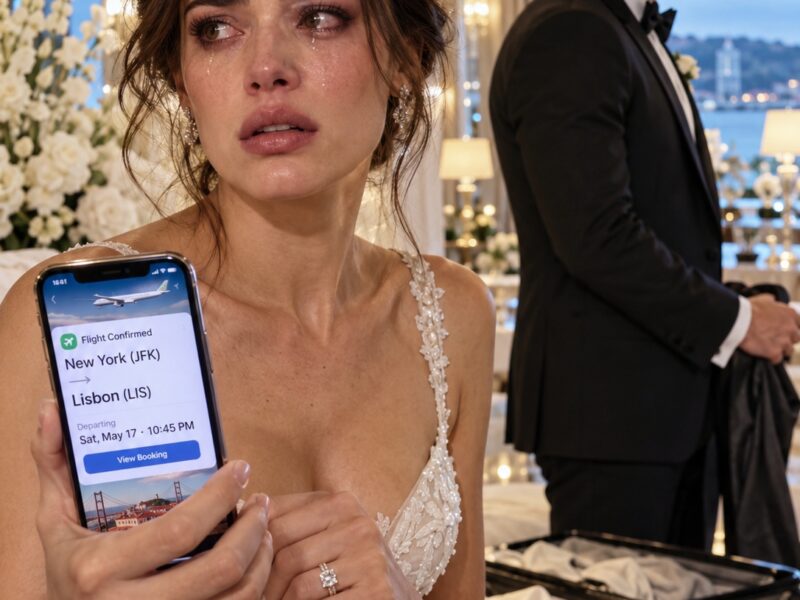
THREE HOURS BEFORE MY WEDDING, HIS PHONE REVEALED THE FLIGHT HE PLANNED TO TAKE AFTER HUMILIATING ME

Three hours before my wedding rehearsal dinner, my fiancé’s phone lit up with a flight alert he was never supposed to receive in front of me.
Nathan Brooks was in the shower, humming.
That was the detail I would remember months later—not the marble bathroom, not the ivory wedding dress hanging from the carved closet door, not even the diamond on my left hand.
The humming.
He sounded like a man with nothing to hide.
His phone vibrated once against the marble counter beside his silver cuff links.
Then again.
I glanced at it because, for the past two months, Nathan had trained me to glance at it. Vendors called him first. The hotel called him first. The caterer, photographer, security company, florist, minister, orchestra director—everyone called Nathan because he insisted that he wanted to be an equal partner in planning the wedding.
Then he handed every problem to me.
“Handle it, Clare,” he would say, sliding the phone across our kitchen island with a kiss to my temple. “You’re better at making people listen.”
I had mistaken that for admiration.
The screen lit up again.
YOUR FLIGHT TO LISBON DEPARTS TOMORROW AT 9:40 P.M.
CHECK-IN NOW AVAILABLE.
For several seconds, the words meant nothing.
My brain simply refused to arrange them into reality.
Tomorrow at 9:40 p.m. was not an empty square on Nathan’s calendar.
Tomorrow at 9:40 p.m., four hundred guests were supposed to be inside the grand ballroom of the Orielia Hotel in Manhattan, lifting champagne glasses beneath a ceiling of Austrian crystal.
Tomorrow at 9:40 p.m., my father was supposed to announce a major Hawthorne Group capital commitment to Brooks Development.
Tomorrow at 9:40 p.m., Nathan was supposed to be standing beside me.
My husband.
Nathan had booked a flight out of the country for the middle of our wedding reception.
And it wasn’t a refundable coach seat booked in panic.
The notification showed first class.
One way.
New York to Lisbon.
My hands went cold before anything changed in my face.
That reflex belonged to my mother.
When I was sixteen, a board member twice my age interrupted me during a family strategy meeting to explain my own financial model back to me. Afterward, while I cried in an empty elevator, my mother had placed one perfectly manicured hand on my shoulder.
“Feel everything later,” she said. “Never let the room watch you bleed.”
There was no room now.
Only steam drifting from the bathroom.
Water striking tile.
Nathan humming behind the glass.
The wedding dress waiting by the closet.
And the glowing phone that had just turned my future into evidence.
I should have confronted him.
That is what people imagine they would do.
They imagine betrayal arrives like fire, and instinct makes you scream.
Sometimes betrayal arrives like ice.
It slows you down.
It makes you careful.
Nathan had given me his passcode weeks earlier. He hated dealing with logistics, and since half the wedding vendors had been instructed to coordinate through him for appearance’s sake, I had effectively become his unpaid executive assistant.
I picked up the phone.
For one second, I hesitated.
Not because I believed in his privacy.
Because I understood that once I opened it, whatever life I had imagined with him might no longer exist.
Then I entered the code.
The airline notification sat at the top of the screen.
Beneath it was a message from a contact saved as VC.
I knew who VC was before I touched it.
Vanessa Clark.
Nathan’s first serious girlfriend.
The woman he had described as a difficult chapter from college.
The woman he said had loved him before he had money, before he had ambition, before he became, in his own words, “someone worth building with.”
A sad memory, he called her.
A person he felt sorry for.
A woman he no longer wanted.
The woman he had promised he stopped seeing when our engagement became public.
I opened the message.
Tomorrow night belongs to us.
Let her stand there in that ugly crown of a hotel while everyone realizes money can’t make a man stay.
My throat closed.
Not because I had just discovered he was sleeping with her.
That hurt, but some part of me had already been preparing for that answer.
For months, there had been canceled dinners.
Sudden “investor calls.”
Weekend meetings no assistant seemed to know about.
The small movement of his wrist whenever he turned his phone facedown.
The private smile that disappeared whenever I entered a room.
Betrayal had been leaving fingerprints everywhere.
What froze me was the timing.
They were not planning to run away before the wedding.
They were planning to let the wedding happen.
I scrolled.
The messages were barely hidden.
Arrogant people become careless when they decide you are too trusting to look.
Vanessa had obsessed over the schedule.
Not before the vows, she had written.
If you leave before, she becomes tragic.
If you leave after the papers and before the toast, she becomes ridiculous.
Nathan had responded with three laughing emojis.
My stomach tightened.
Another message followed.
I want her father watching.
I want every woman who treated me like trash to see Miss Hawthorne abandoned in couture.
Another.
After tomorrow she’ll be too humiliated to fight the clauses.
Your board will panic.
Mine will confirm the Clark partnership.
We take the Lisbon meetings, announce the waterfront fund, and let everyone decide who they trust—the deserted heiress or the man brave enough to walk away from a forced marriage.
I sat down on the edge of the bed.
There it was.
The detail that turned adultery into strategy.
Six months earlier, when Nathan and I agreed to marry, neither of us had pretended we were living inside a fairy tale.
Our families had known one another for years.
Hawthorne Group owned hotels, commercial properties and development interests across the East Coast. My father had spent nearly four years assembling parcels and partnerships for a massive waterfront redevelopment spanning sections of Red Hook and Long Island City.
Nathan controlled something we needed.
Land.
Not enough to complete the project, but enough to delay it indefinitely if he refused to cooperate.
Nathan needed something too.
Everything else.
Capital.
Lender relationships.
Political credibility.
Contractor confidence.
Institutional investors who would return calls when Hawthorne Group was attached to the presentation.
Brooks Development looked impressive from the outside. Nathan gave interviews beneath photographs of cranes and glass towers. Business magazines called him aggressive, young and visionary.
I had seen the books.
He was overleveraged.
Brilliant at selling tomorrow.
Dangerously dependent on tomorrow arriving exactly when he promised.
Our engagement had begun as an alliance.
Not romantic.
Not ugly.
Practical.
He had land.
I had structure.
He had appetite.
I had discipline.
A marriage would calm nervous investors, align control of the waterfront venture and make the two companies look less like temporary partners and more like a stable family alliance.
That was how it started.
Then Nathan began waiting for me after late meetings.
He memorized the way I took my coffee.
He learned that I hated lilies because their smell reminded me of funerals and had the florist remove every one from the engagement party.
He once drove from Manhattan to Connecticut at midnight because my mother had gone to the emergency room with chest pain and I had been too frightened to drive.
Nothing serious, the doctors said later.
Nathan had sat beside me for five hours anyway.
I remembered him handing me vending-machine coffee at three in the morning.
“I’ve never had anyone in my corner the way you are,” he said.
I had believed him.
Love did not always begin as lightning.
That was what I told myself.
Sometimes two people chose the same road first, and affection grew afterward.
Sometimes partnership became tenderness.
Sometimes practicality turned real.
I had allowed myself to believe that was happening to us.
Now I understood something far uglier.
Perhaps it had become real for me.
For Nathan, usefulness had simply learned how to imitate intimacy.
The shower stopped.
I locked his phone and placed it exactly where it had been.
Then I stood in front of the mirror.
Loose blond hair pinned away from my face.
Silk robe tied carefully at my waist.
Diamond flashing beneath soft bathroom lights.
I looked like a woman preparing to become a bride.
I felt like someone standing at the edge of a crime scene.
The bathroom door opened.
Nathan walked out with a towel wrapped around his waist, water darkening his hair.
He looked at me.
“You’re pale.”
“Long day.”
He crossed the room and kissed my cheek.
Warm mouth.
Steady hand.
No hesitation.
No guilt.
“Tomorrow,” he said, smiling at our reflection, “it’ll all be worth it.”
I looked at him in the mirror.
“Will it?”
He laughed softly.
“Of course it will.”
His hand settled on my waist.
“Hawthorne and Brooks. You and me. After tomorrow, the city finally understands.”
“What does it understand?”
His smile shifted.
“That we’re real.”
For the first time since reading Vanessa’s messages, something almost like anger moved through me.
Not hot anger.
Something cleaner.
Sharper.
I turned.
Nathan Brooks had built his entire adult life around hunger.
He hated being underestimated.
He hated old money until old money invited him to dinner.
He hated powerful families until they invested in him.
He hated anyone who could look at a room he desperately wanted and walk away from it without needing applause.
And more than almost anyone, Nathan hated Elliot Vale.
Elliot was thirty-five, quiet and almost unnervingly disciplined. He had inherited a mediocre family investment office after his father’s death and turned Vale Holdings into one of the most exacting private capital firms in New York.
Nathan called him privileged.
Cold.
Predatory.
A man born on third base who acted as though he had hit the ball himself.
That story was convenient.
The truth was more painful.
Vale Holdings had beaten Brooks Development on two waterfront bids, a hotel conversion and a private equity raise Nathan insisted he had never really wanted.
Elliot did not chase rooms.
Rooms adjusted when he entered them.
Nathan feared him because charm stopped working around Elliot Vale.
Numbers didn’t flirt back.
I had invited Elliot to the wedding for business reasons. Vale Holdings participated in one of Hawthorne Group’s unrelated credit facilities, and in our world, courtesy was architecture.
I suddenly wondered what Nathan would do if the one man he could not intimidate was standing beside me when his plan collapsed.
The thought didn’t make me feel better.
It made me feel steady.
Nathan touched the diamond on my finger.
“Tomorrow, whatever happens, trust me.”
I looked at his hand.
Then his face.
“I trust what I can prove.”
Something flickered in his eyes.
“What does that mean?”
“It means I’m exhausted.”
“Clare.”
I smiled.
“Go sleep. We have a wedding to survive.”
For half a second he studied me.
Then arrogance won.
He kissed my forehead and walked through the adjoining door into the groom’s suite.
He liked old traditions when they made him feel important.
The lock clicked.
I counted to ten.
Then I moved.
I photographed the flight alert when it appeared again on his lock screen.
I reopened the phone.
Screenshots.
Messages.
Ticket receipts.
Passport information.
A reservation for a Lisbon hotel suite.
I sent everything to the encrypted legal folder my father and I used for board matters.
Then I searched Vanessa’s name.
The deeper I went, the less the affair mattered.
They were partners.
Vanessa had approached Hawthorne vendors using a consulting entity Nathan never disclosed.
She had introduced him to a Portuguese investment group using draft materials from our waterfront project.
Vendor costs.
Development timelines.
Site maps.
Confidential financial projections.
I found a media package she had prepared.
The working headline made my stomach turn.
BUSINESS HEIRESS ABANDONED AT OWN RECEPTION AFTER GROOM ESCAPES FOR TRUE LOVE.
Below it was a photograph of Nathan and Vanessa kissing in an airport lounge.
It had been scheduled for release at 9:52 p.m. the following night.
Twelve minutes after their flight was supposed to depart.
I kept scrolling.
Then I found the voice memo.
Vanessa had sent it two weeks earlier.
I put in one earbud.
Her voice was soft.
Almost elegant.
“She thinks she doesn’t remember me. That’s the part I hate most.”
I stopped breathing.
“Hawthorne women ruin people and call it standards. Your fiancée sat in a procurement meeting three years ago and told the room my proposal contained undisclosed confidential overlap. Do you know what happened after that? Orielia blacklisted Clark Atelier. Two hotels followed. My investors disappeared. I lost everything because Clare Hawthorne wanted to sound clever in front of her father.”
Memory returned immediately.
A conference room.
Presentation boards.
A luxury launch proposal.
Vanessa had owned a boutique event design company then.
Clark Atelier.
During a resort procurement process, I noticed several visual concepts and vendor combinations in her pitch that matched details from a competing firm’s confidential presentation almost exactly.
I hadn’t “blacklisted” Vanessa.
I had flagged a compliance issue.
Legal investigated.
Two junior employees eventually admitted that confidential material had been improperly obtained.
Vanessa publicly blamed them.
Then quietly dissolved the company.
To her, I had not enforced a standard.
I had humiliated her.
Now she wanted symmetry.
She wanted me dressed in white, surrounded by cameras and abandoned at the exact moment everyone was watching.
And Nathan had volunteered to become the knife.
I forwarded the voice memo.
Then I called my father.
He answered on the second ring.
“Clare?”
“I need you awake, dressed and silent.”
There was a pause.
His voice changed.
“Where are you?”
“Bridal suite.”
“What happened?”
“Nathan has a first-class ticket to Lisbon tomorrow night.”
Silence.
“He’s leaving during the reception with Vanessa Clark.”
Another pause.
“They planned it.”
My father said nothing.
So I continued.
“They want the wedding completed enough to trigger the public alliance optics and stabilize Nathan’s financing. Then he disappears before the toast. Vanessa releases a media package claiming he escaped a forced business marriage. They’re meeting a Portuguese capital group in Lisbon using Hawthorne waterfront materials.”
My father’s breathing became quieter.
That was always more frightening than shouting.
“Proof?”
“Flight itinerary. Two seats. Messages. Voice memo. Media plan. Hotel reservation. Investor materials. Signs that confidential project information was transferred.”
“Send everything to Marbel.”
“Already doing it.”
Marbel Shaw was Hawthorne Group’s general counsel.
She had once made three federal judges visibly irritated in one afternoon and treated it as a successful workout.
“Do not confront Nathan alone,” my father said.
“I already spoke to him.”
“Clare.”
“He doesn’t know I know.”
My father released a slow breath.
Then he asked the question that mattered.
“What do you want?”
Not what should we do.
Not what will the press say.
Not what protects Hawthorne.
What do you want?
I looked at my dress.
At the city beyond the windows.
At the embossed wedding program lying on the desk with CLARE HAWTHORNE & NATHAN BROOKS printed in black beneath an elegant silver crest.
“I want him to enter that ballroom believing he still controls the story.”
My father remained silent.
“I want him to walk to the altar.”
Still nothing.
“I want him to look at every investor, every reporter, every executive he invited to watch me become useful to him.”
I swallowed.
“And then I want to take the story away.”
A long pause followed.
Finally, my father said, “Marbel will need the night.”
“She has it.”
“The marriage license can be withheld. The ceremony becomes symbolic until the legal filing is completed.”
“Good.”
“The capital announcement is suspended.”
“Yes.”
“We notify the board before the ceremony.”
“No.”
My father’s voice hardened.
“Clare.”
“If too many people know, Nathan hears something. I want the smallest circle possible.”
Another pause.
“You sound like your mother.”
“That’s not an insult.”
“It wasn’t intended as one.”
I sat on the edge of the bed.
“There’s something else.”
“What?”
“Elliot Vale is on the guest list.”
For the first time that night, my father almost laughed.
“Nathan will hate that.”
“I know.”
“Elliot is not a prop.”
“I know that too.”
“If you pull him into this, he’ll understand the entire board position in five minutes.”
“That’s why I want him there.”
My father became serious again.
“Do you trust Vale?”
I looked toward Manhattan, thousands of lit windows stacked against the dark.
“I trust his discipline.”
“That isn’t the same thing.”
“Tonight it’s enough.”
By sunrise, my wedding had become an operation.
No one outside a handful of people knew.
My mother arrived at six-thirty wearing pale silver silk and the calm expression she reserved for funerals, hostile takeovers and family crises.
She closed the suite door.
Then she crossed the room and pulled me against her.
Hard.
For one second, I was six years old again.
Not Clare Hawthorne, vice president of strategy.
Not the daughter investors watched.
Not the woman about to dismantle her fiancé in front of half of Manhattan.
Just her child.
When she released me, her eyes were dry.
She fixed a loose strand of hair near my temple.
“Do you want to cancel?”
“No.”
“Do you want me to cancel?”
I almost smiled.
“No.”
“Do you want to destroy him?”
I met her eyes in the mirror.
“I want him to meet the consequences of his own plan.”
She studied me.
Then she nodded toward my head.
“Your veil is crooked.”
That was my mother’s version of saying I love you.
By eleven, the Orielia Hotel looked like a dream designed by people who understood that money could imitate heaven.
White roses climbed ivory columns.
Thousands of crystals scattered sunlight across cream chairs.
A string ensemble played near the ballroom doors.
Security guided senators, investment bankers, real estate families, media executives and hotel owners into carefully assigned seats.
Outside the elevators, reporters waited behind velvet barriers.
For months, the Hawthorne-Brooks marriage had been gossip.
For weeks, it had been business news.
By noon, it was supposed to become fact.
Nathan stood beneath the floral arch in a black tuxedo.
Handsome.
Relaxed.
When he saw me at the ballroom entrance, he smiled.
There was warmth in it.
That was somehow the cruelest part.
He wasn’t nervous.
He wasn’t ashamed.
He was pleased.
He believed he had survived the difficult stage.
All he needed now was for me to walk toward him.
Smile.
Take his hands.
Say yes.
Then he could convert my trust into leverage and my humiliation into narrative.
My father offered me his arm.
“Last chance.”
“No.”
He looked straight ahead.
“Then make them listen.”
The ballroom doors opened.
Every face turned.
I walked slowly.
Not because I wanted to savor the moment.
Because speed looks like panic.
And panic belonged to Nathan’s script.
Mine required precision.
Halfway down the aisle, I saw Elliot.
Second row.
Left side.
Dark charcoal suit.
Silver tie.
Wedding program resting against one knee.
He wasn’t whispering to anyone.
Wasn’t studying his phone.
His eyes moved from Nathan to me.
Then stopped.
Something changed in his face.
Barely.
But Elliot Vale had spent his life reading situations before they became obvious.
He knew something was wrong.
Good.
At the altar, Nathan took my hands.
“You look incredible,” he whispered.
“Thank you.”
“You okay?”
“Perfectly.”
For the first time, uncertainty touched his expression.
The officiant began.
Commitment.
Partnership.
Family.
Future.
All the soft language people use when contracts are hiding behind flowers.
Nathan’s thumb brushed the back of my hand.
I let him.
When the officiant finished the opening remarks, he turned to Nathan.
Nathan delivered his vows smoothly.
He spoke about admiration.
Loyalty.
The first day he knew I was different.
He even mentioned the night my mother went to the hospital.
My chest tightened.
Not because the memory had become false.
Because it had once been true to me.
Maybe that was the hardest thing about betrayal.
It doesn’t erase the tenderness.
It poisons your ability to know what tenderness meant.
Then the officiant faced me.
“Clare Hawthorne, do you take Nathan Brooks to be your husband?”
The ballroom became very still.
Nathan looked at me.
Almost tender.
Almost loving.
I removed my hands from his.
“No.”
The word did not echo.
It cut.
Nathan blinked.
The officiant froze.
Someone gasped behind us.
I turned away from Nathan.
Not toward my parents.
Not toward the guests.
Toward the cameras positioned at the rear of the ballroom.
“Thank you all for coming.”
A microphone hidden inside the floral arch caught my voice.
That had been Marbel’s idea.
Nathan stepped closer.
“Clare.”
I continued.
“This ceremony was arranged as both a personal commitment and the public beginning of a commercial alliance between Hawthorne Group and Brooks Development.”
Nathan’s face changed.
“What are you doing?”
“I entered that alliance in good faith,” I said. “I understood how it began. I also believed that over time, Nathan and I had built something more honest than the arrangement that introduced us.”
A few heads turned toward him.
Nathan’s hands curled at his sides.
“Clare. Stop.”
I finally looked at him.
“No.”
Then I faced the room again.
“Last night, I discovered that Nathan Brooks purchased a first-class ticket from New York to Lisbon departing at 9:40 tonight.”
The atmosphere changed before the sound did.
Shoulders turned.
Phones appeared.
Nathan’s mother covered her mouth.
“That flight,” I continued, “was scheduled during our reception.”
Nathan reached toward me.
“This is insane.”
Security moved one step closer.
My father didn’t move at all.
I lifted one hand.
The large screen behind the altar came alive.
No childhood photographs.
No engagement pictures.
An airline itinerary.
NATHAN BROOKS.
NEW YORK TO LISBON.
9:40 P.M.
SEAT 2A.
Then the second ticket appeared.
VANESSA CLARK.
SEAT 2B.
Whispers exploded across the ballroom.
Nathan went white.
“That’s private information.”
I looked at him.
“A mistake is private. Strategy is not.”
The slide changed.
A message.
NOT BEFORE THE VOWS.
Another.
IF YOU LEAVE BEFORE, SHE BECOMES TRAGIC.
IF YOU LEAVE AFTER THE PAPERS AND BEFORE THE TOAST, SHE BECOMES RIDICULOUS.
Another.
I WANT HER FATHER WATCHING.
LET HER STAND THERE IN THAT UGLY CROWN OF A HOTEL WHILE EVERYONE REALIZES MONEY CAN’T MAKE A MAN STAY.
The room read every word.
Vanessa had wanted an audience.
I had simply changed who was performing.
Nathan lunged for the microphone.
A chair moved.
Then Elliot stood.
He did not rush toward us.
He didn’t need to.
Something about Elliot’s stillness made people stop moving.
“Don’t touch the microphone,” he said.
Nathan turned.
Hatred appeared instantly.
Raw.
Unfiltered.
“Of course.”
Elliot said nothing.
Nathan laughed bitterly.
“Of course you’re enjoying this.”
“I came to a wedding,” Elliot said.
His voice was quiet.
“You brought the fraud.”
A murmur moved through the room.
Nathan looked around, realizing too late that anger was making him look guilty.
“This is a private relationship issue.”
“It stopped being private,” I said, “when you connected it to a capital announcement, foreign investors and proprietary Hawthorne materials.”
Marbel stepped forward from beside the doors.
Navy suit.
Leather folder.
Perfect posture.
“Brooks Development received a document preservation notice at 10:12 this morning,” she said. “Hawthorne Group has suspended all pending capital support and initiated review of the waterfront joint venture.”
Nathan stared at her.
“What?”
“We are also referring evidence involving potentially misappropriated confidential commercial information to outside counsel and any appropriate authorities.”
Nathan looked toward my father.
“You can’t let her do this.”
My father smiled without warmth.
“I taught her to do this.”
The screen changed again.
Draft investor materials.
Our maps.
Our schedules.
Our vendor pricing.
The documents had been altered to make Brooks Development appear to control assets it did not control.
The romantic escape suddenly had spreadsheets beneath it.
I faced Nathan.
“You weren’t choosing love over business.”
His jaw tightened.
“You were choosing another business plan.”
“That’s not what happened.”
I nodded toward the screen.
His debt schedule appeared.
Three private loans.
Delayed contractor payments.
A lender covenant dependent on Hawthorne support.
A bridge financing facility partially contingent upon positive public reception of the Hawthorne-Brooks alliance.
Nathan stopped breathing for a fraction of a second.
There.
That was the moment the room understood him.
Not as a runaway groom.
Not as a tortured man following his heart.
As an executive trying to engineer a liquidity event through public humiliation.
“I panicked,” he said.
I almost felt sorry for him.
Almost.
“You planned.”
“Clare—”
Elliot spoke from beside the first row.
“Vale Holdings currently participates in one of the affected lending groups.”
Nathan’s head snapped toward him.
Elliot continued.
“Based on the information disclosed today, I will recommend immediate review before any extension of additional credit to Brooks Development.”
Nathan laughed.
“You’ve wanted my company for years.”
Elliot looked almost bored.
“No.”
A beat.
“I’ve wanted you to stop calling debt ambition.”
The sentence landed softly.
That made it worse.
Nathan turned back to me.
“Listen to me.”
“I listened last night.”
“Vanessa was angry. She says things.”
“Two airline tickets.”
“Clare—”
“One hotel suite.”
“It wasn’t—”
“One scheduled media release.”
He stopped.
“One investor presentation. One false consulting structure. One set of confidential project materials.”
I held his gaze.
“That is an impressive number of accidents.”
His eyes filled.
Real tears.
I had seen those before.
Usually after difficult lender meetings.
Usually before I stepped in to make the call he couldn’t make himself.
“I care about you.”
The room waited.
Maybe he expected me to soften.
Maybe he still believed a woman standing in a wedding dress would accept the smallest evidence of love over the largest evidence of betrayal.
I looked at the man I had respected before I tried to love him.
“You cared about what I could make you look like.”
He flinched.
“That’s not fair.”
“You wanted my family’s capital. My father’s credibility. My hotel. My guests. My cameras.”
My voice almost broke on the final word.
I made it steady.
“And my shame.”
Nathan whispered my name.
“You don’t get to keep any of them.”
Marbel approached him with the folder.
“Mr. Brooks, you are being formally served.”
He did not take it.
Security accepted it.
For one strange second, Nathan looked toward the ballroom doors as if some irrational part of him still believed he could make the airport.
Then the doors opened.
And Vanessa Clark walked in.
She wore red.
Of course she did.
Blood-red satin.
Bare shoulders.
Diamonds flashing at her ears.
Dark hair falling in glossy waves.
It was not an outfit chosen by a woman trying to enter unnoticed.
It had been selected for photographs.
She took three steps inside before realizing that every phone in the ballroom was pointed at her.
Then she saw the screen.
Her own words.
Twenty feet tall.
MISS HAWTHORNE ABANDONED IN COUTURE.
Her smile vanished.
“Nathan?”
Nathan’s face twisted.
“Why are you here?”
For one second, the cruelty of the question was almost funny.
Then Vanessa understood what it meant.
He did not want her beside him now.
Not while the plan was failing.
She looked at him.
At me.
At the room.
“This is illegal.”
Marbel raised one eyebrow.
A bold opening.
“Those messages were private,” Vanessa said.
“The commercial information wasn’t yours,” I replied.
Her head snapped toward me.
“You ruined my company.”
“No.”
My voice remained calm.
“You submitted confidential material belonging to another bidder.”
“I built Clark Atelier from nothing.”
“And you should have protected it by behaving honestly.”
Her face hardened.
There she was.
Not the abandoned first love.
Not the tragic entrepreneur.
Not the woman escaping toward romance.
A person who believed consequences became cruelty whenever they arrived at her own door.
“You sat there in that meeting like a queen,” she said. “You didn’t even raise your voice.”
“You were a vendor under review.”
“I was a person.”
“So am I.”
She froze.
I stepped closer.
“And planning to humiliate a person at her wedding does not become sympathetic because you once felt humiliated yourself.”
Vanessa looked around.
The room had turned against her.
She turned to Nathan.
“Say something.”
Nathan swallowed.
“Vanessa, not here.”
She laughed.
“Not here?”
“Stop.”
“You promised me here.”
People went completely silent.
Vanessa’s voice shook.
“You said she deserved to feel what I felt. You said everyone would finally see she wasn’t untouchable.”
Nathan glanced toward the cameras.
“I said a lot of things.”
Her face changed.
“You said you loved me.”
Then Nathan did what frightened men often do when truth becomes expensive.
He gave the bill to the nearest woman.
“You pushed me.”
Vanessa went still.
“What?”
“You were obsessed with Clare. You kept saying we had to make it public. You kept insisting on the timing.”
Her mouth opened.
“That was your plan.”
Something bright and ugly moved through her expression.
Nathan had betrayed her too.
Not by leaving her at an altar.
By abandoning responsibility the second responsibility had a cost.
Vanessa reached into her clutch.
Security shifted.
She pulled out a phone.
“Then they should hear your voice too.”
Nathan moved.
Fast.
Elliot reached him before he reached her.
One hand closed around Nathan’s forearm.
Controlled.
No theatrics.
Nathan gasped.
“Let me go.”
“Don’t make this worse,” Elliot said.
Vanessa pressed play.
Nathan’s voice filled the ballroom.
“After the toast, she’ll be standing there with that stupid Hawthorne smile waiting for me.”
My heart stopped.
“Let her wait.”
No one moved.
“By midnight every investor will know I was brave enough to walk away from her. By morning they’ll wonder whether Hawthorne pushed too hard.”
Then his laugh.
A laugh I knew.
A laugh I had heard across dinners.
In bed.
In cars.
On quiet Sunday mornings.
“That’s when we call Lisbon.”
A pause.
“The best part is Clare will still try to protect the deal.”
Another laugh.
“She always protects the deal.”
The recording stopped.
The silence afterward was different.
Not shock.
Judgment.
A verdict settling into place.
Nathan stopped fighting Elliot’s grip.
I looked at him.
Something inside me closed.
Not slammed.
Closed.
Cleanly.
Permanently.
“You were right about one thing,” I said.
Hope flickered across his face.
That hurt more than I expected.
“I do protect deals.”
I turned toward the room.
“That is why Hawthorne Group will protect this one by removing Brooks Development from it.”
My father stepped forward.
“Effective immediately, Hawthorne Group will pursue any lawful restructuring options available under the joint venture, including acquisition of affected waterfront interests through lender channels or court-supervised processes if necessary.”
Nathan stared at him.
“No.”
My father didn’t blink.
Elliot looked at me.
He didn’t speak immediately.
That mattered.
He waited.
“Do you want Vale involved?”
I gave one small nod.
He turned toward the guests.
“Subject to diligence and board approval, Vale Holdings is prepared to discuss interim financing with Hawthorne Group for the waterfront redevelopment.”
Nathan made a sound somewhere between a laugh and a choke.
There it was.
The reversal he had feared more than losing me.
The woman he planned to abandon would keep the project.
The rival he hated would help finance it.
And Brooks Development might become little more than a cautionary paragraph in somebody else’s investment memorandum.
Vanessa looked at Nathan as though she had finally realized she had burned her life for a man made mostly of resentment.
“You said we would be free.”
Nathan’s mouth opened.
Nothing useful came out.
Security escorted them from the ballroom separately.
That detail mattered to me more than it should have.
They had planned to leave together.
They left divided.
When the doors closed, four hundred people remained frozen beneath white roses.
Then my mother stood.
She lifted her champagne glass.
“Ladies and gentlemen,” she said, clear enough to reach the back of the room, “the ceremony has changed.”
Nobody breathed.
“The hospitality remains excellent.”
A nervous laugh escaped somewhere near the third row.
Then another.
Within seconds, the room exhaled.
The orchestra started again.
The roses still smelled expensive.
The chandeliers still glittered.
The food was still waiting.
But the wedding was gone.
In its place was something stranger.
A disclosure.
A severance.
A lesson in what happens when someone mistakes trust for blindness.
I stepped down from the altar.
Only then did my knees start shaking.
Elliot reached me near the second row.
“Are you all right?”
The question nearly broke me.
Not because it was profound.
Because no one had asked me that without wanting something from me in months.
“No.”
His expression softened.
“That seems like a reasonable answer.”
I laughed once.
It came out dangerously close to a sob.
“Thank you for standing up.”
“You gave me permission.”
“Most men would have taken more.”
“Most men talk too much.”
Despite everything, I smiled.
My father approached.
“Vale.”
“Mr. Hawthorne.”
“Your financing comment was intentionally public.”
“Yes.”
“Good.”
“My lawyers are already speaking with yours.”
My father’s mouth almost moved.
Then he looked at me.
“Do you want to leave?”
I scanned the ballroom.
Guests pretending not to stare.
Reporters typing so quickly their thumbs blurred.
The dark screen behind the altar.
The empty space where Nathan had been.
Leaving would have been understandable.
That was exactly why I stayed.
“No.”
My mother glanced at me.
“We paid for dinner.”
Her mouth twitched.
“That’s my daughter.”
So the reception happened.
Not as a wedding reception.
As perhaps the strangest investor dinner Manhattan had hosted all year.
Marbel controlled the official statement.
My father controlled the emergency board calls.
My mother controlled the seating arrangements with the concentration of a general defending territory.
Elliot remained close enough to help without behaving as though my crisis had transferred ownership of me to him.
Several guests congratulated him for “saving” me.
He corrected every one.
“Clare saved herself.”
Once, near the bar, I heard him tell a banker, “I answered when she asked.”
I turned away because my eyes burned.
By midnight, the story was everywhere.
For nine minutes, Vanessa’s scheduled post remained public.
Poor rich girls can buy flowers, hotels and press coverage.
They cannot buy a man’s heart.
For approximately three minutes, the internet loved it.
Then Hawthorne Group released its statement.
Flight documentation.
Notice of suspended support.
Confirmation of outside counsel.
Evidence that a commercial review was underway.
No emotional accusations.
No insults.
Facts.
By twelve-thirty, the jokes had changed direction.
By one, financial reporters were asking why Brooks Development appeared to have represented Hawthorne-controlled materials to foreign investors.
By one-forty, one of Nathan’s lenders issued a “no comment” that sounded louder than panic.
Vanessa attempted an interview outside her apartment the following night.
She wore sunglasses after dark.
“Clare Hawthorne has always used money to punish women she envies.”
The reporter asked whether she denied writing that she wanted me abandoned in couture.
Vanessa walked inside.
The next week was not glamorous.
Consequences rarely are.
They were document holds.
Board meetings.
Lawyers.
Lender calls.
Contractor notices.
Amended disclosures.
Nathan called thirty-seven times the first day.
I answered none.
He emailed from three accounts.
I forwarded everything to Marbel.
He sent flowers.
My assistant returned them with a copy of the preservation notice.
On the fourth day, he waited outside the service entrance of the Orielia.
He wore the same navy suit he used for difficult investor meetings.
For a moment, memory attacked me.
Nathan laughing over Chinese takeout in my apartment.
Nathan asleep on a pile of project reports.
Nathan kissing my shoulder while coffee brewed.
Nathan saying nobody had ever believed in him the way I did.
Then I heard his recorded laugh in my head.
Clare always protects the deal.
I walked toward him with security on either side.
“Clare.”
I stopped.
Fear did not deserve control of my route.
“You have two minutes.”
He looked thinner.
Dark circles had formed beneath his eyes.
“Vanessa manipulated me.”
“Try again.”
His jaw tightened.
“I made a mistake.”
“Try harder.”
He looked down.
“I was afraid.”
“Of what?”
He laughed once, bitterly.
“Becoming an accessory in your life.”
That was almost honest.
I waited.
“Everything was Hawthorne,” he continued. “The hotel. The guests. The money. The approvals. Even our marriage felt like something your father could audit.”
“You agreed to it.”
“Because I needed it.”
“And?”
His eyes reddened.
“I hated needing it.”
There he was.
Not a mastermind.
Not a monster.
Something smaller.
More ordinary.
A proud man who would rather betray the hand helping him rise than admit that he had accepted the hand.
“Vanessa made me feel chosen,” he said.
“No.”
His expression tightened.
“She made you feel superior.”
He stared at me.
“Maybe I didn’t understand the difference.”
“You understand it because the plan failed.”
His eyes filled.
“I lost everything.”
“No.”
I stepped closer.
“You risked everything.”
He looked at me.
“The loss is the part you can’t outsource.”
A car door closed behind us.
Nathan looked past my shoulder.
Elliot had stepped onto the sidewalk.
He didn’t approach.
Didn’t interrupt.
He simply waited beside the car.
Nathan’s face twisted.
“Of course he’s here.”
“He has a meeting.”
“With your father?”
“And me.”
Nathan laughed.
“You’re really going to let him take my place?”
For the first time during the conversation, I smiled.
“Nathan.”
His eyes met mine.
“You don’t have a place.”
Security opened the service door.
I walked inside.
I never looked back.
Brooks Development unraveled over the next six weeks.
Former employees began cooperating once it became obvious Nathan could no longer guarantee severance.
Vanessa’s consulting files revealed two additional unauthorized disclosures.
The Portuguese investors denied knowledge of any misuse and provided documents to investigators.
Nathan’s lenders declared technical defaults.
Eventually, a receiver took control of key waterfront interests before contractors could abandon the sites.
Hawthorne Group did not steal them.
That distinction mattered to me.
We acquired interests through the exact legal and financial processes Nathan’s actions had triggered.
At the board meeting approving the restructured development, I presented the new plan.
Not my father.
Me.
New financing.
New compliance walls.
Independent vendor controls.
A revised hotel footprint.
Community benefit commitments that had previously been treated as bargaining chips instead of obligations.
Elliot attended as Vale Holdings’ representative.
He asked difficult questions.
Real questions.
Not theatrical questions men sometimes ask women to prove dominance in a room.
At the end, he voted yes.
Afterward, I found him on the terrace.
Manhattan stretched below us beneath a cold blue sky.
“You could have made that easier,” I said.
“Yes.”
“You didn’t.”
“No.”
“Why?”
He looked at me.
“Because you didn’t need a man making the room gentle for you.”
The wind pushed dark hair across his forehead.
“You needed the room to respect the work.”
I looked toward the skyline.
I had no defense against an answer like that.
“Nathan always wanted me to soften rooms before he entered.”
“I know.”
I turned.
“Did you dislike him before the wedding?”
“Yes.”
“Because he was reckless?”
“Partly.”
“What else?”
Elliot was quiet long enough that I knew I had asked something dangerous.
Finally, he said, “Because he had your trust and treated it like capital.”
The words landed somewhere behind my ribs.
I studied him.
“You noticed?”
“I noticed you.”
He said it without drama.
That made it impossible to dismiss.
“For how long?”
His eyes stayed on mine.
“Ten years.”
I laughed.
“That is an inconvenient number.”
“I agree.”
“Why did you never say anything?”
“You were building a life.”
He paused.
“Then you were engaged.”
Another pause.
“Then I was his competitor. Anything I said would have sounded like strategy.”
“And now?”
“Now I’m still his competitor.”
He stepped closer.
Then stopped before the distance became pressure.
“He is simply no longer relevant to the answer.”
“What answer?”
“Whether I may ask you to dinner once the legal dust settles.”
I almost laughed again.
“That sounds extremely formal.”
“I’m trying not to be an idiot.”
A smile came before I could stop it.
Not the controlled expression I used with reporters.
A real one.
Small.
Mine.
“Ask me again in a month.”
“I can wait.”
“That sounds confident.”
“No.”
He looked at me steadily.
“It’s respect.”
A month later, he asked.
I said yes.
Not because he had stood up during the wedding.
Not because he was wealthy.
Not because Nathan hated him.
And not because heartbreak makes replacement feel like healing.
I said yes because Elliot never treated my pain like an opportunity he had earned.
He did not rush me.
He did not tell me I was too strong to be hurt.
He did not call my anger bitterness.
He did not behave as though patience entitled him to gratitude.
We had dinner.
Then another.
He learned that I preferred small restaurants after months of being photographed everywhere.
He remembered my oat milk and no sugar.
He learned which reporters made me tense and somehow managed to redirect them without making me feel managed.
When we disagreed over financing, he disagreed in public exactly as he did in private.
No punishment.
No sulking.
No need to win the room after losing an argument.
Once, a senior banker joked that Elliot had finally “won” me from Nathan.
The temperature at the table changed instantly.
“Clare is not territory,” Elliot said.
The banker went red.
Elliot continued eating.
That was when I began trusting the warmth.
Slowly.
Trust after betrayal should be allowed to walk.
Winter came.
The Orielia replaced the wedding roses with white branches and silver lights.
The waterfront restructuring stabilized.
Hawthorne Group’s exposure decreased.
Vanessa settled a civil claim and disappeared from public event design.
Nathan remained trapped in creditor litigation, regulatory inquiries and the quieter punishment of becoming a man people stopped inviting to important lunches.
Then one afternoon, Marbel entered my office carrying an envelope.
“Nathan.”
I looked at it.
“Legal?”
“Mostly personal.”
“Anything I need to know?”
“No threat. No demand.”
She placed it on my desk.
“Your choice.”
I read the letter with her in the room.
Old tenderness is not a reason to become careless.
It wasn’t an apology at first.
It was a confession disguised as one.
Nathan wrote that he had loved me in the only way he understood love then.
By loving what a person gave him.
He wrote that Vanessa had understood his resentment because she carried a version of the same wound.
He wrote that humiliating me had seemed, in the ugliest corner of his mind, like proof that he wasn’t beneath me.
Near the end, the sentences became smaller.
You were never the one making me feel small.
I was small.
And I blamed you for standing at your full height.
I folded the letter.
Marbel watched me.
“Do you want to respond?”
“No.”
“File it?”
“Yes.”
She picked up the envelope.
That was the last thing Nathan ever received from me.
Procedure.
By spring, the waterfront project had a new name, new financing and a groundbreaking date.
My father stepped away from daily oversight.
For the first time, I led publicly without his shadow standing behind every decision.
Some reporters called the development my redemption project.
I corrected them.
“It isn’t redemption.”
A reporter looked surprised.
“What is it?”
“Governance.”
Elliot stood at the side of the press area.
Everyone else saw his unreadable expression.
I saw the smile he was trying not to show.
Afterward, he drove me north.
We stopped at a small estate in Connecticut.
Neither family owned it.
That was important.
No investors.
No television cameras.
No four-hundred-person guest list.
No orchestra trying to rescue a scandal.
Only my parents.
His mother.
My closest friend, Megan.
Marbel, because apparently once a lawyer saves your first wedding from becoming legally catastrophic, she earns permanent access to every major life event.
And a judge who checked every document twice.
White roses stood in simple glass vases.
They smelled different there.
Not like performance.
Like spring.
This time, the marriage license was correct before anyone lifted a glass.
This time, the vows were legal before they were symbolic.
This time, no man stood beside me because I needed a shield.
Elliot stood there because I had chosen him.
He wore a dark blue suit.
I wore simple ivory silk.
No enormous train.
No jeweled veil.
No armor disguised as lace.
The judge smiled.
“Are we ready?”
Elliot took my hands.
Then he looked at me for so long that my mother began crying before he even spoke.
“Ten years ago,” he said, “I watched you hold a hostile room without raising your voice.”
I laughed softly.
“I thought I admired you.”
His thumb moved once against my hand.
“I was wrong.”
My eyes burned.
“Admiration was only the beginning.”
His voice lowered.
“I loved you in silence because wanting you didn’t give me the right to interrupt your life.”
My father looked toward the trees.
Pretending.
Badly.
“I respected you from a distance. I waited when waiting was the only decent thing to do.”
Elliot’s eyes never left mine.
“And today I’m done standing at a distance.”
My breath caught.
“If you’ll have me, I’ll spend the rest of my life beside you.”
He paused.
“Not in front of you.”
My mother covered her mouth.
“Not behind you.”
His fingers tightened around mine.
“Beside you.”
For one second, the old ballroom returned to me.
Crystal.
White roses.
Nathan’s hand around mine.
The question.
Do you take this man?
The moment before I said no.
People sometimes believe healing means forgetting the scene that broke you.
I don’t.
I think healing means being able to remember it without confusing survival for identity.
I looked at Elliot.
“I spent too many years mistaking usefulness for love.”
His eyes shone.
“I thought partnership meant making a man feel taller even when he was standing on my work.”
My voice shook.
I let it.
There were no cameras here that deserved my armor.
“You taught me something different.”
He waited.
“Real love doesn’t shrink a woman so a man can feel large.”
A tear slid down my mother’s cheek.
“It doesn’t turn trust into leverage.”
I squeezed Elliot’s hands.
“It tells the truth.”
My own eyes blurred.
“And it stays.”
Elliot breathed out.
“So yes.”
The judge smiled.
“I will have you beside me.”
When he placed the ring on my finger, it did not erase the first wedding.
Nothing could.
I no longer wanted it erased.
The phone glowing on the marble counter.
The Lisbon ticket.
Vanessa’s messages.
Nathan kissing my cheek while knowing exactly when he planned to disappear.
The ballroom waiting to see whether I would break.
Vanessa entering in red.
Nathan’s recorded laugh.
Clare always protects the deal.
Every part of it remained.
But memory had changed shape.
For months, I thought that night was the night Nathan betrayed me.
Eventually, I understood it differently.
Nathan had planned to leave me beneath chandeliers so New York would call me unwanted.
Instead, he exposed himself as a man who had never learned the difference between love and leverage.
Vanessa wanted to humiliate me because she believed my standards had ruined her.
Instead, she reminded every room that consequences are not cruelty simply because they arrive after misconduct.
And me?
I learned that dignity is not always silence.
Sometimes dignity is standing in a wedding dress beneath four hundred pairs of eyes and reading the evidence aloud.
Sometimes dignity is refusing to scream because the truth is already loud enough.
Sometimes it is letting the wrong man leave without following him.
Sometimes it is admitting that being needed is not the same as being loved.
And sometimes it is looking across the wreckage of the future you planned and realizing that losing it may be the first honest thing that future ever gave you.
The city remembered my wedding scandal for a season.
Then another scandal arrived.
And another.
Headlines disappeared.
Brooks Development eventually became a case study whispered through lending committees about leverage, governance and executive arrogance.
Vanessa Clark became a name used in compliance seminars by people who probably never knew what color dress she wore that afternoon.
Even Nathan faded.
Not completely.
People do not disappear just because we stop loving them.
They become quieter rooms inside us.
Doors we no longer open.
What remained vivid was something smaller.
A phone.
A marble counter.
Steam under a bathroom door.
A message arriving at exactly the wrong moment.
Or maybe the right one.
For years, I had believed the most important choices in life announced themselves dramatically.
A proposal.
A wedding.
A contract.
A board vote.
I was wrong.
Sometimes the choice that changes everything is silent.
No audience.
No applause.
Just a woman holding a phone while the man she plans to marry hums in the next room.
A woman deciding whether knowing the truth will destroy her life.
A woman realizing the life being destroyed was never entirely real.
Nathan thought the flight notification would eventually become the first line of my humiliation.
Instead, it became the first line of my freedom.
He wanted me to stand beneath those chandeliers and discover, in front of everyone, that he had chosen another woman.
He wanted the photographs.
The whispers.
The image of Clare Hawthorne finally made small.
But betrayal has one weakness.
It depends on the betrayed person continuing to follow the script.
I didn’t.
I took the story Nathan had written for my humiliation and made him stand inside it instead.
And years later, when I think about that night, I no longer remember the moment as the night before the wedding that failed.
I remember the glow of his phone against the marble.
The cold in my hands.
The sound of the shower stopping.
And the woman in the mirror who had not yet realized that she was about to lose a fiancé, save a company, expose a lie, survive a ballroom full of witnesses, and eventually learn how different love feels when it does not need her to become smaller.
Some endings arrive disguised as disasters.
Mine arrived at 9:40 p.m. on an airline notification.
It asked me a simple question.
Would I rather be humiliated—
or awake?
I chose awake.
Then, finally, I chose myself.









