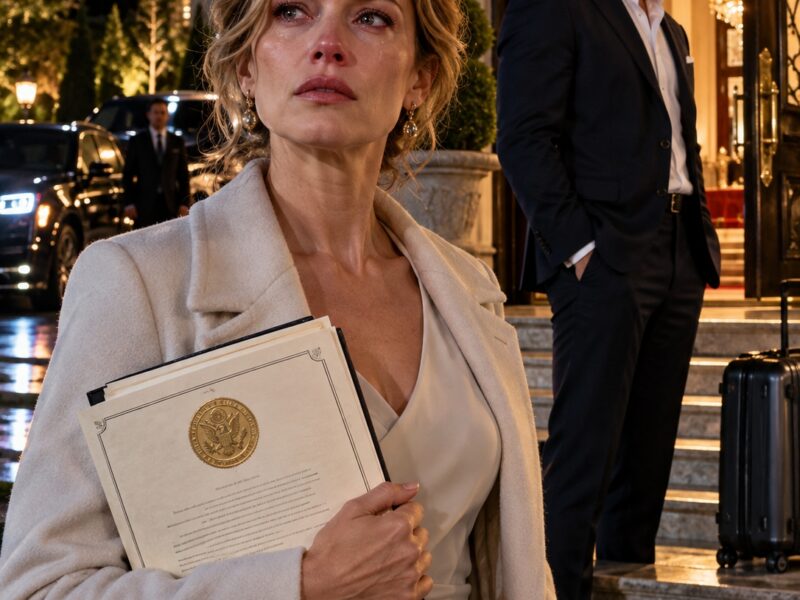
My Husband Threw Me Out for His Mistress, Screaming “You’re Nothing!”—Then 5 Black Cars Arrived, and He Learned Who Really Owned His $20 Million Mansion.

The first thing my husband’s mistress said to me was, “Oh. You must be the wife.”
She was standing barefoot in my kitchen.
My kitchen.
Wearing one of Grayson’s white dress shirts, holding a crystal wineglass I had bought in Florence, with her long blond hair falling over one shoulder as if she had spent enough nights in my home to know exactly where the glasses were kept.
For twelve years, I had been Mrs. Grayson Caldwell.
That night, I discovered how little the title meant to the man whose name I had carried.
I set my handbag on the marble island and looked at her.
She was younger than me. Maybe thirty. Beautiful in the deliberate way certain women are beautiful when they know a room is already watching them.
She smiled.
Not nervously.
Possessively.
“You must be Sloan,” I said.
Her smile changed.
Just slightly.
“And you must be the reason he stopped coming home.”
The room went silent.
Then Grayson appeared in the doorway.
He had loosened his tie. His sleeves were rolled to his elbows. Twelve years earlier, that look had made me think he was the most handsome man I had ever seen.
Now he just looked tired.
And guilty.
“Olivia.”
He said my name like I was the person who had arrived unexpectedly.
“You’re early.”
I looked at the clock above the stove.
It was 6:28 p.m.
“I live here.”
Sloan laughed softly into her wine.
Grayson rubbed his jaw.
“We need to talk.”
“Yes,” I said. “We do.”
He glanced at Sloan.
That glance told me more than any confession could have.
He wasn’t embarrassed that she was there.
He was worried about how I would react.
Which meant this had already been decided.
“Sloan will be staying with us for a while.”
For a moment, I thought I had misunderstood him.
“With us?”
“Until we sort things out.”
I looked at Sloan again.
She raised her glass.
I turned back to my husband.
“In my house, Grayson?”
Something cold entered his expression.
“Your house?”
Those two words should have warned him.
Instead, they almost made me smile.
But I didn’t.
Not yet.
Sloan wandered past me toward the living room, studying the antiques, the paintings, the carved staircase and the chandelier my grandmother Ruth had commissioned in 1978.
“Does she always dress like a librarian?” she asked.
Grayson sighed.
“Sloan.”
“What? I’m asking.”
She turned and looked me over.
I was wearing a navy cardigan, cream blouse, gray trousers and flat shoes.
Nothing expensive enough to impress someone like her.
At least, nothing she recognized as expensive.
“She dresses like she’s apologizing for being in the room,” Sloan said.
Grayson didn’t defend me.
That hurt more than the insult.
There are moments in a marriage when betrayal does not arrive like thunder.
It arrives quietly.
A husband doesn’t laugh when another woman mocks you.
He simply says nothing.
And suddenly twelve years rearrange themselves.
Every dinner you ate alone.
Every business trip that lasted one extra night.
Every phone turned facedown.
Every time he called you “too sensitive.”
Every apology you made just to keep the peace.
I looked at Grayson.
“Is this what you want?”
He exhaled impatiently.
“Don’t make this dramatic.”
That almost made me laugh.
His mistress was drinking from my grandmother’s crystal in my kitchen, and I was the one making things dramatic.
“I asked you a question.”
He walked closer.
“I’m tired, Olivia.”
“Of what?”
“This.”
He gestured between us.
“This marriage. This constant heaviness. Every room feels like a funeral when you walk into it.”
Sloan leaned against the doorway.
Watching.
Enjoying.
I swallowed.
“And she makes you happy?”
“At least she makes me feel alive.”
There it was.
Not adultery.
Not even abandonment.
Replacement.
He had already written the story in his head.
Sloan was life.
I was weight.
He was the brave man finally choosing happiness.
I nodded slowly.
“Then you should have told me before bringing her here.”
“I’m telling you now.”
“No. You’re displaying her.”
His face hardened.
“You know how people look at me at the club when I walk in with you?”
I stared at him.
“I know exactly how they look at you, Grayson.”
He didn’t understand what I meant.
Of course he didn’t.
He had spent twelve years believing every door opened because people admired him.
He had never once asked why the doors had opened before he arrived.
Sloan smirked.
“See? This. That superior little tone.”
She walked closer to Grayson and slipped her hand around his arm.
“You don’t have to explain yourself to her.”
I looked at her hand.
Then at him.
He let it stay there.
That was the moment something inside me stopped asking to be loved.
Grayson called toward the hallway.
“Marisol!”
Our house manager appeared moments later.
Marisol Alvarez had worked in the house for almost nine years. She was in her fifties, small and composed, with silver beginning to show at her temples.
She looked from Grayson to Sloan.
Then to me.
Something in her face tightened.
“Pack Mrs. Caldwell’s things,” Grayson said.
Marisol didn’t move.
“Sir?”
“Her clothes. Personal items. Enough for a few weeks.”
“No, sir.”
Grayson blinked.
“What?”
“I will not.”
Sloan laughed.
“Oh, this is adorable.”
Grayson’s face reddened.
“You work for me.”
Marisol looked directly at him.
“No, Mr. Caldwell.”
He stepped toward her.
“Excuse me?”
“I said I will not pack Mrs. Caldwell’s belongings.”
“Then I’ll do it myself.”
He turned toward the stairs.
I should have stopped him.
Instead, I stood there.
Because sometimes you need to let a person continue making a mistake until there is no possible way for them to pretend it was accidental.
Sloan looked around the living room.
“Should I start measuring for new curtains?”
I finally looked at her.
She grinned.
Grayson stopped halfway up the stairs.
“This house,” he said, turning toward me, “this company, everything we built—it’s mine.”
The words echoed beneath the chandelier.
Then came the sentence he would remember for the rest of his life.
“You are nothing without me.”
Marisol closed her eyes.
Sloan smiled.
Grayson waited.
“Say something,” he demanded.
Sloan laughed.
“She can’t. She has nothing to say.”
I picked up my handbag.
“Not yet.”
Grayson frowned.
“What does that mean?”
I walked toward the front hall.
“Exactly what I said.”
Behind me, Sloan laughed again.
I heard champagne being poured.
I heard Grayson mutter something about finally getting his life back.
Then I heard a drawer open upstairs.
A closet door.
Another drawer.
My marriage was being packed into luggage.
And somehow, I felt strangely calm.
Because Grayson had forgotten something important.
Before I was Olivia Caldwell, I had another name.
A name he had never bothered to understand.
Fletcher.
Twenty minutes later, my suitcases were sitting beside the front steps.
Grayson had thrown clothes into them carelessly.
Dresses.
Shoes.
Photographs.
Books.
A jewelry case.
Pieces of twelve years reduced to whatever he could carry downstairs.
Sloan stood in the doorway wrapped in a cashmere throw that belonged to me.
Then she noticed the small gold locket in Grayson’s hand.
“What’s that?”
“My mother’s,” I said.
It was the only thing my mother had worn every day until she died.
Grayson stared at it.
Maybe some part of him still knew it mattered.
Then Sloan said, “It looks cheap.”
And whatever remained of the man I had married disappeared.
Grayson tossed it.
Not toward me.
Into the darkness beyond the front steps.
The chain flashed once beneath the porch light and vanished into the grass.
Marisol gasped.
“Mr. Caldwell!”
“Stay out of this.”
I stared into the dark.
My chest tightened.
Then something unexpected happened.
I stopped grieving.
I looked at Grayson.
“Finished?”
His anger faltered.
“Finally,” I said. “Are you finished, Grayson?”
“I’m finished with you.”
I nodded.
“Good.”
I picked up one suitcase.
He laughed.
“Where exactly do you think you’re going?”
I said nothing.
“You have nowhere to go, Olivia.”
Headlights appeared beyond the gates.
One car.
Then another.
Then another.
Black sedans moving slowly up the long drive.
Grayson frowned.
“Who are they?”
Sloan stepped beside him.
“Probably the wrong address.”
The first car stopped.
A tall man in a charcoal coat stepped out.
He looked toward me and smiled.
“Good evening, little sister.”
For the first time that night, I smiled too.
“Sorry we’re late,” he said.
“You’re right on time, Edmund.”
Grayson stared.
Edmund Fletcher walked up the steps, saw my suitcase, and stopped smiling.
His eyes moved to Grayson.
“Is that my sister’s suitcase on your steps?”
Grayson recovered quickly.
“My steps.”
Edmund tilted his head.
Then two women emerged from the second car.
One carried a leather portfolio.
The other I knew Grayson recognized immediately.
His face changed.
“Constance?”
Constance Wade had chaired the board of Caldwell Capital for six years.
She ignored him and came directly to me.
“Olivia.”
“Thank you for coming.”
Grayson descended one step.
“What the hell is happening?”
The woman with the portfolio stepped forward.
“Priya Raymond. Counsel to the Fletcher Family Trust.”
Sloan’s smile disappeared.
Grayson looked from Priya to Edmund.
Then to Constance.
“Constance, what are you doing at my house?”
She studied him for several seconds.
“That is the first misunderstanding we need to correct tonight.”
Priya opened the portfolio.
She removed a document.
“Property: 18 Hawthorne Ridge.”
Grayson stared at her.
“Owner: Fletcher Family Trust.”
Silence.
“Trustee,” Priya continued, “Olivia Fletcher.”
Sloan turned toward me.
Grayson laughed.
But there was no humor in it.
“This is a forgery.”
“No,” Priya said.
“Marisol! Call security.”
Edmund almost smiled.
Priya didn’t.
“Security works for the trust, Mr. Caldwell.”
Grayson looked toward the gate.
Two guards stood beneath the lights.
Neither moved.
“They’ve been instructed not to interfere.”
Grayson’s face went pale.
I watched the realization begin.
Slowly.
Painfully.
But we weren’t finished.
Constance opened another folder.
“Caldwell Capital’s ownership structure has also been reviewed.”
Grayson snapped toward her.
“What does my company have to do with this?”
“Quite a lot.”
She handed him a page.
“Fifty-one percent of Caldwell Capital is held by the Fletcher Family Trust.”
Grayson stared at the number.
Then he looked at me.
“That’s impossible.”
Nobody answered.
“I built that company with my own two hands.”
I finally spoke.
“You built it with my family’s money.”
His mouth opened.
Nothing came out.
“Twelve years ago,” I continued, “Caldwell Capital was six weeks from insolvency.”
“No.”
“You had personally guaranteed loans you couldn’t repay.”
“Stop.”
“You owed vendors. Your credit lines were frozen. Two banks had already declined refinancing.”
“How do you know that?”
I almost pitied him.
“Because I was there.”
His eyes narrowed.
“No, you weren’t.”
“Yes, Grayson. I was.”
Edmund stepped beside me.
“An investor appeared.”
Grayson looked at him.
“Meridian Holdings.”
The name seemed to hit him physically.
He looked back at me.
“Meridian?”
“My grandmother’s company.”
The night became completely still.
Even Sloan stopped moving.
I could see Grayson searching his memory.
The rescue financing.
The restructuring.
The silent equity position.
The board appointments he had assumed were simply brilliant professionals who believed in him.
The introductions.
The favorable leases.
The suppliers who suddenly extended terms.
The banks that suddenly returned his calls.
Everything he had called destiny.
Everything he had called proof of his genius.
“My grandmother saved Caldwell Capital,” I said.
“Why?”
“Because I asked her to.”
His voice dropped.
“Why didn’t you tell me?”
That question hurt in a way I had not expected.
“Because I loved you.”
He stared at me.
“I wanted a husband, Grayson. Not a man wondering whether he married a bank account.”
His face twisted.
“So you lied to me.”
“No. I never lied about who I was.”
“You hid this.”
“Yes.”
“Why?”
“Because when we met, you brought me coffee every morning even when you could barely afford your own.”
His expression changed.
“You listened when I talked. You laughed at terrible movies. You drove across town because I said I was scared during a thunderstorm.”
My throat tightened.
“I wanted to know if that man would still love me when he thought there was nothing to gain.”
Sloan slowly removed her hand from his arm.
Grayson noticed.
Then another realization reached him.
“That’s why the board always listened to you.”
Constance said nothing.
“Why you always called Olivia before major votes.”
Still nothing.
“Every single time.”
Constance finally answered.
“Yes.”
Grayson turned toward Sloan.
Her expression had become calculating.
“Sloan, sweetheart—”
She stepped away.
“This is all a misunderstanding.”
She stared at him.
“You told me you built everything yourself.”
“I did.”
“You just heard them.”
“Listen to me—”
“I don’t do misunderstandings, Grayson.”
She went inside.
He followed her with his eyes.
Then looked back at me.
For the first time that night, he seemed afraid.
Priya closed the folder.
“Under the residence agreement, you have thirty days to vacate.”
“Thirty days?”
“Yes.”
“This is my home.”
“It was provided for your use during the marriage.”
“It was a gift.”
Priya looked at me.
I answered.
“You could keep it as long as you kept your word.”
He flinched.
Constance checked her watch.
“The board meets tomorrow at nine.”
Grayson stared at her.
“Of course I’ll be there.”
“Your attendance is optional.”
“You can’t do this to me.”
Edmund looked toward the suitcases.
“We already did.”
I bent to pick up my bag.
“Olivia.”
I stopped.
“Liv, please.”
I hadn’t heard him call me that in years.
“We can talk about this inside.”
I looked through the open doors at the home where I had spent twelve years trying to become small enough for his ambition.
“You had twelve years to talk to me.”
His eyes dropped.
“Tonight, you chose to talk to her.”
I started toward Edmund’s car.
Then a voice called from the lawn.
“Mrs. Fletcher.”
Marisol appeared beneath the porch light.
There was dirt on her knees.
Something gold rested in her palm.
“I found it.”
My mother’s locket.
I took it carefully.
“Thank you.”
Her eyes filled.
“I’m sorry.”
“No.”
I closed my fingers around the locket.
“You were the only person in that house who said no when it mattered.”
Grayson stood behind her.
Silent.
I looked at Marisol.
“You don’t work for him anymore.”
She blinked.
“You work with me.”
Then I looked at my husband.
“You said I was nothing.”
He couldn’t meet my eyes.
“I was always someone, Grayson.”
I stepped into the car.
“You just never asked.”
The next morning, Grayson arrived at Caldwell Capital at 8:57.
He walked into the executive boardroom and stopped.
Someone had moved his chair.
His usual seat at the head of the table was gone.
I was sitting there instead.
“Who moved my chair?”
Constance didn’t look up.
“Sit down, Grayson.”
He remained standing.
“This will be quick,” she said.
The board secretary opened the meeting.
No speeches.
No arguments.
Just one motion.
“Motion to remove Grayson Caldwell as chief executive officer of Caldwell Capital.”
His face went blank.
“All in favor?”
Hands rose.
One.
Three.
Five.
Nine.
Grayson stared around the room.
“You’re all on my payroll.”
Constance finally looked at him.
“Actually, Grayson, we’re on the trust’s.”
The secretary spoke.
“Motion carries. Nine to zero.”
Grayson turned toward me.
“You planned this.”
“No.”
“Don’t lie to me.”
I slid a thick folder across the table.
“Before you leave, there’s another matter.”
He looked down.
Internal Audit.
His face changed.
“Four years of transfers,” I said. “Company funds moved through consulting entities and ultimately into accounts under your control.”
His voice dropped.
“You kept files on me?”
“I kept records.”
“You were spying on me.”
“You signed every page.”
He opened the folder.
Invoices.
Transfers.
Approvals.
Signatures.
His signatures.
“So this is revenge.”
I looked at the man I had once planned to grow old beside.
“No, Grayson.”
He laughed bitterly.
“What would you call it?”
“Revenge would be telling the whole world.”
I nodded toward the closed boardroom doors.
“I’m only telling the board.”
For once, he had no answer.
“The trust will pursue a civil claim to recover the money,” Priya said.
Grayson stared at her.
“Get a good lawyer,” I told him.
His laugh was hollow.
“With what money?”
No one laughed.
Constance moved to the final item.
“The board appoints Olivia Fletcher interim chair.”
Another unanimous vote.
I looked around the table.
“Then let’s get back to work.”
Grayson stood near the door.
“What about the company name?”
I looked at the silver letters on the wall.
CALDWELL CAPITAL.
“The name stays.”
He seemed surprised.
“For now.”
He left without saying goodbye.
I thought that would be the end.
It wasn’t.
Consequences rarely arrive all at once.
They arrive in installments.
Three weeks later, Sloan sat across from Grayson in the apartment he had rented after leaving Hawthorne Ridge.
He had asked whether he could stay with her temporarily.
She barely looked up from her phone.
“My agent says your name is hurting my bookings.”
“What?”
“Brands are backing away.”
“Sloan—”
“I can’t be photographed with you.”
“Two months ago, you said you loved me.”
She finally looked at him.
“Two months ago, you owned a mansion.”
He stared at her.
She slid his spare key across the table.
“Leave it when you go.”
The woman he had destroyed his marriage for needed less than a month to discover she had never loved him.
Only the view from his windows.
By spring, the newspapers had stopped waiting outside his building.
Caldwell Capital had recovered most of the missing funds through settlements and asset seizures.
Grayson sold his cars.
Then his watches.
Then the apartment he had bought as an investment.
Eventually he rented a modest two-bedroom place in Stamford.
For the first time in decades, there was no driver waiting downstairs.
No private dining room.
No assistant carrying his calendar.
No boardroom full of people laughing before he finished his jokes.
Only Grayson.
And the terrifying silence of discovering who you are when nobody is paid to listen.
I learned about some of this from Marisol.
She remained at Hawthorne Ridge temporarily while the trust completed an inventory.
One afternoon, Grayson arrived to collect the last boxes.
“Marisol.”
“Mr. Caldwell.”
He hesitated.
“You were the only person who said no that night.”
“Someone had to.”
He looked around the foyer.
“Did Olivia ever say anything about me?”
Marisol considered the question.
“Yes.”
He waited.
“She said you used to bring her coffee every morning.”
His face changed.
“When?”
“Before the money.”
Marisol carried another box toward the door.
Grayson stood alone beneath the chandelier.
Sometimes punishment is losing everything.
Sometimes it is remembering exactly when you had everything that mattered.
Six months later, I stood on a stage beneath the same chandelier.
Hawthorne Ridge had changed.
The formal dining room had become meeting space.
Several guest suites had been converted into temporary housing.
The east wing contained offices for counselors, scholarship advisers and employment services.
That night, one hundred students sat beneath lights that once illuminated charity dinners for people who never needed charity.
“One hundred scholarships,” I announced, “for students who have been told, directly or indirectly, that they are nothing.”
Applause filled the room.
Then I saw him.
Grayson.
Standing near the rear doors.
The room slowly noticed him too.
Whispers spread.
He walked toward the stage.
“You weren’t invited,” Edmund said quietly.
Grayson ignored him.
His eyes remained on me.
“For twelve years,” he said, loud enough for people nearby to hear, “she let me play the fool.”
I stepped down from the stage.
“No.”
“You knew.”
“Yes.”
“You knew everything.”
“Not everything.”
“You let me think I built that company.”
“You did build part of it.”
“With your money.”
“With an opportunity.”
He laughed bitterly.
“She’s not a wife.”
The room went quiet.
“She’s a trust fund with a pulse.”
Edmund moved forward.
I raised one hand.
“No.”
Then I faced Grayson.
“I never laughed at you.”
His jaw tightened.
“Not once.”
He looked away.
“Not when you were struggling. Not when your first expansion failed. Not when the bank rejected you. Not when you woke up at three in the morning terrified payroll wouldn’t clear.”
My voice dropped.
“Not even the night you put my clothes on the steps.”
He looked back at me.
“For the record,” I continued, “every dollar funding tonight’s scholarships comes from Fletcher family profits. Not one cent comes from Caldwell Capital.”
He said nothing.
“If you need help with legal fees, the foundation has a hardship program.”
He almost smiled.
“You’d help me?”
“Yes.”
“After everything?”
“I would help anyone.”
His eyes filled with something I had not seen in years.
Shame.
“That,” I said softly, “was always the difference between us.”
He nodded.
“Goodbye, Olivia.”
There were a lifetime of unspoken things inside those two words.
I let them remain unspoken.
“Goodbye, Grayson.”
Then I returned to the stage.
I looked at the students.
“Now,” I said, “where was I?”
A young woman in the front row smiled.
“One hundred students.”
I smiled back.
“Yes.”
“One hundred students.”
The room erupted in applause.
Nearly a year passed before Grayson asked to see me again.
My assistant entered my office one afternoon.
“There’s a man downstairs without an appointment.”
“Who?”
“Grayson Caldwell.”
I looked toward the window.
“Send him up.”
He looked older when he entered.
Not ruined.
Just human.
The expensive tailoring was gone.
So was the certainty.
“I’m not here for money.”
“I didn’t think you were.”
“The foundation covered part of my legal expenses.”
“I know.”
“I’m paying it back.”
“You didn’t have to.”
“Yes,” he said. “I did.”
He sat across from me.
“I let everyone believe I made myself.”
I said nothing.
“I actually believed it.”
He stared at his hands.
“I didn’t even know your grandmother’s name.”
“Ruth.”
He looked up.
“Ruth.”
“Yes.”
He nodded.
“I’m sorry, Olivia.”
I waited.
“For Sloan?”
“For everything.”
His voice cracked.
“For the steps.”
My fingers touched the locket beneath my blouse.
“For the locket.”
He swallowed.
“For making you feel like you had to disappear so I could feel important.”
For a moment, I saw the young man who once arrived at my apartment every morning with two coffees and no money.
The man I had loved.
He was gone.
But not completely.
“I know,” I said.
His eyes lifted.
I meant it.
I knew he was sorry.
That didn’t mean I wanted him back.
Forgiveness and reconciliation are not the same thing.
“I hope you build something real now,” I told him.
He frowned.
“Real?”
“Something that is actually yours.”
He understood.
He stood.
At the door, he turned.
“You were kinder than I deserved.”
“Kindness isn’t about what you deserve.”
He waited.
“It’s about who I am.”
He nodded once.
Then he left.
That summer, five black limousines came through the gates of Hawthorne Ridge.
Marisol stood beside me on the steps.
“Five limousines, Olivia.”
I smiled.
“Again.”
She laughed.
“This time,” I said, “they’re bringing people home.”
The cars stopped.
Young women stepped out.
Students aging out of foster care.
Mothers escaping abusive homes.
Teenagers with scholarship letters and nowhere safe to sleep before college began.
Families rebuilding after eviction.
People who had spent years being told that one bad decision, one poor parent, one empty bank account or one broken relationship had determined their value.
We welcomed them inside.
Edmund joined me beneath the chandelier.
“Grandmother Ruth would have loved this.”
I looked around the foyer.
“She would have said it took me long enough.”
He laughed.
Later, everyone gathered in the ballroom.
I stood before them without diamonds.
Without designer labels.
Without Grayson’s name.
Just Olivia Fletcher.
“This house was once used to tell me I was nothing,” I said.
The room became silent.
I remembered Sloan drinking from my glass.
Grayson throwing my mother’s locket into the dark.
My suitcases on the steps.
The sentence that had broken something inside me.
You are nothing.
I looked at the people filling the room.
“Now this house will tell every person who walks through those doors that they are someone.”
Applause rose around me.
I turned toward Marisol.
“You said no when it mattered most.”
Her eyes filled.
“This house is yours to run.”
She covered her mouth.
“Olivia…”
“You protected its dignity before any of us deserved your loyalty.”
She hugged me.
Later, when most of the guests had gone to their rooms, Edmund found me alone on the terrace.
“Any regrets?”
Below us, the gardens glowed beneath soft lights.
I thought about twelve years of marriage.
The company.
The humiliation.
Sloan.
The boardroom.
Grayson sitting across from me months later, finally stripped of every illusion except the truth.
“None,” I said.
And I meant it.
Because I had spent too much of my life believing silence was the same thing as strength.
It wasn’t.
Silence could protect dignity.
But it could also hide you.
For twelve years, I had hidden the Fletcher name because I wanted to know whether a man could love Olivia without loving what Olivia owned.
I got my answer.
It simply took longer than I expected.
Near midnight, I walked downstairs.
The mansion was quiet.
At the entrance stood a framed photograph of my grandmother Ruth.
I touched the edge of the frame.
“We did it, Grandma.”
Behind me, Marisol was turning off the last chandelier.
“Where to now?” she asked.
I looked through the open doors.
Past the steps where my suitcases had once been thrown.
Past the lawn where my mother’s locket had disappeared into the darkness.
Past the gates where my brother’s headlights had appeared at exactly the moment Grayson believed I had nowhere left to go.
For years, I thought those steps marked the night my life fell apart.
I had been wrong.
They marked the place where it finally became mine again.
I smiled.
“Forward.”
Then I walked through the doorway without looking back.
Not because the past no longer mattered.
But because it had already taught me the only lesson worth carrying with me:
A person can lose a marriage.
A house.
A title.
A fortune.
A reputation.
Even the life they thought they were supposed to have.
But nobody can make you nothing unless you believe them.
Grayson had spent twelve years believing everything around him belonged to him.
The mansion.
The company.
The respect.
Even me.
In the end, he discovered almost none of it did.
And I discovered something far more valuable.
I had never needed the house to know who I was.
I only needed to stop letting someone else tell me.









