The Billionaire’s Mother Fired 9 Caregivers—Until the 10th Found a Bracelet That Exposed a 39-Year Secret…

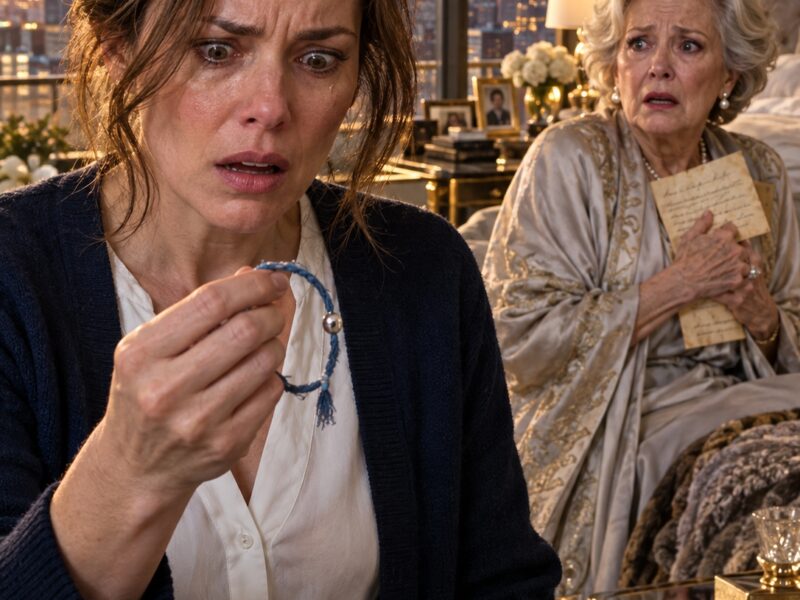
Clara Bennett had been inside Ethan Carter’s penthouse for less than twenty-four hours when she saw the bracelet.
And the color drained from her face.
It was nothing expensive.
No diamonds. No gold clasp. No designer name.
Just three faded strands of blue thread braided around a tiny silver bead, worn soft by decades of being touched.
Margaret Carter held it in her trembling hand as though she had just recovered a piece of her own body.
“I thought this was lost forever,” the seventy-two-year-old woman whispered.
Clara didn’t answer.
She was staring at the bracelet.
Ethan stood outside the half-open bedroom door, unseen by both women, one hand still wrapped around his phone.
He had spent twenty years learning how to read people.
He could tell when investors were bluffing.
He could tell when executives were hiding bad numbers.
He could tell when a hotel owner was desperate enough to sell before the owner admitted it himself.
And right then, he knew Clara was terrified.
Margaret noticed too.
“What is it?”
Clara swallowed.
“My mother had one exactly like that.”
Margaret’s fingers stopped moving.
Outside the door, Ethan felt something cold move through his chest.
The room went silent.
Then Margaret slowly looked toward the old wooden box sitting open beside her.
Inside it lay a faded photograph.
A handwritten letter.
And a secret Ethan Carter had unknowingly lived beside for almost four decades.
But none of them understood that yet.
Twenty-four hours earlier, Clara Bennett had simply been the tenth caregiver Ethan expected his mother to fire.
And by then, he was almost hoping she would.
Because Ethan Carter was exhausted.
At thirty-eight, Ethan had built the kind of life business magazines described with words like visionary, relentless, and extraordinary.
His luxury hotel company, Carter Hospitality Group, had grown from one struggling boutique property in Philadelphia into a national brand with hotels in New York, Chicago, Miami, Boston, Los Angeles, and Seattle.
He owned a penthouse overlooking Manhattan.
His garage held cars he rarely drove.
His kitchen had appliances he couldn’t name.
People waited months for fifteen minutes on his calendar.
But every evening, when the private elevator opened into the quiet marble foyer of his home, Ethan stopped being the man whose decisions affected thousands of employees.
He became Margaret Carter’s son.
And six months earlier, Margaret had fallen.
It happened at 2:13 in the morning.
She had gotten out of bed to close a window during a thunderstorm, lost her balance, and struck the edge of a table before hitting the floor.
The injuries were serious but survivable.
A fractured hip.
A damaged shoulder.
Weeks in rehabilitation.
Months of physical therapy.
The doctors were optimistic about her recovery, but they warned Ethan that Margaret should not spend long periods alone.
His solution seemed obvious.
He would hire the best caregiver money could buy.
Margaret rejected the first woman after two hours.
“She talks about me while I’m sitting right there,” Margaret said.
The second lasted until breakfast.
“She watches the clock more than she watches me.”
The third was a former hospital nurse with twenty-three years of experience.
Margaret refused to let her return after lunch.
The fourth lasted three days.
The fifth lasted four hours.
The sixth cried.
The seventh called Margaret “impossible.”
The eighth quit before Margaret could fire her.
By the ninth, Ethan had doubled the salary.
He offered a private apartment in the building, health insurance, paid vacation, flexible hours, and bonuses larger than some people’s annual income.
The ninth caregiver lasted until 5:40 that afternoon.
Ethan found his mother sitting by the window afterward, staring at Manhattan while evening lights appeared across the skyline.
“Mom.”
Margaret didn’t turn.
“Don’t.”
“I haven’t said anything.”
“You’re about to.”
Ethan loosened his tie.
“Yes. I am.”
She sighed.
He crossed the room and sat opposite her.
“Nine people.”
“Eight and a half.”
“What?”
“The woman yesterday barely stayed through lunch. I don’t think she deserves a full number.”
Despite himself, Ethan almost smiled.
“Mom.”
“There it is.”
“What?”
“That voice.”
“What voice?”
“The CEO voice.”
“I don’t have a CEO voice.”
Margaret finally looked at him.
“You absolutely have a CEO voice. You used it on me when you were sixteen and tried to negotiate your curfew.”
He leaned back.
“Fine. No CEO voice.”
“Thank you.”
“What are you looking for?”
The humor disappeared from her expression.
Ethan waited.
“Seriously,” he said. “Tell me.”
“I’ve hired nurses. Physical therapists. Home health aides. Companions. People with incredible references. One woman cared for a United States senator.”
“And reminded me every seventeen minutes.”
“Mom.”
Margaret looked back toward the window.
When she spoke again, her voice was quieter.
“Someone who sees me before she sees your money.”
Ethan said nothing.
Margaret rubbed her thumb against the edge of the blanket covering her knees.
“They walk through that door and see this apartment. Then they see the paintings. Then the view. Then they see your photograph in some magazine. And suddenly I’m not Margaret anymore.”
She looked at him.
“I’m Ethan Carter’s mother.”
Her words landed harder than he expected.
“I’m the old woman in the billionaire’s penthouse who needs help going to the bathroom.”
“Don’t say that.”
“Why? Because it makes you uncomfortable?”
“Because you’re more than that.”
“I know.”
Margaret’s eyes softened.
“The problem is, I need someone else to know it too.”
That night, Ethan barely slept.
The following morning, his assistant, Rachel, called him at 8:12.
“There’s one applicant left.”
Ethan stared at the ceiling.
“Cancel.”
“She’s already downstairs.”
“Reschedule.”
“She took two trains to get here.”
He closed his eyes.
“Rachel.”
“She’s also the only person who didn’t ask me what the salary was.”
That got his attention.
Twenty minutes later, Ethan walked into the downstairs sitting room and saw Clara Bennett for the first time.
She was forty-two.
At least that was what her application said.
She wore modest charcoal trousers, flat shoes, and a navy cardigan over a white blouse.
Her brown hair was tied loosely behind her head.
Beside her chair sat an old canvas handbag with one repaired strap.
No leather résumé folder.
No designer purse.
No attempt to look impressed.
She stood when Ethan entered.
“Mr. Carter.”
“Ms. Bennett.”
“Clara is fine.”
Ethan remained standing.
He was already late for a meeting.
“This position requires long hours.”
“I understand.”
“My mother has limited mobility.”
“I read the medical summary.”
“She can be difficult.”
Clara smiled slightly.
“People usually become difficult when they feel invisible.”
Ethan looked at her.
It wasn’t what he expected.
“You’ve worked with elderly patients before?”
“Elderly people.”
He raised an eyebrow.
Clara continued.
“I try not to call people patients unless I’m in a hospital.”
“Why?”
“Because needing help shouldn’t become someone’s identity.”
Ethan’s phone vibrated.
He ignored it.
“Your résumé is thin.”
“Yes.”
“You don’t have experience with private clients at this level.”
“No.”
“No celebrity references.”
“No.”
“No wealthy families.”
“Not unless my previous employer was hiding something.”
Ethan almost smiled.
Almost.
Then a voice came from the staircase.
“Send her away.”
Margaret.
She was standing near the upper landing with one hand on the rail.
A small wooden box was tucked awkwardly against her body.
Ethan immediately moved toward her.
“Mom, what are you doing?”
“Standing.”
“You’re not supposed to carry things downstairs.”
“I’m seventy-two, Ethan. Not seven.”
Clara had already noticed the box.
She stepped forward.
“May I help you with that?”
Margaret’s expression hardened.
“I didn’t ask for help.”
Ethan expected Clara to apologize.
Or insist.
Or give Margaret the soft, careful voice every previous caregiver had used.
Instead, Clara stopped.
“You’re right.”
She stepped back.
“But I’ll be here if you change your mind.”
Margaret stared at her.
Five seconds passed.
Then ten.
Ethan watched something strange happen in his mother’s face.
The irritation faded.
Not completely.
But enough.
Margaret shifted the box against her hip.
“Come upstairs.”
Ethan blinked.
Margaret turned.
Clara followed.
“Wait,” Ethan said. “Does that mean—”
His mother looked over her shoulder.
“It means stop talking before I change my mind.”
That was how Clara Bennett became caregiver number ten.
And within hours, she was doing what nine professionals had failed to do.
Nothing extraordinary.
That was precisely the point.
She didn’t hover.
She didn’t ask Margaret every five minutes whether she needed something.
She didn’t rearrange her belongings.
She didn’t call her “sweetheart.”
Instead, Clara sat near the window and noticed an embroidery frame resting on a shelf.
“You made that?”
Margaret glanced over.
“Years ago.”
The faded pattern showed small blue flowers curling around a pale green vine.
“It’s beautiful.”
Margaret looked suspicious.
“You don’t have to flatter me.”
“I’m not.”
Clara pointed toward one flower.
“The tension changes there.”
Margaret’s expression shifted.
“You embroider?”
“My mother did.”
“Did?”
Clara paused.
“She passed away three years ago.”
“I’m sorry.”
“Thank you.”
Margaret touched the frame.
“I haven’t done it in years.”
“Why not?”
“My hands.”
Margaret held them up.
Her fingers were stiff.
“Arthritis. Tremors sometimes. They don’t work the way they used to.”
Clara looked at the unfinished flowers.
“Then perhaps they don’t need to work the way they used to.”
Margaret frowned.
“What does that mean?”
“Maybe they just need someone patient enough to let them work differently.”
That afternoon, Clara found thicker needles.
She adjusted the fabric.
She moved the lamp closer.
Margaret completed three stitches.
Only three.
But when Ethan returned home after seven, he heard laughter upstairs.
He stopped halfway down the hallway.
His mother was laughing.
Not smiling politely.
Not pretending she was fine so he wouldn’t worry.
Laughing.
Ethan stood outside the room and listened.
Clara was telling a story about accidentally putting salt instead of sugar into her mother’s birthday cake when she was twelve.
Margaret laughed until she coughed.
“You fed it to her?”
“She ate an entire slice.”
“Why?”
“She was my mother.”
Clara smiled.
“She loved me more than she loved her taste buds.”
Margaret’s laughter softened.
“So did mine.”
Clara looked at her.
“You don’t talk about your mother much.”
Margaret’s smile disappeared.
“No.”
Ethan noticed the change from the hallway.
Clara noticed it too.
But unlike everyone else, she didn’t push.
She simply returned to the embroidery.
That evening, Ethan found Clara in the kitchen washing a teacup.
“She likes you.”
Clara glanced over.
“She doesn’t know me.”
“She’s fired people for breathing incorrectly.”
“I’ll try to breathe carefully.”
Ethan laughed.
It surprised him.
Clara dried the cup.
“She doesn’t need someone to manage her.”
“She needs medical supervision.”
“She needs that too.”
Ethan heard the distinction.
“Too?”
Clara nodded.
“She’s lonely.”
“She lives with me.”
“That isn’t the same thing.”
The words stung.
Ethan’s expression changed.
Clara noticed.
“I’m sorry.”
“No.”
He looked toward the ceiling.
“You’re probably right.”
His company consumed him.
Flights.
Construction.
Board meetings.
Investors.
Problems in Miami.
A renovation in Chicago.
A lawsuit involving a contractor in Los Angeles.
He had told himself that providing Margaret with everything was the same as being present.
It wasn’t.
“When my father died,” Ethan said quietly, “she worked two jobs.”
Clara listened.
“I was eleven. She cleaned offices at night and worked in a bakery in the morning.”
“She sounds strong.”
“She is.”
“That’s probably why this is hard.”
“What?”
“Needing someone.”
Ethan looked at her.
Clara placed the cup down.
“People who spend their lives taking care of everyone else sometimes experience help as humiliation.”
That sentence stayed with Ethan.
The next morning, Margaret asked Clara to go into the attic storage room.
“There’s a wooden box somewhere.”
“What kind?”
“Cedar. About this big.”
Margaret held her hands apart.
Ethan was preparing to leave for Boston when he heard them discussing it.
“What are you looking for?” he asked.
“None of your business.”
“It’s literally my attic.”
“It was my box before it was your attic.”
Clara hid a smile.
Forty minutes later, she returned carrying a dusty cedar box.
Margaret touched the lid.
For a moment, she didn’t open it.
Then she whispered, “I haven’t seen this since we moved.”
Inside were photographs.
Receipts.
Old Christmas cards.
A baby tooth wrapped in tissue.
Ethan recognized his childhood handwriting on several folded pieces of paper.
MOM I LOVE YOU THIS MUCH.
The word “much” had six H’s.
He laughed.
“I was dramatic.”
“You still are,” Margaret said.
Then she moved several photographs aside.
Her hand stopped.
The bracelet lay beneath them.
Three strands of blue thread.
One silver bead.
Margaret picked it up.
“I thought this was lost forever.”
And Clara turned pale.
“Where did you get this?” Margaret asked.
Clara stared at her.
“My mother had one exactly like it.”
Margaret’s face changed.
“What was your mother’s name?”
Clara hesitated.
“Rose.”
Margaret’s breath caught.
Ethan stepped into the room.
“Rose what?”
Clara turned.
She hadn’t realized he was listening.
“Bennett.”
The bracelet slipped from Margaret’s fingers.
It landed silently on the blanket.
“No,” Margaret whispered.
Clara looked confused.
“What?”
Margaret shook her head.
“No.”
“Mrs. Carter?”
“Leave.”
Ethan stared at her.
“Mom?”
“Tell her to leave.”
Twenty-four hours earlier, Margaret had refused to let Clara go.
Now she was trembling.
“Mom, what is happening?”
“Ethan.”
“Who is Rose Bennett?”
Margaret’s eyes filled with something he had rarely seen there.
Fear.
“Please.”
Clara stood.
“I should go.”
“No.”
Ethan moved between her and the door.
“Not until somebody tells me why my mother looks like she’s seen a ghost.”
Clara’s voice remained calm.
“I don’t know.”
Margaret suddenly grabbed the old letter from the box.
Too quickly.
Ethan saw it.
His mother tried to fold it beneath the blanket.
“Mom.”
“Leave it alone.”
“What is that?”
“Nothing.”
“You’re hiding it.”
“Ethan.”
He stared at her.
Margaret had never lied well.
Not to him.
Not even when he was a child.
He held out his hand.
“Give me the letter.”
“No.”
“Mom.”
“I said no.”
Clara moved toward the door.
Then Margaret said something that stopped her.
“Rose promised me she would never tell you.”
Clara turned.
“My mother?”
Margaret closed her eyes.
And Ethan felt the room tilt.
“Tell her what?”
Nobody answered.
“Tell her what?”
Margaret opened her eyes.
She looked suddenly older.
Not seventy-two.
A hundred.
“Rose and I grew up together.”
Clara stared.
“What?”
“In Pennsylvania. A town called Bellweather.”
“My mother grew up in Bellweather.”
“I know.”
“How?”
Margaret touched the bracelet.
“We made these when we were sixteen.”
Clara slowly sat down.
“There were two?”
Margaret nodded.
“Blue thread from an old sewing basket. The silver beads came from a broken necklace.”
Clara whispered, “My mother kept hers in a jewelry box.”
Margaret’s eyes closed again.
“She kept it?”
“Until she died.”
The room became impossibly quiet.
Ethan looked between them.
“So you knew Clara’s mother.”
Margaret nodded.
“How well?”
“She was my best friend.”
Clara’s eyes filled.
“My mother never mentioned you.”
“She had reasons.”
“What reasons?”
Margaret looked toward Ethan.
That frightened him more than anything else.
“Why are you looking at me?”
Margaret didn’t answer.
Ethan stepped closer.
“What does any of this have to do with me?”
“Ethan…”
“What?”
Her voice cracked.
“There are things parents hide because they are ashamed.”
He stared at her.
“And there are things they hide because telling the truth could destroy the person they love.”
Ethan’s stomach tightened.
“Which one is this?”
Margaret looked at the letter.
“Both.”
Thirty-nine years earlier, Margaret Carter had not been Margaret Carter.
She had been Margaret Hale.
Twenty-three years old.
Poor.
Unmarried.
And pregnant.
Ethan’s father, Thomas Carter, had been twenty-six and working construction.
They loved each other, but love didn’t pay rent.
Margaret cleaned motel rooms.
Thomas worked whenever weather permitted.
Rose Bennett lived two blocks away.
They had been friends since high school.
Rose was bold where Margaret was cautious.
Restless where Margaret was steady.
And when Margaret became pregnant, Rose was the first person she told.
But that wasn’t the secret.
The secret began one winter night.
Margaret was eight months pregnant.
Thomas was working an overnight job.
Rose arrived at Margaret’s apartment crying.
She had bruises on her arm.
Her boyfriend, Raymond Doyle, had been drinking again.
Rose said she was leaving him.
Margaret helped her pack.
For three weeks, Rose slept on their sofa.
Then Margaret went into premature labor.
The delivery nearly killed her.
Ethan was born small but healthy.
Margaret suffered severe complications and remained hospitalized.
Rose became the person holding the family together.
She brought Thomas food.
She sat beside Margaret.
She visited the newborn unit.
Then something happened.
Something Margaret had spent thirty-eight years trying to bury.
“Your father and Rose kissed,” Margaret said.
Ethan stared at her.
Clara went still.
“Once?”
Margaret’s eyes lowered.
“I don’t know.”
“You don’t know?”
“Thomas told me it happened once.”
“Did you believe him?”
“I wanted to.”
Clara looked sick.
“My mother would never—”
“I blamed her.”
Margaret’s voice sharpened with old pain.
“I was twenty-three. I had almost died. My body was broken. My husband was terrified. My best friend was living in my apartment.”
Tears appeared in her eyes.
“I walked in one afternoon and saw them.”
Ethan said nothing.
Margaret wiped her cheek.
“Rose left that night.”
Clara stood.
“No.”
“What?”
“My mother didn’t leave Bellweather then.”
Margaret looked confused.
“She did.”
“No. I have records.”
Clara’s voice trembled.
“I spent the last year sorting her papers after she died. She worked at Bellweather General for almost another year.”
Margaret frowned.
“That’s impossible.”
“It isn’t.”
Clara reached for her handbag.
She pulled out her phone.
“I have photographs.”
She scrolled.
Then stopped.
She turned the screen toward Margaret.
The picture was dated eleven months after the day Margaret believed Rose had disappeared.
Rose stood outside Bellweather General Hospital wearing a housekeeping uniform.
Margaret stared.
“I don’t understand.”
Neither did Ethan.
Clara swiped again.
Another photograph.
Another date.
Then a document.
A pay stub.
Rose Bennett had remained in Bellweather.
Someone had lied to Margaret.
And suddenly the old story changed.
Ethan looked at the letter.
“Open it.”
Margaret didn’t move.
“Mom.”
She handed it to him.
The paper was yellow.
The handwriting faded.
Ethan unfolded it.
Margaret reached for his wrist.
“Wait.”
He looked at her.
“Whatever is inside this letter has already controlled this family for almost forty years.”
He pulled his arm away.
“I think that’s long enough.”
The letter was written by Rose.
Dear Maggie,
If you ever read this, then Thomas finally decided the truth mattered more than protecting himself.
Ethan stopped.
Margaret covered her mouth.
Clara whispered, “Keep reading.”
His eyes returned to the page.
What you saw was real, but what he told you afterward was not.
Ethan’s jaw tightened.
I did not kiss Thomas because I loved him.
He kissed me because he was afraid.
And the reason he was afraid was Ethan.
The air disappeared from the room.
Ethan read the sentence again.
“The reason he was afraid was me?”
Margaret shook her head.
“I never read this.”
“What?”
“I couldn’t.”
“You kept it for almost forty years without reading it?”
“I hated her.”
Margaret was crying now.
“When the letter arrived, I put it away.”
Ethan continued.
Thomas discovered something at the hospital after Ethan was born. Something about the records. He asked me to help him keep it from you. I refused.
Ethan’s pulse hammered.
“What records?”
Margaret whispered, “I don’t know.”
Clara leaned forward.
“Keep going.”
The next lines were harder to read.
Some had been damaged by moisture.
But one sentence remained clear.
Maggie, the baby you took home was yours. But Thomas learned that someone had changed a document connected to Ethan’s birth, and he believed exposing it would destroy your family.
Ethan lowered the letter.
“What document?”
Margaret stared blankly.
Then Clara spoke.
“My mother worked at Bellweather General.”
Everyone looked at her.
“Housekeeping?”
“At first.”
Clara shook her head.
“Later she worked in records.”
Margaret’s face drained.
Ethan looked down again.
There was another paragraph.
Raymond found out what Thomas knew. That is why I stayed in Bellweather. I was trying to get proof before Raymond destroyed it.
“Raymond,” Clara whispered.
“My mother’s boyfriend.”
Margaret nodded.
Ethan continued.
If anything happens to me, look for the name Eleanor Vale.
Margaret gasped.
Ethan looked up.
“You know that name.”
Margaret said nothing.
“Mom.”
She pressed both hands against her face.
“Eleanor was the nurse who delivered you.”
That afternoon, Ethan canceled Boston.
Then Chicago.
Then every meeting for the next two days.
His legal team began searching records from Bellweather General.
The hospital had closed seventeen years earlier.
Many documents had been transferred.
Some destroyed.
Others digitized badly.
Clara sat at the dining table beside Ethan with boxes of her mother’s papers.
Margaret remained upstairs.
She refused lunch.
At 6:30, Ethan finally entered her bedroom.
She was sitting beside the window.
“Why didn’t you read the letter?”
Margaret didn’t look at him.
“Because anger was easier.”
“Than what?”
“Doubt.”
He sat down.
“Did Dad know?”
“I don’t know anymore.”
“You were married to him for thirty-one years.”
“I know.”
“Did you ever ask?”
Margaret laughed bitterly.
“I asked if he loved Rose.”
“And?”
“He said no.”
“That wasn’t my question.”
She finally looked at him.
“No. I never asked about the letter.”
“Why?”
“Because your father spent the rest of his life being good to us.”
“That doesn’t mean he told the truth.”
“I know.”
Ethan looked away.
Thomas Carter had died seven years earlier.
To Ethan, his father had been the safest person in the world.
The man who taught him to drive.
Who stood in freezing rain at football games.
Who mortgaged their small house so Ethan could open his first hotel.
Dead men were difficult to question.
And impossible to forgive properly.
At 9:14 that evening, Ethan’s attorney called.
They had found Eleanor Vale.
Alive.
Eighty-six years old.
Living in a retirement community outside Pittsburgh.
Ethan left the next morning.
Margaret insisted on going.
So did Clara.
The three of them barely spoke during the flight.
Eleanor Vale lived in a small apartment filled with plants and framed photographs.
When she opened the door and saw Margaret, her hand flew to her mouth.
“Margaret Hale.”
Margaret froze.
“You remember me?”
Eleanor looked at Ethan.
Then at Clara.
“Of course I remember you.”
Her voice became quiet.
“I’ve been wondering for nearly forty years whether this day would come.”
Ethan’s patience disappeared.
“What happened the night I was born?”
Eleanor sat down.
Her hands shook.
“Bellweather was a small hospital.”
“I don’t need the history.”
“Ethan,” Margaret warned.
“No. We’ve had thirty-eight years of people deciding what I should and shouldn’t know.”
He looked at Eleanor.
“Tell me.”
Eleanor nodded.
“That night there were two babies born within twenty minutes.”
Ethan’s stomach dropped.
Margaret gripped the chair.
“No.”
“Both boys.”
“No.”
“One was yours.”
Margaret’s voice cracked.
“And the other?”
“Eleanor Vale.”
The old nurse looked ashamed.
“The other baby belonged to a seventeen-year-old girl named Susan Doyle.”
Clara whispered, “Doyle?”
Eleanor nodded.
“Raymond Doyle’s younger sister.”
The room went silent.
Ethan could hear his own heartbeat.
“Were the babies switched?”
Margaret asked.
Eleanor immediately shook her head.
“No.”
Margaret sagged with relief.
“No. Ethan is your biological son. There was never any question about that.”
Ethan exhaled.
“But something else happened.”
Eleanor’s eyes filled with tears.
“Susan’s baby was born with a serious heart defect.”
The baby needed treatment at a larger hospital.
Susan was terrified.
Raymond arrived before sunrise.
He demanded the hospital list Margaret’s insurance information temporarily on the transfer paperwork so the baby could receive immediate treatment.
Margaret stared.
“My insurance?”
“You had coverage through Thomas’s union.”
“And Susan didn’t?”
“No.”
Eleanor lowered her head.
“I did it.”
Margaret looked horrified.
“You changed medical records?”
“I changed a transfer form.”
“Why?”
“Because a baby was dying.”
Nobody spoke.
“The problem,” Eleanor continued, “was that Raymond realized the altered paperwork could be used for something else.”
Ethan leaned forward.
“What?”
“A claim.”
Thomas had discovered the change weeks later when insurance paperwork arrived at their home for medical procedures Ethan had never received.
He confronted the hospital.
Then Raymond.
Raymond threatened him.
If Thomas exposed the fraudulent paperwork, Eleanor would lose her nursing license.
The hospital could face charges.
Susan could be investigated.
And the fragile baby might lose access to ongoing care.
Thomas hesitated.
Rose didn’t.
“She wanted to report everything,” Eleanor said.
Clara’s eyes filled.
“That sounds like my mother.”
“Yes.”
Eleanor smiled sadly.
“Rose was stubborn.”
Margaret looked away.
“So Thomas kissed her?”
Eleanor frowned.
“What?”
“The letter.”
Margaret’s voice trembled.
“I saw them.”
Eleanor stared at her.
Then realization crossed her face.
“Oh, Margaret.”
“What?”
“You didn’t see what you thought you saw.”
Margaret went still.
“Thomas wasn’t kissing Rose.”
Eleanor’s voice softened.
“She was pushing him away.”
Margaret stopped breathing.
“Raymond had threatened Ethan.”
The room seemed to shrink.
“What?”
“He told Thomas that if Rose went to the police, something might happen to his newborn son.”
Ethan felt cold.
“Me.”
Eleanor nodded.
“Thomas panicked. He begged Rose to stop.”
Margaret whispered, “And I walked in.”
“Yes.”
“You knew?”
“I learned later.”
Margaret covered her mouth.
“For thirty-eight years…”
Her voice broke.
“I hated her.”
Clara looked down.
Margaret turned toward her.
“I hated your mother for something she never did.”
Clara’s eyes were wet.
“My mother never hated you.”
“How do you know?”
“Because she kept the bracelet.”
Margaret began to cry.
Not elegantly.
Not quietly.
Her body folded forward beneath the weight of almost four decades.
Clara moved beside her.
Margaret looked up.
“I threw her out.”
Clara said nothing.
“I called her horrible things.”
Still Clara said nothing.
“I told her never to come near my family again.”
Clara’s mouth trembled.
“She probably understood.”
“That makes it worse.”
Margaret grabbed Clara’s hand.
“I’m sorry.”
Clara stared at the woman who had unknowingly carried her mother’s heartbreak for decades.
Then she squeezed Margaret’s fingers.
“My mother used to say something strange.”
“What?”
“She said sometimes people don’t abandon us.”
Clara swallowed.
“Sometimes they leave because staying would hurt us more.”
Margaret sobbed.
Ethan turned toward the window.
But there was still one question.
“What happened to Susan’s baby?”
Eleanor’s face changed.
“He survived.”
“Where is he?”
“I don’t know.”
“You don’t know?”
“The family disappeared.”
“Raymond?”
“Gone.”
“Rose?”
Eleanor looked at Clara.
“She kept investigating.”
Clara stiffened.
“My mother told me she left Bellweather because she wanted a fresh start.”
“That wasn’t the whole reason.”
Eleanor walked slowly toward a cabinet.
She opened a drawer.
Inside was an envelope.
“I received this three months after Rose disappeared.”
Clara stared at it.
“She sent you something?”
“A copy.”
“Of what?”
Eleanor handed the envelope to Ethan.
Inside was a financial statement.
The fraudulent medical claim had not been small.
Raymond Doyle had discovered a system.
He used altered identities and insurance information to submit false claims through several clinics.
What began as a desperate attempt to save one infant became a criminal scheme.
Rose had found evidence.
Thomas had found part of it.
And both had been threatened into silence.
But Rose hadn’t stayed silent forever.
She gave copies to investigators.
Raymond was eventually arrested on unrelated fraud charges under another name.
Margaret stared at the documents.
“Why didn’t Thomas tell me?”
Eleanor’s answer was devastatingly simple.
“Because by then you hated Rose.”
Margaret closed her eyes.
“And he was ashamed.”
Ethan understood.
His father had allowed a misunderstanding to survive because correcting it would require admitting his cowardice.
Thomas Carter had not betrayed Margaret romantically.
He had betrayed her with silence.
Sometimes silence did more damage.
Back in New York, Ethan opened every box his father had left behind.
Three days later, they found the final piece.
It was hidden inside Thomas’s old toolbox.
An envelope addressed to Margaret.
He had never mailed it.
Margaret sat at the dining table while Ethan placed it in front of her.
Her hands shook.
“Read it,” Ethan said.
“I don’t know if I can.”
“You can.”
Clara sat nearby.
Margaret opened the envelope.
Thomas’s handwriting covered four pages.
Maggie,
There is something I should have told you years ago.
Rose never betrayed you.
I did.
Margaret stopped.
Ethan looked away.
She continued.
Not the way you believed.
But perhaps in a way that was worse.
I allowed you to hate someone innocent because I was too ashamed to tell you I had been afraid.
Margaret began crying.
Thomas explained everything.
The threats.
The hospital paperwork.
Raymond.
Rose’s refusal to stay silent.
The afternoon Margaret walked into the apartment.
Thomas had grabbed Rose’s shoulders.
He had begged her not to report Raymond until Ethan was safe.
Rose pushed him away.
Margaret entered at that exact moment.
Thomas could have corrected the misunderstanding.
Instead, fear won.
And then pride.
Then time.
Every year made confession harder.
By the time he wanted to tell Margaret, Rose had disappeared from their lives.
Thomas convinced himself the truth would only reopen old wounds.
He was wrong.
The final paragraph destroyed Margaret.
If you ever find Rose, tell her I was sorry.
And if she refuses to forgive me, tell her I understand.
Margaret lowered the letter.
For a long time, nobody moved.
Then she looked at Clara.
“Did your mother ever talk about Bellweather?”
“Rarely.”
“Did she ever talk about me?”
Clara hesitated.
“Yes.”
Margaret’s eyes widened.
“What did she say?”
“She never gave me your last name.”
Clara looked toward the old embroidery frame.
“She told me about a girl named Maggie.”
Margaret began crying again.
“She said Maggie was the bravest person she knew.”
“No.”
Margaret shook her head.
“No, she shouldn’t have said that.”
“She did.”
“I wasn’t brave.”
Clara leaned closer.
“My mother didn’t remember people by their worst moment.”
Margaret closed her eyes.
That night, Ethan found Clara on the balcony.
The city glittered below them.
“You knew something when you came here.”
Clara didn’t deny it.
“I knew your mother’s first name was Margaret.”
His expression hardened.
“So this wasn’t coincidence.”
“Not completely.”
“Why didn’t you tell us?”
“Because I wasn’t sure.”
Clara looked through the glass doors toward Margaret.
“When I saw the caregiver listing, I recognized your surname.”
“Carter is common.”
“Yes.”
“But?”
“My mother had an old photograph.”
Clara pulled out her phone.
She showed him.
Two young women stood outside a diner.
One was Rose.
The other was unmistakably Margaret.
On the back of the photograph, Rose had written:
Maggie Hale Carter. Summer of 1987. Before everything changed.
Ethan stared at Clara.
“You came here looking for her.”
“I came to see if she was the same Margaret.”
“You lied.”
“I never said I didn’t know her name.”
“You allowed us to believe you were a stranger.”
“Yes.”
His jaw tightened.
“Why?”
Clara’s eyes filled.
“Because my mother died asking me whether I thought Maggie had been happy.”
That silenced him.
“She didn’t ask me to confront your mother.”
Clara continued.
“She didn’t ask me to reveal anything. She just wondered whether Margaret had built a good life.”
“And you wanted to know.”
“Yes.”
Ethan looked through the glass.
His mother was asleep in her chair.
“So why apply as a caregiver?”
“Because when I saw the listing, I thought maybe…”
Clara smiled sadly.
“Maybe life was giving me a strange opportunity.”
“To do what?”
“I didn’t know.”
Ethan studied her.
“Do you now?”
Clara looked at Margaret.
“Maybe to return something my mother carried for too long.”
The following weeks changed the apartment.
Margaret stopped rejecting physical therapy.
Clara restarted the embroidery with her.
Ethan began coming home earlier.
Not every night.
But often.
He moved two weekly meetings out of the evening.
He stopped answering his phone during dinner.
Small things.
But families were rebuilt through small things.
Then one afternoon, Ethan came home and found Margaret standing.
Not independently.
Not perfectly.
She held the edge of a table with one hand and Clara’s arm with the other.
But she was standing.
Ethan froze.
Margaret smiled.
“Don’t make a scene.”
He laughed.
“You’re standing.”
“I’m aware.”
“How long?”
“Fourteen seconds.”
Clara checked her watch.
“Sixteen now.”
Ethan crossed the room.
Margaret looked at him.
And suddenly he saw not the elderly woman he had spent months trying to protect.
He saw the woman who had worked nights when he was a child.
The woman who had worn the same winter coat for nine years so he could have new shoes.
The woman who had believed a terrible lie for almost four decades and somehow remained capable of love.
She sat down.
Breathing hard.
Ethan knelt beside her.
“You okay?”
“I’m tired.”
“We can stop.”
Margaret smiled.
“Tomorrow.”
He nodded.
“Tomorrow.”
But Margaret had one more thing she wanted to do.
She wanted to visit Rose.
Two weeks later, they drove to a cemetery outside Harrisburg.
The day was cold.
Clara carried flowers.
Margaret carried the blue bracelet.
Ethan remained several steps behind them.
When Margaret reached Rose Bennett’s grave, she stood silently.
Then she lowered herself carefully onto the bench.
Clara placed the flowers down.
Margaret touched Rose’s name carved into the stone.
“I was so angry with you,” she whispered.
Clara stepped away.
Margaret continued.
“I thought anger made me strong.”
Wind moved through the trees.
“It didn’t.”
She held up the bracelet.
“It just made me lonely.”
Ethan watched his mother place the bracelet beside the flowers.
Then Clara stopped her.
“No.”
Margaret looked up.
Clara opened her handbag.
She removed another bracelet.
Blue thread.
One silver bead.
Rose’s bracelet.
Margaret stared.
“I thought you should see them together.”
Clara placed Rose’s beside Margaret’s.
For the first time in nearly forty years, the two bracelets touched.
Margaret covered her mouth.
Ethan looked away.
Some moments were too private even for sons.
After several minutes, Margaret stood.
She picked up her bracelet.
But Clara left Rose’s on the grave.
As they walked back toward the car, Margaret stopped.
“Clara.”
“Yes?”
“Your mother raised a good daughter.”
Clara smiled through tears.
“And your son turned out all right.”
Margaret glanced toward Ethan.
“Debatable.”
He laughed.
The sound followed them through the cold afternoon.
Months passed.
Margaret’s strength slowly returned.
She never became the woman she had been before the fall.
That turned out not to matter.
She became someone new.
Someone who accepted help without mistaking it for weakness.
Someone who finished the embroidery she had abandoned years earlier.
She framed it.
Not in the penthouse.
In Ethan’s office.
He complained.
Margaret ignored him.
Clara stayed.
Not because Ethan doubled her salary.
Though he tried.
Not because of the private apartment.
She refused it.
She stayed because somewhere between old letters, physical therapy sessions, unfinished embroidery, and painful truths, the word caregiver stopped describing what she was to Margaret.
One Sunday morning, Ethan walked into the kitchen and found the two women arguing.
“You’re cheating,” Margaret said.
“I’m not cheating.”
“You looked at my cards.”
“I was reaching for tea.”
“With your eyes?”
Ethan leaned against the doorway.
“What are you playing?”
“Gin.”
“Your mother is a criminal,” Clara said.
Margaret gasped.
“My son owns lawyers.”
“That is not the defense you think it is.”
Ethan laughed.
For years, his penthouse had been beautiful.
Expensive.
Perfect.
Quiet.
Now there were embroidery threads on the dining table.
Physical therapy bands beside the sofa.
Clara’s old canvas bag hanging near the kitchen.
Margaret’s cards scattered everywhere.
And laughter traveling through rooms that had once echoed.
It was the most valuable the apartment had ever felt.
One evening, Ethan found Margaret looking at Rose’s old photograph.
“Do you regret it?” he asked.
She didn’t pretend not to understand.
“Every day.”
“That sounds exhausting.”
“It is.”
He sat beside her.
“Clara forgave you.”
“That doesn’t erase it.”
“No.”
Ethan looked at the photograph.
“But maybe forgiveness isn’t erasing something.”
Margaret glanced at him.
“Maybe it’s deciding what happens after it.”
She smiled.
“When did you become wise?”
“I run hotels.”
“That has nothing to do with wisdom.”
“People write articles about me.”
“They also write articles about people who marry their cars.”
Ethan laughed.
Margaret rested her head against the chair.
After a while, she said, “Your father loved us.”
“I know.”
“He was also a coward.”
“I know.”
“Both things can be true.”
Ethan nodded.
That was perhaps the hardest lesson.
People were rarely heroes or villains.
Thomas had been a loving father who made a terrible choice.
Rose had been accused of betrayal while trying to protect them.
Margaret had been wounded and had wounded someone else.
Clara had entered their home under incomplete pretenses but brought truth with her.
And Ethan, who had spent his adult life believing money could solve nearly anything, finally understood the one thing wealth could never purchase.
Time could not be bought back.
Words left unsaid accumulated interest.
Apologies delayed for decades became heavier than grief.
And love, if it was going to matter, had to be practiced while people were still there to receive it.
A year after Clara first entered the penthouse, Margaret walked across the living room without assistance.
Only twelve steps.
Ethan counted every one.
At step nine, her knee shook.
At step ten, Clara moved forward.
Margaret raised a hand.
“Don’t.”
Clara stopped.
Eleven.
Margaret breathed.
Twelve.
She reached the chair.
Ethan was crying.
Margaret stared at him.
“Oh, for heaven’s sake.”
“You walked.”
“I walked twelve feet.”
“You walked.”
“I used to walk miles.”
Clara smiled.
“Today you walked twelve feet.”
Margaret looked at her.
Something passed between them.
Understanding.
History.
Forgiveness.
“Tomorrow,” Margaret said, “thirteen.”
And tomorrow came.
Then another.
Then another.
Years earlier, Margaret had believed that strength meant never needing anyone.
Ethan had believed love meant providing everything.
Thomas had believed silence could protect a family.
Rose had believed truth would eventually find its way home.
Only Rose had been right.
Because truth did come home.
Not dramatically.
Not through detectives or headlines or courtroom doors.
It arrived wearing a navy cardigan.
Carrying an old canvas handbag.
Asking permission before helping an old woman carry a box.
And sometimes Ethan wondered what would have happened if his mother had dismissed caregiver number ten the way she dismissed the other nine.
Perhaps the bracelet would have remained buried.
Perhaps Thomas’s letter would still be inside the toolbox.
Perhaps Margaret would have died believing her best friend betrayed her.
Perhaps Clara would have spent the rest of her life wondering who Maggie Carter really was.
Instead, one quiet decision changed everything.
Come upstairs.
Two words.
That was all.
Years of anger began unraveling because an elderly woman decided to give one stranger five more minutes.
And on Margaret’s seventy-fourth birthday, Clara gave her a small package.
Inside was a new embroidery frame.
The pattern showed two blue flowers growing from different branches.
Their stems twisted together near the bottom.
Margaret stared at it.
“I can’t do something this complicated.”
Clara sat beside her.
“Yes, you can.”
“My hands shake.”
“I know.”
“I’ll make mistakes.”
“Probably.”
Margaret looked offended.
Clara smiled.
“But mistakes are allowed.”
Margaret touched the fabric.
“Since when?”
“Since always.”
For several seconds, Margaret said nothing.
Then she threaded the needle.
Ethan watched from across the room.
His mother’s hand trembled.
The needle missed the fabric once.
Then twice.
Margaret muttered something inappropriate under her breath.
Clara laughed.
On the third attempt, the needle passed through.
A single blue stitch appeared.
Tiny.
Imperfect.
Real.
Margaret smiled.
And Ethan understood something he wished his father had understood decades earlier.
Families were not destroyed because people made mistakes.
Families were destroyed when fear convinced people those mistakes had to remain hidden.
Healing did not arrive when the past became less painful.
It arrived when someone finally became brave enough to touch it.
Margaret pulled the blue thread through the cloth.
Clara steadied the frame without touching her hand.
And beside them, on a small table near the window, sat the old photograph of two young women from Bellweather.
Maggie and Rose.
Both smiling.
Both unaware of everything waiting for them.
Everything they would lose.
Everything they would misunderstand.
Everything time would never give back.
Margaret looked at the photograph.
Then she whispered something so softly Ethan almost didn’t hear it.
“I wish you could see us now, Rose.”
The room remained quiet.
But Margaret smiled anyway.
Then she lowered her eyes and made another stitch.
And another.
And another.
Until two blue flowers slowly began growing toward each other again.
This time, no one was going to tear them apart.









