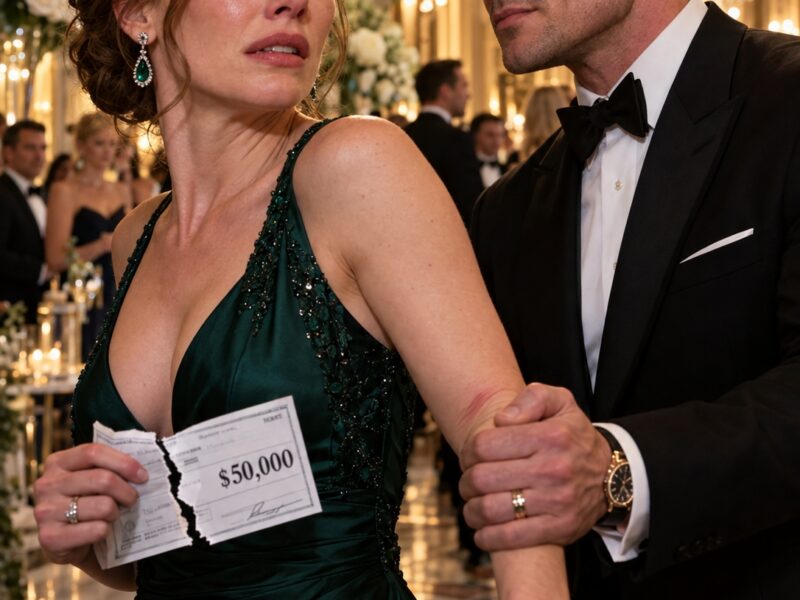
A BILLIONAIRE CEO WAS GRABBED BY A RICH MAN AT HER OWN GALA—THEN A BROKE SINGLE DAD STEPPED IN, NEVER IMAGINING THE $50,000 SECRET THAT WOULD DESTROY HIS LIFE.

“Take your hand off her.”
Merrick Hale didn’t raise his voice.
He didn’t need to.
The five words cut through the polished corridor of Chicago’s Halston Grand Hotel with such quiet certainty that, for one strange second, even the music spilling from the charity ballroom seemed to disappear.
Prescott Vale turned slowly.
His hand was still wrapped around Calla Whitmore’s wrist.
Calla had already told him no.
Twice.
The first time, she had said it politely.
The second time, she had said it with the flat, exhausted tone of a woman who had spent too much of her life discovering that powerful men often heard rejection as the beginning of a negotiation.
Prescott had smiled both times.
Then he had tightened his fingers.
Now he looked past Calla toward the man standing ten feet away and laughed.
Merrick was wearing faded work pants, a navy maintenance shirt and boots dusted from a twelve-hour shift. A contractor badge was clipped crookedly near his chest. In one hand, he carried a heavy tool bag.
He looked like exactly what he was.
A tired working man who had somewhere else to be.
Prescott, meanwhile, looked as though the entire hotel had been designed around him.
Custom tuxedo.
Silver cuff links.
Old-money posture.
The kind of face that had spent forty years being told that inconvenience was something other people experienced.
“Excuse me?” Prescott said.
Merrick set his tool bag gently against the marble wall.
“She asked you to let go.”
“This has nothing to do with you.”
“Maybe not.”
Merrick looked at Calla.
Her face was composed. Almost cold.
But he noticed the details.
The tension beneath her jaw.
The way her free hand had curled into the silk of her dress.
The measured breathing of someone trying very hard not to let fear become visible.
Merrick knew that kind of breathing.
He had seen his late wife use it in hospital rooms.
He had seen his eight-year-old daughter use it on the first day of school after her mother died.
And he knew something else.
A person shouldn’t have to look terrified enough to earn help.
“I heard her,” Merrick said.
Prescott’s smile thinned.
“You have any idea who you’re talking to?”
“No.”
That answer seemed to offend him more than anything else.
Prescott glanced at Merrick’s contractor badge, then at the worn belt around his waist.
“That’s what I thought.”
Merrick didn’t move.
Behind them, two servers had stopped near the ballroom doors.
A security guard was approaching from the opposite end of the corridor.
Another woman had appeared behind Calla—a sharply dressed executive named Lenora Say, though Merrick didn’t know that either.
Everyone was watching now.
Prescott noticed.
Men like Prescott always noticed an audience.
“Walk away,” he said quietly.
Merrick met his eyes.
“And she said let go.”
Something changed in Prescott’s face.
Not shame.
Calculation.
His fingers released Calla’s wrist.
He adjusted his cuff as though he had simply finished shaking someone’s hand.
“You just made a very expensive mistake.”
Merrick bent down, picked up his tool bag and shrugged.
“Wouldn’t be my first.”
Then he turned to Calla.
“Are you all right, ma’am?”
Ma’am.
Not Ms. Whitmore.
Not Chief Executive Officer Whitmore.
Not the woman whose infrastructure company controlled billions of dollars in projects across twelve states.
Not the woman whose foundation had raised almost twelve million dollars in that ballroom before dessert.
Just ma’am.
Calla stared at him.
For most of her adult life, men had recognized her before meeting her.
They knew the magazine covers.
They knew the company valuation.
They knew which senators returned her calls and which banks competed for her business.
Some knew the estimated value of her stock holdings before they knew how she took her coffee.
But this man—
this exhausted stranger with grease near his sleeve—
was looking at her as though none of that existed.
“I am now,” she said.
Merrick nodded.
“Good.”
And he walked away.
Calla blinked.
“Wait.”
He stopped.
“You don’t know who I am?”
Merrick looked over his shoulder.
“No, ma’am.”
“You really don’t?”
“No.”
Something inside her loosened.
It should not have mattered.
Yet somehow it did.
“Then why did you help me?”
Merrick looked once toward Prescott.
Then back at her.
“Because you said no.”
And before Calla could think of another question, he disappeared through the service doors.
For the next hour, she stood beneath chandeliers worth more than Merrick probably made in years and shook hands with donors who believed they had her full attention.
They didn’t.
Her wrist still carried a faint red mark where Prescott had held her.
But that wasn’t what she kept thinking about.
She kept hearing five words.
Because you said no.
No calculation.
No flirtation.
No expectation.
No invoice hidden behind the gesture.
That disturbed her more than Prescott’s hand around her wrist.
Because Calla Whitmore understood men who wanted something.
She had built an entire emotional defense system around them.
She had no idea what to do with one who wanted nothing.
Near midnight, she escaped onto the hotel’s private terrace.
Chicago stretched below her in ribbons of amber and white, the river slicing between towers of glass.
Lenora joined her carrying two coffees.
“You disappeared.”
“I’m twenty feet from the ballroom.”
“For you, that counts.”
Calla took the cup.
Neither woman spoke for a moment.
Then Lenora said, “Merrick Hale.”
Calla turned.
“Who?”
Lenora’s mouth twitched.
“The man you have absolutely not been thinking about for the last hour.”
“I wasn’t thinking about him.”
“Of course.”
Calla stared into her coffee.
“What do you know?”
“Thirty-nine. Building systems technician. Elevators, electrical diagnostics, emergency repairs. Lives in Berwyn. No disciplinary history. No meaningful social media presence.”
Calla frowned.
“You investigated him?”
“I asked hotel operations for his name.”
Lenora took a sip.
“You’re the one who sounds disappointed I stopped there.”
Calla ignored that.
“Did he know who I was?”
“No.”
“You’re sure?”
“The hotel manager said he was called in for an elevator problem three hours before the gala. He had no reason to know.”
Calla looked through the glass doors.
Prescott was already back inside laughing with two investors.
He looked relaxed.
Untouched.
As if nothing had happened.
“He’ll retaliate,” Lenora said.
“Against me?”
Lenora glanced toward the service corridor.
“Maybe not.”
Calla followed her gaze.
A faint uneasiness moved through her.
Then she dismissed it.
Prescott was entitled.
Arrogant.
Vindictive when embarrassed.
But even he wouldn’t destroy a stranger’s life over one moment in a hallway.
At least, that was what she believed.
Three nights later, Merrick sat at his kitchen table staring at a bank balance of $1,418.
His rent was $1,600.
The refrigerator contained half a carton of milk, eggs, mustard, leftover pasta and strawberry jam.
His truck needed brakes.
Juniper’s school science program payment was due Friday.
And an envelope containing an overdue medical bill sat beneath a grocery coupon on the counter.
Merrick rubbed both hands across his face.
Another train thundered past the apartment window.
The glasses inside the cabinet trembled.
From the couch, Juniper stirred beneath a thin blanket.
Her colored pencils were scattered around her.
A drawing rested on her chest.
Merrick walked over and carefully picked it up.
Three tall buildings were connected by sky bridges. Trees covered the roofs. Children played in courtyards. Wheelchair ramps curved beside wide stairs.
Across the top, in uneven handwriting, Juniper had written:
A CITY WHERE NOBODY GETS LEFT OUT.
Merrick smiled despite himself.
“That’s ambitious.”
Juniper’s eyes opened.
“Daddy?”
“Go back to sleep.”
“You’re late.”
“I know.”
“Did the fancy people break something?”
Merrick laughed quietly.
“Fancy people break plenty of things.”
“Did you fix it?”
He thought about Calla.
“Not exactly.”
Juniper pushed herself upright.
“Did you save anyone?”
“Save is a strong word.”
“Did you help someone?”
“Yes.”
“Then you saved them a little.”
Merrick looked at his daughter.
Children had a way of making complicated things embarrassingly simple.
“Maybe a little.”
Juniper noticed the diner bag on the counter.
“Are those fries?”
“You’re supposed to be asleep.”
“That wasn’t my question.”
He handed her three.
While she ate them, his phone lit up.
PAYMENT REMINDER.
Merrick turned it face down.
Juniper saw.
“Are we okay?”
“We’re okay.”
“You always say that.”
“Because it keeps being true.”
Juniper considered this.
“Mom used to say okay and good were different.”
Merrick froze.
His late wife, Hannah, had been gone almost three years, but grief still knew how to walk into a room without knocking.
“Your mom said a lot of smart things.”
“Was she smarter than you?”
“By a dangerous amount.”
Juniper grinned.
Merrick sent her back to bed.
Then he returned to the kitchen and reopened his banking app.
$1,418.
He thought about Prescott’s warning.
You just made a very expensive mistake.
Maybe he should have been afraid.
But fear had already taken enough from Merrick Hale.
He had been afraid while Hannah was sick.
Afraid every time an insurance letter arrived.
Afraid when he had to tell Juniper that her mother wasn’t coming home.
Afraid when funeral bills became past due.
Afraid when one paycheck stood between them and eviction.
Eventually he had learned something.
Fear charged interest.
It collected payment in silence, compromise and regret.
So Merrick turned off his phone.
He had no idea that Prescott Vale had already started calculating exactly how much his integrity would cost him.
Three mornings later, Merrick’s supervisor sent him downtown.
Whitmore Urban Systems had three elevators malfunctioning after a software update.
Their regular technician had failed to isolate the problem.
An hour later, Merrick entered a forty-two-story glass tower beside the Chicago River.
He looked up at the silver letters mounted across the lobby wall.
WHITMORE URBAN SYSTEMS.
The name meant nothing to him.
Not until a familiar voice behind him said:
“You’ve got to be kidding me.”
Merrick turned.
Calla stood twenty feet away in a charcoal suit.
Lenora was beside her, visibly enjoying herself.
Merrick looked at Calla.
Then at the enormous company logo.
Then back at Calla.
“You’re the CEO?”
“That sounds almost accusatory.”
“More surprised.”
“You really didn’t know?”
“I told you I didn’t.”
Lenora murmured, “I believe that officially settles it.”
Calla ignored her.
“And now?”
Merrick looked at the elevator panel.
“Now I know your elevator is broken.”
She waited.
“That’s it?”
“Would you prefer a speech?”
“Most people react.”
“Most people aren’t trying to find a voltage drop.”
Calla laughed.
Not the careful laugh she used at board dinners.
A real one.
Quick.
Unplanned.
Merrick glanced at her.
“Something funny?”
“Apparently.”
He returned to work.
“Give me twenty minutes.”
Calla should have left.
She had meetings.
Legal documents.
Two mayors waiting for calls.
Instead, she stayed.
Merrick traced the fault to a miscalibrated load sensor.
“Your elevator thinks it’s carrying too much weight.”
“Can that happen suddenly?”
“Bad recalibration after a software update.”
“We updated last week.”
“Then somebody trusted the computer more than the machine.”
“You say that like it’s a character flaw.”
“Sometimes it is.”
Calla smiled.
“You always talk like this?”
“Like what?”
“As if every sentence is secretly about something else.”
Merrick closed the panel.
“Sometimes an elevator is just an elevator.”
The doors opened smoothly.
Calla stepped inside.
Before they closed, she stopped them.
“Merrick.”
He looked up.
She had read his name from his badge.
“Why did you help me?”
“We covered this.”
“I know what you said. I’m asking why you got involved when everyone else stayed out of it.”
Merrick rested one hand on his tool bag.
“Because you said no.”
“That’s very simple.”
“It should be.”
“You didn’t know who I was.”
“Would it have mattered?”
“To most people? Yes.”
Merrick nodded.
“Then maybe most people make things too complicated.”
The elevator doors began closing again.
Calla stopped them once more.
“What do you want?”
Merrick frowned.
“From me.”
He looked genuinely confused.
“Nothing.”
That word struck her harder than any declaration she had heard in years.
Nothing.
Men had offered Calla yachts, houses, private flights, partnerships, vacations and futures.
But each gift seemed to arrive carrying invisible paperwork.
Merrick stood there with grease on his sleeve and a battered tool bag at his feet, apparently incapable of understanding why she expected kindness to have a price.
“Your elevator’s good,” he said.
Then he left.
Calla remained inside as the doors closed.
For the first time in years, being called Ms. Whitmore had felt strangely disappointing.
Over the next week, Merrick appeared throughout the building.
Calla began noticing things.
Not dramatic things.
Small ones.
A young analyst spilled coffee outside a board meeting and looked terrified.
Merrick’s first question wasn’t who caused the mess.
It was, “Did you burn your hand?”
When she said no, he grabbed paper towels and helped clean the floor.
“You have a meeting,” the analyst protested.
“And this is my fault.”
“Most messes are somebody’s fault,” Merrick said. “Doesn’t mean they need a public trial.”
Another afternoon, security detained an elderly delivery driver whose paperwork showed the wrong suite.
The guard grew impatient.
Merrick checked the label.
“Suite eighteen hundred moved to twenty-one hundred last month.”
“You sure?” the guard asked.
“I changed the directory panel myself.”
Then Merrick helped the driver move his boxes.
No lecture.
No humiliation.
No need to establish superiority.
Calla had spent twenty years around people who knew how to dominate a room.
Merrick had a rarer talent.
He knew how to make one feel safer.
On Friday evening, she discovered something else about him.
She found him sitting near the lobby windows with an eight-year-old girl.
Juniper.
A sketchbook rested across the child’s knees.
“That building is leaning,” Merrick said.
“It’s artistic perspective.”
“It’s structurally concerning.”
“You fix elevators. I design cities.”
Calla smiled before either noticed her.
Juniper looked up.
“Hi.”
“Hi.”
Merrick turned.
“Ms. Whitmore.”
Juniper’s eyes widened.
“You work here?”
Calla almost laughed.
“Something like that.”
Merrick gave her a warning look.
“Don’t start.”
Juniper held up her drawing.
“Dad says this building would fall over.”
Calla studied it solemnly.
“Your father lacks imagination.”
“Thank you.”
Merrick sighed.
“Great. Now there are two of you.”
Juniper moved her backpack.
“You can sit.”
Calla hesitated.
A driver was waiting outside.
Her inbox contained seventy-three unread emails.
A board packet needed approval before midnight.
She sat.
Juniper offered her a French fry.
“Want one?”
Calla accepted it.
“Best offer I’ve had all day.”
For twenty minutes, a billionaire CEO sat in the lobby of her own company eating fries with a maintenance technician and his daughter.
No one discussed acquisitions.
No one requested access.
No one tried to impress her.
Juniper described her imaginary city where every building had rooftop gardens.
Merrick insisted rooftop gardens still needed drainage systems.
Calla accused him of lacking vision.
Juniper sided with Calla.
It was absurdly ordinary.
That was exactly what made it precious.
When Juniper went to the restroom, Calla looked at Merrick.
“She’s wonderful.”
His entire face softened.
“She’s the best thing that ever happened to me.”
“You’re a good father.”
“I try to be present.”
He shrugged.
“Sometimes that’s the whole job.”
Calla studied him.
“You really don’t want anything from me?”
Merrick smiled faintly.
“You keep asking.”
“Because I keep expecting the answer to change.”
“Why?”
She almost told him everything.
About Graham Mercer, who had pretended to care about her childhood before placing an investment proposal beside dessert.
About the hotel heir who sent two hundred roses and whose father called the next morning asking for access to a municipal contract.
About Prescott.
Instead she said one word.
“Experience.”
Merrick nodded.
“Maybe experience taught you the wrong lesson.”
“What lesson?”
“That kindness always comes with a bill.”
Calla didn’t answer.
She couldn’t.
And neither of them noticed the man standing near the revolving doors.
Prescott Vale had seen everything.
He saw Calla laughing.
He saw Juniper.
He saw the French fries.
Most importantly, he saw peace on Calla’s face.
That was when Prescott understood why Merrick was dangerous.
Not because Merrick had money.
He didn’t.
Not because Merrick had influence.
He had none.
Merrick possessed something Prescott had spent his life trying to manufacture with money, status and control.
He made Calla feel safe.
Two days later, Merrick received a call about prospective contract work.
The meeting was at a private club near the Gold Coast.
Work had been slow.
Slow weeks didn’t care about pride.
Merrick arrived wearing a clean button-down shirt.
Then he saw Prescott waiting in a corner booth.
“You’ve got to be kidding me.”
“Sit.”
“I don’t work for you.”
“No.”
Prescott smiled.
“But you need work.”
Merrick remained standing.
“What do you want?”
Prescott pushed a cream envelope across the table.
Merrick opened it.
Inside was a cashier’s check.
$50,000.
He looked at Prescott.
“For what?”
“Walk away from Calla.”
Merrick laughed once.
“I’m not with Calla.”
“Don’t insult me.”
“I’m not.”
“Men like you always tell themselves the same story. You’re different. You don’t care about money. You only want to help.”
Prescott tapped the check.
“Then reality arrives.”
Merrick pushed the envelope back.
“Reality was here before you.”
Prescott’s expression hardened.
“You have overdue rent.”
Merrick stopped.
“Medical debt.”
Silence.
“A truck that needs brakes. And a daughter in a science program you can barely afford.”
Merrick’s face changed.
Not fear.
Something colder.
“You looked into my daughter?”
“I looked into you.”
“Leave her out of this.”
“Then make this easy.”
Prescott pushed the check toward him again.
“Name your price.”
Merrick looked down.
Fifty thousand dollars.
For a few dangerous seconds, it stopped being a number.
It became rent.
Groceries.
Brakes.
Medical bills.
Juniper’s science program.
A winter coat.
It became sleep.
It became breathing room.
It became the possibility of opening the mailbox without feeling his stomach tighten.
Prescott watched him.
He thought he had won.
Merrick picked up the check.
“Is this what you think she costs?”
Prescott smiled.
“No.”
He leaned closer.
“It’s what you cost.”
Merrick stared at him.
Then he folded the check once.
And tore it in half.
Prescott’s smile disappeared.
Merrick placed both pieces neatly on the table.
“You spent all that money finding out I’m broke and still learned nothing about me.”
“You’re making a mistake.”
“Probably.”
Merrick stood.
“But at least it’s mine.”
He walked out.
Three days later, he lost his job.
His supervisor couldn’t look at him when he placed the termination packet on the desk.
“We lost the Whitmore downtown account.”
“That’s half our commercial work.”
“I know.”
“And I’m the one being cut?”
Silence.
Merrick looked at the paperwork.
“Why me?”
His supervisor finally met his eyes.
“Someone asked for you by name.”
Merrick understood immediately.
Prescott hadn’t been able to buy him.
So he had purchased the consequences instead.
That afternoon, Calla texted him for the first time.
Want to get coffee sometime?
Merrick was sitting inside his truck.
A cardboard box containing his tools occupied the passenger seat.
His termination packet lay beside it.
He typed three answers.
Deleted all three.
Finally:
Busy week. Maybe another time.
Calla replied almost immediately.
Everything okay?
Merrick stared at the screen.
He could tell her.
One call from Calla Whitmore could probably reverse everything.
She could restore the contract.
Find him another job.
Make his financial problems disappear before dinner.
And that was precisely why he couldn’t tell her.
He had defended her because she owed him nothing.
If he went to her now, would that remain true?
Fine. Just work.
He sent the lie.
Then turned the phone over.
That evening, Juniper found him calculating expenses on the back of an envelope.
“Are we okay?”
Merrick looked up.
Same question.
Harder answer.
“We will be.”
Juniper frowned.
“That’s different from yes.”
“You notice too much.”
“Mom said noticing people is a kind of kindness.”
Merrick looked away.
He took a temporary overnight maintenance job in Cicero.
Then another.
He stopped appearing at Whitmore Urban Systems.
And without realizing it, his silence hurt Calla in exactly the place she had spent years trying to protect.
For two days, she told herself he was busy.
On the third, his name disappeared from the contractor schedule.
She texted again.
Coffee offer still stands.
Nothing.
By Friday evening, Calla sat alone at a conference table built for twenty people, pretending to study a parking revenue forecast.
Lenora entered.
“You’ve been staring at the same page for twelve minutes.”
“It’s complicated.”
“It’s parking revenue.”
Calla closed the file.
“What?”
“Why are you angry?”
“I’m not.”
“Disappointed, then.”
Calla looked toward Chicago beyond the windows.
“I thought he was different.”
Lenora sat across from her.
“He defended me. He acted like none of this mattered.”
Calla gestured toward the glass walls.
The skyline.
The empire.
“Then the second things became complicated, he disappeared.”
Lenora studied her.
“What exactly do you think happened?”
“I don’t know. That’s the point.”
“Did you ask?”
“Twice.”
“And because a man didn’t explain his entire life on command, you decided he failed a test he didn’t know he was taking?”
Calla’s eyes sharpened.
“That’s unfair.”
“Maybe.”
Lenora pushed a folder across the table.
“So is this.”
Calla opened it.
Vendor termination notice.
Employment record.
Internal correspondence.
Then one sentence froze her.
REMOVE HALE FROM WHITMORE-ASSOCIATED ACCOUNTS. EFFECTIVE IMMEDIATELY.
Request origin:
VALE CAPITAL RELATIONS.
Calla read it twice.
“Prescott?”
Lenora nodded.
“He pressured one of the investment groups tied to Merrick’s employer.”
Calla’s voice dropped.
“When?”
“Three days after the gala.”
“And Merrick lost his job?”
“Yes.”
Calla looked at her phone.
Busy week.
Maybe another time.
Fine. Just work.
Those messages changed meaning before her eyes.
“He knew.”
“I think so.”
“And he never told me.”
“No.”
Lenora placed something else on the table.
A photocopy of a cashier’s check.
Torn in half.
$50,000.
Calla stared.
“What is this?”
“Prescott tried to pay him to stay away from you.”
Her breath caught.
“Merrick refused?”
“With emphasis.”
For years, men had spent fortunes trying to impress Calla Whitmore.
Merrick Hale had lost his livelihood rather than accept fifty thousand dollars for something that had never belonged to Prescott in the first place.
But the realization didn’t feel romantic.
It hurt.
Because suddenly she understood Merrick’s silence.
“He thought asking me for help would make him like them.”
Lenora was quiet.
“That’s ridiculous.”
“People carry old wounds into new rooms.”
Calla looked at the check.
“So do I.”
The next morning, security called.
“There’s a young visitor asking for you.”
“Who?”
A pause.
“Juniper Hale.”
Calla reached the lobby in less than three minutes.
Juniper stood beside the security desk wearing a purple backpack.
An after-school program director waited nearby.
“My dad doesn’t know I brought this,” Juniper announced.
Calla crouched.
“Then this sounds serious.”
Juniper handed her a folded drawing.
Calla opened it.
It was the city with rooftop gardens.
Three figures stood beneath one of them.
Juniper.
Merrick.
And a woman in dark business clothes with long brown hair.
At the bottom, Juniper had written:
DAD SAYS GOOD PEOPLE DON’T MAKE YOU OWE THEM.
Calla swallowed.
“He said that?”
Juniper nodded.
“He says you help people because it’s right, not because they have to give you something back.”
Then her expression changed.
“But he’s sad lately.”
“Did he tell you why?”
“No. Dad thinks not talking about problems makes them smaller.”
Juniper frowned.
“It doesn’t.”
Despite everything, Calla smiled.
“No. It usually doesn’t.”
Juniper pointed to the third figure.
“I thought you should have the picture.”
“Why?”
“Because Dad smiles more when you’re around.”
The words landed without strategy.
Without protection.
Without adult caution.
Calla looked at the drawing.
Then she understood.
Merrick hadn’t disappeared because he wanted something from her.
He had disappeared because he was terrified she might believe he did.
And in that moment, Calla stopped waiting for him to return.
She decided to step forward herself.
But not yet.
First, she needed the truth.
By Monday, Lenora had collected every email.
Every call log.
Every vendor instruction.
Every pressure point Prescott had used.
By Tuesday, Whitmore’s legal department had confirmed the pattern.
By Wednesday morning, twenty-two executives and investors sat inside the forty-first-floor conference room for the quarterly board meeting.
Prescott Vale was among them.
Calm.
Polished.
Certain.
The final item was a major financing partnership with Vale Capital.
Hundreds of millions of dollars.
Prescott stood.
“Vale Capital is prepared to increase its commitment by another seventy-five million if the infrastructure package is approved today.”
Several directors leaned forward.
Numbers had that effect.
“This partnership,” Prescott continued, “is good for Whitmore, good for investors and good for Chicago.”
Calla folded her hands.
“Anything else?”
Prescott looked directly at her.
“Only that personal distractions should remain outside this room.”
Lenora stopped writing.
Calla’s voice stayed calm.
“Be specific.”
“The maintenance worker.”
Silence.
“Merrick Hale,” Calla said.
Prescott smiled.
“If you insist on using his name.”
“I do.”
“He has financial problems. No meaningful connection to this company. I understand you’ve developed sympathy.”
“Sympathy?”
“Call it whatever you want. But we’re discussing hundreds of millions of dollars.”
He paused.
“He’s nobody.”
The room became very still.
Calla looked at Prescott for several seconds.
Then she reached for the remote.
The screen behind her changed.
A vendor termination notice appeared.
Then Vale Capital correspondence.
Then the copied cashier’s check.
Prescott’s face shifted.
“What is this?”
“Documentation.”
“This isn’t relevant.”
“It is now.”
“You’re misunderstanding a routine business decision.”
“Routine?”
Another slide.
Date.
Time.
Authorization.
“Your office requested that one technician be removed by name.”
Prescott glanced around the table.
“This proves nothing.”
“Then let’s discuss the check.”
A director removed his glasses.
Prescott leaned back.
“You’re really doing this?”
“Yes.”
“For him?”
Calla paused.
“No.”
She looked around the table.
“For the standard this company claims to have.”
Prescott laughed.
“You’re willing to jeopardize a financing agreement over a maintenance worker?”
Calla stood.
“You still don’t understand.”
No one moved.
“Merrick Hale didn’t ask me for money. He didn’t ask for access. He didn’t ask for a job. He didn’t even tell me when your actions cost him his livelihood.”
“That doesn’t make him important.”
Something softened in Calla’s expression.
“It makes him the first man in years who treated me like I mattered before he knew my name.”
No one spoke.
Prescott’s jaw tightened.
Calla continued.
“You saw a poor man and assumed he had a price.”
Her voice remained quiet.
“You saw a woman say no and assumed persistence would eventually become permission.”
Prescott’s face went pale.
“That isn’t partnership.”
Calla looked straight at him.
“That is entitlement wearing a suit.”
“If you cancel this agreement, Whitmore loses money.”
“Yes.”
“A great deal of money.”
“Probably.”
“You cannot be serious.”
“We’ll earn it another way.”
Calla turned toward the board.
“Whitmore Urban Systems is withdrawing from the Vale Capital financing agreement effective immediately.”
The room erupted in murmurs.
Prescott stared at her.
“You’re throwing away hundreds of millions for him.”
Calla shook her head.
“No.”
She closed the folder.
“I’m walking away from a man who believes everyone has a price.”
This time, when silence filled the room, it no longer belonged to Prescott.
It belonged to the truth.
Calla turned toward the doors.
And stopped.
Merrick was standing there.
His work jacket was folded over one arm.
Lenora stood beside him.
Calla looked at Lenora.
Lenora offered the smallest possible smile.
Merrick’s eyes moved from Calla to the screen.
Then toward Prescott.
Then back.
“You didn’t have to do that,” he said.
Calla held his gaze.
“Neither did you.”
For once, Merrick Hale had no answer.
When the meeting ended, board members collected their folders and left.
Prescott remained at the far end of the room.
Alone.
The man who had spent his life believing every door would open eventually discovered that some doors closed because people finally understood who was standing on the other side.
Calla didn’t watch him leave.
She looked at Merrick.
“You heard everything?”
“Enough.”
“Lenora invited you.”
“Apparently she likes surprises.”
Lenora walked past them.
“Only useful ones.”
Then they were alone.
Merrick stared through the windows at Chicago.
“You really walked away from that deal.”
“Yes.”
“Because of what he did to me?”
“No.”
Merrick looked at her.
“Because of what he showed me about himself.”
He considered that.
“There’s a difference.”
“A big one.”
Merrick lowered his eyes.
“You still didn’t have to defend me.”
Calla stepped closer.
“Neither did you.”
He smiled faintly.
“We keep saying that.”
“Maybe we should stop keeping score.”
Merrick laughed.
A small laugh.
But it changed the room.
He didn’t ask for his old contract.
He didn’t request compensation.
And Calla didn’t offer him a check.
She finally understood something Merrick had known instinctively.
Even generosity could become control if it created a debt the other person never asked to owe.
So she asked something simpler.
“Are you working Sunday?”
“Temporary shift tomorrow. Probably not Sunday.”
“Good.”
Merrick narrowed his eyes.
“Why?”
“I’d like to bring dinner.”
“To where?”
“Your place.”
“That’s ambitious.”
“I manage infrastructure systems in twelve states.”
“My apartment is more complicated.”
“I’ll take my chances.”
Sunday evening, someone knocked on Merrick’s door shortly after six.
Juniper reached it first.
Calla stood in the hallway wearing jeans and a cream sweater.
No driver.
No executive armor.
No diamonds.
She held a pizza box in one hand and a bakery bag in the other.
Juniper stared at the bag.
“You brought dessert?”
“I was told this was a serious household.”
Juniper stepped aside immediately.
“You can come in.”
Merrick appeared from the kitchen.
“You actually came.”
Calla lifted the pizza.
“I said I would.”
“Most people say a lot of things.”
Her expression softened.
“I know.”
They ate at the tiny kitchen table.
The refrigerator hummed.
A train rattled the windows.
Juniper described improvements to her imaginary city.
Calla listened as if the child were presenting a billion-dollar development proposal.
Merrick watched the two of them argue over whether every apartment building needed a library.
For the first time in months, the overdue notices on his counter seemed less powerful than the laughter in the room.
Later, Juniper fell asleep on the couch.
Calla helped Merrick clear the table.
“I owe you an apology.”
“For what?”
“I thought you disappeared because you were like everyone else.”
Merrick placed two cups near the sink.
“I disappeared because I didn’t want to become like everyone else.”
“I know that now.”
He leaned against the counter.
“I was wrong too.”
Calla waited.
“I thought accepting help meant owing somebody.”
“Sometimes it does.”
“And sometimes?”
Calla looked toward Juniper.
“Sometimes it means trusting them.”
A train passed outside.
Neither spoke until the sound faded.
Merrick poured coffee into two mismatched mugs.
Calla wrapped both hands around hers.
“I spent years wondering what men wanted from me.”
Merrick looked into his coffee.
“You were the first one who never asked.”
He hesitated.
“I want something.”
Calla raised an eyebrow.
“There it is.”
“Another cup of coffee.”
She smiled.
“That’s all?”
“And maybe dinner next Sunday.”
Calla’s smile came slowly.
Not like the practiced smile from magazine covers.
Not the smile she used when negotiating.
It looked more like a door opening.
“Coffee first.”
Merrick raised his mug.
“Coffee first.”
There was no limousine downstairs.
No photographer captured the moment.
No investors applauded.
Nobody in Chicago knew that one of the city’s most powerful women was sitting in a small Berwyn apartment drinking coffee from a chipped mug with an unemployed maintenance technician.
And for once, Calla didn’t care who knew.
Juniper shifted on the couch.
Her hand rested over the drawing of three people beneath a rooftop garden.
Calla looked at it.
For most of her life, she had believed power meant never needing anyone.
Merrick had believed dignity meant never asking anyone for help.
Prescott had believed money meant everyone could eventually be owned.
All three of them had been wrong in different ways.
Power wasn’t refusing to need people.
Dignity wasn’t carrying every burden alone.
And kindness wasn’t weakness simply because it expected nothing in return.
Merrick switched off the kitchen light.
The city outside kept moving.
Trains passed.
Bills remained unpaid.
Prescott’s retaliation had not magically disappeared.
Calla still had a company to protect after walking away from a massive financing agreement.
Nothing had become perfect.
That mattered.
Because this wasn’t a fairy tale where love erased debt, grief, class or consequence.
Hannah was still gone.
Juniper would still wake some mornings missing her mother.
Merrick would still have to find stable work.
Calla would still enter rooms where people measured her worth in dollars before listening to her voice.
There would still be arguments.
Pride.
Fear.
Misunderstandings.
There would be days when Merrick wondered whether he belonged in Calla’s world.
There would be nights when Calla wondered whether Merrick could ever trust her enough to let her stand beside him without believing he owed her something.
But that Sunday evening, none of those questions required an answer.
Calla stayed.
Not because Merrick needed saving.
Not because she owed him.
Not because he had earned some romantic reward for doing the decent thing in a hotel corridor.
She stayed because, for the first time in years, being beside someone didn’t feel like a transaction.
Merrick poured the last of the coffee.
Outside, another train approached.
Its distant rumble grew louder.
Calla glanced toward sleeping Juniper.
Then toward the drawing.
“A city where nobody gets left out,” she whispered.
Merrick followed her gaze.
“She’s been working on that for months.”
“Maybe she’s onto something.”
“She’s eight.”
“That has never stopped her from being right.”
Merrick smiled.
“No. It hasn’t.”
The train passed.
The windows trembled.
On the couch, Juniper slept through it.
Calla didn’t.
She listened until the sound disappeared into the Chicago night.
Then she looked around the tiny apartment again.
The worn cabinets.
The stack of bills.
The secondhand furniture.
The child’s drawings taped to the refrigerator.
There was nothing impressive about the room by the standards she had spent her adult life surrounded by.
No marble.
No private elevator.
No skyline view.
No imported art.
And yet she could breathe there.
That realization frightened her a little.
Because Calla Whitmore had built an empire by learning how to leave rooms before anyone could trap her inside them.
But sometimes the hardest thing wasn’t walking away.
Sometimes it was recognizing the rare place where you wanted to stay.
Merrick picked up her empty mug.
“More?”
Calla looked at the clock.
It was late.
Her phone contained unread messages.
Her Monday schedule would begin before sunrise.
Her driver had texted twice.
She should have said no.
Instead, she pushed the mug toward him.
“One more.”
Merrick poured.
And somewhere beneath the soft kitchen light, beside a stack of overdue bills and a child’s impossible drawing, the woman everyone had spent years chasing finally stopped running.
Not because someone caught her.
Because someone had given her room to choose.
And the man who had lost almost everything rather than put a price on his character finally allowed another person to sit beside him while the weight was still there.
No promises were made.
No grand declaration followed.
There was only coffee.
A sleeping child.
A train fading into the distance.
And two people who had spent years believing they had to protect themselves alone, sitting at the same small table long after dinner was over.
Sometimes a second chance does not arrive with applause.
Sometimes it doesn’t arrive in a penthouse, a boardroom or beneath crystal chandeliers.
Sometimes it arrives carrying pizza.
Sometimes it sits beneath a humming refrigerator light.
Sometimes it asks for nothing except another cup of coffee.
And sometimes, if you are very lucky, it simply asks whether there is still room at the table.









