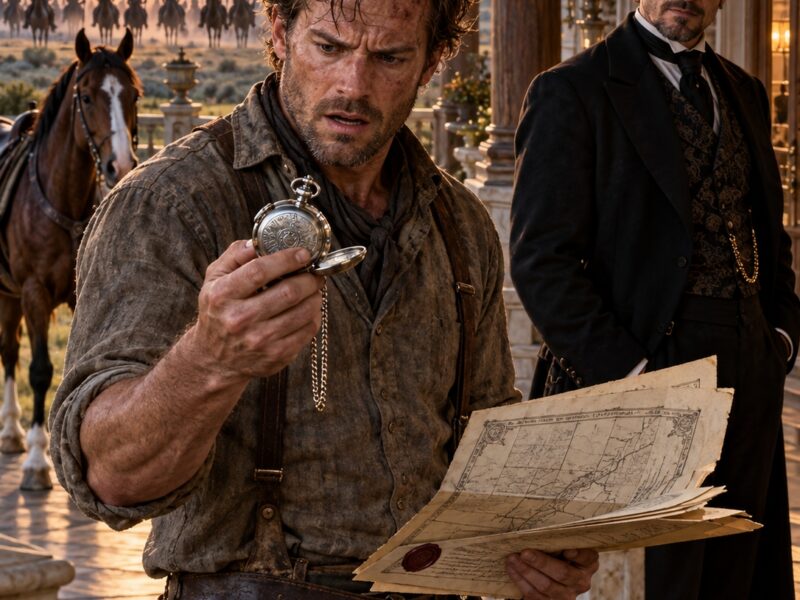
A BROKE RANCHER GAVE HIS LAST HORSE TO TWO APACHE GIRLS—AT DAWN, 30 WARRIORS SURROUNDED HIS HOME… BUT WHAT THEY BROUGHT MADE HIM DROP TO HIS KNEES
The first thing Daniel Mercer noticed was that thirty armed men had surrounded his farmhouse.
The second was that none of them appeared interested in killing him.
Somehow, that frightened him even more.
It was barely dawn on the Kansas frontier. A thin gray light stretched across the dead grass, and a cold wind slipped through the gaps in the porch boards beneath Daniel’s bare feet.
Thirty Apache horsemen stood in a silent semicircle beyond his broken fence.
Thirty.
Daniel had counted twice.
Rifles rested across saddles. Leather reins creaked beneath gloved hands. The horses breathed little clouds into the morning air.
And in the middle of that terrible silence stood a tall man with silver threading through his black hair.
He had introduced himself only as the father of the two girls Daniel had helped the previous evening.
Tala and Nita.
The children who had arrived at his gate with bleeding feet.
The children to whom Daniel had given Clover, his last horse.
The man had already returned the mare.
But now he was reaching beneath his coat.
Daniel watched his hand disappear into the folds of dark cloth.
He had no rifle within reach. Even if he had, there would have been no point. His shotgun was inside the house, unloaded, hanging above the fireplace where his father had placed it twenty years earlier.
Besides, Daniel had spent the night thinking about whether he had enough flour to last until Thursday.
He certainly hadn’t expected to die before breakfast.
The Apache leader withdrew a small object wrapped in weathered cloth.
He held it out.
Daniel hesitated before accepting it.
Inside was a silver watch.
An old watch.
Its case was badly scratched, and a familiar dent marked the lower edge.
Daniel’s fingers went numb.
He knew that dent.
He had put it there himself when he was thirteen, after dropping the watch against a stone water trough.
For nearly twenty years, he had believed the watch was gone.
And for nearly twenty years, he had believed the man who owned it had died hating him.
“Where did you get this?” Daniel whispered.
The warrior studied his face.
“You know it?”
Daniel turned the watch over.
Three letters had been engraved on the back.
E. M.
Elias Mercer.
His father.
Daniel’s knees weakened.
“My father’s watch.”
The warrior nodded slowly.
“Your father gave this to my father.”
Daniel stared at him.
“That’s impossible.”
“Why?”
“Because my father never told me he knew your people.”
The man’s expression changed.
It was not surprise.
It was something closer to sorrow.
“Then there are many things your father never told you.”
Daniel looked down at the watch again.
Behind the warrior, the other horsemen began moving aside.
Something large waited beyond them, hidden beneath a canvas covering.
The leader raised his hand.
“Bring it forward.”
Two men stepped toward the covered wagon.
Daniel heard the scrape of wooden wheels.
He could see the outline of heavy crates beneath the canvas.
He could also see something else.
A familiar iron emblem fixed to the wagon’s side.
A crossed spur and a broken wheel.
Daniel had seen that emblem only three days earlier.
It belonged to the men who had threatened to take his ranch.
And suddenly he understood that the two frightened girls had not stumbled onto his property by chance.
Someone had been looking for something.
Someone dangerous.
And whatever was hidden beneath that canvas had brought the trouble straight to his door.
Twenty-four hours earlier, Daniel Mercer had been trying to repair a fence with a nail that was already bent.
That was what poverty had reduced his life to.
Not hunger, although he knew hunger well.
Not loneliness, although the silence of his farmhouse sometimes felt like another person sitting beside him.
It was the careful straightening of bent nails.
The saving of string.
The watering down of coffee.
The habit of looking at every broken thing and asking whether it could survive one more season.
At thirty-eight, Daniel had the shoulders of a working man and the face of somebody who had spent too many years waiting for bad news.
His hair, once dark brown, carried premature gray near his temples.
The skin around his eyes had deepened into permanent creases.
His boots leaked.
His winter coat had been patched at both elbows.
And beneath his bed, inside a rusted coffee tin, sat seventeen dollars and forty cents.
That was the entire Mercer fortune.
There had been a time when the word fortune would have made Daniel laugh.
His father, Elias, had owned a modest but productive ranch in southern Kansas, within a long day’s ride of the Oklahoma border.
In good years, their cattle grazed on thick grass. Wildflowers spread across the lower pasture every spring, and the creek carried enough water to turn its stones smooth.
Elias had never been wealthy.
But he had never been ashamed of what he owned.
“This land doesn’t owe us a living,” he used to tell Daniel. “We have to take care of it before we expect it to take care of us.”
Daniel remembered those words every time he looked at the dry creek bed.
Three years of drought had destroyed almost everything his father built.
First, the creek disappeared.
Then the southern pasture turned brown.
Then the cattle began losing weight.
Daniel sold twelve head to buy feed for the rest. He sold another nine to repair the well. When the price of beef collapsed at the nearest trading station, he sold what remained for barely enough to pay the interest on his debts.
The bank took the western acreage in February.
Two months later, a dust storm peeled half the shingles from his barn.
In June, the last milk cow died beside the watering trough.
Daniel buried her himself.
He no longer expected a miracle.
He would have settled for rain.
The only creature on the property that seemed unaware of their financial ruin was Clover.
The bay mare had four white socks, bright brown eyes, and a habit of pushing her nose into Daniel’s coat whenever she suspected there might be an apple hidden inside.
He had raised her from a foal.
His father had helped him train her.
Daniel could still remember the old man’s laughter the first time Clover threw him into the mud.
“She’ll respect you when you give her a reason,” Elias had said.
“She nearly broke my neck.”
“Then she’s teaching you faster than I ever could.”
Now Clover was thirteen, patient and strong, with a stubbornness Daniel privately considered an excellent quality in a horse.
She hauled fencing supplies.
She carried water barrels from the distant spring.
She took Daniel into town when he needed flour, nails, lamp oil, or the humiliation of asking for credit.
When he talked to her, she listened.
At least she never interrupted.
That afternoon, Daniel had spent nearly three hours repairing a section of fence along the north pasture.
His hammer had a cracked handle.
His nails were salvaged.
The fence itself was barely worth saving.
Still, he worked.
Because stopping would mean admitting there was nothing left to work for.
Around four o’clock, he noticed the dust.
At first, he thought a pair of coyotes had crossed the distant trail.
Then he saw two small figures approaching on foot.
Children.
Daniel straightened.
No wagon followed them.
No adult appeared over the rise.
The girls moved slowly, one supporting the other, their silhouettes trembling in the heat rising from the ground.
He laid down his hammer.
By the time they reached his gate, he could see how exhausted they were.
The older girl looked about eleven. Her long black hair was divided into two dusty braids, and she wore a faded blue dress with a torn hem.
Her sister was smaller, perhaps nine, with enormous dark eyes and a face drawn tight against pain.
Both wore worn moccasins.
The younger child’s left foot had begun bleeding through the leather.
Daniel felt something tighten beneath his ribs.
“Evening,” he said carefully.
The older girl stopped.
Her hand tightened around her sister’s.
“Evening.”
“You girls lost?”
She shook her head.
“No.”
Daniel looked beyond them.
Nothing moved on the empty trail.
“Where are your folks?”
The older girl glanced toward the western horizon before answering.
“We go home.”
“Where’s home?”
“Past the canyon.”
Daniel knew the country she meant.
The canyon lay beyond the dry flats, where scattered settlements gave way to rougher ground and narrow passages through the rock.
He frowned.
“That’s a long walk.”
“We know.”
“How long have you been walking?”
The girl hesitated.
“Since yesterday.”
Daniel looked at her sister.
The little one’s lips were cracked.
Her face was pale beneath the dust.
“Good Lord.”
He opened the gate.
“Come inside. I’ve got water.”
The older child did not move.
Daniel stopped.
He knew enough about frightened animals and frightened people not to reach for either without permission.
He stepped back.
“All right. I’ll bring it out.”
He walked to the porch and returned with a tin cup and a jug of cool water.
The younger girl watched him pour with desperate attention.
“Here.”
She reached for the cup, but her sister caught her wrist.
“Wait.”
Daniel understood.
He took a drink first.
Then offered it again.
The older girl allowed her sister to accept it.
The child drank so quickly that Daniel gently lowered the cup.
“Easy. There’s more.”
The younger girl nodded without speaking.
When both children had drunk, Daniel crouched a few feet away.
“What’s your name?”
“Tala.”
“And hers?”
“Nita.”
“Daniel Mercer.”
Tala repeated the name quietly, as if trying to remember it.
Daniel looked at Nita’s foot.
“Your sister needs that cleaned.”
“We must go.”
“Not with her bleeding like that.”
“We must.”
There was something in Tala’s voice that made Daniel stop arguing.
Not childish stubbornness.
Fear.
The kind of fear that had already learned what could happen when adults didn’t listen.
“Is somebody after you?” he asked.
Tala lowered her eyes.
Nita pressed closer to her.
Daniel waited.
Finally, Tala spoke.
“Men came.”
“What men?”
“Traders.”
“Where?”
“Near the creek crossing.”
Daniel’s stomach tightened.
There were several trading parties operating along the southern routes that season. Some were honest. Others were opportunists who bought goods cheaply from desperate families and sold them at extraordinary prices.
And a few were worse.
“Did they hurt you?”
Tala shook her head.
Then, after a moment, she said, “They tried to take us.”
Daniel went still.
“Take you where?”
“We do not know.”
Nita began to cry silently.
Tala put an arm around her.
“Our father told us to run if men came. We ran when they were fighting.”
“Fighting who?”
Tala looked toward the horizon again.
“Our people.”
Daniel stared at the distant trail.
He suddenly understood why the older child had been so frightened by his questions.
To these girls, a stranger with a ranch and a horse might have been another danger.
He softened his voice.
“You’re safe here.”
Tala looked at him.
“Can we have a horse?”
Daniel blinked.
“A horse?”
“Please.”
He glanced toward the corral.
Clover stood beneath a cottonwood tree, lazily flicking flies from her flanks.
Daniel almost laughed.
Not because the request was funny.
Because it was impossible.
“Sweetheart, that’s my only horse.”
Tala said nothing.
“She’s how I work this place.”
The girl nodded.
He could see her forcing herself not to plead.
“All right,” she whispered.
She took Nita’s hand.
“We walk.”
Daniel watched them turn.
Nita managed three painful steps before her injured foot buckled.
Tala caught her.
“Come.”
The younger girl tried to move.
She couldn’t.
Daniel felt the old, familiar ache of helplessness rise inside him.
He knew what it meant to be one bad day away from losing everything.
But the two children in front of him were one bad hour away from something worse.
“Hold on.”
Tala stopped.
Daniel looked at Clover.
Then at the girls.
Then back at Clover.
His father had bought the mare’s mother after a particularly good harvest. Daniel had helped deliver Clover in the old barn, kneeling in fresh straw while Elias held the lantern.
For thirteen years, she had been part of his life.
After his father died, Clover had become something more.
She was the last living connection to better days.
But Nita was trembling now.
And Tala was trying not to let him see how frightened she was.
Daniel walked toward the corral.
“Do you know how to ride?”
Tala’s head lifted.
“Yes.”
“Both of you?”
She nodded quickly.
Daniel opened the gate.
Clover approached him, ears forward.
He stroked her neck.
“Well, old girl.”
The mare nudged his shoulder.
He closed his eyes.
“I guess we’ve got ourselves a decision to make.”
He fetched the saddle from the barn.
Every movement felt strangely final.
The old leather creaked in his hands.
He brushed dust from Clover’s back.
Checked the blanket.
Tightened the cinch.
He inspected the hooves that he had cleaned a thousand times.
Then he went inside for the last of his dried meat and nearly half a loaf of bread.
He wrapped the food in a clean cloth, filled his canteen, and brought everything back to the gate.
Tala stared at him.
“You give us horse?”
Daniel swallowed.
“Looks that way.”
“For money?”
He shook his head.
“We have none.”
“I figured.”
“We bring back.”
Daniel glanced at the rapidly sinking sun.
“Just get home. We’ll worry about everything else later.”
Nita touched Clover’s nose.
The mare lowered her head.
The little girl smiled.
It was the first smile Daniel had seen on either child’s face.
He nearly lost his resolve right there.
Instead, he lifted Nita gently into the saddle.
She winced when her injured foot moved.
“Sorry, sweetheart.”
“It’s okay.”
Tala climbed up behind her sister and gathered the reins.
Daniel handed her the canteen.
“Water first. Eat when you stop.”
She nodded.
“If you reach a place where you feel safe, let someone look at that foot.”
Another nod.
“Don’t push Clover too hard. She’ll carry you, but she’s not young anymore.”
Tala leaned forward and stroked the mare’s mane.
“We care for her.”
Daniel looked into the girl’s eyes.
For a moment, she seemed much older than eleven.
He stepped back.
“Then go on.”
Tala didn’t move immediately.
“Daniel Mercer?”
“Yes?”
“Why?”
He frowned.
“Why what?”
“Why give us your horse?”
Daniel looked at the barren pastures.
At the broken fence.
At his collapsing barn.
He thought about his father.
About all the times Elias had stopped to help a stranded traveler, even when doing so meant coming home late.
“Because somebody ought to,” Daniel said.
Tala studied him for several seconds.
Then she reached into her dress and touched something hanging beneath the collar.
Daniel saw the brief glint of a small carved pendant.
“Father says good things must be remembered,” she whispered.
Daniel managed a tired smile.
“Then remember to hold on tight.”
He stepped aside.
Clover walked through the gate.
Nita turned in the saddle and raised one small hand.
Daniel waved back.
He kept waving long after the child had turned away.
Then he stood beside the empty corral until the three figures disappeared into the evening.
The ranch had always been quiet.
But that night, the silence became something different.
Something heavy.
Something that seemed to settle over the entire property.
Daniel closed the corral gate out of habit.
Then he looked at the empty enclosure and almost laughed.
There was no reason to close it anymore.
He walked into the farmhouse.
The kitchen smelled faintly of dust, cold coffee, and the beans he had eaten for three days.
A white envelope waited on the table.
It had arrived from the bank that morning.
He had avoided opening it.
Now he sat down and broke the seal.
The notice was short.
The Mercer property was in default.
Unless the outstanding amount was paid by the following Friday, the bank would initiate foreclosure proceedings on the remaining acreage.
Daniel read the letter twice.
Then he folded it neatly and placed it beside his plate.
Friday.
Seven days.
He had seventeen dollars and forty cents.
And no horse.
He leaned back.
For a long moment, he simply stared at the ceiling.
Then he began laughing.
It wasn’t a happy sound.
It was the quiet, helpless laughter of a man who had finally reached the bottom and discovered there was still farther to fall.
“Well, Dad,” he murmured, “I hope you would’ve done the same.”
The empty kitchen offered no answer.
Daniel carried his chair outside and sat beneath the stars.
He remembered his father’s last winter.
Elias had been sick for weeks, coughing until he could barely stand.
Daniel had been twenty.
He had wanted to sell part of the ranch to pay for a doctor from Wichita.
His father refused.
“You don’t sell your roots to buy a few more days,” Elias had said.
Daniel had been furious.
They argued.
Their last proper conversation ended with Daniel storming out of the room.
Three days later, Elias died.
Daniel had spent eighteen years wishing he could have one more conversation with him.
Not to ask about the land.
Not about money.
Just to apologize.
That night, sitting in the empty corral’s shadow, he wondered what Elias would have said about giving away Clover.
He hoped his father would have understood.
But hope had become an expensive habit.
Daniel fell asleep before midnight.
And just before dawn, the hoofbeats began.
The sound entered his dreams as distant thunder.
For one wonderful second, Daniel believed it was rain.
He opened his eyes.
Then he heard the horses.
He sat upright.
A cloud of dust rolled across the eastern pasture, glowing faintly in the first light.
One rider appeared through it.
Then another.
Then ten.
Fifteen.
Twenty.
Daniel stood.
Thirty mounted men approached his property in a broad formation.
They stopped beyond the fence, their horses restless in the cool morning air.
Daniel recognized their clothing and the distinct equipment carried by some of the riders.
Apache horsemen.
His stomach tightened.
He had heard conflicting stories about Apache communities throughout his life—some told by traders, some by soldiers, and others by men who had never traveled farther than the county line.
Most of those stories were really about fear.
Standing alone before thirty armed strangers, Daniel felt plenty of his own.
But he also remembered Tala’s face.
And Nita’s bleeding foot.
His first thought was not for himself.
It was for the girls.
Had they been found?
Had something happened on the trail?
He stepped off the porch.
“I’m not armed,” he called.
The riders stopped.
A tall man at the center dismounted.
He had strong shoulders, silver strands in his black hair, and a face marked by years of sun and responsibility.
A rifle remained secured to his saddle.
He approached on foot.
Daniel held his ground.
The man stopped several paces away.
“You gave away your horse.”
Daniel swallowed.
“Yes.”
“To two girls.”
Daniel’s heart began pounding.
“Tala and Nita?”
The man’s eyes narrowed.
“My daughters.”
For one terrible instant, Daniel couldn’t breathe.
Then he asked the only question that mattered.
“Are they alive?”
The man’s expression changed.
“Yes.”
Daniel exhaled so sharply that he nearly stumbled.
“They made it?”
“They came home.”
“Both?”
“Both.”
Daniel shut his eyes.
“Thank God.”
When he looked up again, the warrior was watching him closely.
“You worried for them?”
“Of course.”
“You did not know them.”
“They were children.”
The man looked toward the empty corral.
“They told me you gave them your horse.”
“Yes.”
“Your only horse.”
Daniel hesitated.
“Yes.”
“Why?”
Daniel glanced at the man’s face.
There was no accusation in the question.
Only something he couldn’t quite identify.
“They couldn’t keep walking,” Daniel said. “The little one’s foot was bleeding. Your older daughter was doing everything she could to help her, but they weren’t going to make it another day on foot.”
The warrior remained silent.
Daniel rubbed his hands together.
“I didn’t know what else to do.”
The man looked toward the riders.
Then he raised his hand.
Another horseman came forward, leading a bay mare.
Four white socks.
A white mark near her shoulder.
Clover.
Daniel stepped forward before he could stop himself.
“Clover?”
The mare’s ears shot up.
She answered with a loud nicker and tugged against the lead rope.
Daniel laughed, and the sound broke unexpectedly in his throat.
“Well, look at you.”
He hurried toward her.
Clover pushed her nose into his chest.
Daniel buried his face against her neck.
For several seconds, he forgot the thirty men watching him.
He forgot the debt.
The drought.
The bank.
He was simply a tired rancher holding the animal he had believed he would never see again.
Then the leader spoke.
“My name is Chato.”
Daniel turned.
“Thank you for bringing her back.”
Chato inclined his head.
“My daughters would not sleep until they knew she would return.”
Daniel smiled.
“They’re good girls.”
“They told me about the bread.”
Daniel shrugged.
“It wasn’t much.”
“They told me about the water.”
“Anybody would’ve done that.”
Chato shook his head.
“No.”
The word was quiet.
Certain.
“They would not.”
Daniel didn’t know how to answer.
Chato stepped closer.
“My daughters were taken from our camp during an attack on a supply party. Men separated them from the others. They escaped while those men argued.”
Daniel felt sick.
“Are they safe now?”
“They are with their mother.”
“Good.”
“But the men who took them are still out there.”
The morning suddenly felt colder.
Daniel glanced toward the distant road.
Chato noticed.
“You know something?”
Daniel hesitated.
“Maybe.”
Chato waited.
Daniel looked toward the farmhouse.
“Three days ago, some traders came by. Two wagons, maybe six men. They were asking about the north trail.”
“Who led them?”
“A man named Silas Crowe.”
At the mention of the name, Chato’s jaw tightened.
Daniel noticed.
“You know him?”
“Yes.”
“Then we may be talking about the same people.”
Chato reached beneath his outer garment and produced the cloth-wrapped watch.
Daniel unfolded it.
And the world shifted beneath his feet.
His father’s initials.
His father’s dented silver watch.
A memory he had buried for almost two decades.
He looked at Chato.
“Where did you get this?”
“My father kept it.”
Daniel stared.
“Your father?”
“His name was Nahil.”
Daniel knew the name.
Not well.
Only as something his own father had once muttered in his sleep during a winter fever.
Nahil.
A name Daniel had dismissed as meaningless.
Chato studied his expression.
“Elias Mercer helped my father many years ago.”
Daniel looked down at the watch.
“He never told me.”
“There are things men carry quietly.”
Daniel turned the watch in his hand.
“Why give it to me now?”
“Because my father told me something before he died.”
“What?”
Chato looked toward the covered wagon.
“That a debt of honor can sleep for a generation, but it does not disappear.”
He called to his men.
They moved apart.
The wagon rolled forward.
Daniel recognized the crossed-spur emblem.
His chest tightened.
“That belongs to Silas Crowe.”
“It did,” Chato answered.
Two men pulled back the canvas.
Daniel expected weapons.
Or stolen blankets.
Or perhaps the girls’ belongings.
Instead, he saw wooden crates filled with tools, sacks of grain, iron fencing wire, and barrels of supplies.
Beside them were carefully bundled documents.
And beneath a second canvas lay an object that made Daniel forget how to breathe.
A heavy brass-and-iron water pump.
New.
Uninstalled.
The exact model he had spent two years trying to afford.
Daniel stared.
“I don’t understand.”
Chato climbed onto the wagon.
He picked up a leather folder and stepped down again.
“These were in Crowe’s possession.”
Daniel took the folder.
Inside were contracts.
Receipts.
Land deeds.
And several pages bearing his father’s name.
Daniel’s hands began trembling.
He turned one page.
Then another.
His eyes stopped on a signature.
Elias Mercer.
And beneath it, written in careful black ink, was a sentence that made the old wound in Daniel’s heart open all over again.
The northern spring and the passage beyond it shall remain open to Nahil’s family and their descendants, for as long as the Mercer family holds this land.
Daniel looked up.
“My father made an agreement with your family?”
Chato nodded.
“Yes.”
Daniel looked toward the north pasture.
The land the bank had taken.
The land that Crowe had tried to buy.
And for the first time, he wondered whether his ranch had been failing because of drought alone.
Chato did not ask to enter the house.
He waited at the gate while Daniel studied the papers.
The other riders remained mounted, speaking quietly among themselves.
One had a bandage around his arm.
Another wore a torn sleeve.
These men had clearly traveled through trouble.
Daniel set the folder on the fence rail.
“I don’t know what any of this means.”
Chato glanced toward the dry pasture.
“Then we should begin with the spring.”
Daniel frowned.
“The north spring?”
“Yes.”
“It’s been running dry for almost two years.”
“Have you seen its source?”
Daniel hesitated.
“The source is beyond the ridge. The bank took that section.”
“Before that?”
Daniel looked away.
“I haven’t been up there in a long time.”
Chato nodded slowly.
“My father knew that spring. He knew the channels beneath the limestone. Before these fences were here, our people traveled through that country.”
Daniel listened.
He knew the ridge contained old springs and passages used long before his family arrived. His father had spoken of them occasionally, never with much detail.
“Why would Crowe have these papers?”
“Because he has been buying land around the spring.”
Daniel felt the blood leave his face.
“He’s a trader.”
“He trades many things.”
“Livestock. Feed. Equipment.”
“And promises.”
Chato’s voice hardened.
“He offered our people passage in exchange for goods. Then he demanded payment to cross land he did not own.”
Daniel stared at him.
“That doesn’t make sense.”
“It makes sense to a man who believes nobody will stop him.”
Chato gestured toward the folder.
“The papers show what he wants.”
Daniel turned back to the documents.
There were survey maps.
Notices of default.
Mortgage transfers.
One map showed the Mercer property divided into sections marked with red ink.
The northern spring was circled.
So was the old canyon route.
Daniel recognized the handwriting in the margins.
Silas Crowe.
He had seen the same handwriting on a receipt for fencing supplies.
“Where did you find these?”
“One of Crowe’s men abandoned the wagon during the fighting.”
“Fighting?”
Chato’s expression darkened.
“After my daughters escaped, we went looking for the men who took them. We found their camp near the crossing. They fired when we approached.”
Daniel looked toward the wounded rider.
“Did anybody die?”
“One of our men was killed. Two were hurt. The traders fled before dawn.”
Daniel lowered his eyes.
“I’m sorry.”
Chato did not answer immediately.
Then he said, “His name was Tomas.”
Daniel glanced up.
“He had a wife?”
“And a son.”
Daniel felt the weight of the words.
Chato stepped closer to the fence.
“That is why I need to know everything about Crowe.”
Daniel considered the question.
He knew very little about the man.
At least, that was what he had believed.
Crowe had first appeared in the county eighteen months earlier, shortly after several ranches began struggling.
He had a small trading company, two wagons, and a talent for making expensive promises sound generous.
When Daniel needed feed, Crowe offered it on credit.
When the well broke, Crowe knew a man who could repair it.
When the bank threatened foreclosure, Crowe had offered to purchase the northern pasture.
Daniel refused.
Then the bank took it anyway.
Two weeks later, Crowe appeared with a new proposal.
Sell the remaining ranch.
Walk away with enough money to begin again somewhere else.
Daniel refused again.
Crowe laughed.
“Sentiment doesn’t grow grass, Mercer.”
Daniel remembered those words now.
And something else.
Crowe had never seemed particularly interested in his cattle.
He had asked about the spring.
Again and again.
“How deep does it run?”
“Does it freeze in winter?”
“Who uses the canyon passage?”
At the time, Daniel assumed the questions were ordinary.
Now they felt like pieces of a puzzle he should have recognized sooner.
“He wanted the water,” Daniel whispered.
Chato nodded.
“And the trail.”
Daniel looked at the red circles on the map.
Crowe had been buying land along a route used by Apache families moving between settlements and traditional gathering places.
If he controlled the springs, he could make crossing the country difficult for anyone who would not pay him.
But there was another question.
“Why take your daughters?”
Chato’s expression became severe.
“To force my cooperation.”
Daniel stared.
“Crowe approached me weeks ago,” Chato continued. “He wanted me to sign an agreement giving him exclusive control over trade at the crossing.”
“And you refused?”
“Yes.”
“So he took the girls?”
“He tried.”
Daniel looked toward the open prairie.
He imagined Tala holding her sister’s hand.
The two of them running barefoot through darkness.
Hiding from men who saw them as bargaining pieces.
His stomach turned.
Chato studied him.
“Your kindness helped them escape the last part of the journey. But Crowe will not stop because his plan failed.”
Daniel closed the folder.
“Then somebody needs to bring him to the sheriff.”
Chato’s expression remained guarded.
“You trust your sheriff?”
Daniel opened his mouth.
Then closed it.
Sheriff Walter Briggs had been elected three years earlier.
He was a large man with a polished badge, a booming voice, and an impressive ability to arrive after trouble had ended.
Daniel knew he drank with Crowe.
He knew Crowe had contributed money to his election campaign.
And he knew that when three small ranchers accused Crowe of cheating them, Briggs dismissed the complaints as business disputes.
Daniel rubbed his forehead.
“This is bigger than a stolen horse.”
Chato’s eyes sharpened.
“Yes.”
“Why come here?”
The Apache leader looked toward Clover.
“Because my daughters said you helped them when you had nothing to gain.”
Daniel shook his head.
“I don’t have the money or influence to fight Crowe.”
“That is not what I came to ask.”
“What, then?”
Chato reached for a second folded paper.
It was older than the contracts.
The edges had yellowed.
He handed it to Daniel.
“Read.”
Daniel unfolded the page.
The handwriting was his father’s.
He would have recognized it anywhere.
To Nahil and his family,
If there comes a day when my son needs a friend, I hope you will remember what we promised each other. I have never believed that land makes one man greater than another. What matters is how we behave when somebody places their trust in our hands.
You once carried me home when I could not walk. I once opened my door when your children needed shelter. Neither act belongs in a ledger.
But if the world ever tries to make strangers of our families, let this letter remind us that we have already been neighbors.
Elias Mercer.
Daniel’s vision blurred.
He reread the final sentence.
Then he pressed the letter to his chest.
“My father wrote this?”
Chato nodded.
“To my father.”
Daniel struggled to speak.
“He never…”
His voice broke.
“He never told me.”
Chato waited.
Daniel stared across the dry pasture.
“My father died thinking I was angry with him.”
The confession escaped before he could stop it.
He looked embarrassed.
“I’m sorry. That doesn’t concern you.”
Chato shook his head.
“It concerns anyone who has lost a father.”
Daniel lowered his eyes.
For a long moment, neither man spoke.
Then Chato placed a hand against the fence rail.
“My father told me that Elias Mercer was a good man. But he also said good men sometimes fail to tell their sons the things that matter.”
Daniel laughed painfully.
“That sounds like him.”
Chato looked toward the house.
“Now I see that his son learned some of those things anyway.”
Daniel wiped his eyes with the back of his hand.
He had not cried when the cattle were sold.
He had not cried when the bank seized the north pasture.
He had barely cried at his father’s funeral.
But holding that letter, he felt eighteen years of unfinished grief rise inside him.
And he couldn’t stop it.
The men did not arrive with gold.
They arrived with work.
That was the first thing Daniel understood when Chato introduced him to the others.
A younger man named Victor knew how to repair pumps.
An older rider named Ben worked with timber.
Two brothers were experienced horsemen and fence builders.
Another man had brought a wagon of grain purchased from a settlement farther south.
They did not claim that the crates taken from Crowe belonged to Daniel.
Chato was careful about that.
The wagon and its contents would need to be accounted for, along with the papers and other evidence.
But the supplies carried on the Apache horses were different.
They had been gathered by families who heard what Daniel had done.
There were sacks of dried corn.
Beans.
Blankets.
Leather straps.
A small box of nails.
Even a bundle of fresh bread wrapped in cloth.
Daniel stared at it all.
“I can’t take this.”
Chato looked mildly amused.
“You gave away a horse.”
“That was different.”
“Why?”
“Because your girls needed help.”
“And you do not?”
Daniel opened his mouth.
Nothing came out.
Chato gestured toward the barn.
“That roof needs work.”
Daniel looked away.
“Yes.”
“The south fence is falling.”
“Yes.”
“Your well is weak.”
“Yes.”
“Then we begin.”
The leader turned and spoke to his men.
Several dismounted.
One brought a wooden toolbox toward the barn.
Another walked toward the well.
A third began unloading sacks near the kitchen.
Daniel stood helplessly beside the gate.
“Wait. Hold on.”
Chato turned.
“What is wrong?”
“I haven’t agreed to any of this.”
“You disagree with repairing your barn?”
“No.”
“Your fence?”
“No.”
“Then?”
Daniel stared at the men moving efficiently around his ruined property.
He was overwhelmed by the sudden intrusion of help after years of carrying every burden alone.
“I don’t know how to repay you.”
Chato’s face softened.
“My daughters asked you the same question.”
Daniel remembered Tala.
Why you help us?
He lowered his head.
“Because somebody ought to.”
Chato nodded.
“Yes.”
For the first time that morning, he smiled.
A small smile.
But genuine.
Daniel looked around.
One man was already climbing a ladder.
Another had opened the well housing.
And several horses stood quietly near Clover’s corral.
The sound of hammers began echoing across the ranch.
It was a sound Daniel hadn’t heard from anyone but himself in years.
Something inside him loosened.
He turned toward Chato.
“At least let me make breakfast.”
Chato glanced at the farmhouse.
“For thirty men?”
Daniel gave a helpless laugh.
“I suppose I can make coffee.”
“We brought food.”
“Then I’ll make the coffee.”
Chato considered this.
“That seems fair.”
By midmorning, the Mercer ranch looked less like an abandoned property and more like a place where people intended to stay alive.
Men worked on the barn roof.
Others carried posts from the wagon and began reinforcing the southern fence.
Victor dismantled the water pump, carefully arranging its worn components on a clean cloth.
Daniel watched, fascinated and uneasy.
He had replaced the leather seals twice.
He had cleaned the intake.
He had checked the pipe for obvious breaks.
But Victor found something Daniel had overlooked.
A narrow piece of metal had been wedged deep inside the mechanism.
He held it up.
“Did you put this here?”
Daniel frowned.
“No.”
Victor turned the piece in his fingers.
It was thin, deliberately bent, and lodged in a place where vibration would gradually interfere with the pump’s operation.
Daniel stared.
“How did that get there?”
Victor looked at Chato.
The leader had approached silently.
“Could it have happened by accident?” Daniel asked.
Victor shook his head.
“Not easily.”
Daniel felt cold.
His well had begun failing shortly after Crowe’s repairman visited.
The man had charged six dollars and insisted that the pump would need replacing within the year.
Daniel remembered arguing about the price.
He remembered Crowe offering to lend him the money.
And he remembered refusing.
“Someone did that on purpose,” Daniel whispered.
Victor placed the metal in his palm.
“Someone wanted your pump to fail.”
Daniel closed his fingers around it.
The sun was rising higher, but suddenly he felt as though he were standing in winter.
Chato watched him.
“You know who?”
Daniel shook his head.
“Not for certain.”
“That is important.”
Daniel looked at him.
“Why?”
“Because anger tells us where to look. It does not tell us what we can prove.”
Daniel stared at the small piece of metal.
His father had taught him to repair that pump when he was sixteen.
For twenty-two years, Daniel had believed that if something broke, he simply hadn’t worked hard enough to prevent it.
Now he wondered how many of his failures had been arranged by someone else.
And that frightened him almost as much as the armed men at dawn.
Around noon, a young rider returned from the road.
He spoke urgently to Chato.
Daniel noticed the leader’s expression change.
“What is it?”
Chato turned.
“Someone is coming.”
“Who?”
The rider pointed toward town.
Daniel climbed onto the fence.
In the distance, a wagon approached with three mounted men beside it.
He recognized the lead horse.
Then the broad-brimmed black hat.
Silas Crowe.
Daniel’s stomach dropped.
Beside Crowe rode Sheriff Walter Briggs.
And neither man looked pleased to see thirty Apache riders working on the Mercer ranch.
Silas Crowe was the kind of man who never raised his voice unless he was certain nobody could punish him for it.
He wore expensive boots, a dark coat, and a silver watch chain stretched across his waistcoat.
His beard was neatly trimmed.
His eyes were pale and small.
When he smiled, his mouth moved more than the rest of his face.
He stopped at the gate and looked over the property.
Then he laughed.
“Well, I’ll be damned.”
Daniel walked toward him.
“Morning, Silas.”
“Quite a gathering you’ve got here.”
Sheriff Briggs shifted in his saddle.
His eyes moved from Chato to the men repairing the barn.
“What is all this, Mercer?”
“Friends helping me with repairs.”
Crowe laughed again.
“Friends?”
He looked toward Chato.
“That’s an interesting word.”
Daniel stiffened.
“They’re guests on my property.”
Crowe dismounted.
“Your property?”
He reached into his coat and withdrew a folded paper.
“That’s exactly why we’re here.”
Daniel recognized the bank seal.
“The deadline is Friday.”
Crowe smiled.
“Was Friday.”
“What?”
“The bank transferred the outstanding debt to my company.”
Daniel stared at him.
“Since when?”
“Yesterday afternoon.”
“Nobody told me.”
“I’m telling you now.”
Crowe handed him the notice.
Daniel read the first lines.
The debt had been assigned.
The full outstanding balance was due.
Crowe was demanding immediate possession unless Daniel could provide payment or obtain relief through the court.
“That’s not how this works,” Daniel said.
Crowe’s smile narrowed.
“You’re welcome to argue with the bank.”
Sheriff Briggs cleared his throat.
“Let’s keep this civil.”
Daniel looked at him.
“You knew about this?”
Briggs avoided his eyes.
“It’s a financial matter.”
“You came out here with him.”
“To prevent trouble.”
Daniel glanced toward Chato.
The Apache leader stood several feet away, silent and watchful.
Crowe followed the glance.
“Speaking of trouble, Sheriff, I believe we’re looking at a group of men who recently interfered with lawful business at the canyon crossing.”
Chato stepped forward.
“Your men took my daughters.”
Crowe’s expression did not change.
“I don’t know what you’re talking about.”
“Tala and Nita.”
“Never heard of them.”
Daniel felt anger rise.
“They were here yesterday.”
Crowe looked at him.
“Who was?”
“Two girls. They told me what happened.”
Crowe shrugged.
“Children tell stories.”
Chato’s jaw tightened.
For one terrible instant, Daniel thought violence would erupt.
But Chato remained calm.
He studied Crowe.
“My daughters are home,” he said. “That is what matters first.”
Crowe smiled.
“Glad to hear it.”
Then his eyes shifted toward the wagon.
The one bearing his company’s emblem.
His smile vanished.
“Where did you get that?”
Chato did not answer immediately.
Crowe walked toward it.
“That’s my wagon.”
Daniel moved between them.
“There’s paperwork inside.”
Crowe stopped.
“What paperwork?”
“Land records. Contracts. Surveys.”
Crowe’s expression hardened.
“Private business records.”
“Some with my father’s signature.”
Crowe looked at Daniel sharply.
“Those belong to my company.”
“Then you’ll have no problem explaining them in court.”
For the first time since Daniel had known him, Crowe appeared genuinely surprised.
Then he laughed.
“Daniel.”
His voice softened.
The way it always did before he offered a deal designed to hurt somebody.
“You’re making a mistake.”
“Maybe.”
“You’ve got seventeen dollars to your name, a dying ranch, and a crowd of people who’ll be gone by sundown.”
Daniel’s face went hot.
Crowe stepped closer.
“Take my offer.”
“What offer?”
“Two hundred dollars.”
Daniel stared.
“For what?”
“The remaining property. I’ll clear the debt and give you two hundred in cash.”
Two hundred dollars.
More money than Daniel had seen at once in years.
Enough to buy a wagon.
Enough to leave Kansas.
Enough to rent a small farm somewhere with rain.
For one dangerous moment, the idea tempted him.
Crowe saw it.
“Smart man,” he murmured.
Then his gaze moved to Chato.
“And your visitors can move on before anyone gets hurt.”
Daniel looked toward Clover.
She stood quietly beside the corral, chewing hay someone had brought that morning.
The empty place in his heart where hope used to live had begun to fill again.
Not because of money.
Because men who owed him nothing were repairing his home.
Because two children were safe.
Because his father’s handwriting had returned to him after eighteen years.
He looked back at Crowe.
“No.”
Crowe blinked.
“Excuse me?”
“I’m not selling.”
The trader’s smile disappeared.
Daniel held up the notice.
“And I’m taking this to a lawyer.”
Briggs shifted uncomfortably.
“Mercer, you might want to reconsider.”
Daniel turned toward him.
“Are you here as sheriff or as Crowe’s witness?”
The question landed harder than Daniel expected.
Briggs’s face reddened.
“I’m here to maintain order.”
“Then maintain it.”
The sheriff stared.
For years, Daniel had lowered his eyes when men like Briggs spoke.
He had apologized for being poor.
For owing money.
For needing extensions.
He had mistaken exhaustion for weakness.
But something had changed.
Not because thirty men stood behind him.
Because for the first time, he had something worth defending that was larger than his own pride.
Crowe folded his papers.
“Fine.”
He mounted his horse.
“You have until tomorrow evening.”
Daniel shook his head.
“The notice says Friday.”
Crowe smiled coldly.
“Then I suppose we’ll see what a judge says.”
He turned his horse.
But before leaving, he looked back at Chato.
“Stay away from the crossing.”
Chato met his eyes.
“The water belongs to no one man.”
Crowe’s face darkened.
“You’re going to regret making this your business.”
Chato said nothing.
Crowe rode away.
Sheriff Briggs followed.
Daniel watched them disappear.
Then he looked down at the notice in his hand.
His fingers were shaking.
He had just challenged the most influential trader in the county.
And he had no idea how he intended to survive the consequences.
That evening, the barn roof no longer leaked.
The south fence stood straight.
And fresh water flowed from the repaired pump with a sound that made Daniel want to weep.
He caught a handful and drank.
Cold.
Clean.
Beautiful.
He laughed.
Victor watched him with quiet satisfaction.
“Better?”
Daniel splashed water over his face.
“Better than whiskey.”
A few of the men laughed.
For several hours, the ranch had been filled with the ordinary, comforting noise of work.
But as sunset approached, Daniel noticed that Chato kept looking toward the road.
He finally asked why.
“Crowe will not stop,” Chato answered.
“I know.”
“He believes fear will make you surrender.”
Daniel leaned against the well.
“He’s not entirely wrong.”
Chato looked at him.
Daniel stared at his boots.
“I’m afraid.”
The confession surprised him.
He had spent years pretending he wasn’t.
Afraid of losing the ranch.
Afraid of becoming homeless.
Afraid of being remembered as the Mercer who had failed.
He looked up.
“I’m afraid every day.”
Chato considered that.
“Then you know something important.”
“What?”
“Courage is not the absence of fear.”
Daniel gave a tired smile.
“My father used to say something like that.”
“Wise men often discover the same truths.”
They stood in silence.
Then Daniel asked, “What really happened between our fathers?”
Chato looked toward the north ridge.
For a long moment, Daniel wondered whether he would answer.
Finally, Chato sat on an overturned barrel.
“My father was younger than I am now when he met Elias Mercer.”
Daniel sat opposite him.
“It was a winter journey,” Chato continued. “My father had been traveling with family members through the region. A sudden storm trapped several people near the canyon.”
Daniel listened.
“Your father found them.”
“He found their fire.”
Chato smiled faintly.
“Elias was searching for a stray animal. He saw smoke among the rocks. My father had injured his leg. The others could not easily move him.”
“What did Dad do?”
“He went back to his ranch. He returned with a wagon and blankets.”
Daniel pictured Elias in his younger years.
Broad-shouldered.
Stubborn.
Capable of riding into a snowstorm because somebody might need help.
“He brought them here?”
“For a short time.”
Daniel frowned.
“I never knew.”
“You were very young.”
“Then what?”
“My father recovered. Months later, Elias was injured when his horse fell near the canyon. Nahil found him and carried him to safety.”
Daniel looked toward the farmhouse.
A memory surfaced.
His father limping through one winter.
A scar on his left leg.
Elias had said a horse kicked him.
“He never told me somebody saved him.”
Chato nodded.
“Some memories are difficult to explain in a world that demands we choose enemies.”
Daniel understood.
His father had lived among settlers who regarded Apache people with suspicion and sometimes open hostility.
And Apache families had plenty of reasons to distrust the institutions and armed men advancing across their lands.
Friendship across that divide could invite questions Elias had not wanted to answer.
Chato continued.
“They promised to help each other when they could. My father kept the watch as a reminder.”
Daniel looked down at the silver case.
“Why didn’t he return it?”
“Your father told him to keep it until there was a reason to give it back.”
“And that reason was yesterday?”
Chato shook his head.
“The reason began before yesterday.”
Daniel frowned.
Chato looked directly at him.
“My daughters recognized your family name.”
Daniel stared.
“What?”
“Tala remembered a story her grandfather told her. A rancher named Mercer. A man who opened his door during a winter storm.”
Daniel felt a strange pressure in his chest.
“Then why didn’t she tell me?”
“Because she was frightened. Because she did not know whether you were the same kind of man.”
Daniel lowered his eyes.
Chato continued quietly.
“She found out.”
The words settled between them.
Daniel had spent years believing he was a disappointment to his father.
Yet somewhere beyond the canyon, children he had never met had grown up hearing stories about the Mercers.
Stories of kindness.
Stories that had survived longer than cattle or fences.
And yesterday, without knowing it, Daniel had continued one of them.
He looked at the watch.
“Does Tala know you brought this?”
“Yes.”
“And Nita?”
“She helped wrap it.”
Daniel smiled through sudden tears.
He held the watch carefully.
For the first time in eighteen years, the memory of his father did not hurt quite so sharply.
The next morning, Daniel rode Clover into town.
Chato went with him.
So did Victor, who carried the damaged pump component, and another man who knew the circumstances of the attack at the crossing.
They left the others working on the ranch.
Daniel had never felt so conspicuous.
The town of Red Bluff consisted of one main street, a bank, a general store, a livery stable, two saloons, a church, and several wooden buildings that leaned as if tired of standing.
By the time Daniel reached the courthouse, people were already staring.
A rancher arriving with Apache companions was unusual enough.
A rancher arriving with documents accusing Silas Crowe of fraud was something else entirely.
Inside the courthouse, Daniel asked to see the county clerk.
The clerk, Mr. Hensley, was a thin man with spectacles and ink-stained fingers.
He listened impatiently as Daniel explained the situation.
Then Daniel showed him the mortgage assignment.
Hensley adjusted his spectacles.
“Hmm.”
He turned a page.
Then another.
His expression changed.
“Where did you get this?”
“From Silas Crowe’s wagon.”
Hensley looked up sharply.
“Does Mr. Crowe know you have it?”
“Yes.”
“That’s unfortunate.”
Daniel frowned.
“Why?”
The clerk removed his spectacles.
“Because this document appears to contain an altered survey reference.”
Daniel leaned forward.
“What does that mean?”
“The parcel description doesn’t match the original county record.”
Daniel stared.
Hensley retrieved a heavy ledger from the shelf.
He opened it.
Ran one finger down a page.
Then stopped.
“Here.”
Daniel looked.
The original mortgage listed the western acreage as collateral.
Not the north spring.
Not the canyon passage.
But the newer document claimed that both had been included.
Daniel felt his pulse quicken.
“Could that be a mistake?”
Hensley hesitated.
“Possibly.”
Victor placed the metal fragment on the desk.
“And could this be a mistake?”
The clerk looked confused.
Daniel explained the pump.
The repairman.
The timing.
The increasingly desperate offers to buy the ranch.
Hensley listened.
Then he leaned back.
“I suggest you speak to an attorney.”
“Can you recommend one?”
The clerk hesitated again.
“Miss Margaret Whitcomb.”
Daniel knew the name.
A widow in her forties, Margaret Whitcomb had studied law in the East before settling in Kansas. She worked mostly on property disputes and inheritance matters.
She was also famous for arguing with men who assumed a woman ought to remain quiet.
Daniel had once heard Sheriff Briggs call her “a nuisance in a respectable dress.”
That suddenly seemed like an excellent recommendation.
“Where can I find her?”
“Two doors past the post office.”
Daniel gathered his papers.
“Thank you.”
As they turned to leave, Hensley called after him.
“Mr. Mercer?”
Daniel stopped.
“Yes?”
The clerk looked at the old survey.
“Be careful.”
Daniel frowned.
“Of what?”
Hensley glanced toward the window.
“Men who change one boundary on paper are often willing to change more than that.”
Margaret Whitcomb’s office smelled of paper, coffee, and tobacco smoke drifting in from the street.
She had dark hair pinned neatly behind her head and the calm expression of a woman who had learned to let other people finish making fools of themselves.
Daniel placed the folder on her desk.
He expected her to laugh him out of the room when he explained that he had seventeen dollars.
Instead, she examined the documents.
Quietly.
Thoroughly.
For nearly an hour, she said very little.
Then she set down her pen.
“Mr. Mercer, how long have you known Mr. Crowe?”
“Eighteen months.”
“Has he ever purchased your livestock?”
“Yes.”
“At what price?”
Daniel told her.
“Did he provide feed on credit?”
“Yes.”
“Did he recommend the mechanic who worked on your pump?”
Daniel nodded.
“Did he arrange introductions at the bank?”
“Yes.”
Margaret folded her hands.
“And after each transaction, did your financial situation improve or worsen?”
Daniel stared.
“Worsen.”
“Every time?”
He thought about it.
Then his stomach sank.
“Every time.”
Margaret leaned back.
“That is interesting.”
“Interesting?”
“Very.”
Daniel looked at Chato.
The Apache leader remained silent.
Margaret turned toward him.
“And you are Mr. Chato?”
“Yes.”
“These papers came from a wagon abandoned during an armed confrontation?”
“Yes.”
“Can you identify witnesses?”
“I can.”
“Can you describe what happened to your daughters?”
Chato’s face became guarded.
He spoke slowly.
Margaret took notes.
She did not interrupt.
She did not look surprised when he described the attempted coercion.
She asked careful questions about dates, locations, and the men involved.
When he finished, she set down her pen.
“Mr. Crowe has made several enemies.”
Daniel gave a humorless laugh.
“Apparently.”
Margaret looked at the documents.
“But he may also have made a serious legal mistake.”
“What mistake?”
“He appears to have assumed that everyone he cheated would remain isolated.”
Daniel frowned.
Margaret looked directly at him.
“Mr. Mercer, I believe this involves more than your ranch.”
She opened a ledger.
“There are seven properties in this county that Crowe or his associates have acquired through similar arrangements.”
Daniel’s eyes widened.
“Seven?”
“Possibly more.”
She pointed to several names.
“Three families reported unusual equipment failures before selling. Two described unexplained increases in their debt balances. One claimed a survey had moved a boundary line by nearly a mile.”
Daniel stared.
“Why didn’t anybody do something?”
Margaret’s expression turned grim.
“Because each person thought he was alone.”
The office fell silent.
Then Chato spoke.
“That is how men like Crowe become powerful.”
Margaret nodded.
“Exactly.”
Daniel looked at the papers scattered across the desk.
For years, he had thought of his failures as private humiliations.
Now he saw a different possibility.
What if other people had been suffering the same way?
What if Crowe had built his fortune from their silence?
Daniel felt anger rise.
But Margaret raised one hand.
“Before you do anything foolish, understand something.”
He looked at her.
“Mr. Crowe has money. Friends in the sheriff’s office. Business relationships with lenders. And enough influence to make witnesses reconsider their memories.”
Daniel swallowed.
“So what do we do?”
Margaret gathered the documents into a neat stack.
“We find people who are more frightened of what happens if he wins than of what happens if they speak.”
Chato leaned forward.
“And my daughters?”
Margaret met his eyes.
“They deserve protection and the chance to tell what happened, but no child should be forced into a confrontation with the man who frightened her.”
Chato nodded.
Daniel listened.
For the first time in years, a plan was forming around him.
Not a miracle.
A plan.
It began with evidence.
Witnesses.
And the understanding that nobody would be safe if Silas Crowe succeeded.
By the time Daniel returned to the ranch, the afternoon sky had turned gray.
Clouds gathered over the western ridge.
Real clouds.
For three years, Daniel had watched hundreds of promising skies pass without rain.
He had learned not to hope too quickly.
But that afternoon, the air smelled different.
Cooler.
Heavier.
The kind of air his father used to call a promise.
At the house, several workers were reinforcing the barn doors.
Others had finished repairing the front porch.
Daniel stopped Clover at the gate.
He barely recognized the place.
The roof was straight.
The fencing stood firm.
Water filled the trough.
A small pile of split firewood waited beside the kitchen.
He dismounted slowly.
It was as though the ranch had begun remembering what it used to be.
Then he noticed Tala and Nita standing on the porch.
He froze.
For one moment, he wondered whether exhaustion had made him imagine them.
But Nita saw him.
“Daniel!”
She ran down the steps.
Or tried to.
Her foot was wrapped in a clean bandage, and she moved with a slight limp.
Daniel hurried toward her.
“Whoa, sweetheart. Easy.”
She threw her arms around his waist.
Daniel stood stunned.
Then he gently returned the hug.
Tala approached more slowly.
She looked healthier now.
Her braids were neatly tied.
Her dress was clean.
But her eyes carried a seriousness Daniel remembered.
“Hello, Mr. Mercer.”
Daniel smiled.
“Hello, Tala.”
He glanced at Nita.
“How’s that foot?”
“Better.”
“Good.”
Nita pointed toward the barn.
“Father says you have a good horse.”
Daniel laughed.
“Your father has excellent judgment.”
Tala smiled faintly.
Then her expression changed.
“Father says bad men may come here.”
Daniel glanced toward Chato, who had dismounted behind him.
“That’s possible.”
“Because of us?”
The question pierced him.
Daniel crouched so he could meet her eyes.
“No.”
Tala frowned.
“But they came because we ran.”
Daniel shook his head.
“They came because someone decided he could frighten people into doing what he wanted.”
Tala looked down.
Daniel continued.
“You didn’t cause that. And helping you wasn’t a mistake.”
Nita touched his sleeve.
“Even when Clover was your last horse?”
Daniel looked at her.
“Even then.”
The younger girl smiled.
Tala remained thoughtful.
“Father says we should not owe kindness to anyone.”
Daniel nodded.
“He’s right.”
“But he also says we should remember it.”
“He’s right about that, too.”
Tala reached into her pocket.
She withdrew a small leather cord.
Attached to it was a smooth stone marked with a simple carved pattern.
Daniel recognized it as similar to the pendant she had worn when they first met.
She held it out.
“This is for Clover.”
Daniel stared.
“For Clover?”
Tala nodded.
“To thank her.”
Daniel accepted it carefully.
“Well, I think she’ll appreciate that.”
Nita grinned.
“She likes apples.”
Daniel laughed.
“That she does.”
He rose.
And for a few minutes, the world felt almost normal.
Children laughing.
A horse nickering.
Men talking while repairing a fence.
The smell of bread from the kitchen.
Daniel had forgotten how powerful ordinary happiness could be.
Then a rider came hard up the road.
He was alone.
His horse was sweating.
And he carried a message that shattered the peace.
Margaret Whitcomb’s office had been searched.
The county clerk was missing.
And Sheriff Briggs had issued a warrant for Daniel Mercer’s arrest.
The charge was theft.
Specifically, possession of property allegedly stolen from Silas Crowe’s trading company.
Daniel read the warrant beneath the kitchen lantern.
His hands trembled.
“This is ridiculous.”
Chato stood beside the table.
“Can it be enforced?”
Daniel looked at the seal.
“Briggs can arrest me.”
Victor frowned.
“For papers Crowe abandoned?”
“Apparently.”
Daniel looked toward the barn.
“He’s not coming for the papers. He’s coming to shut me up.”
Chato said nothing.
Daniel read the warrant again.
Then he noticed something that made his stomach turn.
The complaint also alleged that Daniel had conspired with an armed group to threaten a lawful trader.
He looked at Chato.
“He’s trying to make you part of it.”
Chato’s expression hardened.
“That was always likely.”
Daniel dropped into a chair.
“What do we do?”
The room grew quiet.
Tala and Nita had already been taken to a safer place several miles away with relatives.
Most of the workers remained outside.
Only Daniel, Chato, Victor, and two older men sat around the table.
Chato studied the warrant.
“We do not give him a fight he can use.”
Daniel looked up.
“Then I go to jail?”
“Not without a witness.”
Victor nodded.
“And not with only Briggs deciding the story.”
Daniel rubbed his face.
“Margaret has the documents.”
“Not all of them.”
Chato reached into his coat.
He placed a folded map on the table.
Daniel recognized the survey Crowe had hidden beneath his wagon canvas.
But this copy contained markings he had not noticed before.
There were numbers beside the springs.
Measurements.
Distances.
And a strange series of letters written in the margin.
Victor leaned over it.
“What are those?”
Daniel studied them.
Then recognition struck.
“Survey references.”
He went to the kitchen shelf and retrieved his father’s old notebook.
The cover was cracked.
The pages smelled of dry paper.
Elias had recorded pasture boundaries, water levels, and seasonal repairs in it for years.
Daniel flipped through the pages.
Then stopped.
“Here.”
He placed the notebook beside the map.
The same numbers appeared.
But the measurements were different.
Crowe’s map had moved the boundary of the north spring.
Not slightly.
By more than eight hundred yards.
Daniel felt his pulse quicken.
“He changed the survey.”
Victor frowned.
“Why?”
Daniel traced the line with his finger.
“Because the original spring lies within the land my father kept.”
Chato leaned closer.
Daniel continued.
“The bank took the northern pasture, but not the spring itself. Crowe’s map makes it look like the water belongs to the land he bought.”
He looked up.
“And if the water belongs to him, he can control the crossing.”
Chato’s eyes narrowed.
Daniel touched another mark.
“But if this old survey is correct, he can’t.”
Victor stared.
“Then the whole purchase was based on false boundaries.”
Daniel nodded.
“And my father knew.”
He turned another page in the notebook.
A folded scrap of paper fell onto the table.
Daniel opened it.
It was a rough sketch of the old water channels beneath the ridge.
And at the bottom, Elias had written:
If the upper channel is blocked, water can still reach the south well through the limestone passage.
Daniel stared.
Victor leaned closer.
“Blocked?”
Daniel remembered the years of declining water.
The sudden failure of the spring.
The repairman.
The hidden metal in the pump.
And Crowe’s relentless interest in buying the northern land.
His mind began racing.
“What if the spring didn’t dry up?”
Chato looked at him.
Daniel continued.
“What if somebody diverted it?”
The room fell silent.
Outside, thunder rumbled over the prairie.
And for the first time, Daniel realized that the drought might have concealed a crime large enough to destroy not just his ranch, but half the county.
They left before dawn.
Daniel rode Clover.
Chato and Victor accompanied him.
A fourth man named Samuel carried a lantern, rope, and tools.
They traveled toward the northern ridge, staying off the main road.
Daniel knew the country well.
Or thought he did.
The ridge rose above the ranch in a long curve of broken limestone and scrub oak.
Beyond it lay the old canyon route.
The north spring had once flowed year-round from a fissure in the rocks.
As a boy, Daniel had splashed in the shallow pools while his father repaired the boundary fences.
He remembered tadpoles.
Dragonflies.
The smell of wet stone.
But when they reached the spring, the basin was dry.
Daniel dismounted.
He ran his hand over the pale limestone.
“Nothing.”
Victor crouched.
He examined the rocks.
Then he stood.
“Look at this.”
Daniel approached.
Several stones near the back of the basin were darker than the surrounding rock.
Not from rain.
From recent moisture.
Victor scraped away loose soil.
Water seeped beneath the surface.
Daniel stared.
“There’s still water.”
Samuel examined the slope.
“Enough to feed the spring?”
“Maybe.”
They followed the old channel toward a narrow passage behind the ridge.
The route was difficult.
Loose stones shifted underfoot.
Thornbushes snagged their sleeves.
After nearly an hour, Victor stopped.
“Here.”
A wooden barrier had been built across a narrow opening in the rock.
It was disguised with brush.
Heavy planks had been wedged between stones, and a shallow trench redirected the water toward a depression farther north.
Daniel stared.
The construction was crude but deliberate.
Water trickled along the trench.
Not much.
But enough to prove the source had not simply vanished.
Daniel stepped closer.
His hands shook.
“Somebody blocked it.”
Victor nodded.
Daniel looked up toward the sky.
For three years, he had blamed himself for failing to save the ranch.
He had sold cattle.
Borrowed money.
Worked through heat that made his vision blur.
He had stood beside the dry well and begged God for rain.
And all that time, someone had been redirecting the little water the land still possessed.
He gripped a rock.
“Three years.”
Chato stood beside him.
Daniel looked at the barrier.
“Three years of watching everything die.”
His voice cracked.
“They knew.”
Nobody answered.
Daniel struck the wooden barrier with his fist.
“Those bastards knew.”
He hit it again.
Chato caught his arm.
“Daniel.”
Daniel struggled against him.
“They did this!”
“I know.”
“They let me think—”
His voice broke.
Chato held his wrist firmly.
“Do not injure yourself for a man who has already taken enough.”
Daniel stopped.
His breathing was ragged.
He looked at the water trickling past the boards.
Then he sank onto a rock.
For a long time, he said nothing.
Finally, he whispered, “I thought I was failing my father.”
Chato crouched nearby.
“The land suffered from drought. That was real. But someone made your suffering worse to profit from it.”
Daniel pressed his palms against his eyes.
“I sold the cattle.”
“Yes.”
“I borrowed everything.”
“Yes.”
“I gave up half the land.”
Chato waited.
Daniel lowered his hands.
“And it still wasn’t enough.”
Chato looked at the blocked spring.
“Because he did not want enough.”
Daniel stared at him.
“He wanted everything.”
A distant sound interrupted them.
Hoofbeats.
Samuel climbed onto a rock and looked toward the valley.
“Riders.”
Daniel stood.
“Who?”
Samuel narrowed his eyes.
“Four men.”
Victor looked at Chato.
“Could be Crowe’s.”
Chato studied the terrain.
The narrow passage offered little cover.
There was no easy route for the horses.
And the riders were approaching fast.
Daniel felt the old fear return.
But this time, it was mixed with something stronger.
He reached for the notebook inside his coat.
The survey.
The proof.
He had spent his whole life trying to save his father’s ranch.
Now he understood that the ranch was only one piece of a much larger injustice.
He looked at Chato.
“We need to get these papers to Margaret.”
Chato nodded.
“Then we move.”
But before they could mount, a rifle shot cracked across the ridge.
Stone exploded beside Daniel’s boot.
Clover reared.
Samuel shouted.
And from the opposite slope, Silas Crowe’s voice rang out.
“Leave the papers, Mercer!”
Daniel turned.
Crowe stood above the passage with a rifle in his hands.
Three armed men spread out behind him.
His smile was gone.
“You’re standing on my land.”
Daniel stared back.
“No,” he said.
He pulled his father’s notebook from his coat.
“That’s the one thing you’ve been lying about.”
Crowe raised his rifle.
“Put that down.”
Daniel looked toward Chato.
The Apache leader stood very still.
Victor had moved a few steps toward cover.
Samuel held Clover’s reins.
The narrow passage had become a trap.
Crowe had higher ground.
He knew it.
“You’re a stubborn fool, Mercer,” he called.
Daniel swallowed.
“You forged the survey.”
Crowe laughed sharply.
“Be careful what you accuse people of.”
“You blocked the spring.”
“No idea what you’re talking about.”
Daniel pointed toward the barrier.
“Then what is that?”
Crowe’s jaw tightened.
For a moment, he said nothing.
Then he smiled again.
“Water management.”
Daniel stared.
“Water management?”
“This country doesn’t have enough water for everyone. Someone has to decide how it’s used.”
Daniel felt sick.
“And you decided that someone was you.”
Crowe shrugged.
“Business.”
Chato stepped forward.
“The passage was used long before your company existed.”
Crowe looked at him with contempt.
“Not according to the deeds.”
Daniel lifted the notebook.
“The original survey says otherwise.”
Crowe’s expression hardened.
“That book is worthless.”
“Then why are you pointing a rifle at it?”
The words escaped Daniel before he could stop them.
Crowe’s face darkened.
“Last chance.”
Daniel looked down at the notebook.
His father’s handwriting covered the pages.
Years of honest measurements.
The work of a man who had believed that boundaries mattered because people depended on them.
Daniel thought of Elias standing beside this very spring.
Teaching him how to read a compass.
How to follow the flow of water.
How to recognize a sick animal before the symptoms became obvious.
He thought of Clover.
Tala.
Nita.
The men repairing his barn.
And the seven families Margaret had mentioned.
Then he looked up.
“No.”
Crowe stared.
Daniel’s voice steadied.
“I’m done handing things over because you tell me I have to.”
Crowe aimed.
Chato moved.
It happened so quickly Daniel barely understood it.
The shot cracked.
Chato slammed into him, throwing him behind a limestone outcrop.
A bullet struck the rock where Daniel had been standing.
Victor pulled Samuel down behind the low ridge.
Clover tore free and galloped toward a sheltered hollow.
For several seconds, everything was noise.
Rifle reports.
Shouts.
Horses scrambling over loose stone.
Daniel pressed himself against the rock.
His ears rang.
Chato crouched beside him.
“Are you hurt?”
Daniel shook his head.
Then he saw blood on Chato’s sleeve.
“You’re bleeding.”
Chato looked at his arm.
“A graze.”
Daniel stared.
“You took that for me.”
Chato’s expression remained focused.
“Now is not the time to discuss it.”
Another shot struck the rock.
Crowe shouted from above.
“Throw out the book!”
Daniel clutched it.
Victor called from the other side of the passage.
“There’s a lower path!”
Chato looked.
The narrow route wound behind a wall of rock toward a dry streambed.
It was dangerous but passable.
Daniel glanced toward the barrier.
An idea struck him.
The wooden planks held back a shallow pool of diverted water.
Not enough to flood the canyon.
But enough to turn the loose soil beneath the upper slope into slick mud if released.
He looked at Victor.
“The retaining boards!”
Victor understood.
“We can’t reach them from here.”
Daniel studied the terrain.
A narrow ledge ran behind the rocks.
He knew it.
As a boy, he had crawled along it to retrieve a lost fishing pole.
He looked at Chato.
“I can get there.”
Chato shook his head.
“No.”
“If I pull the lower brace, the water will run through the wash.”
“The men above may still shoot.”
Daniel looked at the notebook.
Then toward the ridge.
“They’re going to keep shooting anyway.”
Chato considered him.
For one brief moment, Daniel saw the same expression Elias used to wear when his son proposed something reckless.
Then Chato nodded.
“We go together.”
Daniel shook his head.
“Your arm—”
“I can walk.”
They moved along the ledge while Victor and Samuel kept low behind the rocks.
The stone scraped Daniel’s palms.
Loose gravel slid beneath his boots.
At the barrier, Daniel found the main brace.
It had been hammered into a crevice.
He pulled.
Nothing.
He pulled again.
The wood groaned.
Behind them, Crowe shouted orders.
Footsteps sounded above.
Daniel gripped the brace with both hands.
“Come on.”
Chato seized the opposite end.
Together, they pulled.
The brace shifted.
A thin stream of water burst through the gap.
Daniel pulled harder.
The plank gave way.
Water rushed across the stone.
Not a great flood.
Not enough to sweep men or horses from the canyon.
But enough to turn the narrow slope into a slippery mess and send loose earth sliding across the trail.
One of Crowe’s men shouted.
A horse lost its footing and scrambled backward.
Crowe cursed.
The sudden confusion gave Victor and Samuel the opening they needed.
They retreated toward the lower path.
Chato grabbed Daniel’s shoulder.
“Now!”
Daniel scrambled down the ledge.
His boots slipped.
He caught himself on a rock.
Behind him, Crowe fired again.
The shot went wide.
Daniel reached the dry streambed.
Victor helped him onto Clover, who had been recovered near the hollow.
Chato mounted his own horse.
They rode.
Not triumphantly.
Not like heroes in a dime novel.
They rode because they were alive and wanted to stay that way.
Behind them, Crowe’s shouts faded into the wind.
Daniel looked back once.
Water was flowing again through part of the old channel.
It glistened against the limestone.
For the first time in years, the spring had begun to breathe.
They reached Margaret Whitcomb’s office just before sunset.
She opened the door herself.
Her hair was loose.
One sleeve had been torn.
And the office behind her was in chaos.
Drawers stood open.
Papers covered the floor.
A window had been broken.
Daniel stopped.
“What happened?”
Margaret stepped aside.
“Someone searched the place.”
“Did they take anything?”
“Several files.”
Daniel felt his stomach drop.
“The Mercer documents?”
Margaret smiled thinly.
“They took copies.”
Daniel stared.
“Copies?”
“I don’t keep the only evidence of a serious crime in one desk drawer.”
For the first time that day, Daniel laughed.
Margaret noticed Chato’s bloodied sleeve.
Her expression sharpened.
“What happened to you?”
“Silas Crowe,” Daniel answered.
She closed her eyes for a second.
“Of course.”
They told her everything.
The spring.
The barrier.
The altered survey.
The ambush.
Margaret listened without interrupting.
Then she placed Elias’s notebook beside the original county record she had obtained.
The measurements matched.
She ran a finger across the page.
“Well.”
Daniel leaned forward.
“Well what?”
Margaret looked up.
“Mr. Crowe has been very careless.”
Daniel almost laughed.
“Careless?”
“He believed possession was the same thing as ownership. He also believed forged records would be enough to discourage anyone from checking the originals.”
Chato leaned against the wall while Victor cleaned and bandaged his arm.
Margaret continued.
“If we can corroborate the survey fraud and the obstruction of the watercourse, we have grounds to seek emergency relief.”
Daniel frowned.
“And the warrant?”
“That is a separate problem.”
“Briggs?”
“Yes.”
She crossed to a cabinet and withdrew another folder.
“Fortunately, I have a friend in the district court.”
Daniel looked at her.
“What kind of friend?”
“The kind who dislikes forged documents almost as much as I do.”
He smiled faintly.
Margaret’s expression remained serious.
“But we must move quickly.”
“How quickly?”
“Tonight.”
Daniel stared.
“Tonight?”
“Before Crowe can destroy the remaining evidence.”
She looked at Chato.
“And before he can persuade anyone to arrest the wrong people.”
The hearing took place two days later.
By then, the story had spread across Red Bluff.
Some said Daniel Mercer had joined forces with Apache warriors to seize property.
Others said Silas Crowe had kidnapped children and stolen land.
Most people knew only fragments.
They filled those gaps with whatever prejudices they already carried.
Daniel heard whispers as he entered the courthouse.
He saw men who once borrowed tools from him turn away.
He saw women stare at Chato’s companions with visible apprehension.
And he saw Silas Crowe seated beside Sheriff Briggs.
Crowe looked confident.
That worried Daniel more than anything.
Margaret walked ahead of him carrying a thick stack of papers.
“Keep your answers short,” she whispered.
Daniel nodded.
“Don’t argue with Crowe.”
“All right.”
“And if you feel the need to explain everything at once, resist.”
Daniel looked at her.
“You’re making me nervous.”
“Good. Nervous men sometimes remember to think before speaking.”
He almost smiled.
Inside the courtroom, Judge Nathaniel Price sat beneath a high window.
He was a lean man with white hair and a reputation for disliking surprises.
Margaret had arranged the hearing to address the disputed property records and request temporary protection against foreclosure and interference with the spring.
The allegations concerning Tala and Nita, and the shooting at the ridge, required separate investigation.
Daniel wanted everything settled that day.
Margaret had warned him that justice rarely moved as quickly as injured people needed it to.
The hearing began with documents.
Dates.
Signatures.
Boundary measurements.
Daniel found the language difficult to follow.
But he understood the larger argument.
Crowe’s company claimed ownership of a spring that the original survey placed outside the land he had purchased.
The mortgage assignment contained descriptions that did not match the county records.
And the new survey had been prepared using measurements that were inconsistent with older, independently recorded boundaries.
Crowe’s attorney argued that the discrepancies were clerical errors.
Margaret asked why every error favored Crowe.
The attorney objected.
The judge allowed the question.
Daniel noticed Crowe’s jaw tighten.
Then Margaret called the county clerk.
Mr. Hensley entered the courtroom looking exhausted.
Daniel had not seen him since their first visit.
He had been reported missing after someone searched his home.
Now he stood before the judge, sweating beneath his collar.
Margaret approached him.
“Mr. Hensley, do you recognize this ledger?”
“Yes.”
“What is it?”
“The county’s original property record.”
“Has it been altered?”
“Not to my knowledge.”
“Do the descriptions in Mr. Crowe’s documents match the original records?”
Hensley swallowed.
“No.”
A murmur moved through the room.
Margaret waited.
Then she asked, “Did anyone instruct you to replace or modify the records?”
The clerk closed his eyes.
Daniel could see him struggling.
Finally, Hensley answered.
“Yes.”
The courtroom became very quiet.
“Who?”
Hensley looked toward Crowe.
Then toward Sheriff Briggs.
His voice trembled.
“Mr. Crowe asked me to enter a revised boundary description.”
Crowe’s attorney rose.
“Objection—”
The judge raised a hand.
The attorney stopped.
Margaret continued.
“Why did you comply?”
Hensley swallowed hard.
“Because he said I would lose my position if I refused.”
Daniel watched the clerk.
He had never liked Hensley.
The man was nervous, evasive, and far too eager to please important people.
But standing there, admitting what he had done, he seemed less like an accomplice and more like another person finally realizing how much fear had cost him.
Margaret asked one final question.
“Mr. Hensley, were you present when the revised survey was submitted?”
“Yes.”
“Did it reflect a new survey conducted on the ground?”
“No.”
A ripple spread through the courtroom.
The judge leaned forward.
“Then what did it reflect?”
Hensley looked at Crowe.
“Numbers Mr. Crowe gave me.”
Daniel felt his breath catch.
The room erupted in whispers.
Judge Price struck the bench with his gavel.
“Order.”
Crowe sat rigidly.
His face had lost its color.
For the first time since Daniel had met him, the trader looked like a man who understood that money might not solve his problem.
But the hearing was not over.
Margaret called Daniel.
He rose.
Walked to the witness stand.
And told his story.
Not dramatically.
Not with speeches.
He described the drought.
The loans.
The failed pump.
The sale of the cattle.
The foreclosure notices.
He described the two girls who arrived at his gate.
The gift of Clover.
The thirty riders who came at dawn.
And the documents they brought.
When Margaret asked why he had given away his only horse, Daniel hesitated.
Then he answered simply.
“Because the girls needed her.”
The courtroom fell quiet.
Margaret waited.
“Did you expect payment?”
“No.”
“Did you know their father?”
“No.”
“Did you know that helping them might lead you to evidence about your property?”
Daniel shook his head.
“I didn’t know anything except that they were tired, hungry, and scared.”
Margaret nodded.
“Thank you.”
Daniel looked toward Chato.
The Apache leader sat near the back of the courtroom, hands folded in his lap.
Beside him sat Tala and Nita’s mother, who had come to support the family while keeping the children away from the hearing.
Her expression was difficult to read.
But when Daniel looked at her, she inclined her head.
It was a small gesture.
He understood what it meant.
He returned it.
Then Crowe’s attorney stood.
He questioned Daniel’s debts.
His business failures.
His inability to manage the ranch profitably.
Daniel answered each question.
Yes, he owed money.
Yes, he had sold cattle at a loss.
Yes, the ranch had nearly failed.
Then the attorney asked, “Would you agree that your financial troubles were largely the result of your own poor decisions?”
Daniel stared at him.
For years, he would have said yes.
He had said it to himself a thousand times.
But now he looked across the courtroom at the man who had profited from every desperate choice.
And he answered differently.
“I made mistakes.”
The attorney smiled.
“Thank you.”
Daniel continued.
“But making mistakes doesn’t give somebody else the right to cheat me.”
The smile vanished.
Daniel looked toward the judge.
“I worked every day I could. I tried to pay what I owed. I sold everything I had to keep the ranch alive.”
His voice thickened.
“And when I couldn’t keep it alive, I thought I was the reason.”
The room remained silent.
Daniel swallowed.
“Maybe I couldn’t have saved all of it. The drought was real. But somebody took advantage of that and made things worse on purpose.”
He looked at Crowe.
“I know the difference now.”
The attorney sat down.
Daniel stepped away from the witness stand.
His hands were shaking.
But something inside him felt steady.
He had finally spoken aloud the truth he had been unable to admit for years.
Poverty was not a confession of guilt.
And failure was not permission for another man to steal.
Judge Price did not give Daniel his ranch back that afternoon.
He did something less dramatic and more important.
He stopped Crowe from taking any more of it while the disputed records were examined.
He ordered the relevant documents preserved.
He directed that the original surveys be independently reviewed.
He also referred the evidence of possible fraud and intimidation to authorities outside Sheriff Briggs’s immediate control.
The hearing concerning the property ended.
The larger fight had only begun.
But Crowe had lost something he could not easily replace.
The assumption that nobody would challenge him.
Outside the courthouse, Daniel stood beneath the fading sunlight.
He felt exhausted.
Margaret approached with the papers.
“You did well.”
Daniel rubbed his face.
“I thought I was going to be sick.”
“You hid it admirably.”
He laughed.
Chato joined them.
“Is the land safe?”
Margaret considered the question.
“For now, it cannot be transferred on the basis of the disputed records.”
Daniel looked toward the street.
“And Crowe?”
“He’ll fight.”
“Will he win?”
Margaret folded the papers.
“I don’t know.”
Daniel appreciated that she didn’t lie.
Chato looked toward the road.
“Then we continue.”
Margaret nodded.
“Yes.”
Daniel watched the townspeople dispersing.
Some looked at him differently now.
Others avoided his eyes.
He recognized a neighboring rancher standing near the general store.
Henry Bell.
A man who had lost his property the previous autumn.
Henry approached slowly.
“Mercer.”
Daniel nodded.
“Henry.”
The older man twisted his hat in his hands.
“I heard what you said in there.”
Daniel waited.
Henry looked at the courthouse.
“Crowe sold me feed on credit two winters back.”
Daniel’s stomach tightened.
“He did?”
Henry nodded.
“Then the water stopped coming through my lower pasture.”
Daniel stared.
Henry lowered his voice.
“I thought it was the drought.”
Daniel glanced at Margaret.
She had heard every word.
Henry swallowed.
“Maybe I ought to show you my papers.”
Margaret stepped forward.
“Yes, Mr. Bell. I think you should.”
And just like that, the case grew larger.
One rancher.
Then another.
Then a widow who had lost her orchard.
Then a family whose water rights had mysteriously disappeared from a county record.
As the days passed, the stories began fitting together.
Crowe had not ruined every property through sabotage.
The drought had devastated the whole region, and some losses would have happened regardless.
But he had exploited that devastation.
He had bought debts.
Influenced appraisals.
Manipulated boundary records.
Used threats to obtain agreements.
And wherever possible, he had made desperate people believe they had no choice but to accept his terms.
The more witnesses Margaret found, the harder it became for Crowe to dismiss them.
And the more dangerous he became.
Three weeks after the hearing, the first rain came.
Daniel was repairing the barn door when he felt a cold drop strike his hand.
He stopped.
Looked at the sky.
Another drop fell.
Then another.
For a moment, he didn’t move.
He had been fooled too many times by clouds.
He waited.
The wind shifted.
A low rumble passed across the ridge.
Then rain began falling in earnest.
Daniel laughed.
He threw down the hammer.
Walked into the open yard.
And stood with his face lifted toward the sky.
Rain soaked his hair.
His shirt.
His boots.
Water ran down his cheeks.
He didn’t bother wiping it away.
Clover moved into the shelter of the barn, looking mildly offended by the weather.
Daniel laughed harder.
“Well, you don’t have to enjoy it!”
The mare snorted.
The rain intensified.
It struck the barn roof in a steady rhythm.
Filled the watering trough.
Darkened the thirsty ground.
Daniel dropped to his knees in the mud.
For three years, he had imagined this moment.
He thought he would shout.
Or dance.
Or thank God so loudly the neighbors would hear.
Instead, he knelt silently.
And cried.
Not because the rain would fix everything.
It wouldn’t.
The debts remained.
The cattle were gone.
The ruined acres would need time to recover.
But the rain meant the land had not forgotten how to live.
And perhaps neither had he.
When the storm eased, Daniel noticed Chato standing beneath the porch roof.
He had returned from the canyon that morning.
Daniel rose slowly.
His clothes were soaked.
His face was muddy.
Chato regarded him with quiet amusement.
“You look like a man who fell into a river.”
Daniel laughed.
“Best river I’ve seen in years.”
Chato looked toward the pasture.
“The grass will come.”
Daniel followed his gaze.
“Maybe.”
“It will take time.”
“I know.”
They stood together.
Rainwater dripped from the porch.
Somewhere in the distance, thunder rolled away.
Daniel looked at his friend.
“I’ve been thinking.”
Chato raised an eyebrow.
“That can be dangerous.”
Daniel smiled.
“My father used to say the same thing.”
Chato waited.
Daniel looked toward the north ridge.
“If the court confirms the original survey, the spring should remain open.”
“Yes.”
“I want to make sure it stays that way.”
Chato studied him.
“What do you mean?”
Daniel drew a folded paper from his pocket.
It was a draft Margaret had prepared.
An agreement recognizing the established passage and access to the spring, subject to the proper legal approvals and the rights of those who used the route.
Not a claim that Daniel owned the people or their movements.
Not a gift of something that had existed before his father acquired the land.
A promise that he would not use his title to shut others out of water they had long depended upon.
Chato read carefully.
Then he looked up.
“Why?”
Daniel considered the question.
“Because my father understood something I didn’t.”
“What?”
“Owning land doesn’t mean you get to decide who deserves to survive on it.”
Chato folded the paper.
For a long moment, he said nothing.
Then he extended his hand.
Daniel took it.
The two men stood beneath the dripping porch.
No crowd watched.
No photographer recorded it.
No newspaper would print their names for that simple agreement.
But Daniel would remember it for the rest of his life.
The attempt on Daniel’s life came four nights later.
It began with smoke.
Daniel woke shortly after midnight to the smell of burning wood.
At first, he thought he had left something too close to the stove.
Then he heard Clover screaming.
He threw off his blanket.
The room flickered orange.
Fire.
Outside.
Daniel ran to the window.
The barn was burning.
Flames climbed the southern wall.
Smoke billowed through the roof.
For one second, he couldn’t move.
Then instinct took over.
He grabbed his boots.
Ran outside.
And sprinted toward the barn.
“Clover!”
The mare screamed again.
Daniel pulled at the door.
It wouldn’t open.
Something had been wedged against it from outside.
He seized a loose fence post and struck the latch.
Once.
Twice.
The wood splintered.
Smoke rolled through the gap.
Daniel pulled his shirt over his mouth.
“Clover!”
He could hear her kicking.
The heat struck his face.
He pushed inside.
The mare stood in the far stall, terrified, pulling against her rope.
Daniel reached her.
“Easy, girl.”
He struggled with the knot.
His fingers shook.
The rope was tight.
The fire grew louder.
“Clover, easy.”
The mare jerked backward.
Daniel grabbed the pocketknife hanging from his belt.
Cut the rope.
The mare lunged.
Daniel caught her halter.
“Come on!”
They stumbled toward the door.
A burning beam fell behind them.
Sparks exploded across the floor.
Daniel shoved the mare through the opening.
Clover burst into the yard.
Daniel followed.
He made it six steps before the pain hit.
His left arm burned.
He looked down.
The sleeve of his shirt was smoldering.
He dropped to the ground and rolled.
The flames went out.
He lay there coughing.
For several seconds, he couldn’t breathe.
Then he heard shouting.
Men were running toward him.
Chato.
Victor.
Others who had been staying at a nearby camp.
They carried buckets.
Blankets.
Axes.
Daniel struggled to sit up.
“My barn—”
Chato knelt beside him.
“Stay down.”
“The grain—”
“Stay.”
Daniel tried to rise.
Chato gripped his shoulder.
“Daniel.”
The firmness in his voice stopped him.
“You saved your horse.”
Daniel looked toward Clover.
She stood trembling beside the fence.
Alive.
He collapsed backward.
The men worked through the night.
They could not save the barn.
By dawn, only blackened beams remained.
The fire had destroyed the hay, damaged the tools, and ruined much of the work completed during the previous weeks.
Daniel sat on the porch with his burned arm bandaged.
He watched smoke rise from the wreckage.
Chato stood nearby.
Neither spoke.
Finally, Daniel whispered, “I thought we were winning.”
Chato looked at the ruins.
“We were.”
Daniel laughed bitterly.
“Doesn’t feel like it.”
Chato crouched beside him.
“Someone burned a building because they could not win honestly.”
Daniel stared at the ashes.
“That doesn’t make the building less gone.”
“No.”
The simple answer surprised him.
Chato didn’t pretend the loss was small.
He didn’t say everything happened for a reason.
He didn’t tell Daniel to be grateful that it wasn’t worse.
He simply sat beside him.
And that was what Daniel needed.
After a while, Chato spoke again.
“Do you want to stop?”
Daniel looked at him.
He imagined selling the property.
Leaving Kansas.
Starting somewhere no one knew his name.
No more Crowe.
No more threats.
No more waking in the night wondering what would burn next.
He could almost feel the relief.
Then he looked toward the pasture.
The rain had already brought tiny green shoots into the low places.
His father’s land.
Not perfect.
Not wealthy.
But alive.
Daniel shook his head.
“No.”
Chato nodded.
“Then we rebuild.”
Daniel looked at the charred barn.
“Again?”
“Again.”
The answer was so simple that Daniel began laughing.
It hurt his burned arm.
It hurt his chest.
But he couldn’t stop.
And eventually Chato laughed, too.
The fire changed the case.
Until then, Crowe’s wrongdoing could be argued over in ledgers and courtrooms.
But a burned barn and a rancher’s injured arm were harder for the town to ignore.
Margaret demanded an investigation.
A neighboring farmer reported seeing two men riding away from the Mercer property shortly before the fire.
One recognized a horse belonging to Crowe’s trading company.
Another witness came forward with a statement about a paid threat.
The evidence was not perfect.
But it was enough to deepen suspicion.
Then Crowe made his final mistake.
He tried to leave town.
Margaret learned that he had arranged to move several wagons of goods and documents toward the southern crossing.
He intended to disappear before the growing investigation reached his company accounts.
The news reached Daniel on a cold morning.
He was standing beside the ruins of the barn when Margaret arrived.
She dismounted and handed him a letter.
“He’s leaving.”
Daniel read it.
“Tonight?”
“Likely.”
He looked toward the road.
“Then we have to stop him.”
Margaret shook her head.
“We have to let the proper authorities stop him.”
Daniel stared.
“The sheriff works for him.”
“Briggs has been removed from direct involvement in the investigation.”
“What?”
Margaret smiled faintly.
“The district court does not appreciate officers who confuse private loyalty with public duty.”
Daniel almost laughed.
“And Crowe?”
“His accounts are being examined. The false survey is no longer his only problem.”
She paused.
“But we still need the original business ledgers.”
Daniel looked toward the north ridge.
“He’s taking them with him.”
“Possibly.”
Daniel thought about the first covered wagon.
The papers.
The water pump.
The documents hidden beneath canvas.
He remembered what Chato had said.
Anger tells us where to look. It does not tell us what we can prove.
He looked at Margaret.
“What do you need?”
She studied him.
“Information. Witnesses. And for you not to charge into the canyon trying to become a hero.”
Daniel gave a crooked smile.
“That’s a lot to ask.”
“Mr. Mercer.”
He raised both hands.
“All right.”
Margaret stepped closer.
“Listen carefully. If Crowe is as desperate as I believe, he will be dangerous.”
Daniel nodded.
“I know.”
“Then let the law do its work.”
He looked down at the letter.
For years, the law had seemed like a tool used by wealthy men to take things from people like him.
Now he was being asked to trust it.
Not blindly.
Not without evidence.
But enough to believe that honest people inside it could still make a difference.
He folded the letter.
“Tell me what you need.”
The confrontation at the crossing did not happen the way Daniel imagined.
There were no lines of men charging across the prairie.
No great battle.
No heroic last stand beneath the sun.
Instead, there was paperwork.
Patience.
And the kind of quiet coordination Crowe had always assumed his victims were incapable of.
Margaret arranged for officials from outside the county to examine the warrants and evidence.
Chato provided witnesses who could identify the traders involved in the attack on his family’s party.
Several ranchers submitted sworn statements about Crowe’s financial dealings.
Victor described the obstructed pump and the artificial diversion.
Daniel provided his father’s notebook.
And when Crowe’s wagons reached the crossing, officers were waiting under lawful orders to inspect and secure records relevant to the investigation.
Crowe argued.
Threatened.
Offered money.
Insisted that powerful men would hear about the insult.
For once, nobody appeared impressed.
A search uncovered ledgers listing payments to intermediaries, suspicious land transactions, and notes tying several disputed properties to Crowe’s company.
Some entries required further investigation.
Others matched records Margaret had already collected.
Daniel was present when Crowe was detained.
He stood beside Clover near the edge of the crossing.
He had expected triumph.
Instead, he felt tired.
Crowe saw him.
For a moment, the trader simply stared.
Then he laughed.
“Mercer.”
Daniel said nothing.
Crowe looked toward Chato.
“All this because of a horse?”
Daniel met his eyes.
“No.”
Crowe sneered.
“Then what?”
Daniel considered the question.
He thought of the dry creek.
The dead cattle.
The hidden metal in the pump.
Tala and Nita walking barefoot across the prairie.
The barn burning.
His father’s watch.
He looked at Crowe.
“Because you thought people with nothing left wouldn’t fight back.”
Crowe’s expression changed.
Daniel continued.
“You were wrong.”
Crowe looked away.
The officers led him toward the waiting wagon.
Daniel watched until he was gone.
Then he turned to Chato.
“It’s over?”
Chato studied the road.
“For today.”
Daniel nodded.
He understood.
A court case would follow.
Victims would have to testify.
Some property claims might take years to resolve.
Not every loss could be repaired.
Tomas would not return to his family.
The cattle would not rise from their graves.
The burned barn would not rebuild itself.
But something had changed.
Crowe could no longer assume the silence of everyone he had harmed.
And that mattered.
Winter came early.
The first frost settled over the pasture in November.
By then, Crowe faced multiple criminal charges related to fraud, intimidation, and the attempted coercion of Chato’s family. The investigation into the fire and shooting continued, with witnesses and physical evidence being examined separately.
Sheriff Briggs resigned under pressure while his conduct was investigated.
The disputed surveys were corrected after review.
Several property transfers were challenged.
Daniel’s foreclosure was halted, and the disputed debt was reduced after the court found serious irregularities in the records and transactions.
He did not suddenly become rich.
That would have been a different story.
He still owed legitimate debts.
He still had fences to repair.
He still needed a barn.
But he had something he hadn’t possessed in years.
A chance.
Margaret helped him negotiate a repayment schedule that matched what his recovering land could realistically produce.
Henry Bell and two other ranchers offered to share equipment.
Victor helped install the replacement pump once ownership of the supplies was properly resolved.
And Chato’s family returned occasionally to visit and exchange goods.
Daniel rebuilt the barn in stages.
He used salvaged timber where it was safe.
Bought new beams when he could.
Accepted help when it was offered.
And slowly learned that allowing someone else to lift a burden did not make him less of a man.
One cold afternoon, Tala and Nita returned with their parents.
Daniel was working near the corral when he heard Nita laugh.
He turned.
The little girl was riding a small gray pony.
Her injured foot had healed.
Tala rode beside her, looking proud.
Chato followed at a slower pace.
Their mother, Lena, approached carrying a basket.
Daniel walked toward them.
“Well, look who’s here.”
Nita grinned.
“Daniel!”
He laughed.
“Careful. Don’t fall off that pony.”
“I won’t!”
Tala dismounted.
“We brought something.”
Daniel looked toward the basket.
“Oh, no.”
Lena smiled.
“Why?”
“Because every time your family brings me something, I end up feeling like I owe you twice as much.”
Chato laughed.
“You still have much to learn.”
Daniel looked inside.
Fresh bread.
Dried fruit.
And a small wrapped bundle.
He opened it.
Inside was a new leather halter for Clover.
Daniel stared.
Tala spoke.
“We made part of it.”
Nita nodded enthusiastically.
“I helped.”
Daniel ran his fingers over the stitching.
It was careful work.
Beautifully done.
“For Clover?”
Nita nodded.
“She saved us.”
Daniel looked toward the mare.
Clover stood beside the fence, observing the visitors with obvious interest.
He swallowed.
“Yes,” he whispered. “She did.”
Tala stepped closer.
“Father says she knew the trail.”
Daniel smiled.
“She knew enough.”
Nita looked up at him.
“Did you miss her?”
Daniel laughed softly.
“More than you can imagine.”
The little girl studied him.
“Even though you wanted us to take her?”
Daniel crouched.
“Especially then.”
Nita frowned.
“Why?”
Daniel thought about it.
He could have told her that love meant sacrifice.
That kindness was rewarded.
That everything happened for a reason.
But none of those answers felt quite right.
He looked at Clover.
Then at Nita.
“Because sometimes the right thing hurts.”
The child considered this.
Then she nodded solemnly.
“I think I understand.”
Daniel smiled.
“You’re ahead of most grown-ups.”
In December, the first real snow fell.
It covered the fields in white and softened the broken edges of the world.
Daniel sat beside his stove, reading his father’s old notebook.
He had begun doing that most evenings.
Not because it contained hidden riches or great secrets.
Most pages were ordinary.
Cattle weights.
Rainfall.
Fence repairs.
Expenses.
Small notes about hay and weather.
But Daniel had discovered something he hadn’t noticed before.
His father wrote about people.
A neighbor who needed help hauling timber.
A traveler who stayed two nights during a storm.
A family who borrowed a horse.
A man named Nahil.
The entries were brief.
Sometimes only a sentence.
But each one showed a side of Elias Mercer that Daniel had never fully understood.
The man had been more than a rancher trying to keep his land.
He had been a neighbor.
A friend.
A person who believed that what he could give mattered as much as what he could keep.
Daniel turned to a page dated twenty years earlier.
It contained a short entry.
Helped Nahil’s family today. Cold weather. Children frightened. Glad we had enough wood.
Below it, in smaller writing:
Daniel asked why strangers needed our help. Told him they aren’t strangers once they reach our door.
Daniel stared at the words.
He remembered that day.
Only faintly.
His father had invited travelers into the farmhouse.
Daniel had been a boy.
He remembered wet blankets drying near the stove.
The smell of soup.
A child sleeping on a folded quilt.
And his own irritation because he had been asked to give up his bed.
The memory came back with startling clarity.
Elias had knelt beside him.
“Son, this house is warmer when there’s room for somebody else.”
Daniel had forgotten those words.
But somehow he had lived by them anyway.
He closed the notebook.
For a long time, he sat in silence.
Then he took the silver watch from the mantel.
He turned it over in his palm.
Pressed the small catch.
The case opened.
The hands had stopped years earlier.
He had never repaired it.
At first, he thought it was because he couldn’t afford to.
But now he wondered if he had been afraid to change anything about the last object his father touched.
He held the watch near the lamplight.
Then he noticed something.
A tiny inscription inside the case.
He had never seen it before.
The letters were worn.
He tilted the watch carefully.
And read:
For Daniel, when he understands.
He stopped breathing.
He read it again.
For Daniel, when he understands.
The room blurred.
Daniel lowered the watch to his lap.
His father had known.
Somehow, Elias had known that one day the watch would return to his son.
Not as an inheritance.
Not as payment.
But as a reminder.
A reminder of a promise.
A friendship.
A way of living.
Daniel pressed the watch against his chest.
Then he began to cry.
Quietly.
Without shame.
For the boy who had argued with his dying father.
For the man who spent eighteen years believing he had disappointed him.
For the children who had brought the watch home.
And for all the years he could never get back.
Outside, snow fell softly over the Mercer ranch.
Inside, Daniel finally whispered the words he had been carrying since he was twenty.
“I’m sorry, Dad.”
He waited.
There was no answer.
Then the fire shifted in the stove.
Clover moved in the nearby shelter.
And Daniel understood that forgiveness did not always arrive as a voice.
Sometimes it arrived as the realization that love had been there all along.
Spring returned slowly.
The grass came first.
Tiny green blades pushed through the soil beside the old fence.
Then wildflowers appeared near the creek.
The repaired spring fed water into the lower channel again, although its flow remained modest and the wider region still needed careful management.
Daniel knew better than to expect three years of damage to vanish in one season.
But the earth was changing.
He planted a small garden beside the kitchen.
Repaired the chicken coop.
Bought two young calves on credit he could realistically repay.
Later, he acquired a few more animals through a cooperative arrangement with neighboring ranchers.
Each addition was small.
Deliberate.
Affordable.
The Mercer ranch did not become the largest property in Kansas.
It became something Daniel valued more.
A place that could survive without destroying the man who cared for it.
In early May, the new barn was completed.
It was smaller than the original.
Stronger.
Built with straight beams, a sound roof, and wide doors that opened easily from either side.
Daniel stood before it with his hands on his hips.
Victor examined the hinges.
“Not bad.”
Daniel smiled.
“Not bad?”
“For a man who spent half his life using bent nails.”
Daniel laughed.
“I’ve been meaning to thank you for that.”
Victor grinned.
Chato stood nearby with Tala and Nita.
The girls had come to help celebrate the barn’s completion.
Lena brought food.
Several neighboring families joined them.
Even Margaret Whitcomb arrived, carrying a pie and pretending she had no interest in the festivities.
Daniel watched people gather around the long table beside the house.
There were ranchers.
Families from the nearby settlements.
Chato’s relatives.
Children laughing together in the yard.
Some people in the county still disapproved of the friendship between the Mercer family and Chato’s community.
Daniel knew that.
Chato knew it, too.
Their friendship had not erased the larger conflicts of the frontier, the unequal power of its institutions, or the suffering experienced by Apache families.
But on that particular afternoon, they chose to share a meal.
And Daniel could not remember the last time his property had held so much life.
He stood near the corral, watching Clover graze.
Tala approached.
“Daniel?”
He turned.
“Yes?”
She looked toward the barn.
“Is everything better now?”
Daniel considered the question.
He could have said yes.
The ranch was recovering.
Crowe had been convicted on several fraud charges, though related proceedings and appeals continued.
The north spring’s legal boundaries had been restored to the original survey.
His debt was manageable.
The children were safe.
But Daniel had learned that life rarely divided itself neatly into before and after.
“Some things are better,” he said.
Tala nodded.
“And some things?”
“Still need work.”
She considered that.
“Father says that is how life is.”
Daniel smiled.
“Your father is a smart man.”
Tala looked toward Clover.
“Do you ever wish you kept her that night?”
Daniel stared at the mare.
He remembered the empty corral.
The loneliness.
The bank letter.
The cold porch.
Thirty riders at dawn.
He thought about how close he had come to losing the ranch.
How frightened he had been.
How many times he had doubted himself.
Then he looked at Tala.
“No.”
She seemed surprised.
“Never?”
Daniel shook his head.
“Not once.”
Tala smiled.
The expression was different from the frightened look she had worn at his gate nearly a year earlier.
This was the smile of a child who no longer expected every stranger to be dangerous.
Daniel treasured it.
“Good,” she said softly.
Then she ran toward her sister.
He watched her go.
And suddenly he understood something his father had tried to teach him all those years ago.
The world could take nearly everything from a man.
Money.
Land.
Strength.
Certainty.
Even the people he loved.
But there was one thing no loss could decide for him.
What kind of man he would become afterward.
That evening, after the guests had gone, Daniel sat alone on the porch.
The sun slipped behind the ridge.
Crickets sang in the grass.
The air smelled of fresh wood and damp earth.
Clover stood in the corral beneath the cottonwood tree.
Her new halter hung neatly beside the barn door.
Daniel held his father’s watch.
It had been repaired by a watchmaker in town.
The cost had been small.
But paying it had felt like a ceremony.
He opened the case.
The second hand moved steadily.
Tick.
Tick.
Tick.
For eighteen years, the watch had been silent.
Now it seemed impossibly loud.
Daniel looked across his land.
The pasture was green.
The fence stood straight.
The barn was whole.
And beyond the northern ridge, water flowed along the old channel.
He thought about the day Tala and Nita arrived.
Two frightened girls.
Bleeding feet.
Empty hands.
A simple request.
We need a horse.
He had looked at Clover and believed he was giving away the last thing that could save him.
He had never imagined what would happen next.
The thirty riders.
His father’s watch.
The hidden agreement.
The stolen water.
The fire.
The courtroom.
The rain.
He smiled faintly.
“If you’d told me how this would turn out, Dad, I would’ve called you crazy.”
The wind stirred the cottonwood leaves.
Daniel leaned back.
“But I think you would’ve done the same.”
He sat there for a long time.
Then he heard a small sound behind him.
Clover had approached the fence.
She stretched her neck toward the porch.
Daniel rose and walked to her.
“Still looking for apples?”
The mare nudged his hand.
He laughed.
“Of course you are.”
He reached into his pocket.
One apple.
He had saved it from the gathering.
He broke it in half.
Gave one piece to Clover.
Kept the other for himself.
The mare chewed contentedly.
Daniel rested his forehead against hers.
“Thank you, old girl.”
She flicked one ear.
He smiled.
“Not just for coming back.”
For a moment, his voice caught.
“For carrying them home.”
He stood quietly beside her.
Above them, the first stars appeared.
Somewhere beyond the canyon, Tala and Nita were safe with their family.
Somewhere in the county archives, his father’s original survey rested among the official records.
And somewhere in Daniel’s heart, the boy who had spent so many years believing he had failed his father had finally found peace.
The ranch would never be exactly what it had been before the drought.
Daniel would never recover all the years he had lost to fear and grief.
But tomorrow there would be work.
There would be water to check.
Animals to feed.
A fence post to replace.
And perhaps, if the weather held, another patch of green grass.
For the first time in a very long while, tomorrow felt like a gift instead of a threat.
Daniel closed the corral gate.
He walked toward the house.
Then he stopped beneath the porch light and looked back.
Clover stood quietly beneath the stars.
He remembered the moment he had let go of her reins.
He remembered how empty his hands felt.
How completely alone he had believed himself to be.
And he finally understood the strange truth of that evening.
He had not saved those two girls because he expected the world to reward him.
He had saved them because, even after losing almost everything, he could not bear to watch two children lose their chance to get home.
That was all.
No plan.
No calculation.
No promise that kindness would return to him.
And perhaps that was why what happened next mattered so much.
Thirty men had appeared at dawn, bringing neither the punishment he feared nor the riches of a fairy tale.
They had brought his horse back.
They had brought evidence that helped him fight for his land.
They had brought the memory of a father he thought he had lost forever.
And, most importantly, they had brought the simple, astonishing realization that he did not have to face the world alone.
Daniel looked down at the repaired silver watch one last time.
Its hands moved forward.
Steadily.
Without hesitation.
Then he whispered into the quiet Kansas night:
“I thought I was giving away the last thing I had.”
He smiled through tears.
“Turns out, Dad, it was the first thing I’d given that really mattered.”
He went inside.
The porch light remained burning.
And beyond the fence, where two exhausted children had once stood asking for a horse, the prairie grass moved gently in the evening wind.
Years later, when people asked Daniel Mercer how he managed to save his ranch, he never began with the bank.
Or the trial.
Or the forged surveys.
He always began with two little girls at his gate.
And whenever someone interrupted to ask whether he would still have given them Clover if he’d known she was his last chance to work the ranch, Daniel gave the same answer.
“Yes.”
Then he would smile.
“Because when those girls came to my door, I thought they needed everything I had left.”
He would glance toward the old corral.
And his voice would grow quiet.
“What I didn’t know was that I needed someone to remind me what I still had to give.”
The end.









