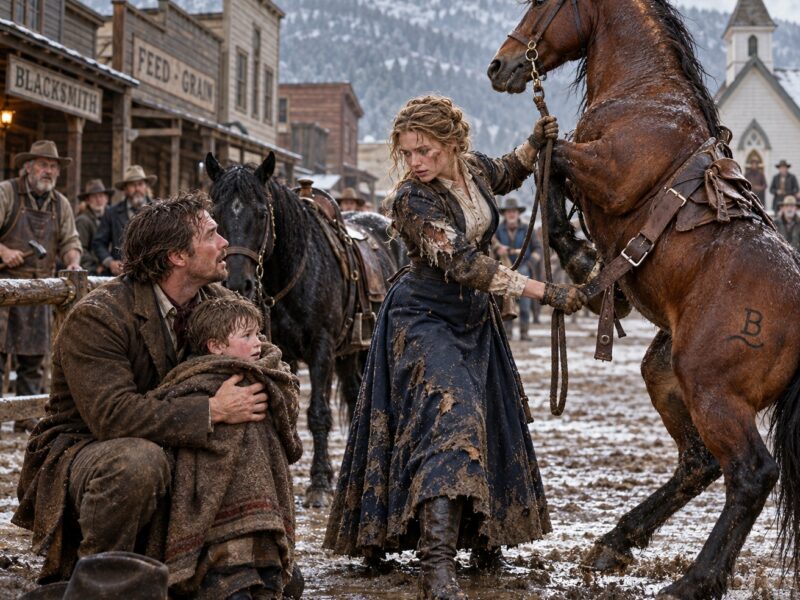
A COLORADO RANCHER WAITED ELEVEN SATURDAYS FOR HIS MAIL-ORDER BRIDE—THEN SHE RODE INTO TOWN WITH HIS MISSING SON AND A DANGEROUS STALLION, REVEALING THE SECRET BEHIND FIVE MONTHS OF SILENCE
For eleven Saturdays, Isaac Bennett waited for a woman who never stepped off the stagecoach.
On the twelfth, she rode into town carrying his missing six-year-old son.
And the dangerous stallion following her carried evidence that someone had been trying to destroy his family before she ever arrived.
PART 1 — THE WOMAN WHO NEVER STOPPED COMING
“Keep your hands on that saddle horn, Peter. Don’t look down.”
The woman’s voice was calm, although her right arm trembled from the effort of holding the little boy upright. Her black gelding picked his way along Dry Fork’s muddy main street, water streaming from his flanks. Behind them came a powerful bay stallion, its coat dark with sweat and its head tossing against the lead rope.
The boy riding in front of her was shivering so violently that his small boots rattled against the stirrup leather. His lips had turned an alarming shade of blue. But he obeyed her instructions, holding tightly to the saddle horn while the woman guided both horses toward the church.
Outside the church, Isaac Bennett was preparing to ride home alone.
He had stood beside that hitching rail every Saturday for eleven weeks, waiting for the woman he had asked to marry him. The stagecoach had arrived without her so many times that he no longer walked toward it when the driver pulled up.
That afternoon, he was staring at the mud on his boots when a familiar voice broke through the noise of the street.
“Pa!”
Isaac looked up.
For a moment, he didn’t move.
Then his hat slipped from his fingers.
“Peter?”
His six-year-old son was sitting on a stranger’s horse, wrapped in a woman’s soaked shawl.
“Pa, I didn’t let go!” Peter called. “She told me not to, and I didn’t!”
Isaac ran.
The woman brought the gelding to a stop outside the church. Before Isaac could reach them, she swung down, caught Peter beneath his arms, and carefully lowered him into his father’s waiting hands.
“He’s been in Miller’s Creek,” she said. “He needs to be warm. Now.”
Isaac dropped to his knees in the mud, clutching Peter against his chest.
His son was alive.
Only an hour earlier, Isaac had believed the boy was safely visiting a neighboring family while he collected supplies in town. He had no idea Peter had gone anywhere near the creek.
“What happened?” he whispered, pushing wet hair away from the child’s forehead.
Peter opened his mouth, but his teeth chattered too hard for the words to come.
The woman knelt beside them. Her fair hair had escaped its pins, and a thin scratch ran from her cheekbone to her jaw.
“His horse lost its footing in the creek. I found him hanging from the saddle with the current pulling at his legs. He’s bruised and frightened, but he stayed conscious.”
Isaac looked at her.
Her skirt was torn above one knee, and her gloves had been rubbed nearly through. She was cold enough that her fingers shook when she adjusted Peter’s shawl, but she appeared more concerned about the boy than herself.
“Who are you?”
The woman hesitated.
“Willa Sorenson.”
Isaac stared.
He knew that name better than the names of most people he saw every day.
He had written it on eleven envelopes.
He had whispered it while standing beside his dead wife’s grave, feeling ashamed that the possibility of loving someone again could still frighten him.
He had carried Willa’s last letter in his shirt pocket until the paper was almost transparent at the folds.
“Willa?”
“Yes, Mr. Bennett.”
She looked down at Peter.
“But I think we should finish our introductions after your boy is warm.”
Isaac immediately removed his coat and wrapped it around Peter. Pastor Jonah Pierce emerged from the church, took one look at the child’s face, and hurried to open the door.
Inside, his wife was lighting the stove.
Within minutes, Peter was sitting beneath two blankets, his wet clothes replaced with a dry shirt borrowed from the pastor’s youngest son. Mrs. Pierce warmed broth while Isaac stayed beside him, unable to stop touching his small shoulders.
Willa remained outside.
The stallion was still fighting the rope.
And the entire town seemed to be watching.
Five months earlier, Isaac Bennett had been a thirty-two-year-old widower trying to hold together a ranch that seemed determined to take everything he had left.
His wife, Bethany, had died of fever two winters before.
It had happened quickly. Four days from the first headache to the final breath, four days during which Isaac learned how helpless a man could feel while sitting beside the person he loved most.
Afterward, he had done what he knew how to do.
He repaired fences.
He fed cattle.
He chopped wood and paid bills and washed his son’s clothes badly enough that the collars sometimes remained stiff with soap.
But supper defeated him.
Bethany had always insisted that they sit together, even during calving season when Isaac came in exhausted. She believed a family should end each day looking at one another’s faces.
After her death, Isaac began eating beside the stove.
Peter often ate alone at the table.
One evening, the child looked toward his mother’s empty chair and asked, “Would Ma be angry if somebody else sat there?”
Isaac stopped chewing.
“No, son.”
“Then why don’t you?”
He had no answer.
That winter, Pastor Pierce suggested that Isaac might consider marrying again.
Isaac had nearly taken offense.
But the pastor said something he couldn’t forget.
“Bethany loved you and that boy, Isaac. I don’t believe she would have wanted either of you to spend the rest of your lives proving it by being lonely.”
Three weeks later, Isaac wrote to a marriage bureau in Denver.
He told the truth.
He was thirty-two, owned a modest Colorado ranch, had a six-year-old son, and owed more money than he liked admitting. He could promise honest work, a roof that didn’t leak, and a household where a woman’s opinion would matter.
He could not promise wealth.
Six weeks later, a letter arrived from Minnesota.
Her name was Willa Sorenson.
She was twenty-six, the daughter of a Swedish-born horse trainer and an American seamstress. Her parents were dead, and she had recently lost her teaching position after refusing to stop helping a student with a physical disability.
Her handwriting was neat and slanted slightly to the right.
I have no interest in becoming a decoration in someone’s house, she wrote. But if you’re looking for a partner who knows the difference between hardship and misery, perhaps we ought to continue writing.
Isaac smiled for the first time in weeks.
Their correspondence grew steadily warmer.
Willa asked about Peter.
Isaac told her the boy was afraid of thunderstorms but loved horses, especially a young bay stallion named Ruck, whose temperament had so far exceeded Isaac’s patience.
Willa advised him against rushing the animal.
A frightened horse remembers the person who frightened him, she wrote. But he also remembers the person who finally made him feel safe.
Isaac kept that letter.
He told her about Bethany.
Willa answered with a kindness that nearly undid him.
You don’t have to stop loving someone who has died to make room for someone who is still living.
By February, they had agreed that Willa would travel west in March.
Isaac repaired the guest bedroom.
He bought new curtains.
Peter picked a small wooden horse from the general store and placed it on the windowsill, explaining that it was for Miss Willa because she liked horses.
Then March passed.
April followed.
No bride arrived.
Three expected letters never came.
The Denver bureau blamed bad roads, damaged correspondence, and confusion along the mail routes. Isaac wrote twice more without receiving an answer.
Every Saturday, he rode into Dry Fork in his cleanest shirt.
Every Saturday, he waited.
By the eleventh week, people had stopped pretending not to notice.
Edwin Crowe, the town banker who held Isaac’s mortgage, was the least charitable.
“Some women enjoy being wanted more than they enjoy being married,” Crowe remarked one afternoon.
Isaac said nothing.
Crowe straightened his waistcoat.
“Perhaps she learned what kind of place you own.”
Isaac turned toward him.
“That’s enough.”
The banker smiled thinly.
“I’m merely suggesting you stop embarrassing yourself.”
Yet Isaac returned the following Saturday.
He could not explain why.
Perhaps it was stubbornness. Perhaps he had fallen in love with the handwriting of a woman he had never met.
Or perhaps some part of him still believed that silence did not always mean abandonment.
And now, on that very afternoon, Willa Sorenson had finally appeared.
Not with a suitcase or a traveling dress.
But soaked to the skin, leading a dangerous horse and carrying his missing child.
Outside the church, Willa kept her attention on Ruck.
The stallion’s ears were pinned back, and a loose strip of leather swung beneath his belly. It struck his hind leg whenever he moved, making him flinch and dance sideways.
“Easy,” she whispered.
She shortened the rope, turned his head slightly toward her, and stepped carefully to his shoulder.
The men watching from the feed store began offering advice.
“Better hobble him!”
“Get a rope around his nose!”
“That animal’s going to kill somebody!”
Willa ignored them.
She reached for the loose strap.
The moment her fingers touched it, Ruck shuddered violently.
Then she saw something she hadn’t noticed at the creek.
The leather had not simply torn.
It had been cut.
Cleanly.
Twice.
Willa straightened.
Her eyes followed the damage toward the fastening near the girth, where another narrow slice had nearly separated the strap.
Someone had deliberately weakened the saddle.
She looked toward the church.
Isaac had emerged with Peter bundled against his chest.
“Mr. Bennett,” she said quietly. “I need you to look at something.”
He approached, keeping a cautious distance from the horse.
Willa held up the damaged leather.
“Does this belong to your ranch?”
Isaac examined the Bennett mark stamped near the buckle.
“Yes.”
“Did you saddle this horse today?”
“No. Ruck was supposed to be in the north pasture.”
“Then somebody saddled him.”
Isaac frowned.
Willa turned the leather so he could see the cuts.
“And somebody wanted that saddle to fail.”
Behind them, the church door creaked.
Peter stood on the threshold with Mrs. Pierce holding his shoulder.
His face was pale.
“Pa?”
Isaac looked up.
The boy swallowed.
“I didn’t take Ruck by myself.”
A silence spread across the muddy street.
Peter’s eyes shifted toward the feed store.
“Mr. Crowe’s man told me you sent him.”
Isaac slowly turned.
Across the street, Edwin Crowe was no longer smiling.
And Willa realized that whatever had happened to her letters might be connected to the reason a six-year-old boy had nearly drowned.
PART 2 — THE LETTERS SOMEONE DIDN’T WANT DELIVERED
Isaac brought Willa and Peter home before sunset.
The wind had turned sharp, and the boy was still exhausted. Pastor Pierce insisted on riding with them, while the blacksmith agreed to keep Ruck in a secure stall until someone could examine his tack.
Willa rode beside Isaac, wearing a dry coat Mrs. Pierce had lent her.
For much of the journey, neither spoke.
Peter slept against his father’s chest.
As they approached the ranch, Willa noticed the sagging south fence, the weathered barn, and the narrow stand of cottonwoods behind the house.
She recognized them.
Isaac had described every one in his letters.
But descriptions had not prepared her for the small wooden cross beneath the trees.
She understood immediately.
“Bethany?” she asked.
Isaac nodded.
“Yes.”
Willa didn’t speak again until they reached the porch.
Inside, the house smelled of woodsmoke, saddle leather, and the faint sweetness of dried apples hanging beside the stove.
It was clean but plainly tired.
The curtains were new.
A blue ceramic bowl sat at the center of the kitchen table.
Beside the window stood a small wooden horse.
Willa touched it gently.
Isaac noticed.
“Peter bought that for you.”
She looked toward the sleeping child.
“Then I shall have to thank him properly.”
Isaac rubbed his hands over his face.
“I’m sorry.”
“For what?”
“For what you arrived to find.”
Willa studied him.
“A boy who loves his father. A house that needs work. A horse that’s been mishandled. None of that surprises me.”
He gave a tired, humorless laugh.
“Neither does the debt?”
“No. You told me about the debt.”
“I didn’t tell you how close Crowe was to taking the land.”
Willa’s expression changed.
“How close?”
“Thirty days, unless the bank agrees to an extension.”
She pulled out a chair.
“Then we’d better stop wasting time being embarrassed and look at the accounts.”
Isaac stared at her.
She removed her borrowed coat, folded it neatly, and sat down.
“After Peter eats,” she added.
For the first time that day, Isaac almost smiled.
They talked long after the boy had fallen asleep.
Willa began with the journey.
She had left Minnesota in early March, carrying a small trunk, fifty-eight dollars in savings, and enough hope to make the uncertainty of the trip bearable.
In Omaha, a rail disruption delayed her connection.
In Denver, she discovered that the marriage bureau had closed its office without forwarding the addresses of several women who had arranged marriages through it.
Her first letter to Isaac had been written from a boardinghouse.
The second came two weeks later, when she secured temporary work at a livery stable.
The third was sent after she learned that someone claiming to represent Isaac had inquired about her travel plans.
That person had told the boardinghouse proprietor that Isaac Bennett no longer wished to marry.
“I didn’t believe him,” Willa said.
“Why not?”
“Because he wouldn’t show me a letter from you.”
Isaac sat forward.
“Who was he?”
“The proprietor only remembered that the man wore a dark coat and had a crooked little finger.”
Isaac’s jaw tightened.
Crowe’s senior clerk, Silas Vane, had broken a finger in a wagon accident years before. It had healed badly and bent inward toward his palm.
Willa noticed Isaac’s reaction.
“You know him.”
“I think I do.”
She continued.
Unable to afford another long stay in Denver, she accepted temporary work with a horse dealer traveling toward Colorado Springs. When she finally obtained reliable transportation north, she discovered that the last coach to Dry Fork had been canceled after heavy rains damaged the crossing near Miller’s Creek.
“So you rode?”
“I borrowed a gelding against my remaining wages. His owner knows where to send for him.”
Isaac glanced toward the window.
“And that’s when you found Peter?”
“Not exactly.”
She wrapped both hands around her cup.
“I first found Ruck standing in the creek with the saddle slipping beneath his belly. Peter was still trying to climb back onto him.”
Isaac’s face drained.
“The horse could have dragged him under.”
“He nearly did.”
Willa looked down.
“I had to get into the water. The bank was too steep for the boy to climb. When I reached him, he was crying because he thought you’d be angry.”
Isaac closed his eyes.
“He thought I’d be angry?”
“He said he had disobeyed you.”
For a long moment, Isaac stared at the table.
Then he whispered, “I would have buried another person I love.”
Willa didn’t answer immediately.
She moved her hand across the table, stopping just short of his.
“You didn’t,” she said.
Isaac looked at her hand.
Slowly, he covered it with his own.
Neither spoke for a while.
The following morning, Peter finally told the entire story.
He was sitting at the kitchen table eating oatmeal when Isaac asked him to explain how he had reached the north pasture.
The boy looked at Willa before answering.
She nodded encouragingly.
“Mr. Vane came to the Millers’ house,” Peter said. “He told Mrs. Miller you needed me at the ranch.”
Isaac’s expression darkened.
“Why didn’t Mrs. Miller send someone with you?”
“Mr. Vane said he’d take me.”
“And did he?”
Peter shook his head.
“He brought me to the pasture and said Ruck was saddled because you wanted me to learn to ride him.”
Isaac went very still.
“I’ve told you never to ride Ruck.”
“I know.”
Peter’s eyes filled.
“But Mr. Vane said you changed your mind. He said you were waiting on the other side of the creek.”
Willa leaned forward.
“What happened when you reached the water?”
“The saddle started sliding. Ruck got scared. Mr. Vane was behind me, but when I called for him, he just kept riding.”
Isaac stood so abruptly that his chair scraped the floor.
Peter flinched.
Willa placed a hand gently on the boy’s arm.
“Your father isn’t angry with you.”
Isaac turned back.
His son was looking at him with the frightened expression he had worn the night Bethany died.
Isaac knelt beside the chair.
“Peter, you should have remembered what I told you about Ruck. But you did not deserve what happened, and you were not responsible for a grown man lying to you.”
Peter began to cry.
Isaac gathered him into his arms.
Willa turned toward the window, allowing them a moment of privacy.
Outside, the morning sun touched the roof of the barn.
She watched the empty pasture and wondered what kind of man would knowingly send a child onto a dangerous horse.
By noon, Isaac and Willa were in Dry Fork.
Pastor Pierce accompanied them to the sheriff’s office.
Sheriff Daniel Mercer listened without interrupting while Peter’s account was repeated. He examined the damaged saddle strap, turning it beneath the light from the window.
“Knife work,” he said at last.
Isaac nodded.
“That’s what Willa thought.”
The sheriff examined both cut edges.
“Could have been done yesterday. Could have been done earlier. But it wasn’t an accident.”
He looked toward the banker’s office across the street.
“You’re accusing Vane?”
“I’m telling you what my boy said.”
Mercer frowned.
“That’s enough for me to ask questions. It isn’t enough to arrest anybody.”
Willa spoke for the first time.
“Then perhaps we should ask why someone wanted Peter away from his father.”
Isaac looked at her.
She took a folded paper from her satchel.
It was a receipt from the boardinghouse in Denver, signed by the proprietor who had accepted the money from the man claiming to represent Isaac.
The signature at the bottom was an awkward attempt at Isaac Bennett’s name.
Willa placed it on the desk.
“That man paid my boardinghouse bill for three nights,” she explained. “The proprietor said he had been instructed to persuade me to return east.”
Mercer inspected the receipt.
Isaac’s mouth tightened.
“That’s not my signature.”
“I know,” Willa replied.
“How?”
“Because I kept every letter you ever sent me.”
The sheriff leaned back slowly.
Now there were two matters to investigate.
A forged signature.
And a child deliberately placed in danger.
The bank stood across from the feed store in a two-story brick building with polished windows.
Edwin Crowe received Isaac and Willa in his private office that afternoon.
His smile faded when he saw the sheriff standing behind them.
“Is something wrong?”
Isaac laid the damaged leather on Crowe’s desk.
“Silas Vane put my son on a horse he had no business touching.”
Crowe glanced at the strap.
“That’s a serious accusation.”
“My boy nearly drowned.”
“I’m very sorry to hear that.”
Willa watched him closely.
Not once did Crowe ask whether Peter was all right.
Sheriff Mercer spoke.
“Where is Vane?”
Crowe folded his hands.
“He left this morning on bank business.”
“Where?”
“Toward Colorado Springs, I believe.”
Mercer’s eyes narrowed.
“You believe?”
Crowe lifted one shoulder.
“He occasionally conducts business outside town.”
Isaac stepped forward.
“Then you’d better send word for him to come back.”
Crowe’s smile disappeared.
“I suggest you remember who holds the note on your ranch, Bennett.”
The room became very quiet.
Willa reached into her satchel and removed a small notebook.
“About that note,” she said.
Crowe looked at her.
“I beg your pardon?”
“Mr. Bennett tells me his payments have increased despite his having made each scheduled installment. I’d like to see the original mortgage and the payment ledger.”
Crowe gave a short laugh.
“Madam, this is a bank, not a schoolroom.”
“No,” Willa replied evenly. “In a schoolroom, people are generally encouraged to show their work.”
Isaac lowered his head to hide an involuntary smile.
The sheriff did not bother hiding his.
Crowe’s face reddened.
“The terms of Mr. Bennett’s loan are not your concern.”
Willa glanced at Isaac.
“May I?”
He nodded.
“She has my permission to review every account connected with my property.”
Crowe rose.
“The records are private and must be retrieved. I’ll have the relevant papers ready next week.”
Willa closed her notebook.
“Then please put that in writing.”
Crowe hesitated.
For the first time, Isaac saw something unfamiliar in the banker’s expression.
Not anger.
Uncertainty.
That evening, Isaac found Willa in the barn.
She stood beside Ruck’s stall, speaking softly while the horse investigated an apple in her palm. The stallion’s enormous head hovered just inches from her shoulder.
Isaac stopped at the doorway.
“He could hurt you.”
“So could a frightened man,” she answered. “That doesn’t mean either should be handled carelessly.”
Ruck took the apple.
Willa stroked his neck.
“He’s not wicked, Isaac. He’s learned that when people come near him, something unpleasant often follows.”
Isaac leaned against the doorframe.
“I bought him from a neighbor who couldn’t manage him.”
“He has old rope burns behind his ears.”
“I noticed.”
“And a scar beneath the girth. Someone kept tightening his saddle to stop it slipping.”
Isaac sighed.
“I thought I was buying a strong breeding stallion. Instead, I brought home an animal nobody could control.”
Willa turned.
“Maybe he isn’t the problem.”
Her words settled between them.
Isaac watched the horse lower his head again.
Then he asked quietly, “Why did you keep coming?”
Willa looked surprised.
“Coming where?”
“Here. After the bureau closed. After you received no replies. After somebody told you I didn’t want you.”
She rested one hand on the stall door.
“Because your letters weren’t written by a man who would send a stranger to dismiss me.”
Isaac looked away.
“You don’t know me.”
“I knew you told me the truth about your debt when you could have hidden it. I knew you loved your son enough to admit you were struggling. And I knew you spoke about your wife with respect rather than using her death to make yourself seem unfortunate.”
She smiled faintly.
“That seemed worth a difficult journey.”
Isaac studied her face.
There were small freckles along her nose. A faint bruise colored her wrist where the wet rope had pulled against it.
She wasn’t the delicate stranger he had imagined stepping gracefully from a coach.
She was stronger.
More practical.
And somehow far more difficult to stop looking at.
“Willa,” he began, “you don’t owe me a marriage simply because you came all this way.”
Her expression softened.
“Neither do you owe me one because I found Peter.”
He nodded.
“Then perhaps we ought to start with supper.”
She smiled.
“That seems sensible.”
Three days later, Sheriff Mercer returned to the ranch carrying a sealed envelope.
His horse was exhausted.
Isaac met him outside the barn.
“Did you find Vane?”
“Not yet.”
Mercer dismounted.
“But I found the Denver proprietor who dealt with him. And I found something else.”
He handed Isaac a copy of a county filing.
Willa stepped closer.
The document described a pending foreclosure arrangement involving the Bennett ranch and an adjoining parcel.
The proposed purchaser was a company registered under a name Isaac had never heard.
But when Willa examined the signatures, she recognized one immediately.
Silas Vane had signed as the company’s agent.
And beneath his signature was another name.
Edwin Crowe.
Isaac read the filing twice.
“The bank told me I still had thirty days.”
Mercer’s expression was grim.
“The first sale notice was prepared before your last payment was even due. They’ve been planning to acquire this land for months.”
Willa looked across the pasture toward the creek.
“Why?”
The sheriff unfolded a second document.
It was a survey.
A proposed railway spur was marked in red ink.
The surveyed route crossed the south end of the Bennett property, near a spring-fed meadow that supplied water to three adjoining ranches.
“The railway company hasn’t announced anything publicly,” Mercer said. “But Crowe knew.”
Isaac stared at the map.
His exhausted ranch was no longer merely a piece of failing farmland.
It sat directly across a potentially valuable transportation route.
Willa’s face went pale.
“Then he didn’t just want your land.”
She looked toward the house, where Peter was playing beside the porch.
“He needed you to become desperate enough to surrender it.”
Mercer nodded slowly.
“And if something happened to the boy, you might have been too broken to fight.”
At that moment, a horse galloped into the yard.
It was Thomas Miller, the neighbor whose wife had been watching Peter.
He was breathless when he dismounted.
“Isaac, you need to get to town.”
“What happened?”
“Vane’s come back.”
Isaac reached for his coat.
Thomas caught his arm.
“That’s not the worst of it.”
He swallowed.
“He’s telling everyone your bride stole money from the Denver marriage bureau. Crowe says he’s going to have her arrested.”
Willa stood motionless.
For a second, no one spoke.
Then Isaac looked at her.
And something in his expression hardened.
“Not without a fight.”
PART 3 — THE TRUTH BENEATH THE SADDLE
The crowd outside the bank was already thick when Isaac and Willa arrived.
Silas Vane stood on the wooden steps beside Edwin Crowe, holding a folded affidavit. His right little finger curled permanently toward his palm.
Willa recognized him from the boardinghouse proprietor’s description.
Crowe raised his voice when he saw her.
“There she is.”
Isaac moved in front of Willa.
“What are you accusing her of?”
Vane unfolded the paper.
“Misappropriating bureau funds. A complaint was lodged in Denver after Mrs. Sorenson obtained money under a false promise of marriage.”
Willa looked directly at him.
“What money?”
Vane hesitated.
“The sum of forty dollars, paid as a travel advance.”
“Who paid it?”
“The Bennett account.”
Isaac turned sharply.
“I never authorized forty dollars.”
Crowe spread his hands.
“That’s precisely why we’re investigating.”
Willa stepped beside Isaac.
“Then perhaps you can explain why the affidavit calls me Mrs. Sorenson when I’ve never been married.”
Vane’s eyes flickered.
She continued.
“And perhaps you can explain how the bureau authorized an advance in April when its Denver office had already closed in March.”
A murmur spread through the crowd.
Crowe frowned.
“Those details can be examined later.”
“Certainly,” Willa replied. “Along with the receipt bearing Mr. Bennett’s forged signature.”
She turned toward Sheriff Mercer, who had joined them.
“And the statement from the boardinghouse proprietor describing the man who paid him to persuade me to return east.”
Mercer stepped forward.
“Mr. Vane, I need you to come with me.”
Vane backed away.
“You’ve no grounds.”
“Then answering a few questions shouldn’t trouble you.”
Crowe moved toward the sheriff.
“Mercer, I won’t have my employee harassed because Bennett found himself a troublesome woman.”
Isaac stepped between them.
“Her name is Willa Sorenson.”
Crowe sneered.
“A woman who only arrived after learning your land might be worth something.”
Isaac felt Willa go still beside him.
But she spoke before he could.
“I arrived knowing exactly what his land was worth to him.”
Crowe opened his mouth.
“And I know what it’s worth to you,” she added.
She took the survey from Isaac’s coat pocket.
People leaned closer as she unfolded it.
“The proposed railway spur crosses the Bennett spring meadow. You intended to acquire the ranch before the survey became public.”
Crowe’s expression changed.
“Where did you obtain that?”
“From the county filing your agent signed.”
He looked at Vane.
It was a small movement, but everyone nearest the steps saw it.
The banker had just revealed more than he intended.
The sheriff took Vane into custody for questioning.
Crowe’s lawyer arrived that afternoon and demanded his release.
A judge granted it pending further inquiry, and by evening Vane was back at the bank.
The accusations against Willa also remained unresolved. The Denver complaint was real, although the information supporting it appeared increasingly suspicious.
Isaac wanted to confront Crowe immediately.
Willa advised patience.
“We know what they wanted,” she said. “But we still have to prove what they did.”
They sat at the kitchen table under the yellow glow of an oil lamp.
Peter slept upstairs.
Outside, wind rattled the shutters.
Isaac had spread his receipts across the table.
Willa organized them by date.
Within an hour, she found the first discrepancy.
An installment made the previous autumn had been recorded as interest instead of principal.
A second had been entered twelve days late.
A third payment bore a fee Isaac had never agreed to.
“This doesn’t prove fraud by itself,” she said, tapping the ledger. “But it gives us a reason to demand an independent examination.”
Isaac looked at the scattered papers.
“I’ve been paying that man for three years.”
“Then we should find out what happened to your money.”
He rubbed his forehead.
“I trusted him.”
Willa considered that.
“Trusting someone isn’t the same as giving him permission to cheat you.”
Isaac looked up.
She was studying another receipt, her hair pinned loosely behind her head.
The house had changed since her arrival.
There were voices at supper now.
Peter had begun carrying his schoolbooks to the kitchen table because Willa helped him with his reading while Isaac finished the evening chores.
Someone opened the windows in the morning.
Someone laughed when the biscuits burned.
For the first time since Bethany’s death, ordinary life had returned without asking permission.
Isaac reached across the table.
“Willa.”
She looked up.
“I’m glad you came.”
She smiled.
“So am I.”
He held her gaze.
“I mean even if none of this works out. Even if I lose the ranch.”
Willa set down her pencil.
“Isaac, I didn’t travel all this way because I believed you were going to make me wealthy.”
“I know.”
“I came because I wanted a place where my work mattered and where I could build something with a decent man.”
Her voice softened.
“Your letters made me think I’d found one.”
Isaac lowered his eyes.
Then he said, very quietly, “I’d like the chance to prove you were right.”
Willa reached for his hand.
“You already have.”
The next morning, Ruck nearly died.
Willa entered the barn before sunrise and found the stallion sweating heavily, his legs unsteady.
He had refused most of his hay.
A small pile of unfamiliar grain lay scattered beside the feed trough.
She shouted for Isaac.
Together, they led the horse away from the feed and called the nearest veterinarian, Dr. Samuel Avery, who arrived that afternoon.
He examined Ruck and collected the remaining grain.
“Something’s wrong with that feed,” he said. “I’m not going to guess exactly what until I’ve examined it.”
Willa showed him the sack.
It bore the stamp of Crowe’s feed supplier.
Isaac’s face darkened.
“The feed delivery was supposed to come tomorrow.”
“Then someone brought it early,” Willa said.
They searched the barn.
Behind an empty barrel, Isaac discovered fresh boot prints in the dust near a side door. The latch had been forced, leaving a bright scratch across the metal.
The sheriff came before nightfall.
He collected the grain and took statements.
This time, he didn’t need persuading that the danger was escalating.
But the incident also made something painfully clear.
Crowe was no longer merely trying to buy the property cheaply.
Someone was willing to endanger the ranch’s animals and its people.
Isaac moved a chair against Peter’s bedroom door that night, then sat awake with his rifle across his knees.
Willa found him there after midnight.
“You can’t guard everything by yourself,” she said.
He looked up.
“I should have kept Peter safe.”
“You couldn’t have known what Vane was planning.”
“I should have.”
She sat beside him.
“Isaac, when I pulled Peter out of that creek, the first thing he asked was whether his father would come.”
His throat tightened.
“He wasn’t afraid you’d abandoned him,” she continued. “He knew you would come if you could.”
Isaac stared at the floorboards.
Willa placed her hand over his.
“That matters more than you realize.”
By the end of the week, Dr. Avery reported that the feed appeared to have been contaminated deliberately, although he could not identify who had placed it in the barn.
Ruck survived.
For three days, Willa barely left his side.
She fed him carefully, cleaned his stall, and sat on an overturned bucket while he recovered.
Isaac came to understand that her confidence around horses was not recklessness.
She paid attention.
She noticed when an animal stood differently, when its breathing changed, when it hesitated before stepping onto an unfamiliar surface.
And she never demanded trust before earning it.
On the fourth morning, Ruck placed his head against her shoulder and stood quietly.
Isaac watched from the doorway.
“He’s never done that with me.”
Willa stroked the horse’s neck.
“Perhaps nobody ever stayed long enough for him to try.”
Isaac smiled.
“You’re making a habit of saying things that sound as though they’re about horses.”
“Perhaps you should listen more closely.”
They laughed.
Then Peter came running into the barn carrying a letter.
“Pa! The sheriff sent this!”
Isaac opened it.
The document had come from Denver.
The marriage bureau’s former bookkeeper had been located. After examining the disputed complaint, he confirmed that Willa had never received the supposed forty-dollar travel advance.
More importantly, he had retained copies of incoming correspondence.
Three letters from Willa had reached the bureau’s forwarding service.
Each had been collected by an individual using written authorization supposedly signed by Isaac Bennett.
The authorization was a forgery.
The collector had signed the receipt as Silas Vane.
Isaac read the statement aloud.
Willa slowly sat down.
For five months, she had believed her letters were simply lost.
Instead, someone had deliberately taken them.
Every mile of her journey, every night she had worked in Denver to afford another ticket, every moment she had wondered whether Isaac had changed his mind—all of it had been made harder by one man’s interference.
Isaac knelt beside her.
“I’m sorry.”
She shook her head.
“You didn’t do this.”
“No. But you should never have had to fight your way here.”
Willa looked at him.
Then she asked, “Do you still have my February letter?”
He reached into his shirt pocket.
The paper was soft and nearly worn through.
Willa stared at it.
“You kept it all this time?”
Isaac nodded.
“It was the last thing I had from you.”
She touched its folded edge.
Then, with tears in her eyes, she gave a small laugh.
“Well,” she said, “I suppose we’ll have to make some better memories.”
Those memories nearly never came.
Two nights later, a storm rolled across the valley.
Lightning struck the ridge beyond the north pasture, and rain began hammering the house shortly after supper.
Peter was upstairs.
Willa was closing the kitchen shutters when she saw movement near the barn.
A lantern.
Then another.
She called Isaac.
He came to the window, looked once, and reached for his coat.
“Stay inside.”
Willa caught his wrist.
“No.”
“Willa—”
“If those men are going near Ruck, you’re going to need someone who can handle him.”
Isaac looked at her for a long moment.
Then he handed her his spare lantern.
They crossed the yard through the rain.
The barn door was open.
Inside, someone had scattered burning oil-soaked rags along the far wall.
Flames were climbing the dry boards.
Isaac ran for the water barrels.
Willa hurried toward Ruck.
The stallion was striking the stall door, wild with panic.
Smoke thickened around the rafters.
“Easy, boy,” she whispered, coughing.
She opened the stall.
Ruck lunged backward.
She stayed beside his shoulder, holding the rope low and steady while the horse fought the fear of the growing flames.
Outside, Isaac shouted for help.
The ranch hands had heard the commotion and were running toward the barn.
Willa guided Ruck through the smoke.
A burning piece of timber fell behind them.
The horse startled and jerked sideways.
The lead rope cut across her palm.
She lost her footing.
For one terrible second, Isaac saw her disappear beneath the horse’s neck.
“Willa!”
She rolled clear, rose to one knee, and caught the rope again.
“Go on, Ruck,” she urged. “Go on.”
The stallion followed her through the doorway.
Isaac reached them in the rain.
Willa’s sleeve was scorched.
She was coughing hard.
But Ruck was outside.
Alive.
The fire was brought under control before it consumed the barn.
And when Sheriff Mercer arrived after dawn, the ranch hands had caught a man attempting to escape through the lower pasture.
Silas Vane.
Vane was arrested.
In his saddlebags, the sheriff found a bottle of lamp oil, matches, and several papers taken from the bank.
Among them was a handwritten accounting of payments Crowe had made for the purchase of distressed ranch properties near the proposed railway route.
Vane refused to speak for nearly a day.
Then Mercer confronted him with the bureau receipts, the saddle strap, and the papers recovered from his bags.
His confidence crumbled.
Crowe had promised him a share of the profits if the Bennett ranch could be acquired before the railway survey became widely known.
Vane admitted intercepting Willa’s letters and impersonating Isaac’s representative in Denver.
He admitted taking Peter to the north pasture, claiming he had intended only to frighten Isaac into reconsidering a sale.
He denied cutting the saddle strap, but the sheriff now had physical evidence and testimony sufficient to investigate that accusation in court.
The feed contamination and attempted barn fire brought further charges.
Vane’s confession implicated Crowe in the foreclosure scheme, although Crowe continued denying that he had authorized any threats or violence.
The matter proceeded beyond Dry Fork.
A county examiner reviewed Isaac’s loan records, found improperly applied payments and charges, and ordered corrections. Crowe’s attempt to foreclose was halted while the accounts were reconciled.
The railway survey also became public.
Other ranchers who had nearly surrendered their properties began examining their own mortgages.
Some discovered discrepancies.
Others discovered that Crowe had pressured them to sell land far below the prices now being discussed.
The county prosecutor brought financial fraud charges.
Vane eventually pleaded guilty to offenses connected with the forged authorizations and the barn fire, and agreed to testify about the scheme.
Crowe’s case took longer.
There were hearings, disputed documents, and months of legal expense. The criminal proceedings eventually resulted in convictions for fraud-related offenses, although the evidence did not establish that Crowe personally ordered the attack on Peter.
For Isaac, that distinction mattered.
He wanted the truth.
Not merely someone convenient to blame.
The correction of his mortgage did not make him rich.
It did, however, give him the chance to keep the ranch he had worked so hard to save.
And when a railway representative finally approached him about purchasing a strip of land along the southern boundary, Isaac refused to sign anything until an independent lawyer had reviewed the terms.
Willa sat beside him during every meeting.
They negotiated a fair sale of a limited right-of-way while preserving access to the spring.
The proceeds cleared the remaining debt and paid for repairs to the barn and pasture fencing.
For the first time in years, the Bennett ranch belonged to Isaac without a banker’s hand resting on its gate.
Spring arrived slowly.
The snow withdrew from the high meadows, leaving the fields soft and green.
Peter began helping Willa with Ruck, although she never allowed him into the stall without supervision.
“Remember,” she told him, “brave doesn’t mean you stop being careful.”
Peter nodded solemnly.
Then he asked whether Ruck loved her.
Willa smiled.
“I think he trusts me.”
“Is that the same?”
“Not quite. But it’s a good beginning.”
Isaac overheard them from the doorway.
That evening, he found Willa standing beside the cottonwoods where Bethany was buried.
The grass around the grave had begun to grow.
She was holding a small bunch of wildflowers.
Isaac approached quietly.
“I hope you don’t mind,” she said.
He shook his head.
“She liked those.”
Willa placed them beside the marker.
They stood together for a while.
Then Isaac said, “I used to come here whenever I felt I couldn’t manage.”
“Does it help?”
“Sometimes.”
He looked toward the house.
A thin trail of smoke rose from the chimney.
Peter’s laughter carried faintly across the yard.
“I think I spent so long trying not to forget Bethany that I forgot how to keep living.”
Willa turned toward him.
“She was part of your life, Isaac. She always will be.”
He nodded.
“I know.”
The evening breeze stirred the cottonwood leaves.
Then he reached for her hand.
“Willa, when I first wrote to you, I thought I needed somebody to help me keep this place from falling apart.”
She waited.
“But you arrived, and I realized the house wasn’t the only thing I’d stopped taking care of.”
His voice became rough.
“I don’t want you here because you saved my son. I don’t want you here because you’re good with horses, or accounts, or because life is easier with you in it.”
He paused.
“I want you here because when something good happens, you’re the first person I want to tell. And when something goes wrong, you’re the person I want standing beside me.”
Willa’s eyes filled.
Isaac took a breath.
“I love you.”
For a moment, she couldn’t answer.
Then she stepped closer.
“I love you too, Isaac.”
He smiled, nervous despite everything they had survived.
“Would you still consider marrying me?”
Willa laughed through her tears.
“After traveling halfway across the country, surviving Miller’s Creek, facing a dishonest banker, and rescuing your dreadful horse?”
“He’s improved.”
“Only a little.”
Isaac laughed.
She reached up and touched his cheek.
“Yes,” she whispered. “I would.”
They married on a warm Saturday in June.
There were no costly decorations, no elaborate gifts, and no crowd large enough to fill the church.
Pastor Pierce performed the ceremony.
Mrs. Pierce arranged wildflowers in glass jars.
The Millers brought a cake.
Peter wore a clean shirt with a collar that bothered him throughout the service.
He stood beside his father holding two rings in a small wooden box.
When Willa walked down the aisle, Isaac looked at her as though he still couldn’t quite believe she had come.
Her dress was simple.
Her hair was pinned neatly.
And on her wrist she wore a narrow blue ribbon Peter had chosen for her.
After the vows, the pastor asked whether anyone wished to say a few words.
Peter raised his hand.
The congregation chuckled.
Isaac leaned down.
“What is it, son?”
Peter looked at Willa.
“Does this mean she gets to stay even when it rains?”
The laughter faded into a tender silence.
Willa crouched before him.
“Yes, Peter.”
“And when it’s snowing?”
“Then too.”
He hesitated.
“Even when Ruck is bad?”
Willa smiled.
“Especially then.”
Peter threw his arms around her neck.
For a moment, she held him with her eyes closed.
Then she looked toward Isaac.
He was crying.
He made no effort to hide it.
That evening, after their guests had gone and Peter had finally fallen asleep, Isaac and Willa sat together on the porch.
The sunset burned gold above the distant mountains.
From the pasture came the low sound of cattle settling for the night.
Ruck stood beside the fence, his bay coat shining in the fading light.
Isaac reached into his pocket.
“There’s something I want to show you.”
He unfolded the old February letter.
Willa laughed.
“You’re still carrying that?”
“I thought you might want it back.”
She looked at the paper.
Then she shook her head.
“No. Keep it.”
“Why?”
“Because I think it belongs to the man who waited for me.”
Isaac smiled.
“Eleven Saturdays.”
“Eleven?”
“Eleven.”
She leaned her head against his shoulder.
“I’m sorry it took me so long.”
He looked through the window.
Inside, Peter’s little wooden horse stood on the kitchen windowsill, where Willa had returned it after thanking him for the gift.
The table was set for three.
Bethany’s chair still stood in its familiar place, but it was no longer an empty chair at an empty table. The house had room for the woman whose memory Isaac would always treasure and for the family learning to live again.
He kissed Willa’s forehead.
“You came when we needed you.”
She slipped her fingers between his.
For a long while, they watched the light disappear behind the mountains.
There would be more difficult winters.
More broken fences, sick animals, unpaid bills, and nights when the weather made every ordinary chore feel impossible.
Nothing about marriage would make their lives effortless.
But Isaac no longer mistook hardship for a reason to stop hoping.
And Willa no longer had to cross mountains and muddy creeks wondering whether a home waited at the other end.
That home was here.
So was the man who loved her.
And upstairs slept the little boy who had trusted her enough to hold on when the water tried to carry him away.
Isaac folded the letter one last time.
Then he put it inside the family Bible, beside a pressed wildflower from their wedding day.
For five months, the silence between them had seemed to mean the end of everything they had hoped for.
Now they knew the truth.
She had never stopped coming.
And he had never stopped leaving a place for her.









