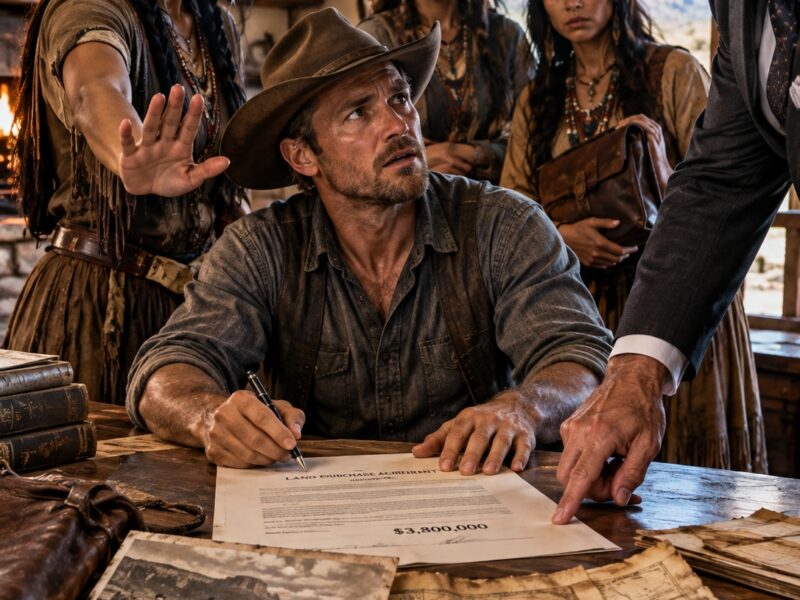
A COWBOY WAS SECONDS FROM SELLING HIS RANCH FOR $3.8 MILLION—THEN THREE APACHE WOMEN HE SAVED 10 YEARS AGO RETURNED WITH A TERRIFYING SECRET ABOUT HIS BEST FRIEND!
“DON’T SIGN THAT PAPER, COWBOY.”
Eli Mercer had the pen in his hand when the voice came through the open doorway.
For a moment, nothing in the kitchen moved.
Not the old ceiling fan clicking above him.
Not the coffee cooling beside his elbow.
Not the contract spread across the scarred oak table.
Even Harlan Voss’s black SUV, parked beyond the porch beneath the brutal New Mexico sun, seemed strangely silent.
Eli slowly lifted his head.
Three women stood beyond the screen door.
Dust covered their boots. Their horses waited beside the fence, reins hanging loose. One woman carried a bow in a leather case across her back. Another held a weathered satchel against her hip.
The tallest stood in front.
She looked to be in her late thirties now.
Her dark hair was threaded with a few strands of silver, and there was something steady in her face that made Eli feel as if she had crossed a great distance without once doubting where she was going.
But it was her eyes that stopped him.
He knew those eyes.
He just didn’t know from where.
Behind Eli, Harlan Voss shifted impatiently.
“Mercer?”
Eli barely heard him.
The woman stepped onto the porch.
“Put the pen down.”
Harlan laughed once.
Not because anything was funny.
Because men like Harlan laughed when someone entered a room they believed they owned.
“I’m sorry,” he said. “Who exactly are you?”
The woman never looked at him.
Her eyes remained on Eli.
“Someone who owes this man a life.”
Eli’s fingers tightened around the pen.
The words touched something buried deep inside him.
Something hot.
Something dusty.
Something ten years old.
He stood.
“Do I know you?”
The woman’s expression changed.
Only slightly.
But enough.
“You did once.”
Eli removed his hat.
Behind her, the desert shimmered beneath the August heat.
And suddenly he remembered another afternoon.
Another road.
Three terrified young women running through red dust.
Gunshots echoing between canyon walls.
A hand reaching desperately toward his saddle.
His own voice screaming above the thunder of hooves.
Take my hand.
The pen slipped from Eli’s fingers.
It struck the table.
Harlan stopped smiling.
The woman on the porch said quietly, “My name is Chaska.”
Eli stared at her.
“No.”
A faint sadness touched her face.
“Yes.”
He took one step forward.
Then another.
“My God.”
Ten years disappeared.
He was twenty-three again.
The year was 2016, but in his memory the desert looked timeless.
Eli had been riding the southern canyon after checking an isolated stretch of fencing when he heard screaming beyond the ridge.
At first he thought it was an injured animal.
Then he saw three young women running through the wash.
Behind them came armed men on dirt bikes and horseback, cutting across the canyon floor.
Eli never learned the entire story that day.
He knew only what his eyes told him.
Three women were terrified.
The men chasing them were armed.
And nobody else was coming.
He could have turned away.
He had one rifle in the saddle scabbard, an aging gray mare named Calico, two bottles of water, and no desire to die.
Instead, he kicked Calico forward.
One of the women stumbled.
Eli remembered leaning dangerously low from the saddle.
“Take my hand!”
She looked at him as though he might be another threat.
Then a shot cracked behind her.
That made the decision.
She grabbed him.
Eli hauled her up behind his saddle.
The other two ran toward the rocks.
“EAST!” he shouted. “FOLLOW THE CREEK BED!”
Another shot.
Stone exploded beside Calico’s hoof.
Eli knew those canyons better than anyone.
His father had ridden them.
His grandfather had ridden them.
Eli had spent his childhood learning every dry creek, blind ravine, abandoned service trail, and narrow sandstone passage where a vehicle could enter but not easily turn around.
He led the pursuers into a maze.
Then he disappeared.
Hours later, after doubling back through an old mining trail, he found the other women hiding beneath an overhang.
They were exhausted.
Bleeding.
Terrified.
Alive.
He gave them water.
He tore apart his spare shirt to wrap one woman’s scraped palms.
He gave another his jacket.
Then he drove them in his old ranch truck toward a highway where they could contact people they trusted.
Before leaving, the woman he had carried behind Calico turned toward him.
“Why did you help us?”
Eli remembered shrugging.
“Because you needed help.”
He had never learned their names.
Never asked what had happened before he found them.
Never asked for anything afterward.
He simply watched them leave.
Then he went home.
Ten years passed.
Now Chaska stood on his porch.
And Harlan Voss was standing beside the contract that would transfer the Mercer ranch to Voss Land & Energy for $3.8 million.
Eli looked at the other women.
Recognition arrived in pieces.
“You were there.”
The woman with the satchel nodded.
“Serina.”
The third woman gave him the smallest smile.
“Waya.”
Eli looked at all three.
“I thought I’d never see you again.”
“That was almost true,” Chaska said.
Then she finally looked past him.
At Harlan.
Her expression hardened.
“But apparently we arrived at exactly the right time.”
Harlan buttoned his suit jacket.
“This is a private transaction.”
Waya looked toward the papers.
“Not anymore.”
Something flickered in Harlan’s face.
It vanished quickly.
But Eli saw it.
Recognition.
“You know them,” Eli said.
Harlan turned.
“What?”
“You looked at her like you knew her.”
“I have never seen these women in my life.”
Chaska stepped into the house.
“Then you won’t mind if Eli reads what we brought.”
Harlan’s jaw tightened.
“I mind strangers interfering in a legal sale.”
Eli looked down at the contract.
For six months, Harlan had been working on him.
First came polite offers.
Then better offers.
Then inspections.
Then warnings about falling water tables and feed costs.
Then a banker Eli had known for fifteen years suddenly became nervous about extending his operating credit.
A livestock supplier stopped offering him thirty-day terms.
Two neighboring ranchers sold.
One moved to Arizona.
The other simply disappeared from the community.
Harlan kept coming back.
Three million.
Three point two.
Three point five.
Finally, three point eight million.
More money than Eli had ever imagined possessing.
Enough to pay every debt.
Enough to buy a smaller property.
Enough to stop waking at 4:30 every morning wondering which machine would break next.
Enough to be free.
That was what Gideon Pratt had called it.
Freedom.
“You’re forty-six, Eli,” Gideon had told him over coffee three days earlier. “You’ve given that dirt half your life. Maybe it’s time that dirt gives something back.”
Gideon was his oldest friend.
The closest thing Eli had to family.
And Gideon had been right about one thing.
Eli was tired.
So tired that when Harlan placed the final contract on his kitchen table, Eli had almost felt relief.
Then three ghosts rode through his gate.
Harlan reached for the contract.
“We can reschedule.”
Eli put his hand over the papers.
“No.”
Harlan stopped.
Eli looked at Chaska.
“What did you bring?”
Serina placed the leather satchel on the table.
Harlan’s eyes followed it.
That alone told Eli the answer mattered.
Serina opened the bag.
She removed a bundle wrapped in faded deerskin.
Inside were old survey documents, photocopied county records, photographs, a tarnished metal marker, and a silver pendant shaped like a sun.
Eli picked up the marker.
The number stamped into its side had nearly worn away.
“What is this?”
“Our grandfather found it near your southern spring decades ago,” Serina said.
Harlan scoffed.
“Fantastic. Archaeology.”
Chaska ignored him.
“Our grandfather knew this valley before any of us were born. He kept records. Maps. Stories. Property documents. Things people assumed had been lost.”
Waya unfolded a map.
Eli leaned closer.
He recognized his ranch immediately.
Pinyon Creek.
The red bluff.
The southern pasture.
The spring beneath Coyote Ridge.
But another boundary line had been drawn beneath the current property lines.
It crossed his land.
Then continued beneath three neighboring ranches.
Beside the spring was a symbol.
Eli frowned.
“What does that mean?”
Chaska looked at Harlan.
“It means he doesn’t want your ranch because of cattle.”
Harlan smiled thinly.
“This is absurd.”
“Then leave.”
The room went still.
Harlan stared at Eli.
“You’re throwing me out?”
“For ten minutes.”
“Mercer, you’re about to make the biggest financial decision of your life based on three strangers arriving with an old map.”
Eli looked toward Chaska.
“They aren’t strangers.”
That landed harder than he expected.
Harlan’s face changed.
Then he collected his folder.
“Fine.”
He walked toward the door, stopping beside Chaska.
“You should be careful about interfering in contracts you don’t understand.”
Chaska met his eyes.
“And you should be careful about contracts we do.”
Harlan walked out.
The screen door slammed behind him.
Nobody spoke until his SUV disappeared down the road.
Then Eli turned.
“What the hell is happening?”
Serina reached into the satchel again.
This time she removed a geological report.
Modern.
Recent.
Stamped with the name of a private engineering company in Albuquerque.
Eli read the first page.
Then the second.
He looked up.
“Lithium?”
“Not just lithium,” Waya said.
She pointed toward the southern pasture.
“An underground brine formation runs beneath this valley. Preliminary estimates put the recoverable mineral value in the hundreds of millions.”
Eli laughed.
It was involuntary.
“That’s impossible.”
“No,” Chaska said. “It’s inconvenient.”
“For who?”
“For Harlan Voss.”
Eli stared at the map.
His ranch had always been poor land by New Mexico standards.
Beautiful.
But difficult.
Dry summers.
Hard winters.
Rocky southern pasture.
His father had once joked that Mercer cattle survived because even death couldn’t find enough grass to lure them away.
Now someone was telling him the worthless ground beneath his boots might contain a fortune.
“That still doesn’t explain why Voss is offering me almost four million.”
“It explains exactly why.”
Eli shook his head.
“If this report is real, why not offer twenty million? Fifty?”
“Because then you would ask why.”
That silenced him.
Chaska continued.
“He isn’t buying one ranch. He’s assembling the entire basin quietly. Your property is the last major parcel blocking direct access to the southern extraction zone.”
Eli remembered the neighbors who had sold.
His stomach tightened.
“Henderson.”
“Sold.”
“McCall?”
“Sold.”
“The Ortega place?”
Waya nodded.
“Through a shell company.”
Eli stared through the window toward his pasture.
His land suddenly looked different.
Not richer.
Threatened.
“What does this have to do with you?”
Chaska exchanged a glance with Serina.
“That answer is complicated.”
“Try me.”
“Our grandfather’s records show that part of the water corridor beneath the southern valley was protected under an old land-use agreement involving several local families and Apache representatives. The agreement was never properly incorporated into later county maps.”
Eli looked at the old documents.
“So?”
“So extracting the minerals could contaminate the spring system.”
His head snapped up.
“My wells?”
“Your wells. Neighboring wells. And water sources farther south.”
Eli looked again toward the window.
That spring had never gone dry.
Not once.
His father had watered cattle there.
His mother had planted cottonwoods beside it.
Eli had scattered both their ashes beneath those trees.
Harlan had never mentioned lithium.
Never mentioned water.
Never mentioned anything beneath the land.
Eli felt something cold moving through him.
“Why didn’t anyone stop him?”
“We’re trying.”
“Why come to me?”
Chaska reached into the bundle.
“Because your property contains the original survey marker.”
Eli held up the tarnished metal.
“This?”
“And because someone signed a document ten years ago confirming that the marker existed.”
Serina unfolded the final paper.
She slid it across the table.
Eli read the first paragraph.
Then stopped.
A name sat near the bottom.
Gideon Pratt.
For a moment, Eli genuinely believed he had misread it.
He moved closer to the window.
Read it again.
Same name.
Same signature.
Gideon Pratt.
His best friend.
The man who had eaten Thanksgiving dinner at this table.
The man who had helped bury Eli’s father.
The man who kept a spare key to the ranch.
The man who had spent six months telling Eli that selling to Harlan Voss was the smartest thing he could do.
Eli looked up.
“What is this?”
Chaska answered softly.
“A witness statement.”
“To what?”
“To a meeting between Harlan Voss, your father, and our grandfather.”
Eli stopped breathing.
“My father?”
Chaska nodded.
Eli read the date.
Ten years earlier.
Three months before the canyon.
Six months before his father died.
His hand began to shake.
“No.”
“Eli—”
“My father never knew Voss.”
“He did.”
“He would have told me.”
Chaska’s voice softened.
“Maybe he was trying to protect you.”
“From what?”
Nobody answered.
Eli slammed the document onto the table.
“From what?”
Serina reached into the satchel one last time.
She removed a photograph.
Four men stood beside the southern spring.
One was Harlan Voss.
Younger.
Thinner.
But unmistakable.
Another was Chaska’s grandfather.
The third was Gideon.
And the fourth—
Eli sat down.
His father.
Thomas Mercer.
Alive.
Looking directly into the camera.
On the back, someone had written five words.
DON’T LET VOSS HAVE THE SPRING.
Eli remained at the table long after the women stopped talking.
Outside, afternoon heat pressed against the windows.
His father had died from what everyone called a heart attack.
He had been found alone beside his truck on County Road 16.
Gideon had identified the body.
Gideon had handled most of the funeral arrangements because Eli had been too devastated to function.
Gideon had stood beside the grave.
Gideon had put one hand on Eli’s shoulder and said, “You’re not alone, son.”
For ten years, Eli had believed him.
Now Gideon’s signature sat beside Harlan Voss’s name.
Eli stood abruptly.
“Where are you going?” Waya asked.
“To ask my friend a question.”
Chaska blocked the doorway.
“No.”
“Move.”
“You are angry.”
“You noticed?”
“Angry men make themselves easy to manipulate.”
“He knew my father.”
“Yes.”
“He lied to me for ten years.”
“Probably.”
Eli stared at her.
“That’s supposed to calm me down?”
“No.”
Chaska did not move.
“It is supposed to keep you alive long enough to learn why.”
That stopped him.
Waya walked toward the window.
“Harlan returned early because someone told him we were here.”
Eli looked at her.
“You think Gideon called him?”
“We don’t know.”
“I do.”
He grabbed his truck keys.
Chaska caught his wrist.
The contact sent another memory through him.
Her hand gripping his ten years earlier.
Take my hand.
This time her voice was quiet.
“If Gideon betrayed you, confronting him without knowing everything only tells him what we know.”
Eli looked at her hand.
Then at her face.
“What do you suggest?”
Chaska released him.
“Coffee.”
He almost laughed.
“What?”
“You said Gideon comes every morning.”
Eli’s anger cooled into something sharper.
“Yes.”
“Then tomorrow morning, let him come.”
At 6:12 the next morning, Gideon Pratt drove through the gate.
Eli was sitting at the kitchen table.
Alone.
At least that was what Gideon believed.
Chaska waited in the pantry.
Waya was outside behind the barn.
Serina had gone to the county records office before sunrise.
The documents were hidden beneath a loose floorboard.
Gideon entered carrying two breakfast burritos.
“Morning.”
Eli looked up.
“Morning.”
Gideon placed one burrito in front of him.
“Green chile. No onions. Because apparently you’re still twelve.”
Normally Eli would have smiled.
He didn’t.
Gideon noticed.
“You all right?”
“Didn’t sleep.”
“Thinking about the sale?”
“Yeah.”
Gideon poured coffee.
“You sign?”
“Not yet.”
The pause was tiny.
Most men would have missed it.
Eli didn’t.
“Why?”
“Had visitors.”
Gideon’s cup stopped halfway to his mouth.
“What kind?”
“Three women.”
Silence.
Then Gideon drank.
“Friends?”
“Something like that.”
Eli watched his eyes.
“They came from Arizona.”
Another pause.
Smaller this time.
But there.
Gideon put down the cup.
“What did they want?”
“To tell me not to sell.”
Gideon laughed.
Too quickly.
“Everyone’s got an opinion when money shows up.”
“They mentioned the southern spring.”
The color left Gideon’s face.
There it was.
Ten years of friendship collapsing in one second.
Eli felt no satisfaction.
Only grief.
Gideon looked toward the window.
Then back.
“Eli.”
“You know.”
Gideon closed his eyes.
“Damn it.”
“You know.”
“I was hoping you’d never find out.”
The pantry door opened.
Chaska stepped into the kitchen.
Gideon stood so fast his chair fell backward.
For several seconds, nobody spoke.
Then Gideon whispered her name.
“Chaska.”
Eli felt the final piece break inside him.
“You know her too.”
Gideon looked old suddenly.
Not guilty.
Not frightened.
Old.
“Yes.”
Eli stood.
“How much did Voss pay you?”
Gideon’s head snapped up.
“Nothing.”
“Don’t lie to me again.”
“I never took a dollar from Harlan Voss.”
“You signed his agreement.”
“I witnessed a meeting.”
“You encouraged me to sell.”
“Yes.”
“Why?”
Gideon looked toward Chaska.
She said nothing.
His shoulders sagged.
“Because I was afraid.”
Eli laughed bitterly.
“Of losing your commission?”
“I’m not your broker.”
“Then what?”
“Of watching you die like your father.”
The kitchen became silent.
Eli stared at him.
“What did you say?”
Gideon swallowed.
“Thomas didn’t die from a heart attack.”
The words seemed to arrive from very far away.
Eli gripped the table.
“Don’t.”
“I’m sorry.”
“Don’t you dare use my father to save yourself.”
“I’m not.”
“What happened?”
Gideon looked at Chaska.
She nodded once.
So he told him.
Ten years earlier, Harlan Voss had been working for an energy exploration company.
His survey team discovered indications of lithium-rich brine beneath the Mercer basin.
But Thomas Mercer learned what extraction could do to the aquifer.
So did Chaska’s grandfather.
They found older records showing protected water rights.
Thomas refused to sell.
Harlan threatened legal action.
Thomas threatened exposure.
Then Thomas began collecting evidence.
Gideon helped.
“I signed that statement because your father wanted proof that someone else had seen the marker,” Gideon said.
Eli could barely hear him.
“What happened on County Road 16?”
Gideon’s eyes filled.
“I don’t know exactly.”
“You just said—”
“I know your father called me that night. He said someone had been following him. He told me to meet him at the ranch.”
Gideon’s voice cracked.
“I never made it.”
“Why?”
“Someone ran me off the road.”
Eli stared.
“I spent six hours in a ditch unconscious. When I woke up, Thomas was dead.”
“Why didn’t you tell the police?”
“I did.”
“And?”
“The report disappeared.”
“Reports don’t disappear.”
“That one did.”
Eli looked at Chaska.
Her face confirmed it.
Gideon continued.
“Two days later, a man came to my house. He knew where my daughter went to school.”
Eli remembered Gideon’s daughter.
Maggie.
Ten years old then.
Living in Denver now.
The anger inside him changed shape.
“You were threatened.”
“Yes.”
“So you lied to me.”
“Yes.”
“For ten years.”
“Yes.”
“And then you told me to sell.”
Gideon looked at him.
“Because Voss came back.”
That was the part Eli had not expected.
“Six months ago,” Gideon said, “he came to my house. Same smile. Same calm voice. He told me the basin project was moving again.”
Gideon rubbed both hands across his face.
“He said if you sold willingly, everyone could walk away rich and alive.”
Eli stepped closer.
“And you believed him?”
“No.”
“Then why push me?”
“Because I believed the threat.”
Eli’s voice dropped.
“You should have told me.”
“I know.”
“I trusted you.”
“I know.”
“You sat in this kitchen every morning.”
“I know.”
“You helped me bury my father.”
Gideon looked down.
“I know.”
That was when Eli hit him.
One punch.
Hard.
Gideon fell against the counter.
Chaska moved forward, but Eli raised a hand.
Gideon wiped blood from his mouth.
He didn’t fight back.
After a long moment, he said, “I deserved that.”
Eli’s chest heaved.
“No.”
His voice broke.
“You deserved to tell me the truth.”
Then tires screamed outside.
Waya burst through the back door.
“Truck coming fast.”
Eli looked toward the road.
A black pickup was racing toward the ranch.
Not Harlan’s SUV.
No plates.
Gideon went pale.
“Get away from the windows.”
The first gunshot shattered the kitchen glass.
Eli hit the floor.
Chaska dragged the documents beneath the table.
Another shot tore through the wall.
Waya returned fire from behind the barn, not aiming at the men but forcing them to take cover.
The pickup stopped near the gate.
Two men jumped out.
One ran toward the southern pasture.
Not the house.
“The spring!” Chaska shouted.
Eli understood.
They weren’t there to kill him.
They were there to destroy evidence.
He grabbed his rifle.
“Eli!” Gideon yelled.
But Eli was already running.
He cut through the corral, vaulted the fence and reached Calico’s successor, a gray gelding named Flint.
The horse sensed his urgency immediately.
Eli mounted.
Chaska swung onto her mare.
Together they rode south.
The truck bounced across the pasture ahead of them.
One man reached the spring first.
He carried a sledgehammer.
The old survey marker stood beneath the cottonwoods.
Eli had seen it a thousand times.
Never understood what it was.
Now he watched the man raise the hammer.
“HEY!”
The man turned.
Chaska’s arrow struck the ground inches from his boot.
He froze.
She already had another nocked.
“Next one doesn’t miss.”
The second man reached inside his jacket.
Eli leveled the rifle.
“Don’t.”
For several seconds, the desert held its breath.
Then sirens sounded in the distance.
Waya had called the sheriff.
The men ran.
They abandoned the truck and disappeared into the ravine on foot.
Eli dismounted beside the spring.
The survey marker was still there.
He touched it.
His father had protected this.
Maybe died protecting it.
And Eli had almost sold it for $3.8 million.
Chaska stood beside him.
“Now you understand.”
Eli looked toward the horizon.
“No.”
His voice was quiet.
“Now I understand that I don’t understand anything.”
By noon, Serina returned from the county office with worse news.
Someone had filed a revised mineral-rights claim three days earlier.
Voss Land & Energy.
Attached to it was an affidavit stating that no conflicting historical water agreement existed.
The affidavit carried Gideon Pratt’s name.
Gideon stared at it.
“That isn’t my signature.”
Eli examined the page.
It looked perfect.
“Can you prove that?”
“I was in Denver three days ago.”
“Receipts?”
“Hotel. Gas. Maggie can verify it.”
Chaska leaned back.
“Then Voss forged your signature.”
Gideon looked sick.
“No.”
“What?”
“He didn’t forge it.”
Everyone turned toward him.
Gideon pointed at the signature.
“He copied it.”
“From where?”
Gideon looked at Eli.
“The document your father made me sign ten years ago.”
The implication settled over the room.
Harlan had access to their evidence.
Which meant somebody else did too.
Somebody close.
That evening, Eli walked the ranch alone.
The sun sank behind the Sangre de Cristo Mountains, turning the sky copper.
For years, he had thought loneliness was a form of safety.
If you loved fewer people, fewer people could betray you.
If you owned little, little could be taken.
If you kept your world small enough, maybe grief would eventually lose your address.
But grief had found him anyway.
So had the past.
Chaska found him beside the corral.
“You disappear when you’re angry.”
“My ranch. I’m allowed.”
She leaned against the fence.
“Fair.”
For a while they watched Flint eat.
Eli finally said, “Why did it take ten years?”
“To find you?”
“To come back.”
Chaska was quiet.
“Because after you saved us, our lives became complicated.”
“That’s a careful answer.”
“It is.”
He looked at her.
“What happened that day?”
She studied the mountains.
“The men chasing us worked for people connected to Voss’s original exploration company.”
Eli turned.
“What?”
“Our grandfather had given us copies of records. We were supposed to deliver them to an attorney.”
“You had the documents?”
“Some.”
“Those men were chasing you because of this land?”
“Yes.”
Eli felt dizzy.
“So when I found you…”
“You entered this story before you knew there was a story.”
“And my father?”
“Was already inside it.”
Eli looked toward the house.
“My father never told me.”
“Perhaps he knew what kind of man you were.”
“What does that mean?”
Chaska smiled faintly.
“You saw three strangers running from armed men and rode toward the gunfire.”
“That was stupidity.”
“Sometimes courage and stupidity share a fence.”
He almost smiled.
Then she said, “Your father probably knew that if he told you everything, you would stand beside him.”
Eli’s smile vanished.
“And maybe he wanted one Mercer to survive.”
That sentence stayed with him all night.
The next morning, Eli made his decision.
He called Harlan.
“I’ll sign.”
Across the kitchen, everyone stared at him.
Harlan’s voice brightened.
“Smart man.”
“Tomorrow. Noon.”
“I can be there in an hour.”
“No.”
Eli looked at Chaska.
“Tomorrow.”
A pause.
“Fine.”
When Eli hung up, Waya stared at him.
“You have lost your mind.”
“Probably.”
Chaska understood first.
“You want him here.”
“Yes.”
“Why?”
“Because men like Harlan don’t confess when they’re cornered.”
Eli picked up his father’s photograph.
“They confess when they think they’ve won.”
The plan was simple.
Which meant it was dangerous.
Serina contacted an attorney in Santa Fe who had been helping trace the historic agreements.
Gideon called a former state investigator.
Waya installed cameras around the kitchen and porch.
Chaska placed the original documents in a bank safe-deposit box.
The papers Harlan would see were copies.
Eli did the hardest thing.
He waited.
At 11:57 the next morning, Harlan’s SUV appeared.
He arrived alone.
That frightened Eli more than armed guards would have.
Harlan entered smiling.
“Glad you came to your senses.”
Eli sat at the table.
The contract waited between them.
“You were right.”
“I usually am.”
“Ranch is killing me.”
“Land has a way of doing that.”
Harlan sat.
He placed a pen beside Eli’s hand.
“Sign and let somebody else carry the burden.”
Eli looked at the pen.
“My father couldn’t.”
Harlan’s smile faded slightly.
“What?”
“Carry the burden.”
Eli looked up.
“Thomas Mercer.”
Harlan leaned back.
There it was again.
That tiny pause.
“Your father was stubborn.”
“You knew him.”
“Everyone knew Thomas.”
“You met him at my spring.”
Silence.
Harlan sighed.
“Those women really filled your head.”
“They showed me a photograph.”
“That proves nothing.”
“They showed me Gideon’s statement.”
Harlan’s eyes narrowed.
“That proves even less.”
“Interesting.”
Eli leaned forward.
“Because I never told you what the statement said.”
Harlan stopped moving.
The room seemed to contract around them.
Eli heard the hidden camera clicking faintly behind the bookshelf.
Harlan slowly smiled.
“You think you’re clever.”
“No.”
Eli’s voice remained calm.
“I think I’ve been stupid for ten years.”
Harlan stood.
“Then stay stupid.”
Eli didn’t move.
“What happened to my father?”
Harlan looked toward the door.
“Heart attack.”
“What happened on County Road 16?”
Harlan’s hand stopped.
Eli saw it.
That was enough.
“You were there.”
Harlan turned back.
“You have no idea what you’re talking about.”
“My father called Gideon.”
No reaction.
“Someone ran Gideon off the road.”
Nothing.
“My father ended up dead.”
Harlan walked toward Eli.
“Your father made the same mistake you’re making now.”
Eli’s pulse hammered.
“What mistake?”
“He thought owning land made him powerful.”
Harlan bent closer.
“It doesn’t.”
Eli forced himself not to look toward the camera.
“What does?”
“Knowing what everyone is afraid to lose.”
The words hung between them.
Eli whispered, “You threatened Gideon’s daughter.”
Harlan smiled.
Not broadly.
Just enough.
“Fear is cheaper than lawyers.”
Eli’s hands curled beneath the table.
“And my father?”
For the first time, something ugly entered Harlan’s eyes.
“Thomas wasn’t afraid enough.”
Eli almost stood.
Almost ruined everything.
Then Chaska’s warning returned.
Angry men make themselves easy to manipulate.
So Eli stayed seated.
“What did you do?”
Harlan laughed.
“You want a confession?”
“I want the truth.”
“No, cowboy.”
Harlan picked up the contract.
“You want permission to stop blaming yourself.”
Eli went still.
Harlan saw it.
And pushed harder.
“Your father kept secrets because he didn’t trust you to handle them. Gideon lied because he thought you were weak. Those women came back because they need your land.”
He tossed the contract onto the table.
“Everybody wants something from you.”
Then he pointed toward the signature line.
“At least I’m paying.”
Eli looked at the contract.
Harlan believed he had won.
That was when a voice came from behind him.
“No, Harlan.”
Gideon stepped from the hallway.
Harlan spun.
Gideon held the original photograph.
“You never paid enough.”
Harlan’s face changed completely.
“You.”
“Me.”
“You should have stayed scared.”
“I tried.”
Gideon’s eyes were wet.
“For ten years.”
Then Chaska entered.
Waya followed.
Serina stood beside the back door.
Harlan looked around the room.
Finally, he understood.
His expression hardened.
“You recorded me.”
Eli stood.
“Every word.”
Harlan laughed.
“You think that’s enough?”
“No.”
A vehicle stopped outside.
Then another.
Then another.
Harlan looked toward the window.
State investigators.
County deputies.
And the attorney from Santa Fe.
Serina smiled.
“But your forged affidavit might help.”
For the first time since Eli had known him, Harlan Voss looked afraid.
The investigation lasted eleven months.
It uncovered shell companies.
Fraudulent mineral claims.
Bribed officials.
Suppressed environmental studies.
Threats against landowners.
Evidence tampering.
And eventually, financial records connecting Harlan to the men who had pursued Chaska, Waya, and Serina ten years earlier.
But one question remained.
Thomas Mercer.
There was never enough evidence to prove Harlan had killed him.
Not directly.
A witness remembered seeing a black company truck on County Road 16.
Another remembered an argument.
An old mechanic produced a repair invoice showing damage to a Voss company vehicle the following morning.
Suspicious.
Powerful.
But not enough for murder.
Eli struggled with that more than he expected.
He had imagined truth as a door.
Open it, and everything becomes clear.
Instead, truth was a hallway filled with other doors.
Some opened.
Some remained locked forever.
Gideon testified.
Then he came to the ranch.
They stood beside the same kitchen table where they had shared thousands of cups of coffee.
Gideon held his hat in both hands.
“I’m leaving for Denver.”
Eli nodded.
“Maggie?”
“She wants me closer.”
“Probably good.”
“Probably.”
Silence stretched.
Gideon looked around the kitchen.
“I don’t expect forgiveness.”
“Good.”
Gideon nodded.
Then Eli said, “But I understand.”
His friend looked up.
“That isn’t the same thing.”
“I know.”
Another silence.
Eli looked at the man who had betrayed him.
And protected him.
And lied to him.
And loved him badly.
Human beings, Eli realized, were inconvenient that way.
Nobody fit cleanly into the roles we gave them.
Coward.
Friend.
Traitor.
Protector.
Sometimes a man could be all four.
Gideon walked toward the door.
“Eli?”
“Yeah?”
“I really did love your father.”
Eli swallowed.
“I know.”
Gideon nodded once.
Then he left.
The ranch did not become a lithium mine.
The historical water agreement was eventually recognized as evidence supporting a conservation settlement covering the spring corridor.
Eli entered a partnership with Chaska, Waya, and Serina.
Not the partnership he had imagined when they first offered it.
There were no instant millions.
No miraculous treasure.
Instead, they created a land and water trust.
Neighboring ranchers joined.
So did several families whose histories in the valley reached farther back than any county map.
They restored damaged creek beds.
Negotiated grazing agreements.
Protected the spring.
And created a small cultural and conservation center near the southern boundary.
Serina designed the exhibits.
Waya managed field operations.
Chaska handled negotiations.
Eli mostly fixed fences and complained about meetings.
He discovered he was very good at both.
Two years later, on an October evening, Eli sat beneath the cottonwoods beside the spring.
The old survey marker remained where it had always been.
They had cleaned it.
Protected it.
But they had not moved it.
Chaska approached carrying two cups of coffee.
She handed him one.
He tasted it.
“This is terrible.”
“Serina made it.”
“Tell her I said it’s wonderful.”
Chaska laughed.
The sound moved softly through the trees.
For a while, neither spoke.
Then Eli removed something from his pocket.
The silver sun pendant.
Chaska looked at it.
“You kept it.”
“You left it.”
“I gave it to you.”
“Why?”
She sat beside him.
“Because our grandfather gave each of us one when we were children.”
Eli turned the pendant over.
Three scratches marked the back.
“What are these?”
“Three lives.”
He looked at her.
She smiled.
“His words.”
Eli ran his thumb over the scratches.
“I didn’t save your lives.”
“Yes, you did.”
“I helped for one afternoon.”
“That is sometimes enough.”
The spring moved quietly over stone.
Eli thought of his father.
Of Gideon.
Of Harlan.
Of three frightened young women running through a canyon.
Of all the decisions people made without knowing what those decisions would become.
Ten years earlier, Eli had turned his horse toward strangers because they needed help.
He had considered it a small thing.
Almost nothing.
A few miles.
Some water.
A torn shirt.
A dangerous ride through a canyon.
Then he had forgotten about it.
But kindness, he had learned, had a strange way of continuing after the person who offered it stopped looking.
Sometimes it crossed ten years of desert.
Sometimes it carried old documents in a leather satchel.
Sometimes it arrived exactly when a tired man was about to sign away the one thing his father had died trying to protect.
Chaska looked toward the ranch house.
“You almost sold all this.”
Eli nodded.
“For $3.8 million.”
“That would have been unfortunate.”
“I thought it was a fortune.”
“At the time, it was.”
He smiled.
“You know what bothers me?”
“What?”
“You still haven’t explained how you found me.”
“Yes, we did.”
“My boot.”
“Your crooked heel.”
“That story was nonsense.”
Chaska’s smile widened.
Eli stared.
“I knew it.”
She stood.
“Come on.”
“Where?”
“There is something you should see.”
She walked toward the cottonwoods.
Eli followed.
Beyond the old survey marker stood a younger tree.
Chaska knelt beside it and brushed dirt away from a flat stone.
Eli crouched.
Something had been carved into the stone.
Two initials.
T.M.
His breath caught.
“My father.”
Chaska nodded.
“Keep digging.”
Eli used his hands.
Several inches beneath the soil, his fingers struck metal.
He pulled out a small rusted box.
For a moment, he could only stare.
Chaska sat quietly beside him.
“Did you know about this?”
“No.”
“Then how—”
“Serina found a reference to it in our grandfather’s journal.”
Eli opened the box.
Inside was a plastic-wrapped envelope.
Still dry.
Still sealed.
His name was written across the front.
ELI.
The handwriting belonged to his father.
His hands began to tremble.
Chaska rose.
“I’ll give you some time.”
“No.”
She stopped.
Eli looked at the envelope.
Then at her.
“Stay.”
So she did.
Eli opened it.
The letter inside was short.
Son,
If you are reading this, then either I finally found the courage to tell you everything, or I waited too long.
I hope it is the first.
I fear it will be the second.
This land is not valuable because of what men can take from beneath it.
It is valuable because water still rises here.
Because cattle drink here.
Because birds return here.
Because your mother loved these cottonwoods.
Because people who lived here before us understood something we keep forgetting:
You do not truly own land.
You borrow it from whoever comes next.
There are men who will offer you more money than you think you can refuse.
Refuse anyway.
Not because money is evil.
Because some things become worthless the moment you put a price on them.
And Eli—
If someday a stranger needs your help and helping them costs you something, help them anyway.
A man’s life is measured less by what he keeps than by what he refuses to abandon.
I hope I taught you that.
Dad.
Eli read the final line twice.
Then a third time.
The desert blurred.
He lowered the letter.
For years, he had wanted one last conversation with his father.
One explanation.
One answer.
Instead, Thomas Mercer had left him a letter beneath a tree.
Chaska sat beside him again.
Neither spoke.
There was nothing to say.
The sun dropped lower.
Gold light spread across the pasture.
Flint grazed near the fence.
Somewhere near the house, Waya shouted at Serina about leaving tools outside.
Serina shouted something back.
Eli laughed through his tears.
Chaska looked at him.
“What?”
“Nothing.”
He folded the letter carefully.
Then he looked across the ranch.
Once, silence had been the thing Eli loved most about this place.
Silence meant nobody could disappoint him.
Nobody could leave him.
Nobody could betray him.
Now there were horses near the barn.
Voices near the house.
Three women arguing about dinner.
A conservation crew returning Monday.
Gideon calling once a month from Denver, neither man quite knowing what to say but neither willing to stop trying.
Life had entered the ranch.
Messy.
Complicated.
Uninvited.
Eli finally understood that loneliness had never protected him.
It had only made loss quieter.
Chaska rose and offered him her hand.
Ten years earlier, in a canyon filled with gunfire, Eli had reached down from a saddle and said the same thing without thinking.
Take my hand.
She had.
Now he looked at her outstretched hand.
Then he took it.
Together they walked toward the house.
After several steps, Eli stopped.
He turned back toward the spring.
The old survey marker caught the final sunlight.
For decades, people had passed it without understanding what it meant.
Maybe that was true of many things.
A piece of land.
A frightened stranger.
A loyal friend who failed.
A father’s silence.
One decision made on an ordinary afternoon.
We rarely know the value of something while it is happening.
Sometimes we discover it ten years later.
Sometimes it rides through our gate seconds before we make the biggest mistake of our lives.
And sometimes, if we are very lucky, the past does not return to punish us.
It returns to remind us who we were before fear taught us to forget.









