A Desperate Lady Begged a Stranger to Marry Her—Then Discovered He Was the Duke Whose Family Had Destroyed Her Own

The young woman had barely spoken when the stranger’s expression changed.
“Please, sir. I need you to marry me.”
Lady Arabella Renford stood before a gentleman she had never met, trembling beneath her rain-soaked cloak. She did not know he was one of the most powerful dukes in England. And she had no idea that the silver ring hidden against her heart would lead them both to a crime their families had concealed for decades.
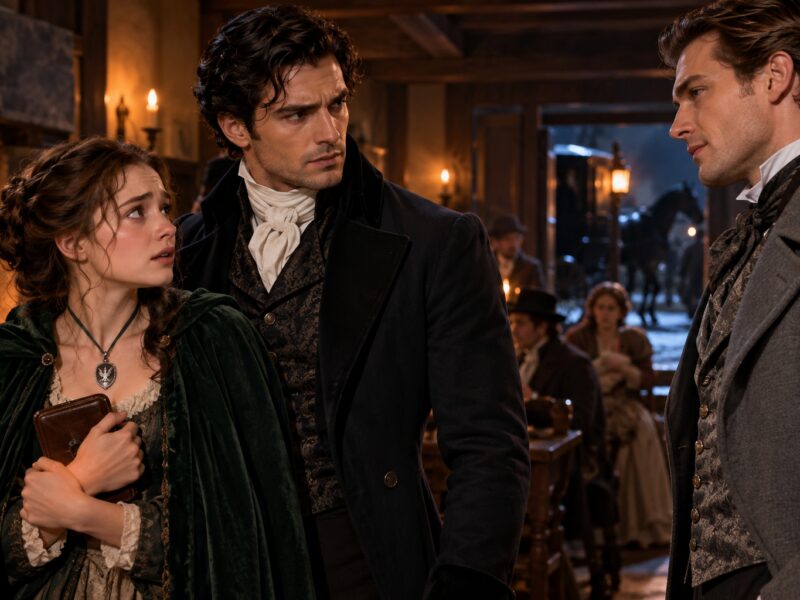
The coaching inn was crowded that evening. Rain tapped against the windows, muddy boots scraped across the floorboards, and a tired servant struggled to carry steaming bowls between the tables. Near the cold fireplace, a dark-haired gentleman had just removed his traveling gloves when Arabella approached him.
She had spent the afternoon watching the road, listening for wheels, and imagining the moment Lord Cassian Vale would arrive to take her home. Every time the inn door opened, her stomach tightened. Her father had been buried only weeks earlier, and already another man was preparing to claim everything he had left behind.
The stranger studied her without speaking.
Arabella knew how she must appear. Her cloak was damp, her complexion pale, and one hand clutched a small leather case so tightly that the seams pressed into her fingers. Beneath her dress, suspended from a narrow ribbon, hung the silver signet ring her father had forbidden her to surrender.
“I realize this is an extraordinary request,” she said, struggling to keep her voice steady.
“Extraordinary is a charitable description.”
His reply was not unkind. That was what gave her the courage to remain standing.
“I have no family willing to protect me. A gentleman is pursuing me, and if he succeeds, I shall lose something my father spent his final years trying to preserve.”
The gentleman’s gaze moved toward the entrance. He seemed to notice how often she glanced in the same direction.
“And marriage to a stranger is your solution?”
“It is the only one I have found.”
For three years, Adrien Blackthorne, Duke of Ravenshallow, had avoided the very subject she had raised. He had withdrawn from society, refused invitations that might lead to introductions, and allowed rumors about his coldness to flourish. It was easier to be thought incapable of affection than to explain why he no longer trusted it.
Once, he had imagined marriage as the beginning of his happiness.
Then the woman he intended to marry had abandoned him a week before their wedding and died before he could understand why.
Since then, he had learned to live without expectations.
He was preparing to dismiss Arabella’s request when her nervous fingers loosened the clasp of her leather case. For an instant, the corner of an old letter became visible.
Adrien stopped breathing.
Pressed into the aging paper was a crest he knew intimately: a raven with its wings half-open, a wreath of thorns encircling its throat.
His family’s crest.
And beneath it, written in the unmistakable hand of his late father, was a name that should never have appeared in the old duke’s private correspondence.
“Close that,” he said quietly.
Arabella looked down.
“Sir?”
“Your case. Close it. Not another word here.”
She obeyed, startled by the sudden change in his manner.
Adrien picked up her traveling bag before she could protest and guided her through the crowded room. They passed a drover asleep beside his unfinished ale and a young mother rocking a baby beneath a window. At the back of the inn, he opened the door to a private parlor.
A single candle burned on the table. Two untouched plates stood beside a supper that had already gone cold.
Adrien closed the door.
“Now,” he said. “Your name.”
“Arabella Renford.”
Something moved across his face, too quickly for her to understand.
“Lord Renford’s daughter?”
She nodded.
“You knew my father?”
“I knew the name.”
He did not offer anything more, and Arabella felt an unpleasant awareness settle over her. She had placed herself alone in a room with a man whose identity she did not know.
“Who is pursuing you?” he asked.
“Lord Cassian Vale.”
The name tightened Adrien’s expression.
“He has asked for my hand three times since Papa’s funeral,” Arabella continued. “I have refused him three times. Yesterday, he informed my aunt that the banns would be read on Sunday, whether I agreed or not.”
She swallowed.
“My aunt believes I ought to be grateful. His family has influence, and ours has very little left. But he does not want me.”
“What does he want?”
“What my father left behind.”
Her hand settled protectively over the leather case.
“My father believed that our family had been cheated out of its estate. He died trying to prove it. Lord Vale has taken an extraordinary interest in his papers, and once I am married, he will have a husband’s legal authority over my affairs and property.”
Adrien watched her carefully.
“And you propose to escape one unwanted marriage by entering another?”
“At least this one would be my choice.”
“With a gentleman whose name you do not know.”
Arabella lowered her eyes.
When she answered, her voice was barely audible.
“Yours was the first face I saw today that did not appear to be calculating what I might be worth.”
For a moment, the severity of his expression softened.
Then his gaze fell upon the ribbon visible at her collar.
“That ring. May I see it?”
Arabella hesitated.
Her father had given her strict instructions never to surrender it. Even during his final illness, when fever made his words difficult to follow, he had reached for her hand and repeated that warning.
At last, she lifted the ribbon over her head and opened her palm.
The little silver ring rested against her skin.
Adrien leaned closer.
A raven. Half-open wings. A wreath of thorns.
His face lost its color.
“My mother had two rings made with this design,” he said slowly. “It was the year before she died. I inherited one. I believed the other had been lost.”
Arabella’s fingers closed protectively around the silver.
“Your mother?”
Before he could answer, carriage wheels crunched over the gravel outside.
A door slammed.
Then came footsteps, unhurried and unmistakably confident.
Arabella knew that walk.
The parlor door opened without a knock.
Lord Cassian Vale stood on the threshold.
He was a handsome man, impeccably dressed despite the weather, with polished boots and a gray traveling coat. His expression was one of gentle concern, the sort that invited witnesses to admire his patience.
“Arabella,” he said warmly. “Thank God. Your aunt has been beside herself.”
Arabella rose.
“My aunt told you where I had gone?”
“My dear, you have frightened everyone. Grief has made you quite unlike yourself.”
He turned toward Adrien and bowed.
“Forgive the intrusion, sir. Lady Arabella is my betrothed. She has not been well since her father’s death. I shall take her home.”
“I am not your betrothed,” Arabella said.
Cassian sighed, as though she had merely confirmed his explanation.
Adrien remained standing beside the table.
“Adrien Blackthorne,” he said. “And you are?”
At the sound of his name, the innkeeper, who had followed Cassian to the door, went suddenly pale.
“Your Grace.”
Arabella stared at the stranger.
The Duke of Ravenshallow.
The name struck her with the force of a physical blow. During the final winter of his life, her father had spoken bitterly of the Blackthorne family, sometimes even in his sleep. He had blamed an earlier Duke of Ravenshallow for the loss of everything the Renfords once possessed.
And she had just begged that family’s heir to marry her.
Cassian recovered more quickly.
“Your Grace. An unexpected honor.”
“Lady Arabella is under my protection,” Adrien said. “She will travel to Ravenshallow in my carriage tonight.”
Cassian’s courteous smile tightened.
“Her father owed my family a considerable sum.”
“Then instruct your solicitor to write to mine.”
Adrien’s tone remained perfectly level.
“If you wish to dispute her presence in my household, Sir Hugh Marlow dines at my table on Sundays. You may raise the matter with him.”
The mention of the magistrate did not please Cassian.
For several seconds, the two men regarded each other across the little room.
Finally, Cassian turned to Arabella.
“Sleep well, my dear. Dukes rarely marry girls who have nothing left to offer.”
He bowed again and departed.
Only after the sound of his carriage faded did Arabella realize how violently her hands were shaking.
Adrien did not try to comfort her with promises he could not keep. He simply returned her traveling bag and waited until she was ready to leave.
Outside, rain had begun to fall harder.
Inside the duke’s carriage, a small lamp swayed above them as the horses carried them away from the village.
For some time, neither spoke.
Then Adrien said, “I will not marry you tonight.”
Arabella looked toward him.
“Of course.”
“The law requires certain formalities, and I have not yet agreed to anything.”
She folded her hands in her lap, trying to hide her disappointment.
“But Vale is correct about one matter,” he continued. “A gentleman’s protection of an unmarried woman can be challenged. The position of a wife is considerably more difficult for him to interfere with.”
Arabella stared at him.
“My vicar may be able to obtain the necessary common license by Thursday.”
“Your Grace—”
“Adrien,” he corrected.
“Why would you do this?”
His eyes rested on the rain-darkened window.
“Because you possess my mother’s ring and a letter written by my father. I intend to discover why.”
When he turned toward her, his expression was solemn.
“But you must understand something. I will not pretend to love you. I ceased believing in that possibility three years ago.”
Arabella remembered Cassian’s hands reaching for papers that were not his, her aunt’s insistence that gratitude and obedience were a woman’s greatest virtues, and the terrible loneliness of burying the only person who had ever defended her.
“I did not ask you to love me,” she said.
Adrien held her gaze for a moment.
“No,” he replied quietly. “You did not.”
Something in his posture eased.
And for the first time that evening, Arabella felt that she might have found a place where she could breathe.
Ravenshallow rose from the darkness shortly before midnight.
The ancestral house was an immense structure of gray stone, its windows glowing against the rain. Arabella had imagined a palace of ruthless luxury, built upon the ruin of people like her father.
Instead, the entrance hall felt strangely silent.
Adrien led her directly to his father’s study.
A fire had been left banked in the grate. Old books filled the walls, and the heavy desk stood beneath a portrait of the late duke, whose stern expression seemed to follow them into the room.
Adrien took a leather-bound letter book from a shelf.
He began turning pages.
Arabella waited beside the fire.
Then his fingers stopped.
She saw the change in his face before he spoke.
On the page were hurried entries in his father’s handwriting, references to an estate called Harrowdown, a debt, and witnesses supplied by the Vale family.
Adrien read the words again.
“Harrowdown,” he said. “That was your grandfather’s estate.”
Arabella nodded slowly.
“Coal beneath nearly every field. Papa said the land was taken from us through a debt that never existed.”
Her voice grew unsteady.
“He spent years trying to prove it. People said grief and disappointment had made him bitter. Eventually, even his friends stopped listening.”
Adrien placed the book on the desk with extraordinary care.
“If these records mean what I believe they mean, the foundation of my family’s wealth is tied to your family’s loss.”
Arabella looked at the portrait above him.
The man in the painting had never known her. Yet decisions made beneath his roof had shaped every hardship she remembered.
“You have every reason to wish you had never encountered me,” Adrien said.
She looked back at him.
“Yes.”
He accepted the answer without flinching.
Then she added, “And yet I find that I do not wish it at all.”
For the first time, he seemed uncertain how to respond.
The next morning, Arabella woke to pale gray light and a gentle knock.
The housekeeper, Mrs. Hobbs, entered carrying tea. She was an older woman whose movements were precise and quiet, but she regarded Arabella with a peculiar expression.
As though she had seen a ghost.
“Is something wrong?” Arabella asked.
“No, my lady.”
Mrs. Hobbs placed the tray beside the bed.
“Only that His Grace has not brought a guest into this part of the house in a very long time.”
Her words lingered after she left.
Later, Arabella wandered through the long gallery, where generations of Blackthornes looked down from gilded frames. At the far end, she discovered a portrait that had been turned toward the wall.
She hesitated before gently shifting it.
A beautiful fair-haired young woman smiled from the canvas, her expression open and almost mischievous. She seemed to be looking at someone standing just beyond the painter’s shoulder.
“Eleanor Hartley.”
Arabella turned.
Adrien stood in the doorway.
“I was to marry her,” he said.
The simplicity of the statement made it more painful.
He approached the portrait, stopping a few feet away.
“A week before the wedding, she sent me a note. Only two sentences.”
Arabella waited.
“‘I cannot marry you. Ask your father why.'”
He looked toward the windows.
“I did not ask him. I was too angry. My father died within the month, and Eleanor was killed when her carriage overturned on the wet road to her sister’s house.”
The gallery was silent.
“For three years,” Adrien continued, “I have believed she betrayed me. I resented her for leaving, and I resented myself for loving her enough to be wounded by it.”
His jaw tightened.
“I never considered that she might have been asking me to discover something.”
Arabella studied the portrait.
Eleanor’s smile seemed unbearably young.
“Perhaps she was,” Arabella said. “And perhaps the answer has been in this house all along.”
He did not reply.
But when they left the gallery, he did not turn Eleanor’s portrait back toward the wall.
On Thursday morning, they were married in the family chapel.
There were no flowers ordered from London, no elaborate breakfast, and no guests drawn from the county’s fashionable families.
The vicar stood before them with his prayer book. Mrs. Hobbs and Prior, the estate steward, served as witnesses.
Arabella wore her one good dress.
Adrien wore black.
Neither made promises of affection that did not yet exist. They spoke the vows with the solemnity of two people entering an agreement neither fully understood.
Then Arabella noticed the monument.
Along the chapel wall stood the white marble memorial to Adrien’s mother, the late duchess.
Carved into the stone was a raven with its wings half-open.
Around its throat lay a wreath of thorns.
Arabella felt her breath catch.
She had carried that very design against her heart for most of her life.
“Arabella,” Adrien murmured.
She looked at him.
“You are meant to say ‘I will.'”
“I will.”
Then, almost in the same breath, she whispered, “Adrien, look at your mother’s monument.”
He followed her gaze.
The service continued, but something had changed. Arabella could hardly hear the words. Her fingers kept returning to the silver ring beneath her collar.
When the vicar had gone, she led Adrien to the marble memorial.
“Your mother had two rings made,” she said.
“Yes.”
“And one was given to my father.”
She lifted the ribbon over her head.
Adrien watched as she placed the face of the signet ring against the carved wreath.
It fitted perfectly.
A tiny click sounded within the stone.
They stood motionless.
Then a narrow panel slid open.
Inside the hidden compartment lay a small packet wrapped in oilskin.
Adrien reached for it slowly.
The wrapping had protected the papers from damp and dust. When they unfolded the first document, Arabella recognized the name of her grandfather’s estate.
Harrowdown.
It was the original deed.
Her grandfather’s genuine signature was still visible, and the document showed that the land had never been lawfully transferred in the manner the Blackthorne family had claimed.
Beneath it lay a confession written in the late duke’s own hand.
Adrien read in silence.
The debt had been fabricated.
Witnesses had been supplied to support a false claim.
And the valuable coal-bearing estate had passed into the Blackthorne family’s control through deception.
At the bottom of the confession appeared another signature.
The elder Lord Vale.
Arabella gripped the edge of the monument.
Cassian’s family had not merely known of the crime.
They had helped conceal it.
There was one further letter, addressed to Edmund Renford, Arabella’s father.
Adrien unfolded it.
The handwriting belonged to his mother.
I could not break my husband’s name while he lived. Forgive a coward. I have hidden what I could and sent you the only key.
Arabella touched the ring.
Her father had preserved the key for years without knowing precisely where it belonged.
Adrien turned to the second page.
As he read, his breathing changed.
For a moment, he appeared unable to continue.
Then he handed the letter to Arabella.
She read the words his mother had written.
Eleanor Hartley had discovered the incriminating papers in the library. She had confronted the duchess, demanding to know whether they were genuine.
The duchess had been unable to deny the truth.
Eleanor had refused to marry into a family whose wealth had been acquired through such wrongdoing while allowing Adrien to remain ignorant of it. Yet she had also been unable to bear the thought of personally destroying the man she loved.
She had withdrawn from the marriage, hoping the truth might reach him another way.
The duchess’s letter carried the weight of her own remorse.
I have never forgiven myself for letting her go.
Arabella lowered the page.
Adrien was staring at the stone floor.
Tears ran openly down his face.
“She did not betray me,” he said.
His voice broke.
For three years, he had lived with the belief that Eleanor’s love had been false. He had punished her memory with bitterness because anger was easier than uncertainty.
Now he knew that she had left because she could not accept the injustice concealed beneath his family’s name.
“She was trying to protect me,” he whispered.
Arabella took his hand.
This time, he held hers.
“I was wrong about her,” he said. “For so long.”
“Yes,” Arabella answered softly.
She did not tell him that the past no longer mattered. It mattered terribly. There had been a woman who died carrying an impossible truth, a father who spent his final years defending his honor, and generations of wealth built upon a forged claim.
Nothing could undo those losses.
But the evidence was finally in their hands.
And Adrien was no longer looking away.
The chapel doors opened behind them.
Arabella turned.
Cassian Vale stood in the doorway.
Beside him was Sir Hugh Marlow, the magistrate, wearing his heavy official coat. Two hired men waited behind them.
Cassian surveyed the chapel, the open compartment, and the documents in Adrien’s hands.
His eyes sharpened.
“Sir Hugh,” he said, “you see the situation. Lady Arabella has been removed from her family and married in secret. These papers are stolen property, and I demand their return.”
“They are mine,” Arabella said.
Cassian ignored her.
“Your Grace, I suggest you consider the consequences of this foolishness.”
Adrien stepped forward.
“Sir Hugh. You know my father’s handwriting.”
The magistrate nodded cautiously.
“Then listen.”
Adrien unfolded the confession and began to read.
He did not raise his voice.
He did not conceal a single accusation.
He read of the forged debt, the false witnesses, and the transfer of the coal-rich land. Every word carried through the chapel beneath the stone gaze of generations of Blackthornes.
Then he turned the document toward the light.
“Witnessed by the elder Lord Vale.”
Sir Hugh leaned forward.
His expression changed.
He looked from the signature to Cassian, then took a deliberate step away from him.
Cassian’s composure shattered.
He lunged toward the packet.
Prior caught his arm before he could reach the papers.
The two men stumbled against a pew, and Mrs. Hobbs, who had served the household for thirty years without once raising her voice in anger, shouted for the grooms.
Within moments, Cassian was restrained.
His carefully polished courtesy had vanished. His face was flushed, his breathing ragged, and his eyes fixed desperately on the documents he could no longer reach.
“You have no idea what you have started,” he spat at Arabella.
She stood beside Adrien, still holding the ring.
“I believe I do.”
Sir Hugh took Cassian into custody that afternoon.
The packet of evidence was sealed and sent to London bearing three signatures.
For the first time in years, the Renford family’s claim could be examined without relying solely upon the word of a grieving man whom society had found convenient to dismiss.
Within a month, Adrien’s solicitors had begun the process of returning Harrowdown to Arabella.
Every acre.
The land her grandfather had lost, the coal beneath its fields, and the inheritance her father had spent his life trying to recover would once again bear the Renford name.
Adrien made no attempt to conceal his father’s crime.
When Arabella asked him not to protect the Blackthorne reputation at the expense of the truth, he answered that he had already resolved to reveal it himself.
She looked at him for a long moment after that.
The man standing before her was the heir of the family that had destroyed her own.
He was also the man willing to acknowledge what his family had done.
She had not expected those two truths to exist together.
On the last evening of that week, the chapel was quiet.
The candles had burned low, and the white marble monument stood pale against the shadows.
Arabella held the silver ring in her hand.
She had carried it through fear, loneliness, and the death of her father. Once, it had seemed little more than a final command from a dying man.
Now it represented something entirely different.
The truth had survived.
Footsteps sounded behind her.
Adrien entered the chapel but did not disturb her silence.
For a while, they stood apart.
Then Arabella spoke.
“Our marriage can be set aside.”
He did not answer.
“Quietly,” she added. “There need be no scandal beyond what has already happened.”
Adrien remained still.
“You agreed to marry me because of the ring and the papers,” she continued. “You never wanted a wife. You have done more than you owed me, and I have no wish to make your kindness into another obligation.”
She looked at the monument.
“I have Harrowdown again. I can make a life there.”
The words were sensible.
They were also more difficult to say than she had anticipated.
Adrien crossed the chapel.
He stopped beside her, close enough that she could see the fine wear in his black coat and the exhaustion left beneath his eyes.
“I told you I would not pretend to love you,” he said.
Arabella nodded.
“I remember.”
He looked at her directly.
“I am not pretending.”
For a moment, neither moved.
Arabella remembered the stranger who had stood beside a cold fireplace, listening when everyone else had decided her fear was an inconvenience. She remembered his hand resting upon the letter book, the tears he had shed for Eleanor, and the steady voice with which he had read his father’s confession aloud.
He had not been an easy man to trust.
But he had never asked her to close her eyes to the truth.
And perhaps that mattered more than all the promises a more charming man might have offered.
Slowly, Arabella slipped the silver ring from its ribbon.
She placed it on her finger.
It was a little loose.
As though it had been waiting for her to grow into the life it had helped return.
Adrien took her hand.
There, before the monument of the woman whose courage had preserved the truth, they stood together without any need to pretend that the past had been painless or that the future would be simple.
Their marriage had begun as a desperate bargain between strangers.
It would continue as something neither had believed possible when the carriage first carried them through the rain.
A choice made freely.
And, at last, a love built upon the truth.









