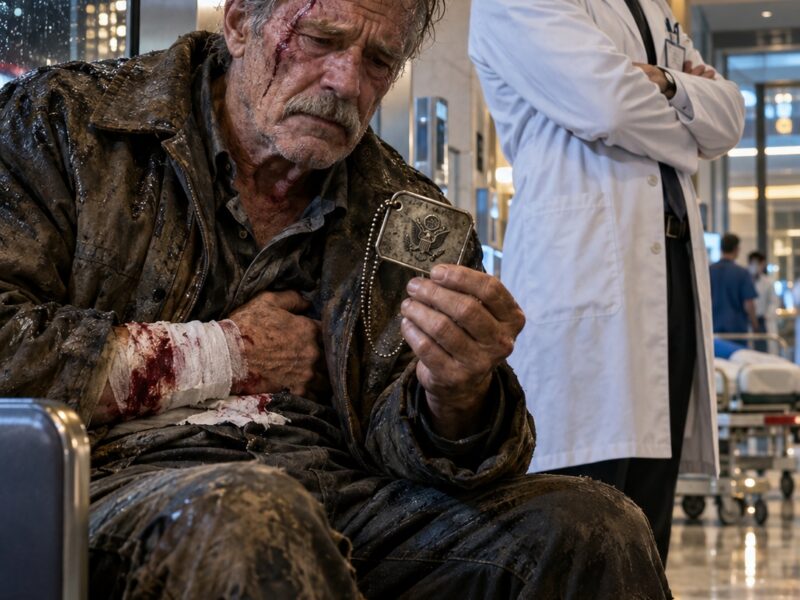
A Doctor Humiliated a Poor, Bleeding Old Man and Left Him in the Hallway—Then His Military File Revealed a Secret About the Doctor’s Father That Changed Everything.
By the time Dr. Everett Blackwood finally understood who the bleeding old man in the hallway was, he had already left him there for three hours and forty minutes.
Three hours and forty minutes beneath a flickering fluorescent light.
Three hours and forty minutes with fractured ribs, blood collecting where it did not belong, and one lung slowly collapsing inside his chest.
And during those hours, Everett had found time for a wealthy man’s sprained ankle.
He had found time to call an orthopedic specialist at home.
He had found time to laugh about a tennis match.
He had even found time to tell the old man, in front of a nurse and half the emergency department:
“You’re not a doctor.”
The old man had simply looked up at him and said quietly:
“No. I never said I was.”
At 2:41 that morning, a restricted military medical record opened on a computer screen at St. Alden Medical Center.
Everett read three lines.
Then he stopped breathing.
Because buried thirty-four years inside that file was his father’s name.
And suddenly the man Everett had judged by a faded canvas coat, cracked boots, and a blank insurance field was no longer a stranger.
He was the reason Everett Blackwood had a father at all.
But by then, the damage had already been done.
The rain had been falling hard over northern Virginia since sunset, turning the county roads into black ribbons of water and smearing the red emergency lights outside St. Alden into trembling reflections across the pavement.
At 11:26 p.m., the automatic doors opened and Caleb Ror walked inside under his own power.
That was the first thing that fooled everyone.
He was sixty-eight, broad through the shoulders despite his age, with silver hair cut shorter than fashion required and a face weathered by decades of sun, cold, and things nobody at the registration desk could see.
His old canvas coat was soaked through.
One sleeve was dark with blood.
His boots were cracked at the toes and muddy from the ditch where his pickup had overturned nine miles outside town.
A local hauler named Dale Apprentice had found the truck folded against a culvert and had driven Caleb to the hospital himself rather than wait for an ambulance.
Caleb had thanked him twice.
Then he had walked through the emergency room doors and apologized to the receptionist for dripping water onto the floor.
That was the second thing that fooled them.
People in serious trouble, Everett Blackwood had learned to believe, looked like people in serious trouble.
They panicked.
They complained.
They demanded.
Caleb Ror did none of those things.
He stood quietly at the triage desk with one hand pressed against his right side while blood seeped through the cloth wrapped around his left forearm.
“Name?” the clerk asked.
“Caleb Ror.”
“Date of birth?”
He gave it.
“Insurance?”
Caleb hesitated.
Not because he did not have coverage.
Because he already knew what was coming.
“I have benefits through my service,” he said. “There’s been an issue with the electronic record.”
The clerk looked at the screen.
“What kind of issue?”
“Old file. It was migrated twice. They’ve been trying to straighten it out.”
“Do you have a card?”
“Not with me.”
Her fingers stopped over the keyboard.
Caleb gave a small, apologetic smile.
“I was going to pick up feed.”
The clerk glanced at his coat.
Then at his boots.
Then at the empty insurance field.
“Take a seat.”
Caleb did.
Nurse Norah Whitaker noticed him less than a minute later.
Norah had worked emergency nights for six years, long enough to understand that patients often lied without meaning to.
They lied when they said they were fine.
They lied when they said the pain was a four.
They lied when they said they could wait.
The body usually told the truth before the mouth did.
And Caleb Ror’s body was telling her something she did not like.
His breathing was too shallow.
Not dramatically shallow.
That would have been easier.
Instead, every breath seemed to stop just before it became complete, as if something inside his chest refused to allow the final inch.
There was gray beneath the weathered color of his face.
He favored his right leg.
His left forearm had been opened by something inside the truck cab, and he had wrapped it with a strip torn from his own shirt.
The knot was tight, high, and strangely precise.
Norah cut the makeshift bandage away.
The wound was deep.
“How bad does it hurt?”
Caleb studied the question as if she had asked him something important.
“Four.”
Norah looked up.
“Out of ten?”
“Yes, ma’am.”
“You’re lying.”
The faintest smile touched his mouth.
“Probably.”
She cleaned around the wound.
“You did this bandage yourself?”
“Yes.”
“You have medical training?”
Caleb looked toward the board where several patient names waited.
“A little.”
“What kind?”
“Old kind.”
Norah almost smiled.
Then Caleb inhaled.
The expression vanished from her face.
His eyes tightened for half a second.
“Your ribs?”
“Probably.”
“Probably?”
“The truck rolled.”
“How many times?”
“Enough.”
Norah checked the monitor again.
“What happened exactly?”
“Wet road. Deer. I corrected too hard.”
“And you walked away from the truck?”
“I crawled first.”
He said it casually.
Norah stared at him.
“Mr. Ror, I’m going to get the doctor.”
Caleb glanced toward a teenage girl being wheeled past with her shoulder held at an unnatural angle.
“Is she worse?”
“That isn’t your concern.”
“It can be.”
“No,” Norah said. “Tonight it’s mine.”
Caleb nodded.
But as she pulled the curtain, he called after her.
“Nurse?”
She turned.
“Take her first if she needs it.”
Norah would remember that sentence later.
At the time, it only irritated her.
Dr. Everett Blackwood entered Bay 6 at 11:40 p.m. looking at a tablet instead of his patient.
At forty-one, Everett had already built the kind of career that made younger doctors study him.
Fellowship trained.
Fast.
Controlled.
Technically gifted.
His charts were clean, his decisions decisive, and his patient turnover among the best in the department.
He had learned early that efficiency was not merely desirable.
It was proof of competence.
Everett had also grown up wealthy enough that privilege had become invisible to him.
His father, Graham Blackwood, sat on St. Alden’s board.
Their family name appeared on a donor wall in the hospital lobby.
Everett had spent his childhood in a house with a circular driveway and his adulthood insisting none of that had mattered because he had still gone to medical school, still survived residency, still worked the brutal overnight shifts.
He believed in merit.
What he did not understand was how often he confused merit with familiarity.
He saw Caleb’s coat first.
Then the boots.
Then the wallet on the tray containing an expired club card and eleven dollars.
Then the blank insurance field.
Only after that did he see the patient.
“Mr. Ror?”
“Yes, sir.”
“Do you have coverage with us?”
Norah looked at Everett.
Not Where does it hurt?
Not Tell me about the crash.
Insurance.
Caleb explained the migration problem again.
Everett tapped the screen twice.
Nothing appeared.
“You don’t have the paper card?”
“No.”
“Why not?”
“I didn’t expect to roll my truck tonight.”
Norah almost laughed.
Everett did not.
He asked Caleb to stand.
Caleb stood.
He asked him to raise his arm.
Caleb raised it.
Everett watched him take two steps.
He did not listen carefully to Caleb’s chest.
He did not examine the right side where Caleb’s hand kept returning.
He did not ask enough about the mechanism of the crash.
He saw a man who could stand.
A man who could talk.
A man who did not appear afraid.
And Everett’s mind finished the diagnosis before his hands had begun the examination.
In the corridor, he lowered his voice.
“We need the bay.”
Norah frowned.
“For what?”
“Incoming.”
“He rolled a pickup.”
“He’s ambulatory.”
“His breathing bothers me.”
“Half the county breathes badly in November.”
“Everett.”
“He’s stable.”
“He has a deep laceration.”
“We can close it later.”
Norah folded her arms.
Everett knew that posture.
“Put him in the hall.”
She stared at him.
“For how long?”
“Until we have space.”
“And the chest?”
“Bruised ribs. Possible contusion.”
“You barely listened.”
Everett’s jaw tightened.
“If his coverage clears, registration can straighten everything out while he waits.”
There it was.
Small.
Clean.
Almost administrative.
A sentence that could hide inside policy.
Norah stood there a second too long.
Then she returned to Caleb.
“I’m sorry,” she said.
“For what?”
“We need to move you into the hallway temporarily.”
Caleb gathered his wet coat.
“That’s all right.”
“It may be a while.”
“I’ve waited in worse places.”
She helped him toward the row of molded plastic chairs.
He lowered himself carefully.
Halfway down, his body stopped.
His right hand pressed hard against his chest.
For three seconds, Caleb did not breathe.
“Mr. Ror?”
Norah stepped forward.
Caleb lifted two fingers.
Wait.
Then the spasm passed.
He took a shallow breath.
“I’m all right.”
“No, you aren’t.”
“I’ve had worse.”
“That doesn’t make this good.”
His eyes shifted toward the treatment rooms.
“How’s the girl with the shoulder?”
Norah stared at him.
“You are unbelievable.”
“Occupational defect.”
“What occupation?”
But Caleb had already closed his eyes.
At midnight, Richard Vale arrived.
His ankle hurt.
That was essentially the entire emergency.
He had rolled it playing indoor tennis at the Fairmont Club.
He arrived wearing a dry wool coat and irritation like a second garment.
His insurance populated instantly.
Platinum plan.
Corporate group.
Everett recognized the firm.
It donated to St. Alden’s foundation every spring.
Within sixty seconds, Richard mentioned that he golfed with someone on the hospital board.
He said it casually.
People like Richard always did.
They never demanded special treatment.
They simply placed the information on the table and allowed everyone else to understand its value.
Richard received Bay 4.
A private room.
A warm blanket.
Then another blanket.
Everett ordered three views of the ankle.
Richard mentioned that his wrist felt strange too.
Everett added another film.
He called orthopedics at home about a next-day consultation.
Then he pulled over a stool and sat at eye level.
“So who won the match?”
Richard laughed.
“Technically nobody. I was up a set.”
“Then I’d put that in the chart.”
Richard laughed harder.
Twenty-two minutes passed.
In the hallway, Caleb Ror sat beneath the buzzing fluorescent light and quietly stopped taking full breaths.
At 1:00 a.m., registration clerk Priya Gilmore approached him with a clipboard.
“I need a member number.”
Caleb gave her an eight-digit identifier from memory.
She typed it.
Rejected.
He gave her his service dates.
Rejected.
He gave her the regional office.
Nothing.
“I’m sorry,” Priya said.
“You didn’t build the computer.”
She looked embarrassed.
“My appointment to straighten it out is in January,” Caleb continued. “They said the old records were transferred wrong.”
“I’ll ask the doctor how he wants me to code it.”
“Thank you.”
Priya found Everett writing a discharge.
“The veteran in the hall still isn’t verifying.”
“Self-pay, unverified.”
“He says he has benefits.”
“The system says he doesn’t.”
Norah was close enough to hear.
“He needs repeat vitals.”
Everett did not look up.
“He’s been sitting there talking for over an hour.”
“That is not a vital sign.”
“He needs four minutes, Everett.”
Now he looked at her.
“You’re getting invested.”
“I’m doing my job.”
“So am I.”
“No. You’re looking at his insurance.”
Everett exhaled.
“Norah, people learn how emergency departments work. They know what symptoms get beds.”
She went still.
“What exactly are you saying?”
“I’m saying I’ve been doing this long enough to know the difference between a sick man and somebody looking for somewhere warm to spend the night.”
For a moment, neither spoke.
Then Norah turned around.
She took a blood-pressure cuff and pulse oximeter into the hallway without asking permission.
Caleb rolled up his good sleeve.
The movement pulled his collar sideways.
Norah saw the scar.
It ran over his shoulder toward the blade, wide and pale, crossed by an older surgical line.
She had seen scars from falls.
Scars from machinery.
Scars from knives.
This looked different.
It looked like damage followed by repair followed by another repair.
Her eyes moved down.
There were more scars along his forearm.
Another thin line disappeared beneath his shirt near the ribs.
“What did you do for work?” she asked.
Caleb considered his answer.
“I worked in places that didn’t have emergency rooms.”
Norah looked at him.
“What does that mean?”
“It means I learned to be patient.”
The cuff finished inflating.
92 over 58.
Norah’s expression changed.
His heart rate was 116.
She clipped the oxygen monitor onto his finger.
The number hovered.
Dropped.
Recovered.
Then dropped again.
Caleb read it upside down.
He nodded once.
That frightened her more than panic would have.
“You knew.”
“I suspected.”
“Suspected what?”
He did not answer.
Norah leaned closer.
“Mr. Ror, what aren’t you telling me?”
He looked toward the treatment rooms.
“Did that girl’s shoulder go back in?”
“What?”
“The teenager.”
“Yes.”
“First attempt?”
“Yes.”
Something in Caleb’s face relaxed.
Norah stared at him.
Then she noticed his fingernails.
Blue.
Not much.
Just enough.
She stood.
“I’m going to argue with somebody.”
Caleb almost smiled.
“Be careful.”
“Why?”
“I’ve known good people ruined by smaller arguments.”
This time Norah did not smile.
She walked straight to Everett.
“His pressure has dropped. Heart rate is over one-ten. His oxygen is drifting and his fingers are cyanotic.”
Everett continued typing.
“I want a chest film.”
“He’s been sitting upright talking.”
“I want a chest film now.”
Everett stopped.
Then he looked at her with the quiet expression that irritated her more than anger ever could.
“Are you tired?”
“What?”
“Night shift does things to judgment. You know that.”
Norah stared at him.
“You think I’m imagining cyanosis?”
“I think you’ve attached yourself to this patient.”
“I think you attached yourself to an empty insurance field.”
That landed.
Everett stood.
“Fine.”
He took his stethoscope and walked into the hallway.
The examination lasted less than two minutes.
Two places on the left chest.
One on the right.
Over clothing.
A brief press over the abdomen.
A glance at the wrapped arm.
“Did you hit your head?”
“No.”
“Lose consciousness?”
“No.”
Everett straightened.
“Bruised ribs. Possible contusion. Nothing suggests a surgical emergency.”
Caleb watched him.
“The arm can be closed when a bay opens,” Everett continued. “You’re not a priority tonight, Mr. Ror. That’s actually good news.”
Caleb’s expression did not change.
“Doctor?”
“Yes?”
“Are you certain my right lung is fully inflating?”
Everett paused.
It was not the kind of question he expected from a man in a patched coat.
“What makes you ask that?”
“I know the feeling.”
“What feeling?”
“When a lung stops opening all the way.”
Norah’s eyes moved immediately to Everett.
Caleb continued.
“There’s a tightness behind the collarbone. Different from rib pain. It’s been getting worse.”
“How would you know that?”
“I’ve felt it before.”
Everett heard the words.
But not their meaning.
He heard what experience had trained him to hear from patients who arrived after searching symptoms online.
“Mr. Ror, you’re not a doctor.”
The hallway went quiet.
Caleb looked at him for a long moment.
There was no anger in his face.
That was what Norah remembered later.
No humiliation.
No wounded pride.
Just a strange, exhausted patience.
“No,” Caleb said.
“I never said I was.”
Everett returned to the station.
Before he reached his chair, his phone rang.
Father.
Graham Blackwood wanted to know whether Richard Vale was being looked after properly.
Richard had apparently called a friend.
The friend had called Graham.
Graham reminded Everett that relationships mattered.
“Reputation in certain circles compounds,” his father said.
“I know.”
“Make sure orthopedics sees him before noon.”
“I already called.”
“Good.”
Everett hung up.
He did not look toward the hallway.
At 1:40 a.m., something hit the wall.
Norah turned.
Caleb had tried to walk to the restroom.
He made it two steps.
Then his body went sideways.
Norah reached him before the floor did.
“Help!”
A tech named Oscar Reyes ran from the station.
Together they lowered Caleb into a chair.
His skin was cold.
Wet.
His pulse felt thin and fast beneath Norah’s fingers.
His coat slipped from the seat.
Something metal fell from the inside pocket.
It struck the tile.
Spun.
Stopped against Norah’s shoe.
She picked it up.
Not a dog tag.
A thin metal identification card, edges polished smooth by decades of use.
CALEB ROR.
Beneath it was a number.
And two letters Norah recognized only vaguely from military records.
She looked at Caleb.
His eyes were closed.
Norah carried the card to the station.
St. Alden had installed a connection to the national veterans database two years earlier.
She entered the number.
For several seconds, nothing happened.
Then a red banner appeared.
RESTRICTED RECORD — CLINICAL AUTHORIZATION REQUIRED.
Norah sat back.
She had never seen that message.
A few basic fields populated beneath it.
Service confirmed.
Eligibility confirmed.
Medical history: 241 pages.
Norah grabbed the phone.
The veterans liaison answered on the fourth ring.
His name was Walter Ames.
She gave him Caleb’s identifier.
She heard typing.
Then the typing stopped.
“You have the patient there?”
“Yes.”
“Active emergency?”
“I believe so.”
Another pause.
“His benefits are valid.”
Norah closed her eyes.
“So why isn’t our system recognizing them?”
“Legacy migration problem. We’ve got thousands caught in the backlog.”
Everything Caleb had said had been true.
Every word.
“Can you open the file?”
“Parts of it are restricted. I can request temporary clinical release if this is an active emergency.”
Everett appeared behind her.
“What are you doing?”
Norah covered the receiver.
“His benefits are confirmed.”
“That doesn’t change his medical presentation.”
“There’s a restricted medical file.”
Everett gave a small laugh.
Not because anything was funny.
Because dismissal had become reflex.
“Restricted records aren’t magical, Norah.”
“I didn’t say they were.”
“Plenty of career military people have protected records.”
“I want the chest X-ray.”
“We’re not imaging an unverified self-pay patient at two in the morning because a nurse found an old military card.”
“His coverage was just verified.”
“Not in our system.”
“Then override it.”
“I’m the attending.”
“Exactly.”
“And I’m not overriding my own assessment.”
Forty feet away, Caleb’s breathing changed.
Both of them heard it.
A short, sharp catch.
Then another.
Norah turned.
Caleb was leaning forward, elbows against his knees, mouth open.
The muscles above his collarbones pulled tight with every breath.
His shoulders rose.
His body was trying to create space that was no longer there.
Norah moved.
She grabbed the nearest wheelchair.
“What are you doing?”
“Saving your patient.”
She rolled Caleb through the doors and into Bay 2.
“Norah.”
“Monitor!”
Oscar came running.
“Respiratory now.”
“Norah!”
She got Caleb onto the bed.
The oxygen saturation appeared.
Norah turned on oxygen.
Everett reached the doorway.
“You took an emergency bay without authorization.”
“I don’t care.”
“This will be documented.”
“I don’t care if he has one dollar or a million dollars.”
She turned and looked straight at Everett.
“He cannot breathe.”
Everett opened his mouth.
Then, perhaps for the first time that night, he actually looked.
Not at Caleb’s coat.
Not his chart.
Not the insurance field.
At Caleb.
The right side of his chest was barely moving.
His trachea sat slightly off center.
Everett pulled the shirt open and placed the stethoscope directly against bare skin.
Left.
Breath sounds.
Right.
Nothing.
He moved lower.
Nothing.
The silence beneath the stethoscope seemed to fill the room.
Everett’s face changed.
“Portable chest. Now.”
Nine minutes later, the image appeared.
Right-sided pneumothorax.
The lung had collapsed away from the chest wall.
Three fractured ribs formed a stair-step pattern.
Fluid density gathered at the base.
Blood.
Norah looked at the screen.
Then at Everett.
Nobody said I told you so.
There are moments when the truth is too ugly for victory.
The chest tube tray arrived.
Dr. Miles Carver’s name went onto the consent because Everett’s hands were no longer entirely steady.
Caleb remained conscious.
Barely.
When the tube entered his chest and trapped air escaped, his lung slowly began expanding again.
His first real breath in hours filled him so deeply that his eyes closed.
“Thank you,” he whispered.
Norah leaned closer.
“You’re welcome.”
Caleb opened his eyes.
“Norah.”
“Yes?”
“Thank you, Norah.”
Everett stood on the opposite side of the bed.
Caleb did not look at him.
At 2:41 a.m., Walter Ames obtained temporary authorization for the restricted military record.
The red banner disappeared.
A document opened.
Everett sat at the computer with his gloves still on.
He told himself he needed the medical history.
That was partly true.
Another part of him simply needed to understand the old man who had recognized the sensation of a collapsing lung while sitting calmly beneath fluorescent lights.
The first page contained a summary.
Everett read.
Senior Combat Rescue Medic.
Special Operations Support.
Twenty-six years of service.
The deployment count made him read the line twice.
Then came the injuries.
Eleven documented wounds sustained during duty.
Four surgical repairs to the left shoulder.
A penetrating injury to the flank.
An entry describing emergency field treatment performed by Caleb on himself while awaiting evacuation.
Everett scrolled.
Another incident.
Caleb declined evacuation to remain with casualties who could not be moved.
Another.
Refused pain medication until other wounded personnel received theirs.
Another.
Nineteen personnel recovered alive from hostile positions during a single deployment.
The language was dry.
Administrative.
There were no heroic adjectives.
That made it worse.
Norah stood behind Everett.
Neither spoke.
In Bay 2, the man described in those pages was asking Oscar whether someone could call his neighbor and make sure his dog had been fed.
Everett kept scrolling.
Thirty years.
Thirty-one.
Thirty-two.
Then he reached an incident report from an ambush on a supply road overseas.
A convoy.
A buried explosive.
Multiple casualties.
A defensive position held through most of the night.
A medic crossing open ground twice.
Everett read the casualty list.
He almost scrolled past the name.
Then his hand stopped.
BLACKWOOD.
He leaned closer.
Lieutenant.
Femoral injury.
Penetrating abdominal wound.
Field stabilization lasting six hours and forty minutes.
Primary medic: Caleb Ror.
Everett stared.
The first name was Graham.
For a moment, the emergency department seemed to recede.
The monitors.
The phones.
The rolling carts.
Everything moved far away.
His father.
Graham Blackwood.
Everett knew the scar on his father’s thigh.
He had seen it since childhood, a thick seam disappearing beneath swim trunks.
“Old accident,” Graham had always said.
Nothing more.
Everett had never heard the word ambush.
Never heard about the ditch.
Never heard about a medic.
He had grown up believing his father’s story began with determination.
A young veteran came home, worked hard, built a company, accumulated wealth, joined boards, raised a son.
But that story had another first page.
Before the company.
Before the house.
Before Everett himself.
A stranger had lain in a ditch with both hands pressed against Graham Blackwood’s artery for six hours and forty minutes.
That stranger was now lying twenty feet away with a tube in his chest.
And Everett had put him in a hallway.
Because of his coat.
Because of his boots.
Because of eleven dollars in a wallet.
Because a computer field had been blank.
“I told him he wasn’t a doctor,” Everett whispered.
Norah said nothing.
“He never said anything.”
Still nothing.
Everett looked at her.
“Why didn’t he tell us?”
Norah walked into Bay 2.
Caleb was awake.
His color had improved.
The chest tube chamber sat beside the bed.
Norah pulled a chair closer.
“Can I ask you something?”
“You’ve earned one.”
She almost smiled.
“Why didn’t you tell us?”
Caleb looked at her.
“Tell you what?”
“What you did.”
He understood immediately.
Norah continued.
“One sentence would have changed tonight. You could have told registration. You could have told me. You could have told Dr. Blackwood.”
Caleb was quiet.
“I would have fought harder if I’d known.”
The words left her mouth.
Then she heard them.
She stopped.
Caleb watched her realize it.
There was no accusation in his expression.
That made the realization hurt more.
“I didn’t come here to trade my past for a hospital bed,” he said.
Norah looked down.
“The minute I do that, it means the man without a past like mine doesn’t get the bed.”
His voice remained soft.
“I’ve been that man’s medic too.”
Norah swallowed.
Caleb looked toward the ceiling.
“I spent twenty-six years doing a job where you treated the worst injury you could reach. Rank didn’t matter. Nationality didn’t matter. Whether you liked the man didn’t matter.”
He breathed carefully.
“If I have to show somebody a medal before they listen to my lungs, then proving I’m special doesn’t fix anything.”
He paused.
“It just creates an exception.”
“And sitting out there while your lung collapsed?”
A shadow of embarrassment crossed his face.
“That part was pride.”
“You could have died.”
“I know.”
“You knew something was wrong.”
“I knew enough to know I should’ve pushed harder.”
“Why didn’t you?”
Caleb looked toward the curtain.
“Because sometimes the habits that keep you alive when you’re young become the habits that nearly kill you when you’re old.”
Norah sat with that.
Then Caleb added:
“I own that part.”
Everett was still staring at the file when she returned.
“Does he know who I am?” he asked.
“I don’t think your name means anything to him.”
Everett looked almost offended by the possibility.
Then ashamed that he had been.
At 3:19 a.m., he called his father.
Graham answered on the second ring.
“What happened?”
“There was an accident.”
“With Vale?”
“No.”
Everett closed the physician alcove door.
“A patient came in tonight. Single-vehicle rollover.”
“Okay.”
“There was a delay in treatment.”
Silence.
Everett pressed his thumb against the edge of the desk.
“I’m going to have to explain some things later.”
“What patient?”
“His name is Caleb Ror.”
The line went silent.
Not normal silence.
Not confusion.
Everett checked the screen to make sure the call had not dropped.
“Dad?”
When Graham finally spoke, his voice had changed.
Everett had never heard that voice.
It did not belong to the wealthy businessman.
Not to the board member.
Not to the father who had taught him how to shake hands properly at twelve.
It sounded young.
Almost frightened.
“Say that name again.”
“Caleb Ror.”
Another silence.
Then Graham whispered:
“What did you do to him?”
Graham Blackwood arrived at St. Alden shortly after four wearing a raincoat over pajama pants.
Everett had never seen his father outside the house looking unprepared.
His hair was uncombed.
His face was pale.
He had driven himself.
Everett met him near the ambulance entrance.
“He’s stable now. We placed a chest tube. Imaging showed—”
Graham walked past him.
“Dad.”
No response.
“There were fractures and—”
Graham reached Bay 2.
He stopped in the doorway.
Caleb looked up.
For eleven feet and thirty-four years, neither man spoke.
Graham placed one hand against the doorframe.
“I’ve been looking for you for a long time.”
Caleb studied the expensive raincoat, the gray hair, the trembling hands.
Then recognition arrived slowly.
“Lieutenant?”
Graham laughed once.
It broke halfway out.
“You remember?”
“I remember most people I spend six hours inside a ditch with.”
Graham stepped closer.
“I wrote letters.”
“So did a lot of people.”
“I tried to find you.”
Caleb raised an eyebrow.
“Maybe not very hard.”
Another broken laugh.
Graham sat beside the bed.
For the next half hour, Everett heard a story his father had never told him.
A spring road.
A convoy.
An explosion that lifted a vehicle.
A twenty-nine-year-old lieutenant thrown into a drainage ditch with a torn femoral vessel and a wound through his abdomen.
Graham had known he was dying.
Not suspected.
Known.
Then a medic appeared.
Caleb crossed exposed ground to reach him.
Then crossed it again to retrieve equipment.
He put his hands into wounds no human being should have to touch.
He kept pressure on Graham’s leg.
He talked.
About Virginia.
About Graham’s mother.
About food.
About baseball.
About anything that might keep a dying man awake.
“How long?” Everett asked.
Graham did not look at him.
“Six hours and forty minutes.”
“You remember that?”
“I learned the number later.”
His eyes stayed on Caleb.
“What I remember is him refusing to let go.”
Gunfire came closer.
Caleb did not leave.
At dawn, evacuation finally arrived.
Graham remembered being lifted toward the helicopter.
He had reached for Caleb’s sleeve.
Caleb pulled away.
Not cruelly.
There were two more wounded men in the ditch.
Graham woke eleven days later in another country.
The medic’s name had been written differently on two forms.
He searched.
He wrote letters.
Then fewer letters.
Life accumulated.
Business.
Marriage.
A son.
A hospital board.
And somewhere along the way, the search for the man who had saved him became something Graham always intended to return to.
“I thought you’d become somebody important,” Graham admitted.
Caleb looked genuinely amused.
“I got forty acres and a bad shoulder.”
Graham lowered his head.
“That wasn’t what I meant.”
“I know.”
Caleb’s voice softened.
“But that was the point, Lieutenant.”
“What was?”
“You went home.”
He looked toward Everett.
“That’s the whole job.”
The room became quiet.
Eventually Graham stood.
He turned toward his son.
The warmth disappeared from his face.
“Why was he in the hallway?”
Everett had spent the previous hour constructing an answer.
Now he used it.
“Capacity.”
Graham said nothing.
“His presentation was atypical.”
Nothing.
“His insurance couldn’t be verified.”
Still nothing.
“We had multiple patients. Bed assignment requires triage judgment, especially overnight, and—”
Graham allowed him to finish.
Every word.
Policy.
Verification.
Capacity.
Documentation.
Atypical presentation.
Other patients.
Caleb had not reported severe pain.
When Everett finally stopped, Graham looked at him.
“You didn’t need to know who he was.”
Everett’s mouth opened.
Graham continued.
“You didn’t need to know what he did for me.”
His voice remained low.
“You didn’t need a military record.”
Everett felt something in him begin to collapse.
“You only needed to treat him like a human being.”
No accusation that followed could have hurt more.
Because Everett had already begun constructing a safer version of his failure.
In that version, he had failed to recognize a hero.
That was tragic.
Embarrassing.
But survivable.
His father had just destroyed it.
The problem was not that Everett had failed to recognize an extraordinary man.
The problem was that he had believed an ordinary poor man deserved less attention.
At 4:50 a.m., Dr. Miles Carver arrived.
Fifty-eight.
Trauma physician.
Nine years of military medicine before entering civilian practice.
When he saw the words combat rescue medic in Caleb’s record, he understood them without needing to search anything.
He entered Bay 2.
For half a second, Miles came to attention.
Then he relaxed and introduced himself.
“Dr. Carver. I’ll be taking over your care.”
Caleb looked at him.
“You can relax, Doc.”
“I’ll try.”
Miles examined him thoroughly.
Then he found Everett.
“I need badge logs.”
Everett looked up.
“Tonight?”
“Tonight.”
“Why?”
“Monitor downloads. Registration timeline. Nursing notes from eleven forward.”
“Miles—”
“And every documented bed assignment.”
Everett went still.
Miles’s voice remained perfectly calm.
“I want them before morning shift arrives.”
Everett understood.
This was no longer about his father.
It was no longer about Caleb’s history.
It was no longer something Graham Blackwood could quietly solve with a conversation behind a closed door.
The hospital had nearly allowed a man to die because somebody decided what he was worth before examining him.
And there would be a record.
The review lasted eleven days.
Its most damaging document was not dramatic.
Four pages.
A timeline.
11:26 p.m.
Caleb Ror presented after a high-energy motor vehicle rollover with abnormal respiratory findings.
11:40.
Initial physician encounter.
Incomplete chest examination.
11:51.
Patient moved to non-clinical hallway area.
12:00.
Richard Vale presented with isolated ankle injury.
Private bay assigned.
Additional imaging ordered.
Specialist contacted.
1:00.
Insurance verification failure for Caleb.
1:08.
Nursing reassessment requested.
1:17.
Request declined.
1:40.
Patient collapsed.
2:00.
Respiratory deterioration.
2:09.
Imaging confirmed pneumothorax, fractured ribs, and accumulating blood.
Four pages.
No adjectives.
No outrage.
No moral commentary.
Just time.
Time was enough.
Miles sat across from Everett in a small conference room.
“Doctors miss diagnoses.”
Everett looked up.
“I know.”
“I have.”
Miles folded his hands.
“Every physician who practices long enough will.”
Everett waited.
“A pneumothorax in a stoic patient can be missed.”
“So you understand.”
“No.”
Everett’s face tightened.
“That isn’t what happened.”
Miles pushed the timeline forward.
“You didn’t examine him thoroughly and get it wrong.”
Silence.
“You decided what kind of man he was before you examined him.”
Everett looked away.
“Then you built a medical decision around that judgment.”
“I was managing a full department.”
“And when Norah gave you evidence that contradicted your judgment?”
Everett said nothing.
“You defended the judgment.”
Miles tapped the timeline.
“For hours.”
Everett’s jaw tightened.
“You think I wanted him harmed?”
“No.”
That answer seemed to hurt more.
“I think you didn’t believe he mattered enough to be dangerous to ignore.”
Everett was suspended from independent emergency coverage pending review.
The incident entered his professional file.
The medical executive committee received the case.
The state reporting process began where required.
Nothing was quietly removed.
Everett went home to his apartment with its expensive view and sat inside it for eleven days.
For the first two, part of him still waited for his father to intervene.
Graham had sat on the hospital board for nineteen years.
Everett had watched phone calls rearrange schedules, introductions, contracts, opportunities.
Surely this would be different.
It was his career.
His father knew the context.
His father knew him.
On the second morning, Graham filed a written recusal from every proceeding related to the incident.
Everett called immediately.
“What are you doing?”
“What I should.”
“You know they’ll report this.”
“Yes.”
“My career could change.”
“Yes.”
“You’re my father.”
“I know.”
“Then help me.”
There was a long silence.
Graham’s answer came quietly.
“If you need my influence to escape the consequences, then you still don’t understand what happened in that hallway.”
The call ended.
Caleb, meanwhile, spent nine days recovering.
On the sixth day, Miles sat beside his bed.
“You have grounds to file a formal complaint.”
Caleb looked out the window.
“I assumed.”
“The hospital will not obstruct it.”
“I know.”
“You could ask for disciplinary action.”
Caleb turned toward him.
“Would they fire him?”
“That could be an outcome.”
“And then?”
Miles hesitated.
“We hire another doctor.”
“Who might believe exactly what he believes.”
“That’s possible.”
“Only next time he’ll know not to say it out loud.”
Miles leaned back.
“What do you want?”
Caleb thought for a while.
“Firing a man is easy.”
“Sometimes it’s necessary.”
“I know.”
Caleb rubbed the edge of the blanket between his fingers.
“But if he’s going to practice medicine again, make him remember something.”
“What?”
“That a patient becomes a patient before he becomes a billing record.”
Miles said nothing.
Caleb looked at him.
“That’s worth more to me than his job.”
Miles carried those words into the committee hearing.
They did more to Everett than a demand for termination might have.
A man can fight an enemy.
He can argue against punishment.
He can call consequences unfair.
What is harder to fight is mercy from the person you harmed.
The committee issued its decision in early December.
Ninety days without independent emergency practice.
Mandatory medical ethics training.
A separate program addressing judgment and bias in triage.
Competency reassessment.
Six months of direct supervision after his return.
The punishment did not destroy Everett’s career.
Neither did it erase what he had done.
The institution made a different choice.
If he could be salvaged, he would have to prove it.
Every day.
In February, Everett drove beyond the county line to Caleb’s farm.
Forty acres.
A modest house.
A porch that needed paint.
A dog that barked once, sniffed Everett’s hand, and apparently decided he was not worth further investigation.
Caleb opened the door.
“Doctor.”
“Mr. Ror.”
“You planning to stand there?”
Everett had rehearsed the conversation during the entire drive.
Inside, Caleb poured coffee.
Everett barely touched it.
“I owe you an apology.”
Caleb waited.
“What happened that night—”
Caleb slid a folder across the kitchen table.
Everett stopped.
Inside was a photocopy of the emergency record.
Nothing military.
No medals.
No casualty report.
No classified pages.
Only the intake form.
Triage vitals.
Blank insurance field.
Timestamps.
Everett looked up.
“Why are you showing me this?”
“Because you’re still thinking about the wrong thing.”
“I don’t understand.”
“You came here because of your father.”
Everett said nothing.
“You’re thinking about that ditch.”
Nothing.
“You’re thinking about who I used to be.”
Caleb leaned forward.
“Don’t remember my name.”
Everett stared at him.
“Remember the next old man.”
“What?”
“The next one who walks through those doors wearing a bad coat.”
Caleb tapped the blank insurance field.
“The one who doesn’t have a military file.”
Everett looked down.
“No commendation.”
Tap.
“No casualty list.”
Tap.
“No board member coming through the hospital at four in the morning.”
Everett’s throat tightened.
“There’s not going to be a screen opening at three a.m. telling you that man was secretly worth saving.”
Caleb sat back.
“He’ll just be a man.”
The kitchen became very quiet.
“That’s the one,” Caleb said.
“The one nobody important knows.”
Everett could not look away.
“That’s the only one that was ever the point.”
The drive home took fifty minutes.
Everett never turned on the radio.
He returned to St. Alden in March.
Under supervision.
Nobody welcomed him back with speeches.
Norah certainly did not.
She had been offered a move to days and declined it.
She did not forgive Everett.
At least not in any way he could see.
But she watched.
In April, a man came in from the interstate wearing wet socks and carrying no identification.
Everett took a blanket from the warmer himself.
He crouched and placed it around the man’s shoulders before registration finished asking questions.
Norah noticed.
She said nothing.
In May, a clerk stood beside a patient’s bed and began:
“I just need to verify your—”
“After the exam,” Everett interrupted.
The clerk looked surprised.
“Doctor?”
“Clinical evaluation first.”
Norah heard that too.
She said nothing.
In June, Everett was supervising a resident three weeks out of orientation.
A patient had arrived with no wallet and a confusing history.
The resident stared at the registration screen.
Everett stood beside him.
“Condition first,” he said.
The resident nodded.
“Paperwork second.”
Everett glanced across the station.
Norah was watching.
He continued.
“And if you catch yourself deciding how sick somebody is before you’ve put your hands on them, stop.”
The resident looked confused.
“Why?”
“Because whatever you’re looking at probably isn’t the patient.”
Norah held Everett’s gaze for a moment.
Then she returned to her charting.
That was all.
He understood he had not earned more.
Caleb went home to his forty acres.
He declined an interview when a county reporter learned enough of the story to call.
He declined a civic award.
He declined a plaque the hospital facilities committee proposed placing near the ambulance entrance.
“I don’t want my name on a wall,” he told them.
In spring, Graham Blackwood drove to the farm.
This time he arrived with a proposal.
A foundation.
Substantially funded.
Named after Caleb Ror.
Caleb stopped him before he finished.
“No.”
“Caleb—”
“No.”
“Would you at least hear what it would do?”
“I’ll tell you what I want instead.”
Graham waited.
Caleb wanted someone in the emergency department twenty-four hours a day who could resolve coverage problems involving veterans with legacy records.
Not only veterans.
Anyone whose eligibility could not immediately be verified.
And he wanted one rule written into the system.
“What rule?” Graham asked.
Caleb answered without hesitation.
“Clinical evaluation continues while verification runs.”
Graham nodded slowly.
“What do you want the program called?”
“Anything except my name.”
“Why?”
Caleb looked across the field.
“Because if you put my name on it, people will think I earned it.”
“You did.”
“That’s the problem.”
He turned back toward Graham.
“Nobody should have to.”
They called it the Open Door Program.
It launched in September.
Two full-time advocates worked with registration and emergency staff.
A new triage instruction appeared in the protocol:
Care would not be delayed while financial eligibility was being resolved.
In its first eleven months, the program caught more than four hundred cases that might otherwise have waited.
Almost nobody knew why it existed.
Caleb preferred that.
A year later, on a rainy Tuesday shortly after midnight, a man around fifty entered St. Alden Medical Center.
His jacket was stiff with dirt.
He held his right side.
No wallet.
No insurance card.
When the registration clerk asked his name, he gave one.
Then, a minute later, gave another.
The clerk looked uncertain.
Everett Blackwood happened to be passing behind the desk.
“Doctor?”
He stopped.
She pointed at the screen.
“Insurance?”
For a second, Everett looked at the blank field.
Years earlier, another blank field had told him a story.
Poor.
Unverified.
Low priority.
Maybe exaggerating.
Maybe looking for shelter.
Maybe not worth the resources yet.
He looked at the man.
Wet coat.
Dirty hands.
Fear hidden beneath irritation.
No remarkable biography waiting to rescue him from somebody else’s assumptions.
Everett remembered a kitchen table.
A photocopied intake sheet.
A finger tapping an empty box.
The next old man.
The one with no file.
The one nobody important knows.
“We’ll take care of him first,” Everett said.
The clerk blinked.
“But registration—”
“Can run while we examine him.”
Everett stepped around the desk.
He did not ask the man whether he could pay.
He did not ask whether someone important knew him.
He did not search for evidence that compassion had been earned.
He simply pulled a pair of gloves from the wall.
“Sir, I’m Dr. Blackwood.”
The man looked suspiciously at him.
Everett crouched until they were at eye level.
“Tell me where it hurts.”
Across the emergency department, Norah Whitaker heard him.
She looked up.
For a moment, Everett thought she might smile.
She didn’t.
She returned to her chart.
And somehow that was better.
Because this was not redemption.
Not yet.
Maybe not ever in the clean, comforting way people liked stories to end.
Caleb’s damaged ribs still hurt when the weather turned cold.
Norah still remembered the blue beneath his fingernails.
Everett still had to live with three hours and forty minutes that no apology could return.
Graham still carried the knowledge that the man who once refused to leave him in a ditch had later been abandoned in a hospital hallway by his own son.
Some things do not disappear because a lesson has finally been learned.
They remain.
Like scars.
Not always visible.
Never entirely gone.
But sometimes a scar can become more than evidence of damage.
Sometimes it becomes a boundary you refuse to cross again.
Years before, Caleb Ror had spent six hours and forty minutes holding pressure on the wound of a young lieutenant because, to him, the man in that ditch did not need to be important.
He only needed to be hurt.
Decades later, Caleb walked into a hospital bleeding and discovered how easily the civilized world could forget that simple rule.
His military file eventually opened.
The commendations appeared.
The classified history appeared.
The names appeared.
And one of those names happened to belong to the father of the doctor who had dismissed him.
But none of that was the reason Caleb deserved a bed.
That was the truth Everett took longest to understand.
Caleb deserved care before anyone knew he had saved nineteen people.
Before anyone knew he had crossed open ground under fire.
Before Graham Blackwood came running through the hospital doors in pajamas.
Before a computer finally decided that his life contained impressive enough information to command attention.
He deserved care when he was only an old man in a wet coat.
He deserved care when there were eleven dollars in his wallet.
He deserved care when the insurance box was empty.
He deserved care when nobody knew his name.
And perhaps that was why Caleb never accepted the plaque.
A plaque would have turned the story into something comfortable.
A story about a secret hero finally receiving the respect he deserved.
But Caleb knew better.
Because somewhere, on another rainy night, another person would walk through another set of emergency doors with no medals, no influential friends, no extraordinary history, and nothing on a computer screen capable of transforming indifference into respect.
There would be no hidden file.
No shocking revelation.
No wealthy father racing through the rain.
Just a frightened human being asking for help.
And that person—
Caleb understood—
was the real test.









