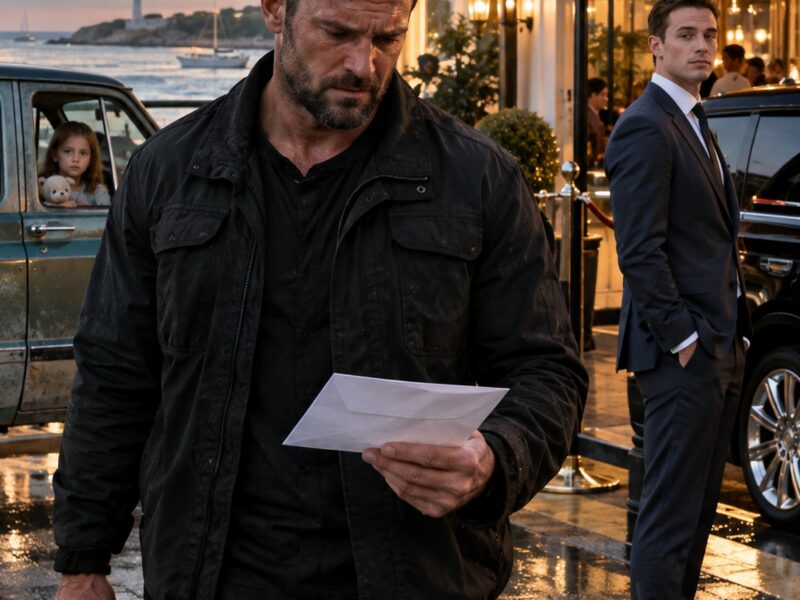
A Former Navy SEAL Was Fired With $20 Left—Then a Billionaire Mother Saw What He Did for Her Daughter
The day Rowan Cade ran out of ways to lie to his daughter began with a suitcase, twenty-three dollars in his wallet, and a termination envelope he couldn’t bring himself to open twice.
He stood behind the Harbor House restaurant in Newport, Rhode Island, with the Atlantic wind cutting through his faded black jacket and his right hand wrapped around the handle of a battered olive-green suitcase.
Inside were two work shirts, a toothbrush, an old Navy sweatshirt, three photographs, and everything he’d cleaned out of his locker after six years of working nights.
Across the parking lot, his eight-year-old daughter sat inside his truck with a purple notebook balanced on her knees.
Marabel was drawing.
She always drew when she was worried.
Rowan knew that because she had inherited the habit from her mother.
He also knew she had started drawing twenty minutes earlier, which meant she already understood something was wrong.
Children usually did.
Adults simply lied to themselves about how much children noticed.
Rowan looked down at the white envelope again.
EMPLOYMENT TERMINATION.
Effective immediately.
No severance.
No unused vacation payout beyond what was already reflected in his final check.
The new management company had decided Harbor House no longer required overnight security.
A business decision, they had called it.
Nothing personal.
That phrase had followed Rowan through civilian life like a bad joke.
Nothing personal when the boatyard cut his hours.
Nothing personal when the warehouse replaced half the overnight crew with automation.
Nothing personal when his landlord taped a red notice to the apartment door telling him he had forty-eight hours to produce $1,840 or leave.
Nothing personal when the electric company shut off power three nights earlier while Marabel was halfway through her spelling homework.
Rowan had spent twelve years learning how to stay alive in places where mistakes were measured in body bags.
And now he was losing a war to overdue notices.
He folded the termination letter once, then again.
For several seconds, he stared toward the ocean beyond the restaurant.
He had carried injured men under gunfire.
He had spent thirteen hours in freezing water during training.
He had once stayed awake almost three days because sleeping meant somebody else might not come home.
None of it had frightened him the way one sentence from his daughter had frightened him that morning.
“Dad, are we poor now?”
He hadn’t answered.
That silence had been answer enough.
The rear door of the restaurant opened behind him.
“Rowan.”
He turned.
Cal Mercer, the new general manager, stood there with both hands shoved into the pockets of his expensive wool coat.
Cal was thirty-two, maybe thirty-three. Business degree. Perfect teeth. Hair that always looked recently cut.
He had been managing Harbor House for eleven weeks.
“Forgot this.”
He extended Rowan’s thermos.
Rowan took it.
“Thanks.”
Cal shifted awkwardly. “For what it’s worth, I argued for two more weeks.”
Rowan looked at him.
“You don’t have to do that.”
“Do what?”
“Try to make it hurt less.”
Cal swallowed.
“I’m serious.”
“So am I.”
The wind rattled a loose sign over the loading entrance.
Cal stared past Rowan at the old Ford pickup.
Through the windshield, Marabel could be seen bent over her notebook.
“Your daughter?”
Rowan nodded.
Cal’s face tightened.
Rowan recognized the expression.
Pity.
He hated pity more than hunger.
“Don’t,” Rowan said quietly.
Cal looked back at him. “Don’t what?”
“Look at her like that.”
“I wasn’t—”
“You were.”
Cal’s jaw worked for a moment.
Then he nodded.
“I’m sorry.”
Rowan turned toward the truck.
“Take care of yourself, Cade.”
Rowan kept walking.
Halfway across the lot, Cal called after him.
“If you need a reference—”
“I’ll call.”
They both knew Rowan probably wouldn’t.
He reached the truck and opened the driver’s door.
Marabel immediately closed the notebook.
Too quickly.
“What were you drawing?”
“Nothing.”
Rowan leaned against the door.
“Must be an impressive nothing. Took you twenty minutes.”
She gave him the tiniest smile.
Then her eyes moved toward the suitcase.
“Why’d you bring your stuff out?”
There it was.
Rowan had rehearsed this moment three times in the restaurant bathroom.
He’d had good versions.
Responsible versions.
Adult versions.
None of them survived his daughter’s face.
“The restaurant is changing some things.”
“Are you working tonight?”
“No.”
“Tomorrow?”
He hesitated.
Marabel looked at the suitcase again.
“Dad?”
Rowan sat behind the wheel and closed the door.
The cab suddenly felt very small.
“No, bug.”
That had been his wife’s nickname for her.
Bug.
Rowan rarely used it anymore because every time he did, he could hear Claire saying it too.
Marabel’s hands tightened around her notebook.
“Did you get fired?”
He looked at her.
“Where’d you learn that word?”
“School.”
“Of course.”
“Did you?”
He considered lying.
He had lied about the electricity.
Breaker problem.
He had lied about dinner.
Already ate at work.
He had lied about why he had sold his wedding watch.
Didn’t wear it anymore.
Each lie had been designed to protect her.
And every lie had made him feel less like the man he wanted her to believe he was.
“Yeah,” he said finally. “I did.”
She went very still.
“Because you did something bad?”
“No.”
“Then why?”
“Sometimes jobs disappear even when people do them right.”
Marabel thought about that.
Children hated answers without villains.
Adults did too.
“Do we still have our apartment?”
Rowan looked through the windshield.
A black SUV was entering the parking lot.
He didn’t answer quickly enough.
Marabel’s voice dropped.
“Dad.”
“We’re figuring some things out.”
“That means no.”
“It means I’m figuring them out.”
She stared down at her purple notebook.
“I’m sorry.”
The words nearly broke him.
Rowan turned sharply.
“For what?”
“If I didn’t need stuff, you’d have more money.”
The world seemed to stop making noise.
No gulls.
No waves.
No engines.
Nothing.
Rowan reached across the center console and turned her face gently toward him.
“Listen to me.”
Her eyes were already wet.
“You do not apologize for needing food. You don’t apologize for needing shoes. You don’t apologize for school, or electricity, or a bed, or anything else. Understand?”
“But—”
“No.”
His voice came harder than he intended.
She flinched.
Rowan softened instantly.
“I’m sorry. But no. We’re not doing that.”
He brushed a strand of brown hair behind her ear.
“Your job is to be eight.”
“What’s your job?”
The question landed harder.
Rowan forced a smile.
“Everything else.”
“Are you good at it?”
He almost laughed.
Almost.
“Some days.”
Marabel studied him for a long moment.
Then she lifted the notebook.
“I drew us a house.”
Rowan looked.
It was a crooked blue house beside a lighthouse, with two stick figures standing in front.
One tall.
One small.
And above them, a yellow sun far too large for the sky.
There were three windows.
Flowers.
A dog.
Smoke coming out of a chimney.
“We don’t have a dog,” Rowan said.
“We will.”
“Oh.”
“His name’s Sergeant Pancake.”
That got him.
One laugh escaped before he could stop it.
Marabel smiled, relieved.
Then she pointed to the taller stick figure.
“That’s you.”
“Handsome.”
“I forgot your ears.”
“Improvement.”
“And that’s me.”
He nodded.
“And Mom’s here.”
His smile disappeared.
Marabel pointed to the oversized sun.
Rowan couldn’t speak for a moment.
Claire had been dead four years.
Some days, he could say that sentence inside his head without feeling anything.
Other days it was a fresh wound.
Marabel closed the notebook.
“Where are we going?”
Rowan looked at the twenty-three dollars in his wallet.
Their apartment was technically theirs for another forty-eight hours.
But there was no power.
Almost no food.
And after the landlord’s last conversation with him, Rowan wasn’t sure the lock would still work tonight.
“We’re getting something to eat.”
“Here?”
He glanced at Harbor House.
The restaurant where he’d just been fired.
His pride said no.
His daughter hadn’t eaten since breakfast.
“We’re eating here.”
He started to reach for the ignition.
That was when he heard the scream.
It came from twenty yards away.
A little girl in a pale blue coat had dropped a stuffed rabbit beside an SUV. The toy rolled under a parked Range Rover.
The child darted after it.
Rowan saw what she didn’t.
The Range Rover’s reverse lights came on.
He was out of his truck before his conscious mind caught up.
“Hey!”
The girl crouched behind the vehicle.
The Range Rover began moving.
Rowan sprinted.
A woman near the black SUV screamed the girl’s name.
“Amara!”
Rowan reached the child in three strides, caught the back of her coat, and pulled her away as the vehicle rolled backward.
The driver slammed on the brakes.
Rowan turned his body between the bumper and the girl.
The Range Rover stopped less than two feet from him.
For half a second, nobody moved.
Then the girl’s mother ran forward.
“Oh my God.”
She dropped to her knees.
“Amara. Baby. Look at me.”
The little girl wasn’t crying.
That worried Rowan more.
Her face had gone pale and blank.
Her hands trembled violently.
She clutched nothing.
“The rabbit,” she whispered.
Rowan looked beneath the Range Rover.
The stuffed animal lay near the rear tire.
The driver stepped out, babbling apologies.
“I didn’t see her. I swear, I checked—”
“Stay there,” Rowan said.
Something in his tone made the man stop immediately.
Rowan waited until the driver placed the vehicle in park and removed his foot from the brake.
Then he crouched and retrieved the rabbit.
One ear was dirty.
Otherwise intact.
He knelt several feet from Amara rather than approaching too quickly.
“Looking for somebody?”
The girl’s eyes lifted.
Rowan held up the rabbit.
Her mouth opened.
She reached for it.
Rowan gave it to her.
Amara crushed the rabbit against her chest.
“His name is Captain.”
“Captain?”
She nodded.
“Sounds important.”
“He sleeps with me.”
“Then he’s got a serious assignment.”
For the first time, the girl’s face changed.
Not quite a smile.
Almost.
Her mother watched Rowan closely.
She was perhaps thirty-eight. Dark hair pulled back in a loose knot. Cream coat. No obvious jewelry except a thin wedding band worn on her right hand.
Her face was striking, but tired in the way expensive makeup couldn’t hide.
“Thank you,” she said.
Rowan stood.
“She shouldn’t go behind parked cars.”
The woman blinked, as if people usually said something gentler to her.
“I know.”
“Kids forget when they’re scared.”
Amara hugged the rabbit harder.
Rowan looked at her.
“Captain falls somewhere again, you tell an adult. Deal?”
After a moment, Amara nodded.
“Deal.”
“Good.”
He turned to leave.
“Wait.”
The woman touched his sleeve lightly.
Rowan looked down at her hand.
She removed it.
“I’m sorry. I just—thank you.”
“You’re welcome.”
“You work here?”
Her eyes had gone to his black Harbor House security jacket.
“Not anymore.”
Before she could ask what that meant, Marabel appeared beside him.
“Dad?”
Rowan’s head snapped around.
“What are you doing out of the truck?”
“You ran away.”
“I did not run away.”
“You ran really fast away.”
The woman laughed softly.
Rowan looked at Marabel.
“Keys.”
“I left them in the truck.”
“Fantastic.”
“I locked it.”
“Even better.”
“They’re in my pocket.”
Rowan closed his eyes.
Marabel grinned and handed him the keys.
Amara was staring at Marabel’s purple notebook.
Marabel noticed.
“You like drawing?”
Amara nodded.
Marabel turned the notebook around.
“I made a lighthouse.”
Amara stepped closer.
Their mothers’ grief and their fathers’ absence meant nothing to them yet.
They were simply two eight-year-old girls standing in a parking lot, evaluating each other’s drawings.
“That’s good,” Amara said.
It was barely louder than the wind.
Her mother froze.
Rowan noticed.
He didn’t understand why.
Not yet.
Marabel beamed.
“I can show you how.”
Amara looked at her mother.
The woman seemed unable to answer for a second.
Then she smiled.
“Maybe inside.”
She looked toward Rowan.
“We were about to have lunch.”
“So were we.”
“Join us.”
Rowan immediately shook his head.
“No.”
Marabel stared at him.
“Dad.”
“We’ve got our own table.”
The woman understood before his daughter did.
“This isn’t charity.”
“I didn’t say it was.”
“You didn’t have to.”
Rowan met her eyes.
There was no offense in them.
No embarrassment.
Only recognition.
That irritated him more than pity.
“We’ll be fine.”
“I’m Sura, by the way.”
He paused.
“Rowan.”
“And?”
She looked at Marabel.
“Marabel.”
The girls exchanged another look.
Amara held up Captain.
“He’s hungry too.”
Marabel nodded seriously.
“Sergeant Pancake gets hungry.”
Rowan looked down.
“You have invented a dog. He cannot be hungry.”
“He can emotionally.”
Sura covered a laugh with her hand.
Rowan stared at his daughter.
“Where do you learn these things?”
“Internet.”
“We don’t have internet.”
“School internet.”
“That’s worse.”
For the first time that afternoon, Rowan felt something loosen in his chest.
Only slightly.
It would tighten again soon enough.
Inside Harbor House, Cal nearly dropped a stack of menus when he saw Rowan return.
His eyes moved from Rowan to Sura.
Then they widened.
“Sura Vale.”
Rowan looked at the woman beside him.
Sura’s expression barely changed.
Cal straightened instantly.
“Ms. Vale. Welcome back.”
“Thank you.”
A server appeared within seconds.
Then another.
Rowan’s stomach sank.
He knew the name.
Everybody on the East Coast who occasionally watched business news knew the name.
Sura Vale.
Founder of Vale Meridian Capital.
Technology investments.
Aerospace.
Cybersecurity.
Medical systems.
A fortune measured in numbers Rowan couldn’t imagine.
He looked at her.
“You left that part out.”
“You didn’t ask.”
Cal looked between them, visibly confused.
Sura glanced toward Rowan.
“Table for four.”
Rowan stepped back.
“Three.”
Marabel stared at him.
“Dad.”
“Three,” he repeated. “We’ll sit somewhere else.”
Sura studied him.
Then she nodded.
“Of course.”
No argument.
That surprised him.
Rowan and Marabel took a small table near the kitchen.
He opened the menu knowing exactly what he could afford.
One grilled cheese plate with fries.
Twelve dollars.
Two waters.
Tax.
Tip.
They’d still have six or seven dollars left.
Enough gas to get somewhere.
He wasn’t sure where.
“What do you want?” Marabel asked.
“I’m not hungry.”
She stared at him.
He hated how quickly she had learned his lies.
“You didn’t eat breakfast.”
“Coffee counts.”
“No, it doesn’t.”
“Since when?”
“Mrs. Delaney says.”
“Mrs. Delaney and I need to talk.”
“She’s my teacher.”
“Exactly.”
When the grilled cheese came, Rowan divided it unevenly.
Three quarters toward Marabel.
One quarter toward himself.
She pushed half of hers back.
“I’m full.”
“You haven’t taken a bite.”
“I got full looking at it.”
“Interesting medical condition.”
“So eat it.”
“Marabel.”
“Rowan.”
He narrowed his eyes.
“Did you just use my government name?”
She folded her arms.
Across the dining room, Sura saw the whole thing.
She also saw the envelope sticking from Rowan’s jacket.
She couldn’t read every line.
She didn’t need to.
Cal had already supplied the missing information.
“He worked here?” Sura asked quietly.
Cal followed her gaze.
“For years.”
“And you fired him today?”
Cal stiffened.
“The ownership group made restructuring decisions.”
Sura looked at him.
“That’s not what I asked.”
Cal lowered his voice.
“His position was eliminated.”
“Was he bad at it?”
“No.”
“Unreliable?”
“No.”
“Complaints?”
“Never.”
“Then why him?”
“Security costs money.”
Sura’s expression changed.
Only slightly.
“Everything costs money.”
Cal said nothing.
At Rowan’s table, a second plate appeared.
Chicken, roasted vegetables, potatoes.
Rowan looked up at the server.
“We didn’t order this.”
“It’s been covered.”
He immediately looked across the room.
Sura was speaking to her daughter.
She didn’t look over.
“Take it back.”
The server hesitated.
“Sir—”
“Please.”
Marabel whispered, “Dad.”
“We didn’t order it.”
“We can eat it.”
“No.”
The server carried the plate away.
Five minutes later, Rowan noticed Sura standing beside his table.
He sighed.
“You don’t give up.”
“Actually, I changed strategies.”
She sat without asking.
Rowan leaned back.
“That’s comforting.”
“I grew up poor.”
He looked at her.
“Didn’t expect that?”
“I didn’t expect a résumé.”
“My mother cleaned offices at night. My father repaired commercial air conditioners.”
Rowan said nothing.
“Once, when I was nine, a woman from our church brought groceries. My father carried every bag back to her car.”
Rowan’s expression didn’t change.
Sura continued.
“We ate saltines and peanut butter for dinner.”
“What happened?”
“She came back the next morning.”
“Persistent.”
“Very. She told my father she wasn’t giving us groceries anymore.”
Rowan gave a faint nod.
“Smart.”
“Then she asked him to repair her furnace.”
That caught him.
“He repaired it. She paid him. Triple what the job was worth, although he didn’t know that until years later.”
Sura glanced at Marabel.
“My father came home with groceries and told us he’d earned them.”
Rowan understood.
“I don’t need a furnace job.”
“No.”
“Then what are you doing?”
“Trying to decide whether you might be qualified for one I actually have.”
The restaurant seemed to get quieter.
Rowan stared at her.
“What job?”
“I own a coastal property outside Jamestown.”
“Congratulations.”
One eyebrow lifted.
“I need a security and operations director.”
“Then hire one.”
“I’ve hired three.”
“And?”
“I fired three.”
Marabel whispered, “That’s a lot.”
Sura smiled.
“It is.”
Rowan looked at his daughter.
“Eat.”
She obeyed.
Mostly because she wanted to hear the adults.
Rowan lowered his voice.
“You don’t know me.”
“I know you moved toward a moving vehicle when everyone else froze.”
“Instinct.”
“I know you didn’t recognize me until we came inside.”
“That’s supposed to impress you?”
“More than you think.”
“I know Cal said you’ve been here six years without a disciplinary incident.”
Rowan glanced toward the manager.
Cal suddenly became fascinated by a reservation screen.
Sura continued.
“And I know my daughter has spoken more in the last thirty minutes than she normally speaks in a week.”
Rowan’s eyes moved toward Amara.
The girl sat alone at Sura’s table, drawing with Marabel’s purple pencil.
“What happened to her?”
Sura’s gaze cooled.
“That’s personal.”
“Then don’t use her as part of the job pitch.”
For the first time, something flashed in Sura’s eyes.
Not anger.
Respect.
“Fair.”
She stood.
“I’ll give you an address.”
“I haven’t said yes.”
“To an interview.”
“I haven’t said yes to that either.”
“Nine tomorrow morning.”
She placed a business card on the table.
Rowan didn’t touch it.
Sura looked at him.
“If you aren’t qualified, I won’t hire you.”
“Good.”
“If you are qualified, refusing because you don’t like how we met would be pride, not dignity.”
That hit precisely where she intended.
Rowan’s jaw tightened.
Sura walked away before he could respond.
Marabel looked at the card.
Then at her father.
“She’s good.”
Rowan stared after Sura.
“At what?”
“Talking to you.”
“Eat your sandwich.”
By eight that evening, the apartment lock had been changed.
Rowan stood in the hallway staring at a new brass deadbolt.
His suitcase sat beside him.
Marabel hugged her backpack.
“Dad?”
Rowan knocked.
The landlord opened from inside.
Gary Nolan was sixty, heavyset, with yellow-gray hair and an expression Rowan had disliked from the day they met.
“You weren’t supposed to change the locks until Monday.”
Gary shrugged.
“Rent’s rent.”
“I have forty-eight hours.”
“You’ve had ninety days.”
“I paid partial.”
“You owe me eighteen-forty.”
“My termination check clears Tuesday.”
“It’s Saturday.”
“Then let us stay until Tuesday.”
Gary looked at Marabel.
For half a second, Rowan thought the man might soften.
Instead he said, “Can’t do it.”
Rowan stepped closer.
“You can.”
“Don’t intimidate me.”
“I’m standing.”
“You’re doing that military thing.”
“What military thing?”
“Looking at me like you could kill me.”
Marabel grabbed Rowan’s hand.
That stopped him.
He took one slow breath.
“I’m asking for my daughter’s clothes.”
Gary pointed to two garbage bags beside the stairwell.
“Packed what I found.”
Rowan stared at them.
“You went through our apartment?”
“Property’s mine now.”
“No. It isn’t.”
“Call a lawyer.”
The sentence hung between them.
Both men knew Rowan couldn’t afford one.
Rowan picked up the bags.
Gary closed the door.
Marabel waited until they were outside before she spoke.
“Is that man mean?”
Rowan put the bags into the truck bed.
“No.”
“He seemed mean.”
“He was afraid.”
“Of you?”
“Maybe.”
“Why?”
Rowan opened the passenger door for her.
“Because sometimes when people know they’re doing something wrong, they decide your anger is the problem.”
Marabel climbed in.
“Are we sleeping in the truck?”
He looked away.
“For one night.”
She nodded as though he had told her they’d be camping.
“Okay.”
That hurt worse.
At 11:17 p.m., Marabel slept curled across the back seat beneath Rowan’s Navy sweatshirt.
Rowan sat behind the wheel in a twenty-four-hour grocery store parking lot.
The temperature outside had dropped to thirty-four degrees.
He could not leave the truck running all night.
They had less than a quarter tank.
He checked job listings on an old phone with a cracked screen.
Warehouse worker.
Night stocker.
Dock hand.
Loss prevention.
Security.
Every application seemed to demand three things.
An address.
Reliable transportation.
Time.
By midnight, Rowan possessed none of them.
He looked at Sura’s business card in the cup holder.
VALE MERIDIAN CAPITAL.
SURA VALE.
Managing Partner.
Below it was a handwritten address.
9:00 a.m.
He turned the card face down.
A few minutes later, Marabel stirred.
“Dad?”
“I’m here.”
“Cold.”
He took off his jacket and climbed into the back seat.
He covered her with it and pulled her against his chest.
She fell asleep almost immediately.
Rowan stayed awake.
He watched his breath fog the glass.
At 2:43 a.m., he accepted something he had resisted all day.
He could survive humiliation.
He could survive failure.
He could survive being poor.
But he could not let pride become another thing his daughter had to survive.
At 8:54 the next morning, Rowan’s old Ford rattled through the gates of Sura Vale’s estate.
Marabel sat beside him wearing the cleanest outfit they could assemble from the garbage bags.
“Do billionaires have dragons?”
“No.”
“How do you know?”
“They’d be expensive to insure.”
The property stretched along the Rhode Island coast behind stone walls and windswept cedar trees.
It wasn’t a palace.
That surprised him.
The main house was large, but understated—gray shingles, white trim, broad glass facing the water.
Security cameras were discreetly mounted beneath the roofline.
Too discreetly.
Rowan saw his first problem before reaching the circular drive.
The east gate camera had a nine-degree blind zone created by an overgrown evergreen.
The keypad was commercial grade, but its weatherproof casing had been mounted incorrectly.
The secondary driveway had no visible plate reader.
A delivery entrance sat partly concealed behind a utility building.
He parked.
Sura was waiting on the front steps.
She looked at her watch.
“Six minutes early.”
“Traffic.”
“Most people blame traffic for being late.”
“I’m not most people.”
“I noticed.”
She looked at Marabel.
“Amara’s inside.”
Marabel’s face brightened.
Then she looked at her father for permission.
Rowan nodded.
A housekeeper escorted her in.
The moment the door closed, Sura’s expression became businesslike.
“Coffee?”
“No.”
“Breakfast?”
“No.”
“You don’t accept anything, do you?”
“I accepted the interview.”
“Progress.”
A man in a charcoal suit stepped outside.
“This is Daniel Price, head of corporate security for Vale Meridian.”
Daniel looked Rowan over with no attempt to conceal skepticism.
“So you’re the parking lot guy.”
Rowan looked at Sura.
“Strong start.”
Daniel didn’t smile.
“Sura tells me you were a SEAL.”
“She tells you a lot.”
“I verified it.”
“Then why ask?”
Daniel’s eyes narrowed.
Sura hid a smile.
For the next two hours, Daniel tried to break him.
Scenario drills.
Surveillance review.
Threat identification.
Vehicle approach protocols.
Emergency evacuation.
Medical response.
Rowan hadn’t worked high-level executive protection in years.
Some terminology had changed.
Some systems were newer.
But danger still behaved like danger.
People still telegraphed intention.
Buildings still had weak points.
And expensive security still had a tendency to become more decorative than useful.
At 10:21, Daniel handed Rowan a tablet showing the estate’s camera network.
“Five vulnerabilities.”
Rowan studied it.
“Five?”
“Find five.”
“There are eleven.”
Daniel’s expression changed.
“Show me.”
Rowan did.
By vulnerability six, Daniel stopped trying to intimidate him.
By vulnerability nine, he called the facilities director.
By number eleven, Sura had stopped checking her phone.
“What would you change first?” she asked.
“The gate.”
Daniel frowned.
“The gate passed inspection last month.”
“The motor isn’t the problem.”
Rowan pointed toward a monitor.
“Your guards open it from this station when delivery vehicles buzz.”
“So?”
“Camera angle doesn’t show the driver’s hands.”
Daniel leaned closer.
Rowan continued.
“A person could hold your gate staff at gunpoint from inside a delivery van and your guard here wouldn’t see it.”
Daniel was silent.
Sura asked, “How much to fix?”
“Maybe four hundred dollars.”
Daniel nearly laughed.
“The consultants charged us twelve thousand to audit that entrance.”
“They missed a bush.”
Sura looked out toward the ocean.
“Sometimes expensive people miss cheap problems.”
Rowan knew she wasn’t only talking about the gate.
Then a scream came from the back of the house.
“Mom!”
Sura went white.
She ran.
Rowan was already moving.
The sound came from the garden level.
A housekeeper pointed toward a small cedar outbuilding.
“Amara went in with Marabel. The door slammed.”
Sura grabbed the handle.
Locked.
“Amara?”
Crying from inside.
“Mommy!”
Sura pulled harder.
“It sticks sometimes.”
“Key?” Rowan asked.
“Maintenance has it.”
“How long?”
“I don’t know.”
Sura struck the door.
“Amara, I’m here.”
The child’s crying became frantic.
Rowan put a hand on Sura’s shoulder.
She spun.
“Don’t tell me to calm down.”
“I wasn’t going to.”
He crouched beside the frame.
“Amara?”
The crying continued.
“Amara, I need you to listen to me.”
No answer.
“It’s Rowan. From yesterday.”
A pause.
“Rabbit man?”
Despite everything, Sura almost laughed.
“Yeah. Rabbit man.”
“Captain’s not here.”
“I know. That’s a problem.”
Her sobbing softened.
“I need you and Marabel to do something.”
“What?”
“Sit down.”
“We’re trapped.”
“I know.”
“It’s dark.”
“I know.”
“Mommy can’t open it.”
Sura closed her eyes.
Rowan’s voice stayed level.
“Your mom is right outside.”
“But—”
“And I’m going to get you out. So right now, your job is to sit with Marabel and tell me what color the walls are.”
There was a pause.
“Brown.”
“Ugly brown or nice brown?”
Marabel’s voice came from inside.
“Ugly.”
Rowan nodded.
“Thought so.”
Sura stared at him.
He moved around the side of the structure.
Small window.
Too narrow.
Rear utility panel.
Bolted.
He checked the hinge pins.
External.
Old hardware.
“Daniel.”
The security chief appeared.
“Toolbox.”
Thirty seconds later Rowan drove the hinge pins upward using a narrow punch.
The door shifted.
One shoulder strike opened it.
Amara flew past everyone and wrapped herself around Rowan’s waist.
He froze.
Not because he didn’t know what to do.
Because Marabel was watching.
Because Sura was watching.
Because the child’s terror was painfully familiar.
He lowered one hand gently onto Amara’s back.
“You’re okay.”
She shook her head.
“I got locked.”
“Yeah.”
“I was scared.”
“I know.”
“Marabel wasn’t.”
Marabel stepped outside.
“I was.”
Amara looked at her.
“You said you weren’t.”
“I lied.”
“Why?”
Marabel shrugged.
“So you wouldn’t be more scared.”
Rowan stared at his daughter.
Something twisted inside his chest.
Eight years old.
Already learning to hide fear to protect someone else.
Exactly like him.
He knelt.
“Come here.”
Marabel walked into his arms.
He held both girls for a moment.
Sura stood a few feet away, crying silently.
Later, when the girls were inside with hot chocolate, Rowan found her alone on the terrace.
She had removed her shoes.
The ocean wind pulled loose strands of hair across her face.
“You shouldn’t hire me because of that,” Rowan said.
She didn’t turn.
“I know.”
“You shouldn’t hire me because I saved her yesterday either.”
“I know.”
“You should hire whoever’s best.”
Sura finally looked at him.
“That’s why Daniel is inside preparing an offer.”
Rowan said nothing.
“The cottage comes with the position,” she continued. “Two bedrooms. You’re expected to be available for emergencies, which means housing is operationally necessary.”
“Operationally necessary.”
“I thought you’d like that phrasing.”
“And the salary?”
She told him.
Rowan stared at her.
“That’s too much.”
“It’s twenty percent below what Daniel earns.”
“That’s still too much.”
“Your ability to negotiate against yourself is fascinating.”
“I haven’t done this work in years.”
“Then prove me wrong.”
Rowan looked toward the house.
Marabel was visible through the glass doors, laughing with Amara.
He hadn’t heard that laugh in weeks.
He hated how badly he wanted this.
Wanting things had become dangerous.
“If I take it,” he said, “I work.”
“I would hope so.”
“You don’t pay me to be grateful.”
Sura’s expression softened.
“No.”
“You don’t get obedience outside the job.”
“Definitely not.”
“My daughter isn’t part of the contract.”
“Agreed.”
“And if this is pity—”
“It isn’t.”
“Don’t answer fast.”
Sura held his gaze.
Then she said something he hadn’t expected.
“I don’t pity you, Rowan.”
“Why not?”
“Because yesterday, you had twenty dollars and nowhere to sleep, and you still found time to help a stranger’s child.”
He stiffened.
“How do you know where we slept?”
“I don’t.”
“Then—”
“You have pillow lines on your face. Your daughter was brushing her teeth from a water bottle when you arrived. And your truck windows have condensation marks on the inside.”
Rowan looked away.
Sura’s voice softened.
“Observation isn’t pity.”
For a moment neither spoke.
Then Sura added, “I also don’t think you’re noble.”
That brought his eyes back.
“Good.”
“I think you’re stubborn, defensive, overly suspicious, and probably exhausting.”
“Strong recruitment strategy.”
“But I think you’re safe.”
Something in the way she said it made Rowan pause.
Not trained.
Not brave.
Safe.
Sura looked through the glass at Amara.
“I haven’t felt that word in this house for two years.”
Rowan wanted to ask what had happened.
He didn’t.
Not yet.
“Give me the contract,” he said.
Sura smiled.
He immediately pointed at her.
“Interview isn’t over.”
Her smile widened.
“Of course not.”
That night, Marabel walked into the guest cottage and stopped in the doorway of the smaller bedroom.
It had white walls.
A window facing the water.
A bed with a blue quilt.
A desk.
An empty bookshelf.
She looked at Rowan.
“Mine?”
“For now.”
She walked inside.
Touched the desk.
Opened the closet.
Then she turned.
“Can we stay?”
Rowan leaned against the doorframe.
“If I do my job.”
“Are you going to get fired?”
The question was quiet.
He realized she had been carrying it all day.
“I don’t plan to.”
“Mr. Cal didn’t plan to fire you?”
“No.”
“So planning doesn’t matter.”
Rowan had no answer.
Marabel sat on the bed.
He crossed the room and sat beside her.
“You’re right.”
She looked surprised.
Adults rarely told children that.
“I can’t promise nobody will ever fire me. Or that everything will always work out.”
Her eyes dropped.
“But I can promise something else.”
“What?”
“If something goes wrong, I won’t hide it from you until it’s scary.”
Marabel considered that.
“No more breaker problems?”
His chest tightened.
“You knew?”
“The whole building had lights.”
He looked toward the ceiling.
“Right.”
“And you didn’t already eat at work.”
“No.”
“And you sold Mom’s watch.”
He went still.
“How did you—”
“I saw the box empty.”
Rowan swallowed.
Marabel leaned into him.
“You don’t have to lie so I don’t worry.”
He wrapped an arm around her.
“Sometimes dads make mistakes.”
“Mrs. Delaney says mistakes help your brain grow.”
“My brain should be enormous.”
She laughed.
Later, after Marabel fell asleep, Rowan stood in front of the open refrigerator.
Milk.
Eggs.
Fruit.
Chicken.
Vegetables.
Bread.
Cheese.
Everything ordinary.
He gripped the refrigerator door.
For four years, he had refused to cry anywhere his daughter could see him.
That night he cried alone in a kitchen full of food.
Not because he was saved.
He didn’t believe in being saved.
He cried because for the first time in years, he could stop calculating how many meals were left.
And that kind of relief felt dangerously close to grief.
The weeks that followed should have been easy.
They weren’t.
Rowan woke every morning before five.
He ran the estate perimeter.
Reviewed logs.
Retrained contractors.
Updated emergency protocols.
Replaced two guards who spent more time on their phones than the cameras.
Installed redundant communications.
Reconfigured delivery screening.
He treated every task like an exam he could still fail.
Sura noticed.
“You know you don’t have to prove you deserve breakfast every day.”
They were standing in the kitchen at 6:30 one morning.
Rowan poured black coffee.
“I like breakfast.”
“You skip it.”
“I like theoretical breakfast.”
Sura leaned against the counter.
“You’ve been working fourteen-hour days.”
“I’m on-site.”
“That’s not the same as always being on duty.”
“It can be.”
“No.”
Rowan looked at her.
“Was there an incident?”
“No.”
“Then what’s this?”
“A conversation.”
“Those usually lead to incidents.”
Sura smiled faintly.
“Sit.”
“I’m fine.”
“Rowan.”
He sat.
Mostly because he wanted her to stop saying his name in that tone.
Sura placed a folder on the table.
His body tensed.
She noticed.
“What did you think this was?”
“Nothing.”
“You thought I was firing you.”
“No.”
“You absolutely did.”
Rowan looked at the folder.
“What is it?”
“Insurance enrollment.”
He stared at her.
“Medical. Dental. Vision. Marabel is eligible.”
Rowan didn’t touch it.
“We haven’t had insurance in eleven months.”
“I know.”
“How?”
“Your employment forms.”
He opened the folder.
There it was.
Coverage.
Routine pediatric care.
Dental.
Prescriptions.
Emergency visits.
Things other people probably considered paperwork.
Rowan saw a hundred disasters avoided.
Marabel’s cough last winter.
The cavity he had been hoping wasn’t getting worse.
The glasses her teacher said she might need.
He closed the folder.
“Thank you.”
Sura sat across from him.
“You don’t have to thank me for benefits included in your compensation.”
“I know.”
“Then why do you look like you’re about to run?”
Because kindness had always had an invoice.
Because dependence could be weaponized.
Because Claire’s illness had taught him how quickly stability vanished.
Because he had survived too many situations by assuming exits could close.
Instead he said, “Habit.”
“Bad one.”
“Kept me alive.”
Sura’s face changed.
“So did mine.”
He looked at her.
There it was again.
The locked room behind her eyes.
“What happened to your husband?”
The question escaped before he could reconsider.
Sura stared into her coffee.
“Car accident.”
“I’m sorry.”
“It wasn’t an accident.”
Rowan went still.
Sura looked toward the windows.
Amara and Marabel were outside with the housekeeper, chasing each other across the lawn.
“What does that mean?”
Sura’s voice became almost flat.
“Evan died because someone wanted me frightened.”
Every instinct in Rowan sharpened.
“When?”
“Two years ago.”
“Who?”
“We never proved it.”
“Police?”
“Investigated.”
“Private security?”
“Investigated.”
“FBI?”
“Briefly.”
Rowan leaned forward.
“Why didn’t Daniel mention this?”
“Because I told him not to.”
His anger came fast.
“You hired me to protect your house without telling me your husband may have been murdered?”
“I hired you for current security.”
“That’s current.”
“No threats in eighteen months.”
“That does not make it old.”
Sura’s jaw tightened.
“I knew this would happen.”
“What?”
“You’d start treating us like targets.”
“If you are targets, that’s my job.”
“I don’t want Amara living inside a security operation.”
“Neither do I.”
“Then why are you angry?”
“Because you took away my ability to assess the risk.”
Sura stood.
“I didn’t owe you my husband’s autopsy on your first day.”
“No. But you owed your security director the existence of a potentially hostile actor.”
Her eyes flashed.
“You think I don’t know danger?”
“I think you’re used to controlling information.”
“And I think you’re used to controlling every room because losing control scares you.”
Silence.
The words landed deeper than either expected.
Rowan stood slowly.
“That’s personal.”
Sura’s expression changed.
His own sentence from the restaurant.
She exhaled.
“Fair.”
Rowan took the folder.
“We need every file on Evan’s crash.”
“I don’t have them here.”
“Where?”
“Corporate office.”
“Get them.”
“Are you ordering me?”
“On security matters?”
He met her eyes.
“Yes.”
For three seconds, Sura Vale—who controlled billions of dollars in investments—looked as though she might throw him off the property.
Then she smiled.
Just once.
“Daniel is going to love you.”
Rowan didn’t smile back.
Because from the terrace beyond Sura’s shoulder, something had caught his eye.
A light.
Far beyond the seawall.
A camera lens.
Or binoculars.
It disappeared almost immediately.
Rowan moved to the window.
“What?”
Sura asked.
He scanned the shoreline.
Nothing.
“Rowan?”
“Keep the girls inside today.”
Her face changed.
“Why?”
He didn’t answer immediately.
Because suddenly the estate didn’t feel safe at all.
Over the next month, Rowan learned two things about Sura Vale.
The first was that she had built her entire adult life around never appearing afraid.
The second was that she was terrified almost constantly.
She disguised it as planning.
Calendars.
Security reviews.
Drivers.
Private schools.
Backup systems.
Amara had three emergency contacts and a GPS tracker sewn discreetly into her school backpack.
Sura’s wealth hadn’t eliminated fear.
It had simply given fear a larger operating budget.
Rowan understood that better than he wanted to.
The investigation into Evan’s death reopened quietly.
The official record described the crash as a single-vehicle incident on a wet section of Route 138.
Evan’s SUV had left the road and struck a concrete support.
Toxicology negative.
No mechanical defect established.
Rowan read the report three times.
Then a fourth.
“Brakes?” he asked Daniel.
“Damaged in impact.”
“Security footage?”
“Missing fourteen minutes.”
“Missing how?”
“System outage.”
“Convenient.”
“We thought so too.”
“Threats?”
Daniel hesitated.
“Several.”
Rowan looked up.
“You knew?”
“I was here.”
“And nobody told me.”
Daniel shut the office door.
“Sura doesn’t like living in the past.”
“Dead husbands aren’t the past when evidence disappears.”
Daniel lowered his voice.
“Evan was pushing her to sell a controlling interest in one of her cybersecurity companies.”
“To whom?”
“A defense contractor.”
“She refused?”
“Eventually.”
“And then he died.”
“Three months later.”
Rowan stared at the file.
“What company?”
“Northstar Sentinel.”
Something about the name scratched at his memory.
He’d seen it.
Not in business news.
Somewhere else.
That evening he pulled out an old Navy storage box he hadn’t opened since Claire died.
Inside were discharge documents, qualification records, letters, photographs, patches.
And beneath them, a folded after-action packet from his final deployment.
Northstar Sentinel.
Contracted communications hardware.
Rowan sat completely still.
He read the page again.
Then his phone rang.
Marabel.
He answered instantly.
“Hey.”
No response.
“Marabel?”
Breathing.
Fast.
“Dad.”
Rowan stood.
“Where are you?”
“School.”
“What’s wrong?”
“A man came.”
Every muscle in his body locked.
“What man?”
“He said you sent him.”
Rowan was already moving.
“Listen carefully. Are you with him?”
“No.”
“Where are you?”
“Mrs. Delaney’s office.”
“Good. Stay there.”
“He knew Mom’s name.”
Rowan stopped.
“What?”
“He said Claire sent him.”
The room seemed to tilt.
“Dad?”
“I’m here.”
Rowan grabbed his keys.
“What did he look like?”
“He had a scar.”
“Where?”
“On his neck.”
Rowan closed his eyes.
A face surfaced from thirteen years earlier.
A man kneeling inside a dim operations tent.
Civilian contractor.
Northstar patch on his shoulder.
Scar cutting across the right side of his throat.
A man Rowan had believed was dead.
“Marabel,” he said, voice changing, “do not leave that office until I get there.”
“Okay.”
“Not with anybody. Not even police unless Mrs. Delaney stays with you.”
“Dad, who is he?”
Rowan looked at the Northstar document in his hand.
For the first time since taking the job, he understood something terrifying.
The danger around Sura might not have begun with Sura.
It might have come through him.
The man was gone before Rowan reached the school.
Security footage showed him entering through a side door wearing a maintenance badge.
He never got closer than twenty feet to Marabel.
Mrs. Delaney had intercepted him when he asked for her by name.
He claimed to be a family friend.
When the teacher requested identification, he left.
“She did everything right,” Mrs. Delaney said.
Rowan crouched in front of his daughter.
Marabel sat in the office holding her purple notebook so tightly its cover had bent.
“You okay?”
She nodded.
“Tell me the truth.”
Her chin trembled.
“No.”
He pulled her into him.
“I didn’t go with him.”
“I know.”
“I remembered what you said.”
“I know.”
“He said Mom wanted me to.”
Rowan shut his eyes.
“I know.”
“Mom can’t send people.”
“No.”
“Because she’s dead.”
“Yes.”
Marabel began crying.
Rowan held her.
Across the office, Sura stood with Amara beside her.
She had come the moment Rowan called Daniel.
Sura watched him comfort his daughter.
Then her eyes moved to Daniel.
Something unspoken passed between them.
Later, outside the school, Rowan rounded on her.
“I need a car.”
“You have one.”
“I need one they won’t recognize.”
Sura nodded to Daniel.
He tossed Rowan a key fob.
“Gray Volvo across the lot.”
“I’m taking Marabel somewhere else.”
“No,” Sura said.
Rowan looked at her.
“No?”
“You think someone’s tracking you.”
“Possibly.”
“So you want to run with your daughter without support.”
“I know how to disappear.”
“That’s exactly what concerns me.”
“This isn’t your problem.”
Sura stepped closer.
“A man walked into a school and used your dead wife’s name to approach your child.”
“I noticed.”
“And you are currently too angry to make a clean decision.”
Rowan’s expression hardened.
“Careful.”
“I’m not afraid of you.”
“You should be afraid of whoever did this.”
“I am.”
The simple admission stopped him.
Sura continued.
“Bring her home.”
“Your house may already be compromised.”
“Then we make it uncompromised.”
“That’s not how this works.”
“Then tell me how it works.”
Rowan stared at her.
For the first time, Sura wasn’t issuing instructions.
She was asking him to stay.
He looked past her.
Amara had wrapped one arm around Marabel.
The girls stood beneath the cold afternoon sky, both frightened, neither willing to leave the other.
Two men could have spent a year arguing about pride.
Those girls ended the debate in five seconds.
“Nobody leaves the estate without me,” Rowan said.
Daniel nodded.
Sura nodded.
“And every staff member gets re-vetted.”
“Done.”
“School changes.”
“We can arrange private instruction temporarily.”
“And I want Evan’s complete Northstar file.”
Sura hesitated.
Rowan saw it.
“What aren’t you telling me?”
“Nothing.”
“That’s a lie.”
“Not here.”
His voice dropped.
“Sura.”
She looked toward the girls.
Then back at him.
“Evan wasn’t only negotiating with Northstar.”
Rowan waited.
“He had evidence against them.”
“What kind?”
“I don’t know.”
“You don’t know?”
“He encrypted it.”
“Where?”
“I’ve spent two years trying to find out.”
Rowan’s anger turned cold.
“And you hired a former SEAL who once worked alongside Northstar systems by coincidence?”
Sura said nothing.
That silence told him everything.
“You knew who I was before the restaurant.”
“No.”
“Before the interview?”
“Yes.”
He stared at her.
“You ran my service record.”
“Daniel did.”
“And saw Northstar.”
“Yes.”
Rowan stepped back as though she’d struck him.
“So this was never just a job.”
“It became more complicated.”
“You used me.”
“No.”
“You put my daughter inside this.”
“I didn’t know anyone was watching you.”
“But you knew there might be a connection.”
Sura’s composure cracked.
“I knew there might be a chance you had seen something.”
“And you didn’t tell me.”
“I was trying to protect Amara.”
“So was I!”
His voice echoed across the parking lot.
Both girls looked over.
Rowan lowered his voice instantly.
Sura’s eyes glistened.
“I know.”
“No. You don’t.”
He took Marabel’s hand.
“I’m done.”
“Rowan.”
He looked at her.
Not employer to employee.
Not billionaire to broke veteran.
Just two frightened parents who had made terrible decisions while trying to protect their children.
“Don’t follow us,” he said.
Then he walked away.
For six hours, Rowan believed leaving was the right thing.
By midnight, he knew he’d been wrong.
He and Marabel checked into a roadside motel under a false name outside Providence.
He paid cash.
He parked behind the building.
He checked every entrance.
Marabel slept fully dressed.
Rowan sat in a chair beside the window with the curtains slightly parted.
At 12:36 a.m., a sedan entered the parking lot.
Slowly.
Too slowly.
It passed once.
Exited.
Returned twelve minutes later.
Rowan stood.
The phone rang.
Unknown number.
He answered without speaking.
A man’s voice said, “Cade.”
Rowan recognized it immediately.
Not from the school.
From thirteen years ago.
“Thought you were dead,” Rowan said.
The man laughed.
“Almost was.”
Rowan looked at Marabel.
“What do you want?”
“Same thing everyone wants.”
“Money?”
“Truth.”
“You’re going to have to be less dramatic.”
“Ask Sura what Evan found.”
Rowan’s grip tightened.
“You stay away from my daughter.”
“Your daughter was never the target.”
“You went into her school.”
“Wasn’t me.”
Rowan went still.
“Then who?”
“You’re looking in the wrong direction.”
The line went dead.
Headlights appeared outside.
Rowan reached beneath his jacket.
A black SUV stopped.
Daniel stepped out alone with both hands visible.
Rowan left Marabel sleeping and met him outside.
“I told Sura not to follow me.”
“Good thing I’m Daniel.”
“You have ten seconds.”
Daniel held out a thin laptop.
“Evan’s encrypted archive unlocked twenty minutes ago.”
“How?”
“Sura found the password.”
“Which was?”
Daniel looked toward the motel room.
“Amara’s birthday.”
Rowan stared at him.
“What was in it?”
“Northstar had been paying people to manipulate government procurement trials.”
“That’s not my world anymore.”
“Your last deployment was one of the trials.”
Silence.
Daniel continued.
“Equipment failures. Navigation failures. Communications blackouts.”
Rowan remembered.
A mission.
Three dead men.
A helicopter that arrived eleven minutes late because coordinates were wrong.
A communications unit that failed twice.
Official explanation: battlefield interference.
“How many?” Rowan asked.
“We don’t know.”
“Evan knew?”
“He discovered internal payment records.”
“Why?”
“Because Sura’s firm was considering acquiring the company.”
Rowan looked toward the motel room.
“And the man with the scar?”
“Name?”
“Grant Voss.”
Daniel typed.
His expression changed.
“What?”
Daniel turned the screen.
Grant Voss.
Former Northstar field systems contractor.
Presumed killed overseas thirteen years earlier.
Rowan looked at the photograph.
Same eyes.
Same scar.
Alive.
“He’s not our enemy,” Rowan said.
Daniel frowned.
“He approached your daughter.”
“No.”
“He called you?”
“Just now.”
Daniel’s hand moved toward his phone.
Rowan caught his wrist.
“Don’t.”
“Why?”
“Because he said he wasn’t at the school.”
“You believe him?”
“No.”
“Then—”
“But I believe he could’ve taken Marabel if he wanted.”
Daniel understood.
The school approach had been theatrical.
A warning.
Not an abduction attempt.
“Who else knows about the archive?” Rowan asked.
Daniel’s face tightened.
“Six people.”
“Names.”
“Sura. Me. You now. Corporate counsel. Our forensic analyst.”
“That’s five.”
Daniel didn’t answer.
“Who’s six?”
“Evan’s brother.”
“Where is he?”
Daniel looked at Rowan.
“He’s been missing since this afternoon.”
By dawn, Rowan and Marabel were back at the estate.
Not because he trusted Sura again.
Because trust had become less important than geometry.
One fortified location.
One team.
One problem.
Sura was waiting in the foyer.
She looked as though she hadn’t slept.
Rowan walked past her.
“Operations room.”
“Rowan—”
“Not now.”
She followed.
He spread the Northstar documents across a table.
Daniel joined them.
“Who approached Marabel if it wasn’t Voss?”
Sura shook her head.
“We don’t know.”
“Your brother-in-law missing?”
“Yes.”
“Name?”
“Michael Vale.”
“Occupation?”
“Attorney.”
“Any Northstar relationship?”
“He handled parts of Evan’s estate.”
Rowan’s eyes lifted.
“Meaning he had access to Evan’s devices.”
Sura’s face changed.
Daniel swore under his breath.
Rowan leaned over the table.
“You’ve been assuming the threat came from Northstar.”
“Wouldn’t you?” Sura asked.
“No.”
“Why?”
“Because Northstar lost more by killing Evan than by discrediting him.”
Daniel frowned.
“Unless he was about to expose them.”
“Still messy.”
Rowan tapped the report.
“Car crash. Missing footage. Nothing stolen. Then silence for eighteen months.”
Sura folded her arms.
“What’s your theory?”
“The person who benefited wasn’t whoever Evan was investigating.”
He looked at her.
“It was someone who got access to what Evan left behind.”
Sura went pale.
“Michael.”
“I didn’t say that.”
“But you’re thinking it.”
“I’m thinking we find him before deciding.”
A phone rang.
Sura’s.
Unknown number.
Everyone stared.
She answered on speaker.
“Hello?”
A man was crying.
“Sura.”
Her face collapsed.
“Michael?”
“I’m sorry.”
“Where are you?”
“I didn’t know.”
“Michael, where are you?”
“They said Evan was going to ruin everything.”
Rowan signaled Daniel to trace.
Michael continued.
“I thought they only wanted the drive.”
Sura covered her mouth.
“What did you do?”
“I gave them his route.”
The room went silent.
Sura’s eyes filled.
“You told them where he’d be?”
“I didn’t know they’d kill him.”
“You gave them his route.”
“Sura—”
“You gave them his route.”
Her voice cracked on the second repetition.
Michael sobbed.
“They have me now.”
“Who?”
“I can’t—”
A sound came through the phone.
A door.
Then a different voice.
Calm.
Male.
“We’d like the archive, Ms. Vale.”
Rowan gestured sharply for silence.
Sura looked at him.
He wrote on a notepad.
KEEP HIM TALKING.
Sura swallowed.
“Who are you?”
“You know who we represent.”
“No. I don’t.”
“Then your husband died for nothing.”
Rowan saw something change in her.
Grief turning into rage.
“Where is Michael?”
“Alive.”
“For now?”
A pause.
“You’re quicker than he said.”
“Let him go.”
“The archive.”
“You’ll kill him anyway.”
“Possibly.”
Rowan watched Sura’s face.
Most people would have heard the threat.
He heard something else.
Traffic.
A rhythmic metallic sound.
A foghorn.
Three seconds later, another.
Daniel heard it too.
He began searching a map.
Sura stalled.
“How do I send it?”
“We’ll contact you.”
“How do I know Michael’s alive?”
A cry sounded.
Then Michael’s voice.
“I’m here.”
The call ended.
Daniel pointed at the screen.
“Foghorn pattern matches Point Judith.”
Rowan shook his head.
“Too obvious.”
“What?”
“They know we can hear it.”
Daniel stared at him.
“So false audio.”
“Or a recording.”
Sura whispered, “Then we have nothing.”
Rowan replayed the call.
Metal sound.
Foghorn.
Traffic.
He listened again.
Then again.
“Not traffic.”
“What?”
“Bridge joints.”
Daniel leaned closer.
Rhythmic thump-thump.
Pause.
Thump-thump.
Rowan closed his eyes.
He had driven it recently.
“The Newport Bridge.”
Daniel pulled up traffic routes.
Sura’s eyes widened.
“There are maintenance facilities beneath the west approach.”
“Owned by?”
Daniel searched.
“Subcontracted.”
“To who?”
A moment later he looked up.
“Northstar subsidiary.”
By noon, law enforcement was involved.
Rowan hated that.
Not because he thought police were incompetent.
Because every additional person created another variable.
A state tactical team located Michael in an abandoned maintenance building.
Alive.
Two captors surrendered.
One fled.
The archive went to federal investigators.
Within weeks, subpoenas spread through multiple companies.
The story reached national news.
Northstar executives denied ordering Evan’s murder.
Their attorneys called Michael Vale’s statements unreliable.
Investigators found financial transfers.
Deleted messages.
Shell companies.
The full legal truth would take years.
But one fact became unavoidable.
Evan’s death had not been an accident.
And Sura finally had the confirmation she had spent two years fearing.
It did not bring peace.
That surprised Rowan.
He found her one night sitting alone at the edge of the estate’s pool.
The girls were asleep.
The house was quiet.
Sura held Evan’s wedding ring between two fingers.
“I thought knowing would change something.”
Rowan sat several feet away.
“It did.”
“Nothing good.”
“You know you weren’t imagining it.”
She laughed bitterly.
“For two years people told me grief creates patterns where there aren’t any.”
“People like comfortable explanations.”
“I started believing them.”
Rowan looked toward the black water.
“That’s the dangerous part.”
“What?”
“When enough people tell you your instincts are wrong, you eventually start outsourcing them.”
Sura turned the ring.
“I blamed myself.”
“For what?”
“Evan wanted me to walk away from Northstar.”
“Why didn’t you?”
“I thought he was overreacting.”
She swallowed.
“The last conversation we had was an argument.”
Rowan didn’t speak.
“I told him he was becoming paranoid.”
Her eyes filled.
“He died forty minutes later.”
There it was.
The private sentence she had been punishing herself with for two years.
Rowan had one of his own.
Everyone who had survived something did.
“What was the last thing Claire said to you?” Sura asked.
He stiffened.
“You don’t have to answer.”
Rowan stared across the lawn.
“She asked me to stay home.”
Sura waited.
“I had picked up a warehouse shift.”
“Why?”
“We needed money.”
“Rowan.”
“I know.”
“No. I mean—”
“I know what you’re going to say.”
He rubbed his hands together.
“Claire had been sick for months. She’d had a good morning. Marabel was four. Claire said we should all stay home and make pancakes.”
His voice became quieter.
“I told her I’d be back by dinner.”
Sura’s eyes stayed on him.
“She died at 3:12.”
The silence between them became enormous.
“I wasn’t there.”
“That wasn’t your fault.”
Rowan smiled without humor.
“See? You hate it too.”
“What?”
“Comfort from somebody who wasn’t there.”
Sura looked down.
He continued.
“I know her death wasn’t my fault.”
He tapped his chest.
“Knowing doesn’t always reach here.”
“No.”
“Same with Evan.”
Sura started crying.
Not elegantly.
Not quietly.
She covered her face with both hands.
Rowan didn’t tell her to stop.
Didn’t touch her.
Didn’t offer a sentence designed to make grief smaller.
He simply stayed.
After several minutes, Sura whispered, “You know what I hate most?”
“What?”
“Everyone leaves eventually.”
Rowan looked at her.
She laughed through tears.
“I know how childish that sounds.”
“It doesn’t.”
“My father died. My mother died. Evan died.”
She looked toward the main house.
“Amara stopped talking. Not literally. But she went somewhere I couldn’t follow.”
Rowan thought of the restaurant.
The stuffed rabbit.
The tiny smile.
“What are you asking me?”
Sura shook her head.
“Nothing.”
“Good.”
That surprised her.
“Because I don’t make forever promises anymore.”
Her expression fell slightly.
Rowan continued.
“But tomorrow I’m fixing the north camera array.”
Sura stared.
“And Wednesday Marabel has a dentist appointment.”
A faint smile appeared.
“Thursday Daniel wants to run a penetration test.”
“That sounds painful.”
“It probably will be for Daniel.”
She laughed.
Rowan stood.
“So that’s what I’ve got.”
“What?”
“Tomorrow. Wednesday. Thursday.”
He looked down at her.
“Sometimes staying isn’t a lifetime decision. Sometimes it’s just what you decide each morning.”
Sura looked at him for a long time.
“Tomorrow, then.”
“Tomorrow.”
Months passed.
Winter softened into spring.
The investigation continued in courtrooms and conference rooms far from the estate.
Rowan discovered that healing was quieter.
Marabel got glasses.
Bright red frames.
She hated them for twelve minutes and then decided they made her look “academically dangerous.”
Her cavity was filled.
She joined an after-school art club.
She covered the cottage refrigerator with drawings until Rowan complained there was no longer any visible refrigerator.
Amara started laughing regularly.
Not every day.
But enough.
She began sleeping without Captain pressed against her face.
She returned to school.
She stopped asking her mother to check the locks three times each night.
One afternoon, Rowan passed the library and overheard the girls arguing.
“My dad is stronger,” Marabel said.
“My mom owns satellites,” Amara replied.
“That’s not strength.”
“She could buy strength.”
“No, she couldn’t.”
“She could buy a company that makes strength.”
Rowan kept walking.
Some battles were beyond his expertise.
His relationship with Sura settled into something neither named.
They fought about security budgets.
Parenting.
Work hours.
Coffee.
They occasionally ate dinner together after the girls slept.
Neither called those dinners dates.
Daniel absolutely did.
“How’s your non-date?” he asked Rowan one morning.
“It’s a meeting.”
“You cooked.”
“People eat during meetings.”
“There were candles.”
“Power flickered.”
Daniel stared at him.
“You’re the worst liar I’ve ever met.”
“Not according to my daughter.”
The phone on Rowan’s desk rang before Daniel could reply.
A voice from his past waited on the other end.
“Chief Cade?”
Rowan froze.
Only a handful of people still called him that.
“Who is this?”
“Tyler Mason.”
The name hit hard.
Tyler had served with him.
Funny.
Reckless.
Brilliant with electronics.
The last time Rowan had seen him, Tyler was twenty-six and bleeding from his shoulder in the back of a transport aircraft.
Now his voice sounded fifty.
“Ty.”
“Been a while.”
“Eleven years.”
“Yeah.”
Silence.
Rowan recognized what came next because he had once sounded exactly like it.
“I heard you got out okay,” Tyler said.
“Depends on your definition.”
A weak laugh.
“I didn’t.”
Rowan sat down.
“Where are you?”
“Virginia.”
“You working?”
“Was.”
“What happened?”
“Same thing that always happens.”
“Tell me.”
Tyler exhaled.
“I know how to find explosives in dirt, Rowan. I can rebuild a communications relay with half the right equipment. I can plan a route through hostile territory.”
His voice cracked.
“But I couldn’t figure out my health insurance forms.”
Rowan closed his eyes.
“My wife left.”
“I’m sorry.”
“Don’t be. She lasted longer than I would’ve.”
“Ty.”
“I’m not going to do anything stupid.”
“I didn’t ask.”
“You were going to.”
Rowan said nothing.
Tyler laughed bitterly.
“Still predictable.”
They spoke for nearly an hour.
After the call, Rowan sat alone.
A memory returned.
His first civilian job interview after leaving the Navy.
The manager had asked where he saw himself in five years.
Rowan had almost laughed.
For most of his adult life, five years had not been a useful unit of planning.
He remembered being told that military experience was “interesting” but difficult to translate.
He remembered applying to thirty-seven jobs.
He remembered pawning equipment.
He remembered smiling at Marabel because she was watching.
Sura found him staring at nothing.
“What happened?”
“Tyler Mason called.”
She knew the name from his records.
“Is he okay?”
“No.”
“What does he need?”
“Everything.”
“Then help him.”
Rowan shook his head.
“One guy isn’t the problem.”
Sura waited.
“There are thousands of them.”
“Veterans.”
“People come out after ten, fifteen, twenty years and everyone says, ‘Thank you for your service.'”
His expression hardened.
“Then they hand them a website and tell them to figure out civilian life.”
Sura sat across from him.
“What would you do differently?”
Rowan looked at her.
“Don’t.”
“Don’t what?”
“Do the investor thing.”
“I haven’t done anything.”
“Your eyes changed.”
“My eyes?”
“That’s the look you get before buying something.”
She smiled.
“Fine. What would you do if money weren’t the first problem?”
He almost dismissed it.
Instead he thought.
“Transitional housing.”
Sura said nothing.
“Actual skills translation. Not résumé workshops run by people who’ve never worked with military specialties.”
She remained silent.
“Legal support. Benefits navigation. Family counseling.”
He stood now, pacing.
“Job placements with employers who understand what they’re hiring. Mentorship for the first year.”
Sura watched him.
“And dignity.”
He stopped.
“That’s the part everybody misses.”
“Explain.”
“You don’t build something that makes men and women feel rescued.”
His voice quieted.
“You give them a place where they’re still useful.”
Sura nodded slowly.
“What would you call it?”
“I don’t know.”
“Think.”
“Why?”
“Because names matter.”
Rowan stared at the window.
Marabel and Amara were outside building something from driftwood.
Claire’s voice surfaced unexpectedly.
One more step.
She used to say it during the worst weeks of her illness.
Don’t solve tomorrow.
Just one more step.
“Next Step,” Rowan said.
Sura smiled.
“There it is.”
He pointed at her.
“I’m not taking your money.”
“Of course not.”
“Don’t say that like—”
“You’ll take an investment.”
“No.”
“A loan?”
“No.”
“Facility lease?”
“No.”
“Donation?”
“Absolutely not.”
Sura stood.
“Good meeting.”
She walked toward the door.
Rowan narrowed his eyes.
“What did you do?”
“Nothing.”
“Sura.”
She opened the door.
“I may own a vacant training facility in Providence.”
He stared at her.
“Since when?”
“Three years.”
“Why?”
“Bad investment.”
“You don’t make bad investments.”
“I was young.”
“It was three years ago.”
“Very young.”
“Sura.”
She smiled and left.
Six months later, Next Step Veteran Transition Center opened its doors.
The first morning, Rowan arrived before sunrise.
He stood outside the converted industrial building staring at a small sign above the entrance.
NEXT STEP.
No giant flags.
No sentimental slogans.
No marble donor wall.
Inside were classrooms, offices, a gym, interview rooms, temporary apartments, and a workshop.
Tyler Mason was the first official enrollee.
By month two, he had a job maintaining emergency communications systems for the state.
By month four, eleven veterans had found housing.
Nine had jobs.
Three had reunited with families.
Two had relapsed into old patterns and returned.
Rowan considered their return a success.
“You came back,” he told one of them.
The man stared at the floor.
“I screwed up.”
“You came back.”
“I drank.”
“You came back.”
“I lost the job.”
“You came back.”
The man finally looked up.
Rowan leaned forward.
“We’re not measuring you by how many times you fall.”
The man’s eyes filled.
“We’re measuring whether you still know where the door is.”
Word spread.
Slowly at first.
Then faster.
Employers called.
Veterans organizations called.
Families called.
A woman from Maine drove six hours with her brother because she said he’d stopped leaving his room.
Rowan sat with him for three hours.
They barely spoke.
At the end, the man asked if he could come back tomorrow.
“Door opens at seven,” Rowan said.
He came at 6:40.
One rainy evening, nearly a year after the Harbor House firing, Rowan locked the center and walked into the parking lot.
Sura leaned against his truck.
He stopped.
“You have your own cars.”
“I know.”
“Expensive ones.”
“I’m aware.”
“Why are you touching mine?”
“Sentimental value.”
The old Ford had new tires now.
A rebuilt transmission.
It still rattled.
Rowan refused to replace it.
Sura held out an envelope.
His expression changed.
“What?”
“Relax.”
“People need to stop handing me envelopes.”
“It’s not a termination letter.”
“That’s what the first termination letter probably would’ve said if it could talk.”
She laughed.
“Open it.”
Inside was a drawing.
A blue house.
A lighthouse.
Two girls.
A ridiculous dog.
Four adults.
Rowan stared at it.
“Who’s that?”
He pointed to a lopsided stick figure.
“Daniel.”
“Why is his head square?”
“Amara says it’s accurate.”
Rowan smiled.
Then he noticed the sun.
Large.
Yellow.
At the top of the paper.
Claire.
He looked at Sura.
“Marabel drew most of it.”
“She remembers.”
“Of course she does.”
Sura stepped closer.
“Tomorrow is one year.”
“Since?”
“You came to the estate.”
Rowan nodded.
He hadn’t realized.
Sura studied him.
“You were right.”
“About?”
“Staying.”
He waited.
“It isn’t one decision.”
“No.”
“I used to think people either stayed forever or abandoned you.”
“That’s a dangerous choice.”
“I’m learning.”
Rowan folded the drawing carefully.
“Me too.”
Sura looked toward the training center.
“You’ve helped eighty-seven people.”
“Eighty-nine.”
“Daniel said eighty-seven.”
“Daniel can’t count.”
“Apparently.”
She smiled.
“You could expand.”
“Here it comes.”
“Boston.”
“No.”
“New York.”
“No.”
“Virginia.”
“No.”
“Rowan.”
“We’re barely doing this one right.”
“That’s why you’d build slowly.”
“We?”
Sura paused.
He noticed.
She looked away.
“Poor word choice.”
“No.”
He stepped closer.
“Pretty interesting word choice.”
For once, Sura Vale had no answer.
Rowan smiled.
“You’re losing your edge.”
“Don’t tell anyone.”
They drove home separately.
Some habits took longer to surrender.
That Saturday, Rowan returned to Harbor House for the first time since the day he had been fired.
Not for revenge.
Life rarely offered moments as clean as revenge stories promised.
Cal still managed the restaurant.
When he saw Rowan, his face went pale.
“Rowan.”
“Cal.”
“I’ve seen the news about the center.”
“Yeah.”
“It’s incredible.”
“Thanks.”
An uncomfortable silence followed.
Cal looked toward the table behind Rowan.
Marabel sat with Amara.
Sura was beside them.
Daniel was arguing with a waiter about something.
“Look,” Cal said quietly. “About what happened last year—”
“You were doing your job.”
“I should’ve fought harder.”
“Maybe.”
Cal looked surprised.
Rowan continued.
“But I wasn’t the only person who lost a job that month.”
“No.”
“You remember their names?”
Cal looked down.
“Some.”
“Remember more.”
That was all.
No humiliation.
No speech.
No demand for apology.
Rowan returned to the table.
Sura raised an eyebrow.
“That it?”
“What were you expecting?”
“A dramatic confrontation.”
“I disappoint constantly.”
“You do.”
Marabel slid a grilled cheese toward him.
“Eat.”
“I’m not hungry.”
She stared.
Rowan sighed.
A year earlier, they had shared one sandwich because he had twenty-three dollars left.
Now his daughter was wearing red glasses, Amara was laughing across from her, the refrigerator at home was full, and seventy miles away a former teammate was teaching newly discharged veterans how to translate military communications experience into civilian certifications.
He picked up half the sandwich.
Sura watched him.
“What?”
he asked.
“Nothing.”
“That’s suspicious.”
She looked around the restaurant.
“Do you ever think about what would’ve happened if Amara hadn’t dropped Captain?”
Rowan did.
More often than he admitted.
He could have driven away.
Slept in the truck.
Missed the interview.
Taken another warehouse job.
Maybe found an apartment.
Maybe not.
Sura might have hired another security director.
Maybe Northstar’s truth would still have emerged.
Maybe it wouldn’t.
Life was full of doors people only recognized after they’d passed through them.
“No,” he said.
Sura knew he was lying.
She let him.
After lunch, the girls raced toward the parking lot.
“Walking!” Rowan called.
They slowed dramatically.
Sura stood beside him.
The afternoon was bright and cold.
Ocean air carried across the road.
A black SUV waited nearby.
Rowan’s old Ford was parked three spaces over.
“Which one?” Sura asked.
“Truck.”
“Of course.”
“It’s reliable.”
“The passenger window opens by itself.”
“Ventilation.”
“The heater screams.”
“Feedback.”
“The radio only gets three stations.”
“Less distraction.”
Sura shook her head.
They walked toward the truck.
Marabel climbed into the back with Amara.
Sura stopped beside the passenger door.
“What?”
Rowan asked.
She looked at the truck.
Then at him.
“Nothing.”
He opened the door.
She got in.
They drove along the coast.
Twenty minutes later, Marabel and Amara were asleep in the back seat.
Sura watched the ocean through the window.
Rowan kept one hand on the wheel.
“You know,” she said quietly, “I spent years thinking money could prevent bad things from happening.”
“How’d that go?”
“Poorly.”
“So why keep it?”
She looked at him.
“Useful for groceries.”
“Fair.”
A little later she said, “And you spent years thinking needing anyone meant you’d failed.”
Rowan glanced at her.
“How’d that go?”
“Poorly.”
“Thought so.”
They smiled.
The silence that followed was comfortable.
That still surprised him.
When they reached the estate, the girls woke and immediately ran toward the lawn.
Marabel had convinced Daniel to help build a wooden doghouse despite the continued nonexistence of Sergeant Pancake.
Rowan suspected this was phase one of an organized campaign.
He stood on the terrace watching his daughter run beneath the afternoon sun.
One year earlier, she had been sitting in a truck while he tried to figure out where they could sleep without freezing.
He remembered the termination envelope.
The suitcase.
Twenty-three dollars.
The apartment door with the changed lock.
He remembered believing he had failed her.
He understood now that failure had not been losing the apartment.
It had not been losing the job.
It had not been needing help.
His closest brush with real failure had been convincing himself that he had to carry everything alone.
Marabel turned.
“Dad!”
Rowan lifted a hand.
“You coming?”
“In a minute.”
“You always say that!”
He laughed.
Sura stepped beside him.
“She’s right.”
“Everybody’s against me.”
“Probably deserved.”
He looked at her.
For years, grief had taught Rowan to measure love by what it could cost him.
Claire had been taken.
His old team had scattered.
His career had ended.
Every attachment looked temporary if you stared at the ending long enough.
But Marabel had taught him something else without ever putting it into words.
A thing did not become meaningless because it could be lost.
Sometimes its fragility was precisely what made it matter.
Sura leaned her forearms against the railing.
“Rowan.”
“Yeah?”
“Amara asked me something last night.”
“What?”
Sura hesitated.
“She asked if people can choose family.”
Rowan looked toward the girls.
Marabel had fallen into the grass.
Amara collapsed beside her laughing.
Daniel stood over both of them holding a hammer and looking exhausted.
“What did you tell her?”
“I said I thought they could.”
Rowan nodded.
“Good answer.”
“Then she asked whether family can leave.”
His smile faded.
“What did you say?”
Sura looked at him.
“I told her yes.”
He hadn’t expected that.
“That’s honest.”
“She didn’t like it.”
“Kids usually don’t.”
“I told her people can leave, people can die, people can disappoint you.”
Sura’s voice softened.
“But loving them anyway doesn’t make you foolish.”
Rowan stared at the lawn.
Claire’s absence was still there.
It always would be.
Not an open wound anymore.
More like an empty chair nobody else was required to fill.
Sura touched his hand.
She didn’t grab it.
Didn’t lace her fingers through his.
She simply rested her hand beside his and waited.
Rowan looked down.
A year ago, he might have moved away.
Instead he turned his palm over.
Their fingers met.
No promise.
No dramatic declaration.
Just tomorrow.
Marabel suddenly sat upright.
She pointed at them.
“I KNEW IT!”
Rowan jerked his hand back.
Sura burst out laughing.
Amara shouted, “You owe me five dollars!”
Rowan stared at both girls.
“You were betting?”
Marabel scrambled to her feet.
“No.”
“She just said you owe her five dollars.”
“We were predicting.”
“With financial consequences?”
Amara nodded.
“That’s betting,” Rowan said.
Sura was laughing too hard to help.
Daniel looked toward the sky.
“I’m staying out of this.”
“You’re security,” Rowan called. “Secure them.”
“I don’t work for you on weekends.”
“Traitor.”
The girls ran.
Rowan chased them across the lawn.
He could have caught them easily.
He didn’t.
For once, there was nowhere urgent he needed to be.
No clock counting down.
No landlord waiting.
No commander calling.
No hospital room.
No locked door.
Only his daughter’s laughter.
Only a ridiculous imaginary dog.
Only a woman standing on the terrace with tears in her eyes because her child was laughing too.
And somewhere in Providence, the lights of Next Step would come on again at seven the next morning.
Somebody would walk through those doors convinced his useful life was over.
Somebody would arrive ashamed to need help.
Somebody would sit across from Rowan and say, “I used to know what I was doing.”
And Rowan would understand.
He would not tell that person everything happened for a reason.
He no longer believed suffering needed to justify itself.
He would not say closed doors were always blessings.
Sometimes a closed door was just cruel.
Sometimes people died too young.
Sometimes decent workers got fired.
Sometimes families lost homes.
Sometimes strong people broke.
But he would tell them something he had learned in a freezing truck with his daughter asleep against his chest.
The worst night of your life does not get to decide what every morning after it will become.
He would tell them asking for help was not surrender.
That accepting a hand did not erase the miles they had already walked alone.
That dignity and pride were not the same thing.
And that sometimes courage looked nothing like the battlefield.
Sometimes courage was filling out an insurance form you didn’t understand.
Walking into counseling.
Calling an old friend.
Showing up after relapse.
Taking a job that felt beneath the person you used to be.
Letting your daughter see you cry.
Sitting beside someone else’s grief without trying to fix it.
Or saying yes to an interview when every wounded part of you wanted to say no.
Years later, Rowan would still keep the old termination letter.
Marabel once found it while searching for school supplies.
“Why do you have this?”
she asked.
Rowan took the folded paper from her.
The edges were soft now.
The ink had faded slightly.
“I don’t know.”
“That’s weird.”
“Probably.”
“Do you hate Mr. Cal?”
“No.”
“Do you wish you hadn’t gotten fired?”
Rowan looked toward the kitchen.
Sura was arguing with Amara about college applications.
Daniel, now director of Next Step’s employment network, was pretending not to listen.
A real dog slept beneath the table.
Sergeant Pancake.
Marabel had won that battle eventually.
Rowan looked back at the letter.
“No.”
His daughter studied him.
“But it was bad.”
“It was.”
“We were homeless.”
“For a night.”
“You were scared.”
“Very.”
“Then why wouldn’t you change it?”
Rowan folded the letter again.
Because that was the strange thing about survival.
He would never tell someone else to be grateful for suffering.
He would never romanticize the nights his daughter had been hungry.
He would never pretend Claire needed to die so another life could begin.
Pain did not become good merely because something beautiful grew afterward.
But human beings were capable of carrying both truths at once.
Something could have been terrible.
And something beautiful could still have followed.
“I’d change parts of it,” he said.
“Like what?”
“I’d tell you the truth sooner.”
Marabel nodded.
“Good.”
“I’d ask for help sooner.”
“Very good.”
“I’d probably punch Gary Nolan.”
“Dad.”
“Kidding.”
She narrowed her eyes.
“Mostly.”
Marabel laughed.
Then she pointed at the old termination letter.
“So why keep it?”
Rowan looked at the sentence across the top.
EMPLOYMENT TERMINATION.
Once, he had read those words as proof that his life was collapsing.
Now they were simply words printed on a page.
“I keep it because I used to think this was the worst thing that could happen to me.”
“And it wasn’t?”
“No.”
“What was?”
Rowan looked at his daughter.
“Believing it was the end.”
Marabel thought about that.
Then she hugged him.
She was taller now.
Almost grown.
But for one brief second, Rowan could still feel the eight-year-old girl curled against him in the freezing back seat of an old Ford.
He closed his eyes.
And somewhere deep inside himself, he saw that first drawing again.
The crooked blue house.
The lighthouse.
The ridiculous dog.
The small girl.
The tall man without ears.
And above them, an enormous yellow sun where Marabel had placed the mother she refused to believe was truly gone.
Rowan had spent half his life thinking strength meant carrying people through danger.
His daughter eventually taught him otherwise.
Sometimes strength meant allowing yourself to be carried for a while.
Sometimes protection meant telling the truth.
Sometimes family was blood.
Sometimes it was friendship.
Sometimes it was a billionaire mother in a cream-colored coat, a silent little girl holding a stuffed rabbit, and two strangers meeting in a parking lot on the exact afternoon both of them believed their families were falling apart.
And sometimes the most important mission of a man’s life began only after every mission he had planned for himself was already over.
Rowan had once walked out of Harbor House with a suitcase in his hand, twenty-three dollars in his wallet, and no idea where his daughter would sleep.
He had believed he was walking away with nothing.
He had been wrong.
He was walking toward the first people who would teach him that surviving alone was not the same as living.
And years later, whenever someone arrived at Next Step carrying everything they owned in a single bag, Rowan never asked what they had lost first.
He opened the door.
He offered them a chair.
And he asked the question someone should have asked him long before Sura Vale walked into that parking lot.
“What do you need to make it through tomorrow?”
Because tomorrow, Rowan finally understood, was where second chances actually began.









