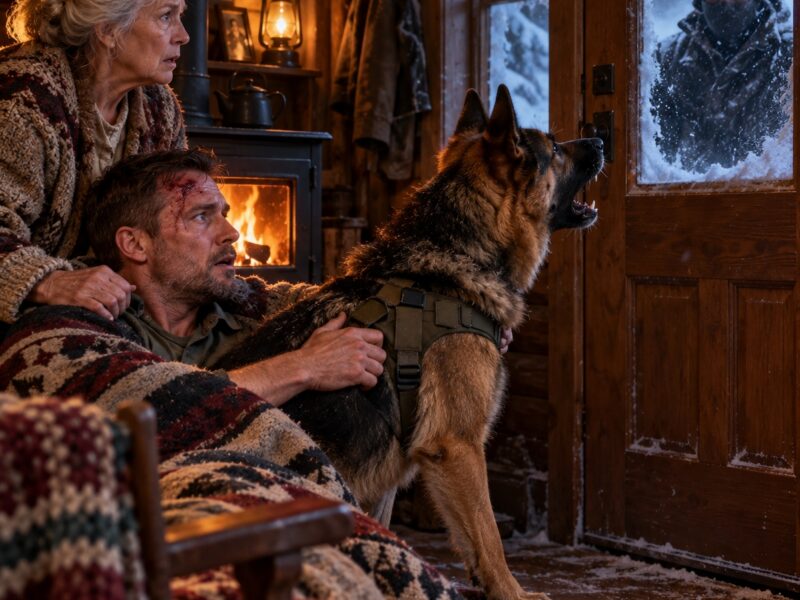
A GERMAN SHEPHERD BEGGED A 75-YEAR-OLD WIDOW TO FOLLOW HIM INTO A DEADLY BLIZZARD—BUT THE THREE KNOCKS THAT CAME LATER WERE EVEN MORE TERRIFYING
The German Shepherd was freezing to death on Margaret Collins’s porch, but he refused to come inside.
Every time the seventy-five-year-old widow reached for him, he backed into the blizzard and barked toward the woods.
And when Margaret finally followed him, she had no idea she was walking into a tragedy that had begun hundreds of miles away.
The wind struck her cabin hard enough to rattle the windows.
Margaret stood in the doorway, one hand gripping the frame, the other holding a flashlight whose beam disappeared almost immediately into the blowing snow.
The dog was enormous.
A German Shepherd, broad across the shoulders, with intelligent brown eyes and a thick coat now stiff with ice. Snow had accumulated along his ears and muzzle. His front legs trembled, and every breath escaped his mouth in a small white cloud.
“Come on, sweetheart,” Margaret said. “You can’t stay out there.”
She stepped aside to make room.
The dog didn’t move.
Instead, he took three steps backward, turned toward the dark trees beyond the driveway, and barked.
Margaret frowned.
“Well, that’s not how this usually works.”
The Shepherd looked at her again.
There was something unsettling about the way he held her gaze. He wasn’t behaving like a lost animal searching for warmth. He wasn’t frightened of her, either.
He appeared to be waiting for her to understand.
Another violent gust swept across the porch.
The dog flinched, then immediately looked back toward the woods.
Margaret felt a small, uncomfortable pressure beneath her ribs.
“You’ve got somebody out there, don’t you?”
The Shepherd’s ears rose.
He barked once.
Then he turned away.
Margaret stared after him.
At seventy-five, she knew the difference between courage and foolishness. She also knew that sometimes the right thing to do came with a price.
She had lived in Aspen Ridge, Idaho, for forty-three years. She understood what a mountain winter could do to a person who underestimated it.
And tonight, the mountains were showing no mercy.
The worst blizzard in more than a decade had swallowed the valley. Snowdrifts buried fences. Fallen branches blocked the narrow mountain road, and the county emergency broadcast had warned residents to stay indoors.
The electricity had failed shortly after sunset.
Her telephone had lost service even earlier.
Only the woodstove, a battery-powered emergency radio, and several lanterns kept her little cabin from becoming another frozen building on the mountainside.
Margaret had prepared for storms like this her entire adult life.
What she hadn’t prepared for was a desperate dog appearing on her porch.
Or the possibility that someone was dying just beyond her reach.
Behind her, the cabin was warm and familiar.
Her late husband William’s canvas work jacket hung from the brass hook beside the door. Its sleeves were worn thin at the cuffs, and a faded patch covered one elbow.
Twelve years had passed since his death.
Margaret had washed the jacket exactly once after the funeral, then hung it back where he had always left it.
She couldn’t explain why she had kept it there.
Perhaps because an empty hook was harder to look at than an old coat.
Perhaps because some part of her still expected to hear his boots on the porch.
She reached for the jacket now.
“All right, William,” she murmured. “I suppose you’d tell me to get moving.”
She pulled it over her sweater.
Then she gathered her heaviest boots, wool gloves, a thick blanket, a length of rope, and the first-aid bag she kept beneath the kitchen sink.
Outside the woodshed rested a wooden hauling sled.
William had built it decades earlier for transporting firewood across the property. Its runners were weathered, and one corner had been repaired twice.
Margaret hadn’t used it in years.
She dragged it into the snow.
The Shepherd immediately came closer.
“Oh, now you’re interested.”
He pressed his cold nose against her glove.
Margaret rested her hand on his head for just a moment.
“Listen to me, handsome. These knees aren’t what they used to be. If we’re doing this, you’re going to have to be patient.”
The dog turned toward the trees.
Margaret took hold of the sled rope.
“Lead the way.”
He bounded into the darkness.
And she followed.
Within minutes, the storm became something entirely different from what it had appeared through her kitchen window.
The wind stole her breath.
Snow drove sideways into her face. It collected in the folds of William’s jacket and slipped beneath her scarf.
Her flashlight illuminated only a narrow tunnel of swirling white.
Each step required effort.
The sled scraped and lurched behind her.
Several times, Margaret nearly lost her footing where fresh powder concealed hard patches of ice.
The dog moved ahead, then stopped.
He looked back.
“I’m coming,” she called.
He waited.
She took another few steps.
Then he continued.
It was that small act of patience that kept her going.
He never disappeared into the trees.
He never abandoned her to the storm.
Somewhere along the narrow path, Margaret began talking to him simply to keep herself from thinking about how far she had come.
“My husband used to say every animal has a purpose.”
The Shepherd looked over his shoulder.
“He was a better judge of dogs than people, truth be told.”
A gust nearly knocked her sideways.
Margaret caught herself against a tree.
“And he’d be furious if he knew I was out here without telling anybody.”
She looked toward the dog.
“But I suspect he’d be right beside us.”
They continued down the slope.
Then Margaret saw something through the snow.
At first, it was only a dark shape among the trees.
She thought it might be a fallen branch.
But when the flashlight beam moved, something reflected the light.
Metal.
A pickup truck had left the road and slid into a shallow ditch.
The front bumper was crushed against frozen earth. One headlight hung broken inside its housing. Snow was already accumulating on the hood.
The driver’s side window had shattered.
And inside, a man sat slumped over the steering wheel.
Margaret stopped breathing for a moment.
“Oh, dear Lord.”
The Shepherd raced toward the truck.
He pressed his body against the driver’s door, whining with an urgency that made Margaret move faster than she believed possible.
She abandoned the sled beside the road and struggled toward the vehicle.
“Sir?”
No answer.
She shone the flashlight through the broken window.
The man was perhaps forty. Broad-shouldered, with short dark hair and a face that looked gray beneath the blood running from his temple.
The airbag had deployed.
His head rested awkwardly against the seat.
“Sir, can you hear me?”
Still nothing.
Margaret pulled off one glove and reached through the broken window.
She pressed two fingers against the side of his neck.
There.
A pulse.
Faint, but present.
She exhaled shakily.
“Well, that’s a start.”
The Shepherd stood so close that his shoulder brushed her leg.
Margaret looked down.
“You did good, sweetheart. You found him.”
She turned back toward the stranger.
“Now listen to me, young man. You’ve got a very determined friend here, and I have no intention of disappointing him.”
The man’s eyelids moved.
Margaret leaned closer.
“That’s it. Stay with me.”
His lips parted.
She could barely hear him over the storm.
“Atlas…”
Margaret glanced at the Shepherd.
“Atlas? Is that your name?”
The dog’s ears twitched.
“Well, Atlas has been doing all the hard work,” she said, turning back to the injured man. “Now you need to help us a little.”
The stranger tried to raise his head.
Pain crossed his face.
“Don’t…”
“Easy. Don’t move too quickly.”
His fingers shifted against the seat belt.
“Don’t leave him.”
Margaret’s expression changed.
She had heard enough fear in those three words to understand that the man wasn’t simply worried about his dog getting lost.
He sounded as though he had already lost someone.
As though losing Atlas would finish something terrible that had begun long before tonight.
Margaret leaned closer.
“Nobody’s leaving anybody,” she said.
And she meant it.
She didn’t know that the stranger’s name was Ethan Brooks.
She didn’t know he was thirty-nine years old, a Marine with nineteen years of service behind him.
She didn’t know his loyal German Shepherd had spent years working alongside him and had recently survived an avalanche that had destroyed both their sense of safety.
Most of all, she didn’t know about Daniel Harper.
Six weeks earlier, Ethan and Atlas had been part of a military-supported mountain rescue operation in the Rockies.
The weather had deteriorated rapidly.
A slab of unstable snow had broken loose above the team.
The first avalanche separated them from the safest route down.
The second came before everyone could reach shelter.
Daniel Harper, Ethan’s closest friend, saw the movement first.
“Ethan! Move!”
He shoved Ethan clear of the falling snow.
Then the mountainside came down between them.
One moment Daniel was there.
The next, he was gone.
Ethan had tried to reach him.
Atlas had dug frantically, barking and pawing at the unstable snowpack.
But another section of the slope had begun cracking overhead.
Ethan had been forced to choose between retreating with Atlas and remaining in a place that could bury them both.
He had dragged the dog away.
The search for Daniel had continued.
But Ethan never again heard his friend’s voice.
Afterward, the official reports had described hazardous conditions, a sudden secondary collapse, and an unavoidable loss.
Ethan remembered only the look on Daniel’s face before he pushed him aside.
For six weeks, he had replayed those final seconds.
He slept with the lights on.
He startled at noises that would once have meant nothing.
Atlas had changed, too.
The Shepherd watched doorways and windows. Sudden sounds made him tremble. Sometimes he woke from sleep barking toward something that wasn’t there.
Their commanding officer had ordered Ethan to take leave and begin a formal evaluation before returning to operational duty.
The possibility that Atlas might no longer be able to serve beside him terrified Ethan.
He had already lost Daniel.
He couldn’t bear the thought of losing the dog who had survived with him.
And so he had taken the long drive toward Idaho, hoping distance and quiet might offer something neither of them had been able to find.
Then black ice sent his truck sliding off a mountain road.
Now he lay injured in the dark while a widow he had never met tried to keep him alive.
Margaret braced herself against the truck.
The driver’s door wouldn’t open.
She tried the handle again, pulling until pain shot through her wrist.
“Stubborn thing.”
Atlas circled toward the front of the vehicle.
Margaret followed the passenger side around and discovered that door would open.
She climbed carefully onto the icy edge of the ditch and reached inside.
“Ethan,” she said, after finally catching his name from his identification, “I’m Margaret. I need you to listen to my voice.”
He blinked.
“Where…?”
“On a mountain road where neither of us ought to be tonight.”
She managed a small smile.
“But we’ll discuss that later.”
Ethan’s gaze drifted toward the driver’s window.
“Atlas?”
“Right here.”
The Shepherd whined.
Ethan closed his eyes for a moment.
Margaret examined what she could see without shifting him unnecessarily.
His forehead was bleeding. He was confused and painfully cold. She worried about injuries from the collision that she couldn’t identify.
Moving him might make those injuries worse.
Leaving him in the wrecked truck, exposed to the storm, could be worse still.
She tried to raise help on her emergency radio, but received only broken transmissions. The roads were blocked, and the nearest crews were responding to several other emergencies.
There was no one close enough to reach them.
Margaret swallowed.
“All right,” she whispered. “One thing at a time.”
She returned to Ethan.
“Can you move your feet?”
After a few seconds, he made a small movement.
“Good. Don’t rush.”
With great care, she helped him release his seat belt and shift toward the passenger side.
He was stronger than she was, but strength meant little when pain and disorientation prevented him from controlling his movements.
Several times, he stopped.
Margaret waited.
Several times, he apologized.
“Don’t waste your breath apologizing,” she told him. “Save it for getting warm.”
At last, she helped him out of the truck and onto the sled.
The wind struck his body and made him shudder violently.
Margaret immediately wrapped him in the blanket.
Atlas stood beside him, pushing his nose beneath Ethan’s hand.
“Good boy,” Ethan whispered.
Margaret secured the blanket and used the rope to keep Ethan from sliding off the sled.
She checked that he could breathe comfortably, then attached an extra line to Atlas’s harness.
The dog glanced at her.
“We’re going home, boys.”
She lifted the hauling rope.
“Together.”
The trip back was almost more than Margaret could manage.
Pulling the sled downhill had been simple.
Pulling a grown man uphill through deep snow was another matter.
Every few steps, the runners buried themselves in powder.
Twice, Margaret had to stop and clear snow away with her gloves.
A buried root caught one runner and brought the sled to an abrupt halt.
Margaret pulled.
Nothing.
She shifted sideways and tried again.
The rope burned against her palms.
Atlas strained forward beside her.
At last, the sled broke free.
“That’s it,” Margaret gasped. “That’s my good boy.”
She didn’t know how much time passed.
The woods appeared endless.
Her breathing grew ragged.
Once, her boot slipped beneath her and she fell heavily to one knee.
Pain shot through her leg.
For several seconds, she couldn’t stand.
She rested both hands against the snow and tried to steady herself.
Atlas immediately returned.
He stood beside her, his muzzle near her face.
Margaret looked into his eyes.
“Oh, don’t look at me like that.”
The dog didn’t move.
She laughed once, weakly.
“I’m getting up. I promise.”
With the help of a nearby tree, she hauled herself upright.
Her knee trembled.
Ethan made a faint sound from the sled.
“Ma’am…”
“Still here.”
“Leave… me.”
Margaret turned.
She looked at the injured man, then at the dog standing faithfully beside him.
“Now, that’s the second foolish suggestion I’ve heard tonight.”
Ethan tried to speak.
She interrupted gently.
“You wouldn’t leave him. I won’t leave you.”
Then she took the rope again.
The last stretch seemed the longest.
Until, finally, a faint amber light appeared beyond the trees.
Her cabin.
Margaret had left a lantern burning near the front window.
The glow was barely visible through the snow, but it was enough.
“There,” she whispered.
Atlas raised his head.
“Home.”
By the time they reached the porch, Margaret was shaking so badly she could hardly manage the door latch.
She got Ethan inside, using the sled to bring him close to the woodstove before helping him onto a padded place beside it.
The warmth struck her face.
For a moment, she simply stood there, breathing.
Then years of habit took over.
She removed his wet outer clothing where she could do so without causing more pain, wrapped him in dry blankets, and checked his breathing and responsiveness.
She cleaned the visible wound on his forehead and covered it with a sterile dressing.
The cut worried her.
So did the dizziness.
She knew he needed a doctor as soon as the roads opened.
The emergency radio crackled with another warning.
Blocked access roads.
Limited visibility.
Rescue delays.
Margaret listened, pressing her lips together.
“Of course,” she murmured.
She set the radio beside her chair so she wouldn’t miss any updates.
Then she filled a bowl with warm broth.
Atlas still hadn’t settled.
He stood between Ethan and the front door, his attention moving constantly from the windows to the hallway.
Margaret set down a dish of water.
“Here you go, sweetheart.”
The dog barely looked at it.
She brought him a little food.
He turned away.
“You’re a stubborn pair, aren’t you?”
She sat beside Ethan.
After a while, his eyes opened.
For several seconds, he looked frightened.
His gaze traveled across the unfamiliar ceiling, the wooden shelves, the stove, the old quilt covering his legs.
“Where am I?”
“My cabin.”
His expression tightened.
“Aspen Ridge,” she explained. “Idaho.”
He tried to sit.
“Easy. You’ve had an accident.”
He stared toward the door.
“Atlas?”
A soft whine answered him.
The Shepherd crossed the room immediately and pressed his head into Ethan’s hand.
Ethan’s face changed.
The guarded expression loosened, leaving something tired and painfully vulnerable.
He ran his fingers through the dog’s fur.
“Hey, buddy.”
Atlas leaned against him.
“Good boy.”
Margaret watched them quietly.
She had known enough people in her life to recognize love that had become a lifeline.
This wasn’t just a man being reunited with his pet.
It was someone checking that the last familiar part of his world was still there.
She handed Ethan the broth.
“Small sips.”
“Thank you.”
“You can thank me by following instructions.”
A shadow of a smile crossed his face.
“Yes, ma’am.”
“Margaret.”
He looked at her.
“My name is Margaret. And you don’t need to call me ma’am unless I’m scolding you.”
He lowered his eyes to the bowl.
“Ethan.”
“I know.”
That made him look up.
“Your identification.”
“Oh.”
She gave him a reassuring smile.
“Don’t worry. I haven’t gone through your secrets.”
He managed another small smile.
But it disappeared almost immediately.
Something rattled against the kitchen window.
Atlas’s head snapped toward the sound.
Ethan followed the dog’s gaze.
Margaret noticed.
Both of them had become completely still.
A few minutes passed before Atlas lowered his head again.
Ethan’s grip on the bowl remained tight.
Margaret didn’t ask about it.
Not yet.
Instead, she spoke about ordinary things.
The ridiculous cost of propane.
The neighbor who insisted on feeding the deer even though everyone told him not to.
The summer William had accidentally trapped a raccoon in the pantry.
At that, Ethan let out a quiet breath that was almost a laugh.
“Sounds like he kept you busy.”
“Oh, William could make an ordinary Tuesday into an emergency.”
She looked toward the jacket hanging near the stove to dry.
“He had a good heart, though.”
Ethan followed her gaze.
“Your husband?”
Margaret nodded.
“Twelve years gone.”
Ethan looked down.
“I’m sorry.”
“Thank you.”
For a moment, neither spoke.
Then Margaret adjusted the blanket over his shoulder.
“You don’t stop missing somebody,” she said. “You just learn how to carry it differently.”
Ethan’s face went still.
Margaret recognized the change, but she let the silence remain.
Later, when he could manage a little more broth, he asked about the storm.
She told him what she knew.
The mountain road remained closed.
Crews were working their way through the valley.
He would need medical attention as soon as someone could reach the cabin.
Ethan nodded, though his eyes were already drifting toward the windows again.
Atlas lay close beside him.
Neither appeared convinced that the danger had passed.
Margaret had seen that look before.
Not in soldiers.
In people who had lost something so suddenly that the world never felt entirely predictable again.
She remembered how she had behaved after William died.
How she checked the driveway whenever she heard an engine.
How she sometimes put two cups on the table without thinking.
How she would wake in the night and reach toward the empty space beside her.
Grief could make a house feel unfamiliar.
But what troubled Ethan seemed sharper than grief.
It seemed to follow him even into sleep.
By late evening, exhaustion overtook him.
He fell asleep beneath William’s old quilt, one hand resting against Atlas’s shoulder.
Margaret turned down the lantern.
The woodstove gave off a steady glow.
Outside, the storm continued.
Inside, the little cabin settled into a fragile quiet.
Margaret sat in her rocking chair with her knitting.
For almost an hour, nothing happened.
Then a violent gust struck the outer wall.
BANG.
Atlas sprang upright.
His claws scraped against the floorboards.
A low, frightened cry escaped him.
Ethan jerked awake.
“No!”
His arms shot forward.
“Get back!”
Margaret dropped a stitch.
Ethan wasn’t looking at her.
He was staring into the dark corner near the stove.
“Daniel!”
His voice broke.
“Daniel, get back!”
Atlas rushed to his side.
Ethan grabbed the dog’s harness and pulled him close.
His breath came in sharp, uneven bursts.
“Not again.”
He pressed his forehead into Atlas’s neck.
“Please. Not again.”
Margaret had risen halfway out of her chair.
For a moment, she didn’t know what to do.
The man sitting before her wasn’t fully awake.
His eyes were open, but the cabin wasn’t what he was seeing.
Whatever had happened to him was happening again, somewhere beyond her reach.
Margaret lowered herself beside him.
“Ethan?”
He didn’t respond.
She kept her voice gentle.
“Ethan, you’re in my cabin.”
Atlas pressed closer.
“The storm is outside,” she continued. “You’re here with me.”
Ethan’s fingers tightened around the harness.
“I’m sorry.”
The words were so quiet she barely heard them.
“Daniel, I’m sorry.”
Margaret felt her throat tighten.
Ethan shuddered.
Then, slowly, his eyes began to focus.
He looked around the room.
At the stove.
At the quilt.
At Margaret sitting beside him.
His breathing eased, though he still held Atlas as if letting go would mean losing him.
“Sorry,” he whispered.
Margaret shook her head.
“You have nothing to apologize for.”
He stared at the floor.
She brought her chair closer, leaving enough space that he didn’t feel cornered.
For several minutes, they listened to the wind.
Then Margaret asked a question.
“Who was Daniel?”
Ethan closed his eyes.
His fingers continued moving through Atlas’s fur.
For a long time, she thought he wouldn’t answer.
When he finally spoke, his voice sounded different.
Smaller.
“He was my best friend.”
Margaret waited.
“We served together.”
He swallowed.
“Nineteen years in the Marines. I’ve known a lot of good men.”
His jaw tightened.
“Daniel was one of the best.”
The fire shifted inside the stove.
A log cracked softly.
Ethan looked toward the window, then forced himself to look away.
“He had this terrible habit of making jokes whenever things got bad.”
A sad, almost disbelieving smile touched his mouth.
“Could drive you crazy.”
Margaret smiled faintly.
“Sounds like somebody I would have liked.”
“You would have.”
Ethan rubbed his face with one hand.
Then the smile disappeared.
“We were in the mountains.”
Atlas raised his head.
“The snow started moving. We thought we had time to get clear.”
Ethan stopped.
His shoulders tightened.
“Then there was another slide.”
Margaret remained silent.
“Daniel saw it before I did.”
Ethan’s voice became unsteady.
“He pushed me out of the way.”
He glanced toward Atlas.
“And then he was gone.”
The room felt unbearably quiet.
Ethan’s hand gripped the harness again.
“Atlas tried to find him. He kept digging.”
His eyes filled.
“I tried, too.”
Margaret could hear how much effort each word cost him.
“But the slope was coming down again. I couldn’t reach Daniel, and Atlas wouldn’t leave.”
He drew in a trembling breath.
“So I pulled him away.”
A tear slipped down his cheek.
“I left Daniel under that snow.”
Margaret didn’t immediately tell him he had done the right thing.
She didn’t tell him Daniel would have wanted him to survive.
Those might have been true words.
But she could see that Ethan had probably heard them before.
And none had reached the place inside him where the guilt lived.
Instead, she stayed beside him.
After a while, she said, “You were trying to save the one you still could.”
Ethan looked down at Atlas.
“I know.”
He spoke so softly the words almost vanished.
“I just keep thinking there had to be something else.”
Margaret nodded.
“I suppose that’s what love does sometimes. It keeps looking for another ending.”
Ethan’s face crumpled.
For several seconds, he couldn’t speak.
Margaret reached for the box of tissues on the side table and set it beside him.
Then she rested her hands in her lap.
She didn’t ask him to stop crying.
She didn’t try to repair a loss that couldn’t be repaired.
She simply stayed.
Atlas rested his head on Ethan’s knee.
The Shepherd’s breathing gradually slowed.
Outside, the blizzard pressed against the windows.
Margaret glanced toward William’s old jacket.
She thought of the twelve winters she had lived through without him.
Of the mornings when getting out of bed had felt like betrayal because the world had continued without his permission.
And of all the times she’d wished someone would simply sit beside her without telling her to be strong.
She looked back at Ethan.
“You don’t have to carry all of this by yourself tonight,” she said.
Ethan closed his eyes.
“Thank you.”
Margaret was about to rise and check the stove when Atlas lifted his head.
His ears stood straight.
His body grew rigid.
At first, Margaret assumed another gust had startled him.
But the dog wasn’t looking toward the walls.
He was staring directly at the front door.
A low whine came from his throat.
“Atlas?” Ethan whispered.
The Shepherd stood.
He took three steps toward the door.
Stopped.
Then barked.
Margaret frowned.
It was not the sharp, frightened sound he had made when the wind struck the cabin.
This bark was different.
Measured.
Intentional.
She recognized it immediately.
It was the same sound she had heard on her porch earlier that evening.
The same sound that had persuaded her to follow him into a deadly storm.
“What’s wrong, boy?” she asked.
Atlas barked again.
Ethan struggled to sit upright.
The color drained from his face.
“Atlas?”
The dog didn’t look back.
He moved toward the door and stood perfectly still.
Listening.
Margaret heard the wind dragging snow across the porch.
Then something else.
A faint scraping sound.
Perhaps a branch.
Perhaps ice shifting against the steps.
She lifted her flashlight.
Outside the frosted window, a dark shape moved between the snow-covered trees.
Margaret took a step closer.
“There’s somebody out there.”
Ethan seized Atlas’s harness.
“Wait.”
She turned.
His expression frightened her more than the storm.
He was staring at the door as though he recognized something he couldn’t possibly recognize.
Atlas let out one long, urgent whine.
Then the cabin fell silent.
Margaret could hear only the soft crackle of burning wood.
She reached toward the door latch.
And before her fingers touched it—
Three slow knocks sounded from the other side.









