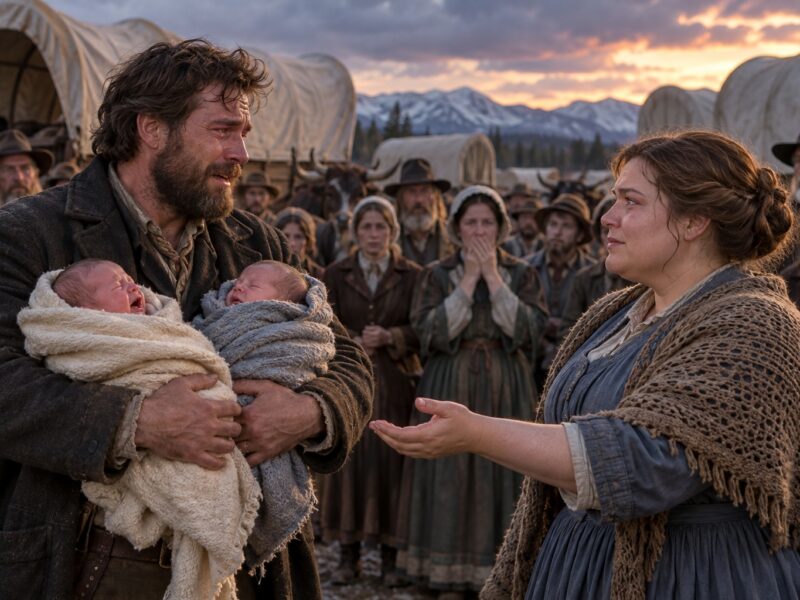
A GRIEVING WAGON CAPTAIN OFFERED HIS NEWBORN TWINS FOR $20 ON THE OREGON TRAIL—BUT A CHILDLESS WIDOW MADE ONE CONDITION THAT SILENCED 47 FAMILIES, AND THE SECRET THEIR DEAD MOTHER LEFT BEHIND CHANGED EVERYTHING
“Twenty dollars. Both boys. Just promise me you’ll never separate them.”
Captain Thomas Brennan stood in the center of a circle of forty-seven covered wagons, holding his newborn sons as though the weight of their tiny bodies was the only thing keeping him upright.
One baby was crying.
The other was barely breathing.
And for the first time since leaving Missouri, the man everyone trusted to lead them through the wilderness had no idea how to save the people who mattered most to him.
Nobody stepped forward.
Nobody offered to take the children.
Then a childless widow standing at the back of the crowd reached into her purse, counted out nearly every dollar she owned, and made an offer that would leave the entire wagon train speechless.
But what no one knew that evening was that the twins’ dead mother had left something behind.
Something meant for that very widow.
And the person who knew about it had remained silent for six days.
The first snow had not yet fallen, but the Oregon Trail was already beginning to feel like a graveyard.
It was October 1852.
The wind came down from the western mountains sharp enough to cut through wool coats and canvas coverings. Frost gathered along wagon wheels before sunrise. Every morning, the families woke to find their water barrels filmed with ice.
They were still miles from safety.
Forty-seven families had placed their futures in the hands of Captain Thomas Brennan.
Most had never traveled farther west than Missouri. They had sold farms, packed furniture, buried sentimental belongings, and turned their backs on everything familiar because they believed Oregon promised something better.
Thomas was the man who had persuaded them they could reach it.
At thirty-eight, he was broad-shouldered and weathered, with dark hair that had begun to gray around his temples. He could read the weather in the shape of the clouds and locate a river crossing where other men saw only dangerous water.
He was not a man given to panic.
When an ox broke its leg, he made the difficult decision.
When a wagon tipped on a narrow slope, he was the first to climb down with a rope.
When disagreements threatened to divide the company, Thomas settled them without raising his voice.
For months, the settlers had treated his judgment as the closest thing they had to certainty.
Then his wife died.
Elizabeth Brennan had been thirty-one.
She had traveled almost the entire distance while carrying their first children, refusing every suggestion that the couple remain behind until spring.
Thomas had worried constantly.
Elizabeth had laughed at him for it.
“You act as though I’m made of porcelain.”
“No,” he had answered, helping her down from the wagon. “Porcelain is easier to reason with.”
She had smiled and placed his hand against her swollen belly.
“They’re going to know their father has a terrible sense of humor.”
He would have given anything to hear her say those words again.
Six days earlier, Elizabeth had gone into labor as the wagons rested beside a narrow creek.
The first boy arrived just before sunset.
The second came after dark.
Thomas remembered the sounds more clearly than anything else: Elizabeth’s breathing, the rustle of Ruth Whitcomb’s skirts, the thin cry of a child discovering the world.
Then another cry.
Two sons.
Two beautiful, impossibly small boys.
Thomas had knelt beside Elizabeth and kissed her damp forehead.
“They’re here,” he whispered. “They’re both here.”
She looked at him with exhausted eyes.
“Let me see them.”
He brought the babies closer.
Elizabeth touched each tiny cheek with one trembling finger.
For a moment, Thomas believed they had survived the worst.
By morning, his wife was gone.
He remembered Ruth bending over Elizabeth’s bedside. He remembered being told to heat water, then being asked to step outside.
He remembered the silence after the frantic movement stopped.
And he remembered Ruth emerging from the wagon with a look that told him the truth before she spoke.
There were words after that.
He could not remember them.
He could remember the shovel.
The earth was hard.
He dug until his palms split inside his gloves, then kept digging after another man offered to finish.
Elizabeth had crossed rivers, survived sickness and hunger, and dreamed of the apple trees they would plant in Oregon.
Thomas buried her beneath a lonely stretch of prairie, where no apple tree would ever grow.
He carved her name into a wooden cross.
Then he stood beside it until the wagon master came to find him.
“Captain, the weather’s turning.”
Thomas did not answer.
“We need to move by morning.”
Behind him, one of his sons began crying.
Thomas looked at the grave.
Then toward the sound.
He had never felt so completely divided between the living and the dead.
By the following morning, the wagon train was moving again.
And Thomas Brennan was trying to be two parents with two exhausted hands.
He learned to change cloth diapers by lantern light. He learned how to warm blankets beside the fire without scorching them. He learned that one baby preferred to be rocked against his shoulder while the other calmed only when held against his heartbeat.
He learned that exhaustion could become something physical, a pressure behind the eyes, an ache in the bones.
But the one thing he could not provide was the thing his sons needed most.
Milk.
At first, several nursing mothers helped.
They offered whatever they could spare after feeding their own babies. Ruth showed Thomas how to handle the newborns gently and how to recognize when they were becoming dangerously cold.
But there was never enough.
The trail had already taken too much from everyone.
Flour bags were shrinking.
Cattle were weakening.
Some families were boiling the last of their dried beans and quietly measuring how many days remained before their food ran out.
Thomas never blamed the mothers who could not help.
He thanked each one.
Then he returned to his wagon and listened to his sons cry.
He began losing track of time.
Morning and night became a blur of campfires, dirty blankets, wagon repairs, and desperate attempts to feed the twins.
He stopped shaving.
He forgot meals.
Once, while studying a map, he woke to find his face resting against the table and one baby’s blanket clutched in his fist.
On the sixth morning after Elizabeth’s death, the smaller twin stopped crying.
At first Thomas thought the boy was finally sleeping.
He bent over the cradle and brushed a finger along his son’s cheek.
The baby’s eyes remained closed.
His breathing was shallow.
Thomas lifted him immediately.
“Come on, little fellow.”
He rubbed the child’s hands.
“Come on. Your father needs you to wake up.”
The baby gave a faint movement.
Nothing more.
Thomas spent the next hour trying to get him to feed.
When that failed, he carried both boys to Ruth Whitcomb.
The older woman examined them in a wagon smelling of dried herbs, damp wool, and wood smoke.
Ruth had delivered dozens of babies before leaving Missouri.
She had seen things that frightened younger women into silence.
But that morning she did not hide her concern.
“This one needs more nourishment, Thomas.”
“I know.”
“And warmth. Consistent warmth.”
“I know that, Ruth.”
She looked up.
“Then you know what we’re facing.”
Thomas stood perfectly still.
Outside, a man shouted for someone to bring another team of oxen.
Wheels creaked.
A child laughed.
The ordinary sounds of life continued while Thomas looked at the tiny face in Ruth’s arms.
“What if I can’t do it?” he asked.
Ruth’s expression softened.
“Then you ask for help.”
“I’ve been asking.”
“I know.”
He swallowed.
“What if there isn’t enough help?”
Ruth had no answer he could bear to hear.
That evening, Thomas called the settlers together.
He waited until the wagons were drawn into their usual defensive circle and the evening fires had begun to burn.
Men approached carrying tin cups.
Women came with children wrapped in shawls.
Some believed the captain intended to announce a change of route.
Others expected bad news about the weather.
Thomas stood before them holding his newborn sons.
His coat was buttoned incorrectly.
His beard had grown uneven.
There was a pale stain across one shoulder where a baby had been sick.
He had never looked less like the confident man who had led them across the plains.
“I’m asking something of you tonight,” he began.
People shifted closer.
Thomas glanced down at the boys.
“Elizabeth died six days ago.”
A hush fell over the group.
“Most of you know I’ve been struggling to care for our sons. Several families have helped us, and I’m grateful.”
He stopped.
The smaller baby’s head rested motionless against the crook of his arm.
Thomas adjusted the blanket.
“But I’m not managing.”
His voice came out rough.
The settlers waited.
“I can lead this company. I can get us through the mountains. But these boys need more than I can give them.”
Someone whispered his name.
Thomas looked into the crowd.
“I need to find them a home.”
The words seemed to hurt him physically.
“I’ve got twenty dollars to put toward their care. If somebody can take both boys and raise them together, I’ll give you everything I can.”
His hands shook.
“If you need me to make it a different arrangement, I will. I don’t care about the money. I just need them safe.”
A woman pressed a hand to her mouth.
Thomas swallowed.
“Please don’t separate them.”
Silence.
He looked from face to face.
He knew these people.
He had helped carry their injured children. He had shared provisions from his own wagon when others ran short. He had gone without sleep to keep their families moving.
But he also knew what he was asking.
Two newborns.
Two fragile lives.
An uncertain winter.
A responsibility that could not be put aside when the weather turned dangerous.
A young mother near the fire began crying quietly.
“I can barely feed my little girl,” she whispered to her husband.
An older settler shook his head.
“Those babies need their mother.”
Thomas lowered his eyes.
For one terrible moment, he could almost hear Elizabeth answering from somewhere behind him.
They need you, too.
He waited.
The fire cracked.
A horse stamped against frozen ground.
Nobody volunteered.
Finally, Thomas nodded.
“All right.”
His voice was barely audible.
“I understand.”
He turned toward his wagon.
At the far edge of the gathering, Margaret Holloway watched him go.
And beneath the canvas roof of her own wagon, an empty cradle waited.
Margaret was thirty-four years old, though grief had occasionally made her feel much older.
She was a full-figured woman with chestnut-brown hair, hazel eyes, and a gentle, round face that strangers often mistook for evidence of an easy life.
It was not.
She wore a faded pale-blue dress beneath a wool shawl. Her boots were patched. Her bonnet had been repaired so many times that its original stitching was nearly invisible.
She had one wagon.
Two aging oxen.
A wooden trunk.
Twenty-three dollars and forty cents.
And a cradle built by a man who had loved her enough to imagine a future neither of them had lived to see.
His name was Samuel Holloway.
He had been a carpenter with broad hands and a quiet laugh.
When they married, Samuel had very little money.
He promised Margaret a house anyway.
“Not a grand one,” he told her. “But a good one.”
“With windows?”
“Four.”
“A roof?”
“If you’re feeling extravagant.”
She had laughed.
“And children?”
Samuel had smiled.
“As many as our kitchen can hold.”
They had dreamed about a little farmhouse surrounded by apple trees.
They had imagined a boy who would inherit his father’s stubbornness and a daughter who would have Margaret’s eyes.
Before their first wedding anniversary, Samuel built a cradle from smooth, pale wood.
He carved tiny leaves along its sides.
Margaret remembered finding him working on it late one evening.
“Isn’t it a little early?” she asked.
Samuel held up his chisel.
“Good things take time.”
They waited.
A year passed.
Then another.
Margaret folded away baby clothes that had never been worn.
She attended christenings and carried casseroles to new mothers.
She smiled when neighbors announced another pregnancy.
And sometimes she returned home, sat beside the empty cradle, and cried without making a sound.
Samuel never reproached her.
When she apologized one night, he looked genuinely confused.
“For what?”
“For not giving you children.”
He took her hands.
“Maggie, I married you.”
She began to cry.
He pulled her close.
“I didn’t marry a promise about what might happen someday.”
For years, those words held her together.
Then fever took him.
His illness moved quickly.
By the time the doctor understood how serious it was, Samuel could barely lift his head from the pillow.
Margaret stayed beside him through every night.
She cooled his forehead.
Changed his bedding.
Read aloud when the pain kept him awake.
The final evening, he asked her to bring a chair closer.
She obeyed.
“Maggie.”
“I’m here.”
“Don’t let this world make you afraid to love again.”
She shook her head.
“Don’t talk like that.”
“Promise me.”
“Samuel—”
“Promise.”
She held his hand against her cheek.
“I promise.”
After his funeral, the house became unbearable.
Every room contained something he had touched.
Every creak in the floorboards reminded her of footsteps that would never return.
For months, she could not bring herself to move the cradle.
Then she heard about families preparing to travel west.
Oregon.
New land.
A place where people could begin again.
Margaret sold the little house, packed what remained of her life, and joined the wagon company.
She took Samuel’s cradle.
Not because she expected to use it.
Because leaving it behind felt too much like burying him a second time.
Now, standing in the cold October wind, Margaret watched Thomas Brennan walk away with his children.
And suddenly the cradle no longer seemed like a relic from a life that had ended.
It seemed like a question.
Margaret looked around at the other settlers.
Forty-seven families.
Men and women with children.
People who understood the ordinary demands of parenthood far better than she did.
Surely someone could help.
Yet the captain was walking away alone.
His shoulders had fallen.
The little boy in his left arm had stopped moving.
Margaret felt an unexpected surge of fear.
She knew what it meant to stand beside a bed and watch someone slip away while everyone assured you they had done everything possible.
She knew how silence could settle into a house and remain there for years.
She could not watch that silence take two more lives without doing something.
“Captain Brennan!”
Her voice carried across the wagon circle.
Thomas stopped.
The settlers turned.
Margaret suddenly became aware of every eye upon her.
She had never enjoyed being the center of attention.
She tightened her shawl and stepped forward.
Thomas looked confused.
“Mrs. Holloway?”
“I want to help your boys.”
A murmur moved through the crowd.
Thomas stared.
“You’re traveling alone.”
“Yes.”
“You have no husband.”
“No.”
“And you understand there are two of them?”
Margaret’s mouth trembled slightly.
“I can count, Captain.”
A few people laughed.
Thomas did not.
“These babies need to be fed every few hours. They need someone watching them at night. They’ve already been through too much.”
“I know.”
“No, ma’am, I don’t think you do.”
He looked down at his sons.
“I haven’t slept more than an hour at a time in nearly a week. I can barely keep them warm. The smaller one won’t feed.”
His voice tightened.
“I can’t hand them over to somebody just because she feels sorry for us.”
Margaret absorbed the words.
She could have taken offense.
Instead, she looked at the trembling hands that held his sons.
“I don’t feel sorry for you, Captain.”
Thomas looked up.
“I think you’re frightened.”
His jaw tightened.
“Of course I am.”
“And exhausted.”
“Yes.”
“And so determined not to fail your children that you’ve decided giving them away is the only decent thing left to do.”
Thomas’s expression changed.
Margaret stepped closer.
“I know what it means to love somebody and still lose them.”
He said nothing.
She reached beneath her shawl and removed a small cloth purse.
Inside were the last coins she owned.
Twenty-three dollars and forty cents.
She had counted them the previous evening.
There was enough to help her buy flour and a few supplies after reaching Oregon.
Perhaps a little less if the road became longer than expected.
Certainly not enough to feed three people through winter.
Her fingers paused inside the purse.
For one moment, she saw Samuel sitting at the kitchen table, carving tiny leaves into a cradle.
Good things take time.
Margaret counted twenty dollars into her palm.
The coins caught the light from the campfire.
Someone behind her gasped.
“That’s nearly everything she’s got.”
“She’ll have nothing left.”
“Someone ought to stop her.”
Margaret ignored them.
She held out the money.
“Captain, I’m offering you twenty dollars.”
Thomas stared at her open hand.
“Mrs. Holloway—”
“Please let me finish.”
He nodded slowly.
“I’ll take your boys into my wagon. I’ll keep them warm. I’ll care for them as best I can, and I’ll love them with everything I have.”
Thomas’s eyes filled.
“But I have one condition.”
His body stiffened.
“What condition?”
Margaret took a breath.
“You don’t get to stop being their father.”
The entire gathering fell silent.
Thomas looked at her as though she had begun speaking a language he did not understand.
“What?”
“Those boys have already lost their mother. They shouldn’t have to lose their father, too.”
Thomas shook his head.
“You don’t understand.”
“Then explain it to me.”
“I have forty-seven families depending on me.”
“Yes.”
“There’s a mountain crossing ahead. The weather’s turning. We have sick animals, damaged wagons, and barely enough supplies.”
“I know.”
“I can’t lead these people and raise two newborn sons.”
“Then perhaps you shouldn’t have to do it alone.”
Thomas looked at the coins.
Then at her face.
Margaret felt her cheeks grow hot.
She knew what people were thinking.
A widow offering to care for a grieving man’s babies.
A woman with no children who suddenly wanted two.
Perhaps they believed she was desperate.
Perhaps they believed she wanted a husband.
But the only thing Margaret could think about was the way Thomas kept kissing his sons’ foreheads, even while begging someone else to take them.
“I have a wagon,” she said quietly.
“I have a cradle my husband made. I know how to cook, sew, and make little things last longer than they should.”
She looked down at the babies.
“I know I can’t do everything their mother could.”
Her voice softened.
“But I can stay. And I can help.”
Thomas’s lips parted.
No words came.
Margaret continued.
“Your sons can sleep in my wagon. You can come to see them whenever you like. You can hold them when the day’s traveling is done.”
She swallowed.
“And when we reach Oregon, we can decide together what comes next.”
A long silence followed.
Then Thomas whispered, “Why would you do that?”
Margaret glanced toward her own wagon.
There was no simple way to explain ten years of longing.
No simple way to describe loving a child who had never existed.
So she told him the truth she could manage.
“Because once, someone made me promise I wouldn’t become afraid to love again.”
Thomas looked at her for a long time.
Behind him, a woman quietly wiped her cheeks.
An elderly farmer lowered his hat.
Margaret waited.
Finally, Thomas looked down at the smaller boy.
“Would you hold him?”
Her breath caught.
“Of course.”
Thomas stepped closer.
He shifted the baby carefully, supporting the tiny head with one hand.
For a moment, he hesitated.
Then he placed his son into Margaret’s arms.
The child was lighter than she expected.
Terribly light.
She drew him against her chest and folded her shawl around the blanket to protect him from the wind.
His mouth opened in a weak, soundless movement.
Margaret looked into his small face.
Something inside her gave way.
She had imagined holding a baby hundreds of times.
She had imagined the weight, the warmth, the softness of tiny fingers.
But she had never imagined that the first child placed in her arms would be fighting simply to remain alive.
The infant’s fingers curled around hers.
Margaret’s eyes filled.
“Hello, sweetheart,” she whispered.
Thomas watched her.
For the first time that evening, something other than despair moved across his face.
Then Margaret noticed the baby’s breathing.
A small breath.
A pause.
Another breath, shallower than the first.
She shifted him closer to the firelight.
His lips were pale.
“Captain?”
Thomas leaned forward.
“When did he last eat?”
Thomas’s expression collapsed.
“This morning.”
“Nothing since?”
“He tried. He couldn’t take much.”
Margaret touched the child’s cheek.
Cold.
Too cold.
She looked toward the crowd.
“Is there a nursing mother who can help us? Just enough to get him started?”
Nobody spoke.
A young woman began crying.
“I would if I could,” she whispered. “My little girl has been hungry all day.”
Margaret nodded.
“I understand.”
She did understand.
But understanding would not feed the child in her arms.
“Does anyone have milk?” she asked again.
One of the settlers shook his head.
“The cows have nearly dried up.”
Thomas stepped beside her.
“Give him back.”
Margaret looked up.
“Captain—”
“Please. I should take him to Ruth.”
Before Margaret could answer, a firm voice rose behind them.
“Then stop standing there and bring him to me.”
Ruth Whitcomb pushed through the gathering.
She was an elderly woman with silver hair tucked beneath a plain bonnet and a face marked by years of difficult work.
She had been a midwife long before leaving Missouri.
Her hands were rough, steady, and practiced.
“Let me see him.”
Margaret lowered the baby slightly.
Ruth examined his face, felt his skin, and watched his chest.
The older woman’s expression changed.
“Margaret, get this child somewhere warm.”
Thomas stepped forward.
“What’s wrong?”
Ruth did not answer immediately.
She placed two fingers gently against the baby’s chest.
Then she looked at Thomas.
“He’s fading, Captain.”
Thomas’s face drained of color.
“No.”
“He’s very weak. We need to act quickly.”
Thomas looked down at his other son.
The healthy twin began crying against his shoulder.
The sound seemed to wound him.
“What do you need?”
“Warmth. Milk. Someone to help us keep him feeding.”
Ruth looked toward Margaret’s wagon.
“Is there a stove inside?”
“Yes,” Margaret answered. “A small one.”
“Good. Get it going.”
Margaret turned.
People began moving at last.
A man offered to carry firewood.
Another hurried to fetch water.
Someone brought a clean blanket.
The crowd that had remained motionless while Thomas begged them to take his children now scattered in a dozen directions, each person suddenly desperate to be useful.
Margaret carried the baby toward her wagon.
She could hear Thomas following.
His other son continued crying.
The wind lifted the loose edge of her bonnet.
She barely noticed.
All her attention rested on the fragile bundle beneath her shawl.
“Stay with me,” she whispered.
The baby did not move.
She adjusted her hold.
“Please, sweetheart.”
A faint breath brushed her wrist.
Then another.
Margaret hurried.
Her wagon stood near the edge of the circle, its canvas covering patched in three places.
Inside waited Samuel’s wooden trunk, a folded quilt, a few cooking utensils, and the cradle he had built nearly ten years before.
She had spent months traveling beside that cradle without daring to imagine it occupied.
Now a dying newborn might spend his first night inside it.
Margaret reached the wagon steps.
She felt a small movement against her arm.
Then nothing.
She stopped.
The baby’s little hand had loosened around her finger.
“Ruth?”
The midwife came quickly.
Margaret looked down.
“Ruth, he’s not moving.”
Thomas was only a few feet behind them.
He heard her.
He stopped so abruptly that the crying twin jerked in his arms.
Ruth bent over the child.
For one dreadful instant, she said nothing.
Thomas’s voice broke.
“Please.”
He looked from Ruth to Margaret.
“Please, not him, too.”
The words were so quiet that Margaret nearly missed them.
But she would remember them for the rest of her life.
Ruth pressed her fingers gently against the infant again.
“Inside,” she ordered. “Now.”
Margaret climbed into the wagon.
She lowered herself onto the narrow bench and held the baby close.
Someone passed Ruth a lantern.
Someone else started the little stove.
Wood crackled.
The lantern’s glass rattled in the wind.
Thomas stood at the entrance with his other son pressed to his chest, helplessly watching the women move.
Margaret looked down at the baby.
“His name,” she said suddenly. “Captain, what’s his name?”
Thomas blinked.
For six days, he had been so overwhelmed that he had scarcely spoken the boys’ names aloud.
“Samuel,” he answered hoarsely.
Margaret looked up.
Thomas hesitated.
“Elizabeth chose it. She said it was a good, steady name.”
Margaret went completely still.
Samuel.
The name of the husband who had built the cradle beneath her bedroll.
A coincidence, perhaps.
A cruelly beautiful one.
“And his brother?” she whispered.
“Daniel.”
Margaret lowered her gaze.
“Samuel,” she said softly to the child.
Her eyes burned.
“You mustn’t give up now.”
Ruth continued examining him.
The little stove began warming the wagon.
Outside, the wind pushed against the canvas walls.
Thomas finally climbed inside and settled on the opposite bench, holding Daniel.
For a few moments, nobody spoke.
Margaret noticed something she had not seen before.
Ruth was trembling.
It was slight.
Only a movement of the older woman’s fingers as she reached into her apron pocket.
But Ruth Whitcomb was not easily frightened.
“Ruth?” Margaret asked.
The midwife looked up.
“There is something I need to tell you.”
Thomas turned sharply.
“About my son?”
Ruth glanced toward the wagon entrance.
Then back at the baby.
“No,” she said.
Her voice had changed.
“About Elizabeth.”
Thomas went still.
Margaret felt the atmosphere inside the wagon tighten.
Ruth looked down at her hands.
For several seconds, she seemed to be deciding whether to speak.
“Before Elizabeth died, there were things she wanted me to understand.”
Thomas frowned.
“What things?”
Ruth raised her eyes.
“I examined your wife before she died, Thomas.”
“I know you did.”
“And I have never been comfortable with what we all assumed afterward.”
The lantern hissed.
Outside, someone called for more firewood.
Thomas did not move.
“What are you saying?”
Ruth’s expression was troubled.
“I’m saying I don’t believe Elizabeth died the way you think she did.”
Thomas stared at her.
His hands tightened around Daniel’s blanket.
“Ruth.”
The old woman looked away.
“Why didn’t you tell me this six days ago?”
Ruth swallowed.
“Because I wasn’t certain. And because Elizabeth asked me to wait.”
Margaret looked from one face to the other.
She had heard the account of Elizabeth’s death.
Everyone on the wagon train had.
A difficult childbirth.
Two surviving babies.
A mother lost to complications no one could prevent.
But Ruth’s words suggested there was more.
“What did Elizabeth ask you to wait for?” Margaret whispered.
Ruth looked directly at her.
That frightened Margaret more than anything else.
“Margaret,” the midwife said, “there’s something you need to know.”
Thomas leaned forward.
“Then tell us.”
Ruth’s fingers closed around the edge of her apron.
“Elizabeth left something for you.”
Margaret felt her breath catch.
“For me?”
She had known Elizabeth only during their journey west.
They had shared coffee beside campfires and helped each other mend torn clothing.
They had spoken of the homes they hoped to build.
But they had never been particularly close.
Why would Elizabeth have left anything to her?
Thomas looked completely bewildered.
“My wife left something for Mrs. Holloway?”
Ruth nodded.
“Before she died.”
“What?”
Ruth glanced toward the newborn in Margaret’s arms.
“Something she wanted you to have when the time came.”
Thomas’s expression shifted from confusion to something darker.
“Ruth, what exactly happened in that wagon?”
The older woman did not answer.
Margaret looked down at little Samuel.
His body lay frighteningly still beneath the blanket.
The fire was burning.
The women were doing everything they knew.
Yet the child remained suspended somewhere between life and death.
Then Ruth reached deeper into her apron pocket.
Her fingers closed around something Margaret could not see.
And when the older woman finally raised her eyes, there were tears in them.
“Captain Brennan,” she whispered, “before I show you what Elizabeth left, you need to understand why she chose Margaret.”
Thomas stopped breathing for a moment.
Margaret felt the tiny weight of Samuel against her chest.
Outside, forty-seven families were settling into their wagons, unaware that the truth about Elizabeth Brennan’s final hours was about to surface.
Ruth slowly opened her hand.
And Margaret realized that the woman she had promised to help might have known far more about her empty cradle than anyone had ever imagined.









