A Horse Trader Sold a Single Mother a “Dying” Clydesdale for $850—Then a Veterinarian Found Something Hidden in the Straw
The Clydesdale had been given less than a month to live.
A struggling single mother spent $850 to bring him home anyway.
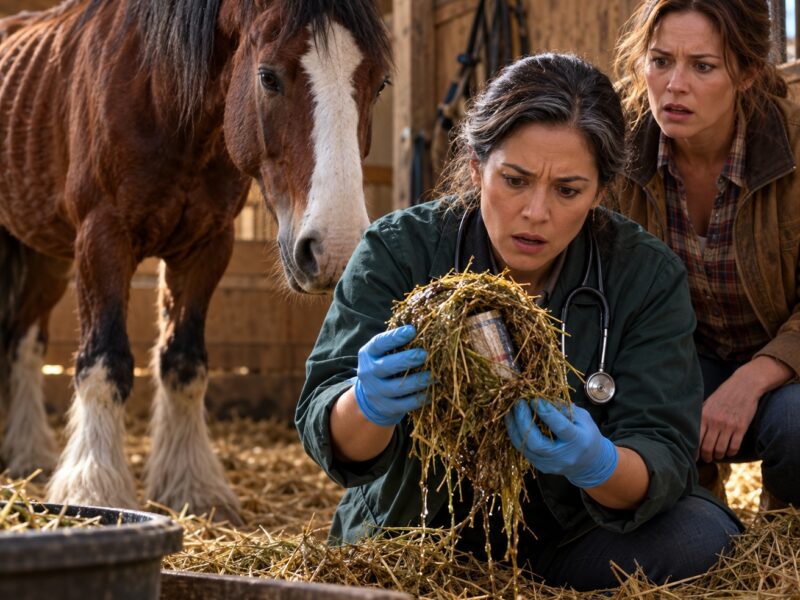
Two days later, a veterinarian picked up a wet ball of hay from his stall—and everything the horse trader had told her began to unravel.
On a cold September morning, Lena Harrow stood inside Ashford’s Livestock Market, trying to understand how an animal so magnificent could have been reduced to something so pitiful.
The horse towered above her, nearly eighteen hands tall, with a dark mahogany coat, four white feathered legs, and a broad blaze running down his face. He should have been the kind of Clydesdale that made people stop along a fence just to admire him.
Instead, his ribs showed beneath his skin. His once-powerful shoulders had wasted away, and his enormous head hung so low that his nose almost brushed the dirty straw.
Warren Ashford stood beside the stall with his arms crossed. His boots were polished, his coat expensive, and his expression carried the mild irritation of a man who believed he had already explained enough.
“Eight hundred and fifty dollars,” he said. “That’s practically giving him away.”
Lena kept her eyes on the horse. “What’s wrong with him?”
“He’s finished. That’s what’s wrong.”
“Is he sick?”
Warren gave a dismissive shrug. “Old age. Something internal, probably. Animals don’t last forever.”
“How old is he?”
“Twelve.”
Lena turned toward him. “Twelve isn’t particularly old for a Clydesdale.”
Warren’s mouth tightened. “I’ve been trading horses for thirty years, ma’am. I think I know when one is done.”
Behind him, the horse slowly reached toward the hay rack.
Lena watched as he gathered a mouthful of hay between his lips. His jaws moved several times, paused, and started again. There was something awkward about the movement, as though every attempt required him to work through an invisible obstacle.
“You said he won’t eat,” she said.
“He won’t.”
“He’s trying right now.”
Warren glanced over his shoulder. “Chewing isn’t eating.”
The answer was technically true, but the way he delivered it made Lena uncomfortable. He sounded less interested in what was happening than in ending the conversation.
She stepped closer to the stall.
The horse raised his head, slowly and with obvious effort. His large brown eyes settled on her face, and for a moment she forgot about the market, the asking price, and the cold coming through the open doors.
There was no wildness in those eyes. No anger.
Only exhaustion.
Lena had seen that expression before, in people who had spent too long being told their best efforts weren’t enough.
“Has a veterinarian examined him?” she asked.
Warren sighed. “Why would I pay a vet to tell me an animal’s dying?”
“Because you might be wrong.”
A stable worker pushing a wheelbarrow stopped near the doorway.
Warren’s expression changed. “You grow apples, Mrs. Harrow. I trade horses. You’d do well to remember the difference.”
Lena looked at him for another moment before returning her attention to the stall.
She was forty-three, divorced, and responsible for an eight-acre orchard that had belonged to her father. There had been a time when buying a horse might have been a reasonable decision. Her father had kept draft horses when she was young, and the old barn still contained a stall built large enough for one.
But those days were gone.
Now the orchard survived on careful spending, long hours, and the kind of quiet sacrifices that rarely appeared in bank statements.
The farmhouse roof leaked over the upstairs hallway. Her truck had started making a grinding noise whenever she shifted into second gear. And the autumn harvest was approaching with more bills than certainty.
Eight hundred and fifty dollars could purchase groceries, fuel, or desperately needed packing supplies.
It could also buy an animal that might not survive the week.
She should have left immediately.
Instead, she rested her hand against the wooden rail.
“What’s his name?”
“Gable,” Warren answered.
The horse moved closer.
His nose was warm and surprisingly soft against her fingers. For several seconds, he stood with his head near her hand, asking nothing of her.
“Hello, Gable,” she whispered.
Warren made an impatient sound behind her. “Don’t go getting attached. Sentiment won’t keep a dead horse standing.”
Lena withdrew her hand.
“Neither will ignoring a sick one.”
She walked out before Warren could answer.
Twenty minutes later, her pickup rolled over the familiar gravel driveway of Harrow Orchard.
The farmhouse stood beneath two enormous maple trees, its white paint weathered and its porch steps slightly uneven. Beyond it, neat rows of apple trees stretched toward the low hills, their branches heavy with fruit that still needed picking.
Her father had planted some of those trees before Lena was born.
When she was little, he used to lift her onto his shoulders so she could reach the highest apples. He had taught her how to recognize blight, how to judge the weather by the way the wind moved through the leaves, and how to tell when a tree needed saving rather than replacing.
She had inherited the land, but sometimes she wondered whether she had inherited enough of his certainty to keep it.
Inside, her daughter Reese sat at the kitchen table with a laptop, a calculator, and a scattering of invoices.
At twenty-one, Reese should have been worrying about college assignments, friendships, and the uncertain excitement of adulthood. Instead, she knew their fuel expenses down to the dollar and had learned how to negotiate with suppliers who preferred being paid on time.
She glanced up when Lena entered.
“You’re back early.”
“I stopped at Ashford’s.”
Reese returned her attention to the screen. “Did you ask about the harvest deliveries?”
“Not exactly.”
Something in Lena’s voice made her daughter look up again.
“What happened?”
Lena pulled out a chair.
“There’s a Clydesdale there. A beautiful horse, or he would be if he weren’t so thin.”
Reese stared at her.
“Mom.”
“He’s twelve. They say he’s dying.”
“Mom, please tell me you didn’t buy him.”
“Not yet.”
Reese closed her eyes.
“Not yet?”
Lena folded her hands on the table. “I think something’s wrong with his mouth. Or maybe his teeth. He kept trying to eat, but the hay didn’t seem to go down.”
“Then the owner should call a veterinarian.”
“He won’t.”
“That doesn’t make it our responsibility.”
Lena said nothing.
Reese turned the laptop toward her. A spreadsheet filled the screen, its columns of numbers highlighted in different colors.
“We have forty-two hundred dollars left to get through harvest. That’s before we pay the remaining cold-storage bill, and before we buy the rest of the packing supplies.”
“I know.”
“Forty percent of our customers come through Ashford’s Market. If we don’t get this harvest sold, we’re in serious trouble.”
“I know that, too.”
Reese lowered her voice. “Then why are we talking about spending eight hundred and fifty dollars on a horse that might die tomorrow?”
Lena looked through the kitchen window toward the old barn.
“Because I watched him try to eat, sweetheart. He was hungry. He just couldn’t seem to manage it.”
Reese leaned back, tiredness settling across her face.
“Hunger doesn’t mean we can save him.”
“I know.”
“And wanting to help doesn’t mean we can afford to.”
That was the part Lena couldn’t argue with.
Four years earlier, when her marriage ended, people had spoken about the orchard as though its future had already been decided. A few neighbors offered sympathy. Others offered the names of real estate agents.
Her former husband had believed they should sell even before the divorce.
Lena had refused.
There were mornings now when she wondered whether her stubbornness had become something less admirable, something that kept her daughter tied to a life she hadn’t chosen.
But she also remembered Gable’s eyes.
That evening, Lena made supper, washed the dishes, and checked the weather forecast twice. Reese worked on an assignment at the kitchen table. Neither mentioned the horse again.
At ten, Lena stood in the hallway outside her daughter’s room.
“Do you think your grandpa would have walked away from him?”
Reese looked up from her textbook.
“Grandpa would have called a vet before buying him.”
Lena smiled faintly. “You’re probably right.”
“Mom?”
“Yes?”
“I know why you want to help him.” Reese hesitated. “I just don’t want us to lose everything trying.”
Lena nodded.
Neither woman had an answer that satisfied the other.
The next morning, Lena returned to Ashford’s Market carrying eight hundred and fifty dollars.
Warren looked up from his desk when she entered.
“Well, I’ll be damned. You came back.”
“I want to buy Gable.”
He leaned back in his chair.
“You’re serious.”
“Completely.”
Warren pulled a printed form from a drawer and slid it across the desk.
The words SOLD AS IS appeared in bold near the top. Below them was a statement disclaiming any guarantee of the animal’s health.
Lena read the document carefully.
“You’re certain nobody’s examined him?”
“I already told you what I know.”
She signed.
Warren counted the money once, then again, straightening the bills into a neat stack before putting them away.
“When he drops dead, don’t come back blaming me.”
Lena slipped her copy of the receipt into her purse.
“If he dies, at least somebody will have tried to find out why.”
By late morning, Gable was standing at the bottom of the trailer ramp in the orchard yard.
He hesitated before taking the first step.
Then, slowly, he brought one enormous hoof down onto the gravel. He shifted his weight, steadied himself, and followed with the next.
Reese stood beside the barn door.
“Oh, Mom,” she murmured.
Lena heard the sadness in her voice.
In the open daylight, the horse looked even worse than he had inside the market. His spine was sharply outlined beneath his coat. The hollows above his eyes appeared deeper. The muscles along his neck had wasted until the great animal seemed almost too fragile to carry his own head.
Lena rubbed the side of his neck.
“This is Reese,” she told him. “She’s the sensible one.”
Reese approached cautiously.
Gable turned toward her, his ears shifting at the sound of her footsteps.
She held out her hand.
He lowered his nose and touched her fingers.
For the first time that morning, Reese’s expression softened.
“He’s awfully gentle.”
“He is.”
“That doesn’t change our bank balance.”
“No,” Lena said quietly. “It doesn’t.”
Together, they settled him into the old draft-horse stall.
Lena filled the water trough and brought in fresh hay. Gable approached the rack almost immediately, his heavy hooves making soft sounds against the packed earth.
He took a large mouthful.
His jaws began moving.
Then stopped.
His head tilted slightly to the left, and the muscles near his cheek tightened. A few damp strands of hay slipped between his lips and fell to the floor.
Lena frowned.
“Easy, boy.”
He tried again.
And again.
At first, Lena wondered whether he simply needed time to settle after the journey. But nearly an hour later, when she checked the rack, most of the hay remained untouched.
Gable was still standing in front of it.
Still chewing.
Still trying.
She called Dr. Celia Navarro shortly before five.
Celia had treated the orchard’s animals for years and had known Lena long enough to recognize when her voice carried more worry than she wanted to admit.
“Tell me exactly what you’re seeing,” the veterinarian said.
Lena described the weight loss, the awkward chewing, and the damp hay falling from his mouth.
“Is he drinking?”
“Yes. At least I’ve seen him drink.”
“Any coughing? Nasal discharge? Trouble breathing?”
“Not that I’ve noticed.”
Celia was silent for a moment.
“All right. Don’t force-feed him or make sudden changes to his diet. Keep clean water available, and I’ll come out first thing tomorrow. If he starts choking or has trouble breathing, call me immediately.”
“Do you think he’s dying?”
“I haven’t examined him yet, Lena. I won’t guess.”
For some reason, that answer brought Lena more comfort than Warren’s certainty ever had.
That evening, the orchard grew quiet beneath a pale September moon.
Reese turned off the kitchen lights shortly after eleven, but Lena remained restless.
She checked Gable after dinner.
Again before bed.
Then a third time when the old clock in the hallway struck midnight.
Each time, he stood beside the hay rack.
He seemed determined to finish a meal his body wouldn’t allow him to swallow properly.
At midnight, Lena carried a flashlight and an old wool blanket to the barn.
She sat on an overturned bucket outside his stall while he stood beside the rack, his great shadow stretching across the boards.
The barn smelled of dry timber, straw, and the faint sweetness of apples stored in crates nearby.
It reminded her of her father.
He used to say that a horse could tell you plenty if you gave it enough time and stopped insisting you already knew the answer.
Lena watched Gable work his jaws.
“What are you trying to tell me, big fellow?”
The horse lowered his head.
Something small and damp dropped from his mouth into the bedding.
Lena was looking at his face and didn’t notice.
She stayed another fifteen minutes before finally returning to the house.
At seven the following morning, Dr. Navarro’s truck pulled into the orchard.
Celia stepped out wearing a weathered canvas jacket, her dark hair pulled back, her medical bag in one hand.
Reese joined them as they entered the barn.
Gable stood quietly while Celia checked his temperature, heart rate, breathing, gums, and hydration. She ran her hands over his ribs and shoulders, studying the severity of his weight loss.
Then she asked Lena to describe his eating behavior again.
Lena demonstrated with an empty hand.
“He gathers the hay normally. Then he chews for a while, but it keeps falling out.”
“Does he ever swallow any?”
“Some, I think. Not much.”
Celia nodded.
She didn’t immediately announce a diagnosis.
Instead, she watched Gable take another mouthful of hay.
His jaw moved carefully from side to side. After several awkward attempts, he lowered his head, and a few strands escaped his lips.
Celia’s attention shifted to the floor.
She examined the bedding near the rack, then moved toward the corner of the stall.
“Did you clean this out last night?”
“No. I was going to do it after you arrived.”
“Good.”
Lena glanced at Reese.
The veterinarian crouched beside the wall and moved a layer of straw aside with her gloved hand.
Something dark green lay underneath.
Celia reached for it.
When she lifted her hand, Lena saw a rounded, tightly packed lump of damp hay, glistening with saliva.
It was larger than Lena expected, almost the size of a small apple.
“What on earth is that?”
Celia turned it gently between her fingers.
“Look at how tightly this is packed.”
Reese stepped closer.
“Did he spit that out?”
“Possibly.”
Celia separated a few strands and examined the compacted center.
Then she looked across the floor.
There were others.
Smaller ones near the hay rack. Another partly buried beneath the straw. Several had dried along their edges, suggesting they hadn’t all appeared that morning.
The veterinarian remained still for a moment.
Her expression had changed.
Lena felt her stomach tighten.
“Celia?”
The veterinarian rose slowly, holding the wet mass of hay in her palm.
“I need to examine something very carefully before I tell you what I think is happening.”
“Is it bad?”
Celia looked at Gable, then at the thin outline of his ribs.
“What’s bad,” she said quietly, “is how long this may have been going on.”
Reese reached for her mother’s arm.
Outside, the wind moved through the apple trees, shaking a few ripe fruits loose onto the grass.
Lena stared at the ordinary-looking ball of hay.
Yesterday, she had brought home a horse everyone believed was dying.
Now, standing in the dim morning light of her father’s old barn, she was beginning to wonder whether Gable had been starving for reasons no one had bothered to understand.
And the veterinarian’s next words would force her to reconsider everything Warren Ashford had told her.









