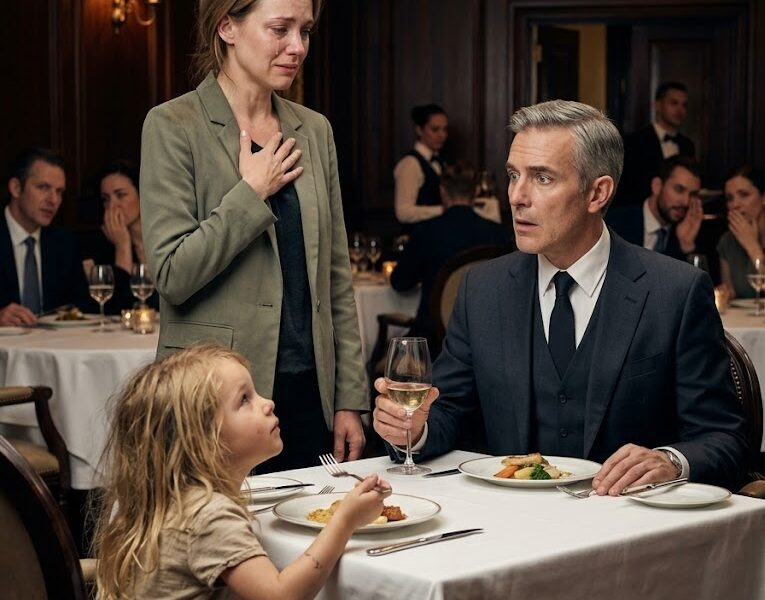
A Hungry Little Girl Asked a Millionaire, “Dad, Can I Eat With You?”—Then Her Mother Walked Into the Restaurant

“Dad… can I eat with you?”
The millionaire’s wineglass stopped halfway to his mouth.
Around him, the garden restaurant continued glowing beneath strands of warm lights. Crystal glasses caught reflections from the chandeliers. A pianist played something soft near the terrace doors. Waiters in pressed black jackets moved between tables carrying plates that cost more than some families spent on groceries in a week.
But at his table, everything stopped.
The little girl standing beside him couldn’t have been older than five.
Her beige dress was wrinkled. One sandal was badly worn at the toe. Her blonde hair had been tangled by the evening wind, and both of her hands were clasped tightly against her chest as if she were trying to make herself smaller.
She looked terribly out of place.
Which was exactly why everyone noticed her.
A woman at the next table lowered her champagne.
A man near the window frowned toward the staff.
Someone whispered, “Where is security?”
The millionaire heard all of it.
But he was looking only at the child.
She swallowed.
“I haven’t eaten today,” she said quietly. “But I promise I won’t bother you.”
Something inside him shifted.
Not enough to understand.
Not yet.
He had spent most of his adult life learning how not to be moved.
He could sit through negotiations involving tens of millions of dollars while three attorneys threatened to walk away. He could close factories, fire senior executives, reject proposals people had spent years building, and board a private flight an hour later without losing sleep.
Emotion complicated decisions.
That was what he had taught himself.
Control was cleaner.
Control had made him rich.
And yet this child, with dirt near one knee and hunger carefully hidden behind good manners, had somehow made him forget the untouched dinner in front of him.
He lowered the glass.
“What did you call me?”
The girl’s eyes widened.
For the first time, embarrassment crossed her face.
“I’m sorry.”
She stepped backward.
“I thought…”
Her voice disappeared.
He should have let her go.
Instead he heard himself ask, “You thought what?”
The girl studied his face.
For several seconds she said nothing.
Then she whispered:
“You looked like somebody.”
His chest tightened for reasons he couldn’t explain.
“Who?”
The child glanced down.
“My dad.”
The pianist continued playing.
Someone laughed on the other side of the terrace.
A fork struck a plate.
Normal sounds.
Yet suddenly they seemed impossibly far away.
The millionaire stared at the little girl.
“Where is your father?”
She lifted one shoulder.
“I don’t know.”
That answer should have ended the conversation.
Instead it opened something.
He slowly pushed the chair opposite him away from the table.
“Sit.”
The girl didn’t move.
She looked behind herself as if he might be speaking to somebody else.
“Me?”
“Yes.”
“Really?”
“Yes.”
She approached the chair cautiously.
Before sitting, she touched the back of it with both hands.
“Are you sure?”
The millionaire almost smiled.
“I’m sure.”
A waiter appeared almost immediately.
His expression was professionally controlled, but his discomfort was obvious.
“Sir.”
The millionaire looked at him.
“Bring another dinner.”
The waiter glanced at the child.
“Perhaps we should—”
“The same dinner as mine.”
“Sir, management may have concerns about—”
“She’s my guest.”
The waiter went silent.
The millionaire rarely raised his voice.
He didn’t need to.
“Bring her dinner.”
“Yes, sir.”
The little girl climbed onto the chair.
Her feet didn’t reach the floor.
“What’s your name?” he asked.
“Khloe.”
His fingers tightened around his glass.
Khloe.
The name touched some distant place in his memory, though he couldn’t understand why.
“Khloe,” he repeated.
She nodded.
“And how old are you?”
“Five.”
The word hit harder.
Five.
For one irrational second, another life flashed through his mind.
A small apartment.
A woman barefoot in the kitchen.
Cheap wine.
Rain against windows that never closed properly.
A promise that money would never become more important than them.
Then airports.
Meetings.
Arguments.
Silence.
Divorce.
Five years.
He pushed the memory away.
“Where are your parents?”
Khloe’s face changed.
“I don’t have a dad.”
He waited.
“And your mother?”
“She’s sick.”
“How sick?”
Khloe looked toward the restaurant entrance.
“Her heart hurts.”
His expression softened.
“A heart condition?”
“I think so.”
Then Khloe added, with the absolute seriousness only children can possess:
“But I think some of it is sadness.”
The millionaire forgot to breathe.
The waiter returned with a plate.
Khloe stared at it.
She didn’t touch anything.
“Go ahead,” the millionaire said.
She looked at him.
“I can really eat it?”
“Yes.”
“All of it?”
“Yes.”
Only then did she lift her fork.
Her first bite was small.
She chewed slowly, closed her eyes for half a second, then opened them again.
That tiny reaction hurt him more than he expected.
He knew expensive food.
He knew Michelin-starred restaurants in Paris, Tokyo, New York and Rome. He knew vintages, private dining rooms and chefs who would redesign menus because his assistant made one phone call.
But he couldn’t remember the last time food had meant anything to him.
To Khloe, one warm bite seemed to mean everything.
“When did you last eat?”
She concentrated on cutting another piece.
“Yesterday.”
He stared at her.
“Yesterday morning or yesterday evening?”
She became quiet.
That answered him.
“Does this happen often?”
“Sometimes.”
“What does sometimes mean?”
Khloe looked up.
“Sometimes we eat.”
She took another bite.
“Sometimes we don’t.”
There were moments in a person’s life when a sentence was too simple to defend against.
This was one of them.
His watch cost more than the building Khloe probably lived in.
Three homes stood empty in his name.
There were cars in garages he hadn’t driven for months.
He owned things simply because somebody had once told him they were difficult to acquire.
And across from him sat a five-year-old who had learned to describe hunger without complaining.
He suddenly felt ashamed.
Not because he had money.
Because he had built walls high enough that he had stopped seeing people outside them.
“Why did you come to my table?”
Khloe’s fork stopped.
“I told you.”
“Because I look like your father?”
“That too.”
“What’s the other reason?”
She looked around the restaurant.
“Because you were alone.”
He almost laughed.
There were perhaps eighty people around them.
“I’m not alone.”
Khloe frowned.
“Yes, you are.”
The certainty in her voice unsettled him.
“How do you know?”
“Because nobody was talking to you.”
“I came here by myself.”
“That’s what I mean.”
He leaned back.
Khloe resumed eating.
“When somebody is alone,” she said, “sometimes they need somebody to sit with them.”
He stared at her.
This child had entered a restaurant because she was hungry.
Yet somehow she had convinced herself that she was helping him.
And the most uncomfortable part was that she might have been right.
He thought of hotel suites in cities whose skylines blurred together.
Long conference tables surrounded by people who laughed when he laughed and disappeared when contracts ended.
An enormous house where the refrigerator was always full and the rooms were always silent.
People wanted his approval.
His money.
His connections.
His signature.
But company?
That was different.
“Are you afraid of being alone?” he asked.
Khloe shook her head.
“No.”
“Why not?”
“Because my dad might be somewhere thinking about me.”
His throat tightened.
“What if he isn’t?”
Khloe considered this.
“Then I’ll learn to be brave by myself.”
He looked away.
Strong.
He had spent his life becoming strong.
Strong meant leaving first.
Strong meant needing nobody.
Strong meant never letting another person possess enough of your heart to damage you.
But brave?
Maybe brave was something else entirely.
Maybe brave meant staying.
Khloe ate slowly until half the plate was gone.
Then she put down her fork.
“Are you finished?”
She nodded.
“You can eat more.”
“I know.”
“Then why stop?”
She hesitated.
“Can I take some home for Mom?”
That nearly undid him.
He raised one hand toward the waiter.
Before the waiter could approach, however, another voice interrupted.
“Sir, the manager would like to speak with you.”
“About what?”
The waiter looked at Khloe.
The millionaire’s expression hardened.
“She stays.”
“Sir, we have standards regarding guests entering from—”
“She.”
His voice dropped.
“Stays.”
The waiter went silent.
“If the manager has a problem with the person sitting at my table, he can come explain it to me personally.”
Khloe stared at him.
The waiter nodded and walked away.
For the first time, she smiled fully.
It transformed her face.
And something about that smile bothered him.
Not because it was unfamiliar.
Because it wasn’t.
He had seen it before.
He just couldn’t remember where.
“Does your mother know you’re looking for your father?”
Khloe’s smile disappeared.
“Mom says we shouldn’t bother somebody who doesn’t want to stay.”
His stomach tightened.
“But I don’t think people always leave because they don’t love you,” Khloe continued.
“No?”
“Sometimes they’re scared.”
He stared at her.
“What makes you think that?”
“Mom says scared people do dumb things.”
Despite himself, he smiled.
“She says that?”
“Not exactly like that.”
He almost laughed.
Then Khloe reached across the table and touched his hand.
The contact lasted only a second.
“Maybe my dad was scared too.”
The millionaire felt something crack behind his ribs.
“And if he was?”
“Someday he’ll be brave.”
He lowered his eyes.
He didn’t know why this conversation felt like an accusation from his own past.
He didn’t know why this girl’s face kept triggering memories he had spent years burying.
And he didn’t know why, from the rear of the restaurant, a woman had been watching them for several minutes without moving.
But when he finally noticed her, he understood immediately that she wasn’t another curious diner.
She was crying.
Quietly.
One hand pressed against her chest.
Her eyes were fixed on Khloe.
Then Khloe turned.
Her entire face changed.
“Mom.”
The millionaire looked up.
The woman began walking toward them.
One step.
Then another.
Something cold moved through his body.
He knew those eyes.
Older now.
More tired.
Surrounded by lines that life had carved there.
But he knew them.
He stood so abruptly that his chair scraped against the stone floor.
The woman stopped several feet away.
For a long moment, neither spoke.
Khloe looked between them.
“Mom, he gave me dinner.”
The woman nodded.
“I saw.”
Her voice.
That voice.
The millionaire felt the years collapse.
A cramped apartment.
A mattress on the floor when they couldn’t afford furniture.
Her laughing while rain leaked through the window.
Her telling him she didn’t care whether he became rich.
His promise that one day she would never worry about money again.
Then the fights.
The missed dinners.
The postponed birthdays.
The phone calls he answered during conversations.
The first international contract.
The second.
The third.
And eventually the day he told her he needed to leave “temporarily” because his career was finally becoming what he had dreamed it could be.
Temporary.
He had always liked that word.
It made abandonment sound reversible.
“It can’t be,” he whispered.
The woman’s expression didn’t change.
“Yes.”
Khloe looked up at her.
“You know him?”
Her mother inhaled slowly.
“Yes, sweetheart.”
“How?”
Neither adult answered.
The millionaire’s mouth had gone dry.
He looked at Khloe again.
Five years old.
Blonde hair.
That smile.
The slight tilt of her head.
Those eyes.
His eyes.
No.
His mind rejected it before his heart could accept it.
“Do we know each other?” he asked the woman.
It was a coward’s question.
They both knew it.
Her mouth tightened.
“More than you apparently remember.”
Khloe watched them.
The millionaire lowered his voice.
“What are you doing here?”
The woman’s eyes flashed.
“Still asking the wrong question.”
“What does that mean?”
“You always asked what interrupted your plans.”
She glanced at Khloe.
“You never asked what your plans interrupted.”
He flinched.
She came closer.
“You left.”
“I had to travel.”
“You left.”
“I told you it was temporary.”
“Yes.”
Her voice remained controlled.
“That was your favorite word.”
He said nothing.
“You said you needed one year. You said you needed to stabilize the company. You said when things were secure, you’d come back.”
Her eyes glistened.
“And while you were becoming successful, I was learning how to survive.”
Khloe’s small voice interrupted them.
“Mom?”
The woman looked down.
“Is it him?”
Silence.
The millionaire felt every eye in the restaurant on them, but none of those strangers mattered anymore.
Khloe pointed toward him.
“Is he my dad?”
Her mother closed her eyes.
When she opened them, she looked directly at the millionaire.
“You tell her.”
He felt suddenly exposed in a way money had always protected him from.
“I…”
Khloe waited.
He looked at the woman.
“I didn’t know.”
She gave a small, bitter nod.
“No.”
Her voice barely rose above a whisper.
“You didn’t ask.”
The words landed harder than a shout.
He wanted to defend himself.
Wanted to say she had disappeared too.
Wanted to say he had traveled constantly.
Wanted to explain the chaos of those years.
Wanted to point toward all the circumstances that had made neglect seem reasonable at the time.
But every defense sounded obscene with Khloe sitting between them.
“Mom?”
Her mother knelt.
“Yes, sweetheart.”
Khloe’s eyes grew enormous.
“Really?”
“Yes.”
Khloe turned toward him.
He had negotiated with men who frightened entire industries.
Nothing had ever terrified him like the hope in that little girl’s face.
She climbed down from her chair.
Walked toward him.
Stopped.
Then asked the question he would remember for the rest of his life.
“Then why weren’t you there?”
No anger.
No accusation.
Just confusion.
He could have survived anger.
Innocence was harder.
Because ambition meant nothing to a five-year-old.
Neither did expansion.
Neither did acquisitions.
Neither did the endless fear that if he slowed down, someone stronger would take everything he had built.
There was only one answer honest enough to give her.
“Because I was a coward.”
Khloe frowned.
Her mother looked at him sharply.
He swallowed.
“I thought being successful meant never stopping. I thought I could leave things behind and come back whenever I wanted.”
He looked at the woman.
“I was wrong.”
Khloe studied him.
“But I said my dad would be brave someday.”
His eyes burned.
For years, he had believed tears belonged to people who had lost control.
Now he understood that sometimes control was exactly what needed to be lost.
“You did,” he whispered.
“Are you?”
“Am I what?”
“Brave now?”
He glanced at her mother.
“I don’t know yet.”
Then he looked back at Khloe.
“But I want to start.”
Her mother folded her arms.
“Wanting doesn’t erase five years.”
“I know.”
“You don’t get to walk into her life because tonight made you emotional.”
“I know.”
“You don’t get to write a check, solve the uncomfortable parts, and call yourself a father.”
He stiffened.
That one found its target because that was precisely what part of him had already begun planning.
Doctors.
Housing.
Accounts.
Schools.
Insurance.
Problems he could solve.
Her mother saw the calculation happening.
“She doesn’t need a sponsor.”
Her voice softened.
“She needs a father.”
Khloe looked between them.
“So…”
She hesitated.
“I’m not alone anymore?”
The millionaire dropped to one knee.
“You never should have been.”
Her mother turned away.
The movement was small, but he saw her wipe beneath one eye.
Then her hand went to her chest.
He noticed.
“Are you all right?”
“I’m fine.”
“You don’t look fine.”
“I said I’m fine.”
Khloe immediately looked worried.
“Mom’s heart hurts sometimes.”
The millionaire stood.
“What’s wrong with your heart?”
Her mother gave Khloe a tired look.
Then she looked at him.
“I need surgery.”
He stared at her.
“When?”
“As soon as I can afford it.”
His response was immediate.
“I’ll pay for it.”
“No.”
“What?”
“I said no.”
“You need surgery.”
“And you’re proving my point.”
“What point?”
“That money is still the first language you speak.”
He fell silent.
She stepped closer.
“I didn’t come here asking for anything. Khloe saw you through the restaurant window. She kept insisting.”
Khloe looked down.
“I thought he looked sad.”
Her mother’s expression softened for half a second.
“She’s been doing that for years.”
“Doing what?”
“Looking for you.”
He felt sick.
“She looks at men on sidewalks. In stores. On buses. She asks if they might be her father.”
The millionaire couldn’t speak.
“I never showed her hatred,” the woman continued. “I never wanted your absence to become poison inside her.”
“You should have told me.”
Her expression hardened again.
“I tried.”
He froze.
“What?”
“Not here.”
“Tell me.”
“Not here.”
He looked around.
Suddenly the restaurant felt obscene.
The expensive wine.
The staring strangers.
The table where his daughter had needed permission to eat.
“Where are you staying?”
She hesitated.
“I’m not taking your pity.”
“It isn’t pity.”
“What is it?”
He looked at Khloe.
“Responsibility.”
Her mother studied him.
“You used to be very good with impressive words.”
“Then don’t believe the words.”
He picked up his jacket.
“Watch what I do.”
Khloe slipped her hand into his.
It was so natural that he nearly stopped breathing.
“Can we go together?”
He looked down.
“All three of us?”
She nodded.
“All three.”
He had spent most of his adult life speaking in the singular.
My company.
My schedule.
My decision.
My success.
Now a five-year-old had introduced a plural that frightened him more than any hostile takeover ever had.
“All three,” he said.
They left the restaurant together.
The streets changed as they walked.
Luxury storefronts gave way to laundromats, convenience stores and aging apartment buildings. Decorative lighting disappeared. Pavement cracked. Traffic became louder.
Eventually they stopped before a narrow building with peeling paint around the entrance.
Her mother unlocked the door.
“This is temporary.”
He almost winced at the word.
They climbed two flights of stairs.
Khloe talked the entire way.
“Mom makes soup when she feels good.”
Another step.
“She reads stories even when she’s tired.”
Another.
“She says hearts heal with hope.”
Her mother looked away.
The apartment was small.
Painfully small.
But clean.
A worn couch sat beneath a window.
Medicine bottles occupied one shelf beside a stack of overdue envelopes.
Children’s drawings covered one wall.
The refrigerator hummed too loudly.
A single lamp made the room warm.
The millionaire stood in the doorway.
He thought of his mansion.
Nine bedrooms.
A wine cellar.
A dining room designed for twenty.
Art selected by a consultant.
Rooms nobody used.
This place had almost nothing.
Yet it felt inhabited in a way his house never had.
Khloe ran toward a drawer.
“I have something.”
She returned carrying folded paper.
“I made it for when Dad came back.”
She opened it.
Three figures.
A mother.
A child.
A man.
All holding hands beneath an enormous yellow sun.
Above them, written in uneven letters:
MY FAMILY.
He stared at the paper.
The father had no face.
“Why doesn’t he have eyes?” he asked.
Khloe shrugged.
“I didn’t know what you looked like.”
He turned his head.
That was the moment he nearly broke.
Not in the restaurant.
Not when she called him Dad.
Not even when he learned she was his daughter.
It was the blank face.
Five years of absence represented by two missing eyes and a child waiting to fill them in.
Her mother sat slowly on the couch.
He noticed the effort it took.
“How serious is your condition?”
“Serious enough.”
“I want your doctor’s information.”
She laughed once without humor.
“There.”
She pointed toward the shelf.
Medical papers.
He picked them up.
He read numbers.
Dates.
Recommendations.
The language of risk.
For once, numbers frightened him.
“You need the operation.”
“Yes.”
“I’ll arrange it tonight.”
She shook her head.
“You still don’t understand.”
“Then make me understand.”
“I need you in the waiting room.”
He stopped.
“I need you to explain to Khloe why her mother is being taken into surgery. I need you there if she gets scared.”
Her voice trembled.
“And if something happens to me, I need to know my daughter isn’t going to discover that her father disappears whenever life becomes inconvenient.”
He put the papers down.
“I’ll be there.”
“Don’t promise yet.”
“Why?”
“Because you don’t know everything.”
The room changed.
He looked at her.
“What don’t I know?”
She took a long breath.
“When Khloe was born, I called you.”
His face tightened.
“No.”
“Yes.”
“I never received a call.”
“I know.”
“What does that mean?”
“I called more than ten times.”
“That’s impossible.”
“Then I went to your office.”
He stared at her.
“Your assistant stopped me downstairs.”
The millionaire’s blood turned cold.
“She told me you had given strict instructions not to be interrupted by personal matters. She told me you were focused on an international negotiation.”
Memory returned.
A major deal.
Flights.
Security.
Meetings.
His first real global expansion.
He had instructed his staff to filter everything.
Nothing personal.
Nothing unnecessary.
Nothing that could wait.
“I never told anyone to block you.”
Her eyes filled.
“No.”
Then she said quietly:
“You only built a life where they believed that was what you wanted.”
He had no answer.
“She told me you didn’t want contact.”
“That wasn’t true.”
“Your number stopped accepting my calls.”
He remembered handing his phone to an assistant before boarding a flight.
“Clean this up. I don’t want distractions.”
Had her number been there?
He couldn’t remember.
That was worse.
“I didn’t know.”
“I know.”
“Then this wasn’t entirely—”
He stopped himself.
She waited.
He had almost done it.
Almost searched for the fraction of blame that belonged to somebody else.
His assistant.
His schedule.
The deal.
Miscommunication.
Anything that would make his guilt smaller.
Instead he sat down.
“I created it.”
Her expression changed.
“What?”
“The wall.”
He looked around the apartment.
“I may not have personally blocked your number, but I created the wall that kept you out.”
For several seconds, she said nothing.
“That’s the first honest thing you’ve said tonight.”
Khloe had fallen asleep on the couch with the drawing against her chest.
He watched her.
Ten phone calls.
A hospital.
A newborn daughter.
And somewhere, while all of that happened, he had probably been celebrating a contract.
“Why didn’t you keep trying?”
Her mother looked at him.
“Because love isn’t begged for.”
The words left no place to hide.
“I thought you knew,” she continued. “I thought you had made your choice.”
“I didn’t.”
“The result was the same.”
He nodded.
Yes.
That was the unbearable truth.
Intent did not raise a child.
Intent did not buy dinner.
Intent did not sit beside a sick woman.
Intent did not answer a little girl asking where her father was.
Presence did.
He took out his phone.
Her mother immediately shook her head.
“No.”
“I need to transfer—”
“Put it away.”
“You need help.”
“So do you.”
He stared at her.
She pointed toward the phone.
“If you solve everything tonight with money, you’ll convince yourself you’ve done your job.”
“That isn’t what I’m doing.”
“Isn’t it?”
He slowly lowered the phone.
“What do you want me to do?”
“Something you’ve never been good at.”
“What?”
“Stay.”
He looked at her.
“Tonight.”
His phone vibrated.
A meeting reminder.
Then another message.
A flight confirmation.
He had an executive session at seven.
A negotiation at nine.
A flight shortly after noon.
Khloe shifted in her sleep.
Her hand fell from the couch and rested against his wrist.
Without waking, she murmured one word.
“Dad.”
The millionaire looked at his phone.
Then at his daughter.
“I’ll stay.”
Her mother watched him carefully.
“The couch is terrible.”
“I’ve slept in worse places.”
She almost smiled.
“No, you haven’t.”
He looked at the small couch.
She was probably right.
That night he did not sleep.
Not because of the couch.
Because at two in the morning, with Khloe sleeping only a few feet away, he finally understood the arithmetic of his life.
He had counted everything except absence.
Every dollar.
Every asset.
Every quarter.
Every percentage point.
Every hour billed.
Every mile flown.
But never the birthdays missed.
Never the unanswered calls.
Never the nights a child had gone hungry.
By dawn, he understood that those had been the most expensive numbers of all.
Her mother emerged from the bedroom shortly after six.
“You stayed.”
There was surprise in her voice.
He looked at her.
“I said I would.”
“You said a lot of things once.”
He nodded.
“Then don’t trust me yet.”
That answer surprised her.
“I have a medical appointment this morning,” she said.
“I’m coming.”
“You have work.”
“Not today.”
His phone began vibrating.
Once.
Twice.
Again.
He switched it off.
Khloe opened her eyes.
For one frightened second she searched the room.
Then she saw him.
Her entire face brightened.
“Good morning, Dad.”
He had received awards.
He had heard audiences applaud his name.
He had watched financial networks discuss his decisions.
Nothing had ever sounded like that.
“Good morning, sweetheart.”
At the clinic, he sat in a plastic chair under fluorescent lights.
Nobody brought him coffee.
Nobody recognized him.
Nobody cleared a private room.
And strangely, he preferred it.
Khloe sat beside him swinging her legs.
Every few minutes, she looked up.
Each time she saw him still there, she smiled.
He began to understand.
She wasn’t watching because she admired him.
She was checking whether he had disappeared.
That realization hurt more than guilt.
When the doctor called them inside, the news was direct.
Surgery should not be delayed.
The risks would increase.
Her mother’s hand trembled.
Khloe noticed.
“Will Mom be okay?”
The doctor answered carefully.
“With surgery, her chances are good.”
The millionaire spoke.
“Schedule it.”
Her mother looked at him.
“At the best cardiac center available.”
The doctor hesitated.
“That will be expensive.”
“I don’t care.”
Her mother’s expression changed.
He corrected himself.
“I mean the cost will not decide whether she receives treatment.”
He turned toward her.
“I’m not trying to purchase forgiveness.”
“What are you trying to do?”
“What I should have done five years ago.”
His phone was switched on only long enough to arrange the hospital.
Dozens of messages arrived.
One stood above the others.
IF YOU ARE NOT HERE TODAY, WE LOSE THE DEAL.
He stared at it.
The old reflex returned instantly.
Urgency.
Adrenaline.
Control.
He could almost hear himself saying it.
I have to go.
Just a few hours.
This cannot wait.
He looked at Khloe.
She was drawing on a piece of paper.
Three people again.
But this time the father had eyes.
The millionaire typed:
I won’t be there. Family priority.
A reply appeared seconds later.
Since when?
He locked the phone.
Her mother had seen the exchange.
“You may have just lost millions.”
He looked at his daughter.
“I already lost five years.”
He put the phone away.
“That cost more.”
Something shifted in the woman’s face.
Not forgiveness.
Not yet.
But perhaps the first small piece of respect.
The surgery was scheduled for the following week.
The millionaire did not return to his mansion.
He canceled travel.
Delegated meetings.
Rescheduled calls.
One afternoon, a business partner arrived outside the apartment building.
The man looked around in disbelief.
“What are you doing?”
The millionaire closed the door behind himself.
“What I should have done years ago.”
“You’re jeopardizing major investments.”
“My daughter’s mother needs heart surgery.”
“Your daughter?”
“Yes.”
“You never told me you had one.”
“I didn’t know.”
The partner stared.
“The market doesn’t care about personal problems.”
Once, the millionaire would have agreed.
Now he looked through the window.
Khloe was sitting at the small table, concentrating intensely on homework.
“It isn’t a personal problem.”
“What is it, then?”
“My life.”
The partner lowered his voice.
“This opportunity may never come back.”
The millionaire looked at him.
“Some opportunities don’t.”
He glanced again toward Khloe.
“I learned that already.”
The partner left.
That evening, Khloe was coloring beside him.
“Dad?”
“Yes?”
“Will you leave when Mom has surgery?”
“No.”
“What if work calls?”
“Work can wait.”
Khloe kept coloring.
“Mom says grown-ups say things they don’t mean.”
He put down the pencil.
“Then don’t believe what I say.”
She looked up.
“Watch what I do.”
The day of surgery arrived.
Her mother wore a hospital gown.
For the first time since their reunion, she looked frightened.
Not angry.
Not guarded.
Frightened.
Khloe held the millionaire’s hand so tightly that her fingernails pressed into his skin.
“Is it going to hurt?”
“A little.”
“Will she wake up?”
The millionaire wanted to say yes.
He wanted to promise certainty.
But fatherhood, he was beginning to understand, was not the art of lying beautifully to protect a child.
“The doctors believe she will.”
Khloe’s eyes filled.
“And if I get scared?”
He crouched.
“Then you get scared.”
She blinked.
“That’s okay?”
“Yes.”
“What do you do when you’re scared?”
He looked toward her mother.
“I stay.”
The surgical team arrived.
Before they took her away, the woman looked at him.
“Don’t leave her alone.”
He shook his head.
“Never again.”
The doors closed.
Hours passed.
His phone vibrated.
He ignored it.
It vibrated again.
Finally he looked.
LAST CHANCE. CONFIRM YOUR PRESENCE NOW OR THE DEAL MOVES WITHOUT YOU.
Millions.
Years of work.
A transaction his company had pursued for months.
He looked beside him.
Khloe had fallen asleep against his shoulder.
One hand still held his.
The choice suddenly seemed embarrassingly simple.
He switched off the phone.
Three hours later, the surgeon appeared.
The millionaire stood so quickly that Khloe woke.
“How is she?”
“The operation was successful.”
Khloe screamed.
Not from fear.
From relief.
She threw herself into her father.
He caught her.
Then he cried.
He didn’t hide it.
When her mother woke in recovery, he was sitting beside her bed.
Khloe was asleep in a chair.
The woman opened her eyes slowly.
“You stayed.”
“Yes.”
“What about your deal?”
“Gone, probably.”
She studied him.
“You’re not angry?”
He thought about it.
“No.”
“Why?”
He looked at Khloe.
“Because I finally know what losing actually feels like.”
Weeks passed.
Recovery was slow.
Nothing magically repaired itself.
Her mother did not suddenly forget five years.
Some evenings she became angry.
Some conversations ended in silence.
There were questions he could not answer.
Memories he could not repair.
And sometimes, when he was late by ten minutes, he saw fear flash across Khloe’s face before she could hide it.
That was when he learned the cruelest part of rebuilding trust.
The person who broke it may change in one night.
The person who was hurt cannot.
So he kept arriving.
School pickup.
Doctor appointments.
Dinner.
Bedtime.
Saturday mornings.
Ordinary Tuesdays.
He learned how Khloe liked her toast.
He learned which story she demanded repeatedly even though she knew every line.
He learned that she hated peas but would eat carrots if they were cut into circles.
He learned that children did not measure love by grand gestures.
They measured it in repetition.
Are you here today?
Will you be here tomorrow?
What about the day after that?
One afternoon, a letter arrived from his business partners.
He opened it at the kitchen table.
The agreement he had abandoned had not collapsed.
The investors had decided to continue.
His decision had created arguments, certainly, but something unexpected had happened.
Several people had respected it.
The company had survived his absence.
Perhaps that was another truth he had needed to learn.
The empire he had believed could not function without him could.
His daughter was the one who had needed him.
Khloe leaned over the table.
“Is that from work?”
“Yes.”
“Are you in trouble?”
He smiled.
“No.”
“Did you win?”
He considered the question.
Then he pulled her onto his lap.
“Yes.”
“Because you got the deal?”
“No.”
“Then why?”
He looked at her.
“Because I stayed.”
Khloe smiled.
To her, that explanation required nothing more.
Months passed.
Her mother grew stronger.
The millionaire reduced unnecessary travel.
He delegated.
He declined invitations.
Some people said he had changed.
They were correct.
Some said he had become less ambitious.
They were wrong.
His ambition had simply found a different target.
He began quietly funding public clinics.
Programs for struggling mothers.
Counseling for fathers who had allowed careers, pride or fear to separate them from their children.
There were no press conferences.
No buildings carrying his name.
He had spent enough of his life needing the world to see what he accomplished.
Now he cared more about seeing other people.
One afternoon, Khloe was drawing at the kitchen table.
“Dad?”
“Yes?”
“Do you remember the restaurant?”
He smiled.
“I think about it every day.”
“I knew it was you.”
His smile faded.
“What?”
“I knew.”
“How?”
She shrugged.
“You looked sad.”
He stared at her.
“And Mom says sad people sometimes need somebody to really see them.”
His throat tightened.
For years, people had admired him.
Feared him.
Needed him.
Envied him.
Quoted him.
Photographed him.
But perhaps nobody had really seen him.
Not until a hungry five-year-old girl had stood beside his table and mistaken loneliness for something worth rescuing.
Later, when they moved out of the small apartment, Khloe found the old drawing.
Three people beneath a yellow sun.
She held it beside a newer picture.
In the old one, the father had no eyes.
In the new one, he stood in the middle holding both their hands.
“Look,” Khloe said.
“It looks like us now.”
The millionaire took the old drawing from her.
He stared at that faceless man.
For a long time he said nothing.
Then he whispered:
“Thank you for waiting for me.”
Khloe frowned.
“I wasn’t waiting.”
He looked at her.
“No?”
She shook her head.
“I knew you’d come.”
He closed his eyes.
Children could forgive with terrifying generosity.
Adults knew better.
Her mother had not forgotten.
Neither had he.
Maybe forgetting was never the point.
They did not become a perfect family.
They became something harder.
A real one.
There were scars.
Arguments.
Therapy.
Uncomfortable truths.
Days when the past entered the room without being invited.
But there was also breakfast.
Homework.
Laughter.
Doctor visits.
Bedtime stories.
Hands held while crossing streets.
Ordinary life.
And ordinary life, the millionaire discovered, was what he had been too busy becoming successful to notice.
Years later, Khloe came home from school carrying an essay.
Her teacher had asked the class to write about someone who had surprised them.
She handed it to her father.
He sat at the kitchen table and read.
Most of the essay was about small things.
How he burned pancakes.
How he made ridiculous voices when reading stories.
How he sometimes fell asleep during movies.
How he came to school performances too early because he was terrified of being late.
Then he reached the final lines.
His eyes stopped.
Khloe had written:
My dad surprised me because he decided to stay.
He read the sentence again.
Then again.
There was no mention of his companies.
No mention of his wealth.
No mention of the hospital bills he had paid.
No mention of the house.
No mention of anything the world used to measure him.
Only that.
He decided to stay.
That evening, long after Khloe had gone to bed, he stood alone beside the kitchen window.
Her mother came beside him.
“What are you thinking about?”
“The restaurant.”
She smiled faintly.
“That feels like another lifetime.”
“It was.”
He looked toward the hallway leading to Khloe’s room.
“I spent years believing the biggest mistake of my life was leaving you.”
Her mother remained silent.
He continued.
“But leaving wasn’t the worst part.”
“What was?”
“Making myself impossible to reach.”
She looked at him.
He swallowed.
“I built a wall around my life because I thought distractions were the enemy of success.”
A sad smile touched her face.
“And?”
“The things I called distractions were my life.”
She didn’t tell him he was forgiven.
He no longer needed forgiveness to be spoken like a verdict.
Some things were rebuilt more quietly.
A cup of coffee placed beside him in the morning.
Her hand resting against his shoulder.
The absence of fear when he left for work because she knew he would return.
Trust had become less like a declaration and more like a thousand small proofs.
Before going to bed, he walked into Khloe’s room.
She was sleeping beneath a blanket, one arm hanging over the side.
On the wall above her desk was the old drawing.
She had kept it.
The three figures.
The enormous sun.
The words MY FAMILY.
And the father who once had no face.
Khloe had added one thing to it.
Eyes.
He stood there for a long time.
Five years could not be returned.
No amount of money could purchase them.
No apology could rewrite them.
No good deed could make them disappear.
That was the consequence he would carry.
But consequence, he had learned, was not the same as hopelessness.
Sometimes the past could not be repaired.
Sometimes all a person could do was stop repeating it.
He leaned down and kissed Khloe’s forehead.
She moved slightly.
Her eyes remained closed.
“Dad?”
“I’m here.”
A pause.
Then, half asleep:
“Okay.”
That single word nearly broke his heart.
Not because she doubted him.
Because she didn’t.
He switched off the lamp.
At the doorway, he looked back once.
For most of his life, he had measured success by what he could acquire.
Companies.
Properties.
Influence.
Money.
But none of those things had ever looked for him when he entered a room.
None had ever waited for his footsteps outside a door.
None had ever asked whether he would stay.
Years earlier, a hungry little girl had walked into an elegant restaurant and asked him the simplest question of his life.
“Dad, can I eat with you?”
He had thought she was asking for dinner.
She wasn’t.
She was asking whether there was room for her in his life.
And perhaps, without knowing it, she had been offering him something too.
A chair at her table.
A second chance.
A way home.
The millionaire quietly closed the bedroom door, walked down the hallway, and found Khloe’s mother waiting for him in the kitchen.
Nothing about their life was perfect.
Nothing had been erased.
But when he sat beside her, he did not check his phone.
He did not look at his watch.
He did not think about tomorrow’s meetings.
Outside, the city kept moving.
Deals were being signed.
Flights were leaving.
Money was changing hands.
Somewhere, another man was probably telling somebody he loved that he would come home after just one more meeting.
The millionaire listened to the silence of the house.
Then he reached across the table and took her hand.
For once, he was exactly where he was supposed to be.
And this time—
he stayed.









