A Little Girl Asked a Stranger, “Can Mom and I Go With You?”—Then Her Mother Learned Who He Really Was
The little girl caught Daniel Carter by the sleeve just as he was about to walk away.
Her fingers were tiny, cold from the October air, and trembling just enough for him to notice.
“Can Mom and I go with you?”
Daniel stopped.
For a second, the noise around the community center seemed to fall away—the squeak of playground swings, the rattle of an old ventilation unit, children yelling across the basketball court, cars hissing over damp pavement on the Boston street outside.
He looked down at the girl.
She couldn’t have been older than seven.
Maybe eight.
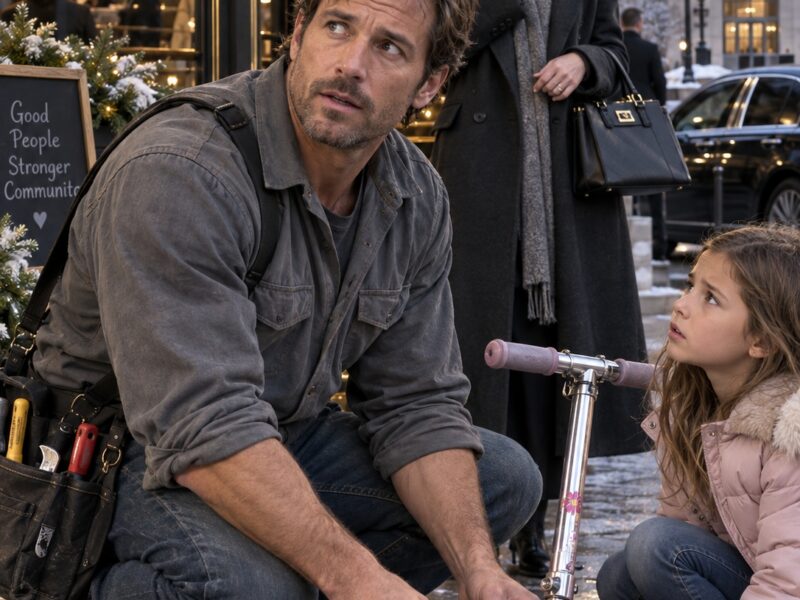
Her dark hair had slipped loose from a pale blue headband, and one knee of her expensive-looking leggings was streaked with dirt from the playground. Ten minutes earlier, Daniel had fixed the front wheel of her scooter.
That was all.
He didn’t know her.
He certainly didn’t know her mother.
Yet the child was looking at him as if she had just asked the most reasonable question in the world.
Behind her, a tall woman in a charcoal wool coat lowered her phone.
“Lily.”
There was something sharp in the woman’s voice.
Not anger.
Embarrassment.
And underneath that, something Daniel recognized immediately.
Exhaustion.
The kind people learned to hide because showing it invited questions they didn’t have the energy to answer.
The woman walked toward them quickly.
“We don’t ask strangers things like that.”
Lily looked back at her.
“But he’s not mean.”
The woman closed her eyes for half a second.
Daniel almost smiled.
Apparently that was the child’s standard for transportation.
He adjusted the canvas tool bag hanging from his shoulder.
“It’s okay,” he said.
The woman gave him a guarded look. “No. It isn’t. I’m sorry.”
“You don’t have to apologize.”
Lily tightened her grip on Daniel’s sleeve.
“But you’re leaving.”
Daniel glanced toward the front entrance.
His eight-year-old son, Noah, was standing beside a pile of donated lumber, struggling unsuccessfully to zip his jacket while talking to Mr. Alvarez, the community center director.
“We were about to head home,” Daniel said.
Lily looked at her mother.
Then back at him.
“Mom’s car didn’t come.”
“Lily.”
“And she’s mad.”
“I am not mad.”
“You said a bad word.”
Daniel looked away quickly.
The woman’s cheeks colored.
“Under my breath.”
“I still heard it.”
This time Daniel did smile.
The woman noticed.
Something in her expression softened for a heartbeat before the invisible walls returned.
“My driver is delayed,” she explained. “I have somewhere I need to be.”
Daniel nodded.
He didn’t ask where.
He didn’t ask why she had a driver.
He didn’t ask why the coat she was wearing probably cost more than his monthly mortgage payment.
Instead, he pulled his phone from his pocket.
“I can order you a ride.”
The woman blinked.
“That’s not necessary.”
“There’s also a café two blocks down. Public place. Warm. Your driver can meet you there.”
She studied him.
Most men Daniel’s age knew what that kind of woman represented the moment they saw her.
Money.
Access.
Possibility.
Daniel saw a mother standing in the cold with a child who was beginning to shiver.
Nothing more.
Maybe that was why she seemed confused.
Or maybe no one had looked at her that simply in years.
Lily suddenly turned toward the parking lot.
“Please, Mom?”
Her mother exhaled.
Then the phone in her hand began vibrating again.
The screen flashed with a name Daniel didn’t recognize.
MARCUS—BOARD CHAIR.
The woman’s face changed instantly.
Not dramatically.
Just enough.
Her shoulders stiffened. Her mouth became a straight line.
She silenced the call.
And Daniel realized that whatever waited for her on the other side of that phone was something she did not want her daughter to hear.
“You said there was a café?” she asked.
Daniel nodded.
“Two blocks.”
“We can walk.”
Lily’s face lit up.
What Daniel didn’t know was that forty-seven minutes later, inside that café, one innocent question would force him to speak about a life he had spent years trying to bury.
And Victoria Hayes would realize the quiet maintenance supervisor sitting across from her had once been the kind of man governments sent into places no one else was supposed to survive.
The morning had begun much more ordinarily.
Daniel Carter woke at 5:41 a.m. without an alarm.
He always did.
Some habits refused to disappear even after ten years.
He lay still for several seconds in the gray darkness of his bedroom, listening automatically.
Furnace.
Refrigerator compressor downstairs.
Wind against the west window.
Noah breathing in the next room.
Nothing wrong.
Nothing unusual.
Only then did Daniel sit up.
His feet touched the cold hardwood floor.
On the dresser sat three objects he never moved.
His wedding ring.
A folded American flag inside a triangular wooden case.
And a photograph taken thirteen years earlier of six men standing in dusty gear beneath a brutal white sun.
Daniel was smiling in the photograph.
He barely recognized that version of himself anymore.
He showered, shaved, put on jeans and a gray work shirt, then went downstairs and started pancakes.
At 6:14, Noah appeared in the kitchen dragging a blanket behind him.
“You said waffles.”
“I said breakfast.”
“You specifically said waffles.”
“I specifically remember you falling asleep during the conversation.”
Noah dropped into a chair.
“That doesn’t mean my memory stopped working.”
Daniel poured batter onto the skillet.
“Your selective memory is excellent.”
“My normal memory is also excellent.”
“Then you remember you promised to clean your room.”
Noah stared at him.
“That feels unrelated.”
Daniel almost laughed.
These mornings were why he had left.
Not because he hated what he had been.
Not because he regretted serving.
Because there had been years when mornings like this seemed like something that belonged to other men.
Men who knew where they would sleep the next night.
Men whose children didn’t learn to recognize them through video calls.
Men whose wives didn’t pause before answering the door because every military spouse eventually understood that some knocks changed the shape of a life forever.
Daniel flipped a pancake.
Noah watched him.
“Community center today?”
“Yep.”
“Playground?”
“Depends what’s broken.”
“Everything there is broken.”
“That’s why we keep going.”
Noah leaned his chin into his hand.
“Mr. Alvarez should just buy new stuff.”
Daniel looked at him.
“Maybe he can’t.”
“He runs the place.”
“That doesn’t mean he has unlimited money.”
Noah thought about it.
Then he nodded.
Daniel placed two pancakes in front of him.
“Sometimes you don’t replace something because it’s damaged.”
“What do you do?”
“You figure out if it can still be fixed.”
Neither of them knew how important those words would become before lunch.
Across the Charles River, Victoria Hayes was already on her third phone call.
Her kitchen was larger than Daniel’s entire first floor.
White marble island.
Custom cabinetry.
Glass walls overlooking the city.
A flower arrangement replaced every four days by someone whose name Victoria could never remember.
Everything was flawless.
Everything was quiet.
Too quiet.
“Move the meeting to eleven-thirty,” she said, scrolling through an email on her tablet.
A man’s voice came through the speaker.
“Marcus is pushing for ten.”
“Marcus doesn’t run my calendar.”
“He chairs the board.”
“And I run the company.”
There was silence.
Victoria closed her eyes.
She had slept four hours.
Again.
“Eleven-thirty.”
“I’ll tell him.”
“Don’t tell him. Inform him.”
The call ended.
“Mom?”
Victoria looked up.
Lily stood at the opposite side of the island holding one sneaker.
“You promised.”
Victoria stared at her blankly.
Lily’s expression changed.
Just a little.
That hurt more than accusation would have.
“The community center.”
Victoria looked at the time.
7:03.
Saturday.
She had forgotten.
“I know.”
“You forgot.”
“I didn’t forget.”
“You did the face.”
“What face?”
“The face when you forgot something but you’re deciding if you can pretend you didn’t.”
Victoria stared at her daughter.
Seven years old.
Brutal.
Accurate.
“I remembered eventually.”
“When?”
“Just now.”
Lily nodded seriously.
“So you forgot.”
Victoria put down the tablet.
Six months earlier, Lily’s school counselor had used words Victoria hated.
Emotionally isolated.
Over-scheduled.
Seeking connection.
None of it sounded like her daughter.
It sounded like an accusation against Victoria.
At first, she had responded the way she responded to most problems.
She tried to solve it.
New dance teacher.
Weekend horseback riding.
Private art lessons.
A trip to Vermont.
Nothing changed.
Finally, the counselor had said something Victoria couldn’t dismiss.
“She doesn’t need more experiences, Ms. Hayes. She needs more of you.”
That sentence had followed Victoria home.
It followed her through quarterly reports, investor calls, black-car rides, late dinners eaten alone over spreadsheets.
And so when Lily’s class had volunteered to donate books and toys to the Brookline Community Center, Victoria had agreed to go.
No assistant.
No nanny.
No delegation.
Just mother and daughter.
Now Victoria looked at the untouched coffee beside her laptop.
“I’m coming.”
Lily smiled.
The meeting with Marcus could wait.
Or so Victoria believed.
By nine-twenty, the community center looked like organized chaos.
Daniel had already fixed a broken door hinge, replaced two shelf brackets, repaired a leaking sink trap, and explained to Noah why power tools were not toys despite what certain internet videos suggested.
He was kneeling beside a storage cabinet when Noah appeared.
“Dad.”
Daniel kept tightening the screw.
“Yeah?”
“There’s a girl breaking her scooter.”
“Is she intentionally breaking it?”
“No.”
“Then she’s probably not breaking it.”
“The wheel keeps wobbling.”
Daniel sat back.
“You offering my services?”
Noah smiled.
“Maybe.”
Daniel sighed theatrically.
“Where?”
Outside, Lily Hayes was pushing her scooter forward three feet at a time and watching the front wheel tilt sideways.
Victoria stood fifteen yards away.
Her phone was at her ear.
Of course.
“No,” she was saying. “I am not approving a revised acquisition model because Marcus wants the announcement before Monday.”
Lily pushed the scooter again.
The wheel snagged.
She almost fell.
Daniel reached her before Victoria even noticed.
“Easy.”
Lily looked up.
Daniel crouched.
“May I?”
She nodded.
He turned the scooter onto its side and examined the wheel.
The axle nut had nearly worked itself free.
“You ride this a lot?”
“Every day.”
“Fast?”
“Very.”
“Dangerously fast?”
She thought about it.
“Mom says yes.”
“Then I’m going to assume yes.”
Noah crouched beside him.
Daniel opened his tool bag.
Lily studied the contents.
“Why do you have so many tools?”
“My dad thinks tools solve everything,” Noah said.
“They solve many things.”
“Not math homework.”
“Nothing solves math homework except doing math homework.”
“That’s depressing.”
Lily giggled.
Daniel tightened the axle.
Victoria finally noticed the small crowd around her daughter.
She ended the call immediately.
“Lily?”
“I’m okay.”
Victoria approached.
Daniel stood.
“The wheel was loose. It could’ve come off.”
Victoria looked at the scooter.
Then at Daniel.
“Thank you.”
“No problem.”
She reached instinctively toward her handbag.
Daniel knew that movement.
He had seen wealthy people do it before.
Payment made uncomfortable interactions simple.
Victoria’s hand stopped.
Maybe she saw something in his face.
Maybe she realized how insulting it would be.
Instead she said, “I appreciate it.”
Daniel nodded.
“Have her test it before she rides hard.”
Lily pushed off.
The wheel rolled straight.
Her face transformed.
“You fixed it!”
Daniel smiled.
“It wasn’t very broken.”
“It felt broken.”
“Those aren’t always the same thing.”
Victoria watched him.
Daniel wiped grease from his fingers with an old cloth.
“Sometimes things don’t need to be replaced,” he said. “Sometimes they just need someone willing to fix them.”
Something about the sentence hit Victoria in a place she wasn’t prepared to examine.
Her marriage had ended three years earlier.
Not with betrayal.
Not with screaming.
Not with some dramatic affair that would have made hatred easier.
It had ended slowly.
Her husband, Andrew, had told her one night that he had spent eleven years feeling like an appointment she kept moving.
Victoria had called that unfair.
He had called it true.
Six months later they divorced.
A year after that, Andrew relocated to London for work.
He called Lily.
He sent gifts.
He loved his daughter.
But he lived an ocean away.
Victoria had told herself everyone had adapted.
Standing beside a broken scooter, she suddenly wondered if “adapted” was simply the adult word for giving up on fixing something.
Her phone rang again.
Marcus.
She answered.
“Victoria, where are you?”
“I told Eric eleven-thirty.”
“The situation changed.”
“What situation?”
“Our legal counsel found language in the Novex filings. If we don’t act before Monday—”
“Not on the phone.”
“We need everyone downtown in forty-five minutes.”
Victoria turned away from Lily.
“I’m in Brookline.”
“Then leave.”
His tone irritated her.
“I’m with my daughter.”
“Victoria, this deal is worth eight hundred million dollars.”
She stared through the community center window.
Inside, Noah was showing Lily a model airplane someone had donated.
“When?”
“Ten-thirty.”
“I’ll be there.”
She ended the call.
Then texted her driver.
No response.
She called.
Voicemail.
A minute later he texted.
ACCIDENT ON STORROW. COMPLETELY STOPPED. TRYING ANOTHER ROUTE.
Victoria stared at the message.
Her chest tightened.
Small inconvenience.
That was all.
A driver delayed by traffic.
Normal people solved problems like this every day.
But Victoria’s life had been engineered specifically so normal inconveniences almost never reached her.
Transportation appeared.
Coffee appeared.
Documents appeared.
Flights waited.
People rearranged themselves around her schedule.
Standing in the chilly courtyard with forty minutes before the most important board meeting of the quarter, Victoria Hayes realized she had become dependent on a machine she controlled only as long as nothing unexpected happened.
And unexpectedly, Daniel Carter was watching her.
Not judging.
Just noticing.
That almost made it worse.
Ten minutes later came Lily’s question.
“Can Mom and I go with you?”
Victoria wanted the ground to open.
Instead, Daniel offered the café.
No leverage.
No interest.
No attempt to turn kindness into opportunity.
They began walking.
Noah and Lily hurried several steps ahead.
Victoria fell into stride beside Daniel.
“I hope you don’t think I normally accept help from strangers.”
Daniel looked at her.
“I don’t think about you normally at all. We met twenty minutes ago.”
She stared at him.
Then, despite herself, laughed.
It surprised both of them.
“I walked into that one.”
“A little.”
“You’re very direct.”
“I try not to waste people’s time.”
“Neither do I.”
“Your phone suggests otherwise.”
Victoria glanced at him sharply.
Daniel nodded toward the screen.
Three missed calls.
She almost became defensive.
Then she saw the hint of humor in his expression.
“You always this observant?”
“Occupational habit.”
“You said you do maintenance?”
“Maintenance supervisor.”
“At the center?”
“No. Commercial properties. The center gets me for free on Saturdays.”
“Why?”
Daniel shrugged.
“Because things are broken.”
“That’s your reason?”
“Usually enough.”
Again, that strange simplicity.
Victoria was accustomed to people presenting motives as polished arguments.
Daniel seemed almost suspicious of explanation.
At the café, they found a table near the windows.
Noah and Lily immediately claimed another table beside them and began drawing on paper placemats with crayons provided by the cashier.
Victoria ordered coffee.
Daniel ordered black tea.
“You don’t drink coffee?” she asked.
“I do.”
“Then why tea?”
“I already had coffee.”
It was such a normal answer that Victoria almost laughed again.
She realized she had asked because she was nervous.
Victoria Hayes did not get nervous around men.
Bankers became nervous around her.
Founders twice her age rehearsed presentations before meetings with her.
Journalists described her as disciplined, intimidating, surgical.
Yet this quiet man with rough hands and a five-dollar hardware-store tape measure clipped to his belt made her uncomfortably aware of herself.
Perhaps because he appeared unimpressed.
Or worse.
Uncurious.
“You volunteer often?” she asked.
“Most Saturdays.”
“With your son?”
“When he wants to come.”
Noah called from the other table.
“I always want to come.”
Daniel turned.
“You complained for twenty minutes this morning.”
“That was about the pancakes.”
Daniel looked back at Victoria.
“Context.”
Victoria smiled.
Then Lily spoke.
“Mr. Carter fixes everything.”
Daniel shook his head.
“Absolutely not.”
“You fixed my scooter.”
“One scooter.”
“And the door.”
Noah added, “He fixed Mrs. Hernandez’s furnace last winter.”
“That was different.”
“And Mr. Alvarez says you saved the summer program because the contractor wanted eighteen thousand dollars.”
Victoria raised an eyebrow.
Daniel looked at his son.
“Anything else you’d like to include in my résumé?”
Noah considered it.
“He can make grilled cheese without burning it.”
“Thank you.”
Victoria looked down into her coffee.
For years, people had constructed stories about her from numbers.
Forty-six.
CEO.
Hayes Meridian Technologies.
Annual revenue: 1.8 billion.
Net worth estimates she never read.
Magazine covers.
Conference stages.
Photos taken beside governors, athletes, founders.
Daniel’s résumé, apparently, consisted of repairing a furnace and producing acceptable grilled cheese.
And somehow it felt more human.
“What did you do before maintenance?” she asked.
Daniel’s expression changed.
It was small.
Most people would have missed it.
Victoria did not build a billion-dollar company by missing small things.
He looked toward Noah.
“Different stuff.”
“Military?”
Daniel looked back at her.
“How did you know?”
“The way you said occupational habit. The posture. And you keep choosing the seat where you can see the entrance.”
Daniel glanced at his chair.
Then at Victoria.
“Maybe you’re observant too.”
“What branch?”
He hesitated.
“Navy.”
“For how long?”
“A while.”
Noah looked up from the other table.
“My dad was a SEAL.”
Silence.
Daniel slowly turned his head.
“Noah.”
“What?”
“We’ve talked about this.”
“I didn’t say anything classified.”
Lily’s eyes widened.
“What’s a SEAL?”
Noah answered immediately.
“They do missions.”
Daniel closed his eyes.
Victoria stared at him.
“You were a Navy SEAL?”
Daniel rubbed his thumb across a faint scar near his wrist.
“It was a long time ago.”
There was no pride in his tone.
No performance.
If anything, he sounded as though someone had opened a drawer he preferred closed.
“How long?”
“Eleven years active.”
Victoria leaned back.
The maintenance supervisor disappeared for a moment.
In his place she suddenly saw details she had interpreted incorrectly.
The controlled movements.
The constant awareness of space.
The calm voice.
The strange stillness.
Even the way he had approached Lily’s broken scooter—quietly, assessing before touching anything.
“Combat?”
Daniel’s jaw tightened.
Noah had gone quiet.
Victoria realized immediately that she had crossed a line.
“You don’t have to answer.”
Daniel looked through the window.
A delivery truck passed outside.
“Yes.”
One word.
Enough.
Victoria waited.
She knew what pressure did to people.
Push too hard and truth became defense.
So she said nothing.
Daniel eventually spoke.
“I joined at twenty-two.”
“Why?”
“My father served. I was good at the work.”
“That sounds like an understatement.”
He smiled faintly.
“I was young.”
“And you left?”
“Yes.”
“Why?”
Daniel looked at Noah again.
The boy was now coloring with Lily, apparently no longer listening.
“I had a choice.”
Victoria waited.
“Stay,” Daniel said, “or become the father who existed mostly in photographs.”
The answer unsettled her.
“Was Noah’s mother…?”
Daniel’s eyes lowered.
Victoria regretted the question immediately.
“Sorry. Forget I asked.”
“No. It’s okay.”
He rubbed his palms together.
“Emily died six years ago.”
Victoria went still.
“Cancer.”
“I’m sorry.”
Daniel nodded.
People always said that.
They meant it.
There was simply nowhere for the words to go.
“She got sick while I was still in.”
“How old was Noah?”
“Two.”
Victoria looked toward the children.
Lily had drawn a house.
Noah was drawing what appeared to be a helicopter.
“You left because of her?”
“I left because of both of them.”
Daniel looked down at his hands.
“The doctors were optimistic at first. Then less optimistic. Then they stopped using words like optimistic.”
His voice remained steady.
That somehow made it harder to hear.
“I had spent years believing duty meant being where I was needed most. One night Emily looked at me from a hospital bed and asked if I knew Noah’s favorite bedtime book.”
Victoria swallowed.
“I didn’t.”
He stared at the table.
“I knew how to do things most people would never need to know. But I didn’t know which stuffed animal my son slept with.”
He laughed once.
No humor.
“That did something to me.”
Victoria didn’t speak.
Daniel continued.
“I requested reassignment. Eventually got out.”
“Did Emily recover?”
“For eleven months.”
The café seemed quieter.
“She got to see me become boring.”
Victoria smiled sadly.
“I imagine she liked boring.”
“She loved it.”
Daniel’s eyes lifted.
“For a while we had breakfast every morning. Took Noah to the park. Argued about groceries. I fixed a leaking gutter and she acted like I’d climbed Everest.”
His expression softened.
“Then she got worse.”
Across the room, milk steamed behind the counter.
Someone dropped a spoon.
Normal sounds continued around grief.
That was the cruelest thing about loss.
The world had terrible manners.
It kept moving.
“What happened after?” Victoria asked.
Daniel breathed slowly.
“I became Noah’s dad.”
“You already were.”
“On paper.”
He shook his head.
“I had to learn the rest.”
Victoria looked toward Lily.
Something inside her tightened.
Her daughter was laughing.
When had Victoria last made her laugh like that?
Not purchased something that produced laughter.
Actually caused it.
She couldn’t remember.
Daniel noticed where she was looking.
“Hard job?”
She looked at him.
“Parenting?”
“Yes.”
“The hardest.”
“Harder than being a SEAL?”
“Not close.”
Victoria almost thought he was joking.
He wasn’t.
“People think dangerous jobs require courage,” Daniel said. “Sometimes they do. But danger is clear. Parenting isn’t. You can’t control every outcome. You don’t know which sentence your kid will remember twenty years from now.”
He nodded toward Noah.
“You just try not to screw up too many important ones.”
Victoria looked at her coffee.
“What if you already did?”
Daniel studied her.
The question had escaped before she could stop it.
“What makes you think you did?”
She nearly gave him the rehearsed answer.
Work.
Pressure.
Divorce.
Normal adult complications.
Instead she said, “My daughter’s school counselor told me Lily feels alone.”
Daniel said nothing.
“I provide everything.”
“I’m sure you do.”
“Good school. Stable home. Travel. Whatever she needs.”
“What does she ask for?”
Victoria looked at him.
“What?”
“When she wants something, what does she ask you for?”
That should have been easy.
Victoria opened her mouth.
Then stopped.
Not toys.
Lily had plenty.
Not clothes.
Not vacations.
Mom, can you come upstairs?
Mom, can we eat together?
Mom, will you watch this?
Mom, do you have to take that call?
The realization landed slowly.
Cruelly.
“She asks for me.”
Daniel nodded once.
Victoria stared through the window.
For a woman who could solve eight-hundred-million-dollar negotiations before lunch, the answer felt humiliatingly simple.
Her phone vibrated.
Marcus.
Again.
Daniel saw the screen.
“Important?”
“Yes.”
“Then take it.”
Victoria answered.
“Marcus.”
“Where are you?”
“Coming.”
“You were supposed to be here eight minutes ago.”
“My driver was delayed.”
“I sent a car.”
Victoria frowned.
“You did what?”
“I had Eric send the address from your calendar. Car’s outside the community center.”
Victoria looked toward the street.
“That information is not yours to use.”
“Victoria, the Novex counsel is in the conference room.”
“And my daughter is with me.”
Silence.
Then Marcus said, “Bring the nanny.”
“I don’t have the nanny with me.”
“Then solve it.”
Something in Victoria changed.
Maybe it was Daniel’s story.
Maybe the phrase solve it suddenly sounded ugly.
Maybe she remembered Lily standing on the other side of the kitchen island holding one shoe.
“I’ll join remotely.”
“You can’t be serious.”
“I’m completely serious.”
“This acquisition—”
“Will still exist in thirty minutes.”
“It may not.”
Victoria looked at Lily.
“My daughter definitely will.”
She ended the call.
Daniel raised an eyebrow.
“Board chair?”
“How did you—”
“The name on your screen.”
“Right.”
She exhaled.
“He thinks I’m making a mistake.”
“Are you?”
“I don’t know.”
“That’s uncomfortable.”
“You enjoy this?”
“What?”
“Watching someone who is supposed to know everything admit she doesn’t.”
Daniel smiled.
“Little bit.”
Victoria laughed.
Really laughed this time.
Lily looked over from the other table.
Her eyes widened.
“Mom?”
Victoria straightened.
“What?”
“You laughed.”
“I laugh.”
“Not like that.”
A painful silence followed.
Lily returned to her drawing.
Victoria didn’t.
Daniel glanced down at his hands.
“She notices more than you think.”
“I’m beginning to understand that.”
A black sedan pulled up outside the café ten minutes later.
Victoria’s driver hurried in.
“Ms. Hayes, I’m incredibly sorry.”
“It’s fine, Anthony.”
“I tried three routes.”
“I said it’s fine.”
He stopped.
Perhaps because Victoria Hayes almost never said something was fine twice.
She gathered Lily’s things.
Daniel stood.
Victoria paused.
“Thank you.”
“For the café?”
“For not making this strange.”
Daniel looked genuinely confused.
“Why would I?”
She almost told him.
Because most people did.
Because wealth distorted normal interactions.
Because kindness usually arrived with an invoice, an expectation, a request for access, a pitch deck, a favor.
Instead she said, “Why did you help us?”
Daniel frowned.
“You needed help.”
“That’s it?”
“Should there be more?”
Victoria had no answer.
Lily hugged Noah.
Then, before Daniel could react, she hugged him too.
“Thank you for my scooter.”
“You’re welcome.”
She pulled back.
“And Mom.”
Victoria looked mortified.
“Lily.”
Daniel crouched slightly.
“I didn’t fix your mom.”
“Not yet.”
Daniel froze.
Victoria closed her eyes.
Noah started laughing so hard he coughed.
Lily seemed pleased with herself.
As Victoria guided her toward the door, she glanced back once.
Daniel had already turned toward his son.
No business card.
No phone number.
No request.
Nothing.
For the first time in a long time, someone had done something kind for Victoria Hayes and then simply allowed her to leave.
That should have been the end of it.
It wasn’t.
The following Saturday, Daniel arrived at the community center at eight-forty carrying a replacement faucet.
Mr. Alvarez met him at the door.
“You have a delivery.”
Daniel looked behind him.
“From who?”
“No idea.”
Inside the gymnasium sat twelve large cardboard boxes.
Cordless drills.
Safety equipment.
Paint supplies.
Electrical components.
New hand tools.
Lumber vouchers.
Plumbing fittings.
Enough materials to cover months of repairs.
Daniel stared.
Noah whistled.
“Dad.”
Mr. Alvarez grinned.
“Christmas came early.”
A voice behind Daniel said, “Actually, I checked with him first.”
Daniel turned.
Victoria stood near the entrance wearing jeans, boots, and a navy sweater.
No charcoal executive coat.
No visible assistant.
Lily stood beside her holding the repaired scooter.
Daniel looked from Victoria to the boxes.
“You did this?”
“I asked what the center needed.”
“You didn’t have to.”
“I know.”
She smiled slightly.
“That’s why I wanted to.”
Daniel’s eyes narrowed.
“No plaque?”
“What?”
“No company logo?”
“No.”
“Press?”
“No.”
“Photographer hiding outside?”
Victoria folded her arms.
“You have a very flattering view of me.”
“I have no view of you. I don’t know you.”
“Then maybe don’t accuse me of staging a press event.”
Daniel studied her.
“Fair.”
She waited.
“And?”
“And what?”
“You’re supposed to apologize.”
“I said fair.”
“That is not an apology.”
“It’s very close.”
“No, it isn’t.”
Mr. Alvarez slowly backed away.
Noah whispered to Lily, “They’re fighting.”
Lily whispered back, “No. My mom fights louder.”
Daniel heard her.
So did Victoria.
They both tried not to laugh.
Eventually Daniel held out his hand.
“Thank you for the supplies.”
Victoria shook it.
“Accepted.”
That became the first Saturday.
There was another.
Then another.
Victoria never announced that she was returning.
She simply did.
Sometimes for thirty minutes.
Sometimes half the day.
At first she worked from her phone while Lily played.
Then, gradually, the phone stayed in her bag longer.
Daniel noticed.
He didn’t mention it.
He taught Lily how to sand a wooden bench.
He showed Noah how to replace stripped screws.
Victoria spent an afternoon painting the wall of a food pantry and discovered she was astonishingly bad at using a roller.
“You missed a spot,” Daniel said.
“I did not.”
He pointed.
Victoria stared at the bare patch.
“That was intentional.”
“What was the intention?”
“Texture.”
Daniel nodded solemnly.
“Very innovative.”
She flicked paint at him.
It hit his shirt.
Everyone froze.
Including Victoria.
Daniel slowly looked down.
Then at her.
She covered her mouth.
“You wouldn’t.”
Daniel dipped one finger into the paint tray.
Victoria took a step backward.
“Daniel.”
“Consequences.”
“Daniel, I am warning you.”
“You started a conflict.”
“I own shirts more expensive than your truck.”
“Then you should’ve worn one.”
Noah shouted, “Get her!”
Five minutes later, Victoria Hayes had white paint on her jeans and was laughing so hard she had to sit down.
Lily stared at her mother with a kind of wonder.
Daniel noticed.
That was the moment he began to understand how lonely the little girl had actually been.
Not neglected.
Not unloved.
Lonely.
There was a difference.
Victoria loved her ferociously.
She simply seemed to have forgotten that love could not always be outsourced into opportunities.
One Saturday in November, Daniel found Lily sitting alone on the back steps.
Cold air curled beneath the steel railing.
He held out a cup.
“Hot chocolate.”
She accepted it.
“Mom said I’m not supposed to take drinks from strangers.”
“I’ve known you six weeks.”
She considered this.
“So you’re not a stranger?”
“I hope not.”
She sipped.
“Mom’s on the phone.”
Daniel nodded.
Victoria was inside arguing quietly with someone.
“Does that bother you?”
Lily shrugged.
Children had dangerous shrugs.
They often carried entire paragraphs.
“My dad calls from London.”
Daniel waited.
“He sends me things.”
“Nice things?”
“Really nice things.”
“But?”
Lily stared at the cup.
“He says we’ll go skiing when he comes back.”
“When’s he coming back?”
“I don’t know.”
Daniel looked toward the playground.
“My mom died.”
Lily looked up sharply.
“I know.”
“Noah told you?”
She nodded.
“I’m sorry.”
“Thank you.”
“Do you miss her?”
“Every day.”
“How?”
Daniel thought about the question.
No adult had ever phrased it that way.
“How do I miss her?”
“Yeah.”
He looked through the glass door toward Noah.
“Different ways on different days.”
Lily listened.
“Sometimes I miss her voice. Sometimes I miss telling her stupid things. Sometimes I remember something funny and for one second I think I should text her.”
“You forget?”
“For one second.”
“That sounds sad.”
“It is.”
“Then why are you smiling?”
Daniel looked down.
“Because missing someone also means I got to love them.”
Lily seemed to think about that.
Then she whispered, “Sometimes I miss my mom when she’s in the same room.”
Daniel’s smile disappeared.
Inside, Victoria ended her call.
She opened the door just in time to hear the last sentence.
Neither Lily nor Daniel saw her.
Victoria stopped breathing.
There were things no financial report could measure.
No dashboard tracked a daughter missing her mother from twelve feet away.
Victoria quietly stepped backward.
She went into the bathroom.
Locked the door.
And cried for the first time in almost two years.
Not graceful tears.
Not cinematic tears.
The ugly kind.
Hand over mouth.
Shoulders shaking.
Mascara on a paper towel.
Because suddenly she saw every dinner answered with “one minute.”
Every bedtime missed because Europe was waking up.
Every Saturday she had promised to protect and then sold back to work one emergency at a time.
She remembered Andrew’s final argument with her.
“You keep saying you’re doing all this for us.”
“I am.”
“No, Victoria. You’re doing it because you don’t know who you are when you stop.”
She had hated him for saying that.
Now she hated that he might have been right.
When Victoria came out fifteen minutes later, Daniel was replacing an outdoor light fixture.
He glanced at her face.
Said nothing.
That irritated her.
“You can ask.”
He tightened a screw.
“Ask what?”
“You know what.”
“I know your eyes are red.”
“So?”
“So I assumed you didn’t want to discuss it in the middle of a hallway.”
Victoria stared at him.
“You heard what Lily said?”
“No.”
“She said…” Victoria swallowed. “She said she misses me when I’m in the same room.”
Daniel lowered the screwdriver.
“I’m sorry.”
“Don’t.”
“What?”
“Don’t make that face like you understand.”
Daniel became very still.
Victoria knew instantly she had said the wrong thing.
But shame had already become anger.
“I’m not one of the families you rescue here.”
“I know.”
“You don’t know what my life is like.”
“No.”
“I have twelve thousand employees whose paychecks depend on decisions I make.”
“I believe you.”
“People think money makes life simple.”
“I didn’t say that.”
“No. You just sit there being calm and decent while everyone else looks like a disaster.”
Daniel’s face hardened slightly.
“That isn’t fair.”
“I know.”
“Then why say it?”
“Because I’m tired.”
“So go home.”
Victoria stared at him.
“Excuse me?”
“Go home.”
His voice remained quiet.
“Take Lily. Order food. Turn off your phone for three hours.”
“You think it’s that easy?”
“No.”
“You just made it sound easy.”
Daniel placed the screwdriver down.
“You want me to tell you it’s impossible?”
“I want you to understand.”
“I understand enough.”
“No, you don’t.”
Something changed in his eyes.
The warmth disappeared.
“You think I don’t know what it feels like to disappoint your child because work mattered?”
Victoria stopped.
Daniel stepped closer.
“I missed Noah’s first words.”
She said nothing.
“I missed the first time he walked without holding furniture.”
His voice was still controlled, but now there was steel beneath it.
“Emily recorded birthdays for me because there were years I couldn’t tell her whether I would be home next week or next month.”
Victoria’s anger drained away.
Daniel continued.
“The difference is I didn’t always have a choice.”
Silence.
“You do.”
The words landed hard.
He picked up the screwdriver.
Victoria whispered, “That was cruel.”
Daniel looked at her.
“No.”
His expression softened.
“It was honest.”
She stared at him another second.
Then walked away.
Daniel let her.
That night, Victoria turned her phone off at six-fifteen.
Marcus called nine times.
She did not answer.
She and Lily made spaghetti.
Victoria burned the garlic.
Lily laughed.
They watched an animated movie neither of them understood.
At eight-forty, Lily fell asleep with her head in Victoria’s lap.
Victoria sat motionless because she didn’t want to wake her.
Her phone remained dark on the counter.
The next morning, the company was still standing.
Nothing had collapsed.
No markets crashed.
No one died.
It was an absurdly small discovery.
It changed everything.
Months passed.
Winter settled over Boston.
Snow gathered along the community center steps.
Daniel continued showing up.
So did Victoria.
But change attracted attention.
And not everyone around Victoria approved.
Marcus Vale noticed first.
“You’ve missed three Saturday strategy calls.”
“They weren’t mandatory.”
“They’ve always been mandatory for you.”
“Then I changed my mind.”
Marcus leaned back in the conference room.
He was fifty-eight, silver-haired, immaculate, and had known Victoria since the company employed fewer than forty people.
“You’re distracted.”
“I’m prioritizing.”
“By volunteering at a community center?”
“Yes.”
“With some handyman?”
Victoria looked up slowly.
“Be careful.”
Marcus smiled.
“There. That.”
“What?”
“Six months ago you would have laughed.”
“At what?”
“Someone suggesting Victoria Hayes had developed a personal attachment to a maintenance supervisor.”
Her face went cold.
“My personal life is not board business.”
“Everything about you becomes board business eventually.”
“Only if men like you make it so.”
Marcus’s smile disappeared.
Victoria stood.
“We’re finished.”
But Marcus’s words stayed with her.
Not because she feared scandal.
Because she had never asked herself what Daniel had become to her.
Friend seemed accurate.
Safe seemed more accurate.
That frightened her.
Daniel did not ask for anything.
He didn’t flatter her.
He corrected her.
Sometimes irritated her.
Made Lily laugh.
Treated Victoria exactly the same whether she arrived in a chauffeured car or carrying paint brushes in old jeans.
In Daniel’s presence, she did not have to be the most powerful person in the room.
She could simply be tired.
She could make mistakes.
She could burn garlic.
She could admit she didn’t know.
That kind of freedom was more intimate than attraction.
Victoria realized this one snowy evening while watching Daniel help Noah repair a bicycle chain.
And she immediately hated how much she wanted to keep it.
Daniel, meanwhile, had his own reasons for maintaining distance.
He recognized attachment.
He also recognized fear.
Emily had been the last woman whose toothbrush sat beside his.
Six years.
People told him he was still young.
Forty-two.
They suggested dating.
Coworkers introduced him to sisters, cousins, recently divorced friends.
Daniel always found a reason to leave early.
It wasn’t grief exactly.
Grief changed shape.
This was different.
He had learned what it felt like to build a life with someone and then watch death walk into the room without permission.
Loving again seemed less romantic when you understood the cost of losing.
So when Victoria began occupying his thoughts, Daniel did what he was trained to do with dangerous developments.
He assessed.
Contained.
Maintained distance.
That strategy lasted until February.
Noah got sick.
Not seriously.
At first.
Fever.
Headache.
Daniel kept him home.
By evening the fever reached 104.
By midnight Noah was vomiting and barely responsive.
Daniel drove him to Boston Children’s Hospital.
Meningitis was mentioned.
Then ruled out.
Then mentioned again.
Tests followed.
Daniel stood beside the hospital bed while machines beeped around his son, and suddenly he was not forty-two.
He was thirty-six again.
Emily was dying.
White sheets.
Fluorescent lights.
Doctors choosing careful words.
His chest locked.
A nurse asked if there was someone she could call.
Daniel automatically said no.
Then his phone rang.
Victoria.
He stared at the screen.
He didn’t answer.
She called again.
Then Noah opened his eyes.
“Dad?”
Daniel leaned close.
“I’m here.”
“Don’t call Grandma.”
“Why?”
“She’ll freak out.”
Despite everything, Daniel laughed softly.
“Okay.”
“Call Lily.”
Daniel stopped.
Noah closed his eyes again.
“I told her we’d finish the fort Saturday.”
Daniel stared at the phone.
Then called Victoria.
She arrived thirty-two minutes later.
No makeup.
Hair pulled back.
Long coat thrown over sweatpants.
Lily remained home with the nanny.
Victoria did not ask whether she should come.
She simply sat beside Daniel.
An hour passed.
Then two.
At three-seventeen in the morning, Daniel’s hands began trembling.
Victoria noticed.
She covered one with hers.
Daniel looked down.
“I hate hospitals.”
“I know.”
“No, you don’t.”
She did not become defensive.
“You’re right.”
Daniel closed his eyes.
“I couldn’t save Emily.”
The sentence came out of nowhere.
Victoria tightened her hand around his.
“I know.”
“I’ve spent six years fixing stupid things.”
“Daniel—”
“Doors. Pipes. Shelves. Scooters.”
His voice cracked.
“Because broken things make sense.”
Victoria felt her chest tighten.
“You can see the problem. You replace a part. Tighten something. Repair it.”
He looked through the glass toward Noah.
“But people…”
His eyes filled.
Daniel turned his face away.
Victoria had never seen him cry.
“People don’t work like that.”
“No,” she whispered.
“I hate that.”
“I know.”
This time he didn’t correct her.
Victoria moved closer.
“You don’t have to fix this tonight.”
Daniel looked at her.
“You just have to sit here.”
He breathed.
“And if it hurts?”
“Then it hurts.”
“And if I’m scared?”
“Then be scared.”
She squeezed his hand.
“You told me strength is what you choose to do with what you have.”
Daniel laughed shakily.
“Sounds annoyingly wise.”
“It was extremely annoying.”
He looked at her.
For the first time since she had known him, Daniel Carter looked completely unguarded.
Victoria understood something then.
His kindness was not evidence that life had been gentle with him.
It was the opposite.
He knew exactly how brutal life could be.
And he had chosen softness anyway.
Noah had a severe viral infection.
Not meningitis.
Not life-threatening.
He was discharged two days later.
Before Daniel left the hospital, the pediatrician smiled.
“He’s going to be fine.”
Daniel thanked her.
Then went into the hallway and leaned against a wall with both hands covering his face.
Victoria waited beside him.
No speeches.
No advice.
Just presence.
Sometimes that was the only kind of help people could accept.
By spring, something had shifted between them.
Nothing dramatic.
No declarations.
But Daniel began keeping Victoria’s favorite tea in his kitchen.
Victoria added his number to the small group of contacts allowed through Do Not Disturb after nine.
Noah and Lily became nearly inseparable.
Lily stopped asking if Daniel would be at the community center.
She assumed he would.
One afternoon in April, the center held a fundraiser.
No expensive gala.
No black tie.
Just folding tables, donated food, children selling cookies, local families filling the gymnasium.
Victoria anonymously covered the cost of replacing the roof.
Daniel knew.
No one else did.
“You could put your company name on it,” he told her.
“No.”
“Why not?”
She looked at him.
“Because they need a roof. I don’t need applause.”
Daniel smiled.
“What?”
“Nothing.”
“You’re doing the face.”
“What face?”
“The face where you know something and think you’re being subtle.”
Daniel looked toward Lily.
“You changed.”
Victoria followed his gaze.
Her daughter was helping Noah arrange cupcakes.
“I’m trying.”
“That’s different.”
“From what?”
“People who want credit for changing.”
Victoria absorbed that.
Then she asked, “Do you think people really change?”
Daniel looked at the new supplies stacked against the wall.
“I think they repair.”
“Is that the same thing?”
“No.”
He turned to her.
“Changing means pretending the damage never existed. Repair means the damage becomes part of what holds you together.”
Victoria stared at him.
“You practice these lines?”
“Constantly.”
“You have a notebook?”
“Leather-bound.”
“I knew it.”
He laughed.
Across the gym, Lily suddenly called.
“Mom!”
Victoria turned.
“Come here!”
Lily was standing beside a display of photographs documenting the center’s renovation.
Victoria walked over.
One picture showed Daniel repairing the original playground bench.
Another showed volunteers repainting the food pantry.
Another showed Victoria herself.
White paint on her cheek.
Laughing.
She stared at the photograph.
“I look ridiculous.”
Lily shook her head.
“You look happy.”
Victoria said nothing.
Her daughter pointed to another photo.
It had been taken the morning they met.
Lily stood beside her scooter.
Daniel was crouched near the wheel.
Victoria was blurred in the background.
Phone pressed to her ear.
Lily looked at her mother.
“You were always on your phone then.”
“I know.”
“Now you’re only sometimes on it.”
Victoria smiled.
“Progress.”
Lily nodded.
Then she looked toward Daniel.
“You know what, Mr. Carter?”
Daniel approached.
“That tone worries me.”
Lily pointed at him.
“You fixed more than my scooter.”
Daniel laughed.
“I knew this was coming eventually.”
“What did I fix?”
Lily pointed at Victoria.
“Mom.”
The people near them laughed.
Victoria did too.
But there were tears in her eyes.
Daniel looked at her.
And for a second the crowded gymnasium disappeared.
She remembered their first morning.
Sometimes things don’t need to be replaced.
Sometimes they just need someone willing to fix them.
Victoria shook her head.
“He didn’t fix me.”
Lily frowned.
“No?”
“No.”
Victoria looked at Daniel.
“He reminded me that I could fix myself.”
Daniel’s expression changed.
Pride.
Tenderness.
Something deeper neither of them named.
Lily seemed dissatisfied.
“But he helped.”
“Yes.”
Victoria smiled.
“He helped.”
Noah appeared beside them carrying two cupcakes.
“My dad helps everybody.”
Daniel gave him a warning look.
“Careful.”
“What?”
“You’re making me sound nice.”
“You are nice.”
“Ruining my reputation.”
Noah rolled his eyes.
Then he became serious.
“My dad says being strong isn’t about winning fights.”
Victoria glanced at Daniel.
Daniel looked uncomfortable.
“What is it about?” Lily asked.
Noah shrugged.
“Knowing when not to.”
Daniel stared at his son.
“Did I say that?”
“Like a hundred times.”
“Huh.”
Victoria smiled.
“Apparently someone has been listening.”
The fundraiser ended shortly after sunset.
Families drifted out.
Volunteers stacked chairs.
Mr. Alvarez switched off half the gym lights.
Daniel carried a box toward his truck.
Victoria followed him outside.
The air smelled like rain.
“You heading home?” she asked.
“That’s usually what people do after leaving places.”
“Still annoying.”
“Consistently.”
She stopped beside his truck.
“Daniel.”
He looked at her.
Victoria suddenly seemed nervous.
That was rare enough to make him nervous too.
“Thank you.”
“For what?”
“For the scooter.”
Daniel smiled.
“You thanked me approximately seven months ago.”
“I know.”
She looked toward the community center.
“For everything after.”
“You did most of that.”
“I wouldn’t have started.”
“Maybe.”
“No.”
She met his eyes.
“I had built a life where nobody could reach me unless they had an appointment.”
Daniel said nothing.
“I thought that made me strong.”
Her voice softened.
“It just made me difficult to love.”
Daniel’s expression tightened.
“Victoria.”
“It’s true.”
“No.”
She looked at him.
“Don’t confuse being difficult to reach with difficult to love.”
Victoria stopped breathing for a moment.
Daniel continued.
“People can love you and still get tired of knocking.”
The words were gentle.
That made them hurt more.
Victoria thought of Andrew.
Of Lily.
Of years behind conference-room glass.
“Then what do you do?”
Daniel looked toward the building.
“You open the door.”
Rain began falling.
Light at first.
Victoria laughed quietly.
“That sounded like it came from the leather notebook.”
“Page forty-three.”
She stepped closer.
Neither of them moved for several seconds.
The distance between them narrowed without permission.
Daniel could smell rain in her hair.
Victoria looked at him.
“You’re afraid of me.”
He almost laughed.
“I was a Navy SEAL.”
“That isn’t an answer.”
Daniel’s smile disappeared.
“No.”
She waited.
“I’m afraid of this.”
Victoria’s voice dropped.
“Why?”
Daniel looked past her.
Cars moved through the wet street.
“I had a life once.”
“So did I.”
“I loved someone.”
“So did I.”
“I lost her.”
Victoria nodded.
“I know.”
Daniel swallowed.
“I survived things I thought would kill me.”
His eyes returned to hers.
“But losing Emily nearly did.”
Victoria did not reach for him.
That restraint mattered.
“I’m not asking you to replace her.”
“I know.”
“I’m not asking you for anything tonight.”
Daniel watched her.
Victoria stepped backward.
“But don’t spend the rest of your life calling loneliness loyalty.”
He went still.
Victoria opened the sedan door.
Then paused.
“Goodnight, Daniel.”
She left.
Daniel stood in the rain long after the car disappeared.
Because sometimes the sentence that changes your life does not arrive loudly.
Sometimes it comes from someone who knows exactly where your armor is weakest.
Summer arrived.
Daniel did not suddenly become fearless.
Victoria did not suddenly become perfect.
Real change rarely followed clean narrative arcs.
She still answered work calls during dinner occasionally.
Then caught herself.
Daniel still withdrew when emotions became too close.
Then came back.
Victoria reduced weekend meetings.
Delegated more.
Promoted two executives she had previously considered “not ready” and discovered that perhaps she had simply been unwilling to surrender control.
Lily began sleeping better.
Her school counselor noted a change.
“She seems lighter.”
Victoria cried in her car after that appointment.
She didn’t tell anyone.
Daniel found out anyway because Lily told Noah, Noah told Daniel, and Noah had inherited none of his father’s instincts for operational secrecy.
In August, Victoria received an invitation to speak at an international leadership conference.
The organizers wanted her to discuss resilience.
Five thousand people filled the auditorium.
Victoria stood backstage holding a prepared speech written by her communications team.
It was excellent.
Polished.
Sharp.
Meaningless.
She walked onstage.
Looked at the first page.
Then set the entire speech aside.
“Eight months ago,” she began, “my daughter’s scooter broke.”
The audience laughed lightly.
Victoria smiled.
“I know. Impressive opening for a technology conference.”
Another laugh.
“But a man I had never met knelt down and fixed it.”
She did not name Daniel.
She did not reveal his past.
That was his story.
Not hers.
“He said something I dismissed at first. He said sometimes things don’t need to be replaced. Sometimes they need someone willing to fix them.”
The hall became quiet.
“I have spent most of my career building systems around failure. If a vendor fails, replace them. If a product fails, redesign it. If a strategy fails, abandon it.”
She looked out at thousands of people.
“That logic made me successful in business.”
A pause.
“It made me terrible at parts of life.”
No one moved.
“There are things efficiency cannot repair. Relationships. Trust. Presence. Love.”
Victoria breathed.
“And sometimes the bravest thing a powerful person can say is not ‘I’ve got this.’”
Her voice softened.
“It’s ‘I was wrong. Can we try again?’”
Back home, Daniel watched the livestream from his couch.
Noah sat beside him eating cereal directly from the box despite being repeatedly told not to.
“She’s talking about you,” Noah said.
“No.”
“She absolutely is.”
“She’s talking about a scooter.”
“You fixed the scooter.”
Daniel looked at him.
“Go get a bowl.”
Noah pointed at the screen.
“You’re changing the subject.”
Daniel smiled.
Onstage, Victoria concluded.
“I once believed strength was measured by how much pressure a person could withstand.”
She paused.
“Someone taught me that strength may be better measured by what you do with power when no one is watching.”
Daniel’s smile faded.
Noah stopped eating.
Victoria looked directly into the camera, though she had no idea whether Daniel was watching.
“Kindness is not weakness.”
Her voice remained steady.
“It may be the most disciplined form of strength we have.”
The audience stood.
Daniel quietly turned off the television before Noah could see his eyes.
A year after the broken scooter, the Brookline Community Center opened its renovated playground.
No company branding appeared on the equipment.
No donor wall carried Victoria’s name.
She had insisted.
Daniel installed the final plaque himself.
It contained only four words.
TAKE CARE OF EACH OTHER.
Lily read it twice.
“That’s boring.”
Daniel stared at her.
“I spent forty minutes mounting that.”
“It’s still boring.”
“What would you write?”
She thought.
“Don’t be a jerk.”
Victoria laughed.
“That might be more effective.”
Daniel shook his head.
“You two deserve each other.”
Lily looked between them.
“That would make you my dad.”
Silence.
Daniel stopped breathing.
Victoria nearly dropped her coffee.
Lily frowned.
“What?”
Noah groaned.
“You can’t just say stuff like that.”
“Why?”
“Because adults get weird.”
“They already are weird.”
Daniel cleared his throat.
Victoria looked desperately interested in the playground surface.
Lily shrugged.
“I was just saying.”
Then she ran toward the swings.
Noah followed.
Daniel and Victoria remained beside the plaque.
Neither spoke.
Finally Victoria said, “Children are terrifying.”
“Absolutely.”
“Maybe we should ban conversation.”
“Strong policy.”
She looked at him.
He looked back.
A year earlier, he would have turned away.
This time he didn’t.
“You know,” Daniel said, “Noah asked me something last week.”
“What?”
“If you and Lily were family.”
Victoria’s chest tightened.
“What did you say?”
“I said family isn’t always something you start with.”
She waited.
“Sometimes it’s something you build.”
Victoria’s eyes filled.
Daniel reached for her hand.
No grand gesture.
No speech.
Just his fingers closing gently around hers.
She looked down.
“Is this you being brave?”
“No.”
Daniel smiled.
“This is me being scared and doing it anyway.”
Victoria squeezed his hand.
“I think that counts.”
Across the playground, Lily shouted.
“Mom!”
Victoria turned.
Lily was standing beside the same scooter.
The one Daniel had repaired a year earlier.
The wheel was crooked again.
Daniel stared.
“No.”
Lily pushed it toward him.
“It broke.”
“I refuse.”
“You fix things.”
“I’m retired.”
“No, you’re not.”
Victoria folded her arms.
“Looks like she has you.”
Daniel sighed.
He crouched beside the scooter.
Noah sat beside him.
Lily leaned over his shoulder.
Victoria watched.
The scene was ordinary.
A man.
Two children.
A worn scooter.
Late-afternoon sunlight crossing the asphalt.
Nothing anyone would photograph for a magazine cover.
Nothing investors would measure.
Nothing powerful enough to appear in an annual report.
Yet Victoria knew she would remember it longer than almost any boardroom victory.
Lily crouched beside Daniel.
“Mr. Carter?”
“Yeah?”
“Do you remember when I asked if Mom and I could go with you?”
Daniel glanced at Victoria.
“I remember.”
“I didn’t mean to the café.”
He stopped turning the wrench.
Victoria’s smile disappeared.
“What did you mean?” Daniel asked.
Lily shrugged.
“I don’t know.”
She looked at him with the same direct, hopeful eyes she had used that first morning.
“I just knew I wanted us to go wherever you were going.”
Daniel looked away.
Victoria covered her mouth.
Children sometimes understood things years before adults found language for them.
Daniel tightened the wheel.
“Try it.”
Lily pushed the scooter.
Perfect.
She smiled.
“You fixed it again.”
Daniel stood.
“For now.”
Lily rolled away.
Victoria walked toward him.
“For now?”
“Everything needs maintenance.”
She smiled through tears.
“Is that another metaphor?”
“No.”
He wiped grease from his fingers.
“It’s actually just a scooter.”
Victoria laughed.
Daniel looked toward Noah and Lily racing across the playground.
Then he looked back at her.
For years, Daniel had believed strength meant endurance.
Survive the mission.
Survive the loss.
Keep standing.
Keep moving.
Do not need too much.
Do not ask too much.
Do not love anything you could not survive losing.
Victoria had lived by a different version of the same rule.
Work harder.
Need no one.
Stay useful.
Stay necessary.
Control everything that could be controlled so nothing unexpected could hurt you.
They had both mistaken armor for strength.
A broken scooter taught them otherwise.
Because life did not change when Daniel Carter saved someone from danger.
It did not change when Victoria Hayes signed a billion-dollar deal.
It changed on a cold Saturday morning when a tired mother was stranded, a little girl needed help, and a quiet man decided the inconvenience of kindness was worth a few extra minutes.
Daniel never asked who Victoria was.
That was why she eventually trusted him enough to show him.
Victoria never asked Daniel to save her.
That was why he eventually understood she did not need saving.
Noah never cared that his father had once been a Navy SEAL.
To him, Daniel’s greatest accomplishments were pancakes, repaired bicycles, bedtime stories, and showing up every Saturday.
And Lily never saw Victoria Hayes as a CEO.
She saw Mom.
Sometimes distant.
Sometimes distracted.
Sometimes imperfect.
But finally reachable.
Years later, Victoria would still remember the question Lily asked that morning.
Can Mom and I go with you?
At the time, it had sounded childish.
Awkward.
Embarrassing.
Daniel had thought she meant a ride.
Victoria had thought Lily was simply looking for someone dependable.
Neither understood the truth.
The little girl had recognized something before either adult did.
She had seen a man who stayed.
A man who noticed.
A man whose kindness did not depend on status, money, recognition, or reward.
And some instinct inside her had decided she wanted to follow wherever that kind of person was going.
Daniel watched Lily race Noah toward the far end of the playground.
Victoria stood beside him.
Their hands found each other again.
No promises.
No guarantees.
Just a choice.
To stay.
To try.
To repair what could be repaired.
And to love what could never be replaced.
Because Daniel Carter had learned long ago that you cannot save everyone.
Victoria Hayes had learned that money cannot protect you from loneliness.
And two children had taught them both the simplest lesson of all.
Sometimes people do not need heroes.
They do not need someone powerful enough to fix every problem.
They need someone who notices when the wheel is loose.
Someone who puts down the phone.
Someone who stays beside the hospital bed.
Someone who comes back next Saturday.
Someone who answers the small question hidden underneath every act of fear, grief, exhaustion, and hope.
When I need you—
will you be there?
Daniel looked at Victoria.
Victoria looked toward the children.
And this time, neither of them needed to say the answer aloud.









