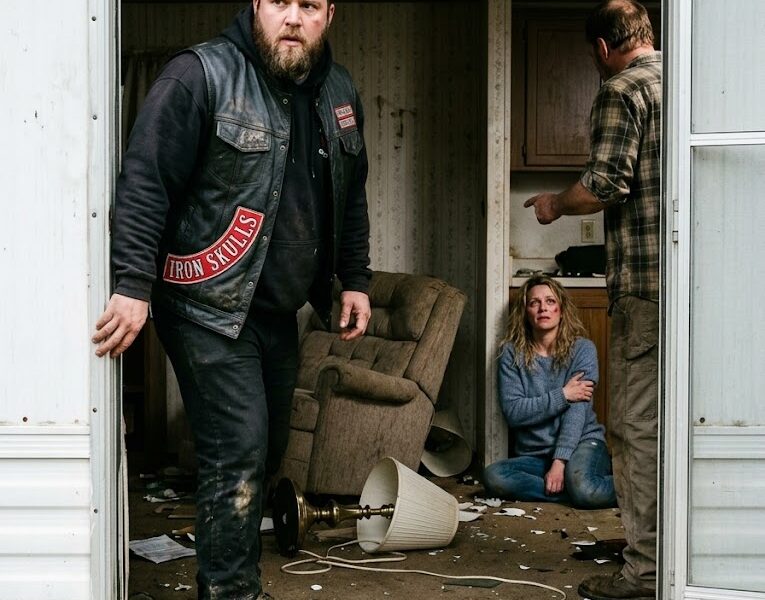
A LITTLE GIRL RAN TO THE BIKERS SCREAMING, “THEY’RE HURTING MY MOM”—WHAT THEY FOUND INSIDE THE TRAILER LEFT EVERYONE SPEECHLESS
The first thing Mason Cole noticed was that the little girl had no coat.
It was thirty-eight degrees outside.
Cold enough that every breath leaving the roadside diner turned white against the pale morning, cold enough that the chrome handlebars lined along the parking lot felt like ice under bare fingers.
Yet the child running toward them wore nothing but a thin red dress, a pair of muddy boots, and one sock pulled halfway down her ankle.
She couldn’t have been older than seven.
Maybe six.
Her hair whipped wildly around a dirt-streaked face as she stumbled across the cracked asphalt, nearly falling twice before catching herself.
Nobody understood what they were seeing at first.
The men gathered beside the motorcycles had been laughing only seconds earlier.
Someone had made a joke about Ray’s ancient Harley coughing harder than he did.
Coffee steamed from paper cups.
Bacon hissed on the flat-top inside Rosie’s Diner.
A tractor trailer idled near the fuel pumps across the road.
Then the little girl screamed.
“Please!”
The laughter died.
She kept running.
“Please, somebody help my mama!”
A coffee cup slipped from one man’s hand.
It hit the pavement and burst open between his boots.
The girl pointed desperately toward the narrow county road disappearing behind the line of bare oak trees.
“They’re hurting her!”
Her voice broke.
For one strange second, nobody moved.
Not because nobody cared.
Because fear sometimes arrived so suddenly that the human body needed a moment to believe it.
The little girl didn’t give them that moment.
She ran directly toward the biggest man in the group.
Mason Cole.
Thirty-eight years old.
Six-foot-two.
Heavy shoulders beneath a worn black riding jacket.
A beard touched with the first threads of gray.
A scar running from beneath his left ear toward his jawline.
To most strangers, Mason looked like the kind of man you avoided arguing with.
The little girl looked at him as though he were the only safe thing left in the world.
She grabbed his jacket with both hands.
“Please.”
Mason looked down.
Her fingers were shaking so violently he could feel it through the leather.
He had been in fights.
He had watched friends bleed.
He had buried a younger brother before turning thirty.
He had been arrested twice in his twenties for things he now considered stupid enough to belong to another lifetime.
But nothing in his memory had prepared him for the terror in a child’s eyes when she believed she might be too late to save her mother.
Mason lowered himself onto one knee.
The parking lot remained silent around them.
“What’s your name, sweetheart?”
The girl tried to answer.
Nothing came out.
Mason kept his voice low.
“You’re okay. Look at me.”
She did.
Not because she trusted him.
Because she had run out of other choices.
“What’s your name?”
“Hannah.”
“Hannah what?”
“Hannah Brooks.”
“All right, Hannah. My name’s Mason.”
Her bottom lip trembled.
“My mama—”
“I know.”
“He came back.”
Mason’s expression changed.
Just slightly.
“Who came back?”
Hannah looked toward the road.
“Darren.”
The way she whispered the name made Mason understand more than she realized.
“Is Darren your dad?”
She shook her head quickly.
“No. Mama said he wasn’t supposed to know where we live.”
That sentence cooled something inside Mason that the morning air hadn’t touched.
Behind him, Thomas “Tank” Bradley stepped closer.
Tank was forty-four, thick through the chest, with a shaved head and hands permanently blackened around the fingernails from years repairing engines.
“What happened?” he asked.
Mason didn’t take his eyes from Hannah.
“Where is your mama right now?”
Hannah pointed again.
“Trailer. Down there.”
“How far?”
“I don’t know.”
“Did you run all the way here?”
She nodded.
Bare knees scraped.
Mud on her dress.
One tiny cut across her palm.
Mason glanced toward the road.
There were several clusters of trailers scattered along that stretch, some visible from the county highway, others buried deep behind scrub woods.
“Did Darren hurt you?”
Hannah shook her head.
“He told me to go to my room.”
“What did you do?”
“I climbed out the window.”
Tank looked at Mason.
So did Ray Mercer, standing beside him.
Nobody needed to say anything.
Hannah gripped Mason’s sleeve harder.
“He was yelling.”
Her eyes filled again.
“Mama told me not to come back.”
Mason felt something tighten beneath his ribs.
“Then you did exactly what she wanted.”
“But nobody was coming.”
“We’re coming.”
It was the certainty in his voice that stopped her crying for half a second.
Mason stood.
He turned toward Tank and Ray.
“Helmets.”
Ray was already moving.
Tank reached for his bike.
Someone near the diner entrance called out, “Shouldn’t we call the sheriff first?”
Mason looked back.
“We are calling them.”
Rosie Mercer, the diner’s owner and Ray’s older sister, was standing in the doorway with her phone already in her hand.
“I’ve got 911.”
Mason nodded.
“Tell them possible domestic assault. Trailer off County Six. We’ll call when we find the address.”
Rosie stared at Hannah.
“I’ll keep her here.”
“No!”
Hannah screamed the word so hard that everyone flinched.
She grabbed Mason again.
“Don’t leave me.”
He crouched.
“Hannah.”
“You won’t know which one!”
That stopped him.
Mason looked toward his motorcycle.
Then toward the child.
“Can you show us?”
She nodded.
His instincts screamed against putting her anywhere near what she had escaped.
But without knowing which trailer, every minute they spent searching might matter.
Mason pulled his helmet from the handlebars.
“Tank rides ahead. Ray behind us.”
Tank nodded.
Mason knelt again.
“You listen carefully to me. We’re not taking you back inside. You just tell us where to stop.”
Hannah nodded.
“If I tell you to stay behind me, you stay behind me. Understand?”
Another nod.
Mason fitted his spare helmet over her head.
It was ridiculously large.
Her entire face nearly vanished inside it.
For the first time that morning, someone almost smiled.
Nobody did.
Mason lifted her carefully onto the rear seat.
“Hold tight.”
Her arms wrapped around his waist.
The other motorcycles roared alive.
Every head outside the diner turned as three bikes pulled from the lot.
Mason felt Hannah’s small body trembling behind him.
At the first bend, she tapped his side.
“Left.”
He followed.
The road narrowed.
Pines and winter-bare trees closed around them.
Another half mile.
Another tap.
“Right!”
A dirt lane appeared between two leaning mailboxes.
Mason turned sharply.
Gravel sprayed beneath the tires.
At the end of the lane stood three trailers.
One blue.
One beige.
One white with plywood over half the windows.
Hannah’s grip tightened.
“That one.”
She pointed toward the white trailer.
Mason stopped so quickly the back tire slid.
Before the engine was even off, Hannah whispered into his jacket.
“That’s his truck.”
A dark green pickup sat crooked beside the steps.
One headlight was broken.
The passenger door hung slightly open.
Mason looked at Tank.
Tank nodded once.
Ray killed his engine.
For several seconds, the only sound was the cooling tick of metal.
Then they heard it.
A crash.
A man’s voice.
“You think you can hide from me?”
A woman shouted something they couldn’t understand.
Another crash.
Hannah made a sound Mason would remember years later.
Not quite a scream.
Not quite a sob.
Recognition.
He lifted her from the motorcycle.
“Behind Ray.”
“But Mama—”
“Behind Ray.”
His tone made her obey.
Ray took her hand.
Mason walked toward the trailer.
Tank beside him.
The wooden steps creaked beneath their boots.
Through the thin walls came the man’s voice again.
“You took my money.”
A woman’s answer, weak but clear.
“I don’t owe you anything.”
Something struck the wall.
Tank reached for the front door.
Mason stopped him.
The door wasn’t closed.
It was hanging open by two inches.
Mason pushed.
The smell hit first.
Cheap whiskey.
Cigarette smoke.
Old grease.
And something metallic beneath all of it.
Blood.
The living room looked as though a storm had passed through.
A lamp lay broken.
One kitchen chair was overturned.
Family photographs had been knocked from the wall.
A television played silently in the corner, some early-morning weather report showing bright yellow sunshine over Tennessee.
At the far end of the room stood a woman in gray sweatpants and a faded sweatshirt.
Barefoot.
One hand against the wall.
The other raised instinctively near her face.
Her lip was split.
A bruise was already darkening beneath her left eye.
Standing in front of her was a man Mason guessed to be somewhere in his early forties.
Tall.
Thin.
Unshaven.
Jeans.
Work boots.
A flannel shirt hanging open over a stained undershirt.
A glass bottle clenched in his right hand.
His left fist was raised.
He never heard Mason enter.
The woman did.
Her eyes moved past Darren’s shoulder.
And whatever expression crossed her face made him turn.
“What the—”
Mason crossed the room before Darren could finish.
He caught the raised wrist in one hand.
The bottle slipped.
It struck the floor and shattered.
Darren swung with his other arm.
Mason blocked it with his shoulder and drove him backward into the wall hard enough to shake the photographs still hanging there.
Tank came around from the side.
“Easy!”
Darren roared.
“Get out of my house!”
The woman shouted, “It’s not your house!”
He twisted violently.
Mason tightened his grip.
Darren swung again.
This time Tank caught his arm.
Within seconds, both men had him against the floor.
No punches.
No stomping.
No threats.
Just control.
But Darren fought with the wild strength of a man who had stopped thinking.
“She stole my kid!”
The woman screamed, “She’s not yours!”
Mason froze.
Only for a fraction of a second.
Then Darren bucked beneath him.
“Get off me!”
Tank forced his shoulder down.
“Stop fighting.”
Darren spat across the floor.
“I’ll kill every one of you.”
Mason leaned closer.
His voice became strangely calm.
“You’re going to stay exactly where you are until the deputies arrive.”
“Screw you.”
“You can do that too.”
Outside, Hannah shouted.
“Mama!”
The woman in the corner changed instantly.
“Hannah?”
She pushed away from the wall.
“Hannah!”
Mason looked toward the door.
Ray had kept the child outside, but hearing her mother had broken whatever restraint she possessed.
Hannah tore free.
She ran through the doorway.
“Mama!”
The woman collapsed to her knees.
Hannah hit her so hard both nearly fell backward.
“Mama, Mama, Mama—”
Carla wrapped her arms around her daughter.
“Oh, baby.”
Her voice cracked.
“You weren’t supposed to come back.”
“I got help.”
“I know.”
“I got the motorcycle men.”
Carla laughed and cried at the same time.
“Yes, baby.”
She pressed her face into Hannah’s hair.
“You got help.”
Darren heard them.
Something ugly crossed his face.
“You little—”
Mason’s grip tightened.
“Finish that sentence.”
Darren stared up.
There was no shouting in Mason’s voice.
That seemed to frighten him more.
The first siren could be heard in the distance.
Ray entered from outside.
“Deputies coming.”
Tank nodded.
Carla remained on the floor, holding Hannah.
Mason could see the woman shaking.
Not dramatically.
Not visibly to everyone.
A tiny rhythmic tremor in her shoulders.
Shock.
He knew it because he had seen it before.
Years earlier.
Different room.
Different woman.
Same shaking.
For a moment, he was twenty-two again, standing inside his mother’s kitchen while his father smashed a plate against the sink.
His mother telling him to go upstairs.
His younger brother crying behind the door.
Mason had spent most of his adult life pretending those nights belonged to someone else.
Standing inside Carla Brooks’s trailer, they came rushing back.
Darren looked up at him.
“You think you’re some kind of hero?”
Mason said nothing.
“You guys ride around in matching jackets pretending to be tough.”
Still nothing.
“I know men like you.”
That got a reaction.
Mason almost smiled.
“No.”
He looked toward Carla and Hannah.
“You know men like you.”
The sirens grew louder.
Blue light flashed through the broken window.
Ray stepped toward the door with both hands visible.
“Sheriff’s department!”
“Inside!” Mason shouted. “Suspect on the floor. No weapons in our hands.”
Two deputies entered carefully.
One recognized Ray.
Another recognized Mason.
Small counties worked that way.
Deputy Aaron Wilkes lowered his weapon slightly.
“What happened?”
Carla spoke before anyone else could.
“He came into my house.”
Her voice shook.
“He wasn’t supposed to know where I lived.”
Wilkes looked at the man pinned beneath Tank and Mason.
“Darren Pike?”
Carla nodded.
Something changed in the deputy’s face.
Recognition.
Not surprise.
Recognition.
Mason noticed.
“You know him?”
Wilkes did not answer immediately.
The second deputy stepped closer with handcuffs.
“Let him up slowly.”
Mason and Tank moved away.
The deputy rolled Darren onto his stomach.
Metal clicked around his wrists.
Darren cursed.
“You’re making a mistake!”
Nobody answered.
“You hear me?”
The deputy pulled him upright.
“Darren Pike, you’re being detained pending investigation for assault, unlawful entry, violation of a protective order, and whatever else we find when we sort this mess out.”
Darren’s eyes locked on Carla.
“This isn’t over.”
Hannah buried her face against her mother’s neck.
Mason stepped between them.
Darren stared at him.
For the first time, something like fear entered his eyes.
Mason didn’t threaten him.
Didn’t move.
He simply stood there until the deputy led Darren outside.
Only when the police car door slammed shut did Carla finally breathe.
Not deeply.
Not with relief.
Just enough to prove she remembered how.
Deputy Wilkes crouched beside her.
“You need an ambulance.”
Carla shook her head.
“I’m okay.”
Mason looked at her split lip.
The swelling eye.
Blood on one sleeve.
“You’re not.”
She glanced at him.
He softened his voice.
“You don’t have to be.”
Carla looked down.
That sentence nearly undid her.
“I can’t afford an ambulance.”
Wilkes frowned.
“Don’t worry about that right now.”
“But I have to worry about it.”
Her laugh came out brittle.
“I’ve been worrying about everything for three years.”
Hannah still clung to her.
Mason stepped away while the deputies asked questions.
He found Tank outside by the motorcycles.
Tank lit a cigarette.
His hands shook as he brought it to his mouth.
Mason noticed.
Tank noticed Mason noticing.
“Don’t.”
“I didn’t say anything.”
“You were gonna.”
Mason looked toward the cruiser.
Darren sat behind the glass staring at the trailer.
“Guy’s been here before.”
Tank exhaled smoke.
“You heard the deputy.”
“Yeah.”
Ray stepped down from the porch.
“Protective order.”
Mason looked at him.
“Confirmed?”
“Wilkes told me. Guy got released three weeks ago. Assault charge out of another county.”
Tank cursed under his breath.
“Carla moved here so he wouldn’t find her.”
Mason turned.
“And he did.”
Ray nodded.
Mason looked toward the trailer again.
Hannah had wandered to the doorway.
She was staring at him.
Small.
Still wearing the oversized helmet.
Mason realized nobody had taken it off her.
He walked back.
When he reached the porch, Hannah touched the black shell.
“Can I keep this?”
For reasons he couldn’t explain, the question hit harder than anything else that morning.
Mason knelt.
“You want my helmet?”
She nodded.
“It smells funny.”
A laugh escaped him.
The first real one since she arrived.
“That’s not exactly a selling point.”
Hannah almost smiled.
Then her expression changed.
“Are you leaving?”
Mason looked toward Carla.
Carla had heard.
Her eyes were swollen, exhausted.
He could see the shame there too.
Not because she had done anything wrong.
Because shame rarely cared who was guilty.
Mason knew that kind of shame.
It lived in people long after bruises disappeared.
“Eventually,” he said.
Hannah’s face fell.
“But not yet.”
The ambulance arrived ten minutes later.
Carla tried refusing again.
This time Hannah betrayed her.
“My mama fell down.”
Carla closed her eyes.
“Hannah.”
“And he kicked the table at her.”
The paramedic crouched.
“What hurts?”
Carla looked around at all the strangers.
Deputies.
Bikers.
Paramedics.
Neighbors now watching from yards.
The whole private horror of her life suddenly spread beneath the morning sun.
Her voice became tiny.
“My ribs.”
The paramedic’s expression sharpened.
“Which side?”
“Left.”
“How hard is it to breathe?”
“I’m breathing.”
“That wasn’t my question.”
Carla looked at Hannah.
Then finally answered.
“It hurts.”
Mason stepped away.
He didn’t know why that confession affected him.
Maybe because people like Carla became experts at saying they were fine.
They used the word the way others used locks on doors.
Fine meant don’t ask.
Fine meant I can’t survive explaining.
Fine meant I already know nobody wants to hear this.
And sometimes fine meant please notice I’m lying.
Hannah wandered toward him.
“Mr. Mason?”
“Just Mason.”
“Are you a bad guy?”
Tank coughed so violently on cigarette smoke he had to turn around.
Ray looked down to hide a grin.
Mason stared at Hannah.
“Why would you ask that?”
“My teacher says motorcycle gangs are dangerous.”
Ray walked away laughing.
Mason shot him a look.
Hannah waited.
Children had no sense of when adults needed an easier question.
Mason crouched again.
“Sometimes people do good things.”
She nodded.
“And sometimes those same people do stupid things.”
Another nod.
“And sometimes people look scary but aren’t.”
Hannah considered this.
“Like dogs?”
Mason smiled.
“Exactly like dogs.”
“My neighbor has a pit bull named Cookie.”
“See?”
“She bites the mailman.”
Mason stared at her.
Tank burst out laughing.
Even Carla smiled from the ambulance stretcher.
For one brief second, the morning became ordinary.
Then Deputy Wilkes walked toward Mason.
“Need a word.”
Mason followed him several yards away.
Wilkes kept his voice low.
“You boys touched Pike?”
Mason’s expression hardened.
“You saw what we did.”
“I’m asking officially.”
“We restrained him.”
“Hit him?”
“No.”
“Threaten him?”
“No.”
Tank shouted from behind them, “He threatened us plenty.”
Wilkes ignored him.
Mason folded his arms.
“Why?”
“Because his attorney will ask.”
“Good.”
Wilkes studied him.
“You know how this goes.”
“Yeah.”
“I need clean statements from all three of you.”
“You’ll have them.”
“And there’s another problem.”
Mason looked toward the cruiser.
“What?”
Wilkes glanced at Carla.
“Her protective order expired four days ago.”
Mason stared at him.
“What?”
“She applied for an extension.”
“And?”
“Paperwork wasn’t processed.”
Mason’s jaw tightened.
“So she did what she was supposed to do.”
“Yes.”
“He found her anyway.”
“Yes.”
“And if Hannah hadn’t climbed out a window?”
Wilkes didn’t answer.
He didn’t have to.
Mason looked across the yard.
Hannah stood near the ambulance holding Carla’s hand.
A paramedic was cleaning the cut on her palm.
The oversized helmet sat on the grass beside her.
Mason looked back at Wilkes.
“Don’t let that man walk.”
Wilkes’s expression turned tired.
“I don’t decide that.”
“Somebody does.”
“The judge.”
“Then tell the judge exactly what happened.”
“You think I won’t?”
Mason studied him.
Wilkes lowered his voice.
“My sister spent six years married to a man like Darren.”
That silenced Mason.
The deputy looked toward the cruiser.
“I know exactly what happens when people stop paying attention.”
For the first time that morning, Mason saw something behind the badge.
Not authority.
Memory.
Wilkes continued.
“Carla needs photographs. Medical documentation. Statements. Everything.”
“She’ll get it.”
“And she needs somewhere else to stay.”
Mason looked at the trailer.
Wilkes shook his head.
“Pike knows the address now.”
“Where’s she supposed to go?”
“Shelter in Knoxville has beds sometimes.”
“Sometimes?”
Wilkes gave him a look that said welcome to the system.
Mason hated that look.
Not the deputy.
The reality behind it.
Across the yard, the paramedic called that they were ready to transport Carla.
Hannah immediately panicked.
“No!”
Carla reached for her.
“Baby, you’re coming with me.”
“No, I don’t want the hospital.”
“Neither do I.”
“Then don’t go.”
Carla tried smiling.
It didn’t work.
Mason approached.
Hannah looked at him.
“What happens at the hospital?”
“They make your mama feel better.”
“Will they take her away?”
“No.”
“Promise?”
Mason hesitated.
He had learned long ago never to promise things he couldn’t control.
So he said the only thing he could.
“I’ll follow you.”
Carla looked at him.
“You don’t have to.”
“I know.”
Those three words made her stare.
People had told Carla plenty of things she had to do.
Leave.
Report him.
Get a restraining order.
Move.
Change jobs.
Change numbers.
Be careful.
Be smarter.
Be stronger.
Nobody had said I know when she tried to release them from helping.
Mason looked toward his bike.
“We’ll follow.”
Tank nodded.
Ray sighed theatrically.
“There goes breakfast.”
Rosie had sent breakfast anyway.
By the time Mason, Tank and Ray reached Cumberland County Medical Center, a paper bag containing six biscuits, bacon, scrambled eggs and enough coffee to revive a small army was waiting in Ray’s saddlebag.
Hannah sat in a plastic hospital chair swinging her boots while Carla underwent X-rays.
Mason sat across from her.
Tank and Ray had gone to provide statements at the sheriff’s office.
The waiting room television played a home renovation show with the sound turned off.
A vending machine hummed.
Somewhere behind double doors, a baby cried.
Hannah looked at Mason.
“You have kids?”
“No.”
“Why?”
“That’s a pretty personal question.”
“My teacher says asking questions is how we learn.”
“Your teacher sounds dangerous.”
Hannah smiled.
Then stared at the floor.
“My mom says Darren used to be nice.”
Mason’s smile disappeared.
“She says nobody starts bad.”
He leaned back.
“She may be right.”
“Was Darren always bad?”
“I don’t know Darren.”
“He brought me a bicycle once.”
Mason said nothing.
“He painted it purple.”
Children remembered details adults desperately wanted them to forget.
Not just the worst ones.
That was what made everything harder.
Hannah continued.
“Mama threw it away after he went to jail.”
“Did that make you sad?”
“A little.”
She looked ashamed.
Mason leaned forward.
“You’re allowed to be sad about a bicycle.”
“But he hurt Mama.”
“Both things can be true.”
Hannah studied him.
“Do grown-ups know that?”
Mason laughed softly.
“Most grown-ups don’t know anything.”
The doctor eventually confirmed two cracked ribs, a mild concussion, extensive bruising and a cut requiring stitches along Carla’s forearm.
No internal bleeding.
No fracture around the eye.
No brain injury.
Lucky, the doctor called it.
Carla didn’t feel lucky.
She sat inside the exam room wearing a thin hospital gown, listening to a social worker explain emergency housing options.
Mason stood near the door.
“You have somewhere safe tonight?” the social worker asked.
Carla stared at her hands.
“No.”
“Family?”
“My mother is dead.”
“Father?”
“Arizona.”
“Can you stay with him?”
“We haven’t spoken in eight years.”
“Friends?”
Carla smiled bitterly.
“Darren handled that.”
The social worker nodded as though she had heard the sentence before.
Maybe she had.
“What about work?”
“Diner outside Cookeville. I clean rooms at a motel too.”
“You work two jobs?”
“Three sometimes.”
“Hannah’s school?”
“Pine Valley Elementary.”
The social worker wrote everything down.
“There is a family shelter about forty miles north. I can call.”
Carla’s face tightened.
“Can Hannah stay with me?”
“Of course.”
Mason watched her relax by half an inch.
That tiny movement told him more than anything else.
The social worker left to make calls.
Carla looked at Mason.
“You really don’t have to keep staying.”
“You said that already.”
“I mean it.”
“So did I.”
She gave him a tired look.
“You always this stubborn?”
“Ask anyone.”
“I don’t know anyone who knows you.”
“That makes asking difficult.”
Despite herself, Carla laughed.
Then winced and grabbed her ribs.
Mason stepped forward.
“You okay?”
“Don’t make me laugh.”
“I’ll try being less charming.”
“Think you can manage?”
“Been doing it thirty-eight years.”
Her smile faded.
“Why are you doing this?”
Mason knew the question had been coming.
He also knew every easy answer would sound dishonest.
Because it’s right.
Because anyone would.
Because Hannah asked.
All true.
None complete.
He looked through the small glass window in the door.
Hannah was sitting with a nurse, coloring.
“She reminded me of someone.”
Carla waited.
Mason rubbed his jaw.
“My brother.”
“A little girl reminded you of your brother?”
“Not what she looks like.”
He paused.
“The way she ran for help.”
Carla said nothing.
Mason hadn’t told this story in years.
Not because it was secret.
Because words could keep old things alive.
“My dad drank.”
Carla’s expression softened.
“So did everybody’s dad where I grew up. Difference was mine got mean when he did.”
Mason kept his eyes on the glass.
“One night he went after my mother. I was fourteen. My brother Danny was nine.”
Carla listened.
“I stood there.”
Mason swallowed.
“Danny ran.”
“For help?”
“Neighbor.”
“What happened?”
“Neighbor called the cops. Dad got arrested.”
Mason gave a humorless smile.
“I spent years thinking about the fact that the nine-year-old kid had more courage than I did.”
“You were fourteen.”
“I was bigger than him.”
“You were a child.”
“So was Hannah.”
Carla’s eyes moved toward the window.
Mason continued.
“Danny died when he was twenty-six.”
“I’m sorry.”
“Motorcycle accident.”
Carla looked at his riding jacket.
Mason noticed.
“Yeah. Irony.”
They sat with that.
Then Carla whispered, “Hannah shouldn’t have had to be brave.”
“No.”
“I was supposed to protect her.”
“You did.”
Carla looked at him sharply.
“Did you see my face?”
“I did.”
“Then don’t say I protected her.”
Mason leaned against the wall.
“You told her to run.”
Carla’s eyes filled.
“She climbed out a bathroom window.”
“And she knew where to go because you taught her what to do when things got dangerous.”
“I brought Darren into her life.”
“You also got him out.”
“Not fast enough.”
Mason shook his head.
“You don’t get to use his choices as evidence against yourself.”
Carla stared at him.
Nobody had ever phrased it that way.
For several seconds, she couldn’t answer.
Then she whispered, “You don’t know what I let happen.”
Mason met her eyes.
“No.”
He paused.
“But I’m guessing you didn’t wake up one morning and choose this.”
Carla looked away.
“No.”
The social worker returned.
Her expression revealed the answer before she spoke.
“The shelter is full.”
Carla closed her eyes.
“Okay.”
“I’ve called two others.”
“How far?”
“One is about seventy miles.”
Hannah appeared behind the social worker.
She had heard.
“Seventy?”
Carla forced a smile.
“Adventure.”
“I have school.”
“I know.”
“My science project.”
“We’ll figure it out.”
Hannah looked at Mason.
Children always looked toward the person in the room who appeared most certain.
That morning, unfortunately, it was him.
Mason took out his phone.
Carla noticed.
“What are you doing?”
“Calling Rosie.”
“For what?”
“Rosie owns apartments.”
Carla immediately shook her head.
“No.”
“You don’t know what I’m asking.”
“Yes, I do.”
“You’re psychic?”
“I don’t take charity.”
Mason stopped dialing.
“Good.”
Carla blinked.
“Good?”
“I wasn’t offering charity.”
“What are you offering?”
“I have no idea yet.”
He called anyway.
Rosie answered on the second ring.
“What?”
“Nice hello.”
“You ruined my breakfast rush.”
“Your brother ruined your breakfast rush.”
“My brother follows you.”
“That’s his first mistake.”
“What do you want?”
“You still have the apartment above the old bakery?”
Silence.
Mason looked at Carla.
She shook her head violently.
Rosie answered.
“Maybe.”
“Is that yes?”
“Why?”
“You know why.”
Another silence.
Longer this time.
“The plumbing works,” Rosie said.
“Heat?”
“Yes.”
“Furniture?”
“Some.”
“Locks?”
“New.”
“Rent?”
Carla glared at him.
Rosie understood the question immediately.
“Six hundred.”
Mason knew for a fact the apartment usually rented for nine hundred.
He didn’t correct her.
“Can somebody move in today?”
Rosie exhaled.
“Yes.”
Carla stood.
“Mason.”
He held up one finger.
“Thanks, Rosie.”
“Tell Carla first month’s due when she can manage it.”
Mason looked at Carla.
Rosie added, “And Mason?”
“Yeah?”
“Don’t make this weird.”
“I don’t make anything weird.”
“You exist weird.”
She hung up.
Mason put the phone away.
Carla stared at him.
“I said no charity.”
“And Rosie said rent is six hundred.”
“I heard.”
“Then it’s not charity.”
“What apartment?”
“Downtown.”
“How far from Hannah’s school?”
“Fifteen minutes.”
“Why is it empty?”
“Previous tenant moved.”
“Why is it only six hundred?”
“Because the place smells like bread?”
“Mason.”
He looked at her.
She knew.
He knew she knew.
Neither needed to embarrass Rosie by saying it aloud.
Carla sat slowly.
“I can’t move today.”
“You can.”
“My stuff.”
“Tank has a truck.”
“My trailer is a crime scene.”
“Deputies will escort us.”
“I don’t even know you.”
Mason nodded.
“That part is true.”
“This is insane.”
“Also true.”
“What if you’re dangerous?”
Hannah raised her hand.
“I don’t think he’s dangerous.”
Carla turned.
“You’re not voting.”
Mason smiled.
“Smart mother.”
Hannah crossed her arms.
Carla looked between them.
Something in her resistance finally cracked.
Not surrender.
Exhaustion.
“What if Darren gets out?”
The question silenced the room.
Mason’s humor vanished.
“He won’t know where the apartment is.”
“He found the trailer.”
“He won’t hear it from us.”
Carla stared at her daughter.
Then whispered, “I can’t keep running.”
Mason understood.
Running sounded easy to people who had never been forced to do it.
New apartment.
New job.
New number.
New school.
New neighbors.
New routes home.
New grocery store.
New lies when people asked where you were from.
Eventually escape could start to resemble another prison.
Mason sat beside her.
“Then don’t call it running.”
“What do I call it?”
“Choosing where you stand.”
Carla turned toward him.
For a long moment they said nothing.
Then she asked the question that changed everything.
“Why does this matter so much to you?”
Mason thought of Danny.
He thought of his mother.
He thought of a fourteen-year-old boy frozen in a kitchen while a nine-year-old brother ran for help.
He looked at Hannah.
“Because once, somebody ran.”
Carla’s eyes filled again.
This time she didn’t look away.
They moved into the apartment that evening.
It was nothing special.
Two bedrooms.
A narrow kitchen.
Old hardwood floors.
Windows overlooking Main Street.
The former bakery below had been closed for almost a year, but the walls still carried the faint warm smell of cinnamon and flour.
Hannah noticed immediately.
“It smells like pancakes.”
Mason carried a box past her.
“That is absolutely not what pancakes smell like.”
“Yes, it is.”
“Your mother needs to improve your culinary education.”
Carla followed them slowly, one arm wrapped around her ribs.
“You volunteering to cook?”
“No.”
“Then stop criticizing.”
Tank entered behind them carrying a mattress.
“Move.”
Mason stepped aside.
Tank dropped it against the wall.
“I’m too old for this.”
“You complain like you’re eighty.”
“My knees are eighty.”
Ray arrived carrying two lamps, neither matching the other.
Rosie brought sheets.
Then towels.
Then dishes.
Then claimed all of it had been sitting in storage and she desperately needed the space.
Nobody believed her.
Nobody challenged her.
By seven that evening, the bare apartment had transformed.
Not into a home.
Not yet.
But into somewhere two frightened people could sleep without listening for Darren’s truck.
Carla stood in the doorway to Hannah’s room.
The little girl was arranging three stuffed animals on the bed.
Most of her toys had been left behind.
Mason had driven with the deputy escort to collect what could be taken quickly.
Clothes.
School bag.
Photographs.
Medicine.
A small jewelry box.
Hannah’s blanket.
A purple bicycle remained leaning beside the trailer.
Mason had noticed it.
So had Hannah.
She hadn’t asked to bring it.
He understood why.
Some things were easier to abandon than explain.
Carla looked at Mason.
“Thank you.”
He nodded.
“You said that.”
“I probably haven’t said it enough.”
“You don’t owe me enough.”
She gave him a faint smile.
“That’s not how grammar works.”
“You knew what I meant.”
“I did.”
Hannah called from the bedroom.
“Mason?”
He leaned into the doorway.
“What?”
“Will Darren come here?”
Carla stiffened.
Mason didn’t lie.
“I don’t think so.”
“But he could?”
“Hannah—” Carla began.
Mason held up one hand.
Kids deserved answers shaped for them, not fabricated for adults.
“He doesn’t know where you are.”
Hannah looked at him.
“And the police know he hurt your mom.”
“Will they keep him?”
“For now.”
“What does for now mean?”
Mason glanced at Carla.
She looked helpless.
He crouched beside the bed.
“It means there are people whose job is to make sure what happened today doesn’t happen again.”
“Are they good at their job?”
Mason hesitated.
The child noticed.
“So you don’t know.”
“No.”
Hannah considered that.
Then she reached beneath the oversized sweatshirt Rosie had found for her and pulled out something folded.
A piece of paper.
She handed it to him.
Mason opened it.
A crayon drawing.
Three motorcycles.
A red figure.
A very large black figure with enormous arms.
He stared.
“Why am I shaped like a refrigerator?”
Hannah giggled.
“That’s you.”
“I guessed.”
“That’s Mama.”
A woman in gray.
“And that’s me.”
The little red figure.
Across the top, in uneven letters, Hannah had written:
PEEPLE WHO CAME.
Mason stared at the words.
People who came.
Not heroes.
Not bikers.
Not angels.
People who came.
A child’s understanding of salvation was simpler than an adult’s.
When someone cried for help, somebody came.
Mason folded the drawing carefully.
“I’m keeping this.”
“You have to.”
“Why?”
“Because I made it for you.”
He slipped it inside his jacket.
“Then it goes wherever I go.”
Hannah smiled.
Carla covered her mouth.
Mason pretended not to notice the tears.
The next morning, Darren Pike appeared before a judge.
By noon, Mason learned he was being held without bond pending a hearing related to multiple charges, including alleged violation of an active emergency protective order issued after his arrest.
The paperwork delay did not save him.
If anything, it became part of the investigation.
Carla provided photographs.
Medical records.
Old messages.
Voicemails.
Threats.
A hidden recording Hannah had accidentally captured weeks earlier while playing with Carla’s phone.
Piece by piece, a private nightmare became evidence.
And evidence became something Carla had almost stopped believing in.
A way forward.
But healing didn’t arrive dramatically.
It didn’t appear when Darren was handcuffed.
It didn’t arrive when Carla received the apartment key.
It certainly didn’t arrive when the bruises faded.
Healing came quietly.
Annoyingly.
Unevenly.
Sometimes Hannah woke screaming.
Sometimes Carla sat in the parked car outside the grocery store because a green pickup passed and her hands refused to release the steering wheel.
Sometimes she checked the apartment lock six times before bed.
Sometimes she called the jail’s automated inmate line at two in the morning just to confirm Darren was still inside.
She hated herself for that most of all.
Mason never told her to stop.
Instead, one Sunday morning, he sat across from her at Rosie’s Diner and said, “You know what my mother used to do?”
Carla wrapped both hands around her coffee.
“What?”
“Check the stove.”
“Why?”
“Dad nearly burned the house down drunk once. After he left, she checked every burner every night.”
Carla looked at him.
“For how long?”
“Years.”
“Did she eventually stop?”
Mason thought.
“I don’t remember.”
“That’s depressing.”
“Sorry.”
Carla smiled weakly.
“No. It’s honest.”
Mason took a drink.
“She did start sleeping again.”
Carla looked out the window.
Hannah was outside showing Tank something beneath the hood of his motorcycle.
Tank pretended to listen as though she understood engines.
Maybe she did.
Kids surprised people.
“Sleeping sounds nice,” Carla said.
“You slept last night.”
“I closed my eyes.”
“Not the same.”
“No.”
They sat quietly.
Rosie passed their table and refilled Carla’s coffee without asking.
Mason watched Hannah outside.
“You want to know something?”
Carla looked at him.
“I think people misunderstand what brave looks like.”
“What does it look like?”
“Usually tired.”
Carla laughed softly.
“Then I’m incredibly brave.”
“I was going to say annoying.”
“There he is.”
Sunday breakfasts became routine.
Not because anyone planned them.
Mason would stop at Rosie’s.
Tank would arrive.
Then Ray.
Sometimes Carla and Hannah were already there.
Sometimes they came later.
Eventually nobody asked.
A booth near the back simply became theirs.
Hannah learned everybody’s names.
She called Tank “Mr. Tank” because Carla insisted.
She called Ray “Uncle Ray” because Ray encouraged bad behavior.
And she called Mason just Mason.
Never Mr. Cole.
Never Uncle Mason.
Mason.
As though his name had become a category all its own.
At school, Hannah’s teacher noticed changes.
She was quieter.
She jumped when doors slammed.
For several weeks, she refused to use the bathroom alone because the bathroom window reminded her of escape.
Carla agreed to counseling.
For Hannah.
Then, reluctantly, for herself.
Mason drove them to the first appointment because Carla’s car wouldn’t start.
When she came out fifty minutes later, her face looked worse than it had going in.
“That helpful?” Mason asked.
Carla glared at him.
“Apparently healing involves talking about every terrible thing that’s ever happened.”
“Sounds terrible.”
“Exactly.”
“You going back?”
She sighed.
“Tuesday.”
Mason smiled.
“Brave.”
“Shut up.”
Spring came slowly.
The hard winter gray softened.
Trees along County Six grew green again.
Wildflowers appeared in the drainage ditch near Rosie’s Diner.
And one Sunday in April, Hannah arrived carrying a new drawing.
Mason was outside leaning against his bike.
She ran toward him.
Not the way she had run that first morning.
Not terrified.
Not barefoot beneath a red dress.
This time she wore jeans.
Pink sneakers.
A yellow jacket.
Her hair had been carefully braided.
“Mason!”
He turned.
She held up the paper.
“I made another one.”
He took it.
A row of motorcycles stretched across the page beneath an enormous yellow sun.
There was the diner.
There was Carla.
Tank.
Ray.
Rosie.
And Mason.
Again, refrigerator-shaped.
But this time, there was something else.
A small girl in red.
Standing near the motorcycles.
Not running.
Mason stared at the picture.
“What am I looking at?”
“Us.”
“Why am I still square?”
“Because you’re big.”
“That’s hurtful.”
She pointed at the red figure.
“That’s me from before.”
“Before what?”
Hannah thought carefully.
“Before I knew you.”
Mason’s smile faded.
He looked at the child.
Then down at the drawing.
Carla had followed her outside.
She stood several yards away, listening.
Hannah reached into her jacket pocket.
“I made something else.”
She handed Mason a folded piece of paper.
He opened it.
Three sentences in a child’s careful handwriting.
My name is Hannah Brooks.
One morning I was scared.
Then people came.
Mason read the last sentence twice.
Then people came.
For the first time in years, he thought about his brother Danny without immediately remembering the phone call telling him Danny was dead.
Instead he remembered a skinny nine-year-old boy sprinting barefoot across a wet lawn.
Running toward a neighbor’s house.
Running because somebody had to.
Mason swallowed.
“You spelled everything right.”
Hannah smiled proudly.
“My teacher helped.”
He folded the page.
“That one’s staying with me too.”
“How many things can fit in your vest?”
“You’d be amazed.”
“Do you still have the first one?”
Mason opened the inside pocket.
He pulled out the folded paper.
The creases were worn.
The edges softened.
But there it was.
People Who Came.
Hannah’s eyes widened.
“You really kept it.”
Mason looked offended.
“I said I would.”
She threw her arms around him.
Mason froze.
Not because he didn’t want the hug.
Because some men spent so much of their lives learning how to be hard that tenderness surprised them more than violence ever could.
He slowly rested one hand against the back of her yellow jacket.
Across the parking lot, Tank pretended to inspect a tire.
Ray suddenly became fascinated with his coffee.
Rosie watched through the diner window.
Carla covered her mouth.
Hannah released him.
“Mason?”
“Yeah?”
“Are you still dangerous?”
He thought about their first conversation.
Motorcycle gangs.
Pit bulls.
Cookie biting the mailman.
Mason looked at her seriously.
“Extremely.”
Hannah laughed.
“I don’t believe you.”
“That’s because you’re reckless.”
Carla approached.
“We heading inside?”
Hannah ran toward the door.
Rosie opened it before she arrived.
Carla remained beside Mason.
For a moment, neither spoke.
Then she glanced toward his vest.
“You really carried that drawing for months?”
“Apparently.”
“You could have left it at home.”
“I could.”
“But you didn’t.”
“No.”
Carla smiled.
“You know Hannah thinks you saved us.”
Mason looked toward the diner window.
“No.”
“She does.”
“She saved you.”
Carla’s expression changed.
Mason continued.
“She climbed out that window.”
“Yes.”
“She ran down the road.”
“Yes.”
“She found help.”
Carla looked toward her daughter.
Mason lowered his voice.
“Make sure she knows that.”
Carla’s eyes filled.
“She already thinks being brave means she has to save me.”
“That’s not what I meant.”
“I know.”
Carla stared through the glass as Hannah climbed into the booth beside Tank.
“I want her to be a kid.”
“She is.”
“Not enough.”
Mason nodded.
“Then give her time.”
Carla looked at him.
“You say things like someone who knows what he’s talking about.”
“I fake confidence well.”
She smiled.
Then her expression softened.
“What happened to your mother?”
Mason hadn’t expected the question.
“She died six years ago.”
“Did she get a good life?”
He thought about it.
Really thought.
She had worked at a grocery store until sixty-three.
Bought a tiny house after divorcing Mason’s father.
Grew tomatoes badly.
Went to church irregularly.
Loved scratch-off tickets.
Dated a retired electrician named Paul who snored and made excellent chili.
She had laughed more in her final years than in the first ones Mason remembered.
“Yeah,” he said.
“I think she did.”
Carla nodded.
“That matters.”
“It does.”
Inside, Hannah banged both hands against the window.
“Come on!”
Mason opened the diner door for Carla.
“After you.”
They stepped inside.
The same bell rang above the entrance that had been ringing for nearly forty years.
Rosie shouted that breakfast would be another ten minutes.
Ray complained loudly.
Tank accused him of never paying anyway.
Hannah began explaining something about planets.
Carla slid into the booth.
Mason took the seat beside the window.
Ordinary sounds filled the room.
Forks against plates.
Coffee pouring.
Boots against tile.
An old country song playing softly from the radio behind the counter.
Nothing heroic.
Nothing dramatic.
Nobody outside would have understood why Mason sat there for several seconds without speaking.
Months earlier, a child had burst through that same doorway believing the worst thing in her world was happening and no one was coming.
Now she was arguing with Tank about whether Pluto deserved to be a planet.
The difference between those two mornings felt enormous.
Yet it had been built from remarkably small things.
A door opened.
A phone call made.
A motorcycle started.
A stranger believed.
A neighbor called police.
A deputy listened.
A nurse documented.
A social worker kept calling shelters.
Rosie found an apartment.
Teachers became patient.
Counselors asked uncomfortable questions.
People brought groceries without making speeches.
No single moment repaired everything.
That was the truth nobody put into inspirational stories.
Rescue was dramatic.
Recovery was repetitive.
Rescue happened in minutes.
Recovery happened every morning afterward.
And sometimes the most important promise one person could make to another was not I will save you.
It was something quieter.
I will still be here when this stops being a story everyone wants to hear.
Months passed.
Then a year.
Darren Pike eventually accepted a plea agreement involving multiple criminal charges stemming from the attack and earlier violations.
Carla did not attend every court appearance.
At first she believed she had to.
Later she learned she didn’t owe him her presence, even in a courtroom.
She built a life instead.
A small one.
A good one.
She kept the apartment above the bakery.
Rosie raised the rent once Carla received a promotion at the motel.
Carla argued that Rosie was a terrible landlord.
Rosie told her to shut up and pay on time.
Hannah finished second grade.
Then third.
Her nightmares became less frequent.
She stopped checking the bathroom window.
She learned to ride a bicycle again.
Not the purple one.
Mason found a used blue bike at a yard sale.
He replaced the brakes.
Tank adjusted the chain.
Ray added a ridiculous horn shaped like a duck.
They left it outside the apartment one Sunday morning with no card.
Hannah knew immediately who had done it.
“How?”
Mason asked.
“The duck horn.”
Ray looked offended.
“It adds personality.”
“It adds stupidity,” Mason said.
Hannah rode that bike in circles around the diner parking lot until Carla threatened to confiscate it if she didn’t wear the helmet correctly.
The old oversized motorcycle helmet stayed on a shelf in Hannah’s room.
Carla tried returning it to Mason several times.
He always refused.
“She asked if she could keep it.”
“It’s expensive.”
“It’s old.”
“She’ll outgrow the memory.”
Mason looked at Carla.
“No, she won’t.”
Carla understood what he meant.
Growing past something and forgetting it were not the same thing.
Eventually the helmet became less like evidence and more like an artifact.
Proof of another version of their lives.
A morning when everything might have ended differently.
Years later, Mason would still sometimes wake before dawn after dreaming about that trailer.
But the dream changed.
At first, he dreamed he arrived too late.
Then he dreamed he couldn’t find the road.
Eventually he began dreaming about Danny instead.
His brother running across the lawn.
Bare feet.
Nine years old.
Not afraid.
Or afraid and moving anyway.
One autumn morning, Mason visited Danny’s grave.
He hadn’t gone in nearly two years.
The cemetery sat on a low hill outside town beneath massive oak trees.
Leaves moved across the grass.
Mason stood beside the headstone with his hands inside his jacket pockets.
Daniel James Cole.
Beloved Son.
Beloved Brother.
1989–2015.
Thirty minutes passed.
Mason didn’t speak.
He had never understood why people talked at graves.
Then he remembered Hannah.
And suddenly he did.
“You would’ve liked her.”
Wind moved through the branches.
Mason looked down.
“Kid’s a menace.”
Silence.
“She ran.”
His voice changed.
“Same as you.”
Mason took the original drawing from his jacket.
The paper was dangerously fragile now.
People Who Came.
He almost left it there.
Then he folded it again.
“No.”
He put it back.
“You don’t get this one.”
A laugh caught in his throat.
He wiped his face before anyone could see him.
Then he walked back toward his motorcycle.
At Rosie’s Diner, Hannah was waiting.
She was older now.
Taller.
The red dress long gone.
The fear from that first morning no longer visible unless someone knew exactly where to look.
Carla stood beside her holding two cups of coffee.
“You’re late,” she told Mason.
“I had somewhere to go.”
Hannah climbed onto the bench.
“Tank says you’re always late.”
“Tank lies.”
“Ray says that too.”
“Ray lies worse.”
Carla handed him coffee.
Mason took it.
Morning sunlight spilled through the diner windows.
Outside, motorcycles lined the curb.
Truckers fueled up across the road.
Somewhere in the kitchen bacon hissed against the grill.
For a moment, Mason felt the strange pull of memory.
Same diner.
Same sunrise.
Same engines.
Almost the same hour.
But no child was running through the parking lot.
No one was screaming.
No glass shattered.
No man waited inside a trailer with his fist raised.
Hannah was arguing about pancakes.
Carla was complaining that Mason’s coffee had too much sugar.
Tank was already stealing bacon from Ray’s plate.
The world had not become safer.
Bad things still happened behind closed doors.
People still froze.
Paperwork still failed.
Fear still convinced good people that nobody would come.
Mason knew all of that now more than ever.
But he knew something else too.
Sometimes someone did come.
Not because they were fearless.
Not because they were perfect.
Not because they wore the right uniform, lived the right life, or had never made mistakes.
Sometimes they came simply because they heard another human being cry for help and decided that walking away would cost them more than stepping forward.
Hannah reached across the table.
“Mason?”
“Yeah?”
“Do you still have my picture?”
He touched the inside pocket of his jacket.
“Every ride.”
She smiled.
Outside, the sunlight caught the motorcycles until every piece of chrome burned gold.
Years earlier, Hannah Brooks had run down a cold road believing she was searching for someone strong enough to rescue her mother.
She had been wrong about one thing.
Strength had never been the leather jacket.
It wasn’t Mason’s size.
It wasn’t Tank’s fists.
It wasn’t three motorcycles roaring toward a trailer.
The bravest person on that road had been six years old, wearing one fallen sock and a red dress, running even though she was terrified.
Mason had spent most of his life believing courage meant standing your ground.
Hannah taught him something different.
Sometimes courage was running.
Sometimes courage was asking.
Sometimes it was admitting you couldn’t save someone alone.
And sometimes the difference between tragedy and tomorrow came down to the smallest sentence a frightened person could say:
Please help.
The diner door opened.
Cold air swept across the floor.
Someone called Mason’s name.
He looked toward Hannah.
She was laughing.
Carla was laughing too.
And for just a moment, he imagined Danny sitting across from them, rolling his eyes at one of Tank’s ridiculous stories.
Mason smiled.
Then he reached into his jacket and touched the folded paper he still carried wherever he rode.
People Who Came.
The spelling had been corrected in Hannah’s later drawings.
Mason secretly preferred the first one.
Because it had been written by a little girl who didn’t yet understand courts or protective orders or emergency shelters or trauma counseling or all the complicated systems adults built around suffering.
She had understood only what mattered most that morning.
She had called.
Someone had heard.
And they had come.









