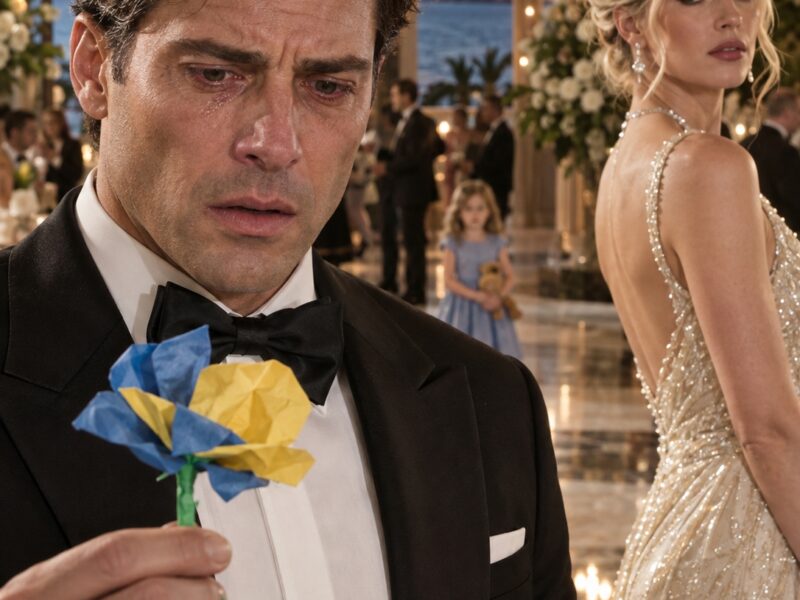
A Little Girl Walked Into His Million-Dollar Engagement Party—By Morning, His Wedding Was Falling Apart
The orchestra stopped before anyone told it to.
One moment, strings were floating beneath the crystal chandeliers of Sterling House, smooth and expensive and almost impossibly perfect. The next, the violinist nearest the dance floor lowered her bow, conversations broke apart in mid-sentence, and two hundred guests turned toward the same small figure standing beneath the largest chandelier in the ballroom.
She couldn’t have been more than seven.
Her blue dress was clean but faded at the seams. One white sock had slipped lower than the other. Her dark hair had been tied back with a ribbon that was beginning to come loose, and between both hands she held a crooked paper flower made from blue and yellow construction paper.
The little girl didn’t understand why everyone had gone quiet.
She was still staring up at the chandelier.
To her, it looked like an upside-down castle made of glass.
Then Vivien Lauron’s voice cut through the room.
“Who let her in here?”
The words weren’t shouted.
They didn’t need to be.
Nathan Sterling turned from the venture capitalist he’d been speaking with and saw his fiancée standing twenty feet away, one hand resting elegantly around the stem of a champagne glass.
Vivien was breathtaking that night.
Her ivory gown had been flown in from Milan. Diamonds caught the chandelier light at her throat. Her blond hair had been swept back from a face that appeared regularly in society magazines under headlines about old money, philanthropy, and America’s most anticipated wedding.
She was smiling.
But Nathan knew her well enough—or thought he did—to see that the smile didn’t reach her eyes.
The little girl looked around, finally noticing the attention.
Her own smile disappeared.
“You shouldn’t be in here,” Vivien said.
The girl tightened her grip on the paper flower.
“I’m sorry.”
Vivien stepped closer.
“This celebration isn’t for children who belong downstairs.”
Something moved inside Nathan’s chest.
Not anger.
Not yet.
Something quieter.
Something colder.
Across the ballroom, Maria Santos nearly dropped a silver serving tray.
“Lily.”
The name escaped her lips like a prayer and a warning at the same time.
Nathan looked toward Maria.
For sixteen years she had managed the Sterling estate with the calm precision of someone who could solve three disasters before breakfast and still remember which flowers his mother had loved.
He had seen Maria deal with flooded kitchens, broken heating systems, impossible guests, a security scare involving a drunk senator’s son, and Nathan himself during some of the hardest months of his life.
He had never seen her look frightened.
She looked frightened now.
Maria put the tray onto the nearest table and hurried through the crowd.
Lily didn’t see her.
She was staring at Vivien.
“I didn’t mean to come in,” she whispered.
Vivien tilted her head.
Nearby, two photographers from Manhattan Society magazine shifted their cameras.
Nathan noticed Vivien notice them.
Her expression changed instantly.
She crouched.
For half a second, Nathan thought she was going to comfort the child.
Instead, Vivien brushed an invisible piece of lint from Lily’s shoulder.
“Sweetheart,” she said in a voice soft enough to sound kind and loud enough for everyone nearby to hear, “big houses can be confusing. But employees and their families use the service areas.”
A man near the champagne tower laughed nervously.
Another guest smiled into her glass.
Most people did what wealthy people often did when cruelty appeared in elegant packaging.
They pretended not to see it.
Lily’s lower lip trembled.
“I wasn’t trying to do anything bad.”
“No one said you were.”
Vivien’s smile grew.
“I just wanted my mommy.”
Maria reached them.
She dropped immediately to her knees and pulled Lily against her.
“I’m so sorry, Miss Lauron. I’m terribly sorry. She was with my sister in the staff quarters. I didn’t realize she’d wandered away.”
Her hands were shaking.
“I’ll take her out immediately.”
Nathan stared at Maria’s hands.
That was what bothered him most.
Not the interruption.
Not the guests.
Not even Vivien’s words.
Maria Santos was afraid that her daughter getting lost for five minutes could destroy the job that had supported their family for nearly two decades.
And for some reason, she believed Vivien Lauron had the power to make that happen.
Vivien stood.
“I’m sure everyone understands accidents happen.”
Her tone was polished again.
Then she lowered her voice.
“We simply have to maintain standards.”
Nathan’s gaze went back to Lily.
The girl was staring at her shoes.
They were white sneakers.
Old.
Clean.
One had a small stitched repair near the toe.
As Nathan watched, Lily slowly moved one foot behind the other and pulled the hem of her faded dress forward to hide them.
The ballroom disappeared.
For one violent second, Nathan was eight years old again.
He was sitting in the last pew of St. Matthew’s Church in Queens, wearing secondhand dress shoes his mother had polished until they shone. A boy from a wealthier family had looked down at them and asked why Nathan was wearing dead people’s shoes.
Other children laughed.
Nathan had spent the rest of Mass hiding his feet beneath the wooden pew.
He hadn’t thought about that morning in more than thirty years.
Until now.
“Lily.”
His own voice surprised him.
It surprised everyone else too.
The ballroom turned.
Maria went pale.
Nathan crossed the marble floor.
Vivien watched him approaching and gave him a small warning look.
He ignored it.
When he reached Lily, Maria lowered her head.
“Mr. Sterling, please. It was my responsibility.”
“I’m not angry, Maria.”
He looked at the child.
“Did you make that?”
Lily followed his eyes to the flower.
She nodded.
“For your mother?”
Another nod.
“I wanted her to have something pretty.”
Nathan crouched.
“Why?”
Lily looked confused by the question.
“Because she makes everything pretty for everybody else.”
Nathan glanced at Maria.
Her eyes filled.
“May I see it?” he asked.
Lily hesitated before placing the paper flower in his palm.
It was badly made.
One petal had been folded backward. The stem leaned hard to the left. A smudge of purple crayon ran across the middle.
Nathan examined it with the same concentration he gave billion-dollar contracts.
“It’s beautiful.”
Vivien laughed softly behind him.
“It’s construction paper, Nathan.”
He turned.
“No.”
The room went still again.
Nathan looked back at the flower.
“It’s love.”
The silence that followed was worse than an argument.
Vivien’s face barely changed, but Nathan caught it.
A flash of embarrassment.
Then irritation.
Then something close to contempt.
He handed the flower back to Lily.
“Would you help me with something?”
She blinked.
“What?”
Nathan pointed toward the dessert tables.
“I’ve been trying to decide which cake to eat for the last hour, and everybody here is too polite to give me an honest answer.”
Several guests smiled uncertainly.
Nathan continued.
“You look honest.”
Lily glanced at Maria.
Maria wiped quickly at her cheek.
“Go ahead.”
Lily studied the desserts with great seriousness.
“The chocolate one.”
Nathan nodded.
“That’s exactly what I was afraid of.”
Lily frowned.
“Why?”
“Because I was hoping you’d say the vanilla one, so I could eat two pieces and pretend I was following expert advice.”
A tiny laugh escaped her.
The tension in the ballroom cracked.
Nathan gestured to a chef.
“Could you bring our youngest guest some chocolate cake?”
Vivien’s head snapped toward him.
“Nathan.”
He didn’t look at her.
The chef appeared with a small plate and silver fork.
Lily accepted it carefully.
She waited until Maria nodded before taking a bite.
Her eyes widened.
“This tastes like birthdays.”
A few guests laughed warmly.
Even the violinist smiled.
Nathan felt something loosen inside him.
Then he looked at Vivien.
She wasn’t smiling.
Not really.
And for the first time since he’d slipped a twelve-carat diamond onto her finger, Nathan Sterling didn’t see the sophisticated woman he’d planned to marry.
He saw someone standing outside a moment of kindness, resenting the fact that she wasn’t controlling it.
The orchestra started again.
Guests drifted back toward their conversations.
The incident began dissolving into the evening.
But Nathan knew with sudden certainty that something had happened that could not be undone.
He just didn’t know how much it would cost him yet.
Hours later, fireworks exploded above the Atlantic.
Sterling House sat on seventeen acres near Southampton, its back lawn descending toward dunes and a private stretch of beach. From the second-floor balcony outside the library, Nathan watched gold and silver burst over the dark water while music continued inside.
He’d been standing there for nearly twenty minutes when Eleanor Brooks stepped through the French doors.
She carried two glasses of sparkling water.
“No bourbon?” Nathan asked.
“You make bad decisions when you’re angry and expensive decisions when you’re drunk.”
He accepted one glass.
“Which kind am I making tonight?”
“Neither, hopefully.”
Eleanor had worked with him for fourteen years. Officially she was his executive chief of staff. Unofficially she was one of the few people who could tell Nathan Sterling he was being an idiot and remain employed.
They watched another firework open above the ocean.
Nathan finally said, “Did everyone notice?”
Eleanor didn’t pretend not to understand.
“The situation with Lily?”
“Yes.”
“The room noticed more than you think.”
Nathan rested both hands on the stone railing.
“Did I embarrass Vivien?”
Eleanor turned toward him.
“Is that what you’re worried about?”
“I’m asking.”
“You embarrassed her.”
He nodded slowly.
Eleanor added, “But not for the reason you think.”
Nathan looked at her.
“What reason?”
“Because you contradicted her publicly.”
He waited.
Eleanor took a sip of water.
“Not because she felt bad about the child.”
A firework detonated.
For several seconds, the ocean flashed white.
Nathan’s jaw tightened.
“Has she always been like that with the staff?”
Eleanor didn’t answer.
Nathan turned fully toward her.
“Ellie.”
She hated when he used the nickname at work.
Tonight she didn’t correct him.
“Do you want the comforting answer?”
“No.”
“The diplomatic answer?”
“No.”
She sighed.
“I think tonight was simply the first time she forgot you were watching.”
Nathan stared at her.
The words settled slowly.
“How long have you thought that?”
“I didn’t say I thought anything.”
“You just did.”
“Nathan—”
“How long?”
Eleanor looked back toward the ballroom.
“Long enough to learn that there are certain things people don’t want to tell a man eight days before his wedding.”
Something in Nathan’s stomach dropped.
Before he could ask another question, laughter drifted through the open doors.
Vivien’s laughter.
Nathan looked toward it.
“Excuse me.”
He left Eleanor on the balcony.
He found Vivien near the grand staircase surrounded by three women Nathan vaguely recognized from charity boards and magazine covers.
Vivien didn’t see him.
A marble column hid most of his body from view.
One of the women lifted her champagne glass.
“So who actually was the little girl?”
Vivien rolled her eyes.
“The housekeeper’s daughter.”
“The one Nathan fed cake?”
Another laughed.
Vivien smiled.
“Nathan has a weakness for rescue missions.”
“That’s sweet.”
“It’s charming most of the time.”
“And the rest of the time?”
Vivien raised her glass.
“The rest of the time, somebody has to remind him that kindness is wonderful until people start forgetting their place.”
Nathan stopped breathing.
The woman beside Vivien laughed.
“I can’t believe he sat her in the ballroom.”
“Please. She had one piece of cake.”
“But what if she comes to the wedding?”
Vivien’s expression hardened.
“She won’t.”
“How do you know?”
“Because I’m not having random staff children wandering through a ceremony covered by six international magazines.”
Nathan’s fingers tightened around his glass.
Vivien continued.
“There are appropriate spaces for everyone. That isn’t cruelty. It’s how the world works.”
The champagne flute in Nathan’s hand cracked.
A thin line of blood appeared across his palm.
The sound wasn’t loud enough for Vivien to hear.
Nathan stepped backward before anyone saw him.
He walked down the hallway, entered a small sitting room and closed the door.
For several seconds he simply stared at the blood sliding along his hand.
Eight days.
Eight days until he married her.
Two thousand flowers had already been ordered.
Private jets had been chartered.
A choir was flying in from London.
More than four hundred guests had confirmed.
Three luxury publications had paid for exclusive photography rights.
None of it mattered.
Not compared with one sentence Nathan couldn’t stop hearing.
People start forgetting their place.
He wrapped his hand in a handkerchief.
Then his phone buzzed.
A message from Vivien.
Where did you disappear to? Everyone’s asking for us.
Nathan stared at the screen.
For the first time since proposing, he didn’t know how to answer the woman he loved.
Worse, he was beginning to wonder whether he had ever known her at all.
Across the estate, Maria sat on the edge of Lily’s small bed in the staff cottage.
The room was barely large enough for a twin mattress, a dresser and a shelf filled with children’s books.
Lily had changed into pajamas covered with tiny yellow stars.
Her paper flower rested beside her pillow.
“I’m sorry, Mommy.”
Maria stopped brushing her hair.
“For what?”
“For going in the big room.”
“You got lost.”
“I know.”
“You didn’t do anything wrong.”
Lily turned.
“Then why was that lady mad?”
Maria put down the brush.
There were questions every parent wanted to answer honestly.
There were others you softened because the truth was ugly and children deserved more time before discovering how cruel adults could be.
“Sometimes grown-ups forget what’s important.”
“Did she forget?”
“I think so.”
Lily considered this.
“I liked Mr. Nathan.”
Maria smiled faintly.
“So do I.”
“He looked sad.”
Maria’s hand stopped.
“What makes you think that?”
“His eyes.”
“What about them?”
“When he smiled at me, his mouth smiled.”
Lily pointed at her own eyes.
“But these didn’t.”
Maria said nothing.
Lily rolled beneath the blanket.
“Do rich people get sad?”
“Everybody gets sad.”
“Even when they have chandeliers?”
Maria laughed despite herself.
“Especially sometimes when they have chandeliers.”
Lily closed her eyes.
Within minutes her breathing slowed.
Maria remained beside her.
She thought about Vivien.
Then she thought about Nathan.
And one question Maria had tried not to ask for months finally became impossible to ignore.
How could a man who noticed so much about everyone else fail to notice the woman sleeping beneath his own roof?
Maria would discover the answer the next morning.
So would Nathan.
Because shortly before sunrise, someone slid a sealed envelope beneath the door of Nathan Sterling’s private office.
Inside was a single piece of paper.
Six words were written across it.
ASK THE STAFF WHAT THEY KNOW.
Nathan found the envelope at 5:42 a.m.
He usually started his mornings early. Thirty minutes on the treadmill. Coffee. Financial briefings. Asia market reports before New York woke up.
That morning he did none of those things.
He stood behind his desk in sweatpants and a white T-shirt, reading the same six words again and again.
No signature.
No explanation.
No threat.
Just an invitation to look.
He pressed the intercom.
Eleanor answered on the third ring, her voice heavy with sleep.
“Nathan?”
“Cancel everything before noon.”
“What happened?”
He stared at the note.
“I think I’ve been blind.”
Silence.
Then Eleanor became fully awake.
“I’ll be there in forty minutes.”
“No.”
“What?”
“Don’t come here.”
“Why?”
“I’m going to the office.”
“At six in the morning?”
“I want to talk to people before someone has time to tell them what they’re supposed to say.”
Eleanor understood immediately.
“Nathan.”
“Yes?”
“Be prepared for answers you won’t like.”
He folded the note.
“I’m starting to think those are the only answers worth hearing.”
By seven-thirty, Nathan was inside Sterling Global’s Manhattan headquarters without his driver or security team.
The fifty-eight-story building carried his name above the entrance.
Normally, Nathan moved through it like the center of gravity.
Assistants opened doors.
Executives altered schedules when they saw him coming.
Security guards stood straighter.
This morning he took the employee entrance.
The first person he met was a maintenance worker pushing a cart.
The man froze.
“Mr. Sterling.”
“Morning, Luis.”
The worker blinked.
Nathan gestured toward his knee brace.
“How’s the surgery recovery?”
Luis stared at him.
“Better, sir.”
“Good.”
Nathan kept walking.
On the nineteenth floor, he stopped beside a receptionist.
“Morning, Priya.”
She looked startled that he knew her name.
“Good morning, Mr. Sterling.”
At the elevators, he met Daniel Ross from building security.
“How’s your son?”
Daniel’s face softened.
“He’s home.”
Nathan smiled.
“That’s good news.”
But even as he spoke, Nathan was studying people.
Noticing the hesitation.
The nervousness.
The way several employees glanced toward one another after he passed.
Had that always been there?
At 8:10, he entered the staff dining room.
Twenty-three people were eating breakfast.
Conversation stopped.
Nathan didn’t stand at the front.
He pulled out a chair.
“I need ten minutes.”
Nobody moved.
“This is not a meeting. Nobody is being evaluated. Nobody is getting fired because of what they say here.”
Still silence.
Nathan placed the anonymous note on the table.
“I’m here because somebody believes there are things I should know.”
A dishwasher looked down at his plate.
A security guard shifted.
Nathan continued.
“I’m not asking as your employer.”
He swallowed.
“I’m asking as a man who may have made a very important decision without enough information.”
That was when Harold Beck stood.
Harold was sixty-seven and had worked maintenance in the building for twelve years.
“You really want the truth?”
“I do.”
“Even if it makes you angry?”
“Especially then.”
Harold rubbed his palms together.
“Miss Lauron doesn’t treat people the same when you’re around.”
Nathan felt the first cold twist in his stomach.
“What does that mean?”
“Last winter she told security I wasn’t allowed to use the main elevators.”
“Why?”
Harold gave a small, embarrassed smile.
“Because I didn’t match the atmosphere.”
The room stayed silent.
Nathan stared at him.
“You reported this?”
Harold shook his head.
“Why not?”
“You’re a busy man.”
“That’s not an answer.”
Harold looked at the table.
“I figured you had bigger problems.”
Nathan felt something painful move behind his ribs.
“Was that the only incident?”
Nobody answered.
Nathan looked around.
“I said nobody loses their job.”
A woman named Priya lifted her hand.
Nathan had spoken to her ten minutes earlier.
“She made fun of my accent once.”
“When?”
“Six months ago.”
“What happened?”
Priya looked uncomfortable.
“She asked me where I was from. I told her New Jersey.”
A few employees smiled sadly.
“She said, ‘No, originally.’ Then she imitated the way I say certain words.”
Nathan’s expression changed.
“Who was there?”
“Two clients.”
Another employee spoke.
“I’m a waiter in executive hospitality. She sent an entire dinner back because the chef didn’t garnish the plates exactly like a photo she’d sent.”
“That’s not unusual.”
“No, sir.”
The waiter hesitated.
“She told me to make sure the chef understood that embarrassment helps people remember.”
Nathan sat very still.
Then stories came faster.
A chauffeur said Vivien refused to learn the names of the drivers.
A floral assistant said she’d once watched Vivien throw away bouquets worth thousands of dollars because the peonies were “working-class pink.”
A junior assistant admitted she’d cried in a restroom after Vivien told her she looked like someone who shouldn’t stand near photographers.
Each incident was small.
Each could have been dismissed.
A bad day.
A misunderstood joke.
Stress.
Tone.
Context.
But character was rarely revealed through one dramatic act.
It accumulated.
Choice by choice.
Moment by moment.
Until denial became more difficult than truth.
Eleanor entered the dining room twenty minutes later.
She carried a thin black folder.
Nathan saw it and immediately understood.
“What is that?”
She placed it in front of him.
“I wondered when you’d ask.”
Nathan opened the folder.
Written complaints.
Internal memos.
Notes from middle managers.
Some anonymous.
Some signed.
None had ever reached him.
His eyes moved quickly.
June 14 — complaint regarding humiliating comments to catering staff.
July 2 — transportation dispute.
August 19 — request that staff member be reassigned during Lauron visit.
October 4 — verbal confrontation involving receptionist.
Nathan looked up.
“How many?”
Eleanor answered quietly.
“Enough.”
“You knew?”
“I knew there were incidents.”
“And you didn’t tell me?”
“Some were petty. Some were hard to verify.”
“Ellie.”
Her eyes hardened.
“You were in love.”
“That isn’t an excuse.”
“No.”
“It sounds like one.”
“It’s an explanation.”
Nathan closed the folder.
“I would have listened.”
Eleanor said nothing.
He looked at her.
“You don’t believe that.”
“You would have listened.”
She chose her next words carefully.
“Then you would have explained them away.”
Nathan’s jaw tightened.
“You don’t know that.”
“I watched you do it.”
He looked away.
Eleanor softened.
“She insulted a restaurant hostess in front of you last year.”
“She was frustrated.”
“She snapped at a driver.”
“We were late.”
“She mocked your cousin’s apartment.”
“She was joking.”
“She made Maria cry once.”
Nathan turned.
“What?”
Eleanor immediately regretted saying it.
“When?”
“Last Christmas.”
“What happened?”
“You’ll have to ask Maria.”
Nathan rose.
“Nathan.”
He grabbed the folder.
“What?”
“Don’t confuse guilt with clarity.”
He stopped.
Eleanor continued.
“You missed things. That doesn’t mean every good thing you saw in Vivien was imaginary.”
“Then what does it mean?”
“It means human beings aren’t contracts. You don’t get to read the worst paragraph and pretend the rest never existed.”
Nathan looked at the folder.
“Would you marry her?”
Eleanor held his gaze.
“I wouldn’t marry anyone I was afraid to leave alone with people who couldn’t do anything for them.”
That answer followed Nathan all the way back to Southampton.
He entered the estate through the service entrance.
Maria almost dropped a basket of towels.
“Mr. Sterling.”
“I need to talk to you.”
Her face changed immediately.
“Of course.”
Nathan noticed that instinctive fear again.
He hated it now.
“You’re not in trouble.”
Maria nodded but didn’t relax.
“Did something happen last Christmas?”
She froze.
Nathan’s answer came in a whisper.
“Eleanor told me Vivien made you cry.”
Maria closed her eyes briefly.
“She shouldn’t have said anything.”
“So it’s true.”
“Mr. Sterling—”
“Nathan.”
Maria looked surprised.
“Today, please.”
She set the laundry basket down.
Vivien had hosted a Christmas luncheon at the estate.
Two days before, Maria’s sister had been hospitalized unexpectedly. Maria had asked another employee to cover part of her shift so she could visit.
Vivien found out.
“She said your mother was ill at the time,” Maria explained.
Nathan’s face tightened.
His mother had been dying of cancer.
“Vivien said everybody had family problems and I should learn the difference between an emergency and inconvenience.”
Nathan stared at her.
“You didn’t tell me.”
“You were with your mother.”
“That’s not the point.”
“It was exactly the point.”
Maria’s voice remained calm.
“You were losing someone you loved. I wasn’t going to add one more ugly thing to your life.”
Nathan looked toward the floor.
“Did she threaten your job?”
“No.”
Maria hesitated.
“Not directly.”
“What does that mean?”
“She said there were many people who would be grateful for my position.”
Nathan’s face went cold.
“Why did you stay?”
Maria almost smiled.
“Because she wasn’t my employer.”
“No.”
Maria looked at him.
“You were.”
The words carried neither accusation nor praise.
That made them worse.
Nathan rubbed his injured palm.
“I should have known.”
Maria shook her head.
“Knowing people is harder when we love them.”
“That sounds like forgiveness.”
“It isn’t.”
“What is it?”
“Experience.”
Before Nathan could answer, a child’s voice floated through the open back door.
“Mom!”
Maria turned.
Lily was kneeling on the stone patio with sidewalk chalk.
A huge yellow sun covered half the path.
She spotted Nathan.
“Mr. Nathan!”
He smiled despite himself.
“That’s quite a masterpiece.”
“It’s our house.”
He walked closer.
The picture included a crooked cottage, blue flowers, birds, Maria and Lily holding hands.
Nathan crouched.
“Who’s this?”
“Mom.”
“And that?”
“Me.”
He studied the picture.
“There isn’t a dad.”
Lily’s expression changed, but she didn’t look sad.
“My daddy’s in heaven.”
Nathan looked at Maria.
She gave a small nod.
“I’m sorry,” he told Lily.
“It’s okay.”
She selected a green piece of chalk.
“Mom says people don’t really leave when you keep doing the good things they taught you.”
Nathan stopped moving.
His mother had said nearly the same thing to him when his father died.
For a second, Lily became blurred through moisture in his eyes.
She didn’t notice.
“I made you something.”
She reached into a small cardboard box.
Another paper flower.
This one was purple and orange.
The petals were straighter.
Nathan accepted it.
“You’ve improved.”
“I practiced.”
“I thought the first one was perfect.”
“It wasn’t.”
“Perfect things are overrated.”
Lily studied him.
Then she tilted her head.
“Can I ask you something?”
“Anything.”
“Did I make your princess stop loving you?”
Nathan froze.
Maria inhaled sharply.
“Lily.”
“It’s okay.”
Nathan lowered himself until he was eye level with her.
“What makes you think that?”
“She was mad.”
“At you?”
Lily nodded.
“After you gave me cake, she looked at me like I broke something.”
Nathan couldn’t answer immediately.
Because Lily had broken something.
Not his relationship.
Not his engagement.
Something more dangerous.
She had broken the illusion Nathan had built around it.
“No,” he finally said. “You didn’t make anybody stop loving anybody.”
“Are you sure?”
“I’m sure.”
“Then why did she look at me that way?”
Nathan stared at the chalk sun between them.
“I don’t know.”
It was the first lie he’d told Lily.
And he hated how easily it came.
Wedding planners arrived that evening.
Bolt after bolt of ivory fabric covered the dining room.
Flowers stood in refrigerated rooms.
Seating charts occupied two tables in the library.
Four hundred and twelve guests.
Thirty-nine security personnel.
Seven photographers.
Three chefs.
A string quartet.
A choir.
A fireworks contractor.
A famous architect had constructed a temporary glass pavilion overlooking the ocean at a cost higher than most houses.
Eight days.
The number sounded absurd now.
Vivien entered Nathan’s study shortly after eight carrying embossed invitation cards.
“What do you think?”
Nathan looked up from the complaint folder.
“About what?”
She smiled.
“The place cards.”
“Oh.”
He barely glanced at them.
“They’re nice.”
“Nice?”
“They’re beautiful.”
Vivien set them down.
“What’s wrong with you?”
“Nothing.”
“You’ve been strange since last night.”
Nathan closed the folder.
“I’ve been thinking.”
“Dangerous habit.”
She smiled.
He didn’t.
Her smile disappeared.
“What happened?”
Nathan leaned back.
“What do you think of Harold?”
“Who?”
“Harold Beck.”
She stared.
“Nathan, I don’t know who that is.”
“The janitor.”
Recognition came.
“Oh.”
“Apparently you do know him.”
Vivien exhaled.
“Is this about the elevator?”
“So it’s true.”
“Good Lord.”
She crossed her arms.
“What exactly did he tell you?”
“That you wouldn’t let him use the main elevator because he didn’t match the atmosphere.”
“It sounds terrible when you say it like that.”
“How would you say it?”
“It wasn’t personal.”
“What was it?”
“Presentation.”
Nathan let the word hang.
“Presentation.”
“Sterling Global is one of the most prestigious companies in the country. Clients come into that building expecting—”
“A janitor?”
“Don’t be childish.”
“I’m trying to understand.”
Vivien moved toward the windows.
“There are front-facing spaces and employee spaces. Every luxury company in the world understands that.”
“He works there.”
“That doesn’t mean he needs to be pushed through a lobby during client meetings.”
Nathan stared at her.
“He’s a person, Vivien. Not a mop somebody forgot to put away.”
She turned.
“That’s not what I said.”
“Did you mock Priya’s accent?”
Her face changed.
“Who?”
“The receptionist.”
“This is ridiculous.”
“Did you?”
“I made a joke.”
“Was she laughing?”
“I don’t remember.”
“She remembers.”
Vivien crossed the room.
“Why are we suddenly investigating every social interaction I’ve had in five years?”
Nathan stood.
“Because apparently I should have started sooner.”
Her eyes hardened.
“Who is putting these ideas in your head?”
“Interesting question.”
“What does that mean?”
“It means your first assumption is that somebody is manipulating me instead of wondering whether you’ve hurt people.”
Vivien stared at him.
“This is about that child.”
Nathan’s expression changed.
“Her name is Lily.”
“I know her name.”
“You called her ‘that child.'”
“Because she is a child.”
“You also called her the housekeeper’s daughter when your friends asked.”
Vivien went completely still.
Nathan watched realization move across her face.
“You heard that?”
“Yes.”
“How long were you standing there?”
“Long enough.”
For the first time, panic flickered beneath Vivien’s composure.
“Nathan, everyone says stupid things privately.”
“Do they?”
“Yes.”
“They say people need to remember their place?”
Vivien closed her eyes.
“I was angry.”
“At a seven-year-old?”
“At you.”
That stopped him.
“Why?”
“Because you humiliated me.”
“I gave a child cake.”
“You contradicted me in front of everyone.”
“So this was about authority.”
“This was about us being a team.”
Nathan almost laughed.
“A team.”
“Yes.”
“A child walks into a room by accident, you’re cruel to her, and my role as your teammate is what? Stand beside you while she hides her shoes?”
Vivien’s expression softened.
“Nathan.”
“No.”
He stepped away.
“I know what she was doing.”
“Who?”
“Lily.”
His voice dropped.
“She was hiding her shoes because she thought something about her made her less worthy of being in that room.”
Vivien looked confused.
“So?”
That single word almost ended everything.
Nathan stared at her.
She realized too late how it sounded.
“I mean—”
“When I was eight, I did the same thing.”
Vivien’s face changed.
Nathan rarely spoke about his childhood.
His father had been a mechanic. His mother cleaned offices at night. Money arrived in envelopes and disappeared into rent, medical bills and groceries. Nothing about Nathan’s childhood fit the mythology magazines later constructed around him.
“Someone made fun of my shoes in church,” he said. “They were secondhand. I spent an hour hiding them under a pew.”
Vivien’s voice softened.
“I didn’t know.”
“You didn’t ask.”
“Nathan, that’s not fair.”
“No. What’s not fair is that a seven-year-old stood inside my house and learned within five minutes that adults judge people by which door their mothers use.”
Vivien’s composure cracked.
“I have spent my whole life learning how to belong in rooms like this.”
Nathan stared at her.
“So did I.”
“You don’t understand.”
“I understand perfectly.”
“No, you don’t.”
Her voice rose.
“Your name opens every door now. Mine didn’t always. My mother spent decades clawing her way into society. I watched people judge our clothes, our schools, our friends, every mistake. I learned early that image protects you.”
“From what?”
“Being treated like you don’t belong.”
Nathan almost whispered.
“And your solution was making sure somebody else felt that way first.”
Vivien’s eyes filled.
For the first time all night she looked wounded rather than angry.
“That’s cruel.”
“No.”
Nathan shook his head.
“That’s what I’m afraid is true.”
Silence.
A clock ticked behind them.
Vivien looked toward the wedding invitations.
“You’ve changed.”
Nathan exhaled.
“No.”
He thought about Lily.
Harold.
Priya.
Maria.
“I finally started paying attention.”
Vivien removed the ring box she’d been carrying in her handbag and placed it on the desk.
The original velvet box.
The one he’d used when proposing.
“You wouldn’t throw away everything we’ve built because of misunderstandings.”
Nathan looked at the box.
Then at Lily’s paper flower sitting beside it.
A diamond worth more than most families earned in ten years.
A construction-paper flower worth pennies.
One reflected light.
The other reflected character.
Nathan opened his mouth.
Before he could speak, the study door flew open.
Eleanor entered without knocking.
That alone was enough to make both of them turn.
She looked pale.
“Nathan.”
“What happened?”
“You need to see something.”
She held a tablet.
Vivien’s face changed.
Nathan noticed.
Just slightly.
But enough.
He took the device.
“Where did this come from?”
“Estate security.”
Vivien spoke quickly.
“Why is security giving Eleanor footage?”
Nathan looked at her.
“Why does that worry you?”
“It doesn’t.”
It did.
Eleanor tapped the screen.
“Yesterday. Four twenty-three p.m. Courtyard camera.”
Nathan pressed play.
Vivien appeared on-screen.
She was standing outside with Melissa Crane, the private coordinator overseeing the wedding.
The audio was clear.
Vivien’s recorded voice filled the study.
“If the little girl appears during the wedding, make sure someone removes her before the guests notice.”
Nathan stopped breathing.
Melissa hesitated on-screen.
“Miss Lauron, she’s Maria’s daughter.”
Vivien smiled.
“Exactly.”
Nathan looked up.
The real Vivien had gone white.
On-screen, she continued.
“Handle it discreetly. I don’t want Nathan making another scene.”
“Should I speak with Maria?”
“No. If Maria knows beforehand, she’ll get emotional.”
Nathan’s grip tightened around the tablet.
Melissa asked, “And if Mr. Sterling notices?”
Vivien paused.
Then she gave a small laugh.
“He’ll be busy getting married.”
Nathan’s eyes closed.
But the recording wasn’t finished.
Vivien added, “People remember images, Melissa. Not intentions. I’m not having my wedding photographed with staff families wandering through the background like it’s a community picnic.”
Nathan stopped the video.
Nobody spoke.
The sound of the clock returned.
Tick.
Tick.
Tick.
Vivien moved first.
“Nathan, let me explain.”
He placed the tablet on the desk.
“Explain what?”
“The context.”
“I heard the context.”
“No, you heard thirty seconds.”
“How many seconds does dignity require?”
“Nathan—”
“You planned to remove a seven-year-old from my house because you thought she’d look wrong in photographs.”
“It’s our wedding.”
“Was.”
Vivien stopped.
Eleanor looked down.
Nathan hadn’t planned to say the word.
But once it existed in the room, everything changed.
Vivien stared at him.
“What?”
Nathan looked at her.
“Our wedding.”
His voice was quieter now.
“It was our wedding.”
Her face drained.
“You don’t mean that.”
“I don’t know what I mean yet.”
“Eight days, Nathan.”
“I know.”
“Four hundred people are coming.”
“I know.”
“My parents—”
“I know.”
“The press—”
“I know.”
“You can’t destroy our lives because some employee secretly recorded me.”
“It wasn’t secret. It was security footage.”
“You know what I mean.”
“No.”
Nathan shook his head.
“I’m starting to think I don’t.”
Vivien stepped toward him.
“You love me.”
His eyes filled with an exhaustion more painful than anger.
“That’s what makes this so difficult.”
“Then don’t do something insane.”
“Insane?”
“Yes.”
She reached for his hand.
He stepped back.
Vivien stared at the distance between them.
Nathan looked at Eleanor.
“Give us the room.”
Eleanor left.
For the next hour, Nathan and Vivien talked.
Then argued.
Then talked again.
Vivien apologized.
Then defended herself.
Then apologized for defending herself.
She cried.
Nathan cried once, briefly, facing the window where she couldn’t see.
She told him she could change.
He told her he didn’t know whether change promised under threat of losing something was change at all.
She accused him of choosing strangers over her.
Nathan said that was precisely the problem—she thought basic decency required choosing sides.
At 11:16 p.m., Vivien took off her engagement ring.
She held it between two fingers.
“Tell me you don’t want me.”
Nathan looked at her for a long time.
“I can’t.”
Hope flashed in her face.
Then he added, “But I also can’t tell you I trust the person I wanted.”
That hurt more.
Vivien placed the diamond on his desk.
The ring landed beside the paper flower.
Metal beside paper.
Money beside kindness.
A future beside a warning.
Vivien stared at both.
Then she walked out.
Nathan didn’t follow her.
By sunrise, the wedding was over.
The official statement contained twenty-two words.
Nathan Sterling and Vivien Lauron have mutually ended their engagement. They wish one another privacy, peace, and continued success.
It was released at 7:05 a.m.
By 7:07, three news networks had alerts running across their screens.
By eight, Nathan’s name was trending worldwide.
By nine, helicopters were circling the Southampton estate.
Speculation exploded.
Infidelity.
Financial scandal.
Family conflict.
Pregnancy.
A secret contract.
Corporate espionage.
One tabloid published a photograph of Vivien leaving Sterling House beside the headline:
WHAT DID BILLIONAIRE NATHAN STERLING DISCOVER EIGHT DAYS BEFORE HIS WEDDING?
Nathan gave no interviews.
Neither did Vivien.
He released no footage.
He never told the media about Harold, Priya, Maria or Lily.
Some truths, he decided, didn’t need to become public punishment to remain true.
Three days later, Nathan asked Maria to meet him in his Manhattan office.
She arrived twenty minutes early and spent twelve of those minutes sitting in the lobby holding her handbag with both hands.
When Nathan’s assistant finally brought her inside, Maria stopped near the doorway.
She had been in Sterling buildings hundreds of times.
Never this room.
Glass walls overlooked Manhattan.
Artwork hung beneath carefully controlled lighting.
A conference table large enough for twenty people occupied one side.
Maria looked suddenly small.
“Mr. Sterling.”
Nathan stood.
“Maria.”
“Am I in trouble?”
The question hit him harder than he expected.
“What?”
She looked embarrassed.
“People like me usually don’t get called into offices like this because something good happened.”
Nathan stared at her.
“Sit down.”
She obeyed slowly.
He placed a folder in front of her.
Maria didn’t touch it.
“What is this?”
“Something I should have done years ago.”
Her eyes sharpened.
“Nathan.”
It was the first time she’d used his first name without being asked.
He smiled.
“Open it.”
Maria lifted the cover.
She read the first page.
Then the second.
Her breathing changed.
Inside was an employment recognition package establishing long-term financial security, health coverage beyond retirement, college funding for Lily and assistance toward purchasing a home wherever Maria chose to live.
Maria stared at the numbers.
Then at Nathan.
“I don’t understand.”
“For sixteen years, you’ve protected my family.”
“I worked for you.”
“You did more than that.”
“I was paid.”
“Not enough.”
She closed the folder.
“I can’t accept this.”
“You can.”
“No.”
“Maria.”
“This is because of what happened.”
“It’s because I finally noticed what had been happening for sixteen years.”
She shook her head.
“I don’t want pity.”
“It’s not pity.”
“What is it?”
“Recognition.”
Maria looked away.
Nathan leaned forward.
“My mother cleaned offices.”
Maria’s eyes returned to him.
“You know that.”
“I know.”
“When I was twelve, she was working nights at a law firm in Queens. One winter our heat was shut off.”
Nathan hadn’t told this story in years.
“Her supervisor found out.”
He smiled faintly.
“His name was David Klein. He wasn’t wealthy. He had three kids and a mortgage.”
Nathan looked toward the skyline.
“He paid our utility bill.”
Maria listened silently.
“My mother tried to repay him.”
“Did she?”
“For years.”
“What did he say?”
“He told her to help somebody else when she could.”
Nathan looked down.
“I’ve spent most of my adult life thinking success meant getting far enough away from that cold apartment that I’d never be afraid again.”
He paused.
“Somewhere along the way I forgot the other half of what he taught us.”
Maria’s eyes filled.
Nathan pushed the folder gently toward her.
“This is not charity.”
She touched the cover.
“This is me remembering.”
Maria cried then.
Quietly.
Without hiding it.
When she finally left Nathan’s office, she held the folder against her chest as carefully as Lily had once held a paper flower.
Nathan stood by the windows watching Manhattan move beneath him.
He thought the story might end there.
A failed wedding.
A lesson learned.
A few people treated more fairly.
Life rarely ends where we think the lesson does.
Six months later, the first Sterling Opportunity Center opened in Queens.
The building stood less than four miles from the apartment where Nathan had grown up.
It offered tutoring, college counseling, vocational training, small-business workshops and legal assistance for low-income families.
Reporters asked why.
Investors wondered what the strategic benefit was.
One business magazine called the program “an unexpected philanthropic pivot.”
Nathan hated the phrase.
At the opening ceremony, someone asked him whether ending his engagement had inspired the foundation.
Nathan considered the question.
“No.”
“What did?”
“A paper flower.”
The reporter laughed, assuming it was a joke.
Nathan didn’t explain.
He didn’t need to.
Maria eventually bought a modest home with a small yard.
Not a mansion.
She didn’t want one.
Lily chose her bedroom because the afternoon sun fell across one wall perfectly for drawing.
Nathan saw them occasionally.
At first deliberately.
Then naturally.
Maria never became part of his social circle.
Nathan never tried to turn gratitude into some sentimental fantasy about wealth erasing class.
Their lives remained different.
What changed was simpler.
Nathan stopped treating those differences as distance.
At Sterling Global, policies changed too.
Anonymous employee complaints could no longer be quietly buried by managers protecting executives from embarrassment.
Service workers received expanded benefits.
Nathan began spending one morning every quarter without senior leadership, eating breakfast with whoever happened to be in the staff cafeteria.
He learned things.
Some were uncomfortable.
That was the point.
Vivien disappeared from Nathan’s life almost completely.
There were rumors about her.
New relationships.
A move to Europe.
A return to New York.
Nathan didn’t chase them.
Once, nearly two years after the canceled wedding, a letter arrived.
It was handwritten.
Vivien apologized.
Not the defensive apologies she’d offered in Nathan’s study.
Something different.
She wrote that losing him had initially made her furious.
Then losing friends made her bitter.
Then spending months without people shielding her from herself made her finally begin asking questions she should have asked years earlier.
She didn’t ask him to forgive her.
She didn’t ask for another chance.
Near the end of the letter, she wrote:
I spent my whole life terrified someone would discover I didn’t belong, and I became the kind of person who survived that fear by deciding who else didn’t belong first.
Nathan read that sentence twice.
He folded the letter.
For the first time, he felt no anger.
Only sadness.
People could change.
Sometimes they did.
But change didn’t always mean relationships had to be restored.
Some lessons arrived too late to save what they were meant to teach.
Nathan placed the letter in a drawer and went back to work.
Ten years after the engagement party, Nathan sat in the third row of a university auditorium.
There were no celebrities beside him.
No magazine editors.
No hedge fund managers.
Maria occupied the seat on his right.
She was crying before the ceremony even began.
“You know she hasn’t walked across the stage yet,” Nathan whispered.
Maria dabbed her eyes.
“I gave birth to her. I’ll cry whenever I want.”
Nathan smiled.
“Fair.”
Hundreds of graduates filled the stage.
One by one, names were announced.
Then the dean stepped toward the microphone.
“Lily Elena Santos.”
Maria grabbed Nathan’s hand.
Lily crossed the stage.
She was twenty now.
Tall.
Confident.
Her dark hair fell over the shoulders of her graduation gown.
She had finished at the top of her class in architecture and urban design.
When she accepted her award, Lily looked toward the audience.
She found Maria first.
Then Nathan.
For half a second, the poised young woman disappeared.
Nathan saw the seven-year-old in the faded blue dress again.
The one hiding her shoes.
He stood and applauded.
Maria stood beside him.
So did half the auditorium.
After the ceremony, Lily found them beneath a row of trees outside.
Maria reached her first.
She wrapped both arms around her daughter.
Nathan waited.
When Maria finally released her, Lily turned.
“Mr. Nathan.”
He groaned.
“You’re twenty years old. When are you going to stop calling me that?”
“When you stop calling me Lily like I’m still seven.”
“Never.”
“Then we have our answer.”
She hugged him.
Nathan held her tightly.
“I’m proud of you.”
“I know.”
“That’s confidence.”
“You paid for college. You’re allowed to be proud.”
“I didn’t earn the degree.”
“No.”
She grinned.
“But you did listen to approximately six hundred complaints about studio projects.”
“Seven hundred.”
Maria laughed.
Lily reached into her bag.
“I brought you something.”
Nathan raised an eyebrow.
“Another paper flower?”
“No.”
“Good. I have standards now.”
She pretended to be offended.
Then she handed him a small plastic container.
Inside was one homemade cookie.
Nathan stared.
“A cookie.”
“My first attempt.”
He looked at it.
The edges were uneven.
The center appeared slightly burned.
“This is your graduation gift to me?”
“Yes.”
“I own restaurants.”
“I know.”
“I know chefs with Michelin stars.”
“I know.”
“Some of the best pastry chefs in Europe send me Christmas gifts.”
“I know.”
He looked at her.
“So why am I receiving this?”
Lily’s smile softened.
“Because none of those chefs knows what you needed that night.”
Nathan went still.
“What night?”
She looked at him as if the answer were obvious.
“The ballroom.”
Maria lowered her gaze.
Nathan looked at the cookie.
Lily continued.
“I used to think you rescued me.”
He frowned.
“I didn’t rescue you.”
“I know.”
She smiled.
“That’s what I mean.”
She sat on the low stone wall beneath the trees.
“When I was little, I thought you were this rich man who saw a sad girl and gave her cake.”
“That is technically what happened.”
“Yes.”
“But?”
“But I grew up.”
Nathan sat beside her.
“And?”
“And I realized you weren’t rescuing me.”
Lily looked toward the university buildings.
“You were remembering yourself.”
Nathan said nothing.
She continued.
“You saw my shoes.”
His throat tightened.
“You remember?”
“I remember everything.”
“Lily—”
“I remember the lights. I remember Mom running toward me. I remember Vivien’s face.”
Maria glanced at her daughter.
Lily’s voice remained calm.
“And I remember hiding my feet because I thought everybody could see I didn’t belong.”
Nathan looked away.
Lily touched his arm.
“Then you noticed.”
She smiled.
“And sometimes being noticed by one kind person is enough to make a terrible room feel survivable.”
Nathan swallowed.
“I wish you hadn’t needed that.”
“So do I.”
She looked toward Maria.
“But I’ve wondered something for years.”
“What?”
“If I hadn’t walked into that ballroom, would you have married her?”
Nathan looked down at the container in his hands.
It was the question everyone else had asked for gossip.
From Lily, it meant something different.
“Probably.”
Maria inhaled softly.
Nathan continued.
“And maybe we would have been happy for a while.”
“Really?”
“People aren’t villains every second, Lily.”
He looked at her.
“Vivien had good qualities. That’s what made it hard.”
“Do you hate her?”
“No.”
The answer surprised neither of them.
“Did you?”
“For a little while.”
“And now?”
Nathan thought about the letter in his desk.
“I think people become what they practice.”
Lily listened.
“Kindness. Cruelty. Courage. Cowardice. None of those things appear all at once.”
He looked at the university lawn.
“They’re habits.”
Lily nodded slowly.
“So she practiced the wrong things.”
“So did I.”
Lily frowned.
“You?”
“I practiced not seeing.”
“That’s different.”
“Is it?”
“Yes.”
“Maybe.”
He smiled sadly.
“But when you’re powerful, not noticing can hurt people almost as much as choosing not to care.”
Lily considered that.
Nathan opened the cookie container again.
“So why the terrible cookie?”
She slapped his shoulder.
“You haven’t tasted it.”
“I have eyes.”
“Eat it.”
Nathan broke off a piece.
Maria watched.
Lily looked suddenly nervous.
He chewed.
Paused.
Lily leaned forward.
“Well?”
Nathan’s face remained serious.
“It’s extraordinary.”
“You’re lying.”
“Completely.”
Maria burst out laughing.
Lily covered her face.
“I knew it.”
“It’s terrible.”
“I followed the recipe.”
“You committed violence against the recipe.”
Lily laughed.
Nathan placed the remaining cookie carefully back into the container.
“I’m keeping it.”
“Why?”
“Because I kept the flower.”
Lily’s laughter disappeared.
“You still have it?”
“Both of them.”
“After ten years?”
“They’re in my study.”
“You kept construction paper for ten years?”
Nathan looked at her.
“It wasn’t construction paper.”
Lily remembered.
Her eyes filled.
“No.”
Nathan closed the container.
“It was love.”
For a moment, none of them spoke.
Students crossed the lawn around them.
Parents carried flowers.
Phones flashed.
Cars moved through the campus streets.
Life continued, noisy and ordinary.
Maria slipped one arm around her daughter.
Nathan watched them together and thought of everything that had followed one accidental doorway.
A wedding canceled.
A company changed.
A foundation built.
A little girl given opportunities.
A frightened billionaire forced to look at himself.
For most of his life, Nathan had believed turning points announced themselves.
Market crashes came with collapsing numbers.
Deals came with signatures.
Deaths came with phone calls.
Weddings came with rings.
He had been wrong.
Sometimes the most important moment of your life entered quietly wearing worn sneakers.
Sometimes it carried a crooked flower.
Sometimes it stood beneath a million-dollar chandelier and showed you exactly what money had made difficult to see.
Years earlier, Nathan Sterling had thought wealth meant never having to hide his shoes again.
Later he thought it meant private planes, oceanfront houses, companies bearing his name.
Then he thought it meant having enough money to change other people’s lives.
All of those definitions had contained pieces of truth.
None had been complete.
Watching Lily stand beside her mother in the afternoon sunlight, Nathan finally understood something simpler.
Wealth wasn’t the room.
It wasn’t the chandelier.
It wasn’t the diamond ring that had once sat on his desk.
It wasn’t even the foundation.
Real wealth was having enough humanity left to notice when someone else was trying to disappear.
It was making room when the world told you there wasn’t enough.
It was remembering where you came from after everyone around you started treating your destination as proof that you had always belonged there.
Nathan looked down at the ridiculous burned cookie in his hands.
Then he smiled.
Lily caught him.
“What?”
“Nothing.”
“You’re doing the sad-eye thing again.”
He laughed.
“The what?”
“The thing you did when I was seven.”
“You remember that too?”
“I told you. I remember everything.”
Nathan shook his head.
“Architects are terrifying.”
“We pay attention.”
The words hit him with unexpected force.
Nathan looked at her.
Ten years earlier, he’d told Vivien that he hadn’t changed.
He had simply started paying attention.
Perhaps that wasn’t entirely true.
Attention had been the beginning.
What came afterward had changed him.
Not instantly.
Not perfectly.
But enough.
Maria called to Lily from several feet away.
“Your friends are waiting for pictures.”
Lily stood.
Before leaving, she glanced at Nathan.
“Hey.”
“Yeah?”
“I’m glad I got lost.”
Nathan looked toward her.
He wanted to disagree.
A seven-year-old shouldn’t have needed humiliation to change the life of a billionaire.
Maria shouldn’t have needed fear to keep a job.
Harold shouldn’t have needed anonymity to use an elevator.
None of it should have happened.
But human lives weren’t built from things that should have happened.
They were built from what people chose after things did.
Nathan smiled.
“So am I.”
Lily walked toward her classmates.
A few steps away, she turned.
“And Mr. Nathan?”
“Yes?”
She grinned.
“The chocolate cake was still the right choice.”
Nathan laughed.
“Finally. Something we can agree on.”
She disappeared into the crowd.
Nathan remained beneath the trees, holding the container.
Beside him, Maria wiped another tear from her cheek.
“You okay?” she asked.
He nodded.
“Yeah.”
Then he looked at the woman who had quietly worked in his home for sixteen years before he truly learned to see her.
“Maria?”
“Yes?”
“Thank you.”
“For what?”
Nathan looked toward Lily.
“For raising the person who reminded me who I wanted to be.”
Maria’s face softened.
She slipped her arm through his.
“You know what Lily’s father used to say?”
“What?”
“People don’t change the world all at once.”
Nathan waited.
Maria smiled through her tears.
“They change the person standing in front of them.”
Across the lawn, Lily laughed with her friends.
Nathan looked down at the burned cookie.
Ten years earlier, a little girl had walked into the wrong room.
Everyone had thought she didn’t belong there.
In the end, she had been the most important person in it.









