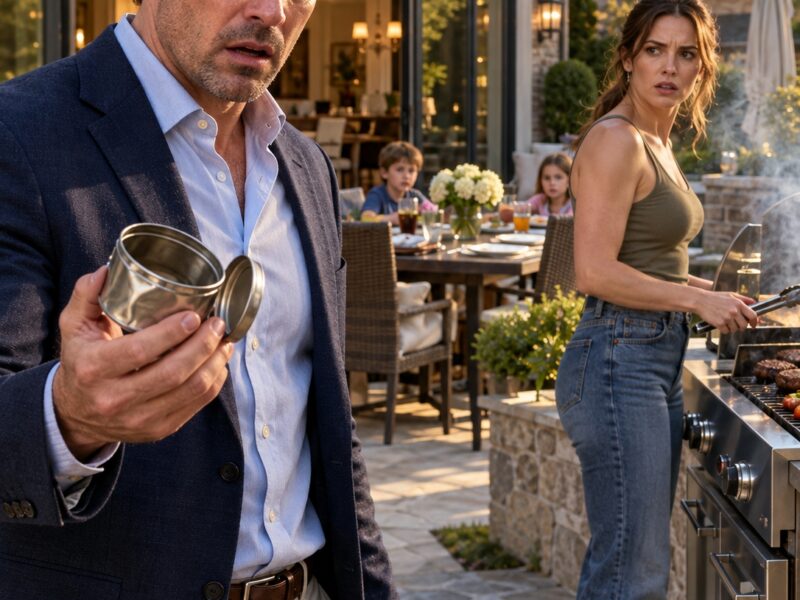
A MILLIONAIRE CAME HOME EARLY AND FOUND HIS NEIGHBOR BARBECUING WITH HIS KIDS—THEN HIS 7-YEAR-OLD DAUGHTER ASKED ONE QUESTION THAT BROKE HIM

The first thing Adam Kesler did when he saw the woman next door standing at his dead wife’s grill was kill the flame.
The second thing he did was turn off the music.
The third thing was worse.
He looked at his ten-year-old son and watched happiness disappear from the boy’s face.
Not slowly.
Not reluctantly.
Instantly.
One second Toby was standing on the patio with a plate of corn in his hands, cheeks flushed from laughing, Sarah’s old soul playlist spilling through the open back door.
The next, he saw his father.
His shoulders tightened.
His smile vanished.
And the child Adam loved more than anything in the world became careful.
Adam would remember that transformation long after he forgot what he shouted.
He would remember his daughter’s barbecue-sauce-stained shirt.
The blackened chicken.
The dented spice tin sitting empty on the kitchen counter.
The woman next door holding Sarah’s old grilling tongs.
But most of all, he would remember Toby’s face.
Because there are moments when a parent discovers something terrible without anyone saying a word.
Adam discovered that afternoon that his children had learned to be happy only when he wasn’t home.
And somehow, that was still not the worst thing waiting for him.
Three weeks later, at 4:12 on a Sunday afternoon, Toby would begin packing away three unopened jars of paprika because he had finally stopped believing his father was coming.
Months after that, another woman would write her name on a tin beside Sarah’s.
And before any of it happened, a seven-year-old girl would stand in Adam’s backyard and ask him a question so simple he would have no defense against it.
But that Saturday morning, Adam Kesler knew none of this.
At 8:03 a.m., he was simply late for work.
Chestnut Lane in Bloomington, Illinois, had already come alive around him.
A lawn mower groaned two houses down. Someone’s garage radio carried a baseball discussion into the warm September air. Minivans loaded with children rolled toward soccer fields, coffee cups balanced in cup holders, parents shouting reminders about shin guards through half-open windows.
It was the kind of ordinary suburban Saturday Sarah had loved.
Adam barely noticed it.
He stood at the kitchen island in a navy quarter-zip, one hand holding his phone, the other searching for his keys.
At forty, Adam was the CEO of Kesler Field Systems, a company his father had started with two trucks and six employees and Adam had expanded into one of the largest athletic-field contractors in the Midwest.
Football fields.
Baseball complexes.
Running tracks.
Drainage systems.
If thousands of people were going to stand on it, run on it, cheer on it, or pay for tickets around it, Adam’s company probably knew how to build it.
People called him disciplined.
Reliable.
Driven.
Since his wife died, they had begun using another word.
Strong.
Adam hated that word.
But he never corrected anyone.
“The fridge is full,” he said.
Toby sat at the island with a bowl of cereal.
He was ten years old and already had the strange stillness of a much older person.
“Mrs. Palmer will be here around noon. Dinner instructions are on the counter. There’s lasagna in the refrigerator.”
“I know.”
“Toby.”
The boy looked up.
“Mrs. Palmer has my number. You have my number. If anything happens—”
“I know, Dad.”
Adam stopped.
There had been a time when Toby would have rolled his eyes dramatically.
Sarah would have laughed.
He’s ten, Adam. Not your regional manager.
Now Toby simply nodded.
No argument.
No attitude.
No childhood resistance.
Adam mistook obedience for resilience.
“We’ll do something next weekend,” he said.
Toby stirred his cereal.
“Okay.”
Seven-year-old Mabel slid down from her stool.
“Dad?”
Adam glanced at his phone.
8:06.
“What, sweetheart?”
“When you come back, can we grill?”
His thumb stopped over the screen.
For one small second, the kitchen changed.
The stainless refrigerator disappeared.
The reports on the counter disappeared.
The calendar filled with work trips disappeared.
He saw Sarah barefoot on the patio, laughing because smoke had blown into the kitchen again.
Then the image was gone.
“The propane tank probably needs replacing.”
Mabel frowned.
“But—”
His phone buzzed.
Quincy site supervisor.
Adam grabbed it like someone had thrown him a rope.
“I’ve got to take this.”
“Dad—”
“Next weekend.”
“You said—”
“I know what I said.”
Too sharp.
Mabel’s mouth closed.
Adam saw it.
He could have fixed it.
He could have crouched down and apologized.
Instead, he answered the call.
“Kesler.”
He was through the front door less than a minute later.
Outside, his black SUV backed down the driveway.
Inside, Toby carried his cereal bowl to the sink.
Mabel stood at the window until their father’s vehicle disappeared around the corner.
Then she whispered, “He always says next weekend.”
Toby turned on the faucet.
“Don’t start.”
“I didn’t start anything.”
“I know.”
“Can we grill with Mrs. Palmer?”
“No.”
“Why?”
Toby rinsed the bowl too carefully.
“Because we don’t.”
Mabel stared at him.
That was the rule now.
Not one Adam had ever announced.
The dangerous rules in grieving families rarely needed to be announced.
Everyone learned them by watching someone’s face.
Outside, beneath a weathered gray cover, the grill sat untouched.
It had not been lit since the last Sunday Sarah Kesler had been strong enough to stand beside it.
More than a year earlier.
Her faded floral oven mitt still hung inside the patio cabinet.
No one had moved it.
No one had washed it.
No one had thrown it away.
The family had become experts at preserving objects while losing everything the objects were supposed to mean.
Next door, twenty feet above the ground, Laurel Dunn was cutting a dead branch from a maple tree when she saw the Kesler children through the fence.
Laurel was thirty-one and worked for Bloomington’s forestry division.
She spent weekdays inspecting damaged trees, arguing with contractors about root zones, climbing where necessary, and explaining to irritated homeowners why a hundred-year-old oak could not be saved by pouring fertilizer around it.
She liked trees because they were honest about damage.
A dead limb was dead.
Rot spread where rot spread.
A trunk could look perfect outside and be hollow within.
People were more complicated.
She lowered her pole saw.
Toby was shooting baskets.
Miss.
Retrieve.
Shoot.
Miss.
Retrieve.
No celebration.
No frustration.
Just repetition.
Mabel sat near the fence drawing chalk flowers across the concrete.
Laurel had lived beside the Keslers for almost two years.
She had known Sarah only casually.
They had talked over the fence.
Exchanged tomatoes.
Complained about mosquitoes.
Once Sarah had borrowed pruning shears and returned them with a plate of brownies because, as she’d said, “I don’t understand borrowing something without attaching sugar to the transaction.”
After Sarah died, Laurel had stayed back.
Grief attracted helpers.
Casseroles.
Flowers.
People arriving with sympathetic faces and sentences beginning with “At least.”
Laurel knew sometimes the kindest thing you could do was not make grieving people manage your desire to comfort them.
So she waved.
She passed tomatoes over the fence.
She shoveled part of Adam’s sidewalk once during a snowstorm and never mentioned it.
She never crossed into their yard.
But she noticed things.
At 10:15, Toby went inside and brought apple slices for Mabel.
At eleven, he checked whether the front door was locked.
At noon, Laurel heard him call across the yard.
“Mabel, your allergy medicine.”
“I took it.”
“No, you didn’t.”
“I did.”
“I counted.”
Laurel’s hand stopped on a branch.
“I counted.”
Two words.
That was all it took.
Suddenly she was nine again.
Her father had died on a Tuesday morning.
Heart attack.
Driveway.
Her mother had loved him so completely that afterward she couldn’t bear his name.
Photographs disappeared into a closet.
His jacket disappeared.
His coffee mug disappeared.
Nobody told stories because stories made Mom cry.
So Laurel learned to keep the television low.
She packed lunches for her younger brother.
She remembered permission slips.
She learned to detect sadness by the sound of footsteps in a hallway.
At nine years old, she had thought that was love.
At thirty-one, she knew another word for it.
Survival.
And now a ten-year-old boy next door was counting his sister’s medication.
Laurel looked away.
Not my family.
She repeated it to herself.
Not my house.
Not my place.
By mid-afternoon she was stacking branches when a small voice came through the fence.
“Miss Laurel?”
Mabel stood on the other side.
She was holding a dented metal spice tin with both hands.
A strip of old masking tape ran across the lid.
On it, in faded looping handwriting, were three words.
SARAH’S SUNDAY RUB.
Laurel felt something shift inside her.
“This was my mom’s.”
Mabel tipped the tin slightly.
Something rattled inside.
“She put it on chicken. It was the best chicken in the whole world.”
Toby appeared behind her almost immediately.
“Mabel.”
“What?”
“We’re not supposed to use Mom’s rub.”
“I’m not using it.”
“You brought it outside.”
“I’m showing it.”
“Mabel.”
What hurt Laurel wasn’t his anger.
There wasn’t any.
He sounded cautious.
Measured.
Like a child who had learned that certain objects were emotional explosives.
Laurel crouched until she was closer to Mabel’s height.
“Your mom must have made something worth remembering.”
Mabel nodded.
“The best.”
Toby looked at the tin.
His thumb rubbed the edge of the masking tape.
Then he asked a question without looking at Laurel.
“Do you know how to make barbecue chicken?”
Laurel smiled slightly.
“I’ve been known to survive a grill.”
He didn’t smile.
“Without burning it?”
That changed something.
Laurel looked toward the Kesler patio.
Toward the covered grill.
Toward the dark kitchen windows.
She knew what he was really asking.
Not Can you cook chicken?
Can you help us go somewhere Dad won’t go?
Laurel stood.
“Come around to my side.”
Toby looked up.
“My gate’s open.”
She didn’t touch the Kesler grill.
Not yet.
Her own backyard was unimpressive.
Patchy grass.
A vegetable bed held together with stakes and twine.
A secondhand kettle grill she’d paid fifteen dollars for at a garage sale.
Mabel loved it immediately.
“This is tiny.”
“It’s efficient.”
“It’s tiny.”
“It’s emotionally secure.”
Toby almost smiled.
Laurel handed him a grocery bag.
“Corn needs shucking.”
Then she pointed at Mabel.
“Lemonade.”
Mabel saluted.
“Yes, ma’am.”
“And you’re not allowed to drink half of it while pouring.”
Mabel lowered the pitcher she’d already lifted toward her mouth.
Toby laughed.
Barely.
But Laurel heard it.
The chicken went on late that afternoon.
The old spice tin remained closed on the picnic table.
Laurel didn’t ask to use it.
Instead, she asked what Sarah had put inside.
“Brown sugar,” Toby said.
“Paprika,” Mabel added.
“Garlic.”
“Pepper.”
“And something dark.”
Laurel opened her cabinet.
“Cumin?”
Toby shook his head.
“Cinnamon?”
“No.”
“Chili powder?”
“Maybe.”
They mixed a small batch.
Toby tasted a piece of chicken.
His expression fell.
“That’s not it.”
Laurel could have told him it was close.
She could have said memory changes flavors.
She could have reassured him.
Instead, she nodded.
“Okay.”
He looked at her.
“Okay?”
“Then that’s not it.”
Something in Toby’s shoulders loosened.
Mabel rescued them.
“Mom used Dijon mustard.”
Toby looked at her.
“In the sauce.”
“Not yellow mustard.”
“Yellow mustard is for hot dogs.”
“And you only brush the sauce on near the end,” Toby added automatically.
“Why?”
“Because Mom did it too early once and everything turned black.”
“Once?” Mabel said.
“The smoke alarm went off every time.”
“Because she left the back door open.”
“She’d wave a towel under the alarm.”
Mabel’s face lit up.
“And bow!”
Toby looked at her.
Then he laughed.
Not the small almost-laugh Laurel had heard earlier.
A real one.
“She called it applause.”
Mabel laughed so hard lemonade came out her nose.
For the next hour, Sarah Kesler returned to the world in fragments.
Not as a dying woman.
Not as a framed photograph.
As a person.
Sarah chasing a squirrel across the yard because it stole corn.
Sarah dancing with a spatula.
Sarah pretending burned chicken was “Cajun.”
Sarah cheating at board games.
Sarah singing the wrong lyrics loudly because she knew it embarrassed Toby.
Each memory seemed to give the children permission for another.
And between those memories, Laurel began to understand what the Kesler house had become.
“Dad eats in his office,” Mabel said.
Toby shot her a look.
“What?”
“Nothing.”
“He works.”
“I know.”
Mabel shrugged.
“I used to put pictures on his desk.”
Laurel turned the chicken.
“Used to?”
“He has important papers now.”
Toby’s eyes went down.
Laurel said nothing.
She wasn’t interested in turning Adam into a villain.
She knew grief.
Sometimes grief looked like crying.
Sometimes it looked like drinking.
Sometimes it looked like anger.
And sometimes it looked like an immaculate house, a successful company, a full refrigerator, and a father who worked so hard nobody could accuse him of falling apart.
That version was harder to recognize.
Which made it more dangerous.
Mabel licked sauce from her thumb.
“We should make Mom’s chicken for Dad someday.”
Toby’s head snapped toward her.
“Don’t.”
“Why?”
“Just don’t.”
“Why?”
“Because it makes him weird.”
Laurel stopped moving.
Toby lowered his voice.
“Don’t talk about Mom too much around Dad.”
Mabel’s smile disappeared.
“Okay.”
And there it was.
Laurel was nine years old again.
Nobody had told her she couldn’t mention her father.
Her mother’s face had taught her.
Toby had learned the same lesson.
Protect the surviving parent.
Hide your grief.
Become useful.
Be quiet.
After they ate, Toby picked up Sarah’s spice tin.
“Could we do this again?”
“Sure.”
He hesitated.
“At our house.”
Laurel looked over the fence.
“Toby…”
“Our grill belongs to us too.”
He wasn’t defiant.
That made it harder.
He was simply stating a fact no child should have needed to defend.
Laurel looked at Sarah’s handwriting beneath his thumb.
Then at Mabel.
The children weren’t asking her for a new mother.
They weren’t asking her to repair their father.
They were asking for permission to remember.
The next Saturday, Toby knocked on Laurel’s gate at exactly ten.
“Dad’s in Quincy.”
He held up his phone.
“He’ll be back Sunday night.”
Laurel read Adam’s message.
Then she looked at the covered grill.
She knew this was different.
Her yard had been neutral territory.
His wasn’t.
“Okay,” she said finally. “But you two do the work. I’m only helping.”
They pulled off the cover.
Dust lifted into the sunlight.
Mabel sneezed.
Toby found a half-used bag of hickory chips.
“Mom used these.”
The propane tank was still half full.
Laurel noticed.
She said nothing.
Inside, the kitchen looked almost untouched by life.
No dishes in the sink.
No school projects on the refrigerator.
No half-finished coffee.
Everything was clean enough to photograph.
Mabel climbed onto a stool to wash corn.
Toby began mixing another version of Sarah’s rub.
The old tin sat between them.
Finally Mabel whispered, “There’s hardly any left.”
“I know.”
“If we use it…”
“I know.”
Laurel kept both palms against the counter.
“It’s yours,” she told Toby. “You decide.”
He picked up the tin.
Turned it slowly.
Read his mother’s handwriting.
Then he opened it.
“Mom made it to be eaten,” he said.
He tipped the tin over the bowl.
Two spoonfuls fell out.
He tapped the bottom once.
Twice.
Every last grain disappeared into the mixture.
When he put the empty tin down, he did it gently enough to break Laurel’s heart.
“Extra pepper,” Toby said.
“What?”
“She always put extra pepper in for Dad.”
Laurel handed him the grinder.
“Then you know what to do.”
By noon, the patio looked alive.
Paper plates.
Hamburger buns.
Corn.
Lemonade.
A Cardinals game drifting from a garage radio down the block.
Toby found Sarah’s old Bluetooth speaker in a junk drawer.
The first song started.
Mabel shouted.
“Mom’s playlist!”
The chicken hit the grill.
Fat dripped.
Flame jumped.
Smoke rolled through the open slider.
And the kitchen smoke detector screamed.
Laurel lunged for a dish towel.
Behind her, Toby exploded with laughter.
“That’s applause!”
Mabel ran onto the patio and bowed dramatically.
The alarm shrieked.
Laurel waved the towel.
Toby doubled over.
Mabel bowed again.
And for the first time in more than a year, laughter poured out of the Kesler backyard.
It traveled over the fence.
Across Chestnut Lane.
Into a neighborhood that had gotten used to silence.
Toby left his phone face down on the table.
He didn’t check it for an hour.
Two and a half hours away, rain swept across Quincy.
The field installation was canceled.
Adam Kesler came home early.
At 1:40 p.m., his SUV turned onto Chestnut Lane.
He stepped out with an overnight bag.
Then stopped.
Smoke.
Hickory.
Brown sugar.
And music.
His chest tightened.
He knew that song.
Sarah had danced to it barefoot in the kitchen.
He hadn’t heard it since the funeral.
Then he heard something even more impossible.
Mabel laughing.
Adam entered through the front door.
The smell hit him like a physical blow.
Smoke.
Chicken.
Pepper.
A year collapsed.
He saw the counter.
Mixing bowl.
Paprika.
And the tin.
Sarah’s tin.
Open.
Adam picked it up.
Empty.
Not nearly empty.
Empty.
Every grain gone.
His hand began to shake.
Through the open slider, he saw Laurel beside his daughter.
Toby carrying corn.
Sarah’s music.
Sarah’s tongs.
Sarah’s grill.
Sarah everywhere.
Except Sarah.
Adam walked outside.
Toby saw him.
And his face changed.
Adam turned off the grill.
Then the speaker.
Silence crashed over the patio.
“Dad?” Mabel said. “You’re home.”
Adam looked at Laurel.
“What is this?”
She put down the tongs.
“Mr. Kesler—”
“What are you doing in my house?”
“The kids asked—”
“The kids asked?”
His voice wasn’t loud.
It was worse.
Cold.
“You walked into my kitchen?”
“They told me you weren’t coming home until tomorrow.”
“So that made this okay?”
“No.”
Laurel held his gaze.
“We were careful, but no. I should’ve asked you.”
“This is my family.”
“I know.”
“No, you don’t.”
Toby began gathering plates.
Adam barely noticed.
“You don’t come into someone’s home and bring back traditions that are none of your business.”
Laurel absorbed the words.
She knew this wasn’t really about trespassing.
It was about the smell.
The music.
The empty tin in Adam’s hand.
She nodded.
“You’re right about something.”
Adam waited.
“I shouldn’t have entered your yard without your permission.”
“Good.”
“I’m sorry.”
He nodded.
Then Laurel continued.
“But I’m not sorry they talked about their mother.”
Adam stared at her.
“I’m not apologizing for that.”
“You have no idea what my children need.”
“Maybe not.”
“Then don’t pretend—”
“Does everybody else get to miss Mom?”
Mabel’s voice stopped him.
Adam turned.
She stood beside the table holding a paper plate.
Sauce stained her shirt.
Her lower lip trembled.
“What?”
“Grandma misses Mom.”
Adam said nothing.
“Mrs. Palmer misses her. Mrs. Turner at the pharmacy said she misses her.”
“Mabel—”
“But when we miss Mom, you get mad.”
Adam’s mouth opened.
Nothing came out.
Mabel’s eyes filled.
“Why?”
No boardroom had ever felt this quiet.
“Why does everybody else get to miss Mom except us?”
Adam looked at Toby.
His son had begun cleaning.
Of course he had.
Stack plates.
Fold napkins.
Carry the corn inside.
Make the problem smaller.
Make Dad’s life easier.
Laurel watched Toby.
And Adam saw the recognition on her face.
Not pity.
Recognition.
Suddenly he understood that whatever she saw in his son frightened her because she’d seen it before.
Maybe lived it.
Laurel picked up the colander she’d brought.
“I should go.”
She walked through the gate.
No dramatic goodbye.
No accusation.
The latch clicked behind her.
Adam remained beside the dead grill.
A half-eaten ear of corn lay on a paper plate.
Sauce stained the patio.
His children had created an entire family afternoon while he was gone.
He looked at the empty tin.
He tried to set it down.
His fingers wouldn’t open.
That night, Adam sat in his office until eleven.
Three reports glowed on his monitor.
He read the same paragraph six times.
Mabel’s question kept interrupting him.
Why does everybody else get to miss Mom except us?
His phone died.
He went upstairs looking for the charger Toby constantly borrowed.
Toby was asleep.
The cable was behind some books.
Adam pulled it.
A blue spiral notebook fell to the floor.
He bent to pick it up.
He should have put it back.
Then he saw the first line.
THINGS ABOUT MOM SO I DON’T FORGET.
Adam sat down on the carpet.
His heart began beating harder.
Mom danced while she flipped burgers.
Mom hated socks in bed.
Mom let Mabel eat dessert first on birthdays.
Mom yelled at Dad when he stole bacon.
Mom bowed when the smoke alarm went off.
Mom sang Stevie Wonder too loud.
Mom smelled like vanilla lotion after showers.
Mom said Dad looked handsome when he was mad because his eyebrow did a weird thing.
Page after page.
Tiny things.
Ordinary things.
The things people assume they will remember forever until one day they realize they don’t.
Adam turned to the final written page.
Toby’s handwriting was slower there.
Neater.
For Mom’s birthday: I want one Sunday where Dad is here and nobody acts sad because we remember Mom.
Adam read it again.
Then again.
He covered his mouth.
For fourteen months after Sarah died, Adam had believed his job was to keep the family functioning.
Bills paid.
House maintained.
Children fed.
Therapy scheduled.
College accounts funded.
Routine preserved.
He had succeeded brilliantly.
And his ten-year-old son was writing memories in a notebook because he was afraid his mother was disappearing.
At nine the next morning, Adam knocked on Laurel’s back door.
She opened it wearing an old flannel shirt.
“Mr. Kesler.”
“Adam.”
She waited.
“Can I come in?”
Laurel stepped aside.
A chainsaw chain lay across newspaper on her kitchen table.
Adam remained standing.
“I was out of line yesterday.”
She said nothing.
“The way I spoke to you.”
He swallowed.
“I’m sorry.”
“Thank you.”
He looked toward the window.
“They were happier than I’ve seen them in months.”
“I know.”
He flinched slightly.
Then tried to do what Adam Kesler always did when life became uncomfortable.
Create terms.
“I’ve been thinking. When I travel, you’d be welcome to spend time with them. They obviously like you.”
Laurel’s expression changed almost imperceptibly.
“But I’d prefer some things remain alone. Sarah’s things. The grill. Certain traditions.”
There.
A solution.
Clear.
Reasonable.
Controlled.
Laurel looked at him.
“No.”
Adam blinked.
“What?”
“No.”
“I don’t think you understand.”
“I understand perfectly.”
She put down the rag in her hand.
“I like your kids. A lot. But I won’t help teach them that your sadness matters more than theirs.”
Adam’s jaw tightened.
“And I won’t make it easier for you to keep disappearing.”
That hit harder than yesterday.
“You don’t know what this has been like.”
“No.”
“You didn’t know Sarah.”
“No.”
“You have no idea what it is to lose her.”
“You’re right.”
Laurel pulled out a chair.
“My father died when I was nine.”
Adam went still.
“Heart attack. Tuesday morning. In our driveway.”
She sat.
After a moment, Adam did too.
“My mother loved him so much she couldn’t say his name afterward. Pictures went into boxes. Nobody told stories. The house became quiet.”
Laurel ran a finger along the edge of the newspaper.
“So I became useful.”
Adam looked at her.
“I packed my brother’s lunches. Kept the TV low. Made sure homework got done. Never cried where Mom could hear me.”
She smiled, but there was no humor in it.
“I thought that was love.”
Adam thought of Toby carrying the corn inside.
“Adam, I’m thirty-one years old.”
Her voice lowered.
“I can’t remember what my father’s voice sounded like.”
The refrigerator hummed.
Nothing else moved.
Laurel looked directly at him.
“Your children are starting to forget their mother’s voice in your house.”
Adam looked away.
He had built stadiums.
Managed hundreds of employees.
Negotiated contracts worth millions.
None of it helped him sit across from this woman.
“If there’s another cookout,” Laurel said, “you need to be the one at that grill.”
“I don’t know if I can.”
“Then figure that out with them.”
He looked at her.
“I’m not doing that part for you.”
Adam returned home.
At one o’clock, his phone reminded him of a conference call.
He canceled it.
Then he made grilled cheese.
He burned one side.
Mabel stared at it.
“Is it supposed to look like that?”
“No.”
“Mom would’ve scraped it with a knife.”
Adam froze.
Mabel froze too.
There it was.
The old reflex.
She had mentioned Sarah.
Now she waited to see what would happen.
Adam picked up a knife.
“Did she?”
Mabel nodded cautiously.
“Then hand me one.”
Something tiny changed.
Not healed.
Changed.
They ate at the kitchen table.
The real table.
Not Adam’s office.
Mabel talked because silence made her nervous.
Toby barely spoke.
When he finished, he automatically picked up everyone’s plates.
Adam reached for them.
“I’ve got it.”
Toby stared.
“What?”
“I’ll clean.”
“It’s okay.”
“I know.”
Adam took the plates.
“You don’t have to.”
Toby stood empty-handed for several seconds as if Adam had removed a job title from him.
Then he sat down.
That evening Adam saw Toby’s school planner.
Three weeks ahead, underlined twice:
MOM’S BIRTHDAY — BBQ 4:00.
Adam stared at it.
Toby had written it after yesterday.
After Adam shut off the grill.
After he stopped the music.
Somehow his son still believed they could try again.
Adam wanted to deserve that belief.
Wanting was the easy part.
Monday, he came home for dinner.
Wednesday too.
Thursday, an investor call ran long.
The kids ate without him.
Friday, he drove Mabel to school and spent most of the ride discussing drainage specifications over Bluetooth.
Saturday, he attended Toby’s soccer game.
At halftime his phone buzzed.
Urgent.
Adam left.
Toby waved goodbye from the field.
He didn’t look surprised.
That hurt more than anger would have.
Laurel never congratulated Adam for trying.
She waved.
That was all.
No praise for eating dinner with his own children.
No medal for attending half a soccer game.
The boundary remained where she’d placed it.
So Adam kept trying.
He packed Mabel’s lunch and forgot a napkin.
He sat with Toby during math homework and discovered the boy had been doing it alone since spring.
He called the dentist and learned both children were six months overdue.
It was his house.
His children.
His life.
And he was discovering rooms inside it he’d never entered.
Then the school called.
Toby had shoved another boy.
Adam arrived expecting disciplinary paperwork.
Instead, the counselor closed her office door.
“The other student made a comment about Toby’s mother.”
Adam rubbed his forehead.
“Is he in trouble?”
“We handled the incident.”
She leaned forward.
“But there’s something else.”
Adam waited.
“Toby keeps telling me it’s his job to keep Mabel calm.”
Adam’s stomach tightened.
“And he says he shouldn’t make you worried.”
The room felt too small.
“He’s ten, Mr. Kesler.”
Adam looked down.
“He thinks your grief is something he’s responsible for managing.”
“Should I get him another therapist?”
The counselor shook her head gently.
“I think he needs something more basic first.”
“What?”
“He needs to see that you can handle being his father even when you’re sad.”
Adam drove home without music.
That Saturday, Toby biked to the grocery store.
He returned with three jars of paprika.
Sweet.
Hot.
Hungarian.
He lined them up in his bedroom.
Still searching for Sarah’s missing ingredient.
That evening Adam walked past the kitchen and saw Toby erasing something from his planner.
“Toby?”
The boy kept erasing.
Adam saw the faint words.
Mom’s birthday.
BBQ.
4:00.
“We don’t have to do it,” Toby said.
Adam’s throat tightened.
“Why are you erasing it?”
“I know you’re busy.”
“I’m not—”
“It’s okay, Dad.”
Toby smiled kindly.
Like he was protecting him.
Again.
Begging would have hurt less.
Begging meant expectation remained.
Wednesday, Adam’s COO called.
A major stadium client in St. Louis was threatening to walk.
Meeting Sunday afternoon.
They wanted the CEO.
For eleven years, Adam had been the person every client expected.
He’d called that leadership.
Now he wondered how much of it had become camouflage.
“You go,” he told his COO.
Silence.
“Adam?”
“You know the account.”
“They specifically asked—”
“I trust you.”
He ended the call.
The schedule was clear.
Adam still wasn’t ready.
Saturday night, after the children slept, he walked onto the patio.
He removed the grill cover.
Old smoke hit him.
Cold grease.
Hickory.
Suddenly Sarah was in the hospital again.
Not the healthy Sarah.
The final Sarah.
Thin wrists.
Dry lips.
Machines.
Fourteen months of cancer reducing their marriage to medication charts, test results, and whispered conversations in corridors.
Adam stumbled backward.
He was inside the kitchen before he realized he’d moved.
His heart hammered.
Cancel it.
The thought came instantly.
Tell the kids something happened.
Work emergency.
Rain.
Anything.
Instead, he crossed the yard.
Laurel opened her door.
She saw his face.
Didn’t invite him inside.
“I don’t think I can do it,” he said.
She didn’t say, Of course you can.
Didn’t call him brave.
“Then tell them.”
He looked at her.
“Tonight.”
“Laurel—”
“Tell them the truth. Don’t let them sit outside tomorrow waiting until they realize you’ve canceled.”
He closed his eyes.
“They’ll be disappointed.”
“They’ve survived disappointment.”
That hurt.
“If you disappear without explaining, they’ll think it’s because they asked for too much.”
Adam looked toward his dark house.
Laurel softened.
“They’ll think it’s their fault.”
He went home.
He stood outside Toby’s bedroom.
His hand reached toward the knob.
Then stopped.
He couldn’t do it.
Sunday came.
Warm sunlight.
Cold breeze.
At three-thirty, Toby carried the hickory chips outside.
Mabel placed Sarah’s empty tin in the center of the table.
Toby arranged his three paprika jars beside it.
3:45.
The office door remained closed.
3:55.
Mabel looked toward the house.
“Should I get him?”
“No.”
4:00.
Nothing.
4:07.
Mabel sat on her hands.
4:12.
Toby stood.
He picked up the paprika.
“Come on.”
Mabel’s face fell.
“What?”
“Let’s put it away.”
“But Dad—”
“Forget it.”
The back door opened.
Adam stepped onto the patio.
He was pale.
In both hands, he carried Sarah’s old grilling tools.
Tongs.
Spatula.
Basting brush with the burned wooden handle.
Toby didn’t move.
Adam walked to the grill.
Set each tool down.
His hands shook.
He bent toward the propane valve.
Missed it.
Tried again.
Then stared at the ignition instructions as if he’d never seen them.
Nine years.
He had used this grill for nine years.
“Bud?”
Toby looked up.
Adam kept his eyes on the grill.
“Can you help me?”
Toby hesitated.
Then walked over.
Adam didn’t step away.
He simply made space beside himself.
Mabel disappeared through the side gate.
A few minutes later, Laurel returned carrying potato salad and ice.
Nothing else.
No recipe.
No rescue plan.
Adam pulled out a chair.
“Sit.”
She raised an eyebrow.
“Please.”
“Bossy.”
“You’re not working today.”
Laurel sat.
Then Adam reached into his jacket pocket.
He placed a glass jar on the table.
Instant espresso.
Toby stared.
“What is that?”
Adam swallowed.
“Your something dark.”
Toby looked at him.
“Coffee?”
“Your mom used instant espresso.”
Toby’s mouth opened.
“Every Memorial Day she’d mix a fresh batch.”
“You knew?”
Adam nodded.
“This whole time?”
The accusation wasn’t loud.
It didn’t need to be.
Adam looked at Sarah’s empty tin.
“I used to stand in the doorway and watch her. She said it was the secret ingredient. Made me promise not to tell anyone.”
Toby stared at him.
“You knew.”
“I’m sorry.”
“Why didn’t you tell me?”
Because telling you meant remembering her.
Because remembering her meant remembering what happened at the end.
Because I was a coward.
Adam couldn’t say all of that yet.
So he said the truest part.
“I should have.”
He measured espresso into Toby’s mixture.
Brown sugar.
Paprika.
Garlic.
Pepper.
Coffee.
Toby stirred.
They tasted it from their fingertips.
Mabel watched anxiously.
“Well?”
Toby frowned.
“It’s…”
“Not exact,” Adam said.
Toby looked at him.
“No.”
Then his mouth twitched.
“But close.”
The chicken went onto the grill.
Fat hit flame.
Smoke rushed toward the open slider.
The alarm inside screamed.
Adam reached for the control knob.
Toby grabbed his wrist.
“Dad.”
Adam stopped.
Toby looked at him.
“That’s applause.”
For a moment, Adam didn’t understand.
Then he remembered.
Sarah beneath the smoke detector.
Dish towel in hand.
Bowing.
Something escaped him.
A laugh.
One broken sound.
He turned away.
His shoulders began shaking.
The smoke alarm continued shrieking.
Mabel stepped onto the patio.
Spread her arms.
Bowed.
Adam laughed again.
Then he cried.
Not elegantly.
Not privately.
He covered his face.
Toby stood frozen.
Laurel didn’t move.
Nobody rescued Adam from the moment.
Eventually the alarm stopped.
Adam sat directly on the patio stones.
Mabel came closer.
“Your mom was sick for fourteen months,” he said.
The children went quiet.
“You remember some of it.”
Toby nodded.
Mabel leaned against the table.
“Near the end…”
Adam stared at his hands.
“It was hard for her.”
His voice trembled.
“Hard for all of us.”
He breathed.
“One night I was at the hospital. It was three in the morning. Your mom had been in pain for hours.”
Laurel’s expression changed.
Adam forced himself onward.
“And I prayed.”
Toby waited.
“I prayed for it to be over.”
Mabel frowned.
Adam’s eyes filled.
“I didn’t mean I wanted her gone. I wanted the pain gone. The hospital. The needles. The fear. I wanted her to stop hurting.”
He wiped his face.
“And then…”
His voice broke.
“Then it ended.”
No one spoke.
“And part of me was relieved.”
There.
The secret.
The thing he’d punished himself for.
“The woman I loved died, and somewhere inside me I felt relieved that she wasn’t hurting anymore.”
Adam shook his head.
“I’ve hated myself for that every day since.”
Mabel began crying.
Adam didn’t tell her to stop.
He didn’t change the subject.
He opened his arms.
She climbed into his lap.
“I thought if I remembered your mom happy, I’d remember what I felt when she died.”
He held Mabel tighter.
“So I stopped talking about her.”
Toby looked down.
“And I made you stop too.”
Silence.
“I’m sorry.”
Toby rubbed his eyes.
“I’m sorry about the barbecue.”
Adam looked up.
“What?”
“I shouldn’t have planned it without asking.”
“Hey.”
Adam waited until Toby met his eyes.
“You should never have had to protect me from missing your mother.”
Toby swallowed.
“That wasn’t your job.”
Adam’s voice cracked again.
“Not for one day.”
Then he reached behind him.
A blue notebook lay on the chair.
Toby went pale.
“You read it?”
“I did.”
“Dad.”
“I know.”
“You weren’t supposed—”
“I know.”
Toby grabbed it.
Then stopped.
There were new pages.
Different handwriting.
Larger.
Slanted.
Mom hated mayonnaise. She called it wet sadness.
Toby blinked.
Turned the page.
She once drove forty minutes back to Target because she forgot Mabel’s birthday candles.
Another.
She let Dad believe he made better ribs than she did because she liked watching him brag.
Mabel laughed through her tears.
“No!”
Adam nodded solemnly.
“Absolutely.”
“Mom made better ribs?”
“Apparently my entire marriage was built on deception.”
Toby laughed.
And for the first time since Sarah died, Adam heard both his children laughing about their mother while he was standing beside them.
Laurel quietly picked up her potato-salad bowl.
She knew when to leave.
“Laurel.”
She turned.
Adam pulled out the empty chair beside him.
“Have you eaten?”
She looked at him.
Then at the children.
Then at Sarah’s empty tin.
She sat down.
Nobody called it a beginning.
Nobody gave Laurel Sarah’s chair.
Nobody asked her to save the Keslers.
Adam burned the first chicken breast.
Toby complained about the corn.
Mabel ate two brownies before dinner.
Laurel laughed hard enough to put her fork down.
It wasn’t perfect.
It wasn’t supposed to be.
Long after everyone went inside, Adam remained at the grill.
Hickory chips smoldered.
Coffee and smoke lingered in the air.
He picked up the vinyl cover.
For fourteen months, covering the grill had felt like protecting something.
Now he understood.
He hadn’t been protecting Sarah.
He’d been protecting himself from Sarah.
Adam folded the cover.
Set it on the bench.
And left the grill uncovered.
The year that followed was not a miracle.
It was a lot of Sundays.
Some Adam cooked.
Some it rained and they ate pizza on the kitchen floor.
Once he missed Sunday because of a legitimate trip to Denver.
The old Adam would have texted from the airport.
The new Adam called.
“I’m sorry. No excuses. Monday night?”
Toby said, “Okay.”
Monday night happened.
That mattered.
Slowly, Toby stopped behaving like Mabel’s second father.
He lost his cleats.
Forgot homework.
Got annoyed about chores.
Argued over video games.
He stopped counting Mabel’s pills.
He became inconvenient again.
Adam had never been so grateful.
Mabel started leaving drawings on his desk.
One showed a purple dog with six legs.
Adam framed it.
It sat beside his laptop during every executive video call.
Nobody at Kesler Field Systems dared question it.
Sarah’s name became ordinary again.
Not sacred.
Not forbidden.
Ordinary.
“Mom liked this song.”
“Mom hated that restaurant.”
“Mom would have laughed.”
“Remember when Mom…”
The first anniversary of Sarah’s death after the barbecue arrived in October.
They lit a candle.
Ordered her favorite Chinese food.
Told stories.
Some were funny.
Some weren’t.
Mabel cried.
Adam cried.
Nobody apologized.
Laurel remained next door.
Then gradually, she wasn’t only next door.
Coffee after school pickup.
Arguments about corn.
Cardinals baseball.
A walk.
Dinner.
Their first real date was awkward enough that both went home early.
On Laurel’s porch afterward, she said, “I don’t want you to love me because you’re grateful.”
Adam nodded.
“I know.”
“And I won’t become Sarah.”
“I know.”
“I’m serious.”
“So am I.”
He looked toward his house.
“I’m not asking you to.”
They didn’t rush.
Months passed.
Toby watched everything.
Mabel was enthusiastic until the afternoon she saw Adam holding Laurel’s hand in the driveway.
She ran upstairs.
Slammed her bedroom door.
Adam followed.
He didn’t tell her nothing would change.
That would have been a lie.
He sat outside her door.
“I’m still your dad.”
No answer.
“I still read Wednesdays.”
Silence.
“Sarah is still your mom.”
The door opened.
Mabel’s face was wet.
“Forever?”
“Forever.”
She stared at him.
Then stepped aside.
Life made room slowly.
Sarah’s photographs stayed.
Laurel never competed with them.
Adam attended Toby’s games.
All of them.
He stayed until the final whistle.
One snowy evening, Toby sat beside Laurel on the couch.
“What was your dad like?”
Laurel went very still.
For years she had possessed only fragments.
“He whistled when he drove.”
Toby smiled.
“What else?”
“He hated socks.”
“Everybody hates socks.”
“He really hated socks.”
Toby waited.
Laurel looked toward the window.
Then said a name she had not said aloud in more than twenty years.
“Frank.”
Adam looked at her.
She smiled through sudden tears.
“His name was Frank.”
By the next summer, the Kesler backyard no longer looked preserved.
It looked lived in.
Patio cushions didn’t match.
Toby dented the grill with a soccer ball.
Mabel grew herbs in crooked clay pots.
On Memorial Day, they made Sunday rub.
Brown sugar.
Paprika.
Garlic.
Pepper.
Dijon powder.
Instant espresso.
They tasted it.
Toby shook his head.
“Still not exact.”
“It never will be,” Adam said.
Nobody was sad about that.
Laurel reached for smoked paprika.
Then stopped.
“Sarah didn’t use this.”
Mabel looked at her.
“I can leave it out.”
“No.”
Mabel pushed the bowl closer.
“Put it in.”
Laurel hesitated.
Then added a pinch.
On Sarah’s birthday, one year after the afternoon Adam had come home early and killed the flame, they grilled again.
The slider was open.
The chicken flared.
Smoke rolled inside.
The alarm screamed.
Four people looked toward the kitchen.
Then all four bowed.
After dinner, Mabel disappeared.
She returned holding a new spice tin.
A strip of fresh masking tape crossed the lid.
In careful seven-year-old handwriting, it read:
SUNDAY RUB — MOM’S AND OURS
Mabel handed Laurel a marker.
Laurel looked at Adam.
He said nothing.
She bent over the tin.
At the very bottom, in tiny letters, she wrote:
Laurel.
Mabel frowned.
“Bigger.”
Laurel laughed.
“Mabel—”
“You’re part of it.”
Laurel looked at the little girl.
Then erased nothing.
She simply wrote her name again.
Bigger.
That night, Adam carried both tins outside.
Sarah’s went onto the shelf first.
Dented.
Washed.
Empty.
Her looping handwriting still visible.
Then he placed the new tin beside it.
Not in front.
Not behind.
Beside.
Adam stood there while evening settled over Chestnut Lane.
Inside, Toby was arguing that Laurel had overcooked the corn.
Mabel was defending her.
Someone laughed.
A cabinet slammed.
Music started.
Adam looked at the two tins.
For a long time, he had believed healing meant eventually reaching a day when Sarah’s absence stopped hurting.
He knew better now.
Some absences do not become smaller.
Your life becomes large enough to carry them.
Nothing had replaced Sarah.
Nothing ever would.
There was simply room beside her memory now.
Room for children to grow.
Room for grief to speak.
Room for Laurel without asking her to become someone else.
Room for a father who had finally understood that being strong for his children did not mean never letting them see him break.
The grill remained uncovered.
The back door remained open.
And on an ordinary Sunday Adam Kesler once believed his family would never have again, he stood beneath the fading Illinois light with smoke in his clothes and the voices of the people he loved behind him.
Then the smoke alarm went off inside.
Mabel shouted, “Dad!”
Adam turned toward the house.
“What?”
“You forgot!”
He stared at her.
Then smiled.
He placed one hand against his chest, bent at the waist, and bowed toward the screaming alarm.
From somewhere behind him came Toby’s laughter.
Then Laurel’s.
And for just one impossible second, Adam could almost hear Sarah laughing too.
He didn’t turn around to look for her.
He didn’t need to.
He finally understood where she was.
Not trapped inside an empty tin.
Not beneath a grill cover.
Not inside a notebook written by a frightened ten-year-old boy.
She was in the stories.
In the burned chicken.
In the coffee hidden beneath the paprika.
In the ridiculous bow.
In every ordinary Sunday her children were finally allowed to remember.
Adam straightened.
Then he went inside to silence the alarm, while the people he loved kept laughing behind him.
This time, he didn’t ask them to be quiet.









