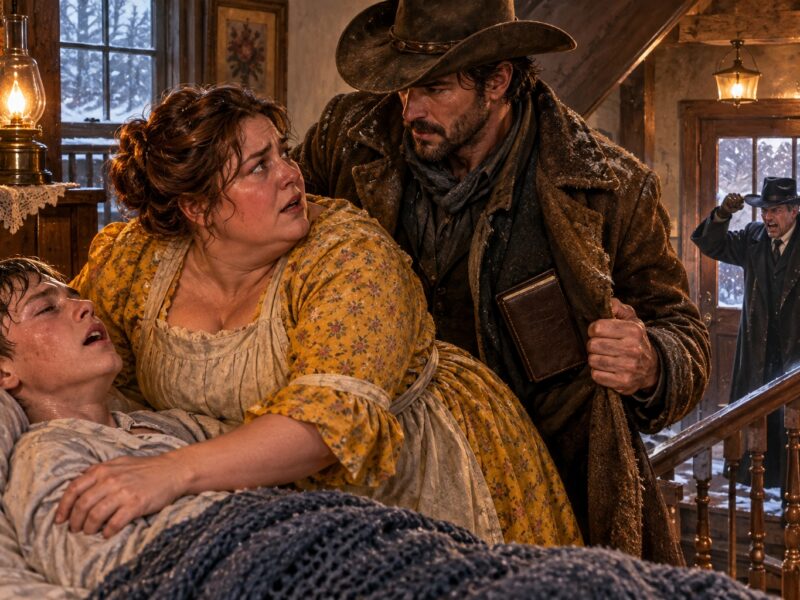
A Millionaire Cowboy Pretended He Couldn’t Afford Dinner—Until a Plus-Size Waitress Gave Him Her Last Meal and He Discovered Who Was Stealing Her Home
The cowboy left eight cents on the table after eating a supper worth fifty times that amount.
The exhausted waitress pushed the coins back toward him, unaware that the stranger could afford to buy every building on her street.
Seven days later, she would lose the restaurant, the home above it, and possibly the little brother whose breathing had grown weaker with every passing night.
“Keep your money, cowboy,” Sarah Miller said quietly. “You might need it more than I do.”
Nathaniel Vance looked down at the nickel and three pennies.
For nearly ten years, he had been trying to discover whether anyone could care about him without knowing he was wealthy.
Now he had found someone.
And he wished he hadn’t tested her.
Outside, snow was beginning to cover the streets of Dodge City, Kansas.
Inside The Prairie Rose, a fire cracked in the iron stove, fresh bread cooled beneath a clean dishcloth, and a twelve-year-old boy coughed in the bedroom upstairs.
Sarah glanced toward the ceiling.
Nathaniel noticed the way her fingers tightened around the coffee pot.
“Someone sick?” he asked.
“My brother.”
“Badly?”
She hesitated.
“He has good days.”
It wasn’t an answer.
Nathaniel recognized that immediately.
He also recognized the particular look of someone who had learned to make her worst fears sound ordinary.
Sarah filled his cup.
“More coffee?”
“I couldn’t pay for what I’ve already had.”
“Well, coffee’s already made.”
She smiled, but it didn’t quite reach her eyes.
“Seems a shame to waste it.”
Nathaniel watched her walk away.
There was something painfully familiar about the loneliness in her shoulders.
Not the loneliness of having nobody around.
The loneliness of being the person everyone needed.
He knew that kind of exhaustion.
His late wife, Elizabeth, had carried it through the final months of her illness, smiling for the servants and asking after the ranch hands while hiding the pain that eventually took her life.
Since her death, Nathaniel had spent more nights in his office than in their magnificent San Antonio house.
He had purchased land, expanded his cattle business, and accumulated more money than either of them had imagined when they married.
None of it had made the house less empty.
At forty-one, he had become a man whose name opened doors but whose presence rarely made anyone genuinely happy.
That was why he had come north dressed like an ordinary drifter.
It was a foolish idea, he knew.
A wealthy man deciding to see how poor people treated him.
He had called it an experiment.
Sitting in Sarah Miller’s restaurant, he was beginning to understand how arrogant that sounded.
Because poverty was something he could remove with a clean shirt and a signature.
For Sarah, it waited upstairs, beneath the stove, and inside every envelope she was afraid to open.
Sarah Miller had been twenty-seven when her father died.
She remembered the exact sound the restaurant clock made that morning.
Three slow clicks before the mechanism caught.
Her father had been sitting in his favorite chair beside the kitchen stove, his spectacles slipping down his nose, a newspaper folded across his knees.
She had brought him coffee.
He had thanked her.
An hour later, he was gone.
The doctor called it a failure of the heart.
Sarah called it the morning everything changed.
Her mother had died years earlier, leaving Sarah to help raise Leo, who had been just an infant then.
Their father had kept The Prairie Rose operating through droughts, railroad disruptions, and winters when customers sometimes paid in potatoes rather than money.
When he died, Sarah inherited the restaurant, its debts, and the responsibility of raising her little brother.
She also inherited a body the town considered appropriate for comment.
At twenty-nine, Sarah was a generously built woman with broad hips, full cheeks, soft arms, and thick chestnut hair that resisted every pin she used to hold it in place.
Customers sometimes mistook her kindness for permission to be cruel.
One traveling salesman had once asked whether she charged extra because she ate half the food herself.
Sarah had smiled and served his supper.
Then she had gone into the pantry and stood motionless until the humiliation passed.
Her father used to tell her she was the strongest person he knew.
Lately, strength felt remarkably similar to having no choice.
Every morning, she rose before dawn, carried coal, kneaded bread, prepared breakfast, tended the upstairs fire, and checked Leo’s breathing before opening the restaurant.
Every night, she counted the day’s earnings twice.
The second count never improved the first.
She had three hundred dollars hidden inside a flour tin beneath the kitchen floor.
Two hundred dollars more stood between her and the loss of everything her father had worked to build.
And Silas Blackwood had given her seven days to find it.
Nathaniel slept that first night in the narrow upstairs room beside the storage closet.
Sarah insisted he take it.
When he protested, she folded her arms.
“You can chop firewood tomorrow.”
“I don’t need charity.”
“Neither do I. I need wood.”
There was a firmness beneath her warmth that reminded him of Elizabeth.
Not because the women were alike.
They weren’t.
Elizabeth had been reserved, graceful, and accustomed to fine society.
Sarah had flour on her sleeves, a stubborn lock of hair falling over one eye, and a habit of speaking to customers as though their troubles were as important as their orders.
But both women possessed a quality Nathaniel had missed without realizing it.
They were not impressed by men simply because those men expected to be impressive.
The next morning, he discovered something unfortunate.
He was terrible at chopping wood.
His first strike landed crooked.
The second bounced off a knot.
By the third, Sarah was laughing so hard she had to brace herself against the doorframe.
“Cowboy, are you trying to cut that log or frighten it?”
Nathaniel set down the axe.
“I believe the log and I have reached an understanding.”
“What understanding?”
“It wins.”
Sarah laughed again.
The sound startled him.
He had heard her smile politely for customers.
He had seen her soothe frightened children and reassure older men who couldn’t afford their usual supper.
But this laughter was different.
For a moment, she sounded like someone whose whole life did not depend on the next seven days.
She stepped toward him.
“Here. Hold it lower.”
Her hand settled over his on the axe handle.
“You’re trying to force it. Let the weight do the work.”
He glanced at her.
“Is that how you manage everything?”
“Most things.”
“And the rest?”
She considered the question.
“The rest, I pray over.”
The axe split the wood cleanly.
Nathaniel grinned.
Sarah looked almost as pleased as he did.
Then a cough sounded from upstairs.
Her expression changed.
The laughter disappeared so quickly that Nathaniel felt its absence.
“Leo?” she called.
There was no answer.
She handed him the axe.
“I should check on him.”
Nathaniel watched her hurry toward the staircase.
He had spent years believing that money could solve nearly any problem.
He was beginning to wonder how many problems went unsolved because people with money never bothered to look.
Silas Blackwood arrived shortly after noon.
His polished boots left wet marks on Sarah’s scrubbed floor.
He removed his gloves one finger at a time, surveyed the room, and stopped at the counter.
“Miss Miller.”
Sarah straightened.
“Mr. Blackwood.”
“Is my money ready?”
Nathaniel, standing near the kitchen doorway, watched Sarah’s hand slide beneath the counter.
Not toward a weapon.
Toward the small silver locket she wore on a chain.
A nervous habit.
“I’ve saved three hundred dollars,” she said.
Blackwood’s expression remained unchanged.
“The debt is five hundred.”
“I understand. But Leo’s medicine has cost more this winter, and business has been slow. If you’d allow me another month—”
“Your family difficulties aren’t my concern.”
Sarah’s face tightened.
“Please.”
Blackwood leaned forward.
“Seven days.”
“Seven?”
“The railroad is expanding its freight yards. Your property has become valuable.”
He glanced around the dining room.
“Far more valuable than this little operation.”
“My father built this restaurant.”
“Then he should have been more careful with his finances.”
Nathaniel took a step forward.
Sarah gave him a slight shake of her head.
She knew men like Blackwood.
They enjoyed an audience.
They enjoyed resistance even more.
“Five hundred dollars by Friday,” Blackwood continued. “Or I take possession of the property under the security agreement.”
His eyes shifted toward Nathaniel’s worn coat.
“Perhaps you’d have more money if you stopped feeding worthless drifters.”
Sarah lifted her chin.
“What I do at my supper table is none of your business.”
Blackwood smiled.
“Not for much longer.”
When the door closed behind him, the room seemed to exhale.
Sarah rested both palms on the counter.
Nathaniel approached carefully.
“Does he actually hold your father’s loan?”
“He says he does.”
“Have you seen the papers?”
“Not since Father died.”
“How much have you paid him?”
She looked embarrassed.
“Nearly nine hundred dollars.”
“Over how long?”
“Two years.”
Nathaniel went still.
“And he says you still owe five hundred?”
“Yes.”
“Who originally lent your father the money?”
“The First Kansas Bank.”
Nathaniel looked toward the window.
He knew that bank.
Two years earlier, Vance Cattle and Land Holdings had purchased a portfolio of loans from the bank’s troubled western accounts.
The purchase had been handled by his business office.
Nathaniel had approved the transaction himself.
He remembered its manager reporting that several commercial borrowers were struggling.
He also remembered signing instructions to extend fair repayment terms whenever possible.
Nathaniel felt the first genuine unease of the afternoon.
“Sarah, was your father’s name listed as Thomas Miller?”
She looked surprised.
“Yes.”
He stared at her.
The name was familiar.
He couldn’t yet remember why.
Then Leo began coughing upstairs.
Not a brief cough.
A harsh, desperate succession of breaths.
Sarah was already moving.
“Leo?”
Another cough.
Then a small voice.
“Sarah…”
She ran toward the stairs.
Nathaniel followed.
Leo Miller sat upright in bed, his narrow shoulders trembling.
His skin was pale, and every breath seemed to require more effort than the last.
Sarah knelt beside him.
“I’m here, sweetheart.”
“It hurts.”
“Where?”
“My chest.”
She touched his forehead.
Nathaniel looked toward the fireplace.
The room was warm, but Leo’s lips had a bluish tint.
“Has a doctor seen him?”
“Three days ago,” Sarah whispered. “He said the inflammation had settled in his lungs.”
“Did he give you medicine?”
“Yes, but—”
Leo struggled to inhale.
Nathaniel pulled off his gloves.
“Sarah, I need you to listen carefully.”
Her frightened eyes met his.
“We need the doctor back. Now.”
“The roads—”
“I’ll find him.”
Nathaniel reached inside his coat.
His fingers closed around his checkbook.
Then someone began pounding on the restaurant’s front door.
Three hard knocks.
A man’s voice rose from below.
“Sarah Miller! Open this door! I’ve come to collect what your father owed!”
Nathaniel froze.
He knew that voice.
Not from the restaurant.
Not from Dodge City.
From a private office in Kansas City two years earlier, where a man named Silas Blackwood had requested control over several distressed railroad properties.
Nathaniel had refused him.
And now that same man was standing beneath Sarah Miller’s roof, claiming ownership of a debt that might belong to Nathaniel’s own company.
“Stay with him,” Nathaniel told Sarah.
He descended the staircase.
The pounding came again.
When he opened the door, wind pushed snow across the threshold.
Silas Blackwood stood outside with two men.
One wore a sheriff’s deputy’s badge.
The other carried a leather document case.
Blackwood’s smile faltered for the briefest instant.
Then recognition settled into his eyes.
Nathaniel saw it.
“You,” Blackwood said.
Nathaniel stepped into the doorway.
“Good afternoon.”
“I thought you were a drifter.”
“That’s what you called me.”
Blackwood studied his battered coat.
“Move aside.”
“Miss Miller is attending to her brother.”
“This concerns her property.”
“Then it can wait.”
Blackwood’s face hardened.
“You have no standing here.”
“Perhaps not,” Nathaniel replied. “But I have a question. When did you acquire the Miller mortgage?”
Blackwood went silent.
The deputy looked between them.
“What’s this about?”
“Nothing that concerns you,” Blackwood snapped.
Nathaniel kept his gaze on him.
“The original lender was First Kansas Bank. I’d like to know when the note was assigned to you.”
Blackwood’s eyes narrowed.
“You seem unusually interested in another man’s financial affairs.”
“Only when those affairs appear questionable.”
The man with the document case shifted his weight.
Blackwood stepped closer.
“I don’t know who you think you are—”
“Yes,” Nathaniel said quietly. “You do.”
For several seconds, neither man moved.
Then Blackwood gave a thin smile.
“I see.”
He glanced toward the deputy.
“We’ll return tomorrow.”
“But Mr. Blackwood—”
“Tomorrow.”
The men turned into the snowfall.
Before leaving, Blackwood looked back.
“Tell Miss Miller that strangers don’t change signed contracts.”
Nathaniel closed the door.
He remained there for a moment, listening to the wind.
The man had recognized him.
Which meant the deception was no longer simply his own.
Upstairs, Leo’s breathing had become frighteningly shallow.
Sarah held a damp cloth against his forehead.
Nathaniel knelt beside the bed.
“Leo, can you hear me?”
The boy gave a weak nod.
“Good. I’m going to bring you a doctor.”
Sarah looked up.
“The nearest physician is across town. Nobody will travel through this storm unless they’re paid.”
Nathaniel met her eyes.
“Then he’ll be paid.”
She frowned.
“With what?”
He reached into his coat and removed a folded bank draft.
Sarah stared at it.
It was drawn on a San Antonio bank.
The amount printed across its face was five thousand dollars.
For a long moment, she didn’t understand what she was seeing.
Then she looked at his hands.
The clean cuffs beneath his worn coat.
The watch chain she had noticed but dismissed.
The way Blackwood had changed when he recognized the stranger at the door.
“Who are you?”
Nathaniel swallowed.
“My name is Nathaniel Vance.”
Her expression remained blank.
The name meant nothing to her.
He almost wished it always would.
“I own cattle ranches in Texas. And several business interests farther north.”
Sarah’s gaze dropped to the draft.
“You told me you couldn’t afford supper.”
“I did.”
“But you could.”
“Yes.”
“How much could you afford?”
Nathaniel hesitated.
“Sarah—”
“How much?”
“More than enough.”
She looked at the five thousand dollars again.
Then at the sick child beside her.
“You lied to me.”
“Yes.”
“Why?”
He struggled to answer.
Because the truth sounded uglier spoken aloud.
“Because I wanted to know whether someone would treat me kindly without knowing I had money.”
Sarah’s expression changed.
Not to anger at first.
To disbelief.
She looked toward the doorway, toward the stairs she climbed twenty times a day, toward the restaurant that might soon be taken from her.
“You wanted to see whether poor people were kind?”
Nathaniel lowered his eyes.
“Yes.”
Sarah gave a small, humorless laugh.
“Well. I hope you enjoyed your supper.”
He felt the words more deeply than any accusation.
“Sarah, I’m sorry.”
Leo coughed again.
Her attention returned immediately to the boy.
Whatever she felt about Nathaniel would have to wait.
“Can you get the doctor?” she whispered.
“Yes.”
“Then please go.”
Nathaniel rose.
At the doorway, he turned.
“I wasn’t lying when I said it was the best supper I’ve had in years.”
Sarah didn’t look at him.
“That doesn’t make what you did better.”
He accepted the answer.
Then he went into the storm.
Nathaniel had not arrived in Dodge City entirely without resources.
He had told his longtime foreman, Caleb Ross, that he wanted to travel without being recognized.
Caleb had called the idea ridiculous.
Then he had insisted on following at a distance.
Nathaniel found him in the stable behind the freight office, tending the horses.
The foreman looked up.
“Finished pretending to be broke?”
“No.”
“Good, because you owe me three nights’ lodging and a new pair of gloves.”
“We need a doctor.”
Caleb took one look at Nathaniel’s face.
The joking stopped.
“How bad?”
“A boy. Twelve. Trouble breathing.”
Caleb reached for his coat.
“I know where Dr. Bennett keeps his practice.”
“Bring the wagon. Blankets too.”
“And the doctor?”
“Whatever he asks.”
Caleb paused.
“Nate, what happened?”
Nathaniel thought of Sarah pushing eight cents across a table.
“A woman fed me when she couldn’t afford to.”
Caleb waited.
“And?”
Nathaniel pulled on his gloves.
“I think one of our business associates has been stealing from her.”
The foreman’s expression sharpened.
“Which associate?”
“Silas Blackwood.”
Caleb swore under his breath.
“I thought you refused that man’s proposal.”
“So did I.”
Dr. Samuel Bennett arrived before evening.
He was a thin man with tired eyes and a black medical bag that had seen better years.
Sarah stood aside while he examined Leo.
The doctor listened to the boy’s chest, checked his pulse, and asked him several questions.
When he finished, he looked at Sarah.
“His lungs are badly inflamed. He’s weaker than when I last saw him.”
Sarah pressed a hand against her mouth.
“Can you help him?”
“We can give him careful nursing, medicine for the fever, and a warmer, better-ventilated room. But I’ll need to watch him closely.”
“Will he live?”
The doctor didn’t answer immediately.
Sarah’s knees nearly gave way.
Nathaniel moved toward her, then stopped.
He had forfeited the right to assume his comfort would be welcome.
Dr. Bennett spoke gently.
“He still has strength. That’s what we’re going to work with.”
For the next two hours, Sarah followed his instructions.
Nathaniel fetched hot water and carried coal.
Caleb repaired a drafty window frame.
The doctor stayed until Leo’s breathing eased enough for the boy to sleep.
When Sarah finally came downstairs, she found Nathaniel beside the stove.
His coat was drying over a chair.
His sleeves were rolled up.
There was soot on his cheek.
He looked less like a cattle millionaire than he had while wearing the poor man’s disguise.
“Dr. Bennett says he’ll come back tomorrow,” she said.
Nathaniel nodded.
“I’ve arranged it.”
Sarah glanced at him.
“I can’t repay you for all this.”
“I’m not asking you to.”
“You should have told me the truth.”
“Yes.”
She pulled out a chair and sat.
For the first time that day, she looked her age.
Not older.
Simply exhausted.
“My father used to say that a person’s character showed when nobody was watching,” she said.
Nathaniel remained quiet.
“But people are always watching when they think they’re being tested, aren’t they?”
He sat opposite her.
“I was wrong.”
“You were.”
“I’ve spent a long time wondering who I could trust.”
“So you decided nobody deserved to know who you were?”
“I suppose I did.”
Sarah looked toward the stairs.
“I don’t have the luxury of wondering whether people are sincere, Mr. Vance. If someone says they need supper, I feed them. If someone says they need work, I try to find something for them to do.”
Her voice softened.
“Sometimes I get fooled.”
Nathaniel waited.
“But I would rather be fooled now and then than become the sort of person who lets somebody go hungry just to protect a few coins.”
He looked down.
There was nothing he could add.
The following morning, Nathaniel walked into the office of First Kansas Bank.
Caleb accompanied him.
The bank manager, Mr. Whitcomb, recognized Nathaniel immediately.
“Mr. Vance! We weren’t expecting—”
“I need records.”
Whitcomb’s smile disappeared.
“What sort?”
“Your loan sale to Vance Cattle and Land Holdings, dated October 1883.”
The banker hesitated.
“That’s an extensive transaction.”
“Then we’ll begin with one borrower.”
Nathaniel placed a slip of paper on the desk.
“Thomas Miller. The Prairie Rose restaurant.”
Whitcomb opened a ledger.
His fingers moved down the page.
Then stopped.
“Ah.”
Nathaniel noticed.
“What?”
Whitcomb adjusted his spectacles.
“The Miller note was included in the portfolio.”
“Outstanding balance?”
“According to the transfer schedule, two hundred and sixty dollars.”
Nathaniel leaned forward.
“Not five hundred?”
“No.”
“Who serviced the account after the transfer?”
Whitcomb turned another page.
“Local collections were delegated to Blackwood Commercial Agency under an interim agreement.”
Caleb made a quiet sound of disgust.
Nathaniel kept his voice level.
“Authorized by whom?”
Whitcomb looked uncomfortable.
“Your northern property representative, Mr. Vance.”
“What representative?”
The banker turned the ledger around.
There was a signature beside the authorization.
Nathaniel stared at it.
E. Vance.
His wife’s first initial.
Elizabeth Vance.
But Elizabeth had been dead for almost four years when the document was signed.
For several seconds, the room was silent.
Caleb leaned closer.
“That can’t be right.”
Nathaniel barely heard him.
He recognized the shape of the letters.
Not because Elizabeth had written them.
Because someone had tried very hard to make it look as though she had.
Nathaniel had not spoken his wife’s name in a business meeting for years.
Now he stood over a forged signature, feeling the old grief reopen in a way he hadn’t expected.
Elizabeth used to sign her name with a distinctive backward curl beneath the final letter.
The signature on the bank document imitated that curl.
It was almost perfect.
Almost.
But she had stopped using that flourish after injuring her right hand in a riding accident.
The accident had happened six years earlier.
The person who forged the signature knew how Elizabeth used to write her name.
Not how she wrote it near the end of her life.
Nathaniel straightened.
“I want copies of every document bearing that signature.”
Whitcomb looked alarmed.
“Mr. Vance, there may be a misunderstanding.”
“My wife was dead when this authorization was signed.”
The banker’s face lost its color.
Caleb looked toward the door.
“We need an attorney.”
Nathaniel nodded.
“And the account ledger.”
Whitcomb slowly closed the book.
“I’ll have to consult the bank’s records.”
“You can consult them while we wait.”
The banker glanced toward the window.
“I assume this concerns Silas Blackwood.”
Nathaniel said nothing.
Whitcomb swallowed.
“He assured us the arrangement had your family’s approval.”
Nathaniel looked at the false signature again.
“Then he lied.”
By late afternoon, Nathaniel had learned three important things.
The first was that the Miller mortgage had been transferred to his company two years earlier.
The second was that Blackwood’s collection agency had been authorized to receive installments, but not to foreclose in its own name.
The third was that almost none of Sarah’s nine hundred dollars appeared in the payments forwarded to Nathaniel’s business.
According to the records, Blackwood had remitted only seventy-five dollars.
That meant the man had collected hundreds of dollars from a struggling waitress while keeping Nathaniel’s company uninformed.
There were gaps in the paperwork.
Enough that Nathaniel would need the original signed note and the complete accounting before accusing anyone in court.
But the pattern was unmistakable.
Blackwood had been exploiting a woman who didn’t have the money or influence to challenge him.
And he had done it using Nathaniel’s business.
Caleb studied the figures.
“Could we pay off the note and end this?”
Nathaniel looked at him.
“We could.”
“Then why don’t we?”
“Because Sarah has already paid more than she owed.”
Caleb considered that.
“And Blackwood’s been taking it.”
“Yes.”
“So we make him return it.”
Nathaniel folded the documents.
“First we stop him from taking her home.”
That evening, Sarah found a folded letter beneath the restaurant door.
There was no envelope.
Only her name written in dark ink.
She opened it beside the stove.
The message was short.
Miss Miller,
The owner of your mortgage has reconsidered the seven-day extension.
Payment in full is required tomorrow morning.
Failure to comply will result in immediate action under the security agreement.
Silas Blackwood.
Sarah read it twice.
Her hands began to shake.
Tomorrow.
Not Friday.
Tomorrow.
She looked at the clock.
The last customer had left.
Leo was asleep upstairs.
Nathaniel had not yet returned from town.
Sarah stood alone with the letter.
Then she heard something outside.
A wagon stopped.
Boots crossed the porch.
The door opened.
Blackwood stepped inside.
And he was not alone.
Beside him stood a woman in a dark blue traveling coat, carrying a small leather valise.
Sarah recognized her at once.
Her aunt.
Margaret Miller.
A woman who had not visited The Prairie Rose since her father’s funeral.
Sarah felt an unexpected surge of relief.
“Aunt Margaret?”
Margaret didn’t smile.
She looked at Blackwood.
Then at Sarah.
“I’m sorry, sweetheart,” she whispered.
Sarah’s stomach tightened.
“For what?”
Blackwood placed a document on the counter.
“Your aunt has agreed to confirm the family claim.”
Sarah stared at the paper.
“What family claim?”
Blackwood leaned forward.
“The one your father never told you about.”
Margaret sat at a table while Blackwood explained.
According to him, Thomas Miller had used an earlier inheritance from his late wife’s family as additional security for the restaurant debt.
Margaret, as a surviving relative, had supposedly signed a declaration acknowledging that the property could be sold if the loan went unpaid.
Sarah listened without interrupting.
The more Blackwood spoke, the less sense it made.
Her mother’s inheritance had been small.
A silver tea service.
A few pieces of jewelry.
Some money used years earlier to repair the kitchen roof.
Nothing that could support the story he was telling.
“Where is the original agreement?” Sarah asked.
Blackwood tapped the document.
“Here.”
“That’s a declaration, not the agreement.”
His eyes narrowed.
“You’re becoming troublesome.”
“My father kept copies of every paper he signed.”
“Then perhaps you should have looked after them.”
Sarah turned toward Margaret.
“Did you sign this?”
Her aunt’s hands moved nervously in her lap.
“I was told it would help settle the matter.”
“By whom?”
Margaret glanced at Blackwood.
Sarah felt a cold certainty settle inside her.
“Aunt Margaret, look at me.”
The older woman did.
“Did you know Father was supposed to owe this money?”
“I knew there had been difficulties.”
“Did you know Mr. Blackwood had been collecting payments from me?”
Margaret’s eyes filled with tears.
“No.”
Blackwood stood.
“Enough.”
Sarah rose too.
“Get out.”
“Miss Miller—”
“I said get out.”
He smiled.
“You’ll regret speaking to me that way.”
Sarah picked up the document and held it out.
“Take your paper.”
Blackwood didn’t reach for it.
“You can keep it. You’ll be seeing plenty more.”
He opened the door.
Margaret followed reluctantly.
At the threshold, she turned.
“Sarah, I didn’t understand—”
“Then you should have asked.”
Margaret flinched.
Sarah hated the hurt in her aunt’s face.
But she was too frightened to soften the words.
After they left, she locked the door.
Then she sat on the floor behind the counter and cried.
Not loudly.
She had learned years ago to cry without disturbing Leo.
Nathaniel returned to find the restaurant dark except for the stove.
Sarah was wiping the same clean table with a damp cloth.
He noticed the folded paper beside the register.
“What happened?”
“Blackwood came.”
Nathaniel picked up the document.
As he read, his expression changed.
“Where did he get this?”
“I don’t know.”
“Did your father sign anything like it?”
“Not that I ever saw.”
He studied the paper more closely.
The declaration bore Margaret Miller’s signature and referred to an older family agreement.
But its most important paragraph appeared to have been added in different ink.
Nathaniel laid it down.
“Sarah, may I keep this tonight?”
She looked at him.
“Why?”
“Because I believe it’s part of what Blackwood is doing.”
“And what exactly is he doing?”
Nathaniel pulled out a chair.
“I’ve been to the bank.”
Sarah went still.
He explained the original loan balance, the transferred mortgage, the missing payments, and the signature written in his dead wife’s name.
He did not rush.
He showed her the records he had been permitted to copy.
He pointed out which entries were verified and which still needed investigation.
When he finished, Sarah stared at the pages.
“Nearly nine hundred dollars,” she whispered.
“Yes.”
“I sold my mother’s wedding ring for one of those payments.”
Nathaniel’s face tightened.
Sarah touched the locket at her throat.
“I thought I was protecting Father’s restaurant.”
“You were doing everything you could with the information you had.”
“Then why didn’t anyone tell me?”
Nathaniel didn’t answer immediately.
The honest answer was not comforting.
“Because the people responsible for overseeing that account failed you. Including my company.”
Sarah looked up.
“You’re the owner?”
“Yes.”
“Then, technically, you’ve been the man holding my mortgage this whole time?”
Nathaniel took a breath.
“Yes.”
For a moment, she simply stared.
Then she laughed once.
It was a terrible, broken sound.
“I fed you supper because you said you had nothing.”
“I know.”
“You slept in my spare room.”
“I know.”
“I taught you to chop wood.”
“Yes.”
“And all this time, you owned the debt hanging over my head?”
Nathaniel lowered his gaze.
“I didn’t know the Miller account was among the loans we purchased until Blackwood mentioned the bank.”
“But you know now.”
“Yes.”
Sarah turned toward the stove.
“Then tell me something, Mr. Vance.”
He waited.
“If your bank records hadn’t led you here, would you still be standing in my kitchen?”
Nathaniel thought about the warmth of her first smile.
The laughter beside the woodpile.
The way she watched the stairs whenever Leo coughed.
“I would like to believe so,” he said.
Sarah looked back.
“That isn’t an answer.”
“No,” he admitted. “It isn’t.”
The following day brought the worst of the storm.
Snow rose against the windows.
The railroad halted freight traffic.
The town’s streets became narrow passages between frozen drifts.
Sarah kept the restaurant open.
A railway worker came in with frostbitten fingers.
A young couple arrived after their wagon broke an axle.
Two elderly sisters sought shelter when the stove in their boardinghouse failed.
Sarah fed them all.
Nathaniel watched her prepare extra soup even while counting the last of her supplies.
He did not ask her to stop.
Instead, he bought flour, potatoes, coal, and dried beans from the general store, charging them to his own name.
When the wagon arrived, Sarah stood in the kitchen doorway.
“What is all this?”
“Supplies.”
“I can see that.”
“The storekeeper had them.”
“And you paid?”
“Yes.”
She folded her arms.
“Nathaniel.”
He had grown to like the way she said his name when she was displeased.
It sounded much more honest than the flattery he heard in San Antonio.
“Your restaurant is feeding half the town,” he said. “It needs food.”
“I won’t have you purchasing my gratitude.”
“I’m not trying to.”
“Then what are you trying to purchase?”
“Flour,” he replied.
Sarah looked at him.
For one suspended moment, she seemed determined not to smile.
Then she did.
Only a little.
But it was enough.
Leo improved slowly.
The fever did not disappear overnight.
Some hours were better than others.
Dr. Bennett came twice a day whenever the roads permitted.
Sarah slept in a chair beside the bed, waking each time Leo’s breathing changed.
Nathaniel took the morning shifts when she became too exhausted to keep her eyes open.
One afternoon, Leo woke to find the millionaire reading an old adventure book.
“You’re not very good at the voices,” the boy whispered.
Nathaniel closed the book.
“Your sister said the same thing.”
“She does them better.”
“Almost certainly.”
Leo smiled faintly.
“Are you really rich?”
Nathaniel hesitated.
“Yes.”
“How rich?”
“Rich enough that I’ve never had to count the price of supper.”
Leo considered this.
“Then why’d you tell Sarah you were poor?”
Nathaniel looked toward the door.
“Because I made a foolish decision.”
“My sister does that sometimes.”
“Does she?”
“She tried to fix the chimney by herself last spring.”
Nathaniel smiled.
“How did that turn out?”
“Fell through the kitchen roof.”
Nathaniel laughed.
Leo’s expression grew serious.
“Mr. Vance?”
“Yes?”
“People say things about my sister.”
Nathaniel waited.
“They think she doesn’t hear them.”
“What sort of things?”
Leo looked down at his blanket.
“About her being big. About nobody wanting to marry her. About her being desperate enough to take anybody.”
Nathaniel felt his jaw tighten.
“She laughs sometimes,” Leo continued. “But I know she cries in the pantry.”
There was a silence.
Leo picked at a loose thread.
“She thinks I don’t know.”
Nathaniel set down the book.
“Your sister is a remarkable woman.”
Leo looked at him carefully.
“Then why does everyone make her feel like she isn’t?”
Nathaniel had negotiated cattle prices, faced armed rustlers, and argued with men who controlled thousands of acres.
He had no answer for a twelve-year-old boy asking why good people were treated cruelly.
Finally, he said, “Because some people confuse being unkind with being important.”
Leo thought about that.
Then he asked, “Are you going to hurt her?”
Nathaniel’s throat tightened.
“I hope not.”
“You already did.”
“Yes,” Nathaniel said quietly. “I know.”
By Thursday, Caleb returned from the courthouse with troubling news.
Blackwood had filed a petition seeking immediate possession of The Prairie Rose.
He claimed Sarah had defaulted on a privately held security agreement.
The filing included the declaration Margaret had signed.
It also claimed that Nathaniel’s company had transferred its remaining interest to Blackwood six months earlier.
Nathaniel read the page twice.
The transfer bore his signature.
At least, a version of it.
Caleb watched him.
“Did you sign that?”
“No.”
“That’s what I thought.”
Nathaniel looked at the witness line.
One of the names belonged to a former clerk from his Kansas City business office.
A man dismissed the previous winter after an internal audit uncovered missing invoices.
Nathaniel had allowed the clerk to resign quietly rather than pursue criminal charges.
At the time, he had believed he was offering mercy.
Now he wondered whether his reluctance to confront wrongdoing had simply given it room to grow.
“We need the original transfer,” he said.
“And if Blackwood won’t produce it?”
“Then the court will have to compel him.”
Caleb folded his arms.
“Will there be time?”
Nathaniel looked toward the restaurant across the street.
That was the question.
Sarah spent Thursday evening making bread.
It was the only way she knew to keep her hands occupied while fear threatened to overwhelm her.
Nathaniel entered the kitchen after speaking with an attorney named Edwin Hale.
Sarah glanced at the flour on his sleeve.
“Did you try chopping wood again?”
“No.”
“Then why do you look as though you’ve lost a fight with a sack of flour?”
“Your front step was slippery.”
She almost smiled.
Then she saw his face.
“What happened?”
“Blackwood filed papers.”
Sarah stopped kneading.
“Can he take the restaurant?”
“Not without a hearing. Mr. Hale has filed an objection and requested an injunction.”
“Will it work?”
“We have grounds to challenge the documents.”
She pressed the dough harder.
“That isn’t what I asked.”
Nathaniel took a breath.
“I don’t know what the judge will do.”
Sarah looked at him.
He could have promised her anything.
He could have said that his wealth guaranteed a victory.
He could have reached for a comforting lie.
Instead, he stood quietly and let her see that he was worried too.
After a long moment, Sarah covered the dough.
“Thank you.”
“For what?”
“For not telling me everything will be fine.”
Nathaniel leaned against the counter.
“I wish I could.”
“So do I.”
Outside, wind rattled the windows.
Sarah stared at the covered bowl.
“My mother used to say dough rises best when you leave it alone.”
“Does it?”
“Yes.”
“Are you going to take her advice?”
“Not a chance.”
Nathaniel laughed softly.
Sarah looked at him.
The laughter faded.
Then she asked the question that had been growing between them.
“Why did you never remarry?”
He stiffened.
She noticed.
“You don’t have to answer.”
“No. It’s all right.”
He pulled out a chair.
“Elizabeth and I married young. We didn’t have much in the beginning. We built the ranch together.”
Sarah remained still.
“When she became ill, I believed there would always be another doctor, another treatment, another place we could take her.”
His hands rested on the table.
“Money makes a man think he can negotiate with anything.”
Sarah sat opposite him.
“But he can’t.”
“No.”
Nathaniel looked toward the window.
“After she died, people told me I ought to marry again. Some had daughters they were eager to introduce. Others thought the ranch needed a mistress.”
“And what did you think?”
“I thought the whole business was unbearable.”
Sarah studied him.
“Then why were you looking for kindness from strangers?”
He considered the question.
“Because I didn’t trust the kindness of people who knew my name.”
Sarah’s expression softened.
“Your wife loved you before you were rich?”
“Yes.”
“Maybe that’s what you’re trying to find again.”
Nathaniel met her eyes.
“Perhaps.”
Sarah looked away first.
She was suddenly aware of the flour on her dress, her hair falling from its pins, and the fact that a man with a mansion in Texas was sitting at her kitchen table.
She stood.
“The bread won’t knead itself.”
Nathaniel rose too.
“Can I help?”
She examined his hands.
“After what you did to the firewood?”
“I’m improving.”
“That’s what worries me.”
But she moved aside.
And together, under the yellow kitchen lamplight, they worked the dough.
Friday morning arrived cold and clear.
The storm had passed.
Icicles hung from every porch.
The courthouse steps were crowded with townspeople who had heard that Silas Blackwood intended to take possession of The Prairie Rose.
Some came out of curiosity.
Others came because Sarah had fed them during the storm.
Nathaniel arrived with Caleb and Edwin Hale.
Sarah wore her best blue dress.
It was old, carefully mended at the cuffs, and slightly too tight around her arms.
She had nearly changed out of it that morning.
Then Leo, sitting upright in bed, had told her she looked beautiful.
So she wore it.
As they approached the courthouse, a man near the entrance muttered something about the wealthy cattleman finding himself a large new cook.
Sarah heard.
Nathaniel heard too.
He stopped.
The man looked startled.
Nathaniel spoke calmly.
“Miss Miller owns the finest restaurant in Dodge City. If you have something to say about her, say it clearly.”
The man’s face reddened.
“I didn’t mean anything.”
Nathaniel held his gaze.
“Then say nothing.”
Sarah touched Nathaniel’s sleeve.
“It’s all right.”
He turned.
“No, Sarah. It isn’t.”
For an instant, she couldn’t speak.
Not because nobody had ever defended her.
Her father had.
Leo did, in his small fierce way.
But she had grown accustomed to men pretending not to hear such comments.
Nathaniel had heard.
And he had not looked away.
Judge Henry Caldwell examined the documents in silence.
Blackwood sat with his attorney on one side of the courtroom.
Sarah sat with Nathaniel and Edwin Hale on the other.
The hearing began with the original debt.
Mr. Hale presented the bank’s transfer records.
He showed that the note had been assigned to Vance Cattle and Land Holdings.
He showed that Blackwood was originally authorized only to collect installments on the company’s behalf.
Then he presented Sarah’s payment receipts.
Nine hundred dollars over two years.
The courtroom grew quiet.
Blackwood’s attorney objected that the figures required verification.
Judge Caldwell agreed.
Then Mr. Hale produced the bank’s remittance ledger.
Only seventy-five dollars had reached the actual lender.
Blackwood shifted in his chair.
Mr. Hale continued.
“Your Honor, my client further challenges the alleged assignment executed six months ago.”
He placed another document before the judge.
“The signature purports to be Mr. Vance’s.”
Nathaniel rose.
“I did not sign it.”
Blackwood’s attorney stood.
“Self-serving testimony.”
Judge Caldwell raised a hand.
“Mr. Vance may testify.”
Nathaniel described the forged signature.
He explained that his company had never authorized the final transfer.
Then Hale produced the earlier servicing document.
The one signed in Elizabeth’s name.
The judge studied it.
“Who is E. Vance?”
Nathaniel spoke quietly.
“My wife.”
“Can she testify?”
“No, Your Honor.”
“Why not?”
“She died in 1881.”
A murmur passed through the room.
The authorization was dated 1883.
Judge Caldwell looked toward Blackwood.
“Mr. Blackwood, how do you explain this?”
Blackwood’s face remained composed.
“An administrative mistake.”
“An administrative mistake involving a dead woman’s signature?”
“The document was prepared by others.”
“Who?”
Blackwood hesitated.
“I would need to consult my records.”
The judge laid down his pen.
“Then you may do so while this court considers whether your supporting documents are genuine.”
For the first time, Blackwood looked uncertain.
But he had one more move.
He leaned toward his attorney.
The lawyer rose.
“Your Honor, we have a witness concerning the original Miller family security agreement.”
The courtroom door opened.
Margaret Miller entered.
Sarah felt her stomach sink.
Margaret’s testimony began badly.
She confirmed that Sarah’s father had struggled financially.
She acknowledged signing Blackwood’s declaration.
She admitted believing that some family property had been pledged as security.
Sarah listened with her hands clenched together.
Then Mr. Hale stood to question her.
“Mrs. Miller, did you witness Thomas Miller sign the original agreement?”
“No.”
“Did you see the agreement before his death?”
“No.”
“Did Mr. Blackwood show it to you?”
“He showed me a paper.”
“Was that the paper you signed?”
“Yes.”
“Did he tell you what it meant?”
Margaret hesitated.
“He said it would keep Sarah from being burdened with a larger debt.”
Sarah looked up.
Hale stepped closer.
“Did he explain that your declaration could be used to seize the restaurant?”
Margaret’s eyes filled with tears.
“No.”
“Did he ask you to read the full text?”
“I tried. I don’t read small print very well.”
“Did he offer you money?”
Blackwood sat straighter.
Margaret lowered her head.
“He paid the overdue taxes on my house.”
A murmur moved across the courtroom.
Hale waited.
“In exchange for your signature?”
Margaret began to cry.
“I thought I was helping my niece.”
Sarah closed her eyes.
She had been furious with Margaret.
She still was.
But looking at her aunt now, she saw another frightened person Blackwood had manipulated.
Someone whose own home was in danger.
Someone ashamed enough to tell herself the explanation she had been given was true.
The judge called for silence.
Then he turned to Blackwood.
“Do you have the original Miller family agreement?”
Blackwood’s attorney shuffled his papers.
“Your Honor, we are attempting to locate it.”
Judge Caldwell leaned back.
“Mr. Blackwood, you’ve filed a request to remove a woman and a sick child from their residence based on documents whose authenticity is disputed, on a debt you may not own, supported by a declaration obtained under circumstances this court finds deeply troubling.”
The courtroom held its breath.
“I will grant a temporary injunction preventing any transfer of possession pending full review.”
Sarah gripped the edge of the bench.
The judge continued.
“The court also directs that the original loan documents and collection records be preserved and produced. Questions about forged instruments and diverted funds will be referred to the appropriate authorities.”
Blackwood stood abruptly.
“This is an outrage.”
Judge Caldwell looked at him.
“Sit down, Mr. Blackwood.”
Blackwood did not move.
The judge’s voice hardened.
“Now.”
Slowly, Blackwood sat.
Sarah stared ahead.
She was still trying to understand.
The restaurant was safe.
For now.
Not forever.
The legal questions remained.
But no one was taking Leo’s home that afternoon.
Nathaniel turned toward her.
“Sarah?”
She covered her face.
And for the first time in two years, she cried where other people could see.
The news spread through Dodge City before Sarah returned to The Prairie Rose.
Her customers waited on the porch.
The elderly sisters from the storm stood near the entrance.
The railway worker whose fingers she had warmed with hot broth held a small parcel.
The young mother she had helped earlier in the week was there with her baby.
When Sarah approached, everyone grew quiet.
Then the older railway worker removed his hat.
“Miss Miller, we heard.”
She nodded.
“I suppose the whole town heard.”
He stepped forward.
“We figured maybe it was time you heard something too.”
He handed her the parcel.
Inside were folded banknotes and coins.
Sarah looked up.
“What is this?”
“Money.”
“I can see that.”
“Folks put in what they could.”
The older woman beside him spoke.
“You fed my husband when he had no wages. You never asked him to pay later.”
A younger man stepped forward.
“You let me sleep beside the stove when I missed the last train.”
The mother with the baby smiled.
“You gave me your last bowl of broth.”
Sarah looked around.
There were men and women she had served for years.
People she had barely noticed helping because helping had always seemed the natural thing to do.
“You don’t owe me anything,” she whispered.
The railway worker smiled.
“We know.”
Sarah pressed the parcel against her chest.
Nathaniel stood a few steps away.
For once, he understood that his money was not the most important thing in the room.
The people of Dodge City had come because of Sarah.
Not because of him.
And no amount of wealth could have purchased the kind of loyalty she had earned.
The legal investigation continued through the winter.
Blackwood did not immediately surrender.
He claimed his records had been mishandled by employees.
He argued that Nathaniel’s company had approved the collections.
He hired another attorney.
But the missing payments, false assignments, and contradictory documents made his position increasingly difficult.
A former clerk from Nathaniel’s Kansas City office was eventually located.
Under questioning, he admitted that Blackwood had paid him to copy signatures and prepare unauthorized transfers.
The clerk’s statement was supported by entries in Blackwood’s own payment ledger and drafts bearing the false signatures.
The investigation revealed other questionable collections from small businesses whose owners had struggled to understand their loan terms.
Blackwood was prosecuted for fraud and forgery.
The court proceedings did not give Sarah back her lost sleep or her mother’s wedding ring.
But they established that Blackwood had no legitimate claim to possess The Prairie Rose.
The mortgage remained with Nathaniel’s company.
A full accounting showed that Sarah’s documented payments exceeded the sum properly owed, including the authorized charges.
The account was marked satisfied.
Blackwood’s diverted collections became the subject of separate restitution proceedings.
Nathaniel personally informed Sarah when the final account statement arrived.
She was standing behind the counter, cutting bread.
He placed the document beside her.
“What is it?”
“Your mortgage statement.”
She looked at him.
“I thought we were finished with those.”
“This is the last one.”
She unfolded it.
The balance was zero.
For a long moment, she stared.
Then she read it again.
“No more payments?”
“No more payments.”
“And the restaurant?”
“Yours. Free of the mortgage.”
Sarah lowered the paper.
She wanted to feel triumphant.
Instead, she felt a strange emptiness.
For so long, fear had given shape to every day.
The next installment.
The next doctor’s visit.
The next knock at the door.
Now the danger had loosened its grip.
And she did not know what to do with the space it left behind.
Nathaniel seemed to understand.
“You don’t have to say anything.”
Sarah swallowed.
“My father would have liked to see this.”
“Yes.”
“He used to sit at that table with his accounts spread out, trying to find a way to pay everything.”
She looked toward his old chair.
“He kept saying there would be a good year.”
Nathaniel waited.
Sarah folded the statement carefully.
“I wish he’d gotten to see one.”
By early spring, Leo was strong enough to help wash dishes again.
Dr. Bennett said the boy would need continued care and time to rebuild his strength.
Sarah watched him carefully, though she tried not to make it obvious.
She failed.
“Sarah,” Leo complained one morning, “I’m allowed to carry plates.”
“Two plates.”
“Four.”
“Three.”
“Five.”
“Leo.”
He grinned.
“Three.”
Nathaniel, sitting at his usual table, laughed into his coffee.
Sarah pointed at him.
“Don’t encourage him.”
“I wouldn’t dream of it.”
“You gave him that adventure book.”
“A terrible mistake.”
“And the pocketknife.”
“A practical educational tool.”
“And told him you once rode through a cattle stampede.”
“I did.”
Sarah narrowed her eyes.
“Did you?”
Nathaniel sipped his coffee.
“Not quite the way he tells it.”
Leo laughed.
The sound filled the restaurant.
Sarah stopped for a moment and listened.
There had been nights when she feared she would never hear her brother laugh again.
She turned toward the stove before either of them noticed the tears in her eyes.
Nathaniel remained in Dodge City far longer than he had planned.
At first, he told Caleb it was because of the legal proceedings.
Then because the weather remained unpredictable.
Then because he wanted to make sure Leo recovered.
Caleb listened patiently to every explanation.
Finally, he said, “You know, Nate, there’s a railroad connecting Kansas to Texas.”
Nathaniel frowned.
“I’m aware.”
“Makes traveling rather convenient.”
“What are you getting at?”
“Nothing. Just marveling that a man who used to hate sleeping anywhere but his own ranch has found so many reasons to stay above a restaurant.”
Nathaniel returned to his papers.
Caleb smiled.
“And a restaurant owned by a pretty woman.”
“Caleb.”
“Very pretty.”
“Get out.”
The foreman chuckled and left.
Nathaniel stared at the documents.
Then he looked toward the dining room.
Sarah was helping Leo with arithmetic while waiting for the bread to rise.
A loose strand of chestnut hair hung across her cheek.
She brushed it aside without looking up.
Nathaniel found himself smiling.
He had not expected to love again.
At first, he wouldn’t even allow himself to name the feeling.
He feared that doing so would diminish what he had shared with Elizabeth.
But the more time he spent with Sarah, the more he understood something Elizabeth herself might have told him.
Grief was not a promise to remain alone.
Love did not become less true because life continued.
One evening in April, Sarah found Nathaniel standing outside beneath the restaurant sign.
He had been quiet all afternoon.
“Something wrong?” she asked.
He turned.
“I received a letter from San Antonio.”
“The ranch?”
“Yes.”
“Trouble?”
“No. Caleb’s men are managing well, but there are decisions I need to make in person.”
Sarah’s smile faded.
“So you’re leaving.”
“For a while.”
She nodded.
“Of course.”
He looked at her.
“Sarah—”
“You have a business. Thousands of cattle. A home.”
“Yes.”
She folded her arms against the evening breeze.
“This was never supposed to be permanent.”
He studied her face.
“What wasn’t?”
She looked down.
“Having you here.”
Nathaniel felt the distance forming between them.
It was familiar.
Sarah had spent years preparing herself for disappointment before it arrived.
He knew because he had done the same.
“Would you miss me?” he asked.
She gave a small laugh.
“Leo would.”
“I’m asking you.”
Sarah looked toward the darkening street.
“Yes,” she said finally. “I would.”
Nathaniel stepped closer.
“I’d miss you too.”
She shook her head.
“You have a whole life in Texas.”
“And you have one here.”
“Yes.”
“I’m not asking you to give it up.”
Sarah looked at him.
“What are you asking?”
Nathaniel took a breath.
“I don’t know yet.”
She smiled sadly.
“Then perhaps you should find out before you go.”
Nathaniel returned to San Antonio at the end of April.
The mansion was exactly as he remembered.
Polished floors.
Tall windows.
A dining table large enough for twenty guests.
Staff waiting to take his coat.
But something had changed.
For the first time, the silence felt like a choice rather than a sentence.
He stood in Elizabeth’s old sitting room.
A portrait hung beside the fireplace.
He had avoided the room for years.
Now he entered, opened the curtains, and sat beneath the window.
There was no revelation.
No imagined conversation with the dead.
Only a man remembering someone he had loved, while acknowledging that he still had years ahead of him.
He thought of Elizabeth’s kindness.
Then of Sarah’s.
He realized they had never demanded that he become a grander man.
They had simply expected him to be a decent one.
And in Dodge City, he had been given the opportunity to discover how much work that required.
The next morning, he met with his business partners.
He ordered a full review of the company’s western debt collections.
He replaced the loose oversight procedures that had enabled Blackwood’s fraud.
He instructed his accountants to establish a clear process allowing borrowers to verify their loan balances and payment histories.
Then he did something that surprised his entire household.
He told the estate manager that he intended to spend much less time in San Antonio.
“Are you selling the mansion, sir?”
“No.”
“Traveling abroad?”
“No.”
“Then where will you be staying?”
Nathaniel smiled.
“Kansas.”
Sarah received his first letter three days after he reached Texas.
It was short.
He asked after Leo.
He complained about the heat.
He described Caleb losing an argument with a stubborn cow.
And at the end, he wrote:
I have eaten in fine dining rooms all across this country. None of them has managed to make coffee taste quite as good as yours.
Sarah read the letter twice.
Then three times.
She hid it inside the old family cookbook.
Leo found it the next morning.
He said nothing.
But he grinned all through breakfast.
Nathaniel wrote again.
And again.
Sarah answered when she could.
At first, her letters described ordinary things.
How the spring rains softened the road.
How Leo had started attending school regularly again.
How a new baker had opened on the next street and was trying to steal her customers.
Nathaniel replied that anyone foolish enough to compete with her apple pie deserved the consequences.
Gradually, the letters changed.
They spoke about the people they had lost.
The regrets they carried.
The strange loneliness that could remain even when surrounded by others.
Sarah told him that she had spent years believing she needed to make herself smaller.
Quieter.
Less demanding.
Less visible.
Nathaniel wrote back:
I have never known you to be anything but generous with the space you occupy. I hope you never apologize for it.
Sarah kept that letter beside her bed.
She did not tell him.
In June, Nathaniel returned.
He arrived without warning on a warm afternoon while Sarah was trying to persuade Leo to stop eating pie before supper.
The restaurant door opened.
Sarah looked up.
For a moment, she forgot what she was saying.
Nathaniel stood in the doorway wearing a clean shirt, a dark vest, and the same battered cowboy hat he had worn the night they met.
He held a small paper bag.
“Evening, ma’am.”
Sarah stared.
“Nathaniel?”
“I was wondering if you had any supper.”
She looked at the bag.
“What’s that?”
He set it on the counter.
Eight cents.
A nickel and three pennies.
Sarah looked down.
Then up.
“You have got to be joking.”
Nathaniel smiled nervously.
“I thought perhaps we might start again.”
She folded her arms.
“And what would you like to order?”
“Steak. Potatoes. Bread. Apple pie.”
“That’s quite a supper.”
“So I’ve heard.”
Sarah tried not to smile.
Nathaniel’s voice softened.
“This time, I’ll pay.”
She looked at him for a long moment.
Then she pushed the coins back across the counter.
“Keep your money, cowboy.”
He smiled.
But Sarah wasn’t finished.
“Sit down.”
He obeyed.
She went into the kitchen and returned with two cups of coffee.
Then she sat opposite him.
“We need to talk.”
Nathaniel straightened.
“All right.”
“You lied when we met.”
“Yes.”
“You thought you could test whether I was worth trusting.”
“I did.”
“And when I found out, it made me feel like a fool.”
He lowered his gaze.
“I know.”
Sarah reached across the table.
Not quite touching his hand.
“I won’t live that way again.”
Nathaniel looked up.
“What way?”
“Trying to prove I’m worthy of someone else’s kindness.”
He nodded slowly.
“You shouldn’t have to.”
“I’m not interested in being rescued, Nathaniel.”
“I know.”
“And I won’t leave this restaurant simply because a man with money has a beautiful house somewhere else.”
“I wouldn’t ask you to.”
She studied him.
“Then what do you want?”
Nathaniel looked at the eight cents between them.
It seemed impossible that such a small amount of money had changed so much.
“I want to be someone you can trust,” he said.
Sarah’s eyes softened.
“And?”
He took a breath.
“And I’d like to court you, if you’ll allow it.”
She looked startled.
“You mean properly?”
“Properly.”
“With visits and conversations and not a single secret identity?”
“Especially that last part.”
Sarah laughed.
Nathaniel reached for her hand.
This time, she let him take it.
Their courtship was not the sort of fairy tale people imagined when they heard about wealthy men and working women.
Nathaniel traveled frequently.
Sarah sometimes grew impatient with his habit of solving problems by offering money.
He occasionally forgot that she knew more about her own restaurant than any businessman could learn from a balance sheet.
They disagreed.
Once, after Nathaniel arranged to have a new stove delivered without consulting her, Sarah refused to let the workmen carry it inside.
Nathaniel arrived to find the stove sitting on a wagon in the street.
He stared at it.
Sarah stood in the doorway.
“What?” she asked.
“I thought the old stove was dangerous.”
“It needs a new flue.”
“This one is better.”
“Did I ask for it?”
“No.”
“Then why did you buy it?”
“Because I thought it would help.”
She took a breath.
“Nathaniel, I know you mean well. But you’ve spent your whole life giving orders and having people follow them.”
He looked at the stove.
“That isn’t entirely fair.”
“No. And neither is deciding what belongs in my kitchen without speaking to me.”
He was quiet.
Then he nodded.
“You’re right.”
Sarah blinked.
“I am?”
“Yes.”
She looked suspicious.
“Are you feeling ill?”
Nathaniel laughed.
The stove remained on the wagon until they discussed it.
Two weeks later, Sarah decided she wanted it after all.
Nathaniel never mentioned that he had originally been right about its efficiency.
That restraint was one of his proudest accomplishments.
By late summer, The Prairie Rose was thriving.
The railroad expansion brought more workers into town.
Sarah hired two assistants.
She increased Leo’s responsibilities gradually, though she still insisted he finish school before helping in the evenings.
Margaret visited one Sunday afternoon.
She brought a small basket of preserves.
Sarah was alone in the dining room when she arrived.
For a moment, neither woman spoke.
“I didn’t know if you’d let me in,” Margaret said.
Sarah looked at the basket.
“I’m still angry.”
“I know.”
“You should have told me what Blackwood asked you to sign.”
Margaret nodded.
“I was ashamed of needing his help.”
Sarah looked at her aunt’s worn gloves.
She understood that shame.
Perhaps more than she wanted to.
“I thought if I signed what he wanted, he would leave you alone,” Margaret whispered.
“Instead, he nearly took everything.”
“Yes.”
Sarah pulled out a chair.
“Sit down.”
Margaret’s eyes filled with tears.
Sarah went to the kitchen and returned with coffee.
Forgiveness did not come all at once.
Neither did trust.
But they sat together long enough for the first careful words to find their way back.
In September, Nathaniel asked Sarah to walk with him after supper.
The evening was cool.
The last light lay across the railroad tracks.
They stopped near the edge of town, where wild grass swayed beneath the open Kansas sky.
Nathaniel removed his hat.
Sarah looked at him.
“You seem nervous.”
“I am.”
“That’s unusual.”
“Only because you’ve never seen me negotiate with you.”
She smiled.
He took her hands.
“Sarah, I’ve been thinking about that first night.”
“The supper you couldn’t afford?”
“The supper I could have paid for a thousand times over.”
She raised an eyebrow.
“A thousand?”
“At least.”
“Then I should have charged more.”
He laughed.
Then grew serious.
“I came to Dodge City because I thought the world had become a place where kindness was always purchased.”
Sarah listened.
“I had money. I had land. I had a name people respected. But I had convinced myself that nobody could care about the man beneath those things.”
His voice caught.
“And then I met you.”
Sarah looked down at their joined hands.
“You were wrong about me.”
“Yes.”
“And about people?”
“Yes.”
Nathaniel stepped closer.
“You taught me that generosity doesn’t belong to the people who can afford it most easily. Sometimes it belongs to the people who understand most clearly what it costs.”
Sarah’s eyes filled.
He continued.
“I love you, Sarah. Not because you fed me. Not because you saved me from my own loneliness. I love you because you’re stubborn, funny, infuriating, and brave. Because you argue with me when I’m wrong. Because you love your brother fiercely. Because you know what matters even when the whole world is trying to convince you otherwise.”
Sarah laughed through her tears.
“You make me sound difficult.”
“You are difficult.”
“Nathaniel.”
“And I wouldn’t change a thing.”
He reached into his pocket.
Sarah glanced at his hand.
Then back at his face.
“Nathaniel?”
He knelt on one knee.
The same man who had once sat in her restaurant pretending he could not afford supper now held a modest gold ring beneath the evening sky.
It had belonged to his mother.
He had chosen it because it carried family history, not because it was the most expensive ring he could buy.
“Sarah Miller, would you marry me?”
She stared at him.
For a moment, all the old voices crowded in.
The customers who had mocked her figure.
The women who had suggested no prosperous man would ever choose someone like her.
The years when she had looked in the mirror and wondered whether kindness was all she could offer, because beauty seemed to belong to somebody else.
Then Nathaniel squeezed her hand.
“Sarah?”
She looked at him.
Really looked.
The weathered face.
The nervous eyes.
The man who had made a foolish mistake and worked patiently to become worthy of forgiveness.
She smiled.
“Yes.”
Nathaniel exhaled so loudly she laughed.
“Yes?” he repeated.
“Yes, you ridiculous cowboy.”
He stood and drew her into his arms.
The kiss was gentle.
Unhurried.
And for the first time in years, Sarah did not feel she was waiting for the good moment to end.
They married the following spring.
Not in Nathaniel’s mansion.
Not in a grand Texas ballroom.
In Dodge City.
The Prairie Rose was filled with wildflowers, fresh bread, and the people Sarah had served through the hardest years of her life.
Leo stood beside her, taller now and healthy enough to complain about his new shoes.
Caleb served as Nathaniel’s witness.
Dr. Bennett attended with his wife.
Margaret sat near the front, holding a handkerchief she had already used three times before the ceremony began.
Sarah wore a cream-colored dress made by a local seamstress.
It followed the generous curves of her figure instead of trying to conceal them.
For the first time, she had refused to apologize for how much fabric it required.
When Nathaniel saw her, he stopped breathing for a moment.
Leo nudged him.
“She’s pretty, isn’t she?”
Nathaniel smiled.
“More than that.”
“Don’t cry,” Leo whispered.
Nathaniel looked at the boy.
“I’m not.”
“You look like you’re going to.”
“Mind your business.”
Leo grinned.
The ceremony was simple.
They promised honesty.
Patience.
Faithfulness.
Not a life without difficulty.
A life in which neither would have to face difficulty alone.
When the minister pronounced them husband and wife, the room erupted in applause.
Sarah laughed as Nathaniel kissed her.
Outside, the Kansas sun shone on the street where she had once feared losing everything.
They did not close The Prairie Rose.
Sarah would not hear of it.
She continued running the restaurant, though she hired a capable manager so she and Nathaniel could spend time together between Kansas and Texas.
Leo finished his education.
He eventually took an interest in business, much to Nathaniel’s delight and Sarah’s occasional concern.
Nathaniel kept the original eight cents in a small wooden box.
Sarah teased him about it for years.
“You know those coins aren’t special,” she told him one evening.
They were sitting on the porch behind the restaurant.
The sky was turning pink over the rooftops.
Nathaniel opened the box.
“I disagree.”
“They’re worth eight cents.”
“No.”
He rolled the nickel between his fingers.
“They’re worth the price of finding out who I was.”
Sarah studied him.
“And who were you?”
Nathaniel smiled.
“A lonely man who thought money could protect him from being hurt.”
She rested her head against his shoulder.
“And who are you now?”
He kissed her forehead.
“A man who knows better.”
They sat in the quiet.
From inside the restaurant came the sound of plates being stacked and Leo laughing with the kitchen staff.
Sarah looked toward the open door.
Years earlier, she had almost lost this place.
She had thought losing it would mean the end of everything.
Now she knew the building mattered because of what happened inside it.
The meals.
The conversations.
The people who found warmth when they needed it.
One winter evening, years later, a thin young traveler arrived after closing time.
He stood just inside the doorway, shivering.
“Ma’am,” he said to Sarah, “I haven’t got enough for a meal.”
She looked toward Nathaniel.
Her husband smiled.
Sarah brought the stranger to a table.
“Sit down, sweetheart. I’ll warm you something.”
The young man fumbled in his pocket.
“I’ve only got a few pennies.”
Sarah shook her head.
“Keep them.”
Nathaniel watched her.
The traveler hesitated.
“Are you sure?”
Sarah set a bowl of soup before him.
“Of course.”
The young man looked from her to Nathaniel.
“Why would you do that?”
Nathaniel opened the little wooden box on the shelf behind the counter.
Inside lay a nickel and three pennies.
He glanced at Sarah.
She smiled.
And Nathaniel answered the young man’s question with the simplest truth he had learned in all his years of living.
“Because someone once reminded me that a person’s worth was never measured by what he could afford.”
Sarah reached for his hand.
Outside, snow began falling over Dodge City.
Inside The Prairie Rose, the stove burned warmly.
And nobody went to bed hungry.









