A Millionaire Said He Couldn’t Help Everyone—Then His 7-Year-Old Son Said One Sentence About His Dead Mother
The little boy wasn’t crying.
That was what made Ethan Blake stop.
Children cried in grocery stores all the time, especially five days before Christmas. They cried because they wanted candy, because they were tired, because their parents said no to toys strategically placed at eye level.
But this boy didn’t cry.
He simply stood beside a freezer filled with Christmas turkeys and stared through the glass as his mother whispered something into his ear.
Then he nodded.
Slowly.
Like a child who had already learned that disappointment was something you swallowed quietly.
Ethan would have walked right past them.
In fact, he almost did.
He had a phone in one hand, a shopping cart in the other, and three unread emails from executives waiting for decisions that involved more money than the woman beside the freezer would probably see in a lifetime.
Then his seven-year-old son tugged on his sleeve.
“Dad?”
Ethan kept reading his phone.
“Give me a second, buddy.”
Oliver tugged again.
This time harder.
“Dad.”
Something in his son’s voice made Ethan finally look up.
Oliver wasn’t looking at him.
He was staring across the grocery store.
And a few seconds later, the little boy asked a question that would force Ethan Blake to confront something he had spent years trying not to feel.
Something about money.
Something about Christmas.
And something about the woman Ethan still wasn’t ready to admit he missed every single day.
His dead wife.
But Ethan didn’t know any of that yet.
At that moment, all he saw was a mother putting Christmas back into a freezer.
Outside, snow had begun falling over the city.
Inside, the grocery store looked almost aggressively cheerful.
Garlands wrapped around every support column. Gold ornaments hung above the bakery. Artificial pine trees blinked beside displays of cookies and peppermint bark.
Christmas music floated softly from hidden speakers.
Near the entrance, a mechanical Santa waved at customers every twelve seconds.
Children laughed.
Couples argued playfully over which wine to buy.
Parents pushed overflowing carts packed with hams, turkeys, pies, toys, wrapping paper, batteries, candy canes, and all the unnecessary little things people somehow decided were essential in December.
The air smelled like cinnamon, roasted nuts, fresh bread, and pine.
For most people in the store, Christmas was already happening.
For twenty-nine-year-old Hannah Carter, Christmas had become a calculation.
She stood beside the frozen meat section with one hand gripping a plastic shopping basket.
Inside were a loaf of store-brand bread, a small carton of milk, two cans of tomato soup, a bag of rice, four apples, and the cheapest jar of peanut butter she could find.
That was dinner.
Breakfast.
Probably lunch.
For several days.
Her six-year-old son, Noah, stood beside her.
His winter jacket was a little too small.
The sleeves ended above his wrists.
His sneakers had been cleaned carefully that morning, but no amount of scrubbing could hide how worn the toes had become.
Hannah had noticed him staring at the turkeys almost three minutes earlier.
She pretended not to.
Sometimes motherhood meant knowing exactly what your child wanted and pretending you didn’t notice because you couldn’t give it to him.
Noah finally pointed.
“Mom?”
Hannah’s fingers tightened around the basket.
“Yes, baby?”
“Is that the kind Grandma used to make?”
She looked at the turkey behind the freezer glass.
Golden Harvest.
Fourteen pounds.
A red-and-gold label showed a smiling family gathered around a perfect Christmas table.
$34.76.
Hannah had forty-two dollars and eighteen cents left until Friday.
Friday was still four days away.
Rent was already late.
Her electric bill was sitting unopened on the kitchen counter because sometimes not opening a bill allowed you to pretend it wasn’t real for another twelve hours.
She crouched beside Noah.
“Yeah,” she said. “Pretty close.”
“Can we get one?”
Four words.
That was all.
Hannah smiled immediately because she had become very good at smiling before her son could see the truth on her face.
“Maybe not this year.”
Noah’s eyes moved back to the turkey.
“Oh.”
“But that’s okay.”
“Okay.”
“We can make something else.”
“Like soup?”
Her smile almost broke.
“Maybe.”
Noah nodded again.
Hannah reached for his hand.
Then he asked the question she had been hoping he wouldn’t ask.
“Did I do something bad?”
Her face changed.
“What?”
“Is that why Santa isn’t bringing Christmas dinner?”
For half a second, Hannah couldn’t breathe.
She placed the basket on the floor and took both of his hands.
“No. Hey. Look at me.”
He did.
“You didn’t do anything wrong.”
“But Tyler said Santa brings people what they deserve.”
Hannah felt something twist inside her chest.
“Tyler is six.”
“So am I.”
Despite everything, she almost laughed.
Instead, she brushed a strand of hair from his forehead.
“Santa doesn’t decide dinner, sweetheart.”
“Then who does?”
Adults, she thought.
Employers.
Landlords.
Insurance companies.
A car transmission that died six weeks before Christmas.
A restaurant owner who cut half his staff after Thanksgiving.
A hospital that still expected payment for the night Noah had pneumonia in October.
Life.
But she couldn’t tell him any of that.
So she squeezed his hands.
“Sometimes families have a hard year.”
“Was this a hard year?”
Hannah looked away.
“Yes.”
Noah thought about that.
“Will next year be better?”
Her throat tightened.
She forced another smile.
“Maybe next Christmas.”
“Okay.”
Her voice cracked when she repeated it.
“Okay.”
She stood quickly because she didn’t want him to see her eyes filling with tears.
Then she picked up the basket and walked away from the freezer.
She didn’t notice the little boy sitting in a shopping cart twenty feet away.
But Oliver Blake had noticed everything.
A few miles from that grocery store stood a house with eleven bedrooms, a heated driveway, a wine cellar Ethan didn’t use, and an entire wing that remained mostly dark.
Ethan Blake could have purchased every turkey in the building without checking his bank account.
At forty-one, he was one of the wealthiest construction executives in the region.
Blake Development had begun with one pickup truck, three employees, and a secondhand concrete mixer.
Eighteen years later, the company employed more than nine hundred people.
Its name appeared on office towers, hospitals, luxury condominiums, schools, and municipal projects across three states.
Business magazines called Ethan disciplined.
Competitors called him ruthless.
Employees called him demanding.
Investors called him reliable.
Almost nobody called him happy.
He wore a charcoal suit beneath a wool overcoat that evening because he’d come directly from a meeting.
His watch cost more than some cars.
His phone hadn’t stopped vibrating since he’d entered the store.
And his seven-year-old son had already asked him twice to put it away.
“Dad.”
“One second.”
“You said that before.”
“I know.”
“That means it’s been more than one second.”
Ethan looked down.
Oliver sat inside the large section of the cart despite technically being too old for it.
Ethan raised an eyebrow.
“Are you timing me now?”
Oliver grinned.
“Maybe.”
For one brief second, Ethan smiled too.
Oliver looked like his mother when he smiled.
That was both the best and worst thing about him.
Grace Blake had died four years earlier.
Cancer.
Thirty-six years old.
Nine months between diagnosis and funeral.
Ethan had spent those nine months doing what Ethan Blake always did when confronted with a problem.
He attacked it.
He found specialists.
Called hospitals.
Chartered flights.
Read medical journals at three in the morning.
Paid for experimental consultations.
Asked questions.
Demanded answers.
He had built his life believing that enough determination could solve almost anything.
Then Grace died anyway.
Afterward, Ethan did what he understood.
He worked.
He worked when he couldn’t sleep.
He worked when the house felt too quiet.
He worked through birthdays.
He worked through anniversaries.
He worked on Christmas Eve.
He told himself he was doing it for Oliver.
Someday, his son would inherit security Ethan had never known as a child.
Oliver would never worry about tuition.
Never worry about rent.
Never watch his parents argue over an electric bill.
Never know what it felt like to hear the word “overdraft.”
Ethan could give his son everything.
At least, everything money could purchase.
It had taken him far too long to realize that wasn’t the same thing as everything a child needed.
That evening was supposed to be different.
Oliver had asked if they could go grocery shopping together instead of sending Mrs. Alvarez, their house manager.
Ethan had almost said no.
He had a conference call at six.
A revised acquisition proposal at seven.
Dinner with two investors at eight.
But Oliver had looked at him and said, “Mom used to let me pick Christmas cereal.”
So Ethan canceled dinner.
Not the conference call.
Not the acquisition review.
Just dinner.
It felt like progress.
Now he pushed the cart down the holiday aisle while simultaneously answering a message from his CFO.
Oliver watched families around them.
Then he saw Hannah and Noah.
He watched Noah point at the turkey.
Watched Hannah kneel.
Watched her smile even though her eyes looked sad.
Watched the boy nod.
Oliver didn’t hear every word.
He didn’t need to.
“Dad.”
Ethan typed another sentence.
“Dad.”
“Hang on.”
Oliver reached over and put his hand directly over the phone screen.
Ethan stopped.
“Oliver.”
“That lady can’t buy a turkey.”
Ethan frowned.
“What?”
Oliver pointed.
Ethan followed his finger.
Hannah was walking away from the freezer with Noah.
“Don’t point at people,” Ethan said automatically.
“But she can’t.”
“You don’t know that.”
“I heard her.”
“Oliver—”
“She said maybe next Christmas.”
Ethan finally looked more carefully.
The woman’s coat was old but clean.
One button was missing.
Her dark blond hair had been pulled into a loose ponytail.
She carried herself with the particular kind of dignity Ethan recognized from people who hated being pitied.
The boy held her hand.
Ethan glanced at the basket.
Bread.
Milk.
Soup.
Apples.
Nothing remotely resembling Christmas dinner.
Something uncomfortable moved through him.
Then his phone vibrated again.
He looked down.
The moment could have ended there.
It almost did.
Ethan had spent years becoming skilled at separating himself from problems that weren’t his responsibility.
In business, that skill was called focus.
In life, Grace had occasionally called it something else.
“Dad,” Oliver whispered.
Ethan sighed.
“Son, sometimes people go through hard times.”
“Then we should help.”
“We don’t know them.”
“So?”
Ethan looked at his son.
Oliver’s expression was completely sincere.
“It’s not always that simple.”
“Why?”
“Because it isn’t.”
“That doesn’t answer why.”
Ethan almost smiled.
Grace used to do that too.
She could interrogate a weak argument until it collapsed from embarrassment.
“Oliver, there are thousands of people who need help. Millions. We can’t help everyone.”
His son considered this.
Then he looked toward Hannah and Noah.
“We don’t have to help everyone.”
Ethan said nothing.
Oliver pointed again.
“We can help them.”
The simplicity of it irritated Ethan because he couldn’t find a logical argument against it.
“Buddy—”
“You said Christmas is about helping people.”
“I said it’s about being grateful.”
“And helping.”
“I probably said both.”
“Mom said both.”
There it was.
Grace.
Ethan’s face became still.
Oliver continued innocently.
“Mom used to help people at Christmas.”
Ethan swallowed.
“She did.”
“She gave Mrs. Peterson groceries when her husband got sick.”
“You remember that?”
Oliver nodded.
“And she made cookies for the firefighters.”
“Yes.”
“And she took my old toys to the shelter.”
“She did.”
Oliver looked toward Hannah again.
“Mom would’ve helped them.”
The store seemed to become quieter.
Not actually quieter.
The music still played.
Carts still rattled.
Cash registers still beeped.
Someone laughed near the bakery.
But Ethan heard none of it.
Instead, he heard Grace.
Not as some mystical voice.
As memory.
Christmas Eve, five years earlier.
Grace standing in their old kitchen with flour on her cheek, packing food into cardboard boxes.
Ethan had complained because they were already late for his parents’ house.
Grace had rolled her eyes.
“Five minutes, Mr. Blake.”
“We’re already twenty minutes late.”
“They’ll survive.”
“You promised one box.”
“I underestimated.”
“You made six.”
“Seven.”
“Grace.”
She had kissed his cheek.
Then she said something he hadn’t thought about in years.
“One small kindness can change a heart forever.”
At the time, Ethan had laughed.
“Did you steal that from a greeting card?”
“No.”
“Pinterest?”
“Definitely not.”
“Then where’d you get it?”
Grace had shrugged.
“My mother.”
And then she carried another box to the car.
Four months later, doctors found the tumor.
Ethan stared across the grocery store.
Hannah and Noah were almost at the checkout lanes.
He slipped his phone into his pocket.
Oliver noticed immediately.
“Stay with the cart.”
His son’s eyes widened.
“Are you going to help?”
Ethan didn’t answer.
He walked back toward the freezer.
He grabbed the turkey Noah had been staring at.
Then he stopped.
A turkey alone wasn’t Christmas dinner.
So Ethan grabbed potatoes.
Stuffing.
Green beans.
Dinner rolls.
Cranberry sauce.
Gravy.
Butter.
Eggs.
A gallon of milk.
Hot chocolate.
Marshmallows.
A pumpkin pie.
Then an apple pie because he didn’t know which one they liked.
He hesitated near a display of Christmas cookies.
A memory returned.
Noah looking at the decorated box earlier.
Ethan added two.
Then he passed the toy section.
He stopped again.
This was becoming excessive.
Grace would have told him that kindness wasn’t supposed to be an opportunity to demonstrate purchasing power.
He almost put the toys back.
Then he saw a small red fire truck.
Beside it sat a children’s building set.
He took both.
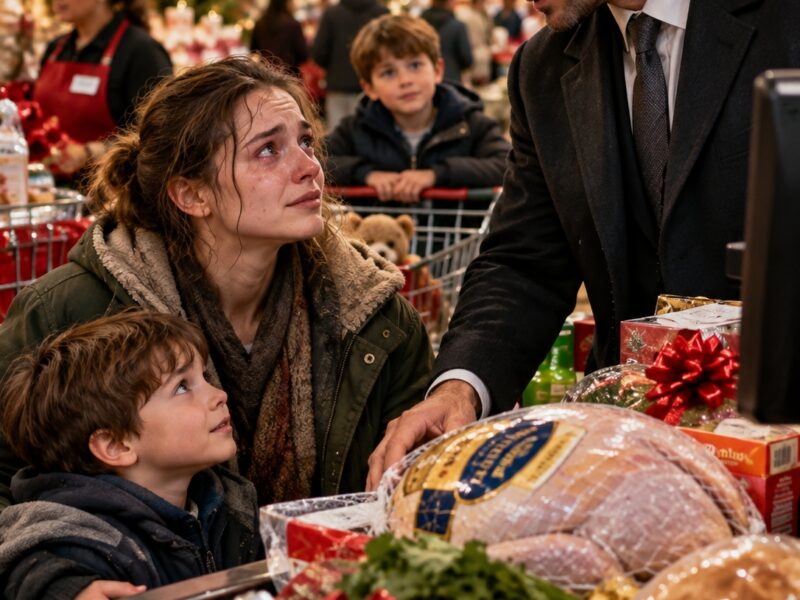
At checkout lane seven, Hannah counted her money for the third time.
She knew exactly how much she had.
She always knew.
But sometimes numbers seemed to change when you were desperate enough.
The cashier scanned the bread.
Milk.
Soup.
Rice.
Peanut butter.
Apples.
Then a small box of chocolate Christmas cookies.
Noah had slipped them into the basket earlier.
Hannah had noticed.
She hadn’t removed them.
For ten minutes, she’d been trying to convince herself that $4.29 didn’t matter.
It mattered.
The total appeared.
$26.83.
Hannah looked at the cash in her hand.
Then at the cookies.
Then at Noah.
He was watching the conveyor belt.
She hated this part.
Not poverty itself.
The performance of it.
The moment when someone else watched you calculate what your child could live without.
“I’m sorry,” Hannah said.
The cashier looked up.
“Could you take those off?”
She pointed toward the cookies.
Noah’s face changed immediately.
He tried to hide it.
That made it worse.
“Maybe next time, sweetie,” Hannah said.
“It’s okay.”
The cashier removed them.
$22.54.
Hannah reached for her money.
A man’s voice came from behind her.
“Excuse me.”
She turned.
Ethan stood there holding a turkey.
Behind him, a store employee pushed another cart piled with groceries.
For a second, Hannah assumed he wanted to get past her.
She moved aside.
“Sorry.”
“No. You’re fine.”
Ethan placed the turkey on the belt.
Hannah looked at it.
Then at him.
“I think this is your order.”
“It is.”
“Oh.”
“But it’s going home with you.”
Silence.
The cashier stopped moving.
Hannah stared at him.
“I don’t understand.”
Ethan gestured toward the cart.
“This too.”
Potatoes.
Bread.
Vegetables.
Desserts.
Hot chocolate.
Cookies.
A Christmas meal large enough to feed a family twice Hannah’s size.
Her expression hardened almost immediately.
“No.”
Ethan blinked.
“No?”
“No, thank you.”
He hadn’t expected that.
“It’s already—”
“I said no.”
Noah looked between them.
The cashier quietly pretended to organize receipt paper.
Ethan lowered his voice.
“I don’t mean to embarrass you.”
“Then please don’t.”
That stopped him.
For the first time, Ethan noticed not just Hannah’s financial situation but her pride.
She wasn’t angry because she didn’t need help.
She was angry because she did.
And because needing it hurt.
“I apologize,” Ethan said.
Hannah seemed surprised.
He continued more carefully.
“My son saw your boy looking at the turkey.”
Hannah glanced behind him.
Oliver stood beside the original cart twenty feet away.
When Noah looked at him, Oliver waved.
Noah gave a small, uncertain wave back.
Ethan said, “My son asked me to help.”
Hannah’s jaw tightened.
“We’re fine.”
Ethan looked at the six items on the counter.
He didn’t contradict her.
That would have been cruel.
Instead, he said, “Then maybe you could help me.”
She frowned.
“What?”
“My son lost his mother.”
The words came out harder than Ethan expected.
Even after four years.
“He remembers her mostly through stories now.”
Hannah’s expression softened slightly.
“I’m sorry.”
“Thank you.”
Ethan glanced at Oliver.
“Grace believed Christmas mattered because it reminded people to notice each other.”
He looked back at Hannah.
“I’ve gotten pretty bad at that.”
She said nothing.
“My son noticed you.”
Hannah’s eyes flickered toward Oliver again.
“He reminded me of something his mother would’ve done.”
Ethan took a breath.
“So I’m not asking you to accept charity from some stranger.”
He paused.
“I’m asking you to let a seven-year-old boy feel like he remembered his mother correctly.”
Hannah’s face changed.
For several seconds, nobody spoke.
Then Noah whispered, “Mom?”
Hannah looked down.
He wasn’t looking at the turkey.
He was looking at Oliver.
“Can we?”
Her eyes filled.
She turned away quickly.
Ethan pretended not to notice.
Finally, she nodded once.
“Okay.”
Noah’s entire face transformed.
“Really?”
Hannah laughed through tears.
“Really.”
The cashier smiled.
“Then we’re putting the cookies back too.”
Hannah covered her mouth.
The cashier scanned them before she could protest.
The turkey followed.
Then everything else.
Ethan paid.
No ceremony.
No photograph.
No business card.
No speech.
When the toys appeared, Hannah shook her head again.
“Sir.”
“One each,” Ethan said.
“That’s too much.”
“Probably.”
“I don’t even know your name.”
“Ethan.”
“Hannah.”
She hesitated.
“This is Noah.”
Noah looked up.
“Thank you, Mr. Ethan.”
Ethan smiled.
“Just Ethan is fine.”
Noah looked at the turkey.
“It’s really ours?”
“It really is.”
“Mom can cook it?”
“If she’s willing.”
Hannah laughed.
“I can cook.”
Noah leaned closer to Ethan as though sharing classified information.
“She burns pancakes.”
“Noah.”
Ethan laughed.
A genuine laugh.
It surprised him.
It surprised Hannah too.
For a moment, they weren’t a millionaire and a struggling mother.
They were just two adults standing beneath fluorescent grocery-store lights while a six-year-old publicly destroyed his mother’s culinary reputation.
Then Hannah looked at the bags.
Her smile faded into something more vulnerable.
“You really don’t know what this means.”
Ethan thought of Grace.
“No,” he said quietly. “Maybe I don’t.”
Hannah reached for the bags.
Ethan helped load them into her cart.
Then she stopped.
“I don’t know how I’ll repay you.”
“Don’t.”
“I mean it.”
“So do I.”
She looked uncomfortable with that answer.
Ethan understood why.
Debt could make kindness feel like another burden.
So he repeated the words Grace had once given him.
“One small kindness can change a heart forever.”
Hannah stared at him.
Ethan almost regretted saying it.
Then she whispered, “Your wife?”
He nodded.
“She sounds like she was a good woman.”
“The best.”
Hannah looked toward Oliver.
“I think your son remembers more of her than you realize.”
That sentence followed Ethan long after she walked away.
Oliver ran toward him.
“Dad!”
Ethan caught him automatically.
“Did you do it?”
“We did.”
Oliver pulled back.
“They got the turkey?”
“Yes.”
“And cookies?”
“Yes.”
“Toys?”
Ethan narrowed his eyes.
“How did you know about the toys?”
“I saw them.”
“You’re very observant.”
Oliver grinned.
“Mom said I was nosy.”
Ethan laughed.
“She absolutely did.”
Oliver wrapped his arms around his father’s neck.
“Just like Mommy used to.”
Ethan closed his eyes.
The hug lasted longer than usual.
When he finally opened them, Hannah and Noah were disappearing through the automatic doors.
Snow swirled outside.
Noah was carrying the red fire truck.
Hannah pushed the cart.
Before leaving, she turned once.
Their eyes met across the store.
She smiled.
Not the forced smile she’d given Noah beside the freezer.
A real one.
Then she disappeared into the snow.
Ethan stood motionless.
Something had happened.
He couldn’t explain it yet.
He only knew that for the first time in years, remembering Grace didn’t feel exclusively like losing her.
For a few seconds, it felt like finding her.
That night, Ethan drove home slowly.
Snow gathered along the edges of the windshield.
Oliver sat in the back seat, humming Christmas songs.
Normally Ethan would have used the drive to return calls.
His phone sat untouched in the center console.
“Dad?”
“Yeah?”
“Do you think Mommy saw us?”
Ethan’s hands tightened slightly around the steering wheel.
He could have given the safe answer.
The vague answer adults gave children when they didn’t know how to talk about death.
Instead, he said, “I don’t know.”
Oliver looked out the window.
“Me neither.”
A few seconds passed.
Then Oliver said, “But I think she’d be happy.”
Ethan swallowed.
“Yeah.”
His voice became rough.
“I think so too.”
Their house appeared beyond tall iron gates.
Christmas lights had been professionally installed along the roofline.
Two enormous wreaths hung on the front doors.
Every window glowed warm against the snow.
It was beautiful.
It was also absurdly large for two people.
Oliver jumped out before the SUV had fully settled in the garage.
“I’m wrapping Tyler’s present!”
“Homework first.”
“It’s Christmas!”
“Christmas doesn’t eliminate math.”
“It should!”
Ethan smiled as Oliver disappeared inside.
Mrs. Alvarez greeted them near the kitchen.
“Dinner is ready.”
“Thank you.”
“Mr. Blake, Mr. Reynolds called three times.”
Ethan glanced toward his phone.
“I’ll call him tomorrow.”
Mrs. Alvarez paused.
In four years, she had almost never heard that sentence.
“Tomorrow?”
“Tomorrow.”
“All right.”
She walked away.
Ethan remained alone in the kitchen.
The room had marble counters, custom cabinetry, two ovens, three sinks, and a refrigerator large enough to supply a restaurant.
He opened it.
Food filled nearly every shelf.
Steaks.
Vegetables.
Juice.
Cheese.
Prepared meals.
Fruit.
Milk.
More food than he and Oliver could finish before half of it spoiled.
Ethan stared at it.
Then he thought of Hannah counting coins.
He closed the refrigerator.
He walked into the living room.
A twelve-foot Christmas tree stood beside the windows.
Grace had chosen that room because she said snow looked magical from there.
For years after her death, Ethan had avoided standing near those windows.
That night, he did.
Beyond the glass, the city glittered.
Thousands of lights.
Thousands of houses.
Thousands of families.
Some celebrating.
Some grieving.
Some pretending.
Some deciding whether they could afford heat and groceries in the same week.
He thought of Hannah’s coat.
The missing button.
Noah’s worn shoes.
The way she had immediately refused his help because humiliation sometimes hurt worse than hunger.
And then a darker thought came.
How many people worked for him who were living exactly like that?
Nine hundred employees.
He knew quarterly labor costs.
He knew overtime percentages.
He knew insurance premiums.
He knew productivity by division.
But did he know whether the man operating a crane on one of his projects could afford Christmas dinner?
Did he know whether the receptionist downstairs had children?
Did he know whether the janitor who emptied his office trash every night was behind on rent?
He knew numbers.
Grace had known people.
That difference suddenly felt enormous.
Ethan poured himself a drink.
He didn’t touch it.
On the mantel stood a framed photograph.
Grace.
Oliver.
Him.
Christmas morning, five years ago.
Grace wore red pajamas and held a mug that said BOSS LADY.
Oliver sat on Ethan’s shoulders.
Ethan looked younger.
Not physically.
Somehow lighter.
He picked up the photograph.
“What happened to me?” he whispered.
Of course, Grace didn’t answer.
But memory did.
A hospital room.
Three weeks before she died.
Grace thin beneath white blankets.
Ethan sitting beside her with his laptop open.
She had reached over and closed it.
“Hey.”
“I need to finish this.”
“No, you don’t.”
“Grace—”
“Ethan.”
He remembered looking at her.
She was so weak by then.
Still stubborn.
“What?”
“Promise me something.”
He hated promises during those final weeks.
They sounded too much like surrender.
“You’re going to tell me yourself when you’re home.”
Her eyes filled.
“Promise me Oliver doesn’t grow up thinking love is something you pay for.”
Ethan had stared at her.
“What does that mean?”
“It means give him your time.”
“I do.”
“No. You give him things.”
“That isn’t fair.”
“I know.”
Her voice had been gentle.
“That doesn’t make it untrue.”
He had looked away.
Grace reached for his hand.
“He doesn’t need the biggest house.”
“I know.”
“He doesn’t need every toy.”
“I know.”
“He needs you.”
“I know.”
“And he needs to know other people matter.”
Ethan remembered becoming angry.
Not because she was wrong.
Because she was dying, and she was talking as though she knew it.
“Stop.”
“Ethan—”
“Stop talking like I’m going to do this alone.”
Grace had cried then.
So had he.
They never finished the conversation.
Three weeks later, she was gone.
Ethan had remembered the promise about Oliver.
Or at least he thought he had.
He provided everything.
Private school.
Tutors.
Vacations.
A college fund.
A trust.
Security.
But standing beside the Christmas tree that night, Ethan finally understood.
Grace hadn’t been asking him to make sure Oliver had everything.
She had been asking him to make sure Oliver became someone.
Someone kind.
Someone aware.
Someone who could see another child’s disappointment from twenty feet away.
And somehow, despite Ethan’s failures, Oliver had.
The realization nearly broke him.
Upstairs, small footsteps approached.
Oliver appeared wearing pajamas.
“You’re supposed to be wrapping Tyler’s gift.”
“I did.”
“That was fast.”
“Mrs. Alvarez helped.”
“Ah.”
Oliver noticed the photograph in Ethan’s hand.
“Mom.”
“Yeah.”
He came closer.
“Were you sad?”
Ethan looked at him.
Children asked questions adults spent entire lives avoiding.
“Yes.”
“Because of the store?”
“Because of a lot of things.”
Oliver leaned against him.
“Dad?”
“Hmm?”
“Can we help another family tomorrow?”
Ethan looked down.
“Tomorrow?”
“Yeah.”
“How many families are you planning to help?”
Oliver shrugged.
“Maybe five.”
“Five?”
“Or ten.”
Ethan laughed softly.
“Your budget is getting ambitious.”
“What does ambitious mean?”
“It means you’re thinking big.”
Oliver smiled.
“You think big.”
Ethan looked back toward the snowy city.
For years, thinking big had meant towers.
Contracts.
Revenue.
Acquisitions.
Market share.
That night, for the first time, it meant something else.
“Yeah,” he said.
“Maybe we should.”
Oliver ran upstairs.
Ethan stayed by the window.
He didn’t sleep much.
But unlike the hundreds of nights he’d spent awake thinking about business, this time he was thinking about people.
At 6:42 the next morning, Ethan called his assistant.
Rachel answered on the fourth ring.
“Mr. Blake?”
Her voice sounded alarmed.
Ethan checked the time.
“Did I wake you?”
There was a pause.
“Yes.”
“Sorry.”
Another pause.
“You’ve never apologized for calling before seven.”
Ethan almost smiled.
“Cancel my meetings.”
Silence.
“For today?”
“For the week.”
Rachel was fully awake now.
“The entire week?”
“Yes.”
“Mr. Blake, you have the Sterling development meeting today, the city planning committee tomorrow, the Reynolds acquisition review Wednesday—”
“Move them.”
“The Reynolds team flew in from Boston.”
“They can fly home.”
“Are you sick?”
“No.”
“Is Oliver sick?”
“No.”
“Then what’s happening?”
Ethan looked at Grace’s photograph.
“We’re doing something different this Christmas.”
Rachel didn’t respond.
“Rachel?”
“I’m trying to determine whether you’re joking.”
“I’m not.”
“What are we doing?”
Ethan looked through the window.
Morning snow covered the lawn.
He thought of Hannah.
Of Noah.
Of the turkey.
Of a little boy quietly saying maybe next Christmas.
Then he thought about something larger.
“Start with every hourly employee at Blake Development.”
“What about them?”
“I want to know who has requested payroll advances in the last six months.”
Rachel hesitated.
“That information is confidential.”
“Then don’t give me names unless HR says it’s appropriate. Just find out how many.”
“All right.”
“And call our site managers.”
“What am I asking?”
“Who needs help.”
“Help with what?”
“Food. Heating bills. Kids’ winter coats. Whatever.”
Rachel was silent again.
“Ethan…”
He rarely heard employees use his first name.
“Yeah?”
“What’s going on?”
He looked at Oliver’s drawing taped beside the refrigerator.
Three stick figures.
Mom.
Dad.
Oliver.
Grace still appeared in every family drawing.
“My son reminded me of something.”
“What?”
Ethan exhaled.
“That I built a company full of people and somehow started seeing payroll instead.”
Rachel didn’t answer immediately.
Then she said, “I’ll make the calls.”
“Thank you.”
He nearly hung up.
Then another idea came.
“And Rachel?”
“Yes?”
“Find out which food banks are running low.”
“How many?”
“All of them.”
“Ethan—”
“And shelters.”
“Okay.”
“Family shelters especially.”
“Okay.”
“And toy drives.”
She laughed quietly.
“What?”
“Nothing.”
“What?”
“I’ve worked for you eleven years.”
“I know.”
“You once scheduled a conference call during your own birthday dinner.”
“That sounds efficient.”
“You hate Christmas fundraisers.”
“I hate speeches at Christmas fundraisers.”
“You refused to wear a Santa hat at the company party.”
“It had glitter.”
Rachel laughed again.
Then her voice softened.
“Grace would like this.”
Ethan closed his eyes.
“I hope so.”
By noon, the first numbers arrived.
They were worse than Ethan expected.
Thirty-seven Blake Development employees had requested payroll advances since July.
Eleven had asked HR about emergency assistance.
Four had eviction notices.
One carpenter’s wife was undergoing chemotherapy.
A concrete worker was raising three grandchildren after his daughter died.
A receptionist had been living in a motel with two children for nineteen days after escaping an abusive marriage.
One warehouse employee had quietly been taking leftover food from company meetings home because his hours had been reduced while recovering from surgery.
Ethan sat in his office reading the report.
He felt sick.
Not because his company had caused every problem.
It hadn’t.
But because he hadn’t known.
He had walked through the same buildings.
Ridden the same elevators.
Passed these people in hallways.
And hadn’t known.
At 1:17 p.m., Rachel stepped into his office.
“You asked for food banks.”
She handed him another folder.
“Three are critically low.”
“How low?”
“One has enough inventory for approximately four days.”
“Christmas is in five.”
“I know.”
“What do they need?”
“Everything.”
Ethan stood.
“Buy it.”
Rachel stared at him.
“What?”
“Buy what they need.”
“All of it?”
“Yes.”
“That could be—”
“I don’t care.”
“Ethan, I need a number for accounting.”
He thought for a moment.
Then shook his head.
“No.”
“You can’t authorize spending without a ceiling.”
“I own the company.”
“And you hired me partly because people who own companies occasionally need someone to tell them when they’re being ridiculous.”
Despite himself, Ethan smiled.
“Fine. Half a million.”
Rachel blinked.
“For food?”
“For food, coats, heating assistance, emergency hotel rooms, and toys.”
“Half a million dollars?”
“If we need more, tell me.”
She stared at him.
“Don’t announce my name.”
“What?”
“No press release. No social media. No giant check.”
“Marketing is going to hate you.”
“They already do.”
Rachel smiled.
Then turned to leave.
“Rachel.”
She looked back.
“Make sure people can ask for help without having to tell their entire life story.”
Her expression changed.
“Understood.”
“Pride matters.”
“Yes.”
He thought of Hannah again.
“It matters more than people think.”
Over the next four days, something unexpected happened inside Blake Development.
It wasn’t the money.
Money helped.
Of course it did.
But the change moved in both directions.
Employees volunteered.
Site supervisors donated overtime pay.
Vendors contributed food.
A trucking company offered three trailers.
A toy manufacturer donated pallets of unopened toys.
Restaurants provided meals.
A hotel owner offered twenty rooms through New Year’s Day.
Word spread, despite Ethan’s refusal to attach his name publicly.
People began calling the effort Grace’s Table after Rachel found an old photograph of Grace serving food at a shelter years earlier.
When Ethan discovered the name, he nearly ordered them to change it.
He couldn’t.
Oliver loved it.
“Mom has a table?”
“Apparently.”
“That’s cool.”
“Yeah.”
“Can we make it really big?”
Ethan smiled.
“It’s getting pretty big.”
Christmas Eve arrived under heavy snow.
Ethan and Oliver spent the afternoon inside a community center helping distribute food.
Oliver wore a red sweater.
Ethan wore jeans for perhaps the fourth time that year.
At one point, Oliver handed a box to an elderly man.
“Merry Christmas.”
The man smiled.
“Merry Christmas, young man.”
Ethan watched.
Grace’s words returned.
One small kindness can change a heart forever.
He finally understood that she hadn’t meant only the heart of the person receiving it.
Sometimes kindness changed the person giving it.
Maybe that was the real secret.
Late that afternoon, the line began thinning.
Ethan carried empty boxes toward the back room.
Then he heard a familiar child’s voice.
“Mr. Ethan!”
He turned.
Noah was running toward him.
Ethan froze.
Hannah stood near the entrance.
Her coat still had the missing button.
But Noah wore new winter shoes.
He threw his arms around Ethan’s waist.
“You’re here!”
Ethan laughed.
“So are you.”
“We brought stuff.”
Hannah approached carrying two grocery bags.
Ethan looked at them.
“What stuff?”
She appeared slightly embarrassed.
“Canned food.”
He stared.
“You’re donating food?”
“Some.”
“Hannah, you don’t have to—”
She raised an eyebrow.
“Careful.”
Ethan stopped.
She smiled.
“You told me not to turn kindness into debt.”
“I did.”
“So don’t.”
He looked at the bags again.
“There are families who need it more than we do today.”
Today.
The word struck him.
Not forever.
Not defining her.
Just today.
Hannah continued.
“I got extra shifts at the restaurant. My landlord gave me until January for the rest of the rent. And…”
She glanced at Noah.
“He insisted.”
Noah nodded proudly.
“We got beans.”
“Lots of beans,” Hannah said.
“And corn.”
“Yes.”
“And soup.”
“We’ve established the inventory, Noah.”
Ethan laughed.
Then Hannah reached into her purse.
“I also brought this.”
She handed him an envelope.
Inside was a folded piece of construction paper.
A child’s drawing.
Two boys.
Two mothers.
One man.
A giant turkey in the center.
Above them, in crooked handwriting, Noah had written:
THANK YOU FOR CHRISTMAS.
Ethan stared at it.
His throat tightened.
“There is one more thing,” Hannah said.
He looked up.
She handed him a small red Christmas ornament.
Nothing expensive.
Probably five dollars.
Maybe less.
On the front were four words.
KINDNESS COMES BACK AROUND.
“I saw it yesterday,” she said. “Thought it belonged to you.”
Ethan couldn’t speak.
Hannah seemed to understand.
She touched his arm lightly.
“Merry Christmas, Ethan.”
“Merry Christmas.”
She and Noah walked toward the donation tables.
Oliver appeared beside his father.
“What’d she give you?”
Ethan showed him the ornament.
Oliver read the words.
Then he smiled.
“Mom would like that.”
Ethan stared across the crowded room.
Volunteers moved between tables.
Children laughed.
People carried groceries.
Someone poured coffee.
An elderly woman hugged one of his employees.
Hannah helped Noah place cans into a donation box.
No cameras.
No reporters.
No applause.
Just people.
For years, Ethan had believed Grace’s absence was a hole in his life that nothing could fill.
He had tried work.
Money.
Success.
A bigger house.
More responsibility.
None of it worked.
Because perhaps grief wasn’t a hole meant to be filled.
Perhaps it was a door.
And every once in a while, if you were brave enough to walk through it, you found the part of someone that death hadn’t managed to take.
Their influence.
Their values.
The things they taught you.
The way they taught you to see other people.
That night, after the community center closed, Ethan and Oliver drove home through falling snow.
They didn’t speak much.
They didn’t need to.
At home, Oliver ran toward the Christmas tree.
“Dad!”
“What?”
“We need to put it up.”
Ethan knew exactly what he meant.
Oliver took the small red ornament from his hand.
He dragged a chair toward the tree.
“Absolutely not.”
“I can reach.”
“You can fall.”
“You always say take risks.”
“Calculated business risks. Not seven-year-olds climbing furniture.”
Ethan lifted him instead.
Oliver stretched toward a branch near the center.
“Higher.”
“This is high enough.”
“Higher.”
“Oliver.”
“Dad.”
Ethan raised him another few inches.
Oliver hooked the ornament onto a branch.
The red surface caught the warm Christmas lights.
KINDNESS COMES BACK AROUND.
“There,” Oliver said.
Ethan lowered him.
They stood together looking at it.
“Dad?”
“Yeah?”
“Are you still sad about Mommy?”
Ethan took a long time to answer.
“Yes.”
Oliver looked worried.
Ethan placed a hand on his shoulder.
“But sad isn’t always bad.”
“How?”
Ethan searched for words a seven-year-old could understand.
“Sometimes being sad means somebody mattered a lot.”
Oliver thought about that.
“So you’re sad because you love her?”
“Yeah.”
“Do you still love her?”
Ethan looked toward Grace’s photograph.
“Every day.”
Oliver smiled.
“Me too.”
Then he walked upstairs.
Halfway there, he stopped.
“Dad?”
“What?”
“Next Christmas, can we help more people?”
Ethan smiled.
“Yeah.”
“How many?”
Ethan thought about the question that had started everything.
We can’t help everyone.
He remembered how certain he’d sounded.
How reasonable.
How adult.
How completely he’d missed the point.
“We’ll start with whoever is in front of us.”
Oliver nodded as though that made perfect sense.
Then he disappeared upstairs.
Ethan remained beside the tree.
His phone vibrated.
An email.
He ignored it.
It vibrated again.
He turned it face down.
Outside, snow covered the city.
Inside, Ethan walked toward the framed photograph on the mantel.
He picked it up.
Grace smiled back at him from another Christmas.
He touched the edge of the frame.
“You were right,” he whispered.
The room remained quiet.
But this time, the silence didn’t feel empty.
Ethan placed the photograph beneath the tree.
Then he switched off the lamps.
Hundreds of tiny Christmas lights remained.
Among expensive glass ornaments and carefully arranged decorations hung one cheap red ornament purchased by a woman who, less than a week earlier, had been counting coins at a grocery-store register.
It was the least valuable thing on the tree.
And somehow, it had become the one thing Ethan knew he would save first if the house ever burned.
Because five days before Christmas, Ethan Blake had walked into a grocery store believing that generosity belonged to people who had enough left over to give.
His son taught him something different.
Kindness wasn’t about fixing the whole world.
It wasn’t about saving everyone.
It wasn’t even about money.
Sometimes it was simply noticing the person standing twenty feet away.
Sometimes it was putting down your phone.
Sometimes it was refusing to walk past someone else’s quiet pain.
And sometimes the person you thought you were rescuing wasn’t the one being rescued at all.
Ethan had bought Hannah Carter a turkey.
Thirty-four dollars and seventy-six cents.
That was what the receipt said.
But receipts only record what something costs.
They don’t record what it changes.
They couldn’t record Noah waking up Christmas morning believing hard years could end.
They couldn’t record Hannah standing in her kitchen with tears on her cheeks while the smell of roasting turkey filled an apartment that had felt hopeless only days earlier.
They couldn’t record Oliver learning that compassion wasn’t merely something his mother had believed.
It could become something he carried forward.
And they certainly couldn’t record Ethan Blake standing alone beside a Christmas tree, realizing that his dead wife had somehow reached him again through the voice of their seven-year-old son.
One small kindness can change a heart forever.
Grace had been right.
She had simply never told him whose heart it would be.
Outside, the snow kept falling.
Upstairs, Oliver slept.
Across town, Hannah tucked Noah into bed after a Christmas they had almost believed they wouldn’t have.
And beneath the soft glow of a twelve-foot tree, a millionaire who had spent years building towers finally understood that the most important thing he would ever build could never be measured in steel, concrete, square footage, or dollars.
It would be measured in people.
In who felt seen.
In who went home warmer.
In who stopped believing they were alone.
Ethan looked at the little red ornament one last time.
Then he smiled.
Not because the grief was gone.
It wasn’t.
Maybe it never would be.
But for the first Christmas since Grace died, Ethan no longer felt as though he was standing on one side of an impossible distance while she existed somewhere beyond his reach.
A piece of her was upstairs in Oliver.
A piece of her was at Grace’s Table.
A piece of her was inside every box of food carried through those doors.
And a piece of her now lived again inside him.
All because one little boy had looked across a crowded grocery store and noticed another little boy who wasn’t crying.
And asked his father to notice him too.









