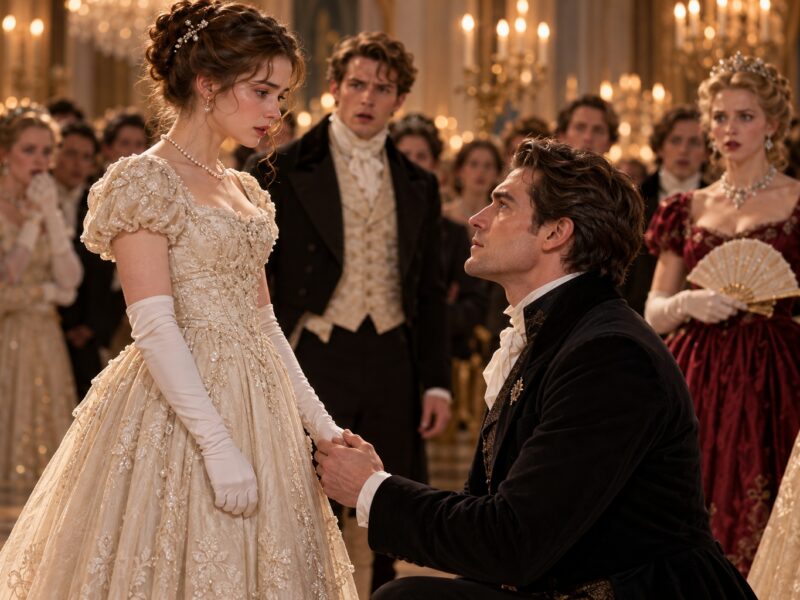
A Penniless Lady Was Publicly Rejected at a Grand Ball—Until a Coldhearted Duke Stood Before Everyone and Said, “Then Marry Me.”
Lord Percy Vance had invited half of London’s fashionable society to witness Clara Whitmore’s humiliation.
He believed that once everyone learned she was penniless, no respectable gentleman would ever ask for her hand again.
But before Clara could leave the ballroom, the most powerful man in the room stepped into her path.
And what the Duke of Ashford said next left even her cruelest enemies speechless.
The invitation to the Ashworth ball lay on Clara Whitmore’s dressing table beside a cracked porcelain basin and a silver hairbrush that had belonged to her mother.
It was the last invitation of consequence she expected to receive.
At twenty-four, Clara had learned that poverty did not merely empty a person’s purse. It gradually erased her from rooms where she had once been welcome, until old acquaintances began looking past her as though she were an unfamiliar servant.
She stood before the small mirror in her rented rooms on Cheapside, fastening her mother’s pearls into her dark hair.
They were the only valuable things she had not sold.
Her father had left behind unpaid creditors, a failed business, and a reputation that had faded more quickly than Clara could have imagined. For months, she had survived by selling pieces of the comfortable life she once possessed.
First went the silver.
Then the books.
Then the furniture.
Eventually, even the modest family house in Hertfordshire had been surrendered, leaving Clara with two trunks, several respectable gowns, and an increasingly uncertain future.
Tonight, however, she would be Miss Whitmore of Hertfordshire again.
For three hours, she could pretend that nothing had changed.
She adjusted the neckline of her pale blue gown, carefully concealing the place where the lace had been repaired.
Then she picked up her gloves and descended the narrow staircase.
Lord Percival Vance had seemed an answer to a prayer.
For six weeks, he had courted her with flowers, thoughtful conversation, and the sort of attention that encouraged hope even in a woman determined not to be foolish.
He had listened when she spoke of her father’s death.
He had assured her that he valued character above money.
Once, during a walk through Hyde Park, he had told her that wealth was a poor substitute for an affectionate marriage.
Clara had believed him.
She had wanted to believe him.
When she entered the Ashworth ballroom, the chandeliers were already ablaze, and the air smelled of beeswax, expensive perfume, and flowers arranged in enormous silver vases.
Women in silk and satin moved beneath the gilded ceiling while gentlemen gathered near the card room, discussing horses, politics, and fortunes.
Clara recognized several familiar faces.
A woman who had once embraced her at every gathering offered only a distant nod.
Another turned away before Clara could approach.
She had grown accustomed to such small humiliations.
What she had not expected was to find Percy standing beside Lady Helena Marsh, the daughter of one of the wealthiest landowners in Yorkshire.
Helena wore emerald silk and diamonds that glittered at her throat.
Percy’s hand rested comfortably against her arm.
When he saw Clara, his expression changed.
Not with pleasure.
With calculation.
“Miss Whitmore.”
His voice carried farther than necessary.
Clara stopped beside the supper table.
“My lord.”
“I believe there has been a misunderstanding between us.”
Several nearby conversations quieted.
Clara glanced at Helena, whose smile had acquired a peculiar satisfaction.
“I am not aware of one.”
Percy drew himself up.
“It concerns the matter of your settlement.”
Clara felt something cold settle beneath her ribs.
“My settlement?”
“My solicitor has recently examined the affairs of your late father. I regret to say that his financial circumstances were considerably less favorable than I had been led to believe.”
A gentleman behind Helena lowered his glass.
Someone else leaned closer.
Clara suddenly understood why Percy had approached her in the busiest part of the ballroom.
He wanted witnesses.
“My father suffered financial difficulties before his death,” she said. “You knew that.”
“I knew he had encountered difficulties. I did not realize he had left his daughter practically destitute.”
The word was delivered with theatrical regret.
Destitute.
Clara could almost hear it traveling from one drawing room to another.
“I have never claimed to possess a fortune, Lord Vance.”
“No, but you failed to explain the extent of your poverty.”
Lady Helena lowered her eyes, concealing a smile behind her fan.
Percy looked around at the gathering.
“I am a gentleman, Miss Whitmore. I must consider the obligations of marriage. I cannot be expected to attach myself to a woman whose father died in debt, leaving her scarcely more than the gown upon her back.”
A few people murmured in agreement.
Others looked embarrassed.
No one intervened.
Clara could hear her own breathing.
Only a week earlier, Percy had held her hand in a conservatory and told her that her courage was what he admired most.
Now that same man was using her circumstances to entertain an audience.
She carefully placed her untouched glass on the supper table.
“I see.”
Percy appeared encouraged by her composure.
“I trust you understand that I require a wife who brings something to a marriage.”
Clara looked directly at him.
“And you, my lord, require a wife who brings something you lack.”
His smile stiffened.
“And what might that be?”
“A spine.”
The silence was immediate.
Lady Helena’s fan stopped moving.
Somewhere beyond the gathered spectators, a violinist missed a note.
Percy’s face reddened.
“How dare you?”
“I have not finished.”
Clara rose to her full height, though her knees threatened to betray her.
“You courted me for six weeks. You knew my circumstances from the beginning. If you wished to withdraw your attention, you might have written a letter.”
Percy opened his mouth.
She continued before he could speak.
“Instead, you chose a crowded ballroom, in front of the very people whose approval you so desperately seek, to make a spectacle of my misfortune.”
A woman near the doorway whispered something to her companion.
Clara heard a suppressed laugh.
Her cheeks burned, but she refused to look away.
“So allow me to make myself equally clear. I would rather earn my living as a governess than spend a single hour as the wife of a gentleman who mistakes cruelty for consequence.”
Percy’s expression turned ugly.
“You will regret speaking to me in that manner.”
“Perhaps,” Clara said. “But I should regret marrying you considerably more.”
She turned toward the doors.
The crowd parted.
Not out of respect.
They made way with the excited anticipation of people who had witnessed a scandal and could scarcely wait to repeat it.
Clara walked steadily, although her hands trembled beneath her gloves.
She had nearly reached the edge of the ballroom when a man’s voice stopped her.
“Miss Whitmore.”
It was low and unhurried.
Yet somehow it carried over every other sound.
Clara turned.
The Duke of Ashford stood near the entrance to the card room.
Alaric Ashford was a tall man with dark hair, severe features, and gray eyes that rarely revealed what occupied his thoughts.
He possessed one of the oldest dukedoms in England and an estate large enough to make lesser noblemen envious.
He was also widely considered cold, unsociable, and almost impossible to please.
Clara had noticed him earlier, standing apart from the festivities.
He had seemed entirely uninterested in the people surrounding him.
Now his attention was fixed upon her.
He crossed the ballroom.
The crowd parted again, but this time no one dared whisper.
“Your Grace,” Percy said, attempting a smile. “I fear you have witnessed an unfortunate private disagreement.”
The Duke stopped beside Clara.
“A private disagreement?”
“Between Miss Whitmore and myself.”
“Then it was remarkably inconsiderate of you to involve the entire ballroom.”
Percy’s smile disappeared.
The Duke continued.
“You publicly humiliated a lady because she possesses less money than you expected. You did so beneath a roof where you were received as a gentleman.”
“I assure you—”
“I heard your assurances.”
The words were quiet.
They silenced Percy more effectively than any shout.
The Duke turned toward Clara.
For a moment, she found herself looking into eyes of an unexpectedly steady gray.
“Miss Whitmore, I have watched you endure an extraordinary insult with considerably more dignity than the gentleman responsible.”
“Your Grace, I hardly think—”
“I have a proposal.”
Clara stared at him.
The room seemed to hold its breath.
“I must confess,” he continued, “it is not one you were expecting this evening.”
He paused.
Then he said, with perfect composure, “Marry me.”
A collective gasp swept through the room.
Percy went pale.
Lady Helena dropped her fan.
Clara remained motionless.
She wondered whether she had misunderstood him.
“Your Grace?”
“I am asking you to become my wife.”
He spoke as though proposing marriage before half of London were no more remarkable than requesting another glass of wine.
Clara’s heart pounded painfully.
“You do not know me.”
“Not as well as I should like.”
“Then why would you ask such a thing?”
His expression did not change, but his voice softened.
“Because I have spent enough evenings in rooms such as this to recognize that the people most worth knowing are frequently those society has been quickest to condemn.”
Clara could not answer.
He lowered his voice so that only she could hear.
“I am not promising a romantic attachment, Miss Whitmore. I am offering an honorable partnership. A home. Security. A position from which no man such as Vance can humiliate you again.”
He glanced briefly toward Percy.
“In return, I ask your honesty and your presence.”
Clara looked at the hand he offered.
It was an extraordinary proposition.
A dangerous one, perhaps.
She knew nothing of the private life of this powerful stranger.
A duke could provide everything she lacked, but he might also demand obedience in return.
She thought of her rented rooms, of the final pearls in her hair, and of the unanswered letters she had written seeking employment.
Then she looked toward Percy.
He was staring at her with something very close to fear.
“Your Grace,” she said carefully, “I will not accept marriage as an act of charity.”
For the first time, the Duke’s mouth moved toward a smile.
“Then we understand each other.”
He extended his hand again.
And Clara Whitmore, who had entered the ballroom believing her future had already been decided, placed her trembling fingers in his.
Two days after their wedding, Clara saw Ashford Hall for the first time.
The great stone house emerged from the morning mist, its pale facade stretching across the Yorkshire countryside in perfect, intimidating symmetry.
Rows of tall windows reflected the gray sky.
Gravel curved around a broad fountain, and dark yew hedges lined the approach.
Clara sat opposite her husband in the carriage.
They had spoken very little since the ceremony.
There had been signatures, congratulations, a small wedding breakfast, and then the long journey north.
Now she wore a wedding ring, bore one of the most distinguished names in England, and knew almost nothing about the man who had given her both.
“You will find the house comfortable,” Alaric said, looking out the window.
“I am certain I shall.”
“The east wing has been prepared for you.”
Clara turned.
“The east wing?”
“Your rooms. You may furnish them as you please. Your household accounts will be separate from mine, and you may select your own attendants.”
“And where are your rooms?”
“The west wing.”
She studied him.
“That is rather a considerable distance.”
“I have always valued privacy.”
“So I am beginning to understand.”
He looked at her.
“I am not a demonstrative man, Lady Ashford. I would rather be plain about it than disappoint you with false expectations.”
Clara folded her hands.
“That is considerate.”
“I ask only that you attend dinner when guests are present and that private household matters remain private.”
Something in his tone irritated her.
“You need not worry, Your Grace. I have no intention of gossiping with the servants about my husband’s coldness.”
His eyebrows lifted.
For an instant, she thought he might laugh.
Instead, he turned toward the window.
“I see we shall have a spirited household.”
“Only if someone provides sufficient conversation.”
The carriage came to a stop before the entrance.
Mrs. Colby, the housekeeper, stood waiting beside a line of servants.
She was a severe woman with iron-gray hair and a face trained into permanent disapproval.
“Welcome to Ashford Hall, Your Grace.”
Her curtsy to Clara was perfectly correct.
Her eyes were not welcoming.
Clara knew that look.
She had seen it from shopkeepers who remembered when her father could pay his bills promptly and from acquaintances who suddenly found themselves too occupied to visit.
Mrs. Colby knew that the new Duchess had been poor.
And she disapproved.
Clara entered the house with her shoulders straight.
The entrance hall was enormous.
Marble columns rose toward a painted ceiling. Portraits of solemn Ashford ancestors watched from the walls, and the polished floor reflected the afternoon light.
Every surface spoke of wealth accumulated over generations.
Her own footsteps seemed embarrassingly loud.
Mrs. Colby escorted her to a suite of rooms overlooking the eastern gardens.
The bed was draped in silk.
Fresh flowers stood beside the fireplace.
A dressing room contained more wardrobes than Clara had ever owned.
Everything was beautiful.
Nothing felt familiar.
That evening, Clara discovered that the dining room was designed to accommodate thirty guests.
Her husband occupied one end of the table.
She sat at the other.
Between them stretched a polished expanse of mahogany, gleaming silver, and an elaborate arrangement of flowers.
Alaric read a newspaper between courses.
Clara ate her soup.
The silence became unbearable.
“Your Grace.”
He lowered the paper.
“Yes?”
“If this is to be a partnership, I require something.”
“What would that be?”
“Conversation.”
He looked surprised.
Clara laid down her spoon.
“I am not a portrait to be hung upon a wall and admired from a distance.”
Alaric considered her for several seconds.
Then the corner of his mouth lifted.
“I have been told I am not particularly skilled in conversation.”
“I believe proficiency requires practice.”
“An excellent observation.”
He folded his newspaper.
“Very well, Lady Ashford. Tell me what occupies the thoughts of a woman who has turned her entire life upside down in the course of one evening.”
Clara hesitated.
It was the first genuine invitation he had offered her.
So she answered.
She spoke of the house, of how strange it felt to possess rooms larger than the home she had recently occupied.
She told him that she was uncomfortable being addressed as Your Grace by people who scarcely looked at her face.
She admitted that she missed her father’s books and her mother’s garden.
Alaric listened.
He did not interrupt.
When she mentioned the garden, he asked what her mother had grown.
“Roses,” Clara said. “Mostly white ones. She insisted they were more beautiful because they did not need to compete for attention.”
“An unusual philosophy.”
“She was an unusual woman.”
“Did you resemble her?”
Clara smiled faintly.
“In appearance, perhaps. In temperament, I was always told I inherited my father’s stubbornness.”
“I should never have guessed.”
She laughed before she could stop herself.
Alaric looked momentarily startled by the sound.
Then he smiled.
It was small and fleeting, but it changed his face entirely.
By the time dessert arrived, Clara had learned that his father had died two years earlier, leaving him the title and an exhausting collection of responsibilities.
She learned that he loved books about the natural world, disliked fashionable gossip, and possessed a dry humor that emerged only when he allowed himself to relax.
She also learned that he was much more comfortable asking questions than answering them.
But he had made an effort.
And when she returned to her rooms that evening, she felt less alone than she had expected.
Over the following days, a fragile routine developed.
Alaric rode each morning before breakfast.
He spent much of the day in his study, overseeing the estate and attending to correspondence.
Clara explored Ashford Hall, discovering quiet corridors, hidden staircases, and rooms that seemed untouched for decades.
The library became her favorite refuge.
Its shelves contained leather-bound histories, poetry, and the collection of natural history volumes Alaric had gathered as a boy.
Occasionally, she found notes written in a child’s uneven handwriting.
One book contained a carefully pressed fern.
Another held a small drawing of a bird.
These little traces of the boy he had once been interested her more than the portraits of his distinguished ancestors.
The servants remained cautious.
Mrs. Colby corrected the arrangement of Clara’s tea tray twice in one afternoon and seemed almost offended when Clara thanked the kitchen staff by name.
Clara did not surrender her position, but neither did she become cruel.
She learned their names.
She listened when work needed attention.
When a young maid dropped a tray of china, Clara helped gather the broken pieces rather than summoning the housekeeper to administer punishment.
Slowly, the atmosphere began to change.
And every evening, Alaric joined her for dinner.
The newspaper disappeared.
Their conversations grew longer.
Sometimes they disagreed.
Sometimes he made her laugh.
On one particularly cold evening, Clara discovered him in the library examining a book she had left open.
“You have been reading my annotations,” she accused.
“I feared you had been making corrections.”
“I have.”
“To a duke?”
“To a man who has misspelled chrysanthemum.”
He looked down at the page.
Then he laughed.
It was the first time Clara heard him do so without restraint.
For a moment, the enormous house felt almost like a home.
On the fourteenth day of their marriage, a letter arrived bearing the seal of Lord Percival Vance.
Clara recognized it immediately.
She was sitting in the morning room when a footman brought the morning correspondence.
The sight of the familiar crest made her stomach tighten.
She broke the seal.
Percy’s letter was brief.
He informed her that he had uncovered a matter of considerable importance concerning her late father’s business affairs.
He suggested that certain debts remained unpaid.
And he implied that Clara herself possessed knowledge that might prove embarrassing if the matter became public.
He concluded by offering to discuss the problem privately.
Clara read the letter twice.
Her father had died believing himself disgraced.
She had spent months enduring questions from creditors who seemed to know more about his business than she did.
Now Percy was threatening to reopen everything.
She became aware of someone standing in the doorway.
Alaric had returned from his morning ride.
Rain darkened the shoulders of his coat.
“You have heard from Vance.”
It was not a question.
Clara folded the letter.
“You are unusually observant.”
“I am also familiar with his handwriting.”
She looked sharply at him.
“How?”
Alaric crossed the room.
“May I?”
After a moment, she handed him the letter.
He read it without speaking.
His expression hardened.
“He is lying.”
“You cannot possibly know that.”
“I can.”
“Alaric—”
He looked up.
It was the first time she had spoken his Christian name without being prompted.
For an instant, the severity in his face softened.
Then he returned his attention to the letter.
“Your father was not the man society believes him to have been.”
Clara went still.
“What do you mean?”
“I have spent the past two years examining the business dealings of several men whose fortunes improved considerably after your father’s enterprise collapsed.”
“Why would you concern yourself with my father?”
Alaric hesitated.
“Because some of the transactions involved my family.”
The room seemed suddenly colder.
Clara stood.
“What transactions?”
“I do not yet know the full extent. But Vance profited from arrangements that left your father carrying debts he should never have borne.”
She stared at him.
“You knew this before we married?”
“I suspected that he had been wronged.”
“And you said nothing?”
“I had no proof I considered sufficient.”
Clara’s hands tightened around the back of a chair.
She remembered their wedding, the journey to Yorkshire, and the strange way he had watched her at the ball.
All those small silences took on a new meaning.
“Did you know who I was before that evening?”
“I knew your name.”
“And my father’s?”
“Yes.”
She felt as though the floor had shifted beneath her.
“Then your proposal was not entirely spontaneous.”
Alaric said nothing.
Clara looked at the letter in his hand.
“You married me because of my father’s ruin.”
“No.”
“Then why?”
“Because you stood in that ballroom and told the truth when everyone else found it more convenient to remain silent.”
His answer was immediate.
But it did not explain everything.
He moved toward the fireplace and held the threatening letter near the flames.
Clara stopped him.
“Don’t burn it.”
He turned.
“If he means to threaten me, I would rather keep the evidence.”
For a moment, Alaric looked at her with something resembling admiration.
Then he lowered the letter.
“You are right.”
He returned it to her.
“Whatever Vance believes he is owed, Clara, it is not money. It is a reckoning.”
He left the room soon afterward.
Clara remained by the fire, holding the letter between trembling fingers.
For the first time since her wedding, she wondered whether she had married a man who had rescued her—or a man seeking forgiveness for something she did not yet understand.
Lady Seraphina Vance arrived at Ashford Hall three days later.
She was Percy’s elder sister, a woman of impressive connections, expensive taste, and an extraordinary talent for making insults sound like polite conversation.
The dinner party she attended had been arranged weeks earlier, before the scandal at the Ashworth ball.
Clara suspected Lady Seraphina considered the invitation an opportunity to inspect the penniless woman who had somehow become a duchess.
She entered the drawing room wearing pale lilac silk.
Her smile was flawless.
Her eyes were cold.
“Lady Ashford. Your marriage was certainly the surprise of the season.”
“I imagine it was unexpected.”
“My poor brother was quite distressed to hear how quickly you had been claimed by another gentleman.”
Clara smiled.
“I am sure Lord Vance has other interests to console him.”
A guest nearby coughed into his hand.
Lady Seraphina’s expression sharpened.
“I see marriage has not diminished your spirit.”
“Nor has it improved my hearing, unfortunately. I still recognize an insult when one is offered.”
Alaric, standing beside the fireplace, lowered his glass.
Clara did not look toward him.
She had no intention of hiding behind her husband’s title.
Dinner proved even more unpleasant.
Lady Seraphina positioned herself beside Alaric and spent much of the meal describing the grandeur of her family’s estates.
She mentioned their ancestral connections, their wealthy relations, and the respectable marriages contracted by generations of Vance daughters.
Clara listened with growing amusement.
Finally, Lady Seraphina turned toward her.
“And what of your own family, Lady Ashford? I confess I know so little of the Whitmores. Were they an established Hertfordshire family, or something rather more modest?”
The room quieted.
Clara carefully set down her fork.
“My father was a gentleman, Lady Seraphina.”
“Of course.”
“He was also an honorable man who worked for what he possessed. He left me his name and his example, and I have found neither cause for shame.”
Lady Seraphina tilted her head.
“How courageous of you to say so.”
“It requires no particular courage to speak the truth.”
Clara met her gaze.
“Only good manners. A quality I am sure your family will acquire with sufficient practice.”
A stunned silence followed.
Lady Seraphina’s face lost its color.
Across the table, Alaric raised his glass.
“To my wife.”
Every guest turned toward him.
He looked at Clara.
“Who possesses more wit in her smallest finger than most gentlemen manage in an entire lifetime. I am honored to call her mine.”
The toast was repeated.
Clara felt warmth rise into her cheeks.
It was not the praise itself that moved her.
It was the quiet certainty with which he offered it.
He had not defended her because she was weak.
He had admired her because she was strong.
Later that evening, she escaped into the garden.
The air was cool.
Moonlight lay across the clipped hedges, and the old stone fountain murmured in its secluded courtyard.
Clara sat on the rim, pressing her palms together.
She heard footsteps on the gravel.
“You have a remarkable talent for making enemies.”
Alaric stood at the entrance to the garden path.
His coat was unbuttoned, and his cravat had loosened slightly.
“I thought I behaved rather well.”
“You behaved like a skilled duelist.”
“Lady Seraphina invited the engagement.”
“She will not forgive you.”
Clara looked up.
“I was unaware that I required her forgiveness.”
Alaric approached the fountain.
For a while, neither spoke.
Then he sat beside her.
“My father once told me that a man’s character could be measured by the people who despised him.”
Clara considered this.
“Was he a wise man?”
“Occasionally.”
There was something bitter in his voice.
She turned toward him.
“You seldom speak of your father.”
“We were not particularly close.”
“Yet you have spent two years attempting to repair the damage he left behind.”
Alaric’s face tightened.
“Not all inheritances are desirable.”
Clara waited.
She had learned that pressing him too hard caused him to retreat into silence.
After a moment, he looked at her.
“You have made an enemy of the Vances tonight. They will not forget.”
“Neither will I.”
His expression softened.
“No. I do not imagine you will.”
Clara studied his face.
“And you? Do you regret defending me?”
“Not for an instant.”
The certainty in his voice unsettled her.
“Why?”
He looked toward the fountain.
“Because I saw a woman being attacked for circumstances beyond her control. And because I knew that remaining silent would make me no better than the people responsible.”
The wind stirred the leaves overhead.
Then he said her name.
“Clara.”
It was such a small thing.
Yet she felt it more deeply than any title he had given her.
He had never used it so naturally before.
She rose, suddenly unable to remain seated.
“What do you want from me, Alaric?”
He stood as well.
For once, he seemed to have no prepared answer.
“I do not know.”
He looked at her for a long time.
“But I believe I am beginning to.”
He left her beneath the stars.
Clara remained beside the fountain until the air grew too cold.
When she finally returned to the house, she carried the unsettling realization that her husband no longer felt like a stranger.
And that frightened her more than his distance ever had.
Lord Julian Ashkam arrived three days later.
He was handsome, charming, extravagantly dressed, and related to Lady Seraphina Vance.
According to his own explanation, he had come to inspect the Duke’s new horses.
Clara doubted that horses had much to do with his visit.
“Lady Ashford,” he announced, kissing the air above her gloved hand. “I have heard so much about you that I feel we are already intimate friends. You must call me Julian.”
“I shall call you Lord Ashkam.”
His smile widened.
“How delightfully formal.”
“How reassuringly proper.”
He laughed.
Clara did not.
During the following days, Julian appeared wherever she went.
Flowers arrived in her morning room.
A volume of poetry appeared on her chair, a romantic passage marked with a silk ribbon.
He offered his arm during walks and found excuses to linger beside her at dinner.
Clara recognized his attention for what it was.
A performance.
Whether he had been encouraged by the Vances or was acting out of personal vanity, she could not say.
But she understood the likely consequence.
A duchess accused of encouraging a lover would provide exactly the scandal her enemies desired.
She kept her distance.
Alaric noticed.
He also noticed Julian’s flowers, his overly familiar manner, and the way he arranged to encounter Clara whenever her husband was occupied.
One evening, as they crossed the gallery, Alaric asked with exaggerated casualness, “Do you find Lord Ashkam’s company agreeable?”
Clara looked at him.
“I find him tiresome.”
“I see.”
“Though I suspect that is precisely what he is meant to be.”
Alaric stopped walking.
“What do you mean?”
“He is either attempting to compromise me or hoping to provoke you.”
“And has he succeeded?”
“With me? Certainly not.”
Alaric’s expression remained carefully neutral.
Clara regarded him more closely.
“With you, perhaps.”
He resumed walking.
“I would advise caution.”
“I have been exercising it.”
“I know.”
There was something in those two words that made her heart beat faster.
The following evening, Julian found Clara alone in the library.
She had been searching for a poetry collection when he entered and closed the door.
“Lady Ashford.”
Clara turned.
“Lord Ashkam.”
“You have been avoiding me.”
“I have been occupied.”
“Your husband leaves you alone rather frequently.”
“My husband’s arrangements are not your concern.”
Julian smiled.
“Surely you must find this marriage lonely.”
Clara replaced the book on its shelf.
“I find it more agreeable than this conversation.”
He moved closer.
“You deserve affection, Clara. Warmth. Someone who sees you as a woman rather than an ornament in a great house.”
She stiffened at his use of her name.
“That is quite enough.”
“He cannot possibly love you.”
“You know nothing of my marriage.”
“I know what people say.”
“Then you have been listening to the wrong people.”
She stepped toward the door.
Julian moved into her path.
“Come now. Must we pretend there is nothing between us?”
“There is nothing between us.”
He reached for her arm.
Clara pulled away.
“Move aside.”
Instead, he leaned toward her.
His lips brushed her cheek and the edge of her jaw before she shoved him backward.
The force of her response startled them both.
“Do not ever touch me again.”
Julian stared.
Then he gave a small, embarrassed laugh.
“You needn’t make a tragedy of a harmless kiss.”
“It was not harmless. I told you to move away.”
His expression hardened.
“You are an ungrateful little—”
“Finish that sentence,” a voice said from the shadows.
Julian turned.
Alaric stood near the library door.
His face was pale with fury.
For a moment, the room was utterly silent.
Then Julian adjusted his cuffs.
“Your Grace. A misunderstanding.”
“I heard my wife tell you to leave her alone.”
“Surely you cannot—”
“Get out of my house.”
Julian’s smile vanished.
Alaric took a single step forward.
“If you approach her again, you will discover how little patience I possess for gentlemen who mistake a lady’s refusal for encouragement.”
Julian looked from Alaric to Clara.
Whatever retort he had prepared died on his lips.
He left.
Clara remained beside the bookshelves.
Her hands were shaking.
Alaric approached slowly.
“Are you hurt?”
“No.”
“Did he frighten you?”
She swallowed.
“He angered me.”
“That I saw.”
His voice was no longer cold.
It was strained.
He raised one hand, then stopped.
“May I?”
Clara nodded.
His fingertips touched the place on her cheek where Julian had kissed her.
The tenderness of the gesture almost undid her composure.
“Alaric.”
He looked into her eyes.
“Say it again.”
“Your name?”
He nodded.
She whispered it.
“Alaric.”
His hand lingered against her face.
“I have built my life around distance, Clara. After my father’s death, I believed I could protect myself from every disappointment simply by keeping people away.”
She stood very still.
“Then you came here.”
His voice grew rough.
“You disagreed with me at dinner. You challenged my household. You turned a room full of people against themselves simply by refusing to be ashamed.”
He gave a faint, unsteady smile.
“And now I spend my days wondering when I shall see you again.”
Clara’s breath caught.
For weeks, she had watched the careful restraint with which he conducted himself.
She had mistaken some of it for indifference.
Now she saw the effort behind it.
“Alaric,” she whispered, “what are you saying?”
“That I am not indifferent to you.”
He paused.
“That I have not been indifferent for some time.”
Clara felt her eyes sting.
She reached for his hand.
“Neither have I.”
He looked at their joined fingers.
“May I kiss you?”
She answered by stepping closer.
Their first kiss was tentative, almost cautious.
Then Clara lifted her hand to his cheek, and the years of loneliness between them seemed to fall away.
He drew her into his arms.
She held him with the astonished tenderness of a woman who had expected very little from her marriage and had suddenly discovered how much she wanted.
The door opened.
Mrs. Colby stood on the threshold.
Her face froze.
“Your Grace!”
Alaric drew back but did not release Clara.
“Mrs. Colby.”
“I beg your pardon. I had no idea—”
“Then there is nothing to explain.”
The housekeeper lowered her gaze.
“Of course, Your Grace.”
She disappeared into the corridor.
Clara leaned against the nearest bookshelf.
“She will never forget that.”
“No.”
“And she will certainly tell someone.”
“Perhaps.”
Clara looked at him in disbelief.
“You are remarkably unconcerned.”
Alaric touched her hand.
“Then they will know that the Duke of Ashford has fallen in love with his wife.”
The words settled between them.
Clara stared at him.
He did not look away.
“I find,” he added quietly, “that I no longer care who knows.”
Her heart gave a painful, wonderful leap.
“That is not a small admission.”
“No.”
He pressed her hand to his lips.
“It is the largest one I have ever made.”
That night, for the first time since arriving at Ashford Hall, Clara went to sleep believing that she might truly have found a home.
Two days later, that belief was shattered.
The letter arrived before breakfast.
It was addressed to Alaric and sealed in black wax.
Clara found him in his study shortly after dawn.
He sat behind his desk surrounded by papers, his expression so grave that she stopped at the threshold.
“Alaric?”
He looked up.
“Come in.”
She closed the door.
“What has happened?”
“Vance has sent proof.”
“Proof of what?”
He pushed the letter toward her.
“That your father’s business was deliberately ruined. And that my father was involved.”
Clara did not immediately move.
Outside, rain struck the study windows.
She could hear the ticking of the mantel clock.
“How involved?”
Alaric lowered his eyes.
“More deeply than I had feared.”
She sat opposite him.
He explained that his father had entered into business arrangements with several wealthy associates, including men connected to the Vances.
Funds had been redirected.
Obligations had been concealed.
The resulting losses had been placed upon the Whitmore enterprise, leaving Clara’s father responsible for debts that properly belonged elsewhere.
“Your father attempted to challenge the arrangements,” Alaric said.
“Then why was he blamed?”
“Because he lacked the influence of the men who had deceived him.”
Clara stared at the documents.
She remembered her father sitting alone at his desk long after midnight.
She remembered the way he had begun folding letters the moment she entered the room.
She remembered his hands trembling as he assured her that everything would soon be settled.
He had died before it was.
“And Percy?”
“He benefited from the scheme. He has now obtained correspondence connecting his family and mine to the transactions.”
“What does he want?”
“Money.”
Alaric’s mouth tightened.
“A sum large enough to cause considerable hardship, even to an estate such as this. He threatens to publish the letters unless I pay.”
Clara looked at the packet on the desk.
“Let him publish them.”
“There is more.”
Something in his voice frightened her.
Alaric hesitated.
“Vance also intends to suggest that your father knew about the fraud and willingly participated.”
Clara stood so suddenly that her chair scraped against the floor.
“That is a lie.”
“I know.”
“How?”
Alaric opened a drawer and removed another packet.
“Because I found these among my father’s private papers yesterday.”
Clara recognized the handwriting before she touched the first letter.
Her father’s.
She unfolded it.
The words blurred.
He had written to the late Duke, pleading with him to end the arrangements and restore the money that had been taken.
The letter was formal at first.
Then increasingly desperate.
Her father had warned that innocent people would be ruined.
He had threatened to expose the transactions publicly if the deception continued.
Clara turned to the next page.
It was dated only two weeks before his death.
She pressed one hand against her mouth.
“He tried to stop them.”
“Yes.”
“He knew what they were doing.”
“He discovered enough to challenge them.”
“And they let him carry the blame.”
Alaric did not answer.
He did not need to.
Clara sank back into the chair.
For months, she had carried the shame of a father’s supposed failure.
Now she learned that he had been fighting men powerful enough to destroy him.
She looked across the desk.
“How long have you suspected your father?”
“Since shortly after his death.”
“And you knew his dealings might be connected to mine?”
“Yes.”
“Before our marriage?”
Alaric’s silence was unbearable.
“Yes.”
Clara stood.
“Why did you not tell me?”
“I wanted certainty.”
“Did you think I could not bear the truth?”
“No.”
“Then why?”
“Because I was afraid.”
The admission stopped her.
Alaric rose.
“I knew that my father had caused suffering. I knew that yours might have been among those injured. I feared that if I told you what I suspected, you would look at me and see only the son of the man who destroyed your family.”
Clara felt tears gather, but she refused to let them fall.
“Was that why you married me?”
“No.”
“Was it guilt?”
“Clara—”
“Did you see me standing in that ballroom and decide that rescuing me might settle a debt your father owed?”
He looked stricken.
“I will not be your penance, Alaric.”
She moved away from the desk.
“I will not become the instrument through which you purchase forgiveness for your family’s sins.”
“You are not.”
“Then tell me the truth.”
Her voice shook.
“Do you love me? Or do you love the idea of saving me?”
For several seconds, he said nothing.
Then he stepped around the desk.
“I love you.”
Clara closed her eyes.
He continued.
“I admired you when you stood before Percy Vance and refused to let him diminish you. I admired you when you challenged me across my own dinner table. I loved the sound of your laughter long before I understood how much I had come to need it.”
He stopped a short distance away.
“I love the woman who argues with me over books, who learns the names of my servants, and who refuses to accept a kindness if it comes at the price of her dignity.”
His voice faltered.
“But I am also ashamed.”
Clara opened her eyes.
“My father helped destroy yours. I inherited his fortune, his title, and the consequences of what he did. I cannot pretend those things have nothing to do with us.”
He drew a breath.
“I should have trusted you with the truth earlier. I believed I was protecting you. In reality, I was protecting myself from the possibility that you would leave.”
Clara looked at him.
She saw the exhaustion beneath his carefully maintained composure.
The fear.
The regret.
And the love she desperately wanted to trust.
For a moment, she almost crossed the distance between them.
Then she remembered the woman she had been when she entered the Ashworth ballroom.
She had accepted marriage because she could see no other future.
She had been grateful.
She had been frightened.
She had wanted someone to save her.
Now she understood why that frightened her still.
“I need time,” she whispered.
Alaric nodded.
“Take whatever time you require.”
“No.”
Her voice broke.
“I need to leave.”
He went very still.
“Leave?”
“I cannot remain here until I know that I am choosing you freely.”
“You are my wife.”
“Yes.”
“And this is your home.”
“Then let me decide whether I wish to return to it.”
His face tightened.
Clara pressed her fingers against her wedding ring.
“I have a cousin in Bath. She has offered to help me obtain employment as a companion. I can support myself there.”
“You need not work.”
“That is precisely the difficulty.”
He looked away.
Clara approached him.
“If you ask me to stay, I may do so because I love you. Or because I am afraid I cannot manage without you. I need to know the difference.”
He swallowed.
She touched his hand.
“I want to love you without wondering whether gratitude is part of the bargain.”
For a long moment, he looked at her.
Then he nodded.
“I understand.”
She knew how much the words cost him.
“I shall have the carriage prepared.”
Clara began to cry then.
Not because she was leaving a man she did not love.
But because she was leaving a man she did.
Bath was smaller than Clara remembered.
The streets were elegant, the buildings pale and orderly, and the mornings filled with the sound of carriage wheels passing across wet stone.
She rented modest rooms in a quiet house and began working as a companion to an elderly widow.
Her duties were simple.
She read aloud.
She arranged correspondence.
She sat at the tea table and listened to stories that were sometimes repeated three times in a single afternoon.
The wages were modest.
The rooms were small.
But the money she earned belonged to her.
That mattered more than she had expected.
At night, she removed her wedding ring and placed it carefully beside the little dish containing her mother’s pearls.
She never considered selling either.
Sometimes, she wrote letters to Alaric.
Sometimes, she tore them up.
She missed his dry humor.
She missed the way he looked up whenever she entered a room.
She missed his voice asking what she had read that day.
Most of all, she missed the sense that her thoughts mattered to someone.
But she also began to discover the quiet satisfaction of making decisions without wondering whether she was permitted to do so.
She bought her own bread.
She managed her wages.
She planted a few flowers in the narrow garden behind the house.
When a loose window latch needed repairing, she arranged it herself.
These were small victories.
To Clara, they felt enormous.
Three weeks after leaving Ashford Hall, she learned that Percy Vance intended to make good on his threats.
Alaric had refused to pay him.
The Vances were preparing to turn the old correspondence into a public scandal.
Clara read the news in a letter from her husband.
He explained that his solicitor had gathered evidence of fraud and that formal action was being prepared.
He did not ask her to return.
Instead, he wrote that she had a right to know what was happening and that he would send copies of the relevant documents if she wished to examine them.
Clara read his letter several times.
Then she replied.
She requested the evidence.
And she told him she intended to confront Percy herself.
Alaric’s answer came quickly.
He advised caution.
He offered assistance.
He did not forbid her.
For Clara, that distinction mattered.
Several days later, she traveled to London to attend the Vance masquerade.
The event was among the most fashionable gatherings of the season.
Guests filled the grand reception rooms wearing velvet masks, jeweled headpieces, and elaborate costumes.
Clara wore a dark blue gown and a simple mask trimmed with silver.
She carried a packet of documents beneath her cloak.
Inside were statements and records prepared by Alaric’s solicitor, detailing the transactions through which Percy and his associates had profited from her father’s ruin.
She had read every page.
She understood the sums.
She knew which statements had been altered and where the money had gone.
She also understood that merely threatening Percy would not be enough to correct the past.
The evidence would need to reach the proper authorities and those who had been injured.
But tonight, she intended to make certain Percy understood that she would no longer be frightened into silence.
Lord Julian Ashkam intercepted her near the refreshment table.
“Lady Ashford.”
His smile was unpleasant.
“I had heard you fled your husband’s estate.”
Clara looked at him steadily.
“I left Ashford Hall.”
“Is there a distinction?”
“A considerable one.”
“Society will be fascinated.”
“Society usually is.”
Julian leaned closer.
“Your husband is not here to protect you.”
Clara stepped back.
“I have no intention of discussing my marriage with you.”
She left him standing beside the punch bowl.
Percy was in the card room.
He had been drinking and was losing money with rather more noise than dignity.
When Clara appeared, his expression shifted from surprise to suspicion.
“Miss Whitmore.”
He rose with an exaggerated bow.
“Or should I say Lady Ashford? I understand your marriage has already encountered difficulties.”
“Your information remains as unreliable as your manners.”
A few gentlemen glanced up from their cards.
Percy smiled thinly.
“What brings you here?”
“Your letters.”
His face changed.
“I do not know what you mean.”
“You know precisely what I mean.”
Clara placed a folded document on the table.
Percy looked down.
“What is that?”
“A statement of the transactions that ruined my father.”
He reached for it.
She kept one hand upon the paper.
“It records money taken from his business, obligations concealed from him, and profits received by men who later claimed he was responsible for their losses.”
Percy glanced toward the men watching.
“These are private matters.”
Clara’s expression remained calm.
“You made my father’s reputation a public matter the evening you humiliated me.”
His jaw tightened.
“Be very careful.”
“I have been careful. I have examined the records with considerably more attention than you showed my father’s life.”
Julian appeared in the doorway.
“Percy, what is this?”
Clara turned toward him.
“An accounting of the business arrangements your family has been so eager to conceal.”
Julian gave a dismissive laugh.
“You cannot prove any of it.”
“Then you need not fear an examination.”
Percy stood abruptly.
“Enough.”
“No, Lord Vance.”
Clara’s voice carried across the room.
“You will retract the accusations you have made against my father. You will cease threatening my husband. And you will answer for whatever part you played in the fraud that destroyed my family.”
He leaned across the table.
“You have no idea what you are doing.”
“I know exactly what I am doing.”
She looked him in the eye.
“Your threats depend upon everyone being too frightened of scandal to challenge you. I am no longer frightened.”
He stared at the papers.
For the first time, he seemed to understand that his hold over her had broken.
“What do you want?”
“An honest account of what happened. And an end to the lies.”
Percy’s eyes moved toward the other gentlemen.
They were no longer looking at him with admiration.
Several had quietly risen from their chairs.
One of them asked whether the allegations concerned the Whitmore accounts.
Another wanted to know whether his own family had been affected.
Percy had sought an audience.
Now he had one he could not control.
Clara retrieved her document.
“The evidence will proceed through the proper channels, Lord Vance. What happens after that will depend upon the truth.”
She turned and walked out.
Her heart was pounding.
Her hands trembled beneath her gloves.
But she did not look back.
Outside, the night air felt almost painfully cold against her flushed cheeks.
A carriage stood near the curb.
Beside it waited Alaric.
He wore a dark coat and held his hat in one hand.
For a moment, Clara could only stare.
“You followed me.”
“I knew where you intended to go.”
“You might have come inside.”
“I considered it.”
“Why did you not?”
“Because you had made it clear that you wished to face him yourself.”
Clara studied him.
He looked tired.
There were shadows beneath his eyes, and the familiar severity of his expression had softened into something more uncertain.
“Would you have intervened?”
“If you had needed me.”
“I did not.”
“No.”
He smiled faintly.
“You did not.”
Clara felt unexpected tears gather.
“I was frightened.”
“I know.”
“But I went anyway.”
Alaric stepped closer.
“You were extraordinary.”
She shook her head.
“I was simply tired of allowing him to decide what happened to me.”
He looked at her for a long moment.
Then he offered his hand.
“May I escort you to your carriage?”
Clara accepted.
At the door, she turned toward him.
“I am not ready to return to Ashford Hall.”
“I know.”
“And I do not know when I shall be.”
“I understand.”
She hesitated.
“But I should like to see you again.”
The expression that crossed his face was almost painful in its tenderness.
“I should like that very much.”
He helped her into the carriage.
As it drew away, Clara looked back.
Alaric remained beneath the lamplight, watching until she disappeared around the corner.
For the first time since leaving him, she allowed herself to imagine a future in which they might meet again as equals.
Six weeks after Clara arrived in Bath, she heard a carriage stop outside her little house.
She was kneeling beside a flower bed, working damp soil around the roots of a newly planted rosebush.
The garden was small and rather untidy.
She loved it.
When she looked up, Alaric stood beyond the gate.
He wore a plain dark traveling coat.
There was no footman accompanying him into the garden, no announcement, no suggestion that his arrival should interrupt the entire household.
He held his hat in both hands.
For a moment, they simply looked at one another.
“Good morning, Clara.”
“Alaric.”
He glanced at the roses.
“I see your mother’s influence remains strong.”
“These are white.”
“I remember.”
She rose and brushed soil from her gloves.
“What brings you to Bath?”
“I have come to tell you something.”
Her heart quickened.
He opened the gate only after she nodded.
“The investigation is complete.”
Clara stood very still.
Alaric explained that the surviving business records had been examined, the fraudulent arrangements exposed, and the evidence placed before the appropriate authorities.
Percy and his associates had lost the protection of respectable silence.
The Vances had departed for the Continent as the scandal surrounding their finances spread.
Alaric had also allowed his father’s involvement to become known.
He had refused to conceal the late Duke’s conduct merely to protect the Ashford name.
Clara listened without interrupting.
“And my father?”
“The evidence establishes that he protested the transactions and attempted to prevent the losses. His name will no longer be left to bear the blame.”
Clara pressed one hand against her chest.
For a long moment, she could not speak.
She thought of her father’s desk.
His unfinished letters.
The worried expression he had worn during the final months of his life.
He had not been careless.
He had been betrayed.
The knowledge could not bring him back.
But it restored something Clara had believed lost forever.
“Thank you,” she whispered.
Alaric shook his head.
“You should never have had to thank anyone for the truth.”
They stood quietly beside the roses.
Then he said, “There is something else.”
Clara looked up.
“I have made changes at Ashford Hall.”
“What sort of changes?”
“The west wing has been opened. The rooms are being restored, and I have instructed Mrs. Colby that the division between our households is no longer necessary.”
A faint smile touched Clara’s lips.
“You were rather attached to your fortress.”
“Yes.”
“What changed?”
“I discovered how empty it was.”
He looked toward the house.
“The east wing has been equally silent since you left.”
Clara lowered her eyes.
Alaric continued.
“I have also instructed my solicitor to prepare a separate financial settlement for you. It will provide independent income and property rights secured for your own benefit.”
She stared at him.
“Why?”
“Because I should never wish you to remain with me simply because you cannot afford to leave.”
He paused.
“I want you to have choices, Clara. Real choices. Even if you choose a life that does not include me.”
The words affected her more deeply than any promise of jewels or estates.
She looked at the man standing before her.
He was still proud.
Still reserved.
Still inclined to conceal pain behind composure.
But he had come without demands.
He had surrendered the comfort of family reputation rather than allow injustice to continue.
He had offered her independence even though it might mean losing her.
“You are not the man who proposed to me in that ballroom,” she said.
“No.”
“Nor the man who could scarcely look at me across his own dinner table.”
A small smile appeared.
“I hope not.”
“Then who are you?”
Alaric looked at her.
There was no practiced speech in his expression.
No authority.
No certainty that she would give him the answer he wanted.
“An imperfect man who loves you,” he said.
“And one who would spend the rest of his life learning how to love you better, if you permitted it.”
Clara felt tears gather.
She remembered the night at the ball, when she had stood before Percy Vance and believed she had nothing left.
She remembered Alaric’s hand extended across the distance between them.
She remembered the coldness of Ashford Hall, the first shared laughter, the fountain beneath the stars, and the kiss in the library.
She also remembered leaving.
Working.
Building a life in which she could stand without his support.
Those weeks had changed her.
She was no longer the frightened woman who had accepted a duke because every other door seemed closed.
She could remain in Bath.
She could continue working.
She could live quietly, with her flowers and her books, and be answerable to no one but herself.
And because she knew that, she was finally ready to choose.
“I will not return to Ashford Hall to sit in a drawing room and wait for my husband,” she said.
Alaric’s eyes softened.
“I would never ask it.”
“I shall argue with you.”
“I should be disappointed if you did not.”
“I shall insist upon managing my own affairs.”
“Naturally.”
“And you must understand that I will not always agree with you simply because you are a duke.”
“I have had ample opportunity to discover that.”
Clara laughed.
The sound escaped through her tears.
Alaric stepped closer, then stopped.
She loved that he waited.
“Alaric.”
“Yes?”
“I want to come home.”
His expression changed.
For a moment, he seemed unable to speak.
Then he whispered, “Clara.”
She reached for his hand.
“Not because I need you to save me. Not because I have nowhere else to go. And not because I owe you gratitude for what you have done.”
She moved closer.
“I want to come home because I love you.”
He closed his eyes briefly.
When he opened them, they were bright.
“I love you too.”
“And I wish to choose you,” Clara continued. “Freely. Every day. Even when we disappoint one another. Even when it is difficult.”
Alaric drew her into his arms.
“Especially then.”
He kissed her gently.
There was no ballroom watching.
No crowd waiting to gossip.
No title that mattered.
Only two people in a small garden, standing among flowers that had not yet bloomed.
When they drew apart, Alaric rested his forehead against hers.
“I have something for you.”
Clara smiled.
“Another proposal?”
“Not quite.”
He reached into his coat and removed a small velvet box.
Inside lay a simple gold ring set with a single pearl.
Clara stared.
“It belonged to my mother,” he said.
His voice was quiet.
“It was the one thing my father never managed to take from her.”
He lifted the ring.
“She told me that if I ever found a woman I loved more than my pride, I should give it to her.”
Clara touched the pearl with one fingertip.
It was not large.
It was not especially fashionable.
But she understood that its value could not be measured in money.
Alaric looked at her.
“I intended to give it to you only if you came back because you wanted me.”
She held out her hand.
He slid the ring onto her finger.
It fit.
Clara laughed softly through her tears.
“I am not an easy woman to love.”
Alaric smiled.
“I am not an easy man to love.”
“No.”
“But I believe we shall manage.”
She leaned against him.
For several minutes, they stood without speaking.
Then Clara looked toward the small garden.
“I intend to keep this house.”
“Good.”
“And my roses.”
“Of course.”
“And I should like to bring some of them to Ashford Hall.”
“I shall instruct the gardeners to prepare whatever beds you require.”
She raised an eyebrow.
“You shall do no such thing.”
Alaric looked startled.
“The gardeners?”
“I intend to plant them myself.”
He laughed.
“Then I shall try not to interfere.”
Clara slipped her arm through his.
They walked toward the little house together.
There would still be difficulties.
The damage caused by Alaric’s father could not be undone in a single season.
Society would continue to gossip.
Their marriage would demand patience from two people who had spent years learning to protect themselves through pride and silence.
But Clara was no longer afraid of an imperfect future.
She had learned that love could not be built upon rescue alone.
It required honesty.
It required freedom.
And sometimes, it required the courage to leave before one could truly choose to stay.
Months later, when the first white roses flowered outside Ashford Hall, Clara stood beside her husband in the morning sunlight.
The house no longer seemed cold.
The enormous dining table had been rearranged so they could sit near one another.
The library was filled with books they had both read and argued over.
And when Clara laughed, Alaric no longer looked surprised.
He simply smiled.
One morning, she found him standing beside the rose garden, examining a blossom that had opened overnight.
“Your mother’s roses,” he said.
Clara joined him.
“She believed that white flowers did not need to compete for attention.”
Alaric considered the bloom.
“She sounds rather wise.”
“She was.”
Clara touched the pearl on her finger.
Then she looked toward the man who had once offered her his hand before a room full of strangers.
He had promised her security.
He had given her something far more difficult.
The freedom to choose him.
And she had given him something he had never believed he deserved.
A home that was no longer a fortress.
Alaric held out his hand.
Clara took it.
Together, they walked back toward the house, leaving the roses to open in their own time.









