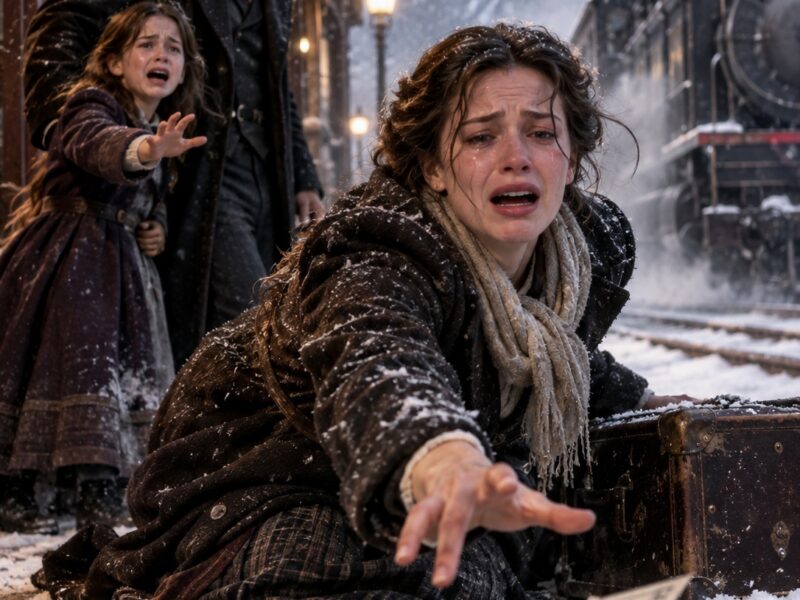
A Penniless Widow Agreed to Marry a Stranger in a Montana Blizzard—But His Daughter Knew Something He Had Never Told Her
The wind stole Beth Hartley’s last train ticket at 4:17 on a December afternoon.
By 4:18, she was running across a frozen Montana platform, screaming for a piece of paper that was worth more than everything else she owned.
By 4:19, it was gone.
And by nightfall, she would be standing in front of a stranger who wanted to make her his wife.
What Beth didn’t know was that the man had two motherless children, a ranch on the edge of ruin, and an enemy who had already destroyed one woman’s life.
Nor did she know that the little girl watching from across the street would eventually ask her a question no one in that family dared answer.
“Did Papa tell you what really happened to Mama?”
But that was still ahead of her.
For now, Beth was on her knees in the snow, watching her final chance at a new life disappear into the white Montana wilderness.
“No! Please!”
She reached beneath the edge of the platform, one gloveless hand scraping against frozen gravel. The ticket had caught briefly against an iron rail, close enough that she could see the faded blue printing. She stretched until her shoulder burned.
Then another gust lifted it into the air.
Beth watched it rise, twist once above the tracks, and vanish into the storm.
For several seconds, she remained where she was.
The cold pressed through her skirt. Snow collected along the sleeves of her thin wool coat. Somewhere beyond the station, a loose shutter banged against a building.
She could hear her own breathing.
It sounded frighteningly small.
Seventeen cents.
That was what remained in her coat pocket.
One dime. One nickel. Two pennies.
She had counted them six times since morning, as though another coin might appear if she looked carefully enough.
It never did.
Behind her, the station agent was closing his window.
“Sir!” she called, stumbling to her feet. “Please, I need another ticket.”
The elderly man looked at her through the glass.
“Miss, I already told you. That’s the last eastbound service until next week.”
“My ticket blew away.”
“I saw.”
“Then surely you can write another one. You remember selling it to me.”
He sighed, not unkindly.
“I’m sorry, ma’am. Railroad rules. I can’t issue a replacement without payment.”
Beth pressed her fingertips against the counter.
“Please. I have almost nothing.”
His eyes moved toward the little pile of coins she had placed on the wood.
For a moment, she thought he might change his mind.
Instead, he slid the coins back toward her.
“Keep your money. You’ll need it more than the railroad does.”
The window shut.
Beth stood there staring at her reflection in the darkening glass.
Twenty-seven years old.
A widow.
Homeless.
And stranded in a town where she didn’t know a single living soul.
She had once lived in a brick house in Philadelphia with polished mahogany furniture and windows that overlooked a garden full of white roses. Her husband had owned three tailored suits, a gold pocket watch, and an impressive collection of books he rarely finished.
There had been servants then.
Dinner parties.
Christmas invitations.
People who smiled whenever she entered a room.
Now Beth could barely remember the last time someone had looked genuinely happy to see her.
She picked up her suitcase.
The leather handle had begun separating from the case. She wrapped her fingers around it carefully and walked toward the center of Silver Creek.
The town had been built along a narrow valley between dark mountains, with a main street that looked as though it had been scraped straight out of the frozen ground.
A general store stood beside a blacksmith’s shop. Across the street, a small hotel displayed a sign advertising comfortable rooms and hot meals, although its windows were boarded for winter.
A few buildings farther down stood a church.
Beth went there first.
The doors were locked.
A wooden notice hung beside the entrance.
BACK, LORD WILLING.
She stared at the three words until the letters blurred.
Then she sat on the steps.
She had promised herself she would not cry again.
Not after Robert’s funeral.
Not after his mother ordered her out of the house.
Not after the cousin in Cheyenne refused to help her.
But there was something unbearable about reaching the end of every possible road.
Beth covered her mouth.
The first sob escaped before she could stop it.
Then another.
Soon she was crying so hard she could barely breathe.
She was still sitting there when the wagon arrived.
Daniel McCormack noticed the woman because she was not moving.
Most people in Silver Creek hurried when a blizzard approached. Even the drunkards staggered toward shelter once the wind began cutting through their coats.
But the woman on the church steps sat perfectly still.
Snow was gathering on her shoulders.
Her suitcase rested against one knee.
And her face was buried in her hands.
Daniel slowed the horses.
Beside him, his eleven-year-old daughter, Rachel, looked toward the church.
“Papa, she’s going to freeze.”
“I see her.”
His seven-year-old son, Lucas, leaned forward beneath the heavy blanket wrapped around their legs.
“Is she dead?”
“No, son.”
“Then why isn’t she moving?”
Daniel didn’t answer immediately.
He knew that posture.
He had seen men sit that way after losing their cattle to disease, their homes to fire, or their families to a winter that refused to end.
It was the posture of someone who had run out of things to hope for.
“Stay in the wagon,” he told the children.
He climbed down and crossed the street.
“Ma’am?”
The woman lifted her head.
Her eyes were red. Her lips had turned pale, and strands of dark brown hair clung to her wet cheeks.
But when she saw him, she straightened with almost comical determination.
“I’m perfectly fine.”
Daniel looked at the snow covering her boots.
“That’s a mighty unusual place to be perfectly fine.”
Something moved across her face.
Not quite a smile.
Close enough.
“Do you need a ride somewhere?” he asked.
“No, thank you.”
“Somebody expecting you?”
“Yes.”
The answer came too quickly.
Daniel waited.
The woman looked past him toward the empty road.
Then she lowered her eyes.
“No,” she admitted. “Nobody is expecting me.”
Daniel removed his hat.
“Daniel McCormack.”
“Beth Hartley.”
“Mrs. Hartley?”
“Yes.”
He glanced at the wedding ring on her left hand.
“Your husband in town?”
Beth’s expression changed.
“No. My husband died last spring.”
Daniel immediately regretted the question.
“I’m sorry.”
She looked away.
“So am I.”
For a few moments, they stood in silence.
Then Daniel nodded toward the restaurant across the street.
“There’s a stove burning in there. At least come inside until the storm passes.”
“I can’t pay for a meal.”
“I didn’t ask whether you could.”
She hesitated.
He could see pride fighting desperation in her face.
Finally, she rose.
Her knees buckled.
Daniel caught her by the elbow before she fell.
She pulled away almost immediately.
“I’m sorry. I haven’t eaten since yesterday.”
“That settles it,” he said.
“What?”
“You’re coming inside.”
The restaurant smelled of coffee, woodsmoke, and frying onions.
Rachel and Lucas sat at a table near the stove, sharing a slice of apple pie.
Rachel looked up when her father entered with the stranger.
Her eyes narrowed.
Lucas simply stared.
Daniel pulled out a chair.
“Sit down, Mrs. Hartley.”
Beth lowered herself cautiously.
The restaurant owner, Mrs. Wilkins, appeared from the kitchen.
“Daniel McCormack, don’t tell me you’ve brought another lost soul in from the weather.”
“Only one this time.”
Mrs. Wilkins looked at Beth’s frozen hands.
Her expression softened.
“I’ll bring soup.”
“I really cannot—” Beth began.
“Didn’t ask you, either.”
The older woman disappeared.
Daniel sat across from Beth.
For a while, they spoke about ordinary things.
The weather.
The railroad.
How long Silver Creek had existed.
How far the nearest larger town lay beyond the mountain pass.
Beth learned that Daniel owned the Diamond M Ranch, eight miles north of town.
She also learned that his wife had died seven years earlier.
Rachel had been four.
Lucas had been an infant.
“Your children are very well behaved,” Beth said.
Daniel glanced toward them.
Rachel was cutting the last piece of pie into two unequal portions.
She pushed the larger portion toward her brother.
“Rachel sees to that,” he said quietly.
Beth watched the girl wipe Lucas’s chin with a napkin.
There was nothing childish about the gesture.
It was practiced.
Automatic.
“She’s been doing that a long time,” Beth observed.
Daniel looked at her.
“Doing what?”
“Being responsible for him.”
He didn’t answer.
Mrs. Wilkins brought a bowl of beef stew, fresh bread, and coffee.
Beth tried to eat slowly.
She failed.
The first spoonful made her realize just how hungry she was. Warmth spread painfully through her empty stomach, and she had to press her lips together to keep from crying.
Daniel pretended not to notice.
It was the first kindness that made her trust him.
Not because he fed her.
Because he allowed her to keep her dignity while he did it.
When the bowl was empty, he asked where she intended to go.
Beth told him the truth.
Philadelphia.
Cheyenne.
The unanswered letters.
The jobs she had sought and failed to find.
She left out the cruelties of her mother-in-law.
Some humiliations were too intimate to share with strangers.
But Daniel listened carefully.
And then, quite unexpectedly, he said, “I came into town today looking for someone.”
Beth looked up.
“A woman who could help at the ranch. Cooking, housekeeping, looking after the children.”
“I could do those things.”
“Have you ever lived on a ranch?”
“No.”
“Milk a cow?”
“No.”
“Bake bread?”
“Yes.”
“Handle a stubborn horse?”
“I once handled a stubborn mother-in-law for four years.”
Daniel laughed.
It came out suddenly, startling both of them.
Rachel looked over.
Beth smiled despite herself.
For a moment, Daniel looked younger.
Then the smile faded.
“There’s another problem,” he said.
And he began telling her about Harrison Blackwood.
Blackwood owned nearly thirty thousand acres along the northern valley, more cattle than any other man in the county, and enough influence to make nearly everyone in Silver Creek reluctant to cross him.
His ranch bordered the Diamond M.
Between the two properties ran a creek that kept Daniel’s cattle alive during the dry months.
Years earlier, Daniel’s father and Blackwood’s father had signed a water agreement.
It was an unusual document, full of conditions that had made sense to two proud men determined to keep their land within their families.
The agreement protected the Diamond M’s water access while the ranch remained a family homestead under a legally recognized married household, with a resident wife and heirs.
Daniel had never paid much attention to those words.
Not until his wife died.
Since then, Harrison Blackwood had claimed Daniel no longer satisfied the agreement’s conditions.
He had threatened to divert the creek, petitioned the county authorities, and hired lawyers who seemed to enjoy making other people’s lives miserable.
“He wants your ranch,” Beth said.
Daniel nodded.
“More than anything.”
“Then why not simply purchase it?”
“He’s tried.”
“And you refused?”
“My father is buried there. So is my wife.”
Beth looked down.
Daniel continued.
“Blackwood’s been making the same offer for three years. Marry his daughter, Victoria, and he’ll forget about the dispute.”
“Is she a willing participant in this arrangement?”
Daniel gave a humorless laugh.
“She’s been told since she was eighteen that she’ll be mistress of the Diamond M.”
“And if you refuse?”
“He takes the water. Without water, the ranch dies.”
Beth’s fingers tightened around her coffee cup.
“And your children lose their home.”
“Yes.”
She looked toward Rachel and Lucas.
Rachel was watching them openly now.
There was suspicion in her eyes.
Something else, too.
Fear.
Beth understood it.
Children were often the first to sense that adults were about to rearrange their lives.
She turned back to Daniel.
“What exactly are you asking me, Mr. McCormack?”
He took a breath.
Then he said the word that changed everything.
“Marriage.”
Beth stared at him.
For one ridiculous moment, she thought he was joking.
“You’re proposing marriage?”
“Yes, ma’am.”
“To me?”
“I don’t see anybody else sitting at this table.”
“But you don’t know me.”
“I know you’re honest enough to admit when you need help.”
“That hardly qualifies me to become your wife.”
“No,” he said. “But maybe what matters is whether we’re both willing to do the work.”
Beth sat back.
She should have been offended.
A stranger was asking her to marry him over a bowl of stew, as though a wife were another supply he had come to town to purchase.
Yet his eyes held no mockery.
Only exhaustion.
And a desperate hope he seemed almost embarrassed to reveal.
“Marriage is supposed to mean something,” she whispered.
Daniel’s jaw tightened.
“It does.”
“It’s supposed to involve love.”
He looked toward the window.
“Love didn’t save my first wife.”
The words landed between them like something heavy.
Beth went still.
Daniel closed his eyes briefly.
“Forgive me. That wasn’t fair.”
“No,” she said gently. “It wasn’t.”
He looked back at her.
“My wife was a good woman. The best I ever knew. I loved her. And when she needed me most, I couldn’t keep her alive.”
Beth saw pain move through his expression.
Not fresh pain.
Something older.
Deeper.
The kind that became part of a man’s bones.
She understood more than she wanted to.
“Robert was ill for two years,” she said softly. “I thought loving him enough might somehow make him better.”
Daniel watched her.
“It didn’t?”
“No.”
A quiet understanding passed between them.
Outside, the storm battered the restaurant windows.
Daniel leaned forward.
“I won’t promise you romance, Mrs. Hartley. I don’t have much talent for pretty words anymore. But I can promise you a roof, food, a place by the fire, and the respect you deserve.”
“And what would you expect in return?”
“Help with the house. Help with the children. A real partnership.”
Beth studied him carefully.
“And the marriage itself?”
He understood.
“Separate bedrooms,” he said. “I won’t touch you unless you want me to.”
She searched his face.
“And if I never do?”
“Then I respect that.”
“Even years from now?”
“Even then.”
Her throat tightened.
She had expected a bargain.
She had not expected him to offer her a choice.
For a long moment, neither spoke.
Then Beth said, “I have conditions.”
Daniel nodded.
“I’m listening.”
“I will not be treated like a servant in my own home.”
“Agreed.”
“You will not humiliate me, frighten me, or make decisions about my life without speaking to me.”
“Fair.”
“And your children will need time. Especially Rachel. She has been caring for this household since she was four years old. She won’t appreciate a stranger arriving and taking her place.”
Daniel glanced at his daughter.
“I know.”
“When that happens, I need you to stand beside me. Not against your children. Beside me.”
He looked back at Beth.
“You have my word.”
She swallowed.
“One more thing.”
“Name it.”
“If we marry, we marry properly. Real vows. No lying about what we’re doing. No pretending before God that we love each other when we don’t.”
Daniel studied her for a long moment.
Then he removed his glove and held out his hand.
“You’ve got yourself a deal, Mrs. Hartley.”
Beth stared at his hand.
Large.
Rough.
Scarred across one knuckle.
It was the hand of a man offering her something she had stopped believing she deserved.
A future.
Not an easy one.
Not a romantic one.
But a future.
She lifted her hand.
And just before their fingers touched, a child’s voice cut through the restaurant.
“Papa, don’t!”
Everyone turned.
Rachel McCormack stood beside the table, her face white with anger.
Lucas hovered behind her.
Daniel frowned.
“Rachel, go sit down.”
“No.”
The little girl looked directly at Beth.
“You can’t marry her.”
Daniel rose slowly.
“That’s enough.”
Rachel’s eyes filled with tears.
“You said there would never be another lady living in Mama’s house.”
The restaurant fell silent.
Daniel looked as though his daughter had struck him.
Beth felt her hand drop to her lap.
Rachel’s chin trembled.
“You promised.”
Daniel took Rachel outside beneath the restaurant’s covered porch.
Beth watched them through the window.
He crouched to speak at his daughter’s level.
Rachel folded her arms and looked away.
Whatever he said made her cry harder.
Beth turned toward Lucas.
He had remained beside her chair.
His hair was dark like his father’s. His eyes were wide and uncertain.
“Do you hate me, too?” she asked gently.
Lucas considered the question.
“No, ma’am.”
“That’s a relief.”
He lowered his voice.
“Rachel doesn’t hate you.”
“Doesn’t she?”
“She gets scared when things change.”
Beth looked outside again.
Daniel was holding Rachel against his chest.
The girl’s fists were pressed into his coat.
Lucas climbed into the chair beside Beth.
“Are you going to be our new mama?”
Beth felt her heart twist.
“No, sweetheart.”
His face fell.
She reached for his small hand.
“I mean I wouldn’t try to replace your mother. You already have one, even though she isn’t here anymore.”
Lucas studied her.
“Would you stay anyway?”
The question nearly undid her.
She glanced at Daniel and Rachel outside.
“I don’t know yet.”
Lucas nodded solemnly.
Then he said, “I think you should.”
“Why?”
“Papa burns the biscuits.”
Beth laughed.
It was the first completely genuine laugh she had given in months.
Lucas smiled.
For one brief moment, the future did not seem quite so frightening.
Then Daniel returned.
Rachel followed him, her cheeks wet but her expression stubborn.
Daniel looked at Beth.
“May I speak with you?”
They moved toward the back of the restaurant.
He removed his hat.
“I’m sorry about Rachel.”
“You don’t need to apologize for a frightened child.”
“I told her years ago that no one would replace her mother.”
“And she believed you.”
“Yes.”
“Then don’t tell her she’s wrong.”
Daniel looked confused.
Beth continued gently.
“Tell her you meant it. Tell her no one can replace her mother. Not even a wife.”
He studied her.
“You really understand that?”
“More than you know.”
Beth glanced toward the children.
“If we do this, I won’t ask them to love me. And I won’t pretend affection can be demanded simply because a minister says we’re family.”
Daniel looked at her for a long moment.
Then he said quietly, “You might be exactly who they need.”
Beth’s eyes stung.
Nobody had said anything like that to her in a very long time.
But she wasn’t ready to accept.
Not yet.
“I need one night to think.”
Daniel shook his head.
“The storm will close the north road by morning.”
“Then perhaps that’s my answer.”
He looked disappointed, but he didn’t argue.
Instead, he reached into his pocket and placed several coins on the table.
“Mrs. Wilkins has a room upstairs. Stay there tonight.”
Beth stared at the money.
“I can’t accept that.”
“It’s already paid for.”
“Mr. McCormack—”
“You can repay me someday if it bothers you.”
He put on his hat.
“And if you decide against marrying me, I’ll still help you find work when the roads open.”
Beth blinked.
“You would?”
“Of course.”
“Even if I refuse?”
Daniel looked genuinely puzzled.
“Why wouldn’t I?”
She didn’t have an answer.
Because too many people in her life had made kindness conditional.
Because Robert’s mother had once told her that a woman unable to provide a child had no right to expect security.
Because she had begun to believe every act of generosity came with a price.
Daniel seemed to understand some of what she wasn’t saying.
“Get some rest, Beth.”
It was the first time he had used her given name.
She watched him walk toward his children.
Rachel took his hand.
Lucas waved at Beth from the doorway.
Then they disappeared into the blowing snow.
That night, Beth lay awake in Mrs. Wilkins’s narrow upstairs room.
The mattress was lumpy.
The blankets smelled faintly of lavender.
Wind rattled the windowpane.
But the room was warm, and for the first time in weeks, she had eaten enough to feel full.
She should have been grateful.
Instead, she found herself thinking about marriage.
Her first wedding had taken place in a Philadelphia church filled with flowers.
Robert Hartley had looked handsome in his dark suit.
His mother had arranged the reception.
Beth had worn a satin gown with pearl buttons and a lace veil borrowed from an aunt.
She remembered believing that happiness was something a person could secure by making the right decisions.
Marry a good man.
Keep a comfortable home.
Love him faithfully.
Raise children.
Grow old together.
She had been twenty-two.
How little she had known.
Robert had loved her, in his quiet way.
But when he became ill, his mother’s influence over their lives grew stronger.
Martha Hartley decided which doctors he saw, what medicines he took, what foods he ate, and which visitors were permitted into his room.
Beth learned to ask permission before doing things that had once seemed ordinary.
By the final year, she was barely allowed to sit beside her own husband without Martha finding a reason to send her away.
Then Robert died.
At the funeral, Martha embraced her publicly.
Three weeks later, she began packing Beth’s belongings.
“You’ve had four years,” she said. “Four years to give this family an heir.”
Beth stood beside the wardrobe, holding Robert’s favorite waistcoat.
“He was ill, Martha.”
“Men have fathered children through worse.”
“The doctors never said I couldn’t—”
“Don’t argue with me.”
Beth had gone silent.
That was what marriage had taught her.
Silence was safer.
Now a stranger in Montana was offering her a different kind of arrangement.
He had not spoken of children she must bear.
He had not demanded gratitude.
He had not even asked her to love him.
He had simply promised respect.
Beth touched her wedding ring.
For months, she had worn it because removing it felt like admitting that her entire married life had ended.
Now she wondered whether keeping it had become another way of refusing to live.
A soft knock interrupted her thoughts.
“Mrs. Hartley?”
It was Mrs. Wilkins.
Beth opened the door.
The older woman stood holding a cup of tea.
“Thought you might have trouble sleeping.”
Beth accepted it gratefully.
“Thank you.”
Mrs. Wilkins looked at her carefully.
“Daniel asked you to marry him, didn’t he?”
Beth nearly spilled the tea.
“How did you know?”
“Because that man’s been walking around with a problem bigger than Montana for three years, and you were the first woman I’ve seen him speak to for longer than five minutes.”
Beth blushed.
“It isn’t what you think.”
“Probably isn’t.”
“He wants a practical arrangement.”
Mrs. Wilkins made a small sound.
“Men call all sorts of things practical when they’re too frightened to call them anything else.”
Beth looked down.
“Do you think he’s a good man?”
The older woman’s face grew serious.
“Yes.”
The answer came without hesitation.
“Is he an easy man?”
“No.”
“Does he have a temper?”
“Sometimes.”
“Is he cruel?”
Mrs. Wilkins shook her head.
“Never known him to be.”
Beth breathed a little easier.
But the older woman wasn’t finished.
“Daniel carries more guilt than any one person ought to bear. And those children have grown up in the shadow of a woman nobody in that house knows how to speak about.”
“His first wife?”
“Anna.”
Beth waited.
Mrs. Wilkins looked toward the window.
“She was a lovely girl. Kind. Stubborn. Always humming while she worked.”
“How did she die?”
The older woman’s expression changed.
For a moment, Beth thought she wouldn’t answer.
Then Mrs. Wilkins said, “There was an accident.”
“What kind?”
“A horse and wagon, down by the north ravine. During a storm.”
Beth remembered Daniel saying love hadn’t saved his wife.
“Was Daniel with her?”
“No.”
“Where was he?”
Mrs. Wilkins looked at Beth for a long moment.
“That, dear, is something you should ask him.”
By morning, the storm had eased enough for a rider to travel from the ranch.
Daniel arrived shortly after breakfast.
His coat was powdered with snow, his cheeks red from the cold.
Beth was waiting downstairs.
She had packed her suitcase.
Daniel stopped when he saw it.
“I suppose you’ve made your decision.”
“Yes.”
He nodded slowly.
“Well, I can still take you to the general store. Mr. Avery might need—”
“I’ll marry you.”
The words surprised them both.
Daniel stared.
Beth lifted her chin.
“Provided you still want me to.”
For the first time since they met, Daniel McCormack seemed entirely without words.
Then he smiled.
It wasn’t a broad smile.
Just the beginning of one, moving slowly through his tired face.
“Yes, ma’am,” he said. “I surely do.”
Beth held out her hand.
“Then we begin with honesty.”
He took it.
And neither noticed the man standing just beyond the restaurant window.
He wore a fine black coat and carried a silver-headed walking stick.
A dark carriage waited behind him.
The man watched their handshake with an expression of cold disbelief.
Then he turned to his driver.
“Go tell Mr. Blackwood.”
The driver hesitated.
“Tell him what, sir?”
The man looked back at the restaurant.
“That Daniel McCormack has found himself a wife.”
He smiled without warmth.
“And that we have a problem.”
They married four days later.
The reverend returned from Bozeman before the storm had fully cleared, arriving with frozen whiskers, a broken wagon wheel, and considerable surprise at discovering he had a wedding to perform.
The ceremony took place inside the little church where Beth had nearly frozen to death.
There were no flowers.
No organ music.
No elaborate wedding dress.
Beth wore the best of the two dresses remaining in her suitcase, a dark blue wool gown with white lace at the collar.
Mrs. Wilkins had pressed it the night before.
Daniel wore a clean black suit that had belonged to his father.
Rachel stood beside him with her arms folded.
Lucas held a small bunch of dried wildflowers he had insisted on giving the bride.
When the reverend asked whether anyone knew a reason the marriage should not proceed, Rachel looked as though she might speak.
Beth held her breath.
But the girl remained silent.
Daniel turned toward Beth.
His gray eyes were steady.
He repeated the vows slowly.
Not like a man performing a necessary legal task.
Like a man making a promise he intended to keep.
Beth found herself doing the same.
When the reverend declared them husband and wife, Daniel hesitated.
Beth understood why.
Their agreement had included boundaries.
He had promised not to presume affection.
So she made the decision for him.
She leaned forward and kissed his cheek.
His eyes widened.
A faint flush rose beneath his weathered skin.
Mrs. Wilkins covered a smile.
Lucas clapped.
Rachel looked away.
Then the church doors opened.
A woman stood in the entrance wearing a dark green velvet coat trimmed with fur.
She was beautiful in a carefully cultivated way, with glossy auburn hair, pale skin, and an expression that suggested the world had committed a personal offense.
Behind her stood a tall man with a silver-headed walking stick.
Daniel went rigid.
Beth felt it immediately.
The woman looked at their joined hands.
Then at Beth’s simple wedding dress.
“Well,” she said.
Her voice carried through the silent church.
“I suppose congratulations are in order.”
Daniel’s face hardened.
“Victoria.”
Victoria Blackwood smiled.
But her eyes were full of hatred.
“How interesting,” she said softly. “Father always told me you’d eventually become reasonable.”
Her gaze moved over Beth.
“I see he was mistaken.”
The reverend cleared his throat.
“This is a house of God, Miss Blackwood.”
“Of course.”
Victoria stepped aside.
The man with the walking stick entered.
Harrison Blackwood was older than Daniel by nearly twenty years, but he carried himself with the confidence of someone accustomed to seeing people make room for him.
He removed his hat.
“McCormack.”
“Blackwood.”
Harrison looked at Beth.
“And this must be the fortunate bride.”
Beth felt Daniel’s fingers tighten around hers.
She gave the older man a polite nod.
“Beth McCormack.”
“McCormack already? How efficient.”
Daniel moved slightly in front of her.
“State your business.”
Blackwood smiled.
“Why, I came to congratulate you.”
He reached into his coat and withdrew a folded document.
“And to save you from a very unfortunate misunderstanding.”
Daniel didn’t take it.
Blackwood held it out anyway.
“A notice from my attorneys. Your father’s water agreement doesn’t protect sham marriages.”
The church grew quiet.
Beth looked at the paper.
Then at Blackwood.
“Sham marriages?”
“Surely your husband explained the circumstances.”
“He explained the dispute.”
“Did he explain that the courts can examine whether a marriage was entered into in good faith?”
Daniel’s voice was low.
“Get out.”
Blackwood ignored him.
“My dear, I hope you understand what kind of situation you’ve placed yourself in.”
Beth stepped forward.
“I understand that you’ve interrupted my wedding.”
Victoria gave a sharp laugh.
“How charming.”
Beth looked at her calmly.
“And I understand that you appear disappointed.”
The younger woman’s smile vanished.
Blackwood’s eyes narrowed.
“Be careful, Mrs. McCormack. Montana can be an unforgiving place for women who arrive without friends.”
Beth felt the threat beneath the words.
She also felt Daniel move beside her.
But before he could speak, she answered.
“Then it’s fortunate I didn’t come here looking for your friendship.”
For one brief moment, no one moved.
Mrs. Wilkins made a small choking sound behind her hand.
Blackwood folded the legal notice.
His smile returned.
“We’ll see how long that courage lasts.”
Then he turned and walked out.
Victoria followed.
But at the church door, she glanced back at Daniel.
“You should have married me,” she said.
Daniel looked at her steadily.
“No, Victoria.”
Something flickered across her face.
Pain, perhaps.
Or fury.
Then she was gone.
Beth watched the carriage disappear into the snow.
Her wedding day had lasted less than an hour.
And already someone was threatening to destroy it.
Daniel turned toward her.
“I’m sorry.”
Beth looked at him.
“Do you intend to apologize every time that man behaves badly?”
“I expect you’ll give me plenty of opportunities.”
“Then we should agree to save apologies for things we’ve actually done wrong.”
Daniel studied her.
Then he laughed quietly.
“Agreed.”
But when he looked back toward the road, the laughter left his face.
Because he knew Harrison Blackwood.
And a man like Blackwood never made a threat without already preparing to carry it out.
The Diamond M Ranch was not what Beth expected.
She had imagined a small house surrounded by cattle and open fields.
Instead, the property sprawled across a broad valley framed by mountains, with a two-story timber house standing beneath a grove of cottonwoods.
A large barn rose behind it.
There were corrals, a smokehouse, a bunkhouse, and several sheds.
Beyond them stretched winter pasture, the fences disappearing beneath rolling hills of white.
The house itself was handsome, though worn by years of hard living.
A porch wrapped around the front.
Smoke rose from two chimneys.
A brass bell hung beside the kitchen door.
And near the front steps stood a wooden bench carved with a faded floral design.
Beth noticed that the bench had been carefully maintained despite everything else showing signs of neglect.
Daniel followed her gaze.
“Anna made that.”
“Your wife?”
He nodded.
“She liked sitting there in the evenings. Said the mountains looked purple just before the sun went down.”
Beth looked at the bench again.
She wondered whether entering this house would feel like trespassing through another woman’s memories.
Rachel answered that question almost immediately.
The moment they stepped inside, the girl walked ahead of them and said, “Mama’s room is upstairs.”
Daniel paused.
“Rachel.”
“What?”
“You know that’s where Beth will be staying.”
Rachel turned.
“No. That’s Mama’s room.”
Beth set down her suitcase.
“I don’t need to stay there.”
Daniel looked at her.
“Beth—”
“Is there another room?”
He hesitated.
“The small room beside the study.”
“Then that will be perfectly fine.”
Rachel studied her suspiciously.
“You don’t want Mama’s room?”
“No.”
“Why?”
Beth met her eyes.
“Because you’ve made it clear that room means something to you.”
The girl looked unsettled by the answer.
Beth continued.
“I’d rather have a room that belongs to me.”
For a moment, Rachel seemed almost disappointed not to have an argument.
Then she turned away.
“Lucas, take off your wet boots.”
The boy obeyed immediately.
Beth looked at Daniel.
He sighed.
“Welcome home.”
She wasn’t certain whether he meant it.
Or whether he was trying to convince himself.
The first week was harder than Beth expected.
Not because the work frightened her.
She knew how to clean, cook, sew, and manage a household.
But the Diamond M operated according to rules no one had written down.
Rachel knew where everything belonged.
Rachel decided when breakfast began.
Rachel knew which bowls Lucas preferred, which blankets needed mending, and which cupboard held the medicine.
If Beth reached for a pan, Rachel told her she had chosen the wrong one.
If she washed the dishes, Rachel pointed out that they were stacked incorrectly.
When she offered to mend Lucas’s torn coat, Rachel snatched it away.
“I can do it.”
Beth let her.
The next morning, she found the girl sitting at the kitchen table before sunrise, struggling to thread a needle with trembling fingers.
There were shadows beneath her eyes.
Beth said nothing at first.
She simply placed a lamp closer.
Rachel looked up.
“I don’t need help.”
“I didn’t offer any.”
“Then why are you standing there?”
“Because I’m making coffee.”
“Papa takes it black.”
“I know.”
“He hates it weak.”
“I know that, too.”
Rachel glared.
“How?”
“Because I asked him.”
The girl looked away.
Beth poured water into the kettle.
Then she noticed blood on Rachel’s thumb.
“You’ve pricked yourself.”
“It’s nothing.”
Beth took a clean cloth from the cupboard.
“May I?”
Rachel hesitated.
Then she held out her hand.
Beth wrapped the thumb gently.
“You don’t have to do everything yourself,” she said.
Rachel’s face hardened.
“Yes, I do.”
“Why?”
The answer came quickly.
“Because nobody else stays.”
Beth went still.
Rachel looked down at her sewing.
After a long silence, she whispered, “Mama went away. The other women went away. Everybody always goes away.”
Beth pulled out a chair.
“Rachel.”
The girl shook her head.
“I don’t want to talk about it.”
“Then we won’t.”
Beth sat beside her anyway.
For several minutes, only the ticking kitchen clock filled the room.
Then Beth reached for the torn coat.
“Would you mind if I showed you a way to keep the needle from catching in the lining?”
Rachel looked suspicious.
“You won’t take it?”
“No.”
“You won’t finish it yourself?”
“Not unless you ask.”
The girl considered.
Then she pushed the coat across the table.
“Show me.”
It was a tiny victory.
Beth knew better than to celebrate.
But when Daniel entered the kitchen half an hour later, he found his daughter sitting beside his new wife, watching carefully as Beth demonstrated a simple stitching technique.
He stopped in the doorway.
Neither noticed him.
For one quiet moment, Daniel saw something he had not seen in seven years.
His daughter learning something without having to be responsible for everyone around her.
And the sight hurt almost as much as it comforted him.
Lucas was easier to love.
He followed Beth everywhere.
He asked questions about Philadelphia, about trains, about whether the ocean truly went on forever.
He wanted to know how bread rose, why snowflakes had different shapes, and whether people in big cities ever saw real stars.
Beth answered as many questions as she could.
When she didn’t know, she admitted it.
Lucas seemed impressed by that.
“Papa always says he knows everything,” the boy confided one afternoon.
“Does he?”
“He says that when he’s tired of answering questions.”
Beth laughed.
“Then perhaps we shouldn’t tell him we’re conducting an investigation.”
Lucas nodded seriously.
Their friendship grew through ordinary moments.
He helped her knead bread.
She listened while he described the imaginary kingdom he had built beneath his bed.
When he had nightmares, she sat beside him until he fell asleep.
The first time she heard him crying, she found him sitting upright beneath his blankets, his small body shaking.
“I dreamed Mama fell,” he whispered.
Beth sat on the edge of his bed.
“Would you like to tell me about it?”
He shook his head.
She didn’t insist.
Instead, she took his hand.
“I can stay until you feel better.”
He moved closer.
“Did you ever have bad dreams?”
“Yes.”
“What about?”
“Losing people I loved.”
He looked up.
“Did they come back?”
Beth swallowed.
“No, sweetheart.”
Lucas’s eyes filled with tears.
“Then what made you stop being scared?”
She thought carefully.
“I haven’t stopped entirely.”
“Really?”
“Really.”
He studied her.
Then he leaned against her.
“I don’t feel as scared when you’re here.”
Beth held him until his breathing slowed.
When she finally returned to the hallway, Daniel was standing outside his room.
He had heard everything.
His face was unreadable.
“I was going to come in,” he said.
Beth nodded.
“He’s asleep now.”
“Thank you.”
She started toward her room.
Daniel spoke again.
“Beth?”
She turned.
“I don’t know how to do that.”
“Do what?”
“Make him feel safe without pretending everything will be all right.”
Beth looked at the man standing beneath the hallway lamp.
He seemed enormous in the narrow passage.
And terribly tired.
“Perhaps you don’t need to promise everything will be all right,” she said.
“Then what do I promise?”
“That you won’t leave him to face the frightening things alone.”
Daniel lowered his eyes.
For a long moment, he said nothing.
Then he whispered, “I wish I’d known that seven years ago.”
Beth wanted to ask what he meant.
But his expression stopped her.
Some doors, she was beginning to understand, could not be opened by force.
The first real argument came over a blue ribbon.
Beth found it in a kitchen drawer, tangled among broken buttons and lengths of thread.
It was faded but beautiful, embroidered with tiny white flowers.
She assumed it had been forgotten.
So she washed it carefully, pressed it flat, and tied it around the handle of a wicker basket.
Rachel saw it at breakfast.
Her face drained of color.
“Where did you get that?”
Beth glanced at the ribbon.
“The drawer beside the stove.”
Rachel hurried forward.
“Take it off.”
“Rachel, I—”
“Take it off!”
Beth immediately untied it.
The girl snatched it from her hand.
“That was Mama’s!”
“I didn’t know.”
“You had no right!”
“Rachel.”
Daniel’s warning came from the doorway.
But the girl was already crying.
“She wore it in her hair the day she died!”
The kitchen went silent.
Beth felt the words like a blow.
Rachel clutched the ribbon to her chest.
“You touch everything. You move everything. You act like this is your house!”
Daniel stepped forward.
“Enough.”
Rachel turned on him.
“You said she wouldn’t replace Mama!”
“She isn’t trying to.”
“Then why is she here?”
The question hung between them.
Daniel had no answer that an eleven-year-old could understand.
Beth did.
Or at least she thought she might.
She knelt in front of Rachel.
“You’re right.”
The girl blinked through her tears.
Beth continued softly.
“I shouldn’t have used something that belonged to your mother without asking.”
Rachel’s grip loosened slightly.
“I didn’t know what it meant to you. But that doesn’t make your feelings wrong.”
The girl’s mouth trembled.
Beth looked at the ribbon.
“It must be very precious.”
Rachel nodded.
“Papa gave it to her.”
Beth glanced at Daniel.
He looked away.
“She wore it every Sunday,” Rachel whispered. “And when she went out that day, she told me she’d be back before supper.”
Daniel made a strangled sound.
Rachel turned toward him.
“She said she’d come back.”
“Rachel.”
“She promised.”
Daniel’s face had gone white.
Beth rose slowly.
The little girl looked between them.
Then she ran from the kitchen.
A door slammed upstairs.
Daniel stood motionless.
Beth waited.
Finally, he said, “You shouldn’t have apologized.”
She stared at him.
“Why not?”
“Because she can’t keep speaking to you that way.”
“She’s grieving.”
“She’s been grieving for seven years.”
“Yes,” Beth said. “And apparently no one has helped her understand what happened.”
Daniel’s expression hardened.
“You don’t know anything about what happened.”
“Then tell me.”
He looked at her.
For a moment, Beth thought he might.
Instead, he reached for his coat.
“Some things are best left alone.”
He walked out.
Beth stood in the kitchen, staring at the door.
For the first time since their wedding, she wondered whether she had made a terrible mistake.
And upstairs, behind a locked bedroom door, Rachel sat on the floor holding her mother’s ribbon.
There was a small photograph beneath her bed.
An old photograph she never allowed anyone to see.
In it, her mother stood beside a handsome young man.
But the man was not Daniel McCormack.
And on the back of the photograph, in faded ink, someone had written two words.
Forgive me.
Beth discovered the photograph three days later.
She wasn’t searching Rachel’s room.
In fact, she had made a point of respecting the child’s privacy, even when that meant allowing the bedroom to remain cluttered with clothes, books, and the strange collections of treasures children considered more valuable than gold.
But Rachel had come down with a fever.
The doctor had visited that morning and recommended rest, warm broth, and keeping the room heated.
Beth was changing the bedding when a small wooden box slipped from beneath the mattress.
Its lid opened when it struck the floor.
A photograph slid out.
Beth knelt to retrieve it.
The picture showed Anna McCormack standing in front of the ranch house, younger and happier than Beth had imagined.
Anna was beautiful.
Not in the distant, delicate way portraits sometimes made people appear, but with a lively warmth that seemed to survive even in the faded photograph.
Her hair was pinned loosely beneath a straw hat. One hand rested against the shoulder of a man standing beside her.
He was tall, dark-haired, and smiling.
And he wasn’t Daniel.
Beth turned the photograph over.
Two words had been written on the back.
Forgive me.
Beneath them was a date.
October 14.
Seven years earlier.
Beth felt a small chill.
She remembered Mrs. Wilkins’s reluctance to explain Anna’s death.
Daniel’s reaction to Rachel mentioning the ribbon.
The way the entire household seemed to go silent whenever Anna’s final day was discussed.
A floorboard creaked behind her.
Beth turned.
Rachel stood in the doorway, pale and unsteady, holding the edge of the wall.
Her eyes went immediately to the photograph.
“What are you doing?”
Beth rose.
“Your box fell. I was putting everything back.”
Rachel hurried toward her.
“Give it to me.”
Beth handed it over.
The girl pressed the photograph against her chest.
“You weren’t supposed to see that.”
“I wasn’t looking for it.”
Rachel stared at her.
Beth lowered herself onto the edge of the bed.
“I’m sorry I frightened you.”
Rachel said nothing.
Then, in a voice so quiet Beth almost missed it, she asked, “Did Papa tell you about him?”
Beth shook her head.
“No.”
The girl looked down at the photograph.
“He came to our house.”
“When?”
“The day Mama died.”
Beth’s pulse quickened.
“Do you remember him?”
Rachel nodded.
“He and Mama were talking in the barn. They didn’t know I was there.”
“What were they talking about?”
Rachel’s eyes filled.
“I couldn’t hear everything. But Mama was crying.”
Beth remained still.
Rachel continued.
“The man gave her something. A book, I think. Then Mama said she had to leave.”
“Did she tell you where she was going?”
“No.”
The girl swallowed.
“She hugged me and said she’d be home before supper.”
Beth felt the words settle heavily in her chest.
“And then?”
“Then Papa came home.”
Rachel looked toward the door.
“He was angry.”
“Did he know where your mother had gone?”
Rachel shook her head.
“He kept asking about the man.”
Beth’s stomach tightened.
“What happened after that?”
The girl looked at the photograph.
“Papa rode after her.”
“And your mother?”
Rachel began to cry.
“She never came back.”
Beth reached for her hand.
Rachel pulled away.
“Papa thinks she fell because of the storm.”
“What do you think?”
The child lifted her eyes.
“I think somebody made her fall.”
Beth did not mention the photograph at supper.
Rachel’s fever had eased, but she was still weak. Lucas sat beside her, determined to entertain his sister by arranging peas into increasingly elaborate shapes.
Daniel listened patiently as the boy explained that one arrangement represented a mountain lion and another a train.
Beth barely heard him.
Her mind kept returning to Rachel’s words.
I think somebody made her fall.
After the children went upstairs, Daniel remained at the kitchen table repairing a leather harness.
Beth dried the last plate and placed it in the cupboard.
Then she turned toward him.
“Daniel, I’d like to ask you something.”
He looked up.
“Go ahead.”
“How did Anna die?”
His hands stopped.
The sudden stillness told Beth she had crossed an invisible line.
“I told you,” he said. “There was an accident.”
“I know. But what happened?”
Daniel looked back at the harness.
“She was driving the wagon along the north ravine. The weather turned. Her horse lost its footing, and the wagon went over the edge.”
“Was she alone?”
“Yes.”
“Why was she out in a storm?”
He pulled the leather strap tight.
“I don’t know.”
Beth waited.
Daniel kept working.
“Did anyone see what happened?”
“No.”
“Did you find her?”
His hands stopped again.
When he looked up, something bleak had entered his expression.
“Yes.”
Beth felt a deep sadness move through her.
“I’m sorry.”
Daniel said nothing.
She stepped closer.
“Rachel told me there was a man here that day.”
The change was immediate.
Daniel pushed back his chair.
“What man?”
“She showed me a photograph.”
His face went rigid.
“You went through her things?”
“No. The box fell while I was changing her sheets.”
“That’s private.”
“I know. I apologized to her.”
Daniel stood.
“Then leave it alone.”
Beth stared at him.
“I only wanted to understand.”
“You don’t need to understand everything.”
The words stung.
For a moment, Beth was back in Philadelphia, standing beside Robert’s sickbed while Martha Hartley told her not to ask questions about medicines and expenses.
She forced herself to remain calm.
“Your daughter is frightened, Daniel.”
“My daughter has been frightened since she was four years old. I know that better than anyone.”
“Then why won’t you tell her what happened?”
“Because I don’t know everything that happened!”
His voice cracked across the kitchen.
Beth went silent.
Daniel looked startled by his own anger.
He turned away, pressing both hands against the table.
After a moment, he spoke more quietly.
“I found the wagon at the bottom of the ravine. One wheel was broken. The horse was dead.”
Beth waited.
“Anna was still alive when I reached her.”
His shoulders rose and fell.
“She looked at me. Tried to say something. I couldn’t understand her.”
Beth felt her eyes fill.
“I carried her home. Sent for the doctor. Sat with her all night.”
He stopped.
“She died before dawn.”
Beth moved closer.
“Daniel—”
“I keep hearing her voice.”
He stared at the table.
“Seven years. And I still can’t remember what she was trying to tell me.”
She wanted to touch him.
Instead, she waited.
Daniel drew a shaky breath.
“That man Rachel saw was a surveyor named Thomas Vale. I found his name in one of Anna’s notebooks.”
“Did you speak to him?”
“He disappeared from the valley after she died.”
“Did you believe she was having an affair?”
Daniel looked at her sharply.
For a moment, Beth feared he would become angry again.
But then his face crumpled with something far worse.
Shame.
“I don’t know what I believed.”
Beth felt her heart break for him.
“I was angry that she’d gone off without telling me. Angry that she met another man in secret. Angry that I couldn’t find her before it was too late.”
He looked toward the dark window.
“And sometimes I’m afraid the last thing she remembered about me was that I didn’t trust her.”
Beth reached for his hand.
This time he let her take it.
“You loved her,” she said.
Daniel closed his eyes.
“Yes.”
“Then whatever happened, that love was real.”
He looked at their joined hands.
For a long while, neither spoke.
Then he said, “I don’t want you getting tangled up in this, Beth.”
“I’m already tangled up in it.”
“You don’t understand Blackwood.”
“Then help me understand.”
Daniel’s expression darkened.
“He destroys anything he can’t control.”
Beth looked toward the window.
Beyond the glass, the mountains were invisible beneath the night.
She thought of Anna.
Of a mysterious surveyor.
Of a frightened child who believed her mother had been murdered.
And for the first time, she wondered whether Harrison Blackwood’s interest in the Diamond M had begun long before Daniel became a widower.
Spring came slowly to Silver Creek.
The snow retreated from the southern hills first, revealing patches of brown grass and rocky soil. Ice broke along the creek, and the cottonwoods began showing pale green buds.
Beth learned the rhythms of ranch life.
She learned to wake before sunrise without resenting it.
She learned that bread required more patience at higher elevations, that a cast-iron stove could burn biscuits faster than anything she had known in Philadelphia, and that a good ranch horse responded better to confidence than force.
She also learned that Daniel rarely slept through an entire night.
Sometimes she heard him moving downstairs long after midnight.
Other times she found him sitting on the porch before dawn, looking toward the distant hills.
He never complained.
But she began to recognize the signs of a man carrying too much alone.
One morning, she found him studying papers at the kitchen table.
There were bills scattered across the wood.
Feed.
Repairs.
Wages.
A notice from the county clerk.
Daniel covered the papers when she entered.
Beth set down the coffee pot.
“What are those?”
“Ranch business.”
She waited.
He sighed.
“Blackwood’s attorneys have filed another petition.”
“About the creek?”
“Yes.”
“What does it say?”
“Same nonsense as before.”
“Then why do you look as though someone’s died?”
Daniel rubbed his forehead.
“Because if the county grants his request for temporary control of the upper diversion gate, I won’t have enough water for the south pasture.”
Beth pulled out a chair.
“Show me.”
He hesitated.
“Beth—”
“You promised a partnership.”
He looked at her.
Then slowly pushed the papers across the table.
She read them carefully.
The legal language was dense, but she had spent years helping Robert organize business correspondence and accounts.
She understood enough to recognize a problem.
“Why does this say the agreement was amended eighteen years ago?”
Daniel frowned.
“Because it was.”
“What changed?”
“My father and Blackwood’s father had a disagreement over maintenance costs. They signed a revised arrangement.”
“And this provision about a resident wife?”
Daniel nodded.
“It was part of the revision.”
Beth read the clause again.
Then again.
Something bothered her.
“Daniel, who drafted this?”
“Blackwood’s attorney.”
“Who witnessed it?”
“Two men from the county.”
“Are they still alive?”
“One died years ago. The other moved east.”
Beth looked at the signature at the bottom.
“Your father signed?”
“Yes.”
“Are you certain?”
Daniel looked offended.
“Of course.”
She pointed to the document.
“I’m not questioning your father. I’m questioning the paper.”
He leaned closer.
“What do you mean?”
Beth hesitated.
The signature appeared genuine enough.
But the clause beneath it was written in a slightly different hand.
The ink looked darker.
She couldn’t know whether that meant anything.
Still, the arrangement troubled her.
“Do you have the original agreement?”
Daniel shook his head.
“The copy is in the county records.”
“No original?”
“Not that I know of.”
Beth looked at the paper again.
“Then perhaps we should find out.”
Daniel stared at her.
“You think my father’s signature was forged?”
“I think a man who wants your land badly enough might be willing to misrepresent what your father agreed to.”
Daniel leaned back.
For a moment, Beth thought he would dismiss the idea.
Instead, his eyes narrowed.
“Anna said something like that once.”
Beth went still.
“What?”
He looked troubled.
“Before she died. She said there was something wrong with the county records.”
“Did she explain?”
“No. I was busy with the fall roundup.”
His voice changed.
“She asked me to come into town with her. I told her I’d go the following week.”
Beth felt a sharp ache.
“Was that before the accident?”
Daniel nodded.
“Three days before.”
He looked at the papers.
Then whispered, “God help me.”
Two weeks later, Beth traveled to Silver Creek with Mrs. Wilkins.
Daniel was moving cattle to the south pasture, and Beth had offered to purchase supplies.
But she had another reason for going.
She wanted to see the county records.
The clerk’s office occupied a narrow brick building beside the courthouse.
Inside, shelves of leather-bound books lined the walls.
A thin man with spectacles sat behind the counter.
“May I help you?”
“I’m looking for a property agreement,” Beth said. “Between the McCormack and Blackwood families.”
The clerk adjusted his spectacles.
“Those records are not available for casual inspection.”
“Why not?”
“They’re legal documents.”
“Yes,” Beth said. “And I’m married to one of the parties.”
The clerk looked uncomfortable.
“Mrs. McCormack?”
“Yes.”
His eyes moved toward the door.
“I’m afraid you would need to return with your husband.”
Beth smiled politely.
“May I ask why?”
“Because that’s how such matters are handled.”
She rested her hands on the counter.
“Then perhaps you could provide the written rule requiring a property owner’s wife to bring her husband before examining a document affecting their home.”
The clerk stared.
Beth continued pleasantly.
“I would be happy to wait while you locate it.”
Mrs. Wilkins turned away to hide her smile.
After several seconds, the clerk stood.
“I’ll see what can be done.”
He disappeared into the back room.
Beth leaned toward Mrs. Wilkins.
“Was I terribly rude?”
“Only enough.”
The older woman patted her hand.
“I’m beginning to like you more every day.”
The clerk returned with a thick ledger.
He placed it on the counter.
“Original agreement recorded in 1863. Amendment filed in 1868.”
Beth opened the book.
The original agreement was straightforward.
The two ranches shared certain water rights. Each family was responsible for maintaining its section of the creek banks and diversion channels.
Nothing about marriage.
Nothing about resident wives.
Nothing about heirs.
She turned to the amendment.
There it was.
A handwritten provision stating that the Diamond M’s special homestead water protection remained effective only while the property belonged to a legally recognized married family household.
Beth read the paragraph carefully.
Then she looked at the clerk.
“May I ask who entered this amendment?”
He pointed to a notation.
“Former county recorder. George Whitcomb.”
“Is he still living?”
“No, ma’am.”
“Who submitted the document?”
The clerk hesitated.
“Mr. Harrison Blackwood.”
Beth’s pulse quickened.
“Not Daniel McCormack’s father?”
“According to the filing record, no.”
She leaned closer.
At the bottom of the page were the names of two witnesses.
One was a ranch foreman who had died years earlier.
The other was Thomas Vale.
Beth stopped breathing.
“Who is Thomas Vale?”
The clerk looked startled.
“Surveyor. Worked around these parts for a while.”
“Do you know where he is now?”
The man shook his head.
“Haven’t heard that name in years.”
Beth stared at the signature.
The same man who had visited Anna on the day she died had witnessed the document Harrison Blackwood was using to destroy Daniel’s ranch.
It could have been a coincidence.
But Beth had stopped believing in coincidences involving Harrison Blackwood.
She asked the clerk for a certified copy.
His expression tightened.
“That could take several days.”
“I can return.”
He glanced toward the back room.
“Perhaps you’d better speak to Mr. Blackwood’s attorney first.”
Beth looked at him.
“Why?”
The clerk said nothing.
And that silence told her more than any answer could have.
Harrison Blackwood learned about Beth’s visit before she reached the general store.
He was waiting beside her wagon when she emerged with a parcel of fabric.
His carriage stood at the end of the street.
Victoria sat inside, watching through the window.
“Mrs. McCormack.”
Beth stopped.
“Mr. Blackwood.”
He removed his hat with exaggerated courtesy.
“I hear you’ve developed an interest in old legal records.”
Beth kept her expression neutral.
“I’m interested in anything that concerns my husband’s ranch.”
“Your husband’s ranch,” Blackwood repeated.
“How quickly you’ve grown possessive.”
“I prefer informed.”
He smiled.
“Philadelphia, wasn’t it?”
Beth felt a chill.
“Yes.”
“Quite a journey for a woman of your circumstances.”
She looked at him steadily.
“I’m sure you didn’t come all this way to discuss geography.”
Blackwood chuckled.
“I admire a woman who gets straight to the point.”
He stepped closer.
“I know about Robert Hartley.”
Beth’s stomach tightened.
Blackwood continued.
“Respectable family. Unfortunate illness. No children. Difficult mother-in-law.”
Beth’s fingers curled around her parcel.
“Leave my family out of this.”
“Your family?”
He tilted his head.
“I was under the impression they no longer considered you part of it.”
The words landed exactly where he intended.
Beth felt the familiar sting of humiliation.
But she refused to let him see it.
“What do you want?”
Blackwood reached into his coat.
For one terrible second, Beth expected a weapon.
Instead, he withdrew an envelope.
“I want to help you.”
She almost laughed.
“That’s generous.”
“Five thousand dollars.”
Beth stared.
He held out the envelope.
“Enough to return east, establish yourself comfortably, perhaps even open a business. You need only leave Daniel McCormack.”
She looked at him.
“You’re offering me money to abandon my husband?”
“I’m offering you freedom.”
Beth thought of the bedroom Daniel had given her.
Of Lucas’s laughter.
Of Rachel learning to sew without cutting herself.
Of warm meals and quiet conversations.
Of the way Daniel always removed his hat when speaking to her seriously, as though her opinion deserved the same respect he offered any man.
Then she looked at the envelope.
“You seem to misunderstand something.”
Blackwood’s expression hardened.
“Do I?”
“I’ve already had one family decide how much my presence was worth.”
She stepped around him.
“I don’t need another.”
His voice followed her.
“Five thousand dollars is considerably more than Daniel can afford to give you.”
Beth turned.
“Then perhaps you should be embarrassed that he has offered me something more valuable.”
Blackwood’s smile vanished.
She walked toward the wagon.
Behind her, he spoke quietly.
“You’re making a mistake, Mrs. McCormack.”
She stopped.
“No,” Beth said. “I think I made my first sensible decision in years when I married him.”
Then she climbed into the wagon and drove away.
Only when Silver Creek disappeared behind the trees did she allow herself to shake.
Daniel was furious when he heard.
Not at Beth.
At Blackwood.
He listened without interrupting as she described the offer.
Then he pushed back his chair so violently it struck the wall.
“I’ll kill him.”
Beth stood.
“No, you won’t.”
“He had no right to speak to you that way.”
“I agree.”
“He had no right to dig into your past.”
“I agree with that, too.”
Daniel reached for his hat.
Beth stepped into his path.
“Where are you going?”
“To town.”
“Why?”
“To make sure he understands—”
“Daniel.”
He stopped.
She looked directly into his eyes.
“Do you want Harrison Blackwood to destroy your family?”
“No.”
“Then don’t hand him the opportunity.”
His jaw tightened.
“He threatened my wife.”
Beth felt something shift inside her.
My wife.
He had said it with such fierce certainty that she almost forgot the danger.
She softened her voice.
“I know.”
Daniel breathed hard.
Beth reached for his arm.
“But he wanted to frighten us. He wanted you angry. He wanted you to do something reckless.”
Daniel looked down at her hand.
She continued.
“And if you ride into town and threaten him, you’ll be giving him exactly what he wants.”
For several moments, he remained motionless.
Then he slowly removed his hat and set it down.
“You’re right.”
Beth smiled faintly.
“Of course I am.”
Daniel almost laughed.
Almost.
Then he looked at her more seriously.
“Why didn’t you take the money?”
The question startled her.
“What?”
“Five thousand dollars. That’s more money than most people ever see.”
Beth stared at him.
“You think I’d leave?”
“No.”
“Then why ask?”
He looked away.
“Because sometimes I wonder what I’ve brought you into.”
Beth stepped closer.
“You gave me a home when I had none.”
Daniel looked at her.
“And now I’m giving you enemies.”
“Enemies can be managed.”
“Blackwood isn’t some fool you can talk into behaving.”
“I’ve noticed.”
He shook his head.
“You don’t understand how dangerous he is.”
Beth was quiet for a moment.
Then she said, “Do you know what frightens me most?”
Daniel waited.
“Becoming the sort of woman who lets fear make every decision for her.”
His expression softened.
Beth continued.
“I did that once. I let people tell me what I was worth, where I belonged, and what I had a right to ask for.”
She swallowed.
“I won’t do it again.”
Daniel looked at her for a long moment.
Then, very carefully, he lifted his hand and touched her cheek.
Beth went still.
His fingers were rough and warm.
He seemed to realize what he’d done at the same moment she did.
He began to withdraw.
She caught his hand.
For one suspended second, they stood close enough that Beth could hear his breathing.
Daniel’s eyes moved to her lips.
Then footsteps sounded in the hallway.
“Papa?”
They separated.
Lucas appeared carrying a wooden toy horse.
“Rachel says you’re both being strange.”
Beth laughed.
Daniel closed his eyes.
“Does she now?”
Lucas nodded seriously.
“She says you look at each other too much.”
Daniel coughed.
Beth turned toward the stove, hiding her smile.
And somewhere in the house, Rachel McCormack was beginning to realize that her father might be falling in love.
The next morning, Beth found a letter beneath the kitchen door.
There was no envelope.
No signature.
Just a few words written in uneven black ink.
Ask your husband why he was at North Ravine before the search party arrived.
Ask him what Anna was carrying.
Then ask yourself whether you really know the man you married.
Beth read it twice.
The first time, she felt fear.
The second time, anger.
Someone wanted her to doubt Daniel.
Someone knew enough about Anna’s death to choose the most painful possible accusation.
She folded the paper and slipped it into her pocket.
Then she went outside.
Daniel was saddling his horse.
The morning sun had barely touched the hills.
“Daniel?”
He turned.
“Morning.”
She approached him.
“Did you find Anna before the search party arrived?”
He went very still.
“Yes.”
“Why?”
His expression darkened.
“Why are you asking?”
“Because someone left this.”
She handed him the note.
Daniel read it.
The color drained from his face.
Then he crushed the paper in his fist.
“Where did you get this?”
“Under the kitchen door.”
“When?”
“This morning.”
Daniel looked toward the road.
“Did you see anyone?”
“No.”
He swore softly.
Beth touched his arm.
“Is any of it true?”
Daniel looked at her.
“The part about finding her before the search party? Yes.”
“And what was she carrying?”
For several seconds, he said nothing.
Then he turned away.
“A leather satchel.”
Beth felt her stomach tighten.
“What happened to it?”
“I don’t know.”
“Daniel.”
He looked back.
“When I reached the ravine, she was lying beside the wrecked wagon. There was blood on her coat. I picked her up and carried her to my horse.”
His voice shook.
“I wasn’t thinking about papers, Beth.”
She immediately regretted pressing him.
“Of course you weren’t.”
“I was trying to save my wife.”
“I know.”
Daniel looked down at the note.
“But somebody else knows that satchel existed.”
Beth studied his face.
“Who?”
He stared toward the northern hills.
Then said a name she hadn’t expected.
“Thomas Vale.”
Beth began searching the house that afternoon.
Not secretly.
She told Daniel exactly what she intended to do.
“If Anna was worried about the water agreement, she may have left papers here.”
Daniel looked exhausted.
“I went through her things after she died.”
“Seven years ago?”
“Yes.”
“While you were grieving?”
He nodded.
“Then perhaps you overlooked something.”
He hesitated.
Finally, he reached into a drawer and handed her a small brass key.
“Her desk is in the study.”
Beth accepted it.
“Thank you.”
Daniel looked at the key for a moment.
“I haven’t opened the bottom drawer since her funeral.”
“Are you certain you want me to?”
“No,” he said quietly.
Then he looked at her.
“But I trust you.”
Those three words meant more to Beth than he knew.
The desk stood beneath a window overlooking the orchard.
It was a delicate piece of furniture, out of place among the ranch’s heavy wooden furnishings.
Anna had carved tiny flowers into the front panel.
Beth opened the drawers slowly.
Inside were ordinary remnants of a life interrupted.
Recipes.
A broken fountain pen.
Dried flowers pressed between pages.
A book of household expenses.
A child’s drawing of a horse.
A shopping list written in hurried handwriting.
Beth found herself feeling strangely emotional.
For months, Anna had existed in her imagination as a beautiful ghost.
A beloved first wife.
A tragic memory.
A woman whose shadow seemed to fall across every room of the house.
But the objects in the desk belonged to someone real.
Someone who had worried about running out of flour.
Someone who had saved her daughter’s drawings.
Someone who had written reminders to purchase new socks for a baby.
Beth touched the small stack of papers.
“You loved them,” she whispered.
Then she opened the bottom drawer.
It contained several notebooks tied with blue ribbon.
Beth untied them carefully.
The first held household accounts.
The second contained letters from Anna’s sister in Colorado.
The third was filled with notes about the ranch.
Dates.
Names.
Water measurements.
References to county filings.
Beth’s pulse quickened.
She turned the pages.
Near the middle, Anna had written:
Thomas says the numbers are impossible. The original diversion measurements do not match the records Blackwood submitted.
On the next page:
Harrison knows I have been asking questions.
A few pages later:
Daniel thinks I am worried about nothing. I must find a way to make him listen.
Beth read the words again.
Then she turned to the final entry.
It was dated October 13.
The day before Anna’s accident.
Thomas has found proof. We will meet tomorrow. If the documents are genuine, everything changes.
Beneath that, in smaller handwriting, Anna had added:
I hope Daniel can forgive me for keeping this from him.
Beth sat motionless.
She thought of the photograph.
The two words on the back.
Forgive me.
Suddenly, they seemed less like a confession of infidelity and more like an apology from a woman carrying a dangerous secret.
Beth turned another page.
Blank.
Then another.
Blank.
At the very back of the notebook, tucked inside the cover, was a folded scrap of paper.
She opened it.
A rough drawing showed the ranch house, the barn, and a narrow path leading toward the old springhouse.
Beside it, Anna had written:
If anything happens, the truth is where the water first reaches home.
Beth stared at the sentence.
Then she heard a sound behind her.
The study door opened.
Daniel stood in the doorway.
He looked at the notebook in her hands.
“What did you find?”
Beth raised her eyes.
“Your wife didn’t die because she was running away from you.”
Daniel went pale.
Beth held out the notebook.
“She was trying to save your ranch.”
Daniel read Anna’s words in complete silence.
Beth watched his expression change as he moved through the pages.
Confusion.
Recognition.
Disbelief.
Then a grief so raw that she had to look away.
When he reached the final entry, his hands began to shake.
“I remember that day,” he whispered.
Beth said nothing.
“She came into the barn while I was checking the horses. Told me she needed to talk about the creek.”
He swallowed.
“I said we could talk after supper.”
Beth felt tears gather.
“She told me it couldn’t wait.”
Daniel stared at the page.
“And I told her everything could wait until I’d finished my work.”
He closed his eyes.
Beth moved toward him.
“Daniel.”
“She was afraid.”
“Yes.”
“And I was too stubborn to listen.”
Beth touched his shoulder.
“You couldn’t have known.”
He shook his head.
“She was my wife. I should have known.”
Beth knew there were no words that could make such regret disappear.
So she stayed beside him.
Eventually, Daniel looked up.
“What’s the drawing?”
She showed him.
He studied it.
“The springhouse.”
“Do you recognize the sentence?”
He read it aloud.
“Where the water first reaches home.”
Then he frowned.
“Anna used to say that.”
Beth looked at him.
“What did she mean?”
Daniel glanced toward the window.
“The old springhouse sits above the kitchen garden. Water from the upper creek used to flow through a wooden channel there before we built the newer diversion.”
“Is it still standing?”
“Barely.”
Beth looked down at the sketch.
“Then perhaps we should go there.”
Daniel hesitated.
“It’s been unused for years.”
“Which might make it a good place to hide something.”
He stared at her.
Then slowly nodded.
The springhouse stood beneath a stand of willows near the eastern fence.
It was a low stone building, half swallowed by weeds and moss.
A narrow wooden door hung crookedly from rusted hinges.
Inside, the air smelled of damp earth.
Water trickled beneath a stone trough, fed by an old underground channel.
Daniel held a lantern.
Beth carried Anna’s drawing.
They searched for nearly an hour.
Behind loose stones.
Beneath rotting boards.
Inside the old water trough.
Nothing.
Daniel finally sat on a broken bench.
“Maybe she wasn’t talking about this place.”
Beth studied the drawing.
“Perhaps.”
She looked again at the words.
Where the water first reaches home.
Then she noticed a small mark beside the trough.
A tiny flower.
The same flower Anna had carved into her desk.
Beth crouched.
“Daniel, bring the lantern.”
He joined her.
The flower had been scratched into a narrow wooden panel near the base of the wall.
Beth pressed her fingers against it.
The wood shifted.
Daniel knelt beside her.
Together, they pried the panel loose.
Behind it was a narrow cavity.
Inside sat a small metal box.
For a moment, neither moved.
Then Daniel reached in.
The box was cold and covered with rust.
Its lid had been sealed with wax.
Beth looked at him.
“Do you want to open it?”
Daniel stared at the box.
He seemed almost afraid of what it might contain.
Finally, he nodded.
He broke the wax.
Inside were several folded documents wrapped in oilcloth.
A survey map.
Three letters.
And a small leather notebook.
Daniel lifted the first page.
His face changed.
“Beth.”
She moved closer.
“What is it?”
He handed her the document.
It was an original survey record of the creek.
At the bottom stood the signature of Daniel’s father.
And beside it, a notation in another hand.
Permanent access retained by Diamond M under original homestead conveyance. No household-status condition applicable.
Beth read the sentence twice.
Then she looked at Daniel.
“If this is authentic…”
He stared at the paper.
“Blackwood has been lying.”
But the worst discovery was still waiting inside the box.
At the bottom lay a letter addressed to Anna McCormack.
It was signed by Thomas Vale.
Daniel unfolded it.
As he read, the blood seemed to leave his face.
Beth touched his arm.
“What does it say?”
Daniel handed it to her.
The letter contained a confession.
Thomas Vale had helped prepare the revised county survey years earlier.
He had discovered that measurements had been altered to place the upper creek diversion entirely within Blackwood’s claimed boundary.
More importantly, he stated that a family-household restriction had been inserted into the agreement after the original parties had signed their approved terms.
The change had been supported by falsified witness certification.
Thomas admitted he had kept silent because Harrison Blackwood threatened to ruin him.
But Anna had found inconsistencies in the records.
She had confronted him.
And he had finally agreed to tell her the truth.
Beth read the final paragraph.
Mrs. McCormack, I have lived with this deception for too many years. If anything happens to me, please take these papers to an honest judge. The creek never belonged to Harrison Blackwood to control.
Beth looked up.
Daniel stood perfectly still.
His eyes were fixed on the letter.
Then he whispered, “She knew.”
Beth nodded.
“She knew.”
“All those years…”
His voice broke.
“She was trying to tell me.”
Beth reached for him.
Daniel folded forward, his hands braced against the stone wall.
For a moment, he seemed unable to breathe.
“I thought she was hiding another man.”
Beth stepped closer.
“She was protecting you.”
He shook his head.
“I was angry with her. Even after she died.”
Beth put both arms around him.
Daniel resisted for a heartbeat.
Then he held her so tightly she could feel his whole body shaking.
They stayed that way in the cold springhouse.
No speeches.
No promises.
Just two people holding on while the past finally broke open.
When Daniel could speak again, he whispered, “I don’t deserve this.”
Beth drew back.
“What?”
“You. This family. Another chance.”
She looked into his eyes.
“Daniel, grief doesn’t make you guilty of everything that happened afterward.”
He swallowed.
“I failed her.”
“You failed to listen when she needed you. That’s something you’ll always regret.”
He lowered his eyes.
“But you didn’t forge those documents. You didn’t threaten her. And you didn’t send her wagon into that ravine.”
Daniel looked at the letter again.
Then he lifted his head.
His expression had changed.
“We need to take this to the sheriff.”
Beth nodded.
“Yes.”
“And then to a judge.”
“Yes.”
He carefully returned the documents to their wrapping.
For the first time in years, Daniel McCormack looked like a man who could imagine winning.
But outside the springhouse, hidden beyond the willow trees, someone had been watching them.
And before sunset, Harrison Blackwood would know exactly what they had found.
The attack came three nights later.
Beth woke to the smell of smoke.
At first, she thought the kitchen stove had been left burning.
Then she heard shouting.
“Fire!”
The voice came from outside.
A ranch hand was running across the yard, waving his arms.
Beth sprang from bed.
Through the window, she saw flames climbing the eastern wall of the barn.
Orange light flickered across the yard.
Horses screamed inside.
For one terrible moment, Beth could only stare.
Then she heard Daniel’s door open.
“Beth!”
She rushed into the hallway.
“The barn!”
“I see it. Get the children downstairs and keep them away from the fire.”
He was already pulling on his boots.
Beth caught his arm.
“Be careful.”
Daniel looked at her.
There was something in his eyes she had never seen before.
Not fear for himself.
Fear of leaving her.
“I will.”
Then he was gone.
Beth ran to Rachel’s room.
The girl was awake, standing beside her bed.
“What’s happening?”
“There’s a fire. Put on your coat.”
Rachel rushed toward the window.
“The barn!”
“Yes. Come downstairs.”
Beth grabbed a blanket and hurried to Lucas’s room.
His bed was empty.
She stopped.
The blanket was on the floor.
His boots were missing.
Beth’s stomach dropped.
“Lucas?”
No answer.
She checked beneath the bed.
Behind the wardrobe.
Then she ran into the hallway.
“Rachel! Have you seen your brother?”
The girl’s face went white.
“He was talking about the new foal before bed.”
Beth felt the world tilt.
Outside, another shout rose above the crackle of flames.
Then she heard Lucas screaming.
“Papa!”
Beth turned toward the window.
A small figure stood inside the burning barn.
And Daniel was running straight toward it.
Beth did not remember deciding to move.
One moment, she stood in the upstairs hallway.
The next, she was racing across the yard with Rachel behind her.
The heat struck her before she reached the barn.
Flames crawled along the roof beams. Burning shingles fell into the snow. Men shouted as they dragged horses through the wide doors.
Daniel had disappeared inside.
Beth tried to follow.
A ranch hand caught her arm.
“Mrs. McCormack, no!”
“My husband is in there!”
“The roof’s coming down!”
She pulled free.
Then Daniel appeared through the smoke.
He was carrying Lucas.
The boy’s face was blackened with soot.
One small arm hung around his father’s neck.
Beth ran forward.
Daniel stumbled just beyond the doorway.
She caught Lucas as his knees buckled.
“Sweetheart!”
The child coughed violently.
“I’m sorry,” he sobbed. “I heard the horses. I wanted to help.”
Beth wrapped him in her coat.
“Don’t talk. Just breathe.”
Daniel dropped to one knee beside them.
“Is he hurt?”
Lucas shook his head.
But Daniel was bleeding.
A dark stain spread down the sleeve of his shirt.
Beth stared.
“Your arm.”
“Just a scrape.”
Then a terrible cracking sound came from the barn.
Everyone turned.
A burning beam fell through the roof.
The eastern wall shuddered.
Daniel grabbed Beth and Lucas, pulling them away as the structure collapsed inward.
A cloud of sparks rose into the night.
For several seconds, no one spoke.
They could only watch.
The barn Daniel’s father had built was disappearing before their eyes.
And the worst part was that Beth already knew it had not been an accident.
By dawn, the barn was a blackened skeleton.
Six horses had been saved.
Two had died.
Most of the winter hay was gone.
The harnesses, tack, stored equipment, and several months’ worth of supplies had been destroyed.
Daniel stood beside the ruins, his injured arm bandaged beneath his coat.
Beth watched from the porch.
He had barely spoken since sunrise.
She knew he was calculating.
How much hay remained.
How much money he owed.
How long the horses could survive without shelter.
How many more blows the Diamond M could absorb before it finally collapsed.
Sheriff Amos Turner arrived shortly after breakfast.
He was a broad, weathered man with a carefully trimmed mustache and the cautious manners of someone who had survived in public office by disappointing powerful men as politely as possible.
He examined the ruins.
Then he questioned Daniel.
“Any reason to believe somebody started this deliberately?”
Daniel looked at him.
“You know there is.”
“Knowing and proving aren’t the same thing.”
Beth stepped forward.
“There’s something you should see.”
She held out a blackened scrap of cloth recovered near the barn’s eastern wall.
It smelled strongly of lamp oil.
The sheriff examined it.
“Could have come from inside.”
“The lanterns are kept in the west tack room,” Daniel said.
Turner nodded slowly.
“I’ll make inquiries.”
Daniel’s expression darkened.
“That’s what you said when Blackwood cut my southern fence.”
“And I did.”
“And when his men drove cattle onto my pasture.”
“I spoke to them.”
“And when somebody poisoned the watering trough.”
The sheriff stiffened.
“We never established who did that.”
Daniel stepped closer.
“You never tried hard enough.”
“Now, Daniel—”
“My son nearly died last night.”
The sheriff fell silent.
Daniel’s voice shook.
“My little boy was inside that barn.”
Turner looked toward the house.
Then he removed his hat.
“I understand.”
“No,” Daniel said. “You don’t.”
Beth touched his arm.
He stopped.
She looked at the sheriff.
“We found documents concerning the water agreement.”
Turner’s expression changed.
“What documents?”
“Evidence that the amendment may have been falsified.”
The sheriff glanced toward Daniel.
Then back at Beth.
“I strongly advise you to let an attorney handle that.”
“We intend to.”
“Good.”
He placed his hat back on his head.
“And until then, I’d advise you both to be very careful.”
Beth watched him ride away.
Daniel stood beside her.
“You see?”
She nodded.
“Yes.”
“He’s afraid of Blackwood.”
“Then we need someone who isn’t.”
Daniel looked toward the ruined barn.
“Who?”
Beth thought of Philadelphia.
Of lawyers.
Of Robert’s old business associates.
Of every person who had dismissed her because she was only a widow.
Then she remembered something she had learned during four years in the Hartley household.
Powerful men often depended on other people’s silence.
And sometimes the smallest thing needed to break that silence was one person willing to ask an inconvenient question.
“I don’t know yet,” she said.
“But we’ll find someone.”
The answer arrived in the form of Victoria Blackwood.
She came to the ranch alone, driving a light carriage through the afternoon dust.
Beth was hanging laundry when she saw her.
For a moment, she wondered whether Harrison had sent his daughter to deliver another threat.
Victoria stepped down from the carriage.
Her fine boots sank into the mud.
She looked toward the ruined barn.
Then at Beth.
“I heard about the fire.”
Beth set down the basket.
“Everyone has.”
Victoria’s expression tightened.
“Was anyone hurt?”
“Daniel injured his arm. Lucas nearly died.”
The younger woman closed her eyes briefly.
When she opened them, there was something different in her face.
“I didn’t know it would happen.”
Beth went still.
“What?”
Victoria looked toward the house.
“Can we speak somewhere private?”
Beth studied her.
Then nodded toward the kitchen.
Inside, Victoria refused tea.
She sat stiffly at the table, her gloved hands folded in her lap.
Beth remained standing.
“What did you mean?”
Victoria looked down.
“My father has been furious since the wedding.”
“That isn’t news.”
“He thought Daniel would eventually give in.”
“To marrying you?”
Victoria’s face flushed.
“Yes.”
Beth sat across from her.
“Did you want that?”
For several seconds, Victoria said nothing.
Then she laughed bitterly.
“Want it?”
She looked toward the window.
“I was raised to believe that marrying Daniel McCormack was my duty.”
Beth waited.
“Father told me the Diamond M should have belonged to our family. That the McCormacks stole opportunities from him. That my marriage would put things right.”
She swallowed.
“I spent years imagining that one day Daniel would see me the way Father insisted he should.”
“Did you love him?”
Victoria looked at Beth.
“I loved the idea of being chosen.”
The answer surprised her.
Victoria continued.
“And then he married you. A woman he’d known for less than a week.”
Beth said nothing.
“I hated you for that.”
“I know.”
“But after the fire…”
Victoria’s voice faltered.
Beth leaned forward.
“What happened?”
Victoria opened her handbag.
She withdrew a small brass key.
“My father keeps certain papers in the locked cabinet in his study.”
Beth stared.
“Victoria.”
“I know what you’re thinking.”
“Do you?”
“That I’m betraying my family.”
Beth looked at the key.
“Are you?”
Victoria’s eyes filled with tears.
“My father has spent my entire life telling me that loyalty means obeying him.”
She took a shaky breath.
“But I heard him speaking with his foreman the night before your barn burned.”
Beth’s blood ran cold.
“What did he say?”
Victoria looked directly at her.
“He said the McCormacks needed to understand what it meant to lose everything.”
Beth gripped the edge of the table.
“And?”
“He told the foreman to make certain the lesson was unforgettable.”
For a moment, Beth could hear nothing but the kitchen clock.
Then she whispered, “Will you tell the sheriff?”
Victoria looked frightened.
“My father would destroy me.”
Beth felt the truth of it.
Harrison Blackwood had controlled his daughter for years.
He would not forgive her for speaking against him.
“Then why have you come?”
Victoria pushed the key across the table.
“Because I want you to find the truth.”
Beth looked down.
The key was small.
Ordinary.
Yet it seemed heavier than anything on the table.
She slowly pushed it back.
“I can’t use this to enter your father’s house.”
Victoria stared.
“Why not?”
“Because stealing his papers would give him another way to attack us. He’d accuse Daniel of burglary before anyone examined what we found.”
Victoria looked away.
Beth continued gently.
“But you can tell us what you know. And you can decide whether you’re willing to make a statement when the time comes.”
The younger woman’s shoulders began to shake.
“I don’t know if I can.”
Beth reached across the table.
“Then don’t promise until you’re certain.”
Victoria stared at her hand.
After a long moment, she took it.
And Beth realized that the woman who had interrupted her wedding was not simply an enemy.
She was another person trapped inside Harrison Blackwood’s expectations.
That evening, Beth told Daniel everything.
He listened silently.
When she finished, he rubbed his forehead.
“Victoria came here?”
“Yes.”
“And she admitted her father threatened us?”
“Yes.”
“Will she testify?”
“She hasn’t decided.”
Daniel gave a bitter laugh.
“Then it won’t help.”
Beth looked at him.
“She came here when she didn’t have to.”
“That doesn’t mean she’ll stand up to him.”
“No,” Beth admitted. “It doesn’t.”
Daniel walked toward the window.
“Blackwood owns half the valley. The sheriff is afraid of him. The county clerk does whatever his lawyer says.”
He turned.
“And now he’s burned my barn.”
Beth watched him.
“What are you thinking?”
“That maybe I should sell.”
The words hit her harder than she expected.
She stared.
“What?”
“Before he takes everything.”
Beth stood.
“Daniel.”
He raised one hand.
“Listen.”
“No.”
“Beth.”
“No.”
He looked startled.
She stepped closer.
“Do you want to sell?”
Daniel’s jaw tightened.
“No.”
“Then don’t say it as though it’s the only choice.”
He looked away.
“You don’t understand the numbers.”
“Then show me.”
“We can’t replace the barn without borrowing money.”
“Then we’ll borrow what we can and rebuild what we must.”
“The bank won’t give us enough.”
“Then we’ll find another way.”
Daniel shook his head.
“You make it sound so simple.”
Beth felt anger rise.
“Do you think I believe it’s simple?”
He looked at her.
“I know we’re in trouble,” she said. “I know we could lose this place. I know Harrison Blackwood is dangerous.”
Her voice trembled.
“But I didn’t marry you because I expected an easy life.”
Daniel stood motionless.
Beth swallowed.
“I married you because I believed we could stand beside each other.”
He looked down.
“And now you’re talking about surrendering without even asking me what I think.”
For a long moment, there was silence.
Then Daniel whispered, “I’m afraid.”
Beth felt her anger disappear.
He had never admitted that before.
Daniel looked toward the dark hills.
“I’m afraid he’ll hurt Rachel or Lucas. I’m afraid I’ll wake up one morning and find I’ve lost everything again.”
He turned toward her.
“And I’m afraid you’ll finally realize you could have had a better life somewhere else.”
Beth’s eyes filled.
She crossed the room slowly.
“Daniel.”
He shook his head.
“You deserve better than this.”
She stopped in front of him.
“Don’t tell me what I deserve.”
He looked at her.
She placed one hand against his chest.
“I spent years being told what I was worth. I didn’t cross half the country to hear it from my husband.”
Daniel’s face softened.
Beth continued.
“This family is not a burden I accidentally inherited.”
Her voice broke.
“You are the first people in a long time who have made me feel wanted.”
Daniel looked at her as though he had been struck.
Then he carefully rested his hand over hers.
“Beth…”
She could feel his heart beneath her palm.
For a long moment, they stood without moving.
Then Daniel leaned closer.
He stopped just inches from her face.
“May I kiss you?”
Beth’s breath caught.
Their marriage had begun with rules.
Separate rooms.
Separate expectations.
A promise that affection would never be demanded.
Now those rules seemed terribly far away.
She nodded.
“Yes.”
His kiss was gentle.
Almost hesitant.
Beth closed her eyes.
For one brief moment, there were no debts.
No Blackwood.
No burned barn.
No dead wives or lost husbands.
Only the warmth of a man who had spent seven years believing he would never love again.
When he drew back, Beth was crying.
Daniel touched her cheek.
“Did I do something wrong?”
She laughed through her tears.
“No.”
“Then why are you crying?”
Beth looked into his eyes.
“Because I thought that part of my life was over.”
Daniel rested his forehead against hers.
“So did I.”
The next day, they began looking for Thomas Vale.
Beth wrote letters to survey offices in Bozeman, Helena, and several smaller settlements.
Daniel asked trusted ranchers whether anyone remembered the man.
Mrs. Wilkins questioned travelers passing through town.
Weeks passed.
Nothing.
Then a reply arrived from a surveyor in Helena.
Thomas Vale had worked there briefly after leaving Silver Creek.
He had departed for Wyoming several years earlier.
No forwarding address was listed.
Beth read the letter twice.
At the bottom was a handwritten note.
Mr. Vale was employed by the territorial land office for a short period. His last known correspondence was sent from Fort Laramie.
Daniel looked over her shoulder.
“That’s a long way.”
“Yes.”
“Could be a dead end.”
Beth folded the letter.
“Could be.”
He studied her.
“You’re thinking of going.”
“I am.”
“Beth, that’s several days of difficult travel.”
“I know.”
“And Blackwood’s men may be watching the roads.”
She looked at him.
“Then perhaps we should go together.”
Daniel sighed.
“Who’s going to run the ranch?”
“Samuel can oversee the cattle. Mrs. Wilkins has offered to stay with the children. And Rachel has promised not to reorganize the entire kitchen while we’re gone.”
Daniel almost smiled.
“Has she?”
“After some negotiation.”
He shook his head.
“You’ve been planning this.”
Beth smiled faintly.
“Only since breakfast.”
Daniel studied her.
Then slowly nodded.
“Then we’ll go.”
Before they left, Beth found Rachel sitting on Anna’s wooden bench.
The girl was holding the blue ribbon.
Beth sat beside her.
“Your father and I will be gone for a few days.”
“I know.”
“Mrs. Wilkins will stay.”
“I know that, too.”
Beth waited.
Rachel stared toward the mountains.
Then she asked, “Are you going to find out what happened to Mama?”
Beth felt her chest tighten.
“We’re going to try.”
The girl nodded.
For a long moment, neither spoke.
Then Rachel said, “I was angry when Papa married you.”
Beth looked at her.
“I noticed.”
Rachel’s mouth twitched.
“I thought you wanted Mama’s place.”
“I know.”
“I thought if Papa loved you, he’d stop loving her.”
Beth reached for the girl’s hand.
“Love doesn’t work that way.”
Rachel looked up.
“Doesn’t it?”
“No.”
Beth thought carefully.
“When someone new becomes important to us, it doesn’t erase the people who mattered before.”
Rachel studied her.
“Like another candle?”
Beth smiled.
“What do you mean?”
“If you light another candle, the first one doesn’t go out.”
Beth felt tears gather.
“Yes.”
She squeezed Rachel’s hand.
“Exactly like that.”
The girl looked down.
Then, very quietly, she said, “I think Mama would have liked you.”
Beth’s eyes filled.
“Thank you.”
Rachel leaned against her shoulder.
It was the first time she had done so without being frightened or ill.
Beth wrapped an arm around her.
For several minutes, they watched the mountains together.
Then Rachel whispered, “Will you come back?”
Beth held her a little tighter.
“Yes.”
The girl looked up.
“Promise?”
Beth remembered Anna’s last promise.
I’ll be home before supper.
She knew better than to promise certainty in a world that had already taught this child how quickly people disappeared.
So she answered carefully.
“I promise I’ll do everything I can to come home to you.”
Rachel studied her.
Then nodded.
“That counts.”
They found Thomas Vale in a boarding house near Fort Laramie.
He was fifty-six, thin, and partially disabled by an old leg injury.
His hands trembled when he saw Daniel.
For several seconds, he couldn’t speak.
Then he looked at Beth.
“Anna’s husband?”
Daniel nodded.
Thomas lowered himself into a chair.
“I wondered whether this day would come.”
Beth placed the copied documents on the table.
“We found these in Anna’s springhouse.”
Thomas stared.
He touched the oilcloth wrapping.
Then closed his eyes.
“She hid them.”
“Yes.”
His mouth trembled.
“Thank God.”
Daniel remained standing.
“Tell me what happened.”
Thomas looked up.
“Mr. McCormack—”
“No.”
Daniel’s voice was low.
“Seven years ago, my wife died while trying to expose something you knew about.”
Thomas lowered his eyes.
“I know.”
“Then tell me everything.”
The older man sat in silence for a long moment.
Finally, he began.
Harrison Blackwood had not merely altered the water agreement.
He had spent years attempting to establish legal control over the creek that crossed the Diamond M.
The upper diversion gate was the key.
Whoever controlled it could determine how much water reached the lower valley.
And whoever controlled the lower valley’s water could eventually control the ranches that depended on it.
Blackwood had bribed a county official, pressured witnesses, and arranged for false survey measurements to be entered into the record.
Thomas had participated.
At first, he told himself the changes were minor.
Then Blackwood threatened to expose unrelated irregularities in his earlier work.
Thomas had a wife and children.
He was afraid of losing everything.
So he remained silent.
Until Anna McCormack discovered inconsistencies in the water measurements.
“She came to me,” Thomas said. “Asked why the creek boundary on the revised map differed from the original.”
Daniel watched him.
“What did you tell her?”
“That she was mistaken.”
Thomas swallowed.
“But she wouldn’t accept it.”
Beth leaned forward.
“What changed your mind?”
Thomas looked at her.
“She brought me a copy of her father-in-law’s original survey notes. She had found them among the ranch papers.”
Daniel went still.
“My father’s notes?”
Thomas nodded.
“They proved the revised measurements couldn’t be right.”
He looked down at his hands.
“She told me she wasn’t trying to ruin anybody. She just wanted the truth.”
Beth felt her throat tighten.
“That sounds like her.”
Thomas nodded slowly.
“She was frightened. But she wouldn’t stop.”
Daniel gripped the back of a chair.
“What happened on October fourteenth?”
Thomas closed his eyes.
“I met Anna at the ranch that morning. Gave her copies of my notes and a signed statement.”
“And then?”
“She said she was taking them to the county judge.”
Beth exchanged a look with Daniel.
Thomas continued.
“I told her not to go alone. She said she couldn’t wait. Blackwood had learned she’d been asking questions.”
Daniel’s face hardened.
“Did he threaten her?”
Thomas nodded.
“Yes.”
“What did he say?”
“He told her that a woman who interfered in men’s business could find herself terribly unfortunate.”
Beth felt cold.
Daniel spoke through clenched teeth.
“Did you know he planned to hurt her?”
“No.”
Thomas’s voice broke.
“I swear to God, I didn’t.”
Daniel took a step forward.
Beth caught his arm.
Thomas began to cry.
“I should have gone with her.”
The older man covered his face.
“I should have stood beside her.”
Daniel looked at him for a long moment.
Then asked the question that had haunted him for seven years.
“Was she meeting you because she loved you?”
Thomas looked up in disbelief.
“What?”
“My daughter saw you together. Anna hid your meetings from me.”
Thomas stared.
Then shook his head.
“No, Mr. McCormack.”
Daniel’s expression crumpled.
Thomas continued softly.
“Your wife loved you more than anything.”
The room went silent.
“She spoke about you constantly. Said you were stubborn as a mule, but the finest man she’d ever known.”
Daniel closed his eyes.
Thomas swallowed.
“She kept those meetings secret because she wanted to bring you proof before she frightened you with accusations.”
Beth felt tears running down her cheeks.
Thomas looked at Daniel.
“The last thing she told me was that she couldn’t wait to see your face when she showed you what she’d found.”
Daniel sat down slowly.
For a long time, he didn’t move.
Then he began to cry.
Not loudly.
Not dramatically.
Just a broken man finally hearing the truth about the woman he had spent seven years mourning.
Beth knelt beside him.
He took her hand.
And for once, Daniel McCormack allowed someone else to carry part of his grief.
Thomas agreed to testify.
But he was frightened.
Blackwood still had powerful friends.
He had money.
Influence.
Men willing to do terrible things for wages.
Beth understood.
She had seen what happened to people who challenged him.
Yet the old surveyor eventually looked at Anna’s handwriting and nodded.
“She was braver than I was.”
Daniel looked up.
Thomas continued.
“I’ve spent seven years trying to forget what happened.”
He touched the letter.
“But some things aren’t meant to be forgotten.”
Beth took a slow breath.
“Then help us finish what she started.”
Thomas nodded.
“I will.”
The journey home was uneventful until they reached the northern pass.
There, beneath a line of pines, three riders appeared on the road.
Daniel recognized one immediately.
Caleb Briggs.
Harrison Blackwood’s foreman.
The men spread across the trail.
Daniel slowed the wagon.
Beth felt her heart begin to pound.
Briggs tipped his hat.
“Afternoon, McCormack.”
Daniel didn’t answer.
Briggs looked toward Thomas, who sat in the back beneath a blanket.
“Well, now. Looks like you’ve found an old friend.”
Daniel’s hand moved toward the rifle beside the seat.
Beth placed her hand over his.
“Don’t,” she whispered.
Briggs smiled.
“Mr. Blackwood would like a word.”
Daniel stared at him.
“Tell him to send a letter.”
“This is easier.”
One of the riders moved closer.
Thomas went pale.
Beth could feel Daniel preparing to fight.
Three armed men.
A narrow pass.
No witnesses.
She knew exactly how badly it could end.
Then she remembered something.
The road curved past an old logging track.
Just beyond it stood a small toll station used by freight wagons.
If they could reach it, there would be people.
Beth lifted her chin.
“Mr. Briggs?”
The foreman looked at her.
“Well, Mrs. McCormack.”
She smiled politely.
“Could you tell Mr. Blackwood something for me?”
Briggs laughed.
“Depends what it is.”
“Tell him we have already sent copies of the documents to attorneys in Helena.”
The smile vanished from Briggs’s face.
Beth continued.
“And if anything happens to us, those attorneys have instructions to begin proceedings.”
It was partly a bluff.
She had arranged for copies to be held by a trusted contact, but the legal filings were not yet complete.
Briggs studied her.
“You’re lying.”
Beth met his eyes.
“Would you like to risk your employer’s freedom finding out?”
For a moment, no one moved.
Then Briggs spat into the dust.
“You’ve got a dangerous mouth, lady.”
Beth’s voice remained steady.
“So I’ve been told.”
Daniel tightened his grip on the reins.
Briggs looked toward Thomas.
Then back at Beth.
Finally, he moved his horse aside.
“Ride on.”
Daniel didn’t hesitate.
The wagon rolled forward.
Only when they had passed the trees did Beth realize she was trembling.
Daniel looked at her.
“You were bluffing.”
“Not entirely.”
He stared.
She managed a weak smile.
“I thought it was time Mr. Blackwood had something to worry about.”
Daniel shook his head.
Then reached for her hand.
He held it the rest of the way down the mountain.
The hearing took place six weeks later.
By then, the entire valley knew something extraordinary was happening.
Harrison Blackwood had been challenged.
Not by a wealthy businessman.
Not by a rival cattle baron.
But by a rancher who had nearly lost everything and the penniless widow he had married during a winter storm.
The courtroom was crowded.
Farmers stood along the back wall.
Ranch hands filled the benches.
Mrs. Wilkins sat with Rachel and Lucas near the front.
Thomas Vale waited beside the attorney Daniel and Beth had retained in Helena.
Blackwood sat across the aisle.
Victoria occupied the bench behind him.
Her face was pale.
She avoided looking at her father.
Beth sat beside Daniel.
He wore his father’s black suit.
She wore the same blue dress she had worn on their wedding day.
Daniel noticed.
“You could have worn something else.”
Beth looked down.
“Why?”
“Seems like that dress has been through enough.”
She smiled.
“So have we.”
Daniel squeezed her hand.
Then the judge entered.
The hearing began with the water agreement.
Blackwood’s attorney argued that the amendment was valid and that the Diamond M had failed to maintain the required household status after Anna’s death.
Daniel’s attorney challenged the authenticity of that amendment and the altered survey measurements.
The original survey records were introduced.
Thomas Vale took the stand.
His voice shook at first.
He admitted his participation in falsifying the survey.
He described Blackwood’s threats.
He identified the forged provisions.
And he explained how Anna McCormack had discovered the deception.
Blackwood watched him with an expression of quiet fury.
Then the attorney presented Anna’s notebook.
Beth saw Daniel lower his head.
The courtroom grew silent as the relevant entries were read aloud.
Anna’s words filled the room.
Words written by a woman who had died seven years earlier.
Words proving she had been trying to protect her family.
Beth looked toward Rachel.
The girl was crying.
Mrs. Wilkins held her hand.
Lucas sat very still beside them.
Then Blackwood’s attorney stood.
“Your Honor, these allegations depend heavily on the testimony of a man who admits to forgery.”
The judge nodded.
“That is a legitimate concern.”
Beth felt her stomach tighten.
The attorney continued.
“And the late Mrs. McCormack’s personal notes are hardly independent proof.”
For several moments, the courtroom seemed to shift toward Blackwood.
Then Daniel’s attorney introduced a certified copy of the original homestead conveyance obtained from an older territorial archive.
Its survey boundaries matched Thomas’s original field notes.
It contained no marital-status restriction.
The document did not settle every factual question, but it supported the Diamond M’s claim that its underlying water access had been misrepresented.
The judge examined it carefully.
Blackwood’s face changed.
For the first time, Beth saw genuine fear in his eyes.
Then the judge called for a recess.
Outside, Daniel stood beside the courthouse steps.
Beth joined him.
“Are you all right?”
He nodded.
“Trying to be.”
She looked at his face.
“You’re thinking about Anna.”
“Yes.”
He stared across the street.
“I used to imagine what I’d say if I could see her again.”
Beth waited.
“I thought I’d ask why she left that day. Why she didn’t tell me where she was going.”
His voice grew quiet.
“Now I think I’d just tell her I’m sorry.”
Beth touched his hand.
Daniel looked at her.
“And that I’m proud of her.”
She smiled through her tears.
“I think she’d like that.”
He looked toward the courthouse doors.
Then whispered, “I hope so.”
Victoria Blackwood approached them just before the hearing resumed.
She was trembling.
“Mrs. McCormack.”
Beth turned.
“Victoria.”
The younger woman looked at Daniel.
“I need to speak with you both.”
Daniel’s expression hardened.
“If your father sent you—”
“He didn’t.”
Victoria swallowed.
“I’ve made my decision.”
Beth watched her carefully.
“What decision?”
Victoria looked toward the courthouse.
“I’m going to tell the truth about the fire.”
Daniel went still.
“You’re certain?”
She nodded.
“My father told me that everything he did was for our family.”
Her eyes filled.
“But he never asked whether I wanted a family built on fear.”
Beth reached for her hand.
Victoria took a breath.
“I don’t know what will happen afterward.”
“Neither do I,” Beth said.
The younger woman nodded.
“Then perhaps that’s what courage is.”
She looked at Daniel.
“Doing the right thing when you can’t be certain you’ll survive the consequences.”
Daniel studied her for a long moment.
Then he removed his hat.
“Thank you, Victoria.”
Her face crumpled.
It was the first time he had spoken to her with genuine warmth.
She nodded once.
Then walked toward the courthouse.
Victoria’s testimony changed everything.
She described overhearing her father’s instructions to Caleb Briggs.
She admitted she had initially remained silent out of fear.
She told the court about Blackwood’s threats toward the McCormacks.
Her testimony did not, by itself, establish who had set the barn on fire.
But it gave investigators a new reason to question Briggs and examine the circumstances surrounding the attack.
Blackwood erupted.
“My daughter is confused!”
The judge struck his gavel.
“Mr. Blackwood, you will remain seated.”
Victoria flinched.
Her father pointed at her.
“You ungrateful girl!”
The judge struck the gavel again.
“One more outburst and you will be removed.”
Beth saw Victoria’s hands trembling.
She wanted to cross the room and stand beside her.
But she remained seated.
Sometimes the most powerful thing a person could do was tell the truth while afraid.
And Victoria was doing exactly that.
The judge did not issue an immediate final ruling on every disputed matter.
He ordered the challenged amendment suspended from enforcement pending full review and preserved the Diamond M’s existing water access while the case proceeded.
He also directed that the evidence of fraudulent filings be referred for investigation.
It was not the complete victory Daniel wanted.
But it meant Blackwood could not use the disputed marital clause to cut off the ranch’s water while the underlying claims were examined.
For the first time in years, the Diamond M had room to breathe.
Weeks later, after further document review and testimony, the court ruled that the contested household-status provision had not been validly established and could not be used against Daniel’s property.
The original water rights remained protected.
Blackwood lost the legal weapon he had spent years sharpening.
And a separate criminal investigation began into the falsified records, intimidation, and barn fire.
Caleb Briggs eventually admitted his role in setting the fire after investigators confronted him with witness accounts and physical evidence.
He also described Blackwood’s involvement in arranging the attack.
The broader proceedings took time.
There were lawyers, hearings, challenges, and more than one attempt to delay the inevitable.
But Harrison Blackwood’s power began to collapse.
Not in a single dramatic instant.
Slowly.
Publicly.
As people who had feared him for years began to speak.
Former employees came forward.
Neighbors described intimidation.
Records previously ignored received new scrutiny.
And the man who had once controlled the valley through fear discovered that fear was no longer enough to keep everyone silent.
The question of Anna’s death remained harder to resolve.
Thomas Vale knew she had intended to travel with the documents.
Rachel remembered seeing her leave.
Daniel remembered finding the broken wagon.
And Blackwood’s threats made the accident deeply suspicious.
But no surviving witness could say with certainty what happened on the road.
The original investigation had been poorly documented.
The wagon was long gone.
The ravine had changed with seven winters of flooding and ice.
Beth wanted answers.
Daniel did, too.
Yet gradually, they accepted that some questions might never have a complete answer.
One evening, after another visit with their attorney, Daniel sat on the porch beside Beth.
The mountains were turning purple.
He looked toward the north ravine.
“I used to think finding out exactly what happened would make it easier.”
Beth rested her hand over his.
“And now?”
He was quiet.
“Now I think what matters is that I finally know why she went.”
Beth nodded.
“She loved you.”
Daniel looked at her.
“Yes.”
He glanced toward the house.
“And she loved those children.”
Beth followed his gaze.
Inside, Rachel was helping Lucas read.
Their laughter drifted through an open window.
Daniel swallowed.
“She was trying to keep this place safe for them.”
Beth squeezed his hand.
“And she did.”
He looked at her.
“She didn’t survive to see it.”
“No.”
Beth’s voice softened.
“But her courage did.”
The Diamond M recovered slowly.
There was no sudden fortune.
No mysterious inheritance.
No miraculous solution that erased years of hardship.
The burned barn had to be rebuilt.
The ranch still owed money.
Cattle still required feed.
Fences broke.
Weather changed without warning.
And Daniel still woke before dawn to face work that seemed to multiply whenever he looked away.
But something had changed.
Neighbors began helping.
A rancher from the southern valley loaned Daniel equipment.
Two families brought timber.
Men who had once avoided crossing Blackwood arrived on Saturday mornings to rebuild the barn.
Mrs. Wilkins organized a supper to raise money for supplies.
Victoria Blackwood quietly contributed several horses from her own share of the family property after she moved away from her father’s household.
She later found work helping a widowed aunt manage a small boarding establishment in Helena.
For the first time in her life, her future belonged to her.
Beth wrote to her occasionally.
Victoria always answered.
Their letters were careful at first.
Then warmer.
Neither forgot the past.
But neither allowed it to define everything that came afterward.
Summer brought a new kind of life to the Diamond M.
The orchard filled with green leaves.
The creek ran clear beneath the willows.
And the new barn rose where the old one had burned.
Beth spent her mornings tending the garden and helping Rachel with lessons.
In the afternoons, she sometimes rode with Daniel to inspect the pastures.
She was still not an accomplished horsewoman.
Daniel took great pleasure in reminding her.
“You’re sitting too stiff.”
“I’m sitting exactly as you taught me.”
“Then you’re remembering it wrong.”
Beth gave him a look.
“Mr. McCormack, I believe you enjoy criticizing my riding.”
“Only because it’s the one thing I can safely criticize.”
She laughed.
He grinned.
Their affection grew through ordinary things.
Shared meals.
Quiet conversations.
Small arguments that ended with apologies.
A hand resting against another beneath the table.
A kiss in the kitchen when no one was watching.
And sometimes when someone was.
Lucas caught them one afternoon.
He stood in the doorway, looking delighted.
“Rachel!”
Daniel pulled back immediately.
Beth covered her face.
Lucas shouted louder.
“Papa’s kissing Beth again!”
From the hallway, Rachel answered without looking up from her book.
“I know.”
Lucas stared.
“How?”
“Because they keep doing it.”
Daniel groaned.
Beth laughed so hard she had to sit down.
For the first time in seven years, laughter had become a familiar sound in the McCormack house.
One evening, Rachel approached Beth while she was folding laundry.
The girl carried the faded blue ribbon.
Beth smiled.
“That’s beautiful.”
Rachel nodded.
“It was Mama’s.”
“I remember.”
The girl looked at the ribbon for a long moment.
Then she held it out.
“I want you to have it.”
Beth stopped folding.
“Rachel, sweetheart—”
“Please.”
Beth looked into the girl’s eyes.
“Are you certain?”
Rachel nodded.
“I used to think if I gave anything away, I’d forget her.”
Beth swallowed.
“And now?”
The girl looked toward the window.
“Now I know I won’t.”
Beth took the ribbon carefully.
Rachel hesitated.
Then said, “Would you wear it?”
Beth felt tears gather.
“Yes.”
The girl smiled.
“Maybe tomorrow. When we go to church.”
Beth nodded.
“I’d be honored.”
Rachel turned to leave.
Then stopped.
“Beth?”
“Yes?”
The girl’s voice was very small.
“Do you think Mama would mind if I loved you?”
Beth could barely breathe.
She set the laundry aside and knelt in front of Rachel.
“No, sweetheart.”
Rachel looked uncertain.
“How do you know?”
Beth took a moment before answering.
“Because everything I’ve learned about your mother tells me she wanted you to be loved.”
The girl’s eyes filled.
Beth brushed a tear from her cheek.
“And loving someone new doesn’t mean loving her any less.”
Rachel nodded.
Then threw her arms around Beth’s neck.
Beth held her tightly.
For a long while, neither spoke.
Then Rachel whispered something against her shoulder.
Something Beth had not dared hope to hear.
“I love you.”
Beth closed her eyes.
“I love you, too.”
That autumn, seven years after Anna’s death, Daniel took Beth to the north ravine.
The day was clear.
Golden sunlight touched the mountains.
The leaves of the cottonwoods had begun turning yellow.
Daniel stopped his horse beside a narrow trail.
Beth dismounted.
They walked together toward a small rise overlooking the valley.
A wooden cross stood beneath a pine tree.
The name Anna McCormack had been carved into it years earlier.
Beth looked at Daniel.
“I didn’t know this was here.”
He nodded.
“I come sometimes.”
She stepped closer.
The wood was weathered.
Wildflowers grew around the base.
Someone had recently cleared the weeds.
Daniel knelt and placed a small bunch of white flowers beneath the cross.
For several moments, he remained silent.
Then he spoke.
“Anna, I brought someone.”
Beth felt her throat tighten.
Daniel looked toward her.
“This is Beth.”
She moved beside him.
He took her hand.
“She’s been looking after Rachel and Lucas.”
His voice grew rough.
“Better than I knew how to.”
Beth shook her head gently.
But Daniel continued.
“She helped me understand what you were trying to do. She found your papers. She wouldn’t let me give up.”
He swallowed.
“And the ranch is still ours.”
The wind moved softly through the trees.
Daniel looked down.
“I should have listened to you.”
His voice broke.
“I should have trusted you.”
Beth felt tears on her cheeks.
Daniel closed his eyes.
“I’m sorry.”
For a long time, neither spoke.
Then he whispered, “Thank you for loving us.”
He stood slowly.
Beth looked at the cross.
She had never met Anna McCormack.
Yet that woman had shaped every part of her new life.
She had loved Daniel.
She had raised Rachel.
She had held Lucas.
She had fought for a home she would never live long enough to see saved.
Beth knelt beside the flowers.
“I hope I’ve taken good care of them,” she whispered.
The leaves rustled overhead.
She smiled through her tears.
“And I promise I’ll keep trying.”
They rode home near sunset.
The ranch house appeared between the cottonwoods, its windows glowing warmly against the darkening sky.
The new barn stood beyond it.
Smoke rose from the kitchen chimney.
Rachel and Lucas were waiting on the porch.
When they saw the wagon, Lucas began waving both arms.
“Papa!”
Daniel smiled.
Beth felt a familiar warmth move through her chest.
It had been almost a year since she lost her train ticket.
Almost a year since she sat crying on the steps of a locked church.
Almost a year since a stranger offered her a marriage that began with neither love nor certainty.
She thought of the seventeen cents.
The frozen station.
The empty streets.
The feeling that her life had already ended.
Then she looked at Daniel.
He was watching her.
“What?”
She smiled.
“Nothing.”
He raised an eyebrow.
“You’ve got that look.”
“What look?”
“The one you get when you’re thinking something you haven’t decided to tell me.”
Beth laughed.
Then she reached for his hand.
“I was thinking about the day we met.”
Daniel smiled.
“Cold day.”
“Very.”
“You were stubborn.”
“I was terrified.”
He looked at her.
“I know.”
Beth leaned against his shoulder.
“I thought I’d lost everything.”
Daniel kissed the top of her head.
“So did I.”
They rode in silence for a while.
Then Beth whispered, “It’s strange, isn’t it?”
“What is?”
“How something that seems like the worst moment of your life can lead you somewhere you never imagined.”
Daniel looked toward the house.
“Sometimes.”
Beth watched the children running toward them.
Her eyes filled.
“I used to pray that God would give me back the life I had.”
Daniel squeezed her hand.
“And now?”
She smiled.
“Now I’m grateful He didn’t.”
Winter returned to Silver Creek.
Snow covered the mountains.
The creek froze along its shallow edges.
The new barn stood strong against the wind.
And the Diamond M’s kitchen remained the warmest room in the house.
One evening, after supper, Daniel found Beth sitting near the fire with a small wooden box in her lap.
“What have you got there?”
She looked up.
“Something I kept.”
He sat beside her.
Beth opened the box.
Inside lay a faded wedding program from Philadelphia.
Robert’s photograph.
A few letters.
Her old wedding ring.
And two pennies, one nickel, and one dime.
Daniel looked at the coins.
“Seventeen cents.”
Beth nodded.
“All I had when you found me.”
He picked up the dime.
“You kept them?”
“Yes.”
“Why?”
Beth thought about the question.
Then she looked toward the doorway.
Rachel was helping Lucas hang paper stars above the fireplace.
The little boy was arguing that his star deserved the highest place.
Rachel was explaining, with enormous patience, that no star deserved special treatment simply because its maker was loud.
Daniel smiled.
Beth watched them.
Then she said, “Because I never want to forget what it felt like to have nothing.”
Daniel looked at her.
She continued.
“Not because I want to remember the pain.”
“Then why?”
“So I never forget what kindness can mean to someone who’s run out of hope.”
Daniel stared at the coins.
Then he placed the dime carefully back inside the box.
“You know something?”
“What?”
“I nearly didn’t stop that day.”
Beth turned toward him.
“Really?”
He nodded.
“I saw you on those church steps, and I thought I’d better mind my own business.”
Beth smiled faintly.
“What changed your mind?”
Daniel looked toward Lucas.
“Our boy.”
She waited.
“He asked why nobody was helping you.”
Beth felt her throat tighten.
Daniel continued.
“I told him I didn’t know.”
He looked back at her.
“And he said, ‘Then shouldn’t we?’”
Beth closed her eyes.
A small boy.
A simple question.
An entire life changed.
She looked toward Lucas.
He was standing on a chair, trying to hang his paper star while Rachel held his waist.
Beth smiled through her tears.
“That sounds like him.”
Daniel put his arm around her.
For a while, they simply watched the children.
Then Lucas called out.
“Beth?”
“Yes, sweetheart?”
“Do you think Mama Anna can see our stars?”
The room became quiet.
Rachel looked toward Beth.
Daniel’s arm tightened gently around her shoulders.
Beth considered the question.
She did not want to promise something she couldn’t know.
So she answered with the truth she could give.
“I think she’d be very happy to know you’re making them together.”
Lucas thought about that.
Then nodded.
“Me too.”
He reached for another paper star.
Rachel handed it to him.
And the house filled with laughter again.
Later that night, after the children were asleep, Beth stood beside the kitchen window.
Snow drifted past the glass.
The same kind of snow that had fallen the day she arrived in Silver Creek.
Daniel approached from behind.
He rested his hands gently on her shoulders.
“Cold?”
“A little.”
He wrapped his arms around her.
She leaned back against him.
For several minutes, they watched the snow in silence.
Then Beth said, “Do you ever wish we’d met differently?”
Daniel considered.
“How differently?”
“At a dance, perhaps. Or through friends. Somewhere respectable.”
He smiled against her hair.
“You think proposing marriage to a stranger outside a restaurant wasn’t respectable?”
“I think it was quite possibly the most outrageous thing anyone has ever done to me.”
Daniel laughed softly.
“Well, it worked.”
Beth turned in his arms.
“Did it?”
He looked into her eyes.
“Ask me again in forty years.”
She smiled.
“And if I’m still here?”
“Then I’ll tell you I got lucky.”
Beth touched his cheek.
“You didn’t know anything about me.”
“I knew enough.”
“What did you know?”
Daniel looked at her for a long moment.
Then he said, “I knew you were cold, hungry, frightened, and still trying to stand up straight.”
Beth’s eyes filled.
“I knew you’d lost a great deal.”
His voice softened.
“But I could tell you hadn’t lost yourself.”
She leaned into him.
Daniel kissed her forehead.
“And I knew something else.”
“What?”
“That when I held out my hand, you were brave enough to take it.”
Beth closed her eyes.
Outside, the storm deepened.
Inside, the fire burned steadily.
Upstairs, two children slept without fear.
And in a small wooden box beside the hearth lay seventeen cents.
The price of a life that had nearly ended.
The beginning of another.
Beth had once believed that a home was something a woman received through marriage, money, or the approval of others.
Now she knew better.
A home was the place where her absence would be noticed.
Where her voice mattered.
Where grief could sit beside joy without destroying it.
Where a little girl could remember one mother while learning to love another.
Where a man who had lost faith in happiness could find it again without betraying the past.
And where a woman who had once been told she was worthless could finally stop trying to prove she deserved to stay.
Daniel kissed her gently.
“I love you, Beth.”
She smiled through her tears.
“I love you, too.”
Then she reached behind him and closed the curtains against the snow.
For the first time in her life, Beth Hartley McCormack was no longer waiting for someone to tell her where she belonged.
She already knew.
And the next morning, when sunlight touched the white Montana hills, she placed Anna’s blue ribbon in her hair.
Not because she had taken another woman’s place.
But because, in a house that had endured more grief than any family should, there was finally room for every kind of love.
The ribbon fluttered softly as she stepped onto the porch.
Rachel ran toward her.
Lucas followed, shouting about fresh tracks in the snow.
Daniel waited beside the wagon, smiling.
Beth looked at all three of them.
Then she walked down the steps.
Not toward an uncertain future.
Not away from a painful past.
But toward the people who had become her home.
And behind her, on the little wooden bench Anna had carved years before, the morning sun fell across four simple words Daniel had recently added beneath the faded flowers.
There is room for love.
The End.









