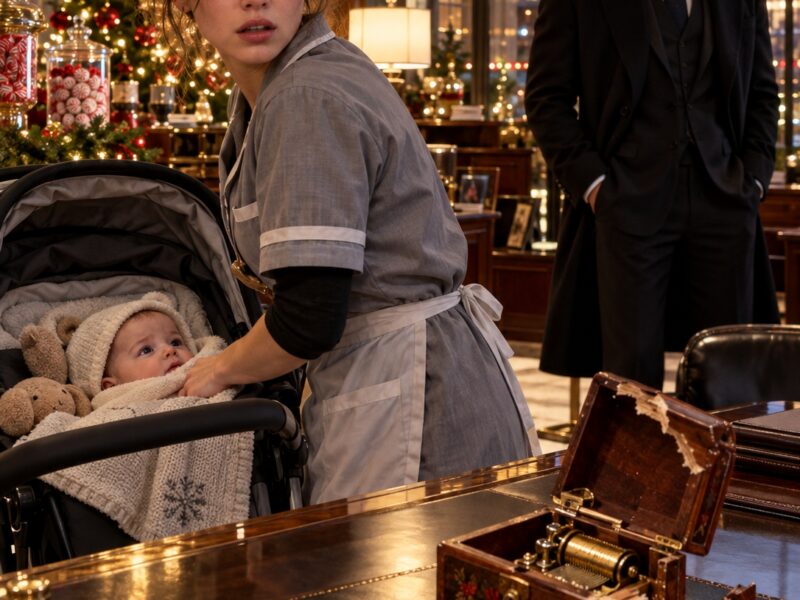
A POOR CLEANER BROUGHT HER BABY INTO THE CEO’S OFFICE ON CHRISTMAS EVE—BUT WHEN THE BABY BROKE A HIDDEN MUSIC BOX, THE BILLIONAIRE’S REACTION EXPOSED A HEARTBREAKING SECRET HE’D BURIED FOR FOUR YEARS.
The first time Hadley Rowan saw Jude Tolbert cry, he was sitting alone in a dark conference room with a broken music box in his hands.
She wasn’t supposed to be there.
Not anymore.
By then, she had lost her job, been investigated by the state, watched strangers question whether she deserved to keep her daughter, and learned how quickly one grainy security video could turn a tired mother into a dangerous one.
Jude had lost something too.
Not his company.
Not his money.
Something he had buried so completely that for four years, even the people closest to him had stopped asking about it.
Hadley stood outside the glass wall without making a sound.
Inside, Jude turned the tiny brass key.
The melody began.
Three notes.
Four.
Then the song reached the place where it had always stopped.
Jude’s shoulders tightened.
Hadley pressed one hand against the cold glass.
And for the first time in four years, Jude Tolbert whispered the name of the daughter he had never allowed himself to mourn.
“Avery Jane.”
Then he bowed his head.
The music kept playing.
To understand why Hadley was standing there listening to a wealthy man break apart over a wooden box, you had to go back seven weeks.
Back to Christmas Eve.
Back to 6:40 p.m., when Hadley Rowan pushed a secondhand stroller through the lobby of the old Tolbert Candy Warehouse in downtown Knoxville and believed the worst thing that could happen that night was getting caught.
The enormous Christmas tree in the lobby was still glowing.
Gold ornaments.
White lights.
Velvet ribbon.
The kind of tree built by professionals and admired by people who didn’t calculate grocery purchases down to the last four dollars.
Hadley walked past it quickly.
Her daughter did not.
Ten-month-old May Rowan twisted beneath a fleece blanket covered in tiny moons and stared at the lights as if she’d just discovered stars.
“Don’t get used to it,” Hadley whispered.
May kicked happily.
The stroller squeaked.
Hadley winced.
Everything about the stroller announced itself—the crooked left wheel, the faded fabric, the small tear near the handle that Hadley had stitched twice.
Normally, May would have been with Mrs. Penland.
But at 3:04 that afternoon, Mrs. Penland had called from urgent care.
She’d slipped on her back steps.
Broken wrist.
Hadley had called the upstairs neighbor.
No answer.
The woman across the street was already visiting family.
The backup daycare on Broadway answered with a cheerful recorded voice wishing everyone a merry Christmas.
Hadley had stood in her kitchen with May on one hip and her work uniform hanging over a chair.
She had exactly three choices.
Miss work.
Leave May alone.
Or bring her.
The second choice had never really been a choice.
Hadley knew what it felt like to be a child waking up in an empty house.
She would rather lose every job she ever had than let May learn that feeling.
So she brought her.
Missing the Christmas Eve shift meant losing holiday premium.
It also meant an attendance point.
Three points meant termination.
Two were already sitting beside Hadley’s name.
She didn’t need someone to explain the math.
At the elevators, she stopped beside a vending machine.
A bottle of water cost $2.25.
Hadley stared at it.
Then she looked into her purse.
Then she walked away.
“Tomorrow,” she murmured.
May slapped the stroller tray.
“Exactly. Water is overrated.”
“Rowan.”
Hadley froze.
Darla Haskins stood beside the supply closet.
Darla had supervised the night crew for eleven years. She was sixty-one, broad-shouldered, silver hair usually tied into a braid, and possessed the supernatural ability to hear a vacuum cleaner malfunction from two floors away.
Her eyes dropped to the stroller.
The color left her face.
“Lord, girl.”
“I know.”
“You absolutely do not know, or you wouldn’t be standing here with a baby.”
“I couldn’t find anyone.”
Darla glanced toward the security camera.
Then back at Hadley.
For a long second, neither spoke.
Finally Darla pulled her cart away from the wall.
“I didn’t see nothing.”
Hadley exhaled.
“Darla—”
“I said I didn’t see nothing. Don’t make me say it twice.”
“Thank you.”
“Keep her off the cameras.”
“I will.”
Darla started away, then turned.
“And keep that chemical cart away from her.”
“Of course.”
“I’m serious.”
“So am I.”
Darla studied her face, perhaps deciding whether desperation had made her stupid.
Apparently satisfied it had not, she nodded.
“Floors one through three are mine. You take four.”
The elevator doors opened.
Hadley pushed May inside.
She did not know that before the night was over, that simple decision—fourth floor—would change almost every part of her life.
The fourth floor smelled faintly of peppermint.
It always did.
The building had once been the original Tolbert candy warehouse, and according to Darla, ninety years of peppermint oil had seeped so deeply into the brick that you could tear the building down and the rubble would probably still smell like Christmas.
Most of the offices were empty.
Executives had gone home hours earlier.
Hadley moved quickly.
Trash.
Vacuum.
Glass.
Desks.
Restrooms.
At the end of the hallway was the largest office.
A brass plate beside the door read:
JUDE TOLBERT
CHIEF EXECUTIVE OFFICER
Hadley had never met him.
She knew the face.
Everybody did.
There was a framed photograph downstairs from some chamber-of-commerce dinner: dark suit, dark hair, serious expression, the kind of man photographers probably asked to smile twice before giving up.
Hadley parked May’s stroller in the doorway.
From inside the office, she could see her daughter constantly.
That was the rule she made for herself.
Wipe the desk.
Look up.
Empty the trash.
Look up.
Dust the credenza.
Look up.
Warm a bottle.
Come back.
Look up.
“Still there,” Hadley whispered.
May grinned.
“Good girl.”
What Hadley didn’t know was that someone else was watching too.
Across the hallway, behind a wall of dark glass, Jude Tolbert sat alone in the conference room.
He had been there since 4:52.
His mother was expecting him for Christmas Eve dinner in Sequoia Hills.
She had expected him the year before too.
And the year before that.
And the year before that.
Every December, Glenda Tolbert asked.
Every December, Jude said he’d try.
Every December, something suddenly became urgent at the office.
A report.
A contract.
A forecast.
Anything with numbers.
Numbers were safe.
Numbers did not ask why he couldn’t sit through Christmas dinner.
Numbers did not ask why he hadn’t opened the closet at home containing one particular cardboard box in four years.
Numbers did not have names.
He had been looking at the Knoxville skyline when he heard the laugh.
A baby’s laugh.
High.
Sudden.
Bright enough to feel almost violent in the silent building.
Jude sat upright.
Another laugh.
He turned.
Through the glass he saw the stroller.
Then the cleaning cart.
Then the woman.
Gray uniform.
Brown hair pulled into a tired knot.
She was polishing his conference table.
Jude reached for his phone.
Children weren’t allowed on cleaning shifts.
There were liability rules.
Insurance rules.
Security rules.
He could call downstairs with one touch.
His thumb hovered over the screen.
Then the woman began singing.
Badly.
Very badly.
“Rudolph the Red-Nosed Reindeer.”
She knew perhaps sixty percent of the lyrics and replaced the rest with humming.
Every few seconds, she stopped polishing and looked toward the stroller.
Not casually.
Automatically.
As if some invisible cord connected her eyes to the child.
She smiled every time.
The baby smiled back.
Jude slowly lowered his phone.
He told himself this wasn’t his concern.
Then he remained exactly where he was.
Watching.
Inside his office, May discovered freedom.
Hadley had loosened the stroller strap while giving her the bottle.
One tiny leg escaped.
Then another.
By the time Hadley turned from the trash can, May was on the carpet.
“May.”
The baby crawled faster.
“Oh, now you have speed?”
May reached the credenza.
“Don’t.”
She pulled herself upright.
“May.”
On the lowest shelf, behind several old annual reports, sat a small walnut box.
May reached.
Hadley lunged.
Too late.
The box hit the floor.
The lid opened.
A delicate melody spilled into the room.
Silent Night.
May gasped in delight.
Hadley’s heart stopped.
“No, no, no—”
She dropped to her knees.
The melody played for several seconds.
Then stopped in the middle of a note.
Silence.
Hadley picked up the box.
A tiny brass hinge had split.
She tried pressing it into place.
It slipped loose.
Again.
Nothing.
“Oh God.”
She looked toward the hallway.
Empty.
Back toward the shelf.
The box had been hidden behind annual reports under a visible layer of dust.
Maybe nobody used it.
Maybe nobody remembered it existed.
She could put it back.
Turn the damaged side toward the wall.
Who would know?
May sat on the carpet staring up at her.
Hadley looked at her daughter.
It was absurd.
May was ten months old.
She wouldn’t remember this moment tomorrow.
But Hadley suddenly heard her grandfather’s voice from years ago.
If your hands break something, those same hands tell the truth.
Odell Rowan had repaired watches behind the counter of a pawn shop in Maryville for thirty years.
People trusted him with wedding watches, retirement watches, watches belonging to dead fathers.
Hadley reached for her clipboard.
She tore off a work ticket.
In careful block letters she wrote:
I broke this.
My daughter pulled it down.
I’m so sorry.
I’ll pay for it or fix it, whichever you’d rather.
Hadley Rowan — Night Crew.
She hesitated.
Then added her phone number.
She placed the note against the box.
Neat.
Square.
Impossible to miss.
Across the hallway, Jude Tolbert stopped breathing.
Nobody had seen her.
She believed she was completely alone.
She could have hidden it.
She hadn’t.
He stared at the note.
Something inside him moved.
Then May coughed.
Hadley turned.
The baby coughed again.
Harsh.
Hollow.
Wrong.
“May?”
Another cough.
Then came the sound.
A thin whistle when she inhaled.
Hadley’s face changed instantly.
She scooped May off the floor.
“Hey. Hey, baby.”
May struggled for another breath.
The skin beneath her ribs pulled inward.
Hadley felt cold spread through her body.
“No.”
She grabbed her phone.
Her fingers slipped against the screen.
“Okay. Mama’s here. Mama’s got you.”
May coughed.
“Come on, sweetheart. Breathe.”
Hadley tried unlocking the phone again.
That was when the conference-room door opened behind her.
She spun around.
A man stood in the doorway.
Tall.
Dark overcoat.
Mid-thirties.
The lobby photograph flashed through her mind.
Jude Tolbert.
Her employer’s biggest client.
The owner of the building.
The man whose office contained the thing her daughter had just broken.
Hadley’s terror rearranged itself into shame.
“I’m sorry.”
Jude stared at her.
“I’m so sorry. I’ll finish the floor. I swear. I just—”
“Which hospital?”
She stopped.
“What?”
He looked at May.
“Which hospital?”
Another terrible whistle.
“East Tennessee Children’s.”
“My car is downstairs.”
Hadley hesitated.
Only for a second.
But Jude saw it.
He understood later what that hesitation contained.
She had come by bus.
A rideshare on Christmas Eve was nearly triple price.
She had broken company policy.
Brought a child into a restricted workplace.
Broken something in his office.
And now the CEO himself was offering to put her in his car.
Trust was expensive when you had very little money.
May coughed again.
Hadley grabbed the diaper bag.
“Okay.”
In the elevator she called the nurse line printed on May’s insurance card.
The nurse listened to the cough through the phone.
“That sounds like croup. You need to bring her in.”
“I’m going.”
“Cold air may help reduce the swelling on the way.”
In the parking garage, Jude opened the rear door of a dark gray sedan.
Hadley climbed in.
Then she stopped.
No car seat.
Everything inside her screamed that this was wrong.
Then May struggled for another breath.
Waiting felt worse.
Jude started the engine.
And rolled down all four windows.
December air crashed into the car.
Thirty degrees.
Hadley wrapped her coat around May.
“Breathe, baby.”
Jude pulled out.
Not recklessly.
Not fast.
Steady.
That surprised Hadley.
Rich men in movies always drove fast during emergencies.
Jude drove as if getting them there alive mattered more than looking heroic.
Wind roared through the sedan.
May’s small body trembled against Hadley’s chest.
“That’s it,” Hadley whispered. “You’re okay.”
She didn’t know whether she was talking to May or herself.
They crossed Henley Street Bridge above the black Tennessee River.
Halfway across, the whistle softened.
Hadley froze.
She listened.
Another breath.
Softer.
Another.
She closed her eyes.
In the front seat, Jude’s hands tightened around the steering wheel.
He had heard it too.
Two strangers drove through freezing air on Christmas Eve, neither speaking, both holding their breath because a baby finally could.
At the emergency entrance, a nurse took one look at May and waved them through.
Hadley turned.
Jude stopped outside the doors.
“Aren’t you coming?”
Something passed across his face.
“No.”
Then, softer:
“I’ll be out here.”
He sat in the waiting room.
For three hours.
He watched a television playing A Christmas Story with the sound muted.
He drank terrible coffee.
He answered no emails.
At 12:45 a.m., Hadley finally appeared.
May was sleeping against her shoulder.
Pink cheeks.
Easy breathing.
Jude stood.
“She’s okay?”
Hadley nodded.
“Croup. They gave her steroids.”
She swallowed.
“The doctor said getting her here quickly helped.”
Jude nodded.
Nothing else.
A nurse found them a loaner car seat.
Jude spent four increasingly irritated minutes attempting to install it.
Hadley watched.
Finally she reached past him.
“You’re doing it backward.”
“I’ve noticed.”
“No, you haven’t.”
He looked at her.
For the first time that night, Hadley almost smiled.
She fixed it in thirty seconds.
The drive home was warmer.
May slept.
At a red light on Broadway, Hadley finally asked the question she had been carrying since the fourth floor.
“Are you going to report me?”
Jude didn’t answer immediately.
The traffic signal painted the windshield red.
Hadley watched his face in the rearview mirror.
“I don’t know yet,” he said.
Her stomach sank.
A lie would have been easier.
Don’t worry.
It’s fine.
Forget it happened.
Instead he had given her the truth.
And somehow the truth frightened her more.
When they reached her duplex in Fountain City, Jude’s headlights swept across plastic sheeting taped over one front window to keep the winter draft out.
He saw it.
Hadley knew he saw it.
She waited for his expression to change.
Pity.
Embarrassment.
Calculation.
It didn’t.
“Thank you,” she said.
“For tonight.”
He nodded.
She carried May inside.
At 3:00 that morning, Jude returned to the office.
He turned on one desk lamp.
The walnut box remained exactly where Hadley had left it.
So did the note.
He picked it up.
I broke this.
My daughter pulled it down.
I’m so sorry.
I’ll pay for it or fix it.
He read those words twice.
Then folded the note carefully.
He placed it inside the music box.
And closed the damaged lid.
He remained at his desk until dawn.
At 7:12 Christmas morning, Hadley’s phone buzzed beside her mattress.
May slept beside her.
Hadley opened the message.
It was from Gil Varner.
YOU’RE PULLED OFF TOLBERT EFFECTIVE IMMEDIATELY.
BUILDING SECURITY SENT ME THE FOOTAGE.
CALL ME.
Hadley stared at the screen.
Then she remembered Jude’s answer.
I don’t know yet.
Apparently, she thought, he knew now.
Christmas morning continued anyway.
That was one of the cruelties of being poor: disasters rarely cleared your schedule.
May needed breakfast.
Diapers needed changing.
Laundry still existed.
Hadley stood over the stove attempting snowman pancakes.
They came out looking like potatoes.
“Merry Christmas, sweet pea.”
May slapped both hands against the high-chair tray.
“Mama is an artist. Don’t let anybody tell you otherwise.”
One present sat beneath their tabletop tree.
A board book about farm animals from the thrift store.
One dollar.
Wrapped in Sunday comics.
May immediately ate the corner of the paper.
“Perfect,” Hadley said.
“Exactly how Christmas is supposed to go.”
But she kept the baby monitor on the kitchen counter.
Every few seconds, she listened.
Breathing.
Normal.
Breathing.
Normal.
She had called Gil at 7:20.
No answer.
An hour later he texted.
COME BY FRIDAY.
WE’LL TALK.
Friday.
Two days.
Two days of not knowing whether she could pay January rent.
Two days of remembering what happened to children whose mothers made mistakes.
While May slept, Hadley sat on the kitchen floor with her back against the cabinets.
And suddenly she was seven again.
Her mother had worked nights at a hosiery mill.
One evening, the sitter didn’t come.
There was no money to miss the shift.
Her mother tucked Hadley into bed.
Kissed her forehead.
Locked the door.
“You’ll be asleep the whole time.”
Hadley wasn’t.
At dawn, she woke to a stranger in the kitchen.
Brown coat.
Folder.
A neighbor had noticed the lights and no car.
Four months.
Hadley spent four months living in someone else’s house.
Someone else’s rules.
Someone else’s smells.
When she finally returned home, her mother hugged her so tightly it hurt.
But something between them had changed.
Her mother had never completely forgiven herself.
Hadley had made a promise at seven years old.
My child will never wake up alone.
Twenty years later, she had kept that promise.
And it might cost her everything.
On December 26, Jude Tolbert arrived at work before eight.
At ten, his assistant called.
Lorna Teague had worked for him nine years and considered unnecessary words a character defect.
“Security flagged your badge.”
Jude stopped reading.
“What?”
“Three a.m. Christmas morning. Holiday access triggers automatic review.”
He knew immediately.
“Lorna—”
“They pulled the hallway footage.”
Silence.
“There’s a baby in it, Jude.”
His eyes closed.
“They sent the clip to Varner Building Services yesterday. Procedure.”
He leaned back.
He had never reported Hadley.
But by returning for the music box, he had triggered the system that did.
That evening, he unfolded Hadley’s note.
He dialed the number.
She answered on the fourth ring.
“Hello?”
“It’s Jude Tolbert.”
Silence.
“I didn’t report you.”
More silence.
“My badge triggered an automatic security review when I came back that night. They pulled the footage. Your company received it automatically.”
A baby babbled behind her.
Finally Hadley said, “Okay.”
He understood immediately.
Okay did not mean I believe you.
It meant the door wasn’t completely closed.
“How is May?”
“Better.”
A beat.
“Loud.”
“Good.”
Another silence.
Jude looked at the music box.
“It’s still here.”
“What?”
“The box.”
“I said I’d fix it.”
“You don’t have to.”
“I wrote it down.”
Her voice changed.
That quiet stubbornness again.
“That means I do.”
Jude looked at the folded note in his hand.
He couldn’t explain why that sentence stayed with him.
On Friday, Hadley took the bus to Varner Building Services.
Gil’s company operated from a converted garage behind a ranch house off Clinton Highway.
Mop buckets stood near the entrance.
A space heater clicked in the corner.
Gil Varner sat behind an old desk.
Fifty-four.
Gray at the temples.
A man who had built his company with one mop and a borrowed van and looked as though he had carried both ever since.
He didn’t yell.
That somehow made Hadley more nervous.
“I watched the clip three times.”
Hadley sat opposite him.
“Forty-seven minutes,” Gil said. “Baby in the stroller. Chemical cart beside her.”
“I was eight feet away.”
“The camera doesn’t show you.”
“I was inside the office.”
Gil rubbed his face.
“Security also says Mr. Tolbert was there.”
Hadley’s stomach tightened.
“He was across the hall. I didn’t know that.”
Gil leaned back.
“Here’s my problem.”
He opened a drawer.
“Tolbert’s contract is forty percent of my business.”
Hadley said nothing.
“If they terminate us over this, eleven people could lose their jobs.”
Darla.
Marcy.
Luis.
Denise.
People with mortgages.
Kids.
Insulin.
Car payments.
Gil slid a page across the desk.
“But if Tolbert gave you permission to bring the baby in, liability changes.”
Hadley looked down.
The first line read:
I, Hadley Rowan, state that Mr. Jude Tolbert gave me permission to bring my daughter into—
She stopped.
Looked up.
“What’s this?”
“Sign it, you’ve got your shifts back Monday.”
“He didn’t give me permission.”
Gil’s expression hardened slightly.
“Hadley.”
“He didn’t even know I was there.”
“I’m trying to protect everybody.”
“No.”
She folded the page.
Set it on his desk.
“You’re asking me to lie.”
“I’m asking you to understand what eleven jobs mean.”
“I understand.”
“Do you?”
Hadley stood.
“I understand exactly.”
She pushed the paper toward him.
“I was eight feet from my daughter. Mr. Tolbert never gave me permission. Both things are true.”
Gil stared at her.
“And I’m not signing something that makes one of them false.”
By Monday, every shift had disappeared from her scheduling app.
Hadley applied at a hotel laundry.
A grocery store.
A motel.
She smiled at managers.
Filled every box.
Wrote AVAILABLE IMMEDIATELY.
Nobody needed to know she had seventeen dollars in her checking account.
Tuesday afternoon, Jude called.
“I heard about your shifts.”
“Who told you?”
“Lorna.”
“Of course.”
“Our company has an employee assistance fund. It could cover—”
“No.”
“Hadley—”
“Gil asked me to sign something.”
Silence.
“Saying what?”
“That you gave me permission to bring May.”
Jude stood from his desk.
“What?”
“I didn’t sign.”
“Jesus.”
“And I’m not taking your money.”
“This isn’t charity.”
“I didn’t say it was.”
“Then what’s the problem?”
Hadley looked at the overdue electric bill on her table.
Because I might need it too much, she thought.
Instead she said:
“I’m not for sale.”
Jude went silent.
“And neither is the truth.”
She exhaled.
“Bring the music box Saturday.”
At exactly ten Saturday morning, Jude knocked on her door.
Hadley let him into the kitchen.
Only the kitchen.
Not the living room.
Not the hallway.
The kitchen table had a wobbly leg and yellow lemons printed across its vinyl cloth.
Jude seemed to understand the boundary without being told.
May was asleep.
Hadley unrolled a worn leather pouch.
Tiny screwdrivers.
Tweezers.
A jeweler’s loupe.
“My grandfather’s.”
Jude looked at the tools.
“Watchmaker?”
“Repairman. Pawn shop in Maryville.”
She fitted the loupe over one eye.
“He taught me before I could ride a bike.”
Hadley opened the music box.
Jude watched her hands.
Small.
Red and chapped from chemicals.
Steady.
Completely steady.
After several minutes she said, “Found it.”
“What?”
“Broken spring.”
She showed him something barely larger than an eyelash.
“That’s why the song stops.”
“Can you replace it?”
“Maybe.”
The following Monday, Hadley carried the spring to Break Bill Jewelers on Kingston Pike.
The shop was narrow and crowded with clocks.
Dozens of them.
Nothing ticked at exactly the same rhythm.
Arlo Break Bill was seventy-eight, wore half-moon glasses, and had buttoned his cardigan incorrectly.
He found a matching spring in one of a hundred tiny drawers.
Then watched Hadley test it.
“Who taught you to hold tweezers like that?”
“My grandfather.”
Arlo nodded as though this explained something important.
The next Saturday, Jude arrived with a paper bag.
Hadley looked inside.
Peppermint sticks.
Tolbert peppermint sticks.
“These are yours.”
“I bought them.”
“You own the company.”
“I bought them at Walgreens.”
“Why?”
“Because apparently that’s important.”
She almost smiled.
Almost.
The repair took several Saturdays.
And something strange happened during those mornings.
They talked.
Not about important things.
At first.
Broken appliances.
Bus routes.
Coffee.
May’s refusal to eat peas.
Jude’s inability to distinguish between children’s clothing sizes.
Then May woke early one Saturday.
She crawled into the kitchen.
Saw Jude.
Went directly toward him.
She grabbed his pant leg.
Pulled herself upright.
Jude froze.
May looked at him.
He looked at her.
He did not touch her.
He kept both hands flat on the table.
Waiting.
Hadley noticed.
The following Saturday, she made a choice.
She lifted May.
Walked around the table.
Placed her in Jude’s arms.
He held the baby as though she were made of glass.
May studied his face.
Then slapped his chin.
She laughed.
Hadley smiled.
“She likes you.”
Jude stared at the baby.
“She doesn’t know any better.”
But his voice wasn’t steady.
Near noon, Hadley finally installed the new spring.
She turned the music box over to tighten the last screw.
Then stopped.
There were words engraved into the bottom.
Small.
Worn smooth where someone’s thumb had touched them many times.
FOR AVERY JANE.
Hadley’s hand went still.
She didn’t ask.
She tightened the screw.
Set the box upright.
Across the table, Jude had become very quiet.
He knew she had seen it.
She knew he knew.
May babbled in his lap.
The furnace switched on.
Who was Avery Jane?
A wife?
A daughter?
A sister?
Someone dead?
Someone who had left?
Hadley didn’t know.
What disturbed her was how badly she suddenly wanted to.
Two days later, someone knocked on her door.
Nine in the morning.
Hadley opened it with May on her hip.
A woman stood outside.
Brown coat.
Folder.
Identification clipped near her collar.
“Tennessee Department of Children’s Services.”
Hadley stopped breathing.
“Miss Rowan?”
The woman’s voice was calm.
“I’m Shea Lowry.”
The kitchen disappeared.
Hadley was seven years old again.
A brown coat.
A folder.
A stranger at the door.
“We received a report concerning your daughter.”
Shea sat at the lemon-print table.
May chewed a plastic spoon on the floor.
Hadley’s hands trembled beneath the table.
“I want to be clear,” Shea said. “A report isn’t a finding. My job is to determine what happened.”
Hadley nodded.
“The report was filed by your employer.”
She already knew.
“Gil Varner.”
Of course.
“He states your daughter was left unattended in a stroller beside industrial cleaning chemicals for forty-seven minutes.”
“She wasn’t.”
“And required emergency treatment that evening.”
“For croup.”
Shea turned a tablet around.
Pressed play.
Gray security footage.
The hallway.
May’s stroller.
Cleaning cart.
No Hadley.
The timestamp moved.
Minute after minute.
From the camera angle, May looked completely alone.
Forty-seven minutes.
Hadley felt sick.
“I was there.”
“Where?”
“Inside the office.”
“How far?”
“Eight feet. Maybe less.”
“But outside the camera frame.”
“Yes.”
“How often did you check her?”
“Constantly.”
Shea waited.
Hadley corrected herself.
“Every thirty seconds. Maybe less. I looked up after everything.”
“Can anyone verify that?”
Hadley went silent.
Then stood.
She opened the kitchen drawer.
Returned with a folder.
Hospital discharge papers.
Vaccination records.
Daycare schedules.
Mrs. Penland’s text from 3:04 p.m.
Fell. Wrist broken. So sorry, honey.
Shea read everything.
Then looked up.
“Was anyone else on the floor?”
Hadley stared at her.
Her entire adult life had been constructed around one principle:
Do not need anyone.
People who needed powerful people became indebted to powerful people.
People who needed witnesses gave those witnesses power.
But there had been someone.
“Yes.”
“Who?”
“I didn’t know he was there at the time.”
Hadley stepped onto the back porch.
Called Jude.
He answered quickly.
“DCS is here.”
She heard movement.
“What happened?”
“Gil reported me.”
“I’m coming.”
“Wait.”
Silence.
“If you come, you tell her what you saw.”
“Of course.”
“Only what you saw.”
Jude said nothing.
“You don’t defend me. You don’t tell her who you are unless she asks. You don’t tell her I’m a good mother.”
“Hadley—”
“That’s mine to prove.”
A pause.
Then:
“Okay.”
“Twenty minutes.”
He arrived in eighteen.
Jude sat opposite Shea.
No suit jacket.
No CEO performance.
He spoke carefully.
“I entered the building at 4:52. Security logs will confirm it.”
“Where were you?”
“Conference room across the hallway.”
“Lights?”
“Off.”
Shea looked up.
“Why?”
Jude’s jaw tightened.
“Personal reasons.”
She wrote that down.
“What could you see?”
“Straight through the glass into my office doorway.”
“And Miss Rowan?”
“She worked inside the office.”
“How often did she look at the stroller?”
Jude glanced at Hadley.
Then back at Shea.
“Every time she lifted her head.”
“How certain are you?”
“Very.”
“Why?”
He took a folded square of paper from his coat.
“Because I kept waiting for her to stop.”
Shea’s pen paused.
“She never did.”
He placed Hadley’s note on the table.
“The baby knocked a music box from my shelf. It broke. Miss Rowan believed nobody was watching.”
Shea unfolded the paper.
“I broke this. My daughter pulled it down. I’m so sorry.”
She read the entire note.
Jude continued.
“She could have hidden the damage. Instead she left that.”
For the first time, Hadley looked at him.
He wasn’t defending her.
He was doing exactly what she asked.
Telling what he saw.
Shea reached into her folder.
“I have something else.”
She removed the hospital intake sheet.
“East Tennessee Children’s.”
Hadley recognized it.
Shea pointed to two handwritten words.
Accompanying adult.
Then she looked at Jude.
“Mr. Varner’s statement contains an additional allegation.”
Hadley’s stomach tightened.
Shea read:
“The CEO and the cleaner appear to have a personal relationship.”
The room went completely still.
Jude’s face changed.
“I drove her to the hospital.”
“Anything else?”
“No.”
Shea folded her hands.
“You understand my problem.”
Jude did.
Hadley did too.
Her only independent witness was now being portrayed as her secret lover.
The truth had become suspicious simply because the wrong person had seen it.
At the door, Shea turned.
“The case can remain open for up to forty-five days.”
Hadley’s fingers tightened around the edge of the table.
“I’ll interview Mr. Varner and your daughter’s daycare.”
Then she left.
Nobody moved.
Jude’s phone buzzed.
Lorna.
He read the message.
His jaw tightened.
“What?”
“Gil wants to meet.”
The Waffle House on Clinton Highway smelled like coffee and hash browns.
Seven the next morning.
Gil Varner sat in a corner booth.
Jude sat opposite him.
Gil stirred his coffee.
“That report’s filed. Can’t unring the bell.”
Jude said nothing.
“But reports can be clarified.”
“What does that mean?”
“Employer reconsiders. Says maybe timing wasn’t exact. Maybe wording was too strong.”
“And what would make you reconsider?”
Gil smiled faintly.
“Your cleaning contract expires at the end of the month.”
Jude stared at him.
For several seconds, the restaurant seemed to disappear.
He had arrived believing Gil was a frightened businessman who had made a cruel decision under pressure.
Now he understood.
Gil hadn’t panicked.
Gil had created leverage.
And now he was selling the truth back.
That evening Jude stood in Hadley’s kitchen.
“I can end this.”
Hadley looked up.
“How?”
“Cancel his contract tomorrow. Lawyers handle the report. He practically admitted what he did.”
“No.”
Jude blinked.
“What?”
“No.”
“He used your daughter.”
“I know.”
“He lied to the state.”
“I know.”
“Then why are we arguing?”
“Because eleven people work for him.”
Jude stopped.
“Darla is one of them. They didn’t file that report.”
“I’ll find them other jobs.”
Hadley laughed once.
No humor.
“Listen to yourself.”
“What does that mean?”
“It means you still think money makes consequences disappear.”
His expression hardened.
“That’s not fair.”
“No? You cancel the contract. Your lawyers show up. Suddenly DCS sees the CEO going to war for the cleaner.”
Jude went silent.
“What does that look like?”
She answered herself.
“Exactly what Gil said.”
The boss’s girlfriend.
Jude’s voice dropped.
“I’m trying to protect you.”
“Protecting me isn’t the same thing as deciding for me.”
The sentence landed hard.
Hadley lowered herself into a chair.
She looked exhausted.
No work in almost three weeks.
Rent due.
Daycare due.
Enough money for one.
Not both.
“I don’t even know you,” she whispered.
Jude’s anger disappeared.
“What?”
“You come here every Saturday. You sit at my table. My daughter reaches for you.”
She looked at him.
“And I don’t know one real thing about you.”
Jude didn’t move.
Hadley thought of the engraving.
“Who is Avery Jane?”
Everything in his face closed.
His mouth opened.
Nothing came.
“Jude?”
He picked up his keys.
Walked toward the door.
Hadley felt something inside her harden.
So there it was.
The boundary.
He could watch her life.
Ask questions.
Enter her kitchen.
See her cracked window and overdue bills and daughter and fear.
But his life remained behind glass.
“Every time you’re near me, somebody’s watching,” she said.
Jude stopped.
“Please don’t come back.”
His hand remained on the doorknob.
Then he left.
The next morning, Lorna entered his office carrying the Varner contract.
“You want it terminated?”
Jude stared at the signature line.
“Extend it sixty days.”
Lorna stared.
“After what he did?”
“Same terms.”
“Jude.”
“Eleven people work for him.”
He signed.
“They didn’t do anything.”
He didn’t call Hadley.
Didn’t drive past her duplex.
Didn’t send money.
Didn’t interfere.
It was the hardest thing he’d done in four years.
Thursday afternoon, the director of May’s daycare asked Hadley into her office.
“The state called.”
Hadley’s chest tightened.
“Routine questions.”
The director smiled awkwardly.
“I’m sure it’s nothing.”
Hadley smiled back.
“Thank you.”
She made it to the bus stop before sitting down.
Friday, she returned to Break Bill Jewelers to return tweezers Arlo had lent her.
The old man examined her over his glasses.
“I need somebody behind this counter.”
Hadley blinked.
“What?”
“Somebody with hands like yours.”
Hope arrived so quickly it hurt.
Then Arlo continued.
“One question I ask everybody. Anything open with the law or state?”
Hadley could have lied.
He would never know.
She needed the job.
She needed it desperately.
“Yes, sir.”
Arlo’s face changed.
“DCS investigation.”
She swallowed.
“It isn’t true. But it’s open.”
Arlo removed his glasses.
“I’m sorry, honey.”
Hadley nodded.
“Not until it’s settled.”
“I understand.”
And she did.
That was the worst part.
That night, she sat on the kitchen floor.
Two envelopes rested on the table.
RENT.
DAYCARE.
She could pay one.
At 11:58, headlights crossed the plastic-covered window.
Hadley’s head snapped up.
Car door.
Footsteps.
She grabbed her phone.
Approached the front door without switching on the light.
A figure stood outside.
Heavy coat.
Gray braid.
Darla.
Hadley opened the door.
Darla’s eyes were red.
In the backseat of an old Buick, a little boy slept against the window.
“Darla?”
The older woman twisted her purse strap.
“Gil didn’t find you on that tape.”
Hadley frowned.
“What?”
“I’m the reason he knew it was you.”
Darla sat at the kitchen table.
Coat still on.
Then told her everything.
For two years, she had sometimes brought her grandson Tucker to work.
His mother worked nights at a nursing home.
When childcare failed, Darla hid him in a second-floor supply room.
Sleeping bag.
Snacks.
Tablet with headphones.
Nobody knew.
“Christmas Eve, Gil called me.”
Darla wiped her cheek.
“He asked whose baby was on four.”
Hadley listened.
“I knew if he started checking cameras, he’d find Tucker eventually.”
Her voice broke.
“So I told him your name.”
Hadley looked away.
“I told him you were inside that office.”
Hadley slowly looked back.
“What?”
“I told him you were watching May. I told him you were right there.”
Darla pulled out her phone.
Displayed a text.
KEEP YOUR MOUTH SHUT ABOUT YOUR GRANDSON AND YOU KEEP YOUR JOB.
Hadley read it twice.
“He knew?”
“He knew everything.”
Darla covered her mouth.
“He knew May wasn’t alone.”
The room became silent.
“I kept this,” Darla whispered. “Don’t know why.”
Her hand shook.
“Maybe I knew I’d have to be brave someday.”
Hadley looked at the woman who had betrayed her because she was terrified of losing the job that kept her own family alive.
And suddenly Gil’s greatest weapon became obvious.
It wasn’t money.
It was fear.
He had found people who couldn’t afford to tell the truth.
Hadley placed her hand over Darla’s.
“Then let’s be brave tomorrow.”
Darla looked up.
“Together.”
The next morning, they sat side by side in Shea Lowry’s office.
Darla told everything.
Including the part that could cost her job.
Shea photographed Gil’s message.
“That took courage.”
Darla wiped her eyes.
“Took about two years too long.”
That afternoon, Hadley and Darla went to Varner Building Services.
Jude offered to come.
Hadley said no.
This one was hers.
Gil looked up from his desk.
Saw them.
Something in his expression collapsed.
“You lied about my daughter,” Hadley said.
Her voice never rose.
“You told the state she was alone.”
Gil stood.
“Hadley—”
“You knew she wasn’t.”
“I was protecting this company.”
“You threatened Darla.”
“I didn’t threaten anybody.”
Darla raised her phone.
Gil stopped.
Behind them, the side door creaked.
A woman in a cardigan stood holding invoices.
Bonnie Varner.
Gil’s wife.
She had kept the company’s books for twenty-six years.
She looked at Darla’s phone.
Then at her husband.
“Gil.”
He closed his eyes.
“What did you do?”
Gil sank into his chair.
“I started this company with a mop.”
Nobody spoke.
“A mop and a borrowed van.”
He rubbed both hands over his face.
“I was going to lose everything over a baby in a hallway.”
Hadley stared at him.
“No.”
Gil looked up.
“You almost lost everything because you lied about one.”
Bonnie walked to his desk.
She placed a legal pad in front of him.
Then a pen.
“Write it.”
Gil stared at her.
“Bonnie—”
“Everything.”
Her voice shook.
“The distance. Where Hadley was. What Darla told you. What you changed.”
“Bonnie.”
“Write it.”
Gil picked up the pen.
It took twenty minutes.
Nobody spoke.
The following week, Bonnie took over Varner Building Services.
Gil stopped coming to the garage.
Darla kept her job.
So did the other ten employees.
And in mid-February, an envelope arrived from the State of Tennessee.
Hadley opened it outside.
Cold wind moved through the street.
May sat bundled in her lap.
Hadley unfolded the letter.
She found the word.
UNFOUNDED.
She read it once.
Again.
A third time.
Then Hadley Rowan sat on her front step and cried.
Not politely.
Not quietly.
She cried for Christmas Eve.
For the hospital.
For every job application.
For the daycare director who couldn’t meet her eyes.
For seven-year-old Hadley waking to a stranger in a brown coat.
For the mother she had spent twenty years trying not to become.
May watched her solemnly.
Then reached up with one mittened hand.
Patted Hadley’s wet cheek.
Hadley laughed through the tears.
“Yeah.”
She kissed the mitten.
“We’re okay.”
Inside the house, the walnut music box sat on the kitchen table.
Hadley had continued repairing it after Jude stopped coming.
A little each night.
The spring.
The hinge.
The scratched wood.
Now it was finished.
That evening, Darla drove Hadley back to the Tolbert building.
“He’s up there every night.”
“How do you know?”
“I run the crew, remember?”
The fourth floor still smelled like peppermint.
The conference room was dark.
Jude sat beside the window.
Exactly where he’d been on Christmas Eve.
Hadley entered.
Placed the walnut box on the table.
“It’s fixed.”
Jude looked at it.
The hinge was whole.
Wood polished.
For Avery Jane remained underneath where nobody could see.
Except the two people in that room.
Jude didn’t touch it.
Hadley sat.
Minutes seemed to pass.
Then he said:
“She was my daughter.”
Hadley remained still.
“Four years ago. Early December.”
His voice sounded different.
Smaller.
“Kendall was thirty-four weeks.”
Hadley understood before he finished.
“No heartbeat.”
Jude looked toward the city.
“They told us Thursday.”
His fingers tightened.
“She was born Friday.”
Hadley couldn’t breathe for a moment.
“And Monday morning, I came to work.”
He laughed once.
A terrible empty sound.
“Monday.”
Hadley said nothing.
“I closed a distribution deal.”
He stared at his hands.
“Kendall stayed home and fell apart.”
His voice cracked.
“I went to meetings.”
A long silence.
“A year later, she left me.”
Hadley waited.
“She said something when she left.”
Jude swallowed.
“She said, ‘You never once said her name.'”
His eyes lifted toward Hadley.
“She was right.”
Hadley looked at the music box.
“Avery Jane.”
Jude flinched.
Not because she had done something wrong.
Because someone had finally spoken the name inside that room.
“The music box was for her nursery,” he said.
“Silent Night.”
His thumb moved over the repaired hinge.
“I bought it before…”
He stopped.
Hadley waited.
“I never let the song finish.”
“Why?”
Jude’s eyes filled.
“I don’t know.”
But Hadley thought he did.
Because finishing meant there was an ending.
And Jude had survived by pretending nothing had happened.
He looked toward the office across the hallway.
“Christmas Eve, I watched you with May.”
Hadley said nothing.
“You kept looking at her.”
He breathed in.
“You sang to her.”
A tear moved down his face.
“I couldn’t move.”
His voice broke.
“I just sat there.”
Hadley watched him.
“I didn’t get up until she couldn’t breathe.”
There it was.
Not romance.
Not rescue.
The real reason.
Jude hadn’t been fascinated by Hadley because she was poor.
Or beautiful.
Or vulnerable.
He had watched a mother love her child without restraint.
And it had forced him to remember the child he had spent four years refusing to name.
Hadley picked up the music box.
Placed it in his hands.
Jude looked at her.
“Say it.”
His face tightened.
“Hadley—”
“Say her name.”
He looked down.
“She should hear you say it.”
Hadley stood.
Walked out.
Closed the glass door.
Jude remained alone.
Except this time, Hadley stood in the hallway.
Watching.
The way he had watched her.
Jude turned the brass key.
The cylinder moved.
Silent Night began.
The repaired mechanism reached the note where it had stopped on Christmas Eve.
Jude’s breathing changed.
“Avery Jane.”
The melody continued.
His shoulders shook.
“Avery Jane.”
He bowed over the box.
The song moved through the next line.
Then the next.
All the way to the end.
Hadley stood unseen in the dark hallway with one palm against the glass.
She didn’t go inside.
She didn’t comfort him.
Some grief needed company.
Other grief needed a witness.
A year later, every clock inside Break Bill Jewelers struck noon at a slightly different time.
Hadley barely noticed anymore.
She sat behind the repair counter wearing a canvas apron, loupe fitted over one eye, working a balance wheel into a 1952 Hamilton.
A customer wanted it running by Christmas.
Hadley worked days now.
Eight to four-thirty.
Her health-insurance card had her own name printed across it.
May attended daycare and frequently came home with glitter in places glitter had no logical reason to exist.
Arlo had hired Hadley the week after the DCS letter arrived.
He’d said only one thing.
“You told me the truth when a lie was free.”
He tapped the counter.
“That’s the whole job, honey.”
He had since begun telling customers that when he retired, the repair counter would belong to Hadley.
Her life wasn’t suddenly glamorous.
She drove an eleven-year-old Corolla.
She compared grocery prices.
Sometimes she returned things to shelves after doing math in her head.
But everything she owned belonged to a life she had built herself.
Not one piece came from Jude.
That mattered to Hadley.
And eventually Jude understood why it needed to matter to him too.
Darla ran the night crew under Bonnie Varner.
Bonnie taped a new policy inside every supply closet.
NOBODY GETS FIRED OVER A SICK CHILD.
Jude’s changes were quieter.
In April, he called Kendall for the first time in three years.
They spoke for almost an hour.
Near the end, there was a long silence.
Then Kendall said:
“Thank you.”
“For what?”
“For finally saying her name.”
In May, a wooden bench appeared beside a trail overlooking the quarry water at Ijams Nature Center.
A small brass plaque was attached to it.
AVERY JANE TOLBERT.
Nothing more.
Nothing needed.
Most evenings, Jude began leaving the office before seven.
Hadley and Jude did not become a fairy tale.
That was important.
They became something slower.
Saturday coffee at a Broadway diner.
A bookshelf Jude attempted to assemble for May without reading the instructions.
Then disassembled.
Then rebuilt correctly while Hadley watched without helping.
Arguments over schedules.
Awkward silences.
One disastrous dinner involving burned chicken.
Evenings when neither had enough energy to be romantic, so they sat on Hadley’s couch eating cereal.
Sometimes Jude wanted to solve something Hadley hadn’t asked him to solve.
Sometimes Hadley mistook concern for judgment.
Sometimes they argued.
Then learned how to come back.
Slowly.
Nothing dramatic.
Nothing purchased.
Nothing rescued.
Real.
On Christmas Eve, exactly one year after the night they met, Jude drove Hadley and May to his mother’s house in Sequoia Hills.
He hadn’t spent Christmas Eve there in five years.
Glenda Tolbert opened the door wearing a red sweater.
She stopped.
First she looked at her son.
Then Hadley.
Then May.
Almost two now.
Pink light-up sneakers flashed every time she stepped across the welcome mat.
Then Glenda looked back at Jude.
And saw him smile.
A real smile.
She didn’t ask questions.
Didn’t cry.
Didn’t make a speech.
She turned toward the china cabinet.
And quietly placed two additional plates on the table.
After dinner, Jude and Hadley stood on the back porch.
Cold air moved through the trees.
Below the hill, Knoxville lights shimmered against the river.
Inside, May pressed her nose against the glass door.
Jude rested both hands on the porch railing.
“I used to think loving somebody meant watching over them.”
Hadley turned toward him.
“So nothing bad could happen.”
His eyes stayed on the river.
“Then something happened anyway.”
Hadley understood.
“So I stopped watching anybody.”
She pulled her coat tighter.
“I used to think being seen meant being judged.”
Jude looked at her.
Neither said those fears had disappeared.
They hadn’t.
Maybe they never completely would.
“I can’t promise you a fairy tale,” Jude said.
“Good.”
That surprised a laugh out of him.
Hadley smiled.
“I don’t trust fairy tales.”
Jude became serious again.
“I’m not going to fix your life.”
She waited.
“It doesn’t need fixing.”
That mattered.
More than he knew.
“I just want to walk beside you.”
His voice was quiet.
“Not in front.”
Hadley felt something tighten in her chest.
“And never deciding for you.”
She didn’t answer.
Instead she looked through the glass.
May was pointing furiously toward the Christmas lights outside.
Hadley picked up the little pink coat from a chair.
Held it toward Jude.
“She wants to see the lights.”
Jude looked at the coat.
Then at Hadley.
“Can you get her into this?”
It was an ordinary question.
Except it wasn’t.
Jude understood what she was giving him.
Not permission to rescue them.
Not permission to lead.
Something smaller.
Something harder.
A place beside them.
He took the coat.
May immediately fought the first sleeve.
“Why is she stronger than me?”
“Technique.”
“She’s twenty-three pounds.”
“Twenty-four.”
“That explains it.”
May escaped.
Jude caught her.
Hadley laughed.
Eventually the zipper reached the top.
May ran to Hadley.
Then back to Jude.
Then toward the lights.
Later that evening, the walnut music box rested beneath Glenda’s Christmas tree.
The hinge was whole.
The walnut gleamed softly beneath the lights.
May crouched beside it.
She found the key.
Twisted.
Nothing.
Again.
Nothing.
Jude knelt beside her.
He reached out.
Then stopped.
Looked at Hadley.
A year earlier, Jude would have simply taken over.
Hadley knew that.
So did he.
She nodded.
Jude folded his hand gently around May’s tiny one.
Together, they turned the key.
The lid lifted.
Silent Night filled the room.
Glenda stopped breathing for a moment.
In the kitchen, someone stopped rinsing dishes.
Nobody spoke.
The song continued.
Through the first line.
The second.
Past the place where it had once stopped.
May swayed on her blinking pink sneakers, humming something that wasn’t remotely the melody.
Jude sat on the floor beside her.
He wasn’t crying.
Not this time.
He was listening.
The music played through every note.
All the way to the end.
Then silence returned.
But it wasn’t the same silence.
Jude looked across the room at Hadley.
For a second, she remembered the dark conference room a year earlier.
The invisible man behind the glass.
Watching a frightened cleaner sing to her baby because he couldn’t bear to go home for Christmas.
She remembered how terrified she had once been of being seen.
Seen bringing her daughter to work.
Seen counting money.
Seen living behind a plastic-covered window.
Seen needing help.
Seen making mistakes.
And Jude had once been terrified of something almost opposite.
He was afraid to look.
At his daughter.
At his marriage.
At his grief.
At anything he couldn’t protect.
Maybe that was why they had found each other.
Not because one of them had rescued the other.
Because eventually, they had learned the difference between watching someone and truly seeing them.
May reached for the key again.
Jude looked at Hadley.
Hadley smiled.
“Again.”
May squealed.
Jude turned the key with her.
The little wooden box began playing once more.
And somewhere beneath the laughter, the clinking dishes, the peppermint on the table, and a little girl’s terrible humming, Avery Jane’s song finally belonged to Christmas again.
Jude looked at Hadley the same way he had looked at her through that dark pane of glass one year before.
Only this time, she knew he was watching.
And this time—
she let him.









