A Seven-Year-Old Paid a Mafia Boss $20 to Protect Her for One Day—Then He Learned Who Her Dead Father Was
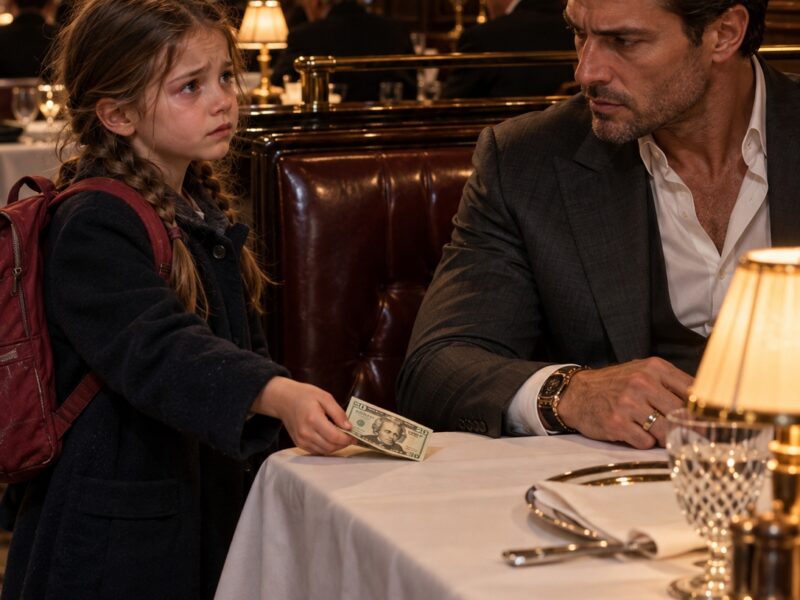
The little girl put twenty dollars on Dante Moretti’s table and asked him to keep her alive until tomorrow.
Six days later, Dante would discover that her father had died because of an order bearing his signature.
But at three o’clock on that gray Tuesday afternoon, he knew none of that.
He only knew the child standing across from him was seven years old.
And terrified enough to hire a stranger.
The brass bell above the front door of the Raven trembled once and went still.
It was the dead hour between lunch and dinner, when half the chairs were upside down on tables and the kitchen had fallen into its afternoon silence. November light came through the leaded windows and stretched pale rectangles across the tiled floor.
Dante Moretti sat alone in his usual corner booth.
Forty-one years old. Dark gray suit. White shirt open at the collar. No tie.
A newspaper rested between his hands.
People in that neighborhood knew better than to interrupt Dante Moretti when he was reading.
The girl apparently did not.
Her navy wool coat was too large through the shoulders. A worn red backpack hung from both straps. Her hair had been braided badly, probably without a mirror. One braid sat higher than the other.
She walked directly toward him.
No hesitation.
No looking around.
That interested Dante before anything else did.
Children looked around unfamiliar rooms.
Frightened children looked everywhere.
This one had already decided where safety was supposed to be.
She stopped beside his table.
Then she reached into her coat pocket.
Marco Bellini appeared through the kitchen door at exactly that moment, drying his hands on a towel.
He saw the child.
He saw her hand moving.
He started forward.
Dante raised one finger.
Marco stopped.
The girl pulled out a twenty-dollar bill.
It had been folded twice, then twice again, until it was no larger than a matchbook.
She placed it carefully between Dante’s coffee and his newspaper.
“Mister,” she said, “can I hire you to protect me for one day?”
Dante looked at the money.
Then at her.
Her chin was lifted with the deliberate courage of a child who had been taught that appearing frightened could sometimes be more dangerous than being frightened.
Dante folded his newspaper.
“Sit.”
She climbed into the chair opposite him.
Her feet didn’t reach the floor.
She placed the backpack across her knees and folded both hands over it.
Dante studied her.
“What’s your name?”
“Clara.”
“Clara what?”
A pause.
“Bennett.”
The pause mattered more than the answer.
Dante leaned back slightly.
“How do you know who I am?”
“The librarian at school said you own this street.”
Marco’s eyes shifted toward Dante.
Dante’s expression didn’t.
“I don’t own this street.”
Clara considered that.
“She said everybody acts like you do.”
That almost made Marco smile.
Almost.
Dante glanced toward the twenty.
“And why do you need protection?”
“There’s a man following me.”
The room changed.
Not visibly.
The same afternoon light remained on the floor. Somewhere behind the kitchen door, a pot lid clicked against a burner.
But Marco stopped drying his hands.
Dante’s eyes sharpened.
“What man?”
Clara answered like a witness.
“He wears a tan coat. The collar has fake fur, but it’s old. The right side is flatter than the left.”
Dante said nothing.
“Brown shoes,” she continued. “There’s a scratch across the left one. It goes like this.”
She traced a diagonal line in the air.
“He usually stands on my left side. He doesn’t stand under the brightest streetlight. He stands between two lights.”
Marco slowly lowered the towel.
Clara continued.
“He carries coffee.”
“What kind?”
“Big paper cup. From the deli.”
“He drinks it?”
“No.”
“How do you know?”
“He held the same cup for almost an hour yesterday.”
That was when Dante stopped seeing a frightened child.
He started seeing somebody who had been trained.
“Who taught you to notice those things?”
“My mama.”
“What else did she teach you?”
Clara looked down at her hands.
“To count to seven.”
Dante waited.
“If you think somebody is following you, you count to seven. If they’re still there, you go into a store with two doors. You don’t run. You ask to use the bathroom. You leave through the back if you can.”
Marco moved one step closer.
Clara noticed.
She noticed everything.
“And after that?” Dante asked.
“Turn twice before taking a bus.”
“How many times have you done that?”
She thought.
“In this city?”
Dante felt something cold settle behind his ribs.
“How many cities, Clara?”
“Three.”
The answer came easily.
“Portland first. I was little. Then Austin. Now here.”
“And your name?”
Her eyes lifted to his.
“In Portland, Katie.”
A pause.
“In Austin, Anna.”
Another pause.
“Now Clara.”
Dante looked at the twenty-dollar bill again.
It suddenly seemed heavier than money should.
He pushed it toward her.
“Keep it.”
She didn’t move.
“This one’s on the house.”
“No, sir.”
Her voice was polite.
Firm.
“If you don’t take my money, it’s a favor.”
Dante waited.
Clara swallowed.
“Favors can be taken back.”
Her small fingers tightened around the backpack.
“Contracts can’t.”
For the first time in several years, Dante Moretti had no immediate answer.
Marco watched him.
The restaurant seemed to wait with them.
Finally Dante reached across the white tablecloth.
He picked up the folded twenty.
Turned it once between his fingers.
Then placed it inside the breast pocket of his jacket.
Not in his wallet.
Against his heart.
“One day,” he said.
Clara’s shoulders dropped half an inch.
“Starting now.”
Dante stood.
“Marco.”
Marco was already reaching for his coat.
“Bring the car around.”
Dante looked down at Clara.
“Where’s your mother?”
“At home.”
“Does she know you came here?”
“No.”
“What does she think you’re doing?”
“Library.”
Dante held out his hand.
Clara looked at it, then took it.
“Are you going to tell her about the twenty dollars?”
“No.”
“Promise?”
Dante opened the restaurant door.
Cold November air moved into the Raven.
“That’s between us.”
For the first time, Clara smiled.
Only a little.
Outside, a black Bentley pulled to the curb.
And across the street, a man pretending to examine his phone lowered his head.
Dante saw him.
Clara did not.
That was when Dante understood something the girl herself did not yet know.
Her one-day contract had already begun.
And somebody else had placed a much larger contract on her first.
The apartment was above a dry cleaner in Queens.
Three flights up.
Green iron street door. Peeling paint. Narrow stairwell smelling of cleaning solvent and somebody’s cardamom-heavy dinner.
Clara led Dante to the last door.
It opened before she knocked.
Her mother stood there.
Sarah Bennett was lean, pale, perhaps thirty-five. Her brown hair was tied low at the nape of her neck. Gray sweater. No jewelry.
Her right hand was hidden behind the doorframe.
Dante stopped immediately.
He knew that stance.
Weight low.
Body angled.
Door used as cover.
Eyes moving over him, past him, down the stairs, then back.
Not panic.
Training.
“Baby,” Sarah said.
Her voice remained remarkably steady.
“What did you do?”
“I hired someone.”
Sarah looked at Dante.
The hidden hand didn’t move.
Dante raised both hands.
“She came to me. I walked her home. That’s all.”
“You need to leave.”
“Ma’am—”
“Now.”
Dante believed her.
More importantly, he believed whatever she had behind the door.
He reached slowly into his jacket.
Sarah’s shoulders tightened.
He removed a plain white card containing only a telephone number and placed it on the small table inside the threshold.
“If the man in the tan coat comes tonight, call that number.”
Sarah’s face changed by almost nothing.
Almost.
“My people can be here in six minutes.”
“I don’t know what you’re talking about.”
“Yes, you do.”
Their eyes held.
Then Dante stepped backward.
He walked downstairs without looking behind him.
Sarah did not take the card while he was watching.
She didn’t throw it away either.
That told him enough.
By the time Dante reached the Bentley, Marco had already placed two men on the block.
One wore a delivery jacket.
Another sat inside a hatchback eating a sandwich.
Dante climbed into the back seat.
“Find out who Sarah Bennett was before she became Sarah Bennett.”
Marco glanced at him in the mirror.
“You think she’s running?”
“I think she’s been running so long her daughter thinks counter-surveillance is something mothers teach before multiplication tables.”
Marco put the car in gear.
“And the man?”
“Don’t touch him.”
Dante looked up toward the third-floor window.
“Not yet.”
By nine that night, Marco had an answer.
Or rather, the absence of one.
Sarah Bennett’s Social Security number was legitimate. Her driver’s license was legitimate. Her employment records checked out.
For seven years.
Before that?
Nothing.
No school.
No prior address.
No medical history that matched.
No childhood.
Sarah Bennett had been born as a fully documented adult.
“A professional identity build,” Marco said over the phone.
Dante watched the apartment window from across the avenue.
“How good?”
“Very.”
“How expensive?”
“Very.”
At 9:22, Dante’s phone rang.
Unknown Queens number.
He answered.
Sarah spoke first.
“Who are you really?”
“Someone who owes your daughter twenty dollars’ worth of protection.”
“That isn’t funny.”
“It wasn’t meant to be.”
Silence.
Dante heard traffic behind her.
She wasn’t calling from the apartment.
Smart.
“The man in the tan coat,” Dante said. “How long?”
Seven seconds passed.
Exactly seven.
“Three years,” Sarah said.
“On and off.”
Dante looked toward the third-floor window.
“Officer Bennett.”
Silence.
“Before you took your daughter and disappeared, who were you protecting her from?”
Sarah hung up.
She had not denied being an officer.
That was his answer.
The next morning, Dante’s men watched Clara’s school.
At 7:48, the man appeared.
Tan coat.
Worn fake-fur collar.
Brown shoes.
Scratch across the left toe.
Clara had remembered everything.
But the coffee cup was gone.
Instead, his left hand rested low inside his coat.
Dante watched through the Bentley’s tinted glass.
“He’s not watching the school,” Marco murmured.
“No.”
The man was watching the reflection of the school in a parked sedan’s windshield.
Marco lowered the binoculars.
“Professional.”
The man’s lips moved.
Tiny movements.
Comms.
Dante’s expression hardened.
“Follow him.”
“Take him?”
“No.”
Dante watched the man turn away.
“I want to know who pays him.”
The trail led to a business hotel in Long Island City.
The car registered to Meridian Passage LLC.
Delaware shell.
No public officers.
No meaningful address.
A corporation designed to exist without appearing to exist.
That night Dante called an FBI contact named Howerin.
He gave him one name.
Meridian Passage.
Forty minutes later, Howerin called back.
“That company only does one thing we can identify.”
“What?”
“It pays Samuel Voss.”
Dante had never heard the name.
Howerin’s next sentence ensured he would never forget it.
“If Voss is being paid to find somebody, Dante, that somebody should start writing a will.”
Elena Cruz arrived at the Raven shortly before eleven.
Eight years earlier she had investigated financial crimes for the Southern District of New York.
Now she investigated things for Dante.
Three folders lay on the walnut conference table.
“Samuel Voss,” she said. “Sixty-two. Psychiatrist. Formerly licensed. Boston, then Providence.”
“What happened to the license?”
“Three patients disappeared.”
Dante looked up.
“Disappeared how?”
“Completely.”
Elena opened a folder.
“Two were federal witnesses. One was the wife of a Boston police lieutenant. Nobody proved Voss killed anybody because killing wasn’t his specialty.”
“What was?”
“Making people disappear.”
She pushed a photograph toward him.
“Voss is what people in his world call an identity architect.”
Not fake passports.
Not forged driver’s licenses.
Lives.
He built Social Security histories, medical records, school records, credit footprints, employment trails.
For ninety thousand dollars, a woman could become somebody who had apparently existed for thirty years.
Sarah Bennett was almost certainly one of his creations.
But Voss had another business.
He kept copies.
Every original name.
Every new name.
Every destination.
Then, years later, when somebody came looking with enough money, he sold the person twice.
Elena placed four photographs on the table.
“These people bought identities from Voss.”
Dante looked at them.
“They were all found again.”
“How many survived?”
“None.”
The room became very quiet.
Dante looked at Sarah Bennett’s thin file.
Then he thought about uneven braids.
A navy coat.
A red backpack.
A folded twenty-dollar bill.
“Who pays ninety thousand dollars,” he asked, “to find a seven-year-old?”
Elena’s expression tightened.
“Maybe somebody who doesn’t need the seven-year-old.”
Dante looked at her.
“Maybe they need something she’ll eventually inherit.”
And suddenly the contract felt much larger than one day.
Thursday morning, Clara saw the man herself.
She was sitting beside the library window with a book about North American songbirds open across her knees.
Across the street, the tan coat appeared.
Clara didn’t stare.
Her mother had taught her better.
She looked at the illustration of a winter finch.
And counted.
One.
The man passed the school.
Two.
He turned.
Three.
He came back.
Four.
His hand touched his pocket.
Five.
He stopped between two parked cars.
Six.
He pretended to check his phone.
Seven.
Still there.
Clara turned another page.
If they see you, see them.
If they know you know, you lose something.
Never let them know you know.
Ninety seconds later, she calmly returned the book to the shelf.
She approached the librarian.
“Mrs. Marlene?”
“Yes, sweetheart?”
“Could you call my mother?”
The librarian saw Clara’s face.
“What should I tell her?”
“Monday, Tuesday, Wednesday.”
Mrs. Marlene did not understand the words.
But she understood the child saying them.
“Right now,” she promised.
Sarah arrived twenty minutes later.
Four blocks from the apartment, she saw Dante waiting under an awning.
She stopped the car.
“He came to the school.”
Dante looked at Clara through the passenger window.
“He’s never done that before,” Sarah said.
Her hands were white around the steering wheel.
“That means something changed.”
“Yes.”
“What?”
Dante looked back at Sarah.
“His employer is tired of waiting.”
Sarah said nothing.
Dante finished the thought.
“I think they’ve decided this is the last week.”
That night Sarah finally invited him inside.
Clara slept in the back room with one arm wrapped around a stuffed rabbit.
Sarah poured coffee into two mismatched mugs.
For several minutes neither adult spoke.
Then Sarah said, “Her father was a detective.”
Dante’s fingers stopped against the ceramic.
“Boston Police. Narcotics.”
She stared into the coffee.
“Killed seven years ago outside a warehouse in the port district.”
Something cold moved through Dante.
He did not yet know why.
“The department called it crossfire,” Sarah continued. “Wrong place, wrong time. Rival crews. He was supposedly doing solo surveillance.”
“Clara?”
“Six weeks old.”
Sarah swallowed.
“He held her twice.”
Her voice softened.
“The second time was the morning he died.”
Dante said nothing.
“I was a cop too. His partner on other cases. I knew he was investigating something inside the department. Three days after we buried him, a lieutenant called me into a conference room and told me the investigation was finished.”
Sarah looked at Dante.
“He shook my hand before I left.”
Her thumb rubbed slowly over the pale place where a wedding ring had once been.
“He held on half a second too long.”
“You understood.”
“I understood perfectly.”
A widow with a badge.
A newborn daughter.
Knowledge powerful men wanted buried.
Sarah went home.
Emptied the accounts.
Sold her wedding ring.
And paid Samuel Voss ninety thousand dollars to erase both of them.
“He gave me Bennett,” she said. “He gave my daughter Clara.”
“What was her name before?”
Sarah hesitated.
“Katie.”
Dante remembered Clara’s answer at the restaurant.
Portland.
Katie.
Austin.
Anna.
Queens.
Clara.
Seven years of names.
Seven years of running.
“Why didn’t you use witness protection?”
Sarah’s eyes hardened.
“Because the people Marcus was investigating wore badges.”
Dante leaned forward.
“What was your husband’s name?”
Sarah looked down.
“Marcus.”
The name meant nothing yet.
Then she added the surname.
“Marcus Reed.”
Dante’s hand tightened beneath the table.
He knew that name.
Not from memory.
From somewhere worse.
A file.
An old report.
Something he had chosen not to read closely enough.
Sarah didn’t notice the change in him.
“He left something,” she said.
“What?”
“I don’t know.”
“You’ve had it seven years and never opened it?”
“He told me not to.”
Dante looked toward the hallway where Clara slept.
“Show me.”
The next morning Sarah lifted a floorboard beneath Clara’s bed.
A black steel box rested between the joists.
Inside were a Glock, three passports, six thousand dollars in cash—
and a sealed manila envelope.
Written across the front in pencil were the words:
For Clara on her 10th birthday. From her father.
Dante stared at it.
Marcus had created a safe-deposit trust shortly before he died.
The contents would become Clara’s when she turned ten.
Two and a half years away.
Sarah finally understood why the hunt had accelerated.
“They know something exists,” she whispered. “They don’t know exactly what.”
“And once Clara turns ten—”
“She gets access.”
Sarah looked at her sleeping daughter’s bed.
“If Clara never turns ten, there’s nobody left to claim it.”
Dante felt the entire case rotate.
The stalker wasn’t hunting Sarah.
He wasn’t even primarily hunting Clara.
He was hunting a birthday.
A date on a calendar.
A dead detective had built a bomb seven years ago, locked it inside a bank, and set the timer for his daughter’s tenth birthday.
“Who did Marcus suspect?” Dante asked.
Sarah looked at him.
“His closest friend.”
“Name.”
“Frank Delaney.”
Detective Frank Delaney.
Narcotics.
Best man at their wedding.
Two years after Marcus died, Delaney had purchased a thirty-eight-foot Grady-White in cash.
He called it inheritance.
His mother was still alive.
Sarah reached toward Marcus’s envelope.
Dante stopped her.
“Don’t.”
She looked at him.
“We could know tonight.”
“And lose our advantage tonight.”
He pointed at the seal.
“Right now they don’t know what Marcus left. Uncertainty is the only reason they still need information.”
Sarah slowly withdrew her hand.
Dante looked at the envelope again.
“And I need Voss alive.”
“For what?”
“To tell us who paid him.”
Sarah studied Dante.
Something in his face had changed.
“You already suspect.”
Dante closed the steel box.
“I suspect everybody.”
It was not an answer.
Sarah knew it.
But she let him have the lie.
For one more day.
At three that afternoon, Dante stood alone in his office above the Raven.
A folder lay on the desk.
He had not opened it in six years.
BOSTON OPERATION — WAREHOUSE DISTRICT.
Seven years earlier, the Moretti organization had been fighting a Boston crew over shipping routes.
Dante had been thirty-four, newly responsible for decisions his father had once made.
He had authorized a warehouse strike.
Five opposing men died.
His people recovered the shipment.
Fourteen minutes.
Clean operation.
Except for one line on page two.
Dante read it again.
One collateral. Plainclothes officer believed to have been conducting solo surveillance.
His throat tightened.
He turned the page.
Date.
Warehouse.
Time.
Everything Sarah had told him.
Then the name.
Marcus Reed.
Dante sat down.
For several seconds, the room seemed to lose sound.
He remembered the report.
He remembered refusing to ask the officer’s name.
Names made collateral into people.
People had wives.
Children.
Morning routines.
Coffee mugs.
Unfinished conversations.
So Dante had asked for only one thing.
The widow’s bank information.
Fifteen thousand dollars had been transferred anonymously through three shell companies.
A gesture he had once allowed himself to call mercy.
Now he opened his desk drawer.
The twenty-dollar bill lay on a square of white linen.
Clara’s money.
Dante stared at it.
Marcus Reed had held his six-week-old daughter twice.
The second time had been the morning Dante’s signature sent armed men toward the warehouse where Marcus stood.
Seven years later, Marcus’s daughter had walked into Dante’s restaurant.
She had placed twenty dollars in front of the man responsible for the operation that killed her father.
And she had said:
Protect me.
Dante closed his eyes.
There were debts money could pay.
There were debts blood could pay.
And then there were debts for which payment itself was an insult.
He picked up the phone.
“Marco.”
“Yes?”
“Bring the car around.”
A pause.
“We’re moving Sarah and Clara.”
“Where?”
“The farmhouse.”
Dante looked once more at the twenty-dollar bill.
“Tonight.”
The farmhouse stood two hours north of New York City, surrounded by thirty acres of forest and meadow.
Motion sensors lined the drive.
Thermal cameras watched the perimeter.
Dante owned the road for the final mile and a half.
If Voss came, Dante wanted him coming onto ground Dante understood.
Sarah agreed for one reason.
Running had failed.
Portland.
Austin.
Queens.
Every new identity bought time.
None bought freedom.
Clara slept most of the drive north.
When they arrived after one in the morning, Sarah was too exhausted to carry her.
Dante lifted the child.
Her head settled against his shoulder.
Halfway upstairs, she opened her eyes.
“Mr. Moretti?”
“Yes?”
“Are we hiding?”
He considered lying.
“No.”
Her sleepy eyes remained on him.
“We’re waiting.”
“For what?”
Dante looked toward the dark window at the end of the hall.
“For them to make a mistake.”
Clara apparently found that acceptable.
She fell asleep again.
The next morning, Marco made pancakes.
Clara found an orange barn cat with white paws and a torn ear.
She named him Twenty.
Dante actually laughed when she told him.
Sarah heard it from the hallway.
She stopped.
For a moment, the dangerous man everyone feared was sitting at a kitchen table while a seven-year-old explained why a half-feral orange cat required the same name as her protection contract.
Then Dante’s phone rang.
The moment disappeared.
Elena.
“I found the money.”
Dante stood.
“Tell me.”
“Meridian Passage received fifty thousand dollars three weeks ago.”
“From?”
“The Delaney Family Legacy Trust.”
Dante’s eyes moved toward Sarah.
She was standing twenty feet away.
She knew from his face.
“Frank Delaney controls the trust,” Elena continued. “His mother died in 2023. He controls every distribution.”
“So Delaney hired Voss.”
“Yes.”
Sarah closed her eyes.
Her husband’s best friend.
The man who stood beside them at their wedding.
The man who carried Marcus’s casket.
The man who had hugged Sarah after the funeral.
He had spent seven years waiting for Marcus’s daughter to become dangerous.
But Sarah had one more document.
A forty-page internal report she had stolen from Marcus’s file before fleeing Boston.
Marcus had spent eleven months investigating nine narcotics officers who were stealing seized drugs from evidence and reselling them across three states.
Money moved through real estate.
Boat transactions.
A Marblehead marina.
At the top of Marcus’s suspect list:
Frank Delaney.
But another name appeared repeatedly.
Samuel Voss.
Voss had been Marcus’s informant.
Marcus paid him seven hundred dollars a week for documents.
Delaney paid him more.
Dante read the final entry.
Marcus planned to meet Voss at ten o’clock the night he died.
At the warehouse.
Voss never arrived.
Sarah stood beside Dante on the farmhouse porch while Clara sat in the grass below them, reading a bird book to Twenty.
“Voss sold Marcus to Delaney,” Sarah said.
Dante kept reading.
“He also sold someone else the shipment routes that night.”
Dante already knew.
Sarah didn’t.
“Delaney didn’t need to kill Marcus himself,” she continued. “He only needed to put Marcus in the path of somebody else’s bullets.”
The wind moved through the meadow.
“He knew another organization was hitting that warehouse.”
Dante closed the report.
“He used them as a weapon.”
Dante looked down at his hands.
Yes.
He had.
Without knowing.
Frank Delaney had aimed him at Marcus Reed.
But Dante had still pulled the trigger in the only way men like him pulled triggers from offices.
With ink.
Sarah looked at him.
“You’re very quiet.”
Dante handed back the report.
“Keep this inside.”
“That’s all?”
“For now.”
She watched him walk away.
She knew there was another truth.
She simply did not know its name yet.
At three in the morning, she found it.
The farmhouse was silent.
Dante sat across from Sarah at the pine kitchen table.
Two cups of coffee cooled between them.
Upstairs, Clara slept.
Outside, armed men waited in the trees.
Voss was coming north.
Sarah stared at Dante.
“You know who killed Marcus.”
Dante did not answer.
“That wasn’t a question.”
“I know who set the trap.”
“That isn’t what I asked.”
Dante looked at her.
Sarah’s face was very still.
“Was it you?”
There are moments when a lie can save a man.
This was not one of them.
“I ordered the warehouse hit.”
Sarah stopped breathing.
“Seven years ago,” Dante continued, “my organization was in a dispute over the port lane. I signed the order.”
She stared at him.
“My people were supposed to hit five men. They came back reporting one additional casualty. Plainclothes officer. Solo surveillance.”
Sarah’s eyes became wet.
She did not cry.
“I never asked his name.”
That hurt her more.
Dante could see it.
“I found the widow’s information. I sent fifteen thousand dollars anonymously.”
Sarah stood so quickly the chair scraped backward.
Then she froze.
“Fifteen thousand?”
Dante nodded.
“Through a Boston attorney?”
“Yes.”
Her face changed.
“Oh my God.”
She walked away from him.
Then back.
“You paid me.”
Dante said nothing.
“Three months after Marcus died, fifteen thousand dollars appeared in my account.”
Her voice broke for the first time.
“I sat on the bathroom floor for an hour with the bank printout.”
Dante could barely look at her.
“I hated that money.”
She laughed once, without humor.
“But I needed it.”
Sarah pressed a hand against her mouth.
“Voss wanted ninety thousand.”
Dante understood before she finished.
“Your fifteen was the last fifteen.”
The room seemed to contract around them.
“I used the money you sent me because my husband died…”
She looked directly at Dante.
“…to disappear from the man who arranged his death.”
Dante had no defense.
So he offered none.
Sarah crossed to a kitchen drawer.
Opened it.
Removed the Glock.
Dante did not move.
She returned.
Placed the pistol on the table.
Slid it between them.
For one terrible second, neither spoke.
“Not tonight,” Sarah said.
Dante looked at her.
“Voss is coming. Clara is upstairs. I need you thinking clearly.”
Her voice trembled now.
Not from fear.
Rage.
“When this is finished, you owe me a choice.”
Dante nodded.
“You don’t disappear. You don’t send money. You don’t send a lawyer.”
“I won’t.”
“You sit across from me.”
She pushed the Glock closer.
“And you let me decide what happens next.”
Dante looked at the weapon.
Then at the widow of the man his order had killed.
“I won’t run.”
Sarah sat down.
Neither touched the gun again for the rest of the hour.
At 3:27 a.m., the first perimeter sensor turned red.
Three black SUVs were coming up the road.
Headlights off.
Six armed men minimum.
Samuel Voss was among them.
Dante stood.
The contract was about to reach its final hour.
Sarah carried Clara into the reinforced cellar.
Clara held Twenty against her chest.
“Is Mr. Moretti okay?”
Sarah locked the steel door.
“He’s doing his job.”
Clara looked down at the cat.
“That’s what I paid him for.”
Outside, the first SUV reached the culvert.
Marco opened fire.
The driver went down.
Men spilled from the vehicle.
Gunfire tore through the trees.
Dante watched from the farmhouse.
Then he heard something worse than gunfire.
Silence.
Directly beneath him.
A floorboard creaked on the back porch.
Andrew Hy had slipped around the perimeter.
Dante drew his Glock.
He entered the kitchen just as the back door opened.
Hy came through with his pistol raised.
Both men stopped.
Four yards apart.
The refrigerator clicked on, throwing a pale rectangle of light across the floor.
“You looking for the girl?” Dante asked.
Hy aimed at his chest.
“Voss wants her.”
“No.”
Dante raised his weapon.
“Delaney wants her.”
“Same money.”
“Not anymore.”
Hy’s eyes narrowed.
Dante continued.
“We have Delaney’s trust. His transfers. Marcus Reed’s report. Federal warrants are already being drafted.”
Hy’s trigger finger changed.
Barely.
But Dante saw it.
“Your contract is dead.”
A professional killer did one thing before risking his life.
He calculated.
For half a second, Andrew Hy recalculated.
Dante fired twice.
The first bullet hit Hy’s shoulder.
The second struck his thigh.
He collapsed.
His pistol skidded across the floor.
Dante kicked it away.
“Stay down.”
Hy clenched his jaw.
“I know.”
Dante touched his earpiece.
“Marco?”
“Clear.”
“Voss?”
“Alive.”
Dante breathed once.
“Bring him to the porch.”
Minutes later, Sarah unlocked the cellar.
Clara emerged behind her, still holding the orange cat.
She looked at Hy lying on the kitchen floor.
Studied him carefully.
Then she looked at Dante.
“That’s the man in the tan coat.”
“Yes.”
Clara tilted her head.
“He looks smaller in here.”
Dante almost smiled.
Fear usually did.
Dawn came gray over the farmhouse.
Samuel Voss knelt on the gravel with his hands bound.
He looked less like a criminal mastermind than a tired professor.
That, Dante thought, was probably how evil survived so long.
It learned to look administrative.
Voss looked up.
“Mr. Moretti.”
Dante said nothing.
“I know who you are.”
Still nothing.
Voss smiled.
“Seven years ago, I sold Frank Delaney the information that placed Marcus Reed outside that warehouse.”
Dante’s jaw tightened.
“I also sold your organization the shipment intelligence that brought your men there.”
Sarah had stepped onto the porch.
She stopped.
Voss continued.
“I sold both sides.”
His smile widened.
“You and I have been business partners for seven years, Mr. Moretti.”
Dante felt something ancient and ugly rise inside him.
He let it die.
Killing Voss would be easy.
Living with him alive would be harder.
So Dante chose harder.
“You’re going to prison.”
Voss laughed softly.
“I can give you Delaney.”
“I already have him.”
The smile disappeared.
Dante stepped closer.
“Frank Delaney was arrested forty minutes ago at the Marblehead marina.”
For the first time, Samuel Voss looked afraid.
Not because a gun was pointed at him.
Because information had moved without his permission.
The architect had lost control of the blueprint.
Dante turned toward Sarah.
“Officer Bennett.”
She stared at him.
It had been seven years since anyone had called her that and meant it.
Dante nodded toward Voss.
“Would you like to make the arrest?”
Sarah slowly descended the porch steps.
She stopped in front of Samuel Voss.
For seven years, this man had owned the secret map of her life.
Every name.
Every address.
Every escape.
Now he was kneeling at her feet.
Sarah crouched until their eyes were level.
“Samuel Voss.”
Her old police voice returned.
Clear.
Controlled.
Alive.
“You are under arrest.”
And somewhere behind her, Clara watched her mother become someone she had never known.
Not Sarah Bennett.
Not the frightened woman who checked windows twice.
Not the mother who taught her to count to seven.
Officer Sarah Whitfield.
The woman who had survived.
By eight that morning, state police and federal vehicles filled the property.
The Boston Federal Savings safe-deposit box was opened under emergency court order.
Inside were Marcus Reed’s notebook, records linking ninety-one accounts to Delaney’s laundering network, and recordings of meetings between Marcus and Samuel Voss.
Frank Delaney would not be walking away.
Neither would Voss.
Sarah gave her statement at the same pine table where she had placed the Glock between herself and Dante hours earlier.
She told the agents everything.
Almost.
There were some truths that belonged to another table.
Another day.
When the interviews ended, Sarah found Dante beside the garage.
“Witness protection offered us Oregon.”
Dante looked at her.
“Real identities?”
“Federal.”
“Take it.”
“I already said yes.”
He nodded.
Sarah looked toward the farmhouse.
“Clara wants to write to you.”
Dante’s expression shifted.
“I told them I need a post-office box in Manhattan. Once every two months.”
“You shouldn’t tell me where you are.”
“I won’t.”
“Good.”
“She’ll send drawings.”
Dante looked away.
For once, he did not trust himself to speak.
Sarah understood.
There were still things unresolved between them.
Marcus.
The warehouse.
The signature.
The choice Dante had promised her.
Forgiveness was not one of the things Sarah owed him.
Perhaps it never would be.
But hatred was no longer simple either.
The man who had helped create her worst day had also stood between her daughter and death.
Neither truth erased the other.
That was what made them truths.
At 10:40, the federal van arrived.
Clara came down the porch steps carrying Twenty.
Dante reached inside his jacket.
The twenty-dollar bill was still there.
He held it toward her.
“Your contract is fulfilled.”
Clara stared at the bill.
“You’re giving it back?”
“The job is finished.”
She considered this.
Then she sat on the porch step.
She folded the bill.
Once.
Again.
Then another time.
Her small fingers worked carefully until the money had become something else.
A bird.
Two wings.
A small folded head.
A tail raised slightly behind it.
Clara stood.
She climbed into the van.
Before Marco closed the door, she leaned out.
“Mr. Moretti?”
“Yes?”
She held out the bird.
“Keep this one.”
Dante took it.
“I’ll make another next time.”
The door closed.
The van started down the gravel drive.
Dante stood there until it disappeared.
Then he stood there a little longer.
The paper bird remained in his palm.
Twenty dollars.
That was what a seven-year-old had decided one day of safety was worth.
Dante had spent his adult life around men who believed everything had a price.
Judges.
Cops.
Loyalty.
Silence.
Lives.
Maybe they had all misunderstood money.
Sometimes the smallest amount could purchase the heaviest promise.
Months passed.
Autumn returned to New York.
At five o’clock one afternoon, the Raven was quiet between shifts.
Half the chairs were upside down.
Dante sat in the same corner booth.
The brass bell rang.
Marco entered carrying a white envelope.
No return address.
He placed it on the table.
Dante opened it.
Inside was a crayon drawing.
A kitchen.
Yellow curtains.
A bowl of apples.
Sarah sat on one side of a table.
Clara sat beside her.
Twenty, now considerably fatter, occupied Clara’s lap.
On the wall behind them was a small blue picture frame.
Inside it, Clara had drawn a paper bird.
Dante unfolded the note.
The handwriting leaned slightly right.
Mister,
School is okay. Mama laughs sometimes now. Twenty is fat. I am learning piano. Miss you sometimes.
Clara
Then, beneath it:
P.S. Mama says hi. She means it.
Dante read the last sentence twice.
Marco waited.
“Any reply?”
Dante carefully folded the note.
“Not yet.”
“When?”
Dante looked at the paper bird sitting inside the small silver frame on his table.
“Maybe when she turns ten.”
Marco understood.
He returned to the kitchen.
Dante remained alone.
Clara would turn ten someday.
On that morning, in a town Dante would never visit, Marcus Reed’s final truth would belong to his daughter.
Perhaps Sarah would tell Clara everything.
Perhaps she would leave one part out.
That the man who protected her had once signed the order that shaped the greatest absence in her life.
Dante no longer believed every silence was cowardice.
Some were.
Some were lies.
Some were weapons.
But sometimes silence was simply a burden an adult chose to carry so a child would not have to carry it yet.
Dante finished his espresso.
He slipped Clara’s newest drawing into the leather satchel containing the others.
Then he walked outside.
Malbury Street glowed pale gold beneath the late-afternoon sun.
Across the street, another little girl walked beside her mother.
Red coat.
School backpack.
Seven, perhaps.
She looked across traffic and saw Dante standing outside the Raven.
For no reason at all, she waved.
Dante froze.
Then slowly raised his hand.
He waved back.
The girl continued down the sidewalk.
She never knew his name.
She never knew what kind of man he had been.
She never knew about Marcus Reed, Frank Delaney, Samuel Voss, Sarah Whitfield, the farmhouse, the black SUVs, or the little girl who had once entered the restaurant behind him carrying twenty dollars and enough fear for three lifetimes.
And perhaps that was the point.
For most of Dante Moretti’s life, people had said he owned Malbury Street.
He finally understood how little that meant.
Owning a street meant people feared what you might do.
Belonging to one meant noticing who walked home afraid.
Inside the Raven, beneath the afternoon light, a small silver frame rested on the corner table.
Behind the glass was a twenty-dollar bill marked permanently by four old creases.
Beside it, hidden inside a leather satchel, was the same money folded into the shape of a bird, its edges slowly yellowing with time.
A child had once offered it to a dangerous man because she needed one safe day.
She had no idea she was asking him to repay a debt seven years old.
She had no idea her father’s blood lived somewhere in his past.
She had no idea that the man accepting her twenty dollars would eventually discover that protecting her could never undo what he had done.
Maybe that was why Dante kept the bird.
Not as proof that he had redeemed himself.
Some things could not be redeemed that neatly.
Not as proof Sarah had forgiven him.
She hadn’t.
Not even as proof that Clara was safe.
No one could promise that forever.
He kept it because once, on an ordinary Tuesday afternoon, a seven-year-old girl had walked into his restaurant and asked the most powerful man she could find for exactly one day of courage.
And when the day became six days, and six days became a lifetime of consequences, Dante Moretti finally learned the difference between paying a debt—
and carrying one.









