A Single Dad Sang to a Dying Stranger in the Wrong ICU Room—The Next Morning, a Billionaire CEO Demanded to See Him…
The first thing Victoria Bennett remembered from the night she almost died was not the alarm of a heart monitor.
It was not the doctors shouting over her bed.
It was not the fluorescent glare of the ICU ceiling or the cold pressure of an oxygen mask against her face.
It was a man’s voice.
Rough.
Untrained.
A little shaky.
Singing to her in the darkness.
And then, just before the darkness swallowed her again, she heard him whisper something no one had said to her in years.
“You’re not alone tonight.”
By morning, one of the most powerful women in America wanted to know who he was.
The problem was that Daniel Carter had no idea she had heard him.
He had no idea who she was.
And when he walked into that ICU room shortly before midnight, he had been looking for someone else entirely.
His eight-year-old daughter.
Six hours earlier, Daniel had carried Emma Carter through the emergency entrance of Mercy Hills Medical Center in Chicago with rain dripping from his hair and terror crawling beneath his skin.
“Dad?”
“I’m right here.”
Emma’s arms were wrapped around his neck.
Usually she complained that she was too old to be carried.
That evening, she hadn’t complained once.
That frightened him more than anything.
Her face was pale against his wet construction jacket, her breathing shallow and uneven.
Daniel pushed through the emergency department doors.
“My daughter needs help.”
A nurse hurried toward him.
“What happened?”
“She got sick this afternoon. Fever, vomiting, then she almost passed out. She said her chest hurt.”
“How old?”
“Eight.”
“Name?”
“Emma Carter.”
The nurse reached for a wheelchair.
Daniel shook his head.
“I’ve got her.”
“Sir, we need to—”
“I’ve got her.”
It came out sharper than he intended.
He immediately softened his voice.
“Sorry. I just… I’ve got her.”
Emma lifted her head weakly.
“Dad.”
“Yeah, Bug?”
“Don’t be mean to the nurse.”
Despite everything, the nurse smiled.
Daniel almost laughed.
Almost.
Then Emma’s eyes rolled shut.
And the entire emergency department seemed to move at once.
A stretcher appeared.
Someone took Emma from his arms.
Doctors surrounded her.
Questions came from every direction.
Medical history.
Allergies.
Symptoms.
Medication.
Insurance.
Daniel answered as quickly as he could until one question stopped him.
“Mother?”
He hesitated.
“Deceased.”
The nurse looked up.
“I’m sorry.”
“It was two years ago.”
There was no time to explain more.
No time to say that Emma’s mother, Rachel, had died after an aggressive illness that turned a healthy thirty-three-year-old woman into a photograph on the living-room shelf in less than eleven months.
No time to explain that since then Daniel had learned how to braid hair badly, pack school lunches, wash pink clothes separately, attend parent-teacher conferences, fix broken dolls, remember pediatric appointments, and hide overdue bills beneath grocery-store coupons.
He had also learned something else.
Fear never really left after you lost someone.
It simply learned to wait quietly.
And that evening, watching doctors wheel Emma away, Daniel felt it waking up again.
“Mr. Carter?”
He looked at the physician.
“We’re moving her upstairs for monitoring.”
“ICU?”
“For observation while we stabilize her. It doesn’t necessarily mean the worst.”
But Daniel heard only one word.
ICU.
The same three letters had appeared on the doors during Rachel’s final week.
For a second, he couldn’t breathe.
Then Emma reached for him.
“Daddy?”
Daniel forced himself forward.
He took her hand.
“I’m here.”
“Am I dying?”
The question nearly broke him.
“No.”
He answered too quickly.
Emma noticed.
Children always noticed.
“You promise?”
Daniel looked into his daughter’s frightened eyes.
He wanted to tell the truth.
He wanted to say he didn’t know.
Instead, he squeezed her hand.
“I promise I’m not going anywhere.”
It was the only promise he knew he could keep.
By 11:40 that night, Daniel had been awake for nearly twenty hours.
He had worked construction from six in the morning until three in the afternoon, helping install drywall in a commercial building near West Loop.
At 3:17, Emma’s school had called.
By 3:46, he was driving through Chicago traffic with one hand on the steering wheel and the other reaching backward every few seconds to make sure his daughter was still conscious.
Now his work boots were still damp.
His jeans were stained with plaster dust.
His phone battery showed three percent.
And somewhere inside his jacket was an unopened envelope from his landlord.
He already knew what it said.
Late.
Again.
Daniel sat beside Emma’s hospital bed and watched every movement of the monitor.
Beep.
Beep.
Beep.
It was astonishing how quickly a human being could begin worshiping a sound.
As long as the machine kept beeping, Daniel could breathe.
Emma opened her eyes.
“Dad?”
He leaned forward instantly.
“Hey.”
“You look terrible.”
Daniel stared at her.
Then laughed quietly.
“You’re eight.”
“I have eyes.”
“You’re supposed to say I look handsome.”
“You look like a wet raccoon.”
“That’s better.”
A faint smile appeared on her face.
Daniel felt his chest loosen.
Emma looked toward the window.
Rain streaked the glass.
“Can we go home tomorrow?”
“I hope so.”
“Can we get pancakes?”
“If the doctor says yes.”
“With chocolate chips?”
“We’ll negotiate.”
She studied him.
Then her expression changed.
“Dad?”
“What?”
“Are we poor?”
Daniel went still.
“Why would you ask that?”
“I heard you talking to the lady downstairs about insurance.”
He looked away.
Emma continued.
“And last week you said we couldn’t order pizza because you had to pay electricity.”
“We have electricity.”
“That’s not what I asked.”
Rachel had always said Emma inherited Daniel’s stubbornness.
Daniel privately believed she had inherited Rachel’s terrifying ability to detect nonsense.
He rubbed his face.
“We’re okay.”
“That means yes.”
“No. It means your dad has everything under control.”
Emma narrowed her eyes.
“That’s what you said when the toilet broke.”
“And did I fix it?”
“You watched six videos.”
“But did I fix it?”
“Eventually.”
Daniel smiled.
Emma didn’t.
“Is the hospital expensive?”
His smile disappeared.
He leaned closer.
“Listen to me. You don’t worry about money. Ever. That’s my job.”
“But—”
“Your job is to get better.”
Emma stared at him for several seconds.
Then she nodded.
“Okay.”
Daniel kissed her forehead.
A few minutes later, a nurse entered.
“Mr. Carter?”
Daniel stood.
“We need to run another examination. The doctor wants to check a few things.”
“Is something wrong?”
“Not necessarily.”
Those two words again.
Not necessarily.
Hospital language for don’t panic yet.
“How long?”
“Maybe twenty minutes.”
“I can stay.”
“We need some room.”
Emma’s fingers tightened around his.
Daniel looked down.
“I’ll be right outside.”
“You promise?”
“Doorway.”
“Dad.”
“I’m serious. You’ll probably see my ugly face through the glass.”
That earned another weak smile.
He squeezed her hand and stepped into the hallway.
The door closed behind him.
And suddenly Daniel had nothing to do except think.
That was dangerous.
He checked his phone.
Two percent.
Three missed calls from his supervisor.
One message.
Need to know if you’re coming tomorrow. Crew is short.
Daniel closed his eyes.
If he didn’t work, he didn’t get paid.
If he didn’t get paid, rent didn’t get paid.
If Emma stayed in the hospital…
He stopped the thought.
One problem at a time.
That was how he had survived the two years since Rachel died.
One problem.
Then the next.
Then the next.
Never look at all of them together.
Because if you did, they started looking like a wall.
Daniel walked toward a vending machine and stared at the prices.
He put his hand into his pocket.
Two crumpled dollar bills.
Some coins.
A hospital parking receipt.
He bought the cheapest coffee.
It tasted burned.
He drank it anyway.
Then he started back toward Emma.
At least, he thought he did.
Mercy Hills had recently renovated part of its critical-care floor, and at midnight every hallway seemed identical.
White walls.
Blue signs.
Muted televisions.
Glass doors.
The smell of disinfectant.
Daniel turned left instead of right.
He checked a room number without really reading it.
Then he pushed open the door.
“Emma?”
Silence.
Daniel stopped.
This wasn’t Emma’s room.
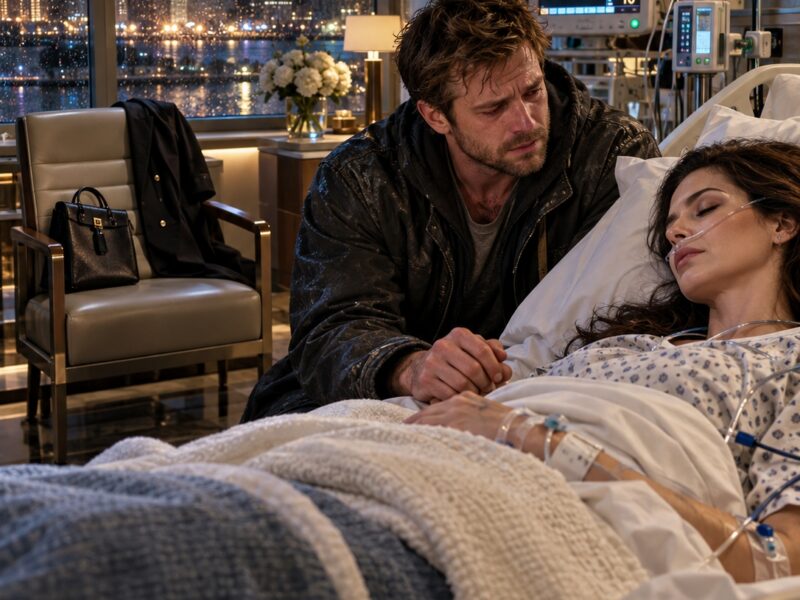
A woman lay alone beneath a white blanket.
She appeared to be somewhere in her early forties.
Dark hair rested against the pillow.
Several machines surrounded her.
An IV line disappeared beneath the blanket.
Her face was pale.
Still.
Daniel immediately stepped backward.
“Sorry.”
Of course, she didn’t answer.
He reached for the door.
Then something made him stop.
There were no balloons.
No family photographs.
No sweater draped over a chair.
No half-finished cup of coffee left by a worried husband.
Nothing.
Just the woman.
The machines.
And an empty chair.
Daniel knew it was ridiculous.
She was unconscious.
She didn’t know whether someone was sitting beside her.
But he remembered Rachel’s hospital room.
He remembered the nights when she would wake disoriented and reach blindly toward the chair until she found his hand.
And he remembered Emma an hour earlier.
You promise?
Daniel looked back toward the woman.
He should leave.
He had his own daughter to worry about.
He had bills.
Work.
A dying phone.
A life held together by exhaustion and duct tape.
He did not have emotional energy left for a stranger.
Then the woman made a faint sound.
Daniel froze.
It wasn’t a word.
Barely even a breath.
But something about it sounded frightened.
He walked back toward the bed.
“Ma’am?”
Nothing.
Daniel glanced toward the hallway.
No nurse appeared.
He pulled the chair closer.
“This is probably weird.”
Silence.
“I’m Daniel.”
He gave a nervous laugh.
“My daughter is somewhere down this hallway, and apparently I’m too tired to remember which room she’s in.”
The woman’s eyes remained closed.
Daniel looked at the monitor.
Steady.
He hoped that was good.
“My daughter hates hospitals.”
He paused.
“Actually, everybody hates hospitals. That’s probably not interesting information.”
Still nothing.
Daniel should have felt foolish.
Instead, sitting beside a stranger somehow made it easier to breathe.
Maybe because he didn’t have to pretend.
“I’m scared too,” he whispered.
The confession surprised him.
Daniel hadn’t said it aloud all evening.
Not to the doctors.
Not to nurses.
Certainly not to Emma.
He stared at his hands.
They were rough from construction work.
Small cuts crossed his knuckles.
“I keep telling her everything’s going to be okay.”
His voice tightened.
“But I don’t know that.”
The monitor continued its quiet rhythm.
Daniel swallowed.
“My wife died in a hospital.”
He looked toward the unconscious woman.
“So I’m not very good at this.”
His eyes burned.
He blinked hard.
Then he remembered something.
A rainy night years earlier.
Emma at five years old, trembling beneath her blankets during a thunderstorm.
Dad, sing.
Daniel smiled faintly.
“Emma makes me sing when she’s scared.”
He leaned back.
“You’re lucky you’re unconscious because I’m terrible.”
For some reason, that made him think of his mother.
She used to sing an old folk melody while washing dishes when Daniel was a boy.
It was simple.
A song about home.
About losing your way.
About keeping a light burning for someone who hadn’t returned yet.
Daniel had sung it to Rachel.
Then to Emma.
Now, close to midnight in the wrong ICU room, he began singing it to a woman whose name he didn’t know.
His voice cracked on the second line.
He stopped.
“This is embarrassing.”
No response.
Daniel smiled.
“Okay. You asked for it.”
He started again.
This time, he kept going.
He sang quietly so he wouldn’t disturb anyone.
There was nothing impressive about his voice.
No perfect notes.
No trained control.
Just a tired father singing because somewhere along the way he had learned that sometimes love was nothing more complicated than staying in the room.
Outside the glass, ICU nurse Carla Reyes slowed her steps.
She had been carrying a medication tray.
She stopped.
Through the window she saw a man in wet work clothes sitting beside Victoria Bennett.
Carla knew who Victoria was.
Everyone on the floor did.
Her admission had triggered calls from administrators who rarely visited the ICU at midnight.
Private security had arrived.
Executives had called.
Her assistant had demanded updates.
But Victoria’s closest relatives were out of state and struggling to get back to Chicago because storms had delayed flights.
So for several hours, one of the most influential women in American business had lain almost entirely alone.
Carla watched Daniel sing.
She could have interrupted him.
Technically, she probably should have.
Instead, she stood outside.
And listened.
Inside the room, something changed.
Daniel didn’t notice.
Carla did.
Victoria’s fingers moved.
Barely.
One small twitch against the sheet.
Carla stepped closer to the glass.
Daniel finished the final line.
For several seconds, he said nothing.
Then he stood.
“I hope wherever you’re trying to get back from…”
He looked at the woman.
“…you make it.”
He pushed the chair beneath the bed.
Then, feeling ridiculous but unable to stop himself, Daniel leaned closer.
“I don’t know who you are.”
His voice was almost a whisper.
“But nobody should have to fight alone.”
He looked at her hand but didn’t touch it.
“You’re not alone tonight.”
Then he walked out.
Carla moved aside before he saw her.
Daniel disappeared down the hallway.
She entered Victoria’s room.
“Ms. Bennett?”
Nothing.
Carla checked the monitor.
Stable.
Then Victoria’s lips moved.
Carla leaned closer.
At first, she couldn’t understand.
Then she heard it.
“Who…”
Carla’s breath caught.
Victoria’s eyelids fluttered.
“Who was singing?”
Daniel found Emma’s room three minutes later.
The doctor was waiting for him.
And the expression on his face erased everything else.
“Mr. Carter.”
Daniel’s stomach dropped.
“What happened?”
“Emma’s stable.”
He exhaled.
“But?”
The physician gestured toward a consultation room.
Daniel didn’t move.
“Tell me here.”
“We found signs of a significant infection. We believe we’ve identified what’s causing her symptoms, but we want to keep her under close observation and start aggressive treatment tonight.”
“Is she going to be okay?”
“We have every reason to be optimistic.”
Daniel hated sentences like that.
“What does that mean?”
“It means she’s responding. But the next several hours matter.”
Daniel looked through the glass at Emma.
She was asleep.
Tiny beneath the hospital blanket.
He nodded.
“Do whatever you have to do.”
The doctor spoke gently.
“We will.”
Daniel sat beside Emma until sunrise.
He never mentioned the woman.
By seven in the morning, his phone was dead.
By eight, his supervisor had left a voicemail he couldn’t hear.
By nine, Daniel had forgotten entirely about the stranger in the wrong room.
Then two hospital administrators walked into Emma’s room.
Daniel stood immediately.
“Is there a problem?”
“No, Mr. Carter.”
One of them looked strangely nervous.
“We’d actually like to ask you something.”
Behind them stood a woman in an immaculate black suit.
She carried a leather folder.
Daniel recognized her face.
Not personally.
From television.
News interviews.
Business magazines at grocery-store checkout lines.
He frowned.
Then recognition hit.
Victoria Bennett.
Founder and CEO of Bennett Technologies.
Daniel had seen her speak on television about artificial intelligence, manufacturing jobs, education grants, and some billion-dollar acquisition he hadn’t understood.
He looked from the woman in the black suit to the administrators.
“Why is Victoria Bennett’s company here?”
The woman extended her hand.
“I’m Claire Donovan. Ms. Bennett’s chief of staff.”
Daniel did not take it.
He looked toward Emma.
“Is this about my daughter?”
“No.”
“Then I’m confused.”
Claire studied him.
“Were you in ICU room 814 last night?”
Daniel’s face changed.
The wrong room.
“Oh.”
The administrators exchanged glances.
Daniel rubbed the back of his neck.
“Yeah. For a few minutes. I’m sorry. I was looking for my daughter. I didn’t touch anything.”
Claire’s expression softened.
“We know.”
“If I broke some hospital rule—”
“You sang to her.”
Daniel stared at her.
“What?”
“The patient in room 814.”
His embarrassment arrived immediately.
“Jesus.”
He lowered his voice.
“Sorry.”
Claire almost smiled.
“You sang.”
“Look, I thought…”
He stopped.
“I don’t know what I thought.”
“Do you know who was in that bed?”
Daniel shook his head.
Claire held his gaze.
“Victoria Bennett.”
Silence.
Daniel looked at her.
Then at the administrators.
Then back.
“The Victoria Bennett?”
“Yes.”
He let out a stunned breath.
“Well.”
It was all he could think to say.
Claire’s expression became serious.
“She regained consciousness briefly after you left.”
Daniel straightened.
“She did?”
“The first thing she asked was who had been singing.”
Daniel felt something cold move through him.
“She heard me?”
“Parts of it.”
“But she was unconscious.”
“People can sometimes retain fragments. Voices. Sounds. Emotions.”
Daniel looked down.
He suddenly remembered everything he had said.
His wife.
Emma.
His fear.
“I didn’t know.”
“We understand.”
Claire glanced at Emma.
“Ms. Bennett wants to meet you when she’s strong enough.”
Daniel almost laughed.
“Why?”
Claire looked at him for a moment.
Then she said something he would remember for years.
“Because apparently you were the only person in the room who didn’t know she was Victoria Bennett.”
Three days passed.
Emma improved slowly.
Her fever dropped.
Her appetite returned.
Daniel slept in twenty-minute fragments in a chair beside her bed.
He borrowed a charger from a nurse and discovered fourteen missed calls.
His supervisor had replaced him temporarily.
His landlord had sent another message.
The hospital billing department had left a voicemail.
Daniel deleted that one without listening.
He would deal with it later.
He always dealt with things later.
On the fourth morning, Emma was eating gelatin when she looked at him.
“Dad?”
“What?”
“Why does everybody keep looking at you?”
Daniel glanced toward the hallway.
Two nurses immediately looked away.
“No reason.”
“You did something.”
“I did not.”
“You definitely did.”
Daniel sighed.
“I accidentally walked into another patient’s room.”
Emma stopped eating.
“That’s it?”
“I may have sung.”
She stared at him.
Then burst out laughing.
“It’s not funny.”
“You sang to a random person?”
“She was unconscious.”
“That makes it worse.”
“Thank you.”
Emma laughed harder.
Daniel pointed his plastic spoon at her.
“I can still ground you.”
“From the hospital?”
“I’ll find a way.”
A knock came from the door.
Claire Donovan stood there.
Emma looked between them.
“Oh.”
Daniel frowned.
“What?”
Emma whispered loudly.
“Fancy lady.”
Claire heard.
To Daniel’s surprise, she smiled.
“May I come in?”
Daniel nodded.
Claire approached Emma.
“You must be Emma.”
Emma nodded.
“You’re the one whose father gets lost.”
Daniel covered his face.
Claire laughed.
“I’ve heard.”
Then she turned toward him.
“Victoria is awake.”
Daniel lowered his hand.
“Good.”
“She’d like to see you.”
“Now?”
“If you’re comfortable.”
Daniel looked at Emma.
His daughter waved him away.
“Go.”
“You sure?”
“Dad, I’m eating green gelatin. My day cannot get worse.”
Claire laughed again.
Daniel reluctantly stood.
As they walked down the hallway, he became increasingly uncomfortable.
“What exactly am I supposed to say?”
“Whatever you want.”
“That is terrible advice.”
“You managed fairly well when she was unconscious.”
“I thought she couldn’t hear me.”
“That may have helped.”
They stopped outside a private room.
Two security officers stood nearby.
Daniel looked down at himself.
Faded jeans.
Work boots.
A sweatshirt he had slept in.
“Maybe I should change.”
Claire opened the door.
“Victoria has met presidents wearing less comfortable clothes.”
“That doesn’t help.”
“Go in.”
Daniel stepped inside.
The woman in the bed looked different awake.
Smaller somehow.
More human.
Her hair was pulled loosely behind her head.
There was no makeup.
No television lighting.
No tailored suit.
No stage.
Just a tired woman recovering from something that had nearly killed her.
Victoria looked at him.
For several seconds, neither spoke.
Then she smiled.
“You sing terribly.”
Daniel stared at her.
Then he laughed.
“I was hoping you wouldn’t remember that part.”
“I remember enough.”
“I’m sorry I walked into your room.”
“I’m not.”
Daniel shifted awkwardly.
Victoria pointed toward the chair.
“Please.”
He sat.
She studied him.
“You thought I was someone else?”
“No.”
Her eyebrow lifted.
“I thought the room belonged to my daughter.”
“So you regularly sing to strangers?”
“Only unconscious billionaires.”
Victoria laughed.
Then winced.
Daniel leaned forward.
“You okay?”
“Yes.”
A beat passed.
Then she asked quietly, “Why did you stay?”
Daniel looked at her.
“I don’t know.”
“That isn’t true.”
He rubbed his hands together.
“You looked alone.”
Victoria’s smile disappeared.
Daniel immediately wondered if he had offended her.
“I didn’t mean—”
“No.”
She looked toward the window.
“You were right.”
The room became quiet.
“My staff was here,” she continued. “Security. Hospital administrators. My assistant was making calls. My family was trying to get back.”
She paused.
“But you were right.”
Daniel waited.
“I was alone.”
There was something in the way she said it that had nothing to do with an empty hospital chair.
Daniel recognized it.
Grief had the same accent in rich people.
Victoria looked back at him.
“I remember your voice.”
“Unfortunately.”
“I don’t remember every word.”
Her expression changed.
“But I remember you saying I wasn’t alone.”
Daniel didn’t know how to respond.
So he simply nodded.
Victoria looked at his hands.
“You work construction?”
“Yeah.”
“And something else.”
Daniel frowned.
“How do you know?”
“You said something about two jobs.”
He had forgotten that.
“Delivery driving.”
“And you’re raising Emma alone?”
“Yes.”
Victoria hesitated.
“Her mother?”
“Rachel.”
Daniel swallowed.
“She died two years ago.”
Victoria’s eyes softened.
“I’m sorry.”
“Thank you.”
Another silence.
Then Victoria asked, “How much is Emma’s treatment going to cost?”
Daniel’s posture changed immediately.
“I don’t know.”
“Your insurance?”
“Covers some.”
“How much?”
“I said I don’t know.”
Victoria recognized the wall going up.
She changed her tone.
“I can help.”
“No.”
The answer came instantly.
Victoria blinked.
“Daniel—”
“No.”
“You haven’t heard what I—”
“I know what you’re offering.”
“You don’t.”
“Money.”
“Help.”
“Same thing when one person has billions and the other can’t pay his rent.”
The words escaped before Daniel could stop them.
Victoria stared at him.
Daniel stood.
“I’m sorry.”
“Don’t be.”
“I should get back to Emma.”
“Daniel.”
He stopped.
Victoria’s voice was calm.
“I’m not trying to buy what you did.”
Daniel turned.
“Good. Because it wasn’t for sale.”
Something shifted in Victoria’s expression.
Not anger.
Respect.
“Sit down.”
Daniel almost refused.
Then he sat.
Victoria folded her hands.
“Tell me something.”
“What?”
“If money weren’t a problem, what would you be doing?”
Daniel laughed.
“That sounds like something rich people ask.”
“Probably.”
“I’d still be raising my daughter.”
“Besides that.”
Daniel looked away.
“No idea.”
Victoria waited.
He sighed.
“When Rachel was sick, Emma had trouble at school.”
He rubbed his thumb over his knuckles.
“She stopped talking much. A teacher found this after-school music program. Nothing fancy. Old instruments, volunteers.”
Victoria listened.
“Emma started playing piano.”
Daniel smiled.
“For forty-five minutes a week, she wasn’t the kid whose mom was dying.”
His smile faded.
“She was just a kid.”
Victoria said nothing.
“I always thought maybe someday I’d open something like that. A place where kids could come after school. Music lessons. Somewhere safe.”
“Why haven’t you?”
Daniel looked at her as though the answer were obvious.
“Because rent exists.”
Victoria smiled faintly.
“Fair.”
“And instruments cost money.”
“Also fair.”
“And I have an eight-year-old.”
“I’ve met her.”
Daniel’s eyes narrowed.
“You met Emma?”
“Briefly.”
“When?”
“She sent me a drawing.”
Daniel closed his eyes.
“What did she draw?”
“You singing.”
“Oh God.”
Victoria laughed.
“She labeled it ‘Dad bothering sick lady.’”
Daniel groaned.
“I’m moving us to another state.”
For the first time since he had entered, the room felt almost normal.
Then Victoria became serious.
“What if Bennett Technologies funded the program?”
Daniel stopped smiling.
“No.”
“Listen first.”
“I already told you—”
“Not for you.”
That silenced him.
“A community initiative,” Victoria continued. “Independent board. Proper nonprofit structure. Free music education for children whose families can’t afford private lessons.”
Daniel stared at her.
“We could partner with local schools.”
“Victoria.”
“And Mercy Hills.”
“Why?”
Her answer came quietly.
“Because I spent twenty years building a company that connects millions of devices.”
She looked at him.
“And I almost died without one person I loved sitting beside me.”
Daniel said nothing.
Victoria’s eyes glistened.
“I think maybe I’ve been measuring the wrong things.”
That was the first moment Daniel understood that the song had not merely awakened her.
Something else had awakened with it.
The proposal should have been simple.
It wasn’t.
Within days, lawyers were involved.
Accountants.
Hospital administrators.
Bennett Technologies’ public-relations department.
Everyone seemed to have an opinion.
Daniel hated almost all of them.
One executive suggested calling the program the Victoria Bennett Center for Youth Arts.
Daniel immediately said no.
Another proposed filming Daniel and Emma for a corporate advertisement.
“No.”
A marketing consultant suggested recreating the ICU moment.
Daniel stood up from the conference table.
“Absolutely not.”
Victoria watched him.
The consultant frowned.
“Mr. Carter, emotionally authentic storytelling is extremely effective for—”
“My daughter was sick.”
“We understand.”
“No, you don’t.”
Daniel’s voice hardened.
“That wasn’t content.”
The room went silent.
Victoria closed the folder in front of her.
“He’s right.”
The consultant turned.
“Victoria—”
“No cameras.”
“But the campaign—”
“There is no campaign.”
She looked around the table.
“No advertisements. No recreation. No interviews with Emma. No using Daniel’s story to sell software.”
Daniel studied her.
Victoria continued.
“If we do this, we do it because it matters.”
One executive cleared his throat.
“The board may question the expenditure.”
“Then they can question me.”
“It’s potentially several million dollars over—”
“I know how numbers work, Richard.”
No one spoke after that.
Daniel almost smiled.
Almost.
But there was another problem.
Emma’s medical bills.
Victoria had quietly learned that Daniel’s insurance would leave him with a staggering amount.
She tried again.
Daniel refused again.
Finally, she confronted him in the hospital cafeteria.
“You’re being stubborn.”
“Yes.”
“Why?”
“Because I don’t want my daughter growing up believing we survived because a billionaire rescued us.”
Victoria stared at him.
“Is that what you think this is?”
“I don’t know what this is.”
“Neither do I.”
That surprised him.
Victoria sat across from him.
“I know what people say about money.”
Daniel raised an eyebrow.
“That it doesn’t buy happiness?”
“No.”
She looked tired.
“That people with money think it solves everything.”
“Doesn’t it?”
“It solves a lot.”
Daniel appreciated the answer.
“At least you’re honest.”
“It can buy treatment. Time. Education. Safety.”
She paused.
“But it cannot force someone to sit beside your hospital bed because they care whether you wake up.”
Daniel looked down at his coffee.
Victoria continued.
“You gave me something that night.”
“I sang badly for four minutes.”
“You stayed.”
The word landed harder.
Victoria leaned forward.
“I’m not asking you to become indebted to me.”
“Then what are you asking?”
“To let one act of kindness become another.”
Daniel was silent.
She slid a document across the table.
He didn’t touch it.
“What is that?”
“A proposal.”
“For?”
“A hospital assistance foundation.”
Daniel looked at her.
“Not your bills.”
She tapped the document.
“Everyone’s.”
He slowly pulled it closer.
The plan was ambitious.
A fund for working families caught between insurance limits, lost wages, emergency treatment, transportation costs, and medical debt.
Daniel read several pages.
“You came up with this?”
“My team did.”
“Because of me?”
“Because of what happened.”
He looked at her.
Victoria smiled.
“You were very specific about not wanting charity.”
Daniel leaned back.
“This isn’t charity?”
“It is.”
He stared.
Victoria continued.
“But it isn’t pity.”
That distinction mattered.
Daniel looked at the proposal again.
“How many families?”
“First year? Potentially hundreds.”
“And after that?”
“If it works, thousands.”
Daniel thought about the parents he had seen sleeping in hospital chairs.
The mother counting coins at the vending machine.
The man downstairs arguing with an insurance company while his son waited for surgery.
Then he thought about his own unopened bills.
“What do you need from me?”
Victoria smiled.
“Apparently, you.”
Emma went home nine days after she entered Mercy Hills.
Daniel carried her through the front door even though she insisted she could walk.
“Dad.”
“Doctor said rest.”
“He did not say carry me everywhere.”
“I heard carry.”
“You hear whatever you want.”
He placed her on the couch.
The apartment looked exactly as they had left it.
One cereal bowl in the sink.
Emma’s backpack near the door.
A pink sweater hanging over a chair.
Life frozen in place.
Emma looked around.
Then she started crying.
Daniel dropped to his knees.
“What hurts?”
She shook her head.
“Nothing.”
“Then what—”
“I missed home.”
Daniel wrapped his arms around her.
“So did I.”
For a long time they sat on the floor together.
Then Emma whispered, “Dad?”
“Yeah?”
“Did the rich lady really hear you sing?”
Daniel sighed.
“Apparently.”
“Poor lady.”
He pulled back.
“You are incredibly disrespectful.”
Emma grinned.
“Can she come over?”
Daniel blinked.
“What?”
“She gave me her number.”
“She what?”
Emma pointed toward her backpack.
Daniel stared at it.
“Emma.”
“What?”
“You cannot casually collect billionaire phone numbers.”
“Why?”
“I don’t know. There should be rules.”
Emma giggled.
Daniel looked toward Rachel’s photograph on the shelf.
For a strange second, he could almost hear her laughing too.
And for the first time in months, home didn’t feel quite as empty.
Victoria returned to work three weeks later.
Her doctors had advised six.
She negotiated.
They settled on reduced hours.
The woman who returned to Bennett Technologies looked exactly like the CEO employees remembered.
Tailored suit.
Controlled expression.
Confident stride.
But people close to her noticed differences.
She stopped scheduling meetings after seven.
She began calling her sister regularly.
She ate lunch away from her desk.
And one Friday afternoon, she canceled a board strategy session for something no one could believe had made it onto her calendar.
Emma Carter — Piano Recital.
The recital was held in a public-school auditorium.
No press.
No security spectacle.
Victoria sat in the third row beside Daniel.
Emma walked onto the stage in a blue dress.
She spotted them.
Her nervous expression disappeared.
Daniel leaned toward Victoria.
“She thinks you’re here because she’s talented.”
Victoria whispered back, “Isn’t she?”
“She has been playing for eight months.”
“So?”
“You’re about to find out.”
Emma began.
She missed the fourth note.
Then the seventh.
Daniel winced.
Victoria elbowed him.
“Stop.”
“What?”
“Your face.”
“What about it?”
“You look like you’re being tortured.”
“I’m supporting her.”
“You look constipated.”
Daniel stared at Victoria Bennett, billionaire CEO.
“Did you just—”
“Quiet.”
Onstage, Emma recovered.
The melody became steadier.
Then Daniel recognized it.
His breath caught.
The song.
The same melody he had sung in the ICU.
Victoria recognized it too.
She slowly turned toward him.
Daniel looked at Emma.
“I didn’t know she was doing this.”
Victoria’s eyes filled.
Neither spoke until the final note.
The audience applauded.
Emma stood and bowed.
Then she looked directly at them.
And smiled.
Victoria wiped one tear before anyone else could see.
Daniel saw.
He pretended he didn’t.
Four months later, an abandoned storefront on Chicago’s Northwest Side reopened.
The sign above the door was simple.
THE LIGHTHOUSE MUSIC ROOM.
Daniel had rejected twelve more impressive names.
Victoria had eventually stopped arguing.
Inside were donated guitars, refurbished pianos, drums, violins, keyboards, and shelves filled with sheet music.
Children from nearby schools could attend free.
No membership fees.
No audition requirements.
No expensive uniforms.
Just music.
On opening afternoon, twenty-two children arrived.
By the following month, there were sixty-eight.
Daniel reduced his delivery shifts.
Eventually, he stopped them entirely and became the program’s full-time director.
He refused a ridiculous salary.
Victoria called him impossible.
He called her bossy.
Emma called both of them annoying.
The hospital foundation launched quietly around the same time.
Victoria insisted on no giant press conference.
The first family it helped never knew Daniel’s name.
A warehouse worker whose wife needed emergency surgery.
Then a single mother whose son required weeks of treatment.
Then an elderly couple drowning in medication costs after a prolonged hospital stay.
Hundreds became thousands.
Daniel occasionally received anonymized reports.
Families helped.
Bills covered.
Transportation provided.
Lost wages supplemented.
He kept every report in a drawer.
Not because he cared about statistics.
Because each number represented a chair beside a hospital bed where someone might now be able to stay.
Nearly a year after the night they met, Daniel returned to Mercy Hills.
This time, no one was sick.
The foundation was opening a family support center inside the hospital.
Victoria stood beside him near the ICU hallway.
“You’re quiet,” she said.
Daniel looked down the corridor.
“Just remembering.”
“The wrong turn?”
“Yeah.”
Victoria smiled.
“Best navigational error of your life.”
“Debatable.”
She looked offended.
“I funded your dream.”
“You also attend staff meetings without warning.”
“Leadership.”
“Terrorism.”
Victoria laughed.
Then Daniel’s expression softened.
“I used to think about that night a lot.”
“So did I.”
“I almost didn’t stay.”
Victoria looked at him.
“I had my hand on the door.”
She said nothing.
“I was exhausted. Emma was sick. I was scared. I remember thinking, ‘That woman isn’t my problem.’”
Victoria looked toward the room where she had once lain unconscious.
“What changed your mind?”
Daniel considered it.
Then shrugged.
“You looked alone.”
Victoria nodded.
“That was enough?”
Daniel glanced at her.
“Shouldn’t it be?”
She looked away.
For several seconds, the billionaire CEO had no answer.
They walked farther down the hallway.
A father sat outside another room.
He was wearing work clothes.
His elbows rested on his knees.
His face was buried in his hands.
Daniel recognized that posture immediately.
Fear trying to look like exhaustion.
He stopped.
Victoria followed his gaze.
“You know him?”
“No.”
Daniel walked toward the man.
“Hey.”
The father looked up.
His eyes were red.
Daniel pointed toward the vending machines.
“I’m getting coffee. Want one?”
The man shook his head automatically.
Then hesitated.
“Actually…”
Daniel waited.
“Yeah.”
Daniel nodded.
“Cream?”
“Black.”
“Got it.”
He walked away.
Victoria remained where she was.
The father glanced at her, clearly recognizing her, but she simply sat in the empty chair beside him.
Neither spoke.
They didn’t need to.
Sometimes presence was enough.
Years later, Emma would remember very little about the infection that sent her to Mercy Hills when she was eight.
She would remember the green gelatin.
She would remember her father’s terrible hospital coffee.
She would remember teasing him about singing to a stranger.
But Daniel remembered everything.
The rain.
The dead phone.
The unpaid bills.
The fear.
The wrong hallway.
The wrong door.
The empty chair.
And the woman beneath the white blanket who had seemed to have everything in the world except someone beside her.
People later told the story as though Daniel had saved Victoria Bennett.
He always corrected them.
“I didn’t save anyone.”
Doctors saved her life.
Medicine saved her life.
Training, science, nurses, machines, and a thousand decisions Daniel could never understand saved her life.
All he had done was sit down.
All he had done was sing.
All he had done was refuse to leave one frightened human being completely alone.
But perhaps that was why the story lasted.
Because most people will never build billion-dollar companies.
Most people will never establish foundations that help thousands of families.
Most people will never have their names on buildings or appear on television.
But almost everyone will eventually encounter an empty chair beside someone who needs them.
A frightened child.
A grieving neighbor.
A tired coworker.
A stranger in a hospital.
Someone sitting alone.
Someone pretending they’re fine.
Someone whose life may look completely different from ours until pain strips away all the things we use to separate ourselves.
Money.
Status.
Job titles.
Clothes.
Power.
Pride.
And underneath all of it, there is simply another human being hoping someone notices.
On the fifth anniversary of the Lighthouse Music Room, Daniel arrived early.
The building had grown since opening.
Three classrooms had become eleven.
Hundreds of children had passed through its doors.
Some learned piano.
Some guitar.
Some drums.
Some never became particularly good at any instrument.
That had never been the point.
Emma, now thirteen, sat at the piano preparing for the anniversary performance.
Daniel stood in the doorway.
She looked up.
“You’re staring.”
“I’m allowed.”
“It’s creepy.”
“I’m your father.”
“Exactly.”
Daniel smiled.
On the wall behind her hung a small framed photograph.
It wasn’t of Victoria.
It wasn’t of Daniel.
It wasn’t even of the hospital.
It showed one simple object.
An empty chair.
Beneath it were six words.
SIT DOWN.
STAY.
LET THEM KNOW.
Emma began playing.
Daniel recognized the melody immediately.
The old song.
The same one his mother had sung.
The same one he had sung to Rachel.
The same one he had sung to Emma during thunderstorms.
The same one he had carried accidentally into the wrong ICU room.
Victoria entered quietly and stood beside him.
Neither said anything.
They listened.
Halfway through the song, Daniel looked around the room.
Children laughing in the hallway.
Parents waiting after work.
A boy tuning a donated guitar.
A little girl practicing scales.
A mother speaking with a foundation counselor about medical assistance.
Life everywhere.
All because one terrible night had contained one small decision that seemed meaningless at the time.
Victoria followed his gaze.
“Do you ever wonder what would’ve happened if you’d opened the right door?”
Daniel thought about it.
Then he shook his head.
“No.”
“Why not?”
He watched Emma play.
“Because I did open the right door.”
Victoria looked at him.
Daniel smiled.
“I just didn’t know it yet.”
Emma reached the final notes.
The room became still.
And Daniel thought again about that night in Mercy Hills, when he had believed he had nothing left to give anyone.
No money.
No influence.
No solutions.
No certainty that his own daughter would be all right.
He had been exhausted, frightened, nearly broke, and lost in a hospital hallway.
Yet somehow, even then, he had possessed one thing he could give.
A few minutes.
A chair pulled closer.
A bad song.
A promise to a stranger.
You’re not alone tonight.
Perhaps kindness was rarely about having enough.
Perhaps it was about giving something when you felt you had nothing.
Emma played the final note.
For one quiet second, it hung in the room.
Then it disappeared.
But its echo remained.
Just like the song in that ICU.
Just like the wrong door.
Just like the stranger who heard a tired father’s voice through the darkness and found one small reason to keep following it home.









