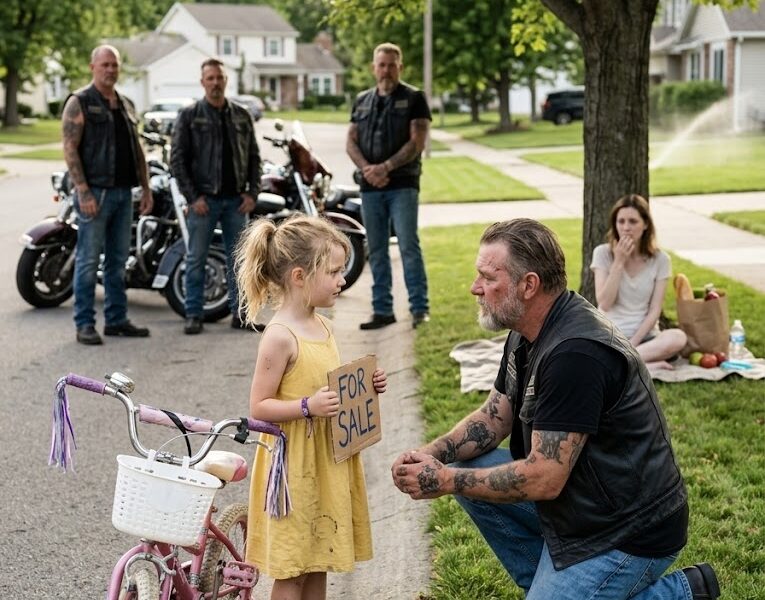
A SIX-YEAR-OLD TRIED TO SELL HER PINK BIKE TO FOUR BIKERS—WHAT THEY FOUND UNDER THE TREE MADE ONE OF THEM TURN AROUND

The first thing the neighborhood heard was thunder.
Not the kind that came from clouds.
It rolled down Willow Creek Drive at three seventeen on a warm Thursday afternoon, deep and mechanical, rattling picture frames inside quiet houses and sending two dogs barking behind white vinyl fences. Four Harley-Davidsons came around the curve in a staggered line, chrome flashing beneath the late-summer sun, their engines loud enough to make people look up from lawn sprinklers and half-finished cups of coffee.
Curtains moved.
A garage door stopped halfway down.
A mother standing beside a minivan reached instinctively for her son’s shoulder and guided him toward the porch.
The riders noticed.
They were used to being noticed.
The men wore faded black leather, heavy boots, old tattoos, and the weathered expressions of people strangers tended to judge before speaking to them. The patches on their vests had earned enough stories of their own that most people preferred to watch from a safe distance.
Ryder Hayes rode in front.
His brothers called him Wolf.
At fifty-one, he had gray beginning at the edges of his dark beard, a scar cutting through one eyebrow, and hands permanently roughened by thirty years of engines, welding torches, winter roads, cheap motel rooms, and choices he had stopped explaining to anyone.
He had learned long ago that fear had a sound.
Doors locking.
Conversations stopping.
Footsteps changing direction.
That afternoon, however, he heard something else.
A child’s voice.
“Sir?”
Ryder almost kept riding.
Then the voice came again.
“Sir, will you buy my bike?”
His right hand eased off the throttle.
Tank nearly clipped his rear tire.
“What the hell?” Tank muttered as the four motorcycles slowed.
Ryder lifted one fist.
They stopped.
The sudden silence after four Harley engines died felt almost unnatural.
Ryder put one boot on the pavement and turned his head.
She stood at the edge of the sidewalk beside a mailbox shaped like a little red barn.
Six years old, maybe seven.
Small.
Too small for the seriousness in her face.
Her blond hair had been tied into a ponytail that morning and had mostly escaped by afternoon. Her pale yellow dress had one carefully sewn repair along the hem. Her sneakers were dirty at the toes, but someone had wiped the sides clean.
Beside her stood a little pink bicycle.
White tires.
White handlebars.
A plastic basket with three faded daisies molded into the front.
A silver bell.
Pink streamers.
On the seat was a crooked sticker of a smiling moon.
The girl held a piece of cardboard against her chest.
FOR SALE.
The letters were written in blue marker.
Some were backward.
Ryder stared at her.
Then he looked farther down the yard.
Thirty feet behind the little girl, beneath the shade of a maple tree, someone was sitting against the trunk.
A woman.
Blanket over her legs.
Head tilted slightly to one side.
So still that Ryder’s stomach tightened.
He swung off his motorcycle.
Behind him, Tank, Viper, and Mason did the same.
The child stepped backward when she saw all four men approaching.
Ryder immediately stopped.
He removed his sunglasses.
Then, despite his bad knee, he lowered himself onto one knee on the hot pavement.
“Hey,” he said.
The little girl looked at his tattoos.
At the skull ring on his right hand.
At the scar above his eye.
Then back at his face.
“Hi.”
Ryder nodded toward the bicycle.
“You’re selling that?”
She nodded.
“How much?”
The girl looked uncertain.
Ryder waited.
Finally she whispered, “A lot.”
Tank looked away.
Mason rubbed the back of his neck.
Ryder’s mouth almost curved.
“What’s a lot?”
The little girl considered this with grave concentration.
“Maybe fifty dollars.”
Ryder looked at the bicycle again.
One training wheel was missing.
The front brake cable had been repaired with electrical tape.
A purple friendship bracelet hung from the handlebars.
It was the kind of bicycle a child loved not because it was expensive but because it belonged entirely to her.
“What’s your name?” he asked.
“Mira.”
“I’m Ryder.”
She studied him.
“Are you bad guys?”
Tank made a choking sound behind Ryder.
Ryder glanced over his shoulder.
“Nobody say a word.”
Then he looked back at Mira.
“Depends who you ask.”
Her eyebrows pulled together.
That answer clearly had not helped.
Ryder tried again.
“We’re not here to hurt you.”
Mira nodded as though she had already decided that for herself.
Then she held out the cardboard sign.
“You can have the sign too.”
Something about that broke through Ryder more quickly than the bicycle had.
He looked toward the woman under the tree.
“Who’s that?”
Mira followed his eyes.
“My mommy.”
“Is she sleeping?”
“No.”
The answer came too quickly.
Ryder rose.
Mira grabbed the bottom of his vest.
“Don’t scare her.”
He looked down at the tiny hand gripping leather.
“I won’t.”
They crossed the lawn together.
Tank stayed near the motorcycles while Mason and Viper followed several steps behind.
The closer Ryder came to the maple tree, the worse the situation looked.
The woman was younger than he had first thought.
Mid-thirties.
Maybe thirty-seven.
Her brown hair was pinned behind one ear, though several strands stuck damply to her forehead. She wore jeans and a blue blouse that hung loosely on her frame.
A half-empty water bottle stood beside her.
So did a grocery bag.
The bag contained a loaf of bread, one bruised apple, and two packets of crackers.
The woman’s eyes opened when Ryder approached.
Her hand went instantly toward Mira.
“Mira?”
“I’m here, Mommy.”
The woman’s gaze moved to Ryder.
Fear appeared immediately.
She tried to stand.
She couldn’t.
Ryder stepped back.
“Easy.”
“I’m fine.”
People who were fine rarely said it that way.
The woman reached for the tree trunk, trying again.
Her knees gave.
Ryder caught her elbow before she hit the ground.
She jerked away from him.
“I said I’m fine.”
“Okay.”
“I don’t need anything.”
“Okay.”
Her breathing was too shallow.
Her skin was pale.
Mira crouched beside her.
“Mommy, I found someone.”
The woman’s expression changed.
“Mira.”
“He wants my bike.”
“I do not,” Ryder said.
Mira looked offended.
“You asked how much.”
“That was before I saw the seller’s negotiating tactics.”
She didn’t understand.
The woman did.
Barely.
Her face tightened.
“Mira, sweetheart, I told you to stay close. I didn’t tell you to—”
“But you said we don’t have grocery money.”
Ryder saw the mother’s eyes close.
Just for a second.
That second told him more than tears would have.
Mira continued.
“And you didn’t eat breakfast.”
“Mira.”
“Or yesterday dinner.”
The woman swallowed.
“Mira, please.”
The girl stopped.
A silence settled under the tree.
Across the street, somebody’s sprinkler clicked steadily.
Tick.
Tick.
Tick.
Ryder remembered another summer afternoon.
Another child.
Another tree.
He pushed the memory away.
“What happened?” he asked.
The woman lifted her chin.
“Nothing.”
“Lady, with respect, you’re sitting under a tree because standing is currently an ambitious project.”
“I got dizzy.”
“When did you last eat?”
Her jaw hardened.
“That’s none of your business.”
“Fair enough.”
He turned to Mira.
“When did your mom last eat?”
“Tuesday.”
The woman shut her eyes.
Ryder looked at Mason.
“Food.”
Mason nodded and headed for the bikes.
“No,” the woman said sharply.
Ryder turned back.
“My name is Clara Bennett.”
“Okay, Clara.”
“And I’m not taking money from strangers.”
“Good. Neither am I.”
Despite herself, she looked confused.
Ryder sat on the grass several feet away, giving her space.
“You don’t know me.”
“No.”
“You don’t know my daughter.”
“No.”
“So you don’t get to ride in here, look at us for five minutes, and decide we’re some charity case.”
Ryder’s expression changed.
Not anger.
Recognition.
“I didn’t.”
“You were reaching for your wallet.”
“I was going to buy a bicycle.”
“It isn’t worth fifty dollars.”
“Didn’t realize you were involved in negotiations.”
Clara stared at him.
Mira almost smiled.
Almost.
That mattered.
Ryder leaned his forearms across his knees.
“How long have things been this bad?”
Clara turned her face away.
“I’m handling it.”
“Under a tree?”
“I came outside because Mira wanted to ride her bike.”
“Mommy fell.”
“Mira.”
The child looked down.
Ryder didn’t press.
He knew pride when he saw it.
He had survived on it once.
Sometimes pride was dignity.
Sometimes it was the last locked door between a struggling person and humiliation.
And sometimes it nearly killed you.
Mason returned carrying two bottles of water and a paper bag from the gas station three blocks away.
He handed Ryder the bag.
Ryder opened it.
Turkey sandwich.
Banana.
Crackers.
A bottle of orange juice.
He placed everything on the grass.
Clara stared at it.
“No.”
“It’s not money.”
“No.”
“It’s a sandwich.”
“I can see that.”
“So we’re making progress.”
“I don’t want your food.”
Mira looked at the sandwich.
Clara saw her.
That was the end of the argument.
Not because Clara wanted to eat.
Because her daughter did.
She took the sandwich, opened it, tore it carefully in half, and handed the larger portion to Mira.
Ryder watched.
Clara took one bite from the smaller half only after her daughter started eating.
Something cold moved through his chest.
“Where’s her father?” he asked.
Clara’s expression closed immediately.
“Not here.”
“Coming back?”
“No.”
He left it there.
“Family?”
“My sister lives in Oregon.”
“Friends?”
Clara gave a dry, exhausted laugh.
“You’d be surprised how fast friends become busy when you lose your job.”
Ryder picked at a blade of grass.
“What kind of job?”
“Catering.”
“Restaurant?”
“Corporate events. Weddings. Private dinners. Conferences.”
“For who?”
Clara hesitated.
“Hensley Hospitality.”
Behind Ryder, Tank muttered something.
Ryder glanced back.
“You know it?”
Tank snorted.
“Everybody knows it.”
Everyone in three counties knew Hensley Hospitality.
The company had started as one wedding-catering business twenty years earlier and expanded into event venues, corporate dining, hotel food service, and luxury event management. Its owner, Richard Hensley, appeared regularly in local business magazines wearing custom suits and carefully practiced smiles.
He sponsored charity galas.
He donated turkeys at Thanksgiving while television cameras watched.
His face smiled down from billboards about COMMUNITY FIRST.
Ryder remembered one outside the children’s hospital.
Richard Hensley holding a cardboard check.
Clara wiped crumbs from Mira’s cheek.
“They cut forty-three people in May.”
“Business slow?”
“No.”
That answer was quiet.
Ryder looked at her.
“What do you mean?”
Clara’s eyes met his for the first time without defensiveness.
“They didn’t cut us because business was slow.”
“Then why?”
She looked toward the houses.
As though someone might be listening.
“The company was being reorganized.”
“That’s corporate language for what?”
Clara hesitated.
Ryder waited.
Finally she said, “Cheaper workers. Fewer benefits. Outsourced kitchen crews. Contractors they didn’t have to insure.”
Tank swore softly.
Clara continued.
“I’d been there nine years. I was a shift supervisor. I trained half the people who eventually replaced me.”
“You ask Hensley for help?”
Her face changed.
That answered him before she spoke.
“I asked for three weeks.”
“Three weeks?”
“I didn’t ask him to reverse the layoff. I didn’t ask him for charity. I asked him to keep me on payroll for three weeks because Mira’s health insurance was attached to my job, and I had an interview scheduled with another hotel.”
“What’d he say?”
Clara stared down at her hands.
Mira had finished the sandwich and was ringing the little silver bell on her bicycle softly.
Ding.
Ding.
Ding.
Clara’s voice became almost emotionless.
“He said everyone thinks their situation is special.”
Ryder felt his jaw tighten.
“He actually said that?”
“He said if he made exceptions every time an employee cried in his office, he’d be running a shelter instead of a company.”
Mason looked toward the street.
Viper’s hands curled into fists.
Ryder remained still.
“What else?”
“Nothing.”
“Clara.”
She looked at him.
“What else did he say?”
Her lower lip trembled once before she controlled it.
“He told his assistant to walk me out.”
Ryder’s face emptied of expression.
That worried the men behind him more than if he had shouted.
Mira wheeled her bicycle closer.
“Mommy said Mr. Hensley isn’t bad.”
Clara immediately said, “Mira.”
“She said he’s just busy.”
Ryder looked at Clara.
The mother wouldn’t meet his eyes.
Even starving, she had protected her child from learning how casually adults could be cruel.
That did something to him.
Something old.
Something dangerous.
Not violent.
Worse.
Focused.
He reached into his vest.
Clara stiffened.
Ryder pulled out his wallet.
“I told you—”
He counted several bills.
Five hundred dollars.
He folded them once.
Then he held them toward Mira.
Clara pushed herself upright.
“No.”
Ryder ignored her.
Mira looked at the money, then at her bicycle.
“Is that for my bike?”
“Yep.”
Clara stared at him.
“Ryder.”
He looked at Mira.
“One condition.”
“What?”
“You keep the bike.”
The girl’s forehead wrinkled.
“That’s cheating.”
Tank laughed unexpectedly.
It burst out of him, loud enough that Clara jumped.
He covered his mouth.
“Sorry.”
Ryder nodded seriously.
“You’re right. Terrible business practice.”
Mira studied him.
“Then what are you buying?”
Ryder looked at the cardboard sign.
“That.”
Mira looked at it too.
“The sign?”
“The sign.”
“It’s cardboard.”
“So?”
“It’s not worth five hundred dollars.”
Ryder glanced at Clara.
“Kid drives a hard bargain.”
For the first time, Clara smiled.
It lasted less than a second.
But it was there.
Mira slowly handed him the sign.
Ryder gave her the money.
Her hands disappeared around the folded bills.
Then she immediately carried them to her mother.
“I sold it.”
Clara stared at the money.
Then at Ryder.
“You shouldn’t have done that.”
“Probably not.”
“I can’t repay you.”
“Didn’t ask you to.”
“You don’t understand.”
“No,” Ryder said. “I understand exactly.”
Something in his tone made her look closer.
He folded the cardboard sign and tucked it beneath his vest.
Then he stood.
“We’ll be back.”
Clara’s expression sharpened.
“What does that mean?”
Ryder put on his sunglasses.
“It means get something to eat.”
“Ryder.”
He paused.
“Where are you going?”
He looked down the street where afternoon sunlight glowed across four waiting motorcycles.
“To return something that doesn’t belong on a six-year-old’s bicycle.”
Clara watched him.
“The sign?”
Ryder nodded.
“To the man who put it there.”
Her face lost color.
“No.”
Tank stopped halfway to his bike.
Clara forced herself up against the tree.
“Ryder, don’t.”
“Why?”
“You don’t know Richard Hensley.”
“I know enough.”
“No, you don’t.”
There was fear in her voice now.
Real fear.
Ryder removed his sunglasses again.
“What aren’t you telling me?”
Clara looked at Mira.
Then lowered her voice.
“Hensley doesn’t just fire people.”
Ryder waited.
Clara stared at him for a long moment.
Then she said, “He makes sure they stay quiet.”
The four bikers left Willow Creek Drive without another word.
This time the neighborhood didn’t hide quite as quickly.
Mira stood beside the mailbox ringing the little silver bicycle bell while Clara watched from beneath the tree, one hand pressed against her stomach and a fear in her eyes that had nothing to do with four tattooed strangers.
Ryder rode north.
Tank pulled beside him at the next light.
“You planning on telling us what the plan is?”
Ryder kept looking forward.
“Talk.”
Viper laughed from behind.
“Your version of talking?”
“My version.”
“Which version is that?”
Ryder finally looked at him.
“The one where everybody leaves with the same number of teeth they arrived with.”
Tank grinned.
“Disappointing.”
Ryder faced forward again.
“Kid’s watching.”
“Kid’s three miles away.”
“Still watching.”
Tank’s grin disappeared.
He understood.
They all did.
For men who had spent years being treated like trouble, there were certain lines they guarded almost religiously.
Children were one of them.
Ryder had once had a child of his own.
None of the others mentioned it.
They knew better.
The ride downtown took eleven minutes.
Hensley Hospitality occupied the top four floors of a fourteen-story glass building overlooking the river. The lobby had polished marble, a living wall of green plants, and a sculpture that looked like twisted silver forks rising from a granite pedestal.
Ryder hated it immediately.
Four motorcycles pulled into visitor parking.
The security guard looked up from his desk.
His expression said everything.
Ryder entered first.
Boot heels struck marble.
Clack.
Clack.
Clack.
The receptionist behind the front desk straightened.
“Can I help you?”
Ryder removed the folded cardboard sign from his vest.
“Richard Hensley.”
“Do you have an appointment?”
“No.”
“Mr. Hensley doesn’t accept unscheduled—”
“We’re not selling insurance.”
Tank leaned against the counter.
The receptionist glanced at the security guard.
Ryder noticed.
“Ma’am, nobody’s here to cause trouble.”
“Then perhaps you can tell me the nature of your visit.”
Ryder unfolded the cardboard.
FOR SALE.
The receptionist stared at it.
“It’s personal.”
“I’m afraid—”
A woman stepping out of the elevator stopped.
Mid-forties.
Navy suit.
Employee badge.
Her eyes fell on the sign.
Then on Ryder.
Something changed in her face.
“Where did you get that?”
Ryder turned.
“Why?”
The woman looked toward reception.
Then back.
“Who gave you that?”
“A little girl.”
The employee went pale.
“Was her name Mira?”
Ryder’s entire posture changed.
“You know her?”
The woman swallowed.
“I’m Dana Ortiz.”
“That wasn’t what I asked.”
Dana lowered her voice.
“I worked with Clara.”
Ryder glanced at the receptionist.
“Is there somewhere we can talk?”
Dana looked toward the elevator.
Then toward a hallway.
“Outside.”
They stepped through a side door into a small courtyard surrounded by glass walls.
Dana hugged her folder against her chest.
“How bad is she?”
“Bad enough.”
Dana shut her eyes.
“I tried calling.”
“She answer?”
“No.”
“You go over there?”
Dana looked ashamed.
“Once.”
“And?”
“She wouldn’t let me in.”
Ryder studied her.
“Clara says Hensley makes sure people stay quiet.”
Dana’s gaze snapped up.
“She told you that?”
“Not enough of it.”
Dana looked through the glass wall toward the lobby.
“Mr. Hayes—”
“Ryder.”
“Ryder, you should leave this alone.”
“So I’ve been told twice today.”
“I’m serious.”
“So am I.”
Dana took a slow breath.
“When the layoffs happened, several employees complained.”
“About what?”
“Unpaid overtime. Missing gratuities. Medical deductions that didn’t match benefit statements. The new contracting company they moved kitchen employees into.”
Ryder frowned.
“What about it?”
“The contracting company is called Silver Line Staffing.”
“Okay.”
Dana looked him directly in the eye.
“It’s owned by Richard Hensley’s brother-in-law.”
Ryder went quiet.
“Clara knew?”
“Clara found the payroll discrepancies.”
“How?”
“She was supposed to approve staff hours for events. Numbers stopped matching.”
Dana lowered her voice further.
“She asked questions.”
“And three weeks later she got laid off.”
Dana nodded.
Ryder felt something settle into place.
This wasn’t only a rich man being heartless.
“Did Clara report it?”
“She started to.”
“Started?”
Dana’s mouth tightened.
“She requested copies of payroll records. Human Resources denied access. Then someone left an envelope on her desk.”
“What was in it?”
“A severance agreement.”
“That’s normal.”
“Not one offering almost eight months of salary if she signed a nondisclosure agreement and withdrew any wage complaint.”
Ryder stared at her.
“She take it?”
“No.”
“Why?”
“Clara.”
Dana gave a sad smile.
“She said if the numbers were wrong, they belonged to everybody. Not just her.”
Ryder looked through the window toward the elevator.
“Where’s Hensley?”
Dana stepped in front of him.
“Listen to me.”
Her voice shook now.
“I have two kids. I need this job.”
Ryder stopped.
“I’m not asking you to lose it.”
“You showing up already puts people on edge.”
“Then go back inside.”
Dana hesitated.
Before leaving, she reached into her folder.
She removed a business card.
On the back she wrote something.
Then she handed it to Ryder.
A name.
MARSHALL REED.
And beneath it, a phone number.
“Who’s this?”
“Former finance director.”
“Former?”
“He asked the same questions Clara did.”
“What happened to him?”
Dana held Ryder’s eyes.
“They said he resigned.”
“And?”
“I don’t think he did.”
She went inside.
Ryder looked at the card.
Tank read over his shoulder.
“This is getting interesting.”
“No.”
Ryder folded the card into his wallet.
“It’s getting ugly.”
They went upstairs anyway.
The receptionist had clearly warned somebody.
Two security officers were waiting outside Richard Hensley’s office.
Ryder stopped ten feet away.
One guard raised a hand.
“Mr. Hensley is unavailable.”
Through the glass wall, Ryder could see Hensley standing beside his desk.
Gray suit.
White shirt.
Gold watch.
He was talking on a phone.
Their eyes met.
Hensley looked away.
Ryder lifted the cardboard sign.
Hensley looked back.
For just a second, recognition flickered across the CEO’s face.
That was all Ryder needed.
“He knows what this is,” he said.
One guard frowned.
“What?”
Ryder spoke louder.
“Richard.”
Hensley’s head turned.
The employees in the outer office went silent.
Ryder held up the sign.
“This look familiar?”
Hensley ended his phone call.
He stepped out of his office.
“Who are you?”
“Ryder Hayes.”
“And why are you in my building?”
“Six-year-old girl sold me something today.”
Ryder walked to the nearest empty desk.
He placed the cardboard sign on it.
Hensley looked down.
FOR SALE.
“What does that have to do with me?”
“Her name’s Mira Bennett.”
Hensley didn’t move.
But his right thumb rubbed once across the side of his gold watch.
Ryder noticed.
So did Mason.
“Clara Bennett’s daughter,” Ryder added.
Hensley exhaled.
“This is absurd.”
“Is it?”
“If Ms. Bennett has sent you here to intimidate me—”
“She told me not to come.”
That interrupted him.
Ryder stepped closer.
The security officers tensed.
He stopped well outside arm’s reach.
“Little girl was trying to sell her bike because her mother hadn’t eaten in two days.”
Hensley’s expression remained controlled.
“I sympathize with her circumstances.”
“That’s a nice sentence.”
“I don’t know what you expect from me.”
“Nothing yet.”
“Then leave.”
Ryder studied him.
“Did Clara find something in your payroll records?”
Silence.
There.
It was tiny.
The muscles around Hensley’s eyes tightened.
“Whatever employment dispute Ms. Bennett believes she has is a legal matter.”
“Didn’t say there was a dispute.”
Hensley looked at him.
Ryder continued quietly.
“I asked if she found something.”
The CEO’s jaw shifted.
“Get out.”
Ryder smiled without warmth.
“Now I know.”
“You know nothing.”
“Maybe.”
Ryder reached for the cardboard sign.
Hensley spoke before he picked it up.
“How much?”
Ryder froze.
Hensley seemed to realize his mistake.
Ryder turned.
“Excuse me?”
Hensley straightened his cuffs.
“How much does she need?”
The room felt colder.
Ryder stared at him.
“I told you. Five hundred dollars bought me the sign.”
“I’m talking about Clara.”
“So am I.”
Hensley’s tone hardened.
“If Ms. Bennett is having financial difficulty, perhaps some charitable assistance can be arranged.”
Ryder laughed once.
It wasn’t a pleasant sound.
“Charity.”
“Call it whatever you like.”
“How much did you offer her before?”
Hensley said nothing.
“Eight months salary?”
That hit.
Ryder saw it.
Hensley looked past him.
“Security.”
Ryder picked up the sign.
“You don’t get to buy forgiveness.”
The CEO looked back.
“And you don’t get to storm into private businesses and make accusations you can’t prove.”
Ryder nodded.
“You’re right.”
Hensley looked almost surprised.
Ryder folded the sign.
“So we’ll find proof.”
For the first time, Richard Hensley lost control of his expression.
Only for half a second.
But fear has a sound.
Sometimes it’s a door locking.
Sometimes it’s a person’s breathing changing.
And sometimes it is a wealthy man saying absolutely nothing when he should have laughed.
Outside the building, Tank lit a cigarette.
“So much for talking.”
“We talked.”
“He didn’t enjoy it.”
“Wasn’t a customer satisfaction survey.”
Mason leaned against his bike.
“What now?”
Ryder took out Dana’s card.
“Marshall Reed.”
Viper whistled.
“You plan on playing detective?”
“No.”
“Then?”
Ryder looked back at the glass tower.
“We ask a man why he disappeared.”
Marshall Reed lived forty minutes outside the city in a rented ranch house beside a disused cornfield.
He didn’t answer the first phone call.
Or the second.
On the third, Ryder left a message.
“My name is Ryder Hayes. I met somebody today who used to work at Hensley Hospitality. Her daughter tried to sell me her bicycle because they don’t have food. Dana Ortiz gave me your number. If you don’t want to talk, don’t. But if Hensley did something to those employees, today might be a good day to stop letting him.”
Marshall called back six minutes later.
His voice was cautious.
“Where did you get my number?”
“Dana.”
“She shouldn’t have given it to you.”
“She seemed aware of that.”
A long silence.
“Clara Bennett?”
“Yeah.”
“Is she all right?”
“No.”
Another silence.
Then Marshall said, “Meet me at the old Lakeside Diner. Six thirty.”
“Fine.”
“Come alone.”
Ryder looked at Tank, Viper, and Mason.
“They’re going to hate that.”
“Who?”
“My friends.”
Marshall hung up.
Ryder went alone.
Mostly.
Tank sat at the far end of the parking lot in a pickup truck and pretended this counted.
Lakeside Diner had been closed for two years. Paper covered the windows. Weeds grew through cracks in the pavement.
Marshall Reed arrived in a blue Honda that looked ten years old.
He stayed inside for a full minute.
Then he got out.
He was in his early sixties, slim, with white hair and the cautious eyes of somebody who checked reflections before crossing parking lots.
He looked at Ryder’s motorcycle.
“You’re not what I expected.”
“Get that a lot.”
“You know why I left Hensley?”
“I know you didn’t leave voluntarily.”
Marshall’s mouth tightened.
“Who told you that?”
“Nobody.”
“Then why say it?”
Ryder leaned against the bike.
“See if you correct me.”
Marshall almost smiled.
“Clara used to do that.”
“Do what?”
“Ask questions when she already suspected the answer.”
His smile disappeared.
“That’s what got her fired.”
“Tell me.”
Marshall looked toward the empty road.
Then he reached into his car and removed a worn leather messenger bag.
Inside were folders.
Printed spreadsheets.
Invoices.
Copies of contracts.
Ryder stared.
“You carry these around?”
“No.”
“Then why today?”
Marshall’s hand rested on the bag.
“Because I’ve spent four months deciding whether fear was a good enough reason to keep them hidden.”
He opened a folder.
“The layoffs weren’t about restructuring.”
“Silver Line Staffing?”
Marshall looked impressed.
“You’ve been busy.”
“Not really.”
“Silver Line is part of it. Hensley transferred hundreds of hourly workers to outside staffing contracts. The rates on the invoices increased.”
“But workers got less.”
“Much less.”
“Where’d the difference go?”
Marshall tapped a page.
“Consulting fees. Management fees. Vendor adjustments.”
“Meaning?”
“Money moved through companies controlled by relatives and business partners.”
“Illegal?”
“Some of it may be. Some of it is simply ugly.”
Ryder studied him.
“Difference?”
“Ugly can be legal.”
Marshall flipped pages.
“Then there were gratuities.”
“What about them?”
“For years, clients paid mandatory service fees believing they were tips for staff. Employees received only a portion.”
“How much?”
“Depends on the event.”
“How much total?”
Marshall looked him directly in the eye.
“Potentially more than two million dollars over five years.”
Ryder stopped breathing for a second.
“And Clara found this?”
“Pieces.”
“Why didn’t you report it?”
Marshall’s face hardened.
“I did.”
“To who?”
“The board.”
“What happened?”
“I was offered retirement.”
“You refused?”
Marshall laughed quietly.
“I was escorted from the building.”
“And you just walked away?”
The older man flinched.
Ryder regretted the words immediately.
Marshall looked toward the dark windows of the diner.
“My wife had stage-four ovarian cancer.”
Ryder said nothing.
“Hensley knew.”
Marshall swallowed.
“My insurance depended on a continuation package. His lawyer sat across from me and explained, very politely, exactly what I would lose if I decided to become difficult.”
Ryder looked down.
“Your wife?”
“Died in July.”
“I’m sorry.”
Marshall nodded once.
“After that, the agreement didn’t have much power over me anymore.”
He handed Ryder a folder.
Ryder didn’t take it.
“What do you want me to do with that?”
“I thought that’s why you called.”
“No.”
Marshall frowned.
“I called because a six-year-old sold me cardboard.”
He told him about Mira.
About the bicycle.
About Clara under the tree.
By the time Ryder finished, Marshall’s eyes were wet.
He looked down at the documents.
“Clara wouldn’t sign.”
“No.”
“I knew she wouldn’t.”
Marshall rubbed his forehead.
“I should’ve called her.”
“Maybe.”
“I should’ve told her she wasn’t imagining it.”
“Probably.”
“I was ashamed.”
Ryder looked at him.
“Shame gets hungry if you feed it.”
Marshall gave him a tired look.
“That from experience?”
“Unfortunately.”
Marshall closed the folder.
“What are you going to do?”
Ryder thought about Mira’s hands wrapped around five hundred dollars.
He thought about Clara dividing a sandwich.
He thought about Hensley asking how much.
“First?”
“Yes.”
“I’m buying groceries.”
Marshall blinked.
Then Ryder smiled faintly.
“After that, we’re making some phone calls.”
They returned to Willow Creek Drive at eight twelve.
The neighborhood looked different after sunset.
Porch lights glowed.
Televisions flickered behind windows.
Crickets had replaced lawn mowers.
Clara’s house was smaller than Ryder had realized.
One-story rental.
Peeling shutters.
A cracked driveway.
Mira’s pink bike leaned against the porch.
Ryder carried two grocery bags.
Tank carried three.
Mason had somehow purchased enough food for a family of six.
Viper held a gallon of milk in each hand.
Clara opened the door.
She stared.
“No.”
Ryder sighed.
“We’ve had this conversation.”
“No, you had this conversation. I objected.”
“Technically true.”
Mira appeared behind her mother.
Her eyes widened.
“Ryder!”
She ran past Clara.
Ryder set the bags down before she crashed into him.
She wrapped both arms around his waist.
He froze.
Tank saw it.
Mason saw it.
Viper stared at the porch ceiling.
Nobody said a word.
Ryder slowly put one hand on the back of Mira’s head.
“Hey, kid.”
“You came back.”
“Told you I would.”
She looked at the groceries.
“Did you buy the store?”
“Mason doesn’t understand reasonable quantities.”
Mason looked offended.
“That cereal was on sale.”
Clara leaned against the doorframe.
She looked stronger than before.
Still pale.
But she’d eaten.
“Come inside.”
It was the first time she had invited them anywhere.
The kitchen had four chairs.
Eight people tried to fit around it.
Tank sat on an overturned bucket.
Viper leaned against the refrigerator.
Mason and Mira unpacked groceries while arguing about whether marshmallows qualified as dinner.
Clara made coffee.
Ryder watched her.
She noticed.
“What?”
“You look better.”
“I ate.”
“Good.”
“Because apparently refusing food around you is impossible.”
“That’s what Tank says.”
Tank raised his coffee.
“Can confirm.”
For ten minutes, the kitchen almost felt ordinary.
Then Clara saw the folder in Ryder’s hand.
Her expression changed.
“What’s that?”
“Marshall Reed.”
The mug slipped slightly in her fingers.
“You found Marshall?”
“He found me halfway.”
Clara sat.
Ryder placed the folder on the table.
She didn’t touch it.
“Why?”
“Because you were right.”
She stared.
“About what?”
“Hensley.”
Her eyes moved to Mira.
The girl was showing Mason how the bicycle bell sounded different if she struck it with her fingernail.
Clara lowered her voice.
“I never said he broke the law.”
“No.”
“I said the numbers looked wrong.”
“They are.”
Clara looked at the folder again.
Ryder explained what Marshall had shown him.
The vendor transfers.
Silver Line.
The gratuities.
The service charges.
The workers.
The nondisclosure agreements.
Clara listened without interrupting.
Then she stood.
She walked to the sink.
For several seconds she said nothing.
Ryder expected relief.
Vindication.
Maybe anger.
Instead, her shoulders began to shake.
She covered her mouth.
Mira didn’t see.
Mason quietly led the child toward the living room.
“Come on,” he said. “Show me your bike.”
When they were gone, Clara turned.
“I thought I was crazy.”
Ryder’s chest tightened.
“I spent weeks thinking I’d misunderstood.”
“You didn’t.”
“I thought maybe I deserved to be fired.”
“You didn’t.”
“I couldn’t sleep.”
She pressed both hands against the counter.
“I kept thinking that if I’d just shut up, Mira would still have insurance. We’d still have the apartment. We’d still have groceries.”
Ryder moved closer but didn’t touch her.
Clara’s voice cracked.
“I ruined everything because I couldn’t stop asking questions.”
“No.”
She looked at him.
“No,” Ryder repeated.
“Someone else ruined something because he was afraid you’d keep asking.”
Clara laughed through tears.
“You make that sound simple.”
“It isn’t.”
“Then don’t pretend it is.”
“I’m not.”
Ryder pulled out a chair.
“Sit down.”
She did.
For the first time that day, he told her something about himself.
“My son was named Caleb.”
Clara’s expression softened.
Ryder stared at his coffee.
“He was nineteen when he died.”
“I’m sorry.”
“Everybody says that.”
“I don’t know what else to say.”
“Nothing else to say.”
He rubbed his thumb across a scar on the table.
“Caleb started using pills after a football injury. Prescription at first. Then whatever he could get.”
Clara listened.
“I knew.”
Ryder’s voice stayed steady.
“I knew something was wrong. But every time I asked, he got angry. Every time his mother told me to push harder, I said he was nineteen. Said he needed space. Said boys did stupid things.”
He exhaled.
“Truth was, I was scared.”
“Of him?”
“Of the answer.”
His eyes finally met hers.
“I waited.”
Clara didn’t move.
“One night he called me at eleven forty-three. I was angry because he’d disappeared for two days.”
Ryder swallowed.
“I let it ring.”
The kitchen became silent.
“He left a voicemail.”
Clara’s eyes filled.
“I listened the next morning.”
Ryder looked toward the living room where Mira’s laughter drifted through the doorway.
“He died at two seventeen.”
Clara whispered, “Ryder.”
“So when I tell you asking questions didn’t ruin your life, I’m not pretending things are simple.”
His voice roughened.
“I’m telling you sometimes silence costs more.”
Clara reached across the table.
Her fingers touched his hand.
Neither moved.
Then Mira came running into the kitchen.
“Ryder!”
He pulled his hand away instinctively.
“What?”
“Mason says motorcycles are safer than bicycles.”
Mason yelled from the living room.
“I did not say that!”
Mira grinned.
For a moment Clara laughed.
Really laughed.
It transformed her face.
Ryder forgot what he had been about to say.
Then his phone rang.
Unknown number.
He answered.
“Hayes.”
Richard Hensley said, “We need to talk.”
Ryder’s expression changed.
Clara saw it.
“Who is it?” she mouthed.
Ryder didn’t answer.
Hensley’s voice was calm.
Too calm.
“I understand you’ve been contacting former employees.”
“Fast learner.”
“This has gone far enough.”
“Funny. I was thinking we’re just getting started.”
“Mr. Hayes, you seem to believe you’re helping Ms. Bennett.”
“I am.”
“No.”
Hensley paused.
“You’re putting her in serious danger.”
Ryder stood.
Everyone in the kitchen went quiet.
“What did you say?”
“You should ask Clara what happens if certain confidential materials become public.”
Ryder looked at her.
She had gone white.
“She knows.”
Then Hensley hung up.
Ryder lowered the phone.
Clara stood slowly.
“What did he say?”
“He says you’re in danger.”
Clara closed her eyes.
Ryder felt anger rise.
“What didn’t you tell me?”
She didn’t answer.
“Clara.”
“I took something.”
The room became very still.
“What?”
“Before they fired me.”
“What did you take?”
Clara looked toward Mira.
Then toward the hallway.
“In my bedroom.”
She walked away.
Ryder followed.
Clara opened a closet.
Moved a box of winter clothes.
Reached behind a loose panel near the floor.
And pulled out a small black USB drive.
Ryder stared.
“What is that?”
“The reason Richard Hensley is afraid of me.”
Clara had copied the files three days before she was terminated.
At first she’d intended to protect herself.
Nothing more.
She had seen too many unexplained changes in employee hours, service-charge distributions, insurance deductions, and vendor payments to trust management’s explanation.
So she copied records.
Spreadsheets.
Internal emails.
Invoices.
Payroll summaries.
One audio file.
Ryder held up the drive.
“What’s on the recording?”
Clara stared at it.
“A meeting.”
“Whose?”
“Hensley. His brother-in-law. Two executives.”
“What were they talking about?”
“Employees.”
“Which employees?”
Clara’s voice dropped.
“The ones who complained.”
Ryder’s face hardened.
“What did Hensley say?”
Clara looked him in the eye.
“He said people with mortgages learn obedience quickly.”
Ryder closed his fist around the drive.
“No.”
Clara grabbed his wrist.
“Don’t.”
“I’m not going to hurt him.”
“That’s not what I’m afraid of.”
“Then what?”
She pointed at the drive.
“If this becomes public, Hensley will claim I stole confidential company data.”
“Did you?”
“Yes.”
“Because you believed workers were being cheated.”
“Intent doesn’t erase the law.”
Ryder knew enough to understand.
“Who have you shown this to?”
“Nobody.”
“Not Marshall?”
“No.”
“Attorney?”
“I couldn’t afford one.”
“Labor department?”
“I started filling out a complaint.”
“Then?”
Clara looked toward the front of the house.
“I got scared.”
Ryder was quiet.
“Of what?”
She laughed bitterly.
“Being homeless.”
“You’re already close.”
“I know.”
“Then what else?”
Her eyes filled.
“Mira.”
That stopped him.
Clara wrapped both arms around herself.
“Hensley has lawyers. Money. Connections. I have a six-year-old daughter and eighty-four dollars in my checking account.”
Ryder looked at the woman in front of him.
For the first time he understood why she had sat under that tree.
It wasn’t simply hunger.
She had been crushed beneath the impossible arithmetic of poor people confronting powerful ones.
Rent versus groceries.
Medicine versus electricity.
Truth versus survival.
People liked to imagine courage as a clean choice.
It rarely was.
Sometimes courage came with late fees.
Sometimes courage arrived after eviction notices.
Sometimes courage had a six-year-old asking strangers to buy her bicycle.
Ryder held out the USB drive.
“Keep it.”
Clara blinked.
“You’re not taking it?”
“No.”
“But you said—”
“I said we’re finding proof.”
He closed her fingers around the drive.
“This is yours.”
“What now?”
“Now we find somebody whose job is knowing what to do with it.”
The next morning, Ryder called a lawyer.
Not a glamorous one.
Not one from a billboard.
A woman named Evelyn Shaw who had represented Mason’s younger sister in a wage-theft case five years earlier.
Evelyn met them at ten.
She listened for forty minutes.
Asked Clara precise questions.
Read several documents.
Listened to twelve minutes of the audio recording.
Then she removed her glasses.
“Do not contact Richard Hensley again.”
Ryder opened his mouth.
She pointed at him.
“Especially you.”
Tank coughed into his fist to hide laughter.
Evelyn continued.
“Do not threaten him. Do not go to his office. Do not post documents online. Do not call reporters. Do not discuss this with anyone who doesn’t need to know.”
Ryder nodded.
“You’re taking all the fun out of it.”
“I’m trying to keep Ms. Bennett out of court.”
Clara leaned forward.
“Can they prosecute me for copying the files?”
“They can accuse you of things.”
“That’s not what I asked.”
Evelyn considered.
“There are whistleblower protections that may apply. There are also questions about whether you were authorized to access these records as part of your employment.”
“I was.”
“That helps.”
Evelyn tapped the folder.
“If these records are authentic, there could be significant wage-and-hour issues here. Potential tax questions. Benefit administration questions. Possibly fraud depending on the transactions.”
Clara looked overwhelmed.
“So what happens?”
“We verify.”
“And then?”
“We report through proper channels.”
“How long?”
Evelyn’s expression told her.
Clara’s shoulders dropped.
“Months?”
“Possibly.”
“I don’t have months.”
Ryder looked at Evelyn.
“She doesn’t.”
“I understand.”
“No, you understand legally.”
Evelyn’s eyes sharpened.
“And that’s what she needs me to understand.”
Ryder sat back.
She was right.
He hated that.
Outside the law office, Clara stopped beside his motorcycle.
“Thank you.”
“Don’t.”
“For what?”
“For not deciding you know better than everyone.”
Ryder snorted.
“Give me time.”
She smiled.
Then her phone rang.
She looked at the screen.
Unknown number.
Her smile vanished.
“Answer it,” Ryder said.
Clara put the phone to her ear.
“Hello?”
She listened.
Her face changed.
“Who is this?”
Ryder straightened.
Clara’s eyes moved toward him.
“What do you mean?”
Another pause.
Then:
“No. Don’t call me again.”
She ended the call.
Ryder waited.
Clara stared at the screen.
“Someone said they know where Mira goes to school.”
Every sound on the street seemed to disappear.
Ryder’s face became frighteningly calm.
“What exactly did they say?”
Clara’s hand trembled.
“They said, ‘People who care about their children should think carefully before starting fights they can’t finish.'”
Ryder took out his phone.
“Call Evelyn.”
Clara grabbed his arm.
“And you?”
“I’m calling Mason.”
“Why?”
“Because Mira doesn’t get picked up from school alone today.”
Police took the report.
They could not identify the caller.
Hensley denied involvement.
His lawyer called the accusation “reckless and defamatory.”
Evelyn instructed everyone again not to contact him.
Ryder obeyed.
Barely.
For the next four days, one of the bikers stayed near Clara’s house.
Not inside.
Not dramatically.
Tank repaired a lawn mower across the street.
Mason fixed Clara’s leaking sink.
Viper installed a deadbolt after receiving permission from the landlord.
Ryder drove Mira to school with Clara following behind because a six-year-old could not safely ride a Harley and Ryder refused to entertain Tank’s increasingly ridiculous suggestions for sidecars.
People in Willow Creek slowly stopped closing curtains.
On Wednesday morning, Mrs. Alvarez from number fourteen brought over soup.
The next afternoon, Mr. Jenkins left groceries on Clara’s porch without knocking.
Someone paid the overdue electric bill.
Nobody admitted who.
A teacher sent home a backpack filled with school supplies.
Kindness began spreading the way fear had.
Quietly.
One house at a time.
Then Richard Hensley made a mistake.
He held a press conference.
The story had leaked somehow.
Not the documents.
Not the recording.
Only the fact that former Hensley employees were speaking with a labor attorney regarding wage complaints.
Hensley stood beneath the company’s blue-and-gold logo and told cameras that Hensley Hospitality had “always treated its workforce as family.”
Clara watched from Ryder’s garage.
She had started helping him organize invoices two afternoons a week in exchange for pay she initially refused three times.
Ryder stood beside an open motorcycle engine.
On the television, Hensley smiled.
“We have nothing to hide.”
Clara stopped sorting receipts.
Ryder looked at her.
“You okay?”
She stared at the screen.
Hensley continued.
“Unfortunately, successful companies occasionally become targets of individuals seeking financial advantage through false accusations.”
Clara’s face changed.
Ryder put down his wrench.
“Don’t.”
She looked at him.
“I didn’t say anything.”
“You’ve got that look.”
“What look?”
“The one I had before Evelyn banned me from downtown.”
Hensley continued speaking.
Then a reporter asked whether one of the former employees was Clara Bennett.
Hensley paused.
Barely.
“Ms. Bennett was terminated as part of a legitimate restructuring.”
Another reporter asked, “Did she raise payroll concerns before her termination?”
Hensley smiled.
“We do not discuss confidential personnel matters.”
Then came the question that changed everything.
“Mr. Hensley, did your company offer Ms. Bennett money in exchange for withdrawing a wage complaint?”
His smile disappeared.
Clara stepped closer to the television.
Ryder stared.
The reporter continued.
“We have obtained a copy of a proposed nondisclosure agreement offering Ms. Bennett eight months salary.”
Hensley looked toward someone off camera.
Clara whispered, “I didn’t give that to anyone.”
Ryder’s phone rang.
Marshall.
Ryder answered.
“Was that you?”
Marshall said, “Not exactly.”
“What does that mean?”
“I sent it to the state labor investigator.”
“Then how did a reporter get it?”
“I don’t know.”
On television, reporters began shouting questions.
Hensley stepped away from the podium.
Clara’s phone buzzed.
Then again.
Then six times.
She looked down.
Former coworkers.
Dana.
Unknown numbers.
Messages.
CALL ME.
I SAW THE NEWS.
IS IT TRUE?
I HAVE RECORDS TOO.
PLEASE DON’T GIVE THEM MY NAME.
Then one message from a number Clara recognized.
Her former kitchen assistant.
A single sentence.
HE DID IT TO ME TOO.
Clara sat down slowly.
Ryder watched her.
The story was no longer about one hungry mother.
It had never been.
Within forty-eight hours, nineteen former workers had contacted Evelyn Shaw.
By the end of the week, there were thirty-two.
Dishwashers.
Servers.
Cooks.
Supervisors.
Banquet captains.
Drivers.
One former payroll clerk.
People brought pay stubs.
Bank records.
Emails.
Time sheets.
Screenshots.
One man had kept every event schedule for six years.
A woman named Janice had saved voicemail messages from a manager telling her not to record overtime.
Dana Ortiz resigned.
Then she handed Evelyn a hard drive.
Marshall gave investigators everything.
Hensley Hospitality stopped speaking publicly.
Then the state announced it was reviewing wage complaints.
Two days later, a federal inquiry was reported.
Richard Hensley’s attorneys insisted no wrongdoing had been established.
Evelyn reminded everyone that allegations were not convictions.
Ryder didn’t care about public humiliation.
He cared about Clara eating dinner.
He cared that Mira stopped asking whether the electricity would be turned off.
He cared that Clara started sleeping through the night.
Then, strangely, the biggest moment came without cameras.
Richard Hensley requested a private meeting.
Evelyn attended.
So did Clara.
Ryder was not invited.
He came anyway.
He waited outside the conference room.
“You’re impossible,” Evelyn told him.
“I’m in the hallway.”
“That still counts as the building.”
“Technicality.”
Inside, Clara sat across from Hensley for the first time since the day he fired her.
He looked different.
Not destroyed.
Not broken.
Just tired.
The gold watch was gone.
So was the perfect television smile.
His attorney sat beside him.
Hensley folded his hands.
“Ms. Bennett.”
Clara waited.
“I regret how your employment ended.”
Her face remained still.
His attorney shifted.
Hensley continued.
“I regret the hardship your family experienced.”
Clara said, “Do you?”
He looked at her.
“I wouldn’t have requested this meeting otherwise.”
“Why did you request it?”
Hensley glanced at Evelyn.
Then back to Clara.
“We’d like to resolve your individual claims.”
“Money.”
“A settlement.”
“Money.”
“Compensation.”
Clara almost smiled.
“Still buying problems.”
Hensley stiffened.
“I’m trying to make this right.”
“No.”
Clara leaned forward.
“You’re trying to make it stop.”
His attorney spoke.
“Ms. Bennett, I think it’s important that—”
Clara raised one hand.
“I’m talking to him.”
The lawyer stopped.
Hensley stared at her.
Clara took a breath.
“You know what my daughter did the day those bikers found us?”
His eyes flickered.
“She tried to sell her bicycle.”
Hensley said nothing.
“Pink bicycle. White basket. Little silver bell.”
Her voice remained steady.
“She loved that bike.”
Hensley’s jaw tightened.
“She tried to sell the one thing she loved because I hadn’t eaten.”
His eyes dropped.
“For two days.”
Silence.
“You remember telling me everyone thinks their situation is special?”
Hensley looked up.
Clara waited.
“Do you remember?”
“Yes.”
“Good.”
Her eyes shone but she refused to look away.
“Because I remembered it every night.”
Hensley’s shoulders seemed to shrink.
“I made decisions.”
“You made choices.”
“Running a company of our size—”
“No.”
Clara’s voice cut through him.
“Don’t hide inside business words.”
Hensley stopped.
“You didn’t lay me off because you couldn’t afford me. You laid me off because I wouldn’t stop asking questions.”
His attorney started to object.
Hensley raised a hand.
He knew.
Clara knew.
Everyone knew.
“Say it,” Clara whispered.
Hensley looked toward the conference room window.
Ryder stood outside, visible through the glass.
Their eyes met.
Ryder did nothing.
No threat.
No gesture.
He simply stood there.
Hensley turned back to Clara.
“I was afraid.”
Her expression changed slightly.
“Of me?”
“Of what would happen if the restructuring was challenged.”
“People might discover the truth.”
“Yes.”
There it was.
Not a legal confession.
Not enough to settle every allegation.
But the first honest word Clara had ever heard from him.
She sat back.
Hensley continued.
“I convinced myself the decisions were necessary.”
“Did you believe that?”
“At first.”
“And later?”
His face tightened.
“Later, I believed fixing them would cost too much.”
Clara laughed softly.
“There it is.”
Hensley looked confused.
“That’s the whole thing.”
She wiped one tear from beneath her eye.
“It always cost someone something.”
“You just made sure it cost us.”
Hensley looked away.
Clara pushed the proposed settlement back across the table.
“I won’t sign this.”
Her attorney looked surprised.
Hensley’s attorney immediately said, “Ms. Bennett—”
Clara continued.
“I’ll participate in whatever lawful process comes next. If compensation is owed, then it should be determined fairly. For everyone.”
Hensley stared.
“Why?”
“Why what?”
“Why refuse money you need?”
Clara looked at him for a long time.
“Because my daughter already tried to sell something she loved to pay for your choices.”
She stood.
“I’m not teaching her that truth is another thing people with money can purchase.”
Then she walked out.
Ryder followed her toward the elevator.
Neither spoke until the doors closed.
Then Ryder said, “That was terrifying.”
Clara looked at him.
“Which part?”
“You.”
She laughed.
“You weren’t scared.”
“Absolutely was.”
“Of Hensley?”
“No.”
“Then what?”
Ryder looked at her.
“That you’d realize you don’t need four bikers hanging around your house anymore.”
Clara’s smile faded into something softer.
“I never needed four bikers.”
Ryder nodded.
“I know.”
“I needed one stranger to stop.”
The elevator descended.
Ryder stared at the floor numbers.
After a moment, he said, “Yeah.”
Clara’s shoulder rested against his arm.
Neither moved away.
The investigations took months.
There was no magical sunset in which every injustice disappeared.
That wasn’t how life worked.
Lawyers argued.
Companies reorganized.
Documents were reviewed.
Some allegations were substantiated.
Others remained disputed.
Hensley Hospitality entered negotiated settlements involving unpaid compensation for groups of workers. Several executives resigned. Silver Line’s contracts were reviewed. New controls were introduced.
Richard Hensley stepped down from daily management.
He did not become a saint.
Clara didn’t need him to.
She only needed him to stop being untouchable.
One year after Mira tried to sell her bicycle, Willow Creek held a neighborhood block party.
Clara had a new job managing events for a family-owned hotel downtown.
Her salary was slightly lower than what she had once earned at Hensley.
She didn’t care.
She had health insurance.
A predictable schedule.
A boss who occasionally said thank you without cameras nearby.
Mira was seven.
Her pink bicycle was becoming too small.
She refused to replace it.
Ryder had repaired the brake cable.
Mason replaced the missing training wheel, then removed both when Mira learned to ride without them.
Tank installed a ridiculous horn shaped like a duck.
Viper denied being responsible for the tiny leather pouch attached beneath the bicycle seat.
Nobody believed him.
That Saturday afternoon, Ryder stood beside the grill while Mira raced down the street.
“Watch me!”
“I’m watching.”
“Don’t look away!”
“I’m not.”
She pedaled faster.
Clara came up beside him carrying two lemonades.
“You know you’re encouraging her.”
“Encouraging what?”
“Speed.”
“That’s a serious accusation.”
“Yesterday she told her teacher she wants a motorcycle.”
Ryder almost dropped the spatula.
“Absolutely not.”
Clara laughed.
“Interesting.”
“What?”
“The man with four motorcycles suddenly believes motorcycles are dangerous.”
“For her? Extremely.”
“She’s seven.”
“Exactly.”
Clara handed him a lemonade.
Across the street, several neighbors waved at Ryder.
He waved back.
A year earlier they had watched him through curtains.
Now Mrs. Alvarez yelled at him for burning hamburgers.
Time had strange ways of changing people.
Mira circled back.
Her bicycle bell rang.
Ding.
Ding.
Ding.
Ryder went still.
Clara noticed.
“Caleb?”
He nodded.
She waited.
Ryder rarely spoke about his son.
But he did now.
“He had a red bike.”
“How old?”
“Eight when I bought it.”
“What happened?”
“He crashed it into Mrs. Conway’s rose bushes on the first day.”
Clara smiled.
“Bad?”
“Twenty-three stitches.”
Her smile vanished.
“The bike?”
Ryder looked offended.
“Bike was fine.”
She hit his arm.
He laughed.
It surprised him.
Even after a year, laughter sometimes did.
Grief didn’t disappear.
People lied when they said time healed everything.
Time didn’t heal everything.
Sometimes time simply built more rooms around the wound so you could live without touching it every hour.
Ryder still had Caleb’s last voicemail.
He had stopped listening to it every night.
That counted as progress.
Some nights, when guilt came back, he remembered a small blond girl standing beside a pink bicycle.
Sir, will you buy my bike?
And he wondered if stopping that afternoon had been an act of kindness.
Or whether kindness was what Mira had unknowingly offered him.
A reason to answer this time.
A reason not to ride past.
A reason to believe that seeing pain created an obligation greater than discomfort.
Mira pulled to a stop beside him.
Her sneaker scraped pavement.
“Ryder?”
“What?”
“I have a question.”
“That’s dangerous.”
“Why?”
“Questions started this whole mess.”
She ignored him.
“Did you really buy my sign for five hundred dollars?”
Clara smiled.
Ryder looked suspicious.
“Who told you?”
“Mom.”
“Your mother has poor respect for confidential business agreements.”
Mira giggled.
“Where is it?”
Ryder looked toward Clara.
She nodded.
So he walked Mira into his garage.
On the wall above the workbench hung old photographs.
Motorcycles.
Friends.
Caleb at twelve holding a fishing pole.
A younger Ryder with his late wife.
And inside a simple black frame was a crooked piece of cardboard.
FOR SALE.
The blue marker had faded slightly.
Mira stared.
“You kept it.”
“Yep.”
“Why?”
Ryder crossed his arms.
“Cost me five hundred bucks.”
She rolled her eyes.
Ryder smiled.
Then his expression softened.
“Because I forget things.”
“What things?”
“Important things.”
Mira looked at the sign.
“What does it remind you?”
He considered how much truth belonged in the ears of a seven-year-old.
Finally he crouched beside her.
“That people don’t always look like what they’re carrying.”
She frowned.
“What does that mean?”
“It means sometimes a person can look fine and still need somebody to stop.”
“Oh.”
“And sometimes the person who stops needs saving too.”
Mira considered that.
Then she pointed at his framed photograph of Caleb.
“Was that your son?”
Ryder went still.
“Yeah.”
“Mommy told me.”
He looked toward the garage door.
Clara stood outside.
She looked apologetic.
Ryder nodded.
It was okay.
Mira stared at the photograph.
“Did he have a bike?”
Ryder smiled.
“Red one.”
“Was he fast?”
“Thought he was.”
“Was he faster than me?”
Ryder looked at her.
“Not a chance.”
Satisfied, Mira ran outside.
Her little bell rang again moments later.
Ding.
Ding.
Ding.
Ryder remained beside Caleb’s photograph.
Clara joined him.
“You okay?”
“Yeah.”
She looked at the framed cardboard.
“Hensley sent something.”
Ryder’s expression changed.
“What?”
“Yesterday.”
She handed him an envelope.
Inside was no check.
No legal document.
No apology drafted by lawyers.
Just a photograph.
A community food pantry.
Shelves filled with groceries.
Beneath the photograph was a handwritten note.
No cameras this time.
Ryder read it twice.
Clara watched him.
“What do you think?”
He put the note back into the envelope.
“I think one good thing doesn’t erase bad ones.”
“No.”
“And guilt isn’t the same as change.”
“No.”
He looked toward Mira riding beneath the afternoon sunlight.
“But maybe it’s a start.”
Clara smiled faintly.
“That’s what I thought.”
Outside, neighbors laughed.
Smoke rose from the grill.
A radio played an old country song from someone’s porch.
Mira raced past again, hair flying behind her.
For one second Ryder saw another child.
A boy on a red bicycle.
A summer that no longer existed.
A phone ringing at eleven forty-three.
Then Mira shouted his name.
“Ryder! Watch!”
He stepped into the sunlight.
“I’m watching.”
She lifted one hand from the handlebars.
Clara gasped.
Ryder yelled, “Both hands, kid!”
Mira laughed and grabbed the handlebars again.
She disappeared around the curve at the end of the street, then came racing back.
Alive.
Loud.
Impossible to ignore.
Ryder stood in the road waiting for her.
Once, he had believed the worst moments of a man’s life were the moments when something terrible happened.
Now he knew differently.
Sometimes the worst moment was the second before, when you still had a chance to answer the phone.
To ask another question.
To open the door.
To stop the motorcycle.
To look beneath the tree.
The world rarely announced those moments.
They came disguised as inconveniences.
Strangers.
Wrong turns.
Cardboard signs.
A child’s voice almost lost beneath the sound of engines.
Years later, Ryder would forget what the weather had been that day.
He would forget what shirt he wore and which road they had planned to take before turning onto Willow Creek Drive.
But he would never forget Mira standing beside that tiny pink bicycle.
He would never forget the dirt on her sneakers.
The backward letters on the sign.
The way Clara broke a sandwich in half and gave her daughter the larger piece.
And he would never forget the question that had made four engines fall silent on an ordinary suburban street.
“Sir, will you buy my bike?”
Ryder had thought he was buying a cardboard sign.
He wasn’t.
He was buying five minutes of someone’s trust.
Five minutes became groceries.
Groceries became questions.
Questions became evidence.
Evidence became voices.
Voices became people who had once believed they were powerless discovering that they were not alone.
And somewhere inside all of it, a grieving father finally learned something his son had tried to teach him years too late.
When somebody you love—or even somebody you’ve never met—reaches toward you from the worst day of their life, you answer.
You don’t wait until morning.
You don’t assume somebody else will stop.
You don’t tell yourself it isn’t your problem.
You answer.
Mira’s bicycle bell rang again beneath the fading gold light.
This time Ryder smiled before he even turned around.









