After 25 Years in Foster Care, an Ohio Nurse Inherited a Stranger’s House—Then Found Her Name in His Ledger and Discovered the Family She’d Been Denied
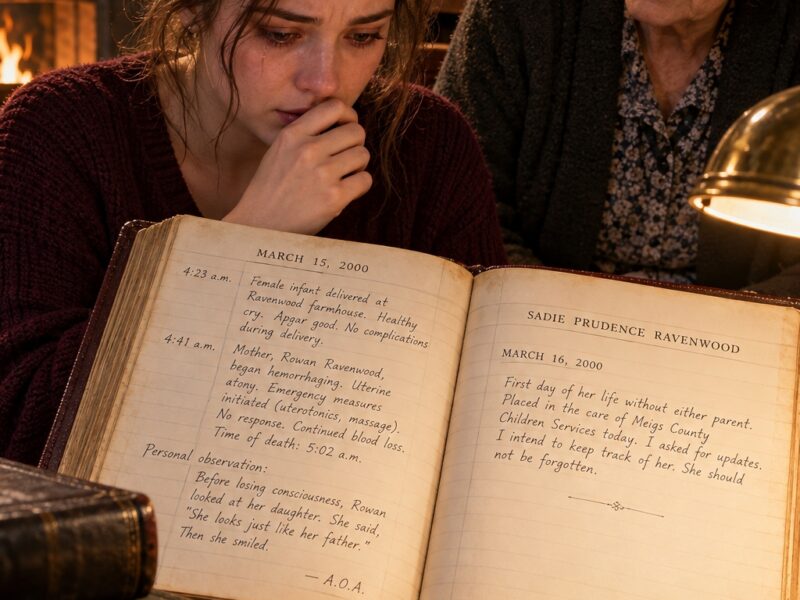
The first thing Sadie Ravenwood found in the dead doctor’s ledger was the exact minute her mother had died.
The second was a record of nearly every year of her own life.
And the third was a letter that proved someone had known where her family was all along.
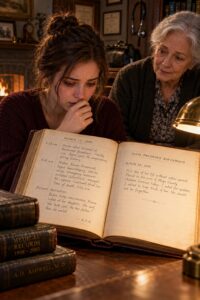
Sadie sat motionless beneath the yellow light of an old brass desk lamp, one hand resting on a page dated March 16, 2000. Outside, rain tapped against the windows of the Victorian house on Main Street in Reedsville, Ohio. Beside her, seventy-one-year-old Marceline Templeton stood with both hands clasped around a folded dish towel, watching the young woman discover a history that should have belonged to her from the beginning.
For twenty-five years, Sadie had believed she was an unwanted child. Her mother had died shortly after giving birth, her father had disappeared, and the state had raised her through seven foster placements across four Ohio counties. Now, inside the home of a country doctor she had never met, she was about to learn that abandonment was not the whole story.
Three days earlier, she hadn’t even known his name.
On March 9, 2026, Sadie finished her third consecutive night shift at Riverside Methodist Hospital in Columbus. She was twenty-five years old, six days from her twenty-sixth birthday, and so exhausted that the fluorescent lights in the staff corridor seemed painfully bright.
She had spent most of the night caring for an elderly man with pneumonia and a woman recovering from abdominal surgery. At six that morning, she had helped a frightened patient call his daughter because he didn’t want to receive his test results alone. By the time she finally reached her employee locker, her feet were aching and there was a faint indentation across her cheeks from her surgical mask.
Inside the locker lay a white envelope.
It had been delivered to the hospital’s administration office and forwarded to her department. The return address belonged to Wilfred Trumbull, an attorney in Pomeroy, Ohio.
Sadie recognized the county.
Meigs County was where she had been born, though she had never known it as home.
She opened the envelope expecting some administrative matter involving a birth certificate or an old foster care record. Instead, she found a formal notice explaining that Dr. Absalom Owen Ashwell, a retired physician from Reedsville, had died in January at the age of eighty-seven.
Under the terms of his will, he had left Sadie his residence at 224 Main Street, including its furnishings, books, and personal property.
The estimated value was seventy-eight thousand dollars, subject to an outstanding property tax lien.
Sadie reread the first paragraph.
Then the second.
She had never heard of Dr. Ashwell.
There was no family connection identified in the letter, no explanation for the inheritance, and no indication that the doctor had ever practiced in Columbus.
A small brass key had been enclosed in a padded sleeve.
At the bottom of the attorney’s letter was an additional instruction, written at the doctor’s request.
The explanation is waiting on the third shelf of my office bookshelf.
Sadie stood in front of her open locker for several minutes, listening to a cleaning cart rattle down the hallway.
Then she called the attorney.
Wilfred Trumbull had the careful voice of a man who had spent thirty years explaining difficult things to people who weren’t prepared to hear them. He confirmed the inheritance and said the doctor had been unusually specific about Sadie’s identity.
“Did he know my mother?” she asked.
There was a pause.
“I believe he did.”
“Was he my father?”
“No, Miss Ravenwood. He made a point of stating that he was not.”
“Then why would he leave me his house?”
Mr. Trumbull turned a page.
“I can read you one sentence from the instructions he left with me.”
Sadie leaned against the lockers.
The attorney cleared his throat.
“‘I have thought about this young woman every day since March 15, 2000, and I hope that, when she knows the truth, she will understand why.'”
Sadie felt a chill move across her shoulders.
March 15, 2000.
The day she was born.
The day her mother died.
She arranged to meet the attorney the following morning, intending to sign whatever documents were necessary before returning to Columbus. But by noon she was sitting on the edge of her bed, still in her hospital clothes, holding the envelope and staring at the brass key.
Sleep wouldn’t come.
At two that afternoon, she packed an overnight bag.
At three, she was driving south.
The rain began near Athens and grew heavier as the road curved through the wooded hills toward the Ohio River. Bare branches scraped against one another above the highway. Small farmhouses appeared and vanished beyond the roadside, their porches stacked with firewood against the lingering March cold.
Sadie had driven through southern Ohio before, but never with the feeling that each mile was bringing her closer to something she had spent her whole life trying to understand.
She had been fourteen when she arrived at the Hollingsworth home in Columbus, carrying two plastic bags and a backpack with a broken zipper.
Helen Hollingsworth had opened the door and asked whether she preferred the room with the yellow curtains or the one overlooking the backyard. Sadie had answered that either would be fine, because in six previous placements she had learned not to express preferences about rooms she might be leaving within a month.
The Hollingsworths were the closest thing to a permanent family she had ever known.
They hadn’t adopted her. By then, Sadie was old enough to be skeptical of promises, and the household had been built around a long-term foster arrangement rather than legal permanence. But Helen had attended her graduation, and George Hollingsworth had helped her move into her first college apartment.
When Sadie graduated from Ohio State University with her nursing degree, Helen had cried harder than anyone.
They were still part of her life.
But even with their kindness, there remained a place inside Sadie that no amount of affection had ever quite reached.
It was the place where her beginning should have been.
Her official records told her that her mother’s name was Rowan Ravenwood. She had died from postpartum hemorrhage shortly after Sadie’s birth. Her father, Ashwood Ravenwood, had surrendered her to county services and eventually relinquished his parental rights.
There was no photograph of either parent.
No letter explaining what had happened.
No remembered voice.
Sadie owned a small silver locket that had been found among her mother’s belongings and passed along with her childhood records. The hinge was loose, and the interior held nothing except a faded indentation where a tiny photograph might once have been.
She wore it beneath her nursing uniform.
Most days she could forget it was there.
Other days, she caught herself holding it between two fingers whenever a patient spoke about a mother, a father, or a childhood home.
By the time she reached Reedsville, the sky had darkened.
Number 224 Main Street stood behind an iron fence with one missing finial. The house was larger than she had expected, with cream-colored clapboard siding, a gray slate roof, and a wraparound porch supported by white wooden columns.
A brass plaque beside the front door read:
Absalom O. Ashwell, M.D.
The lettering had darkened with age.
One downstairs window glowed warmly.
Sadie parked along the curb, turned off her engine, and sat looking at the house through the windshield.
Someone had lived here for decades.
Someone who had known her name.
Someone who had apparently carried a memory of her birth for almost twenty-six years.
She stepped into the rain and approached the porch.
Before she could knock, the door opened.
An elderly woman stood inside, wearing a dark green cardigan over a neat cream blouse. Her silver hair was pinned at the back of her head, and her expression held the tired gentleness of someone who had spent most of her life caring for others.
“Sadie Ravenwood?”
Sadie stopped.
“Yes.”
The woman took a small breath.
“I’m Marceline Templeton. I worked with Dr. Ashwell for thirty-eight years.”
She moved aside.
“Come in, honey. You’re soaked.”
Sadie hesitated.
“How did you know I was coming?”
Marceline glanced at the suitcase in her hand.
“Mr. Trumbull said you might arrive tomorrow. But I had a feeling you wouldn’t wait.”
Inside, the house smelled of furniture polish, old paper, and something warm simmering in the kitchen. The entrance hall contained an umbrella stand, a grandfather clock, and a narrow wooden bench polished smooth by decades of use.
It did not feel abandoned.
It felt as if someone had stepped out for a short errand and failed to return.
Marceline offered her dry clothes, coffee, and chicken with rice. Sadie tried to refuse the meal, but her stomach betrayed her with an audible growl.
For the first time that day, she smiled.
They ate in a sitting room where a fire burned behind a black iron grate.
Marceline asked about her nursing work.
Sadie answered cautiously, then found herself describing a difficult patient and the small triumph of persuading him to sit up long enough to eat breakfast. Marceline listened without interrupting, occasionally nodding with the recognition of another woman who knew how much work could hide inside an ordinary act of care.
Eventually, Sadie set down her fork.
“Please tell me why I’m here.”
Marceline looked toward the fire.
“Because Dr. Ashwell should have told you something a very long time ago.”
Sadie waited.
“He delivered you.”
The clock on the mantel ticked.
“At a farmhouse outside town,” Marceline continued. “Your mother went into labor during the night. Your father called the doctor when things started going badly. The hospital was some distance away, and emergency help wasn’t reaching them quickly enough.”
Sadie’s fingers tightened around her coffee cup.
“Was I premature?”
“No. You were full-term. Strong lungs, too, according to the doctor.”
Marceline smiled briefly.
“You came into the world at four twenty-three in the morning.”
Sadie looked down.
Nobody had ever told her the time she was born.
“Your mother was exhausted,” Marceline said. “But she held you. She was conscious long enough to look at your face.”
Her voice changed.
“Then the bleeding started.”
Sadie knew the medical meaning of those words better than she wanted to.
Postpartum hemorrhage could turn a joyful delivery into an emergency in minutes. She had studied the physiology, the treatment protocols, the terrifying speed at which a patient could deteriorate.
But until that moment, she had never been able to picture her own mother as a patient.
“Did he try to save her?”
“Everything he could, with what he had. He had called for emergency transport, but it took time to get there.”
“Was she frightened?”
Marceline’s eyes filled.
“I wasn’t at the farmhouse that morning, sweetheart. I only know what the doctor told me afterward.”
Sadie nodded slowly.
She appreciated the honesty.
“Your father was there,” Marceline continued. “And when Rowan died, something in him seemed to collapse. Dr. Ashwell said he kept repeating that he should have taken her to the hospital earlier.”
Sadie stared at the coffee.
“What happened to him?”
“He left.”
“I know that part.”
“He called county services the next morning and asked for someone to take care of you. The legal process came later. But he never took you home.”
Sadie swallowed.
For years she had pictured that decision as a man looking at his newborn daughter and finding her insufficient reason to stay.
She had imagined him turning away from a nursery, putting on his coat, and walking out.
The reality sounded more complicated.
It did not make the abandonment hurt less.
Marceline drew a breath.
“Dr. Ashwell felt responsible. He had known your mother and father. He had been there when everything fell apart.”
“So he remembered me?”
“He did more than remember.”
Sadie looked up.
Marceline’s fingers tightened around the dish towel.
“He asked about you whenever he could. He learned when you changed foster homes. He followed your schooling. He knew when you were accepted into nursing college.”
Sadie’s expression changed.
“How?”
“People talked. Some people gave him information they should not have shared.”
“He had access to my foster records?”
“Not officially. And not all the information was accurate.”
Sadie sat back.
The warmth of the room no longer felt quite as comforting.
“You mean a stranger was keeping track of where I lived?”
Marceline lowered her gaze.
“Yes.”
“For twenty-five years?”
“Yes.”
“Without ever speaking to me?”
Marceline did not answer immediately.
“I’m not going to ask you to be grateful for that.”
Sadie looked toward the hallway.
She had spent childhood birthdays wondering whether anyone remembered the date. She had sat in unfamiliar kitchens, filled out forms about parents she couldn’t identify, and endured school assignments asking students to build family trees.
All that time, somewhere in southern Ohio, a doctor had been writing down the pieces of her life.
And he had chosen not to tell her.
“Why didn’t he come?”
Marceline’s face tightened.
“That is the question he spent his final years trying to answer.”
She rose slowly.
“Come with me.”
The former medical office occupied the back of the first floor.
It was separated from the main hallway by a heavy oak door. Inside were an examination table, two wooden chairs, a glass-fronted medicine cabinet that had long since been emptied, and a large roll-top desk facing the windows.
A bookshelf filled most of the far wall.
Some volumes were medical references.
Others were leather-bound ledgers, each marked with a range of years.
Sadie moved toward them.
Marceline remained by the doorway.
“Third shelf.”
Sadie ran her fingers along the spines until she found a burgundy volume stamped 1998–2003.
She carried it to the desk.
The leather was cool, the pages thick and yellowed at the edges.
She turned toward March 2000.
The doctor’s handwriting was small, precise, and unexpectedly beautiful.
There, halfway down a page dated March 15, she saw her mother’s name.
Rowan Ravenwood.
Beneath it were clinical observations, medication details, and timestamps documenting the emergency.
Sadie read the notes twice.
Then she found the entry recording her birth.
Female infant delivered at 4:23 a.m. Vigorous cry. Breathing established immediately. No apparent complications affecting infant.
Her eyes moved down the page.
Maternal hemorrhage began shortly afterward.
Further notes described the treatment.
The final time was 5:11 a.m.
Sadie placed her fingertip beside it.
Forty-eight minutes.
She had been alive for forty-eight minutes when her mother died.
A line beneath the clinical record had been written in darker ink.
Before losing consciousness, Rowan looked at the child and said, “She’s got her father’s chin. Look at that. She’s got his chin.”
Sadie lifted her hand to her face.
She had never seen her father’s photograph.
She didn’t know what he looked like when he smiled, whether his hair had gone gray, or whether the small cleft beneath her lower lip came from him.
But her mother had noticed.
In the narrow window between her daughter’s birth and her own death, Rowan Ravenwood had looked carefully enough to recognize a family resemblance.
Sadie pressed her lips together.
Marceline stepped closer but said nothing.
After a long silence, she touched the back of the ledger.
“The important part continues here.”
Sadie turned several pages.
The final section of the book had been reserved for a separate record.
Across the top, in carefully underlined letters, was her name.
Sadie Prudence Ravenwood.
Beneath it was an entry dated March 16, 2000.
Child placed under temporary care of Meigs County Children Services following maternal death. Father unable to provide immediate care. I have promised myself that Rowan’s daughter will not disappear from memory simply because no one is able to keep her at home.
Sadie read the words again.
Then she turned the page.
April 2, 2000. Infant reported healthy. Placed with foster family in Athens County.
November 19, 2001. Placement changed.
June 6, 2003. Sadie reportedly fond of picture books. No significant medical concerns known.
The entries continued.
Not every month.
Not even every year.
But often enough that Sadie could recognize the outline of her childhood.
August 2006. Child starting first grade. Reports suggest difficulty adjusting to new household.
She remembered that year.
The first day of school had begun in a classroom where everyone already knew one another. A teacher had asked the children to draw their families, and Sadie had drawn a house with no people because she couldn’t decide which faces belonged inside it.
December 2009. Another placement disrupted. Child reportedly withdrawn.
Sadie closed her eyes.
She remembered standing in a kitchen while a foster mother explained to a caseworker that she was too difficult, too quiet, too unwilling to trust.
September 2014. New placement with Helen and George Hollingsworth in Columbus. Initial reports encouraging.
Sadie’s throat tightened.
June 2018. Graduated high school. Plans to pursue nursing.
August 2020. Continuing nursing studies despite difficulties associated with pandemic restrictions.
May 2022. Completed nursing degree. Employment planned at Riverside Methodist Hospital.
The handwriting grew shakier toward the end.
The last entry was dated December 31, 2025.
Sadie continues her work as a nurse. I am told she is kind to difficult patients. Rowan would have recognized that kindness. I have failed to find the courage to tell her what I know.
Sadie lifted her head.
“What he knew?”
Marceline did not move.
Sadie looked back at the page.
Beneath the final entry, written in a hand so unsteady that several letters overlapped, were five words.
The blue envelope. Second drawer.
Sadie turned toward the desk.
There were two drawers on the right side.
She opened the lower one.
Inside lay a blue paper envelope, yellowed at the corners.
It was addressed to Dr. Ashwell.
The return address was a small town in Pennsylvania.
And on the back, in handwriting Sadie had never seen before, was a name that made her stomach tighten.
Ashwood Ravenwood.
Her father.
The envelope had been postmarked September 17, 2011.
Sadie had been eleven years old.
She lifted it with both hands.
“Marceline.”
Her voice was barely audible.
“Did my father write to him?”
Marceline’s expression answered before she spoke.
“Yes.”
Sadie stared at her.
“Did he write more than once?”
The older woman looked down.
“Many times.”
Sadie felt something cold settle inside her chest.
For nearly twenty-six years, she had believed her father had vanished without looking back.
Now she was holding a letter he had written eleven years after her birth.
And the person who had received it had never told her.
She unfolded the first page.
The handwriting was uneven, with one sentence heavily crossed out.
Dear Doctor Ashwell,
I know you don’t owe me anything after the way I left. But if you still have any way of knowing where Sadie is, please tell me whether she’s all right.
I am not asking you to make her see me. I know I’ve lost the right to ask for that.
I only want her to know that I didn’t stop loving her when I left.
Sadie’s breathing grew shallow.
She looked at Marceline.
“There’s more, isn’t there?”
Marceline’s eyes filled with tears.
“Yes, sweetheart.”
She looked toward the bottom drawer.
“And some of it is going to hurt.”
The next morning, the rain had stopped, but Sadie was still sitting in the doctor’s office.
She had slept for less than two hours on the sitting-room sofa, unable to bring herself to leave the ledger and the letters upstairs.
A dozen envelopes now lay across the desk.
Some were addressed in Ashwood Ravenwood’s uneven handwriting. Others carried the careful script of a woman named Evelyn Vale.
Sadie had never heard that name before.
Yet the first letter from Evelyn contained a sentence she could scarcely understand.
I am Rowan’s mother. I know her daughter survived. Please stop telling me there is nothing you can do.
Sadie read the sentence four times.
Then she looked at Marceline, who had brought her toast and coffee.
“My grandmother was alive?”
Marceline set down the tray.
“Yes.”
“After my mother died?”
“Yes.”
“She knew about me?”
Marceline’s eyes dropped to the letters.
“She knew Rowan had a baby.”
Sadie felt her stomach turn.
“Then why wasn’t I with her?”
Marceline pulled out the chair opposite her.
“Because what happened after your mother died wasn’t handled the way it should have been.”
Sadie waited, afraid to move.
Marceline explained that Rowan had been estranged from her family when she married Ashwood. Her father, Walter Vale, had been a rigid man who disapproved of the marriage, and the disagreement had grown into several years of silence.
Rowan had moved to Meigs County with Ashwood, and her parents had remained in Pennsylvania.
But family estrangement was not the same as abandonment.
After Rowan’s death, Evelyn had learned about the baby through a distant relative.
She had contacted county officials.
She had asked about taking custody.
She had written to Dr. Ashwell because she knew he had attended the birth.
The first letter was dated April 2000.
Sadie unfolded it carefully.
Evelyn had written that she understood Rowan was gone and could not change the terrible way their last conversation had ended. But she wanted to care for her granddaughter, even if it meant moving to Ohio.
The letter was four pages long.
On the last page, she had described a spare bedroom with pale yellow wallpaper and a wooden cradle that had belonged to Rowan.
I would give anything to put my daughter’s baby in that cradle, she wrote.
Sadie felt her eyes burn.
She had grown up believing nobody had wanted her.
Somewhere across the state line, a woman had been waiting beside an empty cradle.
“What did the county say?” Sadie asked.
Marceline drew a slow breath.
“The letters suggest there were attempts to contact them. But the legal record will tell you more than either of us can.”
“Did Dr. Ashwell know she was trying?”
“Yes.”
“Did he help her?”
Marceline looked miserable.
“Not enough.”
Sadie pushed back from the desk.
“That’s not an answer.”
“No,” Marceline whispered. “It isn’t.”
Sadie stood and walked toward the window.
Beyond the glass, the doctor’s backyard contained a narrow stone path, a sagging greenhouse, and a pear tree that had grown crooked with age.
She had spent years telling herself that no one had ever come for her because no one had cared.
That belief had hurt, but at least it had been simple.
Now she was beginning to understand that her childhood might have been shaped not only by grief and abandonment, but also by decisions made by adults who had never asked what she wanted.
“What happened to Evelyn?”
“She died in 2018.”
Sadie closed her eyes.
The year she graduated high school.
“Did she ever find me?”
“I don’t believe she did.”
Sadie turned.
“Did he tell her I was graduating?”
Marceline said nothing.
Sadie looked at the letters again.
“Did he?”
“No.”
The answer struck harder than Sadie expected.
She returned to the desk, picked up the oldest letter, and began reading from the beginning.
Evelyn’s letters continued for several years.
In 2002, she wrote that her husband had died and that she was still willing to raise the child. In 2004, she enclosed copies of documents demonstrating her relationship to Rowan. In 2007, she asked whether Sadie had started school.
The replies from Dr. Ashwell were not present, but some of his draft notes survived.
In one, he explained that Sadie’s placement arrangements were already complicated and that reopening the question of family custody could be disruptive.
Another contained a sentence Sadie could not forgive.
Perhaps it is better to let the child establish roots where she has been placed.
Sadie laid the paper down.
“Roots?”
Her voice sharpened.
“I was moved seven times.”
Marceline looked at her helplessly.
“He thought—”
“He didn’t know me.”
“No.”
“He knew addresses. He knew dates. He knew whatever someone told him over the telephone.”
Sadie’s hands trembled.
“He didn’t know what happened when I packed my things. He didn’t know what it was like to stand in somebody’s driveway while they decided whether they could keep me.”
Marceline lowered her head.
“You’re right.”
Sadie had expected an explanation that would make the doctor’s strange devotion seem noble.
Instead, she was finding something much harder to live with.
A man could care about a child and still make terrible decisions about her life.
She turned to the letters from Ashwood Ravenwood.
The first was dated 2003.
Dear Doc,
It’s been three years. I know you think I ought to stay away. I probably should. But I need to know whether my girl is healthy.
He described working in a machine shop in western Pennsylvania and attending counseling through a local community clinic.
He had stopped drinking, he wrote, after nearly losing his job.
He did not ask for Sadie’s address.
Only for news.
In a letter from 2005, he enclosed a photograph.
It showed a lean man in his early thirties standing outside a modest brick building, wearing work boots and a navy-blue jacket.
He had dark hair.
Tired eyes.
And a small cleft beneath his lower lip.
Sadie touched her chin.
For the first time in her life, she knew what her father looked like.
Her mother had been right.
She had his chin.
The photograph had been folded carefully into fourths.
On the back, Ashwood had written:
In case she ever asks what I looked like.
Sadie held it for a long time.
Then she unfolded another letter.
By 2008, Ashwood had remarried.
He wrote that his wife knew about Rowan and Sadie. He had told her the truth before their wedding.
He had no other children.
He had tried to contact county services, but he understood that his parental rights had been terminated and that he could not simply demand information.
In 2011, he wrote the blue-envelope letter Sadie had found first.
Then came a letter dated March 15, 2015.
Dear Sadie,
Sadie’s breath caught.
For the first time, her father had addressed a letter directly to her.
You are fifteen today. I don’t know whether you like books or horses or music. I don’t know what color your room is, or whether you still have the little silver locket your mother wore.
I remember being afraid to hold you. You were so small, and I was so certain that everything I touched would be ruined.
That was a terrible reason to leave you. I understand that now.
If this letter ever finds you, I don’t expect forgiveness.
But I hope you never believe that your mother regretted having you.
She had been choosing names for months. She wanted Prudence for your middle name because it had belonged to her grandmother. We argued about it for weeks, and then she laughed and said I could choose the first name if she could choose the second.
I chose Sadie because she smiled every time I said it.
You were loved before you were born.
Sadie brought the letter against her chest.
She had spent years privately hating her middle name because it sounded old-fashioned. She had never known it belonged to someone in her family.
Now she could almost picture her parents talking about names in a kitchen, teasing one another, imagining a daughter they both expected to raise.
The image hurt more than the empty space that had existed before it.
“Is he alive?” she asked.
Marceline looked up.
“I don’t know.”
Sadie studied her face.
“How can you not know?”
“The last letter came in 2023. He wrote that he was having some trouble with his heart.”
Sadie searched the envelopes.
There were no letters dated later than November 2023.
The last one was brief.
Doctor,
I’ve been thinking about how much time we’ve all wasted.
If you ever speak to Sadie, please tell her I’m sorry. Not because I expect anything back. Just because she deserved a father who stayed.
I’ve kept a place for her in my life, although I know keeping a place isn’t the same as being there.
Ashwood.
Sadie put the letter down and stared at the wall.
Then she noticed something.
Beside the date of the final letter, Dr. Ashwell had written a note in red pencil.
Contact withheld. Decision must be hers.
She turned to Marceline.
“What does that mean?”
Marceline stood.
“I think you should read the doctor’s own letter.”
She crossed to a small locked compartment behind the roll-top desk and removed a cream envelope sealed with burgundy wax.
“His instructions were that you read this after the ledger.”
Sadie took it.
Her hands had become strangely steady.
Inside were six pages.
The first began:
Dear Sadie,
If you are reading this, then I have died without finding the courage to face you.
That is not the sentence I hoped to write at the end of my life, but it is the truthful one.
Sadie continued.
Dr. Ashwell described Rowan as a young woman with a quick laugh who had once brought him a basket of pears after he treated Ashwood for a farming injury.
He remembered her asking dozens of questions during prenatal visits.
He remembered how Ashwood held her hand when she complained that the baby seemed determined to kick through her ribs.
And he remembered the morning everything went wrong.
He admitted that his own judgment during the emergency had haunted him for decades.
He had tried to manage the hemorrhage while waiting for transport, believing help would arrive before Rowan’s condition became irreversible. After her death, he repeatedly reviewed his notes, wondering whether some different decision would have saved her.
He had never found an answer that gave him peace.
Then he wrote about Sadie.
When your father left, I told myself that keeping track of you was a responsibility I had inherited from that terrible morning.
At first, I believed I might help you someday. Then years passed, and I grew afraid that telling you who I was would only reopen a wound.
When your grandmother contacted me, I made a greater mistake.
Sadie stopped reading.
Her pulse thudded in her ears.
I believed that a child whose life had already been disrupted should not be pulled into another dispute between adults. I encouraged others to leave your placement alone. I did not control the court proceedings, but my opinions carried more weight than they deserved.
I mistook my fear of another tragedy for wisdom.
You were not a patient whose future I had the right to manage.
You were a child with a family history, and I helped keep that history from you.
Sadie pressed the heel of her hand against her forehead.
The doctor continued.
I know that leaving you a house does not repair what was lost. Nor does keeping a ledger make me a good man.
I watched you grow from a distance because it was easier than risking your anger. Every year that I waited made the next conversation harder.
I was proud when you became a nurse. I was ashamed that I knew you had done so only because someone told me.
Your grandmother left something for you. Your father may still be living in Pennsylvania. In the small wooden box beneath this desk, you will find the addresses and documents I have kept.
I am leaving them to you because they belong to you, not because I deserve your forgiveness.
The final paragraph was shorter.
I once believed that protecting someone meant deciding which truths they could bear.
I was wrong.
The house is yours. You may keep it, sell it, or tear down every trace of me. I ask only that you do not let my mistakes convince you that your mother was forgotten or that no one ever wanted you.
She loved you.
And I am sorry.
Sadie lowered the pages.
There was no dramatic revelation that made the doctor innocent.
No hidden explanation that erased the harm he had done.
He had carried guilt for twenty-five years.
But Sadie had carried the consequences.
She sat with that knowledge until the sound of a vehicle outside interrupted the silence.
Attorney Wilfred Trumbull had arrived.
He entered the office ten minutes later, carrying a leather briefcase and wearing a charcoal overcoat damp from the morning mist.
Sadie did not stand.
“Mr. Trumbull, I want access to every document related to this estate.”
He nodded.
“Of course.”
“And I want to know whether there are legal restrictions on these medical records.”
His expression became serious.
“Some materials contain information about other patients. Those will need to be handled separately.”
“I’m not asking for anybody else’s history.”
Sadie glanced toward the ledger.
“I’m asking for mine.”
“I understand.”
She gathered the letters into a careful stack.
“I also need to know whether my grandmother tried to find me through the courts. And whether anyone deliberately kept her from contacting me.”
Trumbull opened his briefcase.
“I can help arrange a review of the estate papers, but the child welfare records will have to be requested through the appropriate channels.”
Sadie nodded.
She was accustomed to paperwork.
She knew how much human suffering could disappear inside a file if nobody bothered to read it carefully.
Then the attorney said something unexpected.
“There is another item Dr. Ashwell wanted you to have.”
He removed a small wooden box wrapped in faded blue cloth.
“Your grandmother left this with him in 2016. His instructions say she intended it for you when you were old enough to receive it.”
Sadie looked at the box.
“Why didn’t he give it to me when I turned eighteen?”
Trumbull’s face tightened.
“I’m afraid I can’t answer that.”
Sadie untied the cloth.
Inside lay a yellowed photograph, a narrow silver bracelet, and a folded letter.
The photograph showed a young woman sitting beneath a flowering tree.
She had dark hair gathered loosely at the back of her neck.
She was laughing at someone outside the frame.
One hand rested across the unmistakable curve of her pregnant belly.
Sadie stopped breathing for a moment.
“That’s Rowan,” Marceline whispered.
Sadie touched the photograph’s corner.
Her mother.
Not a name on a death certificate.
Not a medical tragedy recorded in blue ink.
A young woman in a pale cotton dress, laughing in the spring sunshine.
On the back, someone had written:
Rowan, February 2000. Six weeks until the baby comes.
Sadie turned the photograph over again.
She studied the woman’s eyebrows, the slight tilt of her head, the shape of her hands.
Then she noticed the silver locket hanging against Rowan’s dress.
Without thinking, Sadie reached beneath her sweater.
She pulled out her own locket and held it beside the photograph.
It was the same one.
For twenty-five years, she had worn something that had once rested against her mother’s heart.
Now, for the first time, she could see it there.
Her vision blurred.
She opened Evelyn’s letter.
My darling Sadie,
I don’t know if you will ever read this, or whether you will want to know the family your mother came from.
I have made mistakes I cannot undo. The worst was allowing an argument with Rowan to last longer than my pride should have permitted.
I thought there would be time to apologize.
There wasn’t.
Your mother was stubborn, generous, funny, and sometimes impossible. She loved peaches, old country songs, and thunderstorms when she was safe inside the house.
When she was six years old, she used to collect injured birds and bring them into my kitchen. Most recovered. The ones that didn’t, she buried beneath the pear tree and marked their graves with stones.
I was told you wanted to become a nurse. Perhaps kindness travels through a family even when the family itself has been broken apart.
There was always a room for you in my home.
I wish someone had brought you to it.
Sadie couldn’t read further.
She covered her face.
For a long time, nobody spoke.
Marceline eventually moved close enough to rest a hand on the back of Sadie’s chair.
Sadie did not pull away.
But she did not look up, either.
Because the sentence she could not stop hearing was the simplest one.
There was always a room for you.
She thought of the seven foster homes.
The plastic bags.
The birthdays spent with unfamiliar families.
The nights she had tried to be good enough, quiet enough, useful enough that no one would ask her to leave.
Somewhere, her grandmother had prepared a room.
And Sadie had never been allowed to know.
Later that afternoon, Trumbull drove her to the county offices in Pomeroy so she could begin the process of obtaining her records.
The clerk explained that an adult formerly in foster care could request certain portions of her own case history, though some information might be restricted or redacted. The attorney helped her identify which requests required formal authorization.
Sadie filled out the forms at a gray metal counter.
Name.
Date of birth.
Previous legal names.
Parents.
Addresses.
She had answered those questions so many times that her hand usually moved automatically.
This time, she paused over the space for her mother’s name.
Rowan Ravenwood.
For the first time, she could picture the person behind the words.
Three weeks later, the first packet of records arrived.
Sadie sat at the Hollingsworths’ kitchen table in Columbus to read them.
Helen made tea.
George stayed nearby, pretending to repair a small kitchen drawer that had been sticking for months.
Neither asked to read over her shoulder.
Sadie was grateful.
The records confirmed that Evelyn Vale had attempted to establish contact with the child welfare agency. They also showed that her inquiries had become entangled with jurisdictional complications, missing information, and disputes about her suitability as a caregiver.
The file contained references to Dr. Ashwell’s opinion that moving the child could be destabilizing.
But it also contained something that surprised Sadie.
A social worker had recommended additional investigation into the grandmother’s circumstances in 2002.
That recommendation appeared never to have been fully completed.
Sadie read the pages twice.
Her grandmother had not simply been ignored by one doctor.
A series of people had failed to follow through.
Some had made defensible decisions with incomplete information. Others had relied on assumptions they never verified.
The combined result had been the disappearance of an entire family from Sadie’s life.
Helen sat beside her.
“Are you all right?”
Sadie gave a small, bitter laugh.
“I don’t know what to be.”
“You don’t have to know today.”
Sadie looked at the woman who had helped her survive the years after fourteen.
“Helen, did you know any of this?”
“No, honey.”
“Would you have told me if you had?”
Helen’s eyes filled.
“Of course.”
Sadie looked down at the photograph of Rowan.
For years, she had imagined that finding the truth would make everything simpler.
Instead, it was teaching her how much could be true at once.
Her father had left.
Her grandmother had tried to find her.
A doctor had cared about her while withholding information she needed.
The Hollingsworths had loved her without knowing any of it.
And none of those truths canceled the others.
That evening, after George had gone to bed, Sadie opened the final envelope from Ashwood Ravenwood again.
At the bottom was a telephone number.
She had avoided looking at it closely because seeing the digits made the possibility of a living father feel dangerously real.
Now she entered them into her phone.
She stared at the screen.
Then she pressed call.
The line rang six times.
A woman’s voice answered.
“Hello?”
Sadie sat straighter.
“Um. I’m looking for Ashwood Ravenwood.”
The woman was silent for a moment.
“May I ask who’s calling?”
Sadie felt her mouth go dry.
“My name is Sadie.”
A sharp breath came through the receiver.
Then the woman said, very softly, “Oh, my goodness.”
Sadie gripped the phone.
“Is he there?”
Another pause.
“Sadie, my name is Claire. I’m Ashwood’s wife.”
Sadie’s heart began pounding.
Claire’s next words came slowly.
“He’s alive.”
Sadie pressed her free hand against her chest.
“But he’s been waiting a very long time to hear your voice.”
Ashwood Ravenwood lived in a small brick house outside Washington, Pennsylvania, with a narrow front porch and two maple trees that had begun showing the first signs of spring.
He was fifty-three years old.
His hair had gone almost entirely gray, and a heart condition had forced him to retire early from the machine shop where he had worked for more than two decades.
The first time Sadie spoke to him, he cried before either of them had finished saying hello.
She didn’t know what to do with that.
She had imagined a hundred versions of their first conversation, usually while lying awake in unfamiliar bedrooms as a child.
In some, he was cold.
In others, he made excuses.
Sometimes he refused to admit who he was.
She had never imagined that he might be an older man sitting beside a telephone, unable to say his own daughter’s name without his voice breaking.
Claire explained gently that Ashwood had kept every letter he had written to Dr. Ashwell, along with the few replies he had received.
He had also kept newspaper clippings and photographs when information reached him through relatives or public announcements.
But he had never known where Sadie lived as a child.
He had not been given her foster family details.
His knowledge had come in fragments.
Sadie listened.
Then she asked the question she had carried for most of her life.
“Why did you leave me?”
The telephone line went quiet.
When Ashwood finally answered, his voice was hoarse.
“Because I was a coward.”
Sadie looked down at the kitchen table.
“I thought you were going to say you were grieving.”
“I was.”
“Or that you couldn’t take care of a baby.”
“I couldn’t.”
“Or that you were too young.”
“I was twenty-seven. Old enough to do better.”
Sadie waited.
Ashwood took a breath.
“I loved your mother more than I knew how to explain. And when she died, I couldn’t stand to look at anything that reminded me of her.”
He stopped.
“That includes you, Sadie. I wish I could tell you something kinder.”
She closed her eyes.
The answer hurt.
But at least it was an answer.
“I thought she’d died because of me,” he continued. “I thought if I’d taken her to the hospital sooner, she’d still be here.”
“That wasn’t your decision alone.”
“I know that now.”
“Did you try to come back?”
“Not soon enough.”
“Why?”
“I was drinking. I was ashamed. By the time I was sober and working again, the courts had already moved forward, and I didn’t know how to reach you.”
Sadie looked at the letter from 2015.
“You could have tried harder.”
“Yes.”
He didn’t argue.
“You could have gone through an attorney.”
“Yes.”
“You could have fought for me.”
Ashwood’s breathing became uneven.
“I know.”
Sadie pressed her fingers against her eyes.
For years, she had wanted a father who would explain why leaving her had been necessary.
Now she was speaking to a man willing to admit it hadn’t been.
“I don’t know what you want me to say,” she whispered.
“You don’t have to say anything.”
“Do you expect me to call you Dad?”
“No.”
“Do you expect me to forgive you?”
“No.”
She listened to the quiet on the other end of the line.
Then he added, “I hoped I might get to tell you about your mother.”
Something inside Sadie softened despite herself.
“What was she like?”
Ashwood exhaled shakily.
“She was the kind of woman who couldn’t pass a dog sitting in the rain without trying to bring it home.”
Sadie gave an unexpected laugh.
He laughed too, although his voice was still wet with tears.
“She loved terrible jokes. She used to sing while washing dishes and never quite got the words right.”
Sadie leaned back.
For the first time, she was hearing about Rowan as a person who had lived.
Not simply someone who had died.
Ashwood told her about meeting Rowan at a county fair when they were both in their early twenties. He remembered how she had refused to ride the Ferris wheel but had spent half an hour feeding corn to a goat that belonged to a children’s petting exhibit.
He described the small farmhouse they rented and the old kitchen table they bought at an auction.
He remembered how she kept a jar of wildflowers beside the sink even when they could barely afford groceries.
Sadie listened until it was dark outside.
When the conversation finally ended, they had agreed to speak again.
Nothing more.
That was enough for the first day.
Over the next several weeks, Sadie divided her time between work, Columbus, and Reedsville.
She hired a local attorney to review the property tax lien and determine what would be required to settle the estate cleanly. The house needed roof repairs, updated electrical work in the former medical office, and several windows replaced.
The cost frightened her.
Seventy-eight thousand dollars sounded like an enormous inheritance until she began adding up the expenses.
Yet every time she considered selling, she remembered the bookshelf.
She remembered her mother’s photograph.
And she remembered that the house contained the only written account she had ever found of her first morning alive.
She did not want to make a decision while she was still grieving a family she had only just discovered.
So she waited.
Marceline helped her sort the doctor’s belongings.
They separated private medical records for appropriate handling, gathered personal books for donation, and carefully boxed the documents related to Sadie’s family.
Some afternoons, they worked in comfortable silence.
Other times, Sadie asked questions that made Marceline wince.
“Did you know he was writing down my foster placements?”
“Some of them.”
“Did you ever tell him he should contact me?”
“Yes.”
“How often?”
Marceline considered.
“More than once.”
“Why didn’t he listen?”
The older woman looked toward the desk.
“Because he was accustomed to being the one everyone listened to.”
Sadie thought about that.
It sounded like something she had seen in hospitals.
The most experienced professionals could become so certain of their judgment that they forgot other people had the right to disagree.
“Did you think he was doing the right thing?” she asked.
Marceline shook her head.
“Not always.”
“Then why did you stay?”
“Because I cared about him, and because there were patients here who needed us.”
She paused.
“That doesn’t mean I did everything right, either.”
Sadie appreciated the absence of excuses.
One afternoon in April, Marceline brought out a small metal tin from a high kitchen cupboard.
Inside were old recipe cards.
Several had been written by Rowan.
“She used to help the doctor with the church supper,” Marceline explained. “He couldn’t cook to save his life, so she brought pies.”
Sadie sifted through the cards.
Apple pie.
Buttermilk biscuits.
Peach preserves.
On the back of one card, Rowan had written:
Add more cinnamon if Ashwood complains. He never knows the difference.
Sadie laughed so suddenly that tears came into her eyes.
She traced the handwriting.
It was the first ordinary thing she had ever owned that her mother had written.
Not a message about dying.
Not a farewell.
A joke about cinnamon.
She took the recipe home and made the pie in Helen’s kitchen.
It came out too brown around the edges.
George ate two slices anyway.
Sadie put the card in a small wooden frame.
In late April, she drove to Pennsylvania.
Ashwood had offered to meet her in a restaurant, reasoning that a public place might feel safer.
Sadie agreed.
She arrived fifteen minutes early at a modest diner with green vinyl booths and framed photographs of the surrounding county.
She ordered coffee she didn’t want.
Then she sat watching the door.
When Ashwood entered, she recognized him immediately.
He moved slowly, one hand briefly resting against the doorframe.
He wore a clean navy jacket and carried a small paper shopping bag.
He looked older than in the photograph.
Much older.
But the cleft beneath his lower lip was unmistakable.
He saw her.
Stopped.
And for a moment, neither moved.
Then he approached the booth.
“Sadie?”
She stood.
“Hi.”
His hands trembled.
She could see he wanted to embrace her.
He did not.
Instead, he pulled out the chair across from her.
“Thank you for coming.”
Sadie nodded.
They ordered breakfast because neither knew what else to do.
Ashwood asked about her work.
She told him about the hospital, her schedule, and the apartment she rented in Columbus.
He listened with the concentration of someone afraid of missing a single word.
When she mentioned that she had always hated math in school, he smiled.
“Your mother was the same way.”
Sadie looked up.
“Really?”
“She once balanced our checkbook three times and got three different answers.”
Sadie laughed.
Ashwood’s face changed when he heard it.
“What?”
He shook his head.
“Nothing.”
“Tell me.”
His eyes shone.
“You laugh the way she did.”
Sadie looked down at her coffee.
She wanted to feel comforted.
Part of her did.
Another part was furious that this man had missed the first twenty-five years of that laugh.
After breakfast, Ashwood took the paper bag from beside his chair.
“I brought something. You don’t have to take it.”
He placed it on the table.
Inside was a small photo album.
The first photographs showed Rowan standing with a bicycle in front of a brick house.
Another showed her wearing an oversized sweater, laughing at a Christmas party.
There were wedding photographs, pictures of their farmhouse, and one image of Rowan holding a tiny pair of yellow baby shoes.
Sadie turned each page slowly.
Then she reached the final photograph.
Rowan sat on the porch steps, heavily pregnant, one hand resting on her belly.
Ashwood sat beside her.
Both were smiling.
On the back, in Rowan’s handwriting, were three words.
Waiting for Sadie.
Sadie began to cry.
Ashwood looked away, giving her privacy.
She had spent almost twenty-six years believing her first appearance in the world had destroyed everything.
But the photograph showed something else.
There had been happiness before the tragedy.
There had been anticipation.
Her parents had waited for her.
They had imagined meeting her.
The knowledge did not erase what came afterward.
It gave the beginning of her life a different shape.
When Sadie finally closed the album, Ashwood spoke.
“I don’t want you to think I deserve credit for loving you before you were born.”
She wiped her face.
“Then don’t ask for it.”
“I won’t.”
She looked at him for a long moment.
“I don’t know what we’re supposed to be.”
He nodded.
“Neither do I.”
“I’m not a little girl anymore.”
“I know.”
“You missed everything.”
His eyes filled.
“I know that too.”
Sadie pushed the empty coffee cup aside.
“But I might want to know you.”
Ashwood stared at her.
She lifted one hand.
“Slowly.”
He nodded, unable to speak.
When they walked outside, the afternoon sun had broken through the clouds.
Ashwood stopped beside her car.
He held out his hand as though they were acquaintances meeting after a business appointment.
Sadie looked at it.
Then, unexpectedly, she stepped forward and hugged him.
He froze.
She could feel his heartbeat against her shoulder.
For several seconds, his arms remained at his sides.
Then he held her carefully.
He did not say that everything would be all right.
He did not promise to make up for the years.
He simply stood there, an older man holding the daughter he had failed, while cars passed along the road and the wind moved through the budding trees.
Sadie was the first to let go.
“I’ll call you next week.”
Ashwood nodded.
“I’d like that.”
She got into her car.
As she drove away, she looked into the rearview mirror.
He was still standing outside the diner.
She wondered how many times he had imagined watching her leave.
And how many years it would take before he believed she might come back.
The summer brought changes to the house in Reedsville.
Sadie arranged for the tax lien to be paid through a manageable combination of her savings and a small loan. She contracted with a local roofer to repair the worst sections of slate and found an electrician willing to update the old office wiring without tearing apart its original woodwork.
She continued working full-time in Columbus, visiting Reedsville on her days off.
Helen and George came to help paint.
Marceline organized the kitchen.
Ashwood visited once in July with Claire, carrying a toolbox and a box of tomato plants.
It was awkward at first.
George and Ashwood shook hands with the stiff politeness of men who understood they occupied very different places in Sadie’s life.
Then George handed him a paintbrush.
By lunchtime, the two were arguing amiably over the proper way to repair an old porch railing.
Sadie watched from the kitchen window.
For years, she had believed that families came in one shape.
Then she had believed she had none at all.
Now she watched two men who had both, in very different ways, been connected to her life, standing side by side on a porch neither of them owned.
The scene was ordinary.
She found herself unexpectedly grateful for it.
But not everything became easy.
Some evenings, Ashwood called and she let the phone ring.
Sometimes a question would occur to her at work, and she would become angry that he hadn’t been there to answer it when she was twelve.
One afternoon, while she was sorting old photographs, she discovered a picture of Rowan holding a birthday cake.
It was her twenty-fourth birthday.
Sadie calculated that her mother had been only twenty-four when she died.
Younger than Sadie was now.
The realization unsettled her so deeply that she put the photographs away for several days.
She began to understand her mother not as an idealized figure who had existed only to die, but as a young woman who had wanted a life.
Rowan had planned to plant roses beside the farmhouse porch.
She had hoped to travel to the ocean.
She had wanted to go back to school someday.
There were dreams Sadie would never know whether she might have fulfilled.
And there was grief in that, too.
In August, Sadie drove to Pennsylvania to visit the cemetery where her grandmother Evelyn was buried.
Ashwood offered to accompany her.
She declined.
This was something she wanted to do alone.
Evelyn’s grave stood beneath a row of maples in a small cemetery overlooking a valley.
Sadie brought a bunch of pale yellow flowers.
She had never met her grandmother.
She had no memories of her voice.
Yet she knew Evelyn had written letters for years, trying to find a granddaughter whose life was being decided somewhere beyond her reach.
Sadie stood before the stone.
“I’m sorry we never met.”
Her words sounded small in the summer air.
She knelt and brushed a little dirt from the inscription.
Then she placed a copy of her nursing graduation photograph beneath the flowers, protected inside a clear sleeve.
“I finished school,” she whispered. “I think you would have liked that.”
A breeze moved through the trees.
She stayed until the afternoon shadows lengthened.
On the drive back to Ohio, she felt the familiar sadness.
But it no longer carried the same emptiness.
She could not have a relationship with Evelyn.
She could know that Evelyn had wanted one.
For a child who had spent years interpreting silence as rejection, that distinction mattered.
By September, Sadie had made a decision about the house.
She would keep it.
Not because she owed Dr. Ashwell gratitude.
Not because she wanted to preserve the memory of a man who had made painful decisions about her life.
She would keep it because, for the first time, she had the opportunity to choose a home without waiting for someone else’s permission.
She moved a few belongings into the upstairs bedroom, though she kept her apartment in Columbus for work.
The downstairs office became a quiet reading room and a place where she could organize her family’s history.
The examination table was donated to a medical history collection.
The medicine cabinet was cleaned and repurposed for books.
The ledgers containing other patients’ information were transferred for appropriate confidential handling.
Sadie retained copies of the records she was entitled to keep about herself and her family.
The burgundy ledger remained in her possession only as far as the estate’s legal arrangements allowed, with the sensitive material secured.
She framed three photographs for the office wall.
One showed Rowan laughing beneath the tree.
Another showed Evelyn standing in front of her Pennsylvania home.
The third was taken outside the diner in April.
In it, Sadie stood beside Ashwood.
They were not embracing.
Both looked a little uncomfortable.
But neither looked away from the camera.
Below the photographs, Sadie placed the silver locket in a small glass case when she was home, taking it out to wear during her working days.
She had worn it for years without knowing what its owner looked like.
Now, sometimes, she opened the case just to look at it beside Rowan’s photograph.
One October afternoon, Marceline found her sitting at the desk.
The younger woman was reading the doctor’s final letter again.
Marceline stopped in the doorway.
“Do you ever think you’ll forgive him?”
Sadie considered.
“Which part?”
Marceline looked surprised.
Sadie folded the letter.
“I think he loved my mother in his own way. And I think he was devastated when she died.”
She glanced toward the ledger.
“I think he believed he was helping me.”
Marceline nodded.
“But?”
“But he never asked.”
Sadie ran a finger along the desk’s worn edge.
“He got to decide what I knew. What my grandmother knew. Whether my father’s letters reached me.”
Her voice remained calm.
“And when he realized he was wrong, he waited until he was dying to admit it.”
Marceline lowered herself into a chair.
“I wish he had lived long enough to hear you say that.”
“Maybe I wish that too.”
They sat quietly.
Then Sadie added, “I don’t have to hate him to know he hurt me.”
Marceline’s eyes grew wet.
“No, sweetheart. You don’t.”
Outside, the pear tree had begun losing its leaves.
Sadie looked at the garden.
“Would you help me plant something in the spring?”
Marceline smiled.
“Of course.”
“Roses.”
“Any particular color?”
Sadie looked at Rowan’s photograph.
“Yellow.”
The first frost arrived early that year.
On the morning of October 18, Sadie woke in the upstairs bedroom beneath a quilt Helen had given her. The house was quiet except for the faint clicking of the old radiator and the occasional creak of floorboards settling in the cold.
She went downstairs barefoot, wrapped in a cardigan, and made coffee.
Sunlight lay across the wooden floor of the kitchen.
For a moment, she stood at the counter, listening.
There was no caseworker coming to explain a new placement.
No foster parent deciding whether another child could stay.
No packed bag waiting beside the door.
The silence was hers.
She carried her coffee to the office.
On the desk lay the last page of Dr. Ashwell’s letter.
She had read it so often that she knew the words by heart.
The house is yours.
Sadie looked around the room.
The house was hers.
But so was the choice of what it would become.
She placed the letter inside a folder, closed the drawer, and opened her laptop.
For several weeks, she had been considering a small community project.
Nothing grand.
Just a monthly gathering for young adults transitioning out of foster care, held in a space where they could receive practical help with résumés, nursing school applications, financial aid forms, and the hundreds of ordinary questions that were harder to answer when there was no parent at home to ask.
She knew it could not replace family.
But she also knew that sometimes a little practical help at the right moment could keep a young person from feeling entirely alone.
She named the gathering the Open Door Circle.
The first meeting was held in November.
Seven people attended.
Two were young women from Columbus who had recently aged out of care. Another was a nineteen-year-old man working evenings while trying to finish community college. A young mother arrived with a toddler, apologizing repeatedly for bringing her child.
Sadie handed the little boy a box of crayons.
“He’s fine here.”
The young mother looked relieved.
They sat around a long wooden table in the former doctor’s office, drinking coffee and talking about apartment leases, health insurance, job interviews, and the complicated process of obtaining personal records.
Sadie didn’t tell them what to do with their lives.
She shared what she knew.
Marceline brought sandwiches.
Helen arrived with homemade cookies.
George fixed a loose step on the porch while the meeting was underway.
At the end of the afternoon, one of the young women lingered after everyone else had left.
She was eighteen, with short dark hair and a worn denim jacket.
Her name was Lydia.
She held a folder against her chest.
“Can I ask you something?”
Sadie looked up from stacking chairs.
“Sure.”
Lydia hesitated.
“How do you know where you belong when you don’t really come from anywhere?”
Sadie stopped moving.
For a moment, she saw herself at eighteen.
A young woman standing at the edge of adulthood with a diploma, a few belongings, and no clear idea what the word home was supposed to mean.
She set down the chair.
“You don’t have to figure that out all at once.”
Lydia looked doubtful.
“Everybody else seems to know.”
“They don’t.”
Sadie pulled out a chair.
“Sometimes you find people who make room for you. Sometimes you make a place for yourself. Sometimes it’s both.”
Lydia looked around the office.
“Is that what you did?”
Sadie thought about the seven foster homes.
The Hollingsworths.
The ledger.
The photographs.
The father she was still learning how to speak to.
And the house where she had finally been allowed to decide whether to stay.
“I’m still doing it,” she said.
Lydia smiled a little.
“That actually makes me feel better.”
After the young woman left, Sadie stood at the front door watching her walk down Main Street.
Then she returned to the office.
The old desk lamp cast a warm circle of light across the table.
A year earlier, she would never have imagined living in a country doctor’s house.
She would never have believed her mother had loved terrible jokes or that her father had spent years writing letters he did not know how to deliver.
She would never have known that her grandmother had kept a yellow room ready for a granddaughter she never got to hold.
The truth had not given Sadie a perfect family.
It had given her something more difficult.
People who had loved her imperfectly.
People who had failed her.
People who had stayed.
And the freedom to decide how much room each of them would occupy in the life she was building.
In December, Ashwood came for Christmas.
He arrived with Claire, carrying a pecan pie and a small wrapped package.
Helen and George had already arrived that morning. Marceline was in the kitchen, complaining that everyone kept trying to help her cook and making twice as much work.
The house smelled of cinnamon and roasted vegetables.
Outside, a thin layer of snow covered the porch railing.
During dinner, George told a ridiculous story about locking himself out of the house in his slippers.
Everyone laughed.
Ashwood looked across the table at Sadie.
For a moment, she recognized the expression in his face.
It was the same look he had worn in the diner when he first heard her laugh.
Grief and gratitude mingled together.
Sadie reached for the basket of rolls and offered him one.
He took it.
“Thank you.”
It was a small exchange.
She was learning that some relationships returned through small exchanges.
After dinner, Ashwood handed her the package.
Inside was a wooden picture frame.
He had made it himself.
The wood was dark walnut, carefully sanded and polished.
Inside was a photograph of Rowan holding the yellow baby shoes.
Sadie looked at him.
“Thank you.”
Ashwood nodded.
Then, cautiously, he said, “Your mother would have loved this house.”
Sadie looked toward the hallway, where the old grandfather clock ticked.
“Would she?”
“She loved places where people felt welcome.”
Sadie smiled faintly.
“Then I hope she would.”
Later that evening, after the others had settled in the sitting room, Sadie returned to the office alone.
She opened the desk drawer and took out the photograph of Rowan beneath the flowering tree.
She placed it beside the doctor’s ledger.
For twenty-five years, Sadie’s life had existed in that book as dates and reports.
A birth.
A placement.
A school.
A graduation.
A job.
But the ledger could never have captured everything.
It did not record the nights Helen sat beside her when she was afraid to sleep.
It did not record George teaching her how to change a tire before she left for college.
It did not record the first patient who thanked her for holding his hand.
It did not record the moment she heard her father’s voice and realized she could be angry with him and still want to know him.
And it did not record the afternoon seven strangers sat around her table and began speaking about futures they had once been afraid to imagine.
Sadie closed the burgundy cover.
Then she switched off the desk lamp.
From the sitting room, she could hear laughter.
Someone had put on an old country song.
Marceline was telling George he was stepping on her feet.
Sadie stood in the doorway for a moment, looking at the people gathered inside the warm room.
Her family was not the one she had imagined when she was small.
Some of its members were gone.
Some had arrived late.
Some had earned their place by staying when they didn’t have to.
But for the first time in her life, Sadie did not feel she was waiting outside a door, hoping someone would open it.
She walked into the room.
Helen moved over on the sofa.
Claire handed her a cup of tea.
Ashwood pulled out a chair.
Sadie sat down.
And no one asked how long she planned to stay.









