An 8-Year-Old Girl Begged a CEO for Work to Feed Her Baby Brother—His Answer Silenced the Entire Building
“I can clean.”
The little girl’s voice was so quiet that the security guard almost didn’t hear her.
“I can cook, too. And wash dishes. I can do anything.”
It was 8:17 on a freezing Monday morning in downtown Chicago, and hundreds of people were moving through the marble lobby of Callahan Financial as if every second of their lives had already been assigned a dollar value.
Phones rang.
Elevator doors opened and closed.
Leather shoes struck polished stone.
Men in tailored suits discussed quarterly projections while women carrying expensive coffee hurried toward meetings on the upper floors.
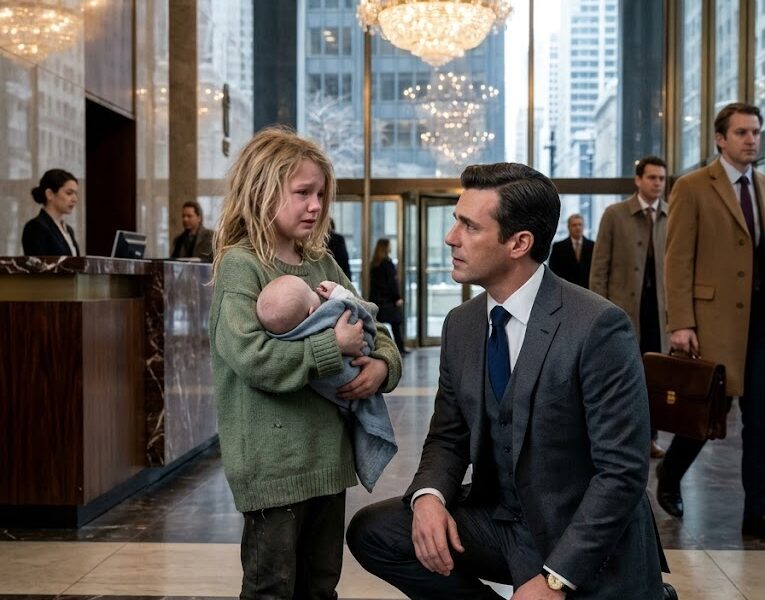
And in the middle of all that polished urgency stood an eight-year-old girl in a faded green sweater.
She was holding a baby.
Not a doll.
Not a younger child who could stand beside her.
A six-month-old baby wrapped in an old blue blanket, his small face pressed against her chest.
The girl’s arms were trembling from the weight.
The security guard stared at her.
“What did you say?”
She swallowed.
Her eyes moved toward the employees gathering near the elevators.
Then she looked down at the baby.
“My mommy can work, too,” she whispered. “She’s better than me.”
A few people nearby slowed.
The guard’s expression changed.
“Sweetheart, where is your mother?”
“At home.”
“Does she know you’re here?”
The girl hesitated.
That hesitation answered him.
The guard crouched slightly.
“What’s your name?”
“Lily.”
“And the baby?”
“Noah.”
Noah made a weak sound against her sweater.
Lily immediately began rocking him.
“It’s okay,” she whispered. “Please don’t cry. I’m trying.”
Something about those three words made the guard straighten.
I’m trying.
They weren’t words an eight-year-old should have needed.
A woman passing behind them glanced at Lily and then at the baby.
“She shouldn’t be in here,” she murmured to a coworker.
“Probably asking for money.”
Lily heard her.
Her cheeks flushed.
She tightened her arms around Noah.
“I’m not asking for money.”
The woman stopped.
Lily looked at the security guard again.
“My baby just needs food.”
And thirty feet away, a man stepping out of a private elevator heard every word.
His name was Daniel Callahan.
And before that morning was over, everyone inside that building would remember exactly what he did next.
But none of them yet understood why.
Six hours earlier, Lily Carter had been awake in a dark apartment listening to her mother cry.
Emily Carter thought her children were asleep.
She had become very good at crying quietly.
There was an art to it when you had children.
You learned how to press your face into a towel.
How to breathe slowly.
How to turn on the bathroom faucet so nobody heard the sound that escaped when fear finally became too heavy to hold inside.
For almost eight years, Emily had convinced herself that she could survive anything as long as her children never felt the full weight of it.
She had survived Lily’s father leaving before Lily turned two.
She had survived pregnancy with Noah while working nights.
She had survived rent increases, broken appliances, bus rides through snow, overdue medical bills and employers who smiled sympathetically before saying they had no additional hours available.
She had worked mornings at a diner near Logan Square and evenings cleaning rooms at a small hotel.
Then, six weeks earlier, everything had collapsed.
It started with exhaustion.
Then fever.
Then dizziness so severe that Emily fainted beside a hotel laundry cart.
The emergency room doctor told her she had developed a serious infection and severe anemia.
“You need rest,” he said.
Emily almost laughed.
Rest was something wealthy people prescribed to poor people.
“What happens if I go back to work?”
“You could end up back here.”
“What happens if I don’t?”
The doctor didn’t answer.
He didn’t need to.
No work meant no paycheck.
No paycheck meant everything else.
The diner replaced her after ten days.
The hotel manager promised to “see what he could do,” but stopped returning her calls.
Emily applied everywhere.
Grocery stores.
Restaurants.
Cleaning companies.
Warehouses.
School cafeterias.
Office buildings.
She heard the same phrases again and again.
We’ll call you.
We’re reviewing candidates.
We need someone with more flexible availability.
We need someone who can start immediately.
The irony nearly broke her.
She could start immediately.
She would have started at midnight if someone had asked.
But nobody did.
By Sunday evening, the refrigerator contained half a carton of milk, mustard, three ketchup packets and a container of rice from two nights earlier.
The electricity had been disconnected Friday afternoon.
Emily told Lily it was temporary.
She lit candles and pretended it was an adventure.
Lily pretended to believe her.
Children sometimes lie to protect their parents, too.
That Sunday night, Noah began crying from hunger.
Emily prepared what little formula remained.
She measured it carefully.
Then measured it again.
Lily watched from the kitchen doorway.
“Is that all?”
Emily forced a smile.
“I’m buying more tomorrow.”
“With what?”
Emily froze.
Lily was only eight, but hardship had taught her arithmetic adults wished she didn’t understand.
She knew groceries cost money.
She knew rent cost money.
She knew their electricity had not disappeared because of a storm.
And she knew her mother had spent almost an hour counting crumpled bills and coins at the kitchen table.
“Go back to bed, sweetheart.”
“Mom.”
“Lily.”
“You didn’t eat dinner.”
“I ate earlier.”
“No, you didn’t.”
Emily turned away.
That was the moment Lily understood.
Her mother wasn’t just worried.
Her mother was scared.
Emily waited until both children were quiet before entering the bathroom.
Then she sat on the floor beside the bathtub, pressed a towel against her mouth and cried.
She did not know Lily was standing on the other side of the door.
At 6:42 the next morning, Emily finally fell asleep on the couch.
Lily got dressed.
She chose her green sweater because it was the warmest thing she owned.
She found Noah’s blue blanket.
Then she remembered a building she had seen several times from the bus.
CALLAHAN FINANCIAL.
The name was written in enormous silver letters above glass doors.
People with expensive coats entered every morning.
Lily didn’t know exactly what a financial company did.
But she understood one thing.
People who went into that building had jobs.
And jobs meant food.
So the eight-year-old made a decision that would have terrified her mother.
She picked up her baby brother and left.
The cold hit her before she reached the end of the block.
Chicago wind cut between the buildings like a blade.
Lily tucked Noah deeper inside the blanket.
“It’s okay,” she whispered.
He looked up at her.
She smiled even though her teeth were beginning to chatter.
“Mommy’s going to be mad.”
Noah blinked.
“But maybe she won’t be mad when we bring food home.”
She walked three blocks to the bus stop.
An elderly woman waiting there noticed her immediately.
“Where’s your mother, honey?”
“She’s sick.”
“Are you going somewhere alone?”
Lily lowered her eyes.
The woman seemed ready to ask another question, but the bus arrived.
Lily climbed aboard.
She had exactly $2.50 in coins.
The driver looked at the baby.
Then at Lily.
“Where are you headed?”
“Downtown.”
“By yourself?”
Lily nodded.
The driver stared at her for a long moment.
Then waved her through without taking the money.
“Sit where I can see you.”
Lily did.
She held Noah through every stop.
Outside the windows, Chicago moved past them in shades of gray.
Apartment buildings.
Coffee shops.
Traffic lights.
People hurrying beneath scarves and winter coats.
Eventually the buildings became taller.
Cleaner.
More intimidating.
When Lily stepped off the bus, she stood on the sidewalk and stared upward.
Callahan Financial looked even bigger from below.
Forty-three floors of steel and glass.
For several seconds, Lily nearly turned around.
Then Noah began crying.
That decided it.
She entered.
And now she stood beneath a chandelier worth more than everything her family had ever owned, asking a security guard if someone might let her clean floors.
The guard’s name was Marcus Hill.
He had worked security at Callahan Financial for eleven years.
He had seen protesters, angry investors, fired executives and once an intoxicated shareholder attempt to enter a board meeting wearing only one shoe.
He had never seen anything like Lily.
“Do you have a phone number for your mother?” Marcus asked.
Lily nodded.
“Can we call her?”
Fear immediately crossed her face.
“No.”
“Why not?”
“She’ll make me come home.”
“That might be a good idea.”
“But Noah’s hungry.”
Marcus glanced toward reception.
“Okay. We’ll figure something out.”
A voice came from behind him.
“Marcus, we can’t have this happening in the lobby.”
Lily looked up.
A woman in a charcoal business suit had approached.
Her badge identified her as Rebecca Sloan, senior operations manager.
Rebecca looked at Lily with an expression that wasn’t cruel exactly.
It was worse.
Efficient.
“Is she lost?”
“No,” Marcus said carefully.
“She came asking about work for her mother.”
Rebecca frowned.
“She’s eight.”
“I know.”
“Then call the police or child services. We have clients arriving in fifteen minutes.”
Lily’s face drained of color.
“Please don’t call the police.”
Rebecca sighed.
“Nobody is angry with you.”
“My mommy didn’t do anything.”
“I didn’t say she did.”
“She’s a good mommy.”
People were watching now.
That was what Lily hated most.
Not the hunger.
Not even the cold.
The watching.
She knew those looks.
She had seen them when her lunch account at school ran out.
When her mother used coupons at the grocery store.
When the electricity company employee came to their apartment.
Pity had a way of making a child feel guilty for existing.
“I’ll leave,” Lily whispered.
She shifted Noah in her arms.
His head moved weakly against her shoulder.
Marcus noticed.
“Wait.”
“I’m sorry.”
“Lily—”
“I wasn’t asking for free money.”
Her voice cracked.
“I can work.”
A few conversations stopped.
Rebecca closed her eyes briefly.
“Sweetheart, children can’t work here.”
“I can clean.”
“No.”
“I know how.”
“That isn’t the point.”
“I wash dishes at home.”
“You shouldn’t have to.”
“I can learn.”
“Lily—”
“My mommy can do it, then.”
Now tears were spilling down her cheeks.
“She cooks really good. She can clean hotel rooms really fast. She can wash clothes. She can work nights. She can work mornings. She’ll do anything.”
Noah began crying.
Lily rocked him desperately.
“Shh. Noah, please.”
The sound echoed through the enormous lobby.
Then a deep male voice came from behind the growing crowd.
“What’s going on?”
People moved almost instinctively.
Daniel Callahan walked toward them.
At forty-two, Daniel had the kind of presence that changed the temperature of a room.
Six-foot-two.
Dark navy suit.
Silver watch.
No tie because he had removed it during a 6:30 a.m. conference call.
His company managed more than $14 billion in assets, and business magazines had spent years describing him with words like relentless, disciplined and intimidating.
Employees knew he could identify a flawed financial model faster than most analysts could open the spreadsheet.
He had fired senior executives in less than five minutes.
He had once canceled a $200 million acquisition because a single paragraph in the due diligence report didn’t make sense.
Daniel did not miss details.
Which was why, when he entered the lobby, he did not first notice the crowd.
He noticed Lily’s shoes.
They were too small.
Her toes were pushing against the front.
Then he noticed the baby.
Then the tears.
Rebecca stepped forward.
“Mr. Callahan, we’re handling it.”
Daniel didn’t look at her.
“What happened?”
Nobody answered immediately.
So he looked at Lily.
The expression on his face changed.
He lowered his voice.
“Hi.”
Lily stared at him.
“My name is Daniel.”
She said nothing.
“What’s yours?”
“Lily.”
“And who’s this?”
“Noah.”
“Your brother?”
She nodded.
Daniel glanced at Marcus.
“Where are their parents?”
“Their mother is home. Apparently she’s been ill.”
Daniel returned his attention to Lily.
“Does your mom know you’re here?”
Lily stared at the floor.
“No, sir.”
“Okay.”
He could have called security.
He could have handed the situation to human resources.
He could have continued toward the elevators where eleven executives were already waiting for him.
Instead, Daniel crouched.
His expensive trousers touched the marble floor.
Rebecca blinked.
Several employees exchanged glances.
Daniel didn’t notice.
Or perhaps he simply didn’t care.
“Why did you come here, Lily?”
She tried to speak.
Nothing came out.
Daniel waited.
He did not rush her.
Finally she whispered, “I saw people coming here.”
“Yes.”
“They have jobs.”
“Most of them do.”
“So I thought maybe you had one.”
“For your mom?”
Lily nodded.
Then she looked at Noah.
“For me, too, if you need.”
Daniel’s jaw tightened.
“You’re eight.”
“I know.”
“What kind of work were you hoping to do?”
The question was gentle.
That made everything worse.
Lily’s face crumpled.
“I can clean.”
Daniel remained still.
“I can cook a little. I make eggs.”
Someone behind Daniel inhaled sharply.
“I can wash dishes. I can fold clothes. I can sweep. I can do anything.”
Her voice became smaller with every sentence.
“My baby just needs food.”
Silence.
Real silence.
Not corporate silence.
Not the respectful quiet before an executive spoke.
The kind of silence that comes when a room full of adults realizes a child has just said something none of them can pretend they didn’t hear.
Daniel looked at Noah.
The baby’s cheeks were pale.
Then he looked at Lily’s hands.
Red from cold.
Trembling.
He saw something else.
A memory.
Suddenly he wasn’t standing in the lobby of a company bearing his name.
He was nine years old again.
Standing in a laundromat on the South Side.
Watching his mother count quarters.
Daniel’s father had disappeared when Daniel was seven.
For years afterward, his mother, Theresa, cleaned office buildings at night.
She would come home at two in the morning smelling of disinfectant and coffee.
Sometimes Daniel woke and found her sitting at the kitchen table with envelopes spread around her.
RENT.
ELECTRIC.
PAST DUE.
FINAL NOTICE.
He remembered one winter when she cut the toes from an old pair of sneakers because his feet had grown and there wasn’t enough money for new shoes.
She told him it was temporary.
He believed her because children want to believe their mothers can fix everything.
Then one evening, someone knocked on their apartment door.
There was nobody outside.
Only two paper grocery bags.
Milk.
Bread.
Eggs.
Chicken.
Cereal.
Apples.
Peanut butter.
And a winter coat.
No note.
No name.
Years later Daniel learned a neighbor named Mrs. Ramirez had bought everything after noticing his mother skipping meals.
Theresa never forgot it.
Neither did Daniel.
Now he looked at Lily Carter.
And for the first time in years, the billion-dollar financial world around him seemed absurdly small.
“Lily.”
She wiped her cheek.
“Yes, sir?”
“You should never have to carry this much.”
She looked confused.
Daniel nodded toward Noah.
“I don’t mean your brother.”
Something in Lily’s expression broke him.
Daniel stood.
He turned toward his executive assistant, Claire Bennett, who had just arrived.
“Claire.”
“Yes?”
“Cancel my nine o’clock.”
Rebecca stared at him.
“Daniel, that’s the Hartwell meeting.”
“I know what meeting it is.”
“They flew in from New York.”
“Then they can have coffee.”
He looked at Claire.
“Get baby formula. Diapers. Bottles. Whatever is age-appropriate. Have someone from the cafeteria prepare breakfast for Lily.”
Claire nodded immediately.
“Of course.”
“And clothes.”
Lily looked down at herself.
Daniel noticed.
“Warm clothes,” he clarified gently. “Not because there’s anything wrong with yours.”
Lily swallowed.
“Sir, we don’t have money.”
“I didn’t ask for money.”
“But—”
“Lily.”
Daniel crouched again.
“You came here because your brother was hungry, right?”
She nodded.
“Then we solve that first.”
“But how do I pay you back?”
Daniel stared at her.
The question hurt more than he expected.
“You don’t.”
Her brow furrowed.
“Everybody has to pay.”
“No.”
“Yes.”
“My mommy says—”
“Your mother sounds like a proud woman.”
“She is.”
“Good.”
Daniel smiled faintly.
“Then tell her this isn’t charity.”
Lily watched him suspiciously.
“What is it?”
“Someone helping someone.”
Behind them, Noah cried again.
Daniel stood.
“Claire, now.”
His assistant hurried away.
But Lily reached for Daniel’s sleeve.
He stopped.
“Sir?”
“Yes?”
“You said my mommy sounds proud.”
“She does.”
“She won’t take free things.”
Daniel nodded slowly.
“I thought that might be a problem.”
Lily looked frightened again.
Then Daniel said the words that would later be repeated by nearly everyone who had been standing in that lobby.
“Then we won’t give your mother charity.”
He turned toward Rebecca.
“We’ll give her an opportunity.”
Rebecca stared at him.
Daniel continued.
“If Emily Carter wants to work, someone from HR will interview her today.”
Lily’s mouth opened.
“Really?”
“Yes.”
“You’ll give Mommy a job?”
“I said an interview.”
Lily’s hope flickered.
Daniel smiled.
“And if she’s as hardworking as you say she is, I suspect she’ll make a very strong case for herself.”
For the first time that morning, Lily smiled.
It lasted only a second.
Then her face changed.
“Can Noah eat now?”
Daniel’s chest tightened.
“Yes.”
He looked toward the cafeteria manager who had joined the crowd.
“Right now.”
Within twenty minutes, Lily was sitting in a private conference lounge eating scrambled eggs, toast and strawberries.
She ate slowly at first.
Then faster.
Daniel noticed she slipped a piece of toast into a napkin.
“You can have more.”
Lily froze.
“I know.”
“Then why are you saving that?”
She looked embarrassed.
“For Mommy.”
Daniel turned his face toward the window for a second.
When he looked back, he spoke carefully.
“We’ll bring your mother breakfast.”
“Promise?”
“I promise.”
A pediatric nurse from the building’s employee wellness center examined Noah and confirmed that although he was hungry and tired, he appeared stable.
Appropriate formula was brought in.
When Lily saw the bottle, she nearly grabbed it.
Then stopped herself.
“Can I feed him?”
The nurse smiled.
“Of course.”
Daniel watched from across the room.
Noah drank.
And drank.
Lily stared at him as if nothing else existed.
“There you go,” she whispered. “I told you I’d find some.”
Daniel looked away.
He had negotiated with senators.
CEOs.
Billionaires.
Attorneys.
Investors who could move markets with one phone call.
But he had never felt as powerless as he did hearing an eight-year-old tell a hungry baby that she had kept her promise.
His phone vibrated.
Claire.
He stepped outside.
“We reached the mother.”
“How?”
“Lily had the number memorized.”
“And?”
Claire hesitated.
“She’s terrified.”
Daniel looked through the glass.
Lily was still feeding Noah.
“She woke up and the children were gone. She was about to call the police.”
“Tell her they’re safe.”
“We did.”
“Is she coming here?”
Another pause.
“No.”
“Why?”
“She says she doesn’t have bus fare.”
Daniel closed his eyes.
“I’ll go to her.”
Claire looked surprised.
“You have the Hartwell meeting.”
“Move it.”
“To when?”
“Tomorrow.”
“They may not like that.”
Daniel glanced back at Lily.
“I’ll survive.”
An hour later, a black SUV stopped outside a three-story apartment building in Logan Square.
Daniel stepped out with Claire and a licensed family-support specialist his company routinely worked with for employee assistance cases.
Emily Carter was waiting at the entrance.
Daniel recognized Lily immediately in her face.
Same brown eyes.
Same stubborn jaw.
But Emily looked exhausted.
Her coat was too thin.
Her hair had been tied back hastily.
When Lily climbed from the SUV carrying Noah, Emily ran toward her.
“Lily!”
She dropped to her knees and grabbed both children.
“What were you thinking?”
Lily started crying.
“I’m sorry.”
“You left without telling me!”
“I’m sorry.”
“I woke up and you were gone. Both of you were gone.”
Emily kissed Noah’s forehead, then Lily’s face.
“I thought something happened to you.”
“Mommy—”
“You never do that again.”
“I was helping.”
“I don’t care.”
“We needed food.”
Emily froze.
Lily’s next words came through tears.
“You were crying.”
The anger disappeared from Emily’s face.
Daniel watched her shoulders collapse.
“You heard me?”
Lily nodded.
“I know we don’t have money.”
“Baby…”
“I know the lights aren’t broken.”
Emily closed her eyes.
“I know they turned them off.”
“Lily.”
“And Noah was hungry.”
Emily covered her mouth.
“I can work, Mommy. I told them.”
“What?”
“I told them I can clean.”
Emily stared at her daughter.
Then she looked at Daniel for the first time.
Humiliation flooded her face.
“Oh God.”
“Ms. Carter—”
“I’m sorry.”
“You don’t need to apologize.”
“She shouldn’t have gone there.”
“I agree.”
“I swear I didn’t send her.”
“I know.”
“I would never send my child into an office asking strangers for money.”
“She didn’t ask me for money.”
Emily’s eyes filled.
Daniel continued quietly.
“She asked me for work.”
That was somehow worse.
Emily turned away.
“I’m sorry.”
Daniel watched her wipe her face.
“Please stop saying that.”
She faced him.
“You don’t understand.”
His expression shifted.
“Maybe more than you think.”
Emily shook her head.
“You’re Daniel Callahan.”
“Yes.”
“I know who you are.”
“That doesn’t mean you know where I came from.”
She said nothing.
“My mother cleaned offices for thirteen years.”
Emily blinked.
Daniel glanced at the apartment building.
“May we come inside?”
Embarrassment returned instantly.
“No.”
He understood.
“It isn’t very—”
“Ms. Carter.”
He kept his voice soft.
“I did not come here to inspect your home.”
Emily looked at Lily.
Then Noah.
Finally she stepped aside.
“Okay.”
The apartment was colder than outside.
Not literally.
But almost.
Daniel saw candles on the kitchen counter.
A disconnected space heater.
An empty refrigerator.
An eviction warning tucked beneath a magnet.
He did not stare.
That mattered to Emily.
People who had never been poor often believed poverty was defined by what someone lacked.
Money.
Food.
Heat.
But Emily knew another part of poverty was being observed.
Inspected.
Judged.
Daniel did none of that.
He sat at the small kitchen table as though it were a boardroom.
Claire placed grocery bags on the counter.
Emily immediately shook her head.
“I can’t accept all that.”
“Lily warned me.”
Daniel almost smiled.
“She said you’d say that.”
Emily looked at her daughter.
“Then she knows me.”
“So let’s discuss work.”
Emily’s expression changed.
“Work?”
Daniel nodded.
“What did you do at the hotel?”
“Housekeeping.”
“How long?”
“Three years.”
“Before that?”
“Restaurant kitchen. Prep work. Dishwashing. Some cooking.”
“References?”
“Yes.”
“Any disciplinary problems?”
“No.”
“Why did you leave?”
“I got sick.”
“Are you able to work now?”
Emily hesitated.
“I think so.”
“That isn’t an answer.”
She straightened.
Daniel’s tone had become more professional, and strangely, she appreciated it.
“I can work.”
“Full-time?”
“If the hours let me get Lily from school.”
“What hours?”
“Anything between seven and four-thirty.”
Daniel nodded toward Claire.
“Do we have openings?”
Claire checked her tablet.
“Executive cafeteria has a kitchen support opening. Seven to three-thirty.”
Emily looked between them.
“Wait.”
Daniel said nothing.
“You’re actually interviewing me?”
“This is the beginning of one.”
“In my kitchen?”
“You didn’t have bus fare.”
Emily flushed.
Daniel immediately regretted the bluntness.
But she surprised him.
“That’s true.”
He nodded.
“The position has benefits after the probationary period. The hiring manager makes the decision, not me.”
Emily stared at him.
“You own the company.”
“Which is exactly why I shouldn’t pretend you’re hired just because I say so.”
Her expression hardened slightly.
“So this could be nothing.”
“It could.”
Lily looked frightened.
Daniel continued.
“But you’ll be interviewed.”
He looked directly at Emily.
“Not pitied.”
Something changed in her face.
That word mattered.
Daniel understood why.
“What if I’m not good enough?”
“Then you don’t get the job.”
Lily gasped.
“Mr. Callahan!”
Daniel nearly laughed.
Emily did.
It was a tiny laugh.
The first one in days.
Daniel looked at Lily.
“Your mom doesn’t want special treatment.”
“No.”
“So I’m not giving it to her.”
Lily crossed her arms.
“I don’t like interviews.”
“You’re eight.”
“I still don’t like them.”
That made Emily laugh again.
And for a moment, the freezing apartment did not feel quite as hopeless.
But Daniel’s expression soon became serious.
“There is something else.”
Emily stiffened.
“What?”
“I want you connected with temporary food assistance and emergency housing support.”
“No.”
“Emily.”
“No.”
It was the first time she had used anything stronger than politeness with him.
“I said I want work.”
“And you’re being offered an interview.”
“I don’t want handouts.”
“Neither did my mother.”
“Then you understand.”
“I do.”
Daniel leaned forward.
“And I also remember watching her nearly destroy herself because accepting help felt like failure.”
Emily looked away.
“The rent is eleven days late,” he said.
Her head snapped toward him.
Daniel gestured toward the notice.
“I saw the envelope. I didn’t read it.”
She remained silent.
“Your children need heat.”
“I know.”
“Food.”
“I know.”
“You are recovering from an illness.”
“I know.”
“Then don’t turn pride into another bill your children have to pay.”
Emily stared at him.
The words landed hard.
Daniel knew it.
For several seconds, nobody spoke.
Then Emily whispered, “You don’t get to come into my house and tell me I’m failing my children.”
Daniel’s face softened.
“I didn’t.”
“Yes, you did.”
“No.”
He paused.
“I’m telling you I watched my mother make the same mistake.”
Emily’s anger faltered.
“She believed suffering privately made her strong.”
Daniel looked toward Lily.
“It didn’t. It just made her suffer privately.”
Emily’s eyes filled again.
This time she did not turn away.
“What happened to her?”
Daniel swallowed.
“She worked until her body stopped letting her.”
“Is she…?”
“She died twelve years ago.”
“I’m sorry.”
“So am I.”
He looked at Emily.
“She would have liked your daughter.”
Lily was sitting on the floor beside Noah.
Emily followed Daniel’s gaze.
“She shouldn’t know any of this.”
“No.”
“She should worry about spelling tests and cartoons.”
“Yes.”
“Not rent.”
“No.”
Emily pressed her lips together.
Daniel waited.
Finally she nodded.
“Temporary help.”
“Temporary.”
“And I still interview.”
“Yes.”
“And if I’m terrible, they don’t hire me.”
Daniel smiled.
“If you’re terrible, they absolutely shouldn’t hire you.”
Emily extended her hand.
“Deal.”
Daniel shook it.
Three days later, Emily Carter entered Callahan Financial through the same glass doors her daughter had walked through alone.
This time she wore borrowed black pants and a white blouse.
Lily had insisted on brushing lint from her jacket.
“Mom?”
“Yes?”
“Don’t be nervous.”
“I’m not.”
“You’re doing the thing with your fingers.”
Emily looked down.
She was twisting her wedding band.
She still wore it even though Lily’s father had been gone for years.
Old habits survived longer than relationships.
“I’m fine.”
“Mr. Callahan said you’re good.”
“Mr. Callahan barely knows me.”
“I told him.”
Emily smiled.
“That is not how references work.”
“It should be.”
The interview lasted forty-seven minutes.
Daniel did not attend.
That surprised Emily.
The cafeteria director asked about food safety.
Scheduling.
Teamwork.
Her restaurant experience.
How she handled pressure.
Then he gave her a practical test.
Dice onions.
Prepare vegetables.
Organize a station.
Emily’s hands remembered everything.
At 2:13 that afternoon, her phone rang.
“Ms. Carter?”
“Yes?”
“This is Frank Morales from Callahan Financial.”
Emily stopped breathing.
“We’d like to offer you the kitchen support position.”
She sat down.
“Are you serious?”
“Yes.”
“When do I start?”
“Monday.”
Emily covered her mouth.
Lily was watching from across the room.
Her eyes widened.
“Mom?”
Emily began crying.
Lily ran toward her.
“You got it?”
Emily nodded.
“You got it!”
Lily wrapped her arms around her.
Noah, startled by the noise, began crying from his playpen.
Emily laughed through her tears.
For the first time in weeks, the sound filling that apartment wasn’t fear.
It was relief.
But recovery was not magical.
The first months were hard.
Emily woke at 5:15 every morning.
She took two buses to work.
She stood for hours while her body rebuilt its strength.
Some evenings she came home exhausted enough to sit on the edge of the bed without removing her shoes.
There were medical bills.
Back rent.
Childcare problems.
A broken washing machine.
A week when Noah developed an ear infection and Emily feared missing shifts would cost her everything.
But this time, she wasn’t falling without a net.
The company’s family-support program helped her find affordable childcare.
A housing nonprofit negotiated a repayment schedule with her landlord.
Her electricity was restored.
The refrigerator slowly filled.
Not with luxury.
With ordinary things.
Milk.
Eggs.
Apples.
Chicken.
Yogurt.
Vegetables.
Formula.
Ordinary things can look extraordinary when you’ve lived without them.
One evening Lily opened the refrigerator and simply stood there.
Emily noticed.
“What are you doing?”
“Nothing.”
“You’ve been staring inside for thirty seconds.”
Lily shrugged.
“I like it.”
“What?”
“That there’s food.”
Emily’s heart cracked.
She walked over and wrapped her arms around her daughter.
“You don’t have to worry about that anymore.”
Lily looked up.
“Promise?”
Emily wanted to say yes.
Every parent wants to promise permanence.
But she had learned something.
Life did not respect promises.
So she chose a different answer.
“I promise I won’t stop fighting.”
Lily considered that.
Then nodded.
“Okay.”
At Callahan Financial, Daniel returned to his routines.
Meetings.
Flights.
Acquisitions.
Quarterly reports.
But something had shifted.
Sometimes he crossed the cafeteria during lunch and saw Emily working behind the counter.
He never made a spectacle of speaking to her.
Sometimes he simply nodded.
She nodded back.
That was enough.
Then one Friday afternoon, Claire entered his office carrying an envelope.
“This was left downstairs.”
Daniel looked up.
“For me?”
“Apparently.”
He opened it.
Inside was a handmade card.
The front showed a child’s drawing.
A tall building.
A little girl.
A baby.
And an unusually large man in a blue suit.
Daniel laughed.
“Is that supposed to be me?”
Claire leaned over.
“I think so.”
“My head is enormous.”
“Children are perceptive.”
Daniel gave her a look.
Then he opened the card.
There were seven words inside.
Thank you for seeing us when everyone walked past.
Daniel stopped smiling.
Claire saw the change in his face.
“You okay?”
He read it again.
Thank you for seeing us.
Not saving us.
Not giving us money.
Seeing us.
He placed the card beside a framed photograph of his mother.
For years, Daniel’s office had displayed awards.
Business magazine covers.
Deal trophies.
Photographs with governors and CEOs.
But Lily’s crooked card remained on his desk longer than any of them.
Months passed.
Then a year.
Emily was promoted to shift lead.
Lily entered fourth grade.
Noah learned to walk.
On his first birthday, Emily brought cupcakes to work.
Daniel happened to enter the cafeteria while she was arranging them.
“Birthday?”
Emily smiled.
“Noah.”
“One already?”
“Apparently babies don’t care about my schedule.”
Daniel smiled.
“How’s Lily?”
“Bossy.”
“Good.”
“She thinks she runs the family.”
“She walked into a financial company at eight years old and negotiated food and a job interview.”
Emily laughed.
“You created a monster.”
“I think she arrived that way.”
Then Emily became quiet.
“Daniel?”
“Yes?”
“I never properly thanked you.”
He shook his head.
“You don’t need to.”
“I do.”
“No.”
“You changed our lives.”
Daniel looked toward the cafeteria windows.
“No.”
Emily frowned.
“Daniel—”
“You did.”
“What?”
“You showed up for the interview.”
He looked back at her.
“You worked. You rebuilt things. You got yourself here.”
“You opened the door.”
“Yes.”
She smiled faintly.
“Sometimes that’s the part people need.”
Daniel thought about that sentence for a long time.
Because Callahan Financial had hundreds of employees.
Thousands of clients.
Millions of transactions.
Yet Daniel began noticing how many people lived one emergency away from collapse.
A medical bill.
A missed paycheck.
A broken car.
A sick child.
An eviction notice.
He had spent his career studying financial risk.
But somehow the industry had taught him to see risk as numbers.
Lily had given those numbers a face.
So Daniel started asking questions.
How many employees needed emergency childcare?
How many families in the surrounding neighborhoods struggled to find work after illness?
How many food banks had people waiting hours?
How many qualified workers couldn’t attend interviews because they lacked transportation?
The answers bothered him.
He assembled a team.
Legal.
Human resources.
Community organizations.
Food banks.
Employment specialists.
Housing nonprofits.
“What exactly are we building?” Claire asked during one meeting.
Daniel looked at the handmade card he had brought from his office.
“A bridge.”
“Between what?”
“People who need help and people who already have the resources to provide it.”
“What do we call it?”
Daniel looked at the drawing.
He smiled.
“I have an idea.”
Three years after an eight-year-old girl walked into Callahan Financial carrying her hungry baby brother, a small community center opened on Chicago’s West Side.
The sign above the entrance read:
LILY’S HELPING HANDS
Emily cried when she saw it.
Lily was eleven now.
Older.
Taller.
And deeply embarrassed.
“You named it after me?”
Daniel smiled.
“You started it.”
“I asked for food.”
“You reminded a building full of adults to look up.”
Lily glanced toward her mother.
“Can he change the name?”
“No,” Emily said.
“Mom.”
“I like it.”
“This is humiliating.”
Daniel nodded thoughtfully.
“We could call it Daniel’s Helping Hands.”
Lily made a face.
“No.”
“Then we’re keeping yours.”
The center did not promise miracles.
Daniel had learned to distrust anyone who did.
It offered practical things.
Emergency food.
Employment referrals.
Interview clothing.
Childcare connections.
Temporary transportation assistance.
Housing referrals.
Help filling out applications.
People who listened without first asking how someone had allowed their life to become so difficult.
The first family entered fifteen minutes after the doors opened.
A father with two children.
He had been laid off six weeks earlier.
His car had been repossessed.
He needed work.
Lily watched from behind the reception desk.
She had volunteered to help for the opening.
The man looked embarrassed.
Lily recognized that expression immediately.
She remembered the marble lobby.
The whispers.
The woman who assumed she wanted money.
Her trembling hands.
Noah crying against her chest.
And a man in a navy suit kneeling until they were eye to eye.
Lily walked around the desk.
“Hi.”
The father looked at her.
“Hi.”
“My name is Lily.”
He glanced at the sign above her.
“That Lily?”
She groaned.
“Unfortunately.”
He laughed.
His children laughed, too.
The tension disappeared.
“What do you need?” she asked.
The man hesitated.
“I need work.”
Lily smiled.
“Okay.”
Such a simple word.
Okay.
Not prove you’re worthy.
Not explain every mistake.
Not show me how desperate you are.
Just okay.
Let’s start there.
Years later, employees at Callahan Financial would still tell the story about the freezing Monday morning when an eight-year-old girl walked into their lobby with a baby in her arms.
Some remembered what she wore.
Some remembered Noah crying.
Some remembered Daniel canceling one of the most important meetings of the quarter.
But Marcus Hill remembered something different.
He remembered Lily’s first sentence.
“I can clean.”
She hadn’t asked to be rescued.
She had asked for permission to carry even more weight.
That was what stayed with him.
Children shouldn’t have to become adults because adults failed to notice them.
Emily never forgot it either.
Even years later, she sometimes woke in the middle of the night and walked quietly to the kitchen.
She would open the refrigerator.
The light would spill across the floor.
There would be food inside.
Then she would walk down the hall and check on her children.
Noah asleep beneath a blanket.
Lily surrounded by books and clothes she had promised to put away.
Ordinary chaos.
Beautiful chaos.
Emily would stand there and remember the morning she woke to an empty apartment.
The terror.
The phone call.
The black SUV pulling up outside.
Her eight-year-old daughter climbing out with her baby brother.
And the stranger standing behind them.
She had once believed that was the day Daniel Callahan saved her family.
Eventually she understood something more complicated.
Daniel hadn’t saved them.
He had stopped long enough to see them.
Then he had opened a door.
Emily walked through it herself.
That distinction mattered.
One snowy December evening, nearly five years after their first meeting, Daniel remained alone in his office after everyone else had left.
Chicago glittered beyond the glass.
His desk was covered with financial reports.
An acquisition proposal sat unanswered on his laptop.
Beside it stood a framed photograph of Theresa Callahan.
His mother.
And next to that photograph was Lily’s old card.
The paper had faded.
One corner was bent.
The crayon lines were still visible.
Daniel picked it up.
Thank you for seeing us when everyone walked past.
He thought about his mother.
About Mrs. Ramirez leaving groceries outside their apartment.
About Lily standing in his lobby.
About Emily refusing charity but accepting opportunity.
About all the people who moved through cities every day while carrying private emergencies nobody could see.
A knock came at his door.
Daniel looked up.
Lily stood there.
Now thirteen.
Winter coat.
Backpack.
A teenage expression that suggested being summoned to a CEO’s office was extremely inconvenient.
“My mom says you’re coming to dinner.”
Daniel checked his watch.
“I forgot.”
“I know.”
“Give me five minutes.”
“She said you would say that.”
Daniel smiled.
“And?”
“She said I should tell you dinner gets cold whether you’re rich or not.”
Daniel laughed.
“That sounds like your mother.”
Lily noticed the card in his hand.
“You still have that?”
“Yes.”
“Why?”
“Because it’s important.”
She walked closer.
“I drew you really badly.”
“You gave me an enormous head.”
“I was eight.”
“That’s not a defense.”
She smiled.
Then she looked at the words she had written years earlier.
Her expression softened.
“I barely remember that day.”
Daniel did.
He remembered everything.
“You were brave.”
“I was scared.”
“Those aren’t opposites.”
Lily looked at him.
Daniel placed the card back beside his mother’s photograph.
Then he closed his laptop.
A billion-dollar acquisition could wait until morning.
Dinner could not.
As they walked toward the elevator, Lily asked him something.
“Do you ever wonder what would’ve happened if you hadn’t been downstairs that morning?”
Daniel stopped.
The question landed harder than she intended.
He looked through the glass walls toward the enormous lobby forty floors below.
People were moving through it.
Security guards.
Employees.
Visitors.
Cleaning staff.
Everyone carrying some story invisible to the people passing beside them.
“Yes,” he said.
“What?”
“I wonder about it more than you know.”
Lily waited.
Daniel looked at her.
“That’s why I don’t think the lesson was that I happened to be there.”
“What was it?”
He pressed the elevator button.
“That someone should have helped you before you ever needed to ask me.”
The doors opened.
Lily stepped inside.
Daniel followed.
And somewhere far below them, another cleaning crew was beginning its evening shift.
Vacuum cleaners rolled across marble floors.
Trash bags were replaced.
Glass doors were polished.
Work most executives would never notice was being done by people whose names they might never learn.
Daniel noticed now.
His mother had once been one of them.
Emily had been one of them.
And on one freezing Monday morning, an eight-year-old girl had walked into his building believing she needed to earn a bottle of formula for her baby brother.
She had offered to clean.
To cook.
To wash dishes.
Anything.
But what she needed was never another burden.
She needed one adult to stop walking.
One person to listen.
One door to open.
The elevator descended.
Daniel glanced at Lily.
She was texting her mother.
“Tell her we’re coming.”
“I did.”
“What did she say?”
Lily showed him the screen.
Dinner is getting cold.
Daniel smiled.
“Your mother is terrifying.”
“She says the same thing about you.”
The elevator doors opened into the lobby.
They walked across the same marble floor where Lily had once stood in a worn green sweater with Noah trembling against her chest.
Nobody stopped them.
Nobody whispered.
Nobody stared.
Outside, snow was falling over Chicago.
Lily pushed through the revolving door.
Daniel followed.
And neither of them noticed Marcus standing behind the security desk watching them leave.
He remembered the little girl.
He remembered the hungry baby.
He remembered the billionaire kneeling on the floor.
But most of all, he remembered what happened before Daniel arrived.
Hundreds of people had walked past.
Not because they were evil.
Not because they didn’t care.
Most simply had somewhere else to be.
And perhaps that was the frightening part.
Sometimes cruelty announces itself loudly.
But sometimes suffering survives because everyone is busy.
Marcus looked toward the doors after Daniel and Lily disappeared into the snow.
Then he noticed an elderly man standing uncertainly near the entrance, holding a worn envelope and looking around as though he didn’t know where to go.
Marcus stepped out from behind his desk.
“Sir?”
The man turned.
“Can I help you?”
And in an office tower built around numbers, profits and predictions, that small question became part of Lily Carter’s legacy.
Because years earlier, a hungry child had entered those same doors asking for work.
She thought she needed to prove that she was useful enough to deserve help.
Instead, she taught an entire building something far more valuable:
Sometimes the most important thing you can give another human being isn’t money.
It isn’t a job.
It isn’t even an answer.
Sometimes it begins with simply refusing to walk past.









