An Old Man Asked Me to Be His Granddaughter for Five Minutes—Then His Grandson Found Out Why
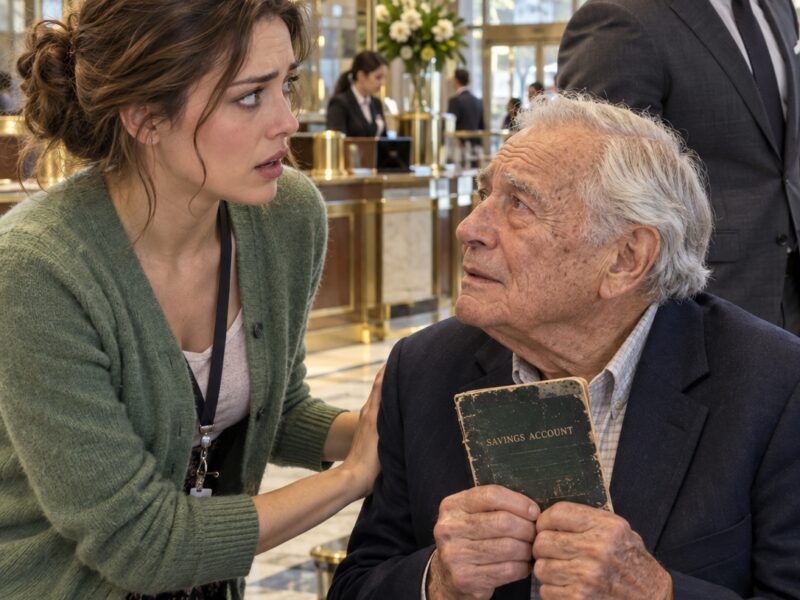
The first time Arthur Whitmore asked Natalie Jane to lie for him, he was standing in the middle of a crowded Tennessee bank with an eighty-one-year-old savings passbook pressed against his chest.
“Could you pretend to be my granddaughter for five minutes?”
Natalie stared at him.
Around them, printers hummed, phones rang, and impatient customers shifted from one foot to the other beneath the fluorescent lights. The young banker behind the counter had just asked Arthur whether someone had accompanied him that morning, and something in the old man’s face had changed.
Not fear exactly.
Something worse.
Embarrassment.
The kind that came when a person realized the world had begun treating being alone like a weakness.
Natalie had been standing behind him in line, twenty-five years old, still wearing the green cardigan from the bookstore where she worked. She had come in to deposit two checks before her afternoon shift and had expected to spend no more than ten boring minutes inside.
Instead, an elderly stranger with silver hair and a navy blazer was looking at her as if those five minutes might matter more than he wanted to admit.
“I’m sorry,” Arthur said quickly. “That was inappropriate. Forget I asked.”
He turned back toward the counter.
Natalie noticed the way his shoulders folded inward.
“Wait.”
Arthur looked back.
She stepped beside him.
“What’s my name?”
He blinked. “Excuse me?”
“If I’m your granddaughter, you should probably know my name.”
For one second he simply stared at her.
Then his entire face changed.
“Natalie.”
She laughed. “You heard the teller call me earlier.”
Arthur straightened his blazer with great dignity. “A grandfather is allowed to know things.”
“And what’s your name?”
“Arthur Whitmore.”
“All right, Grandpa Arthur.” Natalie hooked her arm lightly through his. “You’ve got five minutes.”
The relief in his eyes hit her harder than she expected.
Arthur turned to the banker.
“My granddaughter is here.”
The employee smiled immediately. “Wonderful, Mr. Whitmore.”
And just like that, everything changed.
The banker slowed down. She explained each form more carefully. She stopped asking Arthur whether he understood and started speaking to him like a capable adult who happened to have someone beside him. An older woman in the next line smiled at Natalie. Someone whispered that they made a sweet pair.
Arthur played his role beautifully.
He complained that Natalie never called enough.
Natalie accused him of exaggerating.
He told the banker she had inherited stubbornness from her grandmother.
Natalie kicked his shoe beneath the counter.
Arthur nearly laughed out loud.
It took closer to ten minutes than five, but eventually the banker returned his worn savings passbook and wished them both a good day.
Arthur thanked her.
Then he and Natalie walked through the glass doors together.
Outside, sunlight spilled across the parking lot. Cars crawled through rows of parked vehicles, and somewhere nearby a landscaping crew was running a leaf blower.
Natalie stopped.
“All right.”
Arthur stopped too.
She folded her arms.
“You owe me an explanation.”
His smile weakened.
“For making you my granddaughter?”
“For looking like you were about to disappear when she asked whether somebody was with you.”
Arthur looked toward the road.
For several seconds, he said nothing.
Then he touched the old passbook inside his jacket.
“Some things are easier,” he said quietly, “when people think someone is waiting for you.”
Natalie’s smile vanished.
Arthur seemed to regret the sentence the moment it left his mouth.
“Well.” He cleared his throat. “Thank you, young lady. You performed admirably.”
“You’re changing the subject.”
“I taught seventh grade history for forty-two years. Changing the subject was an essential survival skill.”
Natalie almost laughed.
Almost.
“Is someone picking you up?”
Arthur pointed toward the street. “I take the bus.”
She looked around.
There was no bus stop in sight.
“Where?”
“About fifteen minutes that way.”
“You walked fifteen minutes here?”
“I’m eighty-one, not one hundred and twelve.”
“You also just hired a fake granddaughter because you didn’t want a banker to know you were alone.”
Arthur looked offended.
“I didn’t hire you.”
“You’re right. I should unionize.”
That got him.
He laughed, a warm, surprisingly young sound.
Natalie had no idea that laugh was about to rearrange three lives.
“I’ll walk you to the bus stop,” she said.
Arthur shook his head. “Absolutely not.”
“I wasn’t asking.”
“My students used to say that.”
“Were they usually right?”
“Unfortunately.”
So they started walking.
Halfway down the block, Natalie noticed Arthur favoring his left knee.
He denied it.
Naturally.
She learned three more things before they reached the next intersection.
Arthur had taught American history for most of his career. He hated decaffeinated coffee on moral grounds. And he had been married to a woman named Helen for fifty-two years.
“You were married fifty-two years?”
“Fifty-two years, eight months and seventeen days.”
Natalie looked at him.
“You counted?”
“I still count.”
She didn’t know what to say to that.
Arthur rescued her.
“My wife would have liked you.”
“You’ve known me eighteen minutes.”
“Helen was an excellent judge of character.”
“And you?”
“Terrible.”
Natalie laughed.
That was when Arthur stopped outside a narrow little tea shop squeezed between an independent bookstore and a bakery.
A brass bell hung over its green-painted door.
Arthur looked at the sign, then at Natalie.
“I have a proposal.”
“That sounds dangerous.”
“You’ve already pretended to be related to me. We passed dangerous twelve minutes ago.”
She smiled.
“Tea?”
“My treat.”
“You don’t owe me anything.”
“I know.” His voice softened. “I’d simply enjoy the company.”
Something about those six words made refusing impossible.
Natalie checked her watch.
“Fine. But I’m buying the cookies.”
Arthur extended his hand.
“We negotiate inside.”
The shop smelled like cinnamon, black tea, and old wood.
They chose a table by the window.
Arthur ordered Earl Grey. Natalie ordered peach tea. They split a plate of shortbread cookies after a deeply serious dispute over who would pay for them.
For the next half hour, Arthur told stories about students who had tried to convince him the Civil War happened in 1963, a boy who once hid a hamster inside his desk, and a girl who became a judge twenty-five years after he taught her.
Natalie laughed until her cheeks hurt.
Then Arthur asked about her.
She worked at Bellweather Books, a neighborhood bookstore owned by a woman who believed computers were a temporary cultural mistake. Natalie loved novels, hated inventory days, and had learned that customers asking for “that blue book” rarely remembered anything else about it.
Arthur nearly spilled his tea laughing.
“You like your work?”
“I like books.”
“That wasn’t my question.”
Natalie paused.
Arthur watched her over the rim of his cup.
“I like my work,” she said. “I’m just not sure it’s where I’m supposed to stay forever.”
Arthur nodded.
He didn’t offer advice.
Natalie liked him more for that.
Then he pulled out his phone.
It was an older smartphone in a thick leather case.
“I have another question.”
Natalie leaned back.
“There it is.”
“What?”
“The real reason you kidnapped me.”
Arthur ignored that.
“I’m attempting to video-call my grandson.”
“Attempting?”
Arthur showed her the screen.
The front-facing camera displayed the ceiling.
Natalie laughed.
“You’ve been calling him as a light fixture?”
“I wondered why he kept complaining.”
She took the phone.
Arthur took it back immediately.
“I need to learn.”
“All right. Hold it like this.”
He repositioned it.
Now only his ear appeared.
“Closer.”
He moved it.
His forehead filled the screen.
Natalie covered her mouth.
“What?”
“I’ve met your eyebrows three times.”
“They’re friendly.”
She laughed so hard the woman at the next table smiled.
Eventually Arthur managed to position the camera correctly.
Then, while trying to press his grandson’s contact, he accidentally sent a giant animated dinosaur into the family group chat.
The dinosaur bounced across the screen under rainbow letters that said GOOD MORNING!
Arthur froze.
“What did I do?”
Natalie was crying with laughter.
“I think you just sent a prehistoric greeting to your entire family.”
“I’m eighty-one. I’m too old to fight dinosaurs.”
His phone rang almost immediately.
LOGAN flashed across the screen.
Arthur squinted.
“Is that him?”
“Yes.”
He pressed the red button.
The phone went silent.
Natalie stared.
“You hung up.”
“I did?”
“You rejected your grandson.”
Arthur looked genuinely troubled.
“Should I call him?”
“Yes.”
He considered it.
Then calmly slipped the phone back into his jacket.
“He worries too much.”
“Arthur.”
“I’m having tea with my granddaughter.”
Natalie shook her head.
“I’m only your granddaughter until lunch.”
Arthur smiled into his cup.
“We’ll see.”
Across town, Logan Whitmore stared at his phone.
He was thirty-one, president of a rapidly expanding commercial property firm, and the kind of man whose calendar divided his life into fifteen-minute blocks.
Normally, missed calls did not concern him.
A rejected call from his grandfather did.
Especially after Arthur had promised him two weeks earlier that he would stop “wandering around town without telling anyone.”
Logan called again.
Nothing.
He opened their message thread.
The last thing his grandfather had sent was a dancing dinosaur.
Logan stared at it.
“What the hell?”
His assistant, Megan, looked through the open door.
“Everything okay?”
“My grandfather just sent me a dinosaur.”
She considered this.
“Should I call someone?”
“I already am.”
Logan called Arthur again.
No response.
He called the bank.
The employee confirmed that Mr. Whitmore had completed his business and left.
“When?”
“About forty minutes ago.”
“Was he alone?”
There was a pause.
“I believe his granddaughter was with him.”
Logan went still.
“His what?”
“His granddaughter.”
“My grandfather doesn’t have a granddaughter.”
Another pause.
“Oh.”
Logan was already grabbing his jacket.
He called three nearby cafés.
Nothing.
The fourth employee said, “There’s an older gentleman here who might match that description.”
“Silver hair? Navy blazer?”
“Yes.”
“With a young woman?”
The employee glanced across the room.
“Yes.”
Logan ended the call.
Five minutes later, he pushed through the tea shop door looking like a man prepared to either rescue his grandfather or call the police.
Instead, he stopped.
Arthur was laughing.
Not smiling politely.
Not chuckling the way he did when Logan visited.
Laughing.
Head tipped back, eyes bright, one hand pressed against his chest.
Across from him sat a young woman Logan had never seen before.
Something in Logan loosened.
Then tightened again.
Arthur noticed him.
“There you are.”
Logan crossed the room.
“Grandpa.”
“Perfect timing.”
“I’ve been calling you.”
Arthur waved that away.
“I was occupied.”
“With what?”
Arthur stood proudly.
“This is Natalie.”
Natalie lifted one hand.
“Hi.”
“And Natalie,” Arthur continued, “this is my grandson Logan.”
Then the old man smiled.
“And Logan, this is my granddaughter.”
Silence.
Natalie nearly dropped her teacup.
Logan looked at Arthur.
Then Natalie.
Then Arthur again.
“My grandfather,” he said carefully, “doesn’t have a granddaughter.”
Arthur sat down and took another sip of Earl Grey.
“That sounds unnecessarily technical.”
“Grandpa.”
Natalie looked at Logan.
“You know what? I can explain.”
“I hope so.”
Arthur pointed at him.
“Be polite.”
“I am being polite.”
“You’re using your lawyer voice.”
“I’m not a lawyer.”
“You sound like one.”
Natalie pressed her lips together to stop herself from laughing.
Logan noticed.
That did not improve his mood.
Two minutes later, he asked Natalie if they could speak near the entrance.
Arthur waved as if sending children outside to play.
Logan lowered his voice.
“I’m sorry if this sounds strange.”
“Considering how we met, I think we left strange behind.”
“Who exactly are you?”
Natalie glanced at Arthur.
He was casually stealing the last cookie.
She sighed.
“Apparently, your cousin.”
Logan did not smile.
So she told him everything.
The banker.
The request.
The five-minute performance.
The bus stop.
The tea.
The dinosaur.
By the end, Logan’s suspicion had been replaced by embarrassment.
He rubbed a hand over his face.
“I’m sorry.”
Natalie raised an eyebrow.
“For which part?”
“Assuming the worst.”
“That was fast.”
“I’m trying to improve.”
“Good. Because I was about to charge you for emotional damages.”
His mouth twitched.
It was the first time Natalie saw him almost smile.
Through the glass, Arthur cupped his hands around his mouth.
“ARE YOU TWO FINISHED?”
People turned.
Logan closed his eyes.
“Grandpa.”
Arthur opened the door.
“I’m eighty-one. I don’t have time for whispering.”
Natalie laughed.
Logan looked at her.
And for reasons he could not explain, the sound stayed with him for the rest of the day.
Logan drove Arthur home.
At the curb, Arthur opened the rear passenger door.
Logan frowned.
“You always sit in front.”
“My knee hurts.”
“You said your shoulder hurt this morning.”
“Pain travels.”
Natalie covered a smile.
Arthur settled into the back seat and pointed toward the front passenger door.
“Don’t keep my granddaughter waiting.”
Logan looked at Natalie.
Natalie looked at Logan.
“I can walk.”
“You’ll encourage him.”
“I think it’s too late.”
Logan opened the door.
As she climbed in, Natalie whispered, “Is he always like this?”
“Unfortunately.”
From the back seat, Arthur said, “I heard that.”
The drive should have been awkward.
Arthur made certain it wasn’t.
He interrogated Natalie about the bookstore, criticized Logan for wearing “the same funeral expression” he had worn since age twelve, and announced that the three of them should have Italian food soon.
Logan glanced at him in the mirror.
“Why?”
“Why what?”
“Why are we having dinner?”
“People eat, Logan.”
“I know how eating works.”
“Debatable. You consider protein bars lunch.”
Natalie laughed.
Arthur pointed toward her.
“See? She understands.”
Logan tightened his grip on the steering wheel.
He should have been irritated.
Instead, he found himself glancing sideways at Natalie whenever she smiled.
That should have worried him.
It didn’t.
Not yet.
The next morning at 8:15, Natalie’s phone rang.
Unknown number.
“Hello?”
“Good morning, granddaughter.”
She sat upright in bed.
“Arthur?”
“I require assistance.”
Concern shot through her.
“What happened? Are you okay?”
“I’m choosing tomatoes.”
Natalie stared at the wall.
“What?”
“The supermarket has six varieties. They all look suspicious.”
“You called me because of tomatoes?”
“I called because I require an honest opinion.”
“Where’s Logan?”
“Working.”
“Did you call him?”
“He sent me something called a grocery-delivery application.”
Arthur sounded personally betrayed.
“Machines should not choose tomatoes.”
Twenty minutes later, Natalie stood beside him in the produce aisle.
She explained Roma tomatoes.
Vine-ripened tomatoes.
Beefsteak tomatoes.
Arthur listened carefully.
Then picked cherry tomatoes.
Natalie stared at him.
“Why did you ask me?”
“I enjoy having options.”
That grocery trip became the first of many.
Arthur called when his television remote “broke.” Natalie discovered the batteries were upside down.
He called because he wanted a recommendation for a mystery novel.
He called because his roses needed pruning and he claimed he could no longer remember which branch to cut.
He called because he wanted to walk through the park and hated walking alone.
Sometimes Natalie suspected Arthur invented excuses.
Eventually, she stopped caring.
Then came the medical appointment.
“Logan usually comes,” Arthur said casually over the phone, “but he has a meeting.”
Natalie heard the disappointment beneath the joke.
“I’ll take you.”
“You work.”
“I start at noon.”
“I don’t want to interfere.”
“You called me over tomatoes.”
“That was an emergency.”
She picked him up anyway.
The appointment was routine.
Arthur’s doctor told him his blood pressure needed monitoring and his knees needed kindness.
Arthur informed the doctor that his knees had survived eighth-grade students and deserved medals, not kindness.
Natalie was laughing when they stepped into the hallway.
That was where they found Logan.
His tie was crooked.
His breathing was uneven.
He looked as if he had run from the parking garage.
“I’m sorry.”
Arthur waved one hand.
“It’s fine.”
“The meeting ran late.”
“It always does.”
Arthur didn’t sound angry.
That made the words heavier.
Logan looked at him.
For a moment, neither man spoke.
Natalie stepped between the silence.
“Good news. The doctor says your grandfather is healthier than his attitude.”
Arthur looked offended.
“My attitude is excellent.”
Logan smiled.
A small smile.
But real.
“Thank you for bringing him.”
Natalie shrugged.
“Somebody had to stop him from diagnosing himself online.”
Arthur lifted his phone.
“I searched one symptom.”
“You diagnosed yourself with a tropical disease.”
“It was educational.”
Logan laughed.
And something shifted.
After that, Logan began appearing more often.
At first, he told himself it was responsibility.
He joined Arthur’s Saturday walk because the old man had nearly tripped the previous week.
He came to lunch because he happened to be nearby.
He went with them to the farmers’ market because Arthur claimed carrying vegetables was “medically unwise.”
Then he stopped inventing explanations.
Natalie made ordinary places feel different.
She argued with parking meters.
She complimented strangers’ dogs.
She returned shopping carts other people abandoned.
She knew the names of three homeless people who regularly came into the bookstore, and she kept damaged novels behind the counter so she could give them away instead of throwing them out.
Logan found her exhausting.
He also started leaving work early on Fridays.
Arthur noticed.
Of course he did.
Arthur noticed everything.
At restaurants, he always selected the chair that forced Logan and Natalie to face one another.
In the car, his mysterious knee pain forced him into the back seat.
Once he claimed his hearing was failing and insisted they lean closer whenever they spoke.
His hearing recovered completely when the waitress mentioned chocolate cake.
Natalie narrowed her eyes at him.
Arthur smiled innocently.
Later, outside the restaurant, she whispered to Logan, “Your grandfather is matchmaking.”
“I know.”
“You’re not going to stop him?”
“I’ve spent thirty-one years trying to stop him from doing things.”
“How’s that going?”
Logan looked back toward Arthur, who was pretending not to watch them through the window.
“Poorly.”
Natalie laughed.
Logan smiled before he could stop himself.
And from inside the restaurant, Arthur quietly raised his coffee cup in victory.
One afternoon, Natalie was sitting beside Arthur in his living room while he showed her photographs of Helen’s rose garden when her phone buzzed.
A dancing cat appeared.
She looked at Arthur.
He was sitting three feet away.
“What did you do?”
Arthur frowned.
“What?”
She looked at the sender.
FAVORITE GRANDDAUGHTER.
Natalie burst out laughing.
Arthur looked pleased.
“You saved me as ‘Favorite Granddaughter’?”
“Efficient.”
“You don’t have another granddaughter.”
“Exactly. No competition.”
Logan walked in carrying coffee.
“What happened?”
Natalie showed him.
“Apparently, I’ve been promoted.”
Arthur accepted his coffee.
“She earned it.”
Natalie looked at Logan.
His ears had turned slightly red.
She grinned.
“Are you jealous?”
“No.”
“That answer came very quickly.”
“I’m not competing with you for my grandfather.”
Arthur took a sip.
“You should.”
Natalie nearly spilled her coffee.
Logan stared at him.
“Can you go five minutes without interfering?”
Arthur considered the question.
“No.”
Everyone laughed.
But underneath the laughter, Natalie began noticing something she couldn’t explain.
Every Thursday morning, Arthur disappeared.
Always alone.
Always carrying the old savings passbook.
When she asked, he said he had banking business.
Yet he never came home with cash.
Never brought papers.
Never mentioned bills.
One Thursday, Natalie happened to be delivering books a few blocks away and passed the bank where they had first met.
Through the window, she saw Arthur.
He wasn’t at the counter.
He was sitting in a chair talking to the same young banker.
Natalie stopped.
For ten minutes, she watched them through the glass.
Arthur showed her a photograph on his phone.
The banker showed him something on hers.
They laughed.
No documents changed hands.
No money.
No signatures.
Eventually Arthur stood, waved goodbye, and walked toward the door.
Natalie moved aside.
He saw her the moment he stepped outside.
Surprise flashed across his face.
“What are you doing here?”
“I could ask you the same thing.”
Arthur lifted the passbook.
“Banking.”
“You didn’t do any banking.”
He looked at her.
“You were watching me?”
“Accidentally.”
“That’s a very Natalie word.”
She softened.
“Arthur.”
He looked through the glass.
Inside, the banker saw him and waved again.
Arthur waved back.
Then he sighed.
“After Helen died, the house became very quiet.”
Natalie said nothing.
“Logan called. He visited when he could. My friends called for a while too. But people have their own lives.”
He turned the passbook over in his hands.
“At first I came here because I actually needed something. Then one Thursday, that young woman asked why I hadn’t come the week before.”
His voice changed.
Barely.
But Natalie heard it.
“She noticed?”
“Yes.”
Arthur smiled faintly.
“After that, I started coming every Thursday.”
“For what?”
“Ten minutes.”
Natalie swallowed.
Arthur looked back at the bank.
“They know my name. They ask whether my knee still hurts. They ask about the roses. If I miss a Thursday, someone notices.”
He looked down at the passbook.
“I don’t come here for money.”
Natalie felt her chest tighten.
“I come because for ten minutes, somebody expects me.”
And suddenly the day they met looked completely different.
Arthur had never needed a fake granddaughter for paperwork.
He had wanted the banker to think someone would notice if he didn’t make it home.
Someone was waiting.
Someone belonged to him.
Natalie stepped closer and slipped her arm through his.
Arthur looked at her.
“Well,” she said, fighting the pressure behind her eyes, “now somebody does.”
His eyes shone.
“Somebody what?”
“Notices.”
Arthur stared at her for a long time.
Then smiled.
Not the polite smile he gave strangers.
Not the teasing one he used when embarrassing Logan.
This one reached all the way to his eyes.
And for the first time since she met him, Natalie understood how close loneliness could sit to a person without anyone else seeing it.
A week later, Arthur asked Natalie to keep his passbook while he went into another doctor’s appointment.
She dropped it into her tote bag.
That evening, while looking for a receipt, she remembered it.
She opened the leather cover to check that nothing had bent.
A folded sheet of paper fell onto the floor.
Natalie picked it up.
She should have put it back.
Instead, she saw the first line.
Logan—
She froze.
The paper was old.
The folds had softened from being opened and closed many times.
Natalie read only a few sentences before guilt made her stop.
But the words she had already seen were enough.
I spent most of my life believing love was something a man proved by providing. I wish I had learned sooner that sometimes people need to hear the words too.
Natalie’s throat tightened.
She folded the letter exactly as she found it.
The next morning, she drove to Arthur’s house.
He was watering Helen’s roses.
“You look serious,” he said.
“I found something.”
His expression changed when she held up the passbook.
“The letter,” he said.
“I didn’t mean to.”
“How much did you read?”
“Not much.”
Arthur put down the watering can.
For several seconds, he stared at the roses.
Then he sat on the garden bench.
Natalie sat beside him.
“I wrote it four years ago,” he said.
“For Logan?”
Arthur nodded.
“Why didn’t you give it to him?”
He leaned forward, hands folded between his knees.
“My father believed men solved problems. They didn’t talk about feelings.”
Natalie waited.
“I believed him.”
A breeze stirred the rose bushes.
Arthur looked older suddenly.
Not physically.
Somewhere deeper.
“I never told my son I loved him enough.”
Natalie knew Logan’s parents had died when he was young, but Arthur rarely spoke about them.
“I made sure he had everything. Education. A safe home. A father who never had to worry about money.”
Arthur stared at his hands.
“I assumed he knew.”
His voice thinned.
“Then one morning, there was a police officer at our door.”
Natalie’s breath caught.
Arthur continued.
“Car accident. My son and daughter-in-law were both gone.”
“I’m sorry.”
“I raised Logan after that.”
His eyes remained on the ground.
“I tried to do better. I truly did. But habits become walls if you leave them standing long enough.”
He smiled sadly.
“I attended every school event. Paid every tuition bill. Taught him to drive. Sat outside his room when he was sick because I didn’t want him to know I was worried.”
Natalie felt tears sting her eyes.
“But every time I wanted to tell him how proud I was, I told myself I could say it tomorrow.”
Arthur looked at her.
“There are a lot of tomorrows that never come.”
Natalie picked up the folded letter.
“Then give him this today.”
Arthur looked toward the house.
“He’ll think I’m dying.”
“Tell him you’re not.”
“He’ll still panic.”
“Probably.”
Arthur almost smiled.
“But he deserves to know.”
“Yes.”
“And you deserve to stop carrying it.”
Arthur didn’t answer.
Natalie placed the letter beside him.
For the rest of the morning, it sat untouched on the bench between them.
But when Natalie left, Arthur picked it up.
She saw him through her rearview mirror.
He stood alone among Helen’s roses, holding four years of unsaid words in both hands.
Three weeks later, Logan’s assistant looked at him across his office.
“Sir?”
“Yes?”
“Are you feeling all right?”
Logan looked up from his laptop.
“Why?”
“You’ve left before sunset three times this week.”
“So?”
“So accounting has started a betting pool.”
Logan frowned.
“About what?”
“Whether you’ve been replaced by a kinder version of yourself.”
He leaned back.
“Fire accounting.”
Megan smiled.
“You have dinner with your grandfather?”
“And Natalie.”
“Ah.”
Logan’s eyes narrowed.
“What does ‘ah’ mean?”
“Nothing.”
“It clearly means something.”
Megan gathered the folders from his desk.
“It means you smiled when you said her name.”
“I did not.”
“Of course not.”
“Megan.”
“Have a nice dinner, Mr. Whitmore.”
That Saturday, Logan announced he was cooking.
Arthur stared at him.
Natalie slowly lowered her book.
“You cook?”
“I can cook.”
Arthur looked at Natalie.
“We should order pizza.”
“I watched four videos,” Logan said.
Arthur whispered, “Definitely pizza.”
For almost an hour, Logan refused help.
Then the smoke alarm went off.
Natalie ran into the kitchen.
A blackened apple pie sat on the counter like evidence from an arson investigation.
Logan stared at it.
“It looked easier online.”
Arthur entered slowly.
He inspected the pie from several angles.
Then folded his arms.
“Two.”
Logan looked at him.
“Two what?”
“Out of ten.”
Natalie laughed.
“I’d give him three.”
“Thank you.”
“The extra point is because the kitchen survived.”
Logan pointed toward the door.
“Both of you out.”
Twenty minutes later, pizza arrived.
No one complained.
They ate in Arthur’s dining room beneath the old chandelier Helen had selected decades earlier.
For the first time in years, laughter filled every corner of the house.
Arthur sat at the head of the table and watched the two people across from him argue about whether pineapple belonged on pizza.
Natalie insisted it did.
Logan looked personally betrayed.
Arthur declared both opinions historically inaccurate.
Their argument became louder.
Arthur stopped listening to the words.
He watched Logan smile.
Not the controlled expression he gave investors.
Not the polite smile he used during photographs.
A real one.
Arthur suddenly remembered Logan at eight years old, running through the same room with a paper airplane.
And for a moment, the past and present overlapped so perfectly that Arthur’s heart hurt.
He looked toward the empty chair where Helen used to sit.
You’d like her, he thought.
Then his chest tightened.
Not pain.
Something stranger.
A warning he ignored.
One warm Thursday morning, Natalie arrived to find Arthur in the garden.
“You’re supposed to wait for me before lifting anything.”
“I’m watering flowers.”
“You lifted the watering can.”
“It weighs less than a cat.”
“You don’t own a cat.”
“That’s irrelevant.”
Natalie went inside to answer a call from the bookstore.
Thirty seconds later, she heard metal hit stone.
She ran outside.
The watering can lay on its side.
Arthur was sitting on the ground.
His face was gray.
Natalie’s stomach dropped.
“Arthur?”
“I’m fine.”
“No, you’re not.”
She crouched beside him.
“Don’t stand.”
“Natalie—”
He tried anyway.
His legs collapsed.
She caught his shoulders.
“Arthur!”
His eyes closed.
Natalie called 911 with shaking fingers, then Logan.
He answered on the first ring.
“What happened?”
“It’s Arthur.”
Everything on Logan’s end went silent.
“What?”
“He collapsed.”
“I’m coming.”
“Logan, the ambulance—”
“I’m coming.”
He ended the call.
Natalie rode with Arthur to the hospital.
She held his hand the entire way.
Arthur opened his eyes once.
“Natalie?”
“I’m here.”
“Don’t let Logan panic.”
She almost laughed from fear.
“You collapsed and you’re worried about Logan panicking?”
“He gets dramatic.”
“You sent me to a supermarket because you distrusted tomatoes.”
Arthur’s mouth moved.
Almost a smile.
Then his eyes closed again.
Logan arrived before the ambulance crew had even finished Arthur’s intake.
His hair was disordered.
He wasn’t wearing a tie.
Natalie had never seen him look so young.
“What happened?”
“They’re examining him.”
“Was he conscious?”
“Mostly.”
“Did he hit his head?”
“No.”
“Did he—”
“Logan.”
He stopped.
Natalie took his arm.
“Sit down.”
“I don’t want to sit.”
“Then stand. But breathe.”
The doctor emerged twenty minutes later.
“Mr. Whitmore?”
They both stood.
“Arthur’s stable. His blood pressure dropped suddenly. We’re keeping him overnight for observation and running additional tests.”
Logan nodded.
“Can I see him?”
“Soon.”
The doctor walked away.
Logan sat.
Just like that.
As if someone had removed the structure holding him upright.
Natalie sat beside him.
Minutes passed.
Then Logan whispered, “I thought I still had time.”
She looked at him.
He stared at the floor.
“I kept saying next weekend.”
His voice cracked.
“After this project. After this acquisition. When things slow down.”
He laughed once, bitterly.
“Work never slows down.”
Natalie remained silent.
“I built an entire company because I thought being busy meant I was doing something important.”
A tear slipped down his face.
He wiped it immediately.
“I forgot he was getting older.”
“You didn’t forget.”
“Yes, I did.”
“Logan—”
“I knew.”
He finally looked at her.
“That’s worse.”
Natalie’s chest tightened.
“He raised me. After my parents died, he became everything.”
Logan looked toward the doors behind which Arthur had disappeared.
“And I made him schedule lunch with me.”
Natalie rested her hand over his.
Logan stared at their hands.
“I almost learned too late.”
“No.”
He swallowed.
“You know now.”
That afternoon, Arthur slept.
The nurse dimmed the room and told them to let him rest.
Natalie found Logan alone beside a hallway window.
In her purse was Arthur’s letter.
He still hadn’t given it to Logan.
Natalie had found it that morning on the garden table after the ambulance left.
She had brought it without knowing why.
Now she did.
“Logan.”
He turned.
Natalie held out the envelope.
“What’s that?”
“Something your grandfather wrote.”
Logan frowned.
“He wrote it nearly four years ago.”
“For me?”
“Yes.”
“Why do you have it?”
“He wasn’t ready.”
Logan stared at the envelope.
“And now?”
Natalie glanced toward Arthur’s room.
“I think almost losing time changes what ready means.”
Logan took it.
He opened the letter.
Natalie stepped away.
He read silently.
At first, his expression did not change.
Then his jaw tightened.
Halfway down the first page, his eyes filled.
He turned away.
Natalie pretended not to notice.
Near the end, one paragraph had been underlined.
Logan stopped there.
His eyes moved across the same words twice.
If one day you find someone who makes you laugh before breakfast, don’t make her wait while you build a life you think she’ll eventually fit into. People are not appointments. Love does not stay untouched on a calendar until you finally have time.
Logan lowered the paper.
He looked through the window.
Natalie remained silent.
After a long time, he said, “He always knew.”
“Knew what?”
“That I was becoming him.”
Natalie stepped closer.
“Maybe he knew you could become better than the parts of him he regretted.”
Logan laughed through tears.
“He wrote that four years ago.”
“Yes.”
“And still didn’t give it to me.”
“Courage can be slow.”
He folded the letter against his chest.
“So can I.”
Three days later, Arthur returned home.
The doctor gave strict instructions.
No lifting.
No unnecessary exertion.
No gardening for at least two weeks.
Arthur nodded solemnly.
“I understand.”
The doctor smiled.
“Good.”
The moment they stepped outside, Arthur looked at Logan.
“How much does a bag of fertilizer weigh?”
Logan stopped.
“Grandpa.”
“What?”
“He literally said no gardening.”
“I’m not gardening. I’m asking a scientific question.”
Natalie laughed so hard she almost dropped his medication.
For the first time since the collapse, they all breathed normally again.
But something had changed.
Logan stopped bringing his laptop to Arthur’s house.
He silenced his phone during breakfast.
He delegated weekend calls.
He began arriving without checking the time.
Arthur noticed.
“So,” he said one Saturday, pouring coffee, “you finally remembered where I live.”
Logan smiled.
“I guess I did.”
“Took you long enough.”
“I know.”
Arthur handed him the cup.
That was all.
No speech.
No accusation.
Sometimes forgiveness looked like coffee poured before the other person asked.
Natalie became part of the house in the same quiet way.
She stopped knocking.
Arthur told her that people who knocked were visitors and she had forfeited that status.
She planted basil and rosemary beside Helen’s roses.
She helped organize the attic.
One afternoon, she found a box filled with Father’s Day cards Logan had made as a child.
Arthur picked one up.
The construction paper was faded.
BEST GRANDPA IN THE WORLD was written in enormous uneven letters.
Arthur smiled.
“He insisted I hang this in my classroom.”
Logan rubbed the back of his neck.
“I was eight.”
“You threatened to inspect the wall.”
“I was persuasive.”
Natalie looked at him.
“You still are.”
Arthur shook his head.
“No. He just started using it for better things.”
Logan looked at his grandfather.
Something passed silently between them.
Then Arthur turned toward another box before emotion could make everyone uncomfortable.
Old habits did not disappear overnight.
But now they were learning not to let silence win.
A month later, Natalie received an email.
She read it once.
Then again.
Arthur noticed immediately.
They were sitting on the porch shelling peas.
“Good news?”
Natalie looked up.
“What?”
“You smiled first.”
She glanced at the screen.
“I was offered a position.”
Arthur’s face brightened.
“At the publishing company?”
She nodded.
The job had been something she applied for months earlier and nearly forgotten.
Community outreach coordinator for a national literacy organization.
Better salary.
Real responsibility.
A career instead of a job.
Arthur smiled.
“That’s wonderful.”
“It is.”
“But?”
Natalie looked toward the street.
“It’s in Chicago.”
Arthur stopped shelling peas.
“When?”
“Three weeks.”
“And you have to answer?”
“In three days.”
Neither of them noticed the front door open behind them.
Neither saw Logan step into the hallway.
But he heard one word.
Chicago.
And in his jacket pocket, Arthur’s letter suddenly felt heavier.
For the next two days, Logan said nothing.
Natalie noticed.
He asked ordinary questions.
Had she eaten?
Did Arthur take his medication?
Was the bookstore busy?
But he never mentioned Chicago.
Natalie told herself he was respecting her decision.
A smaller, more vulnerable part of her wondered whether it simply didn’t matter enough to him.
On the third evening, Arthur deliberately announced he was exhausted thirty minutes into a black-and-white comedy.
Natalie smiled.
“You’re not tired.”
“I’m eighty-one. I’m always tired.”
He closed his eyes.
Within seconds, he began snoring loudly.
Natalie looked at Logan.
“That was fast.”
“He’s pretending.”
“How do you know?”
“He only snores like that when he’s acting.”
Arthur’s snoring became even louder.
Natalie covered her mouth.
Logan leaned closer.
“Give him thirty seconds.”
Arthur shifted theatrically.
Then announced without opening his eyes, “I’m sleeping.”
Natalie burst out laughing.
“You’re talking.”
“People sleep-talk.”
“Not in complete sentences.”
“I have no idea what you mean.”
Logan shook his head.
“You’ve been trying to set us up since the bank.”
Arthur opened one eye.
“Trying?”
Natalie hid her face behind a pillow.
Arthur sat up.
“I thought I already had.”
For a few minutes, laughter filled the room.
Nobody mentioned Chicago.
Nobody mentioned goodbye.
Then Natalie looked at Logan.
He looked away first.
And somehow that hurt more than if he had asked her to stay.
The morning she left came too soon.
Her blue suitcase stood beside the front door.
Most of her belongings had already been shipped.
The suitcase itself was light.
Everything else felt impossibly heavy.
At exactly eight, someone knocked.
Natalie opened the door expecting a rideshare driver.
Arthur stood there in his favorite navy blazer.
Logan stood beside him.
“You came.”
Arthur looked insulted.
“You thought my favorite granddaughter was leaving without supervision?”
Natalie smiled through sudden tears.
“I should have known.”
“You should have.”
Logan took her suitcase.
Their eyes met.
“Morning.”
“Morning.”
That was all.
The drive to Franklin Station was quieter than usual.
Arthur filled the silence with stories about trains he had ridden as a boy.
Logan listened.
Natalie watched the landscape pass.
Every few minutes, Logan glanced at her.
She caught him twice.
Neither said anything.
At the station, families hugged goodbye beneath the high arched ceiling.
Children pulled luggage.
A conductor’s announcement echoed.
Chicago service boarding in twenty minutes.
Natalie stared at the departure board.
For years she had wanted a chance like this.
Now it looked less like a destination than a distance.
Arthur reached inside his blazer.
“I have something.”
He handed her a cream envelope.
Two words were written across it.
RESIGNATION LETTER.
Natalie laughed despite herself.
“I didn’t know I worked for you.”
“Oh, you definitely did.”
She opened it.
Employee: Natalie Jane.
Position: Temporary Granddaughter.
Natalie covered her mouth.
Arthur folded his arms proudly.
“Keep reading.”
Her eyes moved lower.
Status: Permanent family member, effective immediately. Resignation rejected.
Natalie’s vision blurred.
She stepped forward and hugged him.
Arthur held her tightly.
“This is the best promotion I’ve ever received.”
“I taught forty-two years. I understand paperwork.”
She laughed against his shoulder.
The announcement came again.
Ten minutes.
Natalie stepped back.
“I’ll call.”
“Weekly.”
“Yes.”
“Video calls.”
“If you promise not to point the camera at the ceiling.”
“No guarantees.”
“Holidays.”
“Every one I can.”
“Birthdays.”
“You negotiate aggressively.”
“I’m old. I’ve earned it.”
Natalie laughed.
Then Arthur’s expression changed.
Softened.
“My dear girl…”
His voice caught.
He cleared his throat.
“Go build the life you worked for.”
Natalie nodded.
She turned.
Logan was standing several feet away.
Still silent.
Something inside her sank.
“Goodbye, Logan.”
He looked at her.
“No.”
She frowned.
“No?”
He reached inside his coat.
The old savings passbook was in his hand.
The same faded leather cover Arthur had carried into the bank the day they met.
Logan walked toward her.
“I don’t want to say goodbye.”
Natalie’s heart slammed against her ribs.
Arthur stepped away.
Logan opened the passbook.
Inside was Arthur’s letter.
The paper had softened from being read so many times.
Logan unfolded it.
Near the bottom were the underlined words.
If one day you find someone who makes you laugh before breakfast, don’t make her wait.
Logan pulled out a pen.
He looked at Arthur.
The old man gave one small nod.
Logan wrote beneath the sentence.
Then handed the paper to Natalie.
Grandpa was right. Please don’t make me wait either.
Natalie looked up.
Logan took a breath.
“I spent most of my life believing there would always be another weekend.”
The station seemed to quiet around them.
“Another dinner. Another phone call. Another chance.”
His voice trembled.
“I thought success meant building something so secure that nobody I loved would ever have to worry again.”
He glanced at Arthur.
“But somewhere along the way, I became the grandson who always arrived late.”
Arthur lowered his eyes.
Logan looked back at Natalie.
“And then you walked into a bank and gave him five minutes.”
Natalie’s eyes filled.
“You didn’t know his last name. You didn’t know what he owned. You didn’t know whether anyone would ever thank you.”
His voice softened.
“You just saw somebody who looked alone, and you stayed.”
Natalie swallowed.
“Logan…”
“I don’t want you to give up Chicago.”
She blinked.
That wasn’t what she expected.
He smiled sadly.
“You earned it.”
The announcement echoed.
Final boarding soon for Chicago.
Logan stepped closer.
“I’ve spent two days trying to convince myself that loving someone means asking them to stay.”
Natalie didn’t move.
“But that would make this about what I’m afraid to lose instead of what you deserve to become.”
His eyes held hers.
“So go.”
Natalie’s heart twisted.
Then Logan continued.
“And let me come toward you.”
She stared.
“I don’t mean today. I don’t mean abandoning everything and turning your dream into some dramatic gesture.”
A small smile appeared.
“I mean let me show up. Let me take the train. Let me call. Let me rearrange my calendar instead of expecting everyone I love to rearrange themselves around it.”
Natalie’s tears escaped.
Logan reached for her hand.
“I want to earn the right to be the person walking beside you, wherever beside happens to be.”
She looked down at Arthur’s letter.
Then back at him.
“You know what your grandfather told me outside the bank?”
Logan shook his head.
“He said some things are easier when people think somebody is waiting for you.”
Arthur’s eyes shone.
Natalie squeezed Logan’s hand.
“I don’t want someone waiting for me.”
Logan’s expression fell slightly.
“I want someone walking beside me.”
A slow smile spread across his face.
“Is that a yes?”
Natalie laughed through tears.
“It means you’ve earned more than five minutes.”
Logan pulled her into his arms.
People nearby began applauding.
Natalie laughed harder.
Arthur turned toward the tracks, pretending to be fascinated by the departing trains.
Neither Natalie nor Logan saw him wipe his eyes.
But both knew.
Natalie boarded for Chicago.
Logan did not stop her.
That mattered.
Two weeks later, he took the Friday evening train north after work.
He brought no grand gesture.
No flowers.
Just Arthur’s terrible homemade shortbread and a book Natalie had mentioned wanting to read.
They spent Saturday walking along the lake.
On Sunday, Logan returned to Tennessee.
The next weekend Natalie came home.
Then Logan went back.
Then Natalie did.
Distance forced them to learn something neither had understood before.
Love did not survive because people promised not to leave.
It survived because they kept choosing to return.
Arthur demanded Sunday video calls.
He still pointed the camera at his forehead.
Natalie still corrected him.
Logan still complained.
Nothing was perfect.
That became part of what made it real.
Six months later, Natalie’s organization announced plans to open a Tennessee community literacy program.
She applied to lead it.
When she received the position, she did not tell Arthur over the phone.
She drove directly to his house.
Arthur opened the door.
Natalie held up a cardboard box.
“I need somewhere to put these books.”
Arthur stared at her.
Then at the box.
Then back at her.
“You’re home?”
Natalie smiled.
“I’m home.”
Arthur pulled her into his arms so quickly he nearly knocked the box over.
Logan arrived twenty minutes later.
He found Natalie sitting at the kitchen table.
For one second, he simply stood in the doorway.
“You’re here.”
She smiled.
“I’m here.”
“For how long?”
Natalie stood.
“That depends.”
His expression changed.
“On what?”
“Whether the local branch can tolerate a certain emotionally unavailable property developer constantly bringing coffee.”
Logan crossed the room.
“I’ve become moderately emotionally available.”
“Debatable.”
“I have references.”
“Your grandfather doesn’t count.”
Arthur shouted from the living room.
“I ABSOLUTELY COUNT.”
Natalie laughed.
Logan kissed her.
Three months later, they were married beneath Helen’s rose arbor.
The wedding was small.
Arthur insisted on that.
“Large weddings,” he said, “are designed by people who dislike conversation.”
Natalie wore a simple ivory dress.
Logan cried before she reached the end of the aisle.
Arthur denied crying at all.
Photographs proved otherwise.
During the reception, Arthur gave a short speech.
He stood beneath strings of warm lights with one hand resting on his cane.
“I spent forty-two years teaching history,” he began, “which means I spent forty-two years telling young people that small decisions can change everything.”
Guests smiled.
Arthur looked at Natalie.
“I believed that intellectually.”
Then at Logan.
“I understand it now.”
His voice trembled.
“One morning, I asked a stranger for five minutes because I was ashamed to admit I was lonely.”
Natalie’s eyes filled.
“I thought I was asking her to pretend I had a family.”
Arthur smiled.
“I didn’t realize I was meeting the person who would help me rebuild one.”
The yard went completely silent.
Arthur looked at Logan.
“My grandson taught me that it is never too late to say what should have been said years ago.”
Then he looked at Natalie.
“And my granddaughter taught me that family is sometimes the person who sees your loneliness before you have the courage to name it.”
Natalie wiped her eyes.
Arthur raised his glass.
“So I have only one piece of advice.”
Logan smiled nervously.
Arthur looked directly at him.
“If she makes you laugh before breakfast, don’t make her wait.”
Everyone laughed.
Logan lifted his glass.
“I’ve heard that before.”
Sunday mornings became sacred after that.
Nine o’clock.
Pancakes.
Fresh coffee.
Far too much maple syrup.
Arthur’s roses bloomed again.
Logan stopped working most weekends.
Natalie built the literacy program into something larger than she had imagined, creating reading rooms, senior storytelling groups, and free after-school programs throughout the county.
Sometimes Arthur volunteered.
He claimed he was only there to teach children history.
Everyone knew he came because he liked being needed.
Years later, Natalie would still remember the first Thursday she walked into the bank with him after they became family.
The young banker looked up.
“Mr. Whitmore.”
Arthur smiled.
“My granddaughter brought me today.”
The banker looked at Natalie.
“I remember you.”
Natalie laughed.
“I’m real now.”
Arthur put one hand over his chest.
“She was always real.”
They sat for ten minutes.
Arthur asked about the banker’s puppy.
She asked about his roses.
No transaction was made.
When they left, Natalie slipped her arm through Arthur’s.
He looked at her.
“You know, you don’t have to come every Thursday.”
“I know.”
“You have work.”
“I know.”
“A husband who complains when you leave him unsupervised.”
“I know.”
Arthur smiled.
“Then why are you here?”
Natalie squeezed his arm.
“Because somebody expects you.”
He looked away quickly.
She pretended not to see the tears in his eyes.
When Arthur turned eighty-five, Logan gave him a new smartphone.
Arthur opened the box and frowned.
“What was wrong with my old one?”
“You sent a dancing dinosaur to the board of directors.”
“They seemed to enjoy it.”
“You followed it with a sticker that said ‘KISS ME.’”
“That was an accident.”
Natalie nearly fell off the couch laughing.
Arthur looked at her.
“You’re supposed to defend me.”
“I’m your favorite granddaughter, not your attorney.”
Logan folded his arms.
“Also your only granddaughter.”
Arthur pointed at him.
“Still jealous.”
Some arguments never needed solving.
One winter afternoon, several years after the bank, Natalie entered Arthur’s study and found the old savings passbook on his desk.
Its leather was cracked now.
Inside rested Arthur’s original letter.
Beneath his handwriting was Logan’s sentence.
Grandpa was right. Please don’t make me wait either.
And tucked beside it was the absurd resignation letter Arthur had handed Natalie at Franklin Station.
Status: Officially family.
Natalie smiled.
Behind the papers was a photograph from the wedding.
Arthur stood between her and Logan beneath Helen’s roses.
All three were laughing.
Not posing.
Laughing.
Natalie returned everything carefully to the passbook.
Arthur appeared in the doorway.
“There you are.”
She turned.
“I was putting this back.”
He walked into the room slowly.
His steps had become smaller over the years.
Natalie noticed.
She always noticed.
Arthur ran one finger over the edge of the passbook.
“I carried that thing around for decades.”
“You still do sometimes.”
“Not because I need it.”
“I know.”
He looked at the photograph.
“I used to think security meant money in an account.”
Natalie leaned against the desk.
“And now?”
Arthur smiled.
“Now I think security is knowing somebody will notice if your chair is empty.”
Natalie couldn’t speak.
Arthur placed his hand over hers.
“Promise me something.”
“What?”
“When I’m gone—”
“Arthur.”
“Let an old man finish.”
She swallowed.
He continued.
“Don’t let this house become quiet again.”
Her eyes filled.
“You’re not going anywhere.”
“History teacher, remember?”
He smiled.
“Everything goes somewhere eventually.”
Natalie shook her head, tears falling now.
Arthur squeezed her fingers.
“I’m not frightened.”
“How can you say that?”
“Because I know somebody is waiting for me here.”
His eyes drifted toward a framed photograph of Helen.
“And maybe somebody is waiting somewhere else too.”
Natalie leaned forward and hugged him.
Arthur held her.
For a long time.
Neither said goodbye.
They had both learned better than to save the important words for moments that sounded final.
“I love you, Grandpa.”
Arthur closed his eyes.
“I love you too, my favorite granddaughter.”
From the hallway, Logan called, “Still your only granddaughter.”
Arthur laughed against Natalie’s shoulder.
“Jealous again.”
Years earlier, Arthur Whitmore had walked into a crowded bank carrying an old savings passbook and a loneliness nobody could see.
He asked a stranger to pretend to love him for five minutes.
Five minutes.
That was all he thought he needed.
Five minutes so the banker would believe somebody was waiting.
Five minutes so the world would treat him like a man who still belonged to someone.
Five minutes so he wouldn’t have to admit how quiet his house had become after Helen died.
But kindness is dangerous that way.
Sometimes it refuses to remain small.
Sometimes five minutes becomes tea.
Tea becomes Thursday mornings.
Thursday mornings become family dinners.
Family dinners become hospital hallways, unsent letters, train stations, wedding vows and Sunday pancakes.
Sometimes one act of kindness crosses a room and quietly changes the lives of people who weren’t even there when it happened.
The old savings passbook eventually stopped recording money.
Instead, it held something more valuable.
Arthur’s apology.
Logan’s promise.
Natalie’s place in the family.
And one photograph of three people who had once been strangers but had chosen one another anyway.
Years later, when sunlight came through the study window, it still fell across that faded leather cover.
The same passbook Arthur had clutched when he asked a young woman the strangest question of her life.
Could you pretend to be my granddaughter for five minutes?
The answer had been yes.
But the truth was, Natalie stopped pretending long before those five minutes were over.









