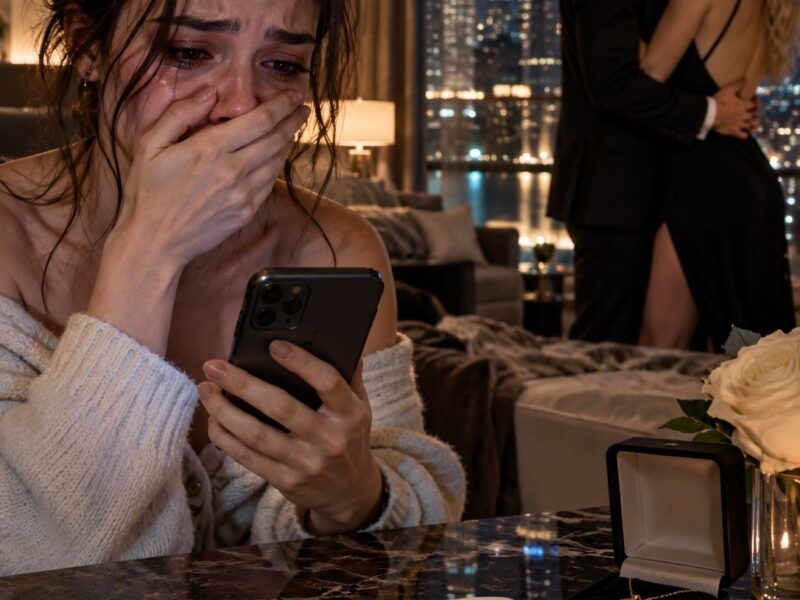
At 2:07 A.M., My Coworker Called Me Crying—Then She Whispered the One Thing I Wasn’t Ready to Hear

At 2:07 in the morning, my phone rang.
I almost ignored it.
Then I saw her name.
Emily Carter.
For several seconds, I just stared at the glowing screen beside my bed while rain tapped against the windows of my apartment.
Emily had worked three desks away from me for eight months.
We had eaten lunch together.
Stayed late together.
Complained about our boss together.
She knew I hated hazelnut creamer. I knew she always removed the onions from her sandwiches and pretended she wasn’t doing it.
But Emily had never called me after work.
Not once.
Certainly not at two in the morning.
I answered.
“Emily?”
Nothing.
Then I heard breathing.
Thin.
Uneven.
And somewhere beneath it, a sound that frightened me more than crying would have.
Her teeth were chattering.
“Daniel?”
Her voice barely sounded like hers.
I sat upright.
“What happened?”
“I’m sorry.”
Those were her first words.
Not help me.
Not I’m sick.
Not I’m scared.
I’m sorry.
“Why are you apologizing?”
“I didn’t know who else to call.”
I swung my feet onto the floor.
“Are you hurt?”
“No. I—I don’t think so.”
“What does that mean?”
“I have a fever.”
Her voice faded for several seconds.
“Emily?”
“I’m here.”
“What’s your temperature?”
“I don’t know anymore.”
“What do you mean anymore?”
Another silence.
Then she said, “The thermometer fell.”
Something in the way she said it made my stomach tighten.
“Why did it fall?”
“I got dizzy.”
I was already reaching for my jeans.
“How dizzy?”
“I stood up and everything went black for a second.”
“Did you pass out?”
“I don’t think so.”
“You don’t think so?”
“Daniel, please don’t sound angry.”
I stopped.
That sentence hit me harder than it should have.
“I’m not angry.”
“I shouldn’t have called.”
“Emily.”
“I just…”
Her breath shook.
“I didn’t want to be alone.”
I stood motionless in the dark.
Then came the words I would remember years later with impossible clarity.
“You’re the only person I wanted to call.”
I forgot about sleep.
I forgot about work.
I forgot every careful boundary I’d spent two years building around my life.
“I’m coming.”
“No.”
“Yes.”
“You have work in the morning.”
“So do you.”
That almost made her laugh.
Almost.
“Daniel, seriously. I’ll be okay.”
“You called me at two in the morning because you’re so dizzy you dropped your thermometer.”
“I know.”
“You’re alone?”
“Yes.”
“Then stop apologizing. I’m coming.”
I grabbed my jacket.
As I reached the door, I heard her whisper my name again.
“Daniel?”
“Yeah?”
A pause.
“If I fall asleep before you get here…”
She didn’t finish.
For the first time that night, I became genuinely afraid.
“Emily, stay awake.”
“I’m trying.”
“Talk to me.”
“About what?”
“Anything.”
So I walked through my apartment gathering my keys, wallet, thermometer and whatever medicine I had while keeping her voice in my ear.
She told me her ceiling needed repainting.
She told me her neighbor had a dog that barked at elevators.
She told me she hated grape-flavored medicine.
Then she stopped speaking.
“Emily?”
Nothing.
“Emily.”
A weak sound came through the phone.
“I’m here.”
I was already running.
I had no idea that twenty minutes later I would see a version of Emily Carter no one in our office had ever seen.
And I had no idea that behind her carefully locked apartment door was a loneliness much older than that fever.
My name is Daniel Brooks.
I was thirty-two when Emily called me that night.
At the time, I worked as a financial analyst for a marketing company in Chicago where people measured their lives in quarterly reports, performance reviews, unread emails and how quickly they could say “circling back” without sounding dead inside.
Our office occupied the twenty-third floor of a glass building near the river.
Everything about it looked expensive.
Everything about it felt temporary.
Emily joined our department in February.
She was twenty-nine.
Smart without advertising it.
Beautiful without appearing aware of it.
And kind in a way that made people comfortable without ever letting them become close.
She arrived fifteen minutes early every morning.
Always carried a small black notebook.
Always remembered birthdays.
She knew whose mother was undergoing chemotherapy.
She knew which intern couldn’t afford lunch near the office and somehow began “accidentally” ordering too much food twice a week.
When our receptionist’s son had surgery, Emily quietly organized a meal train.
But ask Emily about Emily?
You got a smile.
Then a subject change.
“How was your weekend?”
“Quiet. Did you finish the Morrison numbers?”
“Seeing anyone?”
She’d laugh.
“I’m seeing approximately forty-seven spreadsheets today.”
“Family in Chicago?”
“Not really. Hey, did Rebecca ever send you that presentation?”
She could redirect a personal question so smoothly that most people never realized she’d done it.
I did.
Maybe because I recognized the trick.
I had my own walls.
Two years before Emily arrived, I had been engaged to a woman named Lauren.
We had booked the venue.
Paid the photographer.
Chosen flowers I couldn’t name.
There were eighty-six people on our guest list.
Three months before the wedding, Lauren sat across from me at our kitchen table and said something that permanently changed the way I heard the word love.
“I don’t know if I love you enough to marry you.”
I remember staring at her.
“Enough?”
She cried.
That somehow made it worse.
“You’re good to me, Daniel.”
I said nothing.
“You’re dependable. You make me feel safe.”
“That sounds terrible.”
“You know what I mean.”
I did.
Unfortunately.
She loved what I provided.
The predictable paycheck.
The apartment.
The plans.
The version of adulthood we represented together.
But when I finally asked the question I’d been terrified to ask—
“If I lost all of that tomorrow, would you still choose me?”
—she couldn’t answer.
Silence answered for her.
Three months before our wedding, Lauren moved out.
After that, I became very good at being fine.
Then Emily Carter arrived.
And she irritated me almost immediately.
Not because she was difficult.
Because she noticed things.
One afternoon, I’d spent nearly four hours correcting a forecasting error made by another analyst.
At six-thirty, most of the office had emptied.
I was still staring at my monitor when a paper cup appeared beside my keyboard.
I looked up.
Emily was putting on her coat.
“I didn’t order coffee.”
“I know.”
“Then what’s this?”
“Coffee.”
“Thank you, Captain Obvious.”
She smiled.
“Drink it before you become homicidal.”
Then she walked toward the elevators.
Under the cup was a yellow sticky note.
You don’t have to carry every problem alone.
I stared at those words longer than I should have.
Then I put the note inside my desk drawer.
I never told her I kept it.
Maybe that’s when something began.
Not love.
I wasn’t ready to call it that.
Just awareness.
I began noticing when she rubbed the back of her neck after stressful meetings.
When she skipped lunch.
When she stared at her phone after everyone else had gone home.
Sometimes the screen would light her face.
She wouldn’t type anything.
She would just look.
As if waiting for a message that never came.
Once, around eight at night, I asked, “Everything okay?”
She locked the phone immediately.
“Perfect.”
It was such an obvious lie that I nearly laughed.
But something in her expression stopped me.
So I only said, “Good.”
For months, that was how we existed.
Close enough to notice.
Too afraid to ask.
Until 2:07 a.m.
The drive to Emily’s apartment normally took twenty minutes.
I made it in fourteen.
The streets were almost empty, shining black beneath the rain.
I kept thinking about the moment she’d gone silent on the phone.
When I reached her building, I called.
No answer.
I called again.
Nothing.
My heart began pounding.
Then, on the third attempt—
“Hello?”
I exhaled.
“Open the door.”
“You’re here?”
“Yes.”
“You actually came?”
That question bothered me.
“Of course I came.”
The lobby door buzzed.
I took the elevator to the sixth floor and hurried down the hallway.
Her apartment door opened before I knocked.
And I almost didn’t recognize her.
Emily was leaning against the frame.
Her dark hair, normally neat, was tangled around her flushed face.
Her eyes were watery.
Her skin looked simultaneously pale and overheated.
She wore gray sweatpants and an oversized Northwestern sweatshirt.
No makeup.
No professional smile.
No armor.
“Hey,” she whispered.
Then her knees buckled.
I caught her before she hit the floor.
“Jesus, Emily.”
“I’m okay.”
“No, you’re not.”
“I’m just dizzy.”
“You nearly collapsed.”
She tried to straighten herself.
“I can walk.”
“You’re doing a terrible job proving it.”
For one second, she looked offended.
Then she laughed weakly.
I slipped an arm around her waist and helped her inside.
Her apartment surprised me.
It was beautiful but almost painfully controlled.
Neutral furniture.
Books arranged by height.
No dirty dishes.
No photographs except one framed picture of Emily with an older couple I assumed were her parents.
It looked less like a home someone lived in than a place someone tried very hard not to disturb.
On the kitchen counter sat a bowl of soup.
Untouched.
Beside it was a glass of water.
Also untouched.
“How long has that been there?”
She followed my eyes.
“Since dinner.”
“You didn’t eat?”
“I wasn’t hungry.”
“Water?”
“Some.”
“How much is some?”
She didn’t answer.
“Emily.”
“Half a glass?”
“When?”
Another silence.
“Maybe seven.”
It was after two-thirty.
I helped her onto the couch.
“Where’s your thermometer?”
She pointed toward the bathroom.
I found it on the floor.
When I returned, she had curled beneath a blanket.
“Open.”
She gave me a tired look.
“You’re bossy when you’re worried.”
“You called the right person, apparently.”
That made something flicker in her expression.
I checked her temperature.
The number was high enough that my attempt at humor disappeared.
Emily watched my face.
“What?”
“We’re getting you checked.”
“No.”
“Yes.”
“It’s just the flu.”
“Maybe.”
“I hate hospitals.”
“Clinic, urgent care, emergency department—I don’t care what we call it. You’re getting assessed.”
“Daniel—”
“You almost passed out opening the door.”
She closed her eyes.
“Please.”
The word wasn’t defiant.
It was frightened.
I sat beside her.
“Tell me what you’re afraid of.”
Her eyes opened.
For a moment, the fever seemed to disappear from her face.
Not because she looked healthier.
Because she looked exposed.
“Nothing.”
“That’s not true.”
“I just hate doctors.”
“Why?”
She looked away.
“I don’t know.”
I waited.
Emily pulled the blanket closer.
Finally she whispered, “I hate needing people.”
That wasn’t the answer I expected.
Before I could ask what she meant, she shivered violently.
I stopped pushing.
“Okay. You can hate needing people tomorrow. Tonight, I’m staying.”
Her eyes filled.
She blinked quickly.
“Don’t.”
“Don’t what?”
“Be nice to me right now.”
I stared at her.
“Why?”
“Because I’m going to cry.”
Something inside my chest shifted.
I looked away just enough to give her dignity.
“Then cry.”
She didn’t.
Emily Carter was too practiced at swallowing things.
Instead, she nodded.
We arranged medical care.
While we waited, I sat on the floor beside the couch because she insisted she needed space.
Every few minutes, I gave her water.
She took tiny sips.
At one point, she opened her eyes and found me watching her.
“You can go home.”
“No.”
“You’ve already done enough.”
“No.”
“You have that meeting at nine.”
“So?”
“You’ll be exhausted.”
“So will you.”
“I won’t be there.”
“Then I’ll tell them you’re inconsiderate.”
Her mouth twitched.
“Daniel.”
“Emily.”
“You don’t have to stay.”
“I know.”
That silenced her.
Because there is a difference between someone staying because they have to and someone staying because they choose to.
Apparently, Emily knew that difference better than I did.
At the clinic, fluorescent lights made everyone look tired.
Emily received fluids while the doctor evaluated her.
She had a significant infection and dehydration that needed treatment and monitoring.
Nothing catastrophic.
But serious enough that waiting alone until morning would have been a bad idea.
I should have felt only relief.
Instead, I was angry.
Not at her.
At the fact that she had apparently spent hours alone getting worse before allowing herself to call anyone.
While we waited for her medication, I asked, “When did you start feeling sick?”
“Yesterday afternoon.”
My jaw tightened.
“And you waited until two?”
“I thought it would pass.”
“You were dizzy.”
“Eventually.”
“You couldn’t finish water.”
She looked down.
“I know.”
“Why didn’t you call someone earlier?”
She became very still.
There it was again.
That wall.
“Emily?”
“Because people have lives.”
“So?”
“So they shouldn’t have to rearrange them because I have a fever.”
“That’s what people who care about you do.”
She gave a small, humorless smile.
“Is it?”
I wanted to ask what had happened to her.
I didn’t.
Not yet.
Just before sunrise, I drove her home.
Chicago was turning gray around us.
Emily rested her head against the passenger window.
Halfway there, she said, “I looked through my contacts for almost twenty minutes.”
I glanced at her.
“What?”
“Before calling you.”
She kept watching the city.
“I called my mom first. Then hung up before it rang.”
“Why?”
“She’d panic. My parents are four hours away.”
“Okay.”
“I thought about calling Rachel from college.”
“Why didn’t you?”
“We haven’t spoken properly in months.”
She rubbed her thumb against her palm.
“There were other names.”
I waited.
“But every person I considered calling came with a reason not to.”
“Except me?”
She finally looked at me.
“Except you.”
“Why?”
“I don’t know.”
“That’s flattering.”
She smiled faintly.
Then the smile vanished.
“Because you listen.”
I said nothing.
“You notice when people aren’t okay without making them explain themselves immediately.”
The traffic light turned red.
I stopped.
Emily continued.
“You never make people feel stupid for worrying.”
Something tightened in my throat.
“And I remembered the day you stayed late helping Kevin redo his presentation even though he blamed you for the mistake.”
“He bought pizza.”
“Daniel.”
“I’m listening.”
“I thought…”
She swallowed.
“I thought if I called you, maybe you wouldn’t make me regret it.”
The light turned green.
Someone honked behind us.
I drove.
But those words stayed in the car with us.
When we reached her apartment, I carried her medicine upstairs.
She was steadier now, but exhausted.
I wrote the doctor’s instructions on a sheet of paper in unnecessarily large handwriting.
“Medication here. Water here. Phone charger here.”
“You missed your calling as a dictator.”
“I considered it.”
I put everything on the nightstand.
“Call me if anything changes.”
She nodded.
“I mean it.”
“I know.”
“And eat something when you wake up.”
“Yes, Dad.”
“That’s disturbing. Never say that again.”
She laughed.
A real laugh this time.
I headed toward the bedroom door.
Then fingers closed around my sleeve.
I looked down.
Emily was holding me.
Barely.
Her grip was weak.
But she wasn’t letting go.
“What?”
Her face changed.
For eight months, I’d watched this woman control every expression that crossed it.
Now she couldn’t.
“I lied.”
“About what?”
“I didn’t call because you were convenient.”
I waited.
Her eyes dropped.
“I was scared.”
“I know.”
“No. I mean I was scared to call you.”
“Why?”
“Because if you didn’t come…”
She stopped.
I understood before she finished.
“If I didn’t come, what?”
Her voice cracked.
“Then I’d know I was wrong about you.”
The room became very quiet.
I sat on the edge of the bed.
“You weren’t wrong.”
Emily looked at me.
“I know that now.”
She released my sleeve.
I should have left.
Instead, I stayed until she fell asleep.
I sat in a chair beside her window while dawn spread slowly over the buildings outside.
And somewhere between the sound of her breathing and the first morning traffic below, I remembered the yellow note inside my desk.
You don’t have to carry every problem alone.
Emily had written it to me.
Yet apparently, she had never believed it applied to herself.
That morning, something changed.
Not romance.
Not yet.
Something more dangerous.
Trust.
Over the next week, I checked on her before work and after.
I brought groceries.
Soup.
Crackers.
Electrolyte drinks.
Once, I left a bag outside her door because she was sleeping.
When she woke up, she texted:
You know normal coworkers don’t do this, right?
I answered:
Normal coworkers also don’t call me at 2:07 a.m. and threaten to die dramatically from dehydration.
Three dots appeared.
Disappeared.
Returned.
I did not threaten to die dramatically.
Your thermometer died dramatically.
She sent me a middle-finger emoji.
It was the first time she’d ever done that.
I laughed so loudly in the office that my manager looked over the cubicle wall.
Something about Emily became easier after that night.
Not completely.
Walls built over years don’t disappear because someone brings soup.
But small doors appeared.
She told me she hated thunderstorms.
She loved old bookstores.
She had played piano as a child but stopped after college.
She called her mother every Sunday and usually spent twenty minutes pretending everything in Chicago was wonderful.
Then she told me about Mark.
We were sitting in a quiet coffee shop three weeks after she’d recovered.
She had returned to work, but neither of us had returned to what we’d been before.
“Mark was my last serious relationship,” she said.
I didn’t ask whether she loved him.
Her face answered.
“We were together almost three years.”
“What happened?”
She stirred her coffee even though she’d added nothing to it.
“He liked me when I was easy.”
I frowned.
“What does that mean?”
“When I was fun. Successful. Independent.”
Her spoon circled the cup.
“If work was good and I looked good and I didn’t need anything, we were perfect.”
“And when you needed something?”
She smiled without humor.
“He called it drama.”
My chest tightened.
“If I had a bad day, he had a worse one. If I was worried, I was overthinking. If I got sick, he suddenly had something important to do.”
I remembered her apologizing while shaking with fever.
“Emily…”
“One night my car broke down outside Milwaukee. It was freezing. I called him.”
“What did he do?”
“He asked if I’d called roadside assistance.”
I waited.
“He said there wasn’t much point in both of us being inconvenienced.”
I stared at her.
“He actually said that?”
“Yes.”
“That’s…”
“Efficient?”
“I was going to say something less polite.”
That finally made her smile.
But tears had gathered in her eyes.
“The stupid thing is, I stayed another eight months.”
“That’s not stupid.”
“It felt stupid.”
“Why did you stay?”
Her gaze dropped.
“Because by then, he’d convinced me that needing anything from another person was a character flaw.”
I thought about Lauren.
Different wound.
Same scar.
I had learned that being needed meant being used.
Emily had learned that needing someone meant becoming a burden.
No wonder we’d spent eight months orbiting each other without getting closer.
We were both terrified of opposite sides of the same door.
I reached across the table.
I didn’t take her hand.
I simply rested mine nearby.
Close enough that she could choose.
After several seconds, Emily moved her fingers until they touched mine.
That was all.
Yet it felt more intimate than any kiss I’d had in years.
Then she asked, “What happened with Lauren?”
I froze.
Emily immediately withdrew.
“You don’t have to tell me.”
“No.”
I looked at my coffee.
“You told me about Mark.”
So I told her.
About the venue.
The deposits.
The eighty-six guests.
The conversation at the kitchen table.
I told her what Lauren had said.
Then I told her the part I had never told anyone.
“After she left, I kept wondering whether she would have stayed if I’d been more useful.”
Emily’s eyes hardened.
“Daniel.”
“I know how that sounds.”
“No, you don’t.”
She leaned forward.
“That’s exactly what you just told me not to do.”
“What?”
“Turn someone else’s inability to love properly into evidence that something is wrong with you.”
I stared at her.
She stared back.
Then both of us realized what had happened.
Emily laughed first.
“We’re ridiculous.”
“Completely.”
“You’re telling me not to be afraid of needing people.”
“And you’re telling me not to be afraid of being needed.”
“Maybe we should charge each other therapy fees.”
“I brought soup. We’re even.”
That afternoon became the beginning of something neither of us named.
Breakfast before work became normal.
So did evening walks.
We discovered a tiny Italian restaurant where the owner never remembered our names but always remembered our order.
Emily began leaving chocolate bars on my desk again.
I began leaving coffee on hers.
Coworkers noticed.
Of course they noticed.
One Friday, Kevin leaned against my cubicle.
“So.”
I didn’t look up.
“No.”
“I haven’t asked anything.”
“You’re about to.”
“Carter.”
“No.”
“You two dating?”
“No.”
“Sleeping together?”
I looked up.
“Would you like to keep your teeth?”
Kevin grinned.
“So that’s a maybe.”
“We’re friends.”
“Sure.”
“We are.”
Kevin studied me.
Then his smile softened.
“Whatever you call it, you look happier.”
That irritated me because it was true.
But happiness had a way of frightening me.
The closer Emily became, the more I started waiting for the cost.
It arrived one Tuesday afternoon.
Not because Emily did anything wrong.
Because I misunderstood something.
I was walking past a conference room when I saw her inside with a man I’d never met.
Tall.
Expensive suit.
Confident.
His hand rested on the back of her chair.
Emily was smiling.
Then he leaned down and hugged her.
I kept walking.
My reaction embarrassed me immediately.
Jealousy.
Sharp and irrational.
We weren’t dating.
She owed me nothing.
So I did what emotionally mature adults famously do when frightened.
I became distant.
Emily noticed within twenty-four hours.
At lunch, she put down her fork.
“What did I do?”
“Nothing.”
“Daniel.”
“Nothing.”
“You’ve answered me with four words since yesterday.”
“Busy.”
“Five.”
I almost smiled.
Didn’t.
Her expression changed.
And suddenly I saw it happening.
She was retreating.
Not angrily.
Quietly.
The old Emily.
The woman who would rather disappear than risk being told she was asking for too much.
That realization stopped me.
I put down my coffee.
“I saw you yesterday.”
“Where?”
“Conference room.”
She waited.
“With that guy.”
For two seconds, she looked confused.
Then her eyebrows lifted.
“Oh.”
“What?”
“You’re jealous.”
“I am not jealous.”
“You are incredibly jealous.”
“I asked one question.”
“You didn’t ask any question. You emotionally vanished for twenty-four hours.”
I rubbed my forehead.
“Who was he?”
Emily’s expression softened.
“My brother.”
I stared at her.
She burst out laughing.
“You have a brother?”
“Yes.”
“You never mentioned a brother.”
“You never asked.”
“You let me embarrass myself.”
“I didn’t know you were having a secret psychological crisis.”
I groaned.
She laughed harder.
Then I started laughing too.
But eventually the laughter faded.
Emily looked at me.
“Why didn’t you just ask?”
I knew what she was really asking.
Why had I assumed distance was safer than vulnerability?
“Because I didn’t have the right.”
“The right to what?”
“To be jealous.”
She became very still.
“Maybe I wanted you to be.”
The restaurant noise seemed to fade.
Neither of us moved.
Then her phone rang.
She looked at the screen.
Her expression changed.
“My mom.”
She answered.
The moment broke.
But it didn’t disappear.
For the next several weeks, that unfinished sentence existed between us.
Maybe I wanted you to be.
I thought about it constantly.
Then, just when I had convinced myself I was finally ready to tell her how I felt, Emily pulled away.
It began with canceled breakfasts.
Then longer hours.
Then messages answered hours later.
At first, I told myself she was busy.
Then one evening, I found her alone at her desk after nine.
“Emily.”
She jumped.
“What are you doing here?”
“Looking for you.”
“Why?”
“You canceled dinner.”
“I texted.”
“You said something came up.”
“It did.”
“What?”
“Work.”
I looked at her dark monitor.
“Your computer is off.”
She said nothing.
I pulled the chair beside her desk.
“What happened?”
“Nothing.”
“Don’t do that.”
“Do what?”
“The old thing.”
Her jaw tightened.
“What old thing?”
“Pretend you’re fine until you collapse.”
“That happened once.”
“The fever happened once. The pretending happens constantly.”
She stood.
“That isn’t fair.”
“Then tell me what’s going on.”
“Nothing is going on.”
“Emily.”
“I said I’m fine.”
“And I don’t believe you.”
Her face changed.
“Maybe you should.”
“Why?”
“Because not everything is your responsibility.”
The words struck harder than she intended.
I stood.
“Is that what you think this is?”
“I don’t know what this is.”
There it was.
The sentence we’d avoided for months.
“What do you mean?”
She looked exhausted.
“I mean you show up. You fix things. You bring coffee. You listen. You make everything easier.”
“That sounds terrible.”
“Stop joking.”
“I’m not.”
“Yes, you are.”
Her eyes filled.
“You make me depend on you.”
I stared at her.
“I make you?”
“No.”
She closed her eyes.
“God, that’s not what I meant.”
“Then what do you mean?”
“When you’re not there, I notice.”
My anger disappeared.
Emily’s voice became smaller.
“When something happens, you’re the first person I want to tell. When I’m scared, I think of you. When something funny happens, I reach for my phone.”
She wiped angrily at a tear.
“And I hate how much that scares me.”
I understood.
But understanding didn’t make it painless.
“So your solution is to disappear?”
“My solution is to remember how to stand on my own.”
“You already know how.”
“You don’t know that.”
“I watched you do it for eight months.”
“You watched me pretend.”
The words hung between us.
I stepped closer.
“Then stop pretending.”
“You make that sound easy.”
“No. I’m saying you don’t have to do it with me.”
She looked directly at me.
And then she asked the question I wasn’t prepared for.
“What happens when you get tired of showing up?”
I couldn’t answer immediately.
That hesitation was all she saw.
Emily looked away.
“Exactly.”
She grabbed her coat.
“That’s not fair.”
“No.”
She nodded.
“It probably isn’t.”
Then she walked away.
I stood beside her empty desk wondering how two people could care so much about each other and still know exactly where to hurt.
We barely spoke for three days.
Friday night, I opened my desk drawer looking for a charger.
The yellow sticky note was still there.
The edges were curled.
The ink had faded slightly.
You don’t have to carry every problem alone.
I sat there staring at it.
And finally I understood something.
Emily wasn’t the only person running.
I had been waiting for certainty before loving anyone again.
I wanted guarantees.
Proof that if I showed up, I wouldn’t be used.
Proof that if I opened my heart, nobody would leave.
Proof that love wouldn’t cost me anything.
But that’s not trust.
That’s insurance.
Lauren hadn’t destroyed my ability to love.
She had simply given me an excuse not to risk it.
Emily’s fear looked different from mine, but beneath it was the same question.
If I let you matter, can you hurt me?
The answer was yes.
Of course yes.
That’s what makes someone matter.
Monday morning, I put the sticky note on Emily’s desk.
She arrived at 8:43.
She saw it.
Then she looked at me.
I didn’t say anything.
Neither did she.
At 9:16, a chocolate bar appeared beside my keyboard.
Attached was another note.
Coffee after work?
I wrote underneath:
Only if you’re buying.
She replied:
Cheap.
I wrote:
Emotionally damaged.
She looked across the office at me.
Then laughed.
That evening, we talked for nearly three hours.
No declarations.
No promises.
Just truth.
We agreed not to rescue each other.
Not to punish each other for what other people had done.
Not to disappear when we became frightened.
We failed at all three eventually.
Then apologized.
Then tried again.
That became our pattern.
Not perfection.
Repair.
Months passed.
Spring became summer.
Summer leaned toward fall.
Almost six months after that phone call, Emily and I left our little Italian place and found ourselves trapped beneath the awning of a café by sudden rain.
Chicago traffic hissed across wet pavement.
Emily stood beside me, arms folded against the cold.
“Remember the night I called you?”
I looked at her.
“Unfortunately.”
She nudged me.
“I nearly died.”
“You had an infection, not the plague.”
“I was very brave.”
“You called me crying.”
“I was not crying.”
“You absolutely were.”
“Fever moisture.”
I laughed.
She became quiet.
“What?”
“Do you remember asking why I called you?”
“Yes.”
“I think I finally know.”
The rain intensified.
People ran across the street beneath umbrellas.
Emily reached down.
Her fingers found mine.
For once, neither of us pretended the gesture was accidental.
“I didn’t call you because you were the only person available.”
“I know.”
“No, you don’t.”
She turned toward me.
“I had people I could have called.”
“Okay.”
“But before that night, some part of me already believed you’d come.”
I couldn’t speak.
Emily’s fingers tightened around mine.
“I think that terrified me.”
“Why?”
“Because I trusted you before I’d given myself permission to.”
Something inside me broke open.
Not painfully.
More like a locked room finally receiving air.
“Emily.”
She watched me.
“I need to tell you something.”
Her expression became nervous.
That almost made me smile.
“I cared about you before that night.”
She blinked.
“How long before?”
“I don’t know.”
“Daniel.”
“Maybe the coffee.”
“What coffee?”
“The one you left beside my keyboard.”
Her mouth opened.
“That was months earlier.”
“I know.”
“And you said nothing?”
“I was emotionally damaged.”
“You’re an idiot.”
“Probably.”
She laughed, but tears appeared.
I continued.
“I didn’t say anything because I was scared.”
“Of me?”
“Of what you’d become.”
Her smile disappeared.
“What does that mean?”
“Important.”
She stopped breathing for a second.
“I knew how to survive losing someone I didn’t completely trust.”
I swallowed.
“I wasn’t sure I could survive losing someone I did.”
Emily’s eyes filled.
The rain kept falling around us.
For months, we’d built something from small things.
Coffee.
Chocolate.
Soup.
Phone calls.
Walks.
Listening.
Showing up.
None of it looked dramatic from the outside.
But sometimes the biggest changes in your life happen so quietly you don’t recognize them until you’re standing in the rain holding the hand of the person who caused them.
Emily stepped closer.
“I don’t need you to save me.”
“I know.”
“I don’t need you to fix me.”
“I know.”
“And sometimes I’m going to get scared and pull away.”
“I know.”
She looked at me.
“What do you need?”
That question almost destroyed me.
Because Lauren had once made me believe that what I provided was more valuable than who I was.
Emily was asking something different.
Not what can you give me?
What do you need?
I answered truthfully.
“I need you not to make decisions for me.”
She frowned.
“What decisions?”
“Don’t decide I’ll get tired of you.”
Her eyes lowered.
“Don’t decide you’re too much.”
A tear slipped down her cheek.
“Don’t decide I won’t show up before giving me the chance to choose.”
She nodded.
“Okay.”
“And I won’t decide you’re going to use me just because someone else did.”
Another nod.
“Okay.”
For several seconds, neither of us spoke.
Then Emily smiled.
“You know this would be a perfect moment to kiss me.”
I stared at her.
“Was that subtle?”
“I’ve tried subtle for six months. You’re apparently defective.”
I laughed.
Then I touched her face.
She leaned into my hand.
And I kissed her.
There was no explosion.
No dramatic music.
No audience.
Just rain.
Warm breath.
Her fingers gripping my jacket.
And a strange sense that something had finally settled into the place where it belonged.
When we separated, Emily rested her forehead against mine.
“So.”
“So?”
“Are we dating now?”
“I don’t know.”
She pulled back.
“Daniel Brooks.”
“I think paperwork is required.”
She punched my shoulder.
I kissed her again.
A year after that night, Emily still claimed she deserved credit for our relationship because she was the one brave enough to call first.
I argued that technically the infection deserved credit.
She said that was disgusting.
We moved slowly.
Deliberately.
We learned each other’s habits.
Emily learned that when I became quiet during conflict, I wasn’t leaving.
I was usually trying not to say something stupid.
I learned that when she said, “It’s fine,” there was approximately an eighty-percent chance that nothing was fine.
We met each other’s families.
Her brother—the mysterious man from the conference room—never stopped mocking me about the jealousy incident.
My mother loved Emily immediately.
That should have frightened me.
Instead, it felt right.
But the moment I remember most happened on an ordinary Sunday morning.
No rain.
No fever.
No emergency.
I woke around six and found Emily sitting by the bedroom window.
For one terrifying second, I thought something was wrong.
“What happened?”
She turned.
“Nothing.”
I gave her a look.
She smiled.
“Actually nothing.”
I sat beside her.
She was holding something.
A yellow sticky note.
My yellow sticky note.
The one she’d written more than a year earlier.
You don’t have to carry every problem alone.
“You kept it?” she asked.
“I told you that.”
“No, you didn’t.”
“I thought I did.”
“You absolutely did not.”
She stared at it.
Then she laughed softly.
“I wrote this because you looked miserable.”
“Romantic.”
“I wasn’t trying to be romantic.”
“Even more romantic.”
She leaned her head against my shoulder.
After a while, she said, “I didn’t believe this when I wrote it.”
“I know.”
“How?”
“Because people are usually best at giving the advice they need themselves.”
She was quiet.
Then she whispered, “I think I believe it now.”
I took her hand.
“So do I.”
For years, I believed love would arrive as certainty.
Emily believed love would arrive only after she’d proven she didn’t need it.
We were both wrong.
Love arrived at 2:07 in the morning.
It sounded like a frightened woman apologizing for being sick.
It looked like an untouched bowl of soup on a kitchen counter.
It felt like weak fingers holding the sleeve of my jacket because someone was finally brave enough to admit she didn’t want to be alone.
There was nothing glamorous about that night.
No expensive dinner.
No perfect dress.
No rehearsed confession.
Just fluorescent clinic lights.
Medicine bottles.
Rain.
Fear.
And two people carrying wounds neither had caused.
Sometimes I still think about what might have happened if I’d let the call go to voicemail.
Not because Emily wouldn’t have found help.
She would have.
Emily had survived plenty before me.
But maybe we would have gone back to work Monday morning and continued pretending.
Maybe she would have smiled across the office.
Maybe I would have nodded.
Maybe she’d have left another chocolate bar on my desk.
Maybe I’d have kept wondering why she stared at her phone when the office emptied.
Two lonely people could have remained three desks apart for years simply because neither wanted to inconvenience the other with the truth.
That’s the part that stays with me.
Not the fever.
Not the clinic.
Not even our first kiss.
The call.
The terrifying little act of reaching out.
Because asking for help is easy when you’re certain someone will come.
Emily wasn’t certain.
She called anyway.
And showing up is easy when you know exactly what someone will become to you.
I didn’t know.
I went anyway.
Maybe that’s why the memory still matters.
We didn’t save each other that night.
We did something smaller.
And, in the end, more important.
We gave each other evidence.
I showed Emily that needing someone did not automatically make her a burden.
She showed me that being needed did not automatically mean I was being used.
Everything else grew from there.
Months later, Emily asked me something while we were washing dishes.
“If I hadn’t been sick, do you think we still would’ve happened?”
I considered lying.
Instead, I told her the truth.
“I don’t know.”
She looked disappointed for half a second.
Then I continued.
“I think I would’ve kept finding reasons to sit near you.”
She smiled.
“I think you would’ve kept leaving chocolate on my desk.”
“Probably.”
“And eventually one of us would’ve had to stop being a coward.”
“Probably you.”
“Definitely me.”
I splashed water at her.
She shrieked and hit me with a dish towel.
Five minutes later, there was water across the kitchen floor and neither of us could stop laughing.
That was what our love eventually became.
Not an emergency.
Not fear.
Not rescue.
Ordinary mornings.
Arguments repaired before bedtime.
Groceries.
Coffee.
Inside jokes.
Her feet freezing against my legs under the blankets.
My terrible habit of leaving cabinet doors open.
Her habit of buying books faster than she could read them.
Two people learning, over and over, that vulnerability wasn’t a debt.
It was an invitation.
And sometimes, late at night, when my phone lights up beside the bed, I still remember 2:07 a.m.
I remember seeing her name.
I remember almost letting it ring.
Then I look beside me.
Emily is usually asleep.
Sometimes one hand is tucked beneath her cheek.
Sometimes she’s stolen most of the blanket.
Sometimes there is nothing extraordinary about the scene at all.
And that is precisely what makes it extraordinary.
Because once, both of us thought love had to prove itself through permanence before we could risk trusting it.
Now I understand something simpler.
Nobody can promise you they will never disappoint you.
Nobody can guarantee they will never leave.
Love doesn’t come with that kind of evidence.
What you get instead are moments.
Someone answering.
Someone listening.
Someone remembering.
Someone staying when staying is inconvenient.
Someone allowing you to stay without turning your kindness into an obligation.
A hundred ordinary choices that quietly become a life.
Emily’s first choice was to call.
Mine was to answer.
Everything beautiful came afterward.
And whenever she jokes that she owes our entire relationship to the worst fever of her life, I remind her that the fever wasn’t the moment that changed us.
It was what she said before I came.
The sentence I can still hear exactly as I heard it that night, trembling through the darkness:
“You’re the only person I wanted to call.”
Back then, I thought she was asking me to help her survive one frightening night.
I didn’t understand that she was trusting me with something far more fragile than her illness.
She was handing me the part of herself that had learned never to ask anyone to stay.
And without realizing it, when I walked through her door, I handed her the part of myself that had stopped believing anyone could need me without eventually making me regret it.
Neither of us knew what to call that exchange.
We certainly didn’t call it love.
Not then.
Maybe that was why it survived.
We didn’t demand that it become anything.
We simply kept showing up.
Until one day, there was no longer a lonely woman staring at a silent phone.
There was no longer a man keeping an old sticky note hidden in his desk because he was afraid to admit how much kindness affected him.
There were just two people standing in the same kitchen, living an ordinary life neither had believed they were brave enough to build.
And sometimes, in the quietest moments, Emily still reaches for my hand.
Not because she is sick.
Not because she is frightened.
Not because she needs to be rescued.
Just because I’m there.
I squeeze her fingers.
And every time, some part of me returns to that rainy night, to that glowing phone beside my bed, to the split second when I could have rolled over and let it ring.
Then I remember the lesson Emily and I had to learn separately before we could learn it together:
The people who change our lives do not always arrive with grand declarations.
Sometimes they arrive as a name glowing on a screen at 2:07 in the morning.
Sometimes love begins with three frightened words:
“I need help.”
And sometimes the most important answer you will ever give is simply:
“I’m coming.”









