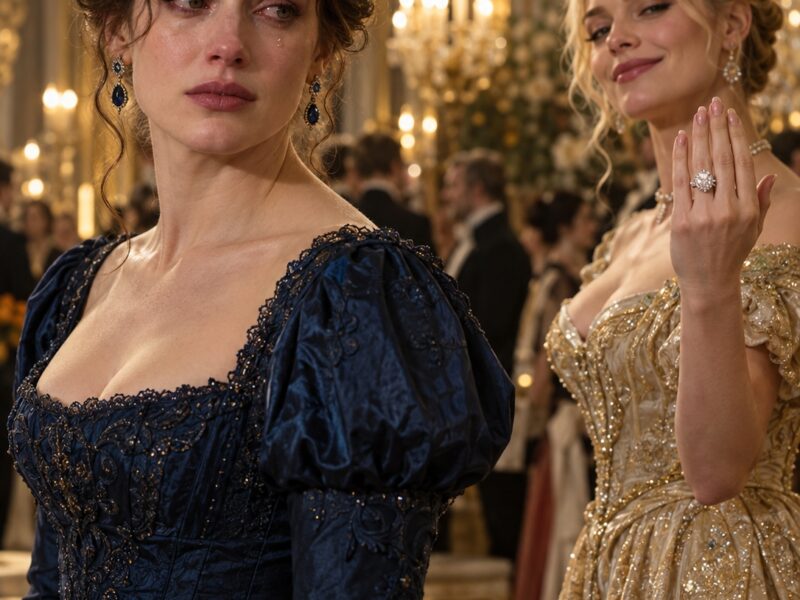
At 31, Her Family Called Her the Daughter No Man Would Ever Want—Until a Ruthless Duke Walked Past Every Beauty in the Ballroom and Asked Her One Question
The night her father declared her the only disgrace in his family, Odora Veilrest stood beneath a thousand candles and wished she could disappear.
Her sisters laughed. Her mother looked away.
Then the ballroom doors opened, and the most powerful duke in England walked into the room.
Odora would remember the sound of those doors for the rest of her life.
Not because she believed the man entering would rescue her. She had stopped believing in rescue years ago. But because, in the terrible silence following her father’s words, she had begun to wonder whether everyone in the room could see how badly she wanted to cry.
It was an absurd thing to worry about at thirty-one.
She knew that.
She had lived through disappointment, grief, and more humiliations than she cared to count. She had learned to receive insults with a lowered gaze and a composed mouth. She could oversee a dinner for forty guests while suffering a headache, mend a torn hem without disturbing its wearer, and sit through an entire evening of jokes about her unmarried state without allowing her hands to tremble.
But some cruelties still found their way beneath the skin.
Especially when they came from one’s father.
Lord Cedric Veilrest stood at the head of the long table, his silver hair shining beneath the chandeliers. He had raised his glass in celebration of his youngest daughter’s engagement.
“All my daughters have brought honor to this family,” he announced.
A warm ripple of approval moved through the guests.
Then he paused.
His eyes settled on Odora.
“Except one.”
For a moment, nobody moved.
Then someone near the far end of the table released an uncomfortable little laugh, as though Lord Cedric had made an especially daring joke.
Others followed.
Odora stared at the embroidered edge of the tablecloth.
She had helped select it.
She remembered spending two afternoons with the housekeeper deciding which linens would best complement the gold dinner service. She remembered making certain the elderly Lady Fenwick had a chair that would not aggravate her back, and arranging for extra candles near Sir Edmund’s place because his eyesight had grown poor.
She remembered everything.
Apparently, none of it counted as bringing honor to her family.
“Father,” Lady Rowena murmured.
Her voice was not particularly distressed. It carried the mild disapproval she reserved for a servant who had placed a vase in the wrong room.
Lord Cedric waved a dismissive hand.
“Oh, come now. We must be able to laugh at ourselves.”
Odora managed to lift her eyes.
“Of course, Father.”
Her voice sounded steady.
That, at least, was something.
Across the table, her younger sister Kalista was examining her newly acquired engagement ring.
“Nearly five thousand pounds,” she had announced earlier, holding it toward the candlelight.
The diamond was enormous.
Everyone had admired it.
Then Kalista had turned toward Odora with the sweet smile she wore whenever she meant to hurt someone.
“Though I suppose engagement rings are rather unfamiliar to you, dear sister.”
Selmera, married for nearly two years and endlessly proud of it, had laughed.
“Do not lose hope. Perhaps some lonely old widower may still choose you.”
Odora had told Kalista the ring was beautiful.
It was beautiful.
She did not see why admitting that should have been difficult.
Now, as the ballroom settled into an awkward quiet, she wondered how many more times she would be expected to smile before the evening ended.
The doors swung open.
A footman stepped forward, followed by the household’s master of ceremonies.
“His Grace, the Duke of Ravenshade.”
Conversations stopped.
Even Lord Cedric straightened.
Duke Allaric Ravenshade entered without any apparent interest in the effect he had produced.
At thirty-seven, he was one of the wealthiest men in England. His estates were extensive, his political connections formidable, and his reputation so severe that even accomplished hostesses approached him with caution.
He was tall, dark-haired, and dressed with the understated precision of a man who had no need to advertise his fortune.
His expression gave little away.
Society had been attempting to understand him for years.
There had once been talk of a marriage between Ravenshade and Lady Vivien Ashborne, a woman celebrated for her beauty and considerable charm.
Nothing had come of it.
The engagement had never been publicly announced, and neither party discussed the matter.
Eventually, the whispers had faded into a widely accepted conclusion.
The Duke of Ravenshade had no intention of marrying.
Some called him arrogant.
Others called him bitter.
His mother, according to those who knew her, considered him lonely.
Allaric himself preferred not to discuss it.
He greeted Lord Cedric, bowed to Lady Rowena, and allowed himself to be introduced to several young women who seemed suddenly incapable of remembering ordinary conversation.
Odora watched from her chair.
She had no desire to attract his notice.
Men like Ravenshade belonged to a world in which her sisters moved comfortably, armed with silk gowns, flirtatious smiles, and the reassuring certainty that they deserved admiration.
Odora had once possessed a little of that certainty.
It had not survived.
Earlier that evening, before her father’s toast and the Duke’s unexpected arrival, Odora had spent nearly an hour in the servants’ quarters.
The household was in its customary state of controlled panic.
A visiting lady had demanded different pillows. One footman had misplaced a pair of gloves. The cook was furious because an additional guest had arrived without notice, and a young maid had nearly burst into tears after dropping a silver dish.
Odora moved between them quietly.
She knew the rhythm of such evenings.
She also knew that her mother expected everything to be perfect without wishing to hear how perfection had been achieved.
Near the kitchen entrance, she found a little girl sitting on a stool with her face buried in her sleeve.
It was Clara, the daughter of one of the maids.
“Clara?”
The child looked up.
Her cheeks were wet.
“What happened, sweetheart?”
Clara held out a reddened hand.
“I touched the hot pan.”
Odora crouched beside her.
“Let me see.”
The burn was small, but painful enough to make the child shiver whenever she moved her fingers.
Odora fetched cool water and clean cloth, gently tending the injury.
“Does it hurt very badly?”
Clara nodded.
“I tried not to cry.”
“Oh, Clara.” Odora smiled sadly. “You are allowed to cry when something hurts.”
The child considered this.
“Even if I’m supposed to be brave?”
“Especially then.”
Clara sniffed.
Odora remained with her until the trembling stopped. Then she found a sugared biscuit and placed it in the child’s uninjured hand.
“Now. That is not a cure, but I have found it helps considerably.”
Clara smiled.
For a few moments, Odora forgot about the ballroom.
She forgot the uncomfortable gown, the judgmental looks, and the certainty that the evening would end with somebody reminding her she was still unmarried.
She was simply sitting beside a child who needed kindness.
Then Lady Rowena appeared.
“There you are.”
Odora stood.
“Mother.”
“We have been looking everywhere for you.”
“I’m sorry. Clara burned her hand.”
Lady Rowena barely glanced at the girl.
“Surely one of the servants could have attended to that.”
“Her mother was occupied, and—”
“Odora.”
The single word ended the discussion.
Her mother examined the plain dark-blue gown she had chosen.
“You might at least have made an effort with your appearance.”
Odora looked down.
“I thought this was suitable.”
“It is suitable for a quiet dinner. Tonight is an important occasion.”
“Yes, Mother.”
“Selmera and Kalista have brought great distinction to this family. I should like you to remember that.”
Odora said nothing.
“And please,” Lady Rowena continued, lowering her voice, “do not draw unnecessary attention to yourself.”
The words remained with Odora long after her mother had gone.
Do not draw attention.
She had become remarkably accomplished at that.
Three years earlier, Odora had laughed easily.
She had played the pianoforte in the evenings, argued cheerfully about books, and enjoyed walking through the estate gardens when the weather was mild.
She had not considered herself beautiful, exactly, but neither had she regarded her appearance as a failure.
She had believed that life might contain something unexpected and wonderful.
Then she met Thomas Everwin.
He was not titled.
He possessed neither a great estate nor influential relations.
But he listened.
That was the first thing Odora remembered about him.
When she spoke, Thomas did not merely wait for an opportunity to speak about himself.
He asked questions.
He remembered her opinions.
He once borrowed a book she had recommended and returned it filled with little slips marking passages he wanted to discuss.
He treated the servants courteously, never seeming to understand why such behavior was thought unusual.
And when he looked at Odora, there was nothing in his expression that suggested she ought to become someone else.
Their affection grew in the quiet spaces between ordinary days.
A conversation in the library.
A walk through the gardens.
A moment beneath an old tree when Thomas took her hand and she did not withdraw it.
For the first time, Odora allowed herself to imagine a different future.
It did not require wealth.
It did not require applause.
Only the possibility of waking beside someone who was glad she was there.
Her father discovered the attachment before Thomas had secured a position sufficient to provide for a wife.
The confrontation took place in Lord Cedric’s study.
“You will not marry my daughter.”
Thomas stood opposite him.
“My lord, I understand that my circumstances are not what you would wish.”
“They are entirely unsuitable.”
“I love her.”
Lord Cedric’s mouth tightened.
“Love does not preserve a noble family.”
Odora stood near the window, her hands clasped so tightly her fingers ached.
“Father, please.”
“This discussion is finished.”
“Thomas is a good man.”
“He is a man without prospects.”
“He intends to work.”
“How admirable. Then let him work somewhere else.”
Thomas turned toward her.
She remembered his face.
Not angry.
Not defeated.
Simply devastated by the knowledge that their happiness had become a negotiation he could not win.
Lord Cedric arranged for him to leave.
Odora begged.
Her father refused.
At the garden gate, beneath a cold, steady rain, Thomas held both her hands.
“I will return for you.”
She wanted to believe him.
So she did.
For weeks afterward, she lived from one letter to the next.
Then the letters stopped.
At first, she told herself he must be traveling.
Then that he was occupied.
Then that his letters had been delayed.
Finally, one arrived.
Thomas had become seriously ill while abroad.
He had died.
Odora read the words repeatedly, until the page trembled too badly for her to continue.
There had been no farewell.
No final conversation.
No chance to tell him that she would have waited longer.
Something in her life became permanently quiet after that.
Her family spoke of the tragedy briefly, then moved on.
There were daughters to marry.
Invitations to answer.
Reputations to maintain.
Odora’s grief was expected to become private, convenient, and eventually invisible.
She did her best to oblige.
The sound of breaking crystal pulled her back to the present.
A young servant had dropped a tray of champagne glasses.
Several shattered across the ballroom floor.
The girl stood motionless, horrified.
“My apologies, Your Grace.”
One of the guests made an irritated sound.
“How dreadfully careless.”
The servant bent to gather the pieces.
“Don’t move.”
Odora had already crossed the room.
She crouched beside the girl.
“You’re bleeding.”
“I’m sorry, Miss.”
“There is no need to apologize to me.”
Odora took a clean handkerchief from her sleeve and folded it carefully around the girl’s finger.
“Hold that firmly.”
The girl obeyed.
“I’m going to lose my position.”
“Not over a broken glass.”
“But—”
“Look at me.”
The servant lifted frightened eyes.
“Accidents happen. We shall have the floor cleared, and then you must see to that hand.”
Odora turned toward a footman.
“Would you ask someone to bring a brush and a pan? Carefully, please. There is glass beneath the table.”
The footman hurried away.
Only then did Odora become aware that the room had grown strangely quiet.
She looked up.
Across the ballroom, Duke Allaric Ravenshade was watching her.
Not the fallen tray.
Not the guests.
Her.
She immediately lowered her eyes.
It was a moment she would have forgotten had he not remembered it.
Allaric had spent years watching people perform kindness when an audience might reward them.
He had seen elaborate donations made with more concern for the donor’s reputation than the recipient’s welfare.
He had heard men praise generosity while treating their servants with casual contempt.
The woman kneeling in spilled champagne had not looked around to see who might be impressed.
She had simply noticed someone in pain and gone to help.
He found himself curious.
When she rose, he saw that her gown was plain compared with those surrounding her.
She wore no diamonds.
Her hair had been arranged neatly but without extravagance.
There was no calculated invitation in her expression.
In fact, the instant she discovered him watching, she seemed to wish he would look elsewhere.
That was unusual.
Allaric was accustomed to women wanting his attention.
He was less accustomed to wondering whether he might deserve theirs.
Dinner began badly and grew steadily worse.
Selmera raised her glass.
“To our dear Kalista, the last of us to secure a brilliant marriage.”
Several guests applauded.
Kalista smiled.
Selmera turned toward Odora.
“Though I suppose miracles are still possible for our eldest sister.”
A few people laughed.
Odora set down her fork.
She had been hungry earlier.
Now she could scarcely swallow.
She could have objected.
She had thought about doing so many times over the years.
But she knew what would follow.
Her sisters would insist they had only been teasing.
Her father would accuse her of oversensitivity.
Her mother would ask why she could not accept a harmless joke with grace.
And by the following morning, the incident would become another example of Odora’s unfortunate temperament.
So she said nothing.
Then a chair scraped against the floor.
Odora looked up.
The Duke was standing.
For an instant, she thought he intended to leave.
Instead, he crossed the room.
He passed Kalista.
He passed Selmera.
He passed several young women whose expressions changed from anticipation to confusion.
Then he stopped before Odora.
“Miss Veilrest.”
Her pulse quickened.
“Your Grace?”
Allaric extended his hand.
“Would you honor me with a dance?”
Silence.
The orchestra seemed very far away.
Odora stared at his outstretched hand.
Surely he had mistaken her for someone else.
“Me?”
Something softened in his expression.
“Unless there is another Miss Odora Veilrest I have not had the pleasure of meeting.”
A small, startled laugh escaped her.
It was the first genuine laugh she had given that evening.
She placed her hand in his.
“I would be honored.”
The Duke led her onto the dance floor.
Every eye followed them.
Odora felt each stare as distinctly as she might have felt a hand against her back.
“You are frightened,” he observed.
She glanced up.
“Is it terribly obvious?”
“Only a little.”
“I am not accustomed to being watched by an entire ballroom.”
“Nor am I particularly fond of it.”
She gave him a doubtful look.
“Your Grace, people have been watching you since you arrived.”
“Yes,” he said. “It has been an inconvenience.”
Another laugh escaped her.
This time, she did not immediately suppress it.
They moved beneath the chandeliers, and Odora gradually became aware that he was a careful partner.
He did not pull her too close.
He did not hurry her steps.
When her hand trembled, his fingers remained steady around it.
“You do not seem especially interested in impressing me,” he said.
She looked at him in surprise.
“I would not know how.”
“Most people appear to have studied the subject.”
“Then I fear I have neglected my education.”
His mouth curved slightly.
The expression transformed his face.
Odora found herself wondering how often he smiled when nobody was watching.
“May I ask you something?” he said.
“Of course.”
“Why were you so surprised when I invited you to dance?”
She hesitated.
A practiced answer rose to her lips.
Something polite.
Something dismissive.
Something that would conceal the truth.
Instead, perhaps because he had already seen her kneeling beside a servant, she answered honestly.
“Because nobody usually notices me.”
Allaric’s expression changed.
He looked briefly toward the watching guests.
Then back at her.
“Perhaps,” he said quietly, “they have been looking in the wrong direction.”
Odora had no answer.
For the remainder of the dance, she found it difficult to think about anything else.
The Duke’s carriage returned to Veilrest Estate the following week.
And the week after that.
At first, Odora assumed he had business with her father.
Lord Cedric certainly behaved as though their acquaintance had become one of the most important events in the family’s history.
But Allaric repeatedly found reasons to speak with her.
He asked what she was reading.
He inquired about the gardens.
He remembered the little girl whose hand she had tended and asked whether the injury had healed.
Odora stared at him.
“You remembered Clara?”
“Should I not have?”
“No. It is only…”
She stopped.
“Only what?”
“Most people would not.”
Allaric looked thoughtful.
“Then most people are missing a great deal.”
It was not the sort of remark Odora knew how to receive.
She was accustomed to praise for work completed.
A successful dinner.
A household problem resolved.
But his attention seemed directed toward the person doing the work rather than the usefulness of the result.
One afternoon, they walked through the gardens.
The season was turning.
The last roses leaned heavily against their supports, and damp leaves had begun collecting along the paths.
“Do you enjoy these grand occasions?” he asked.
“Not particularly.”
“How refreshing.”
“Surely you attend more of them than I do.”
“Unfortunately.”
“Then why?”
“Duty. Politics. An occasional lapse in judgment.”
Odora smiled.
“I prefer quiet evenings.”
“Do you?”
“Books. Music. A walk, when the weather allows it.”
“That sounds considerably better than most evenings I endure.”
A few days later, he canceled a large social engagement.
When Odora learned he had chosen instead to spend a quiet afternoon at Veilrest, she found herself oddly moved.
She had not asked him to do it.
He had simply remembered.
And because he remembered, she began to fear how much his attention had come to mean to her.
Her family noticed the change.
Her mother ordered new gowns from London.
Her father began inviting her into conversations from which she had previously been excluded.
At dinner, she was seated beside guests of consequence.
A drawing room chair that had always belonged to Selmera was suddenly offered to her.
Odora watched these transformations with growing unease.
Nothing about her had changed.
She was still thirty-one.
Still unmarried.
Still the same woman who had organized their dinners, comforted their servants, and listened quietly while her sisters mocked her.
The only difference was that a duke had chosen to notice.
One afternoon, Selmera found her reading alone.
“You have certainly become important.”
Odora closed her book.
“I beg your pardon?”
“Do not pretend you don’t understand.”
“I wasn’t pretending.”
“The Duke visits because of you.”
“I never asked him to.”
Selmera folded her arms.
“Of course not. You simply stand there looking innocent until powerful men feel sorry for you.”
Odora felt the familiar sting.
But something in her resisted lowering her eyes.
“Perhaps you should ask His Grace why he visits.”
Selmera’s face tightened.
“You think yourself very clever now.”
“No.”
“You think he will marry you.”
Odora went still.
“I have said nothing of the kind.”
“He will tire of you.”
The words struck precisely where Selmera intended.
“You may have caught his interest for a little while, but men like Ravenshade do not marry women like you.”
Odora stared at her sister.
For once, she could not think of a response that would not reveal how badly she had been hurt.
Selmera left satisfied.
Odora reopened her book.
She read the same paragraph six times without understanding a word.
Because beneath her sister’s cruelty lay a fear she had been carrying since the first dance.
What if Allaric looked more closely and discovered there was nothing remarkable about her after all?
Lady Vivien Ashborne returned to London society with her usual confidence.
She was beautiful in the effortless, practiced manner of someone who had spent her life being admired.
She also possessed something Odora did not.
A history with Allaric.
Odora saw them speaking at a dinner.
Vivien smiled at him as though recalling an intimate joke.
“You were happier before you became so serious.”
Allaric’s expression did not change.
“No.”
Vivien’s smile faltered.
“You cannot mean that.”
“I was more foolish,” he replied. “There is a difference.”
Odora looked away before either could notice her watching.
Later, standing beside a window, she watched the lights of passing carriages.
She disliked the jealousy she felt.
It seemed petty.
She had no claim upon Allaric.
He had offered friendship, attention, and kindness. He had never promised anything more.
Yet the sight of Vivien beside him had awakened an old, familiar terror.
The certainty that happiness, once offered, could be taken away.
“You have been avoiding me.”
Allaric’s voice startled her.
She turned.
“Your Grace.”
“Have I offended you?”
“No.”
“Then something is troubling you.”
She attempted a smile.
“Nothing of consequence.”
“You are a terrible liar, Miss Veilrest.”
A reluctant smile touched her mouth.
Then faded.
“May I ask you something?”
“Anything.”
She looked down at her hands.
“Was Lady Vivien important to you?”
Allaric stood silent for several seconds.
“Yes.”
Odora nodded.
“She is very beautiful.”
“That has nothing to do with why I loved her.”
Odora looked up.
There was no embarrassment in his voice.
Only a quiet weariness.
“Why did you love her?”
“Because I believed she loved me.”
The answer was so simple that Odora felt it almost physically.
“And now?”
Allaric looked toward the dark window.
“Now I know that believing someone loves you is not the same as being loved.”
Neither spoke for a moment.
Odora thought of Thomas.
Of the rain at the garden gate.
Of promises that had been sincerely made and tragically broken.
Their losses were different.
She knew that.
Thomas had not chosen to betray her.
But grief and betrayal could leave similar fears behind.
Both taught the heart that loving someone did not guarantee they would remain.
“I am sorry,” she said.
Allaric looked at her.
“For what?”
“That someone made you feel foolish for trusting her.”
Something shifted in his expression.
He had received sympathy before.
He had also received endless assurances that Vivien had been unworthy of him.
Odora offered neither judgment nor flattery.
Only understanding.
“Thank you,” he said.
They stood together in the quiet.
And for the first time in years, Allaric did not feel compelled to hide the painful parts of his history.
The rumors began slowly.
At first, they were whispers between acquaintances.
Odora Veilrest had deliberately cultivated the Duke’s interest.
She was not nearly as innocent as she appeared.
Her modesty was an affectation.
Her kindness a performance.
Soon the remarks reached church gatherings, dinner parties, and drawing rooms across London.
Odora noticed conversations stop when she entered.
She recognized the peculiar smiles women exchanged over their teacups.
She heard her own name spoken and then abruptly swallowed.
She began declining invitations.
It seemed easier.
Her mother accused her of jeopardizing an advantageous acquaintance.
Her father complained that she had become difficult.
Her sisters offered sympathy so false that she almost preferred their insults.
Then, one evening, she heard voices beyond a half-open door.
Selmera’s.
Kalista’s.
And Odette’s.
“She is embarrassing herself,” Selmera said.
“At her age, she ought to be grateful that any wealthy man looks at her,” Kalista replied.
Odora stopped in the corridor.
Her first instinct was to leave.
Then Odette spoke.
“Eventually, he will realize what everyone else already knows.”
“What is that?”
The new voice came from inside the doorway.
Deep.
Controlled.
Allaric.
The sisters fell silent.
Odora stood motionless.
“I asked you a question,” he said.
Nobody answered.
Allaric stepped fully into the room.
“Are you suggesting there is something shameful about your sister?”
Selmera struggled to compose herself.
“Your Grace, it was merely a private joke.”
“Was it?”
“Of course.”
“I see.”
His voice remained calm.
That made it more terrible.
“Miss Veilrest possesses more dignity than anyone I have met in this household.”
Lord Cedric appeared at the far end of the corridor.
“What is the matter?”
Allaric turned toward him.
“Your daughters have been discussing their sister.”
Lord Cedric looked uncomfortable.
“Young ladies will gossip.”
“They have mocked her because she is unmarried. Because she does not wear diamonds. Because she has endured their cruelty without returning it.”
Nobody spoke.
Allaric looked directly at Selmera.
“You mistake marriage for character.”
Then at Kalista.
“And attention for worth.”
Kalista lowered her gaze.
“Your Grace—”
“You should all be ashamed.”
He walked into the corridor.
Odora stood before him.
He stopped.
Her eyes were wet.
She hated that he had seen her tears.
She hated even more that she could not conceal them.
“Allaric.”
It was the first time she had addressed him by his given name without hesitation.
His expression softened.
“Odora.”
She drew a trembling breath.
“No one has ever defended me before.”
He looked at her for a long moment.
“Then someone should have.”
She lowered her eyes.
“Why?”
He stepped closer.
“Why what?”
“Why would you do that for me?”
He took her hand.
“Because I have watched you be kind when you had every reason to become bitter.”
Her throat tightened.
“And because you never change who you are simply because nobody important is watching.”
Odora could not speak.
She had spent years believing that her gentleness was merely what remained after courage had been worn away.
Allaric seemed to see something else in it.
Something worth protecting.
For the first time, she wondered whether she might have judged herself through her family’s eyes for so long that she had forgotten how to see herself clearly.
Weeks passed.
Their acquaintance deepened in small, ordinary ways.
They spoke of books and music.
They shared walks.
Sometimes they disagreed.
Allaric could be stubborn, impatient, and so accustomed to being obeyed that he occasionally forgot other people might have valid objections.
Odora learned not to retreat whenever his opinions differed from hers.
One afternoon, after a particularly spirited argument about a proposed improvement to his estate, he stared at her in surprise.
“You disagree with me.”
“Entirely.”
“Most people would be more diplomatic.”
“Would they?”
“Certainly.”
“Then perhaps you should consult them instead.”
For a moment, he looked almost offended.
Then he laughed.
It was a rich, genuine sound.
Odora laughed with him.
Neither spoke of love.
Not yet.
But something was changing.
Allaric found himself looking forward to conversations that had no political purpose and offered no material advantage.
Odora discovered that she could enter a room without first wondering whether she was wanted.
She was still afraid.
He was, too.
Neither wished to lose the quiet happiness they had begun to find.
The royal banquet at Kensington Hall was among the most anticipated events of the season.
Odora attended wearing silver silk embroidered with tiny pearls.
Lady Rowena had insisted upon a magnificent gown.
For once, Odora had accepted without protest.
She liked the way the fabric moved when she walked.
She liked its soft color.
And although she would never have admitted it aloud, she hoped Allaric might notice.
Her sisters arrived dressed in considerable splendor.
Selmera looked at her with open suspicion.
Kalista examined her gown.
“You seem very confident.”
“Do I?”
“You must understand that the Duke has many choices.”
Odora looked at her.
“I am aware.”
“There are younger women here.”
“Yes.”
“And more beautiful women.”
Odora held her sister’s gaze.
“Almost certainly.”
Kalista seemed irritated by her composure.
“Then do not be disappointed when he eventually remembers it.”
Odora turned toward the ballroom.
She had learned that not every cruel remark required an answer.
The doors opened.
Allaric entered.
Conversation shifted at once.
Lady Vivien stood among a group of guests, watching him approach.
Several eligible young women moved toward him.
He greeted them courteously.
Then passed on.
Odora saw him look across the room.
Their eyes met.
Something in his face changed.
He walked straight toward her.
She felt her heartbeat quicken.
“Odora.”
“Allaric.”
He stood before her for a moment, looking strangely solemn.
“May I have a word?”
“Of course.”
He glanced around the room.
Then back at her.
“I had intended to say this privately.”
Odora’s breath caught.
“But I have come to believe that some things ought to be said where everyone can hear them.”
From his coat, he withdrew a small velvet box.
Odora stared.
The room began to fall silent.
Allaric opened it.
Inside lay a diamond surrounded by pale sapphires.
She lifted one hand to her mouth.
“Allaric…”
He looked directly into her eyes.
“For years, I believed that love was something foolish men trusted.”
His voice carried through the room.
“I was wrong.”
Odora could barely breathe.
“I have spent much of my life surrounded by people who value appearance, influence, wealth, and the admiration of strangers.”
He stepped closer.
“Then I met a woman who showed me that the rarest qualities are seldom displayed beneath chandeliers.”
Her eyes filled with tears.
“They are shown in quiet rooms. In moments of difficulty. In the way we treat people who have nothing to offer us in return.”
Allaric paused.
“You have been kind when nobody thanked you. You have remained gentle when gentleness was not returned. And you have reminded me that trust, however frightening, is not foolish when it is placed in the right hands.”
He lowered himself onto one knee.
A collective breath seemed to move through the room.
Odora barely noticed.
She saw only his face.
The man who had once believed love was a weakness now stood before her, openly risking rejection.
“Odora Veilrest,” he said softly, “will you marry me?”
For a moment, the world seemed very still.
She thought of Thomas.
Of the young woman she had been before his death.
She thought of the lonely years afterward and the terrible certainty that her life had already passed her by.
She thought of the person she had become while trying to survive those years.
And she realized that accepting Allaric would not erase any of it.
She would always have loved Thomas.
She would always carry the memory of that loss.
But loving again would not betray the girl who had once stood at a garden gate in the rain.
It would mean that her heart had survived.
She looked at Allaric.
There was no pity in his expression.
No condescension.
Only love.
And hope.
“Yes,” she whispered.
His face changed.
“Yes?”
Odora smiled through her tears.
“Yes, Allaric. I will marry you.”
The ballroom erupted into applause.
He rose, took her hand, and slipped the ring onto her finger.
It fit.
For a moment, she looked down at it.
Then back at him.
“I am afraid,” she admitted softly.
“So am I.”
She laughed through her tears.
“That is not terribly reassuring.”
“No,” he said. “But perhaps we can be afraid together.”
And when he took her hand again, she believed they could.
Years later, Duchess Odora Ravenshade became known throughout England for her generosity.
She remembered servants’ names.
She visited hospitals.
She helped struggling families during difficult winters.
She listened when people spoke.
Her husband sometimes teased her that she knew more about the lives of the people on their estate than he knew about his own tenants.
She told him that was precisely why he ought to listen more carefully.
He generally did.
Their marriage was not an endless succession of balls and magnificent declarations.
There were disagreements.
There were difficult seasons.
There were evenings when Allaric withdrew into silence and Odora had to remind him that she could not understand what he refused to tell her.
There were moments when old insecurities returned unexpectedly, and she needed to hear that his affection had not changed.
But they learned.
They apologized.
They listened.
And gradually, the love they had once been afraid to trust became something steady enough to endure ordinary life.
Odora never forgot where she had come from.
Nor did she forget the servants who had treated her with quiet affection during the years her family had made her feel unwelcome.
She took care to ensure that Ravenshade was a household in which kindness was expected from everyone, not merely demanded of those with the least power.
When people praised her title, she smiled politely.
But she understood something they often did not.
The title had never made her worthy.
She had been worthy long before she wore it.
Her sisters’ lives unfolded less happily than their extravagant wedding celebrations had promised.
Their marriages, once displayed as proof of superior judgment and good fortune, became more complicated with time.
There were disappointments.
Financial worries.
Private unhappiness.
The ordinary troubles that silk gowns and diamonds could not prevent.
Odora heard about these things from time to time.
She never celebrated them.
She knew too well what it meant to live beneath the judgment of others.
Then, one winter afternoon, three familiar carriages arrived at Ravenshade Estate.
Selmera.
Kalista.
Odette.
Odora was in the drawing room when the footman announced them.
She stood.
For a moment, she felt the old instinct to straighten her gown and prepare herself for criticism.
It surprised her.
So many years had passed.
Yet some habits remained.
Allaric was standing near the fireplace.
He looked at her.
“Would you prefer that I stayed?”
Odora considered the question.
Then shook her head.
“No. I think I should like to see them myself.”
He touched her hand briefly before leaving the room.
When her sisters entered, Odora scarcely recognized the uncertainty in their faces.
They were older.
Quieter.
Their expressions lacked the easy confidence she remembered from the ballroom at Veilrest.
Selmera looked around the beautifully furnished room.
Kalista held her gloves in both hands.
Odette seemed unable to decide where to look.
Nobody spoke.
Odora remembered a younger version of herself standing beneath chandeliers while her sisters laughed.
She remembered her father’s raised glass.
Except one.
She remembered how small those two words had made her feel.
Then she looked at the women before her.
They were no longer the same women.
And neither was she.
“Would you like some tea?” she asked.
Selmera’s eyes filled with tears.
Odora waited.
After a moment, Selmera nodded.
“Yes,” she whispered. “I think I should.”
Odora rang for the tea.
She did not pretend the past had never happened.
She did not offer immediate forgiveness simply to spare them discomfort.
But neither did she need to humiliate them to prove she had won.
She no longer required their approval.
And because of that, she was finally free to decide what kind of sister she wished to be.
Outside, snow drifted quietly past the drawing-room windows.
Inside, four women sat down together.
There would be difficult conversations ahead.
Old wounds did not vanish because someone poured tea.
But for the first time in many years, Odora did not feel powerless in her own family’s presence.
She felt at home.
And when Allaric returned later that afternoon, he found her standing beside the window, watching the last carriage depart.
“Are you all right?” he asked.
She turned toward him.
“Yes.”
He studied her face.
“Truly?”
Odora smiled.
“Truly.”
He offered his hand.
She took it.
For years, she had imagined that happiness would arrive when the people who had hurt her finally understood what they had lost.
But standing beside her husband in the quiet warmth of their home, she realized that understanding was no longer necessary.
Their judgment had never defined her.
Their cruelty had never diminished her worth.
And the most remarkable thing Allaric had given her was not his name, his fortune, or even the title of duchess.
It was the experience of being loved without being asked to become someone else.
She leaned gently against him.
Beyond the windows, the snow continued to fall.
And for the first time in a very long while, the woman who had once wished to disappear was entirely content to be seen.









