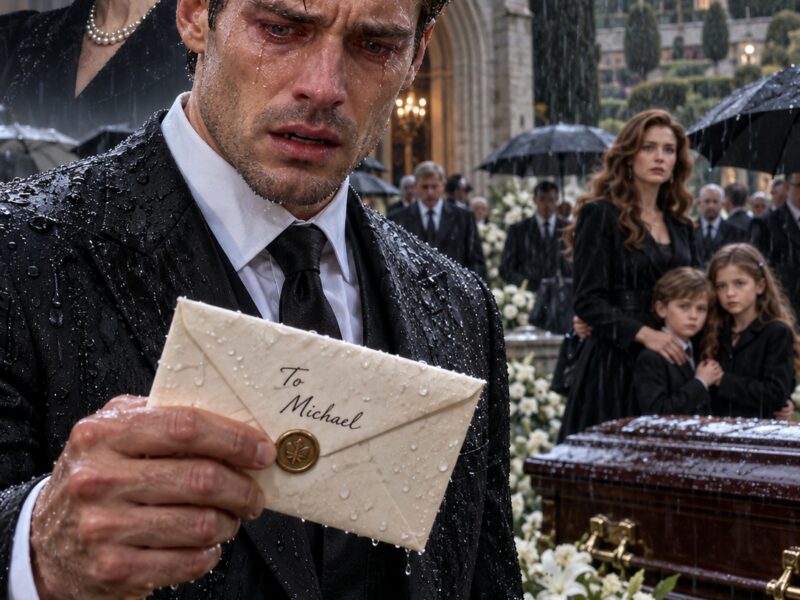
AT HIS MOTHER’S FUNERAL, THE BILLIONAIRE SAW HIS EX-WIFE HOLDING TWO CHILDREN—THEN THE BOY LOOKED UP WITH HIS EYES
The first time Christopher Harrington called Michael “Dad,” Michael was standing in the doorway of a bedroom that had been empty for nearly thirty years.
He didn’t answer.
He couldn’t.
The word was too small for what it did to him.
It crossed eight missing birthdays, eight Christmas mornings, eight first days of school, eight years of scraped knees and bedtime stories and questions no child should have had to ask.
Then it landed inside him like an accusation.
Dad.
Michael gripped the brass doorknob until his knuckles went white.
Behind Christopher, his twin sister Cecilia was already asleep beneath a pale blue blanket, one hand curled beneath her cheek. A picture she had drawn that afternoon lay on the nightstand.
Four stick figures stood beneath an enormous yellow sun.
A woman.
A boy.
A girl.
And a tall man wearing what looked suspiciously like a black business suit.
Michael had stared at that drawing for almost a full minute before Christopher spoke.
“You can turn off the light, Dad.”
Dad.
Again.
Michael swallowed.
“Good night, buddy.”
He switched off the lamp.
Then he walked into the hallway of the Harrington mansion, closed the door softly behind him, and leaned against the wall because suddenly his legs would not hold him.
Thirty-five years old.
CEO of Harrington Industries.
A man who could walk into a Manhattan boardroom and move hundreds of millions of dollars with three sentences.
And one eight-year-old boy had just reduced him to tears with a single word.
But Christopher didn’t know the cruelest part.
Michael hadn’t abandoned him.
He hadn’t even known Christopher existed.
And the woman responsible for those stolen eight years had been buried less than a month earlier.
His mother.
Cecilia Harrington.
The woman whose name his daughter carried.
The woman Michael had spent most of his life believing loved him more fiercely than anyone else in the world.
The woman whose handwriting he had found inside a purple velvet journal in the attic.
I’ve taken steps to ensure this union won’t last.
Michael had read that sentence six times.
Then another.
And another.
Payments.
Threats.
Lawyers.
Letters that never reached him.
A pregnancy concealed from him.
A marriage deliberately dismantled while he and Rebecca blamed each other.
And then the final insult.
A will that threatened to take Harrington Industries away from him unless, within one year, he could prove he had built a “stable family life.”
Even dead, Cecilia Harrington was still arranging her son’s future.
The difference was that Michael finally knew what she had done to his past.
And now he had to decide whether the woman who destroyed his family was somehow forcing him to rebuild it.
It had begun in the rain.
Three weeks earlier, Michael had stood beside his mother’s grave beneath a black umbrella while white lilies trembled against the polished mahogany of her coffin.
He remembered the sound more than anything else.
Rain against umbrellas.
Wind moving through old oak branches.
The low murmur of expensive shoes sinking into wet grass.
The priest speaking words Michael barely heard.
People said funerals brought closure.
Michael thought that was something people said when they had no idea what else to say.
There was no closure in watching the only parent you had left disappear into the earth.
Only arithmetic.
Three months since their last real conversation.
Seventeen missed calls from her during his Tokyo trip, most answered by assistants.
One canceled Sunday dinner because of an emergency acquisition.
A dozen promises that he would visit “when things calmed down.”
Things never calmed down.
People just died.
Michael stood near the old willow tree beside the family chapel, surrounded by politicians, investors, society families and executives who had known Cecilia Harrington as a philanthropist, widow and formidable keeper of one of New York’s oldest fortunes.
He knew another Cecilia.
The woman who had raised him after his father died.
The woman who had taught him that Harringtons did not panic publicly.
That grief belonged behind closed doors.
That reputation could take generations to build and an afternoon to destroy.
That love, although she never said it this way, sometimes meant deciding what was best for another person before they had the chance to decide for themselves.
Michael had spent years resisting that last lesson.
He had never understood how deeply she believed it.
Not until the funeral.
The priest finished.
A handful of soil struck the coffin.
Michael lowered his head.
Then, through a shifting line of black umbrellas, he saw a woman standing at the edge of the cemetery.
Chestnut hair.
Black coat.
Hands clasped tightly in front of her.
For one irrational second, Michael thought grief had invented her.
Then she lifted her face.
Rebecca.
His ex-wife.
The woman he had once married in Las Vegas with forty dollars in his wallet and champagne from a hotel minibar.
The woman he had once believed he would grow old beside.
The woman he had not seen in almost nine years.
Michael stopped breathing.
Rebecca saw him looking.
Something changed in her expression.
Fear.
Not guilt.
Not surprise.
Fear.
She took half a step backward.
That was when Michael noticed the children.
A boy stood on her right.
A girl on her left.
Seven or eight years old.
Twins.
The girl was holding Rebecca’s hand.
The boy was staring directly at Michael.
Michael’s body reacted before his mind did.
His stomach tightened.
His heartbeat changed.
The cemetery disappeared.
The mourners disappeared.
Even Rebecca seemed to disappear.
There were only the boy’s eyes.
Hazel.
Gold around the pupils.
A strange green ring at the edges.
Michael had seen those eyes every morning of his life.
In the mirror.
“No,” he whispered.
The boy tilted his head.
Rebecca tightened her grip on his hand.
Michael started walking.
“Michael.”
Someone touched his shoulder.
He didn’t stop.
Wet grass darkened his shoes as he crossed between the graves.
Rebecca’s face grew paler with every step.
By the time he reached her, she looked as though she had spent years rehearsing this moment and had forgotten every word.
“Rebecca.”
“I’m sorry about your mother.”
Michael stared at her.
“What are you doing here?”
“I came to pay my respects.”
“To my mother?”
Rebecca looked toward the grave.
“Yes.”
Michael almost laughed.
His mother had despised Rebecca.
Cecilia had called their marriage reckless, embarrassing and beneath him.
She had treated Rebecca’s middle-class upbringing like a contagious disease.
So why would Rebecca travel to the Harrington estate after nearly nine years to bury a woman who had never wanted her in the family?
Then the little girl moved closer to Rebecca.
Michael looked down.
The girl’s face was softer than the boy’s.
Brown eyes.
Chestnut hair.
But something about the shape of her mouth reminded Michael painfully of his father.
His voice came out lower.
“Who are they?”
Rebecca closed her eyes for half a second.
That half second told him everything.
“Rebecca.”
“Michael…”
“Who are they?”
The boy looked between them.
“Mom?”
Rebecca crouched.
“It’s okay, sweetheart.”
Michael felt cold despite the summer humidity.
He heard himself ask the question.
“Are they mine?”
Rebecca stood slowly.
Rain collected along her eyelashes.
“I wanted to tell you.”
Michael didn’t move.
“That wasn’t my question.”
Her chin trembled.
“Yes.”
The word nearly knocked him backward.
He stared at the children.
“How old?”
“Eight.”
Michael did the calculation automatically.
The divorce.
Rebecca leaving.
His mother’s insistence that he stop humiliating himself by trying to contact her.
Eight years.
“Eight?”
Rebecca nodded.
Michael looked at the boy again.
Then the girl.
“Twins?”
“Yes.”
His voice cracked.
“Names?”
Rebecca looked down at them.
“This is Christopher.”
The boy gave a cautious little wave.
“And this is Cecilia.”
Michael’s face changed.
Rebecca saw it.
“I know.”
“You named her after my mother?”
“Yes.”
Michael turned toward the grave.
For several seconds he said nothing.
His mother lay beneath flowers twenty yards away.
His daughter carried her name.
His daughter.
The phrase felt impossible.
Michael turned back.
“Did she know?”
Rebecca’s silence returned.
And suddenly the funeral became something else entirely.
Not an ending.
A crime scene.
“Rebecca.”
“We shouldn’t do this here.”
“Did my mother know I had children?”
Christopher moved closer to his sister.
Rebecca noticed.
“Not in front of them.”
Michael followed her eyes and immediately hated himself.
He crouched so he was closer to the children’s height.
Neither child moved.
“Hi.”
Christopher studied him.
“Hi.”
Michael had negotiated with hostile governments with less anxiety.
“I’m Michael.”
The boy nodded.
“I know.”
Michael blinked.
“You do?”
Christopher looked at his mother before answering.
“You’re the man from the magazines.”
Something inside Michael broke a little more.
Not my father.
The man from the magazines.
Rebecca touched Christopher’s shoulder.
“Mrs. Carter is over by the chapel. Why don’t you and Cecilia go with her for a few minutes?”
The children hesitated.
Cecilia whispered something into her brother’s ear.
Then they walked toward Evelyn Carter, Cecilia Harrington’s oldest friend.
Michael waited until they were out of earshot.
Then he turned.
“Tell me.”
Rebecca folded her arms tightly across her body.
“I found out I was pregnant after we separated.”
“You had my number.”
“I called.”
“I never got a call.”
“I wrote.”
“I never got a letter.”
“I came here once.”
Michael froze.
Rebecca’s eyes filled.
“Your mother met me before I reached the house.”
Rain drummed against the umbrella between them.
“What did she say?”
“That you didn’t want to see me.”
Michael’s jaw tightened.
“She lied.”
“I know that now.”
“What else?”
Rebecca looked toward the grave.
“She knew I was pregnant.”
The world seemed to tilt.
Michael’s umbrella slipped slightly in his hand.
“She knew?”
“Yes.”
“How?”
“I told her.”
“And she never told me.”
Rebecca said nothing.
Michael took a step away.
His mother.
The woman he had just buried.
The woman he had spent three sleepless nights blaming himself for neglecting.
Had known.
“How long?”
“All of it.”
He turned sharply.
“What does that mean?”
Rebecca wiped rain from her cheek, though Michael wasn’t sure it was rain.
“She knew when they were born.”
Michael stared at her.
“She knew they were twins?”
“Yes.”
“And she said nothing to me?”
Rebecca whispered, “No.”
Michael looked toward the coffin.
Something ugly moved beneath his grief.
He had arrived at the cemetery wishing he had one more conversation with his mother.
Now he wanted one for an entirely different reason.
“What did she do to you?”
Rebecca hesitated.
“Michael—”
“What did she do?”
“She offered me money.”
His face hardened.
“How much?”
“I never accepted it.”
“How much?”
“Enough to disappear.”
Michael laughed once.
There was no humor in it.
“Of course.”
“She said if I came near you again, she’d use the Harrington attorneys to challenge my fitness as a mother.”
Michael’s expression went blank.
Rebecca continued before courage abandoned her.
“She said you had moved on. That you regretted marrying me. That you considered the pregnancy a trap.”
“I never knew about the pregnancy.”
“I know.”
“No.” He stepped closer. “Rebecca, I need you to understand this. I never knew.”
“I believe you now.”
“Now?”
Her eyes flashed.
“What was I supposed to believe then? I was twenty-six, pregnant, alone, and the most powerful woman I’d ever met was standing in front of me telling me her son wanted nothing to do with me.”
“You knew me.”
“I thought I did.”
That landed.
Michael looked away.
Rebecca’s voice softened.
“And you thought you knew me.”
He did.
He remembered his mother’s voice after Rebecca vanished.
She made her choice, Michael.
He remembered calling Rebecca until the number was disconnected.
He remembered letters returned unopened.
He remembered Cecilia sitting across from him in the library.
Stop chasing someone who doesn’t want your life.
And eventually, exhausted and humiliated, Michael had believed her.
He had turned heartbreak into work.
Work into expansion.
Expansion into an empire.
Tokyo.
London.
Los Angeles.
Dubai.
Every city another place not to think about Rebecca.
He had become exactly the man Cecilia Harrington wanted him to become.
And apparently, that had been the point.
Michael looked at Rebecca.
“Why today?”
She glanced toward the grave.
“Your mother contacted me six months ago.”
Michael went still.
“What?”
“She knew she was sick before you did.”
His mouth opened.
“She asked about the twins. She wanted photographs.”
“You sent them?”
“Eventually.”
“Why?”
“Because whatever she did to me, she was still their grandmother.”
Michael stared at the grave again.
“And she asked you to come?”
“No.”
“Then why are you here?”
Rebecca looked at Cecilia, standing beside Christopher beneath Evelyn’s umbrella.
“Because I didn’t want our children to grow up knowing I had hidden their grandmother’s death from them too.”
Our children.
Michael nearly flinched.
Rebecca whispered, “Someone had to stop the secrets.”
Two days later, Michael learned his mother had left one more.
Jonathan Pierce read Cecilia Harrington’s will in the mansion library beneath a chandelier Michael remembered from childhood.
Rebecca sat near the windows with Christopher and Cecilia.
Michael remained standing.
He didn’t trust himself to sit.
Jonathan worked through charitable donations, staff provisions and trusts.
Then he paused.
Michael noticed.
“What?”
Jonathan adjusted his glasses.
“There is an addendum.”
“Regarding?”
Jonathan looked at the twins.
Michael’s blood went cold.
“Jonathan.”
“Your mother amended her estate plan after learning of Christopher and Cecilia.”
Rebecca straightened.
Michael stared.
“You knew?”
Jonathan chose his words carefully.
“I knew an addendum existed.”
“That wasn’t my question.”
“I was bound by attorney-client privilege.”
Michael’s jaw flexed.
“Convenient.”
Jonathan continued.
“Subject to confirmation of paternity, your mother created trusts for both children. They will receive substantial portions of her personal assets when they turn twenty-one.”
Rebecca looked stunned.
Michael felt something stranger.
Anger.
Relief.
Disgust.
His mother had denied him his children and then remembered them in her will.
She had erased them from his life while making them heirs.
Even her guilt had been organized by lawyers.
Christopher leaned toward his sister.
“Are we in trouble?”
Michael’s head snapped toward him.
“No.”
The boy looked uncertain.
Michael crossed the room and crouched beside him.
“You didn’t do anything wrong.”
“Then why is everyone upset?”
Michael looked at Rebecca.
Because adults had lied for eight years.
Because love could become control when fear was allowed to dress itself as protection.
Because his grandmother had decided an entire family’s future without asking any of them.
Instead Michael said, “Because grown-ups sometimes make simple things complicated.”
Christopher considered this.
“That’s dumb.”
For the first time in days, Michael almost smiled.
“Yes.”
Jonathan cleared his throat.
“There is another condition.”
Michael stood.
“Of course there is.”
“The mansion and controlling shares of Harrington Industries pass to you provided that within one year you demonstrate a stable family life consistent with the continuation of the Harrington legacy.”
Michael frowned.
“Define stable.”
Jonathan looked uncomfortable.
“The document refers specifically to marriage to a suitable partner or equivalent evidence of permanent family stability.”
Silence.
Michael slowly turned toward Rebecca.
She looked horrified.
Then he laughed.
It was a cold, stunned sound.
“She did it.”
“Michael—”
“She actually did it.”
He walked toward the fireplace.
“I’m thirty-five years old. I’ve run Harrington Industries for a decade. We employ thousands of people. I oversee operations on three continents, and my dead mother is still telling me whom to marry.”
Jonathan remained calm.
“If the condition isn’t satisfied, the controlling shares revert to the Harrington family trust.”
“And the house?”
“To the foundation.”
Michael stared at him.
“Meaning the board controls the company.”
“Effectively, yes.”
“And I lose controlling authority.”
“Yes.”
Michael turned toward the windows.
Christopher and Cecilia were whispering to each other.
Rebecca stared at the floor.
And suddenly Michael understood the elegance of his mother’s trap.
She had taken his family away.
Then, after death, she had made his empire dependent on whether he could create one.
The mansion became a different place after that.
Rebecca and the twins moved temporarily into the east wing.
Michael told himself it was practical.
They needed privacy.
He needed time.
The children deserved a chance to know him without hotel rooms and scheduled visits.
But each morning he woke to sounds the mansion had not known in decades.
Running feet.
Laughter.
Arguments over cereal.
Doors closing too loudly.
Christopher discovered a hidden staircase behind the old music room.
Cecilia found Michael’s childhood piano books.
Within four days, toys appeared in hallways that had previously contained only antiques.
The house seemed offended at first.
Then it seemed alive.
Michael was less adaptable.
He knew how to acquire companies.
He did not know what cereal eight-year-olds liked.
He knew how to read quarterly projections.
He did not know whether children needed night-lights.
The first time Cecilia asked him to braid her hair because Rebecca was on a work call, he stared at the brush as if she had handed him a surgical instrument.
“You don’t know how?”
“No.”
“My mom knows.”
“Your mom knows many things I don’t.”
Cecilia considered him seriously.
“You can learn.”
Michael smiled.
“I’ve been hearing that a lot lately.”
He failed spectacularly.
Cecilia examined the crooked braid in the mirror.
“It looks weird.”
“I was afraid of that.”
She touched it.
Then she smiled.
“I like it.”
That nearly destroyed him.
Because every small thing contained a missing version of his life.
The first loose tooth.
First bicycle.
First fever.
First word.
He had missed all of it.
One evening, Michael found Rebecca on the balcony overlooking the gardens.
“Were they happy?”
She looked at him.
“The kids.”
“Yes.”
“Growing up.”
Rebecca rested her arms on the railing.
“We didn’t have this.”
She gestured toward the estate.
“But yes. Mostly.”
“Did they ask about me?”
“All the time.”
Michael stared into the darkness.
“What did you tell them?”
“That their father didn’t know where we were.”
He turned.
“You didn’t tell them I abandoned you?”
“No.”
“Why?”
“Because I wasn’t sure.”
Rebecca looked at him.
“I was angry at you, Michael. I hated you sometimes. But I never wanted my anger to become their identity.”
He swallowed.
“Thank you.”
“Don’t thank me yet.”
“What does that mean?”
“They’re going to ask harder questions.”
Michael looked through the glass doors toward the hallway where Christopher had abandoned a toy spaceship on an antique table.
“I’ll answer them.”
“All of them?”
“Yes.”
“Even if the answers make your mother look terrible?”
Michael didn’t answer immediately.
Rebecca noticed.
“There,” she said quietly.
“What?”
“That hesitation.”
“My mother just died.”
“And she hurt us while she was alive.”
“I know.”
“Do you?”
Michael faced her.
“I found out at her funeral that I have two eight-year-old children. Don’t ask me if I understand what she did.”
“Then stop protecting her.”
“I’m not protecting her.”
“You’re protecting the version of her you need to keep.”
That silenced him.
Rebecca stepped toward the door.
Michael spoke behind her.
“I loved her.”
Rebecca stopped.
“I know.”
“And I’m furious with her.”
“I know that too.”
“I don’t know how to hold both things.”
Rebecca looked back.
“You don’t have to choose.”
Then she went inside.
That sentence stayed with him.
Three days later, John Smith arrived from Manhattan.
John had served on the Harrington board for years and was one of the few executives Michael trusted.
They sat in the drawing room.
John declined whiskey.
That alone told Michael the conversation was serious.
“The board is nervous.”
“The board is always nervous.”
“This is different.”
Michael leaned back.
“Say it.”
“They know about Rebecca.”
Michael’s eyes hardened.
“How?”
“Staff talk. Lawyers talk. Society people saw her at the funeral.”
“And?”
“People are suggesting the timing is convenient.”
Michael’s expression changed.
“Convenient?”
“Ex-wife appears with secret heirs at the same time Cecilia dies and leaves a marriage condition.”
“She’s the mother of my children.”
“I know.”
“Apparently the board doesn’t.”
“They’re concerned about appearances.”
Michael stood.
“I’m beginning to hate that word.”
“Appearances move markets.”
“So do results. I’ve given them ten years of those.”
John watched him.
“Alistair Morton sees an opening.”
That got Michael’s attention.
The silver-haired board member had wanted the CEO position for years.
“If your shares revert to the trust,” John continued, “Alistair will build a coalition.”
“To remove me.”
“Yes.”
Michael walked to the window.
“So what are they expecting? That I marry Rebecca?”
John was quiet.
Michael turned.
“You’ve got to be kidding.”
“It would satisfy the clause.”
“That’s your advice?”
“No.”
John stood.
“My advice is to decide what you want before other people decide what your choices are.”
The words sounded uncomfortably familiar.
After John left, Michael remained alone.
His mother’s portrait hung above the fireplace.
Cecilia Harrington looked elegant even in oil paint.
Michael stared at her.
“You planned this.”
Silence.
“You hated my marriage.”
Silence.
“You got rid of my wife.”
Silence.
“And now you’re threatening my company unless I build a family.”
The painted woman offered no explanation.
Michael looked away.
For the first time in his life, he wondered how many of his decisions had truly belonged to him.
That question led him to the attic.
He found the trunk beneath a white sheet.
The Harrington crest had been carved into the lid.
Inside were letters, documents and several journals.
One had a purple velvet cover.
Michael recognized his mother’s handwriting immediately.
At first, the entries were harmless.
Dinners.
Travel.
His father’s illness.
Michael’s childhood.
Then Rebecca appeared.
Michael insists he loves her.
Michael’s heartbeat changed.
He continued.
He is too young to understand what this life demands.
Another page.
Rebecca is not prepared for the Harrington world.
Then:
I’ve taken steps to ensure this union won’t last.
Michael stopped.
He read it again.
His hands began shaking.
The next pages were worse.
Cecilia had contacted people around Rebecca.
She had pressured employers.
She had instructed attorneys to prepare custody arguments before the twins were even born.
She had intercepted communications.
She had manipulated Michael into believing Rebecca had abandoned him.
And Rebecca into believing Michael wanted nothing to do with her pregnancy.
Michael slammed the journal shut.
“No.”
His voice disappeared into the dusty attic.
He opened it again.
He needed it to be false.
Instead, he found dates.
Names.
Payments.
Specific conversations he remembered.
One entry had been written after the divorce.
Success. They have separated.
Michael sat on the floor.
For several minutes he couldn’t move.
His mother hadn’t merely disapproved.
She had engineered the collapse.
And Michael had helped her by trusting her.
He had been angry with Rebecca.
He had called her weak.
Cowardly.
Opportunistic.
He had spent years telling himself she had never loved him enough to stay.
Meanwhile Rebecca had been raising his children alone because his mother had convinced her that he did not want them.
Michael pressed his palms against his eyes.
Then he saw the envelope.
His name was written across it.
Michael.
He tore it open.
His mother’s final letter did not deny anything.
That hurt most.
She said she had acted from love.
She said Rebecca was not ready.
She said the Harrington name destroyed people who lacked the strength to carry it.
She admitted she had intervened.
She admitted she had gone too far.
She asked Michael to forgive her.
And near the end, she wrote something that made him sit motionless in the dust.
Prove that you can find the person strong enough to stand beside you—or prove that you can become that person yourself.
Michael read the line again.
He wanted to hate her.
It would have been easier.
But grief was crueler than hatred.
He remembered her holding his hand at his father’s funeral.
Teaching him to tie a tie.
Sitting beside him through pneumonia when he was nine.
Calling him after every major acquisition even when it was three in the morning in New York.
He remembered love.
Then he looked at the journal.
And remembered what that love had justified.
That evening Rebecca found him sitting alone in the dark study.
“What happened?”
Michael placed the journal on the desk.
She stopped.
“What is that?”
“My mother.”
Rebecca didn’t move.
“I found everything.”
Her face lost color.
“The letters?”
“Some.”
“The payments?”
“Yes.”
“The threats?”
“Yes.”
Rebecca looked away.
Michael stood.
“Why didn’t you tell me all of it?”
“Would you have believed me?”
He opened his mouth.
Nothing came out.
Rebecca gave a small, sad nod.
“Exactly.”
“I believe you now.”
“Because she’s dead.”
Michael flinched.
Rebecca immediately regretted it.
“Michael—”
“No. You’re right.”
He walked toward her.
“I need to say something, and I need you not to make it easier for me.”
Rebecca waited.
“I failed you.”
Her eyes filled.
“I didn’t know what she was doing. But I stopped looking for the truth because the lie hurt less than believing my mother might have manipulated me.”
“Michael…”
“I should have found you.”
“You tried.”
“Not hard enough.”
“We were both young.”
“I had resources.”
“You had grief.”
“I had private investigators.”
“You had a mother you trusted.”
Michael looked at her.
“That doesn’t give me eight years back.”
“No.”
“Or them.”
“No.”
His voice cracked.
“I missed everything.”
Rebecca’s tears fell.
“Yes.”
Michael lowered his head.
Then Rebecca crossed the space between them.
She did not kiss him.
She did not tell him everything would be fine.
She simply touched his hand.
For the first time, Michael understood that forgiveness and comfort were not the same thing.
The next morning he canceled three meetings.
He took Christopher and Cecilia fishing.
Christopher complained after nine minutes.
“This is boring.”
Michael smiled.
“Your grandfather used to say that patience is what you practice while nothing interesting is happening.”
“Was Grandpa good at fishing?”
“Terrible.”
Christopher grinned.
“Then why are we listening to him?”
Michael laughed.
Cecilia watched him.
“You laugh different with us.”
Michael looked at her.
“What does that mean?”
She shrugged.
“When you’re on the phone, you laugh like this.”
She produced a stiff corporate chuckle.
Christopher nearly fell over.
Michael stared at them.
Then he laughed for real.
Cecilia pointed.
“That one.”
Rebecca sat beneath a willow tree reading.
Michael glanced toward her.
She was smiling.
An hour later Christopher caught a fish.
The boy screamed.
Cecilia screamed because Christopher screamed.
Michael scrambled toward them.
The fish was barely larger than his hand.
Christopher held the rod as if he had landed a shark.
“Dad! Dad, look!”
Michael froze.
Christopher didn’t notice.
“Dad!”
This time Michael moved.
He knelt beside him.
“I see it.”
Christopher beamed.
And Michael felt eight years of absence inside one perfect second.
That night, he read bedtime stories.
Christopher chose a knight fighting a dragon.
Cecilia chose a princess traveling alone.
Michael did voices badly.
They loved them anyway.
When he finished, Cecilia reached up.
“Are you leaving tomorrow?”
Michael frowned.
“Leaving?”
“For work.”
He looked toward Rebecca in the doorway.
“I have meetings.”
Cecilia’s face fell.
“But I’ll be back before dinner.”
“You promise?”
Michael thought of every promise he had postponed with his mother.
“Yes.”
He kissed her forehead.
“I promise.”
He kept it.
Again the next day.
And the next.
Summer slowly changed the mansion.
The board noticed too.
Three months after Cecilia’s funeral, Michael walked into Harrington Tower knowing several people in the room wanted him gone.
Alistair Morton sat at the head of the table.
Genevieve Park from legal sat beside him.
John sat near Michael.
Alistair folded his hands.
“We require clarity.”
“You have a functioning CEO.”
“We have a succession problem.”
“You have a hypothetical succession problem.”
“In nine months, it becomes very real.”
Michael leaned back.
Alistair continued.
“Have you decided whether you intend to comply with the will?”
“My personal life is not a quarterly report.”
“Your personal life controls forty-one percent of this company’s voting authority.”
Michael’s eyes narrowed.
Alistair smiled slightly.
“So unfortunately, it is now our business.”
The room went silent.
Michael could feel every person waiting.
Months earlier he might have erupted.
Instead he folded his hands.
“I will satisfy the legal requirements of the will without allowing this board to dictate whom I marry.”
Alistair’s smile disappeared.
“And if you cannot?”
“Then we’ll have that conversation when the time comes.”
“You might consider stepping aside voluntarily.”
John shifted.
Michael didn’t.
“Is that a suggestion?”
“It’s risk management.”
Michael leaned forward.
“No. Risk management is what I did when I kept this company profitable through three international disruptions while you were lobbying my mother for my job.”
Several board members looked down.
Alistair’s face hardened.
Michael continued quietly.
“If you want my chair, Alistair, stop hiding behind my mother’s will and ask for it.”
Silence.
Alistair said nothing.
Michael stood.
“Until then, I remain CEO.”
He walked out.
John caught him in the corridor.
“That was either brilliant or suicidal.”
“Ask me in nine months.”
When Michael returned home, Rebecca was waiting in the foyer.
“How bad?”
“Bad enough.”
She followed him into the drawing room.
Michael poured water instead of whiskey.
Rebecca noticed.
“The board wants an answer.”
“About us?”
“About whether I’m going to satisfy the will.”
Rebecca sat.
Michael remained standing.
“They expect me to marry.”
“And?”
He looked at her.
“And I’m not proposing to you because a board of directors wants reassurance.”
Rebecca exhaled.
“Good.”
He almost looked offended.
“Good?”
“Yes.”
Michael laughed softly.
“I wasn’t expecting that.”
“What did you expect?”
“I don’t know.”
“That I’d be thrilled to become Mrs. Harrington again because it saves your stock position?”
“No.”
“Because I won’t.”
“I know.”
Rebecca stood.
“If we ever marry again, Michael, it cannot be because your mother demanded stability from her grave.”
“I agree.”
“It cannot be because Alistair wants an investor presentation.”
“I agree.”
“And it cannot be because we feel guilty about the twins.”
Michael’s expression softened.
“I agree.”
Rebecca studied him.
“Then what are we doing?”
He had no answer.
So they didn’t force one.
Autumn arrived.
Christopher became obsessed with astronomy.
Michael bought him a telescope, then deliberately returned the absurd professional model his assistant had ordered and bought a modest one they could assemble together.
It took three hours.
They put two pieces backward.
Christopher thought this was hilarious.
Cecilia began painting.
Her pictures slowly changed.
At first Michael appeared at the edge.
Then closer.
Eventually, in one painting, he stood beside Rebecca.
Michael kept that one in his desk.
Rebecca took over several of Cecilia Harrington’s unfinished charitable programs.
One afternoon Michael found her in the old foundation office surrounded by scholarship applications.
“You don’t have to do this.”
Rebecca didn’t look up.
“I know.”
“My mother wasn’t exactly kind to you.”
“No.”
“So why continue her work?”
Rebecca finally looked at him.
“Because the children receiving these scholarships didn’t blackmail me.”
Michael laughed.
Then she became serious.
“People aren’t only the worst thing they’ve done.”
Michael stopped smiling.
Rebecca returned to the applications.
“You’re allowed to hate what she did without erasing everything else she was.”
Michael looked at her for a long time.
“You said that for me.”
“No.”
She picked up another file.
“I said it because it’s true.”
Later that month they took the twins apple picking.
There were no photographers.
No board members.
No estate staff.
No black cars waiting visibly nearby.
Just four people in old boots walking between rows of trees.
Christopher tried to climb too high.
Cecilia demanded the reddest apple in the orchard.
Rebecca took pictures.
Michael carried a paper bag that eventually split open, sending apples rolling across the dirt.
The twins laughed until they could barely breathe.
Rebecca took a photograph of Michael kneeling in the mud collecting them.
“What?”
“Nothing.”
“You’re laughing.”
“I’ve never seen Michael Harrington crawling after apples.”
“You’ve seen worse.”
Rebecca’s smile faded into something softer.
“Yes.”
Michael looked at her.
“So have I.”
For a second the years between them seemed to disappear.
Not because they had been erased.
Because they were finally being acknowledged.
That night the children fell asleep early.
Michael found Rebecca near the fireplace in the private lounge.
He handed her hot cocoa.
She smiled.
“Very billionaire of you.”
“I made it myself.”
She tasted it.
“You shouldn’t have.”
He laughed.
Then silence settled.
Not uncomfortable.
Different.
Michael sat opposite her.
“I’ve been thinking about the will.”
Rebecca’s shoulders stiffened.
“Okay.”
“I don’t want to talk about the company.”
That surprised her.
“What, then?”
“You.”
Rebecca put down her mug.
Michael leaned forward.
“I spent years believing you left because you didn’t love me enough.”
“I spent years believing you knew I was pregnant and didn’t care.”
“I know.”
“And now we know both things were lies.”
“Yes.”
“That doesn’t automatically fix us.”
“I know.”
Michael looked toward the fire.
“I think that’s what I’ve been getting wrong.”
Rebecca waited.
“I’ve spent my whole life solving things. Companies. Contracts. Problems. I thought once we found the truth, everything after it would become obvious.”
“And it didn’t.”
“No.”
He smiled sadly.
“It got harder.”
Rebecca nodded.
“Truth does that sometimes.”
Michael looked at her.
“I still love you.”
Rebecca’s eyes immediately filled.
He didn’t move closer.
He didn’t use the confession as leverage.
“I don’t know whether it’s the same love I had at twenty-six. I don’t think it should be. That love was reckless. We thought wanting each other was enough.”
Rebecca wiped a tear.
“It wasn’t.”
“No.”
Michael continued.
“But when I see you with Christopher and Cecilia… when I see what you built without me… when I think about what you survived…”
His voice roughened.
“I don’t want to marry you to save Harrington Industries.”
Rebecca said nothing.
“I want the chance to find out whether we can become people who would choose each other again even if there were no company.”
A tear slipped down her cheek.
“Michael…”
“If the answer is no, I will accept it.”
“You could lose the company.”
“I could.”
“The house.”
“Yes.”
“Everything your family built.”
Michael looked around the room.
Portraits.
Mahogany.
Silver.
Generations of accumulated proof that the Harrington name had survived.
Then he looked upstairs, toward the rooms where his children slept.
“No.”
Rebecca frowned.
“I could lose assets.”
He reached across the space between them.
“I already know what losing everything feels like.”
She looked at his hand.
Then placed hers in it.
“I never stopped loving you,” she whispered.
Michael closed his eyes briefly.
“But,” she added.
He opened them.
“Love isn’t enough this time.”
“No.”
“We need trust.”
“Yes.”
“And time.”
Michael smiled faintly.
“Apparently we have nine months.”
Rebecca laughed through her tears.
“That’s the least romantic thing you’ve ever said.”
“I once proposed to you beside a Las Vegas vending machine.”
“It was an ice machine.”
“See? Growth.”
She laughed again.
Michael squeezed her hand.
“One day at a time?”
Rebecca studied him.
“One day at a time.”
There was no proposal that night.
No dramatic kiss.
No announcement.
Michael did not call Jonathan.
Rebecca did not move into his bedroom.
Nothing was solved.
And perhaps that was why it mattered.
For once, Michael Harrington allowed something important to remain unfinished.
Winter came early that year.
The first snow covered the Harrington estate in white.
One Saturday morning Michael woke to pounding on his bedroom door.
“Dad!”
He sat up.
Christopher burst inside.
“It’s snowing.”
Michael looked at the clock.
6:12 a.m.
“I’ve been informed.”
“We’re going outside.”
“That sounds less like a question.”
Cecilia appeared behind her brother wearing pajamas and one boot.
“Mom says we have to wait.”
“Your mother is wise.”
Christopher stared at him.
“You’re boring.”
Twenty minutes later Michael was outside.
Rebecca stood on the terrace holding coffee.
The twins attacked him with snowballs.
Michael retaliated.
Badly.
At one point Christopher tackled him into a snowbank.
Cecilia screamed with laughter.
Rebecca took another photograph.
Michael lay on his back staring at the gray winter sky.
For years he had imagined success as height.
Higher floors.
Higher revenue.
Higher valuations.
More countries.
More influence.
But lying in the snow while his son dumped freezing powder down his collar, Michael understood something his mother never had.
Legacy wasn’t height.
It was presence.
Being there.
For the ordinary morning.
For the bedtime story.
For the bad braid.
For the tiny fish.
For the snowball.
For the conversation you would rather postpone.
His mother had spent her life protecting the Harrington future.
And in doing so, she had nearly destroyed it.
Rebecca walked toward him.
“You alive?”
“Debatable.”
She offered her hand.
Michael took it.
Christopher and Cecilia ran toward the frozen pond.
“Not on the ice!” Rebecca shouted.
“We know!”
Michael stood beside her.
Their shoulders touched.
Neither moved away.
“What happens when the year ends?” Rebecca asked.
Michael watched the children.
“I don’t know.”
“Does that scare you?”
“Yes.”
She looked at him.
He smiled.
“But not as much as it used to.”
That evening Michael went alone to the cemetery.
Snow covered his mother’s grave.
He brushed it away from the stone.
CECILIA HARRINGTON.
Beloved wife.
Mother.
Philanthropist.
There were so many things gravestones didn’t say.
Manipulator.
Protector.
Architect of wounds.
Woman terrified of losing control.
Mother who loved her son so fiercely she confused love with ownership.
Michael stood there for a long time.
“I found your journal.”
The cemetery remained silent.
“I know what you did.”
Wind moved through the bare branches.
“I don’t forgive all of it.”
His throat tightened.
“Maybe I never will.”
He placed one white lily against the stone.
“But I understand you were afraid.”
Michael looked toward the mansion visible faintly beyond the trees.
“You thought strength meant controlling what could hurt the people you loved.”
He breathed slowly.
“You were wrong.”
His eyes burned.
“So was I.”
He thought of Rebecca.
Christopher.
Cecilia.
The board.
The approaching deadline.
The possibility that he might still lose control of Harrington Industries.
For once, that possibility did not feel like the end of the world.
“I don’t know if Rebecca and I will marry again.”
Saying it aloud felt important.
“I don’t know if I’ll keep the company.”
Another breath.
“But I’m done letting fear make my decisions.”
Michael touched the cold stone.
“I loved you, Mom.”
His voice broke.
“I still do.”
That was the hardest truth.
Not that Cecilia had betrayed him.
Not that Rebecca had suffered.
Not even that eight years had been stolen.
The hardest truth was that love did not disappear simply because someone had done something unforgivable.
Sometimes love stayed.
Changed shape.
Lost its innocence.
Learned boundaries.
Carried grief beside anger.
And perhaps adulthood was accepting that two opposite truths could occupy the same heart without canceling each other.
Michael turned away from the grave.
Halfway toward the path, he saw three figures waiting near the cemetery gate.
Rebecca.
Christopher.
Cecilia.
Christopher waved.
Cecilia held something against her coat.
Michael walked toward them.
“What are you doing here?”
Rebecca smiled.
“They wanted to find you.”
Cecilia stepped forward.
“I made something.”
She handed him a folded sheet of paper.
Michael opened it.
Another drawing.
Four people stood in front of the Harrington mansion.
But this time the mansion was smaller.
The people were larger.
Michael looked at Cecilia.
“Who’s this?”
She pointed.
“Mom.”
Then Christopher.
“Chris.”
Then herself.
“And that’s me.”
Michael pointed at the fourth figure.
“And him?”
Cecilia rolled her eyes.
“You.”
“Oh.”
“You’re Dad.”
The certainty in her voice hurt beautifully.
Michael looked at Rebecca.
She was crying.
He looked back at the drawing.
Above the four figures, Cecilia had written one word in uneven purple letters.
HOME.
Not Harrington.
Not legacy.
Not empire.
Home.
Michael folded the drawing carefully.
Christopher grabbed one of his hands.
Cecilia took the other.
Rebecca walked beside them.
No one mentioned the will.
No one mentioned marriage.
No one mentioned the board waiting in Manhattan for an answer.
There would be lawyers.
Deadlines.
Arguments.
Probably more wounds.
Michael and Rebecca still had years of pain between them and no guarantee that love would be enough to cross it.
But as they walked through the snow toward the mansion, Michael realized his mother’s final condition had already become irrelevant in the one way that mattered.
She had demanded that he prove he could build a stable family.
Michael no longer wanted to prove anything to her.
Or the board.
Or the Harrington name.
For the first time in his life, he was building something without asking whether it protected the legacy.
He was building it because Christopher laughed when he was happy.
Because Cecilia trusted him with terrible braids.
Because Rebecca still reached for his hand even after everything.
Because a house full of priceless paintings had been empty until two children started leaving toys on the stairs.
At the edge of the lawn, Christopher suddenly pulled free.
“Race you home!”
He ran.
Cecilia chased him.
Michael called after them to slow down.
Neither listened.
Rebecca laughed beside him.
Michael watched his children disappear toward the glowing windows of the mansion.
Eight years.
He could never recover them.
That was another truth he had finally stopped trying to negotiate.
There would always be birthdays he hadn’t seen.
Christmas mornings he could not recreate.
Questions Rebecca had answered alone.
Nights when Christopher or Cecilia had needed a father and Michael had been somewhere across an ocean believing his wife had abandoned him.
Some losses could not be repaired.
Only honored by refusing to waste what remained.
Rebecca slipped her hand into his.
Michael looked down at it.
Then at her.
“You know,” she said softly, “your mother would probably hate the muddy boots in the foyer.”
Michael smiled.
“Good.”
Rebecca laughed.
They continued walking.
Behind them, beneath the snow, Cecilia Harrington rested among generations of people who had believed the family name was the most important thing they could leave behind.
Ahead of them, Christopher opened the mansion door and yelled for his father.
Cecilia’s laughter spilled through the doorway.
Warm light stretched across the snow.
Michael tightened his fingers around Rebecca’s hand.
Then he walked toward his children.
Not as the billionaire heir to Harrington Industries.
Not as the son Cecilia Harrington had spent her life trying to shape.
Not as the husband Rebecca had once lost.
Just as a man who had finally understood that a legacy was not something you protected by controlling the people you loved.
It was something you built by showing up for them.
And for the first time in eight years, when his children called for their father—
Michael Harrington was there.









