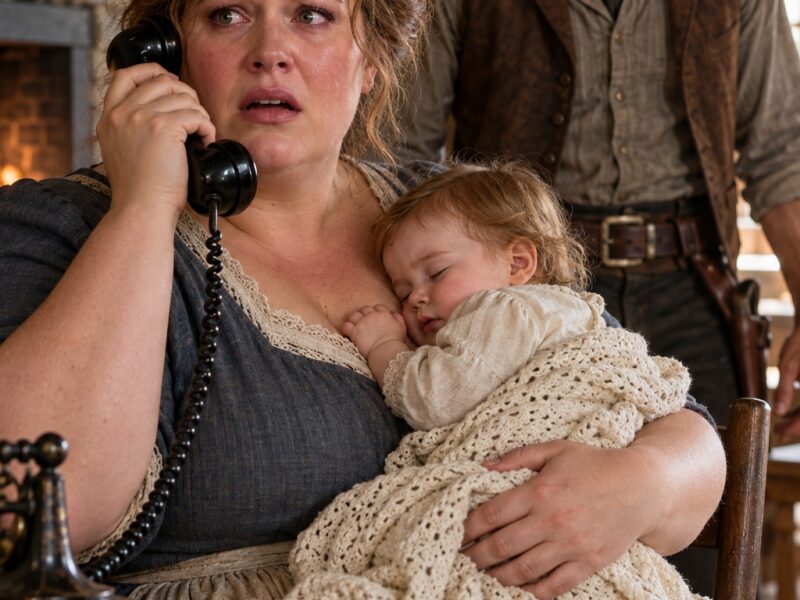
“CAN YOU NURSE HER JUST ONCE?” THE COWBOY BEGGED — THE WIDOW EVERYONE MOCKED SAVED HIS BABY, THEN UNCOVERED THE TERRIBLE REASON SHE HAD BEEN LEFT TO DIE
The cowboy fell to his knees in the marketplace, holding a baby so weak she could barely cry.
“Please,” he begged. “She hasn’t eaten properly in three days. Somebody help my little girl.”
Twenty people watched him. Not one stepped forward.
Then an elderly woman pointed toward me.
“Ask Norah. She lost her baby last month. Perhaps she still has milk.”
Someone laughed.
“That enormous widow?” a young woman said. “She couldn’t even keep her own child alive.”
I might have walked away if the baby hadn’t opened her mouth just then.
It was such a small movement. Her lips trembled, but no sound came out. Her father looked down at her with an expression I knew too well—the look of someone begging a body to keep living when there was nothing left he knew how to do.
I had worn that expression myself.
My name is Norah Whitcomb. I was thirty-two years old, widowed, and living in a rented attic room above Mrs. Henderson’s boarding house in a small Wyoming town.
My husband, Samuel, had died the previous winter after a fever settled in his lungs. He had been a patient man, a carpenter who whistled while he worked and left little curls of pine shavings in the pockets of every coat he owned.
I still found them sometimes.
Our daughter had come into the world seven months after his burial.
She never took a breath.
I had named her Rose before she was born, after the climbing roses Samuel promised to plant beside our kitchen door. When the midwife wrapped her in a small white blanket, I asked to hold her once more before they took her away.
Nobody told me how difficult it would be to surrender a child whose face I had barely learned.
Nobody warned me that my body would go on preparing to mother her.
Milk came in days afterward. It soaked through my nightdress, stained the sheets, and left my breasts painfully full. Each morning I woke expecting to hear a baby, and each morning the silence reminded me that Rose was buried beneath a little wooden cross beyond the churchyard fence.
The women in town had opinions about everything.
They had opinions about my broad shoulders, my heavy hips, the amount of bread I ate, and how little effort I supposedly made to become presentable again.
Mrs. Henderson once told me that a woman my size should be grateful anyone had married her at all.
After Rose died, her remarks became crueler.
“Some women simply aren’t made for motherhood,” she said one evening while I washed the boarding house supper dishes.
I was too tired to answer.
I had begun to believe her.
Until the morning Thomas Hayes rode into town carrying his daughter.
He was a rancher from the western side of Cottonwood Creek, a tall man with dark hair, sunburned hands, and a face that had grown gaunt from sleeplessness. I had seen him only twice before, both times at church with his pretty young wife.
Her name had been Eleanor.
She died shortly after giving birth.
Their daughter, Grace, had survived, but the woman Thomas had hired to feed her became ill and left the ranch. Thomas tried obtaining milk from neighboring farms and following the feeding instructions available to him. Grace struggled to take it, grew weaker, and began refusing nearly everything.
By the time he reached the marketplace, he had already ridden through the night looking for help.
I knew none of that when I saw him.
I saw only the child.
Her little face was drawn and pale. One hand lay against her father’s shirt, the fingers barely curled. Her lips looked dry, and there was a frightening stillness in the way she rested against him.
Thomas walked from one woman to another, offering money he clearly could not afford to lose.
Most lowered their eyes.
One said her own baby needed every drop she had.
Another claimed she had stopped nursing months earlier.
A third told him to take Grace to a physician, although the nearest doctor who regularly visited our town was away attending a patient in the mountains.
Then Martha Bell, who sold eggs and vegetables outside the general store, saw me standing beside the flour sacks.
“Norah might be able to help,” she said.
The laughter followed almost immediately.
Elsie Parker, a young woman employed at the boarding house, looked me up and down.
“Good heavens. Surely you aren’t suggesting her.”
Her friend covered her mouth, smiling.
“Perhaps she’ll have better luck keeping this one alive.”
I felt the words settle somewhere beneath my ribs.
There were things I could bear being called. Fat. Plain. Unfortunate. I had heard them often enough that they no longer surprised me.
But hearing a stranger turn my daughter’s death into entertainment was something else.
For one moment, I considered leaving.
Then Grace moved her mouth again.
I remembered holding Rose against my chest, waiting for a cry that never came.
I stepped forward.
“Mr. Hayes?”
He turned.
“I may still be able to feed her,” I said. “But we need somewhere private.”
He stared at me, as though afraid he had misunderstood.
“Can you nurse her?” he whispered. “Just once?”
I nodded.
The cowboy began to cry.
He tried to stop himself. I could see him swallow and straighten his shoulders, attempting to recover whatever dignity the marketplace had taken from him.
But Grace shifted weakly in his arms, and he broke.
“Thank you,” he said. “Oh, thank you, ma’am.”
I led him through the side entrance of the boarding house and up the narrow stairs to my attic room.
Mrs. Henderson was not there. I was grateful for that.
The room contained a narrow bed, a washstand, an old rocking chair, and a little wooden chest holding the clothes I had sewn for Rose.
I closed the curtains.
Thomas stood facing the window while I settled into the rocking chair with his daughter.
Grace felt terribly light.
I loosened the blanket around her and studied her face. Her breathing was shallow, and she seemed too exhausted even to turn her head.
“Has she been making wet diapers?” I asked.
Thomas hesitated.
“Not much since yesterday.”
My stomach tightened.
She needed a doctor. Feeding her would not make every danger disappear.
“Mr. Hayes, please have someone find the physician as soon as possible. She is very weak.”
“I will.”
He moved toward the door, but stopped when I spoke again.
“You may stay. Just turn around a moment.”
He obeyed.
I brought Grace close and tried to guide her gently.
At first, she did nothing.
Panic rose in my throat.
“Come along, little sweetheart,” I whispered. “There’s something here for you.”
I stroked her cheek.
Her mouth opened.
Then, after several hesitant movements, she latched.
I felt the faint pull and nearly forgot to breathe.
A moment later, she swallowed.
I had imagined hearing my daughter feed so many times that the real sound seemed impossible.
It was quiet, almost nothing.
Yet it filled the room.
Thomas turned halfway around.
“Is she—?”
“She is,” I whispered.
He sat down heavily on the edge of the bed.
For several minutes, he watched the floor while tears dropped from his chin onto his hands.
I kept Grace close, stopping when she needed rest and offering her the breast again only when she seemed ready. I knew she was still desperately ill, but she was swallowing.
She was trying.
And for the first time since Rose died, the milk that had felt like a punishment was giving comfort to a living child.
When Grace finally released her hold, her father approached the chair.
“May I?”
I placed her carefully in his arms.
He looked down at her face, brushed one finger over her forehead, and let out a shaky breath.
“Hello, sweetheart,” he murmured. “There you are.”
I watched him hold her.
Something inside me hurt.
Something else began, very quietly, to heal.
Thomas sent a rider for the doctor and stayed at the boarding house until the physician arrived that evening. The doctor examined Grace, treated her dehydration, and instructed us to continue frequent, careful feeding while watching for signs that she needed further medical attention.
Grace remained frighteningly fragile through the night.
I slept in the rocking chair beside her.
Thomas slept on the floor with his back against the bed, waking at every little sound.
Near dawn, Grace cried.
It was not a strong cry, but it was unmistakable.
Thomas woke so suddenly that he struck his head against the bedframe.
I laughed.
The sound surprised both of us.
He rubbed his head, staring at his daughter.
“She’s hungry?”
I nodded.
“That’s what she’s telling us.”
He smiled for the first time.
It changed his face.
Three days later, when the doctor was satisfied that Grace was improving, Thomas asked whether I would come to his ranch.
“She needs you,” he said. “And I can’t leave her alone to work.”
I hesitated.
He looked down at his hands.
“I can pay you. Not much at first. But I’ll make it right.”
“It isn’t the money.”
“Then what is it?”
I thought about Mrs. Henderson, the boarding house girls, the gossip that would follow an unmarried woman living under a widower’s roof.
Thomas seemed to understand.
“There are two bedrooms downstairs,” he said. “You’d have your own room. And nobody will tell you how to live while you’re helping my daughter.”
I looked at Grace sleeping in the basket beside us.
“Then I’ll come.”
The Hayes ranch stood five miles beyond Cottonwood Creek, where the grassland rose toward a line of distant blue mountains.
Thomas’s house had once been beautiful.
There was a broad front porch, a stone fireplace, and a row of cottonwoods lining the creek. Someone had planted lavender beneath the front windows, although weeds had nearly swallowed it.
Inside, the rooms smelled of cold ashes, dust, and neglected cooking.
A sewing basket sat beside the hearth. A half-finished baby quilt lay over the arm of a chair, its tiny blue squares carefully stitched together.
I did not touch it.
Thomas carried Grace to the bedroom and laid her in the cradle.
Then he stood beside it as if he had forgotten where he was supposed to go next.
“Eleanor kept everything in order,” he said quietly.
I looked toward the kitchen, where unwashed pans were stacked beside the stove.
“She must have worked very hard.”
“She did.”
He seemed grateful I had not called the house a disgrace.
I began with the kitchen.
The next morning, I washed the dishes, opened the windows, and baked bread. I found flour in a covered barrel and beans in a pantry jar. There were two chickens left in the coop and enough potatoes in the cellar to make meals for several weeks.
Thomas had not been eating properly.
I suspected he had been too frightened to leave Grace long enough to cook.
That evening, I placed a bowl of stew before him.
He looked at it as if it were a strange object.
“You made supper?”
“Someone had to.”
“I’ve been living on biscuits.”
“I noticed.”
He took a spoonful.
Then another.
After a while, he said, “Eleanor used to put thyme in hers.”
I put down my spoon.
“Would you like me to?”
He shook his head.
“No. Yours is good the way it is.”
It was the first time he had spoken of Eleanor without looking as though the words might undo him.
We found a rhythm.
I cared for Grace, cooked, cleaned, mended the curtains, and helped Thomas repair the chicken coop when the baby’s naps allowed it.
He worked the land, tended the cattle, and brought in firewood.
At night, we sat near the fireplace.
Sometimes we talked about ordinary things—the weather, the rising price of feed, the stubborn mule that refused to cross shallow water.
Other nights, we talked about the people we had lost.
Thomas told me Eleanor had loved music and had always wanted to see the ocean. He had promised to take her someday, although neither of them knew how they would afford the journey.
I told him Samuel used to save the prettiest scraps of wood from his work because he believed he could eventually find a use for everything.
“He made Rose’s cradle,” I said one evening.
Thomas looked at me.
“Did she ever sleep in it?”
I shook my head.
For a long while, neither of us spoke.
Then he said, “I’m sorry, Norah.”
He did not tell me Rose was in a better place.
He did not explain that everything happened for a reason.
He simply sat beside me and let the grief exist.
I liked him for that.
Grace gained strength week by week.
Her cheeks filled out. Her cry grew louder. She learned to grip my finger, and eventually she began smiling when I leaned over her cradle.
The first time she laughed, Thomas came running from the barn because he thought something was wrong.
I was sitting on the rug, making silly faces while Grace kicked beneath her blanket.
Thomas stopped in the doorway.
“What happened?”
“She laughed.”
He stared.
Then Grace laughed again.
He dropped to his knees beside us, his work clothes covered in dust, and began making the most ridiculous faces I had ever seen.
By the time the baby was finished laughing, I was laughing too.
I had almost forgotten what an ordinary happy afternoon felt like.
But happiness in a small town rarely remained private.
People began talking.
Some said Thomas had hired me out of charity.
Others claimed I had used his desperation to work my way into his home.
Mrs. Henderson told anyone willing to listen that I had abandoned my obligations at the boarding house.
One Sunday, after church, I heard a woman whisper that Grace was beginning to resemble me.
Her companion snorted.
“Poor child.”
I kept walking.
Thomas caught up with me outside.
“You heard that?”
“Yes.”
“Why didn’t you say something?”
I adjusted Grace’s blanket.
“Because if I answered every unkind thing said about me, I’d never have time to do anything else.”
He looked at me for a long moment.
Then he took the basket from my arm.
“You shouldn’t have to get used to it.”
I had no answer.
That evening, he asked whether I had ever thought about marrying again.
We were sitting on the porch while Grace slept inside.
The sunset had turned the creek gold.
“I suppose I stopped thinking about it,” I said.
“Why?”
I watched a moth circle the porch lantern.
“After Samuel died, I thought I’d had my share of being loved. After Rose, I wasn’t sure I had much left to offer anyone.”
Thomas leaned forward, resting his elbows on his knees.
“That isn’t how it looks from where I sit.”
My hands grew still.
He did not elaborate.
Instead, he reached across the space between our chairs and rested his hand lightly over mine.
I let it stay.
For the first time in months, I imagined a future without immediately feeling guilty.
I wondered what it would be like to remain in that house after Grace no longer needed feeding.
I wondered whether Thomas might someday look at me and see something besides gratitude.
And then I went back to the boarding house for my Bible.
I should have gone in through the front door.
Instead, I used the kitchen entrance, as I always had when I lived there.
Voices reached me before I crossed the threshold.
Mrs. Henderson was speaking.
“We’ll go tomorrow. That woman has stayed at the Hayes ranch long enough.”
Another voice answered.
It belonged to Mrs. Lydia Mercer, the preacher’s wife.
“People are beginning to talk about marriage. Reverend Mercer says the situation must be addressed.”
A younger woman giggled.
“Imagine Thomas Hayes marrying Norah Whitcomb.”
Mrs. Henderson made an irritated sound.
“Thomas is grieving. He doesn’t understand what he’s doing.”
“And Norah?” Mrs. Mercer asked.
“We’ll remind her what happened to her own baby. She’ll leave once she’s ashamed enough.”
I stood motionless beside the kitchen wall.
Elsie laughed.
“She’s always been terribly sensitive about that.”
Then Mrs. Henderson said something I could not forget.
“And make certain nobody mentions what happened before Thomas reached the marketplace.”
A chair scraped across the floor.
Mrs. Mercer’s voice became sharp.
“Must we discuss that here?”
“I’m merely saying we cannot afford another mistake.”
“What happened?” Elsie asked.
“Nothing that concerns you,” Mrs. Henderson snapped.
I stepped backward.
My Bible could wait.
I walked out before anyone discovered me, feeling the cold air strike my face.
During the ride home, I remembered the marketplace.
I remembered women turning their backs before Thomas even reached them.
I remembered Mrs. Mercer standing near the general store, watching without expression.
And I remembered that no one had seemed particularly surprised when Thomas appeared with a dying child.
That night, after Grace had fallen asleep, I asked him about the days before he brought her to town.
He was sitting at the kitchen table, repairing a broken harness strap.
“What do you mean?”
“Did you ask anyone for help before that morning?”
“Of course.”
“Who?”
He set down the leather.
“Mrs. Henderson, for one.”
My stomach tightened.
“What did she say?”
“She said there wasn’t a woman nearby who could nurse Grace. Told me the church ladies had already asked around.”
I stared at him.
“Did you tell her how sick Grace was?”
“Yes.”
“When?”
“Three days before I rode into town.”
The room seemed colder.
“Three days?”
He nodded.
“She said she’d arrange for someone to bring a feeding woman out from Riverton. Then the next day, she sent word that the woman couldn’t come.”
I gripped the edge of the table.
“Thomas, I lived under Mrs. Henderson’s roof. She knew I still had milk.”
He looked up.
For several seconds, neither of us spoke.
Then he said quietly, “Why would she lie to me?”
I wanted to believe there was an innocent explanation.
But I remembered the kitchen.
I remembered the laughter.
And I remembered Mrs. Henderson warning everyone to remain silent.
“I don’t know,” I answered.
The following morning, I arranged three things in a little tin box.
The first was the receipt for the boarding house debt Thomas had paid when I moved out. Mrs. Henderson had demanded two months of unpaid rent, although I had spent nearly every evening cleaning and cooking to reduce what I owed.
The second was Grace’s tiny headcloth from the marketplace. I had washed it and kept it because it reminded me how close we had come to losing her.
The third was a list of every person I remembered watching Thomas beg.
I had written their names carefully.
Not to threaten them.
I wanted to look at those names without allowing myself to pretend that their silence had been harmless.
At ten o’clock, Mrs. Henderson’s carriage appeared.
She arrived with Mrs. Mercer and three young women from the boarding house.
Thomas was in the barn repairing a gate.
I stood beside the porch table as they approached.
“Norah,” Mrs. Henderson announced, “this disgrace ends today. Pack your belongings.”
I looked at her.
“Good morning to you, too.”
Her lips tightened.
“An unmarried woman living with a widower is improper.”
“I’m employed to care for his child.”
“Don’t pretend you don’t understand what people are saying.”
Elsie glanced toward the house.
“Surely you haven’t imagined he’ll marry you.”
I felt the old familiar heat rise in my face.
But this time, I did not retreat.
“If you’re concerned about Grace,” I said, “perhaps we should discuss what happened when her father came looking for help.”
Mrs. Henderson’s expression changed.
I slid the tin box toward her.
“Open it.”
She lifted the lid and studied the contents.
When she saw the list, she went very still.
“What’s this supposed to mean?”
“Those are the people who watched Thomas beg for his daughter’s life.”
Mrs. Mercer moved closer.
“Norah, that is a very uncharitable thing to write down.”
I looked at her.
“Then imagine how uncharitable it was to stand there.”
Thomas emerged from the barn.
“Is there a problem?”
Mrs. Henderson closed the box.
“This woman is making accusations.”
Thomas stepped onto the porch.
“What accusations?”
I answered before she could.
“I’d like to know why you were told nobody could feed Grace when Mrs. Henderson knew I could.”
Silence fell.
Mrs. Mercer’s hands tightened around her purse.
Mrs. Henderson gave a brittle laugh.
“I had no reason to believe you were capable.”
“You asked me to wash your bedding that very morning,” I said. “You knew exactly what my condition was.”
She looked away.
Thomas took another step.
“You told me you’d found a wet nurse in Riverton.”
“I said I would inquire.”
“You told me she was coming.”
Mrs. Henderson’s face hardened.
“We did what we could. It is unfortunate you didn’t arrange better care for your own child.”
I watched Thomas absorb the insult.
He did not raise his voice.
“Leave my property.”
Mrs. Mercer lifted her chin.
“Thomas, the church—”
“The church is welcome when it comes to pray for my daughter,” he said. “Not when it comes to insult the woman who kept her alive.”
Nobody spoke.
Mrs. Henderson placed the tin box on the table and turned toward the carriage.
The others followed her.
Only Elsie hesitated.
She glanced at me.
For one second, I thought she meant to say something.
Then Mrs. Henderson called her name, and she hurried away.
Thomas stood beside me until the carriage disappeared.
“I’m sorry,” he said.
“For what?”
“For not knowing.”
I looked toward Grace’s bedroom window.
“There are things we both still don’t know.”
That afternoon, a boy from the telegraph and telephone office arrived at the ranch with a message.
Mrs. Henderson wanted me to call her.
The Hayes ranch had a telephone line installed years earlier to help Thomas coordinate livestock shipments. It seldom rang, and I disliked using it.
But curiosity had begun to outweigh fear.
I lifted the receiver and asked the operator to connect me.
Mrs. Henderson answered almost immediately.
“What exactly are you trying to accomplish with that box?” she demanded.
“Nothing but the truth.”
“You foolish woman. Do you want the entire town knowing what happened?”
My heart began beating harder.
“What happened?”
A long silence followed.
Then her voice returned, lower this time.
“You don’t understand. If Thomas discovers the whole truth about that morning, everything will come apart.”
I gripped the receiver.
“What truth?”
Her next words were barely audible.
“His daughter wasn’t supposed to reach that marketplace alive.”
I felt the floor move beneath me.
Behind me, a chair scraped.
I turned.
Thomas stood in the kitchen doorway.
His face had gone white.
From the receiver came Mrs. Henderson’s terrified whisper.
“Norah? Please tell me Thomas didn’t hear that.”
But he had.
Every word.
Thomas took the receiver from my hand.
For a moment, he could not speak.
Then, very quietly, he said, “What did you do to my daughter?”
The line went dead.
He stared at the telephone.
I had seen him exhausted, frightened, grieving, and angry.
I had never seen him look that way.
He set down the receiver with extraordinary care.
Then he went to Grace’s room.
I followed him.
He stood beside the cradle and looked at her for a long time.
Grace slept with one fist beside her cheek.
Thomas reached down and touched her tiny fingers.
“They knew,” he whispered.
I did not answer.
“They knew she was dying. And they let me ride around begging.”
His shoulders rose and fell.
Then he turned toward me.
“I want to know why.”
“So do I.”
He went to his desk and pulled open the bottom drawer.
Inside lay a bundle of papers tied with a faded blue ribbon.
“Eleanor’s family has been trying to buy the creek property since before we married,” he said.
I watched him untie the ribbon.
“Her brother, Charles Mercer, manages the grain business in town. He’s Lydia Mercer’s brother, too. He and Eleanor inherited neighboring parcels from their father.”
He spread a deed across the desk.
“The spring that feeds Cottonwood Creek rises on Eleanor’s land. Her father put restrictions on its ownership when he divided the property.”
I bent over the paper.
Thomas pointed to a paragraph.
“If Eleanor died without surviving children, the spring parcel was to pass to Charles, subject to the life interest Eleanor had held. If she had a child, that child’s interest took priority.”
“Grace,” I whispered.
He nodded.
“The land belonged to Eleanor under her father’s arrangement. Grace inherited her interest.”
I looked toward the bedroom.
“The spring supplies your ranch.”
“And several others downstream.”
Thomas sat down heavily.
“Charles has wanted control of that water for years.”
I studied the document.
A thought formed that frightened me.
“If Grace died—”
“Charles would argue the property reverted to him under the deed.”
The room seemed suddenly too small.
Thomas looked at the papers spread before him.
“Last month, Charles offered to buy my livestock and the house. Said I couldn’t run a ranch while caring for an infant.”
“Did you refuse?”
“I told him to get off my land.”
He rubbed his forehead.
“I thought he was simply trying to take advantage of a widower.”
I looked again at the deed.
For the first time, Mrs. Henderson’s words had a shape.
But suspicion was not proof.
And we both understood what it meant to accuse respected people of deliberately allowing a baby to die.
Thomas rose.
“I’m going to Charles Mercer.”
I caught his sleeve.
“Not alone.”
“Norah—”
“If he did what we suspect, he’ll have an explanation prepared. And if he didn’t, we need to know that before we destroy a man’s name.”
Thomas looked down at my hand.
His breathing slowed.
Finally, he nodded.
“What do you suggest?”
“We start with the woman who told you the wet nurse was coming.”
“Mrs. Henderson won’t confess.”
“Perhaps not. But somebody else knows something.”
I thought about Elsie on the porch.
Her frightened glance.
The way she had lingered before leaving.
“I know where to begin.”
The next morning, I returned to the boarding house.
Elsie was hanging laundry behind the building when I arrived.
She saw me and immediately looked toward the kitchen windows.
“You shouldn’t be here.”
“I need to talk to you.”
“Mrs. Henderson said I’m not to speak with you.”
“That makes two of us she’s trying to keep quiet.”
Elsie pulled a damp sheet from the basket.
For a while, she said nothing.
Then she whispered, “I didn’t mean what I said about your baby.”
I had not expected an apology.
It hurt more than I thought it would.
“You said it anyway.”
Her eyes filled.
“I know.”
I stood beside the clothesline, looking at the familiar rows of white sheets.
“What happened before Thomas reached the marketplace?”
Elsie’s hands stopped moving.
“I can’t.”
“Elsie, Grace almost died.”
She looked away.
“I was told she was already going to die.”
My blood turned cold.
“Who told you?”
Elsie began folding the sheet with shaking hands.
“Mrs. Mercer.”
I waited.
“She said the doctor had little hope, that Mr. Hayes was being unreasonable. She said we were not to encourage his desperate ideas.”
“What ideas?”
“Finding another woman to nurse the child.”
I stared at her.
Elsie swallowed.
“There was a letter. From Mr. Hayes.”
“What letter?”
“He sent it to Mrs. Henderson asking whether you could help. He said he’d heard you lost a baby and might still be able to feed Grace.”
For a moment, I could not move.
Thomas had asked for me.
Before the marketplace.
Before the humiliating laughter.
Before his daughter had become too weak to cry.
“What happened to the letter?”
Elsie started crying.
“Mrs. Henderson burned it.”
I steadied myself against the fence post.
“Did she tell Thomas?”
“No. She sent word that you were too ill and that another woman would come.”
I remembered Thomas telling me about the supposed wet nurse from Riverton.
“Was there ever another woman?”
Elsie shook her head.
“No.”
The laundry stirred in the wind between us.
I asked the question I was most afraid to hear answered.
“Why?”
Elsie looked toward the boarding house.
“Mr. Mercer was there the night the letter came.”
Charles Mercer.
Eleanor’s brother.
Grace’s uncle.
“What did he say?”
“I couldn’t hear everything. I was carrying coal to the kitchen. But Mrs. Henderson said Grace was innocent, and Mr. Mercer told her that unfortunate things happened to weak infants every winter.”
I felt sick.
“He said that?”
Elsie nodded.
“Then Mrs. Mercer told her brother that sometimes people had to think about the welfare of the whole community.”
I looked at the young woman before me.
She was barely nineteen.
She had laughed at my grief because the people who paid her wages had taught her that cruelty was a way to belong.
Now she was trembling.
“Why didn’t you tell anyone?”
“Because I thought the baby really was dying, and because Mrs. Henderson said she’d dismiss me without a reference.”
She pressed the sheet against her chest.
“My mother depends on the money I send home.”
I understood being trapped by poverty.
I also understood that a baby had nearly paid for Elsie’s silence.
“Will you tell Thomas what you told me?”
Her face crumpled.
“I’ll lose my job.”
“Perhaps.”
She looked at me helplessly.
I did not promise everything would be easy.
Instead, I said, “The truth won’t become easier to live with if Grace dies before anyone hears it.”
Elsie lowered her head.
After a long silence, she nodded.
That afternoon, she came to the ranch.
She sat at Thomas’s kitchen table and repeated everything.
Thomas listened without interrupting.
When Elsie finished, he stood and walked outside.
Through the window, I watched him grip the fence rail.
For a moment, I feared he would tear it apart with his bare hands.
Instead, he stood there until his breathing steadied.
Then he came back inside.
“Thank you for telling us,” he said to Elsie.
She began crying again.
He looked at me.
“We need someone who understands the law.”
The county seat was nearly forty miles away.
Thomas knew an attorney there, a widowed woman named Margaret Vale who had helped settle his father’s estate years earlier.
The next morning, we rode to see her.
I left Grace with Martha Bell, who came willingly when I explained that we needed someone trustworthy.
Margaret listened carefully while Thomas described the deed and Elsie recounted the missing letter.
She did not appear impressed by Mercer’s standing in town.
She read the deed twice.
Then she asked to see Eleanor’s father’s original probate records.
“This provision could place a great deal of money and control in Charles Mercer’s hands,” she said. “But motive isn’t the same as evidence.”
Thomas leaned forward.
“Isn’t it enough that he was there when they lied to me?”
“It may establish a reason to investigate. It does not establish that he ordered anyone to harm your child.”
She folded her hands on the desk.
“What I want to know is who carried the false messages, who was paid, and whether anyone made preparations to claim the property before Grace was actually dead.”
The last words struck Thomas visibly.
Margaret noticed.
Her expression softened.
“I know this is difficult.”
He nodded.
She continued.
“If there is a criminal conspiracy, we need the county authorities. And if there are records, we need to preserve them before anyone knows what we’re looking for.”
Over the next week, the things we discovered changed the way I saw our town.
The first was a telegram sent from Charles Mercer’s grain office three days before the marketplace incident.
It had been addressed to a land surveyor in Casper.
The message requested an urgent valuation of the Cottonwood spring parcel.
The second was a draft legal notice prepared for Mercer, asserting that Eleanor Hayes’s estate had no surviving heir.
The draft was dated the day before Thomas brought Grace to town.
Grace had been alive.
Sick, but alive.
I saw Thomas read the date.
His jaw tightened.
“They were already preparing for her death.”
Margaret took the paper gently from his hands.
“It appears someone expected it.”
The third piece of evidence came from an unexpected person.
Martha Bell arrived at the ranch late one afternoon, carrying a folded scrap of paper in her apron pocket.
“I should’ve brought this sooner,” she told me.
She seemed ashamed.
I made her tea before asking what it was.
“A note I found outside the general store the morning Thomas came to town.”
She unfolded it.
The paper was stained and creased.
A few lines were written in Mrs. Henderson’s familiar handwriting.
No nursing woman is to be sent. The arrangement remains as discussed. C.M. will handle the rest.
Martha had picked it up because she recognized the handwriting and assumed it was something Mrs. Henderson had dropped.
“Why did you keep it?” I asked.
“Because I saw Mr. Mercer coming out of the back office before dawn. And when Thomas arrived carrying that baby, I remembered the note.”
She stared into her cup.
“I didn’t know what it meant then. I told myself there must be some reasonable explanation.”
Her voice shook.
“By the time I realized there might not be, I was frightened.”
I reached across the table.
Martha covered my hand with hers.
“You were the only one who walked toward that child,” she whispered.
I thought about the marketplace again.
“No,” I said. “You pointed Thomas toward me.”
She began to cry.
It was a small distinction.
But it mattered.
Margaret took the evidence to the county prosecutor.
An investigation began quietly.
The boarding house accounts were examined. The telegraph records were preserved. The stableman who had carried Thomas’s messages was questioned.
One evening, he came to the ranch accompanied by a deputy.
His name was Daniel Price, and he had worked for the Henderson boarding house for nearly twelve years.
He held his hat in both hands.
“I was told not to bring Mr. Hayes’s second message to the house,” he said.
Thomas looked at him.
“Who told you?”
“Mr. Mercer.”
“Why did you obey?”
Daniel swallowed.
“He said arrangements were already being made. I believed him.”
Thomas looked toward Grace, who was playing on a blanket beside my chair.
Daniel followed his gaze.
His face changed.
“I didn’t know,” he whispered. “I swear I didn’t know.”
Thomas stood.
For one frightening moment, neither man moved.
Then Thomas walked over to Grace, lifted her into his arms, and turned away.
“Tell the deputy everything,” he said.
Daniel did.
The investigation eventually uncovered a payment made from Mercer’s business account to Mrs. Henderson, described as compensation for arranging private nursing services.
No nurse had ever been hired.
There was also a letter from Mrs. Mercer to her brother, urging him to settle the spring property quickly before Thomas found “unsuitable influences” among the townspeople.
Margaret showed us the documents one rainy afternoon.
“The prosecutor intends to question them formally,” she said.
Thomas sat across from her.
“Will they go to prison?”
“I can’t promise an outcome. Their statements, the records, and the intent behind those actions will have to be examined in court.”
He looked disappointed.
I understood.
We wanted the law to do something large enough to match what had nearly happened.
But no punishment could give Thomas back the nights he spent believing he had failed his daughter.
No verdict could erase the sight of Grace’s pale little face.
The next morning, Mrs. Henderson arrived at the ranch alone.
I was washing Grace’s blankets when I saw her carriage.
For a moment, the sight of her brought back every humiliation I had endured beneath her roof.
She stood near the porch steps without approaching.
“May I speak with you?”
I set down the wash basket.
“About what?”
Her face looked older.
“Mr. Mercer has been questioned.”
“I know.”
“People are saying terrible things.”
I waited.
She twisted the handle of her purse.
“I never meant for that child to die.”
The words struck me so hard that I had to grip the porch rail.
“Then why did you refuse to help her?”
Mrs. Henderson looked toward the road.
“Charles said Thomas would eventually be forced to sell. He said the water property belonged with the Mercer holdings and that the ranch was failing anyway.”
“That has nothing to do with feeding a baby.”
“He said Grace was too weak. That she wasn’t likely to survive even with help.”
I thought of the child laughing in her cradle.
“And you believed him?”
She began crying.
“I wanted to.”
It was the first truthful thing I had ever heard her say.
“He promised money for the boarding house repairs,” she continued. “He said no one would blame us. The baby was already so sick.”
I stared at her.
“You had a chance to save a child, and you chose to be paid for doing nothing.”
She tried to speak.
I stopped her.
“You knew I was upstairs. You knew I had milk. You listened to me cry for my daughter at night.”
Mrs. Henderson lowered her head.
“You don’t understand the pressure I was under.”
I felt an anger rise in me that was unlike anything I had known.
It was not hot or wild.
It was painfully clear.
“I understand exactly what you did.”
She looked up.
“I came to ask if you might speak kindly of me when the time comes.”
I studied the woman who had once told me I was not meant to be a mother.
I remembered how small I had felt beneath her roof.
How grateful I had tried to be for every little kindness.
How often I had swallowed humiliation because I had nowhere else to go.
“No,” I said.
Her mouth fell open.
“I won’t lie for you.”
“Norah—”
“You will have the opportunity to explain yourself. Tell them what you told me.”
She stared at me, then turned toward her carriage.
I watched her leave.
My hands were shaking.
Thomas had been standing just inside the doorway.
He came out and stood beside me.
“Are you all right?”
I looked at the empty road.
“I think so.”
He rested his hand against my back.
“You didn’t owe her anything.”
I nodded.
And for the first time, I believed it.
The hearing took place several weeks later.
Our little town had never seen anything quite like it.
Charles Mercer had supplied grain to half the county. His sister was married to the preacher. Mrs. Henderson had housed traveling businessmen, teachers, and church visitors for nearly twenty years.
Their names had once been enough to silence almost anyone.
Now those names were spoken in a courtroom beside records of false payments and messages withheld from a desperate father.
The prosecutor did not argue that every person who stood in the marketplace had intended Grace’s death.
He focused on the people who had deliberately prevented Thomas from reaching help while preparing to profit from the child’s expected death.
Elsie testified.
She was frightened, and her voice trembled, but she described the burned letter and the conversations she had overheard.
Martha testified about the note.
Daniel Price testified about the messages.
And Thomas testified about the three days he spent believing no woman could help his daughter.
When asked why he had ridden to the marketplace, he looked directly toward the defendants.
“Because my baby was dying,” he said. “And I couldn’t stand at home waiting for someone who wasn’t coming.”
I sat behind him with Grace sleeping in my arms.
Mrs. Henderson avoided my eyes.
Charles Mercer’s attorney questioned whether Thomas had misunderstood the messages and suggested that everyone’s actions had been influenced by an infant’s poor condition.
Margaret had warned us to expect that argument.
What the defense could not easily explain was the legal notice declaring Grace dead while she was still alive.
Nor could it explain the payment to Mrs. Henderson for nursing services that had never existed.
The case did not end in a single dramatic afternoon.
There were more hearings, testimony, and arguments.
Eventually, Charles Mercer was convicted on charges arising from the fraudulent attempt to obtain the property and his role in the conspiracy to obstruct assistance to Grace. Mrs. Henderson admitted her participation under a plea agreement, and Mrs. Mercer was held accountable for her part in the scheme.
The court preserved Grace’s rightful interest in the spring parcel, and an independent trustee was appointed to protect it until she was old enough to manage her inheritance.
No one could promise us that every wrong had been punished.
But the documents were public now.
The truth could no longer be quietly folded away and locked inside a boarding house drawer.
The marketplace changed after that.
Not all at once.
People still whispered.
Some said the Mercer family had been treated unfairly. Others claimed Mrs. Henderson had merely made poor decisions under pressure.
But a few women who had stood silent when Thomas begged began coming to the ranch.
One brought a basket of eggs.
Another brought fabric for Grace’s clothes.
A third came with tears in her eyes and admitted she had been ashamed of the way she’d treated me.
I accepted their apologies when I believed they were sincere.
I did not pretend the hurt had never happened.
And I did not allow their regret to become another duty I was expected to carry.
One afternoon, Elsie appeared at our door with a small suitcase.
Mrs. Henderson’s boarding house had closed during the legal proceedings, and Elsie had lost her employment.
She looked thinner than before.
“I heard you might need help with the spring cleaning,” she said.
I studied her.
“Do you know how to scrub a kitchen floor?”
A small smile appeared.
“Better than anyone.”
I let her inside.
She worked for us for several weeks while she arranged a position at a respectable inn in the county seat.
We did not become close friends.
But I watched her learn to speak without mocking someone else first, and I hoped that would serve her well.
Spring arrived late that year.
The snow melted along Cottonwood Creek, revealing the first green shoots beneath the cottonwoods.
Grace learned to sit without help.
Her favorite occupation became pulling at Thomas’s beard whenever he leaned too close.
He pretended to be terribly offended.
She laughed every time.
One evening, after supper, Thomas found me sitting beside the fireplace with Rose’s little wooden chest open on my lap.
Inside were her blanket, a pair of knitted socks, and the tiny cap I had sewn before she was born.
Thomas sat beside me.
“I didn’t know you kept those here.”
“I brought them from the boarding house.”
I folded the cap between my hands.
“Sometimes I feel guilty.”
“For what?”
“For loving Grace.”
He turned toward me.
I swallowed.
“Rose never got to be held the way I hold her. She never got to laugh or learn anything. Sometimes I’m so happy with Grace that I suddenly remember my daughter, and it feels as though I’ve left her behind.”
Thomas was quiet for a while.
Then he said, “I think about Eleanor when you laugh.”
I looked at him.
He smiled sadly.
“She used to laugh at things other people barely noticed. Sometimes I hear you laughing with Grace and remember her. At first, I felt guilty for being happy in the same house.”
He reached for my hand.
“But I don’t think love works the way we fear it does.”
I looked down at Rose’s cap.
“What do you mean?”
“I don’t think loving someone new takes anything away from the people we’ve lost.”
My throat tightened.
He held my hand a little more firmly.
“I think Eleanor would be grateful to you.”
I closed my eyes.
“And I think Samuel would be glad you found us,” he added.
For a long time, we sat together in silence.
Then Thomas stood.
“Come outside a moment.”
I followed him onto the porch.
The air smelled of wet earth and budding grass.
Beyond the fence, the creek shone beneath the last light of evening.
Thomas turned toward me.
“Norah, I have something to ask you.”
His voice sounded different.
I looked up.
“I know we both loved other people,” he said. “And I know there are parts of our lives that will always belong to them.”
He reached into his coat pocket.
My heart began pounding.
“But I would like to spend the rest of mine with you.”
He brought out a small gold ring.
It was simple and worn smooth along one edge.
“It belonged to my mother,” he said. “I had it cleaned.”
He looked almost frightened.
“I don’t need you because you can cook or keep the house or feed Grace. Those things mattered, especially when we were lost. But they aren’t why I’m asking.”
I could not speak.
Thomas took my hand.
“I’m asking because when something happens, good or bad, you’re the person I want to tell. Because this house feels empty when you’re gone. Because I love you, Norah.”
Tears blurred his face.
He smiled nervously.
“Would you marry me?”
I thought of Samuel.
Of Rose.
Of the lonely attic room.
Of the market where strangers had laughed while a baby struggled to live.
And of the man standing before me, asking not out of desperation but because he wanted me beside him.
“Yes,” I whispered.
Then, louder, “Yes, Thomas. I will.”
He slipped the ring onto my finger.
It was a little tight across my knuckle, and we both laughed as he worked it gently into place.
Then he kissed me.
It was not the kind of kiss young girls dream about in romantic stories.
It was better.
It belonged to two people who knew exactly how much the world could take from them and had chosen, in spite of everything, to begin again.
We married in June.
It was a small ceremony beneath the cottonwoods, with Martha Bell standing beside me and Grace wearing a pale yellow dress.
Thomas’s old friend from the neighboring ranch witnessed our vows.
I wore a blue dress I had sewn myself.
It fit me properly.
For once, I did not try to make myself look smaller.
After the ceremony, we carried Grace to the little hillside where Rose was buried.
Thomas had made a new fence around her grave.
He placed fresh flowers beside the wooden cross.
I stood there with my hand in his.
“This is Rose,” I whispered to Grace.
The baby reached toward a flower.
I let her touch one soft petal.
Thomas bowed his head.
I did not ask the Lord why one daughter had died and another survived.
I knew those questions would remain with me.
But I could stand beside Rose’s grave without believing that her short life had been a failure.
She had been my daughter.
That was enough to make her precious.
Years passed.
Grace grew into a lively girl with her mother’s dark eyes and her father’s stubborn chin. She learned to ride a pony before she could write her name neatly, and she insisted on helping me bake bread even when half the flour ended up on the floor.
Thomas never stopped teasing me about the day I had ordered him to turn around in my little attic room.
“You sounded like a schoolteacher,” he would say.
“And you looked like a boy who’d broken a window.”
Grace loved hearing the story of how we met.
But as she grew older, she wanted to know the difficult parts too.
One evening, when she was ten, she asked why the people in town had refused to help her.
We were sitting at the kitchen table, shelling peas into a blue bowl.
Thomas looked at me.
I answered carefully.
“Some people were frightened. Some didn’t understand how badly you needed help. And a few people made terrible choices because they wanted something that didn’t belong to them.”
Grace frowned.
“Were they bad people?”
I thought about Mrs. Henderson, Elsie, Martha, and the marketplace full of silent faces.
“People can do bad things for different reasons,” I said. “But those reasons don’t excuse what they do.”
Grace considered this.
“Why did you help me?”
I smiled.
“Because you needed someone.”
She leaned against my arm.
“But you didn’t know me.”
“No.”
“Then why?”
I looked at Thomas across the table.
He smiled.
I brushed a loose strand of hair from Grace’s forehead.
“Because you didn’t have to belong to me to deserve help.”
She seemed satisfied with that.
A few years later, Grace found Rose’s tiny cap in the wooden chest.
She brought it to me, holding it as gently as though it might break.
“Was this my sister’s?”
I nodded.
“Her name was Rose.”
Grace studied the small stitches.
“Would she have liked me?”
I felt tears prick my eyes.
“I think she would have loved you.”
Grace sat beside me and rested her head against my shoulder.
“Then I wish I’d met her.”
“So do I, sweetheart.”
We stayed there together until Thomas came home.
I never stopped missing Samuel.
I never stopped wishing Rose had lived.
Grief did not disappear because I married again or because another child called me Mama.
It lived alongside the ordinary happiness of our days, growing quieter in some seasons and sharper in others.
But the old shame was gone.
I no longer believed my daughter’s death had been a judgment against my body, my appearance, or my worth.
And whenever I remembered the marketplace, I remembered something different from what I had expected.
I remembered Thomas kneeling in the dirt.
I remembered Grace’s little mouth moving without a sound.
I remembered the laughter.
But most clearly, I remembered walking toward them.
At the time, I thought I was carrying nothing but grief.
I had been wrong.
Years later, Grace asked me whether I’d ever regretted stepping forward that morning.
I looked at my husband sitting beneath the porch lantern, his hair beginning to turn silver, and at the daughter who had grown strong enough to argue with him about nearly everything.
Then I thought of a baby buried beneath a little wooden cross.
“No,” I told her. “Not for a single day.”
Because that morning I had not replaced the child I lost.
I had answered the cry of a child who was still here.
And in doing so, I had discovered that my life, which I believed was finished, still had room for love.









