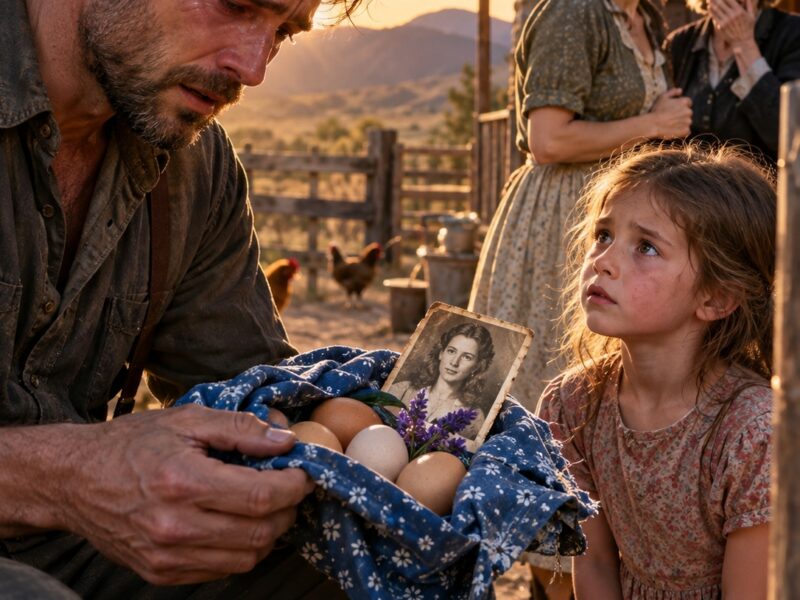
Every Morning, Someone Left Eggs at the Lonely Rancher’s Gate—On the Sixth Day, He Followed the Little Girl and Discovered Why
On the sixth morning, Ransom Calder loaded his rifle before sunrise and hid behind the barn.
Not because he expected trouble.
Because someone had been coming onto his land while he slept.
And whoever it was knew exactly how to avoid him.
For six mornings, something had been waiting on the bottom rail of his ranch gate.
Eggs.
Not money.
Not a warning.
Not a note.
Eggs.
The first morning, there had been three brown ones wrapped carefully inside a square of calico cloth and tied with string.
Ransom had stood in the cold gray light staring at them for nearly a minute.
The high desert stretched empty in both directions.
No wagon.
No rider.
No footprints he could make sense of.
Only sagebrush, pale dirt, fence posts disappearing toward the horizon, and a hawk circling high above the eastern ridge.
He had looked at the eggs again.
Then toward the road.
“Hell of a strange way to trespass,” he muttered.
Ransom was not a suspicious man by nature.
He was simply a man who had learned that most mysteries became less interesting once daylight reached them.
A stray calf belonged somewhere.
A broken fence had a cause.
A missing tool usually turned up beneath the wrong pile of hay.
And eggs left at a ranch gate probably belonged to some passing family who had mistaken one property for another.
So he carried them inside.
He fried all three in a black iron skillet, sprinkled them with salt and pepper, and ate them standing at the kitchen counter.
They were the freshest eggs he had tasted in months.
That should have been the end of it.
The next morning there were four.
Smaller this time.
Wrapped in faded blue cloth covered with tiny white stars.
Ransom stopped.
He touched the fabric.
Something about it bothered him.
Not because it was threatening.
Because it was familiar.
He could not remember why.
He walked the fence line for half a mile.
Checked behind the cottonwoods.
Climbed down into the dry arroyo where someone could have hidden from the house.
Nothing.
The third morning, Ransom decided he would catch whoever was doing it.
He opened the gate before dawn and waited behind the barn.
For two hours.
He watched darkness become charcoal, charcoal become silver, and silver turn slowly gold across the desert.
No one came.
Finally, irritated with himself for wasting half a morning on eggs, he went inside for coffee.
Twenty minutes later, he stepped back onto the porch.
Two eggs sat on the gate.
Wrapped in clean cloth.
Ransom stared at them from fifty yards away.
Then he looked toward the barn where he had been hiding.
“That’s not funny.”
There was nobody there to hear him.
On the fourth morning, six eggs appeared inside a small tin pail.
A wild sunflower lay across the top.
Its yellow petals were still wet with dew.
That changed something.
Ransom stood beside the gate in his nightshirt, holding the flower between two fingers.
For the first time since the strange deliveries began, he smiled.
He hadn’t meant to.
The smile simply happened.
And that disturbed him more than the eggs.
Because Ransom Calder had spent the last two years constructing a life in which very little happened unexpectedly.
He woke before dawn.
He fed livestock.
He repaired fences.
He counted cattle.
He ate.
He worked.
He slept.
And somewhere between those things, he tried not to remember Helen.
His wife had been dead for two winters.
A fever had taken her quickly enough that Ransom still sometimes dreamed he could have saved her if he had ridden faster.
In the dreams, he always reached the doctor.
In the dreams, Helen always lived.
Then he woke in the same oversized bed, in the same silent house, with one side of the mattress untouched.
So Ransom had stopped expecting life to surprise him kindly.
Loss surprised you.
Death surprised you.
Bad weather surprised you.
Bank notices surprised you.
Kindness usually announced its price.
Yet here was a sunflower on his gate.
And Ransom had no idea what it wanted from him.
By the sixth morning, curiosity had defeated dignity.
He was behind the corral post before first light.
This time, he waited without moving.
Then he saw her.
At first she looked like part of the landscape.
A small figure coming through the pale morning with a tin bucket swinging beside one knee.
She couldn’t have been more than six.
Seven at most.
Her dress was clean but patched at one elbow. Her boots were too large and slapped softly against the hard earth as she walked.
Freckles covered her nose as if somebody had flicked brown paint across her face.
She approached Ransom’s gate with extraordinary seriousness.
Then she knelt.
From the bucket she removed a piece of cloth.
Blue.
Tiny white stars.
Ransom’s chest tightened with that same strange flicker of recognition.
The girl unfolded the fabric carefully.
Three eggs.
She placed them on the gate rail one by one.
Then she added a small purple flower.
Apparently satisfied, she folded her hands behind her back, inspected her work, and turned around.
Ransom stepped from behind the post.
“Morning.”
The girl froze.
Not like a child caught stealing.
Like a tiny outlaw who had always known this day would come.
She slowly turned.
Ransom kept both hands visible.
The rifle remained leaning against the barn behind him.
“You’ve been leaving those eggs?”
She studied him.
“Yes, sir.”
“Every morning?”
“Yes, sir.”
“Why?”
The girl frowned as though he had asked a question with an embarrassingly obvious answer.
“Because you might be hungry.”
Ransom blinked.
“Who told you that?”
“Grandma.”
“Your grandma knows me?”
Another pause.
“I don’t think so.”
Now Ransom was thoroughly confused.
“Then how does she know I’m hungry?”
“She didn’t say you were hungry.”
“But you just said—”
“She said we should bring eggs.”
The girl pointed toward the gate.
“I figured if somebody needs eggs, it’s because they might be hungry.”
Ransom pressed his lips together.
There was an internal logic to this that he suspected he would not defeat.
“And the flower?”
“I added that.”
“Why?”
“The eggs looked lonely.”
Ransom looked at the three eggs.
Then at the purple flower.
He had no answer.
“What’s your name?”
“Hattie Hayes.”
“Where do you live, Hattie Hayes?”
She pointed northwest.
“That way.”
There was almost nothing northwest except rocky ground and the abandoned Tilman claim.
Ransom knew because he had bought his ranch three years earlier and studied every survey map the bank possessed.
The old Tilman place had been empty for years.
Half the cabin roof was gone.
The well had dried or clogged.
The fence had collapsed.
Nobody with sense would live there.
Ransom looked at Hattie.
“How far?”
“Not far if you don’t complain.”
Before he could answer, she picked up her empty bucket and began walking.
“Hattie.”
She stopped.
“Does your mother know you’ve been coming here every morning?”
Hattie looked suddenly less confident.
That was answer enough.
Ransom glanced toward his barn.
There were cattle to check.
A section of southern fence needed repair before the afternoon wind came up.
The sensible thing was to take the eggs inside and forget the entire matter.
Then he remembered the sunflower.
He remembered smiling at an empty gate.
And he followed the little girl northwest.
The trail wasn’t really a trail.
It was the faded scar of wagon wheels half erased by wind and time.
Hattie walked quickly.
Every few minutes she glanced back, apparently making sure the adult she had accidentally acquired was still following.
The land grew harder as they climbed.
Grass thinned.
Sagebrush crowded the pale soil.
Then they reached the ridge.
Ransom stopped.
Smoke was rising from the Tilman chimney.
A thin gray ribbon against the blue morning sky.
He stared.
“Well, I’ll be damned.”
Hattie looked back.
“Grandma says you’re not supposed to say that.”
“Your grandma isn’t here.”
“Yes, she is.”
She pointed toward the cabin.
Ransom almost laughed.
Then he saw the chicken run.
Fresh wire.
Scrap lumber.
A repaired gate.
Twelve hens scratched through the dirt.
Someone had rebuilt part of the collapsed fence.
Someone had stretched canvas over the missing section of roof.
And beside the chicken run, kneeling with a piece of wire between her hands, was a woman.
She was perhaps thirty.
Maybe a little older.
Dark hair pinned beneath a kerchief.
Faded work dress.
A man’s canvas apron.
Sleeves pushed above her elbows.
Her hands moved quickly and competently.
Hattie ran toward her.
“Momma!”
The woman looked up.
Relief crossed her face.
Then she saw Ransom.
Every muscle in her body changed.
She rose.
Not frightened.
Ready.
Ransom recognized that posture.
It was the way people stood when they had very little and believed someone had arrived to take part of it.
Hattie stopped beside her.
“This is the man from the eggs.”
The woman slowly closed her eyes.
“Hattie.”
“He followed me.”
“I can see that.”
“I didn’t tell him to.”
“I believe you.”
Ransom stopped outside the fence.
“Ma’am.”
The woman wiped her hands against the apron.
“Mr. Calder?”
That surprised him.
“You know who I am?”
“I know whose property borders this one.”
Her eyes moved toward Hattie’s bucket.
Understanding appeared.
Then embarrassment.
“Oh, Lord.”
Hattie looked between them.
“What?”
Her mother exhaled.
“The eggs.”
“Yes.”
“All week?”
“Yes.”
“Hattie.”
“I thought he might still be hungry.”
The woman covered her face for half a second.
Ransom nearly smiled.
Nearly.
She stepped closer to the fence.
“I’m Josephine Hayes. I owe you an apology.”
“For breakfast?”
“For my daughter trespassing.”
“I wouldn’t call it trespassing.”
“You should.”
“Then I suppose she’s a very polite trespasser.”
Josephine did not smile.
But something in her eyes almost did.
“She was supposed to bring you eggs once.”
“Once?”
“Half a dozen. Several days ago.”
Ransom looked at Hattie.
Hattie looked offended by the technicality.
“Grandma said it was important.”
Josephine sighed.
“That does not mean every morning.”
“You never told me to stop.”
“I didn’t know you started.”
Ransom looked from mother to daughter.
“Can somebody explain why you were sending me eggs at all?”
Josephine hesitated.
That hesitation changed the air.
“I can’t,” she finally said.
“Can’t?”
“My mother-in-law asked Hattie to take them.”
“And why did she ask?”
“She wouldn’t tell me.”
Ransom stared at her.
“You’re living in an abandoned cabin, your daughter has been sneaking onto my property before sunrise, and your mother-in-law is sending me gifts for reasons nobody wants to explain.”
Josephine’s chin lifted.
“We’re not on your property.”
There it was.
Pride sharpened into defense.
Ransom immediately understood that he had stepped on something deeper than a boundary line.
“I didn’t say you were.”
“You implied it.”
“I meant the girl.”
“Hattie crossed your boundary. I didn’t.”
“Ma’am, I’m not trying to throw anybody anywhere.”
“You followed a six-year-old to our house.”
“Because somebody kept feeding me.”
That finally did it.
Josephine’s mouth twitched.
She looked away.
Ransom caught the almost-smile.
So did Hattie.
“Momma thinks it’s funny.”
“I do not.”
“You do.”
“Hattie.”
A voice came from the cabin.
“Josephine?”
An older woman appeared in the doorway.
Thin.
White-haired.
Wrapped in a shawl despite the warmth.
She leaned heavily on a walking stick.
Her eyes found Ransom.
And unlike Josephine, she did not look surprised.
She looked as though she had been waiting years to see him.
“Ransom Calder,” she said softly.
A chill moved across his shoulders.
He had never seen her before.
At least he was almost certain he hadn’t.
“You know me?”
The old woman studied his face.
“No.”
Then, after a pause:
“But I knew someone who had your eyes.”
Josephine turned.
“Ada?”
The old woman ignored her.
She opened the cabin door wider.
“You’ve walked all this way. You might as well come in.”
Ransom looked at Josephine.
Josephine clearly did not love the idea.
But hospitality, pride, and curiosity were now fighting inside her, and hospitality barely won.
“Coffee’s weak,” she said.
“I’ve had worse.”
“You haven’t tasted mine.”
That time Ransom did smile.
He stepped through the gate.
The cabin told him more about Josephine Hayes than she did.
It was poor.
There was no disguising that.
But it wasn’t neglected.
Every object seemed repaired, cleaned, reused, or repurposed.
A cracked bowl had been bound with wire.
A chair with one short leg stood level because someone had fitted a thin piece of wood beneath it.
Jars of preserved beans lined one shelf.
A patched quilt covered a narrow bed.
The damaged roof had been stretched with canvas so carefully that even the temporary repair looked deliberate.
Poverty lived there.
Defeat did not.
Josephine poured coffee.
Ransom accepted the cup.
It was, indeed, terrible.
He drank it anyway.
Hattie watched him.
“Well?”
“Strong.”
Josephine raised one eyebrow.
“It’s weak.”
“Then it’s aggressively weak.”
Ada laughed.
Josephine surrendered a small smile.
Ransom realized he wanted to see it again.
That irritated him.
He asked how long they had been there.
Josephine answered plainly.
Since late winter.
She had come from Missouri after her husband, Thomas, died of fever the previous fall.
Thomas had been Ada’s only son.
Josephine had been left with Hattie, an elderly mother-in-law, very little money, and fewer choices than she cared to discuss.
A cousin had written that the old Tilman property stood empty and might be claimed and worked.
They had traveled west.
The cousin was gone when they arrived.
The cabin was half ruined.
The well was clogged with tumbleweed.
The roof leaked.
They stayed anyway.
“You cleared that well yourself?” Ransom asked.
“Mostly.”
“How?”
“Rope. Bucket. Bad temper.”
Ada nodded.
“The temper did most of it.”
Josephine gave her a look.
Ransom hid his smile behind the coffee cup.
She had earned money mending clothes in town.
Bought chickens.
Built the run from scrap wood.
Patched the roof with canvas and sod.
The hens were their most reliable income.
Ransom looked toward the window.
Six mornings of eggs suddenly seemed extravagant.
“Then why give them to me?”
Josephine looked at Ada.
“So far, nobody has answered that question.”
Ada’s fingers tightened around her cup.
“A kindness was owed.”
“To me?”
“To your family.”
Ransom waited.
Ada offered nothing else.
“What kindness?”
“An old one.”
“How old?”
“Old enough that the person who gave it probably forgot.”
Ransom leaned back.
“Who?”
Ada’s gaze held his.
“Some debts shouldn’t be explained before they’re ready.”
Ransom almost objected.
Then Hattie whispered loudly to her mother:
“Grandma does this when she wants to sound mysterious.”
Ada tapped her walking stick once.
“I am old. I’ve earned the privilege.”
Even Josephine laughed.
Ransom left an hour later with more questions than he’d arrived with.
He also left with a dozen eggs because Josephine refused to allow him to return home empty-handed after drinking her coffee.
The next morning, he came back.
Not because of the mystery.
That was what he told himself.
He brought a coil of rope and a cedar bucket.
Josephine stood outside the cabin, arms folded.
“No.”
Ransom remained on his horse.
“You haven’t even asked what I’m offering.”
“I can see it.”
“Your well rope is fraying.”
“I know.”
“Then take this one.”
“No.”
“I’ve got three.”
“You might need them.”
“If I need three spare ropes at the same time, something has gone catastrophically wrong with my life.”
She stared at him.
He held up the bucket.
“And yours leaks.”
“I can repair it.”
“You already repaired it.”
“Yes.”
“It still leaks.”
Her eyes narrowed.
Ransom dismounted.
“I’m not offering charity.”
“What would you call it?”
“Preventing your child from falling into a well while hauling water with bad equipment.”
Hattie, listening from the chicken run, immediately shouted:
“I’ve never fallen in!”
“Not helping,” Josephine said.
Ransom leaned the rope against the fence.
“I don’t need anything for it.”
“Then I can’t take it.”
He studied her.
“Fine.”
“Fine?”
“Trade.”
Her expression changed.
“For what?”
He thought.
“A dozen eggs.”
“That’s too much.”
“Six.”
“Too little.”
“Eight.”
Josephine considered.
“And the bucket?”
Ransom thought again.
“Pickled peppers.”
“We have one jar.”
“Then apparently I have excellent timing.”
For the first time, she smiled fully.
And something in Ransom’s chest moved in a way he did not appreciate.
“Eight eggs,” she said. “One jar.”
“Done.”
That should have settled things.
Instead, it began them.
Ransom discovered he possessed an astonishing number of reasons to travel northwest.
A board he didn’t need.
A tool Josephine might.
Advice about fence bracing.
A hinge.
A sack of nails.
Once, a bag of flour that he claimed had to be removed from his pantry immediately because he suspected weevils.
Josephine opened the sack, inspected it, and looked at him.
“There are no weevils.”
“They’re cunning.”
“Ransom.”
“They may be hiding.”
She stared at him until he gave up.
“All right. I bought too much flour.”
“How?”
“Poor planning.”
“You’ve run a cattle ranch for three years.”
“I occasionally make mistakes.”
“I’ve yet to see evidence.”
He looked directly at her.
“You’re looking at one.”
She understood.
Her expression softened.
Then hardened again.
“I won’t owe you.”
“You don’t.”
“I mean it.”
“So do I.”
Josephine stepped closer.
There was no flirtation in her face now.
Only something fierce.
“I spent most of my marriage worrying about money Thomas had already spent. After he died, every person who offered help also seemed to have an opinion about what I should do next. Go back east. Remarry. Send Hattie to relatives. Leave Ada with family. Sell what little we had.”
Her voice dropped.
“I am done letting assistance become authority.”
Ransom said nothing for several seconds.
Then he nodded.
“All right.”
She looked surprised.
“All right?”
“You tell me when something isn’t fair.”
“And you’ll listen?”
“I’ll try.”
“That’s not the same thing.”
“No. But it’s more honest.”
Josephine watched him.
Then she took the flour.
Two days later, Ransom found one of his torn work shirts hanging neatly from his gate.
Washed.
Mended.
Folded.
A note pinned to it in Hattie’s crooked handwriting said:
EVEN.
Ransom stood beside the gate for a long time.
Then he laughed aloud.
Weeks passed.
The desert shifted into spring.
Small green things appeared where the earth had looked dead.
Hattie became a regular presence at Ransom’s ranch.
She asked questions with the persistence of a federal investigator.
Why did cows stare?
Why did men spit?
Why did horses sleep standing?
Why was his house so big?
Why did he live in it alone?
That last question caught him unprepared.
They were sitting on the porch.
Hattie had been practicing the letter R on a slate.
Every version looked like a wounded insect.
Ransom stared toward the pasture.
“My wife died.”
Hattie’s chalk stopped.
“Oh.”
“Her name was Helen.”
“Was she nice?”
“Yes.”
“Did she like eggs?”
Ransom looked at the child.
“Very much.”
Hattie nodded solemnly.
Then she considered the house.
“You should get a dog.”
Ransom barked a laugh before he could stop himself.
“That’s your solution?”
“It would make the house less quiet.”
He looked through the open door.
The silence waiting inside suddenly felt visible.
“You may have a point.”
When Josephine came later to retrieve Hattie, she noticed the change in him.
She didn’t ask.
That was one of the things Ransom began to like most about her.
She saw things without demanding possession of them.
A week later, she borrowed his hammer.
Inside the ranch house, she paused beside the mantel.
A small tintype photograph sat there.
An older woman in a dark dress.
Ransom’s mother.
Josephine studied it.
“Your mother?”
“Yes.”
“She looks strict.”
“She was.”
“Kind?”
“The kindest person I knew.”
Josephine glanced around the orderly room.
“She taught you to keep house?”
“She taught me that doing a small thing properly was worth more than promising a large thing.”
Josephine looked at him.
Something passed between them.
Neither named it.
Then the first hard spring storm arrived.
Wind slammed across the high desert after midnight.
Rain came sideways.
By dawn, part of the canvas roof over Josephine’s cabin had torn free.
Water soaked Ada’s bedding.
Two jars shattered.
A sack of beans was ruined.
Josephine climbed onto the roof before the storm had fully passed.
Ransom found her there.
“Get down.”
She hammered another patch into place.
“No.”
“Josephine.”
“I heard you the first time.”
“That roof is slick.”
“So is your opinion.”
Another gust nearly tore the canvas from her hands.
Ransom climbed the ladder.
“What are you doing?”
“Helping.”
“I didn’t ask.”
“No.”
“Then get down.”
“No.”
They stared at each other in the rain.
Josephine’s wet hair had escaped her kerchief and stuck against her cheeks.
“You are the most stubborn man I’ve ever met.”
“You haven’t met yourself?”
She almost threw the hammer at him.
Instead, they repaired the temporary patch together.
Afterward, Ransom made his offer.
He had shingles left from his barn.
Enough for the cabin.
Josephine refused.
He expected that.
So he proposed a trade.
She would help lay the roof.
Then she would sew curtains for his bare front room.
“In exchange for shingles?” she asked.
“And labor.”
“My labor.”
“And mine.”
She narrowed her eyes.
“Why curtains?”
“Because Hattie says my house looks sad.”
“Hattie also thinks chickens understand English.”
“One of those claims has evidence.”
Josephine looked toward his house in the distance.
Then at the ruined roof.
“Cream cloth.”
“What?”
“The curtains. Cream. Brown stitching.”
“I surrender completely to your expertise.”
“You should.”
They worked for two days.
Josephine climbed ladders, measured boards, carried shingles, corrected his nail spacing, and informed him three separate times that his line was crooked.
“It is not crooked.”
“It absolutely is.”
“That’s the roof.”
“The roof isn’t crooked.”
“Then it’s the horizon.”
“The horizon isn’t crooked either.”
Ransom looked toward Hattie.
“Whose side are you on?”
“My mother’s.”
“Traitor.”
Hattie grinned.
Josephine had a streak of dirt across one cheek.
When Hattie pointed it out, she wiped the wrong side.
The dirt became worse.
Ransom started laughing.
Josephine glared.
“What?”
“Nothing.”
“What?”
“Your face.”
She wiped again.
He laughed harder.
Josephine picked up a handful of roofing dust.
“Don’t.”
“You have three seconds.”
“Josephine.”
“One.”
“Be reasonable.”
“Two.”
He jumped from the roof before three.
Hattie screamed with laughter.
Ada, watching below, shook her head.
That night they ate together beneath the new roof.
Beans.
Biscuits.
Pickled peppers.
Hattie included the chickens in grace because, according to her, they had “worked extremely hard not to become supper.”
Even Josephine laughed.
Ransom rode home after dark.
He reached his ranch house and stopped before opening the door.
For years, home had meant this building.
His land.
His table.
His bed.
His memories.
Yet that evening, the place he had just left felt more like home than the place in front of him.
That frightened him.
Three days later, Josephine arrived carrying the curtains.
Hattie carried the borrowed hammer.
They hung the fabric in Ransom’s front room.
Cream cloth.
Narrow brown stitching.
Nothing expensive.
Nothing elaborate.
Yet when Josephine tied them back, sunlight softened through the windows.
The entire room changed.
Hattie stood in the center.
She turned slowly.
“Well?”
Ransom asked.
She frowned critically.
“Still too quiet.”
Josephine sighed.
“Hattie.”
“But it doesn’t look sad anymore.”
Nobody spoke.
Josephine’s eyes met Ransom’s.
The room suddenly felt too small.
Too warm.
Too aware of the distance between them.
Then Hattie said:
“You still need the dog.”
The moment broke.
Ransom laughed.
Josephine looked relieved.
Perhaps disappointed too.
He couldn’t tell.
The following week, a fox tore into the chicken run before dawn.
Ransom heard the hens from his ranch.
By the time he arrived, Josephine was outside in her shawl holding a rifle.
The fox had fled.
One hen was dead.
Wire hung loose from the fence.
Josephine gripped the rifle awkwardly.
Ransom reached toward it.
She stiffened.
So he stopped.
Instead of taking the weapon, he said:
“Your shoulder’s wrong.”
“What?”
“The stock.”
She looked at him suspiciously.
“Show me.”
He adjusted her stance without touching her.
“Feet apart.”
She complied.
“Lean forward.”
She did.
“Now breathe.”
“I know how to breathe.”
“Apparently we’re back to arguing.”
“Apparently.”
He set a tin can on a fence post.
Her first shot missed badly.
The second struck dirt.
The third knocked the can spinning.
Hattie cheered.
Josephine lowered the rifle.
Her face had changed.
Not triumph exactly.
Capability.
Ransom recognized it.
He liked seeing it there.
That evening, Josephine brought the cleaned hen to his ranch.
Ransom refused.
Josephine insisted.
Hattie solved the dispute.
“We all eat it.”
Ada came too.
For the first time since Helen died, four people sat around Ransom’s table.
There were too many voices.
Too many elbows.
Hattie spilled water.
Ada complained that Ransom sliced bread too thick.
Josephine argued that the chicken needed more salt.
Ransom argued that anyone criticizing free chicken could cook next time.
The room felt smaller.
And Ransom discovered that smaller could be wonderful.
After supper, Josephine helped Hattie with letters.
Ada sat beside Ransom on the porch.
“Thomas was a good man,” she said quietly.
Ransom looked at her.
“I never said he wasn’t.”
“I know.”
She watched Josephine through the doorway.
“He loved them. But he was not good at making money remain where he’d put it.”
Ransom said nothing.
“Josephine learned to carry more than her share before he died.”
Ada’s voice softened.
“Afterward, she decided carrying everything herself was safer than trusting someone else to carry anything.”
Ransom looked toward Josephine.
She was correcting Hattie’s R.
Hattie protested.
Josephine erased it.
The child protested louder.
Ada smiled.
“My worry isn’t whether she can survive.”
“No?”
“My worry is whether she’ll ever understand survival doesn’t have to be the same thing as living alone.”
Ransom turned.
Ada’s eyes were sharp.
“You’re not subtle.”
“At my age, subtlety wastes time.”
Spring deepened.
Ransom taught Hattie to ride an old mare named Millie.
Hattie immediately renamed her Queen Margaret.
“Her name is Millie.”
“She didn’t choose it.”
“Neither did she choose Queen Margaret.”
“She likes it better.”
“How do you know?”
“She told me.”
Ransom looked at the mare.
The mare looked exhausted.
“Of course she did.”
Josephine taught Ransom how to make yeast from potatoes.
He accused her of witchcraft.
She accused him of ignorance.
They disagreed frequently.
They also began seeking each other out.
One afternoon, while Hattie slept and Ada rested inside, Ransom and Josephine sat on the cabin step repairing harness.
Their shoulders almost touched.
Josephine worked quietly.
Then she said:
“I was angry with Thomas for dying.”
Ransom’s hands stopped.
She stared at the leather.
“I know how terrible that sounds.”
“It doesn’t.”
“I loved him.”
“I know.”
“But after the funeral, everyone told me how brave I was. How strong. As though strength were something I’d chosen.”
Her needle passed through leather.
“I didn’t want to be strong. I wanted my husband alive.”
Ransom looked toward the hills.
“I know that feeling.”
Josephine glanced at him.
“Helen?”
He nodded.
“For a year after she died, I kept thinking there had to be something I missed. A doctor I should’ve found. Medicine I should’ve bought. Some decision that would’ve changed it.”
“Was there?”
“No.”
“That doesn’t help.”
“No.”
Josephine looked down.
“After Thomas, I started thinking depending on anyone was the same thing as becoming helpless.”
“And now?”
She considered.
“Now I’m not sure.”
Ransom’s hand rested beside hers on the harness.
“Maybe there’s a difference between needing somebody and choosing to let them stand beside you.”
Josephine looked at him.
“That sounds suspiciously wise.”
“I’ve been saving it.”
“For what?”
“This exact conversation.”
She laughed softly.
Their fingers touched.
Neither moved.
Ransom felt the contact travel through him.
Josephine’s eyes dropped to their hands.
For one suspended second, the desert seemed completely silent.
Then Hattie shouted from inside:
“Momma! Grandma says I’m not dying!”
Josephine jerked away.
“What?”
“I have a stomachache!”
Ada shouted:
“She ate six biscuits!”
Josephine closed her eyes.
Ransom began laughing.
“You find this funny?”
“A little.”
She stood.
“Wait until she eats six of yours.”
He watched her disappear inside.
And realized he had crossed a line he could not uncross.
He loved her.
The realization was terrifying.
Because love had already taken one wife from him.
And because Josephine Hayes had spent months proving she belonged to nobody.
Then trouble came.
A county clerk rode out in late May.
Josephine stood beside Ransom while the man explained the problem.
The Tilman property had not been abandoned cleanly.
An old tax lien remained attached to the claim.
Josephine could file for ownership.
But first the lien had to be cleared.
The amount wasn’t enormous.
Not to Ransom.
To Josephine, it might as well have been a fortune.
More than a year of sewing.
More eggs than her hens could lay.
More money than she could produce before the filing window closed.
When the clerk rode away, Josephine went inside.
She sat at the table.
Placed both hands flat against the wood.
She didn’t cry.
Ransom almost wished she would.
Instead, she stared at the wall.
“I can pay it.”
“No.”
“Josephine.”
“No.”
“You haven’t heard—”
“I heard.”
“You’ll lose the claim.”
“Then I’ll find another.”
“With Ada? With Hattie?”
Her head snapped toward him.
“Do not use them to make me afraid.”
“I’m not.”
“Yes, you are.”
Ransom stepped back.
She rose.
“I will not own land because a man bought it for me.”
“It wouldn’t be mine.”
“It would feel like yours.”
“Not to me.”
“To me.”
There was the wall again.
Not pride for pride’s sake.
Fear.
The kind built from years of invisible debts.
Ransom nodded once.
“All right.”
Josephine looked almost suspicious of his surrender.
“All right?”
“I heard you.”
He left.
The next morning, he rode into town.
But he did not pay the lien.
Instead, he sat with the county clerk for almost three hours.
When he returned two days later, he carried papers.
Josephine saw them.
Her face hardened.
“I told you—”
“Read first.”
She didn’t take them.
“What did you do?”
“Nothing you can’t refuse.”
Ada watched from the doorway.
Ransom placed the papers on the table.
“A private note.”
Josephine’s eyes moved over the first page.
“I advance the lien.”
“No.”
“You repay me.”
She stopped.
Ransom continued.
“Over several seasons. From whatever produce, stock, eggs, sewing, or income you choose.”
She read faster.
“The land stays entirely in your name.”
Her eyes moved lower.
“The interest?”
“Written there.”
“This is almost nothing.”
“It isn’t nothing.”
“Ransom.”
“Keep reading.”
She did.
There were clauses preventing him from claiming the cabin.
Clauses denying him authority over her household.
Clauses making the debt independent of any personal relationship between them.
One sentence was brutally explicit:
Any courtship, engagement, marriage, refusal of courtship, or termination of personal association between Josephine Hayes and Ransom Calder shall have no effect upon this agreement.
Josephine looked up.
“You put courtship in a loan contract?”
“I wanted to avoid confusion.”
Ada turned away to hide a smile.
Josephine stared at him.
“Are you courting me?”
Ransom suddenly wished he had fought a bear instead.
“I was considering asking permission.”
“You put it in legal paperwork first?”
“I may have handled the order poorly.”
Hattie appeared beside the table.
“What’s courting?”
“No one answer that,” Josephine said.
Ransom cleared his throat.
“You don’t have to sign.”
Josephine returned to the document.
“Who wrote this?”
“The clerk.”
“At your instruction?”
“Yes.”
“Why?”
Ransom met her eyes.
“Because you said you wouldn’t accept help that became authority.”
Silence.
“So I made sure it couldn’t.”
Josephine looked down again.
For once, she had no immediate response.
“Take it to town,” Ransom said. “Ask the clerk yourself. Change whatever you don’t like. Tear it up if you want.”
“And if I refuse?”
“I go home.”
“And the cabin?”
“Still yours to fight for.”
“And us?”
The word escaped before she could stop it.
Ransom heard it.
So did Ada.
Josephine’s cheeks colored.
Ransom answered carefully.
“Whatever ‘us’ is, it isn’t collateral.”
He left the papers.
Josephine took two days.
She went to town herself.
Questioned the clerk.
Changed a repayment clause.
Added a requirement that every payment be recorded in her ledger and acknowledged in writing.
Then she signed.
When Ransom received his copy, Hattie announced:
“I knew you were trustworthy.”
Josephine looked at her.
“You are six.”
“I’ll be seven.”
“That doesn’t improve your legal qualifications.”
“He fixed the roof.”
“Hattie.”
“And he lets me ride Queen Margaret.”
“Millie,” Ransom corrected.
“And he respects ledgers.”
Ransom considered.
“She may have a future in law.”
Josephine laughed.
The agreement changed something between them.
But not in the way Josephine had feared.
Ransom never mentioned what she owed unless she did.
He never treated the cabin as his.
Never told her what to plant.
Never asked how she spent money.
When she made a payment, he signed her ledger.
Nothing more.
And because the debt had boundaries, their feelings were finally allowed to exist outside it.
Still, one mystery remained.
The blue cloth.
Every time Ransom saw the tiny white stars, memory scratched at him.
Then one evening Hattie arrived at his house carrying a jar of preserves wrapped in another piece.
“For safety,” she explained.
“It’s ten yards from the wagon.”
“It could fall.”
Ransom turned the cloth over.
Blue.
White stars.
And suddenly he was eight years old.
Missouri.
Winter.
His mother’s kitchen.
A sewing basket beside the door.
The inside of its lid lined with blue calico.
Tiny white stars.
Ransom stopped breathing.
“Hattie.”
“Yes?”
“Where did this cloth come from?”
“Grandma.”
“All of it?”
“Yes.”
He sat down.
His mother had owned that pattern.
But cloth wasn’t unique.
Thousands of women might have bought it.
He told himself that.
Still, the feeling remained.
A week later, Ada came to the ranch house alone.
Josephine had gone into town.
Hattie was with her.
Ada entered slowly.
Ransom poured coffee.
She didn’t sit.
Her eyes had found the photograph on the mantel.
His mother’s tintype.
The color drained from Ada’s face.
Her hand tightened around the walking stick.
Ransom saw it.
“Ada?”
She moved closer.
“Where did you get this?”
“That’s my mother.”
Ada closed her eyes.
For several seconds she said nothing.
Then:
“Eleanor.”
Ransom went still.
He had never told Ada his mother’s name.
“How do you know that?”
Ada touched the edge of the mantel.
“Eleanor Calder.”
Ransom stared.
“Ada.”
Her eyes shone.
“I wondered how much of her would be in your face.”
The room suddenly seemed smaller.
“You knew my mother?”
Ada sat down slowly.
“Yes.”
“When?”
“A lifetime ago.”
Ransom remained standing.
Ada looked at the photograph.
“When Thomas was a baby, I had almost nothing.”
Her voice changed.
Not weaker.
Farther away.
“My husband had died. There was work, but never enough. I sewed when I could. Washed clothes. Cleaned kitchens. Took anything respectable that kept food in the house.”
Ransom sat opposite her.
“Your mother found me crying behind a church one Sunday because Thomas needed clothes and I had no money for cloth.”
Ada smiled faintly.
“Eleanor hated crying. She considered it inefficient.”
Ransom laughed once.
“That sounds like her.”
“She brought me to her kitchen.”
Ada looked toward him.
“She didn’t give me money.”
Ransom waited.
“She gave me work.”
Something tightened in his throat.
“She taught me quilting. Found women who needed mending. Paid me fairly. And when winter came, she pressed a bundle of fabric into my hands.”
Ada’s eyes moved toward a scrap of blue cloth lying beside Ransom’s chair.
“That fabric.”
Ransom picked it up.
His fingers trembled.
“The stars?”
“Yes.”
“My mother’s sewing basket…”
“Was lined with the same cloth.”
Ransom could barely speak.
Ada nodded.
“She’d bought too much. Or that’s what she claimed.”
A tear moved down the old woman’s cheek.
“I knew better.”
Ransom looked at the cloth.
All at once, six mornings rearranged themselves inside his mind.
The eggs.
The strange gift.
The secrecy.
Ada recognizing him.
The name Calder.
“You knew before Hattie came to my gate.”
“Yes.”
“How?”
“I heard in town that the neighboring ranch belonged to a Calder. I asked questions.”
“And learned I was Eleanor’s son.”
“Yes.”
“Why didn’t you tell me?”
Ada looked down.
“Because I didn’t want gratitude to become another debt.”
The irony nearly made him laugh.
Instead, his eyes burned.
“So you sent eggs.”
“I wanted to return something.”
“Ada, that was decades ago.”
“Kindness doesn’t expire because the calendar changes.”
He stared at her.
“She probably forgot.”
“Perhaps.”
Ada smiled.
“But I didn’t.”
Ransom looked toward the photograph.
His mother had been dead for years.
Helen too.
So many people gone.
So many rooms emptied.
He had spent two years believing loss was the most powerful thing time could carry forward.
Now an old woman sat across from him telling him otherwise.
“The first delivery was supposed to be six eggs,” Ada said.
Ransom laughed through the pressure in his throat.
“I know.”
“I did not authorize six mornings.”
“I suspected that.”
“The flowers were also unauthorized.”
“That was Hattie.”
“Entirely.”
Ada leaned back.
“I told her it was proper to make sure the Calder neighbor did not go hungry.”
“And she interpreted that literally.”
“Very.”
Ransom stared at the blue cloth.
His mother’s hands had once touched it.
Ada had preserved it through poverty, widowhood, raising Thomas, Thomas’s marriage, his death, and a journey west.
Then Hattie had wrapped eggs in it.
And carried them before dawn to a lonely man’s gate.
Ransom covered his mouth.
He remembered something Eleanor used to say.
A kindness done properly did not need an account.
Life kept stranger ledgers than people did.
Some debts returned as things nobody could predict.
He had thought it was merely one of her sayings.
Now he understood.
His mother had once given cloth and work to a frightened young widow.
Decades later, that widow’s granddaughter had crossed a desert road to make sure Eleanor’s grieving son ate breakfast.
Ada had tried to repay kindness.
Hattie had accidentally multiplied it.
Ransom looked toward the window.
His gate stood in the distance.
For two years after Helen died, he had treated grief as evidence.
Evidence that happiness had already happened.
Evidence that whatever mattered most was behind him.
Evidence that loving deeply meant eventually being left with an empty chair.
But perhaps grief proved only that something had mattered.
Perhaps it wasn’t a command to stop living.
Ada rose.
At the door, she paused.
“Your mother never asked me to repay her.”
“I know.”
“That was why I had to.”
After she left, Ransom remained at the table until sunset.
The blue cloth stayed in his hand.
The following Sunday, he rode to Josephine’s cabin.
He carried peppermints for Hattie.
Josephine stood outside.
“Is this official courtship?”
Ransom almost fell off his horse.
“What?”
“Your contract mentioned it.”
He dismounted.
“I regret that sentence more every day.”
“I’ve decided I like it.”
“That’s cruel.”
“Probably.”
He approached her.
Josephine’s smile faded into something quieter.
“Ada told you.”
“Yes.”
“My husband never knew the whole story either.”
Ransom nodded.
“I think your mother wanted the kindness to belong to itself.”
He looked at her.
“She was right.”
After that, courtship happened properly.
Slowly.
Carefully.
Ransom came on Sundays.
Josephine sometimes came to his ranch.
They planted saplings against the western wind.
Argued about beans.
Argued about apple storage.
Argued about whether Hattie could ride without a lead rope.
“No,” Josephine said.
“Yes,” Hattie said.
“No.”
“Mr. Calder says—”
“Mr. Calder would like to remain alive,” Ransom interrupted.
Josephine pointed at him.
“Smart man.”
Hattie was an enthusiastic and catastrophically unreliable chaperone.
She interrupted serious conversations with poultry emergencies.
Once she fell asleep between Ransom and Josephine on the cabin floor and snored loudly enough that Ada had to leave the room because she was laughing.
Josephine continued paying the note.
By midsummer, she had two additional laying hens.
Then four.
She established regular egg sales in town.
Ransom learned an important rule.
Offer advice when asked.
Keep his mouth shut when not.
He failed occasionally.
Josephine corrected him.
At the late-summer town dance, she allowed him one waltz.
Halfway through, she looked up.
“Are you counting?”
“No.”
“You’re counting.”
“I am not.”
“Your lips are moving.”
“I’m praying.”
“You’re saying numbers.”
“Numbers can be prayers.”
Josephine laughed against his shoulder.
Ransom missed the next step.
She laughed harder.
And standing there beneath lantern light, surrounded by fiddles and boots and neighbors who pretended not to watch them, Ransom felt something he had once believed belonged only to his past.
Happiness.
Not the same happiness.
That mattered.
Helen was not being replaced.
Thomas was not being erased.
Their dead did not have to disappear for the living to continue.
Love could arrive twice without making the first love false.
Weeks later, Ransom asked Josephine to walk with him.
They reached the ranch gate near sunset.
The same rail where Hattie had left the first eggs.
Josephine leaned against the fence.
“You’re nervous.”
“No.”
“You’re counting your breaths.”
Ransom frowned.
“You notice too much.”
“I sew for people. Observation is half the job.”
He looked at her.
Then at the gate.
“I had a speech.”
“Oh, no.”
“It was decent.”
“That makes this worse.”
“I’ve forgotten most of it.”
“Good.”
Ransom laughed softly.
Then became serious.
“I don’t want your land.”
Josephine’s expression changed.
“I know.”
“I don’t want your ledger.”
“I know.”
“I don’t want you to stop earning your own money.”
She watched him.
“I don’t want you to become easier.”
That surprised her.
Ransom stepped closer.
“I don’t want a woman who needs permission to be herself.”
The sunset burned copper behind her.
“I want the woman who climbed onto a roof during a storm because she decided rain wasn’t allowed inside.”
Josephine’s eyes filled.
“The woman who rewrote a legal contract before she’d accept help.”
He smiled.
“The woman who thinks my coffee is too strong.”
“Your coffee is terrible.”
“Exactly.”
A tear escaped down her cheek.
Ransom’s voice dropped.
“I want Hattie’s impossible questions.”
Josephine laughed through the tears.
“I want Ada’s opinions, though preferably fewer of them.”
“Impossible.”
“I know.”
He took a breath.
“I want the arguments. The work. The bad days. Sundays. I want to complain about your chickens for thirty years.”
Josephine looked away.
Ransom waited.
He did not reach for her.
Did not corner her with silence.
Did not mention the money.
Did not mention what he had done.
Because none of it purchased an answer.
Finally Josephine said:
“I married Thomas because I loved him.”
Ransom nodded.
“When he died, I discovered how much of myself I’d allowed to become attached to the idea that someone else would always be there.”
She looked at Ransom.
“I had to rebuild that woman.”
“I know.”
“I won’t lose her again.”
“I don’t want you to.”
“You say that now.”
“I’ll say it tomorrow.”
“And ten years from now?”
“If I forget, remind me.”
“What if you don’t listen?”
“Use the rifle.”
Josephine laughed.
Then cried harder.
Ransom waited.
She stepped toward him.
“Yes.”
He didn’t move.
“What?”
“Yes, Ransom.”
“You’ll marry me?”
“Yes.”
He kissed her beside the gate.
Not desperately.
Not like a man trying to recover something lost.
Like a man accepting something new.
They married in early autumn beneath the cottonwood behind Josephine’s cabin.
There was no grand church.
No expensive dress.
No orchestra.
Neighbors brought pies, beans, coffee, chairs, flowers, and unsolicited advice.
Ada stood beside Josephine.
Hattie carried a basket.
It contained flowers.
And eggs.
Josephine stared at it.
“Hattie.”
“What?”
“Why are there eggs?”
“Flowers don’t explain everything.”
Ransom turned away because he was laughing too hard.
Josephine wore a simple new dress.
Inside the hem, where almost nobody could see it, she had sewn one tiny square of faded blue calico.
White stars.
A piece of history carried forward without being displayed.
After the ceremony, everyone ate at Ransom’s ranch house.
The table no longer looked too large.
Hattie informed anyone willing to listen that the entire marriage had been her idea.
“I fed him,” she explained.
“You brought him eggs,” Josephine corrected.
“He was lonely.”
“You didn’t know that.”
“I suspected.”
Ransom raised an eyebrow.
“You told me I was hungry.”
“Same kind of problem.”
Ada laughed until she coughed.
Marriage did not erase Josephine’s cabin.
That mattered.
The Tilman claim remained in her name.
She kept her hens.
Kept her ledger.
Kept earning.
Ransom kept his cattle and his ranch.
Some nights they slept at the ranch house.
Some evenings ended at the smaller cabin with Ada.
The two homes slowly became parts of one family without either swallowing the other.
And Ransom learned that love was not the merging of two lives until neither could be recognized.
Sometimes it was simply building a gate between them and leaving it open.
The following year, Josephine made the final payment on the note.
Ransom rode into town with her.
At the clerk’s office, Josephine placed the final coins on the desk herself.
The clerk signed the release.
Stamped the papers.
Then pushed them toward her.
Josephine stared down at her name.
Her land.
No husband’s name beside it.
No creditor’s claim.
No condition.
Hers.
Ransom stood behind her.
He didn’t touch the papers.
Josephine looked back.
“You’re not going to say anything?”
“Seems like your moment.”
She swallowed.
Then she reached for his hand.
That evening, Ada opened her sewing tin.
Only one square of blue star calico remained.
She kept it.
Josephine had another in her sewing box.
Ransom kept none.
When Hattie asked why, he told her:
“I already got what the cloth was carrying.”
She frowned.
“That’s strange.”
“Probably.”
“Was it eggs?”
Ransom looked toward Josephine.
She was outside feeding chickens while complaining that three of them were thieves.
Ada sat in the shade.
The ranch house windows glowed warm in the evening light.
“No,” Ransom said.
“It was more than eggs.”
Years passed.
And every now and then, Ransom would wake before sunrise and walk toward the gate.
Sometimes there was nothing there.
Sometimes a flower.
And sometimes, sitting carefully on the bottom rail, was one brown egg wrapped in plain cloth.
Hattie kept doing it long after she was old enough to understand that Ransom had plenty of food.
One morning he caught her.
She was older now.
Longer-legged.
Less freckled.
Still serious about unnecessary responsibilities.
“You know I have chickens now,” Ransom said.
“I know.”
“And food.”
“Yes.”
“So why the egg?”
Hattie placed it carefully on the rail.
“Because the gate looked empty.”
Ransom smiled.
He had heard something like that before.
Hattie started walking toward the house.
Then stopped.
“Besides, somebody else might come.”
“Who?”
She shrugged.
“Anybody.”
Ransom looked down at the egg.
Hattie continued:
“Grandma says you never know who’s hungry.”
She disappeared toward the porch.
Ransom remained beside the gate.
Morning opened slowly across the desert.
Gold light touched the fence posts.
Wind moved through the grass.
Somewhere behind him, Josephine called his name.
And for one brief moment, Ransom thought about all the people who had stood at invisible gates before him.
Ada, young and widowed, with a baby and no money for cloth.
His mother Eleanor, opening her kitchen door.
Josephine arriving west with Hattie and an elderly woman, discovering a ruined cabin where a promised future should have been.
Ransom himself, sitting alone in a house after Helen died, believing silence was peace because admitting loneliness hurt too much.
None of them had known what waited beyond the next season.
Eleanor never knew the cloth she gave away would survive decades.
She never knew Ada would save it.
Ada never knew her granddaughter would wrap eggs in it.
Hattie never knew that a childish misunderstanding would lead Ransom down an abandoned wagon trail.
Josephine never knew that the stubborn rancher at her fence would become the first man after Thomas who offered help without demanding ownership.
And Ransom never knew that the smallest kindness his mother had forgotten would someday find its way back to him.
That was the strange thing about kindness.
People liked to imagine it traveled in straight lines.
One person gave.
Another received.
A debt formed.
A debt was repaid.
But life wasn’t a ledger.
Sometimes kindness disappeared for thirty years.
Sometimes it crossed state lines.
Sometimes it survived death.
Sometimes it hid inside an old sewing tin.
Sometimes it traveled in the hands of a six-year-old girl who misunderstood her grandmother’s instructions.
And sometimes it waited on a ranch gate at sunrise, wrapped in faded blue cloth beneath a wildflower still wet with dew.
Ransom picked up the egg.
Josephine called again from the house.
“Are you coming?”
He turned toward her voice.
“Yes.”
The gate remained behind him.
Open.
And as Ransom walked home, he understood something his mother had known long before he did.
You could spend your whole life trying to protect yourself from loss.
You could lock every door.
Refuse every debt.
Need nobody.
Love nobody new.
You could make yourself so independent that grief would never again find anything to take.
But eventually, that kind of safety became another name for emptiness.
The better choice was harder.
Open the gate.
Accept the egg.
Follow the child.
Take the road whose ending you cannot see.
Because somewhere beyond the ridge might be another broken person refusing to call herself broken.
There might be a leaking roof.
A stubborn widow.
An old woman carrying a secret.
A little girl with flowers in her bucket.
There might be laughter at a table you thought would always be too large.
There might be another life after the one you were certain had ended.
And if you were very lucky, years later, you might look back and discover that the thing you thought was merely waiting at your gate had actually been knocking on your heart.
Ransom reached the porch.
Josephine handed him a cup of coffee.
He tasted it.
His face tightened.
She watched him.
“Well?”
“Terrible.”
She smiled.
“You’ve been saying that for years.”
“And yet you refuse to improve.”
“And yet you keep drinking it.”
Ransom looked at the woman beside him.
At Hattie arguing with a chicken in the yard.
At Ada asleep beneath the cottonwood.
At the morning sun spilling through cream-colored curtains that had once transformed an empty room.
Then he looked back toward the distant gate.
“Yes,” he said quietly.
“I suppose I do.”
Josephine slipped her hand into his.
And this time, neither of them let go.









