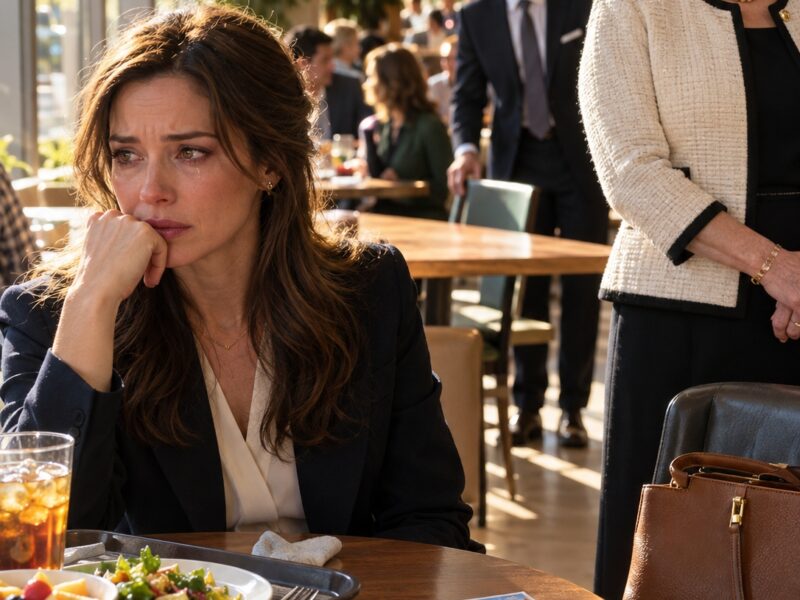
EVERYONE AT WORK REFUSED TO SIT WITH HER—UNTIL THE CEO CHOSE HER TABLE AND EXPOSED A SECRET THEY’D BEEN HIDING FOR TWO YEARS.

Everyone at Gaines Peanut Company knew the little table by the cafeteria window was where people sat when nobody wanted them.
Roz Carrian knew it too.
That was why, on the last Tuesday in August, when the CEO crossed a room full of eighty employees, walked past the chair that had been saved for him for four years, and stopped beside her lonely two-person table, Roz did not feel rescued.
She felt afraid.
“May I sit here?” Boyd Gaines asked.
The cafeteria went so quiet Roz could hear the old refrigerator humming behind the serving counter.
She looked at the empty chair across from her.
Then she looked at the long table in the center of the room, where Trudy Odum had slowly set down the ladle she was holding.
Roz understood something Boyd did not.
By tomorrow morning, nobody would remember what they had eaten for lunch.
But everybody would remember where the CEO had chosen to sit.
And one woman in that room would take it as a betrayal.
“There are other seats,” Roz said softly.
“I know.”
Boyd’s expression did not change.
“I’d like this one.”
Roz should have told him no.
She should have picked up her lunch, walked outside, eaten in her Honda with the windows cracked, and saved herself the trouble.
Instead, she nodded.
And across the cafeteria, Trudy Odum stood.
That was the moment everything began to break open.
Six weeks earlier, Roz had returned to southeast Alabama carrying almost everything she owned in the back of her Honda.
She was thirty-five, divorced, tired of explaining herself, and living in the small Headland house that had belonged to her grandmother Wilma.
People around Dothan remembered her by a different name.
Roz Odum.
Clay Odum’s wife.
Or, depending on who was telling the story, the woman who had abandoned him.
She had spent nearly two years in Montgomery after the marriage ended. Long enough to learn that distance did not erase a story once enough people had agreed on the version they preferred.
Then Wilma died.
The house sat empty.
Roz needed work.
Gaines Peanut Company needed someone in quality control who understood grading, moisture, damaged kernels, storage contamination, and aflatoxin.
Roz understood peanuts.
Her grandfather had taught her when she was fourteen.
He would split a kernel beneath the barn light, hold it between two rough fingers, and make her look closely.
“Peanuts tell on themselves,” he used to say.
Roz had believed him.
People were harder.
By the end of her first week at Gaines, she understood the geography of the plant.
Office employees preferred the tables near the tall cafeteria windows. Forklift drivers and line crews gathered near the vending machines. Supervisors tended to drift between groups depending on who was watching.
And in the center sat the long table beneath an old framed photograph of Royal Gaines, the founder.
Twelve chairs.
Everybody knew who belonged there.
Trudy Odum belonged there more than almost anyone.
Twenty-seven years on the packing floor had turned her into something larger than an employee. She brought casseroles when someone had a baby, organized collections when someone’s father died, remembered birthdays nobody else remembered, and every first-roast week she carried in a crockpot of boiled peanuts seasoned with salt and bay leaf.
Roz had once eaten at Trudy’s Thanksgiving table.
Eight times.
Trudy had once called her sugar.
Now, when Roz entered the cafeteria, handbags appeared on empty chairs.
People suddenly remembered they were saving seats.
Conversations changed direction.
Nobody openly insulted her.
That would have been easier.
Instead, the exclusion was performed through tiny gestures civilized enough to deny.
A purse placed on a chair.
A lunch tray shifted six inches.
A conversation stopping when she approached.
A person saying, “Sorry, someone’s sitting here,” while refusing to meet her eyes.
So Roz developed rules.
Bring a book.
Eat quickly.
Never ask whether a chair is free.
Never look wounded.
Never give anybody a new story.
That Tuesday, she warmed leftover chicken and rice in a microwave someone had left splattered with dried soup.
She cleaned the glass tray before using it.
Nobody thanked her.
Nobody noticed.
Or so she thought.
She carried her food to the small table beside the window, folded her napkin into a square, silenced her phone, and opened the paperback she had been pretending to read for a week.
Across the plant, Boyd Gaines was having a different kind of bad morning.
He was forty-one and had inherited a company before he had learned how to live inside his own house alone.
His wife, Lee, had been dead four years.
Cancer had taken eleven months to do what everyone kept calling “losing her,” as if Boyd had misplaced her somewhere.
He hated that phrase.
He knew exactly where she was.
That was the problem.
He still had her photograph on his office shelf. Still sometimes bought the yogurt she liked. Still woke at two in the morning reaching toward a side of the bed that had been cold for years.
And he had not eaten in the company cafeteria since the memorial lunch held there after her funeral.
That morning, Fay Trimble found him near the scale house.
Fay had worked at Gaines longer than some of the machinery. Her gray hair was pinned back, reading glasses balanced on her head, clipboard against one hip.
“First roast,” she said.
“I know what day it is.”
“Your daddy never missed one.”
“My daddy liked people more than I do.”
Fay stared at him over her glasses.
“Four years, Boyd.”
He knew exactly what she meant.
By 11:40, he stood at the cafeteria entrance carrying a tray with turkey, green beans, and something advertised as peach cobbler.
His body remembered the room before his mind did.
Folding tables.
Foil-covered casseroles.
Lee’s photograph on an easel.
People speaking softly as if grief might wake if they made too much noise.
A plate appearing in front of him.
A woman sitting beside him for nearly an hour without demanding that he eat, speak, pray, smile, or be grateful.
Trudy.
At the long table now, she smiled and removed her cardigan from the chair beside her.
His chair.
She had apparently been saving it every first roast for four years.
Boyd started toward her.
Then he saw the handbag.
A woman he did not recognize had been approaching an empty chair. Another employee lifted her purse and placed it on that chair without even looking at her.
Smooth.
Automatic.
Practiced.
The woman kept walking.
Boyd watched her reach the little table by the window.
Something about the room changed around her. Not dramatically. Nobody pointed. Nobody laughed.
They simply leaned away.
And Boyd had spent enough years studying numbers to recognize a pattern.
He walked past Trudy’s chair.
The cafeteria noticed.
So did Trudy.
Roz saw him coming and immediately began packing her lunch.
She assumed he wanted the table.
Then he asked permission to join her.
And when she warned him there were other seats, he answered, “I know.”
He sat down.
Across the room, Trudy rose.
She approached wearing the pleasant smile of a Southern woman who had spent decades learning how to hide anger beneath manners.
“Mr. Gaines,” she said. “Your seat’s over here. Same as always.”
“Thank you, Trudy. I’m all right here.”
Her smile stayed perfectly still.
Roz stared at her plate.
Eight Thanksgiving dinners.
Christmas pies.
Hospital visits.
Birthdays.
All of them compressed into the few inches between those two women.
Trudy reached toward the napkin dispenser, straightening something that was already straight.
Then she leaned slightly toward Roz.
“Enjoy it while it lasts.”
Only Roz heard.
Trudy returned to the long table.
Boyd looked down at his food.
“Is it me,” he said, “or are these green beans older than I am?”
Roz blinked.
Of all the things she expected him to say, that was not one of them.
“They boil them around nine.”
“That explains it.”
“By noon, they’ve given up.”
Something almost like a laugh crossed his face.
It startled her.
For the next fifteen minutes, they talked about work.
Nothing personal.
Boyd asked what she did.
“Quality lab.”
“What kind?”
“Incoming loads. Moisture. Foreign material. damaged kernels. Aflatoxin.”
“You like it?”
Roz considered the question.
“I’m good at it.”
“That wasn’t what I asked.”
She looked at him.
“My granddaddy had me grading peanuts by hand when I was fourteen. He said a peanut tells the truth if you hold it to the light.”
“Does it?”
“More often than people do.”
The sentence escaped before she could stop it.
Roz looked back at her lunch.
Too much.
But Boyd did not ask what she meant.
He asked about the moisture meter.
So she told him.
She explained that the old unit drifted and she recalibrated it every morning.
He listened.
Actually listened.
He never asked why she ate alone.
He never asked what she had done.
He never asked why Trudy hated her.
When he stood, he picked up his tray.
“Thank you for the chair.”
By two o’clock, the entire plant knew.
Upstairs, Fay walked into Boyd’s office without waiting to be invited.
“Well,” she said.
Boyd looked up.
“What?”
“You made an entrance.”
He leaned back.
“Who is she?”
Fay’s expression changed.
“Roz Carrian.”
“That tells me nothing.”
“She used to be Roz Odum.”
Boyd stopped moving.
Fay continued.
“Clay Odum’s ex-wife.”
“Trudy’s Clay?”
“Yes.”
“What happened?”
Fay took off her glasses.
“Depends who you ask.”
“I’m asking you.”
“Folks say she left him two years ago. Packed up. Went to Montgomery. Clay never got right afterward.”
Boyd looked toward the window.
Fay hesitated.
“Last summer he was driving south on 231 in a storm. People said he was trying to get to her.”
Boyd already knew the rest.
The accident had been plant news for weeks.
Clay’s truck had left the highway in heavy rain.
“He died,” Boyd said.
Fay nodded.
“And Roz didn’t come to the funeral. That’s the part Trudy can’t forgive.”
Boyd thought about the cafeteria.
Trudy removing her cardigan from his chair.
Trudy sitting beside him after Lee died.
The woman who had known enough not to tell a grieving man that everything happened for a reason.
“I didn’t know.”
“No,” Fay said.
Then she stood.
“But now you do.”
Boyd did not come to lunch the next day.
Roz hated herself for noticing.
For five minutes she watched the cafeteria door.
Then she felt relief.
She did not want to become Boyd Gaines’s act of charity.
The lonely divorced woman the CEO publicly adopted because he had noticed his employees being mean.
She could survive cruelty.
Pity was harder.
Thursday afternoon, she was recalibrating the moisture meter when a shadow appeared in the lab doorway.
Boyd.
He stayed outside.
“I didn’t know who you were to Trudy.”
Roz set down the sample cup.
He waited.
She said nothing.
“I’d have sat there anyway.”
Then he left.
The following morning, Roz discovered that being seen by Boyd had made her more visible to everyone else.
The plant manager held up a sealed sample jar during the quality meeting.
Roz recognized her handwriting on the label.
The plastic lid was cracked.
“This retain came back two points high on recheck,” he said. “Anybody want to explain that?”
Faces turned toward Roz.
She had sealed it herself.
She knew the lid had been intact.
“It must have been damaged on the shelf.”
Nobody contradicted her.
Nobody believed her.
That evening, Roz drove to Wilma’s house beneath an orange Alabama sunset.
She pulled into the gravel driveway and immediately knew something was wrong.
The porch light was dark.
She walked closer.
The bulb had not burned out.
Someone had loosened it.
Roz stood perfectly still.
Then she saw the back door.
Open half an inch.
She had locked it that morning.
She entered without calling anyone.
The refrigerator hummed.
The kitchen clock ticked.
Nothing appeared stolen.
That frightened her more.
She checked the bedrooms, bathroom, pantry, drawers.
Everything looked normal.
Until she opened the hall closet.
A cardboard box sat on the floor.
CLAY was written across the side in her handwriting.
She had brought it from Montgomery and shoved it there six weeks earlier.
She had never opened it.
Now the flaps were spread apart.
His work shirts had been moved.
Photographs had been disturbed.
Someone had gone through the box carefully.
Then put everything back almost correctly.
Roz knelt.
For one moment, she considered calling the sheriff.
Then she imagined the deputy’s cruiser in her driveway.
She imagined neighbors watching.
She imagined Sunday morning.
Roz Carrian comes back and trouble follows.
She did not call.
Instead, she reached beneath Clay’s shirts until her fingers touched the postcard.
Still there.
She wrapped it in one of Wilma’s old handkerchiefs, placed it inside a Danish cookie tin filled with sewing thread, and hid the tin behind blankets on the closet’s top shelf.
She did not read the postcard.
She already knew enough about what it could destroy.
Monday morning brought Lamar Pettis.
Lamar was Trudy’s brother-in-law, Clay’s uncle, and a farmer who believed the quality lab existed mostly to confirm whatever price he had already decided his peanuts deserved.
Roz pulled his sample herself.
She knew before the machine finished.
Too wet.
Too many damaged kernels.
She ran the test three times.
Same result.
The grade would cost Lamar nearly four thousand dollars.
He stormed into the scale house holding the slip.
“You did this on purpose.”
“I graded what you brought me.”
“You took Clay.”
Roz went still.
Lamar stepped closer.
“Now you’re taking the farm.”
Drivers outside had stopped talking.
Through the window, Roz saw Trudy near the loading dock.
Their eyes met.
Trudy said nothing.
She simply turned away.
That silence followed Roz all afternoon.
Boyd heard about the dispute within an hour.
He did not call Roz.
He did not call Lamar.
He went to Fay.
“Show me the numbers.”
She did.
Three tests.
Three matching results.
“She graded it right,” Fay said.
Boyd handed back the paperwork.
“I figured she did.”
“Then why check?”
“Because figuring isn’t knowing.”
The grade remained.
Not because Boyd defended Roz.
Because the grade was correct.
When Fay mentioned that to Roz later, something inside her loosened.
For two years, being noticed had meant being judged.
Boyd had noticed her work without turning her into a cause.
Maybe there was a difference.
Then someone knocked on the lab window.
Colby Odum stood outside.
Clay’s younger brother.
Thirty years old now, though his grin still carried something of the teenager Roz remembered.
“Hey, Roz.”
“Colby.”
“Sorry about Uncle Lamar. He’s all bark.”
“It’s fine.”
Colby leaned against the doorway.
“I know this place isn’t easy for you.”
Roz said nothing.
“Mama. Everybody.”
“I can handle it.”
“I know.”
His smile stayed warm.
His eyes did not.
“If you ever wanted to get settled someplace easier, I could help. Montgomery maybe. I know people.”
There it was.
Not a threat.
Something more polite.
An invitation to disappear.
“I’m fine here, Colby.”
“Sure.”
He tipped his cap.
“Just think about it.”
At six that evening, Roz sat in her Honda with a resignation email open on her phone.
Three sentences.
Thank you for the opportunity.
Effective in two weeks.
Best regards.
Her thumb hovered over Send.
Two rows away, Boyd sat in his pickup.
His window was cracked.
Old Motown drifted softly through the parking lot.
He did not wave.
Did not approach.
Did not rescue her from anything.
He simply sat in his truck like a man who did not particularly want to go home either.
Roz stared at the email.
Then turned the phone facedown.
When she reached Wilma’s house, the porch light was on.
The new relief lasted exactly twelve seconds.
She entered the kitchen.
The sewing tin sat open in the center of the table.
The handkerchief had been unfolded.
The postcard lay on top.
Message side up.
Someone had found it.
Someone had read it.
And whoever had entered her house wanted Roz to know that they had.
This time she changed the locks.
She still did not call the sheriff.
Two nights later, Gaines Peanut Company nearly shipped contaminated peanut butter to children.
A school-lunch contract had the plant running late. Eighteen hundred cases had to be loaded by six the next morning for school districts across three states.
Roz’s shift was over.
She stayed anyway.
At 9:40 p.m., she ran one last test on lots staged for roasting.
The strip came back hot.
She tested again.
Aflatoxin.
Far above the allowable limit.
Roz hit the line stop.
Machinery groaned into silence.
Workers stared.
“Nobody touches Lot Fourteen.”
She pulled tickets.
Tracked bins.
Matched deliveries.
Retested.
By 10:30, she found the source: one storage bin had taken moisture through a damaged seal.
Everything else was clean.
They could save the order.
But only if they isolated the bad material, restaged the good lots, and roasted through the night.
At eleven, the elevator opened.
Boyd stepped onto the production floor without his jacket.
“The line stopped.”
Roz explained in four sentences.
He asked one question.
“What do you need?”
“Hands.”
Boyd rolled up his sleeves.
For three hours, the CEO of Gaines Peanut Company hauled fifty-pound bags alongside the night crew.
Nobody photographed him.
Nobody posted it.
Nobody applauded.
He simply worked.
During a short break, Roz cracked a kernel beneath the inspection light.
“See this one?”
Boyd leaned closer.
“Clean?”
“Good.”
She opened another.
A dark line ran through its center.
“And this?”
“Bad.”
“Exactly.”
Boyd frowned at the kernel.
“So that’s a peanut lying to me.”
Roz almost smiled.
By 1:50 a.m., the final clean lot was moving.
The order would ship.
A worker slapped Roz on the shoulder.
“You saved our asses tonight.”
Roz immediately stepped away.
“Fay’s tickets saved us. And these guys did the work.”
After the others left, Boyd watched her.
“You do that a lot.”
“Do what?”
“Hand credit away like it’s too hot to touch.”
“Somebody has to stay humble around here.”
She glanced at his sweat-soaked shirt.
“And apparently it won’t be the CEO hauling bags for three hours just to prove he can.”
Boyd laughed.
A real laugh.
Roz had never heard it before.
Outside, wet grass and roasted peanuts scented the humid darkness.
Boyd leaned against his truck.
“I hadn’t been in that cafeteria in four years.”
Roz waited.
“Not since Lee.”
He looked toward the plant.
“They held her memorial lunch there. I couldn’t eat. Couldn’t even lift the fork.”
Roz knew what came next before he said it.
“Trudy brought me a plate. Then sat beside me for an hour. Didn’t tell me God had a plan. Didn’t tell me Lee was somewhere better. She just sat.”
He rubbed his hands together.
“I never properly thanked her.”
“And then the first day you went back, you walked past her.”
“Yeah.”
Roz looked down.
“Then you owe her.”
Boyd nodded slowly.
“I owe her the truth.”
Roz looked at him.
“I’m not sure that’s the same thing,” he added.
The words rose into Roz’s throat.
She could tell him.
She could end the story everybody believed with one sentence.
Instead, she pictured Trudy’s face.
The woman who had already buried a husband.
Then a son.
“Good night, Boyd.”
At home, Roz finally opened the sewing tin.
The postcard showed a sunset over Panama City Beach.
Clay had mailed it one week before his death.
Roz turned it over.
His handwriting was unmistakable.
Thank you for letting her hate you instead of me.
I’ll tell her myself soon.
C.
Roz read it twice.
Then once more aloud.
Clay had never told Trudy.
He died first.
And for two years, Roz had carried the lie he had begged her to carry.
Now someone else knew.
September arrived.
Boyd began coming downstairs for lunch on Fridays.
But he did something Roz did not expect.
He did not always sit with her.
He sat with whoever was alone.
A nineteen-year-old sanitation worker.
An elderly retiree.
A temporary driver.
Sometimes Roz.
It became impossible to call his behavior favoritism because he had turned it into a habit.
They talked about rain.
Music.
Bad cafeteria vegetables.
Never about the postcard.
Never about Clay.
But the long table watched.
And on the third Friday, Trudy finally broke.
She crossed the cafeteria carrying her crockpot and set it on Roz’s table hard enough to rattle the silverware.
“I’ve kept my mouth shut.”
Eighty people heard her.
Roz did not move.
“For weeks I’ve kept it shut. But I won’t watch this anymore.”
“Trudy—” Boyd began.
She pointed at Roz.
“She left my boy with nothing.”
Her voice trembled.
“Eight years. Eight years she sat in my house. Then she packed up and walked away. Clay drove through a storm trying to get her back.”
Roz stared at the table.
“He died on that road.”
Trudy’s eyes filled.
“And she couldn’t even come to his funeral.”
That part was not true.
Roz had attended.
She had stood at the rear of First Baptist in a borrowed black dress, hidden behind a pillar.
She heard the pastor say Clay’s name.
She watched Trudy shake.
And before the casket moved down the aisle, Roz slipped outside because she could not bear the moment when Trudy might see her.
She told nobody.
Trudy turned to Boyd.
“I sat with you when Lee died.”
“I remember.”
“Then you owe me this.”
The cafeteria seemed to stop breathing.
“Move her to nights.”
Trudy swallowed.
“Or after twenty-seven years, I walk.”
Boyd stood.
His face had lost color.
But his voice remained calm.
“I’m not moving an employee because of who she used to be married to.”
Trudy stared at him.
“And I’d sit with both of you,” Boyd said. “Any day you’d let me.”
For several seconds, Trudy did not move.
Then she untied her apron.
Folded it neatly.
Placed it beside the crockpot.
And walked out.
Every face turned toward Roz.
Later, Boyd found her in the lab.
He closed the door.
“Do you want to tell me?”
Roz stared at the moisture meter.
She heard Clay’s voice from two years earlier.
Please, Roz. Let her think it was you.
She’ll never look at me the same.
“Some things aren’t mine to tell.”
Boyd studied her.
Then nodded.
He left without pressing.
For the first time, Roz understood something important.
Her silence was no longer cowardice.
She knew exactly why she was silent.
She knew what it cost.
She knew who it protected.
That made it a choice.
On Monday, Trudy did not come to work.
At two that afternoon, Roz pulled a retain sample from the shelf.
Lot Twenty-Two.
Her initials.
Her handwriting.
Her date.
She opened it.
The smell stopped her.
Musty.
Wet.
Wrong.
She poured the peanuts onto a steel tray.
Mold.
Gray-green growth.
Shriveled kernels.
Roz’s stomach tightened.
These were not the peanuts she had graded.
Someone had switched the sample.
She went directly to the warehouse and pulled a fresh sample from Lot Twenty-Two.
Same mold.
Same contamination.
She looked at the roast board.
Lot Twenty-Two was scheduled for six the next morning.
If it entered production carrying her approval, her career was finished.
She placed red hold tags on every affected bin.
Removed the lot from the schedule.
Photographed everything.
Then drove home.
At 9:30, she looked at the photograph again.
The hold tags bothered her.
They were paper.
Whoever had tampered with the peanuts had already crossed lines much larger than paper.
At ten, Roz drove back through a Gulf storm.
The parking lot was nearly empty.
Inside the warehouse, one distant row of lights burned.
Then she heard a pallet jack.
Roz moved toward the sound.
Colby Odum stood between stacks of bins.
A red hold tag was crushed in his hand.
He was moving Lot Twenty-Two toward the roasting line.
“Colby.”
He froze.
Thunder shook the metal roof.
“Go home, Roz.”
“Those bins are contaminated.”
“They’ll pass.”
“No.”
His face changed.
“They’ll roast tomorrow. Somebody will discover it afterward. Your grade will be on the paperwork.”
Roz stared at him.
“And then you’ll finally leave.”
Suddenly every strange detail aligned.
The cracked retain lid.
The porch light.
Clay’s box.
The sewing tin.
“The house,” Roz whispered. “That was you.”
Colby said nothing.
“The postcard.”
He pulled out his phone.
A photograph appeared.
Clay’s postcard lying on Roz’s kitchen table.
“I wanted you gone before you broke her.”
“Mama has already buried Daddy. She buried Clay. You think she can survive finding out what he really did?”
Roz’s throat tightened.
“You knew about Darcy.”
Colby laughed once.
There was no humor in it.
“I always knew.”
Darcy Lane.
The name Roz had refused to say for two years.
Clay’s affair.
The real reason the marriage ended.
“I lied for him too,” Colby said. “Every Sunday dinner. Every Christmas. Every time Mama asked if you two were okay.”
His hands shook.
“He made all of us liars.”
Headlights swept through the open dock.
A truck door slammed.
Boyd appeared with the night security guard behind him.
Rain covered his shoulders.
He looked at the moved bin.
The crushed red tag.
Colby.
Roz.
“What’s going on?”
Colby looked at the floor.
Roz had one chance.
She could expose him.
She could save herself.
Instead, she heard herself say, “I mislabeled the retains Friday.”
Boyd’s eyes snapped to hers.
“My mistake,” Roz continued. “Colby was helping me fix it.”
Silence.
Boyd knew.
She could see it.
He looked at Colby.
Then back at Roz.
“Put the bins back on hold.”
His voice was quiet.
“Both of you go home.”
Roz did not sleep.
At 7:30 the next morning, she placed her resignation on Boyd’s desk.
“Effective Friday.”
He did not open it.
He put it in his top drawer.
“I’ll keep it until Friday.”
“Boyd—”
“If you still want to leave Friday, I’ll sign it myself.”
Roz turned toward the door.
“Roz.”
She stopped.
“I won’t sign a lie.”
That night, Colby sat alone in his pickup while rain covered the windshield.
He looked again at the photograph on his phone.
Clay’s words.
Thank you for letting her hate you instead of me.
Roz had carried his brother’s lie for two years.
Then, with her career at risk, she had carried Colby’s too.
Near midnight, Fay called Roz.
“My nephew just saw Colby’s truck on 231.”
Roz sat upright.
“Which direction?”
“South.”
Her blood went cold.
Highway 231.
Rain.
Night.
Florida.
The same road Clay had driven.
Roz called Colby.
Voicemail.
Again.
Again.
Six times.
On the seventh attempt, she called Boyd.
“He’s on 231.”
“I’m coming to get you.”
“No. I’ll drive.”
A pause.
Then Roz said the thing she would once have been too proud to say.
“But I’d like you to come.”
Ten minutes later, Boyd’s headlights appeared behind her.
The storm turned the highway into black glass.
Roz watched every ditch.
Every guardrail.
Every shape beyond the headlights.
Just before the Florida line, she saw Colby’s pickup beneath the canopy of a closed gas station.
She stopped so quickly the Honda rocked.
Colby sat behind the wheel.
Alive.
Roz opened his door.
“I couldn’t go farther,” he said.
His voice was hoarse.
“Clay used to stop here.”
He looked toward the dark convenience store.
“Every trip. Coke and boiled peanuts.”
Then he lifted his phone.
“I called Darcy.”
Roz stopped breathing.
“She’ll meet us.”
Dawn found them in Panama City Beach.
Darcy Lane sat inside an all-night diner with a cardboard box beside her.
She was not the woman Roz had imagined while lying awake during the final months of her marriage.
Not glamorous.
Not cruel-looking.
Just tired.
Human.
She stood when Roz approached.
“I’ve had his things for a year.”
Roz looked at the box.
“I didn’t know who deserved them.”
That afternoon, the truth finally reached Trudy Odum.
They gathered in her kitchen.
Darcy.
Colby.
The cardboard box.
Clay’s postcard.
But Roz waited outside.
She sat in Boyd’s truck.
He sat beside her.
Neither spoke.
Through the kitchen window, Roz could see the back of Trudy’s head.
Inside, Darcy told the story without decoration.
Clay had left Roz.
Not the other way around.
He had fallen in love with Darcy while still married.
When Roz discovered the affair, Clay begged her to let his mother believe she had chosen to leave.
He was ashamed.
Cowardly.
Terrified of becoming smaller in Trudy’s eyes.
Roz agreed.
And the night Clay died, he had not been driving toward Montgomery to bring Roz home.
He had been driving back to Dothan.
To tell Trudy the truth.
“He said he was done lying,” Darcy said.
Her voice broke.
“I told him to wait until the rain stopped.”
Then Colby confessed.
The break-in.
The porch bulb.
The postcard.
The altered samples.
Lot Twenty-Two.
Everything.
Including what Roz had done in the warehouse.
“She lied for me,” Colby said. “After everything I did, she still lied for me.”
Trudy sat at the same kitchen table where Roz had eaten Thanksgiving dinner eight years in a row.
For fourteen months, she had hated the wrong person.
And after Roz returned, Trudy had turned that hatred into something the whole plant understood without ever needing instructions.
Empty chairs.
Turned backs.
Cold silence.
A handbag on a seat.
Outside, Boyd glanced at Roz.
“You don’t have to go inside.”
“I know.”
“Do you want to?”
Roz watched Trudy through the window.
“No.”
Not yet.
Friday arrived.
Roz went to work expecting it to be her last day.
At noon, she carried her lunch to the little table by the window.
Her book lay beside her tray.
The long table was noisy.
Then the cafeteria doors opened.
Trudy entered wearing her apron.
She carried a brown paper sack.
The smell reached Roz first.
Boiled peanuts.
Salt.
Bay leaf.
The room became silent.
Trudy walked past the long table.
Past the chair where she had ruled lunch for decades.
Past eighty people who had watched her humiliate Roz.
She stopped at the small table.
Her eyes were red.
Her hands trembled.
And then Trudy Odum asked the same question Boyd Gaines had asked weeks earlier.
“May I sit here?”
Roz could not speak.
She nodded.
Trudy sat.
She opened the paper sack between them.
No speech.
No public apology.
No dramatic explanation.
For several seconds, only the rustle of paper filled the room.
Then Fay stood with her tray.
Another employee followed.
Then the woman who had once placed her handbag on a chair to keep Roz away.
Chairs scraped.
People moved.
One by one, the little table became surrounded.
Trudy reached across and placed her hand over Roz’s.
“I didn’t ask.”
Her voice was barely audible.
Roz looked at her.
“In two years,” Trudy whispered, “I never once asked you what happened.”
“You were grieving.”
Trudy’s eyes filled.
“So were you, honey.”
That afternoon, Colby walked into Boyd’s office and confessed.
Boyd fired him.
Immediately.
Every affected quality record was reviewed. Every suspicious lot was retested. Colby was barred from the plant.
Roz asked Boyd not to involve police.
He disagreed at first.
“What he did could have hurt people.”
“I know.”
“It could have destroyed your career.”
“I know.”
“And you’re asking me to protect him?”
“No.”
Roz shook her head.
“I’m asking you not to turn one terrible month into the rest of his life.”
Boyd studied her.
Eventually, he agreed.
But mercy did not mean pretending nothing happened.
Colby lost his job.
Lost his reputation.
Lost Boyd’s reference.
What came afterward would have to be earned.
At four o’clock, Boyd entered the quality lab.
He placed Roz’s resignation envelope on the counter.
Unopened.
Unsigned.
“It’s Friday.”
Roz looked at it.
For weeks, she had imagined leaving.
Montgomery.
Birmingham.
Anywhere people did not know Clay Odum’s name.
But suddenly she understood what leaving would mean.
Not escape.
Surrender.
She picked up the envelope.
Tore it in half.
Then again.
Boyd exhaled.
He lingered at the doorway.
“There is something I’ve wanted to ask you since that first lunch.”
Roz raised an eyebrow.
“But I’m not asking it inside this building.”
He walked away.
Roz stood holding the torn resignation.
For two years, she had wanted somebody to tell her she belonged somewhere.
That day an entire room had tried.
And she realized something strange.
She did not need their permission anymore.
The only question left was whether she had room in her life for a man who had once asked for nothing more dangerous than a chair.
Boyd waited until October.
He came to Wilma’s porch on a Saturday evening wearing jeans and an expression more nervous than Roz had ever seen in a board meeting.
“One dinner.”
Roz folded her arms.
“That’s your big question?”
“Away from the plant.”
“What if I say no?”
“Then I’ll drive home and spend Monday pretending this conversation never happened.”
“That sounds healthy.”
“I’ve been told I have room for improvement.”
Roz made him wait.
Not because she worried about gossip.
For once, she asked herself only what she wanted.
“One dinner.”
Boyd smiled.
“No promises,” she added.
“Terrifyingly clear.”
He took her to a catfish restaurant in Headland.
Paper napkins.
Plastic cups of sweet tea.
No chandeliers.
No corporate people.
They stayed until the waitress began stacking chairs.
Ten months later, August returned.
The first roast began before dawn.
By midmorning, Gaines Peanut Company smelled like a warm kitchen again.
Roz still worked in the quality lab.
Same title.
Same moisture meter.
Same habit of holding kernels beneath the light.
Farmers now requested her by name because everyone knew one thing about Roz Carrian’s grades.
They were honest.
Even Lamar Pettis asked for her.
Not everything healed neatly.
Some employees apologized.
Some did not.
One woman from packing never acknowledged what she had done.
Roz stopped waiting.
Other people’s unfinished guilt was not hers to carry.
Some days she ate at the long table.
Other days she chose the small table by the window because twenty quiet minutes with a paperback felt good.
The difference mattered.
Once, she had sat there because nobody wanted her.
Now she sat there when she wanted herself.
Trudy returned to work.
For six Fridays, she placed an extra bag of boiled peanuts beside Roz’s lunch without explanation.
On the seventh, Roz finally looked at her.
“You know you don’t accidentally make exactly one extra bag every week.”
Trudy sniffed.
“I make too many.”
“Every Friday?”
“Apparently.”
Roz smiled.
“Don’t tell anybody.”
Sunday dinners resumed.
There was a chair for Roz again.
Twice that winter, she and Trudy drove to the cemetery together.
They stood beside Clay’s grave without speaking.
Neither defended him.
Neither reduced him to the worst thing he had done.
He had been a husband who betrayed Roz.
A son who loved his mother but lacked the courage to disappoint her.
A brother who taught Colby how easily love could become secrecy.
A man who finally decided to tell the truth and ran out of time.
Some people were complicated enough that forgiveness and anger could exist in the same breath.
At Christmas, Trudy received a card from Panama City Beach.
Darcy.
After two days, Trudy wrote back.
Colby went to work on Lamar’s farm.
He became quieter.
Sunburned.
He stopped asking people to excuse what he had done.
When the first wagon of the new harvest arrived at Gaines, Colby drove it himself.
He handed Roz the paperwork.
“Thought you ought to grade the first one.”
Roz tested it.
Clean.
She stamped the grade.
Neither mentioned the warehouse.
Some apologies were sentences.
Others were what a person did for the next thousand days.
Boyd changed too.
Slowly.
He still worked too late.
Still forgot meals.
Still believed every problem became more manageable when converted into numbers.
But every Friday at lunch, he came downstairs.
He looked for whoever was alone.
Sometimes he sat with them.
Sometimes he simply asked whether the chair was taken.
And he learned something no business school had ever taught him.
Sometimes listening was the entire job.
On Sunday evenings, he occasionally sat with Roz on Wilma’s porch while an old Motown station played softly through the screen door.
She taught him how to judge peanuts by touch.
He remained terrible at it.
“You’re overthinking,” she told him.
“I run a company. Overthinking is practically in the job description.”
“Hold it.”
“I am.”
“Feel the weight.”
“I feel a peanut.”
“Boyd.”
“What?”
“It’s bad.”
“You haven’t opened it.”
“I don’t need to.”
“You expect me to believe a peanut can lie?”
Roz cracked it.
A dark line ran through the center.
Boyd stared.
“I hate when you do that.”
“You hate being wrong.”
“That’s different.”
They argued about music.
His hours.
Her stubbornness.
Whether the Four Tops were better than the Temptations.
Ordinary arguments.
The kind two people could have only after they stopped believing every disagreement meant someone was leaving.
Lee’s photograph remained in Boyd’s office.
Roz never asked him to remove it.
One afternoon, she noticed the frame sitting in shadow on a bookshelf.
She moved it to the corner of his desk beside the window.
When Boyd returned, he saw what she had done.
He said nothing.
He left it there.
Because loving someone new did not require pretending you had never loved anyone before.
And healing, Roz had learned, was not the same thing as erasing.
At 11:40 on the last Tuesday in August, Roz entered the cafeteria carrying her tray.
She was late.
The room was loud.
Warm.
Alive.
Fay was laughing.
The crockpot of boiled peanuts was already moving down the long table.
Boyd stood in line behind two forklift drivers, waiting his turn like everyone else.
Roz paused beside the little table by the window.
It was empty.
The same wobbly leg.
The same view of the parking lot.
One year earlier, that empty table had felt like evidence.
Proof that she was unwanted.
Now it was only furniture.
Roz looked toward the center of the room.
Trudy had saved two chairs at the long table.
One for Roz.
One for Boyd.
And on the second chair sat Trudy’s handbag.
For a moment, Roz simply stared at it.
The same gesture.
The same handbag.
The same woman.
But everything it meant had changed.
Roz walked toward the table.
Trudy looked up.
Their eyes met.
Then Trudy lifted her handbag from the chair.
This time, she placed it on the floor.
Roz sat.
A moment later, Boyd arrived with his tray.
He did not ask whether the chair was free.
He no longer needed to.
He sat beside Roz, close enough that their shoulders touched.
Nobody stopped talking.
Nobody stared.
Nobody made it important.
And somehow that made it more important than anything.
At the far end of the table, someone opened the warm brown paper sack.
Boiled peanuts began traveling from hand to hand.
Past the packing crew.
Past the forklift drivers.
Past Fay.
A year earlier, the bag had stopped one seat before Roz.
This time, it reached her.
Roz took a handful.
Then passed the bag to Boyd.
Outside the windows, trucks rolled across the yard beneath an Alabama sky bleached white by August heat.
Inside, people laughed.
Forks scraped plates.
Someone complained about the green beans.
Trudy told them to stop whining.
And Roz sat among them without wondering whether she had earned the chair.
Because in the end, that had never been the lesson.
The lesson was not that good people eventually get welcomed back to the table.
Sometimes they don’t.
Sometimes nobody apologizes.
Sometimes the people who hurt you remain convinced they had reasons.
Sometimes the truth arrives too late to restore what was lost.
Roz had lost a marriage.
Trudy had lost a son.
Colby had lost a brother and nearly lost himself trying to preserve a lie.
Boyd had lost Lee and spent four years believing grief was a room he had to occupy alone.
None of those things could be undone.
But one chair could be pulled out.
One question could be asked.
One person could choose to listen before deciding who was guilty.
And sometimes that was how a life changed—not through a grand rescue, but through a small act performed in front of everyone.
May I sit here?
Roz looked down at the peanuts in her palm.
Her grandfather had been right.
Hold one beneath enough light and eventually it told you what was inside.
People were different.
People could hide the truth for years.
They could hide it behind loyalty.
Behind shame.
Behind grief.
Behind a mother’s love.
Behind an empty chair.
But eventually, if someone was brave enough to stop telling the old story and brave enough to ask what really happened, light found its way in.
Roz cracked one peanut open.
Clean.
Pale.
Honest all the way through.
Beside her, Boyd reached for another.
“Good one?” he asked.
Roz examined it.
Then looked around the long table.
At Trudy.
At Fay.
At the place that had once made her feel invisible.
Finally, she looked at Boyd.
“We’ll see.”
She broke the shell beneath her fingers.
And this time, nobody at the table looked away.









