Everyone Feared the Cold-Blooded Heiress—Until a New Waitress Asked About the Necklace She Never Took Off
The first thing Eleanor Whitmore destroyed that night wasn’t a wineglass, a dinner plate, or someone’s job.
It was the sound in the room.
One second, the Magnolia House was alive with the polished noise of a Friday evening in Savannah—silverware touching porcelain, low jazz slipping from hidden speakers, rain tapping against the tall windows, old-money couples speaking softly over candlelight.
Then the glass doors opened.
Eleanor stepped inside.
And the restaurant seemed to inhale and forget how to exhale.
She wore a charcoal dress beneath a cream wool coat, the kind of coat that probably cost more than Hannah Mercer’s used Honda. Her dark hair was pinned neatly behind her ears. A slim silver bracelet caught the chandelier light whenever she moved her hand.
She was beautiful in the severe, expensive way that made people sit straighter without understanding why.
But nobody at the Magnolia House was staring at her clothes.
They were watching her face.
“Table twelve,” Clare whispered beside Hannah.
Hannah looked over.
“That’s her?”
Clare’s eyes widened.
“Don’t point.”
“I didn’t.”
“You were about to.”
Hannah lowered her hand.
Clare was twenty-nine, had worked at the Magnolia House for almost six years, and could carry four champagne flutes in one hand while remembering the names of regular customers’ dogs. Hannah had known her for less than three days and already trusted her judgment.
So when Clare leaned close and said, “Whatever happens tonight, do not argue with Eleanor Whitmore,” Hannah listened.
“She looks normal.”
Clare gave her a look that nearly made Hannah laugh.
“Last spring, she made Peter cry in the walk-in freezer.”
“The waiter?”
“The assistant manager.”
Hannah glanced toward the entrance again.
Eleanor had stopped beside the hostess stand.
The hostess, a college student named Sophie, appeared to be explaining something about Eleanor’s preferred table.
Hannah couldn’t hear the conversation.
She could see Sophie’s hands.
They were shaking.
A moment later, the floor manager hurried over.
Suddenly the couple seated beside the tall windows was being moved to another table.
Eleanor never raised her voice.
That somehow made it worse.
She simply waited.
Five minutes later she was seated exactly where she wanted to be.
Clare exhaled.
“That,” she whispered, “is what I mean.”
Hannah watched Eleanor unfold her napkin across her lap as if nothing unusual had happened.
“What did the couple do?”
“Nothing.”
“And they just moved them?”
“People move when Eleanor Whitmore wants them to move.”
Clare picked up a tray.
“Welcome to Savannah.”
Hannah had been in the city only three weeks.
She had moved from a small community outside Macon after her father’s sudden death turned every familiar road into a reminder of something her family no longer had.
His laugh.
His truck in the driveway.
His boots beside the kitchen door.
His paycheck.
The last one mattered more than Hannah liked admitting.
Her mother, Diane, had spent most of the previous year dealing with a complicated autoimmune illness that had made steady work almost impossible. Medical bills sat in a ceramic bowl beside the refrigerator because there were too many to organize properly anymore.
Hannah worked mornings at a bakery near Forsyth Park and evenings at Magnolia House.
She slept when she could.
She worried constantly.
And she had learned to smile while doing both.
She was twenty-five years old and carried herself with a quiet steadiness that people sometimes mistook for innocence.
It wasn’t innocence.
Life had already taught her that terrible things could happen without warning.
But Hannah’s aunt June had taught her something else.
“People are almost never only the worst thing they’ve done,” June used to say.
And when Hannah was old enough to question that philosophy, June would add, “Anger is often grief with nowhere decent to go.”
Hannah had believed her.
Mostly.
Looking at Eleanor Whitmore now, she wondered whether Aunt June had ever waited tables.
Within twelve minutes, Eleanor complained about the lighting.
“It’s dimmer than usual.”
The manager apologized.
Someone adjusted a fixture that had not actually changed.
Eight minutes later, Eleanor rejected a bottle of Burgundy because she said it had been served three degrees too warm.
The sommelier checked the temperature after carrying it away.
It was correct.
Nobody told Eleanor.
Then came the appetizer.
The plate had barely touched the table when Eleanor looked down.
“What is that?”
The server froze.
“Ma’am?”
Eleanor pointed.
A single parsley leaf rested beside the crab cake.
“I specifically requested no parsley.”
The server swallowed.
“I’m so sorry. I’ll have the kitchen redo it.”
Eleanor leaned back.
“You said that twenty minutes ago when you took the order.”
“Yes, ma’am.”
“Then either you didn’t listen, or the kitchen didn’t.”
“I’ll take care of it.”
“That isn’t an answer.”
Across the room, conversations continued, but more quietly.
The server’s face had turned red.
Hannah watched him carry the dish away.
In the service station, he placed it on the counter harder than necessary.
Chef Luis stared at the parsley leaf.
“You have got to be kidding me.”
“She asked for none.”
“It’s garnish.”
“She knows.”
Luis closed his eyes.
“I have thirty-two tickets.”
“Then make it thirty-three.”
He swept the plate away.
Hannah was putting clean forks into a tray when the manager approached.
“Hannah.”
She looked up.
“You’re taking table twelve.”
The fork slipped from her fingers.
Clare stared at him.
“She’s new.”
“I know.”
“She’s very new.”
“I know, Clare.”
Hannah glanced toward Eleanor.
“What happened to Marcus?”
The manager lowered his voice.
“He asked me to switch him.”
Translation: Marcus had reached his limit.
Clare muttered, “You can’t throw a new girl in front of a moving train.”
The manager rubbed his temple.
“Five servers have tables. She wants someone attentive. Hannah’s section is light.”
He looked at Hannah.
“Just be polite. Write everything down. Repeat the order. If she complains, get me.”
Hannah nodded.
Clare caught her arm before she left.
“I mean it. Don’t joke with her. Don’t ask personal questions. Don’t try to make conversation.”
“What if she makes conversation?”
“She won’t.”
“And if she does?”
Clare looked toward Eleanor.
“Assume it’s a trap.”
Hannah almost smiled.
Clare didn’t.
So Hannah picked up her order pad and walked across the dining room.
She could feel people watching.
Not obviously.
That was the Magnolia House way.
People noticed everything without appearing to notice anything.
Eleanor didn’t look up when Hannah arrived.
“Good evening, Ms. Whitmore.”
“I’ve already had three people tell me good evening.”
Hannah paused.
“Then I suppose you’re covered.”
Eleanor’s eyes lifted.
Across the room, Clare appeared to stop breathing.
Hannah immediately wondered whether she had made a career-ending mistake during her first week.
Then something unexpected happened.
The corner of Eleanor’s mouth almost moved.
Almost.
“You’re new.”
“Yes, ma’am.”
“That wasn’t a question.”
Hannah nodded.
“Still true.”
This time Eleanor definitely looked at her.
Not warmly.
But with interest.
“My appetizer is being remade.”
“I know. Chef Luis is preparing it personally.”
“I didn’t ask who was preparing it.”
“No, ma’am.”
“And the wine?”
“A fresh bottle is being chilled.”
“It shouldn’t need to be chilled now. It should have arrived correctly the first time.”
“You’re right.”
That answer seemed to irritate Eleanor more than resistance might have.
She picked up her water glass.
Hannah waited.
That was when she saw it.
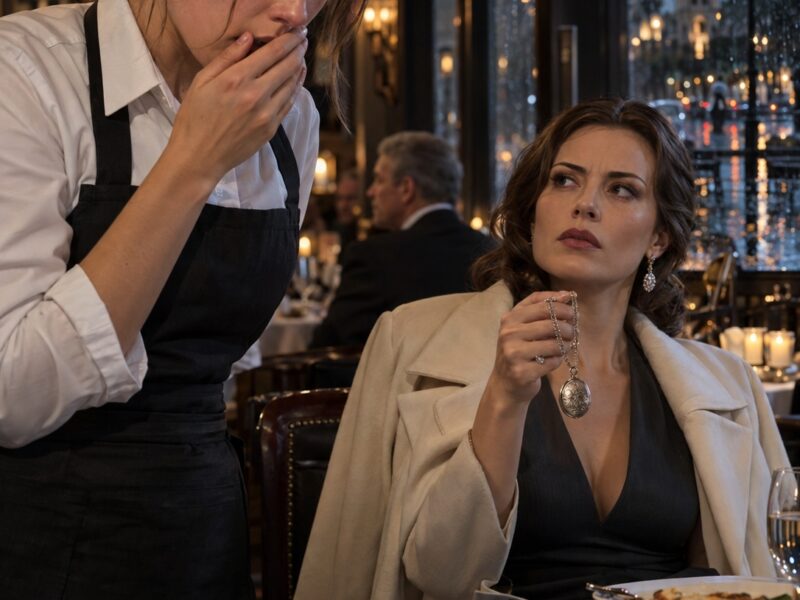
Beneath the collar of Eleanor’s cream coat, almost hidden behind the clean line of expensive fabric, hung a tarnished silver chain.
Everything else Eleanor wore was immaculate.
The chain wasn’t.
It was scratched.
Old.
And attached to it was a small oval pendant rubbed dull by years of human fingers.
It looked so out of place that Hannah stared half a second too long.
Eleanor noticed.
“What?”
Hannah should have remembered Clare’s warning.
She should have said nothing.
Instead she heard Aunt June’s voice in her head.
People carry stories in what they refuse to throw away.
“I’m sorry,” Hannah said. “May I ask you something?”
Eleanor’s expression hardened.
“You seem determined to.”
Hannah gestured slightly toward the pendant.
“That belonged to someone important, didn’t it?”
Silence.
Not just at table twelve.
The nearest server had stopped beside a column.
The manager was watching from the bar.
Eleanor’s hand moved instantly to the pendant.
Her fingers closed around it.
For one brief moment, the woman everyone feared didn’t look angry.
She looked caught.
Hannah saw it clearly.
Shock first.
Then pain.
Then the door slammed shut.
“You are here to take my order,” Eleanor said slowly, “not investigate my life.”
Hannah’s face warmed.
“You’re right. I apologize.”
“I don’t appreciate strangers making assumptions about me.”
“I understand.”
“No, I don’t think you do.”
Hannah lowered her eyes.
“I’ll bring your appetizer.”
She turned.
“Hannah.”
She stopped.
It took her a second to realize Eleanor had read the name on her uniform.
“Yes?”
Eleanor still held the pendant.
Her voice was quieter.
“Don’t ask me about it again.”
Hannah nodded.
“I won’t.”
She walked away.
Clare intercepted her near the kitchen.
“What did you say?”
“Nothing.”
“I watched Eleanor Whitmore turn white.”
“I asked about her necklace.”
Clare stared at her.
“Why?”
“I don’t know.”
“You don’t know?”
“It looked important.”
Clare closed her eyes.
“Hannah.”
“I apologized.”
“You asked Eleanor Whitmore an emotional question.”
“It was about jewelry.”
“It was about whatever lives inside the jewelry.”
Hannah looked back.
Eleanor was sitting perfectly still, staring through the rain-streaked window.
One hand remained closed around the pendant.
For the rest of dinner, she barely complained.
That frightened the staff more than anything else.
When she left, there was no dramatic confrontation.
No manager called over.
No demand that Hannah be fired.
Eleanor simply placed a hundred-dollar bill beside the check and walked out into the rain.
Clare picked it up.
“She tipped you forty percent.”
Hannah stared at the money.
“Maybe it was an accident.”
“Eleanor Whitmore does not accidentally spend money.”
The manager approached.
“What exactly did you ask her?”
Hannah told him.
His face changed.
“You’re lucky.”
“Why?”
“Because that woman has gotten people removed from this building for less.”
Hannah glanced toward the doors.
Outside, a black car pulled away from the curb.
For reasons she couldn’t explain, she didn’t feel lucky.
She felt as though she had accidentally touched a bruise beneath someone’s clothes.
And judging by the look Eleanor had given her, that bruise had been there for years.
The following Thursday, Eleanor came back.
“Hannah’s section,” she told the hostess.
The hostess blinked.
“Hannah?”
“Yes.”
“Of course.”
Within thirty seconds, three people knew.
Within two minutes, everybody did.
Clare cornered Hannah beside the coffee station.
“She requested you.”
“I heard.”
“Why?”
“I don’t know.”
“Did you call her?”
“No.”
“Send her a card?”
“No.”
“Accidentally inherit a shipping company?”
Hannah laughed.
Clare didn’t.
“She’s either fascinated with you or planning your death.”
“I’m going to assume the first one.”
“I wouldn’t.”
Eleanor was seated at the same table beside the windows.
This time the weather was clear.
Savannah glowed beyond the glass—wet pavement reflecting streetlights, live oaks bending over sidewalks, Spanish moss moving gently in the cold breeze.
Hannah approached.
“Good evening.”
Eleanor looked at her.
“No questions tonight?”
“Depends on what you order.”
Another almost-smile.
“Coffee.”
“After dinner?”
“Now.”
“How do you take it?”
Eleanor’s gaze sharpened.
“One packet of raw sugar. A teaspoon of cream. Not half-and-half.”
Hannah wrote it down.
“Anything else?”
“Hot.”
Hannah raised an eyebrow.
“Usually how we serve it.”
The silence lasted one second too long.
Then Eleanor said, “We’ll see.”
The coffee arrived exactly right.
Eleanor took one sip.
Said nothing.
For Eleanor, that was practically applause.
She came back the next week.
And the week after that.
Then twice in one week.
Always Hannah’s section.
At first, the staff believed Eleanor was trying to break her.
There was evidence.
She changed reservations with thirty minutes’ notice.
She ordered meals with precise modifications.
No shallots.
Sauce on the side.
Coffee at a specific point between entrée and dessert.
She once sent Hannah back for a second glass because she claimed the first one smelled faintly of detergent.
Hannah smelled it.
It did.
Another time Eleanor complained that her steak was slightly over medium rare.
Hannah cut into the returned steak in the kitchen.
It was.
“She’s not wrong often,” Hannah told Clare.
“That doesn’t make her pleasant.”
“No.”
“You keep defending her.”
“I’m not defending her.”
“You said her steak was overcooked.”
“That’s defending meat.”
Clare shook her head.
But there were times Eleanor was wrong.
One evening, she blamed a new busser named Jamie for knocking a handbag from an empty chair.
Jamie hadn’t touched it.
Hannah had seen the bag slide when Eleanor moved her coat.
“Jamie didn’t do that,” Hannah said quietly.
The whole table went still.
Eleanor looked up.
“Excuse me?”
“The bag slid when your coat caught the strap.”
Jamie stood nearby, pale.
Eleanor’s eyes narrowed.
“You’re correcting me?”
“I’m explaining what happened.”
“There’s a difference?”
“I think there is.”
For several seconds, neither woman spoke.
Clare was visible behind Eleanor, silently mouthing something that looked like Please stop.
Hannah kept her hands folded in front of her.
Eleanor looked toward Jamie.
He looked terrified.
Then she looked back at Hannah.
“You’re certain?”
“Yes.”
Eleanor picked up the handbag.
“Fine.”
Jamie blinked.
Hannah turned to go.
“Hannah.”
“Yes?”
Eleanor looked down at the menu.
“Tell him I’m sorry.”
Jamie clearly heard her.
That made it stranger.
Hannah didn’t smile until she reached the kitchen.
That evening, Eleanor tipped thirty-five percent.
A month passed.
Then another.
Something began changing so slowly that nobody trusted it at first.
Eleanor still entered the Magnolia House with the same controlled posture.
She still expected her reservation to be correct.
She still noticed details other people ignored.
But she stopped using every mistake as evidence of incompetence.
When coffee arrived late one night, she looked at Hannah.
“You forgot.”
“Yes.”
No excuse.
No performance.
Hannah simply reached for the cup.
“I’ll fix it.”
Eleanor watched her.
“You’re not going to tell me the kitchen was busy?”
“It is busy.”
“Or that another customer stopped you?”
“One did.”
“Then why aren’t you saying that?”
“Because you asked for coffee and I forgot.”
Eleanor stared at her for a long moment.
Then she said, “All right.”
Hannah returned three minutes later.
Eleanor accepted the cup.
“Thank you.”
At the service station, Clare dropped a spoon.
“Did she just—”
“Yes.”
“Say thank you?”
“Yes.”
“To you?”
“Apparently.”
Clare pressed a hand to her chest.
“I need to sit down.”
Soon, the staff had a running list of Eleanor Whitmore Firsts.
First unprompted thank-you.
First time she laughed.
First time she told a server, “Don’t worry about it.”
First time she waited more than seven minutes without asking where her food was.
Hannah never participated in the list.
It felt cruel somehow.
Improvement shouldn’t become entertainment.
But she noticed.
Of course she did.
She noticed that Eleanor sometimes reached for her pendant when a family with children sat nearby.
She noticed that Eleanor hated birthday songs.
She noticed that once, when two sisters hugged beside the coatroom after dinner, Eleanor stared at them until her eyes became glassy.
She noticed she never mentioned siblings.
She noticed she never talked about her mother.
Her father, Malcolm Whitmore, appeared occasionally in the Savannah business pages despite living primarily in South Carolina.
His name was attached to hotels, shipping companies, commercial property, development projects, and charity dinners where tables cost more than Hannah earned in a month.
Eleanor’s photograph sometimes appeared beside his.
Elegant.
Controlled.
Untouchable.
Never smiling with her teeth.
Hannah didn’t search deeper.
She had promised not to investigate Eleanor’s life.
And strangely, the promise mattered.
One night near Christmas, Savannah was hit by a cold rain that seemed to turn the whole city gray.
Reservations canceled one after another.
By ten, Magnolia House had emptied early.
The kitchen shut down.
Chairs were pushed beneath tables.
Candles were extinguished.
Hannah pulled on her coat, said goodnight to Clare, then drove halfway home before realizing her phone wasn’t in her bag.
She turned around.
The manager had left the side entrance unlocked for the cleaning crew.
Hannah hurried inside, irritated with herself.
The restaurant after hours felt like a different building.
Without guests, the grand dining room seemed larger.
Lonelier.
She found her phone on the shelf beneath the bar.
Then she heard something.
A breath.
Uneven.
She turned.
At first she saw only darkness near the windows.
Then the outline of someone seated at table twelve.
Hannah’s body tensed.
“Hello?”
No response.
She stepped closer.
Eleanor was sitting alone.
Still wearing her cream coat.
Her handbag rested untouched beside her.
One elbow was on the table.
Her silver pendant lay in her open palm.
And tears were moving silently down her face.
Hannah stopped.
Every instinct told her she had entered something private.
She should leave.
Then Eleanor looked up.
The transformation was immediate.
She straightened.
Wiped her face.
Closed her fist over the pendant.
Her expression hardened with practiced speed.
“You didn’t see anything.”
Hannah remained where she was.
“Okay.”
Eleanor turned toward the window.
“Why are you still standing there?”
“I forgot my phone.”
“You found it.”
“Yes.”
“Then go home.”
Hannah looked at the empty chair opposite her.
“Do you want me to?”
Eleanor gave a bitter little laugh.
“You’re an employee. You don’t need permission to leave.”
“That wasn’t what I asked.”
Eleanor’s jaw tightened.
The rain whispered against the glass.
Somewhere in the kitchen, a refrigeration unit clicked on.
Hannah waited.
Eleanor finally said, “You people are strange.”
“What people?”
“Kind people.”
Hannah almost smiled.
“That sounded insulting.”
“It wasn’t intended as a compliment.”
“I figured.”
Eleanor wiped another tear before it could reach her jaw.
“I said you didn’t see anything.”
Hannah pulled out the chair.
She didn’t sit yet.
“No,” she said softly. “I saw someone who was hurting.”
Eleanor’s eyes snapped toward her.
“Don’t.”
“I’m not asking questions.”
“You’re doing something worse.”
“What?”
“Looking at me like that.”
“Like what?”
Eleanor swallowed.
“Like you feel sorry for me.”
Hannah sat.
“I don’t.”
“Good.”
“I think you’re sad.”
“I’m not sad.”
“Okay.”
“I’m angry.”
“Okay.”
“You agree too easily.”
“My aunt used to say grief gets angry when nobody lets it speak.”
Eleanor looked away.
“There it is.”
“What?”
“Your little philosophy.”
Hannah leaned back.
“It annoys my mother too.”
For a second, Eleanor almost smiled.
Then her fingers opened.
The pendant caught what little light remained.
“There were two of these.”
Hannah said nothing.
Eleanor looked down at it.
“My sister had the other one.”
That was all.
Hannah didn’t move.
Eleanor waited, perhaps expecting a question.
When none came, she continued.
“Her name was Amelia.”
Her voice changed when she said the name.
It became younger.
Not softer exactly.
But less defended.
“She was four years older than me. Everyone loved her.”
Hannah listened.
“She could walk into a room and make people feel as if they mattered. My father used to say she could charm birds from trees.”
Eleanor rubbed the pendant with her thumb.
“I hated hearing that when I was little.”
“You were jealous?”
“Terribly.”
Hannah nodded.
“At least you’re honest.”
“I was thirteen. Honesty wasn’t difficult. Generosity was.”
Another silence.
Then Eleanor said, “She died in a car accident.”
Hannah’s stomach tightened.
“I’m sorry.”
“I hate that phrase.”
“I know.”
“People say it because they don’t know what else to say.”
“Usually.”
“They’re sorry. Then they go home and eat dinner. They sleep. Their life keeps going.”
Hannah thought of her father.
The people who brought casseroles.
The sympathy cards.
The flowers that died before the grief changed shape.
“You’re right,” Hannah said.
Eleanor looked at her.
“My father died last year.”
For the first time that night, the attention shifted away from Eleanor.
“When?”
“February.”
“Suddenly?”
Hannah nodded.
“Heart attack.”
Eleanor lowered her eyes.
“I’m sorry.”
Hannah smiled faintly.
“I thought you hated that phrase.”
“I do.”
“Still helps sometimes.”
That earned a small, broken laugh.
Then Eleanor’s face changed again.
“She gave me this necklace the morning she died.”
Hannah’s breath caught.
“She had gotten into my room because I’d taken one of her sweaters. We fought.”
Eleanor’s thumb stopped moving.
“I told her everyone would be happier if she disappeared.”
The words hung between them.
Hannah felt her chest tighten.
Eleanor continued before Hannah could respond.
“I was thirteen. Angry. Dramatic. She called me a spoiled little monster.”
“That sounds like a sister.”
“It was.”
Eleanor’s mouth trembled.
“Then she came back five minutes later.”
She looked at the pendant.
“She had two necklaces. Cheap things. She bought them from some shop during a school trip. She put one around my neck and said, ‘Now you’re stuck with me anyway.’”
A tear fell onto Eleanor’s hand.
“She died that afternoon.”
Hannah said nothing.
Nothing felt large enough.
Eleanor’s voice became almost inaudible.
“I spent years remembering the last cruel thing I said before remembering the kind thing she did afterward.”
Hannah understood then.
Not everything.
But enough.
The expensive clothes.
The perfect posture.
The contempt for mistakes.
The rage when people disappointed her.
The refusal to need anyone.
They weren’t explanations for cruelty.
They were architecture.
Somewhere along the way, grief had become structure.
“She was gone,” Eleanor whispered, “and my mother disappeared without leaving.”
Hannah frowned slightly.
“She’s alive?”
“Yes.”
“But after Amelia died, she stopped…”
Eleanor searched for the word.
“Being there.”
She looked through the windows at the rain.
“My mother became very quiet. She took medication. Stayed in bed. Went away for months at a time to what my father called wellness retreats.”
“And your father?”
“Worked.”
Eleanor laughed without humor.
“He already worked constantly. After Amelia died, he built an empire like he was trying to outrun the house.”
“So you were alone.”
“I was never alone.”
Eleanor’s voice sharpened.
“There were housekeepers. Drivers. Tutors. Assistants. Security. People everywhere.”
“That isn’t what I meant.”
“I know.”
The anger disappeared as quickly as it had come.
“Our house was full of people,” Eleanor said. “And I don’t remember anyone asking if I was afraid.”
Hannah looked at her.
“Were you?”
Eleanor’s eyes filled again.
“All the time.”
The answer was so immediate it seemed to surprise them both.
“Afraid of what?”
“That everyone disappeared eventually.”
The sentence barely rose above the rain.
“So I stopped letting people become necessary.”
Hannah leaned forward slightly.
Eleanor continued.
“At boarding school, girls wanted to be invited to our house. In college, people wanted introductions. When I started working for my father’s company, men liked my last name before they liked me.”
“That must have been lonely.”
“It was efficient.”
“That wasn’t what I said.”
Eleanor looked at her.
For once, no anger came.
Only exhaustion.
“I learned that if people feared disappointing me, they worked harder.”
“And if they feared you?”
“They stayed far enough away.”
“Was that the point?”
Eleanor’s silence answered.
Hannah looked at the pendant.
“You know being hurt first doesn’t make hurting people harmless.”
Eleanor’s face tightened.
“I didn’t say it did.”
“I know.”
“You think I’m awful.”
“I think you’ve done awful things.”
Eleanor stared at her.
There was the cliff.
The place where everyone else usually retreated.
Hannah didn’t.
After a long time, Eleanor asked, “What’s the difference?”
“One means there’s nothing else in you.”
“And you think there is?”
“I wouldn’t be sitting here otherwise.”
Eleanor’s chin trembled.
She turned away quickly.
“Pain doesn’t disappear because we hide it,” Hannah said.
“I know.”
“No. I don’t think you do.”
Eleanor looked at her again.
Hannah’s voice stayed quiet.
“Sometimes it just waits inside us until it finds another way out.”
The words struck something.
Eleanor covered her mouth.
The tears came harder this time.
Not elegant tears.
Not cinematic tears.
Her shoulders shook.
Her breathing broke.
And Hannah did the only thing that seemed right.
She stayed.
No speech.
No promise.
No attempt to fix what couldn’t be fixed.
She simply stayed in the dark dining room while rain slid down the windows and Eleanor Whitmore cried for the sister she had lost sixteen years earlier.
When Eleanor finally stopped, it was nearly midnight.
She stared at the table.
“You’ll tell them.”
“No.”
“They’ll ask.”
“Probably.”
“What will you say?”
“That I forgot my phone.”
Eleanor studied her face.
“Why?”
“Because it’s your story.”
Something shifted in Eleanor’s expression.
Not gratitude exactly.
Gratitude was too simple.
It looked more like disbelief.
As though privacy offered freely was a language she had forgotten existed.
The next week, Eleanor returned.
Clare rushed toward Hannah.
“She’s here.”
“I can see that.”
“She smiled at Sophie.”
Hannah glanced toward the hostess stand.
“No.”
“She did.”
“Maybe gas.”
“I’m serious.”
Eleanor sat at table twelve.
When Hannah approached, she noticed the pendant was visible.
Not hidden beneath the coat.
Visible.
“Coffee?” Hannah asked.
“One packet of raw sugar.”
“One teaspoon of cream.”
“Not half-and-half.”
“I know.”
Eleanor looked at her.
“Yes,” she said. “You do.”
Nothing dramatic happened that evening.
That was what made it important.
Eleanor didn’t complain about the music.
She didn’t criticize the lighting.
When her entrée arrived two minutes later than expected, she continued her conversation with Hannah about a bookstore downtown as though waiting had not become an insult.
When Sophie accidentally addressed her as “Mrs. Whitmore,” Eleanor corrected her without humiliation.
“Ms. Whitmore.”
Sophie turned pale.
“Sorry.”
“It’s fine.”
Sophie stared.
Eleanor almost looked amused.
“I promise, Sophie. You’ll survive.”
By January, the staff had stopped stiffening every time the front doors opened.
Not completely.
Reputations did not vanish because of a few good weeks.
Neither did guilt.
Eleanor sometimes slipped.
One Tuesday, a server spilled mineral water across the edge of her table.
Eleanor snapped, “Can anyone here do their job tonight?”
The server froze.
So did Hannah.
Eleanor saw her expression.
Her own face changed.
She looked at the wet tablecloth.
Then at the server.
“Wait.”
He stopped.
Eleanor closed her eyes briefly.
“That was unnecessary.”
The server looked confused.
“What?”
“What I said.”
She exhaled.
“I’m sorry.”
The young man blinked.
“Oh.”
“I’m still wet.”
“Yes, ma’am.”
“So please bring a towel.”
“Right away.”
“And stop looking like I’m going to have you executed.”
The server almost laughed.
After he left, Eleanor looked at Hannah.
“Don’t.”
“I didn’t say anything.”
“You were going to.”
“I was going to ask if you wanted more bread.”
“Liar.”
Hannah grinned.
Eleanor did too.
There were setbacks.
Days when old defenses returned before Eleanor recognized them.
But now something existed between impulse and cruelty.
A pause.
Sometimes a person’s entire life could change inside a pause.
In February, a dishwasher named Noah dropped a rack of expensive wineglasses near the back dining room.
The crash was spectacular.
Every conversation stopped.
Glass scattered across the floor.
Noah stood in the middle of it, horrified.
Eleanor had been walking toward the restroom.
She was the nearest customer.
His face drained when he saw her.
“Oh God.”
She looked at the broken crystal.
Then at him.
Hannah saw the old Eleanor arrive first.
Her lips tightened.
Her eyebrows drew together.
Noah braced himself.
Then Eleanor looked at his hands.
One was bleeding slightly.
“Are you cut?”
He blinked.
“What?”
“Your hand.”
He looked down.
“I—I think I’m okay.”
“You’re bleeding.”
“It’s nothing.”
Eleanor turned toward the manager.
“Get him a first-aid kit.”
Noah stared at her.
“But the glasses—”
Eleanor looked back at the glittering mess.
“It’s glass.”
Nobody moved.
She added, “It can be replaced.”
The sentence traveled through the restaurant before Eleanor reached the restroom.
Clare repeated it in the kitchen.
The bartender repeated it near the coatroom.
By closing time, the line had become legend.
“It’s glass. It can be replaced.”
Hannah found Eleanor putting on her coat.
“You know they’re going to talk about that for weeks.”
Eleanor sighed.
“Because I didn’t have a nervous breakdown over stemware?”
“Because six months ago they think you might have demanded someone be fired.”
“I might have.”
“Would you?”
Eleanor considered it.
“Yes.”
“At least you’re honest.”
“Hannah?”
“Yes?”
“I’m beginning to hate that phrase.”
“Which one?”
“At least you’re honest.”
Hannah smiled.
“That probably means you’re hearing it for a reason.”
Eleanor rolled her eyes.
But her hand touched the pendant before she left.
By spring, the change had spread beyond the restaurant.
Eleanor began volunteering with a grief-support foundation in Charleston, though she refused to let the organization put her photograph on promotional materials.
She made fewer appearances at society galas.
She started having lunch with her mother again.
Those lunches did not go well.
Hannah knew because Eleanor returned from one of them furious.
“She said she did the best she could.”
They were sitting in the empty restaurant between lunch and dinner service.
“Maybe she did,” Hannah said.
Eleanor glared.
“That is an infuriating answer.”
“I didn’t say her best was enough.”
That stopped her.
Hannah continued folding napkins.
“Two things can be true.”
Eleanor looked down.
“She lost Amelia too.”
“Yes.”
“But I was thirteen.”
“Yes.”
“She was supposed to be my mother.”
“Yes.”
“I needed her.”
“Yes.”
Eleanor’s eyes filled.
“And she wasn’t there.”
“No.”
Hannah set down the napkin.
“You don’t have to forgive someone just because you understand them.”
Eleanor whispered, “I thought understanding was supposed to make it easier.”
“Sometimes it just makes the truth more complicated.”
Eleanor stared at her.
“When did you get so wise?”
“I’m not.”
“You sound like a seventy-year-old therapist.”
“I wake up at four-thirty to frost pastries. It ages you.”
Eleanor laughed.
A real laugh.
It filled the empty dining room.
Hannah realized she had never heard it before.
Then life reminded both women that compassion did not cancel practical problems.
One afternoon, Hannah received a call from her mother’s specialist.
She stepped into the alley behind Magnolia House.
When she returned, her eyes were red.
Clare found her by the linen closet.
“What happened?”
“Nothing.”
“Hannah.”
She shook her head.
“It’s Mom.”
The treatment her mother needed had been approved.
That was the good news.
The bad news was the portion insurance would not cover.
Hannah stared at the number written on the back of an order ticket.
It might as well have been a million dollars.
“I can pick up more shifts.”
“You’re already working two jobs.”
“I’ll figure it out.”
“You always say that.”
“Because I usually do.”
Clare hugged her.
Hannah cried for three minutes.
Then wiped her face and returned to work.
She never told Eleanor.
She had never wanted money to become part of their relationship.
Maybe Eleanor sensed that.
Maybe she didn’t.
Three weeks later, Hannah’s mother called.
“Hannah?”
Her voice sounded strange.
“What happened?”
“The hospital called.”
Hannah stopped walking.
“About the treatment?”
“They said the financial portion has been handled.”
“What?”
“A private donor.”
Hannah’s stomach dropped.
“What donor?”
“They wouldn’t tell me.”
“How much?”
Her mother named the amount.
Hannah sat down on the edge of her bed.
She already knew.
Not because there was proof.
Because there was only one person in Hannah’s life who could make that amount disappear without changing her own morning.
The next evening, Eleanor arrived at six forty.
Hannah didn’t bring a menu.
She stood beside the table.
“You paid my mother’s medical bill.”
Eleanor looked up slowly.
“I ordered coffee.”
“Did you?”
“That seems unrelated to coffee.”
“It is.”
Eleanor picked up the menu.
“I don’t discuss private donations.”
“So you did.”
“I didn’t say that.”
“You’re a terrible liar.”
That offended her.
“I am an excellent liar.”
“Not with me.”
Eleanor lowered the menu.
“Hannah.”
“Why?”
A few nearby diners looked over.
Hannah lowered her voice.
“Why would you do that?”
Eleanor’s expression changed.
“You’re angry.”
“Yes.”
“That wasn’t the reaction I expected.”
“That’s why anonymous donations are anonymous.”
“I’m aware.”
“Then how did you find out?”
“I’m not stupid.”
“I never said you were.”
“You had no right.”
Eleanor stared at her.
For a moment, Hannah saw the old reflex.
The defensive chill.
The instinct to remind everyone who held power.
But it passed.
“You’re right,” Eleanor said.
Hannah hadn’t expected that.
“What?”
“I should have asked.”
“Yes.”
“But I was afraid you’d say no.”
“I might have.”
“I know.”
“That doesn’t make it okay.”
“No.”
Hannah pulled out the chair opposite her.
“I don’t want to owe you.”
Eleanor’s face softened.
“You don’t.”
“That isn’t how money works.”
“That’s not why I did it.”
“Then why?”
Eleanor looked toward the windows.
Outside, people moved along the sidewalk under a pale spring sky.
After a while, she said, “Because someone helped me when I couldn’t help myself.”
Hannah went still.
Eleanor looked at her.
“And she never once asked what I could give her in return.”
The anger in Hannah loosened.
Not disappeared.
Loosened.
“That night wasn’t worth thousands of dollars.”
“To you.”
“Eleanor.”
“You sat beside me.”
Hannah’s throat tightened.
“So?”
“So nobody had done that in years.”
There was no performance in Eleanor’s voice.
No heiress.
No powerful surname.
Only a woman admitting the price she had unknowingly placed on being seen.
Hannah looked down.
“You still should have asked.”
“I know.”
“I’m paying you back.”
“No.”
“Yes.”
“You’ll be eighty.”
“Then you’d better stay alive a long time.”
Eleanor stared.
Then laughed.
“Fine.”
“Fine?”
“Twenty dollars a month.”
“That’s ridiculous.”
“You proposed repayment.”
“I was thinking more.”
“I wasn’t.”
Hannah narrowed her eyes.
“Twenty-five.”
“Twenty.”
“Twenty-five.”
Eleanor extended her hand.
“Twenty-five.”
Hannah shook it.
Neither woman mentioned that Eleanor would later donate every repayment check to the same hospital.
By early summer, Hannah had been at Magnolia House almost seven months.
On a humid Thursday evening, the restaurant owner announced a private staff dinner after closing.
Attendance was “strongly encouraged,” which everyone understood to mean mandatory.
Nobody knew why.
Clare suspected bonuses.
Chef Luis suspected renovations.
The bartenders suspected someone had been caught stealing wine.
Hannah suspected nothing.
Then she saw Eleanor arrive.
Not during dinner service.
After.
She wore a simple navy dress.
No coat.
The pendant rested openly against her chest.
Clare grabbed Hannah’s wrist.
“Why is she here?”
“I don’t know.”
“You didn’t invite her?”
“No.”
The owner stood.
“Before dessert, Eleanor asked if she could say something.”
The room changed.
Old fear had muscle memory.
People straightened.
A few exchanged glances.
Eleanor stood at the end of the long table.
Hannah saw her fingers tremble.
That frightened her more than Eleanor’s anger ever had.
Eleanor looked around at the staff.
People she had insulted.
People she had frightened.
Some who had known her for years.
She inhaled.
“I owe all of you an apology.”
Nobody moved.
Eleanor continued.
“For a long time, I believed that being feared meant being safe.”
Her voice was steady, but only barely.
“I thought if people were afraid to disappoint me, they wouldn’t leave. If I stayed in control, nothing could surprise me. And if nobody became close enough to matter…”
She paused.
“…then nobody could hurt me.”
Hannah felt her eyes burn.
Eleanor glanced toward her.
“But fear isn’t respect.”
The room remained silent.
“And cruelty isn’t strength.”
Chef Luis lowered his eyes.
Eleanor continued.
“I have embarrassed people in this restaurant. I have demanded punishment over mistakes that did not deserve punishment. I have spoken to employees as though a dinner reservation mattered more than their dignity.”
Her breath shook.
“There were times I was right about the food and wrong about the human being standing in front of me.”
A few people smiled faintly.
“I can explain why I became that person.”
Her fingers touched the pendant.
“But explanations are not excuses.”
Hannah felt something tighten in her chest.
Eleanor looked at Marcus.
“I’m sorry for the night I blamed you for a reservation you didn’t make.”
Then Sophie.
“I’m sorry I made you cry because you seated someone at a table I preferred.”
Then Chef Luis.
“I’m sorry about Anthony.”
Luis looked up.
The name belonged to the chef Eleanor had helped get fired years earlier.
“I contacted him last week.”
Luis stared.
“He’s working in Atlanta now. I apologized.”
Eleanor swallowed.
“He did not forgive me.”
The room became even quieter.
“And he didn’t owe me forgiveness.”
That sentence changed something.
Apologies were easy when forgiveness was expected as payment.
Eleanor wasn’t asking.
She was naming damage.
“I spent years believing that my pain gave me permission to create pain around me.”
She shook her head.
“It didn’t.”
Then her eyes found Hannah.
“The first night Hannah served me, she noticed this.”
She touched the necklace.
Several employees glanced at the pendant.
“She asked if it belonged to someone important.”
Clare covered her mouth.
Eleanor smiled faintly.
“I nearly had her fired.”
Hannah laughed through her tears.
“You thought about it?”
“For at least thirty seconds.”
A ripple of laughter moved around the table.
Then Eleanor’s expression softened.
“She did something that confused me.”
Her voice became quieter.
“She wasn’t afraid of me.”
Hannah shook her head.
“I was a little afraid.”
“Please don’t ruin my speech.”
The room laughed again.
Eleanor waited.
“She didn’t treat me like Malcolm Whitmore’s daughter. She didn’t treat me like a wealthy woman. She didn’t treat me like somebody she needed to impress.”
Her voice broke.
“She treated me like a human being.”
Hannah looked down.
“And months ago, when I was sitting in this restaurant after closing, she saw me at the weakest moment of my adult life.”
A few staff members looked surprised.
Eleanor continued.
“She could have told everyone.”
Hannah remembered the dark dining room.
The rain.
Amelia’s necklace in Eleanor’s open hand.
“She didn’t.”
Eleanor’s eyes shone.
“She stayed.”
Hannah pressed her lips together.
“That sounds like a small thing.”
Eleanor looked around the table.
“It wasn’t.”
Her voice dropped.
“Sometimes staying is the whole thing.”
No one spoke.
Eleanor looked back at the staff.
“I know an apology cannot erase the way I treated people. I know becoming kinder now doesn’t undo what I did before.”
Her shoulders rose with a breath.
“But I am sorry.”
She nodded once.
“To all of you.”
Silence followed.
Long enough to become uncomfortable.
Hannah watched fear flicker across Eleanor’s face.
Not fear of humiliation.
Something more vulnerable.
Fear that the room would remain still.
That she had finally opened the door and nobody would walk through it.
Then Clare stood.
Eleanor looked at her.
Clare had once told Hannah that Eleanor Whitmore probably didn’t have a soul before noon.
Now she walked around the table.
She stopped in front of Eleanor.
“For the record,” Clare said, “you were horrible.”
Eleanor laughed once through her tears.
“I know.”
“Really horrible.”
“Yes.”
“I hid in the freezer once.”
“I’ve heard.”
Clare looked at her for another second.
Then hugged her.
Eleanor froze.
Her arms remained at her sides.
For half a second, she looked like the thirteen-year-old girl who had learned that loving someone meant risking their disappearance.
Then slowly, Eleanor lifted her arms.
She hugged Clare back.
Someone began crying.
Then someone else stood.
The room moved.
Not everyone hugged her.
Some shook her hand.
Some simply said thank you.
One employee told Eleanor she had nearly quit because of her.
Eleanor listened.
Another said he still didn’t completely trust the change.
Eleanor nodded.
“That’s fair.”
There was no perfect forgiveness.
No magical erasure.
Only something more believable.
Accountability.
And the beginning of trust.
Hannah stayed seated until the others stepped away.
Eleanor approached her last.
Her makeup had smeared slightly beneath her eyes.
“You changed my life,” she whispered.
Hannah shook her head.
“No.”
“Yes.”
“No.”
Eleanor gave her an exhausted smile.
“You’re arguing during my emotional moment.”
“Because you’re wrong.”
“Of course.”
Hannah stood.
“You changed your life.”
Eleanor’s expression softened.
“I just reminded you that you were allowed to.”
For several seconds, neither said anything.
Then Eleanor hugged her.
Not carefully.
Not politely.
She held on.
Hannah felt the pendant between them.
When they separated, Eleanor touched it.
“Amelia would have liked you.”
Hannah smiled.
“I think I would’ve liked her.”
“She would have stolen your clothes.”
“That’s where I draw the line.”
Eleanor laughed.
The dinner ended after midnight.
One by one, everyone left.
Hannah stayed behind to help stack plates.
When she finally stepped outside, the Savannah air was warm and heavy.
Eleanor stood near the curb waiting for her car.
For once, no driver was there yet.
Hannah walked over.
“You okay?”
Eleanor nodded.
“I think so.”
“That was a lot.”
“Yes.”
“You didn’t have to do it.”
“I did.”
Hannah looked at her.
Eleanor stared down the quiet street.
“Do you know what the strangest part is?”
“What?”
“I spent half my life believing being needed was dangerous.”
A car turned the corner in the distance.
“And now?”
Eleanor smiled faintly.
“Now I think maybe being known is more frightening.”
Hannah waited.
“But better.”
The black car stopped at the curb.
Before getting in, Eleanor turned back.
“Hannah?”
“Yes?”
“Thank you.”
This time, nobody dropped a tray.
Nobody whispered.
Nobody acted surprised.
Hannah simply smiled.
“You’re welcome.”
Months later, people still talked about the change in Eleanor Whitmore.
Some exaggerated it.
Some insisted Hannah had performed some miracle.
Others said Eleanor had simply matured.
The truth was less convenient.
Eleanor never became endlessly gentle.
She still had sharp edges.
She still disliked incompetence.
She still returned food when it was prepared incorrectly.
She still had days when grief arrived without warning and turned ordinary frustrations into something larger.
The difference was that now she recognized the moment.
She learned to stop.
To breathe.
To say, “I’m angry, but not at you.”
To say, “I’m frightened.”
To say, “That reminded me of something.”
To say, “I need a minute.”
Simple sentences.
For Eleanor, they were revolutionary.
Her relationship with her mother remained complicated.
There were lunches that ended in silence.
Phone calls that reopened old wounds.
One day, her mother finally admitted that after Amelia died, she had been so consumed by her own grief that she had failed to notice her surviving daughter disappearing emotionally in front of her.
Eleanor did not forgive her immediately.
She cried in her car for forty minutes afterward.
Then she called Hannah.
“I thought hearing her admit it would make everything better.”
Hannah was washing dishes at home.
“And?”
“It made me furious.”
“That happens.”
“Why?”
“Because now you know you weren’t imagining it.”
Eleanor became quiet.
“Do you ever get tired of being right?”
“I’ll let you know when it happens.”
Eleanor laughed.
Their friendship survived money.
Class.
Arguments.
And the strange circumstances that created it.
Hannah eventually left the bakery when her mother’s health stabilized enough for their finances to breathe.
She remained at Magnolia House.
Not because she dreamed of serving tables forever, but because she began studying hospitality management at night.
Eleanor offered to pay tuition.
Hannah said no.
Eleanor argued.
Hannah threatened to stop repaying the medical bill.
Eleanor withdrew the offer immediately.
“You fight dirty.”
“I learned from you.”
Years later, Hannah would remember hundreds of moments from Magnolia House.
Weddings.
Anniversaries.
Breakups.
Proposals.
Wine spilled across white tablecloths.
Children asleep in booths while parents finished dessert.
People arriving with secrets and leaving with different ones.
But whenever someone asked about Eleanor Whitmore, Hannah never began with the apology dinner.
She never began with the money.
She never began with the famous Whitmore name.
She remembered rain.
A dark restaurant.
A woman sitting alone beside a window.
A scratched silver pendant resting in her palm.
And a sentence.
You didn’t see anything.
Hannah had seen plenty.
She had seen arrogance.
Cruelty.
Privilege.
Fear.
Grief.
Shame.
And something else.
A person trapped inside an identity she had built to survive.
That did not excuse the damage Eleanor caused.
Compassion did not require pretending harm had never happened.
But Hannah had understood something most people around Eleanor had stopped believing.
The worst version of a human being might be real without being the only version.
Sometimes kindness changed nothing.
Sometimes people remained cruel.
Sometimes reaching toward someone only gave them another opportunity to hurt you.
But sometimes, in a quiet restaurant after midnight, someone finally became tired enough to put down the armor.
And sometimes the most important thing another person could do was not tear it away.
It was simply stay close enough for them to realize they no longer needed it.
Years after Amelia Whitmore died, her little sister finally understood the gift hidden inside that scratched silver pendant.
It had never been protection from loss.
Nothing could offer that.
Love had never promised permanence.
It promised only that for however long someone remained beside you, you did not have to be alone.
And for Eleanor, that truth arrived sixteen years late, carried not by wealth, family, power, or the people paid to surround her—
but by a twenty-five-year-old waitress who looked at the most feared woman in the room and decided, for one dangerous moment, not to be afraid.
Because Hannah had understood what Eleanor had spent half her life forgetting.
Behind some walls there is cruelty.
Behind others there is grief.
And sometimes, if you listen carefully enough, you can hear the difference.









