EVERYONE IGNORED THE BILLIONAIRE’S DEAF DAUGHTER—UNTIL HER DESPERATE WARNING CAME TRUE
The first person to notice the little girl was the man everyone else in the restaurant had already decided wasn’t important.
He was carrying three lunch plates on one arm, a water pitcher in the other hand, and the exhaustion of a double shift in the shadows beneath his eyes when he saw her standing beside a white-clothed table in the middle of Belmont Terrace.
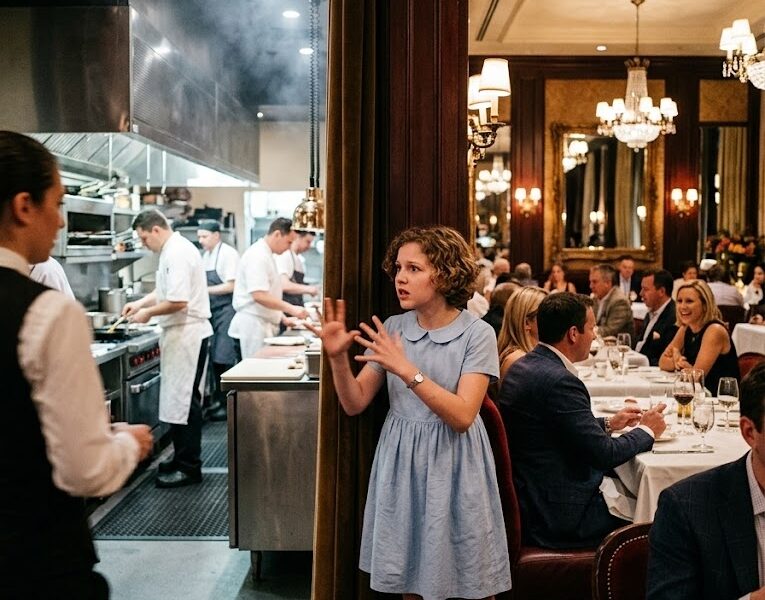
Her hands were moving urgently.
Not randomly.
Not impatiently.
Urgently.
She waved toward the back of the restaurant, pointed above the kitchen doors, then pressed both palms together and pulled them apart in a sharp motion. Her face had gone pale. Her eyes kept darting from the ceiling to the adults around her.
Nobody stopped.
A man in an expensive navy suit glanced at her and returned to his phone.
Two women at the next table exchanged annoyed looks.
One whispered, “Someone needs to get that child under control.”
The other laughed softly.
The restaurant manager walked within six feet of her without slowing down.
Even the waiter assigned to her table passed by with a coffee pot, smiled vaguely at her mother, and never once looked directly at the child.
Ara Voss tried again.
She slapped one palm lightly against the other, pointed toward the kitchen, and made a movement Matteo Ryland had not seen in years.
His steps stopped.
One porcelain plate shifted against another.
A line of sauce trembled near the rim.
Matteo stared across the crowded dining room.
The girl looked straight at him.
For one second, the luxury restaurant disappeared.
The chandeliers, the champagne glasses, the soft piano music, the wealthy customers discussing property deals and private schools—none of it mattered.
He saw only her hands.
And the fear in her face.
Matteo knew enough American Sign Language to understand one word.
Danger.
Then he smelled something burning.
Three hours earlier, twelve-year-old Ara Voss had been standing in front of the mirror in her bedroom deciding between two dresses.
It was an ordinary decision for most children.
For Ara, it had felt important.
She chose the pale blue dress with tiny white flowers because her mother had once told her the color made her eyes look brighter.
Her mother, Saraphina Voss, had promised they would spend Saturday afternoon together.
No assistants.
No foundation meetings.
No charity committees.
No people who smiled at Ara too widely and then spoke about her as though she were not standing there.
Just lunch.
Maybe the art store afterward.
Maybe the riverside promenade if the weather stayed warm.
Ara had been looking forward to it all week.
Her father, Corbin Voss, had planned to come too, but at 10:16 that morning, an emergency board meeting pulled him away.
Corbin was one of the most recognizable real-estate developers in the state. The Voss name appeared on glass towers, residential developments, hotels, and several buildings along the Blue River skyline.
People who had never met him knew his face.
People who had never spoken to Ara knew almost nothing about hers.
She had been profoundly deaf since birth.
That fact followed her into every room before she had the chance to introduce herself.
Adults lowered their voices around her as though deafness made her fragile.
Strangers exaggerated their mouths.
Waiters asked her parents what she wanted to eat even when she held the menu in her own hands.
Teachers she had met before entering her specialized school sometimes praised her for completing tasks nobody would have praised another twelve-year-old for doing.
“She’s so brave.”
“She’s so inspiring.”
“She’s amazing for someone like her.”
Ara hated the last phrase most.
Someone like her.
She had once asked her mother what it was supposed to mean.
Saraphina had hesitated.
That hesitation had been answer enough.
The Voss home contained almost everything money could buy to make Ara’s life easier.
Visual doorbell systems.
Flashing smoke detectors.
Video intercoms.
Captioning built into every television.
Specialists.
Tutors.
Private ASL instruction for relatives and staff.
Corbin had even paid an architect to redesign part of the house around Ara’s needs.
But at twelve, Ara had already learned something her parents could not remodel away.
Accessibility could be purchased.
Attention could not.
Understanding could not.
The willingness to look at another human being long enough to ask what they were trying to say could not.
That Saturday, Saraphina entered Ara’s room wearing a cream jacket and holding her phone.
“Ready?”
Ara smiled and signed, You said no phone.
Saraphina looked at the device in her hand, caught, and laughed.
“You’re right.”
She slipped it into her handbag.
Ara lifted an eyebrow.
Saraphina raised both hands in surrender.
No phone.
Ara grinned.
For the first twenty minutes, her mother kept the promise.
Then they walked into Belmont Terrace.
The restaurant occupied the top floor of a renovated historic building beside the Blue River. Floor-to-ceiling windows faced the skyline. Sunlight spilled over marble floors and polished silver. Waiters moved quietly between tables. Crystal glasses caught the afternoon light.
Outside, a row of luxury cars waited beneath the covered entrance.
Inside, everything had been designed to make wealthy people feel as though the ordinary world existed several floors below them.
Ara liked the windows.
She could see the movement of the river.
She could feel the low vibration of music through the floor near the grand piano.
She noticed laughter through faces instead of sound.
She watched a little boy press his nose against the glass while his embarrassed father pulled him away.
She saw a woman at a corner table open a velvet box and begin crying when the man across from her slid a ring onto her finger.
People fascinated Ara.
Their faces often said things before their mouths did.
That was why she noticed exactly when her mother’s afternoon stopped belonging to her.
“Saraphina?”
A woman in emerald silk approached before they reached their table.
Saraphina froze for half a second.
Then the polished social smile appeared.
“Victoria. Hi.”
Another person joined them.
Then another.
Within minutes, three adults surrounded Saraphina.
Their hands barely moved when they spoke, which meant Ara could not follow much from a distance.
She caught fragments through lip-reading.
Foundation.
Development.
Gala.
Board.
Donor.
Saraphina glanced at Ara.
“Five minutes,” she signed.
Ara nodded.
Five minutes became twelve.
Then twenty.
A waiter approached.
“Still or sparkling?”
Ara looked at him.
The waiter looked at Saraphina.
“Sparkling,” Saraphina answered automatically.
Ara frowned.
She preferred still water.
She lifted two fingers to get the waiter’s attention.
He was already gone.
The irritation was small.
Familiar.
That almost made it worse.
A second server arrived with menus and began describing the specials to Saraphina and her friends.
Ara opened her menu.
She pointed to grilled salmon.
The server smiled at her mother.
“And for your daughter?”
Ara pointed again.
“She wants the salmon,” Saraphina said.
Ara stared down at the menu.
She knew her mother had not meant anything cruel.
That was what made these moments so difficult to explain.
Cruelty was easy to identify when someone laughed at her.
It was harder when people loved her while still forgetting to let her speak.
Ara tapped Saraphina’s wrist.
Dessert later? she signed.
Saraphina nodded distractedly.
“Of course.”
Then turned back to Victoria.
Ara sat quietly.
Ten minutes passed.
Then something flashed near the kitchen.
Ara looked up.
A rectangular emergency indicator above a service corridor blinked once.
Then again.
She watched it carefully.
Nobody else reacted.
A server pushed through the doors carrying empty glasses.
The light stopped.
Ara returned to her menu.
Thirty seconds later, it flashed again.
This time she noticed something else.
A thin gray ribbon near the top of the service doorway.
Smoke.
Ara straightened.
She pointed.
Her mother did not see.
Ara touched Saraphina’s shoulder.
Saraphina turned briefly.
What is it?
Ara pointed toward the kitchen.
Saraphina glanced.
From their angle, the dining room looked perfectly normal.
“What?”
Ara signed smoke.
Saraphina misunderstood the movement.
“Bathroom?”
Ara shook her head.
Smoke.
Fire.
Kitchen.
But Victoria had begun asking Saraphina about a donor event scheduled for the following month, and Saraphina turned away again.
Ara’s frustration tightened into fear.
She stood.
The server nearest them was carrying wine glasses.
Ara stepped toward him and signed quickly.
He stopped.
“I’m sorry, sweetheart.”
Ara pointed toward the kitchen.
The man smiled with visible discomfort.
“Your mom’s right there.”
He walked around her.
Ara stared after him.
Another waiter passed.
She tried again.
He assumed she wanted something from the dessert cart.
“No dessert yet, okay?”
Ara shook her head hard.
She pointed behind him.
He never turned.
At the next table, a businessman watched her with annoyance.
“Where are this kid’s parents?”
His companion shrugged.
Ara felt heat rising into her face.
The flashing light came again.
Longer this time.
She could not hear an alarm.
She could not know whether anyone else could.
But she saw the haze spreading.
So she moved into the center aisle and raised both hands.
Help.
Smoke.
Danger.
Please.
That was when Matteo Ryland saw her.
He had been having one of the worst shifts of his three months at Belmont Terrace.
At 6:10 that morning, his seven-year-old son, Theo, had climbed into his bed holding a construction-paper invitation.
Family Science Day.
Saturday.
2:00 p.m.
“You said you’d come.”
Matteo had stared at the clock.
He had promised.
He had also agreed to cover the lunch shift because another waiter had called in sick and overtime meant he could finally replace the failing brakes on his twelve-year-old Honda.
“I’ll be there,” Matteo had told him.
Theo had studied his face.
“Promise?”
“Promise.”
It was a dangerous word for Matteo.
His late wife, Elena, had once teased him that he treated promises like legal contracts.
Then she had gotten sick.
And there had been promises neither of them could keep.
I’ll get better.
We’ll take Theo to the beach next summer.
This won’t be the last Christmas.
She died four years earlier.
Theo had been three.
Since then Matteo had built their life from alarms, schedules, school pickups, grocery lists, secondhand furniture, extra shifts, and the stubborn belief that a child should never feel like the burden that ruined his father’s life.
Matteo had once wanted his own restaurant.
Not a place like Belmont Terrace.
Nothing with imported marble or a wine list thicker than a dictionary.
He had imagined twelve tables.
An open kitchen.
A chalkboard menu.
Food people could afford twice a month instead of once a year.
Elena had designed the logo on a napkin during their honeymoon.
RYLAND TABLE.
He still had the napkin in a kitchen drawer.
Life had turned that dream into something he avoided looking at.
At 12:43 that afternoon, Matteo dropped a tray.
Not because he was careless.
Because another server backed through a service door without looking.
Matteo twisted to avoid colliding with him.
Three plates hit the floor.
The manager, Preston Hale, arrived before the pieces stopped sliding.
“Ryland.”
Matteo knelt.
“I’ve got it.”
“Do you?”
“I said I’ve got it.”
Preston lowered his voice because wealthy customers were nearby.
“That’s the second problem with your station this week.”
“The first one was a customer knocking over a wine bucket.”
“Excuses don’t clean floors.”
Matteo’s jaw tightened.
He picked up a broken piece of porcelain.
“I’ll cover the plate.”
“It’s not about the plate.”
Of course it was not.
It was about hierarchy.
Belmont Terrace had a way of making people understand where they stood.
The customers were important.
The executives were important.
The manager was important because important people knew his name.
The waiters became visible when something went wrong.
Matteo looked up.
“Anything else?”
Preston gave him a thin smile.
“Try not to embarrass us again.”
Matteo almost laughed.
Instead, he returned to work.
Twenty minutes later, while carrying three fresh plates through the main dining room, he saw Ara.
And recognized a sign he had not used in nearly a decade.
Matteo’s cousin Natalie had temporarily lost much of her hearing after a severe illness when they were teenagers.
The family had taken an introductory ASL course together.
Natalie eventually recovered some hearing.
Matteo forgot most of the vocabulary.
But he remembered enough.
Help.
Danger.
Fire.
His stomach dropped.
He placed the plates on the nearest service stand without caring whose meals they were.
Then walked directly toward Ara.
Saraphina noticed him approaching.
“Yes?”
Matteo barely looked at her.
He crouched so he was level with the girl.
Then slowly, clumsily, signed:
My name Matteo.
Ara froze.
Her expression changed so dramatically that Saraphina stopped talking.
The child who had spent the last half hour shrinking into herself suddenly looked alive.
You sign? Ara asked.
A little, Matteo admitted.
Her hands exploded into motion.
Too fast.
Matteo raised both palms.
Slow.
Ara forced herself to breathe.
Smoke.
Kitchen.
Light flashing.
Nobody listens.
Matteo followed enough.
“Smoke?”
Ara nodded violently.
Saraphina leaned closer.
“What is she saying?”
Matteo stood.
“She says there’s smoke near the kitchen.”
Saraphina’s expression shifted.
“Smoke?”
Matteo turned.
At first he saw nothing.
Then sunlight from the windows caught something near the ceiling.
A faint gray haze.
His pulse spiked.
He smelled heated plastic.
Matteo started toward the service corridor.
Preston intercepted him.
“Where are you going?”
“Possible fire.”
“What?”
“Smoke near the warming station.”
Preston glanced around.
“I don’t see anything.”
“The girl did.”
He pointed back.
Preston looked at Ara.
His skepticism was instantaneous.
“That child?”
Matteo stared at him.
“Yes. That child.”
“Don’t cause a panic over—”
A sharp pop came from behind the kitchen doors.
Matteo heard it.
Ara saw the staff inside turn simultaneously.
Then smoke rolled through the upper edge of the doorway.
Everything changed.
“Call 911,” Matteo said.
Preston went pale.
“Everybody out.”
The dining room transformed in seconds.
Servers began moving customers toward the stairwells and elevator lobby.
People who had been irritated by Ara five minutes earlier were suddenly gathering handbags and children.
A woman demanded to know if the building was on fire.
Someone tried to return for a coat.
A man complained about an unfinished bottle of wine.
Matteo pushed through the kitchen doors.
A commercial warming unit had overheated beside a stack of linens. One towel had begun smoldering. The automatic suppression system had not fully triggered because the heat had not reached the necessary threshold.
Yet.
“Extinguisher!” Matteo shouted.
A cook handed him one.
Within moments, trained staff contained the small ignition while others shut down power to the unit.
But smoke had already entered the ventilation system.
The fire department arrived within minutes.
Customers were evacuated.
Outside, under the bright Saturday sun, Belmont Terrace’s carefully controlled elegance dissolved into confusion.
Bentley owners stood beside tourists.
Executives stood beside dishwashers.
A bride-to-be still wore the napkin she had thrown over her shoulder while rushing outside.
And in the middle of them all stood Ara.
For once, everyone was looking at her.
Not because of her father.
Not because she was deaf.
Because she had seen what everyone else missed.
Saraphina stood several feet away staring at her daughter.
Ara was speaking rapidly with her hands to Matteo.
He understood perhaps half.
When he missed something, he did not pretend.
He shook his head.
Again, slower.
Ara repeated it.
Matteo tried.
She corrected his sign.
He laughed.
Ara laughed too, silently.
Saraphina felt something crack open in her chest.
She had spent twelve years fighting for Ara.
She had argued with schools.
Corrected doctors.
Fired a therapist who spoke about Ara’s “limitations” in front of her.
Donated millions to accessibility programs.
Installed technology most families could never afford.
She had believed that protecting her daughter meant building enough safeguards around her.
Yet forty minutes earlier, Ara had been sitting beside her.
Terrified.
Trying to tell her there was smoke.
And Saraphina had been too busy discussing a charity gala to listen.
A firefighter approached.
“Who first noticed the smoke?”
Preston pointed vaguely toward the restaurant.
“One of our staff members—”
“No,” Matteo said.
Preston looked at him.
Matteo pointed to Ara.
“She did.”
The firefighter turned.
Ara watched his mouth.
Saraphina immediately began interpreting.
“She saw the visual indicator flashing and noticed smoke above the service corridor.”
The firefighter nodded with genuine seriousness and faced Ara directly, not Saraphina.
“Thank you.”
He spoke slowly enough for her to read.
Then he gave her a thumbs-up.
Ara smiled.
Several nearby customers began whispering.
“That’s the girl?”
“She warned them?”
“I saw her trying to get someone’s attention.”
“So did I.”
That last sentence came from the businessman who had complained about her behavior.
Ara looked toward him.
The man’s eyes dropped.
It was a tiny moment.
But Saraphina saw it.
And for the first time in years, wealth offered her no defense against shame.
Her daughter had not been invisible.
People had seen her.
They had simply decided not to look closely enough.
Matteo’s phone vibrated.
3:14 p.m.
He checked the screen.
Three missed messages from Theo’s teacher.
MR. RYLAND, THEO IS STILL WAITING IN THE SCIENCE HALL.
Matteo closed his eyes.
“No.”
He had forgotten.
Again.
The fire.
The evacuation.
Everything had pushed the promise from his mind.
He pulled off his apron.
Preston saw him.
“Where do you think you’re going?”
“My son’s school.”
“We’re in the middle of an emergency.”
“The fire department has the building.”
“We have customers everywhere.”
“My seven-year-old is waiting for me.”
Preston lowered his voice.
“If you walk off this property now—”
Matteo turned.
“Then what?”
Preston stopped.
Something in Matteo’s face warned him not to finish.
Matteo had spent four years swallowing every insult that came with needing a paycheck.
He had smiled at rude customers.
Accepted bad schedules.
Worked holidays.
Covered shifts.
He could survive humiliation.
What he could not survive was becoming the father whose son stopped believing his promises.
“I’m going to my kid,” he said.
Preston’s mouth hardened.
“We’ll discuss your employment Monday.”
“Fine.”
Matteo walked away.
“Wait.”
Saraphina caught up with him.
He looked at her.
She seemed completely different from the elegant woman who had entered Belmont Terrace earlier.
Her hair had loosened in the evacuation.
One sleeve of her cream jacket was smudged gray.
Her face showed something money usually allowed people to hide.
Guilt.
“I need to thank you.”
“You don’t.”
“You listened to her.”
Matteo looked at Ara.
“That shouldn’t be something you have to thank me for.”
Saraphina went still.
He immediately regretted how sharp it sounded.
“I didn’t mean—”
“No,” she said. “You did.”
Matteo hesitated.
Saraphina looked toward her daughter.
“I wasn’t listening.”
Ara had seen the exchange.
Her face softened.
She stepped closer to her mother and touched her hand.
Saraphina looked down.
Ara signed:
You listen now.
Saraphina’s eyes filled.
She swallowed.
“Yes.”
She signed the answer herself.
I listen now.
Matteo looked away.
Private pain deserved privacy.
His phone buzzed again.
“I have to go.”
Saraphina pulled a business card from her handbag.
“At least let my driver take you.”
“My car’s here.”
“To the school?”
Matteo looked at the time.
The drive would take twenty-five minutes.
Maybe eighteen with Saraphina’s driver.
Pride battled fatherhood for less than a second.
“Okay.”
Saraphina nodded.
As Matteo turned, Ara caught his sleeve.
He looked back.
She signed:
Thank you for seeing me.
Matteo stared at her.
Then slowly answered with one of the few signs he knew without hesitation.
Always.
He reached Theo’s school at 3:31.
Family Science Day had ended at three.
Most parents were gone.
Colored volcanoes, poster boards, model planets, and cardboard bridges covered the tables.
Theo sat alone on a folding chair beneath a paper banner, his backpack between his shoes.
On the table beside him stood a small model made from wooden sticks.
Matteo stopped in the doorway.
The teacher looked up.
Relief crossed her face.
“Theo, your dad’s here.”
Theo turned.
He did not run to him.
That hurt more than anger would have.
Matteo crossed the room.
“Buddy.”
Theo looked at the floor.
“I’m sorry.”
“You promised.”
“I know.”
“You always say you know.”
Matteo crouched.
That sentence landed harder than Preston’s threat.
“I messed up.”
Theo shrugged.
“It’s okay.”
“No.”
Matteo shook his head.
“It isn’t.”
Theo looked at him.
Matteo had learned something after Elena died.
Children sometimes said “it’s okay” when what they meant was “I don’t think telling you I’m hurt will change anything.”
He would not let that happen.
“There was a fire at work.”
Theo’s eyes widened.
“A real fire?”
“A small one. Everybody’s safe.”
“Did you fight it?”
“Kind of.”
Theo looked impressed despite himself.
“A girl saw the smoke first.”
“A kid?”
“Twelve.”
“How?”
Matteo thought about Ara.
“She was paying attention when everybody else wasn’t.”
Theo picked at the corner of his project.
“What girl?”
“Her name is Ara.”
“Is she the reason you forgot?”
The question was quiet.
Matteo did not hide behind the emergency.
“No. I forgot because I wasn’t paying enough attention to the time. That’s on me.”
Theo nodded.
Matteo pointed to the model.
“What did you build?”
Theo hesitated.
“A bridge.”
“It looks good.”
“It held sixteen pounds.”
Matteo blinked.
“Sixteen?”
“Second place held eleven.”
A smile broke across Matteo’s face.
“You won?”
Theo looked up.
“For strongest bridge.”
Matteo felt pride and grief collide.
He had missed it.
The moment was gone.
No apology could give it back.
So he sat beside his son in the nearly empty science hall and asked Theo to explain every stick, every joint, every failed version, every reason his bridge had held.
He listened until the janitor needed the room.
That evening, they ate boxed macaroni at their small kitchen table.
Theo asked, “Why couldn’t the girl tell people about the fire?”
“She did.”
“But you said nobody knew.”
“They didn’t understand her.”
“Why not?”
“She’s deaf. She uses sign language.”
Theo considered this.
“So her hands talk?”
Matteo smiled.
“Yeah. You could say that.”
“Then why didn’t people listen with their eyes?”
Matteo stopped chewing.
Children had an infuriating ability to make complicated failures sound simple.
“I don’t know.”
Theo twirled macaroni around his fork.
“You listened.”
“A little.”
“Do you know sign language?”
“Barely.”
“Teach me.”
Matteo laughed.
“I know about twelve signs.”
“Teach me the twelve.”
That night, after Theo went to bed, Matteo opened his laptop.
He searched for local ASL classes.
He did not know why.
Maybe guilt.
Maybe curiosity.
Maybe because one child had looked at him that afternoon like his ability to understand three signs had changed the shape of the world.
At 10:43 p.m., an email arrived from Belmont Terrace.
Mandatory meeting.
Monday, 8:00 a.m.
Matteo knew exactly what it meant.
Across town, in a penthouse overlooking the Blue River, Ara was awake too.
Her mother sat on the edge of her bed.
Neither had turned on the main lights.
The skyline glowed through the windows.
Saraphina signed slowly.
I am sorry.
Ara watched.
Saraphina continued.
Today, you needed me.
I did not see.
Ara looked down.
The response took time.
Finally, she signed:
You see me at home.
Saraphina nodded.
Ara added:
Outside, sometimes you become like other people.
The words hurt because they were precise.
How?
Ara thought.
People ask you questions about me.
You answer.
People ask what I want.
You answer.
People ask what I can do.
You answer.
You tell them to include me.
But sometimes you do not include me either.
Saraphina covered her mouth.
Ara’s expression immediately softened.
She loved her mother.
This was not revenge.
That made it worse.
Saraphina reached toward her, then stopped.
May I hug you?
Ara nodded.
Her mother pulled her close.
Ara felt the vibration of Saraphina’s crying before she saw the tears.
For years Saraphina had believed motherhood meant protecting Ara from people who underestimated her.
She had never considered that love could become its own kind of overprotection.
A beautiful cage was still a cage.
When Ara finally fell asleep, Saraphina went to Corbin’s study.
Her husband had just returned from his meeting.
He was standing beside the window loosening his tie.
“What happened?”
Saraphina told him.
All of it.
The ignored warning.
The smoke.
The waiter.
The evacuation.
Ara’s words upstairs.
Corbin listened without interrupting.
When she finished, he stared at the city below.
Then said quietly, “I do it too.”
Saraphina looked at him.
“At restaurants. At meetings. At school conferences.” His jaw tightened. “I answer for her.”
“We thought we were helping.”
“I know.”
“That almost makes it worse.”
Corbin turned.
“Who was the waiter?”
“Matteo Ryland.”
Corbin nodded once.
“I want to thank him.”
“That’s not what he wants.”
“How do you know?”
“Because I tried.”
Saraphina sat down.
“He said Ara deserved the credit.”
Corbin looked toward the ceiling, as though he could see through two floors to his daughter’s bedroom.
“Then he may be the first person today who treated her like a person instead of a story.”
Monday morning, Matteo arrived at Belmont Terrace prepared to be fired.
He had already updated his résumé.
Preston sat behind the desk in the administrative office.
The general manager, Evelyn Shaw, sat beside him.
Matteo took the empty chair.
Preston folded his hands.
“Saturday was unacceptable.”
Matteo almost laughed.
“Which part?”
Evelyn looked at Preston.
He continued.
“You abandoned your shift during a major operational emergency.”
“My child was waiting alone at school.”
“You left without authorization.”
“The building had been evacuated and the fire department was in control.”
“You were scheduled until four.”
Matteo leaned back.
“Are you firing me?”
Preston hesitated.
Evelyn answered instead.
“No.”
Preston glanced at her.
She continued.
“Fire inspectors reviewed the incident.”
Matteo waited.
“The warming unit had a damaged electrical component. According to the report, another ten or fifteen minutes could have produced a serious kitchen fire.”
Matteo thought of Ara’s frightened face.
Evelyn folded the report.
“The Voss girl’s warning likely prevented a much larger emergency.”
“Yes.”
“And you were the first employee who understood her.”
“Barely.”
“Still more than anyone else.”
Preston crossed his arms.
Evelyn looked at him.
“Mr. Hale informed me that you disregarded his instructions before the evacuation.”
Matteo’s shoulders stiffened.
“He told me not to cause a panic.”
Preston leaned forward.
“I told you to verify before alarming two hundred customers.”
“I did verify.”
“You rushed toward the kitchen.”
“Because there was smoke.”
“Which you didn’t see initially.”
“The child did.”
Silence.
Matteo’s voice lowered.
“That’s the point, isn’t it?”
Evelyn studied him.
“What point?”
“Nobody trusted what she was saying because she wasn’t saying it the way they expected.”
Preston rolled his eyes.
“Oh, come on.”
Matteo looked at him.
“If she could hear and had screamed ‘fire,’ would you have reacted differently?”
Preston opened his mouth.
Nothing came out.
Evelyn noticed.
So did Matteo.
The meeting ended with no termination.
Instead, Belmont Terrace issued Matteo a written warning for leaving before his shift officially ended.
Matteo signed it.
Not because he agreed.
Because rent was due Friday.
He returned to the dining room.
At noon, the hostess approached.
“There’s someone asking for you.”
“Who?”
She pointed.
Saraphina Voss stood near the windows.
Ara was beside her.
And Saraphina was holding an envelope.
Matteo’s stomach tightened.
He wiped his hands on his apron.
“Mrs. Voss.”
“Saraphina.”
Ara smiled.
Matteo signed hello.
Her smile widened.
He had practiced.
Saraphina noticed.
“You remembered more.”
“Internet.”
Ara signed something fast.
Matteo stared.
“No chance.”
Ara laughed and repeated it slowly.
He followed.
She had asked whether he had learned to sign coffee yet.
Matteo tried.
Ara shook her head and corrected his hand.
“Apparently not.”
Saraphina smiled.
Then held out the envelope.
“What’s that?”
“A proposal.”
Matteo did not take it.
“For what?”
“Open it.”
He hesitated, then did.
There was a number on the page.
A very large number.
Matteo looked up.
“No.”
“You haven’t read it.”
“I read enough.”
“It’s a consulting position.”
“I’m a waiter.”
“You’re also the reason my daughter was heard.”
“She’s the reason everyone got out.”
“I know.”
“Then hire her.”
Saraphina almost smiled.
“I suspect child-labor laws would become complicated.”
Matteo handed the paper back.
“I don’t want charity.”
Her smile disappeared.
“It isn’t charity.”
“That number says otherwise.”
“The number reflects what my family pays consultants.”
“I’m not a consultant.”
“No,” Saraphina said. “You’re someone who noticed a problem every executive in this building failed to notice.”
Matteo glanced around.
Several staff members were watching.
He lowered his voice.
“Your daughter needed one person to stop and look at her. That doesn’t qualify me for some six-figure job.”
“No. But maybe what happened qualifies this place for change.”
That made him pause.
Saraphina continued.
“I talked to management. Their accessibility training is almost entirely focused on physical access. Ramps. Restrooms. Seating. There is nothing meaningful about communication with deaf customers.”
Matteo looked at Ara.
“What exactly are you asking?”
“Help us build something better.”
“I know basic ASL.”
“Then don’t teach the ASL.”
Matteo frowned.
Saraphina nodded toward Ara.
“Listen to the people who do.”
For the first time, the proposal sounded different.
Not rescue.
Not reward.
Responsibility.
Saraphina removed a second document.
“This version is smaller.”
Matteo stared.
“You brought two?”
“I’ve negotiated with men much more stubborn than you.”
Ara signed something.
Saraphina laughed.
“What did she say?”
“She said I’m worse.”
Matteo smiled despite himself.
The revised proposal paid him a modest consulting stipend to participate in designing an accessibility initiative alongside certified deaf educators, interpreters, and hospitality trainers.
No enormous salary.
No invented executive title.
Actual work.
Matteo read every page.
Then looked at Saraphina.
“One condition.”
“What?”
“Ara gets asked what she thinks.”
Saraphina’s eyes moved to her daughter.
“Agreed.”
Matteo turned to Ara.
You want help?
She nodded.
Then signed:
Not help me.
Help people listen.
Matteo felt something shift inside him.
“Yeah,” he whispered.
“That.”
The program began with embarrassment.
Belmont Terrace’s staff gathered in a conference room one Tuesday morning.
Twenty-seven employees.
Servers.
Hosts.
Managers.
Kitchen supervisors.
Preston sat in the back with his arms folded.
At the front stood a deaf ASL instructor named Maya Benton and an accessibility consultant from a local advocacy organization.
Ara sat beside her mother near the wall.
Matteo sat with the waitstaff.
Maya began without an interpreter.
She signed for almost thirty seconds.
Most people stared helplessly.
Then the interpreter voiced:
“That feeling you have right now, of not knowing what is being said in a room where everyone expects you to understand, is how many deaf customers feel when you speak around them instead of to them.”
The room became very quiet.
Even Preston stopped moving.
Training continued for six weeks.
Staff learned basic greetings.
Yes.
No.
Water.
Food.
Help.
Emergency.
Allergy.
Bathroom.
Wait.
Thank you.
More importantly, they learned that memorizing signs did not make them experts.
They learned to face people when speaking.
To use visual menus.
To write when necessary.
To stop automatically directing questions to companions.
To ask customers how they preferred to communicate.
Belmont Terrace replaced several emergency indicators that had been placed where seated customers could not easily see them.
Menus gained visual-ordering options.
Digital tablets with typed communication became available.
Some staff embraced the changes immediately.
Others treated them as another corporate requirement.
Then one afternoon, Matteo watched a newly trained server approach an older deaf couple.
Instead of looking at their hearing daughter, the server faced the couple.
He signed, awkwardly but sincerely:
Welcome.
The woman’s entire expression changed.
Matteo remembered Ara’s face that first afternoon.
He understood then that recognition had a physical appearance.
People stood differently when they knew they did not have to fight to exist in a room.
At home, Theo had become obsessed with ASL.
He practiced at breakfast.
He practiced in the car.
He practiced when Matteo wanted five minutes of silence after work.
“Dad.”
“What?”
Theo signed something.
Matteo stared.
“Was that turtle?”
“No.”
“Pizza?”
“No.”
“Elephant?”
Theo threw his hands in the air.
“It’s ‘homework.’”
“That looked nothing like homework.”
“You’re bad at this.”
“I have been saying that for weeks.”
A month after the fire, Matteo brought Theo to Belmont Terrace after his shift.
Saraphina and Ara were there for a meeting.
Theo noticed Ara immediately.
“That’s her?”
Matteo nodded.
“Don’t stare.”
“I’m not staring.”
“You are absolutely staring.”
Theo approached anyway.
Ara looked at him.
Theo froze.
Every sign he had practiced vanished from his head.
Ara waited.
Theo finally managed:
Hello. My name Theo.
He got his own name sign slightly wrong.
Ara smiled and corrected him.
Theo tried again.
Then he signed:
You saw fire?
Ara nodded.
Theo’s eyes widened.
Cool.
Ara laughed.
Matteo covered his face.
“Theo.”
“What?”
“You can’t call a kitchen fire cool.”
“It didn’t burn anything big.”
Ara signed something.
Theo looked lost.
Matteo shrugged.
Ara pulled out her phone and typed:
YOUR DAD LOOKED VERY SCARED.
Theo read it and burst out laughing.
“My dad is scared of spiders.”
“I am not.”
“You made me kill one.”
“It was strategically located.”
Ara laughed harder.
Within fifteen minutes, the two children had forgotten the adults.
Ara taught Theo signs for different animals.
Theo intentionally mixed them up to make her laugh.
Dog became horse.
Horse became fish.
Fish somehow became grandmother.
Saraphina watched from across the room.
“I haven’t seen her laugh like that with a new person in a long time.”
Matteo looked at his son.
“Theo talks enough for both of them.”
Saraphina laughed.
Then her expression softened.
“How are you?”
The question surprised him.
“Fine.”
“That sounded convincing.”
“Years of customer service.”
She glanced toward the children.
“Ara told me you missed something at Theo’s school the day of the fire.”
Matteo looked at her.
“How does she know?”
“I may have told her.”
“Why?”
“She asked why you left so fast.”
Matteo looked down at his hands.
“He won the bridge competition.”
“You missed it.”
“Yeah.”
“That must have hurt.”
“Him more.”
Saraphina was quiet.
Matteo continued before he could stop himself.
“Everybody thinks single fathers want praise for doing basic things.”
“What do you mean?”
“Pack lunch. Show up for parent-teacher meetings. Remember medication. People say, ‘Wow, you’re such a good dad.’ Nobody says that to a mother for remembering lunch.”
Saraphina smiled faintly.
“No.”
“The truth is, half the time I’m terrified.”
“Of what?”
“Missing something I can’t get back.”
His eyes stayed on Theo.
“Elena died when he was three. He barely remembers her. So every school event, every birthday, every stupid cardboard bridge feels like something I have to get right for both of us.”
Saraphina did not offer a comforting cliché.
She simply listened.
Matteo noticed.
“You’re getting better at that.”
“At what?”
“Listening.”
She gave him a look.
“Careful.”
For the first time, he saw not Saraphina Voss, wife of Corbin Voss, foundation director, woman who entered restaurants and was immediately recognized.
He saw a mother trying to correct something before her daughter became old enough to stop asking.
Across the room, Ara suddenly waved both hands.
Matteo and Saraphina turned.
Theo was attempting to sign giraffe and had apparently invented an entirely new language.
Ara was laughing so hard she had tears in her eyes.
Saraphina smiled.
Then quietly said, “Maybe neither of us has to get everything right.”
Matteo glanced at her.
“No.”
He watched their children.
“Maybe we just have to notice when we’re getting it wrong.”
Months passed.
The incident at Belmont Terrace gradually disappeared from local conversation.
Another restaurant opened.
Another development project was announced.
Another scandal occupied the news.
But Ara did not forget.
Something had changed after that afternoon.
Not because she had been called a hero.
She hated that word almost immediately.
Adults used it too easily.
Reporters wanted photographs.
A local television station asked whether she had “overcome her disability to save lives.”
Corbin rejected the interview after Ara rolled her eyes so dramatically he nearly laughed.
The real change was quieter.
Ara started taking up more space.
At restaurants, if a server asked Saraphina what her daughter wanted, Saraphina no longer answered.
She looked at Ara.
The silence that followed sometimes made people uncomfortable.
Good.
Ara ordered for herself.
At school meetings, Corbin stopped explaining her ideas.
He waited.
When business associates praised him for “everything he did for her,” he redirected the conversation.
Ask Ara.
At first it was awkward.
Then it became normal.
That was the point.
One Saturday, Ara attended an art workshop at the city museum.
The assignment was simple.
Paint a memory using no words.
She stared at the blank canvas for almost forty minutes.
Then she began.
Gray figures filled the background.
Dozens of them.
Their faces turned in different directions.
Some looked at phones.
Some looked at each other.
Some had no eyes at all.
In the center stood a small girl in blue.
Her hands were raised.
At the far edge of the canvas stood one man in a white shirt and dark apron.
He was not painted as a hero.
He was not larger than anyone else.
He was simply looking at her.
When the instructor asked for the title, Ara wrote:
SOMEONE SAW ME.
Saraphina cried when she saw it.
Corbin went silent for almost a full minute.
Matteo saw the painting two weeks later.
Ara carried it into Belmont Terrace wrapped in brown paper.
She placed it on a table.
He stared.
“That’s me?”
Ara nodded.
“You made me look taller.”
She signed:
Artistic freedom.
He laughed.
Then looked more closely.
The surrounding people were rendered in gray.
The girl in blue was almost translucent.
But where her eyes met Matteo’s, the colors became warmer.
Matteo swallowed.
Ara’s expression changed.
You okay?
He nodded.
Then shook his head.
Then nodded again.
“I don’t know.”
Theo stood beside him.
“Dad’s crying.”
“I’m not.”
“You literally are.”
Matteo wiped his cheek.
Ara smiled.
Then pointed to the title.
Someone saw me.
Matteo looked at her.
Slowly, he signed:
You saw everyone first.
Ara’s smile faded.
He pointed toward the painted smoke.
You saved them.
She stared at him.
For months, adults had thanked Matteo.
The restaurant had praised him.
Saraphina had credited him.
Even Ara had believed the story began when Matteo noticed her.
He was the first person to say the truth differently.
She had noticed the danger.
She had acted.
He had merely been willing to believe her.
That distinction mattered.
The painting was later selected for a youth exhibition.
Then the Voss Foundation requested permission to display it at an annual fundraising event focused on education and accessibility.
Ara agreed under one condition.
No inspirational speeches about how “brave” she was.
Saraphina promised.
The gala was held seven months after the fire.
Belmont Terrace catered it.
Matteo tried to refuse his invitation.
“You’re going,” Theo informed him.
“I work those events.”
“Not this one.”
“I don’t own a tux.”
“Mr. Voss sent one.”
“That is exactly why I’m not going.”
Theo looked at him.
“You’re being weird.”
“I don’t like rich-person parties.”
“You work at a rich-person restaurant.”
“That’s different. They pay me.”
Theo crossed his arms.
“Ara wants us there.”
Matteo sighed.
Children had discovered his only reliable weakness.
Other children.
He went.
The gala occupied the glass atrium of the Voss Foundation headquarters.
Hundreds of guests moved beneath suspended lights.
Large screens displayed artwork created by deaf and hard-of-hearing students.
Interpreters stood beside the stage.
Live captioning appeared on screens.
Visual announcements accompanied the audio program.
Matteo noticed every detail.
So did Ara.
Her painting stood near the entrance.
People gathered around it all evening.
Some recognized Matteo from the description.
He hated that.
Theo loved it.
“That lady knows you.”
“She does not.”
“She pointed.”
“She’s probably pointing at dessert.”
“She’s looking right at you.”
“Go find Ara.”
“I already found her.”
Sure enough, Ara appeared from behind him.
She wore a dark blue dress.
Her hair was tied back.
She had grown slightly taller.
Or perhaps Matteo had simply stopped seeing her first as a child in need.
She signed something.
Matteo stared.
Theo translated.
“She says you clean up okay.”
“Tell her she’s rude.”
Theo signed an incomprehensible version.
Ara laughed.
“You did not sign what I said.”
Theo looked innocent.
Before Matteo could interrogate him, the lights dimmed.
The program began.
Corbin spoke briefly.
Then Saraphina walked onto the stage.
Matteo shifted uncomfortably.
She began with the day of the restaurant fire.
But not the version people expected.
“Seven months ago,” she said, while an interpreter signed beside her, “my daughter tried to tell me something important.”
Ara watched.
“I did not listen.”
The room became still.
Saraphina continued.
“That is difficult for me to admit because I have spent twelve years believing that I am one of the people who always listens to her.”
She looked toward Ara.
“I loved her. I advocated for her. I built systems around her needs. I fought people who underestimated her. But love does not automatically make us good listeners.”
Matteo lowered his eyes.
Around him, nobody moved.
“My daughter was born deaf. The greatest obstacles she has faced have often had very little to do with her deafness. They come from what hearing people assume her deafness means.”
Saraphina took a breath.
“We confuse communication with speech. We confuse silence with passivity. Sometimes we even confuse our desire to help with permission to take someone else’s voice.”
Ara’s eyes glistened.
Saraphina looked directly at her.
“That afternoon, Ara saw danger before any of us did. She warned us. Again and again.”
The painting appeared on the screen behind her.
“She did not fail to communicate.”
Saraphina paused.
“We failed to listen.”
Matteo felt Theo take his hand.
“A waiter named Matteo Ryland finally stopped.”
Several heads turned.
Matteo wanted the floor to open.
“But I no longer tell this story by saying Matteo gave my daughter a voice.”
Saraphina looked toward him.
“He didn’t.”
Matteo looked up.
“Ara already had one.”
The words struck him unexpectedly.
“Matteo did something both simpler and rarer. He believed that her voice was worth the effort required to understand it.”
Ara was crying now.
Quietly.
Matteo’s throat tightened.
Saraphina continued.
“And that changed more than a restaurant.”
The foundation announced a new accessibility grant.
Not named after Corbin.
Not named after Saraphina.
Ara had refused that too.
It would fund communication training and visual emergency systems in independent restaurants, youth centers, and community spaces that could not afford the upgrades Belmont Terrace had made.
Matteo had helped design the hospitality portion.
He had never expected anyone to mention that.
Saraphina did.
Then she announced something else.
Belmont Terrace would expand the program throughout its parent company’s restaurant group.
Certified deaf trainers would be hired and paid to lead the work.
The applause was loud.
Ara could not hear it.
But she could see hundreds of hands rising.
Some people clapped.
Others used the ASL applause sign, hands lifted and twisting in the air.
Ara stared.
A room full of people was speaking in a way she could see.
For several seconds, she did not move.
Then she raised her hands too.
Matteo watched her.
He remembered the first afternoon.
Those same hands had been moving desperately in a crowded room.
People had looked away.
Now hundreds of people were watching.
And somehow the sight broke something open in him.
Later, after the speeches, he escaped to a quieter hallway.
Corbin found him there.
“You hate these things too?”
Matteo looked at the billionaire.
“I was about to ask you the same question.”
Corbin loosened his tie.
“My wife loves them.”
“That makes one person.”
They stood beside the windows.
Below them, the Blue River reflected the city lights.
Corbin handed Matteo a drink.
“Soda.”
“Thanks.”
For a moment neither spoke.
Then Corbin said, “Saraphina told me you once wanted your own restaurant.”
Matteo almost choked.
“Your wife asks a lot of questions.”
“She does.”
“That was a long time ago.”
“Why did you stop?”
“Life.”
“That’s not an answer.”
Matteo glanced at him.
“You always interrogate waiters at charity events?”
“Only the ones who tell my wife no.”
Matteo laughed.
Then looked through the glass.
“My wife got sick.”
Corbin’s face changed.
“I’m sorry.”
“After Elena died, dreams became expensive.”
“What does that mean?”
“It means I had a three-year-old. Medical bills. Rent. A restaurant is risk. A paycheck is food.”
Corbin nodded.
He did not say, I understand.
Matteo appreciated that.
A billionaire claiming to understand financial survival would have ruined the conversation.
“So,” Corbin said, “you chose your son.”
“There wasn’t a choice.”
“There’s always a choice.”
Matteo looked at him.
Corbin’s gaze had moved toward the ballroom where Ara stood with Theo.
“Sometimes the right one still costs you something.”
Matteo understood the sentence was no longer about restaurants.
Corbin continued.
“I spent years telling myself every late meeting was for my family.”
Matteo waited.
“The house. The schools. The security. The future.” He exhaled. “At some point, you can build so much for your children that you forget to be where they are.”
Matteo looked at Theo.
“That’s why I left during the fire.”
“I know.”
“I still missed his science competition.”
“He told me.”
Matteo groaned.
“Does everybody know?”
“Apparently his bridge held sixteen pounds.”
“Sixteen.”
“Impressive.”
“Thank you.”
Corbin smiled.
Then his expression grew serious again.
“Don’t let survival become your excuse forever.”
Matteo frowned.
“For what?”
“For deciding your life is already over.”
Before Matteo could answer, Ara appeared in the doorway.
She looked at both men.
Then signed something.
Corbin laughed.
“What?”
“She says we look depressing.”
“She’s not wrong.”
Ara walked to Matteo and held out her hand.
He stared.
“What?”
She pulled him toward the ballroom.
Theo was waiting near the painting.
Saraphina stood beside him.
The music had changed.
Matteo could feel the low bass through the floor.
Ara could too.
Theo bounced in place, trying to convince her to dance.
She shook her head.
Then changed her mind.
Within minutes, the children were moving beneath the lights.
Badly.
Joyfully.
Matteo stood between Saraphina and Corbin watching them.
For the first time in years, he did not feel like the surviving half of a broken family.
He felt surrounded.
Not rescued.
Not rewarded.
Included.
There was a difference.
A year after the fire, Matteo left Belmont Terrace.
Preston assumed he had found another restaurant job.
He had not.
The accessibility consulting work had expanded.
Matteo had spent months visiting restaurants, learning operations, talking to deaf trainers, watching what successful businesses did differently.
Somewhere along the way, the old dream returned.
Quietly at first.
He began writing menus again.
Theo found the RYLAND TABLE napkin in the kitchen drawer.
“What’s this?”
Matteo took it carefully.
“Your mom drew that.”
“She did?”
“On our honeymoon.”
Theo examined the faded ink.
“Why does it say table?”
“I wanted a restaurant.”
Theo looked at him.
“You work in a restaurant.”
“My restaurant.”
“Oh.”
Theo thought for approximately three seconds.
“So make one.”
Matteo laughed.
“That’s not how adulthood works.”
“Why?”
“Money.”
“How much?”
“A lot.”
“More than eighteen dollars?”
“Yes.”
Theo looked disappointed.
“That’s all I have.”
Matteo ruffled his hair.
“Keep your eighteen dollars.”
But that evening Matteo opened the business plan he had abandoned six years earlier.
Most of it was useless.
The costs were outdated.
The neighborhood he had wanted was now too expensive.
Half the menu made no sense.
Yet the dream did not look dead.
Only neglected.
He found a smaller location near the river.
Former bakery.
Fourteen tables.
Open kitchen.
Bad paint.
Excellent light.
He stood in the empty room with Theo one rainy afternoon.
“What do you think?”
Theo looked around.
“It smells weird.”
“Thanks.”
“But I like the window.”
“So do I.”
A week later, Matteo told Saraphina.
He expected encouragement.
She immediately asked to invest.
He immediately said no.
“Matteo.”
“No.”
“You haven’t heard the amount.”
“That is exactly why.”
“This is not charity.”
“You said that last time.”
“And I was right.”
“I need to do this myself.”
Saraphina studied him.
“Why?”
“Because I need to know I didn’t get it because a billionaire’s family felt grateful.”
Ara, sitting beside her mother, watched the exchange.
Then signed:
Stubborn.
Matteo pointed at her.
“Stay out of this.”
Ara smiled.
Corbin arrived halfway through the argument.
“What are we fighting about?”
“Your wife wants to buy my restaurant.”
“I said invest.”
Corbin nodded.
“Don’t take her money.”
Saraphina stared at him.
“Excuse me?”
Matteo blinked.
Corbin continued.
“He’ll spend the next twenty years wondering whether it was his.”
Saraphina crossed her arms.
“You have a better idea?”
“Yes.”
Corbin looked at Matteo.
“A loan.”
“No.”
“Commercial terms.”
“No.”
“Bank rate.”
“No.”
“You haven’t heard—”
“No billionaires.”
Corbin almost smiled.
“Fine.”
Saraphina frowned.
“Then how are you planning to open?”
Matteo held up a folder.
“Small-business loan. Savings. One terrifying credit line.”
Saraphina looked genuinely anxious.
“That sounds reckless.”
“That’s because you have accountants.”
She laughed despite herself.
In the end, the Voss family did not fund the restaurant.
But Ara contributed something Matteo could not refuse.
The artwork.
A smaller print of Someone Saw Me hung near the entrance.
Beneath it was a plaque.
Not about deafness.
Not about heroes.
Only four words:
PAY ATTENTION TO PEOPLE.
Ryland Table opened on a Thursday in October.
Fourteen tables.
An open kitchen.
Affordable food.
Visual menus.
Staff trained in basic ASL.
Emergency alerts both visible and audible.
Hiring practices developed with the same deaf consultants who had worked at Belmont Terrace.
No marble.
No crystal chandeliers.
No valet parking.
The first week was chaos.
Matteo burned bread.
A refrigerator failed.
One server quit after two days.
Theo spilled an entire pitcher of lemonade during the friends-and-family opening.
Matteo went home every night exhausted.
And happier than he had been in years.
On the restaurant’s first Saturday, Saraphina, Corbin, and Ara arrived.
Theo ran to Ara.
She immediately signed something that made him laugh.
Matteo approached the table.
“Reservation?”
Corbin looked offended.
“You know who I am?”
“Sorry, sir. We have standards.”
Saraphina smiled.
Ara pointed toward the painting.
Then at Matteo.
He shook his head.
“You’re never getting that back.”
She laughed.
Halfway through lunch, the restaurant grew busy.
Every table filled.
A young family entered.
Mother.
Father.
A teenage boy using a wheelchair.
A little girl, perhaps eight, who seemed overwhelmed by the noise and movement.
Matteo watched one of his servers approach.
The server spoke to the parents.
Then looked directly at both children.
Not over them.
Not through them.
At them.
The little girl pointed to a picture on the visual menu.
The server crouched.
“Good choice.”
Nothing dramatic happened.
No fire.
No emergency.
No wealthy donor.
No applause.
And Matteo realized that perhaps this was what change was supposed to look like when it worked.
Ordinary.
A person entered a room.
Someone noticed them.
Someone communicated.
Nobody called it inspirational.
Life simply continued with one less person made invisible.
Across the restaurant, Ara was watching too.
Their eyes met.
She smiled.
Matteo signed:
I see.
Ara nodded.
Years later, Saraphina would still remember the smoke.
Corbin would remember the phone call telling him his family had been evacuated.
Matteo would remember the cold fear of seeing three missed messages from Theo’s teacher.
Theo would remember the bridge competition his father missed almost as clearly as he remembered the restaurant they later built together.
But Ara remembered something different.
She remembered standing in Belmont Terrace surrounded by people.
She remembered knowing there was danger.
She remembered trying once.
Twice.
Again.
She remembered adults looking directly at her and deciding that whatever her hands were saying could probably wait.
For a long time afterward, that was the part she could not forget.
Not the fire.
The looking away.
At sixteen, Ara was invited to speak at a youth accessibility conference.
She refused to let her mother write the speech.
She refused to let her father review it.
She stood beneath bright stage lights while an interpreter voiced her signs.
Matteo and Theo sat in the audience.
Saraphina and Corbin sat two rows behind them.
Ara began with a sentence nobody expected.
“I was never invisible.”
The interpreter’s voice carried through the auditorium.
“I used to describe myself that way because it felt true. But invisible is not the right word.”
Ara paused.
Hundreds watched her hands.
“People saw me.”
Matteo felt his chest tighten.
“They saw the girl standing in the restaurant. They saw me waving. They saw me trying to communicate. Some of them looked straight at me.”
Another pause.
“The problem was not that I was invisible.”
Her hands moved more slowly.
“The problem was that they had already decided my voice did not matter.”
Saraphina began crying.
Ara saw.
She smiled gently at her mother and continued.
“That distinction matters because we cannot fix exclusion by telling excluded people to become more visible.”
Matteo looked at the painting displayed on the screen behind her.
“We have to ask why the rest of us have learned to look at people without listening to them.”
The room was silent.
Ara told them about Belmont Terrace.
About the flashing light.
About smoke.
About a waiter who knew very little ASL and stopped anyway.
Then she looked toward Matteo.
“For years, people called him the man who gave me a voice.”
Matteo smiled faintly.
“I love him very much.”
Theo elbowed him.
Matteo wiped his eye.
“But he did not give me a voice.”
Ara’s hands slowed.
“He gave me something simpler.”
She looked directly at him.
“A moment of his attention.”
Matteo’s smile disappeared.
The room blurred.
“And sometimes,” Ara continued, “that is where dignity begins.”
After the speech, people surrounded her.
Students.
Parents.
Teachers.
Advocates.
A reporter asked for an interview.
Ara said maybe later.
Then she pushed through the crowd toward Matteo.
Theo was taller now, nearly her height.
He signed fluently.
Far better than his father.
Ara hugged him first.
Then Matteo.
He held her tightly.
When they separated, he signed:
Proud.
Ara shook her head.
Wrong sign.
Matteo frowned.
“No, it isn’t.”
She corrected his hand position.
He stared.
“You’re still doing this?”
Always, she signed.
He laughed.
Saraphina and Corbin joined them.
For a moment, they stood together exactly as they had years earlier beneath the lights of the foundation gala.
A billionaire developer.
His wife.
Their deaf daughter.
A former waiter.
A boy who once waited alone beside a cardboard bridge.
People whose lives should have crossed for only a few minutes.
Instead, they had become stitched into one another’s histories.
Not because money rescued anyone.
Not because disability needed a miracle.
Not because one heroic man saved a helpless child.
The truth was smaller.
And much more demanding.
One child noticed danger.
One man believed her.
One mother admitted she had failed to listen.
One father realized providing everything was not the same as being present.
One little boy decided that if his new friend spoke with her hands, he could learn to understand her.
One restaurant changed.
Then another.
Then more.
Lives rarely change because the entire world becomes kinder overnight.
Usually, the world remains noisy.
Busy.
Distracted.
People keep looking at phones.
Managers keep rushing through hallways.
Parents still make mistakes.
Promises still get broken.
Children still stand in rooms where adults assume they know better.
But sometimes, in the middle of all that noise, one person stops.
One person looks again.
One person asks, What are you trying to tell me?
Years after Belmont Terrace, the original painting still hung inside Ryland Table.
The colors had faded slightly from afternoon sunlight.
Matteo had offered to put it behind protective glass.
Ara refused.
“Things are allowed to age,” she told him.
So it remained near the entrance.
Gray faces.
A girl in blue.
A tired waiter turning toward her.
Most customers never knew the entire story.
They only read the small plaque beneath it.
PAY ATTENTION TO PEOPLE.
One rainy evening, long after closing, Matteo found Ara standing alone in front of it.
She was seventeen now.
Theo was in the kitchen finishing dishes.
Saraphina and Corbin had already left.
Matteo approached.
“You okay?”
Ara nodded.
She looked at the painting.
Then signed:
I used to think this was about you seeing me.
Matteo waited.
Now I think it is about the second before.
He frowned.
She pointed to the painted girl.
Her hands were raised.
Still warning.
Still trying.
Still refusing to become silent simply because no one was listening.
Ara signed:
She did not stop.
Matteo looked at the child she had painted years ago.
“No.”
He swallowed.
“She didn’t.”
Ara smiled.
Outside, rain ran down the windows.
Inside, the restaurant was quiet.
No music.
No customers.
No clinking dishes except the occasional vibration from the kitchen where Theo worked.
Ara placed her fingers against the painted girl’s hand.
Then she turned toward Matteo.
Thank you for listening.
Matteo shook his head.
This time, his sign was perfect.
Thank you for speaking.
Ara stared at him.
A slow smile crossed her face.
And in the empty restaurant, beneath a painting born from one of the loneliest afternoons of her childhood, she began to laugh.
Matteo could not hear laughter the way she experienced it.
He never would.
But he saw it in her eyes.
He saw it in her shoulders.
He saw it in the movement of her hands when Theo emerged from the kitchen asking what was so funny.
He saw it in the life that had grown from a moment everyone else nearly missed.
And Matteo understood something he wished the whole crowded world could learn.
Silence had never been the absence of a voice.
Sometimes it was only the place where impatient people stopped listening.
And sometimes the quietest person in the room had been trying to save everyone all along.









