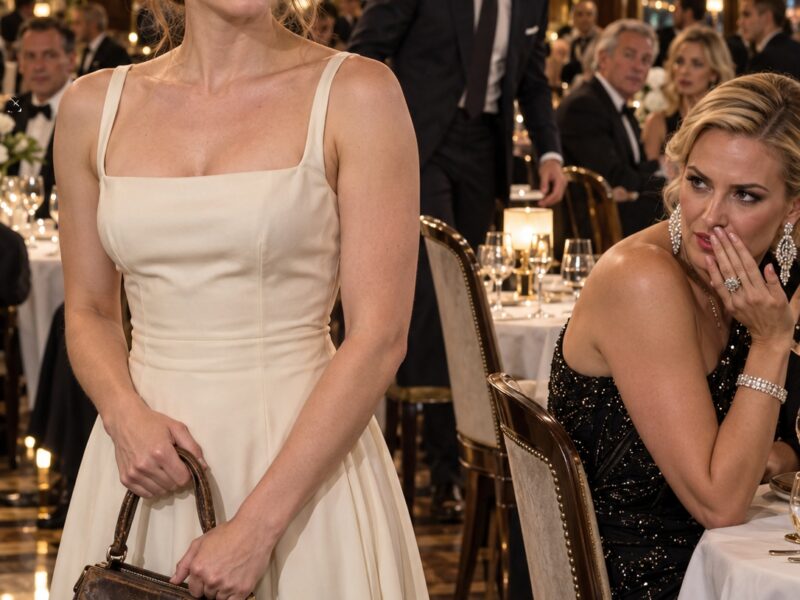
EVERYONE LAUGHED AT THE WOMAN IN THE CHEAP DRESS—UNTIL THE BILLIONAIRE STOOD UP AND SAID HER NAME

The first laugh came from a woman in diamonds.
It was quiet, almost polite, hidden behind the rim of a crystal wineglass as Clara Bennett stepped through the brass-framed doors of one of Manhattan’s most exclusive restaurants wearing a cream dress she had bought six years earlier for someone else’s wedding.
Then another woman leaned toward her companion.
A man near the bar glanced at Clara’s rain-spotted shoes.
Someone whispered something.
Clara didn’t hear the words.
She didn’t need to.
She had spent enough of her life in rooms where money could recognize the absence of money from twenty feet away.
For one terrible second, she nearly turned around.
Her hand tightened around the strap of the small brown handbag hanging from her wrist. The leather had softened with age, one corner slightly scuffed, the brass clasp scratched from years of use. It had belonged to her mother, and Clara had carried it that night because it was the only thing in her apartment that made her feel as if she hadn’t walked into that room entirely alone.
Then, across the restaurant, a chair moved.
Adrien Cole stood up.
The conversation nearest him died first.
Then the silence spread.
People knew Adrien.
At thirty-five, he was the founder and chief executive of Cole Meridian Technologies, a company that had gone from a borrowed loft in Brooklyn to a multibillion-dollar valuation in less than a decade. Business magazines had photographed him in black suits beside phrases like THE FUTURE OF AMERICAN TECH. Financial networks debated his acquisitions. Politicians returned his calls. Investors flew across the country for fifteen minutes of his time.
And Adrien Cole was staring at the woman everyone else had already dismissed.
Not casually.
Not politely.
As if he had been waiting for her.
Clara stopped.
Adrien smiled.
And then, in front of people who had spent the evening calculating who mattered, he walked away from his table and crossed the room to meet her.
“Clara.”
The way he said her name made several people look at her again.
This time, differently.
She swallowed. “I’m sorry I’m late.”
“You’re eight minutes late.”
Her face fell.
Adrien’s smile deepened.
“And considering the rain outside, I was expecting twenty.”
A nervous laugh escaped her.
“The bus stopped near Fifty-Seventh,” she said. “There was some kind of accident, and then everyone had to get off, so I walked the last—”
“You walked?”
“I had an umbrella.”
He looked at the damp shoulders of her dress.
Clara followed his eyes. “Technically, I had most of an umbrella.”
That made him laugh.
Not the controlled laugh she had seen in interviews. Not the camera-ready smile wealthy men learned to wear when photographers were nearby.
A real one.
For the first time since entering the restaurant, Clara could breathe.
What she didn’t know was that Adrien had already been sitting there for forty-three minutes wondering whether meeting her had been a mistake.
Not because of her.
Because of himself.
Three years earlier, he had stopped believing introductions could be innocent.
Every new person seemed to arrive carrying an invisible invoice.
A venture capitalist wanted access. A politician wanted support. A socialite wanted photographs. A woman he dated for two months had secretly negotiated with a lifestyle magazine about an “inside look” at Adrien Cole’s private world before he had even introduced her to his family.
After that, suspicion became easier than disappointment.
He learned to watch people when they thought he wasn’t watching.
The way their eyes drifted toward his watch.
The way questions changed after they saw his penthouse.
The way laughter became louder around him.
The way everyone insisted they didn’t care about money while carefully standing close enough to it.
Then he had seen Clara’s profile.
One photograph.
No filters.
No beach resort. No champagne. No rented sports car positioned strategically in the background.
She was standing outside an old brick bakery with an older woman beside her. Clara’s hair was caught badly by the wind, her mother was laughing, and neither of them seemed aware that the photograph was imperfect.
Beneath it, Clara had written a single sentence.
A good life is one where somebody’s day becomes a little easier because you were in it.
Adrien had stared at the sentence longer than he wanted to admit.
Then he messaged her.
Clara ignored him for eleven days.
When her best friend Maya Rivera found out, she nearly dropped a carton of takeout noodles on Clara’s kitchen floor.
“You ignored Adrien Cole?”
“I thought it was fake.”
“His profile was verified.”
“So are celebrity accounts run by publicists.”
“He asked you to coffee.”
“He asked to meet.”
“Exactly.”
Clara continued folding clean laundry on the end of her sofa.
Maya stared at her.
“You are twenty-eight years old.”
“I’m aware.”
“You work mornings at Bellweather Pharmacy, evenings doing bookkeeping for Russo’s Bakery, and on Saturdays you help Mrs. Donnelly organize medication she forgets she already organized.”
“She gets confused.”
“You have not been on a real date in two years.”
“Three.”
Maya pointed at her. “That is not the correction you should be making.”
Clara smiled despite herself.
Their laughter faded when Maya picked up Clara’s phone and looked again at Adrien’s message.
“He didn’t write anything weird,” Maya said.
“Rich men don’t need to write weird things.”
“That sounded prejudiced.”
“It was practical.”
“He said he liked what you wrote about making someone’s day easier.”
Clara’s hands slowed.
Maya noticed.
“Just one dinner.”
“I don’t belong in his life.”
“You haven’t met him.”
“I’ve seen his life.”
Clara nodded toward the old laptop on her kitchen table.
A photograph from an article was still open on the screen. Adrien in a tuxedo at a museum fundraiser, standing between a former senator and a woman wearing earrings that probably cost more than Clara’s apartment building.
Maya closed the computer.
“That is not his life. That’s a photograph.”
Clara looked at her.
There were moments when Maya sounded so much like her mother that it physically hurt.
“One dinner,” Maya repeated.
Clara eventually agreed.
And now she was standing beneath a chandelier worth more than everything she owned, across from the billionaire she had nearly refused to meet.
Adrien pulled out her chair.
“You don’t have to do that.”
“I know.”
She sat.
That answer unsettled her more than if he had tried to impress her.
The waiter handed them menus bound in dark leather.
Clara opened hers and immediately found a problem.
There were no prices.
Her stomach tightened.
Adrien saw it.
“Anything wrong?”
“No.”
“You made the same face my CFO makes when I suggest expanding into another market.”
She lowered the menu.
“Why aren’t there prices?”
“There are.”
“Not on mine.”
He glanced at the menus and understood.
The restaurant had handed her an old-fashioned guest menu.
Clara caught the change in his expression.
“Oh.”
“It’s ridiculous.”
“It’s fine.”
“No, it isn’t.”
“Adrien.”
It was the first time she had said his name without rehearsing it in her head.
He stopped.
Clara lowered her voice.
“If you make this a thing, everyone will look.”
His eyes moved around the room.
Several people already were.
Clara noticed.
“So please,” she said softly. “Don’t rescue me from a menu.”
Something about the sentence struck him.
He leaned back.
“All right.”
“Thank you.”
“But order whatever you want.”
She gave him a look.
He almost smiled.
“What?”
“I know that sentence.”
“What sentence?”
“The sentence people with money say when they have no idea how terrifying it sounds to people without it.”
That one silenced him.
Clara thought she had offended him.
Then he laughed quietly.
“Fair.”
“You don’t have to pay for me.”
“I invited you.”
“We can split it.”
“Clara.”
“I’m serious.”
“So am I.”
“You probably ordered water here once that cost forty dollars.”
“Twenty-two.”
Her eyes widened.
He immediately regretted answering.
Clara pressed her lips together.
Then she laughed.
Adrien found himself laughing with her.
Several tables looked over again, but something had shifted.
Clara forgot them.
They ordered dinner.
At first, she answered his questions carefully. She told him she worked at a neighborhood pharmacy in the morning and handled bookkeeping for the bakery below her apartment in the evenings. She did not mention the secondhand furniture, the medical debt, or the envelope in her kitchen drawer labeled TUITION that had contained exactly eighty-seven dollars for the last four months.
Adrien didn’t tell her about acquisitions or board meetings.
He asked what she liked.
The question confused her.
“What do you mean?”
“When you aren’t working.”
“I sleep.”
“I’m serious.”
“So am I.”
He waited.
Clara stared at the candle between them.
“I read.”
“What?”
“Everything. Mostly novels from the library because they’re free.”
“Favorite?”
She named one.
Adrien had read it.
Clara’s expression changed.
“You’ve actually read it?”
“You sound surprised.”
“I saw an interview where you said you sleep four hours a night.”
“That’s how I have time to read.”
“That’s not how sleep works.”
“It has so far.”
“You’re thirty-five.”
“Exactly.”
“Come back when you’re forty-five.”
“I feel like you’re threatening me with biology.”
“I work at a pharmacy. Biology makes most of the threats for me.”
He smiled.
The conversation loosened.
She told him about Russo’s Bakery and Mr. Russo’s refusal to change a cinnamon roll recipe his father had invented in 1978.
She told him about Mrs. Donnelly upstairs, who called Clara every Tuesday pretending she needed help opening a jar because she was lonely and too proud to admit it.
She told him about the stray orange cat behind the pharmacy that had learned Clara’s work schedule.
“You feed him?”
“Sometimes.”
“Every day?”
“Sometimes every day.”
“Does he have a name?”
“No.”
“What do you call him?”
“Thomas.”
Adrien stared at her.
Clara realized what she had said.
“Fine. He has a name.”
And Adrien thought, unexpectedly, I like her.
Not because she was different.
Not because she was modest.
Not because he had spent years surrounded by polished people and was now romanticizing simplicity.
He liked the way her face changed before she laughed.
He liked that she challenged him without trying to perform intelligence.
He liked that she seemed embarrassed by compliments but completely unafraid to disagree.
Then a crash shattered the room.
A tray had slipped from a young waiter’s hand near their table.
Two glasses broke.
Silverware scattered across the floor.
The waiter froze.
He couldn’t have been older than twenty.
“I’m so sorry.”
A manager appeared almost instantly.
“What happened?”
“I’m sorry, Mr. Lawson. The tray slipped.”
“Again?”
The boy’s face changed.
Clara heard it.
Not just the word.
The history inside it.
“Get this cleaned up,” the manager snapped. “Then see me in the back.”
The waiter bent down quickly.
His hands were shaking.
One piece of broken glass caught his finger.
Clara was out of her chair before Adrien understood what she was doing.
“Don’t.”
The waiter looked up.
Clara crouched beside him.
“You’re bleeding.”
“I’m fine.”
“No, you’re not.”
The manager’s expression hardened.
“Ma’am, please return to your table.”
Clara ignored him.
She took a clean cloth napkin from the empty place setting beside them and handed it to the waiter.
“Press here.”
“I’ll have someone handle it,” the manager said.
Clara finally looked at him.
“He cut his hand.”
“I can see that.”
“Then why are you talking to him like the broken glass matters more?”
The room became painfully quiet.
Adrien watched.
The manager recognized him.
That made the situation worse.
“Mr. Cole, I apologize for the disturbance.”
Adrien’s expression cooled.
“I wasn’t disturbed until you started speaking.”
The manager went pale.
Clara glanced at Adrien.
He hadn’t raised his voice.
He didn’t need to.
The waiter wrapped his finger.
“I’m really sorry,” he whispered.
Clara looked at him.
“Did you drop it on purpose?”
“No.”
“Then stop apologizing like you committed a crime.”
She helped him collect the unbroken silverware.
A woman at the next table looked horrified that Clara was touching the floor.
Clara noticed her.
Then deliberately picked up another spoon.
Adrien saw that too.
Later, after the waiter had been taken to the kitchen and the glass cleared, Clara sat down.
Her cheeks were flushed.
“What?”
Adrien was staring at her.
“You always do that?”
“Do what?”
“Forget you’re supposed to be intimidated.”
She frowned.
“I was intimidated.”
“You confronted the restaurant manager.”
“He was being cruel.”
“So?”
Clara looked at him as if the answer were obvious.
“So he was being cruel.”
Adrien went quiet.
There was no performance in her answer.
No awareness that kindness had made her more attractive.
No calculation.
That was the moment he began falling for her.
And because life rarely allows people to recognize the most important moment while it is happening, Clara was busy worrying that she had ruined the date.
When dinner ended, she insisted on seeing the check.
Adrien refused.
She threatened to ask the waiter.
He paid before she could.
“You cheated.”
“I moved faster.”
“You have billionaire reflexes.”
“It’s how we survive.”
Outside, Manhattan glittered after the rain.
The sidewalks reflected storefront lights and yellow taxis. Steam rose from a street grate. Somewhere down the block, a man was playing saxophone beneath an awning for strangers who barely slowed down.
Adrien’s driver waited across the street.
Clara noticed the black car.
“Is that yours?”
“Yes.”
“I knew it.”
“Knew what?”
“This evening was becoming dangerously normal.”
He smiled.
“Would you like a ride home?”
She hesitated.
He saw it.
“No pressure.”
“It’s not you.”
“I know.”
“My mother used to say never let someone know exactly where you live until you’re sure they’re not insane.”
“Your mother sounds sensible.”
“She was.”
The past tense landed between them.
Adrien didn’t rush to fill the silence.
Clara appreciated that.
Most people responded to grief by panicking. They said things like she’s in a better place or everything happens for a reason, as if death became easier when placed inside a sentence.
Adrien simply asked, “What was her name?”
Clara looked at him.
“Rose.”
“Tell me about Rose.”
They walked.
For three blocks, then six.
Clara told him about a woman who cleaned offices after midnight and still woke at six to make pancakes. A woman who knew how to stretch one chicken across three dinners. A woman who could sew a button, repair a lamp, negotiate a utility bill, and identify a liar within five minutes.
“She raised me alone after my father left.”
“How old were you?”
“Six.”
“Did you ever see him again?”
“Twice.”
Adrien waited.
“The second time, he asked my mother for money.”
Adrien exhaled.
“She gave it to him?”
“Twenty dollars.”
“Why?”
“She said refusing him would have made her angry all week, and twenty dollars was cheaper than giving him that much space in her head.”
Adrien smiled.
“I think I would have liked her.”
Clara looked down.
“Most people did.”
The smile disappeared.
“She got sick when I was twenty-one.”
“I’m sorry.”
“Ovarian cancer.”
Adrien’s pace slowed.
Clara kept walking.
“I was in college. Social work. Nothing glamorous.”
“It doesn’t need to be.”
“I dropped out.”
“To care for her.”
“For almost two years.”
Her voice stayed level, but her fingers tightened around the old handbag.
“After she died, there were bills. I told myself I’d go back the next semester. Then the next year. Eventually, going back started feeling like something that belonged to a younger version of me.”
“What did you want to do?”
“Open a community learning center.”
He looked at her.
She laughed softly.
“I know.”
“Why are you laughing?”
“Because I’m telling a man who builds billion-dollar companies that my dream was a room with used books and free math tutoring.”
“I didn’t say it was small.”
“No. Your face did.”
“My face was calculating rent.”
She looked at him sharply.
He smiled.
“What kind of center?”
Clara stared ahead.
She hadn’t described it aloud in years.
Then, slowly, she did.
Homework help after school.
College application workshops.
Computers children could use if their families couldn’t afford them.
Financial literacy classes for parents.
A small kitchen where teenagers could eat without being asked whether they had money.
Adrien listened.
At the corner of Lexington Avenue, the light changed.
Neither of them crossed.
“You’ve thought about this a lot,” he said.
“I used to.”
“That’s not what I said.”
She looked at him.
Traffic moved between them and the opposite curb.
For the first time that evening, Clara felt more exposed than she had in the restaurant.
Because embarrassment about an old dress was survivable.
Being seen clearly was something else.
The second date happened four days later.
Then the third.
Then Clara realized Adrien Cole had somehow become the person whose messages she checked before getting out of bed.
He came to Russo’s Bakery one Sunday morning wearing jeans and a navy sweater.
Mr. Russo nearly dropped a tray.
Clara stared at Adrien.
“What are you doing here?”
“You said the cinnamon rolls couldn’t be improved.”
“They can’t.”
“I need independent verification.”
“You could have warned me.”
“Would you have said yes?”
“No.”
“That answers the question.”
She tried not to smile.
Failed.
Adrien sat at a table beside the window while Clara finished helping Mr. Russo reconcile an invoice.
Nobody treated him like a billionaire because Mr. Russo had no idea who he was.
“Young man,” Mr. Russo called from behind the counter, “you want coffee, pour it yourself. I’m not your mother.”
Adrien looked at Clara.
She was biting her lip.
He stood.
“Yes, sir.”
Halfway through breakfast, Mr. Russo pointed a fork at him.
“What do you do?”
“Software.”
“You fix computers?”
“Sometimes.”
“My printer makes a noise.”
Clara put her head down on the table.
Adrien said solemnly, “I’ll take a look.”
Later, outside, Clara laughed so hard she had tears in her eyes.
Adrien watched her.
“What?”
“Nothing.”
“No, that’s a look.”
“You’re different here.”
“From what?”
“From the person on television.”
“Television isn’t a person.”
The sentence stayed with her.
Their worlds began touching in strange, uneven places.
Adrien took her to a small bookstore instead of another expensive restaurant.
Clara brought him soup when he caught the flu and found him trying to answer emails with a fever of 102.
He sent her flowers once.
She divided the arrangement into six jars and distributed them to elderly women in her building.
“That’s not generally what people do with flowers,” he said when he found out.
“They were mine.”
“Correct.”
“So I used them.”
“To improve the romantic lives of half your building.”
“Mrs. Patel cried.”
“I surrender.”
He offered to send a car for her on cold mornings.
She said no.
He bought her a coat after noticing hers had a broken zipper.
She made him return it.
“Clara, it’s a coat.”
“It’s a two-thousand-dollar coat.”
“It’s warm.”
“So is a hundred-dollar coat.”
“I don’t know where to buy a hundred-dollar coat.”
“That may be the saddest thing you’ve ever told me.”
He laughed.
But beneath those moments lived a question Clara could never completely silence.
How long could this last?
Adrien belonged to a world in which people talked casually about vacation homes and private schools and investment portfolios.
Clara calculated the price of groceries in her head.
Adrien’s friends had degrees from Harvard, Stanford, Columbia.
Clara still had an unfinished transcript folded inside an envelope in her desk.
At events, women wore gowns borrowed from designers.
Clara learned which black dress could survive the most occasions without anyone noticing.
Adrien never made her feel ashamed.
Other people did.
Sometimes without saying a word.
Once, at a charity gala, a woman named Sienna asked Clara which foundation her family supported.
“None,” Clara said.
Sienna blinked.
“Oh. I assumed you were from one of the Bennett families.”
“I am.”
“Which one?”
“The one in Queens.”
Adrien nearly choked on his drink.
Sienna didn’t laugh.
Afterward, Clara pretended it didn’t bother her.
Adrien knew better.
“You want to leave?”
“No.”
“You’re squeezing your glass.”
“I’m holding it.”
“Like you’re interrogating it.”
She looked at him.
He lowered his voice.
“We can go.”
“And prove I don’t belong?”
“Clara.”
“No.”
Something sharper entered her voice.
“I am tired of rooms making me feel like I have to earn permission to stand in them.”
Adrien studied her.
Then he held out his hand.
“What?”
“Dance with me.”
“I don’t dance.”
“Neither does half this room. Money just makes bad dancing look intentional.”
She laughed despite herself.
And stayed.
That should have warned her that belonging could become addictive.
Because once you begin imagining a place for yourself inside another person’s life, losing that place becomes frightening.
The invitation to meet Adrien’s family came after four months.
“My mother is having dinner Sunday.”
Clara froze.
Adrien noticed.
“You look like I said she’s arranging an execution.”
“Does she like executions?”
“Only social ones.”
“Adrien.”
“I’m joking.”
“You aren’t.”
He kissed her forehead.
“My sister Emily will be there.”
“The one who sends me memes?”
“The same.”
“Your mother has never sent me a meme.”
“My mother believes memes caused the decline of Western civilization.”
Clara laughed.
But Sunday evening, standing outside Eleanor Cole’s limestone townhouse on the Upper East Side, she stopped laughing.
Adrien touched her hand.
“You don’t have to impress anyone.”
“Easy for you to say.”
“Why?”
“You emerged from this building.”
He looked up.
“Technically I emerged from a hospital.”
“You’re not helping.”
Inside, everything was elegant without trying to appear elegant.
Old paintings.
Fresh flowers.
A piano that looked as if someone actually played it.
Nothing flashy.
That somehow made Clara more nervous.
Emily Cole hugged her the moment she entered.
“Finally.”
Clara blinked.
Emily grinned. “He’s been insufferable.”
“I have not.”
“You smile at your phone.”
“I have always smiled.”
“Not like that.”
Clara’s cheeks warmed.
Then Eleanor entered.
She was sixty-one, silver-haired, poised, dressed in charcoal silk. Her gaze was not cruel.
That would have been easier.
It was assessing.
“Clara.”
“Mrs. Cole.”
“Eleanor, please.”
They shook hands.
Eleanor looked briefly at Clara’s dress.
Then at the handbag.
Only half a second.
Clara still saw it.
Dinner began politely.
Eleanor asked about Clara’s job.
Clara answered.
She asked where Clara had studied.
There it was.
“I attended Hunter College.”
“Attended?”
Clara felt Adrien shift beside her.
“I left before completing my degree. My mother became ill.”
“I’m sorry.”
“Thank you.”
“What did you study?”
“Social work.”
“Do you intend to finish?”
Adrien put down his fork.
“Mother.”
Clara touched his wrist beneath the table.
“It’s fine.”
She looked at Eleanor.
“Yes. I hope to.”
Eleanor nodded.
No judgment visible.
Perhaps Clara imagined the rest.
That was the problem with insecurity.
After enough years of being underestimated, you sometimes heard insults before anyone spoke them.
The conversation moved on.
Clara relaxed slightly.
Then Eleanor mentioned an article about Adrien’s company.
A pending acquisition.
A valuation approaching six billion dollars.
Clara looked at Adrien.
“You didn’t tell me.”
“It isn’t final.”
Eleanor observed them.
Clara felt it.
Later, Emily dragged Clara upstairs to show her childhood photographs.
Adrien stayed behind.
Clara realized halfway up the staircase that she’d left her phone near the dining room.
She turned back.
Voices came from the library.
Eleanor’s.
“You are moving too quickly.”
Adrien answered, quieter.
“I didn’t ask for your opinion.”
“You brought her into this house.”
“Because she’s important to me.”
“That is precisely why I’m speaking.”
Clara stopped.
She should have walked away.
She knew that.
Instead, she stood very still.
Eleanor continued.
“Do you know anything about her finances?”
Adrien’s voice changed.
“Careful.”
“I am being careful.”
“No, you’re being insulting.”
“I am being realistic. You have spent your adult life surrounded by people who want something from you. You know that better than anyone.”
“Clara has never asked me for anything.”
“That proves very little.”
Clara’s stomach tightened.
“She works two jobs,” Eleanor said. “She has debt. She didn’t finish college. And now she is dating one of the wealthiest unmarried men in the country. You don’t see the imbalance?”
“I see you reducing her entire life to a credit report.”
“I see my son making an emotional decision.”
“She isn’t a decision.”
Silence.
Then Eleanor spoke again.
“Women more sophisticated than she is have manipulated men smarter than you.”
That sentence did it.
Clara walked away.
She didn’t retrieve her phone.
She didn’t find Emily.
She picked up her coat from the entry hall with hands that had begun trembling and quietly opened the front door.
Cold air struck her face.
She reached the sidewalk before the tears came.
Not because Eleanor thought she wanted money.
Clara had survived worse judgments.
She cried because some hidden part of her had started believing she might actually fit into Adrien’s life.
That was the humiliation.
Hope.
“Clara!”
She kept walking.
Adrien caught up near the corner.
“Clara.”
“Please don’t.”
He stepped in front of her.
“What happened?”
She laughed once, bitterly.
“Don’t do that.”
“Do what?”
“Pretend.”
Understanding crossed his face.
“You heard us.”
“Enough.”
“Clara—”
“Your mother isn’t wrong.”
“Yes, she is.”
“No.”
“Don’t defend her.”
“I’m not.”
“Then don’t agree with her.”
Clara wiped at her cheek, furious with herself for crying.
“Look at me, Adrien.”
“I am.”
“No. Really look.”
He did.
“This dress cost eighty-nine dollars. On sale.”
He said nothing.
“My apartment is six hundred square feet. I have thirty-two thousand dollars in medical debt from keeping my mother alive as long as I could. I never finished college. I take the subway because I can’t afford a car, not because I’m charmingly committed to public transportation.”
“None of that changes how I feel about you.”
“It changes how your world sees me.”
“I don’t care.”
“I do.”
That surprised him.
Clara’s voice cracked.
“I care because I am the one standing in those rooms while people decide what I must want from you.”
“Then let them be wrong.”
“You don’t understand.”
“Make me.”
She stared at him.
For a few seconds, traffic was the only sound between them.
Then Clara opened her handbag.
She took out an old photograph.
Rose Bennett stood outside Russo’s Bakery, smiling into sunlight, one arm around Clara at seventeen.
“My mother carried this bag for almost fifteen years.”
Adrien looked at the photograph.
“She bought it after saving tips from cleaning offices for four months. Forty-eight dollars.”
Clara smiled through tears.
“She thought it was luxurious.”
Adrien’s throat tightened.
“After she died, I found two things in it. Lip balm and four dollars.”
“Clara—”
“I know what money is worth.”
She closed the photograph in her hand.
“I know because I’ve counted quarters at a laundromat. I’ve skipped meals so my mother could fill a prescription. I’ve called hospitals and begged strangers for payment plans. I have wanted money so badly I felt sick.”
She looked directly into his eyes.
“But I have never wanted yours.”
“I know.”
“Your mother doesn’t.”
“Then that’s her failure.”
Clara shook her head.
“I don’t want you fighting your family because of me.”
“This isn’t about you causing conflict.”
“It will become about that.”
“You’re deciding how this ends before giving me a choice.”
“I’m trying to protect both of us.”
“From what?”
She whispered the answer.
“The day you get tired of defending me.”
Adrien went still.
Clara immediately wished she could take the words back.
But truth, once spoken, rarely returns quietly.
His voice dropped.
“Is that what you think of me?”
“I think you’re human.”
“And humans eventually get tired?”
“Yes.”
“Maybe.”
He stepped closer.
“But you’re making one mistake.”
“What?”
“You think I’m defending you because you’re weaker than the people judging you.”
Clara’s eyes filled again.
“I’m defending you because they’re wrong.”
He touched the photograph in her hand but didn’t take it.
“And because you shouldn’t have to stand alone while they are.”
Clara looked away.
Adrien continued.
“I don’t love how little you have.”
Her head snapped back toward him.
He had never used that word before.
Neither had she.
Adrien heard himself.
So did Clara.
Everything changed.
He swallowed.
“I don’t love you because you’re humble, or because you’re kind to waiters, or because you refuse my car. I love those things about you, but they aren’t why.”
Clara stopped breathing.
“I love you because you’re Clara.”
Traffic moved around them.
A horn sounded somewhere.
Neither reacted.
Adrien gave a small, almost frightened laugh.
“I wasn’t planning to say it outside my mother’s house while we’re arguing.”
Clara whispered, “That was badly planned.”
“I know.”
She began crying again.
“This is terrible.”
“Are those happy tears?”
“I don’t know.”
“That seems important.”
She hit his chest softly.
He caught her hand.
For one suspended moment, Clara thought everything might be simple.
Then she looked back at the townhouse.
It wasn’t.
Adrien returned inside alone.
Eleanor was still in the library.
She stood when he entered.
“Where is Clara?”
“Gone.”
Eleanor’s expression tightened.
“She heard you.”
A flash of regret crossed her face.
Adrien closed the door.
“I need you to understand something.”
“Adrien—”
“No.”
He rarely interrupted his mother.
That alone silenced her.
“You taught me to protect this family from people who wanted access to it.”
“I did.”
“You taught me not to confuse charm with character.”
“Yes.”
“You taught me that wealth makes people reveal themselves.”
Eleanor’s chin lifted slightly.
“And?”
“And tonight it revealed you.”
Her face changed.
Adrien hated hurting her.
He did it anyway.
“You looked at Clara and saw everything she didn’t have.”
“I was protecting you.”
“No. You were protecting your idea of me.”
“There’s a difference?”
“Yes.”
He stepped closer.
“My business taught me to negotiate. Money taught me suspicion. Success taught me how quickly people become agreeable when they need something.”
He paused.
“Clara taught me that a waiter who drops a glass is still a human being.”
Eleanor frowned.
“What?”
“It doesn’t matter.”
“It apparently does.”
Adrien shook his head.
“She has never once asked what my shares are worth. She asks if I’ve eaten. She gets angry when I cancel sleep for work. She sends leftovers home with my driver because she found out he has twin daughters.”
Eleanor looked away.
“Those things do not guarantee—”
“Nothing guarantees anything.”
His voice sharpened.
“Not prenups. Not family names. Not bank accounts.”
Eleanor stared at him.
“You think I don’t know that?”
Something in her tone changed.
Adrien hesitated.
His parents’ marriage had not been happy.
His father had been wealthy, charming, publicly devoted and privately unfaithful for years. Eleanor had endured humiliation with the silence expected of women in families whose reputations mattered more than feelings.
Adrien knew it.
But he had never considered how much of her fear had hardened into prejudice.
Her voice became quieter.
“I watched your father trust people who praised him. I watched friends disappear when his company nearly collapsed in 2003. I watched women smile at me while sleeping with my husband.”
Adrien’s anger softened.
“Clara isn’t Dad.”
“No.”
“She’s not those women.”
“I don’t know her.”
“Exactly.”
The word landed.
Eleanor closed her eyes briefly.
Adrien reached the door.
“You don’t have to love her.”
He stopped.
“But if you humiliate her again, you will lose access to a part of my life that matters to me.”
Eleanor looked at her son.
For the first time that evening, she had no answer.
The next three weeks were difficult.
Clara tried ending the relationship twice.
Adrien refused to cooperate both times.
The first attempt happened over coffee.
“This isn’t sustainable.”
“Why?”
“You know why.”
“No, I know why you’re afraid. That’s different.”
“I’m serious.”
“So am I.”
“You can’t just refuse a breakup.”
“I can refuse a badly reasoned argument.”
“Adrien.”
“Do you not love me?”
Clara stared into her coffee.
“That’s unfair.”
“It’s relevant.”
She hated him a little for being right.
The second attempt happened after an online gossip site published photographs of Clara leaving Adrien’s apartment.
WHO IS ADRIEN COLE’S MYSTERY GIRL?
Within hours, strangers had found Clara’s workplace.
They found her abandoned college program.
They found an old bankruptcy filing connected to her mother’s medical debt.
A photograph of Clara carrying groceries became evidence that she was “refreshingly normal” to some people and “obviously calculating” to others.
By afternoon, the pharmacy manager asked whether she could enter through the back because two photographers were outside.
Clara called Adrien from the stockroom.
“I can’t do this.”
His voice changed immediately.
“What happened?”
“They’re outside my job.”
“I’ll handle it.”
“That’s exactly the problem.”
“What?”
“You can handle it.”
“Clara—”
“You can call security. Lawyers. Public relations. You can make things disappear.”
“I can’t make the internet disappear.”
“You know what I mean.”
She leaned against a shelf of bandages.
“My mother’s medical history is online.”
Silence.
Adrien’s anger became cold.
“Where?”
“Don’t.”
“Tell me.”
“No. Because then you’ll attack them and they’ll write another story.”
“They published private medical information.”
“They published enough.”
He breathed slowly.
“I’m sorry.”
That stopped her.
Not I’ll fix it.
Not I’ll sue them.
I’m sorry.
Clara covered her eyes.
“I don’t know who I am in your life anymore.”
“You are the same person.”
“I’m becoming a headline.”
“Then don’t read them.”
“You think I can walk through my neighborhood pretending people haven’t?”
“No.”
His voice softened.
“I think this is unfair. And I think leaving me won’t make the people who did it better.”
Clara cried quietly in the pharmacy stockroom.
Adrien stayed on the phone.
Eventually, she whispered, “I hate that loving you costs so much.”
He closed his eyes.
“I know.”
For several seconds, neither spoke.
Then Adrien said something Clara never forgot.
“If loving me makes your life smaller, tell me to go.”
She opened her eyes.
“But if you’re leaving because strangers have convinced you that you don’t deserve to stand beside me, I’m going to fight you on that every single day.”
Clara laughed through her tears.
“You’re exhausting.”
“I’ve been told.”
She didn’t leave him.
Something changed afterward.
Not magically.
Clara still felt uncomfortable at events.
People still stared.
Eleanor remained distant.
But Clara stopped trying to disappear.
She enrolled in one evening class.
Then another.
Adrien never paid her tuition.
Clara made that clear.
He didn’t argue.
Mostly.
He did once attempt to buy the college.
Clara threatened murder.
“I was joking.”
“You called the board chairman.”
“I know him.”
“That is not helping your defense.”
“I wanted to understand their scholarship programs.”
“You asked if they needed a new technology lab.”
“They do.”
“Adrien.”
“Fine.”
Months passed.
One evening, Clara arrived at his penthouse and found the dining table covered in documents.
“What is this?”
Adrien looked nervous.
Clara immediately became suspicious.
“Billionaires should never look nervous around paperwork.”
“Sit down.”
“No.”
“Clara.”
“What did you buy?”
“Nothing.”
“What are you planning to buy?”
“Possibly a building.”
She narrowed her eyes.
“For what?”
Adrien turned one document toward her.
An address in Queens.
Clara recognized it.
An old neighborhood youth center had closed four years earlier after losing funding.
“What is this?”
“You told me about your learning center.”
Her stomach tightened.
“No.”
“Listen first.”
“If you bought me a community center, I am going to throw you off this balcony.”
“We’re on the fifty-third floor.”
“Then start respecting the seriousness of my threat.”
He almost smiled.
“I didn’t buy it.”
Clara remained standing.
“I researched it.”
“That’s worse.”
“How?”
“It’s billionaire stalking.”
“Community-development research.”
“Stalking with spreadsheets.”
“Clara.”
Something in his voice made her stop.
Adrien pushed the documents closer.
“The city still owns the building. There are grants available for educational nonprofits. Two foundations are looking for projects in the district. The structure needs renovation, but an architect says it’s usable.”
Clara stared.
He continued.
“You don’t need my money.”
Her eyes lifted.
“You need a plan.”
She sat down slowly.
“I don’t know how to run something like this.”
“Neither did I when I started my company.”
“That’s different.”
“Why?”
“You built software.”
“I built something that didn’t exist yet.”
He tapped the papers.
“So can you.”
Clara looked through the pages.
Budget estimates.
Licensing requirements.
Potential grant sources.
Local demographic data.
A preliminary timeline.
He had taken her dream seriously enough to give it structure.
That frightened her more than failure.
“If I do this,” she whispered, “people will say you gave it to me.”
“Some will.”
“And they’ll be right.”
“No.”
“Adrien—”
“I’ll help.”
“That’s giving.”
“Then don’t take my money.”
She looked at him.
“Apply for grants. Build a board. Raise funds. I’ll introduce you to people if you want introductions, but you decide what happens afterward.”
“You’ve already done all this.”
“I did research.”
“Why?”
His answer came quietly.
“Because every time you talk about this place, you become someone you haven’t allowed yourself to be in years.”
Clara couldn’t speak.
Adrien looked down at the documents.
“I think your mother would recognize her.”
That broke her.
She cried.
Not dramatically.
No sobbing.
Just tears falling while she stared at the first realistic blueprint of a dream she had buried beside her mother.
Adrien came around the table.
Clara stood and wrapped her arms around him.
“You’re still not buying the building.”
“I understand.”
“Or secretly funding the whole thing.”
“I understand.”
“Or having one of your companies donate four million dollars under another name.”
He hesitated.
Clara pulled back.
“Adrien.”
“I said nothing.”
“You hesitated.”
“I respect your investigative instincts.”
“Promise.”
He sighed.
“I promise.”
Building the center nearly destroyed Clara’s romantic ideas about dreams.
Dreams, she discovered, involved zoning hearings.
Insurance policies.
Background checks.
Fire inspections.
Fundraising presentations to people who smiled warmly and then declined by email.
She made mistakes.
A grant proposal was rejected.
A contractor underestimated asbestos removal.
Two board candidates withdrew.
At one point, Clara sat alone inside the abandoned building surrounded by peeling paint and wondered whether everyone who had ever doubted her had simply been realistic.
Her phone rang.
Adrien.
She ignored it.
It rang again.
Ignored.
A third time.
She answered.
“What?”
“That’s romantic.”
“I’m busy.”
“You’re crying.”
“I’m not.”
“You inhale differently.”
“That’s disturbing.”
“Where are you?”
She looked around.
“Nowhere.”
“The center?”
“No.”
“Clara.”
She hung up.
Twenty-five minutes later, Adrien arrived.
She glared at him from the dusty floor.
“How did you know?”
“You are predictable under stress.”
“I hate you.”
“I brought pizza.”
“I love you.”
“Also predictable.”
He sat beside her.
For ten minutes, he didn’t offer solutions.
That was one of the hardest things he had learned with Clara.
Sometimes love meant resisting the urge to repair.
Finally she said, “The foundation rejected us.”
“Okay.”
“The contractor says remediation will cost another sixty thousand.”
“Okay.”
“Stop saying okay.”
“What should I say?”
“Tell me this was stupid.”
“No.”
“Tell me I was unrealistic.”
“No.”
“Tell me I should go back to pharmacy shifts and college and stop pretending I know how to save anybody.”
Adrien put down his slice.
“Do you want to quit?”
Clara looked at him.
“No.”
“Then you’re having a bad day.”
She laughed bitterly.
“This is bigger than a bad day.”
“Probably.”
“Your motivational speeches are terrible.”
“I’m not motivating you.”
“What are you doing?”
“Reminding you that failure and difficulty aren’t the same thing.”
Clara went quiet.
He nudged the pizza box toward her.
“Eat.”
“You sound like my mother.”
“Your mother was obviously brilliant.”
Two weeks later, a regional education foundation approved a major grant.
Clara screamed so loudly inside Russo’s Bakery that Mr. Russo thought someone had been injured.
She called Adrien.
He answered from a board meeting.
“We got it.”
He stood so fast his chair rolled backward.
His directors stared.
“You got it?”
“Three hundred twenty thousand.”
Adrien forgot everyone else was in the room.
“Clara, that’s incredible.”
“I know.”
“You did it.”
“We did.”
“No.”
She heard something in his voice.
“You did.”
Clara looked around the bakery.
Mr. Russo was crying while pretending to wipe flour from his face.
Maya was jumping.
Mrs. Donnelly had somehow appeared downstairs in slippers.
For once, Clara allowed herself to believe.
Maybe this really belonged to her.
And then Eleanor Cole walked into the bakery.
Clara’s smile vanished.
Adrien’s mother looked completely out of place among scratched tables and handwritten pastry signs.
Mr. Russo glanced at Clara.
“Friend?”
Clara hesitated.
“Eleanor.”
Mrs. Cole approached.
“I hoped we could talk.”
Clara stepped outside with her.
Cold November air moved down the street.
Eleanor wore a camel coat.
Clara folded her arms.
“If this is about Adrien—”
“It isn’t.”
That surprised her.
Eleanor looked through the bakery window.
“I owe you an apology.”
Clara said nothing.
Eleanor continued.
“What I said that night was cruel.”
“It was.”
“I believed I was protecting my son.”
“I know.”
“That doesn’t excuse it.”
Clara studied her.
This was not easy for Eleanor.
That didn’t mean Clara had to make it easier.
“You didn’t know me.”
“No.”
“But you decided who I was.”
“Yes.”
“Because I was poor.”
Eleanor flinched.
“Because you had less than him.”
“That’s a beautiful way to say poor.”
A tiny smile touched Eleanor’s mouth.
Clara didn’t return it.
Eleanor looked down.
“My husband came from money. I didn’t.”
Clara blinked.
That she hadn’t expected.
“My father owned a hardware store in Ohio,” Eleanor continued. “My mother was a school secretary. When I married into the Cole family, my mother-in-law told her friends I had ‘good instincts for a girl from Akron.'”
Clara’s anger shifted, not disappearing, but changing shape.
“I promised myself I would never become her.”
Eleanor gave a humorless laugh.
“It turns out people rarely notice the exact moment they become what they hated.”
Clara looked toward the street.
“Why are you telling me this?”
“Because Adrien said something.”
“That sounds dangerous.”
“He said wealth revealed me.”
Clara said nothing.
“He was right.”
Eleanor’s eyes were wet now.
“I looked at your life and saw vulnerability. Then I confused vulnerability with motive.”
Clara swallowed.
“I accept your apology.”
Relief crossed Eleanor’s face.
Clara continued.
“But that doesn’t mean everything is fixed.”
“I understand.”
“Trust takes longer.”
“I know.”
They stood in silence.
Then Eleanor looked through the bakery window again.
“What was everyone celebrating?”
Clara hesitated.
“We received a grant.”
“For the community center?”
“You know about that?”
“My son talks about very little else.”
Clara smiled despite herself.
“The foundation approved us.”
Eleanor nodded.
“Congratulations.”
“Thank you.”
She started walking toward her car.
Then stopped.
“Clara?”
“Yes?”
“I’d like to see it someday.”
Clara thought about the night outside Eleanor’s townhouse.
The photograph in her hand.
The feeling of being measured and found inadequate.
Then she thought about her mother.
Rose had once told her forgiveness was not pretending someone hadn’t hurt you.
It was deciding pain did not deserve permanent ownership of the room.
“When it’s ready,” Clara said.
Eleanor nodded.
“When it’s ready.”
Spring arrived.
The center wasn’t glamorous.
The floors were inexpensive vinyl.
Half the desks were donated.
The library shelves came from a closed elementary school.
Volunteers painted the walls over two weekends, and one room was a slightly different shade of blue because Mr. Russo bought the wrong color and refused to admit it.
Clara loved every inch.
They named it the Rose Bennett Learning Center.
Clara resisted the name at first.
Maya insisted.
“So children are supposed to come here and learn that dreams matter, but you won’t put the name of the woman who taught you to have one over the door?”
Clara stared at her.
“That was manipulative.”
“Thank you.”
Opening day arrived in May.
By nine in the morning, children were running through the hallway.
Parents filled out registration forms.
Volunteers organized donated laptops.
A ten-year-old boy sat in the reading corner turning pages of a graphic novel as if he had discovered treasure.
Clara stood near the entrance.
Her hands were shaking.
Adrien approached.
“You okay?”
“No.”
“Good.”
She looked at him.
“What kind of response is that?”
“The important days should scare you a little.”
Clara held her mother’s photograph against her chest.
“She should be here.”
Adrien’s face softened.
“I think she is.”
“Don’t.”
“What?”
“If you make me cry before the ribbon cutting, I’ll ruin Maya’s photographs.”
“You’ve already cried twice.”
“Those were allergies.”
“Indoors?”
“Very aggressive pollen.”
He smiled.
Then his expression changed.
Clara followed his gaze.
Eleanor stood near the entrance.
Alone.
No assistant.
No photographer.
No formal announcement.
She wore simple slacks and carried a cardboard box.
Clara walked over.
“What’s that?”
“Books.”
Eleanor looked almost embarrassed.
“They belonged to Adrien and Emily.”
Clara opened the box.
Children’s classics.
Old encyclopedias.
A battered copy of Charlotte’s Web with EMILY COLE written in purple marker inside.
“You kept these?”
“Apparently I keep everything.”
Emily appeared behind her.
“She means she has a warehouse.”
Eleanor sighed.
Emily hugged Clara.
Adrien joined them.
For a moment, the four stood together beneath the sign bearing Rose Bennett’s name.
Not healed.
Not magically transformed.
But trying.
Sometimes that was more meaningful.
Later, Eleanor found Clara sitting beside a nervous eight-year-old girl named Jasmine who refused to read aloud.
“I’ll mess up,” Jasmine whispered.
“So?”
“People will laugh.”
Clara lowered her voice.
“Want to know a secret?”
Jasmine nodded.
“Grown-ups mess up words too.”
“Really?”
“Constantly.”
“Even rich people?”
Clara glanced toward Adrien.
“Especially him.”
Jasmine smiled.
Clara pointed to the first sentence.
“Just one line.”
The girl read it.
Slowly.
She stumbled on one word.
Nobody laughed.
She tried again.
Across the room, Eleanor watched Clara celebrate that single sentence as if the child had won an award.
Something inside her finally broke open.
She walked away before anyone saw her cry.
The center became busier over the following months.
Clara completed another semester.
Then another.
She hired two part-time coordinators.
Children who once came for homework help stayed to volunteer.
Parents attended financial workshops.
A local college offered tutoring support.
Adrien remained involved, but carefully.
He fixed broken computers.
He carried boxes.
He sat on folding chairs.
He never put his name on the building.
Once, a reporter asked why Cole Meridian wasn’t listed among the center’s sponsors.
Clara answered before Adrien could.
“Because this isn’t a monument to a billionaire.”
Adrien looked at her.
The reporter blinked.
“What is it?”
Clara smiled.
“A promise I made to a woman who never had much money.”
The article ran the next morning.
Eleanor framed it.
Almost a year after their first date, Adrien told Clara to dress for dinner.
“How expensive?”
“The dinner?”
“The clothing expectation.”
He laughed.
“Wear whatever you want.”
“That is billionaire language again.”
“Clara.”
She chose the cream dress.
The same one.
It still fit, though the fabric had softened after years of washing.
Maya stared when she saw it.
“Seriously?”
“Seriously.”
“You’re going to that restaurant?”
“Yes.”
“In the dress?”
“Yes.”
Maya smiled.
“Your mother would approve.”
Clara picked up the old handbag.
“I hope so.”
When she entered the restaurant this time, nobody laughed.
Maybe some people recognized her.
Maybe they recognized Adrien.
Maybe Clara had simply changed enough that she no longer noticed.
The manager approached.
Clara recognized him immediately.
So did Adrien.
The man seemed uncomfortable.
“Ms. Bennett. Mr. Cole. Welcome back.”
Clara nodded.
He escorted them to the same table near the windows.
A young waiter approached.
Clara looked twice.
Then smiled.
It was the boy who had dropped the tray.
He was older now, more confident.
“Good evening.”
“You still work here.”
“I do.”
He smiled.
“I’m assistant floor manager now.”
Clara’s face lit up.
“Really?”
“Really.”
Adrien noticed the pride in her voice.
The young man leaned closer.
“I never forgot what you said.”
Clara frowned.
“What did I say?”
“That breaking a glass wasn’t a crime.”
She laughed softly.
“I say many profound things.”
Adrien nodded solemnly.
“Usually about affordable coats.”
The waiter left.
Clara looked out the window.
Rain had begun.
Of course it had.
Adrien watched her for a moment.
“What?”
“You almost left.”
“When?”
“The first night.”
She smiled.
“I did.”
“I saw you turn toward the door.”
“You never told me.”
“I didn’t want you knowing I was staring.”
“You were staring?”
“You looked terrified.”
“How romantic.”
“You were also beautiful.”
Clara’s smile faded into something softer.
She touched the old handbag beside her chair.
“I thought everyone was looking at me.”
“They were.”
“Thank you.”
“You want me to lie?”
“No.”
Adrien leaned forward.
“I wasn’t looking at the dress.”
“What were you looking at?”
“You.”
“That’s suspiciously convenient.”
“I’m serious.”
His voice changed.
Clara felt it.
“That first night,” he said, “I spent half an hour wondering whether meeting somebody from a dating site had been stupid.”
“It was.”
“Probably.”
He smiled.
“Then you walked in.”
Clara waited.
“And you apologized because a bus was late.”
“Very irresponsible bus.”
“You studied the menu like it was a legal contract. You argued with me about paying. Then a waiter dropped a tray and you forgot you were supposed to be nervous.”
Clara looked down.
Adrien continued.
“I’ve spent my whole adult life around people who are kind when kindness is useful.”
The restaurant seemed quieter.
“You were kind when nobody important was watching.”
Clara looked toward the waiter across the room.
“Someone important was watching.”
Adrien smiled.
“Exactly.”
She blinked away tears.
“Don’t ruin my makeup.”
“You barely wear makeup.”
“Then don’t ruin what little I have.”
He reached across the table.
His fingers covered hers.
“I used to think the worst part of having money was never knowing what people wanted from me.”
Clara listened.
“I was wrong.”
“What was the worst part?”
“Becoming the kind of person who assumed everyone wanted something.”
That answer surprised her.
He looked around the restaurant.
“Money didn’t only make other people behave differently. It made me behave differently too.”
Clara squeezed his hand.
“Then I met a woman who wouldn’t let me buy her a coat.”
“It was two thousand dollars.”
“Still angry about that.”
“You need therapy.”
“I can afford excellent therapy.”
She laughed.
Adrien watched her.
A year earlier, Clara had entered the restaurant carrying fear inside every step.
Now she sat across from him still wearing an inexpensive dress, still carrying her mother’s battered handbag, still refusing to order bottled water without asking the price.
Nothing essential about her had changed.
That was what he loved.
She had not become worthy because wealthy people finally recognized her.
She had always been worthy.
The world around her had simply taken longer to understand.
Their dessert arrived.
Clara took one bite.
Then stopped.
“What?”
Adrien looked alarmed.
She slowly pulled a small white object from beneath the edge of the plate.
A jewelry box.
She stared at him.
“Adrien.”
He looked suddenly less composed than she had ever seen him.
“No.”
He blinked.
“I haven’t asked anything yet.”
“I know.”
His face fell.
Clara covered her mouth.
Then she started laughing.
His eyes narrowed.
“That was cruel.”
“Your face.”
“I run a company with eleven thousand employees.”
“You looked twelve.”
“Clara.”
She reached across the table and took his hand.
“Ask.”
For once, Adrien Cole had no elegant speech.
He had written one.
Practiced it.
Forgot every word.
He stood.
People began noticing.
Clara immediately shook her head.
“Don’t kneel.”
“What?”
“Everyone will stare.”
“They already are.”
“Adrien.”
He smiled.
Then he did something better.
He sat back down.
No performance.
No restaurant applause.
No spectacle.
Just the two of them.
He opened the box.
The ring was beautiful.
Not enormous.
Clara later discovered Adrien had rejected six larger stones because Maya told him Clara would “throw a bread roll at you if you show up with a satellite dish.”
“Clara Bennett.”
Her eyes filled.
“I don’t want to rescue you.”
Her lips parted.
“I don’t want to give you a life.”
He squeezed her hand.
“You already built one.”
A tear slipped down her cheek.
“I just want to be allowed to stand beside you while you keep building it.”
Clara stared at him.
For a moment she saw every version of herself that had brought her there.
The six-year-old waiting for a father who never came home.
The college student sleeping in a hospital chair beside Rose.
The grieving daughter opening medical bills.
The woman counting cash at a grocery store.
The nervous stranger standing at the restaurant door while wealthy people whispered.
The woman outside Eleanor’s house saying she was afraid Adrien would eventually become tired of defending her.
She thought of her mother.
Never allow hardship to turn you into someone cruel.
Rose had believed dignity was something money could neither provide nor remove.
Clara finally understood.
Dignity was not walking into every room without fear.
It was refusing to become smaller because fear had entered with you.
“Yes,” she whispered.
Adrien exhaled.
Clara laughed through her tears.
“Did you think I’d say no?”
“For approximately three horrifying seconds.”
“Good.”
“You’re enjoying this too much.”
“A little.”
He slid the ring onto her finger.
Someone at another table finally noticed.
Applause began.
Clara groaned.
“Oh, God.”
Adrien laughed.
“You wanted privacy.”
“I wanted dessert.”
The waiter brought champagne.
Clara looked suspicious.
“How much?”
Adrien stared at her.
She smiled.
“I’m kidding.”
“You aren’t.”
“No.”
He laughed again.
Outside, the rain fell harder against the windows.
Almost exactly as it had one year before.
Later that evening, they stepped onto the sidewalk.
Adrien’s car waited nearby.
Clara didn’t immediately get in.
She stood beneath the awning, looking at the wet street.
“What is it?”
She opened her handbag.
The old photograph was still there.
Rose smiling beneath summer light.
Clara ran her thumb across the edge.
“I wish I could tell her.”
Adrien stood beside her.
“You think she would have liked me?”
Clara considered it.
“Eventually.”
“Eventually?”
“She was suspicious of men.”
“Reasonable.”
“Especially wealthy men.”
“Less reasonable.”
“She would have asked what your intentions were.”
“Marriage.”
“She would have asked before tonight.”
“I would’ve told her.”
“She would have stared at you until you became uncomfortable.”
“I’m difficult to intimidate.”
“My mother cleaned executive offices at midnight. She knew where powerful men left embarrassing things.”
Adrien nodded.
“I would have feared her.”
“Correct answer.”
Clara smiled.
Then the smile trembled.
“I spent years thinking I had failed her.”
Adrien looked at her.
“Why?”
“Because she worked so hard for me to have opportunities she never had.”
Clara folded the photograph carefully.
“And I dropped out. I got stuck. I wasn’t doing anything she dreamed for me.”
“Clara.”
“I know better now.”
She looked toward the glowing city.
“I think surviving was part of the dream too.”
Adrien said nothing.
He didn’t need to.
Clara slipped the photograph back into the handbag.
Then she looked at the ring on her hand.
Two objects.
One worth more money than Clara once earned in several years.
The other worth almost nothing to anyone except her.
If forced to choose, she knew which one she would save from a fire.
Adrien probably knew too.
That was why she could marry him.
Not because he had made her life luxurious.
Not because he had opened doors.
Not because loving a billionaire had transformed an ordinary woman into someone important.
Clara had spent too long believing importance was something rooms like that restaurant handed out to selected people.
She finally understood that the room had never possessed that authority.
Months later, on the morning of their wedding, Eleanor entered Clara’s dressing room carrying the old brown handbag.
Clara looked up.
“I thought I left that at home.”
“Adrien brought it.”
Eleanor placed it carefully beside her.
“He thought you might want your mother with you.”
Clara touched the worn leather.
Her throat tightened.
Eleanor sat beside her.
“You look beautiful.”
Clara smiled.
“Thank you.”
A quiet moment passed.
Then Eleanor said, “I was very wrong about you.”
“You’ve apologized.”
“I know.”
“You don’t have to keep punishing yourself.”
Eleanor looked at her.
“I’m not.”
She smiled faintly.
“I’m reminding myself.”
Clara understood.
They sat together in comfortable silence.
Outside, guests filled a garden overlooking the Hudson.
Business leaders.
Old friends.
Employees from Cole Meridian.
Volunteers from the learning center.
Mr. Russo.
Mrs. Donnelly.
Maya, who had threatened three bridesmaids before breakfast.
The young waiter from their first date had even been invited.
Not because Clara wanted a fairy tale.
Because she wanted a room where no one needed a bank account to belong.
When music began, Clara stood.
She did not carry a bouquet at first.
She carried the handbag.
Maya stared.
“You’re walking down the aisle with a purse?”
“For the first half.”
“Of course you are.”
Clara laughed.
At the garden entrance, she stopped.
For one second, the old fear returned.
Hundreds of faces.
An expensive setting.
People watching.
A doorway.
Exactly like the restaurant.
Then Clara saw Adrien.
He stood at the end of the aisle.
And just like the first night, the moment he saw her, he forgot everyone else.
Clara smiled.
This time, she did not think about turning around.
She walked.
Not toward wealth.
Not toward rescue.
Toward someone who had learned to see her before learning what she could become.
And perhaps that was the quiet truth neither Clara nor Adrien understood when they first met.
He had spent years believing money made him powerful.
She had spent years believing the lack of it made her vulnerable.
They had both been wrong.
Money could open a restaurant after hours.
It could buy a penthouse, a private car, a thousand-dollar bottle of wine.
It could build hospitals, destroy marriages, reveal greed, disguise insecurity and place a person’s name on the side of a building.
But it could not make a frightened child read her first sentence.
It could not force forgiveness.
It could not create dignity.
And it could never purchase the exact moment when one human being looked at another and decided to stay.
Years later, Clara would occasionally return to that first restaurant with Adrien.
Sometimes after an anniversary.
Sometimes after a fundraiser.
Sometimes simply because life had become busy and they needed to remember who they had been before marriage, before children, before the learning center expanded into three neighborhoods.
Clara still carried Rose’s handbag.
The leather eventually cracked near the clasp.
Adrien offered to have it restored.
Clara allowed only the smallest repair.
“I want it to look old.”
“It is old.”
“That’s the point.”
One rainy evening, they entered the restaurant and saw a young woman standing near the door.
She wore an inexpensive blue dress.
Her shoes were wet.
She kept looking around nervously as if everyone in the room possessed instructions she had never received.
Clara stopped.
For a second, she was twenty-eight again.
Cream dress.
Old handbag.
Rain on her shoulders.
Certain she had accidentally entered a world that would expose everything she lacked.
The young woman caught Clara looking.
She immediately lowered her eyes.
Clara smiled at her.
Not the careful smile of a wealthy patron.
Not pity.
Recognition.
The woman smiled back.
Adrien touched Clara’s arm.
“You okay?”
Clara nodded.
“Yeah.”
They walked toward their table.
Halfway there, Clara looked back once more.
The young woman was still waiting.
Then a man rose from a table near the window.
His face lit up when he saw her.
She relaxed.
Clara smiled.
Adrien followed her gaze.
“What?”
“Nothing.”
He knew that meant something.
But he didn’t press.
They sat at the same table they had used years before.
Clara placed the old handbag beside her chair.
Adrien reached across the table.
She took his hand.
Outside, Manhattan moved through another wet night, full of strangers rushing past doors they were afraid to enter.
And Clara thought about how close she had come to leaving before her life changed.
Not because a billionaire had chosen her.
That had never been the point.
Her life changed because, for once, she had walked through a door while feeling completely unworthy of the room—and stayed anyway.
Everything that followed had begun with those few extra steps.
A frightened woman.
An old dress.
A battered handbag.
And a man wealthy enough to own almost anything finally discovering the one thing he had never been able to buy.
Someone who looked directly at him…
and saw only the man.









