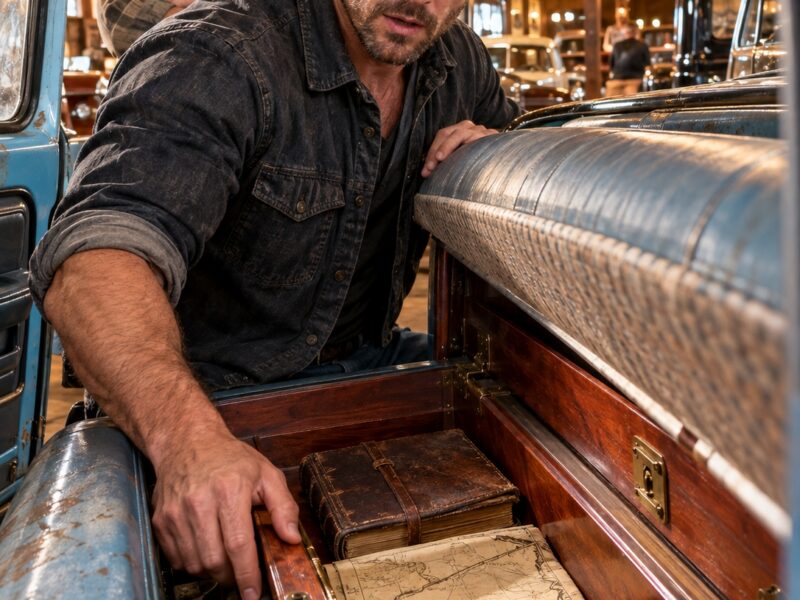
EVERYONE LAUGHED WHEN I PAID $1,200 FOR A RUSTY 1958 FORD—BUT WHEN I PULLED THE SEAT FORWARD, I FOUND A SECRET CHEST LOCKED FOR 35 YEARS… AND INSIDE WAS AN OLD MAP WITH MY OWN LAST NAME ON IT.
The first thing Luke Vance saw was his own last name.
Not on the title.
Not on the registration.
Not scratched into the faded blue paint of the old Ford.
It was written in black fountain-pen ink on the first yellowed page of a leather ledger that had been sealed behind the truck’s bench seat for more than three decades.
PROPERTY OF ELI VANCE
MOUNTAIN TIMBER AND LAND SURVEYS
1928–1955
Luke stood completely still.
The October wind moved through the open doors of his workshop in Augusta County, Virginia, carrying the smell of cold leaves and motor oil. Somewhere down the ridge, a dog barked twice. A loose sheet of newspaper scraped across the gravel.
But Luke heard almost none of it.
His eyes remained fixed on one word.
Vance.
His name.
He slowly looked back at the truck.
That morning, it had been nothing more than a $1,200 gamble everyone at the estate auction thought he was stupid to make.
Now there was a cedar-lined compartment open behind the driver’s seat, old photographs scattered across his workbench, brass surveying instruments gleaming beneath the fluorescent lights, and a dead man’s handwriting waiting for him inside a book that had apparently been hidden before Luke was born.
And the strangest part was still buried deeper inside.
Luke didn’t know it yet, but before the night was over, he would unfold a map drawn sixty years earlier and discover that the dead surveyor had mapped the exact five acres where Luke was standing.
Including a boundary the county no longer knew existed.
Including water nobody had officially recorded.
Including four forgotten mountain parcels with rights that had somehow vanished from modern records.
But none of that explained the question already tightening in Luke’s chest.
Who was Eli Vance?
And why had Luke found his history inside a truck that nearly everyone else had walked past?
That morning had begun with laughter.
Not cruel laughter exactly.
The quieter kind.
The kind men make when they believe someone else is about to waste money and are grateful it isn’t theirs.
The estate auction sat beyond a narrow two-lane road west of Staunton, where the Blue Ridge rose in layers behind weathered barns and fields already turning brown beneath the October cold.
There were tractors lined beside a fence.
Boxes of tools.
Old furniture.
Farm implements whose original purposes half the crowd had forgotten.
A row of vehicles stood in the grass behind the main barn, most of them in varying stages of decay.
Luke had come for parts.
At thirty-six, he made his living fixing engines other men had either neglected or given up on. His workshop sat on five acres along the ridge, an old cinder-block building with two bays, a wood stove, a compressor that rattled like loose bones, and enough unfinished projects to keep him busy until retirement.
He loved old machines for a reason he rarely tried to explain.
Machines were honest.
A carburetor did not lie about being clogged.
A cracked hose did not pretend everything was fine.
Metal told you what had happened to it if you knew where to look.
People were harder.
Luke had learned that years earlier.
So when he saw the light-blue 1958 Ford F-100 sitting behind the barn, he stopped.
The truck looked exhausted.
Its paint had faded almost gray across the hood. Dry leaves filled the bed. The blue vinyl bench seat had split open in several places, exposing yellow foam. One tire had collapsed into the earth.
A handwritten auction number hung from the mirror.
A man in a camouflage jacket walked past Luke and said, “That thing needs a funeral, not a mechanic.”
Luke crouched beside the passenger-side rocker panel.
He ran two fingers underneath.
Solid.
He moved toward the rear, inspected the frame, then the cab corners.
Surface corrosion.
But not rot.
Interesting.
The man in camouflage glanced back.
“You actually thinking about it?”
Luke stood.
“Maybe.”
The man laughed. “Hope they pay you to haul it away.”
Luke smiled but didn’t answer.
He opened the hood.
The hinges protested.
Beneath decades of dust sat Ford’s old 223-cubic-inch inline-six.
Complete.
Dirty.
Untouched enough to be promising.
Luke checked the oil.
Dark, but there was oil.
He studied the wiring, radiator, carburetor, engine mounts.
What everyone else saw was thirty-five years of neglect.
Luke saw thirty-five years without some teenager cutting wires, installing the wrong carburetor, welding brackets where brackets didn’t belong, or trying to turn an old farm truck into something it had never been.
Original neglect was sometimes better than enthusiastic incompetence.
“Eight hundred dollars,” someone called when the truck finally came up.
Luke waited.
“Eight-fifty.”
A scrap buyer raised his card.
“Nine hundred.”
Luke raised his.
The auctioneer’s voice bounced between the barn and surrounding hills.
At eleven hundred, the scrap buyer stopped.
At twelve hundred, silence followed.
“Sold.”
The auctioneer pointed.
“To number forty-seven for twelve hundred dollars.”
Luke lowered his card.
The man in camouflage shook his head.
“Twelve hundred dollars for a mouse hotel.”
Luke looked toward the truck.
“We’ll see.”
He paid cash.
Then he signed the transfer papers.
That should have been the end of the interesting part.
It wasn’t.
By three that afternoon, the Ford was sitting outside Luke’s workshop.
He didn’t try starting it.
Old engines punished impatience.
Instead, he opened both doors and began cleaning.
He filled one trash bag with leaves, brittle receipts, mouse nesting, scraps of paper, an empty tobacco tin, two rusted bolts, and a screwdriver with no handle.
Then he moved to the floor.
The floor pan was better than expected.
He grabbed a flashlight and leaned farther inside.
That was when he decided to pull the bench seat forward.
He wanted to inspect the rear cab wall for rust.
His fingers found the release.
He pulled.
Nothing.
He pulled harder.
The mechanism resisted, then suddenly gave way.
CLUNK.
The entire bench slid forward.
Luke nearly lost his balance.
“Easy,” he muttered.
Then he raised the flashlight.
The beam moved across dust.
Metal.
A wiring loom.
Then wood.
Luke frowned.
He brought the flashlight closer.
Behind the seat, fitted so precisely into the lower cab structure that it almost appeared factory-made, was a long wooden compartment.
Not plywood.
Not a tool box.
Cherrywood.
Its surface had darkened with age but remained smooth beneath the dust. Three brass hinges ran along one edge. A small brass latch sat in the center.
Luke stared.
“Now what are you?”
He touched the wood.
Solid.
Whoever had built it had known exactly what he was doing.
Luke had worked on enough farm trucks to recognize improvised modifications. Farmers could fabricate almost anything with angle iron, bolts and necessity.
This was different.
The joints were precise.
The mounting points had been incorporated carefully into the cab.
A thin gasket ran beneath the lid.
Airtight, or close to it.
Someone hadn’t merely wanted to store something.
Someone had wanted to protect something.
Luke tried the latch.
Locked.
He sat back.
For several seconds he considered forcing it.
He could have opened it in less than a minute with a screwdriver.
Instead, something stopped him.
If a man had spent this much time building a compartment, Luke thought, destroying the lock to satisfy thirty seconds of curiosity felt disrespectful.
He climbed out.
The original Ford ignition keys were hanging from a nail beside his workbench.
Luke picked them up.
Two Ford keys.
And one tiny brass key.
He had noticed it at the auction and assumed it belonged to a toolbox or old padlock.
Now he looked at it differently.
“No way.”
He returned to the cab.
The brass key entered the latch perfectly.
Luke hesitated.
Then turned it.
Click.
After thirty-five years, the lock opened as smoothly as though someone had used it yesterday.
Luke felt the hair rise along his forearms.
He lifted the lid.
The first thing that reached him was the smell.
Cedar.
Old paper.
A faint trace of dried lavender.
And metal.
Not rust.
Polished brass.
He moved the flashlight slowly.
Inside lay several objects arranged with astonishing care.
A bundle of black-and-white and sepia photographs wrapped in oilcloth.
Two thick leather journals.
Three velvet-lined wooden cases.
A brass compass.
An altimeter.
Precision drafting instruments.
Luke picked up the photographs first.
The top image showed a young man and woman standing beside a sawmill sometime in the 1920s. The man wore work trousers, suspenders and a white shirt with the sleeves rolled above his elbows. The woman stood beside him in a simple dress, one hand resting against the fender of an older vehicle.
They weren’t smiling.
People rarely smiled in photographs that old.
But there was something intimate in the way their shoulders touched.
Luke turned the photograph over.
A date had been written lightly in pencil.
June 1929.
Below it were two names.
The first had faded.
The second was clear.
Eli.
Luke set the photograph down.
He opened the first wooden case.
Surveying tools.
Beautiful ones.
Not decorative antiques.
Working instruments.
The velvet had worn in the exact shapes of the tools, evidence of years of use.
Then Luke lifted the first leather ledger.
It was heavier than he expected.
The cover had softened with age, but the binding remained intact.
He opened it.
The handwriting was disciplined and narrow.
Distances.
Bearings.
Measurements.
Names.
Property descriptions.
Dates.
Streams.
Stone walls.
Oak trees used as boundary references.
He turned to the title page.
And stopped breathing for a second.
PROPERTY OF ELI VANCE.
Luke whispered the surname aloud.
“Vance.”
He looked around his empty workshop as if someone might answer.
His family name wasn’t rare enough to prove anything.
Virginia had plenty of Vances.
Still, coincidence felt different when it was staring at you from paper hidden inside a truck you had purchased six hours earlier.
He turned another page.
Then another.
The entries began in 1928.
Mountain properties.
Timber tracts.
Boundary disagreements.
Notes about logging companies.
Luke pulled a stool closer.
Five minutes became twenty.
Twenty became an hour.
The afternoon light disappeared from the workshop doors while he read the dead man’s meticulous records.
Eli Vance had been a surveyor.
Not the polished office kind.
The mountain kind.
He traveled ridge roads, crossed streams, walked timber lines and measured homesteads in an era when one misplaced marker could cost a family twenty acres.
Some entries were purely technical.
Others weren’t.
October 17, 1931.
Boundary stones reset after dispute.
Owner present.
Timber agent objected.
Original markers verified.
Another entry:
April 4, 1933.
Spring confirmed within Holloway parcel. Family requests location remain private due to logging claim.
Luke frowned.
Logging claim.
He kept reading.
During the Depression, timber companies had been buying, disputing and harvesting mountain property throughout the region. Families with incomplete deeds or poorly documented boundaries were vulnerable.
A surveyor carrying original measurements could become very important.
Maybe dangerously important.
Suddenly the secret compartment made sense.
Fireproofing wasn’t possible in an old truck.
But protection from rain?
Yes.
Protection from thieves?
Absolutely.
Luke glanced toward the cherrywood box.
It had never been a place for valuables.
Not in the usual sense.
It had been a traveling vault.
He opened the second journal.
More records.
More names.
More boundaries.
And in the rear pocket, something thick.
Luke reached inside.
His fingers touched fabric.
He pulled out a folded sheet of heavy linen-backed paper tied with a faded blue ribbon.
He did not untie it immediately.
Something about the object felt different.
Official.
Important.
He carried it outside.
Night had not fully arrived, but the sun had dropped behind the ridge. Orange light lay across the truck’s faded hood.
Luke placed the folded document there.
The wind caught one corner.
He grabbed two large sockets from his toolbox and used them as weights.
Then he untied the ribbon.
The linen unfolded once.
Twice.
Again.
A map emerged.
Luke stared.
It was enormous.
Hand-drawn property lines crossed mountains, valleys and streams in black ink. Blue markings indicated water. Red notations identified access roads and easements. Tiny numbers corresponded to ledger entries.
At the bottom was a date.
September 14, 1934.
Beneath it:
Eli Vance
Certified Regional Surveyor
Luke bent closer.
He knew these mountains.
Every mechanic who had spent his entire life in one county learned roads the way sailors learned coastlines.
There was Route 250.
There was the old ridge road.
There was the creek.
There was the forest.
Then Luke’s finger stopped.
“No.”
He leaned closer.
His workshop property was on the map.
Not approximately.
Exactly.
The five-acre lot he had bought years earlier appeared inside a much larger historical tract.
Luke went inside, grabbed his modern property survey and brought it back.
He laid the newer document beside Eli’s map.
The differences were small at first.
Then they weren’t.
A boundary line on the western edge had shifted.
An old access easement had vanished entirely.
Three stone markers shown in 1934 did not appear on the modern county survey.
And there was something else.
A blue circle.
Spring.
Luke knew about a wet patch farther up the slope. Everyone did.
He had never known it had once been documented as a natural spring.
He followed the markings.
There were several.
Then he noticed four parcels along the ridge outlined in a different ink.
Beside them were handwritten notes concerning mineral and water rights.
Luke read the line twice.
Then a third time.
The rights were not assigned the way he expected.
They appeared to have remained attached to four old parcels that no longer existed on modern maps in the same form.
Luke stepped backward from the hood.
Suddenly the old truck seemed less charming.
The records inside it could affect real property.
Real money.
Real families.
He thought about keeping everything exactly where it was until he understood what he had found.
Then another thought arrived.
The county courthouse fire.
Everyone in Augusta County knew about the records that had been lost or damaged over the years. Property disputes lingered because documents vanished, copies conflicted and old descriptions relied on trees, stones and fences that no longer existed.
Luke looked at the leather journals.
If these were authentic…
They might fill holes no one had been able to fill for decades.
That realization brought another uncomfortable thought.
If the records benefited someone, they might hurt someone else.
Luke folded the map carefully.
For the first time that day, he locked his workshop.
He barely slept.
At 7:30 the next morning, he was back beside the Ford.
He had placed every document inside clean protective sleeves he kept for old service manuals.
The photographs went into a flat box.
The brass instruments stayed wrapped separately.
Luke loaded everything into his pickup.
Before leaving, he looked at the Ford.
“You better not have bought me a lawsuit.”
The truck offered no opinion.
The Augusta County Historical Society occupied a brick building filled with the particular quiet of places where people understood that paper could outlive them.
Dr. Sarah Jenkins met Luke near the front desk.
She was in her fifties, with silver beginning to appear in her dark hair and reading glasses hanging from a cord.
Luke placed the box on a table.
“I bought a truck yesterday.”
Sarah looked at the box.
“That sentence usually doesn’t end here.”
“This one might.”
He removed the first ledger.
Her expression changed before she even opened it.
“Where did you get this?”
“Behind the seat.”
“Behind the seat of what?”
“A 1958 Ford.”
She stared at him.
Luke almost smiled.
“I know.”
Sarah put on cotton gloves.
She opened the ledger.
Within minutes, amusement disappeared from her face.
She turned pages slowly.
Then faster.
“Luke.”
“What?”
“Where is the rest?”
He placed the second ledger on the table.
Then the photographs.
Then the instruments.
Finally, the folded linen map.
Sarah stopped moving.
“Don’t unfold that yet.”
Luke’s stomach tightened.
“Why?”
“Because if this is what I think it is, I want proper weights and a clean surface.”
She cleared a larger archival table.
Two staff members joined them.
Nobody joked anymore.
The map opened beneath bright white lights.
Sarah leaned over it.
Luke watched her eyes move from landmark to landmark.
She whispered something he couldn’t hear.
“What?”
She looked up.
“We have references to this survey.”
“To this map?”
“No. That’s the problem. We have references to a master survey that nobody could locate.”
Luke felt a cold sensation in his stomach.
Sarah pointed to the signature.
“Eli Vance did extensive work through this region. Timber boundaries, watershed surveys, family parcels. He was unusually thorough.”
“You know who he was?”
“Anyone who studies early twentieth-century land records here knows the name.”
Luke looked again at Vance.
Sarah noticed.
“Relative?”
“I don’t know.”
“You share a surname.”
“I noticed.”
She studied him briefly, then returned to the map.
“That’s a question for another day.”
She moved a magnifier over several markings.
“This isn’t just interesting, Luke.”
“What is it?”
“Potentially the missing reference document.”
Sarah explained.
For more than thirty years, property owners along sections of the ridge had dealt with boundary confusion made worse by missing courthouse records. Modern surveys could reconstruct much of the history, but certain original markers and easements had become difficult to verify.
Eli’s ledger contained measurements tied directly to physical landmarks.
Stone markers.
Springs.
Creeks.
Old roads.
Distances between permanent features.
The kind of information that could reconnect fragmented records.
“How much land are we talking about?” Luke asked.
Sarah kept studying.
“At least a hundred acres.”
She turned a page.
Then another.
“Possibly more.”
By noon, they had identified records affecting over 150 acres of mountain forest.
Luke sat back.
Yesterday, the entire truck had cost him twelve hundred dollars.
Today, its hidden compartment contained records that might help settle questions older than some of the people arguing about them.
Sarah reached the pages concerning the four forgotten parcels.
Her expression sharpened.
“These are unusual.”
Luke knew exactly which ones she meant.
“Mineral and water rights?”
“Yes.”
“Worth anything?”
“That’s not a question I’m qualified to answer.”
“But potentially?”
“Potentially complicated.”
Luke nodded.
That was enough.
Sarah looked at him carefully.
“You understand these documents belong to you as part of the vehicle purchase unless another legal claim exists.”
Luke said nothing.
“You could have them professionally appraised.”
“How much?”
“I won’t guess.”
“More than twelve hundred?”
Sarah smiled faintly.
“Considerably.”
Luke stared at the map.
For one brief moment, the temptation was real.
He wasn’t wealthy.
His workshop survived month to month like most independent garages. The roof needed replacing. His compressor was older than some of his customers. Winter heating bills were brutal.
Historical documents had collectors.
Surveying instruments had value.
Rare maps had value.
And if the records affected mineral or water rights, lawyers might attach entirely different numbers to them.
Sarah seemed to read his silence.
“You don’t have to decide anything today.”
Luke looked at the careful handwriting.
“No.”
He thought about Eli crossing these mountains before paved roads reached many of the properties.
About families trusting him to mark what was theirs.
About a man building a sealed compartment into his truck because paper could protect land better than a fence sometimes could.
Then Luke thought about the records sitting behind a bench seat for thirty-five years while people argued over boundaries the answers to which were hidden in a barn.
He shook his head.
“These shouldn’t disappear again.”
Sarah looked at him.
“I want them preserved.”
“All of them?”
“The originals.”
“You’re certain?”
Luke exhaled.
“No.”
That made her smile.
“But do it anyway.”
Within weeks, the historical society began cataloging and digitizing the collection.
Eli Vance’s journals became an archival county resource.
His measurements helped verify old property lines, public access trails and protected watershed boundaries.
The photographs were preserved.
The map was stabilized.
Copies were made.
Researchers began cross-referencing names in the ledgers with deeds and tax records.
The four forgotten parcels required more complicated legal research, and Luke deliberately stayed away from the fights that followed.
He had found the records.
He had not found them so he could decide who deserved the mountains.
But one question continued to bother him.
Eli Vance.
Sarah eventually helped Luke trace enough records to establish that the shared surname was not some impossible supernatural coincidence, nor did it turn the story into a secret inheritance.
The Vance name had old roots in the region, branching across families and properties over generations.
Whether Eli belonged to Luke’s direct line was harder to establish conclusively from the documents available at the time.
Oddly, Luke came to prefer it that way.
He didn’t need Eli to be his grandfather or great-uncle for the discovery to matter.
The old man had left something useful behind.
That was enough.
There was, however, another responsibility waiting outside Luke’s workshop.
The Ford.
For several weeks after the historical society took possession of the records, Luke barely touched it.
Without the cedar chest full of maps, it looked smaller somehow.
Just an old blue truck again.
One evening, Luke sat alone on the torn bench seat.
The empty compartment remained open behind him.
He ran a hand over the cherrywood.
Someone had built this with extraordinary patience.
Luke imagined Eli parking on a mountain road after a long survey, opening the chest, putting away his instruments, checking that his records were dry.
He imagined rain striking the windshield.
Mud beneath the tires.
Arguments with timber representatives.
Families waiting for him to tell them whether the oak tree or stone wall truly marked their land.
The truck had not simply transported Eli.
It had carried his work.
Luke closed the compartment.
The brass latch clicked.
“All right,” he whispered.
“If we’re doing this, we’re doing it right.”
He began with the engine.
The original 223 inline-six had not run in roughly thirty-five years.
Luke removed the plugs.
Inspected the cylinders.
Changed fluids.
Cleaned passages.
Flushed the fuel system.
The carburetor came apart piece by piece across his bench.
Old varnish had coated its internal surfaces.
He rebuilt it rather than replacing it.
That became the rule for the entire restoration.
Preserve when possible.
Replace only when necessary.
The truck wasn’t going to become a glossy custom showpiece.
No modern V8.
No lowered suspension.
No expensive leather interior.
No paint color Ford had never offered.
Luke wanted the truck to look like itself.
For four months, his evenings disappeared.
He replaced brittle rubber fuel lines.
Rebuilt the drum brakes.
Changed worn suspension components and tired shock absorbers.
Installed safe radial tires while retaining the original steel wheels.
Every bolt seemed to contain a story and a fight.
Some came loose immediately.
Others required heat, penetrating oil and language Luke would never use in front of Sarah Jenkins.
Friends stopped by.
One of them, Danny Mercer, stood in the workshop doorway one January night holding two coffees.
“You know,” Danny said, “normal people buy trucks that run.”
Luke was beneath the Ford.
“Normal people pay mechanics.”
“You are a mechanic.”
“Exactly. Free labor.”
Danny crouched.
“How much are you into it now?”
“Don’t ask.”
“That bad?”
Luke rolled out from beneath the truck.
“About fourteen hundred in parts and tools.”
Danny laughed.
“So now your twelve-hundred-dollar mistake is a twenty-six-hundred-dollar mistake.”
Luke took the coffee.
“It’s not a mistake.”
“Does it move?”
“Eventually.”
“Does it stop?”
“Eventually.”
“Does it start?”
Luke looked at him.
Danny raised his coffee.
“Twenty-six-hundred-dollar mistake.”
But Luke noticed Danny stayed another three hours helping bleed the brake lines.
By February, the Ford sat on its wheels again.
Luke cleaned the interior carefully.
He treated the original blue vinyl rather than replacing it. The tears remained.
So did the wear marks.
The steering wheel still showed where Eli’s hands—or perhaps the hands of owners after him—had polished the surface smooth over thousands of miles.
Luke preserved those marks deliberately.
History did not need to look new to deserve survival.
The cherrywood compartment required almost nothing.
A little cleaning.
A little oil.
The wood darkened beautifully.
The brass latch shone again.
Luke left every hinge exactly where Eli had placed it.
One Saturday morning, Sarah arrived at the workshop carrying a flat archival envelope.
“I brought you something.”
Luke wiped his hands.
Inside were high-quality duplicates of several photographs and a reproduction of the 1934 master map.
“For the truck,” she said.
Luke stared at them.
“You didn’t have to do this.”
“Yes, we did.”
She looked toward the Ford.
“People should know why that compartment exists.”
Luke glanced at the open chest.
“I was thinking the same thing.”
Sarah walked around the truck.
“You haven’t repainted it.”
“No.”
“You will?”
Luke considered the faded blue hood.
“Maybe someday. But not yet.”
“Why?”
“Because this is how I found it.”
Sarah nodded as though that answer made perfect sense.
Then came the morning Luke had been working toward.
The fuel system was ready.
Electrical connections checked.
Battery installed.
Oil pressure primed.
Coolant filled.
Carburetor adjusted as closely as possible before startup.
Danny stood near the workbench.
Sarah had come too.
Luke climbed into the cab.
The old bench seat creaked beneath him.
He inserted the Ford key.
His hand stopped.
For months, he had imagined this moment.
Now that it had arrived, he was suddenly afraid of it.
Not because the engine might fail.
Engines failed all the time.
He could fix failure.
What bothered him was something stranger.
The truck had been silent for thirty-five years.
Silence that long became part of an object.
Starting it almost felt like waking someone who had earned the right to sleep.
Danny broke the tension.
“Luke.”
“What?”
“Turn the damn key.”
Luke smiled.
Then he turned it.
The starter engaged.
The engine rotated.
Once.
Twice.
Nothing.
Luke released the key.
Danny looked away politely.
Luke pumped the accelerator once.
“Come on.”
He tried again.
The engine turned.
Coughed.
Stopped.
Sarah gripped the edge of the workbench.
Luke waited several seconds.
Third attempt.
The starter spun.
There was a cough.
Then another.
A violent shudder moved through the cab.
And the 223 inline-six came alive.
Not dramatically.
Not with some movie-perfect roar.
It stumbled first.
Luke feathered the throttle.
The idle climbed.
Smoke drifted from the exhaust.
The old engine shook against its mounts as oil circulated through passages that had been dry for decades.
Then something remarkable happened.
It settled.
The idle smoothed.
The mechanical clatter softened.
Luke removed his foot slowly from the accelerator.
The engine continued running.
Danny laughed.
Sarah covered her mouth.
Luke just sat there.
His hands rested on the steering wheel.
He could feel the engine through the floor.
A machine built before he was born was breathing beneath him.
Behind his shoulders sat the empty cedar compartment where Eli Vance had once protected the records of an entire mountain community.
Luke looked through the windshield.
For one irrational second, he expected to see a different world outside.
Dirt road.
Sawmill.
Men with chains and transits.
Instead he saw his workshop.
Danny.
Sarah.
A cold Virginia morning.
The present.
But the sound belonged to both worlds.
By the spring of 1995, the Ford was roadworthy.
Luke drove it slowly at first.
Around the property.
Then down the ridge.
Then farther.
The steering demanded attention.
The brakes felt nothing like a modern vehicle.
Wind hissed through old seals.
The heater seemed more philosophical than functional.
Luke loved every mile.
The truck eventually received an appraisal far beyond what he had paid for it, though the number became almost irrelevant to him.
People kept asking what the discovery was worth.
Luke never had a satisfying answer.
The truck had cost $1,200.
The restoration had cost roughly another $1,400 in parts and tools.
The historical records?
Sarah once told him that attempting to reduce them to a dollar amount missed the point.
Luke agreed.
Their value was visible elsewhere.
In a landowner finally understanding why an old stone marker mattered.
In a trail being correctly identified.
In watershed boundaries being reconstructed.
In records surviving digitally after paper had nearly disappeared once already.
The Ford had not made Luke rich.
It had done something stranger.
It had made him a temporary custodian of another man’s unfinished responsibility.
That summer, Luke entered the truck in the annual Shenandoah Valley classic vehicle parade.
He almost didn’t.
Show vehicles were usually prettier.
Chrome polished like mirrors.
Paint deep enough to disappear into.
Luke’s Ford still carried imperfections.
Its restoration was mechanical and conservative.
Its history mattered more than cosmetics.
But Sarah convinced him.
“Don’t enter it as the prettiest truck,” she said.
“Then what am I entering it as?”
“The one people will remember.”
She was right.
Luke parked the Ford with the doors open.
Behind the bench seat, the cherrywood compartment was displayed exactly as he had discovered it.
Inside were duplicate copies of Eli’s survey map and selected photographs.
The brass compass sat in its case.
A short explanation described how the compartment had protected survey records for decades.
People stopped.
Then they stayed.
Older residents recognized family names on the reproduced map.
A man pointed toward one creek and told his grandson where an abandoned mill had once stood.
A woman in her seventies stared at one photograph for several minutes before quietly saying she remembered hearing her father mention the family pictured beside the sawmill.
Children cared mostly about the hidden compartment.
They kept asking Luke to close the seat and reveal it again.
“Was there treasure in it?” one boy asked.
Luke crouched beside him.
“Depends what you call treasure.”
“Gold?”
“No.”
“Money?”
“No.”
The boy looked disappointed.
Luke pointed toward the map.
“That.”
The boy stared at him skeptically.
“Paper?”
Luke laughed.
“Yeah. Paper.”
“That isn’t treasure.”
“Give it fifty years.”
The boy’s mother smiled.
The Ford won an award for historic preservation and story.
Luke placed the plaque in his workshop.
But the award he cared about was smaller.
He had a brass plate made for the dashboard.
Nothing elaborate.
Just a few lines.
1958 FORD F-100
VANCE MOBILE SURVEY UNIT
DISCOVERED AND RESTORED
OCTOBER 1994
He mounted it beside the original radio.
Years passed.
The truck never became a museum piece sealed away from weather.
Luke refused to let that happen.
He drove it.
He hauled tools in it.
Sometimes timber.
Sometimes supplies.
The tires touched the same mountain roads whose earlier routes appeared in Eli’s journals.
On clear mornings, Luke would drive along the ridge with the window down, the inline-six humming steadily ahead of him.
Occasionally he passed one of the old stone boundary markers that researchers had relocated using Eli’s measurements.
Whenever that happened, he slowed down.
Not because anyone told him to.
He simply did.
There was one particular spring high along the ridge that Luke began visiting every autumn.
The modern county maps had nearly forgotten it.
Eli hadn’t.
The 1934 survey showed its exact location.
Water still emerged between stones beneath old trees, cold and clear even after dry summers.
One October afternoon, almost exactly a year after the auction, Luke parked the Ford nearby.
He walked to the spring.
Leaves drifted across the water.
He crouched and touched it.
Ice cold.
For a while he stayed there alone.
He thought about how close the records had come to disappearing.
If the truck had gone to the scrap buyer, someone might have crushed it without ever pulling the seat forward.
If mice had reached the compartment.
If moisture had entered.
If the tiny brass key had been lost.
If Luke had arrived at the auction ten minutes later.
History often sounded inevitable when written backward.
Standing beside that spring, Luke understood how fragile it actually was.
One forgotten key.
One locked box.
One man curious enough to look.
That was sometimes all that stood between memory and disappearance.
Luke returned to the truck as evening settled across the mountains.
He opened the driver’s door.
Before climbing inside, he pulled the bench seat forward.
The cherrywood compartment remained there.
Empty now except for reproductions.
Luke ran his thumb over the brass latch.
He sometimes wondered about Eli’s final day with the truck.
Had the old surveyor known he was parking it for the last time?
Had he intended to return for the ledgers?
Had he deliberately left them there because the compartment seemed safer than his house?
Or had age simply interrupted his plans?
There was no surviving journal entry explaining it.
Luke eventually accepted that some questions deserved to remain unanswered.
He closed the compartment.
The latch clicked.
Then he slid the bench seat back into position.
The secret disappeared completely.
That still amazed him.
Someone could sit inches from it and never know.
Luke climbed behind the wheel.
He turned the key.
The old six-cylinder engine started.
The dashboard vibrated gently.
Outside, dusk spread through the Blue Ridge.
Luke placed one hand on the steering wheel and looked at the small brass plaque beside the radio.
People liked to say he had been lucky.
They were right.
But luck wasn’t the whole story.
Dozens of people had seen the truck before he bought it.
They had seen faded paint.
Torn vinyl.
Dead tires.
Thirty-five years of dust.
They had calculated what was missing, what was broken and what it would cost to make the machine useful again.
Luke had seen those things too.
He simply hadn’t stopped looking there.
That difference had cost him twelve hundred dollars.
It had given Augusta County back a piece of its history.
Luke shifted into gear.
The Ford rolled onto the old mountain road.
Its headlights stretched across pavement that had once been dirt, following a route that appeared in a dead surveyor’s handwriting.
For a moment, Luke imagined Eli driving the same ridge with maps behind his seat and brass instruments beside him, carrying proof of where one family’s land ended and another’s began.
Then the image faded.
There was only Luke.
The truck.
The road.
And almost a century between two men who might or might not have shared more than a surname.
Luke never found gold behind that seat.
He never found bundles of cash.
He never became wealthy because of the auction.
What he found was quieter than that.
Measurements made by a man who believed accuracy mattered.
Photographs of people who expected to be remembered by someone.
Property lines that fire had erased from a courthouse but not from a leather book.
Springs that continued flowing long after their names disappeared from maps.
And a truck that had spent thirty-five years sitting silently in a barn, guarding all of it without anyone knowing.
Years later, visitors at vehicle shows still asked Luke the same question.
“How did you know something was behind the seat?”
Luke always gave them the same answer.
“I didn’t.”
“Then why did you look?”
He would usually glance toward the old Ford before answering.
“Because that’s what you do when you’re trying to understand something old.”
You don’t only look at what people can see.
You look underneath.
You look behind.
You look at what someone took the trouble to protect.
Then you listen to what survived.
One evening after a show, Luke drove home alone.
The sun had already fallen behind the mountains, leaving a thin orange line above the ridge.
The Ford smelled faintly of warm oil, vinyl and old wood.
At a stop sign, Luke heard something slide behind him.
He smiled.
One of the duplicate maps had shifted inside the compartment.
For a second, the sound transported him back to that first afternoon.
The flashlight.
The dust.
The metallic clunk of the seat.
The impossible little brass key.
The ledger opening beneath his hands.
PROPERTY OF ELI VANCE.
Luke looked at his reflection in the windshield.
Older now.
More gray at the temples.
Still curious.
He reached behind the seat without looking and rested his hand against the cherrywood lid.
Then he drove on.
Because the real treasure had never been the truck.
It wasn’t the map.
It wasn’t even the forgotten rights or the records that historians would preserve long after Luke himself was gone.
The treasure was the simple fact that something entrusted to darkness had survived long enough to be found.
And somewhere high above the road, beneath trees Eli Vance had once used as landmarks, cold spring water continued pushing through ancient stone exactly where his 1934 map said it would.
Nobody needed to remember the surveyor for the water to keep flowing.
Nobody needed to remember Luke either.
That was the strange comfort of it.
Some lives leave monuments.
Others leave measurements, worn tools, handwriting, and a small brass key on the ring of an old Ford.
And sometimes, if the right person happens to pull the seat forward, that is enough.









