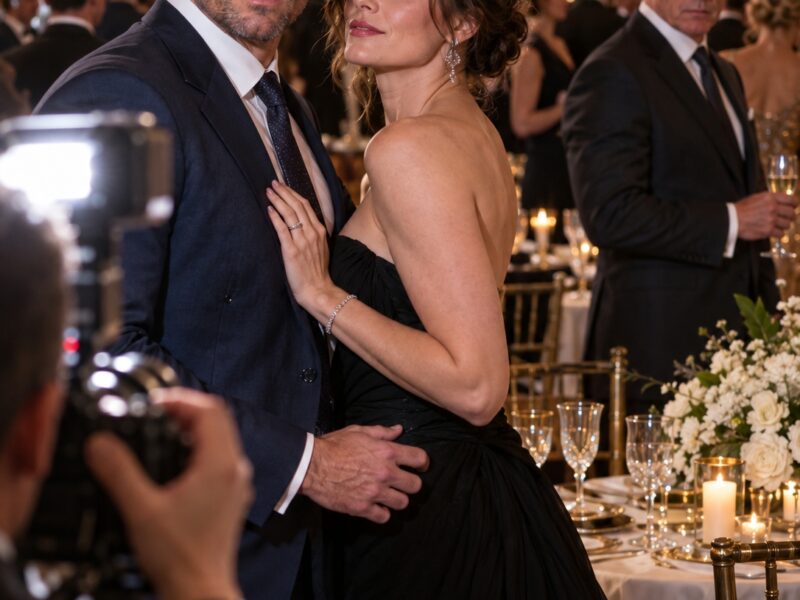
Everyone Thought the Billionaire CEO Was His Wife—Then She Whispered, “Don’t Correct Them.”

“Mr. and Mrs. Mercer—right here, please.”
The photographer raised his camera.
Hollis Mercer froze.
For one strange second, he wondered if he had misheard.
Then another flash exploded across the ballroom.
Beside him stood Tamson Vale, one of the most powerful women in American hospitality, dressed in black beneath a ceiling of crystal chandeliers. On Hollis’s other side, his eight-year-old daughter Marlo clutched the paper flower she had made at school that morning.
The photographer smiled.
“Closer together, please. Beautiful family.”
Hollis slowly turned his head toward Tamson.
“You know they think we’re married.”
Tamson didn’t look at him.
She kept her gray eyes on the camera.
“I know.”
Two words.
Nothing else.
No correction.
No embarrassed laugh.
No explanation.
Hollis stared at her.
Around them, champagne glasses chimed against polished tables. A jazz trio played near the stage. Men in tailored tuxedos talked about acquisitions and market expansion while women in designer gowns moved beneath chandeliers worth more than Hollis’s house.
And standing in the center of all that money was a heating-and-cooling technician from Boise wearing the same navy jacket he had bought for his wife’s funeral three years earlier.
The cuffs were worn.
His shoes were old.
His hands still carried faint scratches from an air handler he had repaired that afternoon.
He did not belong in that photograph.
Everyone in the ballroom knew it.
Everyone except, apparently, the woman standing beside him.
“Hollis,” he whispered.
Tamson finally glanced at him.
“Not yet.”
The shutter clicked.
And across the ballroom, Prescott Wynn stopped talking.
He had spent fifteen years learning how power arranged itself inside rooms like this.
He knew who belonged beside Tamson Vale.
Governors.
Investors.
Board members.
Men with private jets and last names engraved on university buildings.
Not Hollis Mercer.
Not a maintenance technician.
Certainly not a maintenance technician with an eight-year-old daughter smiling between them as if this strange little arrangement made perfect sense.
Prescott’s expression tightened.
Hollis saw it.
So did Tamson.
But Tamson didn’t step away.
That was when Hollis realized something far more dangerous than the misunderstanding itself.
She wanted them to believe it.
And thirty-six hours earlier, Hollis Mercer hadn’t even known her last name.
He had been six floors below that ballroom with a wrench in one hand and half a turkey sandwich in the other when Dileia Boone appeared in the maintenance office.
“Corporate emergency.”
Hollis looked at his sandwich.
Then at her.
“Does corporate know I’m on lunch?”
Dileia, sixty-one and entirely immune to sarcasm after twenty-two years in hotel operations, folded her arms.
“Executive got stuck near the sixth-floor service elevators.”
“Trapped?”
“Elevator stalled for forty seconds. Reset itself. She got out, but the hallway access door won’t release.”
“So she’s standing in a hallway.”
“Yes.”
“Sounds survivable.”
“Hollis.”
He sighed.
Across the office, Marlo sat at a folding desk doing fractions with the concentration of someone attempting to defuse a bomb.
“Stay here.”
“I’m almost done.”
“That wasn’t the instruction.”
“I was providing context.”
Dileia laughed.
Hollis wrapped the remaining half of his sandwich in wax paper and put it into his dented metal lunchbox.
“Go save corporate,” Dileia said.
“I repair HVAC systems.”
He grabbed his tool bag.
“Saving corporate costs extra.”
The sixth-floor service corridor was warmer than it should have been.
That irritated Hollis before he even saw the woman.
Fluorescent tubes buzzed overhead. Somewhere behind the wall, an aging ventilation fan rattled with the exhausted rhythm of machinery that had been asked to survive several years past its intended life.
Then he rounded the corner.
A woman stood beneath the illuminated EXIT sign holding an emergency flashlight backward.
Dark slacks.
Cream blouse.
Practical heels that still looked expensive.
Chestnut hair twisted into a simple knot.
No assistant.
No entourage.
No visible panic.
Just irritation carefully contained behind gray eyes.
“You maintenance?” she asked.
“On my better days.”
Her gaze dropped to the embroidered name over his shirt pocket.
“Hollis.”
“That’s what my mother decided.”
“The door won’t open.”
“That’s usually what locked doors do.”
She looked at him.
Hollis looked at the flashlight.
“And you’re pointing that backward.”
Her eyes narrowed.
Then she glanced down.
For perhaps one second she seemed genuinely offended by the flashlight.
She turned it around.
A reluctant smile appeared.
“That explains the disappointing performance.”
Hollis crouched beside the electronic lock.
“You’re from corporate?”
“That obvious?”
“The shoes.”
She looked down.
“What’s wrong with my shoes?”
“Nothing. That’s the problem.”
He removed the access plate.
“The people who actually work in these hallways know better.”
“Good to know.”
Hollis began checking the controller.
“Power surge confused the access system. Building’s old enough to have opinions.”
“I thought this property was renovated two years ago.”
“The lobby was.”
He loosened a screw.
“Guests see marble. We see what’s behind it.”
Silence.
Not offended silence.
Thinking silence.
That made Hollis look up.
Most executives asked questions because they were waiting for their turn to speak.
This woman appeared to be listening.
“What’s behind it?” she asked.
“Depends which wall you open.”
“Generally.”
Hollis considered her.
“Old controls. Deferred repairs. Equipment running too long because replacing something doesn’t photograph as well as renovating a lobby.”
“And that’s common?”
“Here?”
“In business.”
He smiled faintly.
“You really are from corporate.”
She folded her arms.
“Answer the question.”
“Making the visible parts beautiful while ignoring the systems underneath?”
“Yes.”
Hollis returned his attention to the lock.
“More common than it should be.”
The lock clicked.
He pushed open the door.
Cooler air drifted through.
“There.”
The woman looked almost disappointed.
“That fast?”
“You wanted drama?”
“I was expecting something more complicated.”
“You called the wrong department.”
A small voice came from behind them.
“Dad?”
Hollis closed his eyes.
He knew that voice.
Marlo appeared at the end of the hallway wearing her purple backpack and carrying her math workbook against her chest.
“Dileia said I could find you because I finished the fractions.”
“All of them?”
“All except the dumb one.”
“Then you didn’t finish.”
Marlo reached them and noticed the stranger.
She studied her openly.
Children had a way of looking at people before adults taught them that curiosity should be disguised.
“Hi.”
Something changed in the woman’s face.
“Hi.”
Marlo pointed toward the door.
“Are you lost?”
“Marlo.”
“What?”
“You don’t ask strangers if they’re lost.”
“She was standing beside a locked door.”
The woman laughed.
Not politely.
Actually laughed.
“I suppose I was.”
Marlo nodded.
“Dad fixes things when people get stuck.”
The woman looked at Hollis.
“I’m beginning to understand that.”
Hollis lifted his tool bag.
“My daughter. Marlo.”
The woman hesitated.
Then said only:
“Tamson.”
No title.
No surname.
Just Tamson.
“Do you work here?” Marlo asked.
A tiny pause.
Hollis noticed it.
“Something like that.”
Marlo immediately looked at her father.
“Dad says that when he doesn’t want to explain things.”
“Marlo.”
“He does.”
Tamson smiled again.
And for a moment, Hollis saw something beneath the polished posture.
Weariness.
Not physical exhaustion exactly.
Something older.
He checked the thermostat.
Seventy-eight degrees.
“Too warm.”
Tamson looked toward the ceiling.
“Is that connected to the elevator problem?”
“Different system. Same building.”
He started down the corridor.
“I need to check the mechanical room.”
“Can I come?”
Hollis stopped.
He looked at her blouse.
Then her shoes.
Then the narrow service stairwell.
“It’s dusty.”
“I’ll survive.”
“Corporate usually prefers reports.”
Tamson’s expression changed.
“Maybe corporate has been reading too many of them.”
That answer made him pause.
Then he shrugged.
“Your shoes.”
They walked together.
Marlo moved between them, backpack bouncing against her shoulders.
Tamson asked how long Hollis had worked at the hotel.
Seven years.
What kept breaking?
He told her.
Why hadn’t the control system been replaced?
He told her that too.
How often had he requested it?
That question came later.
And that was the question that changed everything.
Because Hollis didn’t know Tamson Vale had flown into Boise quietly that morning because employee turnover at the property had nearly doubled.
He didn’t know guest complaints were increasing.
He didn’t know every report reaching corporate headquarters seemed to blame another department.
He didn’t know Tamson was president, CEO, and majority shareholder of Vale Hospitality Group.
He didn’t know the name Vale appeared on luxury hotels from Boston to San Diego.
And most importantly, he didn’t know Tamson had come without announcement because she wanted to see what happened before managers had time to polish the truth.
For ten months, executives had sent her presentations.
Hollis Mercer gave her more truth in ten minutes.
The mechanical-room door opened.
Warm air rolled over them.
Marlo stopped automatically behind the yellow safety line painted across the floor.
Tamson noticed.
“You’re staying there?”
Marlo nodded.
“Dad told me twelve times.”
“Good memory.”
“He says the same things a lot.”
“I’m beginning to notice.”
Hollis ignored both of them.
He listened.
Pumps.
Motors.
Airflow.
Then something wrong underneath the ordinary noise.
A thin vibration.
He walked toward the largest air handler and removed the access panel.
Tamson moved closer.
“What am I looking at?”
“A system trying very hard to do a job nobody gives it enough support to do.”
Tamson stared at the blinking control board.
“That sounds familiar.”
Hollis looked at her.
There it was again.
That tiredness.
“Bad week?”
The question caught her off guard.
People asked Tamson whether forecasts were on target.
Whether investors were satisfied.
Whether acquisitions would close.
Whether the board had approved financing.
Nobody asked whether she was having a bad week.
Not without wanting something afterward.
Hollis waited.
“Bad year,” she finally said.
He nodded.
“Those happen.”
Then he went back to work.
No advice.
No inspirational speech.
No curiosity disguised as concern.
Tamson found the absence of follow-up strangely comforting.
She watched his hands move across the control board.
“Why hasn’t this been replaced?”
“I requested replacement.”
“When?”
“First time?”
He glanced at her.
“Fourteen months ago.”
Tamson stopped moving.
“Fourteen?”
“Then eleven. Eight. Three.”
“What happened?”
“Budget review.”
“And?”
“Deferred maintenance.”
“And?”
“Next quarter.”
He tightened a connection.
“Different words. Same answer.”
“Did you escalate it?”
“Depends what you mean.”
“You sound like you tried.”
“I did.”
“And nobody listened?”
Hollis shrugged.
“I’m the heating guy.”
No bitterness.
That bothered Tamson more than anger would have.
He had warned management for fourteen months.
Somewhere between his report and her office, someone had decided his warning mattered less because of the uniform he wore.
Suddenly Tamson wasn’t looking at a broken control board.
She was looking at her company.
And she didn’t like what she saw.
Marlo’s voice interrupted the silence.
“Do you have kids?”
Tamson blinked.
“No.”
“Are you married?”
Hollis straightened.
“Marlo.”
“What?”
“Boundaries.”
Marlo frowned.
“I don’t know what those are yet.”
Tamson laughed again.
“No,” she said. “I’m not married.”
“Do you live alone?”
“Sweetheart.”
But Tamson answered.
“Yes.”
Marlo considered this seriously.
“Does it get lonely?”
Hollis stopped moving.
The mechanical room suddenly seemed quieter.
“Marlo, finish number six.”
Tamson looked at the little girl.
Then at the concrete floor.
“Sometimes.”
Marlo nodded as if loneliness were a plumbing problem.
“We have an extra chair.”
Hollis stared at her.
“We have an extra chair because there are three chairs.”
“Exactly.”
Tamson pressed her lips together.
She had eaten at dinners where a single plate cost six hundred dollars.
She had sat beside senators, athletes, billionaires, celebrities and men whose names appeared on hospital wings.
No one had ever offered her an extra chair as if that alone might solve loneliness.
Hollis replaced the panel.
The vibration steadied.
Cool air began moving through the ductwork.
“Temporary fix. It’ll hold tonight. Controller still needs replacement.”
“How much?”
“About eighteen thousand for the proper retrofit.”
Tamson nearly said, That’s nothing.
Against the operating budget of Vale Hospitality, it was.
Then she stopped herself.
Hollis saw the hesitation.
“You really are from corporate.”
“Something like that.”
Marlo looked up.
“See? She does it too.”
Tamson smiled.
Hollis shook his head.
“Come on. You probably have important people waiting.”
Tamson followed him.
What she didn’t say was that for the first time all day, she had no desire to find them.
Ten minutes later, a seating disaster changed the evening.
A section of the ballroom remained too warm, forcing an executive dinner into another room. Place cards were scrambled. Dileia was overwhelmed. Marlo was hungry. Hollis had skipped most of lunch.
He intended to grab food downstairs and leave.
Instead, a young banquet host checked his list.
“Mercer?”
“Yes.”
“Table four.”
Hollis looked.
Table four was beside Tamson.
“That can’t be right.”
“That’s what I have, sir.”
Before Hollis could object, Tamson pulled out the chair beside her.
“They’re with me.”
The room changed.
Not silence.
Something subtler.
Conversations softened.
Eyes moved.
Prescott Wynn noticed immediately.
Hollis noticed him noticing.
“We can eat downstairs,” Hollis said.
“Sit.”
“Tamson—”
“You repaired the reason everyone can eat dinner without sweating through their jackets.”
Marlo climbed into the chair.
“Sit, Dad.”
Then, with exaggerated seriousness:
“Thank you for your support.”
Tamson laughed.
Hollis surrendered.
Dinner began awkwardly.
He kept his elbows close.
Marlo placed her napkin in her lap as if she had been invited to Buckingham Palace.
Tamson ignored the looks.
A silver-haired investor named Warren Pike leaned toward her.
“Well, Tamson.”
His eyes moved toward Hollis.
“You’ve been keeping secrets.”
Tamson raised an eyebrow.
“Have I?”
“I was starting to think nobody could make you slow down.”
Hollis understood immediately.
“Actually, we’re not—”
Tamson’s fingers touched his wrist beneath the table.
Barely.
“It’s fine,” she whispered.
Warren smiled.
“About time. You look happier.”
Then he turned away.
Hollis waited until the surrounding conversation resumed.
“What was that?”
“Nothing.”
“He thinks we’re together.”
“I noticed.”
“And you let him.”
Tamson stared at her water glass.
“He’s known me twelve years.”
“That doesn’t answer the question.”
Her eyes finally met his.
“When he thought I was just Tamson sitting beside you, he asked if I was happy.”
Hollis frowned.
“And normally?”
“He asks whether the company is.”
That silenced him.
Tamson looked away.
“For thirty seconds, nobody at this table wanted anything from me.”
Marlo had been buttering a roll.
“Dad does that.”
Tamson turned.
“Does what?”
“Doesn’t want things from people.”
“Eat your roll, Marlo.”
She obeyed.
Tamson looked at Hollis differently after that.
He had spent the afternoon believing she was pretending to be someone less important.
Now he began to understand.
She wasn’t pretending to be ordinary because ordinary embarrassed her.
She was hiding inside it.
For a few minutes, she could be a woman instead of an institution.
Then Marlo noticed something else.
“Does she ever eat?”
Hollis nearly dropped his fork.
“Marlo.”
“She keeps moving the food around.”
Tamson looked down.
Her dinner was nearly untouched.
Marlo opened the wax paper around the sandwich Dileia had packed for her.
Turkey.
Cheddar.
Mustard.
Slightly crushed bread.
She tore it in half and pushed one piece toward Tamson.
“You can have this.”
Tamson stared at it.
“That’s your dinner.”
“I have the other half.”
“You should keep it.”
“Why?”
One simple word.
Tamson had no answer.
There was no strategy behind the sandwich.
No favor expected later.
No invisible account waiting to be balanced.
Just half a sandwich offered by an eight-year-old because somebody looked hungry.
Between crystal glasses and polished silver, it looked almost ridiculous.
And somehow more valuable than everything else on the table.
“Thank you,” Tamson whispered.
She took a bite.
Marlo smiled.
“Dad makes those when people have bad days.”
Hollis sighed.
“Apparently my entire personal life is tonight’s entertainment.”
Tamson chewed.
“It’s a good sandwich.”
“That’s all the defense I need.”
For several minutes, Tamson forgot her phone.
Marlo talked about bean plants.
Hollis complained about weather apps.
Tamson laughed twice.
Nothing important happened.
That was why she remembered every second.
Then Prescott arrived.
He stood beside Tamson’s chair in a charcoal suit.
“Tamson. The Denver board members are asking for you.”
His eyes moved toward Hollis.
Then Marlo.
Then the sandwich.
“I see the seating problem became more complicated.”
Tamson carefully lowered the sandwich.
“Has it?”
“Maintenance personnel usually eat downstairs.”
Hollis felt Marlo become still.
That was enough.
“We were seated here by mistake,” he said. “We’ll leave.”
He reached for his jacket.
“Sit down, Hollis.”
Prescott noticed the first name.
His eyebrows lifted.
“I’m simply trying to avoid confusion.”
“What confusion?”
“People are drawing conclusions.”
Hollis knew that tone.
He had heard versions of it in expensive homes for years.
Use the side entrance.
Wait near the kitchen.
Don’t place the toolbox on that surface.
People like Hollis were welcome wherever something needed fixing.
They simply weren’t supposed to remain once the problem disappeared.
“Marlo,” he said. “Backpack.”
Tamson stood.
The nearby tables quieted.
“This doesn’t need to become a scene,” Prescott said.
“Then don’t make one.”
Tamson’s voice was quiet.
That made it sharper.
“Hollis repaired the system that kept this dinner from being cancelled. His daughter has shown more courtesy tonight than several executives in this room. If anyone is confused about why they’re sitting here, they can ask me.”
Prescott’s smile vanished.
“You know how this looks.”
Tamson held his gaze.
“Yes.”
A pause.
“It looks like two guests are eating dinner.”
Prescott said nothing.
Hollis looked at Tamson.
“You didn’t have to do that.”
She sat again.
“Neither did your daughter.”
Marlo pushed the sandwich toward her.
“Finish it before it gets weird.”
Tamson laughed.
And somewhere inside Prescott Wynn, suspicion turned into something colder.
After dinner, Hollis went upstairs to inspect the repaired system one last time.
Tamson followed.
They stopped in a glass hallway overlooking downtown Boise.
City lights spread beneath them.
“You work for Vale Hospitality?” Hollis asked.
“Yes.”
“What do you do?”
Tamson hesitated.
“Management.”
“That isn’t an answer.”
“It’s technically an answer.”
He looked at her.
She almost smiled.
Almost.
Then Hollis noticed the brass plaque beside the elevator.
VALE HOSPITALITY GROUP.
Property of the Vale Collection.
He read it.
Then looked at her.
Then back at the plaque.
“Vale.”
Tamson said nothing.
The elevator chimed.
“Tamson Vale.”
“Yes.”
“As in Vale Hospitality Group?”
“Yes.”
The doors began closing.
Hollis stopped them.
Then let them close without entering.
“You own this hotel.”
“The company does.”
“And you run the company.”
“Yes.”
He turned toward the windows.
Tamson could almost see the previous several hours rearranging themselves inside his mind.
“How long were you planning to let me think you were some corporate employee?”
“I didn’t know.”
“You knew when I told you the controller had been ignored fourteen months.”
“Yes.”
“You knew when I said management kept pushing repairs into another quarter.”
“Yes.”
“You knew when I told you people upstairs don’t see what happens behind the walls.”
Tamson lowered her eyes.
“Yes.”
Hollis nodded.
“That’s a problem.”
“I came because I needed honest answers.”
“Then you should have asked honestly.”
The sentence landed harder because he didn’t raise his voice.
“If I introduced myself as CEO, would you have spoken the same way?”
“Maybe not.”
“That’s exactly why I didn’t.”
“No.”
He faced her.
“That explains why you did it. It doesn’t make it right.”
Tamson was accustomed to defending billion-dollar decisions.
She could explain debt ratios, expansion strategy, labor costs and acquisition risk without notes.
Hollis wasn’t arguing business.
He was talking about dignity.
“Employee turnover doubled,” she said. “Complaints are rising. Every report reaching my desk blames somebody else. I wanted to know what was really happening.”
“So you went undercover.”
“I observed.”
“You let me be honest while hiding the one thing that could cost me my job.”
“I would never fire you for telling me the truth.”
Hollis touched his chest.
“You know that.”
Then he lowered his hand.
“I didn’t.”
Tamson had no answer.
“Do you know what happens to people like me when we embarrass the wrong executive?”
“Hollis—”
“We don’t call board members. We don’t have lawyers on retainer.”
His voice became quieter.
“We update our résumé. Then we go home and explain to our kids why things might be tight for a while.”
Tamson felt something inside her drop.
To her, hiding her title had created freedom.
To Hollis, discovering it created fear.
Same secret.
Completely different cost.
“I’m sorry.”
He studied her.
No corporate cadence.
No defense.
“I believe you.”
That somehow hurt more.
“But I need to get Marlo home.”
He pressed the elevator button.
“Hollis.”
He paused.
“Everything you told me today mattered.”
“Good.”
“I’m going to fix it.”
The doors opened.
Hollis stepped inside.
Then looked back.
“Start with the people.”
Tamson stood alone as the doors closed.
Thirty-six hours earlier, she had wanted one person to see her without the Vale name.
Now he knew exactly who she was.
And she was terrified he would never see her the same way again.
The next morning, Hollis arrived at work to find his photograph circulating through the company.
Dileia brought him the printout.
One picture showed Hollis beside Tamson.
Another showed Marlo between them.
The email beneath the photographs was worse.
Questions had allegedly been raised regarding “inappropriate personal access” to the chief executive officer.
There was language about boundaries.
Reputational risk.
Employee conduct.
Then the ugliest suggestion:
A maintenance employee may have used his child to cultivate personal access to senior leadership.
Hollis read it once.
Then folded the page.
Dileia watched him.
“Say something.”
“What?”
“That you’re angry.”
“I’m tired.”
“You should defend yourself.”
“People who wrote that already decided who I am.”
“Then make them hear the truth.”
Hollis put the paper down.
“Truth works better when somebody wants it.”
Twenty minutes later, Tamson sent for him.
When Hollis entered the executive conference room, he understood immediately that this wasn’t an ordinary meeting.
Regional executives.
Hotel leadership.
Legal counsel.
Three board members on video.
Prescott stood near the end of the table.
Tamson sat at the head.
Marlo remained downstairs with Dileia.
“This is about protecting the company,” Prescott said. “Nobody is accusing Mr. Mercer of wrongdoing. We’re discussing appearances.”
Appearances.
Hollis almost laughed.
Marble lobby.
Broken controls.
Elegant reports.
Ignored workers.
Everything in this building seemed to depend on appearances.
Tamson looked at Prescott.
“Say clearly what you believe happened.”
Prescott hesitated.
“I believe Mr. Mercer recognized an opportunity.”
“What opportunity?”
“Access to you.”
“How?”
“Repeated contact. The dinner. His daughter.”
Hollis spoke.
“I tried to leave the table.”
Prescott glanced toward him.
“That isn’t the point.”
“It is if you’re describing what I did.”
“This is an executive matter, Mr. Mercer.”
Hollis nodded.
“Then why is my name in it?”
Silence.
Tamson almost smiled.
Instead she turned toward Prescott.
“Did Hollis request an invitation to dinner?”
“No.”
“Did he request the seat beside me?”
“No.”
“Did he ask for money?”
“No.”
“A promotion?”
“No.”
“A private meeting?”
“Not that I’m aware of.”
“Did he know who I was when we met?”
Prescott’s jaw tightened.
“Apparently not.”
Tamson folded her hands.
“Then explain the opportunity he was supposedly pursuing.”
“Perception does not require intent.”
“That’s convenient.”
Tamson slid a document across the table.
“Especially when the perception is being manufactured.”
Prescott’s expression changed.
Only slightly.
But Hollis saw it.
“Information technology traced the distribution email.”
Tamson’s eyes never left Prescott.
“It originated from your office.”
“My staff monitors reputational risk.”
“Your staff also deleted three employee complaints concerning maintenance delays.”
Another document.
“And two resignation reports were rewritten before reaching my office.”
Nobody moved.
Hollis felt the room shift.
This wasn’t about a photograph anymore.
Tamson had pulled one thread.
Something much larger had begun unraveling.
“We consolidated reporting,” Prescott said.
“You filtered it.”
“That’s your interpretation.”
“Fourteen months ago, Hollis requested replacement of the sixth-floor control system.”
Tamson placed another sheet on the table.
“Denied.”
Another.
“Eleven months ago.”
Another.
“Eight.”
Another.
“Three.”
She looked around the room.
“Every recommendation disappeared before capital review reached my desk.”
Prescott finally looked at Hollis.
For the first time, there was no condescension in his face.
Only calculation.
Tamson stood.
“You called this man an opportunist because he appeared beside me in a photograph.”
Her hand rested on the stack of maintenance reports.
“But Hollis Mercer had access to something far more valuable than me.”
Silence.
“He had the truth.”
Prescott cleared his throat.
“Tamson, perhaps we should continue privately.”
“No.”
One word.
Nothing more.
She looked toward the board members.
“For years, this company has said it values respect.”
Nobody interrupted.
“But respect that only travels upward isn’t respect.”
Her gaze moved slowly around the table.
“It’s obedience.”
Hollis looked down.
Tamson continued.
“And for the record, Hollis Mercer did not pursue me.”
She looked directly at him.
“He didn’t ask to sit beside me. He didn’t seek access. He didn’t use his daughter. He didn’t ask me for anything.”
Prescott remained silent.
“I followed him.”
That sentence seemed to stop the room.
“Because he was willing to tell me the truth when he believed I had no power at all.”
Hollis met her eyes.
There was no romance in that moment.
No victory.
Something better.
Respect without hierarchy.
Tamson had spent years learning how to use power to protect companies.
That morning, she used it to protect the dignity of a man who had never asked her to.
And Hollis finally saw the difference.
She wasn’t asking him to trust her because she was powerful.
She was showing him that power didn’t have to make somebody else smaller.
Prescott Wynn resigned after the board investigation.
But Hollis didn’t celebrate.
Three days later, Tamson placed a folder in front of him.
He read the title.
Then pushed it back.
“I can’t take it.”
Tamson stared at him.
“You haven’t read the offer.”
“I read enough.”
“Regional Facilities Operations Manager.”
“Exactly.”
“Forty percent raise. Better benefits. Predictable hours.”
“You’re making rejection very difficult.”
“That’s because rejection would be ridiculous.”
Hollis almost smiled.
Then his expression became serious.
“I’ve worked here seven years.”
“I know.”
“And three days after meeting the CEO, I become regional manager?”
“You’ve been doing work above your pay grade for years.”
“That doesn’t change the timing.”
Tamson leaned back.
“You think this is charity?”
“I think perception matters.”
Her face hardened.
“Prescott taught us that.”
“Hollis.”
“I’m not punishing you for helping me.”
“It feels remarkably similar.”
“I’m protecting what comes next.”
“From what?”
He looked at her.
“From me wondering whether I earned it.”
That stopped her.
Hollis continued.
“Have HR review my record independently. Don’t participate. If they reach the same conclusion, ask me again.”
Tamson studied him.
She could have overridden the objection.
She could have ordered the promotion.
Three days earlier, she might have.
Now she understood what that would cost.
“Fair.”
Hollis picked up his tool bag.
“There’s something else.”
Tamson placed another folder on the table.
He looked suspicious.
“That usually means money.”
“Education grant.”
He didn’t touch it.
“For Marlo.”
“Hollis, the Vale Foundation already provides tutoring, summer programs and college matching for employees’ children. I didn’t create it for her.”
He looked at the folder.
Then at Tamson.
“Would you personally have brought this to me if you’d never met us?”
She opened her mouth.
Stopped.
“Probably not personally.”
“Then don’t personally.”
Her eyes narrowed.
“You make accepting help extraordinarily difficult.”
“No.”
He put the folder back.
“I make mixing things difficult.”
“What things?”
Hollis set his tool bag down.
“My daughter likes you.”
Tamson became very still.
“I like you too.”
Something flickered across her face.
He continued before he lost his nerve.
“But if every time you care about us, something expensive appears, I’ll never know where you end and Vale Hospitality begins.”
The refrigerator beneath the counter clicked off.
Traffic moved below the windows.
Tamson Vale had negotiated acquisitions worth hundreds of millions without losing her composure.
Four sentences from a maintenance technician left her without a prepared answer.
“What do you want from me?”
“Nothing.”
“That cannot be the answer.”
“Why?”
“Because people always want something.”
Hollis watched her.
Then his expression softened.
“Maybe that’s the problem.”
Tamson looked away.
Hollis picked up his bag.
“If you want to know Marlo, know Marlo.”
He walked toward the door.
“If you want to know me, know me.”
She turned.
“What does that mean?”
“Come without the title.”
“How?”
“No driver.”
He counted on his fingers.
“No restaurant reservation. No assistant arranging anything. No gifts. No foundation folders.”
“That sounds suspiciously like instructions.”
“You’re good with instructions.”
Tamson raised an eyebrow.
“Apparently not flashlights.”
“Still upside down.”
“I’ve improved.”
He reached the door.
Then stopped.
“Sunday. Six o’clock.”
Tamson blinked.
“Are you inviting me to dinner?”
“Marlo has talked about that extra chair for two days.”
A smile appeared.
“I’d like peace in my home.”
“What should I bring?”
“Nothing.”
Her expression suggested this was unacceptable.
Hollis sighed.
“Dessert.”
“From where?”
“You’re a CEO.”
He opened the door.
“Solve one problem without a consultant.”
Sunday evening, at exactly 5:58, Hollis heard a car outside.
He glanced through the window expecting a black town car.
Instead, a gray rental sedan sat crooked against the curb.
Tamson climbed out.
Alone.
Jeans.
Navy sweater.
Flats.
No driver.
No assistant.
No security.
She held a grocery-store apple pie with both hands as if she had personally negotiated its acquisition.
Marlo reached the window.
“She came.”
Hollis opened the door.
Tamson lifted the pie.
“Apple.”
“Bold.”
“I panicked.”
“It’s Idaho. Apple is defensible.”
Marlo appeared.
“Did you bring your work phone?”
Tamson hesitated.
Then removed it from her purse.
Marlo pointed toward a woven basket near the door.
“Dad puts his there during dinner.”
Tamson looked at Hollis.
He raised his hands.
“Not my rule.”
“It is absolutely his rule,” Marlo said.
Tamson stared at the phone.
Then placed it inside.
A tiny gesture.
Yet somehow it seemed harder for her than signing a contract.
Hollis stepped aside.
“Come in.”
The house smelled of roasted chicken, cinnamon and laundry detergent.
Three plates waited on the table.
Three chairs.
Nothing had been upgraded because she was coming.
Nothing had been staged.
Nothing polished.
Tamson looked around.
Then at Hollis.
“You meant it.”
“About what?”
“Coming without the title.”
He took the pie.
“You left it in the basket.”
Marlo grabbed Tamson’s hand.
“Come see my science project.”
Tamson let herself be pulled toward the kitchen.
For once, Tamson Vale followed someone without needing to know where they were taking her.
And for the first time in years, she entered a room where nobody needed her money, influence, company or surname.
They had simply saved her a chair.
Sunday dinner became another Sunday.
Then another.
Not every week.
Life wasn’t that convenient.
Sometimes Tamson flew to New York.
Sometimes Hollis worked emergency calls.
Sometimes Marlo had school events.
Sometimes neither adult knew what to say after an argument.
The distance between their worlds didn’t magically disappear.
It became something they had to cross deliberately.
Tamson learned Hollis hated expensive gifts because gratitude made him uncomfortable when he couldn’t reciprocate.
Hollis learned Tamson sometimes checked her phone not because she was bored, but because for fifteen years she had trained herself to believe that if she stopped watching everything, everything might collapse.
Marlo learned both adults were surprisingly easy to manipulate when dessert was involved.
One evening Tamson arrived twenty minutes late.
She came through the door still speaking into her phone.
“No. Move the call to tomorrow.”
Pause.
“No, Prescott’s replacement does not need me to approve a chair.”
Another pause.
“A literal chair?”
Hollis leaned against the kitchen counter.
Tamson closed her eyes.
“Yes. Fine. Approve the chair.”
She hung up.
Marlo looked at her.
“Basket.”
Tamson obeyed.
Hollis smiled.
“You’re being trained.”
“I run a company with twenty-three thousand employees.”
“And yet an eight-year-old controls your phone.”
Tamson lowered her voice.
“She’s terrifying.”
“I heard that,” Marlo called.
Tamson smiled.
These were small evenings.
That was what made them dangerous.
Because Tamson began wanting them.
And wanting ordinary things frightened her more than wanting acquisitions ever had.
A hotel could be purchased.
A company could be negotiated.
A relationship could leave.
She had learned that young.
Her father had built Vale Hospitality from three properties into an empire and taught his daughter that dependence was merely another word for vulnerability.
Her mother had lived inside that philosophy until she finally left both of them.
Tamson had been nineteen.
Her father’s response had been simple.
“People leave when staying stops benefiting them.”
Tamson spent the next seventeen years becoming someone nobody could afford to leave.
It worked professionally.
Personally, it was devastating.
Hollis learned pieces of that history slowly.
Never because Tamson sat down and told him her life story.
She revealed herself the way damaged people often do.
One accidental sentence at a time.
“You never talk about your wife,” Tamson said one night.
Marlo was asleep on the couch after insisting she wasn’t tired.
Hollis looked toward his daughter.
“Claire.”
Tamson waited.
“Cancer.”
“I’m sorry.”
“Three years.”
He rubbed his thumb across the edge of his coffee mug.
“Everyone says grief gets smaller.”
“Does it?”
“No.”
He looked toward Marlo.
“Your life gets bigger around it.”
Tamson absorbed that.
Hollis smiled sadly.
“Claire would’ve liked you.”
Tamson’s face changed.
“You don’t know that.”
“She liked difficult women.”
Tamson looked offended.
“I’m not difficult.”
Hollis laughed.
She threw a napkin at him.
Then they both became quiet.
Because underneath the joke was something neither had said.
Claire would have liked you.
Not as CEO.
Not as a guest.
As someone who might stay.
Tamson looked away first.
Months passed.
An independent review panel evaluated Hollis’s work history.
Tamson removed herself completely from the process.
The recommendation returned unanimously.
Regional Facilities Operations Manager.
This time Hollis accepted.
He still drove the same pickup.
Still packed turkey sandwiches.
Still fixed small problems himself when he probably should have delegated them.
But now people listened when he said a system was failing.
And he discovered something uncomfortable about authority.
It was easier to criticize power than to carry it well.
One afternoon, a young technician named Luis entered Hollis’s office with a maintenance request.
Hollis was busy.
He almost said, Leave it there.
Then he remembered fourteen months.
Eleven.
Eight.
Three.
He put down his pen.
“Show me.”
Later he told Tamson.
She smiled.
“What?”
“Nothing.”
“That smile means something.”
“You’re becoming management.”
“Take it back.”
“Too late.”
Three months after the Boise investigation, autumn settled across Idaho.
Cottonwoods turned gold.
Cold entered the evenings.
A neighborhood community center on Boise’s west side organized a fundraiser to repair furnaces in homes belonging to elderly residents before winter.
Hollis volunteered.
Marlo volunteered Tamson without asking.
When Tamson discovered her name on the sheet, she stared at the little girl.
“You signed me up?”
“You said community matters.”
“I also said consent matters.”
Marlo considered this.
“Those seem unrelated.”
Hollis nearly choked on his coffee.
At the fundraiser, nobody cared about quarterly earnings.
Nobody asked Tamson about expansion.
Paper lanterns moved in the wind.
Children ran between folding tables.
Someone burned the first batch of hamburgers.
An elderly woman cheated at the raffle and denied everything.
Tamson wore jeans, boots and a green wool coat.
Her phone stayed in her purse.
Dileia noticed.
She noticed everything.
“Do you remember the first time everybody got it wrong?” she asked.
Tamson smiled.
Hollis, a few feet away, looked suspicious.
“I was hoping we retired that story.”
“I’m sixty-one. Repeating good stories is one of my legal rights.”
Marlo climbed down from a folding chair.
“What did everybody get wrong?”
Dileia pointed between Hollis and Tamson.
“Your father and Miss Vale.”
Hollis groaned.
“They thought you were together,” Marlo said.
“They thought worse,” Hollis replied.
Tamson folded her arms.
Dileia grinned.
“So should I apologize?”
“For what?” Tamson asked.
“For calling you a couple before either of you figured it out.”
Hollis opened his mouth.
Tamson answered first.
“Not anymore.”
Silence.
Hollis looked at her.
Marlo’s entire face illuminated.
Dileia made a satisfied sound.
“I knew it.”
“You knew nothing,” Hollis said.
“I knew enough.”
Tamson suddenly looked less like the CEO Hollis had first seen in that ballroom and more like the woman who had stood outside his house holding a grocery-store pie like an unexploded device.
Hollis stepped closer.
“Not anymore?”
Her confidence softened.
“Unless you’d like to correct me.”
Three months earlier, Tamson had allowed strangers to misunderstand because pretending gave her thirty seconds of freedom.
Now there was nothing to pretend.
Hollis looked toward Marlo.
His daughter was making an extraordinary effort to appear uninterested from four feet away.
He looked back at Tamson.
“No.”
A small smile.
“I think we’ve done enough correcting.”
He reached for her hand.
Tamson took it.
No cameras flashed.
Nobody applauded.
Nobody in the courtyard became silent.
And that was precisely why it mattered.
Their lives didn’t need an audience.
Marlo immediately inserted herself between them.
“Does this mean she gets to keep the extra chair?”
Hollis looked down.
“I thought you weren’t listening.”
“I’m eight. I hear everything.”
Tamson squeezed his hand.
“Can I?”
“Can you what?”
“Keep the chair.”
Hollis pretended to think.
“Depends.”
“On?”
“You stop bringing grocery-store apple pie every Sunday.”
Tamson looked personally wounded.
“Your daughter likes that pie.”
“My daughter eats frosting directly from the container.”
“That sounds like excellent judgment.”
“Thank you,” Marlo said.
Hollis laughed.
Later, after the fundraiser ended and folding tables were stacked inside, the three of them walked toward his truck.
Stars crowded the Idaho sky.
Tamson stopped beside the passenger door.
She looked back at the community center.
“A year ago, I would’ve written a check.”
Hollis waited.
“And left.”
“What changed?”
Tamson looked through the windows.
Volunteers were sweeping the floor.
Dileia was arguing with someone about leftover cookies.
Mrs. Caldwell was carrying flowers home.
“I know who fixed Mrs. Caldwell’s furnace.”
Hollis smiled.
“I know who baked the cookies.”
“Dangerous information.”
“And I know who cheated at the raffle.”
Marlo gasped.
“Dileia told you not to tell.”
Tamson smiled.
“I’m learning community secrets.”
Hollis opened the passenger door.
“Careful.”
“Why?”
“That’s how they keep you.”
Tamson looked at him.
For years, leaving had been easy.
Hotel suites.
Boardrooms.
Private cars.
Airports.
Every room had another exit.
Every relationship had a safe distance.
Every attachment could be converted into a schedule.
But now an eight-year-old had assigned her a chair.
A maintenance technician had refused her money and asked for her time instead.
And somewhere between a broken air handler, half a turkey sandwich and a grocery-store pie, Tamson had begun building something she couldn’t purchase and therefore couldn’t control.
Maybe that was why it finally felt real.
“Maybe,” she said softly, “I’m done trying to leave.”
Hollis didn’t answer with a promise.
He didn’t tell her forever.
He didn’t promise Marlo another mother.
He didn’t turn a fragile beginning into something larger than it was ready to become.
He simply waited while Marlo climbed into the back seat.
Then he closed Tamson’s door gently.
As he walked around the truck, Tamson looked through the windshield.
Three reflections appeared beneath the parking-lot lights.
Once, there had been only two.
Hollis climbed behind the wheel.
Marlo leaned forward between the seats.
“Are you coming Sunday?”
Tamson looked at Hollis.
“Am I?”
He started the engine.
“There’s an extra chair.”
“That wasn’t an answer.”
“Apparently I learned from corporate.”
Tamson laughed.
The truck pulled away.
Marlo’s voice filled the cab.
Outside, Boise disappeared slowly behind them beneath the Idaho night.
Nothing about Hollis Mercer’s life had been rescued by a billionaire.
Nothing about Tamson Vale’s loneliness had been cured by a poor man.
Hollis had not needed saving.
Tamson had not needed humbling.
Money had not made them a family.
Power had not healed grief.
Love had not erased the distance between their worlds.
What changed them was much smaller.
A flashlight held backward.
A warning nobody had listened to.
A little girl standing behind a yellow safety line.
Half a turkey sandwich placed between crystal glasses.
A CEO learning that hiding her power could frighten someone who had none.
A maintenance technician refusing a promotion until he knew he had earned it.
A phone left inside a basket.
A grocery-store pie.
An extra chair.
And the quiet decision, repeated again and again, to see another person’s dignity before discovering what they could offer in return.
When they reached Hollis’s street, Marlo had fallen asleep in the back seat.
Hollis pulled into the driveway.
The porch light glowed above the front door.
Tamson looked toward the house.
Three chairs waited somewhere inside.
One of them had once been empty simply because Hollis had bought a table set with three chairs.
Then an eight-year-old decided emptiness could be an invitation.
Tamson reached for the door handle.
Hollis stopped her.
“Wait.”
She looked at him.
He got out, walked around the truck and opened her door.
Tamson raised an eyebrow.
“I can open a door.”
“I know.”
“Then why—”
“Because I wanted to.”
She became quiet.
There it was again.
Something given without calculation.
Something she couldn’t reimburse.
Marlo stirred behind them.
“Are we home?”
“Yeah, kiddo.”
Hollis lifted her carefully from the back seat.
Half asleep, Marlo wrapped her arms around his neck.
Tamson watched them walk toward the porch.
Then Marlo opened one eye.
“You coming?”
Tamson looked at Hollis.
He didn’t answer for her.
He never did.
She looked at the open doorway.
Warm light spilled across the porch.
Three shadows stretched over the wooden steps.
For most of her adult life, Tamson had believed power meant never needing anyone to hold a door open.
She understood now that she had been wrong.
Sometimes power was being able to leave.
Sometimes trust was choosing not to.
Tamson stepped inside.
Hollis closed the door behind them.
And beneath the quiet Idaho sky, one porch light remained glowing over a house where an extra chair was no longer extra at all.









