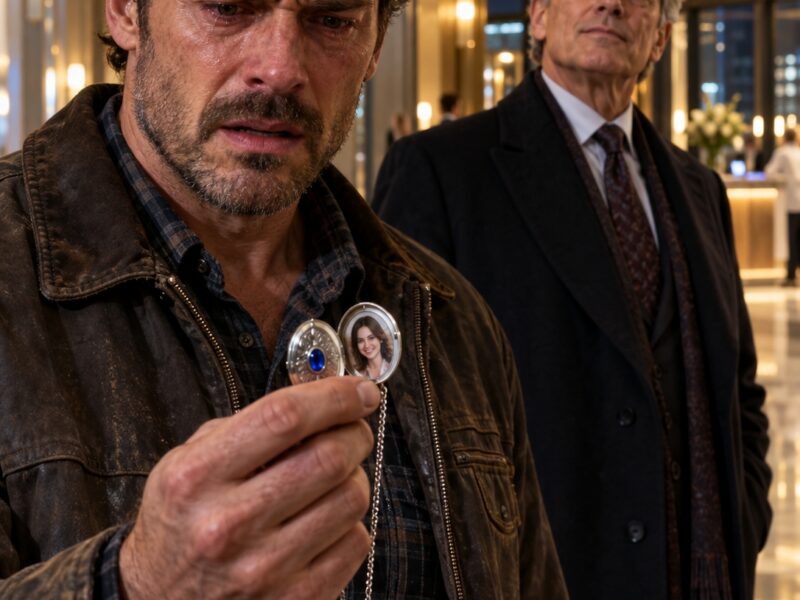
Five Freezing Children Knocked on a Lonely Rancher’s Door at 3 A.M.—Then a Little Girl Handed Him Something His Dead Wife Had Hidden Four Years Ago
The fourteen-year-old girl was carrying a child who had stopped shivering.
That was what frightened Wesley Calder most.
Not the blizzard tearing across his Montana ranch. Not the three desperate knocks that had dragged him out of bed at 3:07 in the morning. Not even the sight of five children standing on his porch in temperatures cold enough to kill a grown man.
It was the little girl in the teenager’s arms.
Her head hung against her sister’s shoulder. Her eyelashes were crusted with ice. One tiny hand had slipped from beneath her coat, and its fingers were almost white.
The oldest girl looked straight at Wesley.
“We have nowhere left to go.”
Her voice was steady, but her knees were beginning to buckle.
Behind her stood an eleven-year-old boy with a swollen cheek, a little girl clutching a torn backpack, and a smaller boy whose boots were held together with strips of silver duct tape.
They looked as though they had walked out of the storm itself.
Wesley reached for the child in the girl’s arms.
She jerked backward.
“Don’t touch her.”
“She’s freezing.”
“I know.”
“Then give her to me.”
The teenager tightened her grip, and for one terrible second Wesley thought she would collapse before she could make up her mind.
“Please,” she whispered. “Don’t separate us.”
Something inside him went very still.
Four years earlier, Wesley had stood in a hospital hallway while a woman with tired eyes told him there was nothing more the doctors could do.
He had begged her to let him see his family.
He had promised anything.
Now another frightened stranger stood in front of him, asking for something he wasn’t certain he had left to give.
“You can all come inside,” he said.
The girl searched his face.
“All five?”
“All five.”
“And nobody has to leave?”
“Not tonight.”
Only then did she step across the threshold.
Wesley shut the door against the storm.
He had no way of knowing that the smallest child was carrying something inside her coat that would reopen the worst night of his life.
Or that before another sunrise, someone would come looking for the children.
Someone who had very good reasons for wanting them silenced.
For four years, Calder Ranch had been the kind of place people drove past without slowing down.
It sat eleven miles north of the nearest paved road, beyond a stretch of cattle fencing, two frozen creeks, and a weather-beaten wooden sign whose faded letters still read CALDER FAMILY RANCH.
The word family had bothered Wesley for so long that eventually he stopped looking at it.
The ranch house was large enough for six people. It had five bedrooms, a wide kitchen, a stone fireplace, and a long covered porch facing the Absaroka Mountains.
Only one bedroom was used.
The others remained closed.
Wesley slept downstairs, ate standing over the kitchen sink more often than he cared to admit, and spent his days repairing equipment that didn’t always need repairing.
He was forty-two years old, although grief had drawn hard lines around his eyes that made him look older.
He wore the same battered boots every winter. His dark hair had begun to gray at the temples. A narrow scar crossed the back of his right hand, a reminder of a night he could barely stand to remember.
Once, people in the county had described him as friendly.
He used to organize summer cookouts. He took his daughter horseback riding every Sunday. He had been the kind of husband who stopped at a roadside stand to buy flowers even when there was no anniversary to remember.
Now he could go two weeks without speaking to another person.
His nearest neighbor, Hank Mercer, occasionally stopped by with spare parts, groceries, or a deliberately ridiculous excuse to check on him.
Wesley always told him he was fine.
Hank always pretended to believe it.
On the night the children arrived, Wesley had been sitting alone at his kitchen table with an unopened letter from the county assessor and a glass of whiskey he had barely touched.
The storm had knocked out electricity shortly after midnight.
He had lit an old kerosene lantern, fed the fire, and decided that sleep wasn’t worth the trouble.
Then the knocking began.
Three blows.
A pause.
Two more, weaker than the first.
He had opened the door expecting Hank, a stranded driver, or perhaps an injured traveler.
He hadn’t expected five orphans.
And he certainly hadn’t expected the oldest child to apologize for dripping snow on his floor.
“I’m sorry,” the girl said as soon as they entered. “We’ll clean it up.”
Wesley stared at the puddles forming beneath her boots.
“Forget the floor.”
“It looks like nice wood.”
“It’ll survive.”
He reached toward the little girl again.
The teenager hesitated, then carefully transferred her into his arms.
She weighed almost nothing.
Wesley knew enough about winter emergencies to recognize danger when he felt it. Years of ranch work had taught him what prolonged cold could do to an animal or a person.
The child wasn’t simply sleeping.
She was barely responsive.
He carried her to the couch, laid her carefully across two blankets, and checked her breathing.
“What’s her name?”
“Della.”
“How old?”
“Four.”
“When did she last talk to you?”
“Maybe an hour ago.”
The girl’s voice cracked.
“She said her feet hurt. Then she got sleepy. I kept talking to her, but…”
She swallowed hard.
“She stopped answering.”
Wesley pulled his phone from his pocket.
No cellular signal.
Of course.
The storm had taken down the valley’s network hours earlier.
His satellite emergency unit sat in a drawer near the back door. He grabbed it, powered it on, and sent a distress message requesting medical evacuation as soon as conditions allowed.
Then he called through the ranch’s old radio system.
Static hissed.
He tried again.
“Calder Ranch to county dispatch. Five minors rescued from blizzard conditions. One preschool-age female with suspected severe hypothermia. Request medical assistance.”
A burst of static answered him.
Then a voice.
“Calder, this is dispatch. Repeat your location.”
He gave his coordinates.
The dispatcher sounded relieved to hear him.
“Ground access is blocked south of Miller’s Ridge. Keep the child sheltered. We’re contacting the county medical team. Do not attempt rapid external heating. Monitor her breathing. Can you stay on radio?”
“I’m not going anywhere.”
He returned to the fireplace and found the oldest girl kneeling beside Della.
She had taken off her own coat and placed it over her sister.
Wesley pulled another blanket from the cupboard.
“Keep the room warm. We’ll change her wet clothes carefully and use dry layers. Help is coming.”
The teenager nodded.
She watched every move he made.
There was something unnatural about the way she held herself.
Not because she was frightened.
Because she was trying so hard not to be.
“What’s your name?” Wesley asked.
“Margaret Ellison.”
“Margaret.”
“Everybody calls me Maggie.”
“All right, Maggie. I’m Wesley.”
“I know.”
He looked up.
She seemed to realize what she’d said.
“I mean, the woman told us your name. At the boarding house.”
“What boarding house?”
“The one near the county road.”
Wesley’s expression tightened.
He knew the place. A weather-beaten lodging house that occasionally took in seasonal workers.
“You went there first?”
Maggie nodded.
“They wouldn’t let us stay.”
Outside, the wind shook the windows.
Wesley looked at the four other children.
An eleven-year-old boy stood by the doorway, arms folded tightly across his chest, watching Wesley as though he expected an attack.
The nine-year-old girl was studying the room with extraordinary concentration.
The youngest boy had positioned himself beside the door, his eyes fixed on the iron latch.
Wesley pointed toward the fire.
“Everybody come closer.”
The eleven-year-old didn’t move.
“You got a problem with that?” Wesley asked.
The boy’s chin rose.
“I can work.”
“I didn’t ask.”
“I know how to chop wood. I can carry water. I can clean stalls.”
“That’s impressive.”
“We don’t need charity.”
Wesley studied him.
He recognized the anger. The desperation beneath it. The terrible effort required to sound older than you were.
“What’s your name?”
“Samuel.”
Maggie glanced over.
“Sam.”
“I can introduce myself,” Sam snapped.
“Then do it politely,” Maggie replied.
Sam looked away.
Wesley almost smiled.
Almost.
“And you?” he asked the nine-year-old.
“Winifred Ellison. Winnie is acceptable.”
Wesley blinked.
“Acceptable?”
“Preferred, actually. Winifred sounds like someone who disapproves of birthday parties.”
The smaller boy let out a startled laugh.
Winnie pointed toward the fireplace.
“Your woodpile is inadequate for a house this size. Also, the lower window by the pantry has a draft. I could feel it when we walked past.”
Maggie closed her eyes.
“Winnie, please.”
“What? He should know before he wastes more heat.”
Wesley looked toward the window.
She was right.
The seal had been loose for months.
He had simply stopped caring enough to fix it.
“And who’s this young man?”
The youngest boy glared at him.
“Gideon.”
“How old are you, Gideon?”
“Seven.”
“You got anything you’d like to tell me about my house?”
Gideon considered that seriously.
“Are there wolves?”
“Sometimes.”
“Do they come inside?”
“Not if I can help it.”
Gideon nodded, apparently reassured.
Then he touched the front door.
“Can you lock that again?”
Wesley looked at the heavy iron latch.
“It’s already locked.”
“Can you check?”
Wesley walked over and tested it.
The boy watched until he was satisfied.
Only then did he move closer to the fire.
Wesley noticed the way Maggie followed him with her eyes, counting her siblings without appearing to count them.
He noticed how Sam positioned himself between Wesley and the girls.
And he noticed the little blue backpack Winnie kept pressed against her chest.
Whatever these children had endured, it had taught them to guard everything.
Even in a warm house.
Even after being invited inside.
By the time Wesley had found enough dry clothing for everyone, the kitchen smelled of reheated venison stew and toasted bread.
He dug out old sweatshirts, flannel shirts, thick socks, and a pile of blankets from a linen closet he hadn’t opened in years.
Maggie tried to refuse the clothing.
Wesley ignored her.
Sam insisted on helping carry firewood from the mudroom.
Wesley let him.
The boy struggled with the first load but refused assistance.
“Those logs aren’t going anywhere,” Wesley said.
“Neither am I.”
“Fair enough.”
Winnie found a pencil stub in her backpack and began making a list of which siblings needed new boots most urgently.
Gideon kept asking whether the doors were secure.
And Maggie refused to leave Della’s side.
Wesley brought bowls of stew to the kitchen table.
“Everybody eat.”
Nobody moved.
He looked around.
“Did I say something complicated?”
Sam stared at the food.
Gideon’s stomach growled.
Winnie quietly pushed her chair toward Maggie, as if arranging the room might somehow solve the problem.
Then Wesley understood.
Every child was waiting for permission from the oldest sister.
Maggie looked at them and managed a fragile smile.
“It’s okay.”
Sam sat first.
The others followed.
They ate carefully at the beginning, as if worried there wouldn’t be enough.
Then hunger took over.
Gideon ate with both hands wrapped around his bowl.
Winnie attempted to maintain impeccable manners, although she kept taking quick bites between sentences.
Sam ate fast, glancing at the door every few seconds.
Maggie touched her spoon to her lips only twice before returning to the couch.
Wesley watched her.
“Sit down and finish your food.”
“Della might wake up.”
“I’ll hear her.”
“She doesn’t like strange places.”
“Neither do I.”
Maggie glanced at him.
For the first time, something resembling curiosity appeared in her face.
Wesley pulled a chair toward the couch.
“Sit here. You can watch her and eat.”
“I’m not hungry.”
“That’s not what your stomach thinks.”
She looked embarrassed.
“I just need to make sure they’re okay.”
Wesley lowered his voice.
“Maggie, you’re fourteen years old.”
“I know how old I am.”
“Then you know you’re allowed to eat.”
The words hit her in a way he hadn’t expected.
Her eyes filled.
She turned away quickly.
Wesley pretended not to notice.
But he had already begun to understand something.
These children hadn’t merely lost their parents.
Their oldest sister had been trying to replace both of them.
And she was beginning to break beneath the weight.
The story came out slowly.
In fragments.
Between spoonfuls of stew and long silences.
Their father, Joseph Ellison, had once worked as a mechanic in Idaho. Their mother, Naomi, had been a home health aide before the family began moving between seasonal jobs.
Two years earlier, Joseph had joined a small heritage wagon project, helping restore horse-drawn wagons for historical tours.
When the project failed, he kept one of the old wagons and its horses.
It had become their temporary home.
They had been traveling west toward Oregon, where Joseph’s cousin had promised him work repairing farm equipment.
Their aging pickup had failed weeks earlier, and most of their savings had gone into repairs that didn’t last.
Joseph refused to abandon the horses or the wagon.
Naomi had argued with him about it.
Maggie remembered that.
They had planned to travel only the last stretch of back roads before borrowing a trailer from a friend.
But winter came earlier than anyone expected.
They were near Miller’s Ridge when the storm arrived.
“The snow got deep fast,” Maggie said.
She sat with Della’s small hand enclosed between her own.
“Papa tried turning the wagon around, but the wheels sank.”
Wesley knew that ridge.
In bad weather, even a four-wheel-drive truck could get trapped there.
“What happened to the horses?”
“We got them loose from the harness.”
“Good.”
“Papa said they had a better chance if they could find shelter.”
She looked at the flames.
“He tried digging the wheels out anyway.”
Sam lowered his spoon.
“I told him it wouldn’t work.”
Nobody corrected him.
“Mama helped,” Maggie continued. “But the wind kept blowing snow through the wagon. We couldn’t keep the blankets dry.”
Her voice became smaller.
“Papa found the heavy canvas. He wrapped all five of us together in the wagon bed. Mama put every blanket we had over us.”
She stopped.
Wesley waited.
“They told us not to come out.”
The fire crackled.
“Mama said she’d stay close.”
Maggie’s fingers tightened around Della’s hand.
“She promised.”
Sam stood abruptly.
His chair scraped across the floor.
“Sam,” Maggie whispered.
He faced the window.
His shoulders were shaking.
After a moment, Maggie continued.
“They stayed outside. They kept trying to make a windbreak with the wagon boards and whatever they could find.”
Her eyes filled.
“I could hear Papa talking to Mama for a long time.”
She swallowed.
“Then I couldn’t.”
Wesley felt an old, familiar pressure settle behind his ribs.
“Morning came,” Maggie said. “I waited because Papa told us to wait.”
She stared at the floor.
“I waited too long.”
“No,” Wesley said quietly.
She didn’t seem to hear him.
“When I finally opened the canvas, they were lying beside the wheel.”
Winnie covered her mouth.
Gideon lowered his head.
Sam struck the wall with the side of his fist.
Once.
Hard.
Maggie continued because stopping would have meant feeling everything.
“I tried waking Mama. I shook her. I kept telling her it was morning.”
Her voice broke.
“She was supposed to wake up.”
Wesley remained still.
He had heard almost the same words come out of his own mouth four years earlier.
She’s supposed to wake up.
He looked at the girl.
“What happened next?”
“We covered them as best we could. Then we started walking.”
“All five of you?”
Maggie nodded.
“Della could walk at first. Gideon too. Winnie got a blister, but she wouldn’t complain. Sam helped carry the bags.”
Winnie lifted her chin.
“I did complain once.”
Maggie gave a tiny, exhausted smile.
“You said your feet were filing a formal protest.”
“That was an observation, not a complaint.”
Then Maggie’s smile disappeared.
“We followed the road until we found the boarding house.”
“Did they call anybody?”
“No.”
“Did they offer you food?”
She shook her head.
“Water?”
Another shake.
Sam spoke bitterly.
“The woman said children meant trouble. She said somebody would come looking for us.”
Wesley’s jaw tightened.
“She told us there was a ranch north of the road,” Maggie said. “She said maybe the owner would let us sleep in the barn.”
“You walked here from there?”
“Yes.”
“In this weather?”
Maggie looked almost ashamed.
“We didn’t know where else to go.”
Wesley stared at the thin teenager.
She had led four younger children across miles of frozen countryside, carrying the youngest whenever she couldn’t walk.
And even now, sitting inside a warm house, she was apologizing for needing help.
He looked at the other children.
At Sam’s clenched jaw.
Winnie’s carefully maintained composure.
Gideon’s constant watchfulness.
And Della, who had not yet opened her eyes.
Something inside him shifted.
“You’re not sleeping in my barn,” he said.
Maggie straightened.
“We don’t want to be a burden.”
“You’re not.”
“We can leave when the roads clear.”
“We’ll discuss that later.”
Sam looked up sharply.
“Does that mean you’re sending us somewhere?”
Wesley held his gaze.
“It means tonight you eat, you get warm, and your sister gets help. Nothing else needs deciding at three in the morning.”
For a moment, nobody spoke.
Then Gideon asked the question the others seemed afraid to say aloud.
“Are you going to call the police?”
“Yes,” Wesley answered. “The dispatcher already knows you’re here. We need help finding your parents, and there are people who can make sure you’re safe.”
Gideon’s face went pale.
Sam moved closer to his little brother.
“Are they going to take us apart?”
Wesley looked at Maggie.
There it was again.
The fear that had followed them across the threshold.
He could have lied.
He could have promised that no one would ever separate them.
But he had learned the hard way that promises made out of desperation could become cruel.
“I don’t know what happens next,” he said. “But I know what I’m going to tell them.”
“What?”
“That there are five children here, and they belong together.”
Maggie stared at him.
Then she lowered her head.
For a long moment, Wesley thought she was simply exhausted.
But when she raised her face again, tears were slipping silently down her cheeks.
Della woke at 4:16 a.m.
The sound was so small Wesley almost missed it.
“Maggie?”
Her voice was thin and frightened.
Maggie dropped to her knees beside the couch.
“I’m here.”
Della blinked slowly.
“Did we get to Oregon?”
“Not yet, sweetheart.”
“Is Mama here?”
Every spoon stopped.
Sam looked down.
Winnie pressed both hands into her lap.
Gideon turned toward the fire.
Maggie stroked her sister’s hair.
“Mama isn’t here right now.”
Della considered that.
“Is Papa fixing the wagon?”
Maggie’s hand trembled.
She tried to answer.
Nothing came out.
Wesley knew that silence.
He had lived inside it for four years.
Della turned her head toward him.
“Are you the rancher?”
Wesley leaned closer.
“That’s me.”
She studied his face with the grave concentration of a child trying to remember something important.
Then she whispered, “Mama said I had to give you something.”
Maggie frowned.
“What, sweetheart?”
Della pushed her small hand inside her coat.
Her fingers searched a hidden pocket sewn into the lining.
Then she pulled out a tiny bundle wrapped in worn blue cloth.
“I kept it safe.”
Wesley reached out automatically to steady her hand.
Maggie unfolded the cloth.
A silver object dropped into her palm.
It was a locket.
Oval.
Tarnished along the edges.
With a small blue stone set into the front.
Wesley stopped breathing.
He knew that locket.
He knew the shallow scratch beside the clasp.
He knew the way the blue stone caught the firelight.
He had bought it at a jewelry store in Bozeman twelve years earlier, when he and his wife were celebrating the birth of their daughter.
Clara had worn it every day.
Every single day.
Until the night she died.
For four years, Wesley had believed the necklace had been lost in the accident that killed her and their little girl.
Now it lay in the palm of a fourteen-year-old stranger.
He gripped the edge of the table.
“Where did you get that?”
Maggie looked frightened by the change in his voice.
“Mr. Calder?”
“Where?”
Della flinched.
Wesley immediately lowered his voice.
“I’m sorry, sweetheart.”
Maggie looked down at the locket.
“Mama had it.”
“Your mother?”
“She kept it in a tin box with some papers.”
“Why?”
“I don’t know.”
Della lifted her head.
“Mama said it belonged to a lady who was very sad.”
Wesley’s chest tightened.
He crouched beside her.
“What lady?”
Della blinked.
“The lady in the hospital.”
The room seemed to tilt.
Maggie turned toward him.
“Mom told us that if we ever found Wesley Calder, we were supposed to give him this.”
Wesley looked at the silver locket again.
His wife’s locket.
The one missing from the wreckage of the worst night of his life.
“Did she say why?”
Maggie hesitated.
“She said you’d understand.”
Wesley shook his head.
“I don’t.”
Then Maggie turned the locket over.
“There was something else.”
She pressed the small clasp with her fingernail.
It opened.
Inside was a faded photograph of a little girl with dark curls and a gap between her front teeth.
Wesley’s daughter.
June.
He made a sound so quiet that none of the children recognized it for what it was.
A grown man trying not to sob.
And tucked behind the photograph was a tightly folded piece of paper.
Maggie carefully pulled it free.
The handwriting on the outside was unmistakable.
For Wes. When the truth finally comes.
Wesley felt his legs weaken.
It was Clara’s handwriting.
His dead wife had left him a message.
And someone had kept it hidden for four years.
The radio cracked before Wesley could unfold the paper.
“Calder Ranch, this is county dispatch. Medical team is attempting access from the south. We’re coordinating with search and rescue. Can you confirm the children are stable?”
Wesley closed his eyes.
Reality returned in pieces.
A sick four-year-old.
Four exhausted siblings.
A deadly storm.
Five children who needed him to function.
He forced himself to set the locket down.
“Child is responsive,” he answered. “Still very cold and weak. Breathing is steady. The others are alert. We need that medical team as soon as you can get them here.”
“Understood. Stay available.”
Wesley placed the radio on the mantel.
Maggie watched him.
“Do you know whose necklace that is?”
He looked at her.
“Yes.”
“Was it your daughter’s?”
He swallowed.
“It belonged to my wife.”
Something changed in Maggie’s expression.
Not recognition exactly.
More like the moment a memory begins fitting into a place it has never fit before.
“My mom knew your wife?”
“I don’t know.”
“She wouldn’t have kept something that wasn’t hers.”
“I believe you.”
Wesley picked up the folded note.
The paper had yellowed at the edges. It was almost translucent where repeated folds had weakened it.
For a moment, he couldn’t bring himself to open it.
He had spent four years avoiding Clara’s handwriting.
He had left birthday cards in drawers.
He had stopped reading old text messages.
He had even thrown away a grocery list because seeing the words milk, apples, June’s cereal had left him standing motionless in the kitchen for nearly an hour.
And now he was holding a letter written by his wife.
A letter she had apparently intended him to read.
Maggie watched his hand tremble.
“You don’t have to read it right now.”
He looked up.
It was such an ordinary kindness.
So unexpected from someone who had just lost everything.
He nodded.
“Maybe you’re right.”
But Della was watching him too.
“Mama said you would cry.”
Wesley’s eyes filled.
“Did she?”
Della nodded.
“She said sometimes people cry because their hearts are full.”
Maggie stroked her sister’s hair.
“Della, you need to rest.”
The little girl settled back against the cushion.
Wesley looked at the folded note.
Then he opened it.
There were only three lines.
Wes, if this reaches you, please know that I never stopped loving you.
What happened on the bridge was not your fault.
Ask Naomi Ellison what she saw.
Wesley read the last sentence again.
Then again.
The words blurred.
He could feel the cold hospital hallway beneath his feet.
Smell the antiseptic.
Hear the sound of tires on wet pavement.
And hear his own voice, four years younger and filled with anger.
Just take June and go, Clara. We’ll talk when you get back.
He had said those words on the night they died.
They were the last words he’d spoken to his wife.
For four years, he had believed they were part of the reason she never came home.
Now a note from Clara was telling him otherwise.
But the only woman who could explain what it meant had died somewhere near Miller’s Ridge.
And her five children were sitting in his kitchen.
Wesley looked toward Maggie.
“Your mother,” he said slowly. “Did she ever tell you about an accident on Blackwater Bridge?”
The teenager went perfectly still.
Sam’s head snapped toward him.
And Maggie whispered something Wesley had not expected.
“That’s why she wanted us to find you.”
Four years earlier, Blackwater Bridge had been the place Wesley Calder’s life ended without his body dying.
It was a narrow two-lane crossing over a steep ravine twenty miles west of Livingston.
During spring, the water beneath it ran violently between black rocks. In winter, the creek nearly vanished beneath ice.
The bridge had been built decades before Wesley was born.
Its guardrails were old.
Its pavement was uneven.
And the approach curved sharply downhill.
Wesley had driven across it hundreds of times.
Clara had driven across it too.
Until the night she didn’t make it to the other side.
The day had begun with an argument.
Not a dramatic one.
Not the kind people imagine will haunt them.
It was about money, family obligations, and whether Wesley was spending too much time working.
June had just turned six.
She wanted her father to take her to the winter festival in town.
Wesley had promised he would.
Then a piece of ranch equipment broke, and he canceled.
Clara was angry.
“You keep saying you’ll make time,” she’d told him.
“I have bills to pay.”
“We all do.”
“Someone has to keep this place running.”
“And somebody has to notice when your daughter stops asking you to come.”
That was the sentence he remembered most clearly.
Because Clara had been right.
He knew it even then.
But pride had made him defensive.
And exhaustion had made him unkind.
Clara had taken June to town without him.
They were supposed to stay with Clara’s sister for the night.
At 8:43 p.m., Wesley had received a voicemail.
Clara’s voice sounded tired.
“Hey. We’re heading out a little earlier than planned. June fell asleep after the festival. I’ll call when we get closer. And Wes…”
A pause.
“I’m sorry we fought.”
He had listened to that message the next morning.
After the sheriff called.
After the hospital.
After he had already learned that apologies could become unbearable things.
The official accident report said Clara’s SUV lost traction on Blackwater Bridge during a winter storm.
The vehicle struck the guardrail.
The barrier failed.
The SUV fell into the ravine.
June was declared dead that night.
Clara lived long enough to reach the hospital.
Wesley arrived just before dawn.
He remembered the doctor explaining internal injuries.
Remembered a nurse standing near the door.
Remembered Clara’s hand in his.
He remembered her opening her eyes once.
And whispering, “June?”
He couldn’t answer.
Clara looked at his face.
Something inside her seemed to understand.
Then she said, “It wasn’t…”
Her voice disappeared.
Wesley leaned closer.
“What?”
She tried again.
But her breathing became shallow, and the medical team moved around the bed.
She never finished the sentence.
For years, Wesley believed she had been trying to say the accident wasn’t his fault.
But believing it and accepting it were different things.
He had convinced himself that if he had gone to the festival, Clara wouldn’t have driven that road alone.
If he hadn’t argued with her, she might have stayed overnight.
If he had answered her last call, perhaps she would have stopped somewhere safe.
He had built an entire prison out of if.
Then, four months after the funeral, an insurance representative told him that the county investigation had found no mechanical defect or external cause.
The bridge had been inspected six months earlier.
The guardrail had met the applicable standards according to the records provided.
The accident was attributed to weather and driver error.
Wesley signed the paperwork.
He stopped asking questions.
And when the county held a public meeting about improving winter-road safety, he didn’t attend.
He couldn’t bear to hear his wife’s name spoken by strangers.
But Naomi Ellison had apparently been there that night.
At least, that was what Maggie now claimed.
“She wasn’t just working in the hospital,” Maggie said.
Wesley looked at her.
“What do you mean?”
“My mom was training as an emergency medical technician. She worked some shifts transporting patients and helping at the county clinic. Sometimes she volunteered with search and rescue.”
Wesley remembered a woman near Clara’s hospital bed.
Dark hair.
Tired eyes.
A soft voice telling him to sit down.
He had forgotten almost everything about her.
“She was at the accident scene,” Maggie continued.
Wesley’s fingers tightened around the note.
“Your mother?”
Maggie nodded.
“She told Papa about it sometimes. When she thought we couldn’t hear.”
“What did she say?”
Maggie glanced at Sam.
The boy’s face had changed.
The anger he carried so openly had become something harder.
“Tell him,” Sam said.
Maggie swallowed.
“Mom said the bridge wasn’t safe.”
Wesley stared at her.
“Everybody knew it was dangerous.”
“No.”
Sam stepped forward.
“Not like that.”
“Sam,” Maggie warned.
But he continued.
“She said somebody knew the railing was going to fail.”
The room became very quiet.
Wesley looked from one child to the other.
“What somebody?”
Sam’s face hardened.
“The people who paid to have it fixed.”
And before Wesley could ask another question, Maggie reached inside her backpack.
“There was a reason Mom kept the necklace,” she said.
Then she pulled out a small envelope.
It was addressed to Wesley Calder.
Underneath his name, Naomi Ellison had written two words.
Personal delivery.
Wesley didn’t open the envelope immediately.
He wanted to.
Every instinct demanded it.
But Della had begun coughing, and the older children looked ready to collapse from exhaustion.
The rancher was suddenly aware that he had spent nearly twenty minutes asking questions while a half-frozen family sat around him.
He tucked the envelope beneath the locket.
“Everybody needs rest.”
Sam shook his head.
“I’m not sleeping until I know what happens to us.”
“Then you’re going to be awake a long time, because nobody knows everything at four in the morning.”
“You might.”
Wesley met his eyes.
“I don’t.”
Sam stared at him.
“I hate that answer.”
“So do I.”
Something passed between them.
Not trust.
Not yet.
But perhaps recognition.
Wesley led Winnie and Gideon upstairs to the room closest to the landing.
It had two twin beds.
One was made with a green quilt.
The other with a faded red one.
The room smelled faintly of cedar and disuse.
Winnie stood in the doorway.
“Whose room was this?”
“Guests.”
“Before?”
Wesley looked at the beds.
Before.
It was such a small word.
He thought of summer weekends when friends visited, children raced through the hallway, and Clara complained that the house was never quiet.
“Yeah,” he said. “Before.”
Winnie touched the green quilt.
“Did you make these?”
“My wife did.”
“She’s good at sewing.”
Wesley looked away.
“She was.”
Winnie’s hand stopped.
“Oh.”
She looked at him with an expression far older than nine.
“I’m sorry.”
“Thank you.”
Gideon inspected the windows.
“Can we leave the door open?”
“Sure.”
“And the hallway light?”
“The power’s out, but I’ve got a lantern.”
Wesley placed a battery-operated camping lantern on the dresser.
The light cast a soft amber glow across the room.
Gideon climbed into bed fully dressed.
Winnie sat beside him.
As Wesley turned to leave, the little boy spoke.
“Mr. Calder?”
“Yeah?”
“Are Mama and Papa cold?”
Wesley stood still.
He knew what the boy was asking.
It wasn’t about weather anymore.
It was about the bodies lying somewhere beneath the snow.
About whether the people who had kept him warm were still suffering.
Wesley sat on the edge of the bed.
“I don’t think they’re hurting now, Gideon.”
The boy considered that.
“Will somebody find them?”
“Yes.”
“Will they be together?”
“I’ll ask the rescuers to take care of them together.”
Gideon rubbed his eyes.
“Mama never liked being alone.”
Wesley looked toward the window.
“Neither did my wife.”
Gideon slipped one hand beneath his pillow.
A moment later, he held out a tiny wooden horse.
One ear was broken.
“Papa made this,” he whispered. “He said horses know how to find their way home.”
Wesley accepted the toy.
“That’s a good horse.”
Gideon hesitated.
“Do you think Papa found his way?”
The question went through Wesley like a blade.
He returned the wooden horse to the boy’s hand.
“I think he did everything he could to make sure you found yours.”
Gideon’s chin began to tremble.
He pulled the toy close.
Wesley stayed until both children fell asleep.
When he returned downstairs, Sam was sitting by the fireplace.
Maggie had curled up beside Della.
Her eyes were closed, but her hand remained wrapped around her little sister’s wrist.
Sam watched Wesley.
“Are you going to read it?”
Wesley looked at Naomi’s envelope.
“Yes.”
“Will you tell us what’s in it?”
“If it’s something you need to know.”
Sam didn’t seem satisfied.
But he didn’t argue.
Wesley sat at the kitchen table, reached for the envelope, and broke the seal.
Inside were several folded pages, a photocopy of an old repair invoice, and a small memory card wrapped in tissue.
On top was a handwritten letter.
Mr. Calder,
I have tried to reach you more than once. I know you have every reason not to answer strangers asking about Clara. I also know that what I have to tell you may reopen a wound I have no right to touch.
But I was there that night.
And I have carried the truth long enough.
Wesley stopped.
He listened to the fire.
To Sam’s quiet breathing.
To the wind scraping across the roof.
Then he read the next sentence.
Your wife did not lose control of her vehicle because she was careless. There was another truck on the bridge.
Wesley’s hand went numb.
The official report had said Clara was alone.
The hospital had said there were no other motorists involved.
The sheriff had told Wesley there was no evidence of a second vehicle.
But Naomi’s letter continued.
The truck forced her against a damaged section of the guardrail. She was trying to avoid a collision. The driver did not stop.
Wesley stared at the paper.
A vehicle.
Another driver.
Someone who had left his wife and daughter in a ravine.
For four years, he had believed Clara made a mistake.
Now a dead woman was telling him that someone else had made a choice.
And driven away.
The final sentence on the page made him stand so suddenly that his chair struck the floor.
The person responsible knew what had happened before the police arrived.
Wesley looked toward the dark windows.
Somewhere beyond them, the storm was swallowing the mountains.
He thought of the county report.
The insurance settlement.
The people who had assured him every question had already been answered.
Then he turned the page.
At the bottom was a name.
Graham Barlow.
Wesley knew that name.
Everybody in the county did.
Barlow owned the largest private road-maintenance contractor in the region.
He served on the county development committee.
His company had helped repair Blackwater Bridge.
And four years earlier, he had stood beside Wesley at Clara’s funeral.
With one hand on his shoulder, Barlow had said, “Sometimes bad weather is simply nobody’s fault.”
Wesley looked down at the letter.
For the first time in four years, his grief had found something more dangerous than itself.
A direction.
The first thing Wesley did was pick up the telephone.
The landline was dead.
He tried his cell again.
Still no signal.
He walked to the radio, then stopped with his hand on the microphone.
The dispatcher was connected to county emergency services. By morning, law enforcement would know about five children found on Calder Ranch.
And somewhere in that same county, Graham Barlow had enough influence to make inconvenient paperwork disappear.
Wesley lowered his hand.
“What’s wrong?” Sam asked.
The boy had risen from his chair.
Wesley turned.
“Nothing you need to worry about tonight.”
“Adults always say that when something’s wrong.”
Wesley had no answer.
Sam approached the table.
“That’s the man, isn’t it?”
“Which man?”
“The one Mom was afraid of.”
Wesley’s expression changed.
“Your mother was afraid of Graham Barlow?”
Sam looked surprised.
“You know him?”
“Yes.”
“Then you know he’s a liar.”
“Sam,” Maggie murmured from the couch.
She was awake.
Her eyes were fixed on the letter.
Wesley looked between them.
“What did he do to your family?”
Maggie pulled Della’s blanket higher before answering.
“Mom said he was important. That he had friends everywhere.”
“When?”
“Last summer.”
“Did he threaten her?”
Maggie didn’t answer immediately.
Sam did.
“He came to the place where we were staying.”
Wesley felt the room grow smaller.
“Where was that?”
“A campground outside Bozeman,” Maggie said. “Papa was repairing engines for a construction crew. Mom had a job at a nursing home.”
“One afternoon this man came to our trailer,” Sam continued. “He drove a black truck and wore a really nice coat.”
“Did you hear what he said?”
Sam nodded.
“He told Mom to stop making trouble.”
Maggie looked down.
“Papa sent us inside.”
“But I could hear them,” Sam said. “The man said somebody had already died and there was no reason to ruin more lives.”
Wesley felt sick.
“What did your father say?”
Sam’s jaw tightened.
“He told the man to get off our property.”
“And then?”
“The man laughed.”
Sam looked toward the door.
“He said people like us didn’t have property.”
Silence settled over the kitchen.
Wesley knew Graham Barlow.
He knew the immaculate suits, the expensive boots, the carefully measured handshakes.
Barlow was the kind of man who attended charity galas and made sure the local newspaper photographed every donation.
He spoke endlessly about responsibility.
Community.
Doing what was necessary for the county’s future.
And he had built a very successful life out of deciding whose suffering counted as unfortunate and whose could be ignored.
But threatening a family with five children?
Wesley had never imagined it.
Or perhaps he had simply never wanted to.
“Did your parents go to the police?” Wesley asked.
Maggie nodded.
“Mom tried. She said she was told there wasn’t enough evidence.”
“Who did she talk to?”
“I don’t know.”
Wesley looked at Naomi’s letter again.
He had found the first page.
There were three more.
He turned to the second.
The official accident report was changed after I gave my initial statement. I described seeing a dark maintenance truck leaving the bridge approach while I was traveling to the scene with a volunteer response team. Its rear lights were damaged, and one side of the front bumper was hanging loose.
I was told my account was unreliable because visibility was poor.
The next day, a supervisor instructed me not to discuss the vehicle with anyone.
Wesley leaned closer.
Three weeks later, I found a copy of a repair order at the service yard where Joseph occasionally worked. The vehicle identification matched a truck assigned to Barlow Infrastructure. The repair was authorized the morning after the crash.
Wesley examined the attached invoice.
It was a photocopy, with a handwritten notation in one corner.
The date was four years old.
The vehicle was identified by fleet number, not by the driver’s name.
The work description included front bumper replacement and repairs to the right headlight assembly.
Wesley felt his pulse beating in his throat.
It wasn’t proof of everything Naomi suspected.
A damaged truck could have been involved in another collision.
A repair order could be explained.
But the dates were impossible to ignore.
And someone had apparently gone to considerable trouble to prevent him from ever seeing them.
He turned to the next page.
I don’t know whether Mr. Barlow was driving the truck that night. I have never claimed to know that. But I know what I witnessed, and I know the statement I gave was not accurately represented in the final report.
Clara was conscious for a short time before she was moved to the ambulance. She asked me to make sure someone told you she loved you. She also asked whether June was safe.
Wesley’s eyes blurred.
He stopped reading.
The kitchen disappeared.
He was back in a hospital.
He could hear Clara asking for their daughter.
He could feel her hand slipping from his.
And for the first time, he understood that she had spent her final hours trying to reach him with more than an apology.
He bowed his head.
Sam watched from across the table.
“Are you crying?”
Wesley wiped his face.
“Yeah.”
“My dad cried sometimes.”
“Did he?”
“Not when people were watching.”
Wesley gave a humorless little laugh.
“Smart man.”
Sam came a step closer.
“Mom said crying doesn’t mean you’re weak.”
Wesley looked at him.
“What did she say it means?”
The boy thought for a moment.
“That something mattered.”
Wesley closed his eyes.
Something mattered.
A marriage.
A child.
A life that had been reduced to a police report and a stack of insurance forms.
He unfolded the last page.
Clara’s necklace came loose while we were preparing her for transport. She asked me to keep it safe for you. Afterward, I made a terrible mistake. I believed the officials who said I should give it to the investigating officer along with my statement. When I asked about returning it, I was told it had been misplaced.
Months later, I found it among personal effects stored in a box awaiting disposal at the old clinic. I took it because it belonged to you, and because I knew you had never received it.
I should have brought it to you immediately.
But by then I had begun asking questions about the truck, and someone was watching my family.
Joseph convinced me to wait until we could get the evidence into safe hands. I kept trying to find a way to contact you without exposing our children.
I was afraid. I am ashamed of how long I let fear make my decisions.
If this letter reaches you, please understand that I am not asking you to forgive me.
I am asking you not to let the truth disappear again.
At the bottom, in smaller writing, Naomi had added:
The memory card contains copies of my original statement, photographs, and an audio recording of the meeting where I was pressured to withdraw my account. The originals are stored somewhere else. Joseph knows where.
Wesley read that sentence twice.
Joseph knew where.
Joseph, who now lay dead beside a frozen wagon.
Wesley looked at the children.
Then at the small backpack Maggie had brought into his home.
“What did your father tell you before the storm?” he asked.
Maggie stared at him.
“What do you mean?”
“About your mother’s papers.”
Her expression tightened.
“Why?”
“Because your mother left me something important.”
“Are we in trouble?”
“No.”
“Is Mom?”
Wesley hesitated.
The silence lasted too long.
Maggie looked down at Della.
“She was already in trouble, wasn’t she?”
Wesley couldn’t bring himself to lie.
“I think someone wanted her to stop asking questions.”
Maggie’s face drained of color.
She reached for her mother’s envelope.
“Then we shouldn’t have come.”
Wesley frowned.
“What?”
“We shouldn’t have brought it here.”
Sam moved beside her.
“Maggie?”
She looked toward the windows.
“Mom told Papa the rancher might not be safe.”
Wesley felt the words settle over him.
“Not safe?”
Maggie shook her head.
“Not because of you.”
Her voice dropped.
“Because if we found you, they would know where to find us.”
By dawn, the storm had weakened enough for the county medical team to reach Calder Ranch in a tracked rescue vehicle.
The sound of its engine came rolling through the trees shortly after 7:30.
Wesley met the team at the porch with a blanket-wrapped Della in his arms.
A paramedic named Laura Bennett took one look at the child and immediately opened her medical bag.
Della was conscious but lethargic, and the paramedics wanted her examined at the hospital without delay.
Maggie clung to her sister’s hand.
“I’m going with her.”
Laura nodded.
“Of course.”
“All of us.”
The paramedic hesitated.
Maggie saw it.
Her breathing quickened.
“No. You don’t understand. We have to stay together.”
Wesley stepped closer.
“There’s room for how many?”
“Three passengers besides the patient,” Laura answered. “We can request another vehicle, but roads are still bad.”
Maggie looked horrified.
Sam moved forward.
“I’ll stay.”
“No,” Maggie said immediately.
“Maggie, somebody has to.”
“No.”
Laura knelt until her face was level with Maggie’s.
“Listen to me. Della needs a doctor. We’ll take her and you to the hospital first. Another crew is already making its way here. Your brothers and sister will be safe until they arrive.”
Maggie’s hands began to shake.
“I promised my mom.”
Laura’s expression softened.
“What did you promise?”
“That I wouldn’t lose them.”
The paramedic was silent.
Then she reached into her coat and pulled out her phone.
“I’m going to call dispatch. We’ll see whether they can send the second vehicle to meet us before we leave the property.”
She stepped away.
Wesley crouched in front of Maggie.
“You’ve kept them alive through a storm.”
Maggie shook her head.
“Not Mom and Papa.”
The words came so suddenly that Wesley felt them in his chest.
“You couldn’t save them.”
“I should’ve opened the canvas sooner.”
“No.”
“If I’d gone outside when Papa stopped talking—”
“You might have died too.”
She looked at him with furious, wounded eyes.
“You don’t know that.”
Wesley held her gaze.
“No,” he admitted. “I don’t.”
He thought of Clara.
Of every impossible bargain he had made with himself.
“But I know what it feels like to believe one different choice could have fixed everything.”
Maggie stared at him.
He continued quietly.
“Sometimes your mind keeps showing you a door you could have opened. A road you could have taken. A sentence you could have said differently.”
Her eyes filled.
“And after a while, you start believing the past would have changed if you’d just been better.”
Maggie whispered, “Wouldn’t it?”
Wesley had spent four years asking that question.
Now he heard himself answer it.
“Not always.”
She lowered her head.
He rested one hand gently on her shoulder.
“Your parents made a choice that kept five children alive. You honored it by bringing your brothers and sisters here.”
“But—”
“You did enough, Maggie.”
The girl pressed her lips together.
Her face crumpled.
For the first time since arriving at the ranch, she cried without trying to hide it.
Not a single tear.
Not a quick, embarrassed breakdown.
She cried like a child who had spent two days refusing to be one.
Wesley let her.
He didn’t tell her to be brave.
He didn’t say everything would be all right.
He simply stayed beside her until she could breathe again.
By late morning, the children had reached Livingston Regional Medical Center.
Della was placed under observation for hypothermia, dehydration, and possible complications from prolonged exposure.
The other children were examined.
Winnie had badly blistered feet.
Gideon was mildly dehydrated and exhausted.
Sam had bruising on his hands from trying to dig the frozen wagon wheels free.
Maggie had strained muscles, small patches of frostbite, and signs of severe sleep deprivation.
When a nurse asked her when she had last slept properly, she couldn’t remember.
Wesley stood outside the examination room while the staff worked.
He had driven behind the rescue convoy as far as the highway and continued on once the roads opened.
He hadn’t been inside a hospital since Clara died.
The smell hit him first.
Then the bright lights.
The squeak of rubber soles.
The soft mechanical beeping from behind closed doors.
He almost turned around.
His hands became cold.
A woman in blue scrubs passed carrying a tray of medical supplies, and suddenly he could hear a monitor from four years ago.
He leaned against the wall.
Breathe.
He told himself to breathe.
But the hallway kept stretching.
And the past kept moving toward him.
“Mr. Calder?”
He looked up.
A woman in her late fifties stood beside him.
She wore a gray coat and carried a leather folder.
“I’m Helen Parker. County family services.”
Wesley straightened.
“Yes, ma’am.”
“I understand you found the Ellison children.”
“They found me.”
Helen gave a small nod.
“I’d like to talk about their circumstances.”
Wesley glanced toward the examination room.
“How’s Della?”
“She appears to be improving, but the doctors are keeping her for observation.”
“Good.”
Helen opened her folder.
“We’ve confirmed a report of an abandoned wagon near Miller’s Ridge. Search and rescue located two deceased adults matching the parents’ descriptions.”
Wesley closed his eyes.
Joseph and Naomi.
He pictured Maggie kneeling by the fireplace, insisting she only needed one night.
“Have the children been told?”
“Not formally. We’re waiting until the medical staff says it’s appropriate.”
“They already know.”
“Yes,” Helen said quietly. “But knowing and hearing it confirmed are two different things.”
Wesley looked toward the floor.
“What happens to them now?”
Helen hesitated.
“We’re searching for relatives.”
“They mentioned a cousin in Oregon.”
“We’re trying to verify that connection.”
“And until then?”
“Emergency placement. Ideally together, although finding a licensed home with room for five children can be difficult.”
Wesley’s jaw tightened.
“How difficult?”
Helen studied him.
“Mr. Calder, the children will need ongoing support. We can’t simply place five traumatized minors with someone because he gave them shelter during a storm.”
“I understand.”
“Do you?”
He looked at her.
“I understand you have rules.”
“They exist for a reason.”
“I know.”
His voice was calm.
But something in his expression made Helen pause.
“I had a daughter,” he said.
Helen’s face changed.
“I know.”
Wesley looked surprised.
She continued gently.
“I remember your family.”
For a moment, he couldn’t speak.
Then he looked away.
“That was a long time ago.”
“Four years.”
He almost laughed.
Four years.
Four thousand years.
Four minutes.
Grief had never been particularly respectful of calendars.
Helen closed her folder.
“The important thing is that we find the children somewhere safe.”
Wesley nodded.
Then he asked, “Can you promise they’ll stay together?”
Helen didn’t answer immediately.
And that silence frightened him more than anything she’d said.
At 1:40 that afternoon, Wesley received his first working cell signal in nearly two days.
There were twenty-three missed calls.
Most were from Hank Mercer.
Two were from the ranch supply store.
One was from a number he didn’t recognize.
And another came from a contact he had deleted four years earlier.
Graham Barlow.
Wesley stared at the screen.
The call had arrived at 9:12 that morning.
Nearly two hours after search and rescue reached his ranch.
His stomach tightened.
He had not spoken to Barlow in almost three years.
He hadn’t wanted to speak to anyone connected with the accident.
Why would Barlow call now?
He opened his voicemail.
The message was short.
“Wesley, Graham Barlow here. Heard you had quite a night up there. Five children, huh? That’s a remarkable thing. Give me a call when you get a chance. There’s something I’d like to discuss with you.”
A pause.
Then the familiar smooth voice added:
“And Wesley? You might want to be careful about getting mixed up in matters that don’t concern you.”
The recording ended.
Wesley stood motionless.
Behind him, a hospital elevator opened.
A man stepped out wearing a dark overcoat and polished brown boots.
He was in his early sixties, broad-shouldered, with neatly combed silver hair.
He looked exactly as he had at Clara’s funeral.
Graham Barlow smiled.
“Well,” he said. “There you are.”
For a moment, Wesley could only stare.
The man approaching him looked like a successful businessman paying an ordinary social visit.
His coat was immaculate.
His smile was warm.
He carried a white paper cup with the logo of a coffee shop in town.
Nothing about him suggested menace.
That was what made Wesley angrier.
Graham had always been good at looking harmless.
“Wesley,” he said again, extending a hand. “It’s been too long.”
Wesley didn’t take it.
Graham lowered his hand without embarrassment.
“I heard about the children. Terrible business.”
“How did you hear?”
“Small county.”
“That’s not an answer.”
Graham sipped his coffee.
“I serve on several county committees. News travels.”
Wesley watched him.
“What do you want?”
“Straight to business. Always liked that about you.”
“Then answer the question.”
Graham’s smile weakened slightly.
“I understand the children’s parents were Joseph and Naomi Ellison.”
Wesley said nothing.
Graham glanced down the hallway.
“I knew Joseph. Good mechanic. Had a little trouble keeping steady work.”
Wesley’s hands curled.
“Funny. Sam told me you knew his mother.”
Graham’s eyes returned to him.
“Sam?”
“One of the children.”
“Ah.”
Another sip of coffee.
“Well, I’m sure they’ve been through a terrible ordeal. Children say all kinds of things when they’re frightened.”
Wesley stepped closer.
“What did you do to Naomi Ellison?”
Graham stopped smiling.
“Excuse me?”
“You heard me.”
For a moment, the corridor seemed unusually quiet.
Then Graham chuckled.
“Wesley, I realize you’ve had an emotional night, but I wouldn’t recommend making accusations you can’t support.”
“Who said anything about accusations?”
Graham studied him.
The charm disappeared from his face.
“You were always a decent man,” he said. “Even after Clara’s accident.”
Wesley felt his pulse spike.
“Don’t say her name.”
Graham lowered his voice.
“I’m trying to help you.”
“By doing what?”
“By reminding you that grief can make people vulnerable. It can make you believe things you desperately want to believe.”
Wesley said nothing.
Graham leaned closer.
“Some stories are more complicated than they appear.”
“Is that what happened on Blackwater Bridge?”
Something flickered in Graham’s eyes.
Very briefly.
Then it was gone.
“I don’t know what you’ve been told.”
“Then maybe you should ask.”
Graham looked at him for several seconds.
When he spoke again, his voice had lost its warmth.
“You’ve got a beautiful ranch, Wesley. It would be a shame to see it become the center of another tragedy.”
Wesley moved so suddenly that Graham took half a step back.
But Wesley didn’t touch him.
He simply leaned forward.
“Listen carefully.”
Graham’s jaw tightened.
“If you have something to say to me, say it. But stay away from those children.”
Graham glanced toward the examination rooms.
“You’re becoming attached to them.”
“They’ve had a hard enough time.”
“Attachment is a dangerous thing. Especially for a man who has already lost so much.”
Wesley felt a surge of anger so violent that he had to unclench his hands.
Graham watched him.
Then he smiled again.
“Take care of yourself, Wesley.”
He walked toward the elevator.
Just before stepping inside, he turned.
“Oh, and one more thing.”
Wesley remained still.
“Naomi Ellison had a habit of keeping things that didn’t belong to her.”
The elevator doors began to close.
“Make sure you know what you’re holding.”
Then he was gone.
Wesley stood in the hallway, breathing hard.
He reached into his pocket.
The locket was there.
So was Naomi’s letter.
But the memory card wasn’t.
He had left it inside the envelope in his truck.
And his truck was parked in the hospital garage.
The parking garage was nearly empty when Wesley reached it.
The overhead lights flickered above rows of vehicles.
He could hear traffic from the street below.
His truck stood exactly where he’d left it.
A dark blue Ford with mud along the tires and a dent in the rear bumper.
Wesley approached slowly.
Nothing looked disturbed.
He unlocked the driver’s door.
The glove compartment was open.
His breath caught.
He had placed Naomi’s envelope in the center console before entering the hospital.
Now the console lid was raised.
The contents had been scattered across the passenger seat.
A pair of work gloves.
A flashlight.
Old receipts.
And the empty tissue in which the memory card had been wrapped.
Wesley stared at it.
Someone had been inside his truck.
Someone had taken the card.
He looked across the garage.
No one.
He checked beneath the seats, searched the floor, then stepped backward.
A sickening realization settled over him.
He had spent four years being told there was nothing to investigate.
Now, within hours of receiving Naomi’s evidence, someone had stolen it.
His phone buzzed.
Unknown number.
He answered.
No one spoke.
“Hello?”
Static.
Then a man’s voice.
“You should’ve left the past buried, Calder.”
The call ended.
Wesley stood motionless.
A horn sounded somewhere outside.
He looked toward the security cameras mounted above the garage entrance.
Then he did something he hadn’t done in four years.
He called the sheriff.
Sheriff Daniel Whitcomb had known Wesley since high school.
They had played football together, worked summer jobs at neighboring ranches, and once gotten into a fistfight at a county fair over a girl neither of them eventually married.
Daniel was forty-three now, with thinning blond hair and a face that rarely concealed what he was thinking.
He arrived at the hospital garage twenty minutes later with a deputy.
“Tell me exactly what happened,” he said.
Wesley did.
He described the children.
Naomi’s letter.
The damaged Barlow truck.
Graham’s visit.
The stolen memory card.
Daniel listened without interrupting.
When Wesley finished, the sheriff looked toward the glove compartment.
“Did you lock the truck?”
“Yes.”
“Any sign of forced entry?”
“No.”
“Who knew the card was here?”
“Nobody.”
Daniel’s expression tightened.
“Somebody did.”
Wesley stared at him.
Daniel took a slow breath.
“Before you say it, no, I don’t think you’re imagining things.”
“Good.”
“But I’m going to need you to understand something.”
Wesley folded his arms.
“This is bigger than one stolen object. If what Naomi wrote is true, we’re talking about possible evidence tampering, intimidation, and a four-year-old fatal collision investigation.”
“You think I don’t know that?”
“I think you’re angry.”
“Wouldn’t you be?”
Daniel’s face softened.
“Yes.”
He glanced toward the passenger seat.
“And I think you’ve got a right to be.”
For the first time that day, Wesley felt the smallest measure of relief.
Then Daniel asked to see Naomi’s letter.
Wesley handed it over.
The sheriff read every page.
By the time he finished, his expression had grown grim.
“Did Naomi ever file a formal complaint about the changed report?” he asked.
“I don’t know.”
“We’ll find out.”
“Do you trust the people who investigated Clara’s accident?”
Daniel looked up.
Wesley held his gaze.
It was an ugly question to ask an old friend.
An uglier one to need answered.
Daniel folded the letter.
“I wasn’t sheriff then,” he said. “And I don’t know who altered what, if anything was altered.”
“That isn’t what I asked.”
Daniel hesitated.
Then he spoke quietly.
“I trust some of them.”
Wesley’s stomach tightened.
“Some?”
Daniel glanced at his deputy.
Then back at Wesley.
“If there’s evidence of misconduct involving the original investigation, I want state investigators involved. Not just my office.”
Wesley nodded slowly.
Daniel continued.
“And until we know what happened, don’t confront Barlow again.”
“I’m not afraid of him.”
“I know.”
“That doesn’t mean I’ll stand by while he threatens five children.”
“Then help me protect them by not doing something stupid.”
Wesley looked away.
Daniel stepped closer.
“Wes, listen to me. Someone broke into your truck in broad daylight. That means somebody is desperate enough to take risks.”
Wesley’s eyes narrowed.
“What are you saying?”
“That whoever stole the card may believe they’ve solved their problem.”
“Have they?”
Daniel looked at the letter.
“Not if we find the originals.”
That evening, the Ellison children were finally told officially that their parents had been found.
Helen Parker sat with them in a quiet hospital family room.
Wesley waited outside.
The door was closed, but he could hear enough to know the moment the words were spoken.
There was silence first.
Then Della’s tiny voice.
“Can we go see Mama?”
Wesley closed his eyes.
A chair scraped.
Someone began crying.
Then Sam shouted.
“No!”
Wesley straightened.
“Sam,” Helen said gently.
“No! They’re wrong!”
Footsteps.
Another chair scraping.
The door flew open.
Sam came out so fast he nearly collided with Wesley.
His face was red.
His eyes were wet.
“Don’t touch me!”
Wesley stepped aside.
Sam ran toward the stairwell.
Wesley followed at a distance.
The boy pushed through the heavy door and stopped on the landing.
There was nowhere else to go.
He turned as Wesley entered.
“I said leave me alone!”
Wesley leaned against the wall.
“Okay.”
Sam looked confused.
“Then why are you here?”
“Because I didn’t think you should be by yourself.”
“I don’t need anybody.”
Wesley nodded.
“That’s what I used to say.”
Sam wiped his face angrily.
“You don’t know anything about my dad.”
“No.”
“He could fix anything.”
“I believe you.”
“He fixed that wagon when everybody said it was junk.”
Wesley listened.
“He taught me how to change a tire. How to check the oil. How to hold a wrench right.”
Sam’s voice cracked.
“He said when we got to Oregon, he’d teach me to weld.”
Wesley looked down at the boy’s hands.
The knuckles were scraped and swollen.
“You can still learn.”
Sam’s face twisted.
“Not from him!”
The words echoed against the concrete stairwell.
Then Sam punched the railing.
Wesley caught his wrist before he could strike it again.
“Hey.”
“Let go!”
“You’re going to hurt yourself.”
“I don’t care!”
Wesley looked into his eyes.
And suddenly he wasn’t seeing Sam.
He was seeing the man who had spent four years punishing himself because there was nobody left to blame.
“I know,” Wesley whispered.
Sam fought for another moment.
Then stopped.
His face crumpled.
“I told him not to go outside.”
Wesley’s hand loosened.
“Sam…”
“I told him the snow was too deep.”
He began shaking.
“I said we should wait for somebody. But he said if he didn’t get the wheel free, we’d all freeze.”
A sob tore out of him.
“He didn’t come back.”
Wesley pulled the boy toward him.
Sam resisted for one second.
Then collapsed against his chest.
Wesley held him as he cried.
Hard.
Angrily.
With the terrible grief of a child who had discovered that knowing how to fix things did not mean you could fix everything.
When the sobbing slowed, Sam whispered, “I hate him.”
Wesley didn’t answer.
Sam pulled away.
“I hate him for leaving us.”
Wesley rested one hand against the wall.
“I think there’s room to feel that.”
Sam looked up, startled.
“Aren’t you supposed to tell me not to?”
“No.”
“But he died saving us.”
“Yes.”
“So I’m not supposed to be mad.”
Wesley took a slow breath.
“You can love somebody and be furious with them for leaving.”
Sam stared at him.
“You were mad at your wife?”
Wesley closed his eyes.
There it was.
The truth he had never said aloud.
“Yes.”
Sam waited.
“I was angry that she left the house that night. Angry that she drove in bad weather. Angry that she called while I was being stubborn.”
Wesley’s voice grew unsteady.
“And after she died, I was angry at her for dying.”
Sam looked down.
“That’s awful.”
“Yeah.”
“Did it stop?”
Wesley looked toward the stairwell window.
Beyond the glass, snow was falling again.
“I’m still figuring that out.”
Three days later, Della was released from the hospital.
Her temperature had stabilized, her appetite returned, and the doctors expected her to recover physically.
Emotionally, things were less simple.
She woke crying whenever she couldn’t see Maggie.
She refused to sleep with the lights off.
And once, when a nurse brought her a tray of oatmeal, she asked whether she was allowed to save half of it for her mother.
The nurse had to step into the hallway before she could answer.
Meanwhile, county family services had located Joseph’s cousin in Oregon.
His name was Raymond Ellison.
He was sixty-eight, widowed, and recovering from a recent stroke.
He loved Joseph.
He cried when Helen told him what had happened.
But he couldn’t safely care for five young children.
No other close relatives were immediately available.
Emergency foster placements were discussed.
Two homes could take pairs of siblings.
Another could take one child.
Not one could take all five.
When Helen explained the situation to Wesley, he felt something cold settle in his stomach.
“So you’d split them up.”
“We’re trying not to.”
“But that’s what’s being considered.”
“Temporarily, if necessary.”
Wesley paced the small office.
“Those kids walked through a blizzard together because they wouldn’t leave each other.”
“I understand.”
“Della won’t even sleep unless Maggie’s in the room.”
“Mr. Calder—”
“And Sam thinks it’s his job to protect everybody. Winnie makes lists because it’s the only thing she can control. Gideon checks doors every ten minutes because he’s afraid someone else will disappear.”
Helen watched him.
“You’ve spent a lot of time with them.”
“Yes.”
“More than most people would.”
Wesley looked away.
Helen folded her hands.
“Can I ask you something?”
“What?”
“Why?”
He laughed bitterly.
“Because they needed help.”
“Lots of people need help.”
“What’s your point?”
“My point is that these children have already experienced enormous loss. They need adults who can provide consistent, long-term stability.”
Wesley stopped pacing.
Helen continued gently.
“And you’ve been living alone since your wife and daughter died.”
Wesley’s face closed.
“You read my file.”
“I reviewed the background information necessary to assess whether you might be a possible placement.”
He stared at her.
“Possible placement?”
Helen looked surprised.
“You’ve asked repeatedly about keeping them together. I assumed you were considering offering your home.”
Wesley opened his mouth.
Then closed it.
He hadn’t thought that far ahead.
Not consciously.
He had imagined driving them back to the ranch for a few nights.
Maybe buying groceries.
Finding warm coats.
Fixing Gideon’s boots.
He hadn’t imagined school registrations.
Court hearings.
Doctor’s appointments.
Nightmares.
Birthdays.
Five children learning to live without their parents.
The sheer size of it frightened him.
Helen studied his face.
“Mr. Calder, this is not something you should decide because you feel sorry for them.”
“I don’t feel sorry for them.”
“Then what do you feel?”
Wesley looked through the office window.
Across the courtyard, Maggie was helping Della zip her winter coat.
Sam stood beside them, holding Winnie’s backpack.
Gideon was chasing a snowflake with one mittened hand.
For a brief instant, they looked like ordinary children.
Then Maggie turned and counted them.
One.
Two.
Three.
Four.
And Wesley realized she was counting herself last.
He turned back to Helen.
“I think they’ve had enough people make decisions about them without asking what they need.”
Helen nodded.
“That may be true.”
“And I think they need to stay together.”
“Agreed.”
Wesley swallowed.
“Then tell me what it would take for them to stay at my ranch while you figure out the long-term plan.”
Helen looked at him carefully.
“It would require an emergency home assessment, background checks, inspections, and judicial approval. There would be substantial ongoing responsibilities.”
“I understand.”
“Do you?”
Wesley looked toward the children again.
“No,” he admitted. “Probably not completely.”
Then he met her eyes.
“But I can learn.”
The first person Wesley called was Hank Mercer.
Hank answered on the second ring.
“Well, look who remembered he owns a telephone.”
“Hank, I need a favor.”
“You finally fixing that pantry window?”
“No.”
“Shame. I’ve been waiting eight months for that miracle.”
Wesley rubbed his forehead.
“I need you to help me get the house ready.”
A pause.
“Ready for what?”
“Children.”
Silence.
Then Hank said, “I think this connection just went bad.”
“Five children.”
“Five?”
“Yeah.”
“At the ranch?”
“Hopefully.”
Another pause.
Then Hank let out a long breath.
“Wes…”
“I know.”
“No, I don’t think you do.”
Wesley closed his eyes.
“Hank, please.”
The older man heard something in his voice that changed the conversation.
“All right,” he said. “Tell me what you need.”
Wesley listed it.
Smoke detector batteries.
Working bedroom locks.
Child-safe storage for tools and firearms.
Repairs to the back stairs.
A proper railing on the porch.
Groceries.
Bedding.
A safety inspection.
Hank listened.
Then he asked, “When?”
“As soon as possible.”
“Then quit talking to me and get home.”
Wesley almost smiled.
“Hank?”
“Yeah?”
“Thanks.”
Hank’s voice softened.
“Clara would have loved those kids, wouldn’t she?”
Wesley couldn’t speak for several seconds.
Then he whispered, “Yeah.”
Hank cleared his throat.
“See you in an hour.”
The line went dead.
For the first time in four years, Wesley wasn’t driving home to an empty house simply because he had nowhere else to go.
He was driving home because someone might need him there.
He found Hank waiting in the driveway with a pickup truck full of supplies.
By sunset, the two men had repaired the back steps, replaced the broken window seal, and tested every smoke detector in the house.
Hank installed a proper lock on the basement workshop.
Wesley secured the firearms in a locked safe.
They carried two mattresses upstairs.
Washed bedding that had sat folded for years.
Cleared old boxes from the hallway.
Then they reached the final bedroom.
The door at the far end.
Painted pale yellow.
With a wooden star hanging from the knob.
Wesley stopped.
Hank followed his gaze.
Neither spoke.
June’s room.
Wesley hadn’t opened it in nearly four years.
The dust beneath the door had gathered into a fine gray line.
Hank placed one hand on his shoulder.
“We don’t have to.”
Wesley stared at the little star.
Clara had painted it blue.
June had insisted on adding yellow dots because she wanted it to look like the night sky.
For four years, Wesley had left everything exactly as it had been.
The books.
The toys.
The unmade bed.
The small riding boots beside the closet.
He had told himself he was preserving their memory.
But he knew the truth.
He was afraid that moving anything would make the loss permanent.
Hank waited.
Finally Wesley reached for the knob.
His hand shook.
He turned it.
The door opened with a soft creak.
Sunlight spilled across the carpet.
The room smelled faintly of dust and old lavender.
A stuffed rabbit sat on the bed.
A drawing of two horses hung on the wall.
And beside the window stood a little wooden desk with a pink pencil case.
Wesley stopped in the doorway.
He could almost hear June.
Daddy, look!
He could almost see her racing toward him with another crooked drawing.
His throat closed.
Hank stood quietly behind him.
Wesley crossed the room and touched the edge of the desk.
There was a small scratch in the wood.
June had made it trying to carve her initials with a butter knife.
Clara had been furious.
Wesley had laughed.
Now the memory hurt so badly he had to sit on the bed.
Hank remained near the doorway.
After a while, Wesley whispered, “I don’t know if I can do this.”
Hank stepped inside.
“Then don’t decide today.”
“Those kids need a home.”
“They do.”
“They need someone who knows what he’s doing.”
Hank gave a short laugh.
“Wes, nobody knows what they’re doing with children all the time.”
Wesley looked up.
“I had one child. I couldn’t even keep her safe.”
Hank’s expression changed.
“Don’t do that.”
Wesley looked away.
“I’m serious.”
“So am I.”
Hank sat beside him.
“Clara and June died because of an accident. Not because you didn’t love them enough.”
Wesley stared at the floor.
Hank continued.
“You’ve spent four years acting like being miserable is the only way to prove you loved them.”
The words landed hard.
“That’s not fair.”
“No,” Hank said. “It isn’t.”
Wesley looked at him.
“Neither is any of this.”
For a long moment, the two men sat silently.
Then Hank reached toward the stuffed rabbit.
“Remember this thing?”
Wesley nodded.
“June took it everywhere.”
“Clara had to wash it three times after that county fair.”
Wesley laughed.
It came out broken.
But it was a laugh.
He picked up the rabbit.
Its fur was worn thin along one ear.
June had called it Captain Hops.
He held it carefully.
Then, for the first time in four years, he opened the curtains all the way.
The emergency placement process began the next morning.
Helen arrived with a home safety checklist, a county licensing specialist, and enough questions to make Wesley feel as though he were applying to run a small school.
They inspected the bedrooms.
The smoke detectors.
The bathrooms.
The food storage.
The water supply.
The locked gun safe.
They asked about transportation, finances, emergency contacts, and Wesley’s history of isolation.
They asked whether he understood trauma-related behaviors.
Whether he could manage school schedules.
Whether he had a support network.
Whether he could afford the children’s basic needs until financial arrangements were resolved.
Whether he was prepared for professional counseling, medical appointments, and ongoing home visits.
And finally, Helen asked him a question he couldn’t easily answer.
“What will you do when one of them tells you they hate you?”
Wesley frowned.
“Why would they?”
“Because children who’ve experienced trauma sometimes direct anger toward the people closest to them.”
He considered that.
“Then I suppose I’ll let them be angry.”
“And when they break something?”
“Depends what they break.”
“And when Maggie refuses to behave like a child?”
Wesley looked at her.
“I’ll try to remind her that she is one.”
Helen watched him carefully.
“And what happens if they start to love you, Mr. Calder?”
He said nothing.
She continued.
“What happens if they become attached, and the court later determines they must live with relatives somewhere else?”
Wesley felt the familiar coldness return.
The possibility of loving someone and losing them.
Again.
He looked toward June’s room.
Then back at Helen.
“I guess I’ll have to survive that too.”
Helen closed her notebook.
For the first time, she smiled.
It wasn’t approval.
Not yet.
But it was something.
Three nights after the children first arrived, Wesley finally listened to the recordings Naomi had left.
The stolen memory card had not contained the only copies.
That was the first thing he learned when Daniel Whitcomb called.
State investigators had obtained court authorization to access an archived online account linked to Naomi’s documented complaint. The account contained backup files, including photographs of the repair invoice and several audio recordings.
Naomi had been cautious.
She had created multiple copies and placed them in different locations.
Some of the files were encrypted, but investigators were able to access those for which Joseph had preserved recovery instructions.
Daniel asked Wesley to come to the sheriff’s office.
An investigator from the Montana Department of Justice was waiting.
Her name was Rebecca Sloan.
She was in her late thirties, with short dark hair, a calm voice, and an expression that suggested she had very little patience for people who mistook politeness for weakness.
She laid a folder on the table.
“Mr. Calder, before we begin, I want you to understand that the materials we’re reviewing haven’t all been independently authenticated yet.”
Wesley nodded.
“Understood.”
“Some may become evidence. Some may simply help us identify where to look.”
“Okay.”
Rebecca studied him.
“Are you prepared to hear things about your wife’s accident that you didn’t know?”
Wesley looked at the folder.
He thought of Clara.
June.
The long years of silence.
“I don’t think anybody can prepare for that,” he said.
Rebecca nodded.
“Fair answer.”
She opened her laptop.
The first recording was only twenty-two seconds long.
A woman’s voice came through the speakers.
Naomi.
“I saw a dark maintenance truck leaving the north approach. The right headlight looked damaged. I can’t tell you who was driving.”
Then a man’s voice.
“Naomi, are you certain about that?”
“Yes.”
“We’re talking about dangerous driving conditions. Visibility was almost zero.”
“I know what I saw.”
“Think carefully before you put that in writing.”
The recording ended.
Wesley leaned forward.
“Who was the man?”
Rebecca answered.
“A supervisor who worked with the volunteer response team.”
“Where is he now?”
“We’ve identified him.”
She didn’t elaborate.
The second recording was longer.
Naomi sounded frightened.
“I’ve already told you what happened.”
A man’s voice replied.
“And I’m telling you that repeating it won’t help anyone.”
“You can’t just erase the truck.”
“I’m not erasing anything.”
“Then why did my statement change?”
A chair scraped.
The man lowered his voice.
“Mrs. Ellison, you have children. You have a husband trying to make a living. You need to ask yourself whether this is a fight worth having.”
Naomi answered quietly.
“Two people died.”
A pause.
Then the man said, “And nothing you do will bring them back.”
Wesley closed his eyes.
Rebecca stopped the audio.
“Do you recognize the voice?”
Wesley shook his head.
“Not yet.”
She opened another file.
A photograph appeared on the screen.
It showed a dark maintenance truck inside a repair bay.
Its front bumper was damaged.
The right headlight assembly was broken.
A timestamp in the corner matched the morning after Clara’s accident.
Wesley leaned closer.
On the driver’s door was the Barlow Infrastructure logo.
His heart pounded.
“That’s it.”
Rebecca held up one hand.
“We need to establish the vehicle’s movements, who had access to it, and whether this photograph was taken when and where its metadata suggests.”
Wesley looked at her.
“But you think it matters.”
“Yes,” she said. “I do.”
Then she opened one more document.
It was a bridge maintenance report.
The guardrail on Blackwater Bridge had been marked for urgent replacement eleven weeks before the accident.
The inspection note referred to corrosion beneath the mounting plate and a compromised section of barrier at the northern curve.
A contractor recommendation called for temporary lane restrictions until repairs could be completed.
But the next page contained a signed completion certificate.
According to that certificate, the guardrail had been repaired.
The date was three weeks before Clara died.
Rebecca pointed to the signature.
“Do you recognize this name?”
Wesley leaned closer.
Graham Barlow.
Below it was an approval stamp from the county public works office.
Wesley stared at the paper.
“So he knew.”
Rebecca chose her words carefully.
“The records suggest his company had notice of the hazard and certified corrective work. We’re investigating whether that work actually occurred.”
Wesley’s voice turned cold.
“And my wife drove across that bridge.”
“Yes.”
“And my daughter.”
Rebecca said nothing.
Wesley looked down at his hands.
He had spent four years imagining Clara turning the steering wheel too sharply.
Driving too fast.
Making some fatal mistake.
Now he was looking at a possible chain of ignored warnings, questionable repairs, and a second vehicle that the official report had failed to acknowledge.
His family’s deaths had been described to him as an unavoidable tragedy.
But what if part of that tragedy had been entirely avoidable?
He covered his mouth.
Rebecca waited.
When Wesley finally spoke, his voice was almost inaudible.
“Why didn’t anybody tell me?”
While Wesley struggled with the past, the children were beginning to fear their future.
Maggie had been present for every meeting with Helen.
She asked questions about custody, schooling, relatives, emergency placements, and what would happen if Della needed another doctor.
She wrote the answers in a small spiral notebook.
Sam watched the adults and said very little.
Winnie began drawing floor plans of places where all five siblings might fit.
Gideon slept with his wooden horse inside his coat.
And Della had started asking a new question.
“Is Mr. Calder coming back?”
The first time she asked, Maggie told her yes.
The second time, Maggie said he was working.
The third time, Della sat down on the floor and refused to move.
“I want the man with the horses.”
Maggie knelt beside her.
“He’s busy.”
Della shook her head.
“He said all five.”
Maggie’s eyes filled.
“Yes, sweetheart. He did.”
“Then where is he?”
Maggie had no answer.
She didn’t know that Wesley was sitting in a law enforcement office listening to the voice of their dead mother.
She didn’t know that he had spent the previous evening repairing the railing on his porch because a licensing inspector said it was two inches too low.
She didn’t know he had bought five toothbrushes, five sets of winter gloves, and a giant bag of pancake mix despite having made pancakes only twice in the past four years.
She only knew that adults made promises.
And adults disappeared.
So when Helen arrived the next morning and told the children Wesley had been approved for temporary emergency placement, Maggie didn’t smile.
She stared at the social worker.
“For how long?”
Helen sat beside her.
“The court has authorized a temporary arrangement while we continue reviewing the long-term options.”
“What happens after that?”
“We’ll reassess.”
“Does he know?”
“Yes.”
“Does he want us?”
Helen looked at her.
“He asked for you.”
Maggie’s face crumpled.
She looked away.
Then she asked the question that frightened her most.
“All five?”
Helen smiled gently.
“All five.”
The first afternoon back at Calder Ranch was chaos.
Winnie announced that the bedrooms should be assigned according to proximity to bathrooms and average nighttime needs.
Sam argued that he should have a room closest to the stairs in case there was an emergency.
Gideon refused to sleep anywhere without a window facing the driveway.
Della wanted to sleep in the same room as Maggie.
Maggie insisted she could sleep on a couch if everyone else had beds.
Wesley stood in the upstairs hallway holding a stack of towels.
“Does anybody want to hear what I think?”
Five faces turned toward him.
“No,” Winnie said, “because you haven’t considered the logistical requirements.”
Wesley blinked.
Sam burst out laughing.
It was the first time Wesley had heard him laugh.
A real laugh.
Not an embarrassed little sound.
Not something forced.
Wesley looked at Winnie.
“You know, I think you might be right.”
She nodded approvingly.
“I usually am.”
They eventually settled on three bedrooms.
Maggie and Della shared the room nearest the stairs.
Winnie had the smaller room beside them.
Sam and Gideon shared the room overlooking the driveway.
Wesley kept June’s room closed for the time being.
He had cleaned it.
Opened the curtains.
Changed the bedding.
But he wasn’t ready to fill it with somebody else’s belongings.
And perhaps, he thought, that was all right.
Healing didn’t have to happen on someone else’s schedule.
That evening, he made spaghetti.
Or attempted to.
The pasta was overcooked.
The sauce burned slightly around the edges.
And the garlic bread came out darker than he intended.
Winnie studied her plate.
“Was this your intended outcome?”
Wesley looked at her.
“It’s dinner.”
“Interesting.”
Sam tried not to laugh.
Gideon took a bite.
“It’s good.”
Maggie gave him a grateful look.
Then Gideon added, “But Mama made it better.”
The room went still.
He looked frightened.
As if he’d said something forbidden.
Wesley set down his fork.
“I bet she did.”
Gideon nodded.
“She put butter in the sauce.”
“Really?”
“And carrots.”
Winnie frowned.
“Only when she had carrots.”
“Those were the best times.”
Maggie smiled faintly.
Wesley leaned back in his chair.
“Then maybe you can teach me how she made it.”
Gideon looked surprised.
“Really?”
“Sure.”
The boy considered that.
“You have to cut the carrots very small.”
Wesley nodded solemnly.
“Understood.”
“And you can’t burn the bread.”
Sam laughed so hard he nearly choked.
Wesley looked around the table.
Five children.
Five plates.
Five different expressions.
For four years, he had eaten alone in this kitchen.
Now the room was noisy, imperfect, and filled with people arguing about vegetables.
It was the most beautiful sound he’d heard in years.
And it terrified him.
Because he was beginning to want it to last.
The trouble began with a red pickup truck.
Sam noticed it first.
It was parked beyond the eastern fence line shortly after sunset, far enough from the ranch house to blend into the trees but close enough that its driver could watch the driveway.
Sam had been helping Wesley carry hay into the barn.
He saw a flash of red between the trunks.
“Mr. Calder?”
Wesley looked up.
“What?”
“Do you know somebody with a red truck?”
“Half the county drives trucks.”
“This one’s been there a while.”
Wesley followed his gaze.
For an instant, he saw a vehicle near the county road.
Then its headlights came on.
The engine started.
The truck disappeared.
Wesley stood motionless.
“Go inside,” he said.
Sam frowned.
“Why?”
“Now.”
The boy stiffened.
“I’m not a baby.”
“I didn’t say you were.”
“Then tell me what’s wrong.”
Wesley looked at him.
He could have dismissed it.
Pretended the truck was a hunter or a delivery driver.
But after everything that had happened, he was done teaching children that uncomfortable truths were best ignored.
“Somebody’s been asking questions about your mother,” he said.
Sam’s expression hardened.
“Barlow?”
“I don’t know.”
“Then let me help.”
Wesley rested a hand on the boy’s shoulder.
“You can help by staying with your sisters and brother while I make a phone call.”
Sam looked toward the road.
“Papa always said you should watch the people who watch you.”
Wesley’s heart tightened.
“He sounds like a smart man.”
“He was.”
Sam looked down.
Then, so quietly Wesley almost missed it, he added, “Until the storm.”
Wesley crouched beside him.
“Sam, your father made a dangerous decision because he was trying to keep you alive. We can wish it had turned out differently without pretending he didn’t love you.”
Sam’s eyes filled.
“He told me to look after them.”
“Then you did.”
“But I couldn’t help Della.”
“You helped bring her here.”
The boy swallowed.
“I thought she was going to die.”
Wesley nodded.
“So did I.”
Sam looked up.
“Were you scared?”
“Terrified.”
The boy studied him.
Then he whispered, “You didn’t look scared.”
Wesley gave a small, sad smile.
“That’s because I had five kids watching me.”
Sheriff Whitcomb sent a patrol car through the area that night.
The red pickup wasn’t found.
The following morning, Rebecca Sloan called with more troubling news.
State investigators had confirmed that the damaged maintenance truck was assigned to a Barlow Infrastructure supervisor named Eric Danner.
Danner had been working near Blackwater Bridge on the night Clara died.
His shift records placed him there.
But his official statement said he left the area nearly an hour before the collision.
Electronic fleet data recovered from archived records suggested otherwise.
The truck had been near the bridge shortly before the accident.
And its route afterward did not match the route Danner claimed to have taken.
“Does that prove he forced Clara off the road?” Wesley asked.
“Not yet,” Rebecca answered.
“Does it prove he lied?”
“It gives us substantial grounds to question his statement.”
Wesley paced the kitchen.
“What about Barlow?”
“We’re following the records.”
“That’s what everybody said four years ago.”
Rebecca let him finish.
Then she replied, “Mr. Calder, I understand your frustration. But if we move carelessly, the people responsible will have a much easier time challenging everything we’ve found.”
Wesley stopped pacing.
His eyes fell on the refrigerator.
Five crooked drawings were attached with magnets.
One showed a horse.
One showed the ranch.
One showed five small figures beneath a yellow sun.
The last was Della’s.
A large brown house.
Six stick figures.
And a seventh figure drawn in blue above the roof.
Wesley had asked who the blue person was.
Della had answered, “That’s Mama watching.”
He closed his eyes.
“What do you need from me?” he asked Rebecca.
“Keep the family safe. And if you remember anything else about that night, call me.”
Wesley promised he would.
Then he hung up.
He had barely put the phone down when Maggie appeared in the doorway.
“How much trouble are we in?”
Wesley turned.
“Excuse me?”
“I heard you say keep the family safe.”
She stood barefoot in one of his old flannel shirts.
Her brown hair was braided loosely over one shoulder.
She looked painfully young.
Wesley pulled out a chair.
“Come sit down.”
Maggie didn’t move.
“Is somebody going to take us away?”
“No one has told me that.”
“That’s not the same as no.”
He sighed.
“No. It isn’t.”
She looked at the drawings on the refrigerator.
“This is about Mom’s letters.”
“Yes.”
Maggie crossed her arms.
“She knew something bad.”
“I think she did.”
“And she tried to tell people.”
“Yes.”
Maggie’s eyes filled.
“Then why didn’t anybody listen?”
Wesley looked at her.
He thought of every official who had assured him the accident was settled.
Every person who had told Naomi to stop making trouble.
Every moment when he himself had been too broken to ask another question.
“Sometimes people don’t listen because the truth would cost them something,” he said.
Maggie lowered her gaze.
“My mom used to say being scared wasn’t the same as being wrong.”
Wesley nodded.
“She was right.”
“Then why was she scared all the time?”
The question hung between them.
Wesley had no easy answer.
Maggie sat down.
She twisted her fingers together.
“There was something I never told you.”
His expression changed.
“What?”
“The day before the storm, Papa wanted to stop at a motel.”
“Why didn’t he?”
“Because Mom saw a truck behind us.”
Wesley went still.
“What kind?”
“Red.”
A long silence followed.
Maggie looked at him.
“I didn’t think it mattered.”
Wesley reached slowly for his phone.
Then Maggie added, “Mom said she recognized the driver.”
Within forty-eight hours, investigators identified the red pickup as a vehicle registered to a private security contractor who had previously worked for Graham Barlow’s company.
Traffic cameras placed it near the Ellison family’s last known fuel stop.
Investigators also found that the same contractor had accessed Wesley’s hospital parking garage on the day Naomi’s memory card disappeared.
A search warrant followed.
The stolen card was recovered from an office safe.
The evidence was no longer merely a collection of suspicious memories.
It was becoming a pattern.
But the most important discovery came from someone nobody had expected.
Eric Danner.
For four years, Danner had maintained that he left Blackwater Bridge before Clara’s accident.
When state investigators confronted him with the recovered fleet records, his attorney requested a formal interview.
Danner had something to say.
And this time, he wanted it recorded.
Wesley learned what happened two days later.
Rebecca called him into her office.
Daniel Whitcomb was already there.
There were photographs spread across the table.
A diagram of Blackwater Bridge.
Vehicle records.
A reconstruction of the accident.
Rebecca waited until Wesley sat down.
“Eric Danner has admitted he was driving the maintenance truck.”
Wesley didn’t move.
“He was there?”
“Yes.”
“Did he hit my wife’s car?”
Rebecca took a careful breath.
“His account is that he approached the bridge too fast on the icy road. He crossed the centerline while attempting to regain control. Clara swerved to avoid him.”
Wesley stared at her.
“He forced her toward the railing.”
“That’s consistent with his statement and with evidence we’re now reviewing.”
“And he left?”
Rebecca nodded.
“He says he panicked.”
Wesley looked down at his hands.
They were trembling.
“He left my wife and daughter in the ravine.”
Daniel leaned forward.
“Wes…”
Wesley shook his head.
“No.”
Rebecca remained silent.
“Don’t tell me to calm down.”
“I wasn’t going to.”
Wesley looked at her.
His voice broke.
“Did he know there were people in the car?”
Rebecca’s expression softened.
“He says he saw the SUV go over the barrier.”
Wesley pressed his hands against the table.
“He saw it.”
“Yes.”
“And he drove away.”
Rebecca nodded.
For a long time, Wesley said nothing.
The room became strangely distant.
He could hear Clara’s voice from that last voicemail.
I’m sorry we fought.
He could see June running toward him with a paper crown she’d made at school.
And he could remember the sentence that had haunted him for four years.
If I had gone with them, they might still be alive.
Only now that sentence was being replaced by another.
Someone saw them fall and chose not to stop.
Wesley covered his face.
A broken sound escaped him.
He had imagined the accident a thousand times.
Clara losing control.
The tires sliding.
The guardrail collapsing.
The terrible drop.
He had lived inside those imagined seconds until they became more familiar than his own memories of his family.
And all the while, someone had known that another vehicle was involved.
Someone had known that his wife was trying to avoid a collision.
Someone had known.
Rebecca waited until Wesley could breathe.
Then she continued.
“Danner has also provided information about the bridge repair certification.”
Wesley lifted his head.
“What information?”
“The guardrail repairs were not completed as certified. According to Danner, Graham Barlow approved the paperwork despite being aware of the outstanding work.”
Wesley stared at her.
Rebecca continued.
“Danner claims Barlow later instructed him to conceal the truck’s involvement and arranged for the repairs to be done before investigators examined the vehicle.”
“And the original report?”
“We’re investigating possible interference with witness evidence and public records.”
Wesley’s voice was barely audible.
“So Clara wasn’t wrong.”
Rebecca looked at him.
“No.”
He closed his eyes.
“She was trying to get home.”
Nobody spoke.
“She was just trying to get June home.”
And finally, after four years of believing he had somehow caused their deaths, Wesley Calder lowered his head and cried.
Not because the truth brought his family back.
It didn’t.
Not because all his guilt disappeared.
It didn’t.
But because the woman he loved had been forced to carry blame she didn’t deserve.
And the daughter he’d lost deserved a father who remembered her life, not only the terrible way it ended.
The arrests began the following week.
Eric Danner was taken into custody on charges connected to the fatal collision and his conduct afterward, with the final charges subject to the prosecutor’s review.
Graham Barlow was arrested later, following a search of his company’s offices and an investigation into alleged falsification of infrastructure records, obstruction, and witness intimidation.
Other individuals were questioned.
Documents were seized.
The earlier investigation was reopened.
The bridge was closed pending inspection and repairs.
News reporters descended on Livingston.
For three days, Wesley’s phone barely stopped ringing.
He didn’t answer most calls.
He refused televised interviews.
And when a reporter approached Maggie outside a county office, Wesley stepped between them.
“She’s fourteen,” he said.
The reporter lowered his microphone.
“We only wanted a statement.”
“Then ask me.”
“Does she have anything to say about her mother’s role in uncovering the case?”
Wesley looked at the man.
“She buried her parents last week.”
The reporter said nothing.
Wesley’s expression didn’t soften.
“Let her be a child.”
He guided Maggie toward the truck.
Once they were inside, she stared through the windshield.
“You didn’t have to do that.”
“Yes, I did.”
“I could have answered.”
“I know.”
She looked toward him.
“Then why didn’t you let me?”
Wesley started the engine.
“Because you don’t owe strangers your pain.”
Maggie said nothing.
Then she turned toward the window.
For the first time since he’d met her, she let somebody else decide how to handle a problem.
And she seemed relieved.
Joseph and Naomi Ellison were buried on a cold Saturday morning beneath a sky the color of pale blue glass.
The county helped arrange the funeral after Raymond Ellison requested that his cousin and Naomi be laid to rest near the town where their children were being cared for.
A small church donated the use of its chapel.
Local residents brought food.
Hank Mercer organized transportation.
Helen Parker attended quietly, standing near the back.
Wesley brought the children.
All five.
Maggie wore a navy dress that was slightly too large.
Sam wore a borrowed jacket and boots Wesley had polished the night before.
Winnie carried a folded piece of paper.
Gideon held his wooden horse.
Della wore a yellow coat.
She had insisted on yellow because Naomi once told her it was the color of sunshine.
The service was simple.
Photographs of Joseph and Naomi stood beside two small arrangements of winter greenery.
The children had chosen the pictures.
In one, Joseph stood laughing beside the old wagon.
In another, Naomi sat on a picnic blanket with Della sleeping in her lap.
Wesley noticed something as the photographs were placed near the front.
Every image showed a family that had been poor in money and rich in small moments.
A birthday cake with crooked frosting.
Five children crowded into a tent.
Joseph holding Gideon on his shoulders.
Naomi laughing at something outside the frame.
There had been happiness.
Real happiness.
Even before the tragedy.
That mattered to Wesley.
He had spent years remembering Clara and June only through the last day of their lives.
He didn’t want these children to make the same mistake.
When it was time for family members to speak, Maggie stood.
She had written three pages.
Wesley knew because he’d seen her working on them late the previous evening.
Now she held the paper so tightly that her knuckles turned white.
She looked at the photographs.
Then at her siblings.
“My mom used to say that home wasn’t a building.”
Her voice trembled.
“She said home was wherever we remembered to take care of each other.”
Maggie swallowed.
“Sometimes our home was a rented room. Sometimes it was a trailer. Sometimes it was a wagon that leaked when it rained.”
A small, sad laugh moved through the chapel.
Maggie’s eyes filled.
“Mom always tried to make it feel special. She’d hang little paper stars over our beds, even if we were only staying somewhere for one night.”
She looked toward the photograph.
“And Papa could fix almost anything. He wasn’t always right. He got stubborn. Sometimes he made decisions Mom didn’t like.”
Sam lowered his head.
“But he loved us.”
Maggie’s voice broke.
“They both loved us.”
She looked down at her pages.
The words blurred.
For a moment, Wesley thought she might stop.
Then she folded the paper.
And spoke without it.
“I was angry with them for leaving us.”
Several people lowered their heads.
“I know they didn’t want to. But I was still angry.”
She took a breath.
“And sometimes I still am.”
Wesley felt his throat tighten.
Maggie looked toward her siblings.
“Mom told me to keep everyone together. I thought that meant I wasn’t allowed to be scared. I thought I had to know what to do every minute.”
Her voice became smaller.
“But I didn’t know.”
She wiped her cheeks.
“I was scared almost the whole time.”
Sam started crying.
Winnie took his hand.
Maggie looked toward Wesley.
“Then somebody opened a door.”
The rancher lowered his eyes.
“He didn’t know us. He didn’t owe us anything. And he was sad too.”
She swallowed.
“But he let us come inside.”
Her voice strengthened.
“So I think Mom was right about home.”
She looked at her brothers and sisters.
“Maybe it’s not only the place where you start.”
A tear slipped down her cheek.
“Maybe sometimes it’s the place where somebody lets you stop running.”
She stepped away from the microphone.
Wesley was the first person to stand.
Then the others followed.
Not because the moment needed applause.
But because a fourteen-year-old girl had finally said aloud what none of them could find the words to tell her.
She didn’t have to hold everybody together alone anymore.
That night, Wesley found Sam sitting in the barn beside an old chestnut mare named Rosie.
The boy was rubbing the horse’s neck.
Wesley leaned against the stall door.
“Thought I might find you here.”
Sam didn’t look up.
“Rosie doesn’t ask questions.”
“Smart horse.”
“She listens.”
“Better than most people.”
Sam gave a small smile.
Wesley stepped inside.
They stood quietly for a while.
Then Sam asked, “Do you think Papa would be mad?”
“At what?”
“For liking it here.”
Wesley looked at him.
“Why would he?”
Sam’s eyes remained fixed on the horse.
“Because I miss him.”
“That doesn’t mean you can’t like something new.”
“But sometimes I forget to be sad.”
Wesley felt something catch in his throat.
“Sam…”
“I’ll be working with you, and something funny happens, and I laugh. Then I remember Papa’s dead.”
His voice cracked.
“And I feel bad.”
Wesley crouched beside him.
“I used to do that.”
Sam looked up.
“When?”
“After Clara and June died.”
“What happened?”
“Sometimes I’d hear something funny on the radio. Or see a sunset June would have liked. For one second, I’d feel happy.”
Wesley looked toward the barn doorway.
“Then I’d remember. And I’d feel guilty for forgetting.”
Sam whispered, “Did you stop?”
“Not all at once.”
Wesley rested one hand against Rosie’s warm flank.
“But I started thinking about what Clara would have wanted.”
“What?”
“She would have been furious if I’d decided my whole life had to be miserable just because she wasn’t here.”
Sam considered that.
“Mom would’ve said that too.”
“I bet.”
The boy looked down.
“Papa used to laugh really loud.”
Wesley smiled.
“What kind of laugh?”
“The kind where everybody turned around.”
“Sounds annoying.”
“He was.”
Sam laughed.
Then started crying again.
Wesley put an arm around him.
They stayed beside the horse until the barn grew dark.
And for once, neither tried to turn grief into something easier.
They simply let it be what it was.
Love with nowhere familiar to go.
Winter slowly loosened its grip on Montana.
Snow melted along the fences.
The creek began moving beneath thinning ice.
Birds returned to the trees near the house.
And the children began filling the ranch with the ordinary complications of being alive.
Winnie enrolled in the local elementary school and immediately corrected a multiplication error on a classroom handout.
Her teacher described her as brilliant, opinionated, and occasionally exhausting.
Wesley told Winnie that teachers deserved kindness.
Winnie replied that accuracy was a form of kindness.
He had to leave the room to keep from laughing.
Gideon became obsessed with learning to ride.
He named every horse on the ranch, including the ones that already had names.
Della insisted on feeding Rosie a carrot every morning.
She still had nightmares.
Some nights she cried for Naomi.
Other nights she woke screaming because she dreamed the wagon was buried in snow.
Wesley would sit outside the bedroom while Maggie comforted her.
Eventually, Della began reaching for him too.
He learned that she liked warm milk with honey.
That she hated scratchy blankets.
That she slept better when a small lamp was left on.
And that when she was frightened, she wanted someone to tell her exactly what would happen in the morning.
So he did.
“Breakfast,” he’d whisper.
“Pancakes?” she would ask.
“Probably.”
“Then Rosie?”
“If the weather’s good.”
“And Maggie?”
“Right down the hall.”
“And you?”
He would touch her hair.
“I’ll be here.”
Sometimes she asked again.
And again.
And he answered every time.
Because he understood what she was really asking.
Will you disappear too?
He couldn’t promise her that life would never take anyone away.
But he could promise not to leave by choice.
The legal process moved slowly.
Wesley’s temporary placement was extended while the county continued assessing the children’s needs and long-term options.
Raymond Ellison remained involved by telephone and visited when his health allowed.
He supported the children staying together at Calder Ranch, where they had begun to feel secure.
Wesley attended parenting classes.
He worked with counselors experienced in childhood trauma.
He rearranged his work schedule.
He hired part-time ranch help during the busiest months so he could be home when the school bus arrived.
None of it happened smoothly.
There were arguments.
Missed appointments.
Muddy boots on clean floors.
Broken dishes.
One spectacular disaster involving Gideon, a garden hose, and three sacks of chicken feed.
Wesley lost his temper sometimes.
Then he apologized.
He learned to ask questions before assuming he knew what a child was feeling.
He learned that Maggie needed permission to rest more than she needed reminders to be responsible.
He learned that Sam’s anger became worse when he was frightened.
He learned that Winnie sometimes hid behind facts because feelings were harder to measure.
And he learned that Gideon could spend an entire afternoon asking ridiculous questions about horses simply because he wanted someone to answer him.
The children learned things too.
They learned that Wesley’s quiet moods did not mean he was angry with them.
That the pantry was never locked.
That they didn’t have to ask permission to eat an apple.
That spilling milk did not require an apology lasting fifteen minutes.
And that if someone said they would be home at six, they generally were.
There were difficult days when everything felt fragile.
But there were good days too.
So many good days that Wesley eventually stopped treating them like accidents.
One evening in April, Maggie found him in June’s room.
He was sitting beside the window, holding the old stuffed rabbit.
She paused at the doorway.
“Is this a bad time?”
Wesley looked up.
“No.”
Maggie stepped inside.
She had never entered the room before.
Her eyes moved over the drawings, the bookshelf, and the small wooden desk.
“This was June’s room?”
Wesley nodded.
Maggie approached a framed photograph.
June stood between Wesley and Clara at a summer fair, holding a pink balloon.
She had Clara’s smile.
“She was pretty.”
Wesley’s throat tightened.
“Yeah.”
Maggie studied the photograph.
“She looks happy.”
“She was.”
Wesley looked at the image.
“She liked horses. Chocolate ice cream. Anything with glitter. And she thought every stray animal in Montana belonged at our house.”
Maggie smiled.
“Della’s like that.”
“Unfortunately.”
She laughed softly.
Then she noticed the stuffed rabbit.
“Was that hers?”
“Captain Hops.”
“Captain?”
“Very distinguished military career.”
Maggie smiled again.
Then her expression grew serious.
“Can I ask something?”
“Of course.”
“Does it hurt when we’re here?”
Wesley looked at her.
“What do you mean?”
“In the house.”
She glanced toward the photograph.
“Because sometimes I wonder if we’re taking up space that belongs to your family.”
Wesley stared at her.
For a moment, he couldn’t answer.
Then he placed the rabbit on the bed.
“Maggie, come sit down.”
She sat beside him.
He looked at the photograph.
“When Clara and June died, I thought the worst thing that could happen would be forgetting them.”
Maggie listened.
“So I stopped changing things. I kept every room the same. Every photograph. Every toy.”
His voice grew quieter.
“I thought if I kept the house exactly the way it was, some part of them would still be here.”
Maggie looked down.
“Did it work?”
Wesley shook his head.
“No.”
He swallowed.
“It just made the house feel like a place where nobody was allowed to live.”
Maggie wiped a tear from her cheek.
Wesley turned toward her.
“You aren’t replacing June. None of you are.”
She looked up.
“And loving you doesn’t make me love her less.”
Maggie’s mouth trembled.
“Really?”
“Really.”
She thought about that.
Then she whispered, “Sometimes I worry that if I get used to living here, it’ll mean I don’t love Mom and Papa enough.”
Wesley felt the words settle between them.
Two people.
Two different losses.
The same fear.
He reached for her hand.
“Do you think your mother wanted you to spend the rest of your life cold?”
Maggie shook her head.
“Do you think your father wanted you to be afraid of having a home?”
“No.”
“Then maybe loving them means carrying what they gave you into whatever comes next.”
Maggie lowered her head.
A tear dropped onto her jeans.
After a moment, she leaned against Wesley’s shoulder.
He put his arm around her.
They sat like that as the evening sun moved across June’s room.
And for the first time, Wesley understood something he had never allowed himself to believe.
Making room for the living was not a betrayal of the dead.
The preliminary hearings in the Blackwater Bridge case began that summer.
The investigation had uncovered serious failures in the bridge’s maintenance records and evidence of attempts to suppress Naomi’s statement.
Graham Barlow’s attorneys disputed the allegations.
The legal proceedings would take time.
There would be motions.
Hearings.
More witnesses.
More difficult days.
Wesley knew that accountability would not erase what had happened.
He also knew he no longer wanted revenge to become the center of his life.
He wanted the truth officially recognized.
He wanted Clara’s name cleared of the blame she had carried.
He wanted the bridge made safe.
And he wanted Naomi Ellison remembered as more than a frightened woman who had delayed doing the right thing.
She had made mistakes.
She had been afraid.
But she had refused to destroy the evidence.
Even while struggling to feed five children, she had protected something that could help another family.
Her final journey had brought that truth to his door.
The irony was almost unbearable.
She had died trying to keep her own children alive.
And the man whose family she had tried to help was now caring for hers.
Sometimes Wesley wondered whether she had known.
Whether, while watching the storm gather around their wagon, Naomi had thought of him.
Whether she had looked at the small bundle inside Della’s coat and hoped that a grieving stranger might still have enough kindness left to open his door.
He would never know.
But he knew what she’d given him.
The truth.
And five reasons to come back to life.
In September, the court approved Wesley as the children’s long-term foster caregiver, with a plan for continued oversight and consideration of permanency options if reunification with relatives remained unsuitable.
There was no dramatic announcement.
No television cameras.
No crowd waiting outside.
Just a courtroom, a judge, Helen Parker, the children’s representative, and five siblings sitting together.
Wesley wore a dark jacket Clara had bought him years earlier.
It still fit.
Barely.
Winnie had insisted he wear a tie.
Gideon had insisted on tying it himself.
The result had required professional intervention from Maggie.
When the hearing ended, the children looked at Wesley.
Sam was the first to speak.
“So we get to go home?”
Wesley nodded.
“Yes.”
“For good?”
Wesley crouched so he could look all five of them in the eye.
“The court says you can keep living with me. There will still be people checking on us, and we’ll keep working through the plans together.”
Sam frowned.
“You’re making it sound complicated.”
“It is complicated.”
Gideon slipped his hand into Wesley’s.
“Can we still have pancakes?”
Wesley laughed.
“Absolutely.”
Della looked up.
“And Rosie?”
“She’s waiting.”
Winnie adjusted her backpack.
“Then we should leave immediately. The drive home is unnecessarily long, and I’m hungry.”
Maggie smiled.
But as the others began walking toward the exit, she stayed behind.
Wesley noticed.
“You okay?”
She nodded.
Then shook her head.
“I’m not sure.”
He waited.
Maggie glanced toward the courtroom.
“Can I ask you something?”
“Anything.”
She took a breath.
“When we first came to your house, you said we could stay for one night.”
“I remember.”
“Then you said we’d figure out the next day.”
“Yeah.”
She looked at him.
“Are you glad we knocked?”
Wesley felt his throat tighten.
He thought of the blizzard.
The desperate pounding on the door.
The child who had stopped shivering.
The locket.
The letter.
The truth.
He thought of Clara and June.
Of Joseph and Naomi.
Of everything that had been lost.
And everything that had somehow begun growing in the empty spaces.
He looked at Maggie.
“Yes,” he whispered.
Her eyes filled.
“Even with all the trouble?”
Wesley gave a small smile.
“Especially with all the trouble.”
Maggie laughed through her tears.
Then she hugged him.
For a long moment, neither let go.
By the first snowfall of the following winter, Calder Ranch no longer resembled the lonely place it had been.
The fence had been repaired.
The barn roof had been reinforced.
The pantry window finally sealed properly.
Winnie had developed a color-coded feeding schedule for the horses.
Sam could repair a broken gate hinge almost as quickly as Wesley.
Gideon had learned to ride Rosie around the paddock under close supervision.
Della had filled the refrigerator with so many drawings that Wesley had begun attaching them to the cabinets.
And Maggie had joined the school photography club.
She took pictures of everything.
The mountains.
The horses.
The kitchen table.
Her siblings laughing in the yard.
One evening, Wesley found her sorting photographs on her laptop.
There were hundreds.
He recognized most of the scenes.
Sam asleep on the couch with a dog at his feet.
Winnie holding a blue ribbon from a school science fair.
Gideon standing proudly beside a repaired saddle.
Della covered in flour after helping make biscuits.
Then Wesley saw a photograph of himself.
He was sitting on the porch, laughing.
Really laughing.
His head was tipped back.
One hand rested on the shoulder of the chair.
The setting sun caught the gray at his temples.
He barely recognized the man in the picture.
“When did you take that?” he asked.
Maggie smiled.
“Last Sunday.”
“I look ridiculous.”
“No.”
She studied the image.
“You look happy.”
Wesley looked at the screen.
Happy.
The word still felt unfamiliar.
But no longer impossible.
Maggie turned the laptop toward him.
“Can I print it?”
“What for?”
“The hallway.”
He looked at her.
“Why?”
She shrugged.
“Because you should have pictures of yourself being happy.”
Wesley couldn’t answer.
Maggie smiled gently.
“Mom used to say people forget what they look like when they’re laughing.”
He placed a hand on her shoulder.
“Your mother was a wise woman.”
Maggie looked at the photograph.
“Yeah,” she whispered. “She was.”
On the anniversary of Clara and June’s deaths, Wesley drove to the cemetery alone.
The morning was cold.
The sky was clear.
He carried two small bouquets.
One with Clara’s favorite white roses.
The other with yellow daisies.
June had loved yellow.
He stood before the headstones for a long time.
For years, this visit had been an exercise in punishment.
He would stand in the cold until his hands went numb.
He would apologize for everything.
For the argument.
For not driving with them.
For the angry words.
For not being able to protect them.
He would leave feeling as though grief were the only proof of devotion he still possessed.
But this year was different.
He knelt beside June’s grave.
“Hey, sweetheart.”
The wind moved gently through the cemetery trees.
“I brought your flowers.”
He placed the daisies beneath her name.
Then he turned to Clara.
“I found out what happened.”
His throat tightened.
“I wish I could tell you I handled it well.”
A small, broken laugh escaped him.
“I didn’t.”
He sat back on his heels.
“I was angry. I wanted to hurt somebody. I wanted to make the whole world pay attention.”
He looked at her name carved into the stone.
“But I think you’d have told me to come home.”
His eyes filled.
“There are five kids there now.”
He smiled faintly.
“You would’ve loved them.”
A pause.
“Maggie reminds me of you when she’s being stubborn. Sam pretends he’s tougher than he is. Winnie’s convinced she knows more than everybody else.”
He laughed softly.
“She’s probably right.”
His voice grew tender.
“Gideon keeps putting things in his pockets. Rocks. Nails. Half the barn, if I’d let him.”
Then he stopped.
“And Della…”
He wiped his eyes.
“Della talks to the horses like June used to.”
The tears came then.
Not with the violence of the first years.
Not as something meant to destroy him.
They came quietly.
Like rain after a long drought.
Wesley bowed his head.
“I still miss you.”
The words trembled.
“I’ll always miss you.”
He touched the stone.
“But I think I’m finally ready to live again.”
For a long time, he remained beside the graves.
Then he stood.
Before leaving, he placed Clara’s silver locket beside the white roses for a moment.
The blue stone caught the morning light.
He had thought about burying it.
About leaving it with her.
But the locket had traveled too far.
It had carried a photograph, a message, and a truth that brought him back to the living.
He picked it up again.
“I’ll take care of them,” he whispered.
Then he turned toward home.
That Christmas Eve, snow fell over Calder Ranch in thick, silent flakes.
The house glowed against the darkness.
Warm light spilled from every window.
A wreath hung on the front door.
Smoke curled from the chimney.
Inside, the kitchen was a disaster.
Gideon had knocked over a bowl of cookie dough.
Winnie was arguing about the proper temperature for baking gingerbread.
Sam had hidden a handful of chocolate chips in his pocket.
Della was singing the same Christmas song for the seventh time.
And Maggie stood beside the stove, laughing so hard she could barely hold the mixing bowl.
Wesley entered carrying another armful of firewood.
He stopped in the doorway.
For a moment, he simply watched.
Five children.
One kitchen.
A mess that would take an hour to clean.
Then Della spotted him.
“Wes!”
She came running.
He set down the wood just in time to catch her.
She wrapped her arms around his neck.
“We made cookies.”
“I can see that.”
“Winnie says they’re wrong.”
“They are wrong,” Winnie announced. “Gideon doubled the baking soda.”
“I wanted more cookies!”
“That isn’t how baking works!”
Sam laughed.
Maggie shook her head.
Wesley held Della against his chest.
And suddenly, without warning, he remembered the first night.
The tiny body in his arms.
The ice in her hair.
The terrible stillness.
The fear that he was about to lose another child.
He tightened his embrace.
Della leaned back.
“What’s wrong?”
He shook his head.
“Nothing, sweetheart.”
She studied his face.
“Are you sad?”
Wesley looked around the kitchen.
At the flour-covered counter.
At Maggie’s tired smile.
At Sam and Winnie arguing.
At Gideon trying to sneak another chocolate chip.
He felt tears gather.
“A little.”
Della touched his cheek.
“Why?”
He kissed her forehead.
“Because sometimes I remember people I love.”
She thought about that.
Then she reached inside her pocket and pulled out a tiny wooden star.
It was painted blue.
With crooked yellow dots.
Wesley froze.
“Where did you get that?”
Della smiled.
“Maggie helped me make it.”
She placed it in his hand.
“For June.”
Wesley looked at the star.
It was not exactly like the one that had hung on June’s bedroom door.
The paint was uneven.
The yellow dots were too large.
One corner had been sanded crooked.
But the shape was familiar.
And the love behind it was unmistakable.
His eyes filled.
Della looked worried.
“Did I do it wrong?”
Wesley shook his head quickly.
“No.”
He pulled her close.
“No, sweetheart. You did it just right.”
Maggie watched from the stove.
Her own eyes were shining.
Wesley looked toward the hallway.
On one wall hung the photograph of Clara and June at the summer fair.
Beside it were new photographs.
Maggie holding Della.
Sam with Rosie.
Winnie at the science fair.
Gideon covered in mud.
And Wesley, sitting on the porch, laughing.
The pictures were different.
The people were different.
But the wall finally told the whole story.
Not that one family had replaced another.
But that love had survived in ways nobody could have predicted.
Later that night, after the children were asleep, Wesley sat alone by the fireplace.
The Christmas tree lights glowed softly.
Snow tapped against the windows.
He held Clara’s locket in one hand and Della’s wooden star in the other.
The ranch was quiet.
But it wasn’t empty.
From upstairs came the occasional creak of floorboards.
Someone turned over in bed.
A door opened.
Wesley heard small footsteps in the hallway.
Then Gideon’s sleepy voice.
“Wes?”
He looked toward the stairs.
“Yeah?”
“Can I have some water?”
“Sure.”
The boy came downstairs wearing pajamas and mismatched socks.
He climbed onto the chair beside Wesley while the rancher poured him a glass.
For a while, Gideon drank quietly.
Then he looked toward the front door.
“Remember when we came here?”
Wesley nodded.
“I remember.”
“I thought you were scary.”
Wesley raised an eyebrow.
“Really?”
“You were big. And you had a beard.”
“I still do.”
“Yeah, but now I know you.”
Wesley smiled.
Gideon stared at the fire.
Then he whispered, “I thought you were going to tell us to go away.”
The rancher’s smile faded.
“Why?”
“Because everybody else did.”
Wesley felt the words settle deep inside him.
He looked at the little boy.
Gideon continued.
“Maggie said we only needed somewhere for one night.”
“I remember.”
“But you let us stay.”
Wesley nodded.
The boy thought about that.
Then he asked, “Do you think Mama knew we’d find you?”
Wesley looked down at the locket.
At the scratched silver.
The blue stone.
The photograph of June.
He thought about Naomi Ellison, standing beside a dying woman four years earlier.
He thought about a father and mother sheltering their children beneath a wagon canvas.
He thought about five small figures walking through a storm.
And a fourteen-year-old girl carrying her little sister up a dark porch.
“I don’t know,” he said.
Gideon nodded.
Then he leaned against Wesley’s arm.
“I think she hoped.”
Wesley closed his eyes.
“Yes,” he whispered.
“I think she did.”
Gideon finished his water.
He climbed down from the chair.
At the foot of the stairs, he stopped and looked back.
“Good night.”
“Good night, buddy.”
The boy smiled.
Then, without hesitation, he said something that made Wesley’s heart stop for a moment.
“Love you, Wes.”
The words hung in the warm room.
Wesley gripped the locket.
For four years, he had lived in a house where nobody said those words to him.
He had almost forgotten how to receive them.
Now a seven-year-old boy stood on the stairs, waiting for an answer.
Wesley swallowed.
“I love you too, Gideon.”
The child smiled and disappeared upstairs.
Wesley remained by the fire.
His eyes were wet.
But this time, he was smiling.
At 3:07 the following morning, Wesley woke to a faint sound from the hallway.
For one terrible instant, his heart raced.
He remembered the pounding on the front door.
The ice.
The tiny child in Maggie’s arms.
The five desperate faces staring at him from the darkness.
He sat up.
Listened.
Then he heard Della’s sleepy voice.
“Wes?”
He rose and opened his bedroom door.
She stood in the hallway holding her blanket.
Her hair was tangled.
One slipper was missing.
“I had a dream.”
He knelt.
“A bad one?”
She nodded.
“About the snow?”
Another nod.
He lifted her into his arms.
She pressed her face against his shoulder.
“Can you sit with me?”
“Of course.”
He carried her back to the room she shared with Maggie.
The fourteen-year-old was sleeping soundly, her schoolbook open beside her pillow.
Wesley settled Della beneath her blanket.
Then sat in the chair near the bed.
She reached for his hand.
“Are the doors locked?”
“Yes.”
“Is the fire on?”
“Yes.”
“Are we warm?”
He smiled.
“Very warm.”
Della’s eyes grew heavy.
Then she whispered, “Nobody has to go outside?”
Wesley looked at her.
And something inside him broke gently open.
He thought of Joseph and Naomi standing in the storm.
Of Clara and June on Blackwater Bridge.
Of all the people who hadn’t made it home.
He touched Della’s hair.
“No, sweetheart.”
His voice trembled.
“Not tonight.”
She closed her eyes.
Within minutes, she was asleep.
Wesley stayed beside her until the first gray light of morning touched the mountains.
Then he rose, pulled the blanket higher over her shoulders, and walked quietly downstairs.
He paused beside the front door.
The heavy iron latch was locked.
The old floorboards were dry.
Five pairs of winter boots stood beneath the coat rack.
Some were muddy.
Some were crooked.
One tiny yellow boot had fallen onto its side.
Wesley bent down and set it upright.
Then he looked at the door.
Once, he had believed that the worst thing in the world was opening it and discovering someone you loved would never come home again.
Four years of silence had taught him to fear every unexpected knock.
But on a freezing Montana night, five children had come to that door carrying nothing but heartbreak, a hidden truth, and the stubborn determination to survive.
He had thought he was saving them.
Only now did he understand how much they had saved him.
Wesley switched on the porch light.
Outside, fresh snow covered the steps.
The mountains stood silent beneath the pale winter sky.
And inside the house, someone began laughing in their sleep.
He smiled.
Then he walked into the kitchen to make breakfast for six.
For the first time in four years, he didn’t look back at the door.
Because the people he loved were already home.









