FIVE TUTORS WALKED OUT ON THE BILLIONAIRE’S DAUGHTER—THEN THE SIXTH MAN CLOSED THE TEXTBOOK AND ASKED HER ONE QUESTION
At exactly 10:17 on a bright Monday morning, Dr. Melissa Crane walked out of the Hawthorne estate with tears streaking through her makeup, a cracked tablet pressed against her chest, and enough humiliation in her eyes to make three members of the household staff suddenly find the marble floor very interesting.
Corbin Hawthorne followed her as far as the front doors.
“Dr. Crane.”
She stopped.
For eleven days, Melissa had arrived in a black Mercedes wearing tailored suits, carrying advanced placement materials, neurological learning assessments, color-coded schedules, and the quiet confidence of a woman who had spent twenty years teaching the children of senators, CEOs, and celebrities.
Now her hands were shaking.
“I will pay the remainder of the contract,” Corbin said tightly. “Obviously.”
Melissa turned around.
For once, the billionaire standing before her did not look intimidating.
He looked tired.
That somehow made what she said next worse.
“Mr. Hawthorne, your daughter doesn’t need another tutor.”
Corbin’s jaw hardened.
“She needs a miracle.”
Upstairs, twelve-year-old Saraphina Hawthorne heard every word.
And she smiled.
Not because it was funny.
Because if she smiled, nobody would know how badly it hurt.
She sat on the floor beside the enormous arched window in her bedroom, knees tucked beneath an oversized gray sweatshirt, surrounded by the wreckage of another failed attempt to make her normal.
Three mathematics books lay open and untouched.
A reading assessment had been torn neatly in half.
The expensive tablet on her desk had a spiderweb crack across one corner because she had thrown a wooden ruler at it forty-three minutes earlier and missed the tutor by less than a foot.
Outside, the Hawthorne estate stretched over twenty-eight manicured acres north of Greenwich, Connecticut. Gardeners moved between sculpted hedges. Sunlight flashed on the swimming pool. A stone fountain whispered in the circular driveway beneath her window.
Everything was beautiful.
Everything was expensive.
Everything in Saraphina’s life seemed designed to remind her that failure had no excuse.
She pressed her forehead against the glass.
Downstairs, her father began making phone calls.
Saraphina knew how this worked.
First would come the quiet conversation with his assistant.
Then a list of specialists.
Then résumés.
Then someone from Boston or Manhattan or Philadelphia would arrive with a doctorate, a confident smile, and the same look in their eyes.
The look that said, I know how to fix difficult children.
Saraphina hated that look most of all.
Because eventually it always changed.
Confidence became confusion.
Confusion became frustration.
Frustration became pity.
And pity was worse than anger.
She could survive anger.
Pity made her feel small.
Her bedroom door opened an inch.
Saraphina did not turn.
“Go away.”
The housekeeper, Mrs. Alvarez, remained in the doorway.
“I brought lunch.”
“Not hungry.”
“You said that at breakfast.”
“I wasn’t hungry then either.”
Mrs. Alvarez was silent for a moment.
She had worked for the Hawthornes since Saraphina was five, which meant she was one of the few adults Saraphina had not successfully frightened away.
“There’s tomato soup.”
Nothing.
“With those little grilled cheese sandwiches.”
Saraphina’s shoulders moved slightly.
Mrs. Alvarez noticed but wisely did not smile.
“I’ll leave it by the door.”
As she stepped away, Saraphina spoke.
“Did she really cry?”
Mrs. Alvarez stopped.
The question sounded casual.
It wasn’t.
“Dr. Crane was upset.”
“Because of me?”
Mrs. Alvarez looked back at the girl on the floor.
“No.”
Saraphina finally turned.
“You’re lying.”
“She was upset because she didn’t know how to help you.”
“That means because of me.”
“No, sweetheart. Those are not the same thing.”
Saraphina stared at her for several seconds.
Then she looked away.
“They always leave.”
Mrs. Alvarez’s expression softened.
Saraphina immediately regretted saying it.
“Forget it.”
But downstairs, her father had already made a decision that would bring a sixth tutor through the gates before the week was over.
And this one would arrive carrying almost none of the things Corbin Hawthorne thought his daughter needed.
His name was Rafe Calder.
He was thirty-eight years old, a widower, a father, and currently three weeks behind on the payment for the small two-bedroom rental where he lived with his eight-year-old son.
His résumé contained no doctorate.
No Ivy League degree.
No prestigious educational fellowship.
What it did not contain was considerably more interesting.
At eleven forty-three that same morning, Rafe stood beneath the hood of a twenty-year-old Honda Accord in a parking lot behind a computer repair shop in Stamford while his son sat on the curb eating peanut butter crackers.
“Is smoke supposed to come from there?” Milo asked.
“No.”
“That seems bad.”
“That is an accurate scientific assessment.”
Milo nodded solemnly.
Rafe reached deeper into the engine compartment.
“Hand me the flashlight.”
Milo picked it up and aimed the beam directly into his father’s eyes.
“Other direction.”
“Sorry.”
“You’re fired.”
“You don’t pay me.”
“Then you’re aggressively volunteering.”
Milo grinned.
He had his mother’s grin.
That still had the power to hurt.
Three years after Claire Calder died from an aggressive illness neither money nor stubbornness could stop, Rafe had learned that grief did not become smaller.
Life simply grew around it.
There were school lunches to make.
Permission slips to sign.
Shoes that became too small without warning.
Electric bills.
Baseball practices.
Nightmares.
Birthdays.
Christmas mornings when one empty chair seemed louder than every present beneath the tree.
Rafe kept moving because Milo did.
That had become enough.
His phone vibrated on the hood.
He wiped his hand on a rag and checked the screen.
UNKNOWN NUMBER.
He almost ignored it.
Then remembered he had submitted applications to six tutoring agencies and answered.
“Calder.”
A woman’s voice said, “Mr. Calder, this is Evelyn Shaw from Hawthorne Industries.”
Rafe glanced at Milo.
Milo was now carefully balancing two crackers on his knees.
“I think you have the wrong number.”
“I don’t.”
Ten minutes later, Rafe was leaning against the Honda while Evelyn explained that Corbin Hawthorne required a private academic instructor for his twelve-year-old daughter.
Rafe listened.
Then she named the weekly compensation.
He stopped leaning.
“Say that again.”
She did.
Rafe looked at his broken car.
Then at Milo.
Then toward the peeling paint above the repair shop’s back entrance.
“What exactly is wrong with the kid?”
There was a pause.
“Mr. Hawthorne would prefer to discuss that personally.”
“Then what made you call me?”
“Your application.”
“My application says I tutor middle-school math three evenings a week at the community center.”
“It also says you’ve worked with children removed from conventional classrooms.”
“Two.”
“And both returned.”
“They returned because they were ready, not because I dragged them.”
Another pause.
Then Evelyn said, “That sentence is why I’m calling.”
Rafe’s eyes narrowed.
“When does he want to meet?”
“Tomorrow.”
“I’m working tomorrow.”
“Mr. Hawthorne can compensate you for the shift.”
Rafe almost laughed.
Of course he could.
Men like Corbin Hawthorne could compensate people for time because money had convinced them that time belonged to whoever could afford it.
“I’ll be there at eleven.”
Before hanging up, Evelyn added, “One warning.”
Rafe waited.
“Five tutors have quit in six months.”
From the curb, Milo looked up.
“Sixth time’s the charm?”
Rafe stared at him.
Milo shrugged.
“You had it on speaker.”
The next morning, the Calder family Honda died fifty yards from the Hawthorne estate’s front gate.
Rafe sat behind the wheel staring at the dashboard.
Milo, who had been allowed to come because school was closed for a teacher planning day, broke the silence.
“Do rich people have jump cables?”
“They probably have people whose people have jump cables.”
“So yes?”
“Probably.”
Rafe climbed out.
Ten minutes later, a security cart carried father and son along a private driveway lined with elm trees toward a mansion that looked less like a house than a diplomatic compound.
Milo stared openly.
“Dad.”
“Don’t.”
“There are statues.”
“I see them.”
“One of the horses has wings.”
“I see it.”
“Do you think they have a movie theater?”
“Milo.”
“What?”
“Try not to ask the billionaire whether he has a movie theater.”
“Why?”
“Because I need this job.”
Milo considered that.
“Can I ask after you get it?”
The front door opened before Rafe could answer.
Corbin Hawthorne was waiting inside.
He was forty-six, broad-shouldered, silver beginning at his temples, dressed in a charcoal suit that probably cost more than Rafe’s car had when it was new.
Magazine photographs made him look severe.
In person, he looked exhausted.
Not physically.
Some forms of exhaustion lived behind the eyes.
His gaze moved from Rafe’s worn leather backpack to his polished but aging shoes, then to Milo.
“I wasn’t told you were bringing a child.”
“My sitter canceled.”
Rafe offered his hand.
“Rafe Calder.”
Corbin hesitated half a second before shaking it.
“Milo can wait with my staff.”
“He can also wait with me.”
“This is a professional interview.”
“So treat it like one.”
Corbin’s expression changed.
Most people adjusted themselves around his authority.
Rafe apparently had not received the memo.
Milo whispered, “Dad.”
“Yeah?”
“I can wait with the staff.”
“Thank you.”
Mrs. Alvarez appeared from a corridor and gave Milo a warm smile.
“We have cookies.”
Milo looked at his father.
Rafe sighed.
“Traitor.”
Milo disappeared happily toward the kitchen.
Corbin led Rafe into a library with two-story shelves, a fireplace large enough to stand inside, and windows overlooking the lawn.
A folder waited on the desk.
Corbin tapped it.
“You read the educational assessment?”
“Yes.”
“And?”
“It’s incomplete.”
Corbin looked at him sharply.
“It was conducted by one of the finest child-development teams in the Northeast.”
“I’m sure they’re very expensive.”
“They’re very qualified.”
“Those aren’t always the same thing.”
The temperature in the room seemed to drop.
Corbin folded his arms.
“Mr. Calder, perhaps this was a mistake.”
“Possibly.”
Rafe picked up the folder.
“Your daughter scores above average when she chooses to participate. Her verbal reasoning is exceptional. Spatial reasoning is strong. No significant intellectual deficit. No evidence she can’t learn the material.”
“You’re repeating the report.”
“No. I’m pointing out what’s missing.”
“Which is?”
“Why she stopped trying.”
Corbin’s mouth tightened.
“She hasn’t stopped trying. She refuses to cooperate.”
“Same behavior. Different cause.”
“She has thrown books. Insulted teachers. Destroyed expensive equipment. Last month she locked a tutor on the balcony.”
Rafe raised an eyebrow.
“How long?”
“What?”
“How long was the tutor on the balcony?”
“That is not relevant.”
“Was it cold?”
“No.”
“Then I’m trying very hard not to respect the commitment.”
Corbin stared at him.
Rafe put down the file.
“You’ve had five experts. Why call me?”
“My assistant believed your approach might be unconventional.”
“Your assistant believed I’m cheap.”
“You are not cheap.”
“Then your assistant is smarter than both of us.”
Corbin almost smiled.
Almost.
Instead he said, “Saraphina is falling behind.”
“So?”
Corbin blinked.
“So?”
“She’s twelve.”
“She will be entering seventh grade.”
“She’s not applying to medical school.”
“You clearly don’t understand the environment she will eventually enter.”
“What environment is that?”
“My world.”
There it was.
Rafe had been waiting for it.
He walked toward the window.
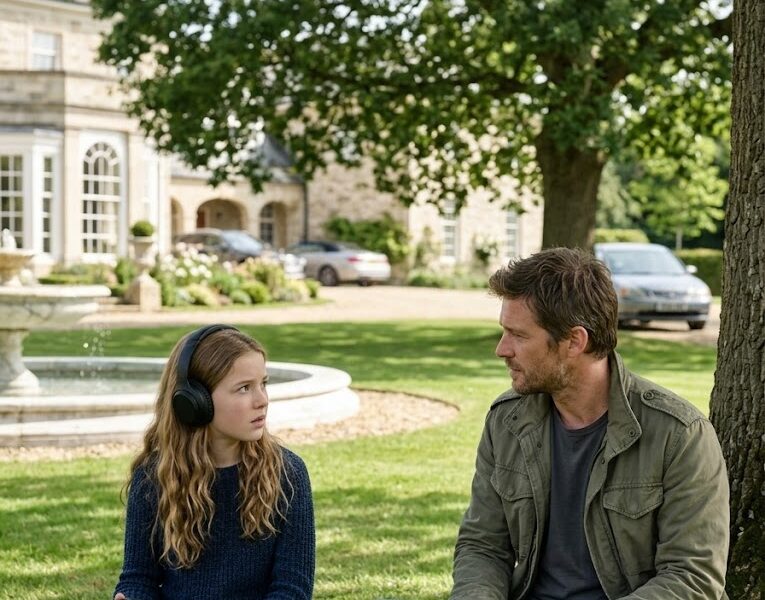
Across the lawn, under an old oak tree, a small figure sat alone with headphones on.
“Maybe that’s the problem.”
Corbin’s face hardened.
“You have known my daughter for less than a minute.”
“I haven’t met your daughter.”
“Then don’t presume to understand my family.”
“I don’t.”
Rafe turned.
“But I know what fear looks like when adults call it bad behavior because fear makes them uncomfortable.”
Something flickered across Corbin’s face.
Rafe saw it.
So he pushed.
“Five tutors walked out. What did all five have in common?”
“They were highly qualified.”
“That wasn’t my question.”
Corbin said nothing.
“They arrived planning to make her do something.”
“Of course.”
Rafe nodded toward the window.
“I’m going to go meet your daughter.”
“And what exactly do you plan to teach today?”
“Nothing.”
That irritated Corbin more than anything else Rafe had said.
“I am not hiring someone to sit around my property doing nothing.”
“Then don’t.”
Rafe picked up his backpack.
“But if you want to know whether I can help her, stop talking for thirty minutes and let me find out whether she can tolerate me.”
Without waiting for permission, he walked outside.
Saraphina saw him coming.
She turned up the volume in her headphones.
Rafe stopped six feet away.
She ignored him.
He sat in the grass.
She looked sideways.
He took a small notebook from his backpack.
She looked away again.
Five minutes passed.
Ten.
Fifteen.
By seventeen minutes, Saraphina was furious.
Adults always talked.
Adults explained.
Adults asked questions designed to trap her into revealing feelings she had no intention of discussing.
This man did nothing.
At nineteen minutes, she pulled one headphone aside.
“Are you stupid?”
Rafe looked up from his notebook.
“Frequently.”
“You’re sitting on wet grass.”
“I’ve made worse choices.”
“You’re the new tutor.”
“Apparently.”
“You’re supposed to talk.”
“I can.”
“Then why aren’t you?”
Rafe closed the notebook.
“You looked like someone who was tired of adults telling you what to do.”
Saraphina stared at him.
“That’s your strategy?”
“I don’t have one yet.”
“All tutors have strategies.”
“That might explain why you got rid of five.”
Her eyes narrowed.
“Dr. Crane lasted eleven days.”
“Impressive.”
“She cried.”
“I heard.”
“You afraid?”
“Of you?”
Saraphina leaned forward slightly.
“Yes.”
Rafe considered it with exaggerated seriousness.
“No.”
That irritated her.
“Why not?”
“Because you’re twelve.”
“I broke her tablet.”
“Expensive?”
“Three thousand dollars.”
“That’s a stupid amount to spend on a tablet.”
Saraphina’s mouth twitched.
She quickly flattened it.
“You’re not funny.”
“My son disagrees.”
“You have a son?”
“Eight.”
“Is he dumb?”
Rafe’s expression changed just enough.
“No.”
Saraphina noticed.
“I didn’t mean—”
“Yes, you did.”
For the first time, there was steel in his voice.
Not anger.
A boundary.
Saraphina went still.
Rafe continued calmly.
“You can insult me if that helps you decide whether I’m leaving. My shoes are old. My car barely works. My haircut is terrible. There’s plenty of material. But you don’t get to use my kid as target practice.”
She stared at him for several seconds.
Then nodded once.
“Fine.”
“Good.”
Silence returned.
Finally Saraphina asked, “Are you going to quit?”
Rafe looked at her.
There was no sarcasm in the question now.
Only something smaller.
Something frightened.
He could have promised.
Adults loved promises because promises sounded noble before life tested them.
Instead he said, “I’ll come back tomorrow.”
“That’s not what I asked.”
“I know.”
“What about next week?”
“I don’t know.”
Her face closed.
Rafe added, “But I know I’ll come tomorrow.”
Saraphina studied him.
“Everybody says they won’t leave.”
“I didn’t.”
And somehow, that was the first answer she believed.
The following morning Rafe returned carrying a wooden airplane.
Saraphina looked at it.
Then at him.
“What is that?”
“A poorly engineered aircraft.”
“It’s a toy.”
“Insulting it won’t improve the engineering.”
He set it on the patio table.
“My son and I built it.”
Saraphina picked it up.
Almost immediately, her expression changed.
“The center of gravity is wrong.”
Rafe sat down.
“That’s what Milo said.”
“No, he didn’t.”
“Why?”
“He’s eight.”
“Eight-year-olds are allowed opinions.”
“He wouldn’t use the phrase center of gravity.”
“Maybe my son is a genius.”
“The wings are too narrow.”
“You saying my genius son built garbage?”
“I’m saying if you add weight here—”
She touched the fuselage.
“—the nose drops before the wings generate enough lift.”
Rafe slid a pencil toward her.
“Prove it.”
She froze.
The moment was almost invisible.
One second earlier, she had been animated.
Now the pencil might as well have been a weapon.
Rafe saw her shoulders tighten.
He looked away deliberately.
“Or don’t.”
Saraphina stared at him.
“What?”
“I said prove it. You don’t want to, don’t.”
“You’re supposed to make me.”
“No.”
“Dad’s paying you.”
“He’s paying me for my time. He doesn’t own your hand.”
She looked at the pencil.
Then slowly picked it up.
Ten minutes later she had drawn a rough wing profile and started calculating load distribution.
Rafe asked questions.
She corrected him twice.
The third time, he intentionally made the same mistake again.
Saraphina slapped the pencil down.
“You’re doing that on purpose.”
“Doing what?”
“You know that’s wrong.”
“You sure?”
“Yes.”
“Prove it.”
Her eyes narrowed.
Then she leaned over the paper.
Twenty-five minutes later, she had forgotten she hated school.
Rafe waited until she finished before saying, “You just spent half an hour doing physics.”
Saraphina stopped.
Her face fell.
“You tricked me.”
“No.”
“You said we weren’t studying.”
“I never said that.”
“You—”
“You saw a problem you cared about and solved it.”
“That’s studying.”
“Terrible, isn’t it?”
She glared.
Then something strange happened.
Saraphina laughed.
It escaped before she could stop it.
From the study window, Corbin Hawthorne saw his daughter laugh over schoolwork for the first time in nearly two years.
And instead of relief, the first thing he felt was suspicion.
That feeling would nearly destroy everything Rafe was building.
Over the next three weeks, lessons stopped looking like lessons.
Fractions appeared in pancake recipes.
Percentages became discounts in imaginary stores.
Geometry became measuring the greenhouse roof.
History became a debate over decisions made by ordinary people trapped inside extraordinary events.
Geography became rescue maps.
Physics became paper bridges, pulley systems, bicycle gears, and the question of why a baseball curved.
Rafe rarely said You’re smart.
Saraphina had heard that before.
Smart had become another cage.
If she was smart, every mistake became proof that people had been wrong about her.
Instead Rafe said things like, “You stayed with that longer than yesterday.”
Or, “That answer is wrong. Show me where it went wrong.”
Or, “Good. You failed faster this time.”
The first time he said that, Saraphina stared at him.
“How can failing faster be good?”
“Because now you have more time to fix it.”
“That makes no sense.”
“It will.”
One afternoon she spent forty minutes trying to make a small bridge from balsa wood support ten pounds.
It collapsed four times.
On the fifth attempt she shoved the pieces aside.
“I hate this.”
“Okay.”
“I’m done.”
“Okay.”
“You’re supposed to tell me not to quit.”
“Why?”
She looked at him suspiciously.
“Because tutors say that.”
“I’m not your motivational poster.”
She glared.
Rafe gathered his notebook.
“See you tomorrow.”
He reached the patio doors before she shouted, “Wait.”
He turned.
Saraphina was staring at the broken bridge.
“What if I change the support triangles?”
Rafe shrugged.
“Could work.”
She sat down again.
The sixth bridge held twelve pounds.
Saraphina screamed so loudly that Mrs. Alvarez came running from the kitchen.
“I DID IT!”
Rafe grinned.
“No.”
Saraphina turned.
“What?”
“You failed five times.”
Her smile vanished.
“That’s not—”
“And then you did it.”
She went quiet.
Rafe tapped the bridge.
“That’s what you need to remember.”
She stared at the tiny structure.
Not that she had succeeded.
That failure had not killed her.
That evening, Corbin found the bridge on the dining room sideboard.
He picked it up.
Saraphina appeared behind him.
“Don’t break it.”
“I wasn’t going to.”
“You break everything.”
The words landed harder than either of them expected.
Corbin slowly turned.
“What does that mean?”
“Nothing.”
“Saraphina.”
“I said nothing.”
She reached for the bridge.
Corbin held it away.
“We need to discuss your progress.”
Immediately, her expression changed.
Progress.
Another word adults used when they wanted to measure whether she was becoming less inconvenient.
“You scored eighty-seven on your mathematics assessment.”
“So?”
“Last semester you scored fifty-two.”
“I know.”
“That is a significant improvement.”
She looked at him.
“Okay.”
“I’m proud of you.”
The sentence should have felt good.
Instead Saraphina heard the sentence underneath it.
Now that you are succeeding, you are worth being proud of again.
She took the bridge from his hand.
“What if I got fifty-two again?”
Corbin frowned.
“What?”
“Would you still be proud?”
“This is a ridiculous question.”
“Would you?”
“Your goal should not be to regress.”
Her eyes dropped.
Corbin saw disappointment and misunderstood it as attitude.
“Saraphina, life will not reward you for refusing to use your potential.”
“There.”
“There what?”
“That thing.”
“What thing?”
“The CEO voice.”
“Saraphina.”
“You talk to me like I work for you.”
“I am trying to prepare you for reality.”
“No. You’re trying to prepare me to be you.”
She walked away.
Corbin stood in the dining room holding nothing.
From the corridor, Rafe had heard enough.
He should have left.
Instead he stepped into the room.
Corbin looked at him.
“If you’re about to give me parenting advice, reconsider.”
“I was going to ask whether you know what she thinks happens when she gets something wrong.”
“I assume she corrects it.”
“That’s what you think happens.”
Corbin’s patience thinned.
“And what does the great Rafe Calder believe?”
“She thinks you love the version of her that succeeds.”
Corbin went utterly still.
“You have crossed a line.”
“Probably.”
“You are employed as a tutor.”
“I know.”
“You know nothing about what I have sacrificed for that child.”
“I know you love her.”
“Then we agree.”
“No.”
Rafe’s voice stayed quiet.
“Loving a kid and making sure the kid can feel it are not always the same thing.”
Corbin’s jaw clenched.
“Get out.”
Rafe nodded.
“See you tomorrow.”
“You misunderstand me.”
“No, I don’t.”
Corbin stepped closer.
“I am telling you to leave my house.”
“And I’m leaving.”
Rafe walked toward the door.
Then he looked back.
“But before you fire me, ask yourself why your daughter would rather be called difficult than risk proving she might not be perfect.”
He left before Corbin could answer.
That night, Saraphina stood outside her father’s study and listened as he told Evelyn Shaw to begin searching for a replacement tutor.
She went upstairs without making a sound.
The following morning, Rafe arrived at nine.
Saraphina did not come downstairs.
At nine thirty, he found Corbin in the library.
“Where is she?”
“She won’t be continuing.”
Rafe stared at him.
“You fired me?”
“I am considering other educational options.”
“You fired me.”
“Yes.”
Rafe nodded.
“Did you tell her?”
“I will.”
“Before or after the next expert arrives?”
“That is no longer your concern.”
Rafe picked up his backpack.
“All right.”
Something about how easily he accepted it made Corbin uncomfortable.
“You have nothing else to say?”
“I said the important thing yesterday.”
Rafe reached the library door.
Then a crash sounded upstairs.
Both men froze.
A second crash followed.
Corbin ran.
Rafe was faster.
They found Saraphina in her bedroom surrounded by torn notebooks.
The wooden bridge lay shattered at her feet.
Corbin stopped in the doorway.
“What have you done?”
Saraphina’s face was white with fury.
“You fired him.”
Rafe looked at Corbin.
Corbin said, “Saraphina, calm down.”
“I hate when you say that!”
“Then stop behaving irrationally.”
Rafe closed his eyes for half a second.
Wrong sentence.
Saraphina grabbed a textbook and threw it across the room.
“You ruin everything!”
Corbin stepped inside.
“That is enough.”
“No!”
“You will not speak to me this way.”
“Why? Because I’m embarrassing you?”
“Because I am your father.”
“You’re never my father! You’re my manager!”
The silence afterward was terrible.
Saraphina looked shocked by her own words.
Corbin looked as though she had struck him.
Rafe moved slowly between them.
“Saraphina.”
She turned on him.
“You said you’d come back.”
“I did.”
“And now you’re leaving.”
“Yes.”
Her eyes filled.
Rafe did not soften the truth.
“Your dad fired me.”
Corbin snapped, “This is inappropriate.”
“No,” Rafe said. “Lying to her would be inappropriate.”
Saraphina wiped her eyes angrily.
“I knew it.”
“Knew what?”
“You all leave.”
Rafe crouched so they were at eye level.
“Listen carefully.”
“No.”
“I showed up today.”
“That doesn’t matter.”
“It matters to me.”
“You’re still going.”
“Yes.”
“Then you’re just like them.”
Rafe absorbed the sentence.
Maybe because part of him believed it.
He had spent years leaving places.
Deployments.
Hospitals.
Funerals.
A marriage he had not wanted to leave but death had ended anyway.
He knew what it meant to love someone who associated departure with abandonment.
So he said, “If your father changes his mind, I’ll come back tomorrow.”
Saraphina looked at Corbin.
Corbin said nothing.
That was answer enough.
Rafe stood.
Saraphina kicked the broken bridge.
“Get out.”
He did.
At five twenty that evening, Corbin found his daughter asleep on the floor beside her bed.
The broken bridge had been pushed into a pile.
Beside it lay a sheet of paper.
Corbin picked it up.
At the top, in Saraphina’s handwriting, was an equation from that week’s mathematics work.
Halfway down, there was an error.
Below it she had written:
Wrong. Again.
Then:
Stupid.
Then:
Don’t let him see.
Corbin sat on the edge of the bed.
He read those three words again.
Don’t let him see.
Something opened inside him.
Not suddenly.
Painfully.
He began remembering details he had previously filed under attitude.
The way Saraphina tore up tests before showing him.
The way she became furious when he asked about grades.
The way she stopped playing piano after missing notes during a recital.
The way she once spent an entire evening in her room because he had said, “You can do better than this,” after a B-plus.
He remembered saying it gently.
He remembered believing it was encouragement.
He had never once wondered what she heard.
Corbin looked down at his sleeping daughter.
For years he had told himself that everything he demanded came from love.
Perhaps it had.
But love could become pressure without intending to.
Pressure could become fear.
And fear could teach a child to destroy the test before anyone could grade it.
At eight that night, Rafe’s phone rang.
He was standing over the stove making boxed macaroni and cheese.
“Calder.”
Corbin said, “Come back tomorrow.”
Rafe stirred the pasta.
“That an order?”
“A request.”
Rafe was quiet.
Corbin added, “Please.”
Milo looked up from the kitchen table.
Rafe met his son’s eyes.
“Ten o’clock.”
The next day, Rafe arrived carrying glue.
Saraphina met him beneath the oak tree.
Neither mentioned what had happened.
He set the glue down.
She stared at it.
“What’s that for?”
“You broke my bridge.”
“It was my bridge.”
“Fine. You broke your bridge.”
“So?”
“So fix it.”
“It’ll look terrible.”
“Probably.”
“The pieces won’t line up.”
“Probably.”
“It won’t be as strong.”
“Maybe not.”
Saraphina looked at him.
“Then why fix it?”
Rafe sat down.
“Because broken doesn’t always mean useless.”
Her eyes stayed on his face.
He had not meant it only about the bridge.
She knew that.
So did he.
They spent the morning putting the pieces back together.
The repaired bridge carried only nine pounds.
Saraphina stared at it.
“Before, it carried twelve.”
“Yeah.”
“So it’s worse.”
Rafe nodded.
She touched one of the visible seams where glue had dried.
“It’s ugly.”
“Also true.”
She looked at him.
“Why are you smiling?”
“Because it still holds.”
Something inside her shifted.
The bridge remained on her desk for years.
The next month changed the rhythm of the Hawthorne house.
Saraphina began arriving at breakfast before being called.
She started bringing homework downstairs instead of hiding it.
Her teachers emailed Corbin about improved participation.
The phrases that once filled her reports—defiant, disruptive, refuses instruction—gave way to different words.
Curious.
Engaged.
Persistent.
Corbin printed one of the emails.
He nearly showed Saraphina.
Then he remembered Rafe’s warning and instead asked her that evening, “What did you enjoy in science today?”
She looked suspicious.
“You’re not asking my grade?”
“No.”
“Why?”
“Apparently I’m trying something revolutionary.”
“What?”
“Conversation.”
Saraphina fought a smile.
“We built circuits.”
“Did yours work?”
“No.”
Corbin felt the old response rise automatically.
Why not?
What went wrong?
Did you follow instructions?
He swallowed all three.
“Was it fun?”
Saraphina stared at him.
Then slowly said, “Yeah.”
That tiny answer felt more valuable than a hundred quarterly earnings reports.
But progress did not move in a straight line.
One warm Thursday afternoon, six weeks after Rafe first entered the estate, Saraphina sat on the back porch facing a page of algebra.
She had solved three problems.
The fourth stopped her.
Rafe was helping Milo repair the wooden airplane several feet away.
Saraphina erased something.
Tried again.
Wrong.
She erased harder.
Tried again.
Still wrong.
Her breathing changed.
Rafe noticed but said nothing.
She wrote another line.
Stopped.
Then threw the pencil across the lawn.
“I CAN’T DO IT!”
Milo flinched.
Rafe looked at his son.
“Kitchen. Ask Mrs. Alvarez if she has those cookies.”
“I already had—”
“Kitchen.”
Milo understood.
He went inside.
Saraphina shoved the workbook away.
“This is stupid.”
Rafe sat across from her.
“I’m stupid.”
He did not answer.
“I said I’m stupid!”
“I heard you.”
“Aren’t you going to tell me I’m not?”
“No.”
She stared at him.
“Why?”
“Because right now you wouldn’t believe me.”
Her anger cracked.
Tears filled her eyes.
“I was doing good.”
“You are doing good.”
“No! I was getting everything right.”
“Those aren’t the same thing.”
“My dad thinks they are.”
From inside the house, unseen behind the glass doors, Corbin stopped walking.
Rafe leaned back.
“When I was younger, I had a job where mistakes could become very expensive.”
Saraphina wiped her face.
“Military?”
Rafe looked at her.
“Who told you?”
“I saw the tattoo.”
A small faded trident showed beneath his sleeve when he reached forward.
“You were a Navy SEAL.”
He said nothing.
“I looked it up.”
“Of course you did.”
“Dad doesn’t know.”
“He does not.”
“Why didn’t you tell him?”
“Because I’m teaching you mathematics.”
“That’s not an answer.”
“It’s the answer you get.”
She stared at his tattoo.
“Did you ever mess up?”
Rafe’s expression changed.
“Yes.”
“How bad?”
“Bad enough that I still think about it.”
Saraphina became quiet.
He rarely spoke about his military past.
Even Milo knew only pieces.
Rafe looked across the garden.
“Years ago, there was a young guy on my team. Good operator. Smart. Fast. Wanted everybody to know he belonged there.”
“What was his name?”
“Eli.”
That was all Rafe offered.
“One night he made a mistake. Nothing dramatic. One decision, made too fast. But afterward he thought everybody saw him differently.”
“Did they?”
“Maybe.”
Rafe rubbed a hand over his jaw.
“But what mattered was that he saw himself differently. He started second-guessing everything. Tried to become perfect.”
Saraphina frowned.
“Did it work?”
“No.”
“What happened?”
“He made more mistakes because he was afraid to make mistakes.”
She understood immediately.
Rafe continued.
“I told him one mistake can usually be corrected. Giving up because you made it is what turns a moment into a permanent decision.”
“Did he listen?”
Rafe was silent long enough that Saraphina knew the answer was complicated.
“Eventually.”
“Did you?”
He looked at her.
“What?”
“You said you made mistakes too.”
Rafe smiled without humor.
“More than I can count.”
“Was your dad disappointed in you?”
The question struck somewhere Rafe had not armored.
He looked down.
“My father died before Milo was born.”
Saraphina’s anger faded completely.
“Sorry.”
“He was a mechanic. Meanest man alive before coffee. Thought every tool should be returned to the exact place it came from.”
She smiled faintly.
“He sounds annoying.”
“He was.”
Rafe swallowed.
“And I’d give almost anything to annoy him one more time.”
Saraphina watched him.
“Do you miss him?”
“Every day.”
“What would you say if you could call him?”
Rafe stared at the wooden airplane on the grass.
“I’d tell him I finally understand what he meant.”
“About what?”
Rafe looked toward the house, where Corbin stood unseen on the other side of the glass.
“When I was seventeen, I failed an entrance exam for a program I wanted. I thought it was the end of my life. My father found me sitting in the garage and said, ‘Son, if your whole identity can be destroyed by one bad result, then you built your identity out of paper.’”
Saraphina looked at her unfinished mathematics problem.
“What happened?”
“I took the exam again.”
“And?”
“Passed.”
“So he was right.”
“Unfortunately.”
Saraphina almost smiled.
Then Rafe pulled the workbook back toward them.
“Show me the first line where you’re certain you were right.”
She hesitated.
Then pointed.
They worked backward.
Seven minutes later, Saraphina discovered she had copied a negative sign incorrectly.
That was all.
One tiny mark.
She stared at it.
“That’s it?”
“That’s it.”
“I had everything else right?”
“Yep.”
She sat back.
Then laughed.
Not a happy laugh.
A shocked one.
“I almost ripped the whole page because of a minus sign.”
Rafe nodded.
“You’ve destroyed more expensive things for less.”
She punched his arm.
Behind the glass, Corbin stepped away before either of them noticed him.
That night he sat alone in his office and opened an old photo on his phone.
Saraphina at five years old.
Missing front tooth.
Paint on her cheek.
Holding up a crooked cardboard castle.
In the photograph, Corbin was kneeling beside her in shirtsleeves, laughing.
He could not remember when they had stopped being those two people.
Maybe there had been no single moment.
Maybe families broke in millimeters.
A missed dinner.
A corrected grade.
A phone call taken during breakfast.
A recital attended physically and forgotten mentally.
A thousand messages that said I am doing all of this for you while the child heard everything matters more than you.
Corbin stared at the photograph until the screen dimmed.
Then his phone rang.
The caller was Dean Mercer, chairman of Hawthorne Industrial’s board.
Corbin nearly ignored it.
He answered.
The conversation lasted twelve minutes.
By the end, the fragile peace inside the Hawthorne house was about to collide with the world Corbin had spent his entire life building.
The following Friday, Hawthorne Industries hosted its annual Foundation Gala at the Grand Meridian in Manhattan.
Eight hundred guests.
Investors.
Journalists.
Politicians.
Executives.
Every year, Corbin’s foundation awarded scholarships to students in engineering and applied science.
Saraphina had never attended.
This year, Corbin asked her.
She immediately said no.
Then she discovered Rafe and Milo were invited.
“I thought he was my tutor.”
“He is.”
“So why is he going?”
Corbin adjusted his cuff links.
“Because the foundation is expanding its community education grants. Rafe consults at a neighborhood center.”
Saraphina looked at him.
“You did that?”
“Did what?”
“Invited him because of his work.”
Corbin avoided her eyes.
“Perhaps.”
“Is this you doing conversation again?”
“Don’t make me regret it.”
She smiled.
“I’ll go.”
For the first hour, the gala went better than anyone expected.
Saraphina wore a dark blue dress Mrs. Alvarez had helped her choose.
Milo wore a suit that made him look deeply offended by formal clothing.
Rafe wore the same dark suit he had owned since Claire’s funeral.
When Corbin saw him, he said quietly, “You could have told me.”
Rafe glanced at him.
“About?”
“The Navy.”
Rafe’s eyes sharpened.
“Saraphina?”
“No.”
Corbin had conducted a background check.
Of course he had.
Rafe’s jaw tightened.
“You searched sealed records?”
“I searched what I was legally able to access.”
“That makes it less invasive?”
“You spend time alone with my daughter.”
“And you hired me before checking?”
“My assistant checked. I checked deeper.”
Rafe looked toward Saraphina, who was explaining something about the ballroom lighting to Milo.
“You don’t need to worry about what I did before.”
“Apparently you were decorated.”
Rafe turned.
“Don’t.”
Corbin heard something in his voice and stopped.
“I wasn’t going to announce it.”
“Good.”
“Why hide it?”
Rafe watched Milo laugh.
“Because my son needs a father who comes home.”
Before Corbin could respond, a reporter approached.
The moment disappeared.
An hour later, Saraphina stood beside Rafe near a display of student engineering projects when a woman’s voice behind them said, “Saraphina Hawthorne?”
Saraphina turned.
A reporter held a microphone.
“Lydia Grant, New York Ledger. Your father tells us you’ve become very interested in engineering.”
Saraphina looked toward Corbin.
He was across the ballroom speaking with donors.
“I guess.”
“What do you hope to study someday?”
“I’m twelve.”
The reporter laughed.
“So you don’t know?”
“No.”
Lydia smiled.
“What about your father’s company? Maybe future CEO?”
Saraphina’s expression tightened.
“I don’t know.”
The reporter leaned closer.
“Your father is known for saying excellence begins early. Are you an excellent student?”
Rafe stepped forward.
“That’s enough.”
But the question had already found its target.
Saraphina saw the cameras.
Saw strangers watching.
Saw her father across the room.
Her breathing changed.
Lydia, unaware, continued.
“I understand you were homeschooled for a period after some academic difficulties. Is that why Mr. Calder was hired?”
Rafe’s face hardened.
“Interview over.”
Saraphina backed away.
Someone bumped a display table.
A model tower tipped.
Glass shattered.
The ballroom went silent.
Saraphina froze.
It had not even been her fault.
But hundreds of eyes turned toward her.
And inside her head, every old voice returned at once.
Difficult.
Behind.
Uncooperative.
Wasting potential.
She needs a miracle.
Corbin reached them.
“What happened?”
Saraphina looked at the broken display.
“I—”
“Saraphina?”
“I didn’t—”
Lydia said, “It was an accident.”
But Saraphina heard Corbin’s tone.
Or thought she did.
Disappointment.
Evaluation.
The CEO voice.
She ran.
“Saraphina!”
Rafe followed.
Corbin followed them both.
They found the service stairwell door swinging open.
By the time they reached the alley, she was gone.
For nineteen minutes, one of the richest men in America had no idea where his twelve-year-old daughter was.
Those nineteen minutes dismantled Corbin Hawthorne more effectively than any business failure ever had.
Security searched the building.
Hotel staff checked bathrooms and service corridors.
Rafe ran toward Bryant Park.
Corbin called Saraphina’s phone.
No answer.
Again.
No answer.
Again.
Voicemail.
At minute twelve, Corbin grabbed Rafe’s arm.
“This is your fault.”
Rafe turned slowly.
“My fault?”
“You filled her head with this idea that she can simply walk away whenever she feels pressured.”
“No. I taught her she could make mistakes without being destroyed.”
“She ran into Manhattan!”
“She ran because she thought you were about to be ashamed of her.”
Corbin’s face twisted.
“I was not ashamed!”
“Then why doesn’t she know that?”
The question stopped him.
A security officer shouted from across the lobby.
“Mr. Hawthorne!”
They ran.
Camera footage showed Saraphina exiting onto Forty-Second Street.
Then disappearing into pedestrian traffic.
Corbin stared at the screen.
For the first time in Rafe’s presence, his hands visibly shook.
“Find her.”
Rafe already had his phone out.
He called Milo.
The boy answered immediately from Mrs. Alvarez’s care upstairs.
“Dad?”
“Think.”
Milo went quiet.
“If Saraphina wanted to disappear but wanted somebody to find her, where would she go?”
“That makes no sense.”
“It does to her.”
There was silence.
Then Milo said, “The library.”
Rafe’s eyes lifted.
“What?”
“She likes old libraries. She said nobody asks you questions if you’re holding a book.”
Rafe looked at Corbin.
New York Public Library sat two blocks away.
They found Saraphina on the stone steps beside one of the marble lions.
She had removed her shoes.
Her arms wrapped around her knees.
The city streamed around her.
Rafe stopped thirty feet away.
Corbin started forward.
Rafe caught his arm.
“Wait.”
“That is my daughter.”
“I know.”
“Then let go of me.”
Rafe did.
Corbin walked toward her.
Saraphina saw him.
Her face closed.
“I’m sorry.”
Corbin stopped.
Those were the first words she said.
Not I’m scared.
Not I’m okay.
I’m sorry.
Something inside him broke.
He sat down on the step below her.
People passed without knowing that the billionaire whose face had appeared on financial magazines was fighting not to cry.
“You scared me.”
“I know.”
“No.”
His voice cracked.
“You don’t.”
Saraphina looked at him.
“I thought…”
He stopped.
He had negotiated hostile takeovers in rooms full of men who wanted him ruined.
He had addressed ten thousand employees after factories closed.
He had testified before Congress.
He had never found four words harder to say.
“I thought I lost you.”
Saraphina’s anger weakened.
“The tower wasn’t my fault.”
“I know.”
“You looked mad.”
“I was scared.”
“You always look mad.”
Corbin gave a broken laugh.
“That appears to be a design flaw.”
She stared at the pavement.
“I embarrassed you.”
“No.”
“Everyone was watching.”
“I don’t care.”
“You care about everything.”
“Not more than you.”
Her eyes lifted.
Corbin looked directly at her.
“I need you to hear this correctly because I have apparently spent years saying it incorrectly.”
Rafe remained far enough away that father and daughter could forget him.
Corbin continued.
“I am not proud of you because you get good grades.”
Saraphina’s chin trembled.
“I’m not proud of you because you might someday run my company. I’m not proud of you because you build bridges that hold twelve pounds or because your test scores improved.”
He swallowed.
“I’m proud that you are my daughter.”
A tear rolled down Saraphina’s cheek.
Corbin’s voice lowered.
“And if you get fifty-two again, I may worry. I may ask questions. I may even make that terrible CEO face.”
She laughed through her tears.
“But you will still be my daughter.”
“What if I fail?”
“Then we fail at something.”
“What if I’m not like you?”
Corbin looked at her for a long moment.
Then said the sentence she had needed for years.
“I hope you aren’t.”
She stared at him.
“I already know how to be me.”
His eyes filled.
“The world needs you to figure out who you are.”
Saraphina launched herself at him.
Corbin caught her.
Rafe turned away.
Not because he did not want to see.
Because some moments deserved privacy.
That should have been the end of the story.
It wasn’t.
The next morning, a photograph from the gala appeared online.
It showed Rafe physically blocking reporter Lydia Grant from approaching Saraphina.
The caption identified him as the billionaire’s daughter’s “mysterious private tutor.”
By noon, someone had discovered the Navy connection.
By evening, another outlet published a headline using words Rafe had spent years trying not to see.
FORMER NAVY SEAL LINKED TO CLASSIFIED MISSION NOW WORKING FOR HAWTHORNE BILLIONAIRE.
Rafe stared at the article in his kitchen.
Milo sat silently at the table.
“Dad?”
Rafe shut the laptop.
“Homework.”
“You’re mad.”
“I’m fine.”
“You do the jaw thing when you’re mad.”
“What jaw thing?”
Milo demonstrated.
Despite himself, Rafe smiled.
Then his phone rang.
Corbin.
Rafe answered.
“I saw it.”
“So did I.”
“My legal team can request corrections.”
“Corrections won’t put toothpaste back in the tube.”
“I can deal with the press.”
“That’s exactly what I don’t want.”
“Rafe—”
“I’m done.”
Silence.
Corbin’s voice changed.
“With the press?”
“With the job.”
“Don’t make a decision tonight.”
“It’s made.”
“What am I supposed to tell Saraphina?”
Rafe closed his eyes.
There it was.
The part that hurt.
“Tell her the truth.”
“That the first adult she trusted enough to fail in front of is leaving?”
Rafe’s hand tightened around the phone.
“That’s low.”
“Yes.”
Corbin did not apologize.
“But is it wrong?”
Rafe looked at Milo.
His son was pretending to do homework and listening to every word.
“I promised my kid a quiet life.”
“And what did he ask for?”
Rafe frowned.
“What?”
“Did you ask Milo what he wants?”
“That’s none of your business.”
“You made my parenting your business.”
The line went quiet.
Rafe almost hung up.
Then Milo spoke from the table.
“I don’t want you to quit.”
Rafe looked at him.
Corbin heard.
Milo closed his workbook.
“Mom died and you decided nothing dangerous gets to happen ever again.”
“Milo.”
“But stuff still happens.”
“This isn’t about danger.”
“You’re scared.”
Rafe went still.
His eight-year-old son continued with the merciless clarity of children.
“You tell Saraphina being scared doesn’t mean she should stop trying.”
Rafe looked away.
“Go brush your teeth.”
“It’s seven thirty.”
“Take a long time.”
Milo stood.
At the hallway he looked back.
“You’re being a hypocrite.”
Then disappeared.
On the phone, Corbin made the mistake of laughing.
Rafe said, “I can still quit.”
“I said nothing.”
The article spread for forty-eight hours.
Then, like most internet storms, it found another target.
Rafe returned Monday.
Saraphina was waiting beneath the oak tree with her arms crossed.
“You almost left.”
“Yes.”
“Why?”
“I got scared.”
She blinked.
“You?”
“Terrifying concept.”
“What were you scared of?”
“That my old life would become more important than the one I have now.”
“Did it?”
“No.”
She studied him.
“So why did you come back?”
Rafe dropped his backpack in the grass.
“My son called me a hypocrite.”
Saraphina grinned.
“I like Milo.”
“You’re both exhausting.”
She handed him a worksheet.
“I got four wrong.”
Rafe looked at it.
“Only four?”
She punched him.
By winter, Saraphina returned to school full-time.
There was no miraculous transformation.
She still hated timed tests.
She still occasionally shut down when she made mistakes in front of people.
She argued with teachers when she believed assignments were pointless.
Twice, Corbin was called into the principal’s office.
The second time, he came home and told Rafe, “Your influence is becoming expensive.”
“What did she do?”
“Corrected a teacher for twenty-two minutes.”
“Was she right?”
Corbin sighed.
“Unfortunately.”
Rafe smiled.
Saraphina’s grades were good but uneven.
An A in science.
A B in mathematics.
An A-minus in history.
A C-plus on one English essay she had rushed.
She brought the paper home folded in quarters.
Corbin found her at the kitchen island.
She slid it toward him.
He opened it.
C-plus.
Red comments covered the margins.
He looked at her.
She watched his face carefully.
The old Corbin would have immediately discussed revision.
The old Saraphina would have interpreted his silence as judgment.
So Corbin picked up a cookie.
“Want half?”
She narrowed her eyes.
“That’s it?”
“What?”
“You saw the grade.”
“Yes.”
“And?”
“And Mrs. Alvarez made cookies.”
“Dad.”
He broke one in half.
“You want help revising it?”
“Maybe.”
“Tonight?”
“No.”
“Tomorrow?”
“Maybe.”
He handed her half the cookie.
“Then tomorrow.”
Saraphina stared at him.
“You’re weird now.”
“I blame your tutor.”
From the doorway, Rafe said, “I heard that.”
Spring arrived.
Then summer.
The tutoring arrangement evolved into something nobody had planned.
Rafe began advising the Hawthorne Foundation’s education program two days a week, designing small grants around project-based learning for children who had disengaged from traditional classrooms.
He still repaired computers.
Still drove the old Honda.
Corbin offered three times to replace it.
Rafe refused three times.
The fourth time the Honda died outside the Hawthorne estate, Corbin stood beside the smoking hood and said, “I am purchasing you a car.”
“No.”
“This is no longer generosity. Your vehicle is creating operational inefficiency.”
Rafe laughed.
“That the CEO voice?”
“Yes.”
“Still no.”
Milo accepted a ride home in Corbin’s Bentley and loudly announced that his father’s principles were “getting inconvenient.”
Saraphina became taller.
Her hair grew past her shoulders.
She started playing piano again, badly at first, with the door open.
That mattered more than any report card.
One evening in early September, almost a year after Dr. Crane had left the estate crying, Saraphina sat alone beneath the oak tree.
Rafe approached carrying two bottles of water.
“You avoiding homework?”
“No.”
“Your father?”
“No.”
“Then I’m out of theories.”
She took the bottle.
“My school wants me to give a speech.”
Rafe sat beside her.
“What kind?”
“Student assembly.”
“About?”
“Failure.”
He smiled.
“That seems dangerously on brand.”
She didn’t laugh.
“They want me to talk about last year.”
Rafe’s smile faded.
“You don’t have to.”
“I know.”
“You want to?”
“I don’t know.”
She pulled at the label on the bottle.
“What if everybody thinks I’m pathetic?”
“Some might.”
She looked at him sharply.
“You’re supposed to say no.”
“I’ve explained my position on motivational posters.”
“What if they laugh?”
“They might.”
“What if I freeze?”
“You might.”
She frowned.
“You’re terrible at this.”
Rafe looked across the lawn.
“Saraphina, bravery isn’t knowing nobody will laugh.”
She waited.
“It’s deciding that what you need to say matters more than who laughs.”
She stared at the water bottle.
“Were you brave when you were a SEAL?”
“Sometimes.”
“And sometimes?”
“Sometimes I was just the guy standing next to somebody braver.”
“Is that enough?”
Rafe looked at her.
“Most days.”
Two weeks later, Corbin sat in the rear row of a middle-school auditorium.
Rafe and Milo sat beside him.
Saraphina walked onto the stage.
She stopped behind the podium.
Three hundred students stared back.
Her hands shook.
Rafe could see it from the rear of the room.
So could Corbin.
For a terrible five seconds, she said nothing.
Then Saraphina unfolded a piece of paper.
“When I was eleven,” she began, “I got very good at making adults think I didn’t care.”
The room quieted.
“I threw books. I insulted teachers. I broke things. Once I locked a tutor on a balcony.”
A few students laughed.
Saraphina smiled.
“It wasn’t cold.”
Rafe covered his face.
Corbin whispered, “That came from you.”
“Probably.”
Onstage, Saraphina continued.
“Everybody thought I didn’t want to learn. That wasn’t true. I was afraid to find out I wasn’t good enough.”
The auditorium became very still.
“So I discovered something useful. If you never try, nobody can prove you failed.”
She looked down at her paper.
“That worked for a while.”
Then she looked toward the back row.
“Until somebody told me one bad result doesn’t get to become my whole identity.”
Rafe felt his throat tighten.
Saraphina continued.
“The worst thing about being afraid of failure is that people sometimes call you lazy or difficult. Then you start believing that too.”
She took a breath.
“My dad used to think I needed more discipline.”
Corbin sank slightly in his chair.
Students laughed again.
Saraphina smiled.
“He was wrong.”
Corbin muttered, “Wonderful.”
“But I was wrong too.”
That surprised him.
“I thought my dad only loved the version of me that did everything right.”
Saraphina found him in the audience.
“He didn’t.”
Corbin’s eyes filled.
“He just didn’t know how to say it in a language I understood yet.”
No one laughed now.
“And my tutor taught me something else.”
She looked at Rafe.
“He never told me failure was fun. It isn’t. He never told me everybody is secretly a winner. They aren’t. Sometimes you lose. Sometimes you get embarrassed. Sometimes you study and still get a C-plus on an English essay that your father absolutely does not need to mention again.”
Corbin laughed with everyone else.
“But failing at something and being a failure are not the same sentence.”
Her voice trembled.
“So if you’re hiding because you’re afraid people will find out you’re not perfect…”
Saraphina looked down briefly.
Then back up.
“…I already have bad news.”
The room waited.
“You’re not.”
A ripple of laughter.
“And that’s probably the least interesting thing about you.”
For several seconds after she finished, there was silence.
Saraphina’s face changed.
Rafe knew that expression.
The old terror.
I did it wrong.
Then one student began clapping.
Another joined.
Then another.
The auditorium rose.
Saraphina stood at the podium staring into a standing ovation she had not expected.
But the person she looked for was not a teacher.
Not a classmate.
Not even Rafe.
She looked at her father.
Corbin was already standing.
He touched one hand to his chest.
No CEO face.
No evaluation.
Just a father who finally understood what his daughter needed to see.
Saraphina smiled.
Years later, people who knew the Hawthorne family would remember Rafe Calder as the tutor who changed Saraphina’s life.
Corbin always corrected them.
“He changed mine first,” he would say.
That was closer to the truth.
Saraphina did not become perfect.
Neither did Corbin.
Rafe certainly didn’t.
Corbin still worked too much.
Saraphina still occasionally mistook criticism for rejection.
Rafe still carried memories from his past that woke him before dawn.
Milo still complained about his father’s car.
No miracle arrived at the Hawthorne estate.
That was the part outsiders never understood.
There was no brilliant technique hidden inside Rafe’s old backpack.
No secret educational method worth millions.
No military trick.
On his first day, he had simply sat in wet grass beside a frightened child and refused to demand that she perform before he decided she mattered.
He came back the next morning.
Then the morning after that.
And somewhere between broken bridges, wrong equations, bad grades, uncomfortable truths and a repaired relationship between a father and daughter, Saraphina learned the lesson no expensive specialist had managed to teach her.
She could fail and remain loved.
She could be wrong and remain worthy.
She could disappoint someone and still belong.
Years later, when Saraphina left for college, she packed the repaired wooden bridge.
It had lost another support piece by then.
The glue lines had yellowed.
One side leaned slightly.
Corbin found her wrapping it in an old sweatshirt.
“You’re taking that?”
She looked at him.
“Obviously.”
“It’s falling apart.”
“No.”
She smiled.
“It’s still holding.”
Corbin stood very still.
He remembered a bedroom floor covered in broken pieces.
A child who believed love had to be earned.
A man in worn shoes who had walked into their house carrying almost nothing and somehow seen everything they had been missing.
There were moments in life when people knew they had changed only because the old version of themselves would have answered differently.
Corbin picked up the battered bridge.
Years earlier, he would have seen damaged wood.
Now he saw scars that had become part of the structure.
He handed it back carefully.
“Then you’d better take care of it.”
Saraphina hugged him.
“I will.”
At the door, Rafe waited beside Milo, who was now tall enough to complain that his father still treated him like he was eight.
The Honda was finally gone.
Not because Corbin bought Rafe a car.
Rafe had eventually saved enough to buy one himself.
Corbin had hated this outcome.
Saraphina carried the bridge outside.
Rafe noticed it.
“You kept that ugly thing?”
She stopped.
“You told me broken didn’t mean useless.”
“I also told you my haircut was terrible. Some opinions expire.”
She laughed.
Then her expression softened.
“Rafe?”
“Yeah?”
“Did you ever call your dad?”
He understood what she meant.
If you could.
In your head.
In memory.
In whatever place the people we lose continue living.
Rafe looked toward the bright morning beyond the driveway.
“Once or twice.”
“What did you tell him?”
Rafe smiled.
“That I finally understand.”
Saraphina nodded as if this answer satisfied her.
Then she climbed into the car with her father.
Corbin started the engine.
Before the door closed, Saraphina looked back.
“Hey, Rafe.”
“What?”
“I’m probably going to fail something.”
He smiled.
“Almost certainly.”
“And if I do?”
Rafe put his hands in his pockets.
“You already know.”
The car pulled away.
Saraphina looked down at the crooked bridge resting across her knees.
One repaired support beam caught the sunlight.
For most of her childhood, she had believed the strongest things were the things that never broke.
She knew better now.
Some things became strong because they had broken, because somebody had stayed long enough to help put the pieces back together, and because the cracks were never hidden afterward.
Behind them, the Hawthorne estate disappeared beyond the trees.
Ahead waited mistakes she had not made yet.
Failures she could not predict.
People she would disappoint.
Dreams that might not survive first contact with reality.
For the first time in her life, Saraphina Hawthorne was not afraid of any of it.
Because the most important lesson Rafe Calder had ever taught her had never appeared in a textbook.
A mistake could change the plan.
It could change the road.
It could even change you.
But it did not get to decide whether you were worth loving.
And sometimes the miracle everyone was waiting for was nothing more extraordinary than one person who kept showing up after everyone else had walked away.









