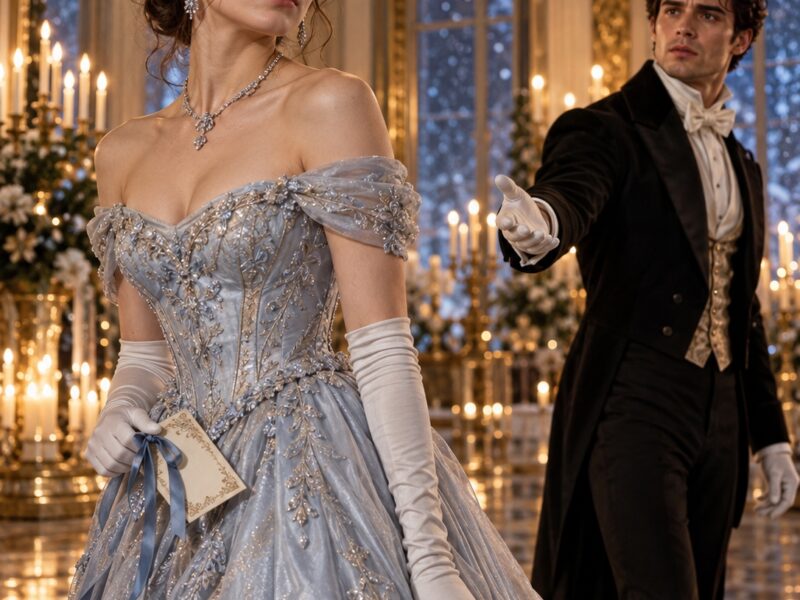
FOR THREE WINTERS, THE DUKE REFUSED TO DANCE WITH HER—ON THE FOURTH, HE FINALLY ASKED… AND SHE SAID NO
The Duke of Renford had never been refused by a woman in public.
Not until the night Lady Evelyn Ashcombe looked at the hand he had finally extended toward her and left it hanging between them.
Thirty feet away, the orchestra continued playing.
Around them, however, Blackthorne Hall seemed to go silent.
Alistister Renford stood beneath three enormous crystal chandeliers, dressed in black evening clothes, his expression controlled with the discipline of a man who had spent his entire adult life making certain no one knew what he felt.
His right hand remained open.
Waiting.
Evelyn looked at it.
Three winters earlier, she would have given almost anything for that hand.
She had imagined this exact moment while lying awake in the darkness of Ashcombe Manor. She had imagined him crossing a ballroom for her. Imagined the surprise of the other women. Imagined his fingers closing around hers and the orchestra beginning and finally having proof that she had not been foolish to hope.
Now the moment had arrived.
And she felt almost nothing.
“Lady Evelyn,” Alistister said quietly.
Something uncertain entered his eyes.
“This dance belongs to you.”
A few women nearby stopped pretending not to listen.
Evelyn raised her gaze.
She saw the man she had wanted for three years.
But she also saw every winter she had spent waiting for him.
“I’m sorry, Your Grace.”
His hand did not move.
Perhaps he had misunderstood.
Evelyn gave him a small, courteous smile.
“Three winters ago, I wanted nothing more than to dance with you.”
His expression changed.
Barely.
But she saw it.
“This winter,” she finished, “I no longer do.”
Then she bowed her head.
Turned.
And walked away.
Behind her, the Duke of Renford remained standing alone in the center of the ballroom.
For the first time in four years, he was the one watching someone leave.
And no one in that room—not even Evelyn—knew that three years earlier, Alistister had wanted desperately to take her hand.
He simply had not believed he was allowed to.
Three winters before that rejection, Evelyn Ashcombe had been twenty-three and still possessed the dangerous belief that patience could make another person love you.
She was not naïve.
At least, she had never thought of herself that way.
The Ashcombes were old enough to have portraits gathering dust in long corridors and poor enough to quietly close unused rooms during winter because heating them cost too much.
Her father had left the family a respected name, a modest estate, and very little money.
So Evelyn understood reality.
She knew titles did not guarantee happiness.
She knew wealth could disappear.
She knew beautiful women were not always loved and good women were not always chosen.
But she had one weakness.
Alistister Renford.
The first time she truly noticed him, he was standing beside a marble column at Renford House, listening to an elderly viscount speak about Parliament while clearly wishing to be anywhere else.
He was not smiling.
That was what Evelyn remembered.
Everyone else seemed to smile constantly during the London season, whether they meant it or not.
Alistister did not.
He was tall, dark-haired, restrained, with the kind of face that seemed carved specifically to reveal nothing.
Then an elderly servant dropped a tray.
Several guests turned.
Someone laughed.
Alistister immediately stepped away from the viscount, crouched beside the embarrassed man, and helped gather the glasses himself.
No performance.
No announcement.
He simply did it.
That small act ruined Evelyn.
Because afterward, she began watching him.
And the more she watched, the more contradictions she found.
Cold with fashionable women.
Patient with children.
Impatient with flatterers.
Gentle with horses.
Silent whenever conversation turned toward his late father.
Once, across a crowded drawing room, she caught him looking at her.
He looked away first.
That was enough for hope to begin.
Hope rarely arrives looking dangerous.
At first, it looks almost reasonable.
At the first winter ball, Evelyn gathered enough courage to approach him.
“Your Grace.”
Alistister turned.
For one suspended second, something warm flickered in his face.
Then it vanished.
“Lady Evelyn.”
“There is a waltz later.”
She hated herself immediately for how obvious that sounded.
He understood anyway.
His jaw tightened.
“I do not dance, my lady.”
Six words.
Perfectly polite.
Completely devastating.
Evelyn managed to smile.
“Of course.”
She walked away before her face could betray her.
What she did not see was Alistister turn after her.
She did not see his fingers tighten around the stem of his glass.
And she certainly did not hear the thought repeating behind his silence.
Better now than later.
Because two floors above that ballroom, locked inside the desk in his father’s former study, were ledgers that could have destroyed everything his family appeared to possess.
Renford House looked magnificent from the street.
Its debts looked even more magnificent on paper.
His late father had left behind failing investments, obligations secured against land, private loans and promises Alistister was now responsible for honoring.
And his mother had already made the solution painfully clear.
Marriage.
Not love.
Marriage.
A woman with enough money and family connections to stabilize Renford.
Evelyn Ashcombe had neither.
Which should have made avoiding her easy.
It did not.
That first night, after the final guests left, Alistister returned alone to the ballroom.
A servant had extinguished half the candles.
The musicians were gone.
On the polished floor lay a pale ribbon from a woman’s glove.
He stared at the place where Evelyn had been standing when he refused her.
Then he whispered to the empty room:
“I’m sorry.”
She never heard him.
That became the pattern of their story.
By the second winter, Evelyn had constructed an explanation kinder than the truth she feared.
Perhaps he had simply been surprised.
Perhaps she had approached at the wrong moment.
Perhaps “I do not dance” had actually meant exactly that.
People could build entire futures from the word perhaps.
Evelyn nearly did.
At a musicale in January, she asked a mutual acquaintance whether the Duke had reserved his final dance.
The message traveled across the room.
The answer returned.
“I do not dance, my lady.”
Exactly the same.
Evelyn felt heat climb her throat.
Across the room, Alistister stood beside a woman whose family owned coal mines in Yorkshire.
A wealthy woman.
A suitable woman.
He looked directly at Evelyn.
Then deliberately looked away.
That was the moment humiliation became personal.
She excused herself and entered an empty corridor.
Her sister Margaret found her there several minutes later.
“Evelyn?”
“I’m fine.”
“You’re standing alone beside a suit of armor.”
“I happen to enjoy armor.”
Margaret stared at her.
Evelyn laughed despite herself.
Then her eyes filled.
Margaret immediately took her hand.
“Oh, Evie.”
“Please don’t.”
“He isn’t worth this.”
“That would be easier if I believed you.”
Margaret said nothing.
Evelyn swallowed.
“What is wrong with me?”
The question escaped before she could stop it.
Margaret’s face hardened.
“Nothing.”
“He dances with other women.”
That was the detail Evelyn could no longer explain away.
Alistister did dance.
Occasionally.
When etiquette required it.
With daughters of powerful families.
With women whose dowries could repair estates.
Just never with her.
“Then he is a fool,” Margaret said.
But Evelyn already understood what the evidence seemed to say.
He did not want her.
What Evelyn did not know was that Alistister had noticed her leave the room.
He nearly followed.
Nearly.
Then his mother appeared beside him.
“Lady Harcourt’s daughter seems fond of you.”
He looked toward the corridor where Evelyn had disappeared.
“Does she?”
“Her grandfather controls considerable holdings in Kent.”
And just like that, duty returned.
Alistister remained where he was.
That choice would haunt him much longer than he imagined.
By the third winter, Evelyn stopped asking.
She told herself she had learned dignity.
In reality, she had simply learned quieter ways to hope.
At gatherings, she positioned herself where Alistister could approach if he wanted.
Near the windows.
Beside the refreshment tables.
At the edge of the dance floor.
She stopped sending messages.
Stopped asking friends.
Stopped risking direct rejection.
Now she waited for him to choose.
One night, their eyes met across Renford House.
Evelyn was standing beneath a tall window.
Snow drifted behind her.
Alistister stared.
Her heart accelerated.
He took one step.
She saw it.
One unmistakable step toward her.
Then he stopped.
His face changed.
A woman beside him said something.
He turned.
And offered that woman his hand.
Evelyn watched them walk onto the floor together.
Something inside her did not break.
Breaking would have been easier.
Instead, something simply became still.
She stood beside the window until the dance ended.
Then she went home.
That night, she removed the little card on which she had written the season’s dances.
She held it above the fireplace.
Margaret watched from the doorway.
“Are you certain?”
Evelyn let the corner catch.
Flame moved quickly across the paper.
“No,” she said.
The card curled black.
“But I’m tired.”
That was how love began leaving her.
Not dramatically.
Not through anger.
Through exhaustion.
The fourth winter arrived beneath heavy snow.
Evelyn stepped from her carriage at Renford House wearing silver-gray silk and carrying no expectations.
That changed everything.
She entered the ballroom and did not search for him.
Across the room, Alistister noticed immediately.
At first he could not understand what bothered him.
Then he realized.
She had not looked at him.
Not once.
A young gentleman named Thomas Bradford approached her.
“Lady Evelyn. May I have the next dance?”
“Yes.”
No hesitation.
Alistister watched Bradford lead her away.
Evelyn laughed at something the man whispered.
Not the careful laugh she once used around Alistister.
A real one.
His chest tightened.
Charles Whitmore, an old friend, appeared beside him.
“You’re staring.”
“I am observing.”
“Ah. Of course.”
Alistister ignored him.
Another gentleman claimed Evelyn’s next dance.
Then another.
“She seems popular,” Alistister said.
Charles looked amused.
“She always was.”
Alistister turned.
“What?”
“You simply never noticed.”
That sentence irritated him far more than it should have.
Over the following weeks, irritation became something worse.
Evelyn attended concerts.
She rode with friends.
She spoke freely.
She stopped becoming nervous whenever he entered a room.
And then Lord Nathaniel Vale returned to London.
Nathaniel was everything Alistister distrusted because he possessed everything Alistister had denied himself.
Ease.
Honesty.
Time.
He listened when Evelyn spoke.
He remembered which books she liked.
He knew she hated overly sweet tea.
He made her laugh.
Worst of all, he did not appear to be trying.
One evening Alistister found them together beside a fireplace.
Nathaniel was leaning toward Evelyn.
She said something.
He smiled.
Alistister crossed the room before deciding to.
“Vale.”
Nathaniel turned.
“Renford.”
“Lady Evelyn.”
Evelyn offered him the same pleasant smile she might have given a distant cousin.
“Your Grace.”
That was all.
No blush.
No nervousness.
Nothing.
Alistister suddenly missed the very reactions he had spent three years extinguishing.
Later, he cornered Charles.
“How serious is Vale?”
Charles stared at him.
“With Evelyn.”
“I understood you.”
“Well?”
Charles took a drink.
“Why do you care?”
“I don’t.”
“Then I suppose the answer is irrelevant.”
Alistister’s expression hardened.
Charles sighed.
“You really are astonishing.”
“What does that mean?”
“It means she spent three years waiting for you.”
Alistister went silent.
“And now?”
Charles looked across the ballroom.
Evelyn was laughing with Nathaniel.
“Now she isn’t.”
Something cold settled inside Alistister.
He had spent three winters believing distance would protect her.
He had never considered that distance might teach her she did not need him.
The truth was that Alistister had wanted Evelyn from the beginning.
That truth made everything worse.
His father’s death had turned him into the Duke of Renford before he was ready.
Within days of the funeral, grief became arithmetic.
Mortgages.
Loans.
Tenant obligations.
Repair costs.
Private notes bearing his father’s signature.
His mother had placed a stack of papers before him one rain-soaked afternoon.
“We can survive this,” she said.
“How?”
She hesitated.
“A good marriage.”
Alistister understood.
A rich marriage.
He hated the idea.
But people depended on Renford.
Servants.
Farmers.
Families.
He could not gamble their security on romance.
Then Evelyn appeared.
Gentle.
Intelligent.
Poor enough that loving her seemed irresponsible.
So he made a decision for both of them.
He would not encourage her.
He would not let affection grow.
He would hurt her early and spare her later.
It sounded noble inside his own head.
Cowardice often does.
Now, four years later, he stood watching Nathaniel Vale make Evelyn happy and finally understood what his noble sacrifice had actually accomplished.
He had hurt her anyway.
Only without giving her the dignity of knowing why.
At Blackthorne Hall, Alistister finally crossed the ballroom.
Everyone noticed.
Evelyn noticed too.
He stopped before her.
“Lady Evelyn.”
“Your Grace.”
He extended his hand.
“This dance belongs to you.”
Once, those words could have changed her world.
Now Evelyn looked at his hand and remembered three winters of standing alone.
“I’m sorry.”
His eyes narrowed slightly.
“Three winters ago, I wanted nothing more than this.”
The room seemed to shrink around them.
“This winter, I no longer do.”
His hand lowered.
Slowly.
“You are refusing me?”
There was no anger in the question.
Only disbelief.
Evelyn almost pitied him.
Almost.
“Yes.”
Then she walked away.
That night, the Duke of Renford discovered something Evelyn had learned years earlier.
Being unwanted hurts.
Being unwanted by someone you assumed would always want you hurts differently.
Alistister began appearing everywhere.
At musicales he normally avoided.
Afternoon teas.
Small dinners.
Charity gatherings.
Evelyn found it almost absurd.
For three years she had engineered coincidences hoping to see him.
Now he was engineering them to see her.
He sent notes.
She answered politely.
He requested conversations.
She granted some.
He never demanded.
That surprised her.
Nathaniel noticed everything.
One evening, while walking with Evelyn through a lantern-lit garden, he asked:
“Do you still love him?”
Evelyn stopped.
Snow crunched beneath her boots.
“I don’t know.”
Nathaniel waited.
She appreciated that about him.
He never rushed to fill silence.
“I loved who I believed he might become,” she finally said. “Perhaps that isn’t the same thing.”
“And now?”
“Now I know I can survive without finding out.”
Neither of them noticed Alistister standing near the garden entrance.
He did not hear every word.
He heard enough.
That night, he sat alone in his father’s study until the fire died.
On the desk lay the old ledgers.
The debts had improved considerably over the past year.
He knew that.
Yet somehow he had continued living according to a disaster that was already passing.
Then another piece of news arrived.
Lady Evelyn might leave London after the season.
For the first time, Alistister felt genuine panic.
Not jealousy.
Not wounded pride.
Loss.
Permanent loss.
His mother found him at two in the morning holding a letter he had rewritten repeatedly.
“Is this about Evelyn Ashcombe?”
He looked up.
She smiled sadly.
“I thought so.”
“You wanted me to marry strategically.”
“I wanted to save this family.”
“And Evelyn could not do that.”
“Perhaps not then.”
He frowned.
His mother moved closer.
“The estate is stable now, Alistister.”
He said nothing.
“We renegotiated the largest obligations last spring. The northern properties are profitable again. You know this.”
“I know.”
“Then why are you still behaving as though the house is burning?”
The question landed brutally.
He looked toward his father’s ledgers.
His mother followed his gaze.
“You built a wall because you believed you needed one.”
She paused.
“The danger passed.”
Alistister looked at her.
“But you never took the wall down.”
He finally understood.
He had spent years protecting Evelyn from a future that no longer existed.
And in doing so, he had nearly guaranteed a different future without her.
The next morning, despite the snow, he ordered his carriage.
Evelyn answered the door of Ashcombe Manor herself.
She froze.
Alistister stood outside, snow on his shoulders.
“What are you doing here?”
“I came to apologize.”
She blinked.
“You traveled through that storm to apologize?”
“Yes.”
“You needn’t have.”
“I do.”
Something in his voice made her step aside.
They sat opposite each other in the small drawing room.
No ballroom.
No audience.
No escape into etiquette.
Alistister told her everything.
The debts.
His father’s mistakes.
His mother’s expectations.
The strategic marriage.
The fear.
Then the ugliest truth.
“I noticed you that first winter.”
Evelyn’s fingers tightened.
“I wanted to dance with you.”
Her expression hardened.
“Don’t.”
“It is true.”
“Then why didn’t you?”
“Because I believed wanting you was selfish.”
She laughed once.
There was no humor in it.
“So you decided what was best for me.”
“Yes.”
“Without speaking to me.”
“Yes.”
“You humiliated me for three years because you believed it was kind?”
He lowered his eyes.
“When you say it that way—”
“How else should I say it?”
He looked back at her.
“You shouldn’t.”
Silence.
He did not defend himself.
That mattered.
Evelyn stood and walked toward the window.
“You made me believe there was something wrong with me.”
His face changed.
She continued before courage failed.
“I stood in rooms full of people wondering what every other woman had that I didn’t.”
“Evelyn—”
“No. You came here to explain. Then listen.”
He became still.
“You don’t get credit for suffering privately while I suffered publicly.”
The words struck.
He accepted them.
After a long silence, Evelyn asked the only question that mattered.
“Why now?”
Alistister looked at her.
“Because now I know what it feels like to watch you walk away.”
That answer was imperfect.
Which was why she believed it.
“And if I don’t come back?”
His face tightened.
But his voice remained steady.
“Then I will respect your decision.”
No bargain.
No title.
No pressure.
For perhaps the first time since they met, he gave her something he had never given her before.
Choice.
Margaret remained suspicious.
“He waited four years to discover honesty?”
“He was afraid.”
“So were you.”
“I know.”
“You owe him nothing.”
“I know that too.”
And Evelyn did.
That was precisely why everything felt different.
She no longer needed Alistister.
Therefore, if she ever chose him, it would actually be a choice.
She watched him over the following weeks.
Not his declarations.
His behavior.
He stopped assuming.
He asked.
He listened.
He became acquainted with her friends instead of treating them as people standing between him and her.
When Nathaniel spoke with Evelyn, Alistister did not interfere.
That may have impressed her most.
One evening Nathaniel approached him privately.
“You know I care for her.”
Alistister’s jaw tightened.
“Yes.”
“I could ask her to marry me.”
Alistister looked at him.
Nathaniel continued.
“I haven’t.”
“Why tell me?”
“Because she isn’t a prize either of us wins.”
Alistister’s expression shifted.
Nathaniel smiled faintly.
“If she chooses you, make certain you understand the difference.”
Then he walked away.
Alistister never forgot it.
The blizzard came two weeks later.
Roads disappeared beneath snow.
Carriages became useless.
Returning separately from a gathering outside London, Evelyn and Alistister were forced to seek shelter at a country house belonging to one of his distant relations.
For two days, winter trapped them there.
No society.
No gossip.
No chandeliers.
Just a modest fire and snow pressing white against the windows.
On the second evening, Evelyn sat holding a cup of tea.
“May I ask you something?”
“Anything.”
“If we could return to the first winter…”
She hesitated.
“Would you dance with me?”
Alistister did not hesitate.
“The first dance of the first evening.”
Evelyn looked into the fire.
“Then why didn’t you?”
He could have mentioned debt again.
Duty.
Fear.
His father.
Instead, he finally named the deeper truth.
“Because I was proud.”
She looked at him.
“I convinced myself that making the decision for both of us was sacrifice. It wasn’t.”
“What was it?”
“Control.”
The answer surprised her.
He continued.
“And cowardice.”
Evelyn stared at the flames.
“You cost me three years learning how to live without needing you.”
“I know.”
No excuse.
No correction.
Just acknowledgment.
The fire cracked.
Snow whispered against the windows.
Then Alistister stood.
He approached her.
Extended his hand.
Evelyn’s breathing changed.
It was the same gesture.
But not the same man.
And she was certainly not the same woman.
“This time,” he said, “you may refuse.”
Evelyn looked at his hand.
She remembered the first winter.
The second.
The third.
She remembered crying where no one could see.
Remembered wondering whether she was pretty enough.
Interesting enough.
Rich enough.
Worth enough.
Then she understood something she wished her younger self could have known.
His hand had never determined her value.
Not when he withheld it.
Not now when he offered it.
And because she finally knew that—
she reached for him.
“Just one dance.”
Relief crossed his face.
There was no orchestra.
So Alistister quietly hummed a melody they both remembered.
They moved across the wooden floor.
Awkwardly at first.
Then slowly.
Evelyn laughed.
Alistister smiled.
“Do you forgive me?” he whispered.
Her smile faded.
“I don’t know yet.”
He nodded.
“Then I’ll wait.”
She looked up.
“Don’t wait too long.”
He stopped.
Evelyn almost laughed at his expression.
“That was not a promise, Your Grace.”
“I know.”
“But it wasn’t a refusal either.”
Something warm appeared in his eyes.
“No,” he said.
“It wasn’t.”
Outside, the snow continued falling.
But for the first time in four winters, neither of them was standing still.
By the time the roads reopened, London had already begun moving toward spring.
The season’s final grand ball would be held at Renford House.
Evelyn almost declined.
Then she remembered a younger woman standing beside those windows.
Waiting.
She decided to go for her.
Not for him.
For herself.
She wore deep green.
When she entered Renford House, conversations shifted subtly around her.
Everyone knew.
Everyone was waiting for the ending.
Alistister saw her.
But this time he did not immediately cross the room.
He waited until she finished speaking with Margaret.
Then he approached.
He stopped at a respectful distance.
Bowed.
And did not extend his hand.
“Lady Evelyn.”
“Your Grace.”
His eyes held hers.
“Would you care to dance with me?”
Such a small difference.
Would you?
Not this dance belongs to you.
Not an assumption.
A question.
Evelyn studied him.
Three winters ago, she would have said yes before he finished speaking.
Now she allowed herself to decide.
Alistister waited.
He did not smile.
Did not persuade.
Did not move closer.
And in that stillness, Evelyn finally saw the thing she had needed far more than an apology.
He was prepared to hear no.
She smiled.
“Yes.”
His breath left him.
Around them, the ballroom seemed to awaken.
Alistister offered his hand.
Evelyn placed hers inside it.
Together they walked onto the same polished floor where she had once spent entire evenings hoping he would notice her.
The orchestra began.
Beyond the windows, the final snow of winter drifted down.
They turned beneath the chandeliers.
For once, Evelyn did not notice who was watching.
“I lost three winters,” Alistister murmured.
“Yes.”
He almost smiled at her refusal to soften it.
“But you’re still here.”
Evelyn looked at him.
There was gratitude in his face.
And something more fragile.
Wonder.
Once, that expression would have made her feel chosen.
Now it made her feel something better.
Free.
“No, Your Grace.”
His brow furrowed.
“I am not here because you finally chose me.”
He became very still.
Evelyn tightened her fingers lightly against his shoulder.
“I am here because this time…”
The orchestra swelled around them.
“…I chose you.”
Alistister said nothing.
Perhaps there was nothing adequate to say.
So they continued dancing.
Not because three winters of hurt had disappeared.
They had not.
Not because one apology could return the nights Evelyn had spent questioning herself.
It could not.
And not because love had somehow made every mistake worthwhile.
Some mistakes are simply mistakes.
Some lost years remain lost.
But outside, winter was ending.
And Evelyn finally understood why this dance felt nothing like the one she had dreamed about at twenty-three.
Back then, she had wanted Alistister’s hand because she believed being chosen by him might prove she was worthy of being loved.
Now she already knew her worth.
She had learned it in every room she entered without searching for him.
In every laugh that came after she stopped waiting.
In every conversation with Nathaniel.
In every painful morning when she discovered that disappointment had not destroyed her.
She had learned to live without Alistister Renford.
Only then had she become free to love him.
And perhaps that was why, when the last snow of the season touched the dark windows of Renford House, Evelyn did not think about the three dances he had denied her.
She thought about the one happening now.
A dance offered without entitlement.
Accepted without desperation.
Two people walking toward one another only after learning they were both free to walk away.
Years later, London society would remember the story differently.
Some would say Lady Evelyn Ashcombe finally captured the Duke of Renford.
Others would say the proud Duke finally came to his senses and won back the woman who had loved him all along.
Both versions missed the point.
Alistister had not rescued Evelyn.
Evelyn had not waited faithfully until he changed.
She had stopped waiting.
That was the entire reason anything between them had been possible.
Because sometimes the person who rejects you does come back.
Sometimes there really was a reason.
Sometimes they were frightened.
Sometimes they loved you badly because they did not yet know how to love you honestly.
But none of that erases what their silence did to you.
And understanding someone’s reasons does not create an obligation to forgive them.
Evelyn forgave slowly.
Alistister changed slowly.
Their love survived because neither pretended otherwise.
The final dance did not undo the first three winters.
It simply meant those winters would not decide every season that came afterward.
And as the music softened and the candles burned lower, Alistister bent slightly toward her.
“Evelyn?”
“Yes?”
“Thank you.”
She knew what he meant.
For the dance.
For the chance.
For still being there.
Evelyn looked through the tall windows.
Snowflakes were dissolving against the glass almost as quickly as they landed.
She smiled.
“Don’t thank me yet.”
His mouth curved.
“No?”
“No.”
“Why?”
She looked back at him.
“Because tomorrow, Your Grace, you still have to deserve me.”
For half a second, he stared.
Then he laughed.
Not the restrained sound society knew.
A real laugh.
Evelyn laughed with him.
And around them, heads turned.
People whispered.
The orchestra played.
The last snow fell.
But neither of them cared anymore.
Because four winters earlier, Evelyn Ashcombe had entered this house hoping a duke might finally see her.
Tonight she left knowing something infinitely more important.
She had finally learned to see herself.
And when Alistister walked beside her into whatever came next, he did so not as the man whose choice had given her value—
but as the man she had become strong enough to choose without losing herself.
That was the difference between the first winter and the last.
And it had cost them three years to understand it.









