For Three Years, His Hound Drove Away Every Woman—Then a Penniless Stranger Walked Through the Gate and the Dog Began to Cry
The Duke of Ravenhurst had watched men lie without blinking.
He had watched ministers betray friends, bankers ruin families, and noblemen swear loyalty while quietly sharpening knives behind one another’s backs.
But nothing in Julian Ravenhurst’s thirty-six years had prepared him for the sight of his enormous gray hound tearing free of his hands, racing toward a penniless young woman—
and dropping at her feet like a grieving child.
Forty guests stood frozen along the rain-darkened carriage drive.
A woman screamed.
Someone shouted for a pistol.
Julian heard neither.
His knees were already in the mud.
“Sovereign!”
The dog ignored him.
That alone was impossible.
For three years, Sovereign had obeyed almost no one.
The great Irish wolfhound was nearly the size of a small pony, scarred across the muzzle, silver-gray from nose to tail, with amber eyes that made nervous people look away.
He had become a legend throughout the county.
And an embarrassment throughout England.
Eleven women had been brought to Ravenhurst Park as possible brides for Julian.
Sovereign had rejected every one.
He had torn the hem from a countess’s gown.
He had cornered an earl’s daughter beside a fountain until she screamed herself hoarse.
He had snapped at the carriage wheel of Lady Margaret Selby and refused to let her step onto the drive.
Society had eventually turned the spectacle into a joke.
No woman, people whispered, would ever become Duchess of Ravenhurst because the Duke’s mad dog would never allow it.
Julian had never corrected them.
Explaining oneself, his father had taught him, was what weak men did when they could not command respect through silence.
So Julian had remained silent.
He had allowed people to laugh.
And somewhere along the way, he had allowed Sovereign to become his excuse for something Julian himself refused to admit.
He did not want another person close enough to lose.
Not after Edmund.
Never after Edmund.
But that spring afternoon in 1814, the joke ended.
Because Sovereign was not attacking the stranger.
He was trembling against her.
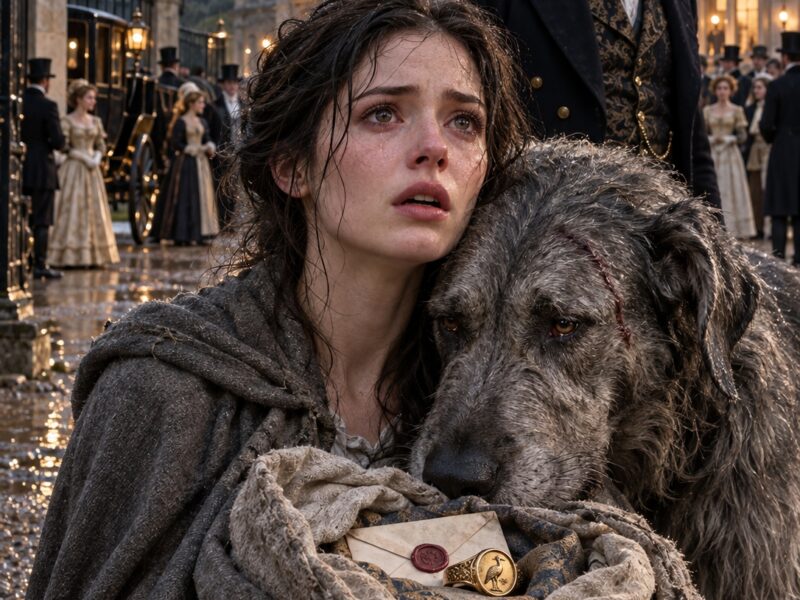
The young woman stood just inside Ravenhurst’s iron gates, one muddy boot ahead of the other, apparently too stunned to move.
She could not have been more than twenty-four.
Rain had darkened the shoulders of her patched gray cloak. Loose strands of black hair clung to her pale cheeks. Her boots were caked with mud, and exhaustion had hollowed the skin beneath her eyes.
She looked poor.
But she did not look born to poverty.
There was something in the way she held her shoulders.
Something stubbornly elegant.
As if someone had once taught her how to enter a ballroom and life had since forced her to walk through kitchens, alleys, boardinghouses and rain—but had never quite managed to make her forget.
A faded wool bundle was pressed tightly against her chest.
Sovereign pushed his scarred muzzle against it.
Then the sound came.
A whine.
Thin.
Broken.
Almost human.
Julian stopped breathing.
He had not heard Sovereign make that sound in three years.
Not since the night Edmund died.
The stranger opened her eyes.
Slowly, cautiously, she placed one hand on Sovereign’s head.
The dog leaned into her touch.
Julian felt something cold move through his body.
“Miss.”
She looked at him.
“What are you carrying?”
Her fingers tightened around the bundle.
Before she could answer, Lady Mary Vance leaned from her carriage.
“Your Grace, surely we are not going to entertain beggars now.”
A few people laughed nervously.
The young woman’s cheeks reddened.
She did not lower her eyes.
Julian noticed that.
He also noticed Sovereign’s ears move.
Not toward Lady Mary.
Toward someone standing behind her.
Lord Perival Ravenhurst.
Julian’s first cousin.
His heir presumptive.
His oldest surviving relative.
Perival stepped forward with the effortless warmth that had made almost everyone in England like him within five minutes of meeting him.
He was fair-haired, handsome, elegantly dressed and perpetually at ease.
Everything Julian was not.
“Come now,” Perival said gently. “The poor girl is soaked.”
He removed one glove and extended his hand.
“Give me whatever you have there, miss. We’ll make certain it reaches His Grace. Then we’ll find you a warm meal and somewhere dry to sleep tonight.”
Sovereign stopped whining.
A growl rolled through his chest.
Perival’s hand froze.
Only for half a second.
But the stranger saw it.
So did Julian.
“No,” Julian said.
Perival glanced at him.
“No?”
“The lady comes inside.”
Lady Vance made a sound of disbelief.
Julian stood.
Mud covered the knees of his trousers and streaked the front of his coat.
He could feel everyone staring.
He no longer cared.
“Hobbs,” he called.
The old butler appeared beneath the portico.
“Lady Vance’s party will take refreshments in the blue drawing room. No carriage leaves until the rain passes.”
Then Julian looked at Sovereign.
“With me.”
For the first time in years, the dog obeyed instantly.
But he did not walk beside Julian.
He walked beside the stranger.
His flank brushed her skirts all the way up the long drive.
Behind them, forty people fell silent.
And Lord Perival Ravenhurst stood in the rain with his glove hanging from one hand—
watching the bundle in the stranger’s arms.
Julian’s study smelled of leather, paper and cold ashes.
There had been no fire in the hearth for three years.
Julian had never consciously decided to stop using it.
After Edmund’s funeral, the room had simply become colder.
Then winter passed.
Another came.
And no one suggested lighting it again.
The stranger noticed.
Julian knew because her gaze rested on the black fireplace for one second too long.
He closed the door.
Sovereign immediately lowered himself beside her boots.
“Your name.”
“Isolda Marlowe.”
Something about the name touched a distant corner of Julian’s memory.
He could not place it.
“And why have you come here?”
She looked down at the bundle.
“My father died in February.”
“I’m sorry.”
Her expression changed almost imperceptibly.
Perhaps she had expected no sympathy from him.
“Thank you.”
“Who was your father?”
“Baron Marlowe.”
Now Julian remembered.
Barely.
A small neighboring estate beyond the river.
A family that had vanished from society three years earlier beneath rumors of debt and fraud.
Julian’s face hardened.
Isolda noticed.
“My father was not a thief.”
“I did not say he was.”
“You didn’t have to.”
Julian’s jaw tightened.
Most people retreated when his expression changed.
She did not.
Interesting.
“My father made me promise to place this in your hands,” she said. “No servant. No secretary. No relative. You.”
She pulled a letter from inside her cloak.
Julian accepted it.
The seal had already been broken and resealed badly with wax.
He glanced at her.
“He asked me to read it after his death,” she explained. “There was no longer anything in it he could hide from me.”
Julian unfolded the paper.
The letter was brief.
Baron Marlowe apologized for writing after years of silence.
He said grief made hermits of men who might otherwise have been friends.
He mentioned three unanswered petitions sent to Ravenhurst Park.
Julian frowned.
He remembered none.
Then he reached the final lines.
I grieve with you still for Edmund.
Julian’s throat tightened.
I loved him as I would have loved a son.
And beneath it:
Tell him, wherever he is, that I kept my promise.
Julian read the line again.
Then a third time.
The room seemed to narrow.
“Why,” he asked, “would your father speak of my brother as a son?”
Isolda did not answer.
Instead, she sat.
Slowly.
The bundle rested across her knees.
She began unwrapping it.
One fold.
Then another.
Julian recognized the cloth before he recognized what was inside it.
Gray and cream check.
Old.
Frayed.
His stomach dropped.
He had seen that scarf around Edmund’s neck one winter when his younger brother had raced across the frozen lawn shouting that Sovereign had fallen through the ice.
Edmund had been nineteen.
Laughing.
Alive.
Julian stepped closer.
“Where did you get that?”
Isolda unfolded the final layer.
A gold signet ring lay inside.
The Ravenhurst heron was engraved into its face.
Beside it was a document bearing a church seal.
Julian reached for the ring.
His hand stopped inches above it.
He knew that ring.
He had given it to Edmund on his twenty-first birthday.
His brother had joked that now he could sign debts with sufficient dignity.
“Where did you get this?”
His voice sounded different.
Isolda looked directly at him.
“Your brother put it on my finger.”
Julian stared at her.
“When?”
“September fourteenth, 1810.”
Silence.
“In the vestry of St. Aldric’s Church.”
Julian’s eyes moved to the paper.
Marriage certificate.
Two witnesses.
A curate.
And two names.
Edmund Thomas Ravenhurst.
Isolda Anne Marlowe.
The air left Julian’s lungs.
“No.”
Sovereign lifted his head.
Isolda’s face did not change.
“No?” she repeated.
“My brother would have told me.”
“He intended to.”
“I knew everything about Edmund.”
A terrible sadness crossed her face.
“No, Your Grace.”
Julian looked up.
“You knew everything he allowed you to know.”
The words struck harder than they should have.
“My brother was twenty-three when he died.”
“Yes.”
“He was impulsive.”
“Yes.”
“Generous beyond reason.”
“Yes.”
“He had a weakness for rescuing lost causes.”
Her eyes sharpened.
“And now we arrive at what you actually mean.”
Julian said nothing.
“You think I trapped him.”
“I think dead men acquire astonishing numbers of secret lovers when they are no longer available to contradict them.”
The moment the words left his mouth, Julian knew they were cruel.
But pride was quicker than regret.
Isolda stood.
Her knees trembled.
Her voice did not.
“I walked four miles today because the carter refused to come closer in the storm.”
Julian remained silent.
“I have spent three months living in a Bristol boardinghouse where my landlady pretends not to notice when I cannot pay her.”
She gathered the scarf.
“My father died in a rented room without enough money for a proper grave.”
Julian looked away.
She stepped closer.
“I came here carrying the last objects I own that still bear your brother’s touch.”
Her eyes glistened.
“I did not come for your title.”
Another step.
“I did not come for your money.”
Her voice cracked now.
“I came because Edmund told me that if everything else failed, his brother would understand.”
Julian flinched.
“He said you were the best man he knew.”
She swallowed.
“I see now that Edmund was loyal to a fault.”
She turned toward the door.
Sovereign rose.
Before she could reach the handle, the enormous dog planted himself in front of it.
“Sovereign,” Julian said.
The dog did not move.
“Sovereign.”
Nothing.
Isolda stared down at him.
“He did this with Edmund too,” she whispered.
Julian went still.
“What?”
She touched the dog’s scarred muzzle.
“When Edmund wanted to leave angry, Sovereign would stand in the doorway until he calmed down.”
Julian felt the room tilt.
“You knew this dog?”
Isolda looked back at him.
“I knew him before you did.”
Julian’s chest tightened.
“He was Edmund’s.”
“Yes.”
Julian looked at Sovereign.
For three years, he had believed the dog had remained with him because Edmund was gone.
He had never asked who else Sovereign might have lost.
“Sit down,” Julian said.
Isolda remained standing.
His voice softened.
“Please.”
She did not sit.
But she did not leave.
“Tell me everything.”
Julian lowered himself behind the desk.
“I will not interrupt.”
A faint, bitter smile touched her mouth.
“You will.”
“I will try not to.”
That almost made her laugh.
Almost.
Then Isolda began.
She had met Edmund at the Marlowe harvest fair when she was nineteen.
He had arrived on horseback with a sick gray puppy stuffed inside his coat.
The puppy vomited down Edmund’s waistcoat.
Edmund laughed so hard he had to sit on a mounting block.
Julian closed his eyes.
That sounded exactly like him.
“Sovereign?” he asked.
Isolda nodded.
“He was half-starved. Edmund found him beside the road.”
Of course he had.
Edmund collected broken things.
Birds.
Dogs.
People.
Once, at fourteen, he had brought home a stable boy dismissed for stealing bread and announced that Julian could either employ the boy or employ neither of them.
Julian had hired the boy.
Isolda continued.
She and Edmund met again beside the garden wall.
Then again.
Then deliberately.
Their courtship unfolded across two years in stolen conversations.
Edmund wanted to tell Julian.
But he was afraid.
“Of me?”
Isolda looked almost apologetic.
“Of your silence.”
That hurt more.
“He said you could freeze a room without raising your voice. He believed you would look at him, look at me, and make him feel foolish without saying a word.”
Julian remembered every time he had dismissed Edmund’s enthusiasms with a raised eyebrow.
Every time he had called something childish.
Every time he had mistaken restraint for wisdom.
“So he married you secretly.”
“Yes.”
“Why?”
“Because he wanted to bring you a fact you could not prevent.”
Despite everything, Julian almost smiled.
“That sounds like Edmund.”
“He planned to tell you immediately.”
“But he didn’t.”
“No.”
Isolda’s expression changed.
“He found something.”
Julian leaned forward.
“What?”
“The estate accounts.”
The warmth vanished from the room.
“What about them?”
“Timber sales for trees that were never cut. Tenant farms mortgaged against your name without your knowledge. Notes of credit guaranteed by my father with signatures he never made.”
Julian stared at her.
“Impossible.”
“I watched my father compare the signatures himself.”
“Who had access?”
“Edmund believed he knew.”
“Who?”
Isolda hesitated.
“Before I tell you that, you need to know what happened the last night I saw him.”
Julian’s hands closed.
Isolda looked toward the rain beating against the windows.
“Edmund came to our cottage in the afternoon. He was nervous, but excited. He said he finally had enough proof.”
“Proof of what?”
“He wouldn’t tell me the name.”
Julian frowned.
“He said it was family.”
The word hung between them.
“He planned to bring you the ledger that night. And tell you about us.”
Julian’s breathing slowed.
“I remember that evening.”
Isolda stopped.
“He came to dinner?”
“Yes.”
Julian saw it now.
Edmund at the far end of the table.
Restless.
Starting sentences and abandoning them.
Drinking too quickly.
Finally saying, “Julian, there’s something—”
And Julian, exhausted from Parliament and irritated by estate business, had raised one hand.
“Whatever it is, Edmund, it can wait until morning.”
Julian whispered the words now.
Isolda’s eyes filled.
“It didn’t.”
The rain struck the windows.
Julian could hear his own heartbeat.
“He left?”
“Yes.”
“Where?”
“He told me he was meeting someone at the old hunting lodge.”
Julian stood.
“The lodge near Heron’s Leap?”
“Yes.”
The quarry.
Edmund had been found at the bottom of it before dawn.
His horse wandering three miles away.
Neck broken.
Sovereign had stood over the body for nearly two days.
When men finally managed to drag the dog away, his muzzle had been cut open and bloodied.
Julian had assumed the rocks had done it.
He suddenly felt sick.
“The ledger,” Julian said.
“Was never found.”
“And your father?”
“One week later, creditors appeared.”
Isolda’s voice hardened.
“Not gradually. Not one by one. All at once.”
Marlowe’s forged guarantees were called in.
His accounts were frozen.
His estate was seized.
Friends vanished.
Invitations stopped.
Within months, a baron who had never missed a debt payment in his life was publicly branded a fraud.
“I wrote to you,” Isolda said.
Julian looked at her.
“Three times.”
“I received nothing.”
“I received one answer.”
She reached inside her cloak.
Another sheet.
Older.
Creased from years of handling.
She placed it before him.
Julian read.
His Grace, the Duke of Ravenhurst, regrets to inform Baron Marlowe that he has no wish to receive further correspondence from his family and considers the matter of any supposed connection entirely closed.
At the bottom was Julian’s signature.
Or something almost indistinguishable from it.
His seal.
His house.
His name.
Julian’s face went cold.
“I did not write this.”
Isolda said nothing.
“I never wrote this.”
“It carries your seal.”
“I know what it carries.”
He stared at the handwriting.
A terrible realization unfolded slowly.
“I have not opened my own correspondence since Edmund died.”
Isolda’s expression shifted.
“Who does?”
Julian did not answer immediately.
Because he already knew.
Perival.
His cousin had offered to handle the letters.
The invitations.
The endless condolences.
The estate disputes.
The creditors.
Everything Julian had found unbearable after the funeral.
Julian had surrendered his life four careless words at a time.
Do as you see fit.
Handle it for me.
I don’t care.
Not tonight.
His eyes lifted.
“Is there anything else?”
Isolda’s fingers tightened around the scarf.
“Yes.”
She drew out one final letter.
Smaller than the others.
Sealed.
Across the front was one word in Edmund’s handwriting.
Julian.
Julian stopped breathing.
“I never opened it,” Isolda whispered. “He left it with me that night. He said I should give it to you if anything happened.”
“Why didn’t you?”
“Because your reply came.”
Julian looked again at the forged letter.
“I thought you hated us.”
Her voice broke.
“My father told me before he died that a dead man’s last words do not belong to the living.”
She placed Edmund’s letter in Julian’s hand.
He broke the seal.
His fingers shook.
He did not hide it.
Julian,
If you are reading this, I have probably been a fool again.
A sound escaped Julian’s throat.
Edmund.
Even on paper.
Still Edmund.
Three things.
First: Perival has been stealing from Ravenhurst for nearly two years.
Julian stopped.
Across the room, Sovereign lifted his head.
Isolda closed her eyes.
Julian kept reading.
I have the ledger. Baron Marlowe has the forged notes. I am meeting Perival tonight at the old lodge because he begged me to settle this privately, as family.
Julian’s vision blurred.
I will give him until Sunday to confess to you.
Do not be too hard on him.
He is weak, Julian.
And weak men are often more dangerous than cruel ones.
Julian’s grip tightened on the page.
Second: I married Isolda Marlowe last September.
She is cleverer than I am, which you will enjoy pretending not to notice.
Despite himself, Julian made a broken sound that might once have been laughter.
Isolda covered her mouth.
I was afraid to tell you because I thought you would see a title where I see a person.
I was wrong to be afraid.
You are the best man I know.
You are simply the worst at saying so.
Julian stopped reading.
His eyes closed.
For three years, he had survived Edmund’s death by turning grief into discipline.
No tears.
No questions.
No explanations.
He had built silence around the wound until silence became the shape of his life.
Now his brother’s voice had walked straight through it.
There was one final line.
Third: be kind to Sovereign.
He will do the right thing before any of us understand what it is.
Your brother, always,
Edmund.
Julian lowered his head.
The letter remained beneath his hands.
For a long time, he said nothing.
Isolda watched the most powerful man she had ever known quietly break.
No dramatic sob.
No collapse.
Only his shoulders bending as though three years had finally landed on them at once.
Sovereign rose.
He crossed the carpet.
And rested his enormous head on Julian’s knee.
Julian placed one hand over the dog’s scar.
“I sent him away.”
Isolda shook her head.
“No.”
“He tried to tell me.”
“You didn’t know.”
“I told him morning.”
Julian looked at her.
“I gave my brother one more night with a murderer because I was too tired to listen.”
“You cannot know that listening would have saved him.”
“No.”
His voice was almost inaudible.
“But I know silence didn’t.”
Then something moved behind his eyes.
A memory.
“His sketchbook.”
Isolda frowned.
“The summer before he died.”
Julian stood abruptly.
“He carried it everywhere.”
He crossed to a cabinet, opened a lower drawer and pulled out a battered leather book.
“I could never bring myself to throw it away.”
He opened it.
Horses.
Trees.
Sovereign as a puppy.
A caricature of Julian reading parliamentary papers with the caption His Grace Converses With Someone Interesting.
Isolda laughed through her tears.
Julian turned another page.
And stopped.
A young woman leaned against a garden wall.
Dark hair.
Laughing eyes.
Another page.
The same woman holding flowers.
Another.
Sleeping beneath an apple tree.
Julian slowly looked at Isolda.
Three years of hunger and grief had sharpened her face.
But now he saw it.
“I knew you.”
She shook her head.
“No.”
“I knew your face.”
His voice cracked.
“I just never knew your name.”
For the first time since entering Ravenhurst Park, Isolda’s anger softened.
Not vanished.
Softened.
Julian closed the sketchbook.
“Isolda.”
She looked at him.
“Your Grace—”
“Julian.”
She hesitated.
“If you can.”
It was such a small request.
Yet she understood what it cost him.
She nodded once.
“Julian.”
Something changed.
Not forgiveness.
Not trust.
But a door opened.
Julian rang the bell.
Hobbs entered almost immediately.
“Who has managed my correspondence since my brother’s death?”
The butler looked surprised.
“Lord Perival, Your Grace.”
“On whose instruction?”
Hobbs hesitated.
“Yours, sir.”
Julian’s face went still.
“Explain.”
“The week after Mr. Edmund’s funeral, you said you wished to hear no more names. Lord Perival offered to relieve you of the burden.”
“And?”
“You told him, ‘Do as you see fit.’”
Julian closed his eyes.
Four words.
That was all.
Four careless words had given another man his voice.
“Did Perival receive use of my seal?”
“Yes, Your Grace.”
“Did letters arrive from Bristol?”
Hobbs’s face changed.
“Three that I remember.”
Isolda inhaled sharply.
“I packed them myself.”
Julian looked toward the door.
“Where is Perival?”
“With the other guests.”
“Good.”
“Your Grace?”
“No one leaves Ravenhurst.”
Hobbs stared.
“Send a rider to St. Aldric’s. I want the parish marriage register here tonight.”
“Yes, Your Grace.”
“Ask every guest to assemble in the great hall in thirty minutes.”
Hobbs bowed.
Julian added, “And Hobbs?”
“Yes?”
“Light the fire.”
The old man glanced at the dead hearth.
Something passed across his face.
“Yes, Your Grace.”
When he left, Isolda stared at Julian.
“The dog,” Julian said.
“What about him?”
“Eleven women.”
He looked at Sovereign.
“I thought he hated them.”
Isolda followed his gaze.
Then understood.
Every candidate had arrived with Perival.
Perival had selected them.
Perival had escorted them from their carriages.
Perival had stood behind every woman Sovereign supposedly rejected.
“The dog wasn’t looking at the women,” Isolda whispered.
Julian felt ice settle inside him.
“He was looking past them.”
At Perival.
For three years.
Eleven times.
Sovereign had tried to tell him.
And Julian had been embarrassed by the noise.
The great hall glittered beneath three chandeliers.
Every guest had gathered by the time Julian entered.
Lady Vance sat rigid with indignation.
Lady Mary looked offended and curious.
Perival stood beside the fireplace holding a glass of brandy.
He smiled.
“There you are. We were beginning to wonder whether your mysterious visitor had murdered you.”
Julian walked into the center of the room.
Isolda entered beside him.
Sovereign followed.
The room stirred.
Julian waited until silence returned.
“I owe everyone here an explanation.”
Perival’s smile remained.
Julian continued.
“I have avoided explanations for most of my life. I once believed that was strength.”
His eyes moved briefly toward Isolda.
“I was mistaken.”
A few guests shifted uncomfortably.
“This woman is Isolda Ravenhurst.”
The room exploded in whispers.
“She is the lawful widow of my brother Edmund.”
Lady Vance stood.
“That is absurd.”
Julian turned his head.
She sat down again.
“My brother married Miss Marlowe in September of 1810. The church register is being brought here now.”
Perival laughed softly.
“Julian.”
The tone was affectionate.
Concerned.
Perfect.
“You are grieving again.”
Julian looked at him.
“Am I?”
“A strange girl appears carrying a ring and a tragic story, and suddenly—”
“She carries Edmund’s final letter.”
Perival stopped.
Only slightly.
But Julian saw it.
So did Sovereign.
The dog rose.
Julian removed the letter from his coat.
“My brother names you.”
Nobody moved.
Perival smiled again.
“For what?”
“Stealing from Ravenhurst.”
The brandy glass remained halfway to his mouth.
Julian continued.
“Forging Baron Marlowe’s signature.”
Perival lowered the glass.
“And meeting Edmund at the old hunting lodge the night he died.”
The room became silent enough to hear the fire.
Perival’s smile changed.
Not gone.
Thinner.
“Forged.”
Julian said nothing.
“Obviously forged,” Perival continued. “The girl has had three years to construct this performance.”
Isolda’s hands curled.
Julian lifted the false letter.
“Then explain this.”
Perival looked at it.
“A reply sent in my name to Baron Marlowe. Written by someone with access to my seal.”
“A secretary’s error.”
“Hobbs?”
The butler stepped forward.
“Lord Perival personally ordered His Grace’s correspondence forwarded to his London rooms.”
Perival’s face tightened.
“He did so under Julian’s authority.”
“I did,” Julian said.
Perival relaxed slightly.
“Then this is ridiculous.”
“Yes.”
Julian nodded.
“It was ridiculous of me.”
Perival frowned.
“To give another man my voice because I was too frightened to use it myself.”
That landed differently.
Julian stepped closer.
“But my cowardice does not make you innocent.”
Perival’s warmth vanished.
“Be careful.”
A murmur passed through the room.
Nobody spoke to Julian Ravenhurst that way.
Except family.
Perhaps that had always been Perival’s shield.
Then Sovereign moved.
The dog crossed the marble floor.
Slowly.
His claws clicked beneath the chandeliers.
Perival watched him approach.
“Julian.”
Sovereign stopped in front of him.
“Call the animal away.”
Julian’s voice was almost gentle.
“Why?”
“You know what he is like.”
“I thought I did.”
Sovereign stared at Perival.
Three years of waiting seemed gathered inside those amber eyes.
Perival stepped backward.
The dog followed.
“Call him off.”
“He hasn’t touched you.”
“Julian.”
Fear.
Real fear.
For the first time in Julian’s memory, Perival Ravenhurst sounded afraid.
Sovereign lunged.
Women screamed.
But he did not bite flesh.
His teeth caught Perival’s coat sleeve.
He pulled.
The expensive fabric tore from wrist to elbow.
The white shirt beneath split open.
Perival jerked his arm away.
Too late.
Everyone saw it.
Five pale puncture scars curved along his forearm.
An old bite.
Deep.
Savage.
Julian felt the world become very still.
Three years earlier, after Edmund’s body was recovered, Perival had arrived at Ravenhurst with his arm bandaged.
He had said his horse threw him.
Julian remembered joking that Perival had finally met an animal immune to charm.
Sovereign growled.
Perival went white.
Lord Whitcombe, a magistrate sitting near the fireplace, slowly rose.
Julian’s voice was quiet.
“You told me you fell from your horse.”
Perival said nothing.
“You told me that the week Edmund died.”
Still nothing.
“Where did Sovereign bite you?”
Perival’s eyes moved around the hall.
Forty faces.
No escape.
The mask cracked.
“He wouldn’t listen.”
Isolda stopped breathing.
Julian did not move.
Perival’s face twisted.
“Edmund wouldn’t listen.”
Someone gasped.
“It was a few thousand pounds at first.”
Julian closed his eyes.
“Then land. Credit. Investments. I was going to repay it.”
“You forged documents.”
“I had debts!”
“You destroyed Marlowe.”
“He had proof!”
Perival shouted it.
The words echoed through the hall.
And then he knew.
Everyone knew.
There would be no retreat now.
Perival’s breathing became ragged.
“Edmund came to me. He said he was going to you.”
Julian’s hands clenched.
“I begged him to wait.”
Isolda stepped forward.
“What happened at the quarry?”
Perival looked at her.
For the first time, there was hatred in his face.
Not because she had accused him.
Because she had survived.
“He said I had until Sunday.”
Perival swallowed.
“Then he changed his mind.”
Isolda stared.
“He said he was riding back to Julian at dawn.”
Julian’s stomach turned.
“I followed him onto the quarry road.”
Perival’s voice broke.
“We argued.”
“What happened?”
“He struck me.”
Sovereign growled.
Perival looked at the dog.
“That animal came out of nowhere.”
His hand touched the scars.
“I tried to get Edmund away from him. The horse reared.”
Isolda whispered, “And Edmund fell.”
Perival closed his eyes.
“I didn’t push him.”
“You left him.”
Her voice was almost gentle.
That made it worse.
“You watched him fall and left him at the bottom of the quarry.”
Perival opened his eyes.
“I panicked.”
“You left him with his dog.”
“I panicked!”
“And then you went home.”
Perival said nothing.
“You slept in your own bed,” Isolda continued, “while Sovereign stayed with Edmund’s body.”
Her eyes filled with tears.
“Then you destroyed my father.”
“I had to remove the evidence.”
“And you intercepted my letters.”
Silence.
“And for three years, you selected women for Julian.”
Perival looked toward his cousin.
Julian finally understood the full architecture of it.
A duke without a wife had no legitimate heir.
If Julian died unmarried—
Perival inherited Ravenhurst.
Everything.
The estate he had already begun stealing.
Eleven women.
Eleven carefully arranged failures.
And Julian had laughed bitterly at the absurdity while his brother’s dog tried to expose the man beside them.
Perival turned toward him.
“Julian.”
“No.”
“Listen to me.”
“I have spent three years not listening.”
“Then start now!”
Perival’s composure collapsed.
“I am your blood.”
Julian stared at him.
“I am the last Ravenhurst after you.”
No one breathed.
“A public trial would destroy us.”
Perival stepped closer.
“The newspapers. Parliament. Society. Five hundred years of our family dragged through a criminal court.”
Julian looked down at Edmund’s ring in his palm.
“Think of the name.”
That had always been the command.
The name.
The house.
Duty.
Silence.
Reputation.
Everything Julian had been taught to place before human feeling.
Then he remembered Edmund at dinner.
Julian, there’s something—
Morning.
He looked at Perival.
“Edmund was my blood too.”
Perival’s face collapsed.
Julian’s voice remained steady.
“I made him wait until morning once.”
He turned toward Lord Whitcombe.
“I will not do it again.”
Two footmen approached.
Perival backed away.
“Julian!”
Nobody moved to help him.
“Julian, please!”
Sovereign stood beside Isolda.
Perival was taken through the great doors.
Rain swallowed his voice.
Only then did Julian realize that his hands were shaking.
He turned.
Isolda stood a few feet away.
The entire room watched them.
Julian could have dismissed everyone.
Could have dealt with the rest privately.
The old Julian would have.
Instead, he walked to Isolda.
And bowed.
Low.
Publicly.
A duke bowing to a woman who had entered his gates dressed like a beggar.
“Lady Edmund Ravenhurst.”
Her lips parted.
“This house is yours for as long as you wish it to be.”
He looked directly at her.
“My brother’s name is yours by right.”
No one made a sound.
“I also owe you an apology.”
Isolda’s eyes filled.
“For the letter written in my name.”
Julian swallowed.
“For allowing grief to make me so absent that another man could use my silence as a weapon.”
His voice tightened.
“And for what I said to you in my study.”
He did not look away.
“There is no excuse for it.”
A tear slid down Isolda’s cheek.
“I will not insult you by inventing one.”
For several seconds, she could not speak.
She thought of Bristol.
Cold soup.
Unpaid rent.
Her father coughing through the night.
The grave without a stone.
She thought of Edmund laughing with a sick puppy hidden beneath his coat.
And of three years believing Edmund had been wrong about the brother he loved.
“Thank you,” she said.
That was all.
Not forgiveness.
Julian understood.
But sometimes forgiveness did not begin with absolution.
Sometimes it began with one person finally telling the truth and another choosing not to leave.
The parish register arrived before midnight.
Edmund and Isolda’s marriage was confirmed.
Both surviving witnesses testified.
Perival’s financial records were uncovered over the following weeks.
The theft was larger than Julian had imagined.
So was the destruction left behind.
Baron Marlowe’s name was formally cleared.
Julian personally paid every debt created by the forged guarantees.
He did not call it charity.
He called it restitution.
Perival was convicted.
The law could have taken his life.
Julian intervened.
Not because he forgave him.
Because Edmund had written one sentence Julian could not forget.
Do not be too hard on him.
Perival’s sentence was commuted to transportation for life.
He sailed for New South Wales that autumn.
People later said he spent years insisting that a dog had ruined him.
He never seemed to understand that Sovereign had only remembered what the humans chose to forget.
Isolda stayed at Ravenhurst.
Not because Julian asked her to become something else.
Not because society suddenly welcomed her.
And certainly not because three years of suffering disappeared with a restored name.
She stayed because Edmund was buried there.
Because Sovereign was there.
And because, gradually, Ravenhurst stopped feeling like the house that had ignored her.
Julian changed slowly.
That mattered.
Grand transformations were easy in stories.
Real people were harder.
Sometimes he still went silent when angry.
Sometimes Isolda would stare at him until he noticed.
“What?”
“You’re doing it again.”
“Doing what?”
“Becoming a marble statue.”
“I am thinking.”
“You are sulking elegantly.”
“I do not sulk.”
Sovereign would thump his tail.
Isolda would raise an eyebrow.
And eventually Julian would sigh.
“Fine. I am sulking.”
Those were the evenings she liked best.
At first, they spoke almost entirely about Edmund.
Julian told her how Edmund, at ten, tried to sail one of their father’s hats across the lake.
Isolda told him how Edmund once walked six miles because he refused to admit he had forgotten where he tied his horse.
Julian confessed that Edmund had given away his pony to a tenant’s son and then spent three weeks claiming the animal had escaped.
Isolda laughed until she cried.
Other nights, they simply sat.
The fire returned to Julian’s study.
At first, he pretended Hobbs had ordered it.
Hobbs pretended to believe him.
Eventually no one pretended.
Two winters passed.
Something shifted so gradually that neither Julian nor Isolda could identify when it began.
One evening they spoke for three hours and never mentioned Edmund.
Neither realized until the following morning.
Julian felt guilty.
Isolda did too.
Then she laughed.
“He would hate this.”
“What?”
“Both of us turning his memory into a prison.”
Julian looked toward Sovereign sleeping beside the hearth.
“I don’t know how to stop missing him.”
“I don’t think we are supposed to.”
She looked at him.
“I think we are only supposed to stop believing missing him requires us to remain miserable.”
Julian said nothing.
Isolda smiled faintly.
“You’re becoming marble again.”
“I’m thinking.”
“Dangerous habit.”
He almost smiled.
On the anniversary of Edmund’s death, they walked to the churchyard.
Spring had returned.
The grass was wet and bright.
Edmund’s stone stood beneath an old oak.
Nearby was the newer stone Julian had commissioned for Baron Marlowe.
Isolda had chosen the inscription herself.
He kept his promise.
Sovereign walked ahead.
The old hound was slower now.
Silver had begun spreading through the fur around his eyes.
He reached Edmund’s grave and lowered himself onto the grass.
For years, even while sleeping, Sovereign had seemed to listen.
For footsteps.
For danger.
For something unfinished.
That afternoon, he rested his head on his paws.
His amber eyes closed.
Isolda watched him.
“He’s finished waiting.”
Julian looked at the dog.
Then at Edmund’s name.
“I think we both have.”
Isolda turned toward him.
Julian’s expression had changed.
She knew that expression now.
It meant he was terrified and determined not to look terrified.
“What?”
He took a breath.
“I am very bad at this.”
“At walking?”
“At explaining myself.”
“That is true.”
“Thank you.”
“You’re welcome.”
His mouth twitched.
“My father taught me that explanation was weakness.”
Isolda waited.
“I have spent most of my life discovering that nearly everything he taught me about silence was wrong.”
The breeze moved through the oak branches.
Julian looked down at his hands.
Then back at her.
“I loved Edmund.”
“I know.”
“And you loved Edmund.”
“Yes.”
“What I am about to say does not change either of those things.”
Her heart began beating faster.
“Julian…”
“Please let me finish before I lose my nerve.”
That made her smile.
He continued.
“I do not know precisely when it happened.”
His voice was quieter now.
“But somewhere between your correcting my accounts, insulting my taste in curtains, refusing to let me dismiss three tenants whose roof repairs were late—”
“They had children.”
“—and informing Lady Vance that her opinion of you was of no practical use whatsoever—”
“It wasn’t.”
“—I began waiting for you to enter rooms.”
Isolda stopped smiling.
Julian swallowed.
“I began noticing when you were gone.”
His eyes held hers.
“And somewhere after that, I began imagining years in which you were not gone at all.”
She said nothing.
“I am not asking you to replace Edmund.”
His voice cracked slightly.
“I would never ask that.”
“I know.”
“And I am not asking because Ravenhurst needs an heir.”
“Good.”
“Because after eleven candidates, I think Sovereign has established that he considers himself responsible for succession.”
The dog’s tail struck the grass once.
Isolda laughed.
Julian smiled.
Then became serious again.
“I would like permission to court you.”
She stared.
“Properly.”
His voice softened.
“No secret garden walls.”
“No secret marriages.”
“No carriages full of women being inspected by dogs.”
“Especially that.”
She looked at him for a long moment.
This was not the man Edmund had described.
Not exactly.
Edmund had loved a brother hidden beneath armor.
Isolda had watched that armor break.
Not all at once.
Not cleanly.
But enough.
She thought about the day she entered Ravenhurst with mud on her boots and nothing left except a letter, a ring and the truth.
She had expected rejection.
She had found it.
Then she had found something harder.
A man willing to discover that he had been wrong.
That did not erase what happened.
But perhaps love was not built from erasure.
Perhaps it was built from what people did after the truth became impossible to avoid.
Julian shifted uncomfortably.
“Isolda?”
“Yes?”
“You have been silent for an alarming amount of time.”
She raised an eyebrow.
“Now you understand how everyone else feels around you.”
“Cruel.”
“Accurate.”
“Are you going to answer?”
She looked toward the house.
The long path curved through green fields toward Ravenhurst.
Two years earlier, she had walked up that drive with no home.
Now the windows caught the afternoon light.
Smoke rose from the chimneys.
Somewhere inside, Hobbs was probably complaining about supper.
Julian waited.
Isolda stepped past him.
“You may walk me back to the house.”
He blinked.
“That is not an answer.”
“It is the answer you are getting today.”
“Isolda.”
She kept walking.
“We shall see what happens on the way.”
Julian stood there for half a second.
Then followed.
Behind them, Sovereign remained beside Edmund’s grave.
The old dog did not raise his head.
He did not watch the road.
He did not guard the gate.
For the first time in years, there was nothing left for him to warn them about.
Halfway down the hill, Julian said something that made Isolda laugh.
The sound carried back across the grass.
Sovereign’s tail moved once.
Just once.
And if Edmund Ravenhurst had been anywhere close enough to hear it, perhaps he would have laughed too.
Because in the end, the dog had done exactly what Edmund promised.
He had known the truth before any of them understood it.
He had waited while men hid behind pride, while a murderer hid behind charm, while grief hid behind silence.
He had waited through eleven carriages.
Three winters.
And one very long afternoon.
Then, when the right woman finally walked through the gate carrying the truth against her heart—
Sovereign stopped growling.
And began to cry.









