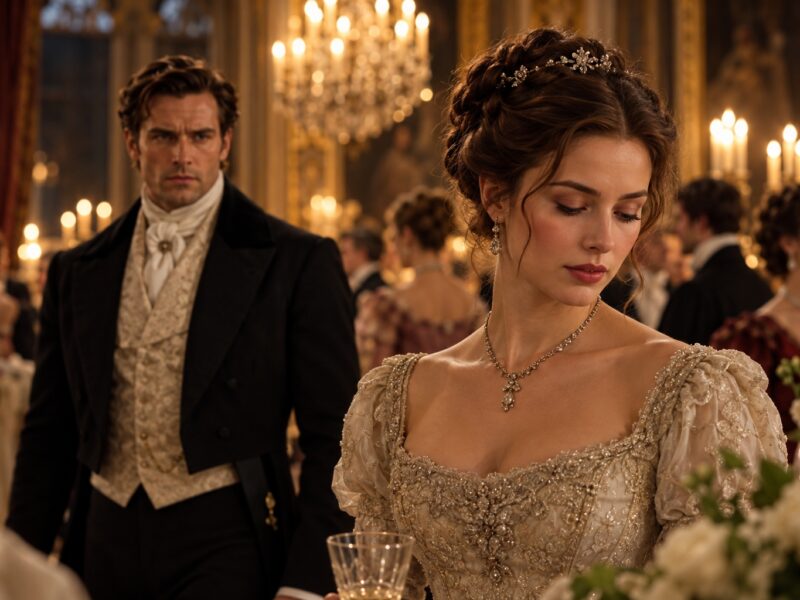
For Two Years, the Duchess Looked Up Every Time Her Husband Entered—Until the Night She Didn’t
For two years, Victoria Fairchild had turned toward the door whenever her husband entered a room.
On the night she finally stopped, the Duke of Hartwell discovered how terrible silence could become.
And for the first time in their marriage, Edmund Fairchild found himself waiting for a woman who was no longer waiting for him.
The winter ball at Hartwell Manor was everything an evening of its importance ought to have been.
Sixty guests filled the grand drawing room, their voices mingling beneath the high plaster ceiling. Crystal glasses caught the light of hundreds of candles. Beyond the tall windows, frost covered the lawns and silvered the branches of the ancient oaks.
Victoria stood near the far windows, speaking with Lady Pembrook and the wife of a Cheltenham barrister. She wore deep blue silk, a gown that moved softly around her ankles whenever she turned.
She was smiling.
Not the practiced smile she offered visiting dignitaries or difficult relatives, but something open and unguarded.
Lady Pembrook laughed at something she said, pressing a hand to her throat in genuine amusement.
Then the doors opened.
Edmund Fairchild, Duke of Hartwell, entered his own drawing room.
Several guests turned immediately. Lord Ashcroft lifted his glass. A gentleman near the fireplace stepped aside to clear the Duke’s path.
Edmund acknowledged them with his customary restraint.
He was thirty-eight years old, broad-shouldered, impeccably dressed, and entirely accustomed to being noticed.
He had spent most of his adult life commanding attention without appearing to seek it.
Yet that evening, as he passed beneath the chandeliers, he noticed something missing.
His wife had not turned.
Victoria continued speaking to Lady Pembrook.
She did not glance toward the door.
She did not search the room for him.
She did not even seem aware he had arrived.
Edmund slowed.
For a moment, he stood among the guests with a strange sensation gathering beneath his ribs.
It was not anger.
He could not reasonably have expected his wife to abandon a conversation simply because he had entered the room.
And yet, for two years, she always had.
Not abandoned the conversation, exactly. Victoria had never been so discourteous. But she had always looked.
A small movement of her head. A brief lift of her eyes. Sometimes the faintest suggestion of a smile.
Something in her expression had always changed when she saw him.
He had accepted that attention so completely that he had never considered what it meant.
Now it was gone.
And its absence followed him through the evening.
The winter of 1886 had arrived early in Gloucestershire.
By the second week of December, frost lay thick across the fields surrounding Hartwell Manor. The soil had hardened, the birds had fallen silent, and the great stone house stood beneath the pale sky with the quiet confidence of something built to outlast generations.
Edmund had grown up within those walls.
In some respects, he resembled the house itself.
He was steady, imposing, and remarkably difficult to read.
At twenty-two, he had inherited an estate burdened by debts his father had left unresolved. The Fairchild name still carried considerable influence, but influence could not pay creditors, repair neglected buildings, or rescue failing investments.
Edmund had spent the next sixteen years restoring what had been lost.
He learned to negotiate before he learned to rest. He developed an instinct for risk, a disciplined understanding of money, and a formidable ability to separate emotion from decisions that required calculation.
By thirty-eight, he had restored the family fortunes.
The land was profitable again. The estate accounts were sound. His political relationships were carefully cultivated, and his judgment was respected in circles where even a duke’s title could not guarantee admiration.
He had accomplished nearly everything he had set out to accomplish.
Somewhere along the way, however, he had begun to treat affection as an inconvenience best managed by keeping it at a distance.
Edmund was not a deliberately unkind man.
He paid his staff fairly. He considered his tenants’ concerns when they reached his desk. He understood duty and honored obligations.
But he had built a life in which usefulness and reliability were the highest forms of praise.
He rarely understood that people sometimes needed something else.
Two years earlier, his marriage had seemed another sensible decision.
Victoria Ashford was the daughter of an established Kent family whose political connections remained valuable despite its increasingly strained finances.
The Ashfords needed security.
The Fairchilds could benefit from influence in social and political circles where Edmund had not yet secured a strong foothold.
Both families recognized the advantages.
The solicitors approved.
And Edmund, sitting opposite Victoria during a formal dinner in London, had considered her quiet intelligence, accomplished manners, and composed bearing before deciding that she would make an excellent duchess.
He had been correct.
That was the tragedy of it.
Victoria had become an extraordinary duchess.
At twenty-nine, she possessed the kind of intelligence that revealed itself through observation rather than display. Her gray eyes were clear and attentive, and she spoke with the precision of someone accustomed to considering the consequences of her words.
She had learned early that a woman in her position could possess considerable ability without receiving much public credit for exercising it.
So she learned to work quietly.
When she arrived at Hartwell Manor, she began studying the estate as carefully as Edmund studied its accounts.
She learned the names of the tenants.
Not merely the heads of households, but their wives, their children, and the difficulties that shaped their daily lives.
She discovered which families had struggled through the previous harvest, which cottages required attention, and which longstanding grievances needed handling before resentment took root.
She established friendships with neighboring families.
She managed invitations, household correspondence, dinners, and social obligations with remarkable judgment.
The household ran more smoothly because of her.
The estate’s relationships improved because of her.
Edmund’s political connections benefited from conversations he rarely knew had taken place.
And Victoria did all of it without demanding recognition.
But she had hoped for something.
Not public praise.
Not elaborate gifts.
Not even the romantic declarations she knew would have embarrassed her practical husband.
She had wanted him to be interested in her.
At first, she tried to create opportunities.
At breakfast, she might mention a conversation with a neighboring lady and wait to see whether he would ask what had been said.
Occasionally, she brought a book into a room where Edmund was reading, hoping they might spend an hour together.
When he returned from London, she asked about his meetings with genuine curiosity.
She listened carefully to his answers.
Then she waited for him to ask about her day.
Usually, he did not.
Sometimes he nodded and turned back to a letter.
Sometimes he answered her questions and then excused himself because some matter required his attention.
Occasionally, he offered a courteous remark that might have been addressed just as easily to a competent household secretary.
Victoria never doubted that he respected her.
What she slowly began to doubt was whether he saw her as a person beyond the role she performed.
During the first year, she continued trying.
During the second, her efforts became smaller.
She stopped asking questions that led nowhere.
She stopped mentioning matters unless they required his approval.
And eventually, without anger or any deliberate decision, she stopped looking for him when he entered a room.
Hope had not departed in a single dramatic moment.
It had worn away through hundreds of ordinary ones.
The winter ball took place on December 14.
Victoria had spent three weeks preparing it.
The flower arrangements had been chosen to complement the season without overwhelming the drawing room. The menu accounted for the preferences of the most important guests. The seating plan balanced political interests, family sensitivities, and the quiet rivalries that could turn an otherwise successful evening unpleasant.
She understood that a dinner at Hartwell Manor was never simply a dinner.
People came to be seen, to form alliances, and sometimes to repair relationships that could not be discussed openly.
By the time the first carriage arrived, every detail had been considered.
Edmund, meanwhile, had spent the day with his solicitor discussing a complicated dispute over two parcels of tenant land along the estate’s eastern boundary.
The matter had been troubling him for months.
He had intended to address it properly in September.
Then other responsibilities intervened.
By the time he dressed and descended to the drawing room, the evening was already underway.
And his wife, for once, was not watching for him.
Lord Ashcroft approached almost immediately to discuss the latest parliamentary session.
Edmund responded as he always did.
He spoke intelligently, listened where listening served a purpose, and offered opinions with the calm assurance that had earned him considerable respect.
Yet his attention kept drifting toward the windows.
Victoria had moved to another group.
She spoke easily with two ladies and an elderly gentleman whose expression suggested he was finding her company delightful.
She looked perfectly happy.
That unsettled Edmund more than he cared to admit.
He had not expected her to be unhappy without his attention.
He had simply never considered that her attention might cease to be directed toward him.
During dinner, the discomfort deepened.
Victoria sat at the opposite end of the long table, as custom required. Her conversation carried in occasional fragments through the clinking silver and shifting voices.
She laughed once.
Edmund looked up immediately.
She was smiling at something a guest beside her had said.
Then she continued the conversation without looking toward him.
He waited.
Minutes passed.
She did not turn.
Charles Alderton, a barrister Edmund had known since Cambridge, leaned closer.
“Is the Duchess displeased about something this evening?”
Edmund reached for his wineglass.
“No. Victoria is too sensible for grievances of that kind.”
Alderton studied him.
“Is she?”
The question was lightly delivered, but Edmund found himself unable to answer.
He looked again toward his wife.
She was listening attentively to the guest beside her.
Her expression contained nothing he could identify as wounded pride or quiet anger.
She simply seemed content to spend the evening without requiring anything from him.
After dinner, he crossed the drawing room and approached her.
“Victoria.”
She turned.
“Edmund. Are you enjoying the evening?”
“It has been well managed.”
He heard the words after he said them.
A peculiar discomfort passed through him.
He had meant to compliment her.
Instead, he had spoken as though assessing a report.
“The arrangements are very good,” he added.
“Thank you.”
Victoria smiled politely and glanced toward the opposite side of the room.
“I believe Lord Ashcroft wishes to speak with you before he leaves. He has been trying to catch your attention since dinner.”
Edmund did not move.
“Victoria.”
She looked at him again.
“Is everything all right?”
Her expression changed very little.
“Everything is quite all right.”
There was no hesitation.
No bitterness.
No invitation to ask again.
“I must speak with Mrs. Hartley about the dessert service,” she continued. “Excuse me.”
She moved away.
Edmund remained where he was, surrounded by people who knew his name, his reputation, and his importance.
He had never felt so unexpectedly alone in his own house.
The ball ended successfully.
Guests offered their compliments. Carriages departed along the frozen drive. The last conversations faded from the entrance hall, and the household began extinguishing the candles.
The evening would be praised throughout the county.
Edmund knew that.
He also knew he would remember almost none of those compliments.
Long after the house grew quiet, he sat in his study with a glass of brandy untouched beside him.
He thought about his wife’s eyes.
They had not been cold.
He could have understood coldness.
They had not been angry.
Anger would have given him something to answer.
What he had seen was more disturbing.
Victoria had looked at him without expecting anything.
She had not ceased to feel.
She had ceased to hope.
And Edmund realized that whatever had brought her to this point had happened while he was busy believing their marriage was entirely satisfactory.
He tried to remember the last time he had asked about something that mattered personally to her.
He could remember discussions about dinner guests.
Household arrangements.
Travel schedules.
Letters requiring replies.
He could remember thanking her for work that had been completed.
But he could not remember the last time he had asked what she wanted, what interested her, or what had troubled her during the day.
For the first time in years, Edmund Fairchild found himself facing a problem that could not be solved by issuing instructions.
At breakfast the following morning, Victoria was already seated when he entered.
A stack of household correspondence rested beside her plate.
She looked up, greeted him pleasantly, and asked whether he expected to be home for dinner.
Then she mentioned the weather.
The Eastfield tenants, she explained, were likely to face further delays with the drainage repairs.
Edmund nodded.
Everything about the exchange was ordinary.
And now he could see how little of their marriage existed beyond such exchanges.
Victoria returned to her letters.
Edmund studied her across the breakfast table.
He had spent years admiring her competence without considering the woman whose effort produced it.
When had he begun to regard her presence as another reliable feature of Hartwell Manor?
He could not find an answer.
The days that followed were outwardly unchanged.
Edmund attended to estate finances, correspondence, London obligations, and agricultural business.
Victoria continued managing the household.
But Edmund began to notice things.
He discovered that she regularly visited Mrs. Callaway, whose husband had been ill since October.
He learned that she had been checking on Mrs. Pratt, an eighty-one-year-old tenant who was becoming increasingly frail.
He watched Mrs. Hartley, the housekeeper, consult Victoria about household matters with the trust and ease of someone who genuinely valued her judgment.
Letters arrived from neighboring estates.
Victoria answered them promptly.
She seemed to know the concerns and circumstances of almost everyone who mattered to the Hartwell community.
Edmund had known, in a general way, that his wife was capable.
He had not understood the extent of what she did.
There were other changes.
She no longer reserved the chair beside her for him when guests came to dinner.
During their first year, she had often arranged the seating with an almost imperceptible preference for his company.
Now she placed him wherever the social requirements of the evening dictated.
He had not noticed when she stopped.
He noticed now.
And each discovery made him increasingly aware of how much he had failed to see.
Three weeks after the winter ball, on a cold morning when the windows were veiled with frost, Edmund went looking for his wife.
He found her in the library.
She stood beside the tall eastern bookcase with a letter in one hand and a heavy volume of estate records open on the table.
Morning light fell across her dark hair.
She was studying two documents with complete concentration, silently comparing dates before making a careful notation in the margin of her working papers.
Edmund stopped in the doorway.
She had not heard him.
For a while, he simply watched.
He had always known Victoria was beautiful.
But he had never really noticed the way her expression changed when a difficult detail became clear, or how completely she gave herself to a problem that mattered.
She appeared more alive in that moment than she ever did during their formal conversations.
And he understood that this was a part of her life he had scarcely entered.
He stepped forward.
Victoria looked up.
“Edmund. I didn’t hear you come in.”
“I was looking for the agricultural board correspondence.”
He glanced vaguely toward the shelves.
The explanation sounded unconvincing even to him.
“What are you working on?”
“The Thornfield lease records.”
She returned her attention to the papers.
“There is a discrepancy in a boundary notation dating back to 1871. I’ve been trying to locate the original survey documentation.”
Edmund approached the table.
The notes were meticulous.
Dates had been cross-referenced. The name of a family that had held the Thornfield tenancy for three generations appeared beside a series of carefully checked figures.
“Is there a problem with the lease?”
“Potentially.”
Victoria set down the letter.
“If the discrepancy means what I believe it means, the Thornfield family has been paying rent on an incorrect acreage for fourteen years.”
Edmund frowned.
“In whose favor?”
“Ours.”
She looked directly at him.
“It needs to be corrected.”
For a moment, he studied the documents without speaking.
“You discovered this?”
“In October.”
“October?”
“I wanted to establish the facts before taking it to your solicitor.”
“You’ve been working on this for months, and you didn’t tell me?”
Victoria’s expression remained composed.
“You were occupied with the London business in October and November. I did not believe it required your immediate attention until I had the necessary documentation.”
“It concerns the estate’s finances. That always requires my attention.”
She paused.
“Then I shall make certain such matters are brought to you sooner in future.”
It was a perfectly courteous response.
Edmund found it unbearable.
She had answered him exactly as an efficient employee might have answered an employer.
There was nothing to dispute.
Nothing to reassure.
Nothing that suggested she had wanted him involved for any reason beyond his legal authority.
He pulled out a chair and sat.
Victoria glanced at him.
A small flicker of surprise crossed her expression before she looked down again.
“How substantial is the discrepancy?” he asked.
She explained the figures.
The amount was not insignificant.
“And you have been correcting it yourself?”
“I have been preparing the documentation. The correction will require your solicitor and the agreement of the Thornfield family.”
“But you didn’t bring it to me.”
Victoria laid down her pen.
“I handled what I could handle, Edmund.”
Her voice was quiet.
“I always do. That is what I am here for.”
He looked at her.
Here.
Not beside you.
Not with you.
Here.
The difference was small enough to pass unnoticed in an ordinary conversation.
For Edmund, it opened a terrible distance.
He had believed marriage meant two people occupying the same life.
Now he saw that Victoria had been carrying much of that life alone, while he remained largely unaware of the weight.
She returned to her papers.
Edmund stayed another ten minutes, watching her work.
There was no meaningful reason to remain.
For the first time, however, he did not particularly want to leave.
When he finally rose, Victoria did not turn to watch him go.
Back in his study, Edmund sat before his unopened correspondence.
Twenty minutes passed.
He was a man accustomed to resolving difficulties through analysis. He examined evidence, identified weaknesses, and acted decisively.
He could restore a failing investment.
He could negotiate a difficult contract.
He could manage competing political interests without revealing more of his intentions than necessary.
But he could not understand why his wife had become so distant without first examining the part he had played in bringing her there.
That examination was proving unpleasant.
He began to recognize something important.
Victoria had not stopped speaking because everything was satisfactory.
She had stopped trying to be heard.
The realization was difficult to accept precisely because it did not accuse him of deliberate cruelty.
It suggested something quieter.
He had been present throughout the marriage.
He had simply failed to pay attention.
Three evenings later, he returned from Cheltenham after dinner had already been served.
The dining room was empty.
One place setting waited at his usual chair.
The candles had been lit for him, but the room bore the unmistakable signs of a meal already finished.
Ordinarily, he would have been grateful that the household had not delayed dinner on his account.
This time, he felt excluded.
The sensation surprised him.
He had spent years expecting his schedule to take precedence.
He had never considered what it might feel like to be the person left waiting.
He found Mrs. Hartley in the corridor.
“Where is Her Grace?”
“Her Grace dined at seven, Your Grace. She is in the east sitting room with her correspondence.”
“Thank you.”
Victoria sat at the small writing desk near the window.
A lamp illuminated the papers before her.
She looked up when he entered.
“Edmund. How was Cheltenham?”
“Productive.”
He crossed the room and sat in the chair nearest her desk.
“What are you working on?”
“Letters.”
She continued writing.
“Mrs. Callaway’s youngest daughter is being considered for a position in Bath. I have written to Lady Fenwick on her behalf.”
“Lady Fenwick of Royal Crescent?”
“Her son owns the house now. But she still has influence over the household appointments.”
Victoria blotted the page.
“The girl is seventeen and very capable. It would be an excellent position for her.”
“You know the Callaways well.”
“I have visited Mrs. Callaway regularly since October. Her husband’s illness has made things difficult.”
Edmund thought of the Eastfield drainage repairs.
The same repairs Victoria had raised at breakfast.
The same work he had repeatedly postponed while other matters demanded his attention.
“Are they managing?”
Victoria put down her pen.
“They are managing because I have made certain they manage.”
She spoke without hostility.
“Mr. Callaway will not recover his strength before spring. The drainage delay has reduced the productivity of their land, which means their share is smaller than it should be.”
She folded her hands.
“I have been supplementing their income from the household account.”
Edmund straightened.
“Without telling me?”
“I told you about the drainage problem in September.”
He said nothing.
“You said you would look into it in October. I mentioned it again afterward, but you were in London.”
The clock sounded quietly from the mantel.
“How much have you provided?”
Victoria told him.
The figure was carefully considered.
Enough to ease the family’s immediate difficulties without creating unnecessary expense.
Edmund recognized the judgment behind it.
He also recognized that Victoria had been exercising that judgment for months without his help.
“I shall have the repairs scheduled for January,” he said. “Before the spring planting.”
“Thank you.”
She reached for another letter.
Edmund watched her.
“Victoria, you could have told me about the Callaways at any point.”
She paused.
Then she looked up.
“Yes,” she said. “I could have.”
Nothing followed.
No complaint.
No attempt to make him feel guilty.
Just four words.
He had given her every opportunity to remind him of the problem.
He had failed to provide a convincing reason why she should have continued trying.
That night, Edmund slept badly.
The weeks between Christmas and the New Year passed quietly.
Hartwell Manor had completed its major social obligations, and most neighboring families had retreated behind their own doors for the remainder of winter.
Without guests or large events to occupy their evenings, Edmund and Victoria’s marriage became impossible to misunderstand.
They shared a house.
They shared meals when his schedule allowed.
They discussed estate business intelligently.
Their conversations were courteous, efficient, and almost entirely devoid of personal intimacy.
Victoria no longer spent her evenings in the drawing room.
She preferred the smaller east sitting room, where she could read without requiring a large fire to be kept burning.
She no longer described upcoming engagements with the hopeful anticipation she had once displayed.
Instead, she informed Edmund of social obligations as though placing notices on his desk.
And she no longer waited for him.
During the first eighteen months of their marriage, Victoria had often delayed a meal, held a conversation open, or remained in a room a few moments longer because she expected him to join her.
Now she ate when dinner was served.
She left when she was ready.
She arranged her schedule around responsibilities rather than the uncertain possibility of his company.
Nothing about her behavior was unreasonable.
That made it more difficult for Edmund to confront.
He could not ask her to resume waiting without admitting that he had offered her very little reason to do so.
During the third week of January, a letter arrived from Lord Hargreave of Norbury Hall.
The Hargreave estate bordered Hartwell along the southern boundary.
The two families had maintained a cordial relationship for years, and Edmund regarded Lord Hargreave as a respectable, if sometimes cautious, landowner.
The letter concerned a proposed drainage consortium.
Three neighboring estates, including Hartwell, would combine their resources to improve shared infrastructure.
The proposal made financial sense.
Properly managed, it could improve drainage and agricultural productivity across a substantial area of land.
Edmund reviewed the preliminary terms and decided to discuss them with Victoria.
He had begun making small efforts since December.
He sometimes asked what she thought of household arrangements he had previously left entirely to her.
He mentioned social news from Cheltenham.
He shared details from conversations with his solicitor.
The attempts felt awkward.
He knew they were not enough.
But he was beginning to understand that conversation required something more than waiting for another person to provide all the interesting material.
At dinner, he placed Lord Hargreave’s letter beside her plate.
“I should like your opinion on this.”
Victoria read it carefully.
She did not rush.
When she finished, she set the letter down.
“The financial terms are reasonable. The shared costs appear equitable given the acreage involved.”
Edmund nodded.
“But?”
“The management provisions give Lord Hargreave disproportionate control over the timetable.”
She tapped one paragraph.
“He is inclined to move slowly when the advantage of moving quickly is not immediately apparent to him.”
Edmund looked at her.
“You know Hargreave rather well.”
“Lady Hargreave and I have corresponded since October.”
“Have you?”
“She mentioned the consortium several months ago. In fact, the original idea was hers.”
Edmund glanced at the letter.
“Her husband’s proposal presents it as his own.”
“Yes.”
“Does she object?”
“Not particularly. She is practical.”
Victoria reached for her glass.
“She is more concerned with getting the improvements made than receiving credit for suggesting them.”
Edmund thought about that.
“You knew about the consortium in October?”
“I knew she was developing the idea. I did not know it had reached the stage of a formal proposal.”
“And you didn’t mention it?”
Victoria looked at him.
“At the time, I mentioned things in October.”
She paused.
“I was not generally invited to continue.”
Edmund’s hand rested beside his plate.
There was no bitterness in her voice.
That made the truth more difficult to evade.
For months, she had tried to speak to him.
And he had given her reason to believe her observations were not welcome unless he specifically requested them.
Victoria returned to the letter.
“The consortium is a good opportunity. But I recommend negotiating the oversight provisions before agreeing to anything.”
She continued with the calm authority of someone who understood the subject thoroughly.
“I would also suggest speaking to Lady Hargreave directly. She has a clearer grasp of the practical difficulties than her husband’s letter suggests.”
“You could speak with her,” Edmund offered.
Victoria nodded.
“I can write tomorrow.”
The discussion moved on.
But Edmund did not forget what she had said.
He had spent two years benefiting from a network of relationships his wife had quietly established.
He had scarcely asked how those relationships were maintained.
Lady Hargreave’s reply arrived within the week.
It was detailed, warm, and considerably more informative than her husband’s formal proposal.
Three important practical considerations had been omitted from his letter.
One concerned a geological assessment of the southern boundary.
Victoria had been correct to question the management arrangement.
Edmund read the letter twice.
Then he went looking for her.
She was in the blue morning room with Mrs. Hartley, reviewing the January household accounts.
He waited in the doorway until she noticed him.
Victoria acknowledged his presence with a brief nod and finished the matter she was discussing.
Four minutes later, she joined him in the corridor.
“Lady Hargreave has replied,” Edmund said.
He handed her the letter.
Victoria read it without visible surprise.
“She is very direct in private correspondence.”
“She says the geological assessment of the southern boundary was conducted incorrectly.”
“Yes.”
“The original survey failed to record a drainage channel dating back to the 1840s.”
“She mentioned that possibility when we first corresponded.”
Edmund stared at her.
“You knew?”
“I knew it was possible. I had not yet confirmed it.”
He studied her for a moment.
“You have been maintaining relationships with nearly every important landowner in the county.”
Victoria returned the letter.
“And I have had no idea,” he finished.
She looked directly at him.
“You have had every idea, Edmund.”
Her voice remained steady.
“You simply have not asked.”
The words remained between them.
He could have defended himself.
He could have reminded her of his responsibilities, the years he had spent restoring the family fortune, or the political obligations that required so much of his attention.
All of those things were true.
None would have answered what she had said.
He took the letter and returned to his study.
For a long time, he sat in the gray January light thinking about a word he had seldom considered important.
Ask.
He had built his adult life around deciding.
Deciding which investments to make.
Which alliances to pursue.
Which risks to accept.
Which responsibilities required his immediate attention.
He had even approached marriage as a decision to be evaluated according to its practical advantages.
He trusted his judgment because his judgment had so often served him well.
But judgment depended upon knowledge.
And he had spent two years making assumptions about his marriage without asking the woman beside him what she thought or felt.
He pulled a sheet of writing paper toward him.
For ten minutes, he considered writing something.
An apology, perhaps.
A declaration of respect.
Some formal acknowledgment of what Victoria had done.
Then he put the paper away.
A letter could not replace the conversations he had failed to have.
And he was beginning to understand that recognizing a problem did not grant him the right to expect it to disappear.
The consortium negotiations continued over the next three weeks.
They progressed well.
Victoria’s relationship with Lady Hargreave proved valuable, and her understanding of the practical concerns allowed Edmund to negotiate from a stronger position.
He thanked her once over dinner.
She accepted his appreciation with a polite nod.
Then she mentioned that the Eastfield drainage work had been moved from January to late February.
She had already informed the Callaway family of the delay.
Edmund felt the familiar discomfort.
He had made a sincere effort to acknowledge her contribution.
But Victoria did not respond with the warmth he had hoped to see.
At first, he was disappointed.
Then he recognized the unfairness of that disappointment.
A single thank-you could not erase two years of neglect.
She had given him her attention freely for a long time.
He had no right to expect her to offer it again simply because he had finally begun noticing its absence.
The recognition did not ease the pain.
But it changed the way he understood it.
By February, parliamentary obligations required Edmund to spend ten days in London.
The consortium terms were still being finalized, and several estate matters remained unresolved.
He informed Victoria that he expected to return on February 22.
Mrs. Hartley received his London address in case anything urgent arose.
On the morning of February 12, Edmund stood in the entrance hall wearing his traveling coat.
Victoria was seeing him off.
For the first time in their marriage, he paid close attention to her face as they spoke.
“If the surveyor arrives before I return,” he said, “you have my authority to approve the Eastfield work.”
“I know.”
She adjusted the scarf at his collar.
The gesture was brief and practical.
She had performed such small acts of care throughout their marriage.
He wondered how often he had accepted them without even looking at her.
“Victoria.”
She finished straightening the fabric.
“Yes?”
“When I return, I should like us to sit down and discuss the estate matters properly.”
She waited.
“The Hargreave consortium, the Thornfield lease, the Callaway family. Everything.”
Victoria looked up.
“You want a briefing?”
Edmund shook his head.
“I want a conversation.”
The distinction surprised them both.
For a moment, neither spoke.
Victoria’s expression changed very slightly.
It was not the warmth he remembered.
But it was not the careful, pleasant distance she had maintained since December, either.
Something in her eyes suggested she was considering his words rather than merely acknowledging them.
“All right,” she said at last.
“When you return.”
Edmund left Hartwell Manor that morning.
The carriage had already passed through the estate gates when he realized he had been holding his breath until she agreed.
London demanded his attention.
The meetings were productive.
His political acquaintances received him warmly, and the conversations he had arranged produced the results he had anticipated.
He dined at his club.
He attended two evening engagements where the discussions were more important than the entertainment.
Under ordinary circumstances, he would have considered the visit entirely satisfactory.
But on the fourth day, he wrote to Victoria.
He did not begin with the estate accounts.
He did not ask about the consortium.
Instead, he described a lecture he had attended at the Royal Institution.
The subject was geological surveying and its application to agricultural land assessment.
Edmund had attended almost on impulse after noticing that the topic might relate to the southern boundary difficulties.
Several of the lecturer’s observations had reminded him of Victoria’s research.
He had taken notes.
And for perhaps the first time since their wedding, he found himself wanting to tell her about something because he thought she would enjoy discussing it.
He paused over the final paragraph.
Then he wrote that he believed she would find the geological argument interesting, particularly the questions surrounding the drainage maps from the 1840s.
He sealed the letter before he could reconsider.
Her reply arrived on the seventh day.
Most of it concerned estate business.
The Eastfield surveyor had arrived.
She had approved the work, which would begin when the ground was sufficiently dry.
She also reported two other matters that she would previously have handled without troubling him.
Then, at the bottom of the page, Edmund found another paragraph.
Victoria had considered his account of the lecture.
She explained that she had read about possible political interference in the original regional survey commission. The work might have been deliberately incomplete, she suggested, and she intended to search for supporting documents before he returned.
Edmund read the paragraph three times.
It was not affectionate.
It contained no personal declaration.
But it was different from the efficient reports she had sent him before.
She had engaged with his thoughts.
She had offered him her own.
She had answered him as someone who believed he might genuinely be interested in what she had to say.
He folded the letter carefully.
Then he placed it inside his breast pocket.
For the remainder of the journey, he carried it there.
Edmund returned to Hartwell Manor on the morning of February 22.
Victoria was not waiting in the entrance hall.
He had not informed the household of his precise arrival time, so there was nothing unusual about her absence.
He gave his coat to the footman and asked after Mrs. Hartley.
Then he went to find his wife.
She was in the library.
Of course she was.
In the weeks since December, he had come to understand that the library was where Victoria did her most serious work.
The east sitting room was suited to correspondence and lighter reading.
But here, among the tall bookshelves and estate records, she could spread documents across the table and examine them without interruption.
Morning light filled the room.
Victoria looked up as he entered.
“You’re back earlier than I expected.”
“The roads were better than I anticipated.”
He crossed to the table and sat opposite her.
The chair was becoming familiar.
Neither had remarked upon it.
“How is the Eastfield work?”
“The survey is finished. The drainage problem is precisely where I believed it would be.”
She moved one set of papers aside.
“The repair crew can begin on Monday if the weather holds.”
Then she pushed a folder across the table.
“The Thornfield documentation is ready. I have drafted a letter to the family explaining the acreage discrepancy and our intention to correct the lease.”
Edmund opened the folder.
The records were meticulous.
Every relevant date had been checked.
Each discrepancy was explained and supported.
The documentation established exactly how the error had occurred and what would be required to put it right.
He studied the pages for several minutes.
“This is remarkably thorough.”
“It needed to be.”
Victoria’s voice was matter-of-fact.
“The family has been paying incorrectly for fourteen years. They deserve a clear explanation of what happened and why we are correcting it.”
He turned another page.
“You have drafted an apology as well.”
“A draft,” she corrected gently.
“You will need to review it and probably sign it yourself. The apology should come from the Duke.”
Edmund looked at her.
The care she had taken was unmistakable.
The correction would benefit a tenant family at the estate’s expense, yet Victoria had approached it with the same precision she applied to decisions that increased Hartwell’s prosperity.
She wanted the matter handled fairly.
And she understood that fairness needed to be visible to the people who had suffered from the mistake.
“The consortium?” Edmund asked.
Victoria reached for another stack.
“I found the geological documentation.”
She placed three pages of closely written notes before him, followed by two folded maps.
“The 1843 commission was politically compromised.”
Edmund unfolded the first map.
Victoria continued.
“The surveyor had a financial relationship with the Hargreave family’s predecessor. Not Lord Hargreave’s father, but his grandfather.”
She indicated a section of the southern boundary.
“The survey was drawn to favor that earlier land arrangement. The inaccuracies have continued causing confusion ever since.”
Edmund examined the map.
“And Lady Hargreave?”
“She knows.”
Victoria paused.
“I believe she has known for some time.”
Edmund lowered the papers.
Before him lay months of careful work.
The Thornfield records.
The drainage assessments.
The letters.
The geological notes.
The documentation she had gathered while he had been occupied elsewhere.
For years, he had looked at Hartwell Manor and seen a well-managed estate.
Now he was beginning to see the woman whose work had helped make it so.
He thought about what that work had cost her.
Not the hours.
Not the effort.
Not even the recognition that had never come.
Something else.
Something he had taken from her without ever realizing he was taking it.
And as Edmund sat across from his wife in the pale February light, he finally began to understand that cost.









